Fumone (FR)
In short. Fumone (FR) stands 783 meters above sea level, on an isolated hill between the Ernici Mountains and the Lepini Mountains, in Frosinone Province.

Fumone (FR) stands 783 meters above sea level, on an isolated hill between the Ernici Mountains and the Lepini Mountains, in Frosinone Province. The village belongs to deep Ciociaria, the kind of place you don't reach by chance. You get there on purpose, along Strada Provinciale 74, which climbs from Ferentino or Alatri through forests of chestnut and oak that turn a bright red in the autumn months, hard to describe. The resident population is around 2,000. The Longhi-De Paolis castle can be visited by reservation through the official website visitfumone.it, and the guide for the inside tours is included in the price. Opening hours vary by season, so it's best to check before you leave. The village as a whole is always open on foot, and the path around the medieval walls takes less than an hour even at a slow pace. From Rome by car the trip is about 80 kilometers: take the A1 motorway to the Frosinone exit, then follow the signs for Alatri and finally climb up to Fumone. By train the nearest station is Ferentino-Frosinone, on the Roma Termini-Cassino line, about an hour from the capital. From there you take a taxi or arrange a ride, because bus connections to Fumone are sparse. The best time to visit is late spring, when the Hanging Garden is in full bloom, and autumn, when the foliage of the surrounding woods turns the whole valley into a first-class display of color. In summer Fumone gets day-trippers from Rome looking for cool air: the altitude guarantees temperatures at least six or seven degrees lower than on the plain. The weekly market is held on Saturday mornings in the square. The Fair of San Sebastiano, the village's patron saint, falls on January 20 and is a chance to taste the local products: ciammaruco (a snail soup with tomato and spices from the Ciociaria tradition), sagne pelose, fried tartalicchi. If you want to sleep in Fumone, you can do it right in the castle, which has a few rooms available for stays. Few people expect it, but it's worth looking for well in advance. For anyone planning itineraries in Ciociaria with a professional tour leader, the tour guiding service of TourLeaderPro covers this part of Lazio with guides prepared on local history and on the connections between the Ernici medieval villages.

A curiosity about Fumone (FR)
Fumone entered European history through a chain of events that began in 1293, when the conclave gathered in Perugia had been dragging on for almost two years without managing to elect a pope. The cardinals, split between the Colonna faction and the Orsini faction, were stuck in a deadlock that paralyzed the Church. According to tradition, Cardinal Latino Malabranca read his colleagues a letter from Pietro da Morrone, the hermit from Calabria and Molise who lived on Monte Morrone in Abruzzo, in which the old monk warned the cardinals to act quickly or God would punish them. The reading had the unexpected effect of bringing the votes together on Pietro himself. It was an unthinkable election: a man of almost 90, a hermit with no experience of government, a faster and an ascetic by vocation, suddenly found himself at the top of the most powerful institution in Europe. The delegation of cardinals had to climb all the way up the Abruzzo mountain to find him and tell him about the election, and the chronicle says that Pietro da Morrone refused to believe the news until he saw the documents sealed with the papal seal. Celestine V's pontificate lasted from July to December 1294: five months during which the curia was moved to L'Aquila, where the Angevin family of Naples had an interest in keeping it, and during which a series of administrative irregularities were committed that would cause problems for years. Celestine's resignation was met with relief by the cardinals and with dismay by the spiritual movements of the time, who saw in him the evangelical pope foretold by the prophecy of Joachim of Fiore. The fact that all of this ended at Fumone, with the death in prison of the resigning pope, makes this village the end point of one of the most singular stories of the European Middle Ages.
The name of this village comes from smoke. It is not a metaphor or a romantic interpretation added later: the root is Latin and medieval, and it describes a precise function the hill served for centuries, when long-distance communication relied on optical signals. Fumone was one of the nodes of a lookout network that covered the arc from Rome to the Apennine buttresses of Campania. When danger was spotted, bonfires of green wood were lit on this hill, producing columns of thick smoke visible for dozens of kilometers. The castellans of Anagni, Alatri, Ferentino and Veroli read the signal and relayed it. By medieval standards it was an instant communication system, and Fumone was one of its main hubs because of its high position and because it doesn't sit in the valley of any river, which guarantees visibility in every direction with no natural obstacles. Curzio Malaparte, who knew Ciociaria better than almost any other twentieth-century writer, called it the "Olympus of Ciociaria," and he did not exaggerate. From up here, on clear days in February and March, you can see the Tyrrhenian Sea to the west and the Monti della Meta to the east, and the Ernici range stretches out like a continuous wall to the north. The position also explains why the medieval popes kept a fortress at Fumone that worked as an emergency refuge and as a prison for inconvenient figures: it was hard to reach in winter, it dominated the surrounding territory and it let you see any approaching army in advance.
The curiosity few people know is a different one: Fumone has not always stayed at 783 meters of altitude in the figurative sense of political standing. In the central Middle Ages, between the 10th and the 13th century, it was considered one of the key strongholds of southern Lazio, with a strategic importance comparable to that of Anagni. Its position on the border between Roman territory and the Norman south first, and the Swabian south later, made it a control point on one of the transit routes between Rome and the Kingdom of Sicily. The popes who held court at Anagni, a few kilometers away, used Fumone as an advanced outpost toward the south. When you walk through the village of Anagni today, it is often overlooked that its medieval defensive belt included support points as far as about 20 kilometers away, and Fumone was one of them.

Something nobody tells you about Fumone (FR)
Ciociaria is one of the areas of Lazio most dense with medieval architecture, but also one of those least known to mass international tourism. The Ernici medieval villages develop on hills and ridges that follow the geological structure of the region: limestone reliefs where infiltrating water feeds abundant springs, and where volcanic tuff intertwines with limestone rock in formations that medieval sculptors and builders exploited with great skill. Fumone is built on a hill of this type. The local tuff, extracted directly from the rock of the hill, is the dominant material in the medieval buildings of the village, with a gray-ochre color that changes appearance with the light. At sunset the tuff of Fumone takes on very warm orange tones, on overcast days it turns almost gray, and at night, under artificial lighting, the facades look hand-carved. This variation in color is one of the reasons why photographers who know Fumone tend to come back in different seasons: the building material behaves like a visual register of the weather, and each season produces different images of the same subject.
The Hanging Garden of the Longhi-De Paolis castle is mentioned in almost every tourist guide to Ciociaria, but always with the same phrase: it is said to offer a view over 45 towns. This number has become a slogan that obscures the reality of the garden itself, which is something very different and in some ways more fascinating than the number would suggest. The garden is literally hanging in the sense that it is built on the roof of a medieval structure, at a height that makes it visible from the outside as a green terrace on the edge of the fortress. Inside, columns of reused Roman marble hold up a pergola that is covered in wisteria in spring. Centuries-old cypresses and ancient horse chestnuts create a system of shade that lets you stay even in the hottest hours. The cultivated species include old roses, aromatic herbs and a few varieties of flowers that the Longhi family has kept up for generations. The garden is not a park open to the public at free hours: it can be visited only as part of the guided tour of the castle, and the guide who leads the group usually devotes a considerable part of the story to this space, because the history of the garden is intertwined with that of the women of the family who looked after it over the centuries.
What nobody tells you is that under the garden and under a good part of the castle there is a system of medieval cisterns dug into the tuff, which collected rainwater and spring water. One of the main cisterns can still be visited during the tour, and it is one of those structures that strike you for the quality of the work: the medieval waterproofing plaster, applied in overlapping layers with a technique of Roman origin, has held for almost 10 centuries with no visible structural failure. The cistern is dark, damp and has the peculiar acoustics of circular underground spaces: every sound multiplies in unpredictable ways. It is one of the parts of the route that children remember most intensely, and even adults rarely come out of a space like that unmoved. The fact that Fumone could count on its own independent water reserves was a significant military advantage: a besieger who calculated he could force the garrison to surrender from thirst would have had to wait much longer than planned.
Another detail almost never mentioned concerns the food. The sagne pelose of Fumone are a fresh pasta shape made without eggs, only durum wheat flour and water, with a rough surface that holds the sauce exceptionally well. The traditional sauce is a pork sauce with tomato, garlic and dried chili pepper. The name "pelose" (hairy) comes precisely from the rough, irregular surface of the pasta, not from any hairy ingredient. The ciammaruco, on the other hand, is a dish of vineyard snails cooked slowly with tomato, oil, garlic, calamint and chili pepper. It is a recipe that takes hours to prepare and that in local trattorias you find mostly during the snail season, between the end of summer and autumn. The legume soups of the area include combinations of farro, grass peas and mountain lentils that taste very different from the same legumes grown at lower altitudes: the prolonged cold and the volcanic-limestone soil help develop more pronounced aromas. If you are planning a visit to Ciociaria starting from the capital, you will find useful the directions in the day trips from Rome collected by ItalyPlanner, which include routes that can be combined with a stop in Fumone.

My advice for visiting Fumone (FR)
Before you arrive in Fumone, it's worth reading at least something about the history of Celestine V, not to look good with the castle guide but to better understand what you are seeing. The room identified as the cell of the imprisoned pope is neither large nor decorated: it is a cramped space with little light, which in its bareness says something more precise than any caption. Someone who walks in knowing nothing about Celestine V sees it as a slightly dark medieval room. Someone who walks in knowing that a pope in his 90s died in there, detained by order of his successor, has a very different experience. History that tells itself in places only works if the visitor brings something with them that lets it work. This is true of almost all historic sites, but at Fumone it is particularly true because the castle has no elaborate educational displays: the guide is the main medium, and the guide works better with an audience that has some basic information. A good starting point is the Wikipedia entry on Celestine V, which covers the essential facts reliably. For further reading you can find any of the historical essays on the pontificate of 1294, easily available in a library or online. You don't need to become an expert: 20 minutes of reading is enough to turn the visit from a tourist one into something more interesting.
Always pair Fumone with at least one other village of the Ernici in the same day, and arrange the castle visit with a reservation made at least a few days ahead, especially on the weekends of April, May and October, which are the busiest. The reason is simple: the castle tours leave at fixed times with groups of limited size, and you can find places sold out if you arrive without a reservation in high season. You book through the website visitfumone.it or by phone at the number you'll find there. The route inside the castle takes about an hour and a half and includes stairs and narrow passages. It is suitable for anyone with normal basic mobility, but it is not accessible with strollers or wheelchairs in the narrowest interior points.
The specific advice is to arrive in Fumone in the late winter afternoon, when the fog rises from the valley and wraps the village in a silence that is hard to find elsewhere in Lazio. At those moments the hill emerges from the blanket of low clouds like an island above the sea, and the visual effect from outside, approaching by car from Ferentino, is one of the most memorable landscapes in Ciociaria. In summer, on the contrary, the advice is to go up early in the morning, before the wave of Sunday visitors arrives, and to stop for lunch at one of the two or three restaurants in the village that serve traditional local cooking. From the main square, which has a small fountain and a few stone benches with a view over the valley, you can clearly see the profile of Monte Scalambra to the east and, in the opposite direction, the plateau that descends toward Ferentino and then toward the Pontine plain.
Another practical tip concerns the roads: the road that climbs to Fumone is narrow in the final stretches and has curves that need attention, especially if you meet a tourist bus coming down. On days when there are events (the Fair of San Sebastiano on January 20, the Corpus Domini procession, the summer night openings of the castle) the parking fills up quickly, so it's better to arrive at least half an hour before the start of the event. The main parking lot is just outside the walls, on an open area that allows large vehicles to maneuver too. If you come as a group and want an organized service with a guide specialized in medieval Ciociaria, the tour design service of TourLeaderPro lets you build a custom itinerary that combines Fumone with Alatri, Veroli and Collepardo in a sensible way with respect to times and distances.
As for the immediate surroundings: the Lake Canterno Nature Reserve is less than 10 kilometers from Fumone. The lake, when it's there, is a mirror surrounded by wooded hills and lends itself to short hikes on marked trails. When the lake isn't there, because it empties through karst sinkholes in a completely unpredictable way, the same landscape changes radically and offers an equally interesting scene. It is not rare for visitors who come specifically to see the lake to find it dry. It is not a disappointment, it is simply the karst nature taking its course as it has for millennia. Near the reserve there are also a few springs and drinking troughs that supplied the surrounding villages before modern aqueducts were built. Pairing Fumone with the Canterno reserve and with Fiuggi, which with its thermal waters is about 20 kilometers away, is an option that lets you build a very varied day without covering excessive distances.
Another well-known fact, yet rarely mentioned
Medieval Ciociaria was crossed by a network of minor roads that branched off from the main Via Latina to reach the hill castles and monasteries. This network is largely forgotten today, but it left traces in place names (the names of districts, springs, fords) and in the location of the villages, almost all built in dominant positions over the transit valleys. Fumone controlled one of these secondary roads, which connected Via Latina to the area of Guarcino and from there climbed toward the passes of the Ernici. The traffic on it was that of wool merchants (flocks moved seasonally along these routes between the Abruzzo mountains and the Pontine plain), of monks traveling between the monasteries of the area (Montecassino, Casamari, Trisulti, Subiaco), of papal messengers and of garrison soldiers. Fumone was a node in this network of movement, and the castle was at the same time a fortress, a customs checkpoint, a prison and the occasional residence of the rulers. This multiplicity of functions in a single building is typical of minor medieval fortresses, which could not afford the specialization of the large royal constructions but had to be flexible and adaptable to whatever need emerged.
Lake Canterno is a karst basin located between the territories of Fumone, Ferentino, Trivigliano and Torre Cajetani. It has been classified as a regional nature reserve since 1982 and, when full, covers an area of about 80 hectares. The feature that makes it unique in Europe is its ability to empty completely through underground sinkholes and to fill up again within weeks or months, without hydrogeologists yet having managed to explain precisely the path of the water underground. The longest drought recorded in modern history is the one between 1894 and 1943: 49 years during which the lake stayed dry, with the bed of the basin used by local farmers for cultivation. Then, in 1943, in the middle of the war, the lake filled up again within a few weeks, to the great bewilderment of those who were using it as a field. This cycle of disappearance and return is documented at least from the 13th century in monastic sources from the abbey of Montecassino, which describe the "lacuna quae adparet et disparescit" as one of the prodigies of Ciociaria.
What few people mention is the link between Lake Canterno and the history of local agriculture. In the periods when the bed of the lake was dry, its soil was considered exceptionally fertile precisely because it consisted of lake sediments rich in organic matter. The families who managed to rent the plots from the Municipality of Ferentino during the dry periods could count on above-average harvests, and some of these families accumulated enough resources to build stately houses in the surrounding villages, which still stand out today for the quality of their facades. It is a case of a local economy directly dependent on an unpredictable natural phenomenon: the lake that disappears is a disaster for the fishermen, but it can be an opportunity for the farmers, and vice versa. Over the centuries this duality produced an ambivalent local culture toward the lake: neither loved nor feared in a single way, but regarded with the caution of those who know that things will change.

The nature reserve around the lake hosts vegetation that is a transition between Mediterranean scrub and submontane woodland. You find downy oaks, hornbeams, hazels, a few beeches in the cooler areas, and along the water's edge (when there is water) reed beds and rush beds that host a notable population of water birds for the latitude. The list of birds recorded in the reserve includes herons, bitterns, tufted ducks, little egrets and several waders during the migrations. For birdwatchers this is a niche destination but appreciated precisely because it is little visited compared with the wetlands of coastal Lazio. The reserve has marked trails and equipped rest areas, which can be visited without a guide, and in some seasons guided hikes are organized by the managing body. For anyone organizing a tour that includes Fumone, Lake Canterno and Guarcino, the possibilities of combining medieval history, landscape and nature are exceptionally concentrated within a radius of 20 kilometers. The guide to the villages of Lazio edited by ItalyPlanner offers a useful context for those who come from abroad and want to understand how these smaller towns fit into the regional tourist geography.
The right photo to take in Fumone (FR)
Fumone can't be photographed in five minutes. Compact medieval villages like this one take time to be understood optically: you have to walk along the inner streets, change direction often, wait for the light to move, and accept that the most interesting photograph of the day will show up when you least expect it. Someone who arrives with a rigid schedule and one hour available will go home with the same photographs found on regional tourism sites. Someone who allows the time to explore without hurry finds corners and moments that are not on those sites. The narrow streets of the center of Fumone, some of which are little more than passages between stone walls, produce very sharp geometric compositions in the hours when the light is almost vertical: at midday in summer the shadows are precise cuts that separate the white of the lit stone from the black of the shade, and the contrast is strong enough to produce almost abstract photographs. In winter, with low light even in the middle hours, the same streets become galleries of warm tones that include all the grays of the tuff and the reddish shades of the iron present in the local rock.
There are three photographs worth looking for in Fumone, and they are three very different framings. The first is the village emerging from the fog seen from the outside, from the bend of the SP74 that climbs from Ferentino about two kilometers from the entrance to the town. This photograph requires specific conditions: a morning between November and February, after a cold night, when the valley is covered by a layer of low fog and the hill of Fumone sticks out above it like an island. The best framing has a foreground of vegetation (in autumn the red leaves of the chestnut trees work perfectly) and the hill in the background, with the castle recognizable on the summit. It is not a photo you can plan with certainty: you have to check the weather forecast and be lucky enough to be there at the right moment. But when the conditions are there, the result is one of those landscapes that look digitally made and are actually real.
The second photograph is the one from the Hanging Garden toward the southeast, in the afternoon hours when the light hits the peaks of the Ernici from behind and creates a backlit effect on the profiles of the mountains. From the garden you see the edge of the Ciociaria plain and, on days of exceptional visibility, you can make out the silhouettes of the Ausoni Mountains toward the sea. To take this photo during the guided tour you need to bring a telephoto lens or a zoom with good reach, because the details of the towns below become recognizable only with a long focal length. The third photograph is the one of the medieval cistern: it is dark, so it needs a long exposure or a high ISO, but the light filtering in from the opening above creates a beam that cuts through the interior space in a very dramatic way. It's not an easy photo without a tripod, but modern phones with night mode manage to produce decent results even handheld if you hold your breath for a second.

For anyone photographing the village itself, the starting point is the little square with the central fountain, where the floor of local stone and the facades of the medieval buildings create a composition that only needs good raking light to work. The best light is in the morning, when the sun is not yet high and the shadows of the architectural cornices mark the surfaces of the facades sharply. Fumone has few commercial signs and few modern elements that break the visual continuity of the village. Compared with other historic centers in Lazio, here it is easier to take photographs without having to deal with signs, power lines and parked cars in the foreground. The little streets of the center, some barely two meters wide, have an almost cinematic quality when local residents walk along them going about their daily business. These are photographs that require patience and discretion, not a wide-angle lens pointed in the face of the first person who walks by.
Some important events that happened here in history
To understand why the history of Fumone matters beyond the case of Celestine V, you have to place it in the context of the struggle between papacy and empire that dominated European politics between the 11th and 13th century. The Holy Roman Empire and the papacy fought for almost 200 years over control of central Italy: the emperor claimed universal supremacy over all Christians, the pope claimed the independence of the Church and the right to crown and depose monarchs. This struggle (known as the Investiture Controversy) had in Via Latina one of its main theaters, because anyone who wanted to move armies from Germany toward the south had to cross Lazio and Campania, and the hill castles of Ciociaria were the control points of these movements. Frederick Barbarossa sacked Rome twice (1155 and 1167) and passed through southern Lazio on both occasions. Frederick II, his grandson, clashed repeatedly with Gregory IX and then with Innocent IV over control of the Kingdom of Sicily and central Italy. Fumone, in the middle of these clashes, was an outpost of the papal side: the fact that Gregory IX stayed there and that Celestine V died there as a prisoner of Boniface VIII makes the village a fixed point of this centuries-long story. It is no accident that the two popes tied to Fumone both had intense dealings with emperors: Gregory IX excommunicated Frederick II (twice), and Celestine V was elected while the tensions between the papacy and secular power were still at the center of European politics, with Charles II of Anjou maneuvering to keep the curia away from Rome and close to his Neapolitan kingdom.
The history of Fumone is long and does not begin with the Middle Ages, even though it is the Middle Ages that gave it its most recognizable form. The first traces of settlement on the hill date back to the era of the Hernici, the pre-Roman Italic people who occupied this part of the Lazio Apennines before the Roman conquest in the 4th century BC. The Hernici were organized in a league of cities that included Anagni, Ferentino, Alatri and Veroli: four centers that still preserve the megalithic walls built between the 6th and the 4th century BC with polygonal technique, without the use of mortar. Fumone has no preserved megalithic walls, but its dominant position suggests it had an outpost function within the same territorial organization. With the Roman conquest, Ciociaria became part of Via Latina, the great artery that connected Rome to Capua, and the Hernici medieval centers were integrated into the Roman urban network, losing part of their political autonomy.
In the Lombard period, between the 6th and 8th century, this part of Lazio was a frontier zone between the duchy of Spoleto (Lombard) and the papal territories that ran from north of Rome down toward Naples. Fumone, because of its strategic position, was probably a guard post in this system of shifting borders. The Lombards left traces in the local vocabulary, in place names and in some agricultural practices: the feud, the wergild and the allodial system of land ownership have Lombard roots that can be found in the medieval documents of the Ciociaria monasteries. After the end of the Lombard kingdom with Charlemagne (774), the territory passed under direct papal control, but local fragmentation continued for centuries through the system of castles and minor lordships.
The best documented moment in the history of Fumone is 1295-1296, the year and a half in which Pope Celestine V was held prisoner in the castle. Pietro da Morrone was a Benedictine hermit of Molise origin who in July 1294 had been elected pope at the age of 84, after a conclave that lasted almost two years. His pontificate lasted only five months: on December 13, 1294 Celestine V did what no pope had ever done and no one would do again: he resigned the papacy with a formal act, declaring himself unable to bear the weight of governing the Church. His successor, Boniface VIII, had him arrested to keep him from becoming a point of attraction for his political opponents and locked him in the castle of Fumone, which belonged to the Caetani family (the family of Boniface). Celestine remained a prisoner for 10 months, in conditions of isolation and deprivation that his advanced age made particularly severe. He died on May 19, 1296, probably from the consequences of an infection, and was buried first in Ferentino before his remains were moved to L'Aquila. He was canonized in 1313 by Clement V, and Dante Alighieri placed him in the Inferno, in the vestibule outside the gates, among those who were great through cowardice: "colui che fece per viltade il gran rifiuto." The Dantean identification with Celestine is debated among scholars, but it is the most accepted. The castle of Fumone preserves a room identified as Celestine's cell, which can be visited during the tours.
Another pope who had to do with Fumone was Gregory IX (pontificate 1227-1241), the pope of the conflicts with Frederick II and of the founding of the Inquisition. Gregory IX, who came from the Conti family and had strong ties to southern Lazio, used the castle of Fumone as a temporary residence during the periods when Rome was too dangerous for a papal stay. The relations between the medieval popes and the city of Rome were often tense: the Roman families fought each other for control of the city and the pope was sometimes forced to move to avoid direct involvement in the power struggles. Anagni, Ferentino and Fumone were usual destinations of these temporary stays. The famous "Slap of Anagni" of 1303, in which the troops of Philip IV of France arrested Boniface VIII at Anagni, belongs to the same context of political instability that had already marked Celestine V's forced stay at Fumone.
In 1584 Sixtus V entrusted the castle to the Longhi family, who still own it. Over the following centuries the fortress was transformed from a military structure into an aristocratic residence, with the addition of the hanging garden and of reception rooms. The 18th and 19th centuries saw Fumone take part, in a marginal but not insignificant way, in the events of the Risorgimento: the village was on the border between the Papal States and the Kingdom of the Two Sicilies, and the roads that crossed it were traveled by couriers and troops of both sides. The unification of 1870 placed Fumone definitively in the Italian state, and the municipality developed within the province of Frosinone, which included the southern part of the old province of papal Rome. The 20th century brought emigration, first to Rome and the cities of northern Italy, then abroad: many people from Fumone emigrated to Germany, Switzerland and Belgium between the 1950s and the 1970s, and the remittances helped keep the village alive during the hardest decades of Apennine depopulation.
In more recent history, Fumone has developed a cultural tourism tied to the castle which over the last 20 years has gradually brought the village out of the tourist obscurity it had remained in for centuries. The castle can now be visited regularly, hosts cultural events, concerts and private weddings, and the Longhi-De Paolis family steadily runs an enhancement project that also includes the possibility of staying inside the fortress. It is an example of private management of a historic asset that works: not extraordinary, not invasive, but solid and continuous. For anyone who wants to explore the historical dimension of this part of Lazio in a guided way, TourLeaderPro organizes custom itineraries that cover medieval Ciociaria with a depth and historical precision hard to find in standard tourist circuits. For a comparison with other Ernici medieval villages that can be visited in a similar way, the recommended itinerary includes Veroli, Boville Ernica and Monte San Giovanni Campano.

Who passed through Fumone (FR)
Before going into the details of individual figures, it is worth recalling the geographic context that made Fumone frequented by people of importance in the Middle Ages: the hill of Fumone was less than two hours' ride from Anagni, which was an alternative papal seat to Rome for a large part of the 13th century. The popes who held court at Anagni needed military outposts nearby, and Fumone was one of them. It was not a simple garrison: it was a fortress able to hold prisoners of rank, as the case of Celestine V shows, and to withstand a siege long enough to allow relief to arrive. The story of the figures tied to Fumone is therefore partly the story of the movements of the papal curia in medieval Lazio, and partly the story of the political conflicts that led certain individuals to end up in places that were not easy to leave. For a direct comparison with the other great papal seat of southern Lazio, Anagni is today one of the best preserved medieval centers in Italy, with the papal palace open to visitors and the crypt of the cathedral frescoed in the 12th century with one of the most important painted cycles of the Italian Middle Ages.
The figure who left the deepest mark on the memory of Fumone is Pietro da Morrone, who became pope with the name of Celestine V and died a prisoner in the castle in May 1296. But to say simply that Celestine V "passed through Fumone" is reductive: Fumone was the last place of his life, the place where a man who had renounced the papacy died in captivity by the will of his successor. Pietro da Morrone had founded the order of the Celestines, a Benedictine congregation of hermitic character that reached a fair spread in southern central Italy. He was considered a saint while still alive: crowds of devotees had followed him in the mountains of Molise for years, before the conclave called him to lead the Church. His election was the result of a compromise between cardinal factions that had been fighting for two years without being able to converge on any candidate: Pietro was chosen precisely because he was foreign to Roman ecclesiastical politics, venerable for age and reputation for holiness, and it was hoped he would be manageable. He was not, in the sense that his inability to govern the curia quickly led to disorder, and his resignation was paradoxically the most lucid act of his very brief pontificate.
Gregory IX was the second most prominent pope tied to Fumone, though in very different circumstances: not as a prisoner but as a temporary guest fleeing the Roman tensions. Gregory IX is remembered mainly for his prolonged conflicts with Emperor Frederick II, whom he excommunicated twice, and for the founding of the tribunal of the Inquisition in 1231. He was a pope of extraordinary intellectual and political energy, author of a reform of canon law (the Decretals of 1234) that remained fundamental for centuries. The fact that a figure of his caliber passed through a village 800 meters up on a Ciociaria hill says something about the structure of medieval papal power: the pope was unstable in the literal sense, constantly on the move between Rome, Anagni, Viterbo, Rieti and the other centers of his diocese extended to the whole of Lazio.
Curzio Malaparte, the novelist and journalist from Prato, is the modern figure most associated with Fumone, although he never lived there permanently. Malaparte knew Ciociaria from stays in southern Lazio during the years of his complex political life, and the definition "Olympus of Ciociaria" for Fumone has remained as one of those journalistic-literary phrases that end up outliving the article they were placed in. Malaparte is known above all for "Kaputt" and "La pelle," the two novels that tell the story of World War II from the inside, with a cruel lucidity that still divides readers between admirers and critics. The fact that he had an eye for Fumone says something about the type of landscapes that interested him: elevated positions, isolation, settings where history could still be read in the walls and in the faces of the inhabitants.
The Longhi family deserves a mention as the protagonist of a family saga that has lasted more than four centuries. Since Sixtus V entrusted the castle to them in 1584, the Longhi (later Longhi-De Paolis) have run the fortress through enough generations to turn their private story into local history. The castle preserves family portraits, furniture, books and objects that cover four centuries of provincial aristocratic life: a collection not displayed in a museum way but present in the living context of the rooms, which makes the guided visit very different from that of a historic palace turned into a museum. The young marquis Francesco Longhi, a member of the family who lived in the 19th century, has become the protagonist of one of the local legends of the castle that tradition says still wanders among the rooms: a story of premature death and unhappy love that the guides tell with the right details to create the proper atmosphere. For a comparison with other historic residences in southern Lazio open to the public, anyone planning itineraries in this area will also find it useful to visit Anagni, with its papal palace and the crypt of the cathedral, and Palestrina, where the Roman sanctuary of Fortuna Primigenia is one of the best preserved Republican monuments in Italy.
Other historical figures who crossed Ciociaria and whose stays in areas not far from Fumone are cited in the medieval chronicles include Frederick Barbarossa (marching toward Rome in 1155 and in 1167), Henry VI (Barbarossa's son, who in 1191 traveled Via Latina toward the south), and Innocent III, the most powerful of the medieval popes, who used Anagni as a second seat and surely knew the military outposts of this part of Lazio. No source places them specifically at Fumone, but the castle was certainly known to the papal curia as a support point in the territory. The concentration of religious and political power that revolved around the medieval Via Latina has left Ciociaria with a density of history per square kilometer hard to find in other areas of Italy of the same size. The guide to Lazio destinations by ItalyPlanner includes Palestrina with useful details on transport and the main sites to visit, which pair well with an itinerary that also includes Fumone.
The architectural story of the castle deserves a chapter of its own. It has not stayed the same since the 10th century but has undergone continuous transformations that reflect the needs of the different owners. The original structure was a watchtower with an elementary walled enclosure. In the 12th and 13th century, when the castle was used by the papal curia, it was reinforced with a sturdier wall circuit and equipped with structures for housing a permanent garrison. The passage to the Longhi family in the 16th century brought a progressive transformation from military fortress to aristocratic residence: reception rooms were added, larger windows toward the landscape (unthinkable in a true medieval fortress, where openings were kept to a minimum for defensive reasons), the hanging garden and an internal chapel. The present result is a building that layers centuries of construction in a readable way: the original medieval parts coexist with the Renaissance and 17th-century reworkings, and whoever knows how to look can tell the different layers apart even without the guide's help. The edges of the corner towers, the different texture of the masonry in certain stretches, the disproportion between some openings and the wall that holds them are all clues to a layered building process that no single restoration campaign has tried to make uniform. This layered authenticity is exactly what makes the castle of Fumone more interesting than many medieval buildings "restored" in too unified a way.
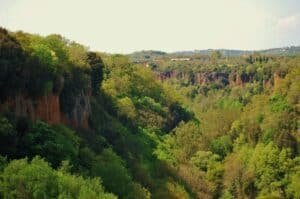
The relationship between Fumone and its surrounding farmland is a subject rarely explored in tourist guides, which tend to focus on the castle and the panorama. But the territory of the municipality of Fumone includes Turkey oak and chestnut woods, high pastures, a few vineyards and many springs that feed the streams of the area. Chestnut growing has historically been one of the main economic activities: chestnuts provided flour (chestnut polenta was a staple food for centuries in the mountain areas of Lazio), timber for construction and fires, and leaves for livestock bedding. The chestnut woods around Fumone are for the most part old: some trees have trunks with circumferences that indicate an age of two or three centuries, and the understory of these chestnut groves has a characteristic botanical composition with species such as wood anemone, cyclamen, autumn squill and several species of terrestrial orchids that bloom in spring before the foliage of the chestnuts closes the canopy. Anyone who walks the trails of the municipal territory in May finds a valley-floor and understory landscape that few visitors know, because most stop at the village and the castle without exploring the surroundings on foot. The CAI trails mark some routes, others are local tracks where you need to ask the residents for directions. In autumn, during the chestnut harvest (September-October), the territory comes alive with local gatherers and Roman families who come for the tradition of the countryside outing, and the smells of the woods mix with those of the roasted chestnuts sold in the square on weekends.
For anyone traveling from Rome toward Ciociaria on a structured cultural itinerary, the best logic is to follow the historic Via Latina: start from Palestrina (Roman Praeneste), move toward Anagni through the pass of the Prenestini Mountains, then climb toward Alatri, Ferentino and finally Fumone. This sequence covers a time span that runs from the Roman era (Palestrina) to the full Middle Ages (Fumone), passing through the centuries of transition of the Ernici early Middle Ages. Alternatively, those coming from the south can combine Frosinone with Ceccano, Priverno and Castro dei Volsci in an itinerary that covers the southern part of Ciociaria before climbing toward Fumone. Subiaco, with the Benedictine monasteries of the Sacro Speco, is instead a detour that justifies itself for anyone interested in the history of monasticism, and it pairs well with Fumone in a two-day itinerary that covers both souls of medieval religiosity in Lazio: the papal one and the hermitic one.
Celestine V at Fumone and the ghost of the child: what is history and what is tale
At Fumone, in the fortress that dominates the town, a pope who had renounced the papacy died. It is not hearsay: it is the historical fact around which everything else revolves, including the ghost stories still told at the castle. It is worth keeping the two things separate: on one side an episode that is documented and has been debated by historians for centuries, on the other the tradition of the castle, which is something else and should be listened to as such.
Why Fumone: a fortress that served to lock people in
Fumone is at about 800 meters, in a position from which the whole Sacco valley is controlled. It was exactly what the Church needed: a lookout point and, above all, a prison. The sources tie it to the papacy from the 10th century, and for a long time the fortress worked as a papal jail for inconvenient detainees, almost always political or ecclesiastical. This is the fact that holds the whole chapter together: you didn't end up in Fumone by chance, you were brought there. The most cited precedent is that of the antipope Gregory VIII, held here in the 12th century. The fortress was part of a system of territorial control that in the 13th century had its political center at Anagni.
Pietro da Morrone, the pope who resigned
Pietro Angelerio, called Pietro da Morrone, was an elderly hermit from Abruzzo with a solid reputation for holiness when, in July 1294, the conclave gathered in Perugia elected him pope after more than two years of deadlock. He took the name of Celestine V, was crowned in L'Aquila, in the basilica of Santa Maria di Collemaggio, and governed for a few months. On December 13, 1294 he renounced the pontificate: it is the first papal abdication for which we have clear records, and it is documented. A few days later Benedetto Caetani was elected, that is Boniface VIII, who came from Anagni itself, a handful of kilometers from Fumone.
The problem, for the new pope, was that a resigned pontiff who was still alive remained a banner available to anyone who wanted to contest the election. Pietro tried to return to the hermit life and to sail for Greece. He was stopped and taken to Fumone, where he stayed until his death, on May 19, 1296. He was declared a saint in 1313. His remains are not at Fumone: they are in L'Aquila, at Collemaggio. In the castle you can instead visit the room indicated by tradition as his cell, and the 18th-century circular chapel built in his memory.
Natural death or murder: the discussion is still open
Here we have to be precise, because this is the point on which the black legend of Fumone was built. That Celestine V died a prisoner in the fortress is documented. How he died is not. The murder thesis comes from a hole found in the skull, read by some as the sign of a nail driven in by order of Boniface VIII. It is an old reading: it was already circulating while Boniface was alive, and it found fertile ground in the posthumous trial that King Philip IV of France brought against him after his death, when piling up charges against the dead pope was a declared political goal.
Scholars and examinations of the remains have spoken against this reconstruction on several occasions. A diocesan commission chaired by the Archbishop of L'Aquila Giuseppe Molinari, which examined the body in 2013, concluded that the hole in the skull has a natural origin and is not traumatic. The historian Barbara Frale has argued an even different version: that the nail was driven into the skull after death, in the context of the French campaign against Boniface VIII, to fabricate the proof of a crime that never took place, and that Fumone was not for Pietro a prison in the strict sense, but a guarded residence in which a man of over 80, used to fasting and the hermit life, could die without needing criminal explanations.
Those who support the opposite hypothesis point out that the guarding was still a detention, that Boniface VIII had an obvious motive and that the conditions of confinement, according to some accounts, were harsh. Scholars do not agree: murder is not proven, and natural death is not demonstrated beyond all doubt. On Boniface VIII, moreover, the judgment has always been controversial, starting with Dante. Anyone who wants to see the places of the other half of this story will find in Anagni the Palace of Boniface VIII, where in 1303 the slap took place.
The ghost of the child: this part is tradition, not record
The second story of the castle is of a completely different kind and belongs to the 19th century. It concerns a child of the Longhi De Paolis family, the marquises who had turned the fortress into a residence. The tale handed down at the castle says that the little boy, the only male heir, was poisoned little by little so that the inheritance would not pass to him, and that the mother, devastated, had his body preserved and kept it at home instead of burying it. On the visit route the child's remains and his belongings are actually shown, and this is what visitors see with their own eyes.
The rest is tale from the castle's tradition, not an established historical fact: responsibility for the poisoning is attributed in different ways depending on who is telling it, and no known sentence or document establishes it. Even more clearly tradition is the part about the ghost: it is said that the child keeps playing in the rooms, and that toys left in the evening are found moved in the morning. These are episodes reported by local chronicles and by word of mouth, never verified, and the castle itself offers them as part of its own heritage of stories. Taken this way, the story still says something true: how much weight the question of male succession carried in a noble family of the 19th century.
The castle today and how to visit it
The castle of the Marquises Longhi De Paolis is still the private property of the family and is visited only with a guided visit, accompanied, along the piano nobile: the rooms with the paintings, the prison area, the shrine dedicated to Celestine V, the archive. The most surprising piece is outdoors, and it is the hanging garden: about 3,500 square meters created by covering walkways, moats and inner towers, with centuries-old trees grown over the fortifications. It is presented as the highest hanging garden in Europe: a record that depends a lot on how you measure it, but the effect of walking in a park grown over a fortress remains what it is.
Quick questions about Fumone (FR)
Where exactly is Fumone?
Fumone is in Frosinone Province, in Ciociaria, 783 meters above sea level on an isolated hill between the Ernici Mountains and the Lepini Mountains. It is about 80 kilometers from Rome, covered in about an hour and a quarter by car following the A1 to Frosinone and then the provincial road toward Alatri and Fumone.
How do you get to Fumone without a car?
The train goes as far as the Ferentino-Frosinone station (Roma Termini-Cassino line, about an hour of travel). From Ferentino you have to take a taxi or arrange a private ride, because bus connections to Fumone are very sparse and not suited to a day of visiting. If you don't have a car, you need to plan carefully or join an organized tour from Rome.
When does the castle of Fumone open?
The Longhi-De Paolis castle opens by reservation with hours that vary by season. The guided tours leave at fixed times and places are limited: it's best to book on the website visitfumone.it at least a few days ahead, especially on the spring and autumn weekends, which are the busiest.
How long does the guided visit to the castle last?
The interior tour lasts about an hour and a half and includes the historic rooms, the cell of Celestine V, the Hanging Garden and the medieval cistern. The route includes stairs and some narrow passages: it is accessible to those with normal mobility, but it is not suitable for strollers or wheelchairs in the narrowest interior stretches.
Is it possible to sleep in the castle of Fumone?
Yes. The castle has a few rooms available for stays, run by the Longhi-De Paolis family. The experience of sleeping in a medieval fortress in private use for four centuries is unusual and much appreciated by the visitors who choose it. Availability is limited and the reservation must be made in advance through the official website.
Why is Fumone called Fumone?
The name comes from medieval Latin and refers to the smoke signals lit on the hill to communicate sightings of danger (Saracens, Normans) to the surrounding villages. Fumone was a node in the medieval optical communication network of southern Lazio, and its elevated position made it visible from dozens of kilometers in every direction.
What do you eat in Fumone?
The local cooking is traditional Ciociaria cooking: sagne pelose (fresh pasta without eggs with pork sauce), ciammaruco (vineyard snails cooked with tomato, garlic and calamint), legume soups with grass peas and farro, fried tartalicchi. The restaurants of the village are few but serve authentic local cooking. In summer it helps to book a table for lunch.
How do you pronounce ciammaruco?
Ciam-ma-ru-co, with the stress on the next-to-last syllable. It is a word of Ciociaria dialect origin that indicates vineyard snails prepared according to the traditional recipe of the area: slow cooking with tomato, garlic, chili pepper and calamint (a wild aromatic herb typical of Lazio). It is a seasonal dish that you find mostly between August and November.
What is the best time to visit Fumone?
April-May for the Hanging Garden in bloom and the mild weather. October for the foliage of the surrounding woods and the autumn food. January for the Fair of San Sebastiano on the 20th of the month. In winter, days with fog in the valley produce landscapes out of the ordinary, but access by car requires caution if it has snowed.
How many people live in Fumone?
The resident population is about 2,000, a number that has fallen steadily since the postwar period because of emigration to Rome and northern Italy. Like many Apennine villages in Lazio, Fumone lost a considerable part of its residents in the 1950s-1970s but kept an active community that manages the territory and local activities.
Is Fumone one of the Most Beautiful Villages in Italy?
No. Fumone is not a member of the association Most Beautiful Villages in Italy, but this does not diminish its historical and scenic interest. The quality of a medieval village does not depend on the list it belongs to, and Fumone has first-level resources (the papal castle, the Hanging Garden, the panoramic view, the local food) that deserve attention regardless of any classification.
Can you visit Fumone with children?
Yes, and the visit to the castle is particularly suited to older children (from 8-9 years old up): the story of the imprisoned Celestine V, the medieval cistern, the rooms with the armor and the family portraits are elements that catch attention naturally. Small children may have difficulty in the narrowest passages of the interior route.
What is there to see in the villages near Fumone?
The nearest villages of historical interest are Alatri (with its acropolis with megalithic walls, 15 kilometers away), Ferentino (with the Roman walls and the local Theater of Marcellus, 10 kilometers away), Veroli (with the abbey and the polygonal walls, 20 kilometers away) and Guarcino (with the mountain landscape of the Ernici, 25 kilometers away). Collepardo, with the caves and the Trisulti charterhouse, is about 30 kilometers away.
Is there parking in Fumone?
Yes. The main parking lot is located just outside the walls, on an open area that allows even larger vehicles to maneuver. On event days (fairs, summer concerts at the castle, the Corpus Domini procession) the parking fills up quickly: it's better to arrive at least half an hour before the start of the event.
What is the Hanging Garden of Fumone?
It is a historic garden built on top of a medieval structure of the Longhi-De Paolis castle, at a height that makes it visible from the outside as a green terrace on the edge of the fortress. Inside there are columns of reused Roman marble, centuries-old cypresses, ancient horse chestnuts, historic roses and aromatic plants. It can be visited only as part of the guided tour of the castle and offers a panoramic view over Ciociaria that on clear days reaches the Tyrrhenian Sea.
Is Fumone connected to the Lombards?
Yes, indirectly. In the Lombard period (6th-8th century) this part of Ciociaria was a frontier zone between the Lombard duchy of Spoleto and the papal territories. Fumone, because of its elevated strategic position, was probably a military outpost in this system of borders. The Lombard influence can be found in local place names, in some agricultural practices and in the medieval documents of the monasteries of the area. After Charlemagne the territory passed under papal control, but the Lombard cultural traces remain layered in local history.
What is the most important festival in Fumone?
The Fair of San Sebastiano, which falls on January 20, is the most deeply rooted traditional event: it includes the procession of the patron saint, the opening of stands with local food products and crafts, and it is one of the community's most heartfelt moments of coming together. In summer, the castle hosts concerts and evening cultural events. The Corpus Domini procession, with the flower carpets on the streets of the village, is another traditional appointment with strong local participation.
For anyone who wants to organize a trip that includes Fumone in a professional or group itinerary context, the custom itinerary design service of TourLeaderPro covers Ciociaria with direct experience of the territory. For those starting from abroad who want a general picture of medieval Lazio before planning the stops, the ItalyPlanner guide to day trips from Rome provides a useful starting point with directions on transport, times and combinations of destinations. The nearest Ernici medieval villages, like Alatri, Ferentino, Veroli and Anagni, combine naturally with Fumone in any itinerary whose common thread is the papal and medieval history of southern Lazio. Those arriving from the north, passing through Subiaco, can build a route that joins the origins of Benedictine monasticism (the Sacro Speco, founded by Benedict of Nursia in the 6th century) with the story of Celestine V (the most famous spiritual heir of that hermit tradition) within two compact days. Those arriving instead from the west, from the Pontine plain, will find it natural to pass through Priverno and Castro dei Volsci before climbing toward the hilly Ciociaria. In all cases, Fumone is a destination that requires intention: it is not on the road of any obvious driving route, and this relative inaccessibility is also the guarantee that whoever gets there finds no crowds.
Article written by the editorial team of TourLeaderPro, contact them for Private/Corporate/V.I.P. Tours and Experiences.
Planning a trip to Rome? The English-language guides for visiting the city are on ItalyPlanner.com.