Ceccano (FR)
In short. Ceccano (FR) is a municipality of about 22,000 inhabitants in the province of Frosinone, set on a limestone ridge that overlooks the middle Sacco Valley, between the Monti Lepini and the Ausoni group, a little over an hour from Rome.
Ceccano (FR) is a municipality of about 22,000 inhabitants in the province of Frosinone, set on a limestone ridge that overlooks the middle Sacco Valley, between the Lepini Mountains and the Ausoni group, a little over an hour from Rome. By car you leave the A1 at Frosinone and head down toward Latina along the Monti Lepini road, or you arrive from the Casilina via Anagni and Ferentino: from Rome it is 80 to 90 kilometers, a short hour and a half in normal traffic. By train it is even simpler, and it is the way I recommend: Ceccano station is on the Rome-Naples line via Cassino, the one commuters call FL6, served by about 40 regional trains a day with termini at Roma Termini, Cassino and Caserta. The trip from Termini takes a little over an hour, the previous stop coming from Rome is Frosinone, and the regional ticket costs a few euros (the exact fare is on the carrier's website, because it changes with the regional fare updates). The station has a self-service ticket office, an underpass with ramps, and parking for cars and bikes. Those who come by car leave the car in the parking lots below the historic center and climb on foot: the village is all uphill, you get around only by walking, and shoes matter more than the map. The churches and the park of Castel Sindici cost nothing. The Castle of the Counts is municipal property and the visits are run by the association Cultores Artium, with openings tied to the calendar of exhibitions, concerts and initiatives: before leaving it's best to contact the municipality or the association to find out if the castle is open on the day you've chosen. For the village three or four hours are enough. With the sanctuary of Santa Maria a Fiume, the Badia dei Passionisti and a stop at the table you fill a whole day.
This guide goes through Ceccano in full: the two castles, the seven historic churches one by one, the archaeology of Fabrateria Vetus and of the villa of Cardegna, the painted station, the calendar of festivals, the history of the counts de Ceccano who for five centuries held half of Ciociaria in their hands. If you are building a wider tour, the village fits well with Alatri, Anagni and Ferentino.

How to Get to Ceccano (FR) and How to Get Around Once You Arrive
By Train from Rome to Ceccano (FR)
The line to Cassino is one of the few Lazio railways that really passes through history: from Roma Termini it crosses the countryside south of the Colli Albani, touches Colleferro, Anagni, Ferentino, Frosinone and then goes down along the Sacco. Ceccano station was opened in 1862, with the opening of the Segni-Ceprano stretch of the old papal railway, and it has never stopped working since. Today about 40 regional trains stop there between weekdays and holidays. The passenger building is served by an underpass with ramps and has an interchange parking lot for cars and one for bicycles. From the station to the historic center there are a couple of kilometers uphill. You can do it on foot, in a good half hour, but in the July heat it is a pointless effort and it's best to arrange some transport.
By Car, and Where to Park in Ceccano (FR)
From Rome the fastest road is the Autostrada del Sole to Frosinone, then the provincial road toward Latina. Those who have time and the wish to look around take the Casilina instead and stop along the way: the sequence Anagni, Ferentino, Ceccano is one of the densest stretches of Romanesque and polygonal walls that Lazio can offer. Inside the town the roads are those of a hill village: narrow streets, hairpin bends, one-way streets. The historic center can only be toured on foot. The practical advice is to leave the car in the lower part of the town and climb, bearing in mind that the whole tour takes place within 120 to 200 meters of elevation change, with some stairways.
How Much Time You Need to Visit Ceccano (FR)
Three hours for the old core: castle, Collegiata, San Sebastiano, San Nicola, the alleys, the lookout. Half a day if you also go down to the sanctuary of Santa Maria a Fiume, which is outside the village, on the riverbank. A full day if you add the Badia dei Passionisti and the park of Castel Sindici, and if you have a leisurely lunch. On the weekend when the castle is open, the time doubles: the rooms deserve the long stop.
The Castle of the Counts of Ceccano (FR): 800 Years of Power and Four Centuries of Prison
The Castle of the Counts is the reason you climb to Ceccano. It occupies the highest point of the hill, the one that originally was the acropolis of the ancient settlement, and overlooks the valley with a view that reaches as far as Monte Cacume and the first slopes of the Lepini. The oldest core is the keep, a tower whose foundation local tradition places around the 8th century, later grown into a fortress that was the political and military center of southern Lazio. The castle walls corresponded roughly to the perimeter of today's Piazza Camillo Mancini.
The Fortress of the Counts de Ceccano
Between the 10th and the 15th century the castle was the capital of a county that behaved like an autonomous state. The counts de Ceccano, probably of Germanic origin and related to the great Roman baronial families, controlled Amaseno, Giuliano di Roma, Prossedi, Pisterzo, Villa Santo Stefano, Carpineto, Patrica, Morolo, Supino, Maenza, Ninfa, Monte Cacume, Monteacuto, and for a certain period they reached as far as Terracina. They also had partial holdings in Frosinone, Ceprano and Alatri. Whoever looks at the map understands the logic at once: the castle stands where the Sacco valley narrows, on the route that connects Rome to the Kingdom of Naples. Whoever held this hill held the road.
The Prison: From 1523 to 1973
The castle's second life is the one visitors don't expect. Once the comital family had died out and the fief passed to the Caetani and then the Colonna, the fortress was gradually turned into a place of detention, and it remained a prison for four and a half centuries, from 1523 to 1973. Inside are preserved the hall where the Colonna court sat and the parade ground where sentences were carried out. Two very different names are tied to the cells: Giovanni Battista Bugatti, the executioner of the Papal State whom the Romans called Mastro Titta, and Teresa Numa, the Ciociaria thief whose story enters Dacia Maraini's Memorie di una ladra. On the walls remain graffiti, dates, names, drawings: the writing of the prisoners is the most impressive thing in the whole visit, and it is worth the ticket far more than any frescoed room.
The Castle Today
The municipality bought the property in the 1990s and began the restorations. Since 2012 the management of the openings to the public has been entrusted to the cultural association Cultores Artium, which organizes in the rooms exhibitions, lectures, opera concerts and initiatives spread throughout the year. It is a model that works: without trained volunteers, a municipal castle in a town of 20,000 inhabitants would stay closed 11 months out of 12. Without hesitation: the Castle of the Counts is the most underrated monument of the province of Frosinone, and it is so because nobody tells its story the way it deserves. Whoever has seen the fortresses of the Colonna and the Caetani in lower Lazio finds the same story here, with the addition of the prison chapter that is entirely missing elsewhere.
Castel Sindici, the Fake Castle Built by the Architect of the Vittoriano
A few steps from the historic center, among centuries-old trees, there is a second castle that has nothing to do with the Middle Ages: Castel Sindici. It was wanted in the late 1800s by Stanislao Sindici, winemaker and Cavaliere del Lavoro, and the design bears the signature of Giuseppe Sacconi, the architect from the Marche who in Rome was working on the Vittoriano. Sacconi designed for Ceccano a neo-Gothic building in white local limestone, with towers, crenellations and mullioned windows: a castle of the imagination, built when the real castles had been ruins for at least three centuries.
The Cellars and the Castel Sindici Wine
The most interesting part is the one you see least. In the basement rooms the family had its cellar, with the big ceramic vats in which they produced the white that bore the castle's name, a wine compared to the white of Frascati, awarded eight gold medals, cited in the Touring Club Italiano gastronomic guide of 1931 and taken to the Brussels exposition of 1935. For a town that today describes itself mostly as an industrial center of the Sacco Valley, remembering that a white fit for a world's fair was made here is not a detail: it is proof that hilly Ciociaria, before the factories, lived on vines and olive trees.
The Parlor, the SS, the Park
The upper floors were the good parlor of a very rich family, which hosted artists: the Roman painters Aurelio and Cesare Tiratelli passed through here, and local tradition adds the name of Gabriele d'Annunzio, which however for now finds no equally solid documentary confirmation. In 1928 the building and its garden were declared a zone of national artistic interest. In 1943, with the German occupation, the villa was requisitioned and turned into a military command: the town's elders remember it as the SS headquarters. Inhabited by the Sindici descendants until the early 1990s, today it is municipal property. The interior cannot be visited. The park around it, with its centuries-old vegetation, remains the best place to look at the profile of the historic center and to understand how the hill detaches from the plain. Plainly: the park ought to be kept much better than how it is found, and the town knows it.
The Churches of Ceccano (FR), One by One
Ceccano has a density of historic churches that surprises anyone who arrives thinking of an industrial town. There are seven buildings worth the stop, and to understand them you need to keep two dates in mind: 1196, when the county was at its peak and people built in the Cistercian style, and January 1944, when the Allied bombings erased in a few weeks centuries of work. Almost everything you see today is either medieval and survived or rebuilt with the stones of the destroyed medieval one.
The Sanctuary of Santa Maria a Fiume
It is outside the village, down below, on the bank of the Sacco: the position already says it began as a pilgrimage and ford church, not as a town parish. Tradition has it built on the remains of a Roman temple tied to Faustina, wife of the emperor Antoninus Pius. The consecration is from 1196, at the wish of Count Giovanni de Ceccano, and was celebrated by his uncle Cardinal Giordano. The layout is the Cistercian one of the area, the same world as Fossanova and Valvisciolo, with reused Roman columns holding up the naves. In the 1800s the church was recognized as a national monument.
Then came the war. The bombing of January 1944 razed the building and carried off the cycle of paintings that local tradition attributed to the school of Giotto, and that Count Annibaldo is said to have commissioned. The attribution can never be verified on documentary grounds, and today it is definitively lost along with the frescoes. The reconstruction, carried out in the 1950s recovering the original materials where possible, ended with the new consecration in 1958. Of the old furnishings the pulpit, the holy water font and a medieval wooden Madonna were saved, and they remain the objects to look at first. The sanctuary is run by the Passionist Fathers. On August 23 the fair of San Giacomo is held there, and the feast of the Madonna falls in May.

The Collegiata of San Giovanni Battista
It is the mother church of Ceccano, the center of the town's liturgical activity, and it was already there in 1196. Raids and remodelings changed its structure several times. It was consecrated in 1767 with the facade facing where the apse is now: in the early 1900s the building was literally turned around, moving the entrance to Piazza San Giovanni, where it is now. It is an operation that can still be read in the plan, and that alone explains how much the historic center was reorganized in the contemporary age.
Inside there is a lot to look at. Just inside, on the left, the treasury chapel keeps 15th-century missals and reliquaries. Along one nave open three altars, dedicated to the Nativity, to the Madonna della Consolazione and to St. Anthony of Padua. On the other are the altars of the Addolorata, 15th century, and of the Madonna of the Rosary. At the main altar are the carved wooden choir and the altarpiece with the martyrdom of St. John the Baptist. Local tradition assigns it to Luca Signorelli or to the school of Guido Reni, two names that stylistically go in opposite directions, and in the absence of a published study it's best to record the attribution as uncertain. On the sides of the altar are the statue of the Baptist and a 15th-century Crucifix. In the chapel of the Blessed Sacrament rests Cardinal Tommaso Pasquale Gizzi, a native of Ceccano, secretary of state of Pius IX. He died at Lenola in 1849 and was buried in Rome, and was moved here in October 1992. In the sacristy survives a cycle of medieval frescoes of the 12th century, partly ruined: ask to see them, because it is the oldest thing in the building and nobody points it out.
The Church of San Nicola
200 meters of alley and the era changes. San Nicola is from the 12th century, Gothic-Romanesque, and on the columns it keeps inscriptions in characters of Lombard tradition that record the date of the works and the name of the count who commissioned them: a rare epigraphic document, in a town where the war carried off almost everything. On the facade look at the 13th-century portal, decorated with small sculptures, and the aedicule with the image of the Madonna della Foresta. Inside, the best work is the 18th-century fresco of the Addolorata. The church was damaged by the bombings of 1944 and repaired. The title of badia survives in the figure of the abbot-pastor, who in the town still has a recognized role.
The Church of San Sebastiano
In Piazza del Comune, and it is the church that best tells the relationship between Ceccano and big ecclesiastical politics. It was built in 1350 by Cardinal Annibaldo IV de Ceccano, the man who opened the Jubilee of that year on behalf of the Avignon pope, and he entrusted it to the Franciscan friars minor. Abandoned in the 1400s, it was rebuilt in Baroque forms around the first half of the 1600s. In the 1800s it passed to the Sisters of Charity, who left it in 1969. Closed for years, it reopened after a major restoration on January 19, 1980.
It has a single nave with two side altars: on the left a fresco with the Stigmata of St. Francis, on the right, in an altar formerly dedicated to the Sacred Heart, a Nativity of the early 1600s. In the apse area a cross vault survives, the only scrap of the 14th-century Gothic construction, and under the vault is the iconostasis with 19th-century stuccos and frescoes that frames the 16th-century statue of St. Sebastian. On January 20, in the afternoon, the statue is carried to the Collegiata for the sung mass. The feast had been suppressed and has been celebrated again, in reduced form, since 1982.
The Church of the Madonna della Pace
Small, out of the way, anciently outside the walls. It dates to the 1600s and for a period served as a lazaretto, which explains the secluded position: epidemics were kept away from the settlement. Inside is a 17th-century panel with the Nativity of the Lord, ruined by damp, which would deserve serious work. The little church was restored in May 2011 on the initiative of the abbot-pastor of San Nicola. On the first Sunday of October the mass of the Madonna della Pace is celebrated here, while the fair is held along the streets of the neighborhood.
The Church of San Rocco
Along the road to Frosinone, 16th century, originally dedicated to the Madonna of Loreto. It changed its dedication during the plague that struck Ceccano in the mid-1600s, when the town entrusted itself to St. Roch as all the communities of central Italy did. Inside is a fine iconostasis with the statues of St. Roch, the Madonna of Loreto and St. Vitus. The statue of St. Vitus was at the center of an old festival, on June 15, in which the people of Ceccano danced and prayed around the saint to obtain graces: one of those rites halfway between devotion and popular choreography that 19th-century ethnographers found in half of Ciociaria and that today have almost all disappeared. On the morning of August 16, at 07:00, the statue of St. Roch is carried to the Collegiata, where at 09:00 the solemn mass is celebrated. It returns to its church on the last Sunday of September, at 16:00.
The Badia dei Passionisti, Santa Maria de Corniano
Outside the town, the abbey dedicated to Santa Maria de Corniano was founded by St. Paul of the Cross, the founder of the Passionists, and in the church are kept the remains of Blessed Grimoaldo Santamaria. His story sums up in a few lines and stays with you: Ferdinando Santamaria was born in Pontecorvo on May 4, 1883, entered the novitiate at 16, on February 15, 1899, and died in Ceccano on November 18, 1902, at 19, of a fulminant meningitis while studying for the priesthood. Buried in the cemetery of Ceccano, he was moved to the Badia in October 1962. Declared venerable on May 14, 1991, he was beatified by John Paul II on January 29, 1995. The liturgical memorial falls on November 18 and the Badia fills up in those days. The people of Ceccano are tied to the Passionists for a secular reason too: during the Second World War the fathers helped the displaced population, and in a town bombed 38 times this is not forgotten.
The Other Churches of the Ceccano Calendar
The town's devotional fabric doesn't end with the seven major buildings. The church of the Madonna de Loco keeps the statue of St. Anthony of Padua, celebrated on June 13, when the abbot of San Nicola blesses the saint's bread. In the church of San Nicola the feast of St. Nicholas is celebrated on May 8 and 9, with the procession of the evening of the 8th: a recent feast, not a medieval one. The little church of Santa Lucia, near the bridge, on the evening of December 13 sends the saint in procession through the streets of the nearby village. And the church of San Pietro, razed by the bombings of 1944 along with Santa Maria a Fiume, is today an absence: when you rebuild a town, the list of what did not come back counts as much as the list of what was saved.
The Archaeology of Ceccano (FR): Fabrateria Vetus, the Villa of Cardegna, the Protohistoric Sanctuary
Before the castle and before the churches, there was a Volscian city here. Ceccano is identified with Fabrateria Vetus, a center already existing in 330 BC along the banks of the river the Romans called Trerus or Tolerus and which is today called Sacco. The identification doesn't come from a parochial tradition: it is based on inscriptions found in the municipal territory between the 1700s and the 1800s, and it still holds. The change of the name, according to the local historian Michelangelo Sindici, would have taken place in the 7th century in honor of Petronio Ceccano, consul of Campagna, father of Pope Honorius I: here we are in the field of scholarly tradition, not of documents, and it's best to say so.
The Roman Villa of Cardegna
During the works for the high-speed railway line, in a site that the people of Ceccano had always known, the remains emerged of a large patrician villa of the imperial age, in the locality of Cardegna, below the town along the Sacco. It is an important structure, with mosaic floors studied and published in scientific venues, and with a stone conduit that served the building like a small private aqueduct: looking at it makes you understand how much water an upper-class Roman residence consumed and how rich the valley was. On the ownership, the hypothesis has circulated for years that the villa belonged to the emperor Antoninus Pius. It is a suggestion based on the presence in the area of the imperial family and on the temple of Faustina that local tradition speaks of, not on an inscription that proves it. After the excavation the site was covered over again and today cannot be visited. It is a serious shame and I say it without diplomacy: a complex of this quality, in a province that lives little on cultural tourism, would deserve an enhancement project instead of a reburial and a lawn.
The Protohistoric Sanctuary and the Sacred Hill
Also during the works on the high-speed line a protohistoric sanctuary came back to light, which pushes the religious use of the area back much earlier than the historical Volsci. Whoever wants to frame the prehistory of this part of Ciociaria finds the right context at the Prehistoric Museum of Pofi, a handful of kilometers away, where the finds of the Sacco valley are displayed and well explained.
The Astronomical-Naturalistic Park of Ceccano (FR)
On the side of a former quarry, along Via Morolense, the Lazio Region financed years ago an intervention that began as a reclamation and securing of a landslide-prone slope: gabions, bark nets, tie rods, scaling of boulders in precarious balance above the road. While working on the topographic maps, the designers noticed something curious. The ridge on which Ceccano stands is positioned in such a way that, at the beginning of spring and fall, an observer placed up there sees the Sun set exactly behind the peak of Monte Cacume, which lies to the west. The Cacume has an unmistakable profile, an almost triangular point: for ancient peoples it could work as the hand of a cosmic clock, a fixed reference for recording the cycle of the seasons.
From that observation, together with the presence on the ridge of limestone boulders suited to building alignments and the proximity of a river-and-lake area favorable to stable settlements, came the hypothesis of the Ceccano hill as a Neolithic sacred-astronomical center. A hypothesis, that is, not a demonstrated thesis. On that basis an astronomical-naturalistic park was designed with educational paths on the measurement of time in human history: sundials, quadrants and astronomical alignments in stone and marble slab, nature trails, a birdwatching area. The park has been closed for many years, awaiting redevelopment work. Whoever arrives in Ceccano counting on visiting it is left empty-handed: better to know it beforehand and plan the sunset from the castle bastion, which shows the alignment with the Cacume anyway.

The Painted Station: The Eco-Station of Ceccano (FR)
Whoever crosses the Sacco Valley by train, along the line to Cassino, at a certain point sees an explosion of color go by: it is Ceccano station. On the passenger building, since 2007, there was a large mural made by Alberto Spaziani on commission from the Centro Studi Tolerus, titled Territorio vivente and listed in the regional register of Lazio street art. From the track side the drawing expressed the wish that the Sacco return to the splendor of the past, the river that the valley's industry has mistreated for decades. The facade was divided into three sectors, dedicated to harmony, conflict and the interaction between man and nature.
Since 2005 the building has housed, thanks to a free loan for use granted by Rete Ferroviaria Italiana, the eco-station: an environmental documentation center with a thematic library open to the public, an exhibition space, a conference room, an educational workshop and a multimedia room. The volunteers of the Centro Studi Tolerus organize nature walks in the river valley and activities with the local schools, and the workshop is recognized as an environmental education center of the Province of Frosinone. Taking a small station destined for decay and turning it into a cultural outpost is an operation that has succeeded only a few times in Lazio. Here it worked, and RFI cited it as an example in its own documents on the regeneration of stations.
One piece of news needs to be told to those arriving now: the building is undergoing renovation work begun by Rete Ferroviaria Italiana, and the plaster on which the mural was painted was coming off. The work was removed to allow the construction site, with a public commitment by the municipality and RFI to reproduce it faithfully when the works are over. Anyone getting off at Ceccano at this stage may therefore find a white facade in place of the colors. It is not neglect, it is a construction site.
The History of Ceccano (FR), from the Volsci to the Industrial 1900s
Volsci, Romans, Lombards
The Volscian city of Fabrateria Vetus controlled the ford of the Sacco and the road to the south. In the Roman age the valley fills with villas and production plants, and the name of the river, Trerus, enters Latin geography. After the end of the empire the Lombard wave arrives: the fortress of Ceccano is conquered in the time of King Aistulf, around 750, and from that moment the hill takes on the strategic value it will keep for eight centuries, because it lies on the southern edge of the Church's possessions, in a band where papal power borders the Neapolitan world.
To the same early medieval age belongs one of the memories the people of Ceccano care about most: the birth in the town of St. Silverius, pope from 536 to 537, son of Pope Hormisdas, deposed and dead in exile on Ponza. That he was born in the district of Campo Troiano, today's Cantinella, is written by Pope Gregory XVI in the bull with which he raised the church of San Giovanni Battista to a collegiate church, and on this basis the town claims him. Other traditions say he was born in Frosinone. We record the tradition for what it is, without passing it off as an established fact.
The Counts de Ceccano, Five Centuries of Power
Between 900 and 1450 the town is dominated by the counts de Ceccano, a family of probable Germanic origin, related to the great Roman nobility. In 915 the people of Ceccano played an important role in the battle of the Garigliano, when the coalition wanted by the pope destroyed the Saracen base that threatened Rome and lower Lazio. Already in the 10th century the county counted in the curia: Count Amato is remembered as a benefactor of the abbey of Montecassino, and in 1099 Gregorio de Ceccano was among the most powerful cardinals of the Church. Another Gregorio, a count, in 1104 escorted with his men Pope Paschal II on his journey toward the Sorano.
In 1168 the people of Ceccano inflicted a hard defeat on the papal troops led by the archbishop of Mainz, Conrad, who sided with Alexander III after Frederick Barbarossa had replaced him with Christian: an episode that shows well how much the county knew how to move within the clash between empire and papacy, changing sides when it paid.
Cardinal Stefano and the Miracle of St. Dominic
Among the figures of the family the first to remember is Cardinal Stefano, formerly abbot at Fossanova, chamberlain of Innocent III, created cardinal in 1206, one of the founders of the abbey of San Galgano in Tuscany and benefactor of the Dominican houses of Sora and Terracina, with recognitions even from King John Lackland of England. Tied to him is the most famous episode of Ceccano's memory: on February 27, 1219, according to the account of Father Pierantonio da Trevi, St. Dominic of Guzman, celebrating mass in the church of San Sisto on the Appia, is said to have risen from the ground during the elevation and, when mass was over, to have called back to life a knight who had fallen from his horse shortly before on that same road. The knight was Napoleone de Ceccano, nephew of Cardinal Stefano, who was present at the event. All the hagiographers of St. Dominic report the miracle: it is a matter of devotion, not of verifiable chronicle, but it explains how much the family was inside the religious history of the century.
Count Giovanni, Morolo and the 424
Count Giovanni, made a knight by the emperor Henry and having sworn fealty to Innocent III in 1200, is the founder of the church of Santa Maria a Fiume and the inspirer of the famous Chronicle of Fossanova, written by his notary Benedetto. His military story is brutal. On May 23, 1216 Ruggero dell'Aquila, count of Fondi, invaded the county of Ceccano. Reached by the troops of Ceccano near Castro-Vallecorsa, he was defeated and had to give up expansion. On September 18 of the same year Giovanni led the assault on the fortress of Morolo, because of the conflicts with the Colonna who had backed Ruggero. Morolo was conquered and burned, the Colonna taken prisoner, and 424 people of Morolo were executed. A number you almost never read in the guides, and which alone tells what a war between barons was in the Lazio of the 1200s.
Cardinal Annibaldo, the Jubilee of 1350 and Petrarch
The most international figure of the house is Cardinal Annibaldo de Ceccano, formerly archbishop of Naples, one of the protagonists of the Avignon court. A diplomat by trade, he was sent several times to settle disputes among the sovereigns of Europe: he attempted a mediation between England and France in the midst of the 100 Years' War and obtained at least a truce, however brief. In Hungary he mediated an agreement between the Magyar king and the queen of Naples. He was given the task of solving the political problem represented by Cola di Rienzo. In 1350, during the Avignon captivity, he was the one sent to Rome by the pope to open the Jubilee. He had contacts with Francesco Petrarca, and local tradition attributes to him the commissioning of works from Giotto for the church of Santa Maria a Fiume. The family gave the Church six cardinals and important knights of the Order of Malta. Among these was Teobaldo, in whose arms, at Fossanova, Thomas Aquinas died, a relative of the counts of Ceccano because his niece Francesca had married Count Annibaldo.
The End of the County and the Spanish Centuries
In 1324, in the midst of the Avignon captivity, Count Francesco de Ceccano conquered Alatri and occupied it for 35 years, creating in effect a state of war against the Church. The last of the de Ceccano can be considered the Hospitaller knight Stefano, remembered in the Vatican archives as frater S. Ioannis de Hierusalem and recently identified as Grand Prior of Rome in the early 1400s. With the family extinct, the fief passed by female inheritance to the Caetani. In 1501 Alexander VI granted it to Rodrigo Borgia, and with the fall of the Borgia in 1504 it ended up, together with the county of Fondi, with Prospero Colonna, who passed it on to his family. The first municipal Statute dates to the early 1600s and was granted by Marcantonio Colonna, descendant of the hero of Lepanto and count of Ceccano.
The 1800s of the Berardi and the Cardinals
In the 1800s the marquis Filippo Berardi bought the Colonna properties and in a few years became the real master of the town. Appointed senator of the Kingdom, he was the architect of the arrival of the railway and the promoter of the first industrial settlements in the area: the station, opened in 1862, is the child of that season. The century also gave Ceccano two leading cardinals: Giuseppe Berardi, brother of the marquis, and above all Tommaso Pasquale Gizzi, born in the town on September 22, 1787. A priest from 1810, with a law degree from La Sapienza, auditor of the nunciature in Lucerne and Munich, chargé d'affaires to the Kingdom of Sardinia, internuncio in Brussels, legate to Ancona, he was created cardinal in pectore by Gregory XVI in 1841 and made public in 1844. Pius IX named him secretary of state on August 1, 1846, at the start of the reform season. Under him came the loosening of press censorship, in March 1847, and the Consulta of State, in April. He resigned on July 6, 1847, when the liberal movement picked up a speed that the Curia did not want to bear. He died at Lenola on June 3, 1849, while in Rome the Roman Republic lay dying.
The 1900s: Bombs and Factories
In 1927 Ceccano passed from the province of Rome to that of Frosinone, just established. During the Fascist ventennio the aqueduct and the sports field arrived, and the first factories settled, among them the Bombrini Parodi Delfino, which in 1939 bought land in the area. That was also the reason for the later catastrophe: from November 3, 1943 to May 31, 1944 the town suffered 38 Anglo-American air raids, which razed the sanctuary of Santa Maria a Fiume, a national monument, and the church of San Pietro, and damaged the medieval San Nicola. The bombings also hit the civilian population. In the final phase of the war the area experienced the violence of the French colonial troops that central-southern Italy remembers under the name marocchinate. The city has been awarded the silver medal for civil merit.
The postwar period turned the scene upside down. With the opening of the Autostrada del Sole in 1962 and the establishment of the industrialization nucleus of the Sacco Valley in 1963, Snia Viscosa, Permaflex, Italbed, Mallory Timers Continental, Prinz Brau, APD accumulators and SIGME settled in Ceccano. In 1969 there were 26 industries and 5,000 employees. Between 1951 and 1969 income grew at rates that seem unreal today. Then, at the end of the century, the closures. In 2015 there were 1,278 businesses in the area with 3,474 employees. The artisan tradition for which the people of Ceccano were famous stays alive: tailoring and cabinetmaking. Many of the town's tailors worked in the 1900s in the great Roman and French tailoring houses, and several cabinetmakers passed through the best workshops of Rome. Whoever looks in Ciociaria for period-style furniture or a made-to-measure suit sooner or later ends up in Ceccano.

The Festivals and Folklore of Ceccano (FR), Month by Month
The Ceccano calendar is packed and almost all of it survives. It's worth reading it in full before choosing the date of your visit, because the town changes face on feast days.
Winter: St. Sebastian, St. Lucy, Carnival
On December 13, in the evening, the statue of St. Lucy leaves the little church near the bridge and goes through the streets of the village near the church. On January 20, in the afternoon, the statue of St. Sebastian is moved to the Collegiata of San Giovanni Battista, where mass is sung. The festival had been interrupted and was restored in reduced form in 1982. Ceccano's Carnival is celebrated with costume festivities on the Sunday before Carnival.
Spring: Good Friday, St. Nicholas, the Madonna a Fiume
On the evening of Good Friday, at 20:30, the procession of the Dead Christ and the Addolorata starts. It crosses the whole historic center in the dark, leaves the walls, goes down the main streets of the urban center and returns to the Collegiata. It is the most beautiful thing of the Ceccano year, and whoever has seen the night processions of lower Lazio knows it isn't a polite phrase: the medieval village without lights, uphill, with the sound of shoes on the cobbles, is an experience different from any daytime visit. On May 8 and 9 St. Nicholas is celebrated, with the procession of the evening of the 8th in the church of the same name. In May the feast of Santa Maria del Fiume is held in its sanctuary. On special occasions, the last in 2014, the statue of the Virgin is carried in procession in the urban center. Between May and June, at 20:30, the Blessed Sacrament leaves the Collegiata for the Corpus Domini procession to the church of San Nicola, with stops in front of the main churches of the center.
Summer: St. Anthony, the Patron Saint, the Sagra dei Colli, St. Roch, St. James
June 13 is the feast of St. Anthony of Padua, deeply felt, celebrated in the church of the Madonna de Loco where the saint's statue is venerated. On that occasion the abbot of San Nicola blesses the bread of St. Anthony. From June 22 to 25 the patron saint, St. John the Baptist, is celebrated. On the morning of the 23rd the statue is enthroned on the 19th-century processional float and receives the homage of the civil authorities, in the evening mass is sung and the procession starts. On the 24th at 11:00 there is the solemn mass with the rite of confirmation, in the evening the concert in the square, and on all the days the goods fair along the main streets. In summer the Sagra dei Colli also comes, Ceccano's great food and wine festival, which puts Ciociaria cooking on the table and fills the town for several days. On August 16, at 07:00, the statue of St. Roch leaves the church on the road to Frosinone for the Collegiata, where at 09:00 the solemn mass is held. The civil festivities run from August 15 to 17, and the saint returns to his church on the last Sunday of September. On August 23, at the sanctuary of Santa Maria a Fiume, the fair of San Giacomo is held.
Fall: St. Pius, the Madonna della Pace, Blessed Grimoaldo
On September 23 the statue of St. Pius of Pietrelcina, kept in the chapel of St. Anthony of Padua in San Giovanni, goes out in procession through the streets of the center. The first Sunday of October is the day of the Madonna della Pace: mass in the little church, fair in the streets of the neighborhood. On November 18, at the Badia dei Passionisti, Blessed Grimoaldo is celebrated, and the community gathers around its young blessed.
Music: A Town That Played Rock for Real
There is a chapter of Ceccano's 1900s that no guide tells and that I find very entertaining. Between 1989 and 2000 Odori Sotterranei was held here, the first rock festival in the province of Frosinone. Since then the town hasn't stopped: from 2001 the IndieGesta Music Festival and the Woman and Blues Festival, from 2003 L'Imboscata, from 2004 IndieJazz, and between 2003 and 2009 Etnika Rock, which brought international groups like the Misfits and OK Go to the stage in Ceccano. The old Cinema Italia, municipally owned, has become the Auditorium self-managed by the cultural association IndieGesta, which has turned it into a workshop of the arts and music. In a town of 20,000 inhabitants in inland Ciociaria, a music circuit like this is a rare thing, and it should be said.
What to Eat in Ceccano (FR)
The cooking is the Ciociaria cooking of the middle valley, peasant and no-frills. Homemade pasta rules: fini fini, sagne, gnocchi, with long-simmered meat sauces or with legumes. Pork is the pantry of the year, between sausages, ventricina and preserves in oil. On the surrounding hills good-quality extra virgin olive oil is made, and the wine of the area, which at the end of the 1800s reached the international expositions, today lives on small productions. In the right season look for wild greens and artichokes. I don't name restaurants, because a list of trattorias ages fast and sending someone to eat at a place closed for three years is a spite: ask at the bar on the corso, the answer from the people of Ceccano is reliable. The Sagra dei Colli, in summer, is the quickest way to taste in one evening what in the other months you chase for days.
Ceccano (FR) with Children
The castle works very well with kids, provided you tell its story: the keep, the cells, the prisoners' graffiti, the executioner of the Papal State. Prison stories hold even the most listless teenagers. The park of Castel Sindici gives room to run in the shade of big trees. The station, with the eco-station workshop and the volunteers' environmental activities, is a smart idea for a school class. The historic center, on the other hand, is all uphill and stairs: with a stroller you suffer, with kids who walk you don't. If you are organizing a group outing or a school visit, having a professional guide makes the difference between a stroll and a lesson: the network of certified tour guides of TourLeaderPro works across all of Lazio and in Ciociaria knows the area well.
Accessibility in Ceccano (FR)
I am honest about the limits: the old village is a hill with narrow alleys, stairways and steep slopes, and in a wheelchair the full tour cannot be done independently. The railway station has an underpass with ramps and parking. The sanctuary of Santa Maria a Fiume, which is down below on flat ground, is the most reachable destination for those with mobility difficulties, together with the park of Castel Sindici. For the castle and for the churches of the center it's best to phone beforehand and ask: the associations that run the openings can point out the best entrance and, when possible, make arrangements.
How Much It Costs to Visit Ceccano (FR) and How to Save
Little, and it is one of the reasons this village deserves a Sunday. The churches don't ask for a ticket. The park of Castel Sindici is open. The lookout on the castle and the streets of the historic center cost nothing. The real expense is the trip: the regional train from Rome costs a few euros and lets you leave the car at home, which in a hill town is already an advantage. Whoever comes for the day from the capital can combine Ceccano with another stop on the same line, for example Ferentino or Anagni, spending almost nothing more. The cost of admission to the Castle of the Counts depends on the type of opening and the initiative under way: ask the municipality or the association that runs the visits.
What to See Around Ceccano (FR)
The town is at the center of one of the densest areas of history in southern Lazio, and in half an hour by car you can reach anywhere. To the north are Ferentino with its walls and the Roman theater, Anagni with the cathedral crypt, Alatri with the acropolis in polygonal masonry, Veroli, Fumone with the castle that saw Celestine V die, and Fiuggi with the spa. To the west you cross the Lepini Mountains and go down to Priverno, Sermoneta and the Garden of Ninfa. To the south the railway line leads to Cassino and the Abbey of Montecassino. To the east are Isola del Liri with the waterfall in the middle of the town, Arpino and Collepardo. Whoever builds a multi-day itinerary based in Rome finds a reasoned selection of day trips in the ItalyPlanner day trips guides, and for the overall regional picture there is the English-language guide to Lazio, useful if you accompany foreign friends.
When to Go to Ceccano (FR) and When to Avoid It
Spring and fall, without hesitation. April, May, October: the light on the valley is the best, the green around the castle holds, the heat doesn't punish the climb. The Ciociaria summer is heavy, with highs that approach 33 degrees, and the hill offers no shade: if you come in July or August, move before 10:00 and after 17:00, and use the middle hours for lunch. Winter is cold, with lows often below freezing, and every now and then snow arrives: in February 2012 more than 50 centimeters fell, with serious damage. To avoid, if you are looking for calm: the days of the patron saint's festival at the end of June and those of the Sagra dei Colli, when the town is full and the parking vanishes. To seek out, instead, if you want to see Ceccano alive: exactly the same days. It depends on what kind of traveler you are, and it's worth deciding beforehand.
A Curiosity About Ceccano (FR)
The castle that is visited today as a medieval monument spent more time as a prison than as a palace. The county of the de Ceccano governed from here for about five centuries, from the 10th to the 15th. The prison period runs from 1523 to 1973, and is therefore four and a half centuries long, almost uninterrupted. It means that for the vast majority of the people of Ceccano who lived between the 1500s and the 1970s, that profile on top of the hill was not the symbol of a glorious past: it was the prison. The town's grandmothers still remember the relatives of the prisoners who climbed up with packages.
Inside, the cells preserve graffiti, dates, names and drawings incised or written on the plaster: a prison writing layered over centuries, of the kind that in Italy survives in very few places. Among the figures tied to the prison are Giovanni Battista Bugatti, the papal executioner known as Mastro Titta, and Teresa Numa, the thief whose story enters Dacia Maraini's Memorie di una ladra. Add that the Colonna court sat in a room of the castle and that the parade ground was used for executions, and you understand that this is not a fairy-tale castle: it is a building that administered justice and punishment over a piece of Lazio for half a millennium. The real curiosity, for me, is another: the renovation of the 1990s did not erase that memory, and whoever leads the visits tells it without embarrassment. In many Italian castles the prison chapter is swept under the rug because it ruins the postcard. Not here, and that is the reason the visit is worth it.
One Thing Nobody Tells You About Ceccano (FR)
That the wine of Ceccano reached the international exposition of Brussels in 1935, and that it was produced by a fake castle built by the architect of the Vittoriano. Nobody tells it, yet it is the most surprising story of the town. Stanislao Sindici, winemaker and Cavaliere del Lavoro, at the end of the 1800s called in Giuseppe Sacconi, the designer of the monument to Vittorio Emanuele II in Rome, and commissioned a neo-Gothic building in local limestone, with the look of a medieval fortress and the function, in the basements, of a cellar. From those ceramic vats came a white that the catalogs of the day compared to Frascati, awarded eight gold medals and cited in the Touring Club Italiano gastronomic guide of 1931.
The second part of the story is less cheerful and just as little told. In 1928 the villa and its garden were declared a zone of national artistic interest. 15 years later, in 1943, the German occupation requisitioned the building and made it a military command: in town it is remembered as the SS headquarters. The Sindici family lived there until the early 1990s, then the property passed to the municipality. Today the interior cannot be visited and the park, with its centuries-old vegetation, is open but would need far greater care. Whoever enters the garden and looks at the profile of the castle against the hill of the old village sees in one glance two opposite ideas of power: the real one of the Middle Ages, at the top, and the scenographic one of the Umbertine bourgeoisie, below. If I had to point to the spot where the social history of this town is best understood, I would point to that one.
The Advice I Give You for Visiting Ceccano (FR)
Come by train and come on a day when the castle is open. They are two pieces of advice, but they go together.
The train, because the line to Cassino crosses the Sacco Valley and lets you understand the geography before you even get off: the river, the hills, the industrial sheds, Monte Cacume appearing on the horizon. Because the historic center is toured on foot anyway, and a car in a hill village is only a parking problem. Because with the same ticket you can combine another stop on the line, and a Rome-Ferentino-Ceccano-Rome day is one of the cheapest and smartest ways to get to know Ciociaria.
The castle opening, because without the castle Ceccano remains a nice village with some churches, while with the castle it becomes a visit of a different level. The openings depend on the calendar of initiatives run by the association that manages the monument, so the phone call to the municipality or the association before leaving is not a formality: it is the difference between a successful day and a half disappointment. Third piece of advice, last in line: organize the tour in a descending direction. Climb to the castle right away with fresh legs, tour the historic center, the Collegiata, San Sebastiano, San Nicola, and only at the end go down to the sanctuary of Santa Maria a Fiume. The opposite, climbing the hill in the afternoon after walking below, is a mistake many make and pay for with their breath. It's best to organize the day in this order, and it is not a matter of convenience: it is how the town is built.
Another Well-Known Fact, Yet Rarely Cited
That Ceccano is the ancient Fabrateria Vetus, a Volscian city already existing in 330 BC, everyone in Ciociaria knows. What almost nobody adds is how it was figured out: not by oral tradition, but thanks to a group of Latin inscriptions found in the municipal territory between the 1700s and the 1800s, which tie the ancient name to this place. It is a classic case of epigraphy solving a problem of historical topography, and it's worth telling because it shows how knowledge of a site is really built, instead of taking it for granted.
The second piece of the fact concerns the modern name. According to the local historian Michelangelo Sindici, who published his research in 1893, the passage from Fabrateria to Ceccano would have taken place in the 7th century in honor of Petronio Ceccano, consul of Campagna and father of Pope Honorius I. It is a scholarly reconstruction of the 1800s, not a documented fact: I record it as tradition. Sindici deserves respect all the same, because one of his intuitions has stood the test of time. He had written, on the basis of very ancient martyrologies, that St. Magnus, patron saint of Anagni, should be linked to Fabrateria and not to Fondi. In the Roman Martyrology of 2001 Fabrateria Vetus appears precisely in the entry on St. Magnus. The real problem remains open, which historians have not closed: if Fabrateria Vetus was a bishop's seat, as Sindici supposed, or if the saint was here for other reasons when he was killed. A declared doubt is worth more than an invented certainty, and in this case the doubt is still the right one.

The Right Photo to Take in Ceccano (FR)
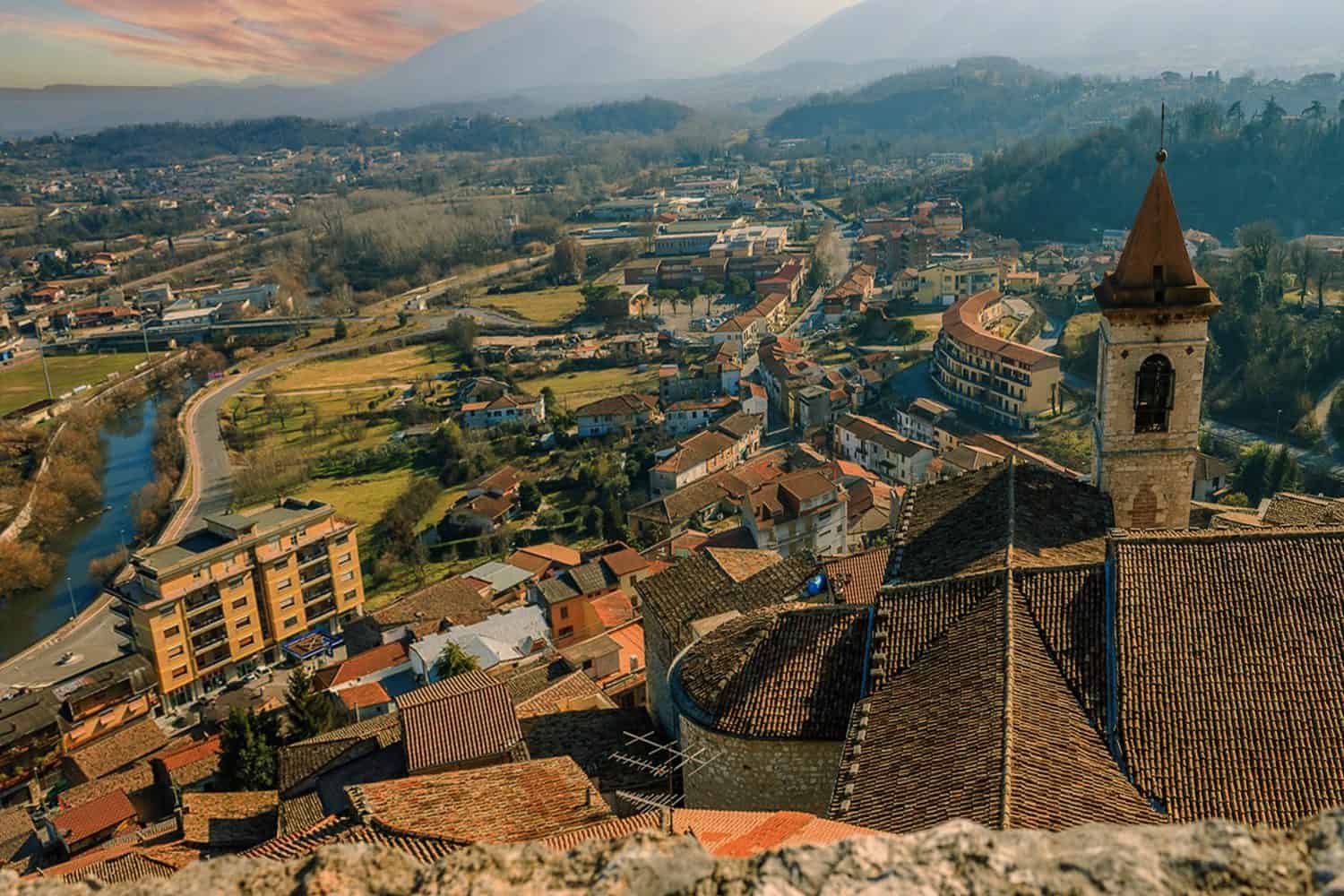
There is only one photo and everyone who has climbed up knows it: the Collegiata of San Giovanni Battista seen from the bastion of the Castle of the Counts. The bell tower and the roof of the church in the foreground, the roofs of the village descending, the Sacco Valley open behind and, with clean air, the silhouette of Monte Cacume in the background. It is the image that sums up the town: religious power seen from the height of military power, with the landscape explaining why that hill was worth a war.
Technically it's best to stand on the side of the bastion in mid-morning, when the sun lights the facade of the Collegiata and is not yet overhead. Late afternoon works the opposite way, with the backlight that separates the profiles and the valley in a golden haze. An extreme wide angle ruins the composition, because it pushes the bell tower away and flattens the drop in elevation: better a normal focal length, which gives back the real distance between the castle and the church. The second photo, the one almost nobody takes, is from the park of Castel Sindici toward the old village: you frame the whole hill, with the castle on top, and you understand the town's urban layout better than with any map. The third, if you pass by train, is the facade of the station, but check the state of the construction site: the mural of 2007 was removed for the renovation work, with the commitment to reproduce it when the works end. One last serious recommendation: inside the churches always ask before photographing, and in the castle spaces respect the instructions of whoever leads the visit.
Some Important Events That Happened Here in History
On September 18, 1216 Count Giovanni de Ceccano led from this hill the assault on the fortress of Morolo. The Colonna had backed Ruggero dell'Aquila, count of Fondi, who on May 23 of the same year had invaded the county and been defeated near Castro-Vallecorsa. The reprisal was ruthless: Morolo conquered and burned, the Colonna taken prisoner, 424 people of Morolo executed. It is an episode you almost never read in the Lazio guides and which says everything about the nature of feudal power in this valley.
In 915 the men of Ceccano took part in the battle of the Garigliano, when the coalition promoted by the papacy destroyed the Saracen settlement that for years had threatened lower Lazio and Rome. In 1168 the county inflicted a heavy defeat on the papal troops led by the archbishop of Mainz, Conrad, in a phase in which the conflict between Frederick Barbarossa and Alexander III was splitting Italy. In 1324 Count Francesco de Ceccano conquered Alatri and held it for 35 years, in open state of war against the Church. In 1350 Cardinal Annibaldo de Ceccano was sent from Avignon to Rome to open the Jubilee: a man of Ceccano, in a holy year, with the pope far from Italy.
The most dramatic event is from the 1900s. From November 3, 1943 to May 31, 1944 Ceccano suffered 38 Anglo-American air raids. The sanctuary of Santa Maria a Fiume, a national monument, and the church of San Pietro were razed. The medieval San Nicola was damaged. The bombs also hit civilians. The city has been awarded the silver medal for civil merit. The reconstruction of the sanctuary, carried out in the 1950s recovering the original materials, ended with the consecration of 1958: looking today at those Roman columns set upright again means seeing the work of a community that put its church back together piece by piece.
Who Passed Through Ceccano (FR)
Pope Paschal II, in 1104, when Count Gregorio de Ceccano escorted him with his men on the journey toward the Sorano: the county acted as the pontiff's bodyguard, and this says what its weight was.
St. Paul of the Cross, founder of the Passionists, who wanted the abbey of Santa Maria de Corniano here. And the young Ferdinando Santamaria, Blessed Grimoaldo, who died in Ceccano on November 18, 1902 at 19 and has rested in the Badia since October 1962, after the beatification by John Paul II of January 29, 1995.
Cardinal Annibaldo de Ceccano, who set out from here for the courts of Europe and who had contacts with Francesco Petrarca. Cardinal Stefano, chamberlain of Innocent III and friend of St. Dominic of Guzman. Cardinal Teobaldo, in whose arms Thomas Aquinas died at Fossanova. Cardinal Tommaso Pasquale Gizzi, born in the town in 1787, secretary of state of Pius IX in the brief reform season of 1846-1847, whose remains were moved to the Collegiata in 1992.
Giuseppe Sacconi, the architect of the Vittoriano, who designed Castel Sindici for Stanislao Sindici. The Roman painters Aurelio and Cesare Tiratelli, guests of the Sindici parlor. For Gabriele d'Annunzio local tradition speaks of a visit, but the documentary confirmation is missing and it's best to say so. Giovanni Battista Bugatti, that is Mastro Titta, the executioner of the Papal State, whose name remains tied to the castle prison, and Teresa Numa, the Ciociaria thief told by Dacia Maraini.
And, to close with the 1900s nobody expects: the Misfits and OK Go, who went on stage at Etnika Rock between 2003 and 2009. A town in Ciociaria that brings international bands under the counts' castle is exactly the kind of Italian contradiction worth telling.
Visiting Ceccano (FR) with a Guide
The village can also be toured alone, but what makes the difference is the stories: without someone to explain who the de Ceccano were, why the castle became a prison, what a 14th-century cross vault inside a Baroque apse means, you risk walking a lot and understanding little. For groups, companies and private visits, the editorial team works with the professionals of TourLeaderPro for the organization of group trips in Italy, who build custom days in Ciociaria and southern Lazio. Whoever accompanies foreign visitors and needs English-language material finds the general picture in the ItalyPlanner guides. If instead you are designing a multi-day itinerary in Lazio on your own, start from our page My Trip and from the list of tourist attractions.
Quick Questions About Ceccano (FR)
Where is Ceccano (FR)?
In the province of Frosinone, in the middle Sacco Valley, on a hill between the Monti Lepini and the Ausoni, 80 to 90 kilometers from Rome.
How far is Ceccano (FR) from Rome?
A little over an hour by train from Roma Termini on the line to Cassino. By car a short hour and a half, A1 exit at Frosinone.
How do you get to Ceccano (FR) without a car?
By train: the station is on the Rome-Naples line via Cassino, served by about 40 regional trains a day with termini at Roma Termini, Cassino and Caserta.
How much does the train from Rome to Ceccano (FR) cost?
A few euros, regional fare. The updated price is on the carrier's website, because regional fares change over time.
Can you visit the Castle of the Counts of Ceccano (FR)?
Yes, but not every day: the openings are run by the association Cultores Artium and follow the calendar of initiatives. It's best to contact the municipality or the association before leaving.
How much does it cost to enter the castle?
It depends on the type of opening and the event under way. The information should be asked directly of whoever runs the visits.
Can you visit Castel Sindici?
The interior no. The park around it, with centuries-old trees and a view of the old village, is accessible and is the main reason to go.
How much time do you need to visit Ceccano (FR)?
Three or four hours for the historic center and the castle. A full day if you add Santa Maria a Fiume, the Badia dei Passionisti and Castel Sindici.
Do you pay for the churches of Ceccano (FR)?
No, admission to the churches is free. Opening hours follow those of the parishes and can vary: outside of masses it's best to ask.
What is there to see in Ceccano (FR) in half a day?
The Castle of the Counts, the Collegiata of San Giovanni Battista, San Sebastiano in Piazza del Comune, San Nicola and the lookout over the valley.
What is the most important church in Ceccano (FR)?
The Collegiata of San Giovanni Battista for the liturgy and the works of art. The Sanctuary of Santa Maria a Fiume, a national monument, for history and for Cistercian architecture.
Why was Santa Maria a Fiume rebuilt?
Because the bombing of January 1944 razed it. It was rebuilt in the 1950s with the original materials recovered and reconsecrated in 1958.
Is Ceccano (FR) suitable for people with walking difficulties?
The historic center is steep and full of stairs, so difficult. The sanctuary down below, the park of Castel Sindici and the station, which has an underpass with ramps, remain accessible.
Is Ceccano (FR) suitable for children?
Very, if you focus on the castle and its prison history, and on the park of Castel Sindici. With a stroller, though, the village is tiring.
Where do you park in Ceccano (FR)?
In the lower part of the town, then climbing on foot to the historic center. At the station there is an interchange parking lot for cars and bicycles.
Is the astronomical park of Ceccano (FR) open?
No. It has been closed for many years, awaiting redevelopment work on the area.
What is the difference between Ceccano (FR) and Ferentino?
Ferentino is a Roman city with polygonal walls, an acropolis and a theater. Ceccano is a medieval hill village with two castles and a comital history. They complement each other and can be visited on the same day, on the same railway line.
When is the patron saint's festival of Ceccano (FR)?
From June 22 to 25, for St. John the Baptist, with the enthronement of the statue on the 23rd, the procession, the solemn mass and the fair along the main streets.
What is the Sagra dei Colli?
Ceccano's great summer food and wine festival, dedicated to Ciociaria cooking: the quickest way to taste the dishes of the area in one evening.
What do you eat in Ceccano (FR)?
Homemade pasta (fini fini, sagne, gnocchi), meat sauces, legumes, pork cold cuts, extra virgin olive oil from the surrounding hills, wild greens in the right season.
What is the eco-station of Ceccano (FR)?
The passenger building of the station, granted on loan by RFI and turned since 2005 by the Centro Studi Tolerus into an environmental documentation center, with a library, an educational workshop and a multimedia room.
Is the station mural still there?
It was removed for the building's renovation work, because the plaster was coming off. The municipality and RFI have announced that it will be reproduced faithfully when the construction site ends.
Can you visit the Roman villa of Cardegna?
No. After the excavation tied to the railway works the site was covered over and cannot be visited.
Was Ceccano (FR) really Fabrateria Vetus?
The identification is supported by the inscriptions found in the municipal territory between the 1700s and the 1800s and is the one accepted by local historiography.
The Final Verdict on Ceccano (FR)
On Ceccano our conviction is firm: it is a town that pays for the industrial fame of the Sacco Valley and that nobody expects to be interesting, and precisely for this it gives back more than it promises. In the same day you look at a comital fortress that was a prison until 1973, a Cistercian church rebuilt stone by stone after the bombs, a neo-Gothic castle designed by the architect of the Vittoriano to make wine, and a railway station turned by volunteers into an environmental education center. No other village in the Frosinone area puts together four stories so different in 3 square kilometers. Go in spring, phone ahead for the castle, climb with fresh legs and go down to the river at the end. And if you happen to be here on Good Friday, stay for the night procession: it is the moment when the town is seen for what it is.
Article written by the editorial team of TourLeaderPro, contact them for Private/Corporate/V.I.P. Tours and Experiences.
Planning a trip to Rome? The English-language guides to visiting the city are on ItalyPlanner.com.