Supino (FR)
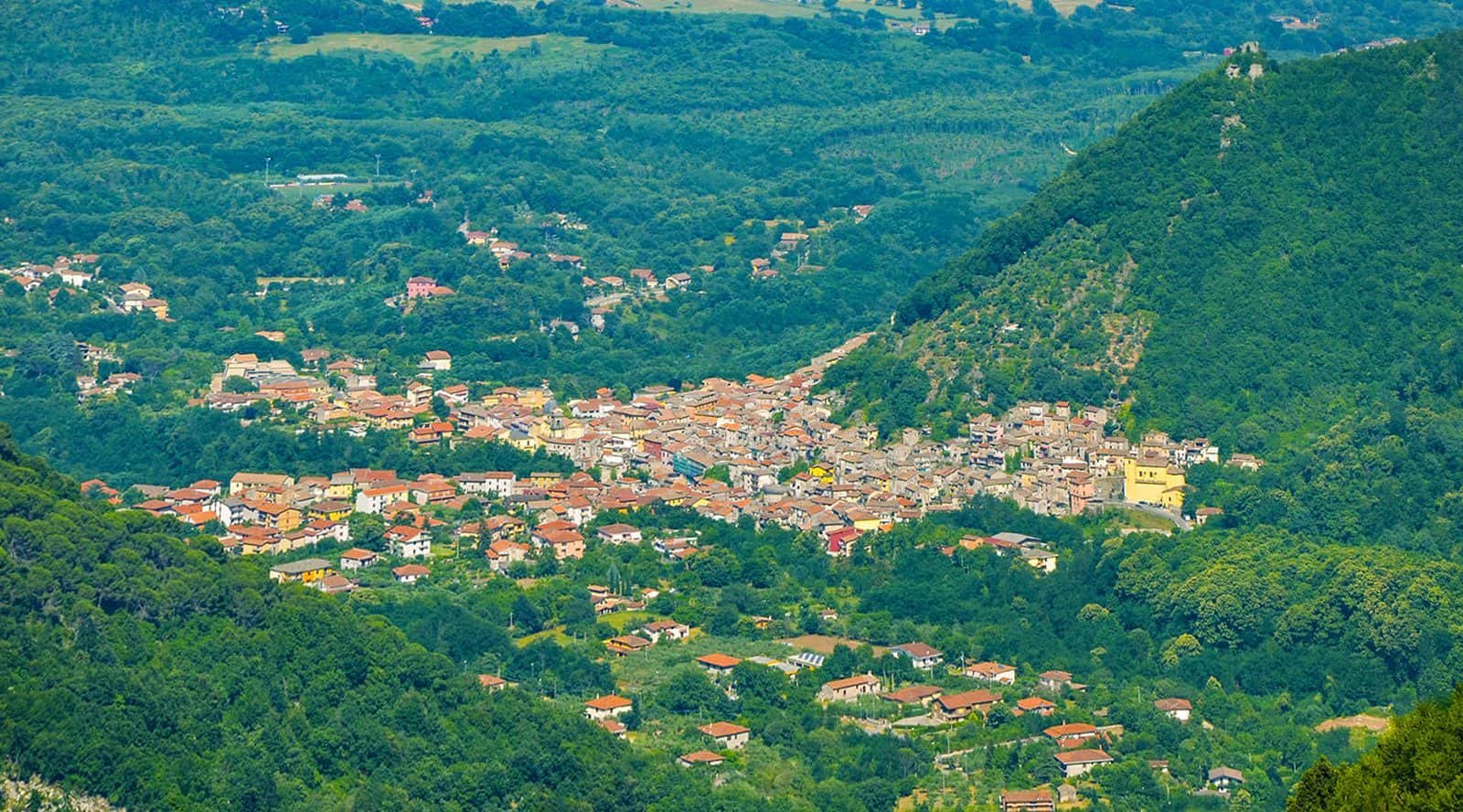
In short. Supino (FR) is a town of about 4,600 inhabitants on the eastern slope of the Monti Lepini, at the foot of Monte Gemma (1,457 meters), overlooking the Sacco valley, in the province of Frosinone.
Supino (FR) is a town of about 4,600 inhabitants on the eastern slope of the Monti Lepini, at the foot of Monte Gemma (1,457 meters), overlooking the Sacco valley, in the province of Frosinone. Town hall at Via Guglielmo Marconi, 03019 Supino, phone 0775 226001. From Rome by car: Autostrada A1 Milan-Naples, Frosinone exit, then SR 156 dei Monti Lepini to the turnoff for Supino. About 75 kilometers, a little over an hour in normal traffic. From Frosinone it's about 15 kilometers, a quarter of an hour on the SR 156. By train the closest station is Ferentino-Supino, on the regional Rome-Cassino-Naples line, served by regional trains from Termini and Tiburtina. From there you need a Cotral bus or a ride, because the station is in the valley floor and the town is several kilometers higher up (the schedules of the intercity runs from Frosinone, Piazza Pertini, toward Supino can be checked on the Cotral site). Park in the lower part of the town, then go on foot: the historic center isn't made for cars. The village can be visited for free, always. The churches follow service hours. The archaeological area of the Roman baths in the locality of Cona del Popolo, near Via Morolense, is public state property managed by the Soprintendenza Archeologia, Belle Arti e Paesaggio for the provinces of Frosinone and Latina and opens only on special occasions (European Heritage Days, FAI openings): before leaving, ask the Soprintendenza or the Comune. For the Santa Serena plain (1,100 meters) and for Monte Gemma you go up by the mountain road or on foot. No ticket, no refuge hut, lots of water in your pack. Half a day for the town, a full day for town and mountain.
If you want to frame the whole massif before choosing, start from the page dedicated to the Lepini Mountains, which explains how the two slopes, the Ciociaria one and the Pontine one, hold together.
How to get to Supino (FR) and how to organize the day
There are towns you only understand by looking at them from below, and Supino is one of them. You arrive from the Sacco valley, the wide, industrial valley floor that runs alongside the highway, and for a stretch you see nothing in particular: warehouses, roundabouts, the usual grammar of productive Lazio. Then the road bends west, the plain narrows and above your head rises a wall of gray limestone that seems to come from another geography. These are the Lepini. Leaning against that wall, clinging to a ridge that seems made on purpose to hold houses, is the village. From there the GPS is no longer needed: just aim for the town up high and climb. The name, after all, says it: according to the most accredited etymology, Supino comes from the Latin supinus, inclined, set on a slope. A town named after its own slope.
From Rome to Supino (FR) by car
From Rome the natural route is the Autostrada A1 toward Naples with the Frosinone exit. It's the right exit, there are no more convenient ones, and whoever tries to exit earlier at Anagni to cut through almost always ends up losing time on the Casilina. From the toll booth you take the road toward the mountains and join the SR 156 dei Monti Lepini, the regional road (formerly a state road) that serves this whole foothill belt and connects the Ciociaria to the Pontine plain passing beneath the ridge. From there you follow Supino and climb. The overall count from central Rome is around 75 kilometers, which in practice means a little over an hour when the A1 behaves and somewhat more on Sunday returns, when the stretch between Colleferro and southern Rome can turn temperamental for no apparent reason.
Whoever leaves from Frosinone has it easy: about 15 kilometers, a little under a quarter of an hour of SR 156, a road that runs at the foot of the mountain with the plain on one side and the limestone on the other. It's the route dozens of people take every day for work, and it's also the best way to understand Supino's position: the town isn't inside the valley and isn't inside the mountain, it sits on the hinge between the two, in that middle belt where people historically lived best because you controlled the passage, had water upslope and arable land downslope. The same SR 156 crosses the municipal territory together with the SR 214 Maria e Isola Casamari, the Ferentino-Sora expressway, and lower down runs the Rome-Naples high-speed line: Supino is a mountain town with its feet in one of the densest traffic corridors in Italy.
The slow way to Supino (FR) along the foothills
Then there's the slow way, the one I recommend to anyone with a full day and no hurry. Instead of going down the A1 to Frosinone you exit earlier and take the SR 156 from the north, arriving in Supino after crossing Ferentino and the belt of foothill villages. The route costs half an hour more and gives you the advantage of seeing the entire eastern flank of the Lepini unroll like a backdrop: town after town, all at the same elevation, all built on the same defensive logic, all with the same stone. By the time you reach Supino your eyes are already trained and you understand at first glance what you're looking at.
Train and bus to Supino (FR): intellectual honesty
The train exists but should be used with intellectual honesty. The reference station is called Ferentino-Supino, shared with the neighboring municipality, on the Rome-Cassino-Naples line, served by regional trains leaving from Termini and Tiburtina. Alternatively there's the Frosinone station, with more runs. The trip is peaceful and takes a little over an hour, but both stations are on the valley floor, far from the town. From there you need a Cotral line bus or a ride, and intercity runs in this area follow schedules designed for commuters and students, not for Sunday tourists. Practical translation: the train is excellent if you stay a few days and move calmly, and inconvenient for a day round trip. For an outing from Rome the car remains the right tool, and it's not an ideological judgment, it's schedule arithmetic.
Parking in Supino (FR) and tackling the climb
Once you arrive the issue becomes parking, and here the universal rule of perched villages applies: the more you insist on going up, the worse it goes. Supino's historic center wasn't born for cars and has no intention of adapting. The little streets narrow, the hairpins between the houses are designed for the pace of a loaded mule, and whoever insists on finding a spot in front of the church almost always ends up making embarrassing maneuvers under the amused gaze of someone sitting on a bench. The right method is to leave the car in the spaces in the lower part of the town, where the settlement expanded in recent times and where there is room, and tackle the rest on foot. The climb is real but not brutal, and above all it's the right way to enter a place built vertically: whoever arrives at the top by car misses the whole sequence of glimpses that is the reason they came.
On shoes I don't compromise. Supino is visited with a sole that grips, because the paving is uneven, uphill, often slick, and in winter can stay damp for whole days since the sun enters the narrow alleys late. And if the idea is to extend toward Santa Serena or the peaks, you need real hiking shoes: the limestone of the Lepini is beautiful but sharp and slippery, and the trails above the town gain elevation fast, without ceremony. It's never a question of technical difficulty, it's a question of terrain.
When to go to Supino (FR): the right season
On the season the indication is precise. Spring and autumn are the right periods, with a personal preference for late autumn. In April and May the Lepini are green in a way that surprises anyone who imagines them barren, the town is full of light, the days are already long and the calendar offers two events that alone justify the trip: the Azalea Show between late April and early May and the festival of San Cataldo from May 8 to 10. But it's between October and November that this area gives its best: the air becomes transparent, the plain below fills with a low haze that looks like a lake, and from above you see much farther than you expect. It's also the olive oil season, which here isn't a gastronomic detail but an economic and social fact, and walking around town when the olive mills are working means walking inside a smell you don't forget.
Summer has to be managed. It doesn't get the monstrous heat of the plain, because elevation and exposure help, but in the middle hours of July and August the rock accumulates heat and you feel the climb. The remedy is trivial and works: arrive early, visit the village by mid-morning, have lunch unhurried, and in the afternoon go up to Santa Serena, where at 1,100 meters the air really changes. August, in compensation, is the month when the town fills with returning emigrants and events: the Calecara footrace, the open-air cinema, the international horn players' meeting named after Guelfo Nalli, the Emigrant Festival of August 10 that coincides with the patron saint, San Lorenzo. Winter is the season of the few: it's cold, the wind on the ridge is no joke, but the clear days of January give extraordinary visibility and the town, emptied of everything, shows its structure unfiltered. It's the best moment to understand how a medieval village was made, because nothing distracts you, and in mid-January there's the polenta festival of Sant'Antonio Abate to warm the day.
Services in Supino (FR): call ahead
On services the rule of all municipalities of this size applies: take nothing for granted and call ahead. Cafés and grocery stores exist and work, the dining is the family-run, thoroughly honest kind but doesn't run nonstop, and in low season a place may close in the early afternoon or take a midweek day off. Churches follow hours tied to services and to the availability of whoever looks after them, which is almost always a volunteer. It's not disorganization, it's the real scale of things: there is no hospitality industry here, and that's also the reason the place has stayed intact. Whoever arrives with the idea of finding everything open as in a tourist resort gets the expectations wrong, not the town.
A piece of advice worth gold and costing nothing: ask. In a village this size the best map is still a person. Ask at the café where the trail to Santa Serena starts, ask whoever is tending a vegetable garden which road goes higher, ask on which days the chapel of San Cataldo opens. They'll answer with a precision no app has, and nine times out of 10 they'll add a piece of information you hadn't thought to ask about. That's how the Ciociaria works, and whoever doesn't use it misses half the trip.
Supino (FR) within a wider loop of the Lepini
If Supino is the first tile of a wider loop, it's better to think by foothill belt rather than by single municipality. On the same slope, at distances counted in minutes and not hours, there are Ferentino with its powerful walls, Alatri with the Cyclopean acropolis that is one of the most impressive things in central Italy, and Ceccano on its spur, the town of the counts who took Supino in the 13th century. Crossing to the other side of the ridge you enter the world of Carpineto Romano and then descend toward Sezze and Priverno, which look onto the Pontine plain.
For those arriving from outside the region or from abroad who want to fit Supino into a wider itinerary, an overall reading of the territory helps a lot: anyone thinking in English will find a clear framing in the ItalyPlanner guide to Lazio, which also collects the pages on Ferentino and on the abbey of Fossanova, while those organizing groups who want a professional guide will find the service on the page dedicated to TourLeaderPro's group travel organization in Italy. Using them before leaving saves those two hours of mistakes you always make the first time.
One last practical note, the kind nobody writes and that you then need. Phone signal in town exists and is decent, but as soon as you go up the trails or enter the gullies on the flank of the mountain it becomes temperamental. If you plan to walk, download the track before leaving and bring water, because above the town fountains aren't as frequent as you hope: there's the Pisciarello spring below Santa Serena and the Fonte dei Canali along the climb, and then nothing. It's the kind of banal precaution nobody ever takes and that, in the rare times it's needed, makes all the difference in the world.
Stone, oil and frontier: the history of Supino (FR)
To understand Supino you have to stop looking at it as a town and start looking at it as a position. It's the position that explains everything: why it was born there, why it has that shape, why it withstood a two-year siege, why it risked emptying out and why it didn't empty out entirely. We're on the eastern slope of the Lepini Mountains, the flank looking at the Sacco valley, at the right elevation to stay above the malaria and floods of the valley floor but below the snows and winds of the ridge. It's the same elevation as all the towns of this belt, and it's the belt of permanent human settlement: where spring water arrives by gravity, where the olive grows, where you see far and defend yourself well. The municipal territory, moreover, is a sampler of elevations: it climbs from the Sacco river, which touches its eastern edge, to the 1,457 meters of Monte Gemma, passing by Monte Malaina, Monte Salerio and Monte Semprevina, and the streams all run from west to east toward the Sacco with a torrential character, that is, full in winter and dry in summer.
Volscians, Hernici and polygonal walls around Supino (FR)
The prehistory of this territory is deeper than the surface tells. Before the Romans, before the consular roads, this was land of the Volscians and Hernici, Italic peoples who had occupied the mountains and built there a system of fortified settlements still readable in the landscape today. A learned tradition has Supino founded by refugees from Ecetra, a Volscian city never located with certainty. The studies of Cesare Bianchi place Ecetra in the Ferentino woods, and the question remains open. The most eloquent traces of that world are the polygonal walls, called Cyclopean: enormous limestone blocks, roughly squared and fitted together without mortar, with a precision that continues to seem impossible. In the Lepini area you find them everywhere, sometimes as complete circuits around an acropolis, more often as isolated stretches sticking out of an embankment or still holding up a modern road without anyone noticing.
It's worth spending a couple of words on these walls, because they're the thing that more than any other gives historical depth to a tour of the Lepini. For centuries people thought they were the work of mythical peoples, the Cyclopes precisely, because they couldn't imagine ordinary men moving stones of that size. Today we know they're the work of the Italic peoples and partly of the Romans, and that the technique was perfectly rational: local rock was used, blocks were roughed out on the spot, fitted by gravity and friction. The result is earthquake-resistant, practically eternal, and has an aesthetic quality no regular masonry possesses. Whoever wants to see the most spectacular version has to go to Alatri, where the acropolis is intact and monumental, or to Ferentino, where the walls are incorporated into the living city and you walk them without realizing. Supino has no polygonal circuit of its own to show off, but belongs entirely to that cultural perimeter.
Supino (FR) in Roman times: the villa in the valley
With Rome, things change scale. The Sacco valley becomes the Latin Valley, the corridor connecting Lazio to Campania, and the mountains above become hinterland: pasture, firewood, water, limestone to quarry. In Roman times the settlement wasn't on the hill but lower down, in the valley, where in 1963 the mosaics of a villa with a bath complex from the first half of the 2nd century AD re-emerged. That villa fell within the ager of Ferentinum, on the border with the territories of Anagnia and Frusino, and belonged to someone who could afford a private bath with Neptune on the floor. I talk about it at length further on, because it's the most important monument in the municipality. A model was born then that would last two millennia, made of two overlapping economies: below, in the low belt, tree crops and arable fields. Above, at elevation, seasonal herding and the woods. The town sits in the middle and lives off both. It's a structure you can still recognize today looking at the territory from above: the olive terraces that start from the last houses and climb as far as the slope allows, then the woods, then the high-altitude grassland. Three levels, three economies, three landscapes.
The incastellamento and the siege of Supino (FR) in 1125
The decisive moment, the one that gives Supino the shape it has today, is the Middle Ages. With the end of the Roman world and the insecurity of the following centuries, people leave the valley floor and perch themselves up high. It's the phenomenon historians call incastellamento, and in this part of Lazio it happened systematically: within a few generations all the towns of the foothill belt compact around a high point, ring themselves with walls, equip themselves with towers. In Supino that high point is the Punta di Creta Rossa, the hill above the town where the fortress stood. The first certain news of the castrum comes from the chronicles of Fossanova, the Annales Ceccanenses, and it's not peaceful news: in 1125 the castle of Supino underwent a two-year siege by the troops of Pope Honorius II. Two years. For a mountain village it means the fortress was serious and that whoever defended it had water, grain and reasons not to surrender. In the end it fell, and the defeat brought the fief into the hands of the counts of Ceccano, the family that then dominated this belt of the Lepini.
The 13th century is the century of the local lords who bear the town's name. In 1216 a Tommaso di Supino allied with Ruggero d'Aquila against the counts of Ceccano, a sign that the da Supino had caught their breath and were trying to shake off their neighbors. In 1303 the family enters great history by the worst door: among the conspirators who on September 7 burst into the palace of Anagni with Guillaume de Nogaret and Sciarra Colonna, the chronicles taken up by Muratori also count a Rinaldo da Supino. The Slap of Anagni, the outrage to Boniface VIII who died a month later, thus has among its protagonists a petty lord from this town, who shared with the Colonna a hatred of the Caetani pope. After the da Supino died out, the castle passed at the end of the 14th century to the Colonna, then to the Papal State, and in the mid-16th century again to the Colonna. When the military function faded, the fortress of Creta Rossa was turned into the church and monastery of San Giovanni della Torre, between the 17th and 18th centuries, and today of all this there remain ruins and an iron cross.
The layout of the village of Supino (FR) and the recycled towers
The result of the incastellamento can be read in the layout of the village. Supino has the typical structure of a centralized hillside settlement: a compact core, alleys following the contour lines, staircases cutting the slope, arches spanning the passages, houses pressed against each other so that the town's outer wall was also a defensive wall. And then the towers, which were the eyes of this system. The towers of the Lepini villages weren't autonomous fortresses but nodes of a network: they could see each other, signaled with fires and smoke, and within a few hours the alarm ran from one end of the massif to the other. Walking through the historic center you pass under structures that today look like simple tall houses and that in fact have thick masonry, blocked arrow slits, battered bases: they're remains of that system, recycled as dwellings when the military function disappeared.
This recycling is the most fascinating thing about the medieval villages of inland Lazio and also the most misunderstood. The contemporary visitor looks for the isolated monument, the object to photograph. Here you don't find it, because here the monument is diffuse: it's in the reused stone threshold, in the blocked arch inside a plastered wall, in the step that is clearly an ancient block turned over. The town kept building on itself for 1,000 years without ever throwing anything away, and the result is a vertical stratigraphy you read by walking slowly and looking up. Whoever rushes sees nothing. Whoever goes slowly sees everything.
Supino (FR), land of frontier and brigands
Then there's the theme of the frontier, which this area has carried on its back for centuries. The ridge of the Lepini long divided different worlds: on one side the papal Campagna e Marittima, on the other territories with different statutes and lordships, and farther south the line separating the Papal State from the Kingdom of Naples was not far. Living on a frontier means living on smuggling, transits, customs posts and bypasses, and it means having a highly developed culture of the border: you know the trails, you know where you can pass unseen, you hand down a geography parallel to the official one. It's no surprise that these mountains hosted brigandage in the 19th century, which here was not only crime but also social reaction, peasant resistance, the rebellion of a world that felt bypassed by history. The caves and gullies of the Lepini are full of stories from that period, some documented, many legendary, all handed down with a surprising precision of detail.
Oil, stone and pasture: the historic economy of Supino (FR)
Supino's historic economy revolves around three things: oil, stone and pasture. The olive is the most important and the most visible. The olive groves of the Lepini grow on terraces built by hand over centuries of work, held up by dry-stone walls that are themselves an anonymous, collective work of art. The limestone drains, the eastern exposure catches the morning sun, the altitude keeps the temperature swings: these are exactly the conditions that produce an oil with character, bitter and peppery, with that grassy finish that those not used to it mistake for a defect and that is in fact the signature of the area. Lepini oil isn't a tourist product invented yesterday, it's been the economic foundation of these towns since time immemorial, and the November harvest is still an event involving whole families today.
Stone is the other pillar. The limestone of the Lepini is everywhere: in the houses, the low walls, the portals, the thresholds, the churches. It has a color range going from white to gray to hazel, changes color with light and humidity, and gives the towns of this area that uniform tone that makes them immediately recognizable. It isn't a noble stone, it isn't marble, it's local material worked by local craftsmen. But for exactly that reason it tells better than anything else the relationship between a settlement and its territory: here they built with what there was, exactly where it was. The exception is the church of San Pietro, where in the 18th century the people of Supino allowed themselves polychrome marbles and stuccoes: the sign that a town of shepherds and olive growers, when it wanted to, knew how to spend.
Pasture, finally, is the least visible component today and the most important yesterday. Short-range transhumance, the kind that took flocks from the valley floor to the meadows of Santa Serena and back, structured the calendar of these communities for centuries. It left a network of drove roads, watering troughs, dry-stone shelters that today have become hiking trails and that then were productive infrastructure. When you walk the Lepini you almost always walk on pastoral roads, and knowing that those stones were worn by thousands of hooves and not by tourists' boots changes how you look at the route. The cheese festival in July, in the Ortelle district, is the direct heir of that world.
Monte Gemma, the mountain of Supino (FR)
Above all this there is the mountain, and the mountain here has a name that matters in town: Monte Gemma, 1,457 meters, the summit where the provinces of Frosinone, Rome and Latina meet. It's one of the peaks that close the horizon above Supino, and for the inhabitants it's not a geographic fact but a reference of identity, one of those places that enter everyday talk. People have climbed it for centuries, for pasture, for devotion, out of habit, and in recent decades for hiking. The fact that the summit offers a view ranging from the Sacco valley to the Pontine plain and, on clear days, to the sea did the rest: it has become the natural goal for anyone who wants to understand where they are. At its foot, between Gemma, Salerio and Malaina, opens the Santa Serena plain, at about 1,100 meters, the town's real balcony.
1927: Supino (FR) changes province
An administrative detail that explains many things: until 1927 Supino belonged to the province of Rome. It was the Fascist government, creating the province of Frosinone, that transferred it to the new district together with the rest of the Ciociaria. Anyone wondering why a town so tied to Rome, by feudal history and by internal emigration, carries the abbreviation FR today has the answer here. In the same decade the town acquired its civic monuments: the War Memorial by the architect Giovanni Jacobucci, commissioned in 1921 and inaugurated on October 22, 1922, with the soldier planting the tricolor on the conquered summit and holding in his left hand a grenade ready to throw. And the fountain called Littoria, also by Jacobucci, from 1933.
Emigration from Supino (FR) and the return
The 20th century brings the biggest fracture, that of emigration. Like all the towns of inland Lazio, Supino emptied in two waves: the first toward the Americas between the late 19th century and the first decades of the next, the second toward northern Italy and Europe in the postwar period, with Rome and Latina as the main internal destinations. Whole generations left, and the town went through what all of them went through: closed houses, abandoned fields, terraces the woods took back, schools emptying. The town chose to say it openly, and this is rare: in 1985, at the initiative of Mayor Alberto Volponi, an Emigrant Monument was erected, inaugurated by Giulio Andreotti, in the area the people of Supino call Giardini di Toronto, a name that by itself tells where so many of them ended up. In the same year the sculptor Tommaso Gismondi of Anagni carved a Famiglia ciociara for the former town hall on Via Roma. And every August 10, on San Lorenzo's day, the Emigrant Festival is celebrated.
There is, however, a second movement, less told and more interesting, and it's the return. Not a mass return, not a miraculous rebirth, but a selective and concrete homecoming: children and grandchildren of the emigrants who keep the house, who come back in summer, who at some point in life decide to work on it again. And, in recent years, new people arriving because the cost of living 75 kilometers from Rome is another planet and because remote work has made thinkable what 20 years ago wasn't. The result is a town that is not a museum and not a dormitory: it's a living place, with a fragile demography and a real vitality, where those who never left, those who came back and those who have just arrived live side by side. The statistics describe the fragility coldly: 222 active businesses in 2015 with 561 employees, 0.66 percent of the province, and a sharp drop compared with previous years.
It's this mixture that gives Supino a character you don't expect. There's none of the melancholy of terminal towns, the ones where you know history is ending. There's instead a kind of practical stubbornness, a non-rhetorical attachment to the place, showing up in tiny things: the vegetable gardens kept on the terraces, the trails cleared by volunteers, the azaleas grown on balconies in view of the show, the festivals organized with no budget that work anyway. Whoever visits only the stone sees half the town. The other half is this, and you only see it by staying. If you want to see the other face of the massif, the one looking at the Agro Pontino, the reference points are Norma with its balcony on the plain and Segni with its walls, two municipalities belonging to the same geological and human story but telling it from a completely different point of view.
A curiosity about Supino (FR)
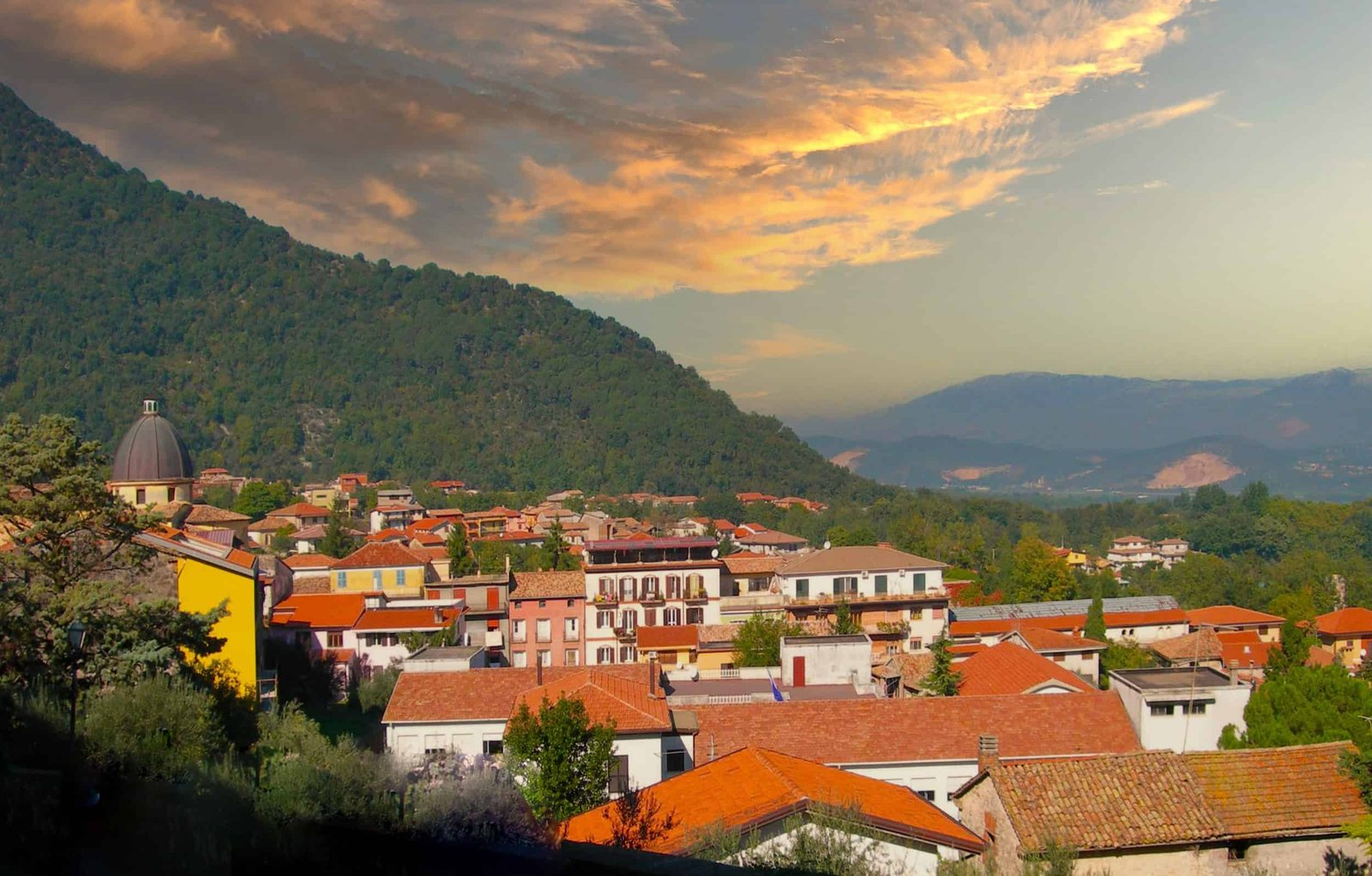
The curiosity of Supino lies in one word: cacciata. Not hunting, not the driving out of an enemy, but the driving out of a saint, who in the night between May 8 and 9 is literally driven out of his niche, and then out of the church, at three in the morning, in front of a whole town on its feet. The saint is Cataldo, an Irish bishop who lived in the 7th century and is buried in Taranto, and the question anyone asks is how a monk from Ireland ended up as the protector of a town in the Monti Lepini that has never seen either the sea or Ireland.
San Cataldo, from Ireland to Taranto and from Taranto to Supino (FR)
The story of Cataldo, as the hagiographic tradition tells it, is this. Born in Ireland to Christian parents, a monk and then abbot in the monastery of Lismore, ordained bishop around 670, during a pilgrimage to the Holy Land he is said to have received in a vision the order to go to Taranto to evangelize it. He died in Taranto, on March 8, 685 according to the traditional dating, and in Taranto his body rests, in the cathedral that bears his name. The Taranto cult is ancient and powerful. The one in Supino has a precise birth date: in 1653 the city of Taranto gave the people of Supino a relic, the blessing arm of the saint, kept in a silver reliquary. From that moment Cataldo becomes the saint of the town, and the municipal Statute still calls him today Bishop Protector of Supino, co-patron alongside the official patron San Lorenzo Martire, for the great social and religious importance of his cult. Traces of the same saint are also found in Patrica, on the other side of Monte Gemma: a mountain cult, probably brought by shepherds and by clerics who shuttled with the South.
The relic has one home and the saint has another, and this is the first thing to understand so as not to get confused. The Holy Arm is kept in the collegiate church of Santa Maria Maggiore, and from there it leaves in procession on March 8, on the dies natalis, when the calendar of celebrations opens. The statue and the chapel of the saint, attested already in the 16th century, are instead in the church of San Pietro Apostolo, which for this reason everyone in Supino calls the Sanctuary of San Cataldo. Two churches, two presences, one saint: the town organizes itself around this double geography.
The cacciata of San Cataldo in Supino (FR), at three in the morning
The central rite takes place in the night between May 8 and 9. At three in the morning a nighttime call gathers the faithful toward the sanctuary. Around four the statue is taken out of the niche and lowered to the level of the people, amid applause and cries of "Viva San Cataldo," and then dressed in the episcopal insignia: miter, crozier, ring, pectoral cross. This is the moment the people of Supino call cacciata, the saint coming out of his home to be with the people. The statue is then placed in its processional float at the center of the church of San Pietro. On May 10, after the noon Mass, the solemn procession crosses the town on the shoulders of more than 50 bearers, the men who load it onto their necks, to the little church of Santi Sebastiano e Rocco, where the bishop and the rector close with thanksgiving. The celebrations, with festive lights, bands and fireworks, stretch over days.
Anyone who wants to understand what popular devotion is in the Ciociaria must be there at three at night, not at 11 in the morning. The night is the real part: a town that doesn't sleep, emigrants who came back just for it, elderly people who know exactly where to stand. The rest, the daytime procession and the band, you find in many towns in Italy. The cacciata, no. The statue venerated today, it must be said, is not the original: the first was destroyed in a fire and the present one is a reproduction of 1870, the work of a Roman artist who remained unknown, made from a design by Ernesto Biondi, the sculptor who was then 15 and who as an adult would become a sculptor by trade. A 15-year-old boy drawing the saint of his town: this too is a curiosity worth the trip.
The saint and emigration from Supino (FR)
One last observation, an anthropological one. Cataldo is the saint of a journey, an Irishman who ends up in Puglia because of a command received far from home. In a town that has seen whole generations leave for Toronto, Belgium, Germany, a protector like this has a particular meaning: the graces asked for and received, the votive offerings, the returns of August and May revolve around departure and homecoming. It's no surprise that the celebrations of San Cataldo and the Emigrant Festival of August 10 are the two moments of the year when the town fills up again. The saint of the journey protects a people of forced travelers. Whoever arrives without knowing sees a nice procession. Whoever knows sees a town telling its own story.

Cacciata of San Cataldo - May 10 in Supino (FR)
Place by place: visiting Supino (FR)
Supino doesn't have a museum route with arrows on the ground. It has four churches, a fortress reduced to ruins, an archaeological area that rarely opens, a historic center that is itself the monument, and above it all a mountain with a plain, a summit and the deepest cave in Lazio. The right way to visit it is from the bottom up, in the same order in which the town was built: first the Roman valley, then the village, then the fortress, then the mountain. Here I follow that order.
The Roman baths of Supino (FR) at Cona del Popolo
The most important monument in the municipality is also the least visible. In the locality of La Cona del Popolo, in the valley below the historic center, next to Via Morolense, the discovery of mosaic fragments in 1963 led to the finding of a Roman bath complex. The Soprintendenza's excavations began in 1964 and in 1976 the area entered the public domain. It's a private bath building, datable to the first half of the 2nd century AD, with mosaic floors and in opus sectile, that is, in two-color marble slabs cut to a design. It wasn't an isolated building but the bathing section of a much larger villa, still buried, whose extent is proven by the terracotta fragments and the walls surfacing all around. Seven rooms have been identified: two apodyteria, the changing rooms. The frigidarium. Two tepidaria. The laconicum, the dry sweat room. The calidarium. The walls are in mixed masonry on a concrete core.
The mosaics are the reason it's worth chasing an opening. In the frigidarium stretches the great mosaic of Neptune on a quadriga of hippocampi, the sea horses, with a black perimeter band and the figures rendered in black silhouette with details in white tesserae: the black-and-white technique of the baths of Ostia, and the comparison with Ostia is the one archaeologists make first. In the calidarium, which keeps two basins, the floor is an entire sea: at the center a Triton blowing into a conch, around it Nereids, sea monsters with the body of a bull and a goat, dolphins, shells, a jellyfish, with a liveliness of design that surprises in a private country building. The calidarium also keeps, better than elsewhere, the heating system: the hot air produced by the praefurnium ran under the floor suspended on small pillars and rose along the walls inside terracotta tubes. Pillars, side ducts and terracotta material are still in place and can be read without need of reconstructions.
The verdict is firm: they are the most beautiful marine mosaics in the Ciociaria and deserve a regular opening that today doesn't exist. The area can be visited on the European Heritage Days in late September, when the Soprintendenza Archeologia, Belle Arti e Paesaggio for the provinces of Frosinone and Latina opens it, and on occasions promoted by the FAI and the Comune. Anyone planning the outing on an ordinary day should assume a closed gate and find out beforehand from the Soprintendenza or the Comune. If the opening coincides, move everything else: it's 40 minutes that explain why 2,000 years ago someone chose to live here.

The church of San Pietro Apostolo, the sanctuary of San Cataldo in Supino (FR)
In the village the first stop is the archpriest and mother church of San Pietro Apostolo, rebuilt for the third time between 1750 and 1790, and it's a surprise. Whoever expects the usual village parish church finds a polygonal plan with 12 sides, with two altars on the flanks, which scholars compare to Guarino Guarini's San Lorenzo in Turin: an idea of learned, centralized, luminous Baroque architecture transplanted into a Lepini town at the end of the 18th century. It is rightly one of the best Baroque architectures in southern Lazio. The facade has three portals with lunettes. In the lunette of the central portal a polychrome mosaic by Ugo Santurri from 1966 shows San Pietro and San Cataldo, the pair that governs the church. The bronze door, called the Door of Hope, is from 1978, the work of Saverio Ungheri: seven asymmetrical panels with theological, doctrinal and local-history themes, to be read one by one before going in.
The interior rests on six sturdy pillars, with polychrome stuccoes and marbles that don't exist in the rest of the town. On the choir loft there is a positive organ from 1764, the work of Johannes Conradus Werle: an instrument of quality, and if you're lucky enough to hear it during a service you don't leave. On the Gospel side opens the chapel of San Cataldo, attested since the 16th century, frescoed in 1890 by Agostino Monacelli, with the wooden statue of the saint from 1870 in its niche. It's from this niche that the saint is driven out on the night of May 9. On the other days of the year the chapel is the quietest place in town, and in our judgment the most beautiful.
The collegiate church of Santa Maria Maggiore in Supino (FR)
Santa Maria Maggiore was erected around 1753 by the Confraternity of the Blessed Virgin, in late Baroque forms fading into Rococo, on the site of an earlier church dedicated to Mary Mother of Consolation. It's the home of the Holy Arm, the relic of San Cataldo that arrived from Taranto in 1653 in its silver case, and it's from here that the procession opening the Cataldo year leaves on March 8. A confraternity church, therefore a church of lay people: the confraternities of the 18th century were the true common funds of the towns, and a church like this says that by mid-century Supino had an agrarian middle class able to finance two building sites at once, this one and that of San Pietro. It's worth the visit for its relationship with the square and for the relic. Hours follow the services.
San Nicola da Bari and Sant'Antonio Abate in Supino (FR)
The church of San Nicola da Bari was rebuilt in 1774, and keeps a cult that long precedes its walls: Sant'Antonio Abate has been celebrated here since the early Middle Ages, with two festivals. The first, on January 16 and 17, with the distribution of the panicelle, the blessed little loaves, and the blessing of the animals. The second on the last Sunday of September. The polenta festival has attached itself to the January feast, which the people of Supino cook in 17 copper pots with about two quintals of cornmeal: a figure that says more than many words about what a village festival means in the Ciociaria. Sant'Antonio with the pig and the fire is the saint of peasants and livestock breeders, and in Supino, a pasture town, his millennia-long persistence has an economic logic before a religious one.
The little church of Santi Sebastiano e Rocco in Supino (FR)
Small, ancient, decisive in the calendar: the church of Santi Sebastiano e Rocco is the terminus of the San Cataldo procession of May 10 and the place where the bishop gives the thanksgiving. Sebastian and Roch are the saints of the plague, and a church dedicated to them on the edge of the village tells of the epidemics this transit valley has known. Around the square of the same name the carnival bonfire is lit, and on the first weekend of September the procession of San Rocco brings with it the festival of the ciambelle.
San Pio X, the new church of Supino (FR)
In the lower belt of the town, where people live today, is the parish of San Pio X, established by a bull of May 1, 1961 by the diocesan bishop Tommaso Leonetti and stubbornly pursued by don Egidio Schietroma (1906-1995), formerly rector of the sanctuary of San Cataldo between 1950 and 1953. It's not a church to visit for its art. It's a church to understand for its geography. By 1961 the population had moved down, along the roads, and the Church followed it. Anyone who wants to see where Supino lives today has to come down here, not go up.
The historic center of Supino (FR): staircases, arches and reused stone
The historic center is the part that can't be told in order, because it has no order: it's a fabric of medieval staircases, arcades spanning the alleys, ramps turning behind the houses, with Vicolo Alto, where in 1973 the Azalea Show was born with 130 pots, as its backbone. The things to look at are those that tell the stratification: a blocked arch inside a plastered wall, an ancient block reused as a step, a threshold hollowed at the center by centuries of passage, a medieval window absorbed into a modern house, a wall where you see three eras of masonry overlapping, an iron ring for tying animals. Whoever walks looking straight ahead sees plastered walls and concludes there's nothing. It's all there, but it's above your head and under your feet. On the edge, on Via Roma, the former town hall houses Tommaso Gismondi's Famiglia ciociara from 1985, and lower down the Jacobucci fountain of 1933 and the War Memorial of 1922 mark the passage from the medieval town to the town of the 20th century.
Punta di Creta Rossa: the fortress and the cross above Supino (FR)
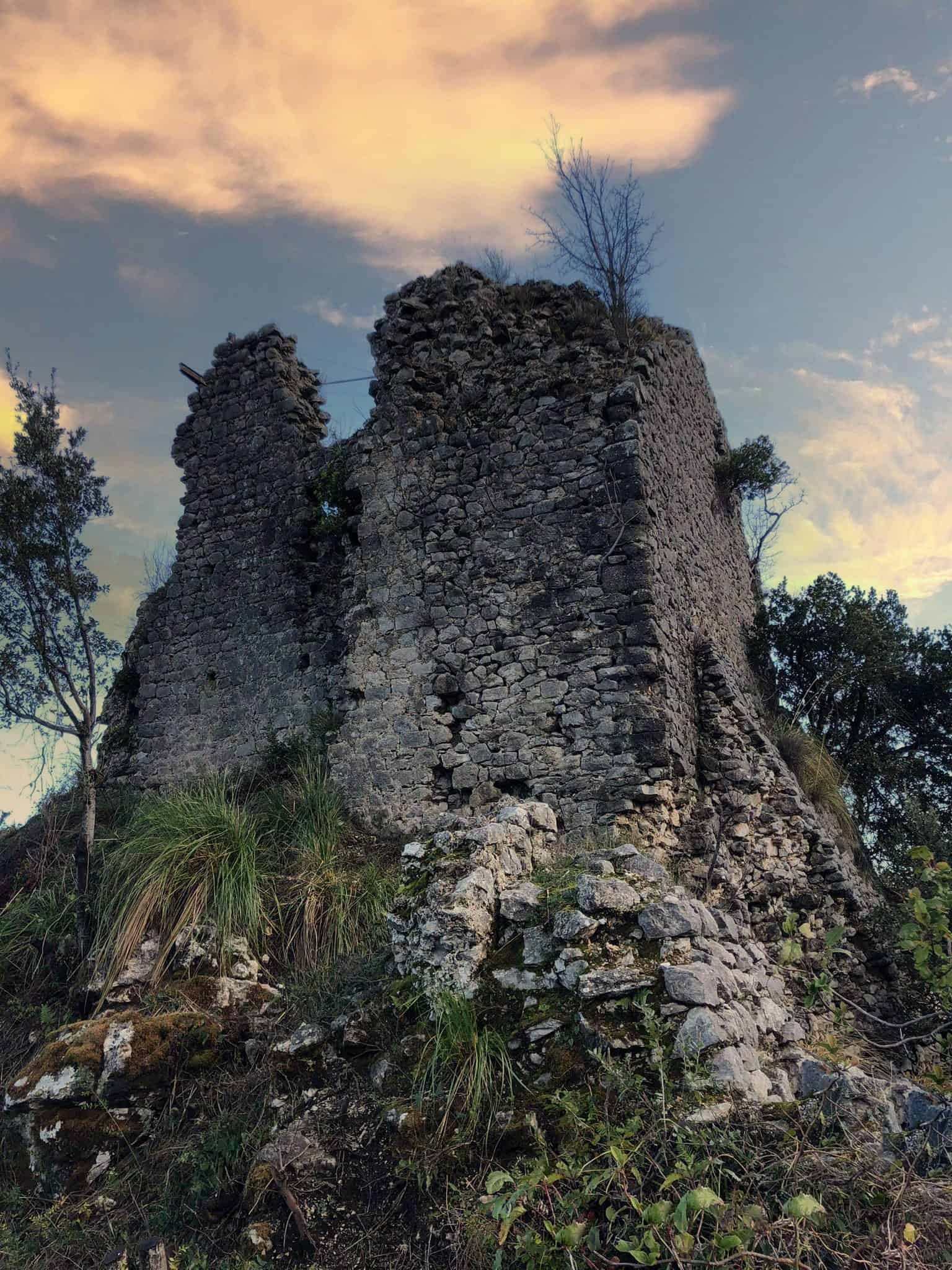
Above the village, on the hill that is part of Monte di Creta Rossa, stood the medieval fortress, the one that in 1125 held out for two years against the troops of Honorius II. With the decline of the Colonna the fortress lost its military function and between the 17th and 18th centuries became the church and monastery of San Giovanni della Torre. Today there remain ruins, breached walls and the physical sense of how hard it was to get up here with an army. In 1951, in memory of the Popular Missions, a group of men and young people led by the 20-year-old don Armando Boni planted an iron cross there, visible and lit, which since then has been the point the people of Supino look at by night. The climb is short and steep, and the panorama over the Sacco valley is the best you can get without going up to altitude. It's best to go up last, before leaving, when the afternoon light enters the valley.
The Santa Serena plain above Supino (FR)
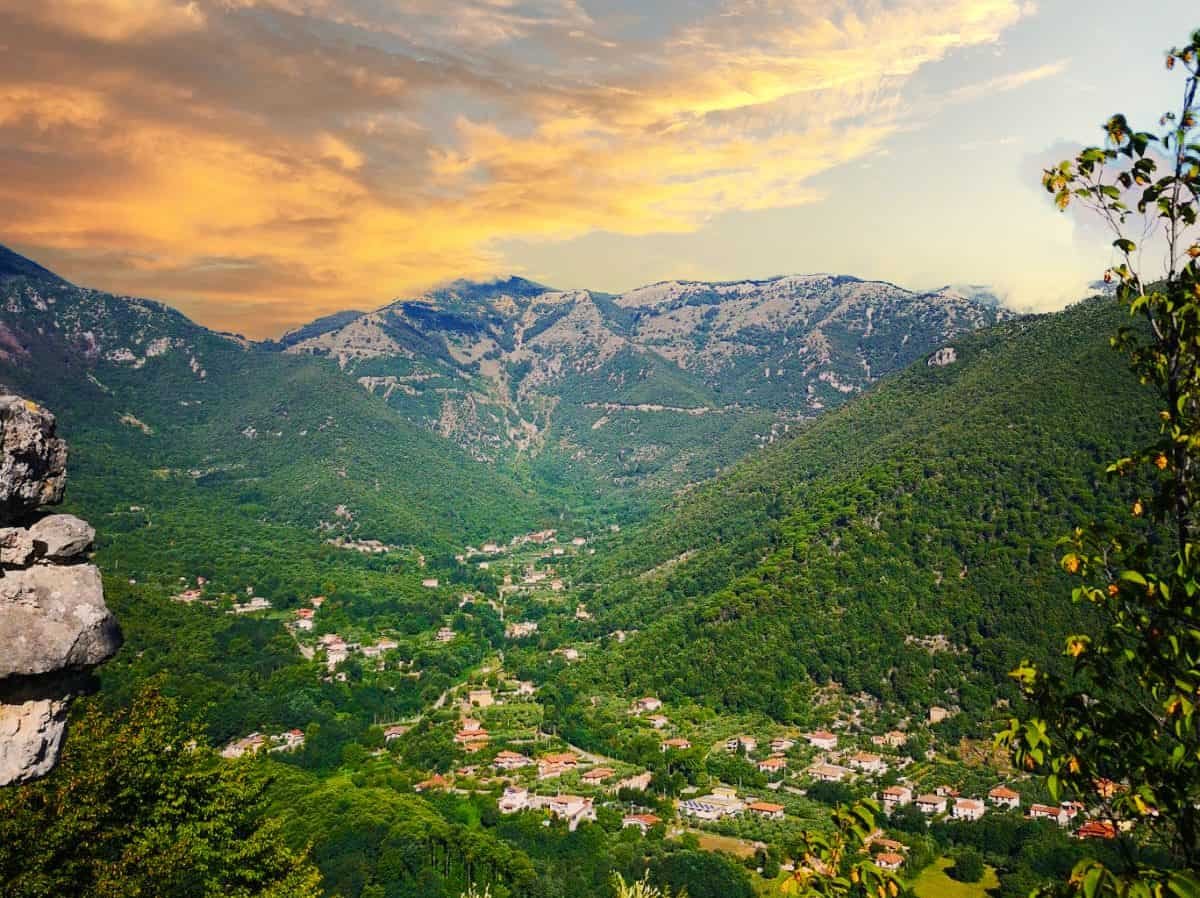
Santa Serena is the place the people of Supino point to when you ask where to go: a vast plateau at about 1,100 meters, enclosed between Monte Gemma, Monte Salerio and Monte Malaina. You get there by car in about 10 minutes from town, along the mountain road, or on foot, with the last stretch of 400 meters from the Pisciarello spring. Along the climb you pass the Fonte dei Canali and some limestone walls used for free climbing. The vegetation changes with elevation, and reading it is half the pleasure: chestnuts, holm oaks and field maples give way to beech forest, while in the valley bottom grow cherries, hollies, yews, Hungarian maples, dog roses, hawthorns and St. John's wort. In summer the plain hosts the town's mountain events, such as Vivere la Montagna in August. In winter, with snow, it becomes the place where people of the Ciociaria bring their kids to play. It's the starting point of the hiking loops toward Semprevina, Malaina and Gemma.
Monte Gemma and Monte Malaina: the peaks of Supino (FR)
The climbs that start from the belt of towns all share the same character. You begin among terraced olive groves, cross a zone of scrub and shrubs, enter the oak wood and higher up beech, and finally come out onto the summit meadow, where the wind meets no obstacles and the view opens to 360 degrees. The passage from woods to meadow is always the best moment of the day: after an hour and a half of trees and short sightlines, the landscape explodes. From up there, on the right days, you keep under control an enormous piece of Lazio: the Sacco valley with the towns lined up, the Ernici opposite, the Simbruini range to the north, and turning around the Pontine plain descending toward the sea, with Monte Circeo standing out on the horizon like an island. Gemma, with its 1,457 meters and the triple provincial border, is the classic goal. Malaina, on whose southeastern slope opens the entrance to the deepest cave in Lazio, is the one for those who want to understand the mountain from the inside.
The Ouso di Passo Pratiglio, the abyss under Supino (FR)
Here is the thing nobody really tells: under the pastures of Supino opens the deepest cave in the region. The Ouso di Passo Pratiglio, with its entrance at 1,360 meters on the southeast slope of Monte Malaina, was discovered in 1976. The Società Carsologica Romana explored it in 1996 down to minus 299 meters, where a flooded siphon stopped everyone. In 2004 the siphon was passed in free diving, and in the summer of 2007 the cavers reached the bottom at about 840 meters of vertical drop, setting up a precarious base camp at minus 700. The course is vertical down to minus 200, then subhorizontal, with five lakes in the middle stretch and progression made complicated by the constant presence of water. As of 2015 it remains the deepest cave in Lazio. All this takes place beneath the feet of those strolling on the plateau without suspecting anything. It must be said clearly: the ouso can't be visited except by equipped cavers, and the caving groups of the area are the only correct way to approach this world.
The vanishing water: Lepini karst explained from Supino (FR)
The ouso is the extreme manifestation of a phenomenon that explains the whole mountain. The Lepini are a karst massif: limestone slowly dissolves in contact with slightly acidic rainwater, and over millions of years this dissolution has built, inside the mountain, a hollow world made of conduits, shafts, galleries and chambers. The most obvious consequence is noticed immediately when walking at altitude: on the Lepini there is no surface water. There are no streams, no mountain lakes, no brooks running down the gullies. It's a mountain landscape that, for a hiker used to the Alps or the Umbrian Apennines, turns out strangely silent: the sound of water is missing. It rains, and the rain disappears. It doesn't run off, it sinks. It slips into the fractures of the limestone, enters the conduits, drops vertically for hundreds of meters (at Passo Pratiglio for 840) and begins an underground journey that can last days or weeks.
That water, however, isn't lost. It re-emerges all together, at the base of the massif, in springs of considerable flow. This is the reason the towns at the foot of the Lepini have historically had plenty of water while at altitude there wasn't a drop, and it's the reason the whole Pontine plain was for millennia a land of water until the reclamation. The mountain works like a giant sponge that absorbs high up and gives back down low. For a settlement like Supino this fact shaped everything: springs and watering troughs weren't ornament, they were vital infrastructure, they determined where you could build and graze and how much population a territory could support. Public fountains, those stone structures that are photographed today because they're beautiful, were the point where half the social life of a community concentrated. Whoever controlled the water controlled the town, and disputes over the use of springs fill the archives of these municipalities.
Even staying on the surface the karst can be read everywhere, you just need to know what to look at. The karren fields, those surfaces of bare rock incised with parallel grooves, are water that has carved the limestone for millennia. The dolines, the closed oval basins that open in plateaus like Santa Serena, are collapses of cavities beneath. Often they have red earth on the bottom and are the only farmable portions at elevation. The swallow holes are the mouths where the water disappears, often invisible until you're standing on them, and they're the reason it's best not to walk off-trail carelessly on these mountains. The minor caves, rock shelters used by shepherds for generations, have yielded archaeological material and, in the winter of 1943-1944, housed war evacuees. Once you've learned this grammar, the Lepini stop being a generic mountain and become a readable text.

The oil, the olive mill and the November of Supino (FR)
If there's a moment when you should see Supino outside the festivals, that moment is November. Not for the landscape, which is also at its best, but because it's when the town does the thing it has always known how to do: it picks olives and makes oil. In a municipality of the Lepini the harvest isn't an economic activity among others, it's a collective rite with its own calendar, rules and language. The olive groves cover the terraces climbing from the last houses toward the mountain. They're old plantings, with plants of respectable age, arranged on strips held up by dry-stone walls that someone built stone on stone and that someone else keeps repairing. It's a built landscape, not a natural one, and it's probably the most extensive and least protected cultural heritage of this whole Apennine belt. Every wall that collapses and isn't rebuilt is a piece of history leaving in silence.
The harvest mobilizes everyone. Relatives come back from Rome and elsewhere, family crews are organized, nets are spread under the trees, olives are beaten, gathered, bagged. Timing is everything: picking too early means low yield, too late means flat, more acidic oil. The right point is veraison, when the drupe turns from green to purplish, and recognizing it is practical knowledge handed down by watching. Then there's the rush to the olive mill, because olives have to be milled within a few hours, otherwise they ferment. In those days the mill is the nerve center of the town: it works nonstop, the smell invades the neighborhood, and around the machines a permanent assembly forms in which yields, vintages, frosts, olive fly and prices are discussed. Olive growing in the Lepini is still largely family-run: most families produce for themselves and their relatives and sell the surplus. Oil isn't bought, it's had, and giving a bottle is a codified social gesture.
On the product, two technical words. The oil of this area is typically bitter and peppery, with grassy notes of artichoke, cut grass and sometimes almond. Bitter and peppery are not defects: they're the sensory manifestation of the polyphenols, and an oil that doesn't sting in the throat is almost always a poor or old oil. Whoever tastes a freshly pressed Lepini extra virgin and coughs is meeting a living product. The right way to try it is the simplest: bread, raw oil, nothing else. On warm toasted bread it shines, on legume soups it finds its historic pairing, on wild greens it becomes the dish. November is also the month when the town is momentarily full again for the harvest: for a few days the demography reverses and Supino looks like what it used to be. No tourist office puts it on the program, but it's the most authentic thing you can see around here.
What nobody tells you about Supino (FR)
We come to the part usually missing from guides, because it requires saying awkward things or things too specific for those compiling standard pages. These are three observations matured by spending time in this belt of territory, and if you know them beforehand they change the visit. None of the three is a secret: they're things obvious to those who live here and invisible to those who arrive.
The town doesn't end where you think: Supino (FR) lives on three levels
The first thing nobody says is that the historic center is not the town. Whoever arrives with the village mentality looks for the old core, visits it and concludes they've seen Supino. They've seen a third of Supino, and probably the least inhabited third. The reality is that the municipalities of the Lepini foothill belt have a settlement structure spread over three levels, and each has a different function. At the top is the historic core, medieval, compact, with the alleys and the traces of the towers, crowned by the ruins of Creta Rossa. It's the photogenic part and it's also the one with the lowest residential density, because the houses are small, hard to adapt to modern standards, often with no vehicle access. Many have been renovated, many others are closed, and the stable resident population is made up in large part of elderly people who were born there and didn't want to move.
Below is the intermediate belt, that of the 20th-century expansion, the San Pio X belt: houses built between the 1950s and 1980s along the roads, with garages, gardens, space for cars. It's architecturally insignificant and ignored by visitors, but it's where most people live, it's where the everyday commercial activities are found, and it's where the town exists as a functioning community. And then there's the scattered belt: isolated houses, farmsteads, districts like the Ortelle, farms scattered over the terraces and along the country roads, down to the valley of the Cona del Popolo where the Romans had chosen to live. It's the legacy of an agricultural organization in which people lived close to the land they farmed, and in many municipalities of the Lepini this scattered population is numerically significant. These are the zones of olive groves, family olive mills, vegetable gardens, where you best see how the real economy of the place still works today.
Why is it important to know this? Because it changes practical expectations. The café, the grocery, the restaurant might not be in the historic center, and whoever looks for services while climbing finds themselves in a neighborhood of closed houses and concludes the town is dead. It isn't dead, it's organized differently. And it also changes how you interpret what you see: the closed shutters of the old core aren't the sign of total depopulation, they're the sign of an internal shift that happened 60 years ago, when those who could built themselves a new house lower down, with the road in front. There is a further consequence, and it concerns summer. Those closed houses aren't all abandoned: many belong to emigrant families who come back for a few weeks a year. In August that fabric reopens, lights come on, chairs are put outside the door, and the old core becomes what it used to be. Whoever passes in February sees a silent neighborhood, whoever passes at Ferragosto sees a continuous party. Both images are true and neither is the whole story.
The mountain above Supino (FR) is not a playground
The second thing nobody says concerns the trails, and I say it clearly because every year someone gets into trouble. The Lepini Mountains are more demanding than their altitude suggests. Looking at the numbers on the map you conclude they're modest mountains, and in absolute terms they are. But altitude isn't the only parameter, and here the other parameters are all unfavorable to the distracted walker. First: the concentrated elevation gain. You start from the low elevations of the foothill towns and climb fast. The trails in this area don't have the luxury of gentle switchbacks, they follow the most direct lines because they began as work routes and whoever laid them out wanted to arrive, not stroll. Second: the absence of water. On a karst massif there are no streams, and the few watering troughs at elevation depend on artificial collection that can be dry. You climb carrying all the day's water, period.
Third: orientation. The summit plateaus of the Lepini are a repetitive environment: meadow, dolines, outcropping rock and very few distinctive landmarks. In clear weather it's all easy. In fog, which arrives quickly here and rises from the valley, it becomes an environment in which it's objectively easy to lose your direction. Those who know the area adjust their plans to the weather with a seriousness that to an occasional hiker can seem excessive. It isn't. Fourth: the terrain. The outcropping limestone is sharp, irregular and, when wet or covered in dry leaves, treacherously slippery. Ankle sprains are the typical injury of the area and almost always happen on the descent, in the last hour, when concentration drops. Fifth, and it concerns the karst directly: the cavities. On these slopes there are swallow holes and vertical shafts, some marked, many not, often masked by vegetation. The Ouso di Passo Pratiglio, with its 840 meters, is only the most famous. It's not a danger for those who stay on the trails, but it's an excellent reason to stay on them.
How, then, do people who know these mountains move? With precise habits. They leave early, to have margin. They check the weather the evening before and don't improvise. They carry plenty of water even for short outings. They have the track downloaded on the phone, because in many gullies there is no signal. They tell someone where they're going. They don't change the plan on the fly to explore something glimpsed from afar. And above all, if the weather worsens, they turn back without making a fuss. I add a cultural note: these trails cross properties, pastures and woods that belong to someone, often to municipal civic-use rights or to private owners. Passing through is normal and nobody will say anything, but elementary respect is expected: gates closed as you found them, sheepdogs left alone and skirted calmly without yelling or running, no noise near the flocks, no indiscriminate gathering of mushrooms or plants. These are obvious rules that every year someone ignores, and the consequence is that the relationship between those who live here and those who come to walk deteriorates. It would be a shame, because at the moment it's still excellent.
Tourism in Supino (FR) has only just begun, and this is its best phase
The third thing nobody says is the most important and the most delicate: you're visiting a place at a moment that won't last. The Lepini and the inland Ciociaria are in an early phase of discovery, with all the advantages and all the limits this entails, and whoever arrives now sees something that in 10 or 15 years will be different. The advantages are evident. There's no crowd. There's no filter between visitor and place. Prices are the real ones of a local economy, not the inflated ones of a destination. The people you talk to have no tourist script and answer as people. In the trattorias you eat what is eaten in the family. And above all the landscape hasn't been equipped to be consumed: no panoramic walkway, no photo installation, no themed route. There's only the place, as it is.
The limits are the other side of the same coin and must be accepted without complaint. Tourist information is fragmentary and often dated. The Roman baths open a few times a year. Churches have hours tied to services. Trail signage is uneven, excellent in some stretches and absent in others. Accommodation is limited. Public transport is designed for residents. None of this is a flaw in the strict sense: it's the normal condition of a territory where tourism is not yet an economic sector. What I want to say, though, is a matter of responsibility. The way the first visitors behave determines to a large extent how a community will react to tourism. If those who arrive now spend locally, eat in the town's trattorias, buy oil from producers, sleep in the area instead of returning to Rome in the evening, hospitality consolidates as a supplementary and sustainable activity. If instead people arrive en masse, photograph, consume the landscape and leave behind traffic and trash, the territory learns that tourism is a nuisance and closes up.
There's also an economic aspect almost nobody mentions. In a town this size the difference between a day with 10 visitors who eat lunch in town and one with 10 visitors who bring a sandwich is not marginal: it's the difference between a trattoria that stays open and one that closes. Local economies of this scale have razor-thin margins. And I add a thought on the fragility of the landscape, which is the real heritage of this area. The olive terraces shaping the slopes above Supino are a historic artifact requiring continuous maintenance. Every abandoned olive grove is a piece of landscape that the woods reconquer in a few years, with hydrogeological consequences, because those dry-stone walls regulate water runoff on the slopes. Buying local oil isn't a souvenir: it's the most direct way a visitor contributes to the preservation of what they came to see. The postcard is maintained by buying the product, not by photographing it.
My advice for visiting Supino (FR)
The most important advice is also the most annoying, because it contradicts the way outings are organized: don't put Supino in the middle of a list. The temptation, when you come down to the Ciociaria from Rome, is to make a necklace of towns: three in the morning, two in the afternoon, all photographed, none seen. With Supino the method doesn't work, because the town has no magnet monument that rewards the day even for those in a hurry. It has instead a structure, a context and a rhythm, and all three of these are grasped only by stopping. Give it a full half day, minimum. If you can, give it a full day and a night in the area: it changes everything.
Climb on foot and in the right order
Second piece of advice, about method: climb on foot and in order. Leave the car down low and tackle the village from the bottom up, following the logic with which it was built. Don't take the most direct road: take the one that seems wrong, the side alley, the staircase that turns behind the houses. Supino's historic center is made of ramps and turns, and every turn opens a different glimpse onto the valley. Whoever climbs in a straight line misses 90 percent of the town. Whoever winds around takes an hour for a route that measures 300 meters on the map, and it will have been the best part of the day. Third piece of advice: look up and look down, not ahead. In a stratified medieval village the information is found at the extremes of the field of view: up high the relieving arches, the blocked little windows, the beams, the remains of defensive structures recycled into housing. Down low the worn thresholds, the ancient blocks reused as steps, the channels for rainwater carved into the paving.
Combining village, baths and mountain in Supino (FR)
Fourth piece of advice, the one that gives the most satisfaction: combine village and mountain in the same day. Supino makes full sense only if you see it from both perspectives. In the morning the town, with the light arriving from the east and lighting up the face of the settlement. In the afternoon the climb toward Santa Serena or toward Creta Rossa, even just for an hour or two, to a point from which you see the village from above and understand how it's wedged into the slope. You don't need to reach the top of anything. You need to gain enough elevation to see the town as an object and not as an environment. It's the step that turns the visit into understanding. And if the calendar offers an opening of the Roman baths, that becomes the absolute priority and everything else reorganizes around it.
Eating and buying in Supino (FR)
Fifth piece of advice, gastronomic and non-negotiable: eat here, not elsewhere. The temptation to have lunch at a better-equipped place along the road is strong and must be resisted. In the family trattorias of the Lepini towns you eat a cuisine that no longer exists in cities: hand-rolled fettuccine, legumes that have a flavor, wild greens, pasture cheese, local oil. Don't expect wine lists or plating. Expect honest portions and prices that make you smile compared to Rome. Always book, though: in low season a place can decide not to open in the evening, and it's not a whim. Sixth piece of advice, on buying. If you buy only one thing, make it the oil, but buy it well: ask for the vintage, ask where the olive groves are, ask when it was pressed. A November extra virgin drunk in March is something else compared to one from two years before, and those who produce seriously answer these questions with pleasure. Be wary of anyone offering generic farmer's oil without being able to say anything precise. In spring, if you happen to be at the Azalea Show, the plant bought from a Supino exhibitor is the second right purchase.
Talking, choosing the date, widening the loop
Seventh piece of advice: talk to people. This isn't rhetoric about Italian hospitality. In a town of this scale, knowledge of the territory is kept orally and distributed among people. Whoever sits at the café knows which trails are clear this year. Whoever works in the vegetable garden knows where the unmarked fountain is. Whoever is of a certain age knows what was in that building before it became a house, and can tell the cacciata as it was when they were a child. All you need is to ask politely and show real interest. The risk, if anything, is leaving with an invitation to lunch. Eighth piece of advice, on the date: if you have to choose just one, choose the night between May 8 and 9, or a weekend between the second half of October and the end of November. The first is the town at its most intense hour. The second is light and visibility at their maximum, perfect temperatures for walking, the colors of the woods, olive mills at work.
Ninth piece of advice, on the wider itinerary. Supino alone doesn't fill a weekend, and it shouldn't. The right way to use it is as a base or as a stop within a loop along the foothill belt. A pairing that works very well is Supino plus Ferentino: half a day of village and mountain here, half a day of walls and arches there, and you've seen two opposite ways of inhabiting the same territory. With two days you add Alatri, which with its acropolis is the most impressive thing in inland Lazio. For the panoramic variant you cross over toward Carpineto Romano and descend to Priverno, with the abbey of Fossanova to close, the same abbey whose annals tell the siege of Supino. If you read English, you'll find the ItalyPlanner guide to the abbey of Fossanova and the one on Ferentino. If you prefer an experience built to measure, with a private guide and logistics solved, on TourLeaderPro you'll find the customized experiences for small groups that leave from Rome.
10th piece of advice, about attitude, and perhaps the real one: don't expect the town to entertain you. Supino has no museum route, no bookshop, no uniformed staff to welcome you. It has an ancient urban structure, a remarkable landscape setting, a living community and honest cooking. Whoever arrives looking for the packaged experience is disappointed and blames the place. Whoever arrives willing to build the visit on their own, walking, asking and observing, comes away with the feeling of having seen something real. It's the difference between tourism and travel, and in inland Lazio that difference is everything. One last recommendation for those who guide groups: build the itinerary with realistic distances. In this area kilometers deceive, because the roads are mountain roads and the hourly average is low. 15 kilometers on paper can mean 40 real minutes.
Another well-known fact, yet rarely cited
Everyone knows Supino is in the province of Frosinone: the abbreviation next to the name says so. Few remember that it has been for less than a century. Until 1927 the municipality belonged to the province of Rome, like this whole part of the Ciociaria, and it was the Fascist government, with the creation of the province of Frosinone, that moved it to the new district. It's a fact found in every administrative record and that nobody comments on, yet it explains a lot. It explains why Supino's tie to Rome is so strong: for centuries its lords were the Colonna, the Roman family par excellence, the castle passed several times to the Papal State, and Rome was the natural destination of those who left. It explains why postwar internal emigration chose Rome and Latina, and not Naples. And it explains why, climbing Monte Gemma, you find yourself at the point where three provinces touch: Frosinone, Rome and Latina, that is, the old single province of Rome broken into three within a few years, first with Frosinone in 1927 and then with Littoria, today's Latina, after the Pontine reclamation.
The second well-known and rarely cited fact concerns transport. Supino has a railway station that carries its name, Ferentino-Supino, on the Rome-Cassino-Naples line, and its territory is crossed by the Rome-Naples high-speed line, by the SR 156 dei Monti Lepini and by the SR 214 Ferentino-Sora. A town that from above seems out of this world has at its feet one of the densest infrastructure bundles in central Italy. It's the historic condition of this belt: the valley is passage, the hill is refuge. The high-speed trains whizzing beneath Supino are the latest version of the route that in the Middle Ages carried pilgrims, armies and, in September 1303, the conspirators headed for Anagni. Whoever looks at the town from the station and whoever looks at the station from the town sees the same history from two opposite sides.
And there's a third fact, which everyone in Supino knows and visitors ignore: the patron saint isn't San Cataldo. The municipal Statute recognizes San Lorenzo Martire as patron, celebrated on August 10 with the watermelon festival and the Emigrant Festival, and Cataldo is co-patron and Bishop Protector. In practice the festival that counts is the one in May, and nobody in town would have doubts about who the home saint is. But the distinction exists, it's written down, and it says something about how the communities of central Italy overlay cults: the liturgical patron and the popular protector, the saint of the calendar and the saint of the heart, which rarely coincide.
The right photo to take in Supino (FR)
First the mistake, because it's the one everybody makes. You arrive, park, point the lens at the first glimpse of the historic center and take a photo identical to that of 300 other villages in Lazio: an uphill alley, an arch, a pot of geraniums. It's a nice photo, it isn't wrong, but it tells nothing about Supino. The right photo here is a different one and requires something not everyone is willing to do: move away. The photograph that explains this town is the one that shows it together with its mountain. The real subject isn't the village and isn't the limestone ridge: it's the relationship between the two, that condition of houses clinging to the rock that is the very reason the settlement exists. To get it you have to gain distance and elevation from the town, and there are two spots, with opposite logics.
Supino (FR) from below and from above
The first spot is from below, from the side. You have to go down toward the belt of olive groves or drive the SR 156 stopping at a safe point, and look for the angle from which the town is seen edge-on, with the ridge rising behind it. Here the task is to compose in three horizontal bands: the terraced olive groves in the foreground, the compact settlement in the middle, the wall of gray limestone closing off the top. You need a medium telephoto, or at least a focal length that compresses the planes, because compression creates that sense of a town squashed against the mountain. With a wide angle the mountain moves away and the effect disappears. The second spot is from above, and it gives the best photograph of all: the climb to Creta Rossa, among the ruins of the fortress and the cross of 1951, or the trail to Santa Serena, stopping as soon as the woods open. From there the town becomes a compact object, a clump of roofs and stone, and behind it unrolls everything else: the belt of olive groves, the fields, the Sacco valley with its infrastructure, and in the background the Ernici range. It's a photo that contains a geographic thesis: it shows in a single frame the settlement logic of this whole part of Lazio, that is, the town between the mountain that protects and the plain that feeds.
The light on Supino (FR) and the temperature inversion
On light I'm categorical, because here orientation decides everything. Supino faces east. The good light is that of early morning: the sun rises from the valley side and lights the houses head-on, the stone glows, the volumes separate, the long shadows give three-dimensionality to the built fabric. In the early afternoon the town goes into backlight and becomes photographically ungrateful, with a blown-out sky and flat facades. At sunset something different and equally interesting happens: the sun drops behind the ridge, the town enters shadow but the valley below stays lit, and you get images with a strong contrast between the dark village in the foreground and the golden plain behind. Then there's the atmospheric condition worth a separate trip: the temperature inversion. On cold, clear mornings of late autumn and winter, cold air pools on the valley floor and condenses into a sea of low fog covering the Sacco valley. From the slopes of the Lepini you see a uniform white surface from which only the peaks emerge, like islands. It's the most spectacular phenomenon of this area and it's free: you just need to climb early on a January morning after a clear night.
The details, the walls, the saint, the night
Inside the village the advice is to stop looking for the view and look for the meaningful detail: a blocked arch, an ancient block reused as a step, a threshold hollowed by passage, three eras of masonry overlapping, Ungheri's bronze door with its seven panels. The dry-stone walls of the olive groves deserve a chapter of their own: photographed in the raking light of early morning or late afternoon, when shadows outline every stone, they're among the most beautiful and least-trodden subjects of the Lazio Apennines. Look for a spot where the terraced strips are seen at an angle, one behind the other, and use a long focal length to stack them. For the San Cataldo festival the rule is simple and absolute: on the night of the cacciata you photograph the crowd and the statue, never the faces of those praying without consent. It's not a legal matter, it's elementary manners, and in a small community the way you behave gets noticed. At the Azalea Show, instead, you photograph everything: it's made for that. One last suggestion, for those who can wait: at dusk, in that half hour when the sky is still blue and the lights have already come on, look for the spot from which you can see at once the lit town, the cross of Creta Rossa and the lights of the valley. You need a tripod, you need patience, and you need to accept getting home an hour later. It's worth it.

The festivals of Supino (FR) through the year
Supino has a calendar of festivals out of proportion for a town of 4,600 inhabitants, and this is perhaps the figure that best measures the vitality I was talking about. I run through it by month, because it's the most useful way to choose when to come.
The Azalea Show of Supino (FR)
The Azalea Show is the event that made Supino known outside the Ciociaria. It began in 1973, when the first edition displayed 130 pots in Vicolo Alto area. Today it presents about 500 specimens brought by over 100 exhibitors, and it runs for three days between the end of April and the beginning of May. The point is that it isn't a nurserymen's fair: in Supino families, growing azaleas is a household tradition, with a silent competition for the most beautiful plant, helped by the humid climate of the slope and the chestnut soil the mountain provides. The plants on show come from the balconies and courtyards of the town. Around the show there are exhibitions of painting, of antique hand-made lace, of period photographs. It's the single occasion when the village presents itself at its best, with flowering alleys and open houses, and whoever can choose the weekend should choose this one.

The other festivals of Supino (FR), month by month
January: the 16th and 17th, Sant'Antonio Abate at San Nicola, with the panicelle, the blessing of the animals and the polenta festival in the 17 copper pots. February: carnival, with allegorical floats and the bonfire in Piazza San Sebastiano. March: the 8th, the dies natalis of San Cataldo, with the procession of the Holy Arm from Santa Maria Maggiore. Late April and early May: the azaleas. May 8 to 10: San Cataldo, with the cacciata at three in the morning of the night between the 8th and 9th and the procession of the 10th on the shoulders of the bearers. July: the cheese and fettuccine festival in the Ortelle district. August: the Calecara, a footrace of 11,600 meters. The open-air cinema. Vivere la Montagna at Santa Serena. The international horn players' meeting named after Guelfo Nalli. On the 10th, San Lorenzo, patron saint, with the watermelon festival and the Emigrant Festival. September: on the first weekend the procession of San Rocco with the ciambelle festival, then Antichi Mestieri Antichi Sapori and, on the last Sunday, the second feast of Sant'Antonio Abate. At the end of the month the European Heritage Days, with the opening of the Roman baths. December and January: from December 8 to January 6 the town dresses up for Christmas, and on Epiphany the Befana comes down from the bell tower, a number the kids of the area know well.
Some important events that happened here in history
Supino's history is not made of pitched battles but of precise dates, and some are more incredible than the size of the town would suggest. I list them in order, with the degree of certainty each deserves.
The 2nd century: a Roman lord has a sea built on his floor
In the first half of the 2nd century AD, in the valley below the present town, the owner of a villa in the ager of Ferentinum had his private bath complex decorated with Neptune on the quadriga of hippocampi and with a Triton surrounded by Nereids and sea monsters. We don't know who he was. We know that his mosaics stayed buried for 18 centuries and that in 1963 fragments surfacing from the ground brought them back to light, with excavations from 1964 and acquisition into the public domain in 1976. It's the oldest documented event on the municipal territory, and the most elegant.
1125: two years of siege against the troops of Pope Honorius II
The chronicles of Fossanova record that in 1125 the castle of Supino was besieged for two years by the troops of Pope Honorius II. A siege of that length for a mountain castle is an exceptional fact, and its conclusion, with the defeat of the defenders, handed the fief to the counts of Ceccano. In 1216 Tommaso di Supino tried to reverse the situation by allying with Ruggero d'Aquila against the same Ceccano: a sign that the local family had not accepted defeat.
September 7, 1303: a Rinaldo da Supino in Anagni
On September 7, 1303, Guillaume de Nogaret and Sciarra Colonna burst into the papal palace of Anagni and outraged Boniface VIII, who died a little over a month later. The chronicles taken up by Muratori in the Annali d'Italia place among the conspirators also Rinaldo da Supino, lord of this castle and ally of the Colonna. It's the only moment when a man of Supino appears in an event that all European history textbooks tell, and he appears on the wrong side. The degree of certainty is that of medieval chronicles: documented in narrative sources, to be taken with the caution they deserve.
1653: the arm of San Cataldo arrives from Taranto
In 1653 the city of Taranto gave Supino the blessing arm of San Cataldo, in a silver case. It's the birth date of the cult that still organizes the town's calendar today, and the relic is kept in Santa Maria Maggiore. A century later, between 1750 and 1790, the people of Supino rebuilt the church of San Pietro for the third time with the dodecagonal plan that makes it unique in southern Lazio, and around 1753 the Confraternity of the Blessed Virgin erected Santa Maria Maggiore: two Baroque building sites in a single mountain town in the same decade.
1870: a 15-year-old draws the new San Cataldo
The original statue having been destroyed by a fire, in 1870 a Roman artist whose name is unknown made its reproduction from a design by Ernesto Biondi, who was 15. It's the statue that is driven out of the niche today. In 1890 Agostino Monacelli frescoed the chapel.
1922 and 1927: the monument and the new province
On October 22, 1922, a few days before the March on Rome, Supino inaugurated the War Memorial by Giovanni Jacobucci, commissioned the year before. In 1927 the Fascist government transferred the municipality from the province of Rome to that of Frosinone, just established. In 1933 Jacobucci himself made the Littoria fountain. In six years the town changed province and public face.
1951: the iron cross on the fortress
In 1951, to close the Popular Missions, a group of men and young people led by the 20-year-old don Armando Boni carried an iron cross by hand to the Punta di Creta Rossa and planted it among the ruins of the fortress and the monastery of San Giovanni della Torre. Mario Cerilli wrote about it in the Osservatore Romano, the same Cerilli after whom the town would name its municipal library in 2008.
1963 and 1973: the mosaics and the azaleas
In 1963 the mosaics of Cona del Popolo resurfaced. 10 years later, in 1973, 130 pots of azaleas displayed in Vicolo Alto began the show that today counts 500. They are the two events that gave Supino, in the 20th century, a reason to be visited.
1976 and 2007: the discovery of the ouso and the bottom at minus 840
In 1976 the Ouso di Passo Pratiglio was discovered on Monte Malaina. In 1996 the Società Carsologica Romana reached minus 299 meters, stopped by a siphon. In 2004 the siphon was passed in free diving. In the summer of 2007 the cavers Benassi, Turrini, Baroncini Turricchia and Antonini reached the bottom at about 840 meters of depth, after a base camp at minus 700. It's the regional depth record, and it belongs to the territory of Supino.
1985: Andreotti inaugurates the Emigrant Monument
In 1985, on the initiative of Mayor Alberto Volponi, the Emigrant Monument was erected, inaugurated by Giulio Andreotti in the Giardini di Toronto. A town that dedicates a monument to those who left, and has it inaugurated by the most powerful politician of the Republic, is saying something precise about its own identity.
Who has passed through Supino (FR)
Supino has no plaque with the name of a poet on vacation, and whoever looks for one comes up empty-handed. But it would be a mistake to conclude that nobody passed through here: the opposite is true. An enormous number of people have passed through this belt of territory, and some names, if you look closely, are there.
The troops of Honorius II and the conspirators of 1303
The first to pass with a name were soldiers. In 1125 the troops of Pope Honorius II camped under the fortress for two years. In the 13th century the counts of Ceccano, masters of the fief, and Ruggero d'Aquila, ally of Tommaso di Supino in 1216. In September 1303 Rinaldo da Supino rode down toward Anagni with Sciarra Colonna and Guillaume de Nogaret, and from Supino, a few hours by horse, the Sacco valley was the obligatory road. Then the Colonna, lords of the castle from the end of the 14th century and again from the 16th, the family that left its mark on all the towns of this slope.
The saints and the priests: Cataldo, the rectors, don Boni
San Cataldo never passed through Supino, but his arm did, in 1653, and it hasn't left since. Around him passed a series of rectors of the sanctuary, among them don Egidio Schietroma, rector from 1950 to 1953 and then founder of the parish of San Pio X in 1961, established by Bishop Tommaso Leonetti. And the 20-year-old don Armando Boni, who in 1951 led the men of the town up to the fortress with the iron cross. Every May 10 the diocesan bishop comes up to Supino for the thanksgiving in front of the little church of Santi Sebastiano e Rocco.
The artists who worked for Supino (FR)
The church of San Pietro is a small register of artists who passed through here for work: Johannes Conradus Werle, who delivered the organ there in 1764. The anonymous Roman sculptor of 1870 and the 15-year-old Ernesto Biondi who supplied him with the design of the saint. Agostino Monacelli, who frescoed the chapel in 1890. Ugo Santurri, author of the portal mosaic in 1966. Saverio Ungheri, who cast the Door of Hope in 1978. Outside the church, the architect Giovanni Jacobucci (1895-1970) with the War Memorial of 1922 and the fountain of 1933, and the sculptor Tommaso Gismondi of Anagni with the Famiglia ciociara of 1985. None of them is a textbook name, but together they tell of two centuries in which a mountain town kept commissioning art.
Andreotti, the mayors, the cavers
In 1985 Giulio Andreotti passed through, to inaugurate the Emigrant Monument wanted by Mayor Alberto Volponi. In 1996, 2004 and 2007 the cavers of the Società Carsologica Romana passed through, and above all went down: Benassi, Turrini, Baroncini Turricchia and Antonini, who under Monte Malaina touched the deepest point in Lazio. Every August horn players from half the world pass through for the meeting named after Guelfo Nalli, and the runners of the Calecara. And every September, on Heritage Days, the archaeologists of the Soprintendenza pass through to open the gate of the baths.
Those who left Supino (FR)
But the passage that truly marked Supino is the one in the opposite direction: emigration. From here, as from the whole Ciociaria, a great many left. First toward the Americas, with migration chains that carried whole groups of relatives and fellow townspeople to the same city, the same neighborhood, often the same trade, and the name of the Giardini di Toronto says which city. Then, in the postwar period, toward the industrial triangle of northern Italy, toward Belgium and its mines, toward Germany, Switzerland, Australia. And finally, more quietly but just as massively, toward Rome and Latina. This exodus produced a parallel geography of Supino, made of communities scattered around the world that for generations have kept their bond with the town, that come back in May for San Cataldo and in August for the Emigrant Festival, and that have there a house, relatives and a surname on the cemetery tombstones. Those who passed through Supino, therefore, are above all those who left Supino, often unwillingly, and the sum of those stories weighs more than any famous figure.
The evacuees of 1943-1944
There is a dramatic passage that has to be named: the Second World War. The province of Frosinone was crossed by the front between the end of 1943 and the spring of 1944, and the towns of the Ciociaria paid a very high price in bombings, occupation and violence against the civilian population. Thousands of people were evacuated to the mountains, living for months in caves, huts and makeshift shelters on the slopes of the Lepini and the Ernici. Those same karst cavities spoken of as a geological curiosity were, for a season, the refuge of whole families. It's a memory still alive in the accounts of the oldest generations, and whoever is lucky enough to hear it from those who were there understands that in these towns the war is not distant history: it's family biography.
Hikers and those who arrive to stay
Today hikers pass through, the category with the clearest growth. For decades the Lepini were ignored by Lazio's hiking tourism, squeezed between the fame of the Simbruini and that of Monte Circeo. In recent years groups, associations and individual walkers have rediscovered these trails, cleared abandoned routes, begun to mark them. Santa Serena has become a base for the loops of Semprevina, Malaina and Gemma. And then there is the last category, the most interesting to watch: those who arrive to stay. People who work remotely and have discovered that 75 kilometers from Rome there's a different regime of costs and quality of life. Families who inherited a house and decided to reopen it. Young locals who tried to start something here instead of leaving. These aren't numbers that reverse a demographic trend of a century, but they're a signal, and in a town of inland Lazio a signal like that counts for quite a lot.
What to eat in Supino (FR)
All the local cooking revolves around oil, and it's the peasant cooking of the Ciociaria that doesn't need to be dressed up. Hand-made fettuccine, the ones celebrated in July together with the cheese in the Ortelle, dressed with long-cooked sauces or with greens. Polenta, cooked in the square in January in 17 copper pots. Legumes in abundance, with a very strong tradition in the Lepini area. Meat from local farms, often lamb or mutton. Fresh and aged cheeses from the herding of Santa Serena. The ciambelle of San Rocco in September and the watermelon of San Lorenzo in August, which is not a typical product but is a rite. It's a cuisine of few ingredients treated well, which is at its best in autumn and winter and is eaten in family trattorias, not in restaurants with a sign. Whoever wants to understand it has to accept its rhythm: serious portions, unhurried timing, and conversation with whoever cooks as part of the service. No names of places: ask in the square, and call ahead.
Supino (FR) with kids and accessibility
With kids Supino works as long as you choose the right piece. The historic center is all stairs and ramps: hostile for a stroller, for a child who walks it's a stone adventure park, with arches to cross and glimpses to discover. Santa Serena is the right place for families: the plain is wide, the meadows are walkable, in winter there's snow and in summer cool air, and the road goes all the way up. The San Cataldo festival fascinates children with the band and the fireworks, but the cacciata at three in the morning is for motivated adults. The Azalea Show is suited to everyone. The Befana coming down from the bell tower on January 6 is designed for them. For those with mobility difficulties the truth has to be told: the old core is not accessible, the churches of San Pietro and Santa Maria Maggiore are reached from the upper part of town with real slopes, and the Roman baths, in their rare openings, are on an excavation site. The lower belt of the town and Santa Serena by car remain the workable options. There are no dedicated services, and anyone who needs them should contact the Comune before leaving.
What's around Supino (FR) within half an hour
The Ciociaria foothill belt is a necklace of towns all at the same elevation and all different. Ferentino, with which Supino shares the station and whose ager included the villa of Cona del Popolo, is a quarter of an hour away: polygonal walls, covered Roman market, cathedral. Anagni, the city of the slap of 1303 and of the frescoed crypt, is half an hour away. Alatri with the acropolis and Veroli with the abbey of Casamari are the stop in the Ernici. Ceccano, the town of the counts who held Supino from 1125, is on the same slope. The Archaeological Museum of Frosinone is the place to frame the Volscians and Hernici before looking for their walls. Beyond the ridge, the Pontine side: Carpineto Romano, Sezze, Priverno with Fossanova, Sermoneta and the Garden of Ninfa, which is worth the trip by itself. The overall picture is on the page for the Lepini Mountains, and whoever wants to push farther south finds the abbey of Montecassino an hour away by car. If you come from abroad and want a guide who handles transfers and visits, on TourLeaderPro you'll find the service of private tours and experiences. If you read English, the ItalyPlanner guide.
Quick questions about Supino (FR)
Where is Supino (FR) and how far is it from Rome?
Supino is in the province of Frosinone, on the eastern slope of the Monti Lepini, at the foot of Monte Gemma, overlooking the Sacco valley. From Rome it's about 75 kilometers via the A1 with the Frosinone exit and then the SR 156: a little over an hour.
How do you get to Supino (FR) without a car?
By train to the Ferentino-Supino station or to Frosinone, on the Rome-Cassino-Naples line, then a Cotral bus or a ride. The runs are designed for commuters: for a day trip the car remains the realistic choice.
How much does it cost to visit Supino (FR)?
The village, the churches, Creta Rossa and Santa Serena are free. The Roman baths open only on special occasions and the conditions are set each time by whoever organizes the opening.
Are the Roman baths of Supino (FR) open?
No, not on regular hours. The Cona del Popolo area is public state property and opens on the European Heritage Days in late September and in openings promoted by the FAI or the Comune. Find out beforehand from the Soprintendenza for the provinces of Frosinone and Latina or the Comune di Supino.
What do the mosaics of the Supino (FR) baths depict?
In the frigidarium Neptune on the quadriga of hippocampi. In the calidarium a Triton blowing into a conch, with Nereids, sea monsters, dolphins, shells and a jellyfish. They date to the first half of the 2nd century AD.
When does the cacciata of San Cataldo take place in Supino (FR)?
In the night between May 8 and 9: at three the call, around four the statue comes out of the niche in the church of San Pietro. The solemn procession is on May 10 after the noon Mass.
Who is the patron saint of Supino (FR)?
By the municipal Statute the patron is San Lorenzo Martire, August 10. San Cataldo is co-patron and Bishop Protector, and he is the saint of the big May festival.
Where is the relic of San Cataldo kept in Supino (FR)?
The blessing arm, given by Taranto in 1653, is in the collegiate church of Santa Maria Maggiore. The statue and the chapel of the saint are in the church of San Pietro Apostolo, the sanctuary.
When is the Azalea Show of Supino (FR) held?
For three days between the end of April and the beginning of May, since 1973. About 500 plants from over 100 exhibitors, almost all families of the town.
How much time do you need to visit Supino (FR)?
Half a day for the village and Creta Rossa. A full day if you add Santa Serena or a climb to Monte Gemma. A night in the area if you want the cacciata or the morning temperature inversion.
Where do you park in Supino (FR)?
In the lower part of the town, where the settlement expanded in the 20th century. The historic center is not comfortably drivable.
Is Supino (FR) suitable for kids?
Yes, especially Santa Serena, the Azalea Show and the Befana from the bell tower. The historic center is all stairs: no stroller, yes to closed shoes.
Is Supino (FR) accessible in a wheelchair?
The old core and the upper churches no, because of slopes and steps. The lower belt of the town and the Santa Serena plain, reachable by car, yes. No dedicated services: contact the Comune first.
What is the Ouso di Passo Pratiglio?
The deepest cave in Lazio, about 840 meters of vertical drop, with its entrance at 1,360 meters on Monte Malaina, in the territory of Supino. Discovered in 1976, bottom reached in 2007. For equipped cavers only.
Can you climb Monte Gemma from Supino (FR)?
Yes, from Santa Serena, on real mountain trails: water in the pack, track downloaded, high boots, watch out for fog. The summit, 1,457 meters, is the meeting point of the provinces of Frosinone, Rome and Latina.
What is Santa Serena?
A plateau at about 1,100 meters between Monte Gemma, Monte Salerio and Monte Malaina, reachable in 10 minutes by car from town or on foot from the Pisciarello spring. It's Supino's balcony and summer ground.
Why is the church of San Pietro in Supino (FR) special?
For its polygonal plan with 12 sides, very rare, rebuilt between 1750 and 1790 on the Guarini-style model of San Lorenzo in Turin. It keeps the Werle organ of 1764, Ungheri's bronze door of 1978 and the chapel of San Cataldo.
What do you eat in Supino (FR)?
Hand-made fettuccine, polenta, legumes, pasture cheeses, lamb and mutton, bitter and peppery extra virgin oil from the terraces. The festivals: polenta in January, cheese and fettuccine in July, watermelon in August, ciambelle in September.
What is the best time for Supino (FR)?
May 9 and 10 for the festival, late April for the azaleas, October and November for light, oil and olive mills. January for the temperature inversion and the polenta of Sant'Antonio.
What's the difference between Supino (FR) and Ferentino?
Ferentino is a city with polygonal walls, a Roman market and a cathedral, to be visited as a monument. Supino is a hillside town with a mountain above and a Roman villa below, to be visited as a landscape. They share the station and complement each other in a day.
Why is Supino in the province of Frosinone and not Rome?
Because in 1927 the Fascist government established the province of Frosinone and transferred the municipality there, which until then belonged to the province of Rome.
We close with our opinion. Supino doesn't hand itself over to those in a hurry and doesn't reward those looking for the postcard monument. It rewards those who climb on foot, who look at the walls, who get the chapel of San Cataldo opened, who wait for the fog in the valley, and who, once in a lifetime, show up in the square at three in the morning on May 9. If I had to choose just one thing among all, I'd choose that night.
Article written by the editorial team of TourLeaderPro, contact them for Private/Corporate/V.I.P. Tours and Experiences.
Planning a trip to Rome? The English guides to visiting the city are on ItalyPlanner.com.