Archaeological Museum of Frosinone
In short. The Archaeological Museum of Frosinone occupies a small palazzo at Via XX Settembre 32, in the upper part of the city, a few steps from the cathedral of Santa Maria Assunta.
The Archaeological Museum of Frosinone occupies a small palazzo at Via XX Settembre 32, in the upper part of the city, a few steps from the cathedral of Santa Maria Assunta. The Comune di Frosinone, which owns and runs it, indicates access by reservation: before climbing all the way up here it's best to call the switchboard at +39 0775 2651 or write to museo@comune.frosinone.it, and for guided visits the required notice is at least 48 hours. The public hours published by the Comune are Tuesday, Wednesday, Thursday and Friday from 9:00 to 13:00, Saturday from 9:00 to 13:00 and from 15:00 to 19:00, the first Sunday of the month from 9:00 to 13:00 and from 15:00 to 19:00. It is closed on January 1, May 1 and December 25. The full ticket indicated by the Comune costs €5, the reduced ticket €3 for under 26, over 65 and groups of at least 10 people, while children under 6, people with disabilities with a companion, tour guides and accredited journalists get in free. The museum's direct number is +39 0775 212314. The fees and time slots reported by other directories don't match the municipal ones: have them confirmed when you book.
If you're building a wider itinerary, the page on tourist attractions collects the places in Lazio that revolve around Rome, and Ciociaria takes up a whole chapter.
It has to be said right away: the Archaeological Museum of Frosinone is one of the most underrated civic museums in southern Lazio. It has no poster-worthy masterpieces, it doesn't have the Fortuna Primigenia of Palestrina or the mosaics of Piazza Armerina, and that's exactly why it works: in three rooms it explains 250,000 years of human occupation of a valley, with small, humble, documented objects. Those with patience leave knowing what a Volscian was. Those who walk in looking for special effects leave disappointed and deserve it.
Where It Is and How to Get to the Archaeological Museum of Frosinone
Frosinone is a two-level city, and this is the first thing to understand before setting out. Below is the lower town, the one that grew in the 1900s around the station, the wide avenues and the shopping centers. Above, on a spur that reaches 291 meters above sea level, is the historic center, a maze of narrow lanes dominated by the cathedral's bell tower. The Archaeological Museum of Frosinone is up there, at Via XX Settembre 32, and the difference in elevation between the two levels is the real logistical difficulty of the day.
By Train from Rome to the Archaeological Museum of Frosinone
The regional line connecting Rome to Cassino and Naples stops at Frosinone, and the station is in the lower part, a few kilometers from the historic center. It's not a stroll: the climb is long and steep, and in summer it's a terrible idea to take it on foot with the sun beating straight down. City buses leave from the station toward the upper town. The lines and frequencies change often, because Frosinone has had open construction sites on mobility for years, so the practical advice is to check the runs on the same day and factor in a taxi for the last stretch. Those who arrive from Rome early in the morning and leave in the afternoon have plenty of time for the museum and for two or three archaeological points in the city.
By Car: Parking and Alleys
By car you take the A1 motorway and exit at Frosinone, then climb toward the historic center. Here comes the uncomfortable part: the lanes around the cathedral are very narrow, partly pedestrianized, and looking for a spot in front of the museum is an exercise in optimism. The strategy is trivial and it works: you leave the car in the parking lots of the middle part of the city and go up on foot or by the lifts, avoiding the labyrinth altogether. Frosinone has a mechanical lift system between the lower and the upper city, but it is subject to works and suspensions: ask the museum for confirmation when you book, because it's exactly the kind of information that no website updates in real time.
On Foot in the Historic Center
Once you're up there, everything is done on foot in 10 minutes. Via XX Settembre runs along the ridge, the cathedral and its bell tower are the only landmark you need, and the lanes around preserve the medieval layout on a hill that was already an acropolis in the Roman age. Bring shoes with a good sole: the paving stones and the sampietrini are uneven, and the climbs short but nasty.
The History of the Institution: How the Archaeological Museum of Frosinone Was Born
The idea is half a century old. The museum was established by a Giunta resolution of January 18, 1972, but it stayed on paper for 20 years: the project and the installation came only in 1993, and the official opening to the public was on April 9, 1994. There are two ways to read this delay. The first, benevolent, says time was needed to put back together collections scattered across different storerooms. The second, more realistic, says that in southern Lazio archaeology has always run behind construction, and that the museum was born when the quantity of material coming out of urban digs became unmanageable.
The decisive push came from the contemporary digs in the municipal territory and in the De Matthaeis district, where building works kept hitting ancient burials and structures. At some point a place was needed to house that mass of finds, and the 1972 resolution came in handy. The collections, divided among several storerooms and reunited after a long effort of research and reacquisition, consist mainly of groups of materials from the city and the surrounding territory, over a chronological span running from the prehistoric period to the Roman imperial age.
The Venue: A Palazzo of the Papal Government
The seat of the Archaeological Museum of Frosinone is a small palazzo incorporated into a larger building complex that, under the Papal States, housed the seat of the Government of Frosinone. It's a detail worth keeping in mind as you climb the stairs: for centuries, in this block, the papal Delegation of a border province was administered, the southernmost of the State of the Church before the Kingdom of Naples. The civic museum has settled inside the former apparatus of government, and the irony of it escapes no one who knows the administrative history of Ciociaria.
The Visit Route of the Archaeological Museum of Frosinone, Room by Room
The installation is chronological and linear: you start from prehistory and end in the empire, with three big thematic sections. Before the actual exhibition rooms there is an initial orientation Space, designed to illustrate the exhibition logic of the Archaeological Museum of Frosinone and to ease the visit itinerary. Don't skip it. In a small museum the initial orientation is what turns a row of display cases into a story: if you walk through it distractedly, half an hour later you're looking at potsherds without knowing why.
The Orientation Space of the Archaeological Museum of Frosinone
It serves to fix two coordinates: geography and chronology. The geography is that of the middle Sacco valley, a natural corridor between Lazio and Campania, closed to the north by the Ernici Mountains and to the south by the Lepini, crossed by the Cosa river flowing down toward the Sacco. The chronology is the very long one the museum covers, from the Lower Paleolithic to the Roman imperial age. Whoever has these two things in mind understands all the rest, whoever doesn't gets lost at the third display case.
Room I of the Archaeological Museum of Frosinone: Prehistory and Protohistory
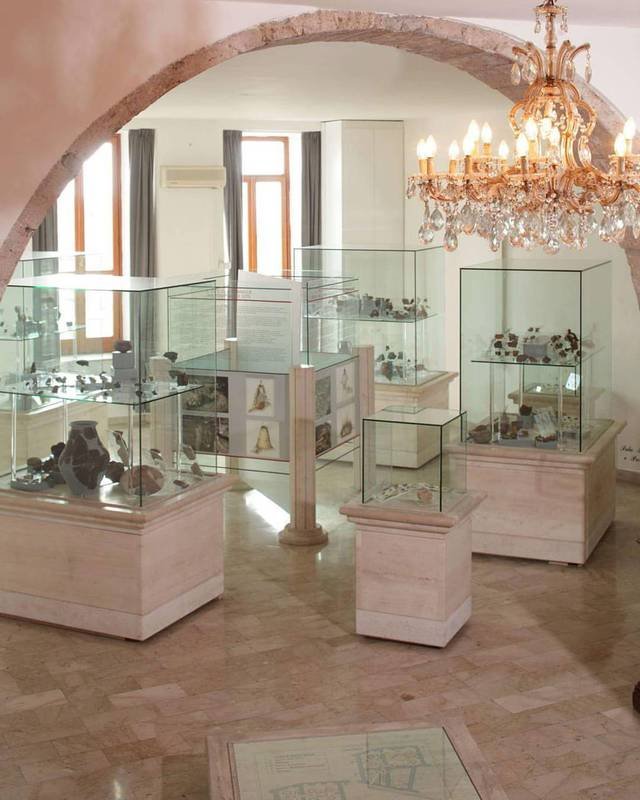
The first section is dedicated to Prehistory and Protohistory, and gathers Paleolithic finds together with household objects and pottery of the Iron Age. The limestone and flint artifacts found near the hill of Selva dei Muli, an isolated rise in the plain west of Frosinone, document the first traces of presence in the territory, dating to the Lower Paleolithic, roughly 250,000 years ago. Stop for a moment on that figure. It's not just any date: it means that on the threshold of the Sacco valley walked hominids who were not yet Homo sapiens, and that this hill was chosen and chosen again by human groups for 2,500 centuries.
Selva dei Muli: The Eneolithic Village
During the Eneolithic, that is, the third millennium and the early centuries of the second, again near Selva dei Muli an extensive village of huts developed, bounded by a ditch. The digs followed an almost straight ditch over 250 meters long, with traces of adjacent palisades, running along the contour lines: a structure that archaeologists read not as defensive, but rather as a boundary and a way of managing water. Next to the ditch, pits and slightly sunken huts have been identified.
The investigations took place in two phases: a first campaign between 1979 and 1981 and a second series of research between 2004 and 2010. The published radiocarbon datings place the site in two distinct cultural horizons of the Italian Copper Age, the Gaudo facies and the Laterza facies, with measurements falling around 3120-3010 BC for the first moment and around 2820-2660 BC for the second. Translated: that plateau was inhabited, abandoned and reoccupied over the span of three and a half centuries, by communities with different pottery traditions.
The Pottery and Tools of Selva dei Muli at the Archaeological Museum of Frosinone
The pottery found in the village is mostly coarse-fabric, often with overlapping scales and raised cords. Vessels with thin walls, sometimes decorated with geometric motifs, are rarer. In the display cases you find cups with a handle and small pots, simple forms that tell of everyday gestures: drawing, pouring, storing. Beside them, cylindrical weights with an expanded base, objects the specialists still debate and that in all likelihood served in weaving.
The presence of sickle elements and lava-stone grindstones suggests the practice of agriculture. The faunal remains and the many flint arrowheads, 26 of them counted among the documented points, indicate forms of subsistence based mainly on pig breeding and deer hunting. It's a precise economic picture: you farm, you raise pigs, you hunt deer. It's not folklore, it's the result of crossing archaeozoology with lithic typology.
From the Final Bronze Age to the Iron Age
The passage from Prehistory to Protohistory, marked by the formation of stable and lasting settlements and by the emergence of more complex societies, is documented in Frosinone by several archaeological presences. Many significant finds are referable to the Final Bronze Age, between the 12th and the 10th century BC: in this period, as the pottery and the clay tools found near the Biondi viaduct show, the occupation of the highest and most defensible part of the hill is recorded, the hill on which the Roman city would also develop. Typical of this moment are the biconical vases decorated with zigzag grooves and rows of dots, which you recognize at a glance in the display cases.
With the Iron Age, in which the passage from Protohistory to History proper takes place, the archaeological evidence of Frosinone is distributed over much of today's urban area, indicating diffuse forms of settlement, both on the intermediate rises and in the valley zone crossed by the Cosa river. The city is not born in one point: it is born as an archipelago of scattered nuclei that only later will coalesce.
Fraginale and Fontanelle: Daily Life in the Display Cases of the Archaeological Museum of Frosinone
Particularly relevant and significant are the finds made at the sites of Fraginale and Fontanelle, stably occupied since the 9th century BC. The table and cooking pottery, the stoves for cooking food, the clay tools for weaving and spinning wool document domestic activities. Craft activities, such as ironworking and pottery making, are suggested by smelting slag and the remains of kilns for firing vases. Over time these two sites took on residential, productive and funerary functions together, which is after all how protohistoric villages really worked: people lived, worked and buried their dead in the same area.
The stoves are the most interesting object in this room. They are ugly, they are coarse terracotta, nobody photographs them. And yet they are the material proof that in the 9th century BC, on these hills, someone cooked hot food every day for a family, and that this gesture left a readable trace after 29 centuries.
Room II of the Archaeological Museum of Frosinone: The Archaic Age, the Volsci and the Ernici
The second section gathers several Volscian, Ernican and Etruscan remains from across the province, and it's the part of the museum that gives the most satisfaction to those who want to understand something new. During the 7th century BC some of the zones that had yielded materials referable to settlement contexts undergo a radical change of function, marked by the discovery of tombs that cut through the earlier stratification. These are the first traces of an infiltration from outside, which seem to foreshadow the later and full Volscian occupation of the site. Put in simple words: where people used to live, now they bury. Someone arrived and changed the rules of the space.
Who the Volsci Were
The Volsci are foreign to the original substrate of the Lazio territory and perhaps come from the central Apennine zone. To this day they remain one of the pre-Roman peoples least investigated on the archaeological level, and that is why the funerary assemblages of Frosinone dating between the end of the 6th and the 5th century BC, attributable to the stable settlement of the Volsci, are of particular interest. In the Roman literary tradition the Volsci are the enemies par excellence of the early republic, the ones Coriolanus measures himself against in Livy's account. In archaeological reality they are a people we know very little about, and every excavated tomb is worth a chapter.
The Volscian Funerary Assemblages of the Archaeological Museum of Frosinone
The elements making up these assemblages, found in pit-type tombs covered with large terracotta tiles or in cist tombs formed of stone slabs, consist mostly of ceramic table or kitchen ware: bowls and jugs for consuming food and drink, pots for storing or cooking food. There are also some miniature vases with a function not real but symbolic, perhaps tied to funerary rites, and, in one case, iron weapons, which generally signal warrior individuals of high social rank.
Look closely at the miniature vases. They are tiny, they look like toys, and yet they are one of the most eloquent documents in the whole room: someone specially made a table service that couldn't hold anything, because the deceased no longer needed to eat but the community needed to behave as if he did. It's theology in miniature, fired in a clay kiln of the 5th century BC.
The Tombs of De Matthaeis and Fontanelle
The urban digs have yielded, in the Fontanelle zone near the Cosa river, an imposing Volscian necropolis: 49 tombs were identified, investigated starting in 1999 and then in the spring of 2000, in a settlement spanning the end of the 8th to the 4th century BC. The typical assemblages included a bowl, a small amphora and a smaller vase placed next to the skull. In some burials there were objects that qualify the deceased, a spear for the warrior, a strigil as a sign of rank. Many of those materials still await restoration and display, and the museum plans to dedicate new rooms to them.
This is the information that changes how you visit the Archaeological Museum of Frosinone: what you see in the display cases is the tip of an iceberg that the storerooms have kept for a quarter of a century. Ask the staff, who are well prepared on this and happy to talk about it.
The Valle Antefix, the Centerpiece of the Archaeological Museum of Frosinone
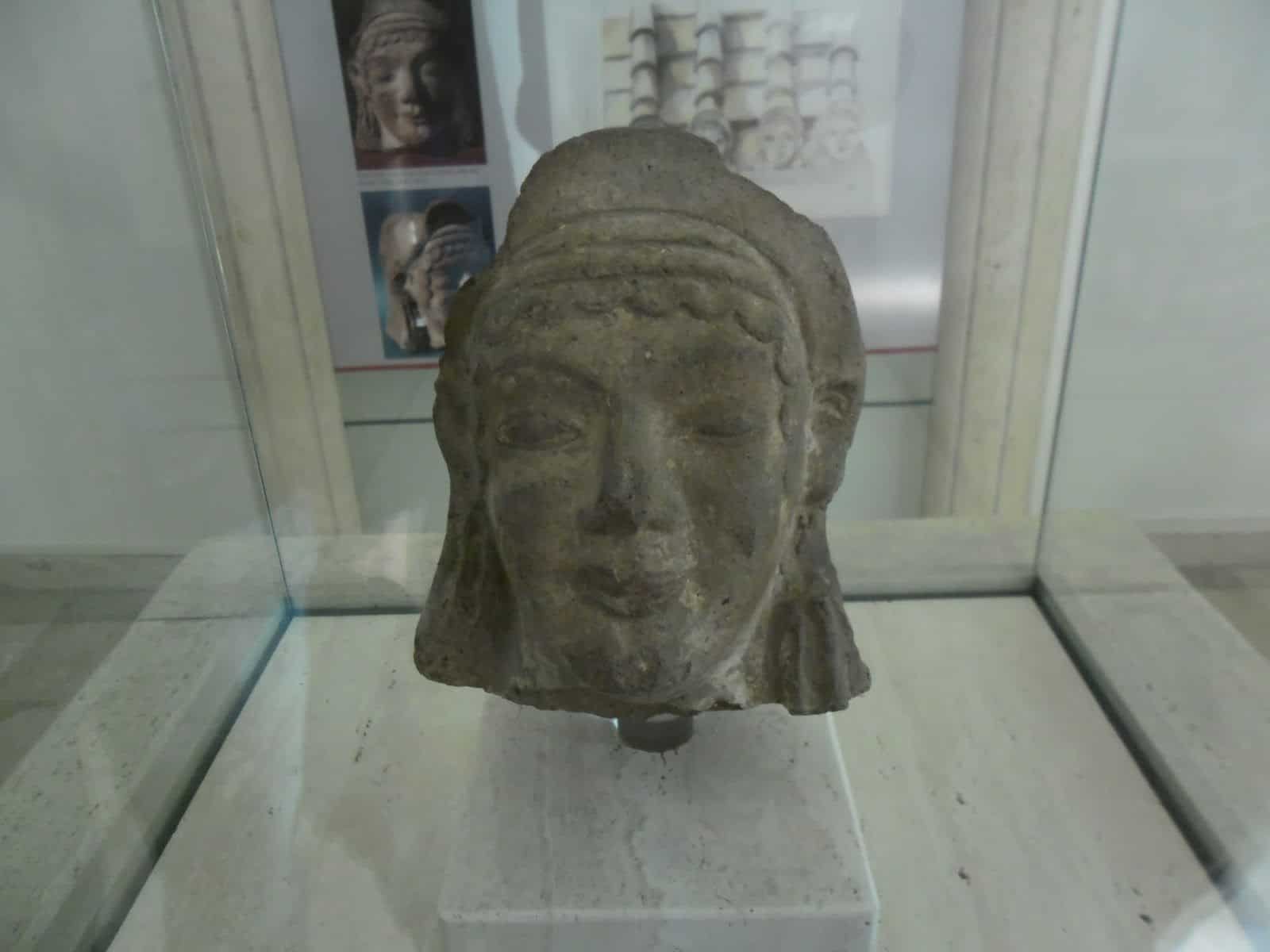
The single most important object of the archaic section is the Valle Antefix, found in Frosinone in 1926 on Via Ferrarelli. The piece depicts a female head datable to the last decades of the 6th century BC, made in a mold and derived from a model of Etruscan origin. It must have belonged to the terracotta decoration of a roof, perhaps of a temple of the Etruscan-Italic type: antefixes were the elements that closed the ends of the roof tiles along the eaves, and in the sanctuaries of central Italy they bore divine heads, gorgons, silens, maenads.
What the piece attests is more important than the piece itself. Its stylistic traits document the early penetration toward the south, along the inland route of the Sacco valley, of models and craftsmen coming from the Etruscan area. It means that in the late 6th century there already existed a cultural axis that ran from Etruria and Tyrrhenian Lazio down toward the Liri and Campania, and that in Frusino there was a clientele able to pay for a roof decorated in the Etruscan-Italic fashion. A temple, in short. Nothing else remains of that temple. A full-size reproduction of the antefix is displayed in the room.
Ernici, Etruscans and Inland Southern Lazio
The data from Frosinone that can be linked to the process of Volscian infiltration and occupation are integrated with a series of archaeological testimonies from other sites in inland southern Lazio, in particular Boville Ernica, Patrica and San Giorgio a Liri. These are mostly weapons, personal ornaments and pottery datable from the end of the 7th century BC, strongly characterized from the typological point of view and indicative of a material culture distinct from that attested for the part of Lazio historically occupied by the Latins.
Here the museum does something that big museums often don't: it lines up the neighbors. The Ernici occupied the high-elevation centers on the ridge, and whoever has seen the polygonal walls of Alatri or Ferentino understands at once the difference between a people who build acropolises in cyclopean blocks and one, the Volsci, who leaves us mostly tombs. They are two different archaeologies because they are two different histories.
Room III of the Archaeological Museum of Frosinone: The Roman Age and Ancient Frusino
The third section tells the story of ancient Frusino and the related archaeological evidence, with particular attention to the studies on the amphitheater found toward the Cosa river. The first historical reports concerning Frusino date to the last years of the 4th century BC, handed down by Livy and Diodorus Siculus: after having pushed the neighboring Ernici to revolt against Rome, the Frusinates, stripped of a third of their territory, fall definitively into the Roman orbit, perhaps with the status of citizens without voting rights and administered by praefecti appointed by the urban praetor.
The punishment deserves some thought. Rome doesn't destroy Frusino: it takes away a third of its land and leaves it its life, but takes away its vote. It's the model the republic would apply for two centuries across the whole peninsula, and which explains why Roman Italy was never a colonial empire but a machine of gradual absorption. Frosinone is a textbook case, and the museum presents it without rhetoric.
Patronage and Luxury in Republican Frusino
For the period marking the transformation of Frusino from a Volscian settlement into a Roman center, the archaeological documents attest to the existence of a wealthy clientele using luxury artifacts imported from other centers and refined products of Hellenizing taste. This is the case of the bronze mirrors, two examples of probable Praenestine production, and of the pottery from funerary contexts datable from the later 4th century BC: furnishings for cosmetics, like the lekythos, and for the symposium, like the kylix and the krater.
The Praenestine mirrors are a precious clue. Palestrina, ancient Praeneste, was by far the most refined center in inland Lazio for bronze working, and its engraved mirrors traveled along the valleys. Finding two in Frusino means that the local elites were buying where the higher-ranking elites were buying. Whoever wants to see the other end of that thread can stop by the Archaeological Museum of Palestrina, which displays Praenestine production in the sanctuary of Fortuna Primigenia.
The Walls, Via Latina and the Topography of Frusino
Very little remains today of the Roman city. It was surrounded by walls at least from the end of the 3rd century BC, as can be deduced from Livy, who mentions them for the year 202, and it was crossed by Via Latina, the great route linking Lazio to Campania through the interior, avoiding the Pontine marsh. Traces of the walls have been identified near the intersection of Corso della Repubblica and Via Amendola: go by there, even just to grasp how far below the acropolis the perimeter ran.
Strabo, in his Geography, mentions Frusino at seven miles from Ferentinum, and that measure conveys the nature of the place better than any description: a station along a road, a node in a chain of centers resting on the valley. Via Latina had to cross the Cosa on a bridge, and precisely in that crossing zone, between the end of the 1st and the beginning of the 2nd century AD, the amphitheater is located.
The Amphitheater of Frusino and the Reconstruction Model at the Archaeological Museum of Frosinone
The amphitheater is the most important Roman monument of the city, and it is also the one that almost no visitor expects to find. It was intercepted in the 1960s, in 1965, during building works in the lower zone toward Viale Roma. The surviving structures, badly altered by modern interventions, belong to the substructure of the cavea, that is, the part intended for spectators, perhaps made in Frosinone of a single order of seating. The Archaeological Museum of Frosinone displays a reconstruction model of it that on its own is worth the visit to the third room, because it puts back on its feet what in the city is hard to read.
The building had the typical elliptical plan, with dimensions indicated at around 80 meters by 60 and an estimated capacity of about 2,000 spectators. At the ends of the major axis opened the main entrances to the arena, the central space in which the munera took place, that is, the gladiator fights, and the venationes, the combats with wild beasts. 2,000 seats for a provincial city is a lot: it means the amphitheater served a catchment wider than the urban center, and that the investment made political sense as well as recreational.
The Sculptures of Piazza Garibaldi and the Tomb of Sant'Angelo
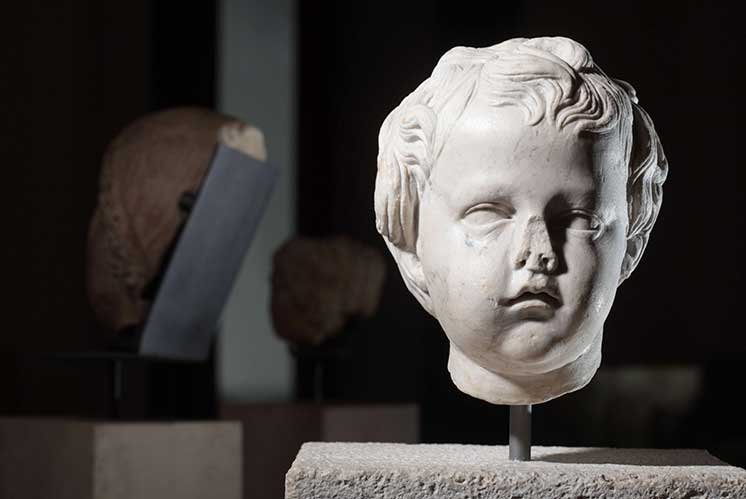
Among the testimonies of the imperial age, the museum displays the marble sculptures found near Piazza Garibaldi: a boy's head and a statue of a figure in military lorica, datable to the 1st century AD, which in all probability depicts an emperor or a general. The sculpted lorica is a well-known statuary type and served a single purpose, declaring authority: whoever wears it in the marble of a provincial square communicates that Rome is present here too.
Then there is the funerary monument at Sant'Angelo, the tomb of a well-off family, which had a curious second life: in the medieval period it was transformed into a place of worship. It's a frequent fate in Italy and always instructive. A pagan tomb becomes a Christian chapel because it was the only building left standing, and the continuity of use saves the structure far more than piety for the ancient.
The construction of the amphitheater and the other archaeological testimonies that have come down to us are indications of the carrying out of demanding building and ornamental activities, public and private. They show that Frusino, remembered in one of Juvenal's Satires as a quiet and cheap place, kept a certain vitality even in the imperial age.
Room IV and the Educational Spaces of the Archaeological Museum of Frosinone
Besides the main exhibition rooms, the museum installation includes a space reserved for temporary exhibitions, Room IV, and a small audiovisual room set up for educational activities. Room IV hosts rotating shows, often built around groups of materials from the urban digs or around themes of the territory: before leaving it's worth asking what is on display, because in a museum of this size a well-made temporary show can be worth as much as the permanent collection.
The small audiovisual room is where the museum really works with schools, and those arriving with children should ask if it's available during the visit. The museum has organized workshops for children and teenagers and workshops for adults for years: they are scheduled activities, so the right question to ask when booking is if your day coincides with an activity.
The External Visit Points of the Archaeological Museum of Frosinone
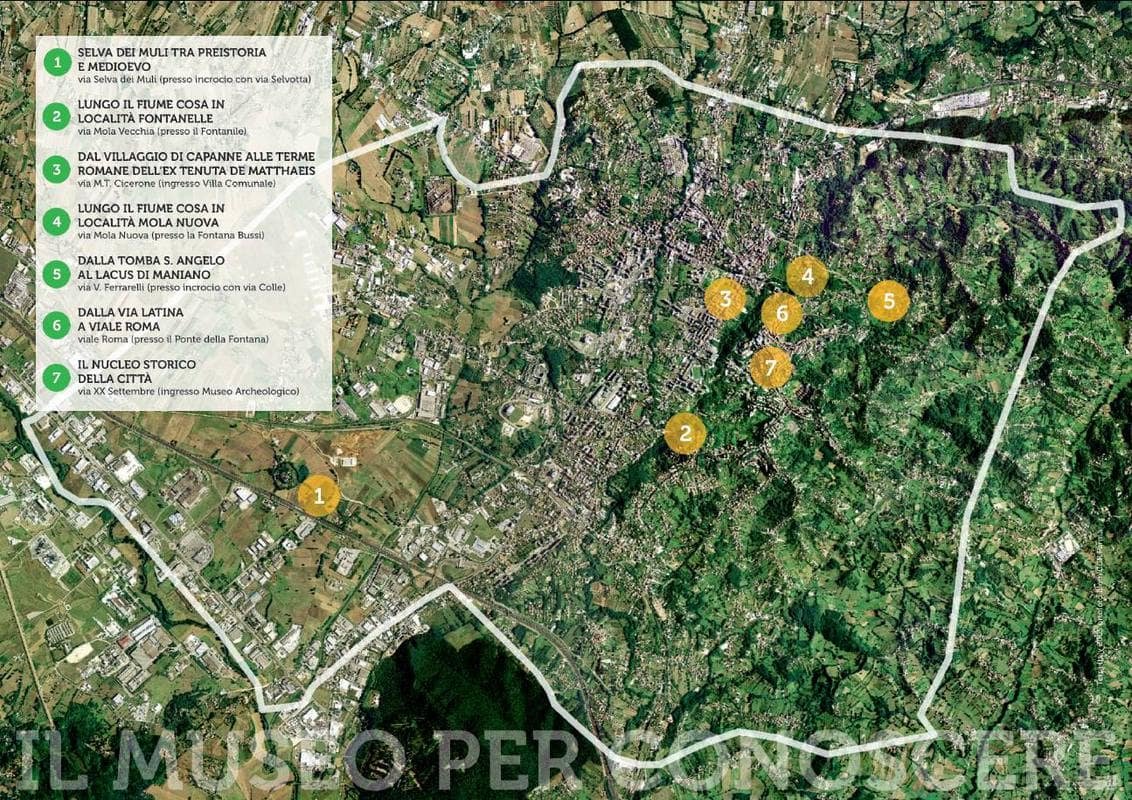
The museum doesn't end inside the museum, and it's perhaps the most valuable thing. New documents keep adding to the groups already held, thanks to acquisitions from private individuals, chance discoveries and further investigations at the Amphitheater, the Ponte della Fontana, the Sant'Angelo Tomb and the Bell Tower of Santa Maria, already partly open to visitors as external visit points of the Archaeological Museum of Frosinone. In practice: the visit can be widened into an urban archaeological walk, and it's best to ask at the ticket office which points are accessible on the day you choose.
The Ponte della Fontana
The Ponte della Fontana marks the point where Via Latina entered Frosinone from the north, crossing the Cosa. It's a threshold zone, the kind that in urban archaeology always yields a lot, and in the area stone pavements have emerged along with materials that signal intense activity. Those arriving by car pass right next to it without noticing, which is more or less the fate of all the archaeology of the lower city.
The Cathedral Bell Tower, the Highest Point of Frosinone
The bell tower of the cathedral of Santa Maria Assunta stands on the highest point of the city, at 291 meters above sea level, and is 62 meters tall. It has three superimposed tiers of two-light windows supported by white marble columns, and is crowned by an octagonal small dome. Local sources date it to the 1500s and describe its style as Romanesque, with the reuse of older materials. In the summer of 2026 the bell tower was restored and made safe, and the blessing of the structure took place on July 27, 2026 in the presence of Archbishop Santo Marcianò and Mayor Riccardo Mastrangeli.
The museum organizes guided visits to the bell tower, and they are the best chance to understand the ancient topography: from up there you read the spur of the acropolis, the Cosa valley, the line of Via Latina and the crown of the Ernici Mountains. The climbs take place on specific dates and by reservation: it's exactly the kind of thing to ask along with the ticket, not on the day itself.
Frusino in the Ancient Sources
An archaeological museum is better understood if you know what the ancients said about the place. On Frusino the sources are few and all interesting.
Livy and Diodorus: The Punishment of 306 BC
Livy and Diodorus Siculus tell the episode that brings Frusino into the Roman orbit in the last years of the 4th century BC: the Frusinates push the Ernici to revolt against Rome and are punished by the removal of a third of their land. Livy returns to the city also for the year 202 BC, and that mention is the one from which the existence of a circuit of walls at least from the end of the 3rd century is deduced.
Strabo and the Measure of Seven Miles
Strabo places Frusino seven miles from Ferentinum along Via Latina. Seven Roman miles are a little over 10 kilometers: the distance between two stages of a day's march, the rhythm on which the road network of the republic was built.
Juvenal and the House That Costs Little
The tastiest passage is in the third Satire of Juvenal, at lines 223 and 224. Umbricius, the character who leaves Rome in disgust, lists the places where for the same sum that in Rome you pay as the annual rent of a hole without light you can buy a whole house: Sora, Fabrateria, Frusino. The poet isn't paying a tourist compliment, he's doing a real-estate calculation. But the result, for us, is the picture of a quiet and cheap little town in the early imperial age, and one of the few literary mentions that give Frusino a character and not just a name on a list.

A Curiosity About the Archaeological Museum of Frosinone
The curiosity I like best concerns a material that doesn't exist in Frosinone and never has: obsidian. Among the materials of Selva dei Muli, obsidian artifacts have been identified, three pieces in the 2004-2010 excavation campaigns and four others, between flakes and a core, in the 1979-1981 research. Obsidian is volcanic glass, and in prehistoric Italy it comes from a very small number of island deposits. In the Sacco valley there isn't a gram of it.
The meaning is enormous and should be said calmly. It means that an Eneolithic community settled on a hill in Ciociaria, 5,000 years ago, had access to an exchange network that brought up here a prized material that had arrived by sea and then by land over hundreds of kilometers. They were not isolated farmers scraping by in a valley floor: they were a node, however peripheral, in a circulation system that covered the Tyrrhenian. The provenance analyses on the Selva dei Muli samples have been published in scientific venues, and they are the kind of research that never ends up on the display case labels.
There is a second curiosity worth keeping together with the first: the hill of Selva dei Muli was frequented in the Lower Paleolithic, 250,000 years ago, and then again in the Eneolithic, 5,000 years ago, and then again in the Middle Ages with a castle. The same height, chosen and chosen again across geological eras. In archaeology it is called settlement persistence, and when it is this striking it means that spot has an objective quality, water, visibility, control of the passage, that human beings recognize regardless of the technology they have in hand.
One Thing Nobody Tells You About the Archaeological Museum of Frosinone
Nobody will tell you that the museum you see is half of the museum that exists. The 49 Volscian tombs of Fontanelle and the materials from the De Matthaeis district make up a heritage that, in large part, still awaits restoration and display. New rooms are a declared goal of the administration, but the time of municipal archaeology is the time of resources: you need restorers, you need square meters, you need staff. In the meantime that material is in storage.
The practical consequence for the visitor is twofold. On one hand it's best to lower expectations about quantity: the main exhibition rooms are few and take an hour to walk through. On the other it's best to raise them about the quality of the conversation: the staff of the Archaeological Museum of Frosinone know those storerooms, and if you arrive with a precise question, for example on Volscian tomb types or on assemblages with a strigil, you get answers that no panel gives you. It's a museum where human mediation is worth more than the apparatus.
I'll add a second thing you won't read anywhere. The fact that urban digs keep producing results means that the archaeological map of Frosinone is still moving. The Fontanelle and De Matthaeis zones have yielded a great deal in recent decades about the pre-Roman age, in particular about the history of the Volsci, and every building site in the city is a potential test trench. Whoever visits the museum today sees a provisional snapshot of open research, not a closed balance sheet. It's a rare condition and worth being aware of while you look at the display cases.
My Advice for Visiting the Archaeological Museum of Frosinone
Tip number one is organizational and allows no shortcuts: call ahead. Access is indicated by reservation, guided visits require 48 hours' notice, and a civic museum of this size can change its opening for service reasons without any portal noticing. A call to +39 0775 2651 or to the direct number +39 0775 212314, or an email to museo@comune.frosinone.it, solves in three minutes what would otherwise become a wasted two-hour trip.
Tip number two is about method: don't visit the Archaeological Museum of Frosinone on its own. Treat it as the head of a half-day itinerary that includes the external points, that is, the amphitheater toward Viale Roma, the Ponte della Fontana, the tomb of Sant'Angelo and the cathedral bell tower. The museum hands you the keys to the reading, the city shows you the locks. Done in this order, the afternoon works. Done the other way around, you go home with the feeling of having seen four stones in a parking lot.
Tip number three is about the calendar. Saturday afternoon and the first Sunday of the month are the only slots when the museum opens after lunch according to the municipal hours, and they are also the moments when the upper city is alive. Those coming from Rome for the day should aim for Saturday: morning by train or by car, museum, lunch in the historic center, afternoon at the external archaeological points, back in the evening. On weekdays, with only the morning slot, the day gets tight.
The fourth tip is the one I always give and almost nobody follows: take 20 extra minutes in the first room. Prehistory is the section everyone rushes through to get to the Romans, and it's actually the section where this museum has its most original material. You see Romans everywhere. An Eneolithic village with a ditch and obsidian you see here.
Another Well-Known Fact, Yet Rarely Cited
That Frosinone was a Roman city, everybody knows, or almost. What is rarely mentioned is that it gave the Church two popes, father and son, a unique case in the history of the Roman papacy. Hormisdas was born in Frosinone, son of a man named Justus. He was a deacon under Pope Symmachus, was elected bishop of Rome on July 20, 514 and died on August 6, 523. Before entering holy orders he had been married and had a son, Silverius.
That son in turn became pope: Silverius, also born in Frosinone, was elected on June 8, 536 and remained in office until March 29, 537, when his successor Vigilius was consecrated. His end was tragic. In February 537, during the Gothic siege of Rome, Silverius was accused of treason and deposed at the will of Belisarius. Sent into exile in the East, he returned to Italy and was confined on Ponza, where he died. His liturgical memorial falls on June 20, and Silverius is co-patron of Frosinone together with his father.
From the pontificate of Hormisdas there remains a fact of European scope: the end of the Acacian schism. With the famous Libellus fidei, the so-called Formula of Hormisdas, in 519 Constantinople returned to communion with Rome after 35 years of rupture. The father's epitaph was written by the son, and it says that Hormisdas healed the body of the homeland torn by schism. A man born in this valley closed the first great fracture between the Christian East and West: it's a fact well known to specialists and strangely absent from the common perception of the city.
The Right Photo to Take at the Archaeological Museum of Frosinone
Inside the museum there is only one photograph that works, and it's not the Valle Antefix. It's the reconstruction model of the amphitheater. Frame it at three-quarters, low, at the level of the arena, so that the ellipse stretches in perspective and you can see the relationship between the cavea and the central space. It's the only image you can take home in which Roman Frusino still stands, and placed next to a photograph of the real remains toward Viale Roma it tells the whole story of the ancient city in two shots. Check the rules on photography, though: in civic museums photography without flash is normally allowed, but it's a courtesy to ask at the ticket office.
Outside the museum the real photo is another one, and it's the one for which it's worth climbing to the top of the bell tower when the guided visits are active. From 62 meters up, on the highest point of the city at 291 meters of elevation, you take in the spur of the acropolis, the furrow of the Cosa below and the barrier of the Ernici Mountains in the background. The best light is that of late afternoon, when the raking sun separates the reliefs and the historic center stops being a mass of roofs and becomes readable as a plan.
If the bell tower isn't accessible, the fallback is good anyway: the narrow stretch of lanes between Via XX Settembre and the cathedral, photographed from the side with the bell tower closing the perspective at the end. It's the image that best conveys the nature of the quarter, a ridge-top historic center, compact, vertical, which survived a bombing that wiped out half of it.
Some Important Events That Happened Here in History
The first event is the Roman punishment of the last years of the 4th century BC. The Frusinates push the Ernici to revolt and Rome deprives them of a third of their territory, incorporating them without voting rights under praefecti appointed by the urban praetor. It is the act that ends the city's Volscian autonomy and opens its Roman history, and it is documented by Livy and Diodorus Siculus.
The second is the construction of the amphitheater between the end of the 1st and the beginning of the 2nd century AD, in the lower zone where Via Latina crossed the Cosa. 2,000 seats in a provincial town are a notable building effort, and they signal a community with resources and with ambitions of representation. The monument was rediscovered in 1965, during building works, and today appears badly altered by modern interventions: the substructure of the cavea is what remains.
The third event dates to 1926: on Via Ferrarelli the Valle Antefix re-emerges, the terracotta female head of the late 6th century BC that is still today the symbol piece of the city's archaeological heritage, and which documents the existence of a place of worship in the Etruscan-Italic taste of which nothing else has survived.
The fourth is the most painful. On September 11, 1943 the bombings hit the historic center and the cathedral of Santa Maria Assunta: part of the facade collapsed and a nave was broken through. The bell tower held, suffering limited damage to the clock faces, which stayed stopped at 22:10. Upper Frosinone paid for the war with an almost total destruction, and the fabric you walk through today climbing to the museum is in large part a postwar reconstruction, carried out also with the contribution of emigrants.
The fifth event is recent and directly concerns the visitor's itinerary: the restoration and securing of the cathedral bell tower, blessed on July 27, 2026 by Archbishop Santo Marcianò in the presence of Mayor Riccardo Mastrangeli. After decades, the vertical symbol of the upper city is back in order.
The sixth, finally, is archaeological and ongoing: the urban digs at Fontanelle and in the De Matthaeis zone, with the 49 Volscian tombs investigated starting in 1999, have changed what we knew about the Volsci in the middle Sacco valley. It is the only event on this list that doesn't yet have an end date.
Who Has Passed Through the Archaeological Museum of Frosinone
The question needs to be turned around: before asking who has passed through the museum, it's best to ask who has passed through here, because the museum keeps the traces of exactly that passage. And the traffic, in this valley, has been imposing.
The Volsci passed through, arriving in all likelihood from the central Apennine area between the 7th and the 6th century BC, and their dead are in the display cases of the second room. Etruscan craftsmen and models passed through, who went up the Sacco valley to leave here the antefix of Via Ferrarelli. The Ernici passed through, neighbors and fatal allies, whose revolt cost Frusino a third of its land. Roman soldiers passed through marching on Via Latina, the road that went down through the interior toward Campania.
Among the documented names, the first is Juvenal, who in the third Satire writes Frusino next to Sora and Fabrateria as a place where you buy a house for what in Rome costs a year's rent for a dark room. The second is Strabo, who in the Geography fixes the distance from Ferentinum at seven miles. The third and the fourth are Livy and Diodorus Siculus, who tell the end of the city's independence. These are literary passages, but for a provincial city of ancient Italy they are worth as much as a state visit.
Then there are the two popes, Hormisdas and Silverius, father and son, both born here and patrons of the city: the first closed the Acacian schism in 519, the second died in exile on Ponza after being deposed during the Gothic siege of Rome in 537. The Archaeological Museum of Frosinone has no display cases on them, because its chronology stops earlier, but the cathedral a few steps away keeps their memory and their statues.
Finally the archaeologists passed through, and they should be named because without them there would be nothing to see: the excavation campaigns at Selva dei Muli between 1979 and 1981 and then between 2004 and 2010, the urban investigations of Fontanelle and De Matthaeis between 1999 and the early 2000s, the work of reacquisition that put back together collections scattered across different storerooms. The museum is their monument, much more than the Volsci's.
How Long the Visit to the Archaeological Museum of Frosinone Lasts
One hour, an hour and a quarter if you read the panels carefully. With a booked guided visit you comfortably reach an hour and a half, and it's worth the cost because the added value here is the storytelling. If you add the external points, that is, the amphitheater, the Ponte della Fontana and the tomb of Sant'Angelo, count on a full half day, transfers included. With the climb up the bell tower, when it's on the calendar, you reach five hours in total.
The Archaeological Museum of Frosinone With Children
It works, on two conditions. The first is duration: 60 minutes is the limit beyond which a child under 10 switches off, and this museum lends itself perfectly to a compact visit. The second is mediation: the museum has organized workshops for ages 5-11 and educational activities in the small audiovisual room for years, and with a workshop in progress the experience changes radically in character.
The objects that catch the youngest are predictable and I list them for those who want to prepare the visit: the flint arrowheads, the miniature vases of the Volscian assemblages, the stoves for cooking food and the model of the amphitheater with the gladiators. Start there and build the rest around it. Children under 6 get in free.
Accessibility and Services at the Archaeological Museum of Frosinone
The Comune indicates free admission for people with disabilities and for companions. The museum occupies a historic palazzo in the medieval fabric of the upper city, with the difficulties that implies: sloping lanes, uneven paving, interior spaces arranged over several levels. Those with specific access needs must report them when booking, which is required in any case, so that the staff can organize the visit in the best way. The last stretch of approach also needs planning, because it's the most demanding part of the whole route.
How Much It Costs and Which Cards Are Valid at the Archaeological Museum of Frosinone
The full ticket indicated by the Comune di Frosinone is €5, the reduced €3 for under 26, over 65 and groups of at least 10 people. Free admission applies to children under 6, people with disabilities and companions, tour guides and accredited journalists. Organized school groups have discounted rates. Tickets are bought at the ticket office.
On the subject of cards I want to clear up a misunderstanding I see often. The MIC card is valid exclusively in the Civic Museums System of Roma Capitale: here, since we are in a municipal museum of the Comune di Frosinone, it is of no use. In the same way, the free openings on the first Sunday of the month concern the state museums of the Ministry of Culture, and this museum is not a state one: the Sunday opening indicated by the Comune concerns the first Sunday of the month as an opening day, and about any free admission it's best to ask for confirmation when you book. The museum's promotional initiatives, including extraordinary evening openings on the Night of the Museums, are communicated from time to time.
What to See Around the Archaeological Museum of Frosinone
10 minutes on foot away is the cathedral of Santa Maria Assunta with its bell tower, built according to tradition on the area of the ancient acropolis. The rest of the historic center can be walked in an hour: Piazza Garibaldi, where the marble sculptures displayed in the museum come from, the lanes on the ridge, the lookouts over the valley.
Outside the city, Ciociaria offers one of the densest archaeological and monumental systems in Lazio, and from Frosinone you can reach everything within half an hour by car. To the north are the acropolises with polygonal walls of Alatri and Veroli, the city of the popes with its cathedral museum, the walled village of Fumone and the thermal baths of Fiuggi. A short distance away is Ferentino, where the Roman theater completes the picture of the valley's buildings for public shows.
To the south and east open Ceccano, Castro dei Volsci, which carries in its name the people whose tombs the museum displays, Boville Ernica, from which come materials compared with those from Frusino, and farther away Arpino, birthplace of Cicero and Marius, and the Montecassino Abbey. Those who want to stay on the Volscian theme can also look at the page on the museums of Priverno, in the territory the Volsci occupied toward the coast.
When to Go and When to Avoid the Archaeological Museum of Frosinone
The best period is spring, April and May, or early autumn. The upper city in July and August is an oven, the climb from the lower part becomes a physical test and the rooms, in a historic palazzo, are not always air-conditioned like a national museum. In winter the historic center is deserted and has a severe appeal of its own, but the short days squeeze the external itinerary.
Avoid Sundays that are not the first of the month, because the ordinary opening doesn't include them, and avoid Monday, which doesn't appear among the public opening days. Also avoid arriving without having given notice: access by reservation is not a bureaucratic formality but the way this museum organizes its staff.
Quick Questions About the Archaeological Museum of Frosinone
Where Is the Archaeological Museum of Frosinone
At Via XX Settembre 32, in the historic center of Frosinone, in the upper part of the city, a short distance from the cathedral of Santa Maria Assunta.
How Much Is a Ticket to the Archaeological Museum of Frosinone
The Comune di Frosinone indicates €5 for the full ticket and €3 for the reduced one, reserved for under 26, over 65 and groups of at least 10 people. Have the fees confirmed when you book.
What Are the Hours of the Archaeological Museum of Frosinone
According to the Comune: Tuesday to Friday from 9:00 to 13:00, Saturday from 9:00 to 13:00 and from 15:00 to 19:00, the first Sunday of the month from 9:00 to 13:00 and from 15:00 to 19:00.
Do You Need to Book to Visit the Archaeological Museum of Frosinone
Yes. Access is indicated by reservation, and guided visits must be requested at least 48 hours in advance by phone or by email.
Is the Archaeological Museum of Frosinone Closed on Monday
Monday doesn't appear among the public opening days indicated by the Comune. The fixed closures are January 1, May 1 and December 25.
What Is the Phone Number of the Archaeological Museum of Frosinone
The municipal switchboard is +39 0775 2651, the museum's direct number is +39 0775 212314 and the email address is museo@comune.frosinone.it.
How Much Time Do You Need to Visit the Archaeological Museum of Frosinone
One hour for a self-guided visit, an hour and a half with a guide. Half a day if you add the external archaeological points in the city.
What Is There to See at the Archaeological Museum of Frosinone
Three sections: Prehistory and Protohistory, the Archaic Age with the Volsci, the Roman Age with ancient Frusino. Plus Room IV for temporary exhibitions and the small audiovisual room.
What Is the Most Important Piece in the Archaeological Museum of Frosinone
The Valle Antefix, a terracotta female head of the late 6th century BC found on Via Ferrarelli in 1926, of which a full-size reproduction is displayed in the room.
Can You Take Photographs at the Archaeological Museum of Frosinone
In civic museums photography without flash is normally allowed, but ask about the rules at the ticket office before starting the visit.
Is the Archaeological Museum of Frosinone Suitable for Children
Yes, especially with a booked educational workshop. The museum has organized activities for ages 5-11 for years. Children under 6 get in free.
Is the MIC Card Valid at the Archaeological Museum of Frosinone
No. The MIC card is valid only in the Civic Museums of Roma Capitale. Here we are in a municipal museum of the Comune di Frosinone and the card has no effect.
Is Admission Free on the First Sunday of the Month at the Archaeological Museum of Frosinone
The national first-Sunday initiative concerns state museums. The Comune indicates the first Sunday of the month as an opening day: for any free admission, ask the museum for confirmation.
Is the Archaeological Museum of Frosinone Accessible to People With Disabilities
Free admission for people with disabilities and for the companion is provided. Since it is a historic palazzo in the medieval center, access needs should be reported when booking.
How Do You Get to the Archaeological Museum of Frosinone From the Station
The station is in the lower part of the city, a few kilometers from the historic center. You go up by city bus or by taxi: on foot the slope is demanding, especially in summer.
Can You Visit the Cathedral Bell Tower
The museum organizes guided visits to the bell tower on specific dates and by reservation. The structure was restored and blessed on July 27, 2026.
Where Is the Roman Amphitheater of Frosinone
In the lower part of the city, toward Viale Roma, in the zone where Via Latina crossed the Cosa river. It was intercepted in 1965 during building works.
How Big Was the Amphitheater of Frusino
An elliptical plan of about 80 meters by 60, with an estimated capacity of around 2,000 spectators. The museum displays a reconstruction model of it.
Who Were the Volsci Displayed at the Archaeological Museum of Frosinone
An Italic people foreign to the Lazio substrate, perhaps of central Apennine origin, who stably occupied the site between the end of the 6th and the 5th century BC. They are among the least investigated pre-Roman peoples.
When Was the Archaeological Museum of Frosinone Opened
Established by a resolution of January 18, 1972, installed in 1993 and officially opened to the public on April 9, 1994.
What Is the Difference Between the Archaeological Museum of Frosinone and the One in Palestrina
Palestrina displays the great Hellenistic sanctuary of Fortuna Primigenia and the Praenestine bronze production in a monumental Palazzo Barberini. Frosinone tells the story of a valley community, from prehistory to the Volsci to the Romans, with humble materials and a one-hour route.
Is It Worth Coming From Rome Just for the Archaeological Museum of Frosinone
By itself, no, in all honesty. Included in a Ciociaria day with Alatri, Ferentino or Anagni, yes, and it becomes the key to reading all the rest.
Is There a Luggage Storage or Coat Check
It is a small civic museum: ask when you book and avoid showing up with bulky backpacks.
Is There a Line at the Archaeological Museum of Frosinone
Practically never. It's one of the few museums in Lazio where the problem is not the queue but the opening hours.
The point needs repeating, because it's the reason the phone call is worth it. This is a small civic museum, with few rooms and materials that will never end up on a poster, and that is exactly why it teaches something big museums no longer teach: how the history of a territory is built starting from a potsherd, a stove, a flint point and 49 tombs. If you have a day in Ciociaria, start here at 9 a.m., then go down to the amphitheater and finish on the bell tower. The Sacco valley, seen in that order, stops being a corridor between Rome and Naples and becomes a place with a history of its own, 250,000 years long.
Article written by the editorial team of TourLeaderPro, contact them for Private/Corporate/V.I.P. Tours and Experiences.
Planning a trip to Rome? The English-language guides to visiting the city are on ItalyPlanner.com.