Palestrina National Archaeological Museum
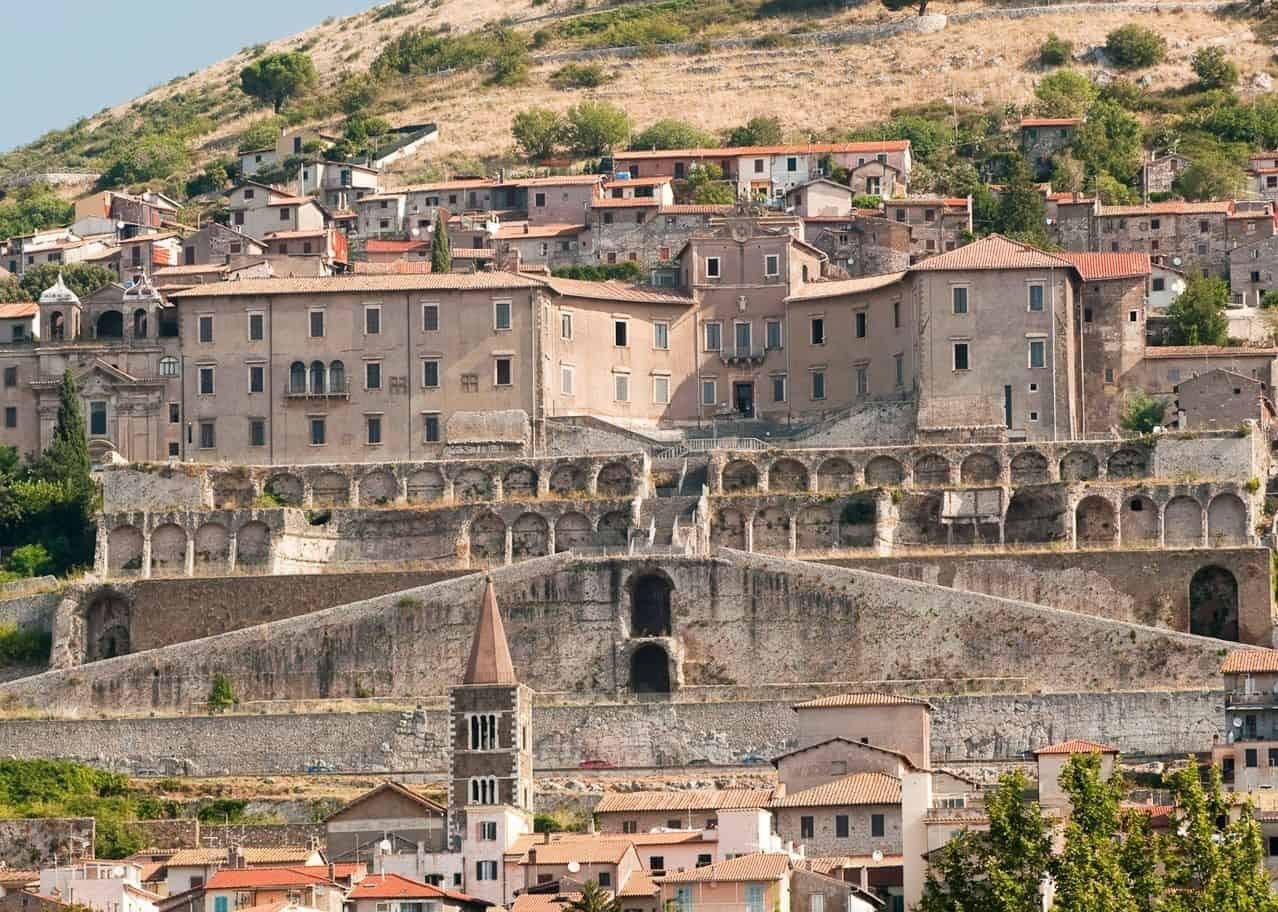
In short. Piazza della Cortina, 00036 Palestrina, Rome Province: the Palestrina National Archaeological Museum occupies Palazzo Colonna Barberini, at the top of the town, and the palace rests on the highest terraces of the Sanctuary of Fortuna Primigenia.
Piazza della Cortina, 00036 Palestrina, Rome Province: the Palestrina National Archaeological Museum occupies Palazzo Colonna Barberini, at the top of the town, and the palace rests on the highest terraces of the Sanctuary of Fortuna Primigenia. The museum is open every day from 9:00 to 20:00 and closes only on January 1 and December 25. The ticket offices close an hour earlier. The archaeological area of the sanctuary, on the other hand, follows solar hours and changes month by month: 9:00-16:00 in January and February, 9:00-17:00 in March, 9:00-18:00 in April, 9:00-18:30 in May, 9:00-19:00 from June to August, 9:00-17:30 in September, 9:00-17:00 in October, 9:00-16:00 in November and December. The ticket that covers the museum and the sanctuary costs €7, with a reduced rate of €2 for visitors between 18 and 25. The forum building complex, down in the town, has a separate €4 ticket and is closed on the second and fourth Sunday of the month. There is a Palestrina combined ticket for €10, valid for two days, and a Palestrina-Nemi circuit ticket for €12, valid for 30 days. You buy tickets at the ticket desk or with the Musei Italiani app. The switchboard answers at 06 9538100. From Rome you get there by Cotral bus from the Anagnina terminal, on Metro line A, or by train to Zagarolo on the line from Termini and then the bus that goes up into town. By car it is 37 kilometers of Via Prenestina, or the A1 motorway with the San Cesareo or Valmontone exit. If you come by car, there is free parking at Piazzale Kennedy, Piazzale della Pace, Piazzale Belvedere and Piazzale Fanfani, and paid parking in the squares of the center.
The complex now depends on an autonomous institute of the Ministry of Culture created in 2024, Musei e Parchi archeologici di Praeneste e Gabii, which brings together the Palestrina museum, the sanctuary area, the forum of ancient Praeneste and the archaeological site of Gabii. Anyone planning the day can pair this reading with the page on tourist attractions and the one dedicated to the Sanctuary of Fortuna Primigenia, which describes in full the architecture buried under the palace.
What the Palestrina National Archaeological Museum really is
The Palestrina National Archaeological Museum is not a provincial museum with four display cases of potsherds. It is the museum of a city that, between the 4th and the 1st century BC, counted as much as Rome in Latium and in certain decades more than Rome: Praeneste exported bronzes all over the Mediterranean, hosted the most consulted oracle in Italy and allowed itself to build, on the side of a mountain, the most ambitious architectural machine of the ancient West before the Imperial Forums. The museum gathers what remains of that city on the spot, and displays it inside the palace that the Colonna first and the Barberini later built by taking over the temple's terraces.
It opened in 1956 and was reorganized in 1998, so in 2026 it turns 70. The collections are spread over several levels, arranged by large themes rather than by strict chronology: the cult of Fortuna, Hellenistic sculpture and Republican portraits, the imperial age, inscriptions, necropolises, the minor sanctuaries of the territory, and at the top, all by itself, the room of the Nile mosaic. The visit is short in meters and long in density: an hour and a half is the bare minimum, two and a half hours is the right measure if you read a few captions, half a day if you add the archaeological area in front of the palace.
Let's say right away what we think: it is the museum with the best ratio between the quality of what you see and the number of people standing in front of it. In 2015 the museum recorded just over 22,000 visitors in a whole year, which is as many as pass in front of the Trevi Fountain on one April morning. In front of the Nile mosaic, which is one of the three or four most important Hellenistic mosaics to survive from the ancient world, on many days there are five people. Whoever has the patience for an hour on the bus buys something that in Rome you can no longer buy with any ticket: the time to look.
Praeneste before the Palestrina National Archaeological Museum
The origins of Praeneste and the myth of Caeculus
The ancient city was called Praeneste and occupied the side of Monte Ginestro, at an altitude of 660 meters, in a position controlling the Sacco valley: from up there you watch over the natural road to Campania, and you can see with your own eyes why Rome took centuries to get its hands on this place. The princely tombs excavated in the 1800s date the settlement to at least the 8th century BC, in a phase when Praeneste was very rich and traded with Etruria, with the Phoenician world, with Egypt.
On the foundation the ancients told three different versions, and keeping them all is more honest than choosing one. One attributed the city to Telegonus, son of Ulysses and Circe. One to an eponymous hero named Praenestus. The third, the most beautiful, to Caeculus, son of the god Vulcan, found as a newborn next to a hearth and raised among shepherds. They are legends, and as legends they should be taken: they tell not where Praeneste came from, but what idea of itself Praeneste had. A city that declares itself the daughter of fire and the granddaughter of Ulysses does not consider itself anyone's suburb.
The war with Rome, Sulla and the year 82 BC
Praeneste fights Rome inside the Latin League, then allies with it, then betrays it again by siding with the Gauls, then obtains citizenship in 90 BC with the Social War. The bill comes due in 82 BC. The city takes the side of Gaius Marius the Younger against Sulla, is besieged, and at the surrender Sulla has the male population massacred and founds a military colony there. It is the last outpost in Italy to be normalized: afterward, Latium no longer has a city able to say no to Rome.
This historical detail helps in reading the sanctuary. The monumental complex that supports the museum dates to the end of the 2nd century BC, so before the Sullan catastrophe, and was in all likelihood paid for by the groups of Praenestine merchants enriched by trade with the East: people devoted to Roman expansion and yet excluded from Roman politics, who invest in architecture what they cannot invest in careers. A sanctuary like this is not born from a religious whim. It is born from a bourgeoisie that wants to write in stone what it is worth.
The Sanctuary of Fortuna Primigenia under the Palestrina National Archaeological Museum
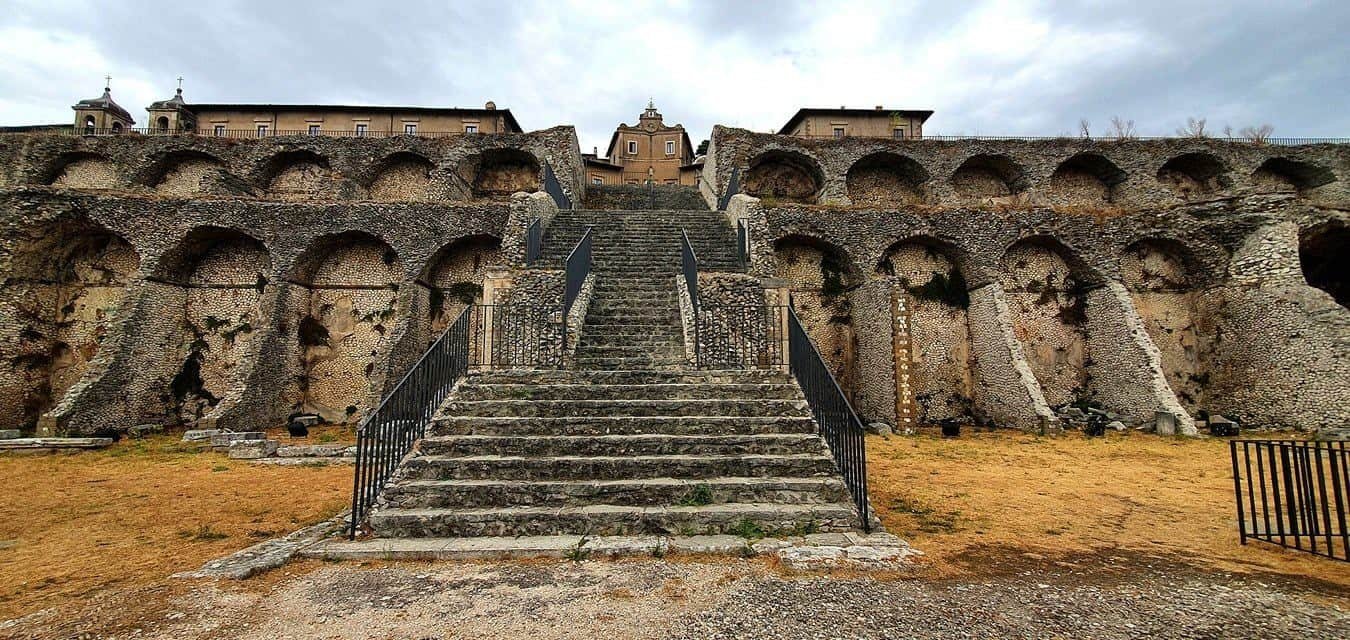
Before going up into the rooms it helps to understand where you are putting your feet, because the Palestrina National Archaeological Museum is literally the lid of a temple. The Sanctuary of Fortuna Primigenia is the greatest complex of late Republican architecture in ancient Italy: six superimposed artificial terraces, connected by ramps and staircases, that turn the side of a mountain into a scenographic machine with a front of almost 200 meters. The idea comes from the Hellenistic East, from the terraced sanctuaries of the Aegean, but the execution is Roman in its material: concrete faced with very fine opus incertum, vaults, arches, and a handling of solids and voids that no other ancient Italian architecture was able to repeat.
The terraces one by one
The first two terraces opened toward the forum of the city and were reached by side staircases, inside walls in polygonal masonry. On the second, five lustral basins lined up, hemispherical nymphaea with reused columns. The third terrace is the one of the two large covered colonnaded ramps, which climb diagonally and meet in the center: Doric capitals, superimposed blind arches, and an effect of forced ascent that the ancient visitor underwent with no choice.
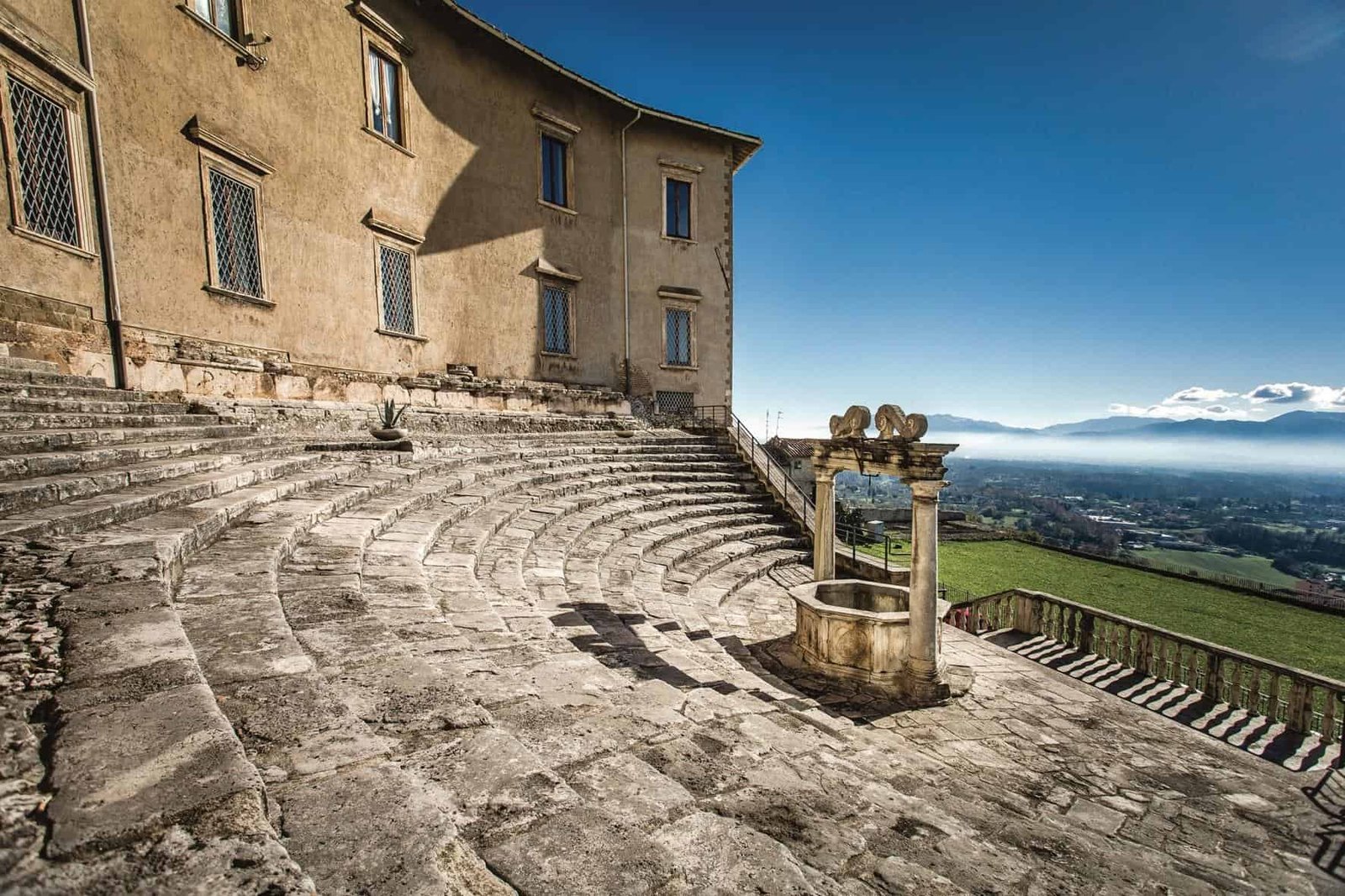
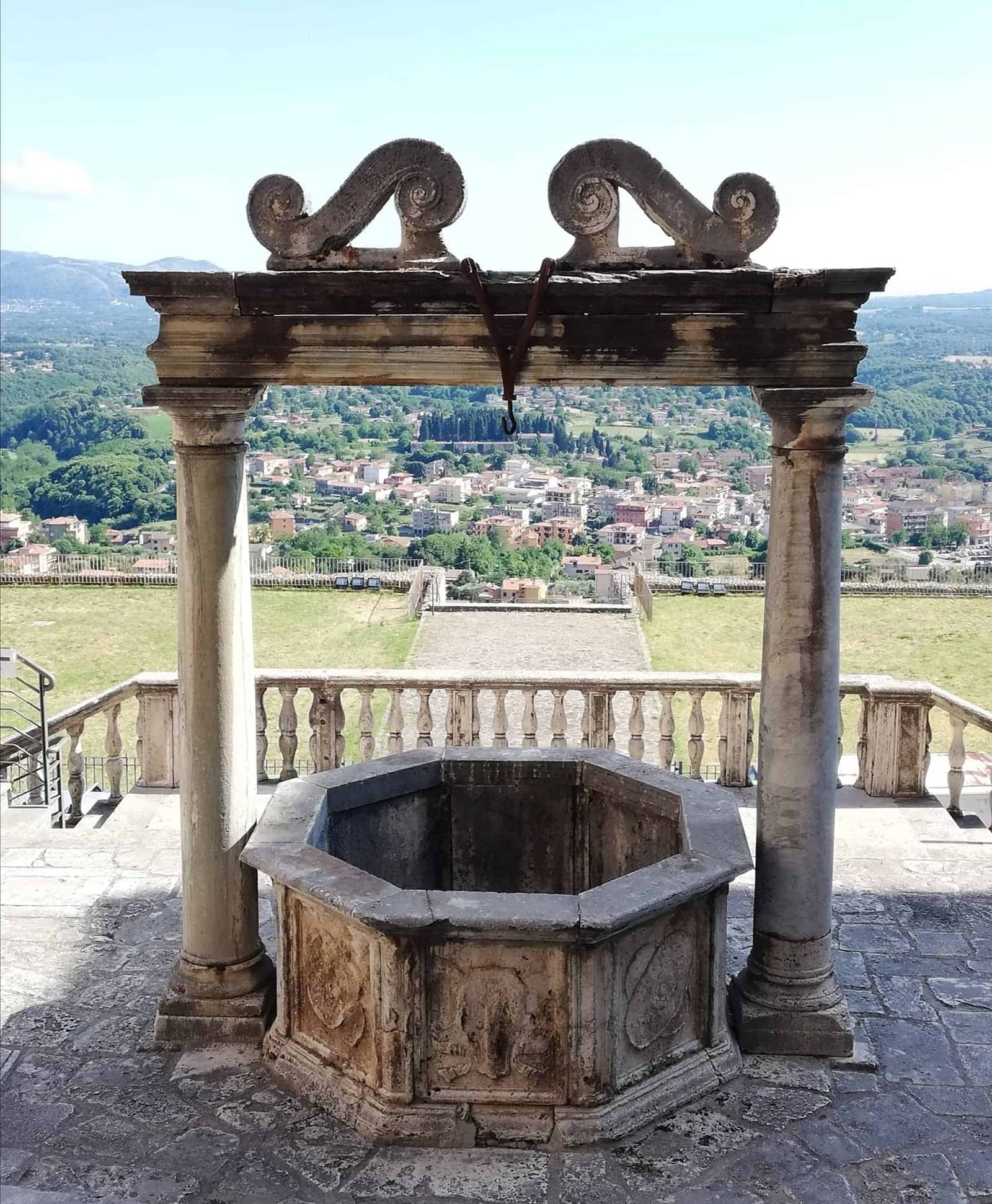
The fourth is the terrace of the hemicycles, the most famous: an Ionic portico at the back, two semicircular exedras covered by coffered annular vaults, and in the middle the sacred well where, according to tradition, the statue of Fortuna nursing the infants Jupiter and Juno was found. The fifth is called the terrace of the fornices, with Corinthian half-columns that frame niches and false doors in alternation. The sixth and last is the cortina square, the U-shaped esplanade closed by a double Corinthian portico, with at the far end a theater cavea crowned by a semicircular portico, and below, the foundations of a small round temple. On that square, and on that cavea, the Colonna and then the Barberini built the palace that now houses the museum: the esplanade in front of the entrance is the ancient esplanade of the sanctuary, not a medieval square.
The oracle of the sortes, the real business of Praeneste
Fortuna Primigenia was not a generic deity of good luck: she was the firstborn goddess, mother and at the same time daughter of Jupiter according to a twisted theology that the ancients themselves struggled to explain, and her sanctuary worked as an oracle. The response was obtained with the sortes, oak wood tablets carved with short phrases, kept inside an olive wood chest. The worshipper did not lay hands on them: the tablet was drawn by a child, who in the rite represented the boy Jupiter. In the imperial age the keeper of the chest became Iuppiter Arcanus, the Jupiter of the chest.
The mechanism explains the economic success of the city. An oracle that answers anyone, with a short and understandable rite, drains pilgrims and money from all of central Italy for centuries. The head of the goddess's cult statue, recovered in the well of the terrace of the hemicycles, is now on the first floor of the museum: one of the few cases in which you can look in the face the economic engine of an ancient city.
The lower sanctuary, the forum and the apsidal hall
The lower part of the complex, down in the town, is the one you visit today with the separate €4 ticket: the complex of the forum buildings of Praeneste, with the basilica, the apsidal hall and the so-called cave of the lots. It is there, and not up in the palace, that between the late 1500s and the early 1600s the Nile mosaic was found, inside an apsidal room that in the meantime had become the cellar of the bishop's palace. Anyone who really wants to understand the relationship between the lower city and the high sanctuary has to make both visits, and it makes sense to do it on the same day using the €10 combined ticket, which is valid for two days and is the most sensible formula for those coming from Rome.
Palazzo Colonna Barberini, the home of the Palestrina National Archaeological Museum
The palace that houses the museum is the long tail of an occupation. In the Middle Ages the Colonna family seizes the city and makes it their stronghold. On the sixth terrace of the sanctuary, that is, on the cavea and the Corinthian portico, the baronial palace rises. In 1298 Pope Boniface VIII razes Palestrina to the ground to bring the Colonna to heel. In 1436 it is the turn of Cardinal Giovanni Maria Vitelleschi to repeat the operation. The city gets back up every time, and in 1571 it becomes a principality.
In the 1600s the Barberini arrive, the family of Pope Urban VIII, and in 1640 Taddeo Barberini has the palace rebuilt in the form you see today, with the large hemicycle at the back that traces, without saying so, the curve of the ancient portico. It is one of the few Italian architectures in which reuse does not hide the original but confesses it: the plan of the palace is the plan of the temple. Since 1956 the upper floors have belonged to the museum, and the choice of placing the archaeological collection here has a logic that goes beyond convenience, because it puts the objects a few dozen meters from the spot where they were found.
An opinion, and I stand by it: the palace is much more beautiful seen from below, walking up the ramps of the sanctuary, than from the esplanade. Anyone who drives all the way to the top misses exactly the effect for which the complex was designed, that is, the climb. If your legs hold up, leave the car at the bottom.
Touring the Palestrina National Archaeological Museum floor by floor
The 1998 layout has a thematic logic: you go up, and on each floor the question the objects answer changes. Anyone who goes in with the idea of getting through in 20 minutes gets the count wrong, because there are 16 rooms and none is filler. Here is the recommended sequence, with the warning that the order of the display cases can change because of works or temporary exhibitions.
The cryptoporticus and the ground floor of the Palestrina National Archaeological Museum
You start from the bottom, in a space that alone would justify the ticket: the cryptoporticus, that is, the covered gallery that in antiquity ran around the highest terrace of the sanctuary and that the 17th-century palace absorbed without demolishing it. Walking in there means walking inside the temple with the palace over your head. On display are architectural fragments, inscriptions and sculptures collected from different points of the city: capitals, cornices, blocks that tell the formal vocabulary of Praenestine architecture. It is also the place to grasp the jump in scale between what you see in a photograph and what you see in person.
The first floor and the cult of Fortuna
The left wing of the first floor, rooms one and two, is dedicated to the cult of the goddess. Here you meet the head of the cult statue found in the sacred well of the terrace of the hemicycles, and above all the colossal statue of Isis-Fortuna, a Hellenistic original from the Iseum near the basilica of the city forum, dated to the 2nd century BC: the garment is in gray marble from the island of Rhodes, and that gray, which looks like a decorative whim, is a declaration of cultural belonging to the eastern Mediterranean. The overlap between Isis and Fortuna is not a late muddle: it is the sign that in Praeneste, in the full 2nd century BC, Egypt was already at home. Anyone who also has the Museum of Civilizations in EUR on the program will find there the natural continuation of the discussion of Egyptian cults in Italy.

Palestrina National Archaeological Museum
The Hellenistic sculptures and the Republican portraits
The next rooms gather Roman copies of Greek masterpieces, honorary statues and portraits of the Republican age. These are the rooms the hurried visitor crosses fastest, and it is a mistake: the Republican portrait is one of the most radical artistic inventions of antiquity, a genre that deliberately gives up beauty to gain authority, and in Palestrina you see examples in which wrinkles, baldness and jawlines are treated as badges of merit. Look at the heads one next to the other and try to imagine them painted, because they were.
The Fasti Praenestini and the Roman sundials
In the fourth room is kept the copy of the Fasti Praenestini, the Roman calendar carved on marble slabs that the scholar Marcus Verrius Flaccus had placed in the forum of the city in the Augustan age: a key document for knowing the Roman festivals day by day, with the comments of Verrius himself. Next to it, the Roman sundials. These are objects that groups look at for three seconds and that deserve three minutes, because they measure a day that was not divided like ours: the Roman hour was the 12th part of the arc of daylight, so in summer it lasted longer and in winter less. Whoever understands this understands why the ancients never arrived late.
The rooms of the imperial age and the triumph relief
In the right wing of the first floor you move on to the imperial age: sculptures, portraits, altars. Among the most discussed pieces is a relief with a triumph attributed to Trajan, in which the proportions of the figures follow not perspective but hierarchy: whoever matters is bigger. It is the entrance door to a very long story, the one that will lead to late antique and then medieval art, and seeing it begin here, in a provincial relief, is worth more than a textbook chapter. There are also altars dedicated to the deified Augustus, to Peace and to Security, which are political documents disguised as devotion.
The Grimani relief of the Palestrina National Archaeological Museum
Among the works of the Augustan age the museum keeps one of the famous curvilinear slabs known as the Grimani reliefs, with a sow nursing her piglets in a landscape of rocks and trees. The other slabs of the series are in Vienna and in Budapest. The theme, animals nursing their young, is the visual vocabulary of the Augustan program: peace, fertility, return to order. It has been suggested that the same sculptors of the Ara Pacis had a hand in the work, and the hypothesis is reasonable given the quality of the marble cutting, but it remains a hypothesis and it needs saying: no ancient document attests it. Anyone who wants to make the comparison should look at the slab here and then at the plant frieze of the Ara Pacis in Rome, with the Praenestine relief still in their eyes.
The inscriptions of the Palestrina National Archaeological Museum
Two rooms gather public, funerary and religious inscriptions. It is the section that visitors skip with the most ease, and the one that, read with a minimum of guidance, gives the people back: the magistrate who pays for the paving, the freedwoman who has her tomb made with her own name carved first, the guild of craftsmen who dedicate to the goddess. Praeneste spoke Latin with its own inflections and left some of the most precious archaic Latin inscriptions in existence. You don't need to know the language: the captions and a bit of slowness are enough.
The second floor: the necropolises, the cistae and the mirrors
On the second floor you enter the tombs. Rooms nine through 11 display grave goods from the 5th to the 3rd century BC, the cippi shaped like a pinecone or a bust that marked the burials, a sarcophagus lid of the 4th century. The star piece of the section, though, is the production that made Praeneste famous in the ancient world: the bronze cistae and the engraved mirrors. The cistae were cylindrical containers for the toilet set, with a lid and figured feet, and the walls were engraved with a burin with mythological scenes. In the 4th century BC Praeneste was one of the main production centers of the Mediterranean.
On those surfaces you read rare versions of Greek and Italic myths, some of which appear in no surviving literary text: they are figurative documents of lost stories. The bronze mirrors work in the same way, with the back engraved and the front polished to a mirror finish. Look at them against the light and look for the inscriptions: many carry the names of the characters in archaic Latin, and it is the most direct way to realize that this was not a peripheral culture.
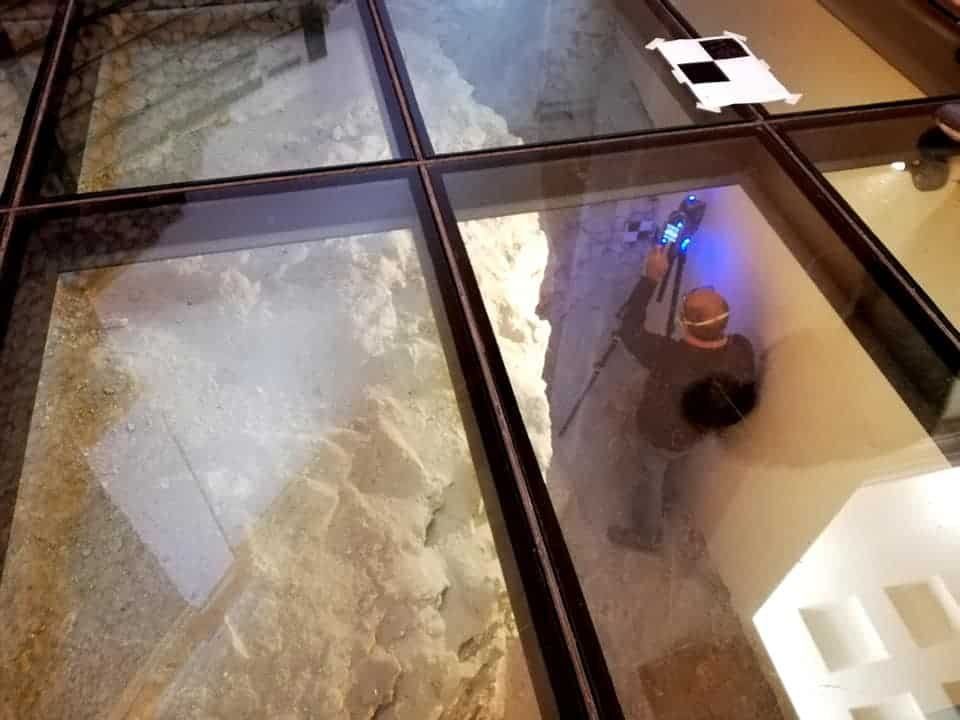
The Carvilio ring
In the central room of the second floor, together with the floors of the Republican age, the museum displays in a permanent case one of the objects that alone are worth the trip: the Carvilio ring. It comes from the so-called tomb of the garlands, excavated at Grottaferrata between 1999 and 2000, where two bodies were found, not cremated but treated according to funerary customs of Egyptian derivation. The ring belonged to Ebuzia Quarta, mother of Tito Carvilio Gemello, who died at 18 years and three months. His mother outlived him and died between 40 and 45. The jewel has a hollow shank in flattened sheet and an oval bezel with a large transparent rock crystal, and under the crystal, magnified by the natural lens of the quartz, the chased gold portrait of the son.
It was presented to the public right in Palestrina, on December 6, 2014. I'll say it plainly: it is the most moving object in the whole museum, and no photograph conveys the way the boy's face floats under the crystal when you move 20 centimeters. If you have little time, keep five minutes just for this case.
The votive gifts and the architectural terracottas
The left wing of the second floor gathers the materials from the minor sanctuaries of the Praenestine territory, among them the votive gifts from the sanctuary of Hercules, and the terracotta fragments of the archaic age: antefixes, cladding slabs, decorative elements of temple roofs. The votive terracottas are a chapter of social history before being one of art history, because they document what ordinary people asked of the gods, from eyes to hands to feet to swaddled newborns. Anyone who likes this kind of material should find the time for the Sanctuary of Hercules Victor in Tivoli too, which tells the same world on another scale.
The third floor of the Palestrina National Archaeological Museum and the model of the sanctuary
On the third floor a single room, the 16th, holds the Nile mosaic and the large reconstruction model of the Sanctuary of Fortuna Primigenia. The advice is to look at the model first and then the mosaic, never the other way around: the model puts the six terraces back on their feet, gives back the height of the porticoes and the depth of the ramps, and finally lets you understand what you walked through on the way up. Many visitors arrive in front of the model and say the same sentence, that the sanctuary looks like a city. It doesn't look like one: it was one, with the difference that in place of inhabitants there were pilgrims.
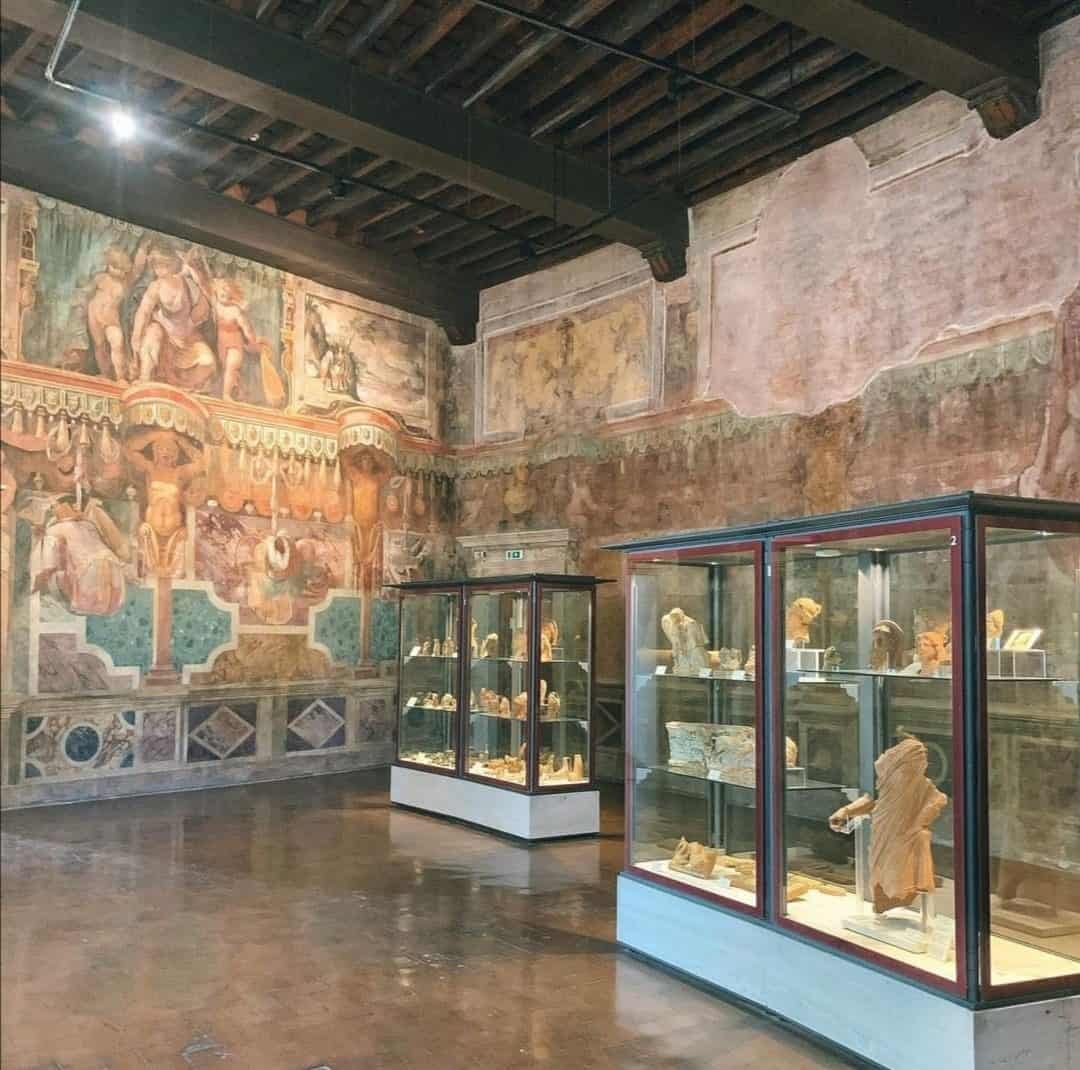
The Nile mosaic of the Palestrina National Archaeological Museum
4.31 meters by 5.85 meters: the Nile mosaic is a surface of over 25 square meters of tiny tesserae, dated to the 2nd or 1st century BC, made on the spot in all likelihood by Alexandrian workers. It represents Egypt during the flood of the Nile, seen from above and at the same time from the front, with a graphic convention that holds together the map and the picture: at the bottom the delta with the cities, the temples, the boats, the banquets under pergolas, the soldiers. Going up, the valley, the villages, the animals of the river, hippopotamuses and crocodiles, and at the top the mountains of Ethiopia with the exotic fauna and the hunters.
The 17th-century detachment and the restorations
The modern history of the mosaic is a story of removals. Found in the apsidal hall of the forum, then used as the cellar of the bishop's palace, it was recognized for what it was in 1625 by Cardinal Andrea Baroni Peretti Montalto, who had it detached from the floor, cut into quadrangular pieces and taken to Rome. In 1635 it passed to Cardinal Francesco Barberini through Cardinal Lorenzo Magalotti. In 1640 the first restoration was entrusted to Battista Calandra. In 1853 Giovanni Azzurri divided it into 27 slabs for a second intervention. Between 1952 and 1954 it was restored by the company Ponti-De Laurentis, in an operation financed thanks to a documentary directed by Gian Luigi Rondi. Since 1956 it has been here, in the room that was waiting for it.
Every step left scars, and the mosaic you look at today bears the marks of the cuts and the integrations. It needs saying clearly, because the visitor has a right to know that some areas are reassembled: the fracture lines can be seen and are not a defect of conservation, they are the history of the object. A fragment with a banquet scene ended up in Germany and never came back.
How to read the Nile mosaic
The right way to look at it is to start from the bottom, from the delta, and slowly go back up the river with your eyes, exactly as an ancient traveler who set out from Alexandria would. At the bottom, Ptolemaic and Romanized Egypt, with recognizable architecture, porticoes, temples with nilometers, loaded boats. Going up, Egypt becomes wilder, the villages thin out, hunters and fantastic animals appear, and geography turns into ethnography from a book of wonders. It is a travel story that goes from civilization to myth in 5.80 meters.
The interpretations, from the 1700s to today
On the meaning of the mosaic the scholars have been divided for three centuries, and the list of hypotheses is almost comic in its breadth. Melchior de Polignac read in it the journey of Alexander the Great to the temple of Jupiter Ammon. Giuseppe Rocco Volpi disputed it by observing that the armor depicted is Roman and not Macedonian. Jean Baptiste Dubos defined it simply as a geographical map of Egypt. Jean Jacques Barthelemy saw in it the Egyptian stay of Hadrian. Carlo Fea, the conquest of Egypt by Octavian. Orazio Marucchi, a homage to Isis connected with the cult of Fortuna Primigenia. The discussion is not closed. What can be said without forcing is that a floor like this, inside a public building of Praeneste, declared to whoever came in that the city looked to the eastern Mediterranean as its own horizon.

What you won't find at the Palestrina National Archaeological Museum
It is worth saying before the visit, because every year someone arrives looking for pieces that are not here and leaves disappointed over a misunderstanding. The grave goods of the great Orientalizing tombs of Praeneste, the Barberini tomb and the Bernardini tomb, two of the most important princely complexes of ancient Italy, are in Rome, at the National Etruscan Museum of Villa Giulia and in the Villa Poniatowski branch. The Ficoroni cista, the absolute masterpiece of Praenestine bronze work, found in Palestrina in 1738 by the antiquarian Francesco de' Ficoroni and signed by Novios Plautios, who made it in Rome for Dindia Macolnia, is also at Villa Giulia. The Praenestine fibula, with the oldest Latin inscription we know, is kept at the Museum of Civilizations, in the collections that used to belong to the Pigorini Museum.
I'll add a clarification that is needed, because the wrong idea circulates online that the Capitoline Triad is kept in Palestrina: that marble group, recovered in 1994 in the territory of the Inviolata, is on display at the Rodolfo Lanciani Civic Archaeological Museum of Guidonia Montecelio. It is not in Palestrina. Anyone looking for it wastes time and good humor.
The fact that the best pieces of ancient Praeneste are scattered among three museums of Rome and one of Palestrina is not a bureaucratic accident: it is the result of four centuries of excavations conducted by private individuals, cardinals and antiquarians who took home what they found. The Palestrina museum was born in 1956 precisely as a belated attempt to keep on the spot what was left.
A curiosity about the Palestrina National Archaeological Museum
The most important mosaic in the museum was restored with the money of a film. Between 1952 and 1954, when the Nile mosaic was still dismounted in the 27 slabs into which Giovanni Azzurri had divided it in 1853, the work was entrusted to the company Ponti-De Laurentis, and the operation was financed through a documentary directed by Gian Luigi Rondi. In practice, postwar Italian cinema, the cinema that in those same months was shooting at Cinecittà the films that would go around the world, paid the bill for the largest Hellenistic mosaic in Italy. Two years later, in 1956, the mosaic entered the room on the third floor together with the newly opened museum.
What I find remarkable is not the anecdote in itself, but what it says about the moment: a country that came out of the war in pieces, with Palestrina destroyed by bombing only eight years earlier, finds a way to put back together 25 square meters of Alexandrian tesserae by making a documentary on top of it. It wasn't wealth, it was stubbornness. When you find yourself in front of the mosaic, look for the lines of the reassemblies: those joins are the work of that time, and the whole museum was born around that restoration. It is the only case I know in Italy of an ancient masterpiece saved by a film crew.
One thing nobody tells you about the Palestrina National Archaeological Museum
The museum and the archaeological area do not close at the same time, and anyone who doesn't know this loses half the visit. The museum inside Palazzo Colonna Barberini stays open until 20:00 every day of the year, while the terraces of the sanctuary follow solar time: in January and February they close at 16:00, in March at 17:00, in April at 18:00, in May at 18:30, in midsummer at 19:00, in September at 17:30, in October at 17:00, in November and December again at 16:00. A winter afternoon with departure from Rome at 14:00 means arriving with the sanctuary closed and visiting only the rooms.
There is a second detail that almost everyone misses: the complex of the forum buildings of Praeneste, that is, the lower part where the Nile mosaic was found, has its own €4 ticket and is closed on the second and fourth Sunday of the month. Whoever organizes the trip on a Sunday therefore has a 50 percent chance of finding the forum barred. The third detail is that the ticket offices close an hour before closing time, and that hour is not a formality: to do the 16 rooms calmly and go up to the mosaic you need at least an hour and a half. The practical rule is simple: you arrive in the morning, you take the €10 combined ticket valid for two days, and on Sunday you pick the first or the third of the month.
The advice I give you for visiting the Palestrina National Archaeological Museum
Do the route the opposite way from how everyone does it. Almost everyone drives up to the esplanade, goes into the museum, comes out, looks at the view and leaves. It makes sense to leave the car at the bottom, in the free parking at Piazzale Kennedy or Piazzale della Pace, start from the forum complex with the mosaic still to be seen, then walk back up the terraces of the sanctuary, one by one, and arrive at the museum last. There are four ramps of climbing, they take half an hour at an easy pace, and they change everything: when you enter the room of the model your legs already know what the little model is about to explain.
Second piece of advice, on when: avoid spring Sundays with good weather, because Palestrina fills with school trips and families and the small rooms of the second floor become uncomfortable. A Wednesday or Thursday morning in October is the perfect window, with low light on the terraces and empty rooms. Third piece of advice, banal and decisive: bring shoes with a sole that grips, because the ancient paving and the ramps are smooth and going down is scarier than going up. Fourth: keep an hour free after the visit for the historic center, which is not a side dish but the same story seen from another angle, with houses built inside the ancient structures.
Another well-known fact, and yet rarely cited
Every guide says that the Sanctuary of Fortuna Primigenia re-emerged thanks to the 1944 bombings. What is cited much less is the price that rediscovery cost the living city. In 1944 Palestrina was hit by the Allied bombings that razed a large part of the historic center to the ground: under the collapsed houses reappeared the ramps, porticoes and hemicycles that the medieval fabric had absorbed for centuries, and from there began the great campaigns of excavation and study that in the 1950s gave the complex back and led to the birth of the museum in 1956.
To the destruction was added blood. On May 28, 1944 a Nazi reprisal killed 11 civilians, and the memory of that day is kept in the town. Holding the two things together, the birth of modern Praenestine archaeology and the end of a piece of the town, is the only honest way to tell this place. When you walk on the terraces it is worth remembering that the free view, which today seems the natural breathing room of an ancient monument, is the emptiness left by the bombs. Italian postwar archaeology is full of similar cases, but none so striking: here the war did in three days what no superintendency could ever have authorized.
The right photo to take at the Palestrina National Archaeological Museum
The photograph that is worth the trip is not inside the rooms: it is from the esplanade in front of the museum, the cortina square, looking toward the plain. From an altitude of 660 meters you overlook the whole valley as far as the Alban Hills, and on clear days you can make out the profile of Rome on the horizon. The right time is late afternoon, when the sun turns to the right and brings out the steps of the terraces below you. At noon the light flattens everything and the photo becomes a vase of white fog.
The second framing, the one almost nobody takes, is from below: from the road that climbs to the town, with the 17th-century palace on top and under it the ancient ramps in a row. It is the photograph that explains the relationship between temple and palace better than any caption, because it shows the ancient monument that holds up the modern monument. You need a modest telephoto lens or simply the right step back.
Inside the museum, the photo to look for is the Nile mosaic shot at an angle, not head-on: the frontal framing squashes the tesserae and gives back a flat postcard, while the oblique angle brings out the tiny relief of the tesserae and the reflections. On the rules for shooting, flash and tripods, it makes sense to ask at the ticket office at the entrance, because conditions change in the rooms with the most delicate materials.
Some important events that happened here in history
The first is the hardest: in 82 BC Praeneste, sided with Gaius Marius the Younger, falls after the siege by Sulla, who has the male population massacred and founds a military colony there. The city that had built the most ambitious sanctuary in Italy loses its ruling class in one blow. In 1298 Pope Boniface VIII razes it to the ground to bring the Colonna to heel, and in 1436 Cardinal Giovanni Maria Vitelleschi repeats the operation. In 1449 it is rebuilt with a ban on refortifying, a ban duly ignored in 1482. In 1571 Pius V raises it to a principality.
The 1600s bring the two facts that directly concern the museum: in 1625 Cardinal Andrea Baroni Peretti Montalto has the Nile mosaic detached from the apsidal hall of the forum and sends it to Rome, and in 1640 Taddeo Barberini rebuilds the palace on top of the sanctuary. In 1944 the bombings destroy the historic center and bring the ancient terraces back to light. On May 28 of the same year a Nazi reprisal kills 11 civilians. In 1956 the museum is born and the mosaic returns to Palestrina after three and a half centuries of absence. In 1998 the layout is redone. In 2014 the Carvilio ring is presented there. In 2024 the complex becomes part of an autonomous institute of the Ministry of Culture.
Who has passed through the Palestrina National Archaeological Museum
On the hill that now houses the museum have passed, in order of appearance, the pilgrims who came to have the lots drawn by the child of the oracle, and with them the ruling classes of central Italy for at least three centuries. Sulla passed through in 82 BC, as a besieger. In the Augustan age the scholar Marcus Verrius Flaccus worked here, author of the Fasti Praenestini that the museum keeps: he had been the tutor of Augustus's grandsons, and the calendar he had carved in the forum of the city is one of the most precious sources we have on Roman festivals. Augustus himself looked on the city with favor, appreciating its hill air, and local tradition attributes to Hadrian the great imperial residence just outside the town, the one that in Palestrina is called the Villa of Hadrian.
In the Middle Ages and the modern era the protagonists of the destructions and reconstructions passed through: the Colonna, Pope Boniface VIII in 1298, Cardinal Vitelleschi in 1436, the Barberini from the 1600s with Taddeo, who rebuilds the palace. The antiquarians passed through, from Francesco de' Ficoroni, who in 1738 found the cista that bears his name, to the cardinals who fought over the Nile mosaic. And in the 1900s passed through the generation of scholars who reconstructed the sanctuary after the bombs, from Furio Fasolo to Giorgio Gullini, whose names come back in every discussion on the dating of the complex. Since 2024 the autonomous institute that governs the museum, the sanctuary, the forum and the Gabii area has been directed by Martina Almonte, an archaeologist trained between the Superintendency of Rome and the Colosseum Archaeological Park.
How to get to the Palestrina National Archaeological Museum
From Rome the simplest way without a car is the Cotral buses that leave from the Anagnina terminal, on Metro line A: you get off in the center of Palestrina and walk up toward the palace, with a real climb that takes you to the esplanade in 20 minutes. Alternatively you take the regional train from Termini in the direction of Zagarolo, get off at the station and continue with the connecting bus to the town. By car it is 37 kilometers from Rome along Via Prenestina, or the A1 motorway with the San Cesareo or Valmontone exit, or the A24 with the Tivoli exit for those coming from the north.
The advice is not to drive all the way to the top. The free parking at Piazzale Kennedy, Piazzale della Pace, Piazzale Belvedere and Piazzale Fanfani is at the bottom, and the walk up through the town is part of the visit: you cross alleys built inside the ancient structures and you reach the museum after having understood the topography. Anyone with difficulty walking does the opposite and drives up to the esplanade, where there is room to stop.
How much the Palestrina National Archaeological Museum costs and how to save
The ticket that covers the museum and the archaeological area of the sanctuary costs €7. The reduced rate of €2 is for visitors between 18 and 25. The forum building complex has a separate €4 admission. The Palestrina combined ticket costs €10, is valid for two days and includes the places of the city circuit: for those coming from Rome who also want to see the lower part it is the most convenient formula. There is also a Palestrina-Nemi circuit ticket for €12 valid for 30 days, designed for those who combine the visit with the museum of the Roman ships on the lake, and for those who organize two day trips in the same month it is a bargain.
You buy tickets at the ticket desk or through the Musei Italiani app of the Ministry of Culture. The free admissions and reductions provided for Italian state museums, including the free Sundays of the national initiative and the special openings for anniversaries, follow the calendar published by the institute: it makes sense to check it on the official website before leaving, because the dates change from year to year.
The Palestrina National Archaeological Museum with children
It works better than you would expect, on two conditions. The first is to reverse the order: you go straight up to the third floor, look at the model of the sanctuary, which for a child is a giant little model of a city, and then the Nile mosaic, which is in fact a comic strip 5.80 meters long full of crocodiles, hippopotamuses, boats and hunters. You go hunting for animals inside the mosaic and the half hour passes without a complaint. Then you go down and look at the cistae and the mirrors, which are objects of everyday use and explain themselves in two words.
The second condition is to keep the archaeological area for the finale, because the ramps and terraces are an open space to run in after an hour of closed rooms. Watch out for the edges and the steps, which are ancient and do not have modern parapets everywhere, and for the smooth paving. I advise against the stroller: between stairs, ramps and paving it is more a burden than a help, better a baby carrier backpack.
Accessibility and services at the Palestrina National Archaeological Museum
The museum occupies a historic palace on several levels and the archaeological area is made of ancient ramps, staircases and sloping surfaces: the outdoor part has significant differences in level and uneven ground. For the access conditions to the individual rooms, for the availability of elevators and for the routes recommended to those with mobility difficulties, it makes sense to phone ahead at 06 9538100 and arrange the entrance. The same goes for large groups: a system of lightweight audio guides is recommended in the rooms, because the spaces are small and the voice bounces.
When to go to the Palestrina National Archaeological Museum and when to avoid it
The best period is autumn, between the end of September and the first half of November: the raking light of the short days draws the terraces like no other season, the air is clear and the view reaches far. Spring is beautiful and more crowded, with school groups filling the museum on April and May mornings. Summer has a temperature problem, because the esplanade at the top has no shade and in the central hours of July the climb on foot becomes punishing: if you go in August, go at 9:00 sharp.
To avoid, if possible: sunny Sundays, the second and fourth Sunday of the month for those who care about the forum complex, and winter afternoons, when the archaeological area closes at 16:00 and only the museum remains. If you have only one morning available, pick a weekday and leave Rome early: the bus takes about an hour, the train with the change at Zagarolo a little more.

What to see around the Palestrina National Archaeological Museum
The town deserves at least an hour after the visit. The cathedral of Sant'Agapito stands on the ancient forum, the streets of the center descend following the curves of the sanctuary's terraces, and a few hundred meters away are the forum buildings with the apsidal hall. Above the town, on foot or by car, you reach Castel San Pietro Romano, the village that dominates the valley from the Colonna fortress and offers the best view of the archaeological complex from above. The nearest green area is the Praenestine chestnut grove, which in autumn is a perfect walk after the museum.
Whoever wants to widen the day has two directions. Toward the Praenestine Mountains, the Villa of Hadrian in Palestrina and the village of Genazzano with the nymphaeum attributed to Bramante. Farther east, Olevano Romano, which the northern painters of the Grand Tour painted for two centuries. Toward Tivoli, instead, you come across the other great ancient architecture of the territory, Hadrian's Villa, and the city of Tivoli with its villas. Whoever bought the €12 circuit ticket should aim for Nemi and the Sanctuary of Diana Nemorensis, which tell of another great Latium devotion.
For those who stay in Rome and want to complete the Praenestine story there are three obligatory addresses: Villa Giulia for the Barberini and Bernardini tombs and for the Ficoroni cista, the Museum of Civilizations for the Praenestine fibula, and the Crypta Balbi to understand how the ancient city turns into the medieval city, which is exactly what happened in Palestrina. The overall picture of the territory is on the Palestrina page.
Quick questions about the Palestrina National Archaeological Museum
How much does a ticket to the Palestrina National Archaeological Museum cost?
The ticket that covers the museum and the Sanctuary of Fortuna Primigenia costs €7, with a reduced rate of €2 for the 18 to 25 age bracket. The forum building complex has a separate €4 ticket. The city combined ticket costs €10 and is valid for two days.
What are the opening hours of the Palestrina National Archaeological Museum?
The museum is open from 9:00 to 20:00, with the ticket offices closing an hour earlier. The archaeological area of the sanctuary instead has seasonal hours: from 9:00 to 16:00 in the winter months up to 9:00-19:00 in June, July and August.
Is the Palestrina National Archaeological Museum closed on Monday?
No. The only annual closures indicated are January 1 and December 25. The forum building complex, on the other hand, is closed on the second and fourth Sunday of every month.
Do you need to book to visit the Palestrina National Archaeological Museum?
For an individual visit you buy the ticket at the ticket desk or through the Musei Italiani app. Organized groups and school groups do well to announce themselves in advance by phoning 06 9538100, because the rooms are small and capacity is limited.
How long does the visit to the Palestrina National Archaeological Museum take?
An hour and a half for the museum rooms alone, two and a half hours for an attentive visit, a good half day if you add the terraces of the sanctuary and the forum complex below.
Does the museum ticket also include the Sanctuary of Fortuna Primigenia?
Yes. The €7 ticket is valid for the museum inside Palazzo Colonna Barberini and for the archaeological area of the sanctuary. The forum building complex instead requires its own €4 ticket, or the €10 combined ticket.
Where is the Nile mosaic?
In the room on the third floor of the museum, together with the reconstruction model of the sanctuary. It was found, however, in the lower part of the city, in the apsidal hall of the forum of Praeneste, and it arrived up here only in 1956.
How big is the Palestrina Nile mosaic?
It measures 431 by 585 centimeters, that is, over 25 square meters of tiny tesserae. It is dated to the 2nd or 1st century BC and is attributed to Alexandrian workers.
How do you get to the Palestrina National Archaeological Museum from Rome without a car?
With the Cotral buses from the Anagnina terminal, on Metro line A, or with the regional train from Termini to Zagarolo and then the bus to Palestrina. From the center of town to the museum you walk up in about 20 minutes.
How far is Palestrina from Rome?
37 kilometers along Via Prenestina. By car it takes about an hour, by bus a little more depending on the traffic on the consular road.
Where do you park in Palestrina?
There is free parking at Piazzale Kennedy, Piazzale della Pace, Piazzale Belvedere and Piazzale Fanfani, and paid parking in the squares of the center. The advice is to leave the car at the bottom and walk up.
Can you take photographs inside the Palestrina National Archaeological Museum?
The rules on flash, tripods and video recording should be asked at the ticket office at the entrance, because they vary from room to room depending on the delicacy of the materials on display.
Is the Palestrina National Archaeological Museum wheelchair accessible?
The museum occupies a historic palace on several levels and the archaeological area is made up of ancient ramps and staircases with uneven ground. To find out the accessible routes and the availability of elevators it makes sense to phone ahead at 06 9538100.
Is the Palestrina National Archaeological Museum suitable for children?
Yes, and it works well if you start from the third floor with the model and the Nile mosaic, which reads like a big scene of hunting and river life. The outdoor archaeological area is the perfect outlet after the rooms.
Are there a bookshop and a cafe at the Palestrina National Archaeological Museum?
Public services change over time and it makes sense to check them on the institute's website or by phone before the visit. The historic center of Palestrina, in any case, offers bars and restaurants a few minutes' walk from the esplanade.
Is admission free on the first Sunday of the month?
The museum is one of the state sites of the Ministry of Culture and follows the national free admission initiatives, whose calendar is published from year to year: you check the institute's official website before leaving.
Who runs the Palestrina National Archaeological Museum today?
Since 2024 the museum has been part of the autonomous institute Musei e Parchi archeologici di Praeneste e Gabii, which also includes the Sanctuary of Fortuna Primigenia, the forum complex of Praeneste and the archaeological site of Gabii.
What is the Carvilio ring on display at the Palestrina National Archaeological Museum?
A Roman gold ring with a rock crystal bezel, under which is set the chased portrait of Tito Carvilio Gemello, who died at 18. It comes from the tomb of the garlands at Grottaferrata, excavated between 1999 and 2000, and is on display in a permanent case.
Is the Ficoroni cista on display at the Palestrina National Archaeological Museum?
No. It was found in Palestrina in 1738 by Francesco de' Ficoroni, but it is kept at the National Etruscan Museum of Villa Giulia in Rome. In Palestrina you can still see many other Praenestine cistae and bronze mirrors.
Is the Capitoline Triad at the Palestrina National Archaeological Museum?
No, and the confusion is frequent. The marble group recovered in the territory of the Inviolata is on display at the Rodolfo Lanciani Civic Archaeological Museum of Guidonia Montecelio.
What is the difference between the museum and the Sanctuary of Fortuna Primigenia?
The sanctuary is the ancient architecture, that is, the six terraces that climb the mountain. The museum is the collection of finds, housed in the 17th-century palace built on the highest terrace. They are visited with the same ticket and should be seen together.
Why is the Palestrina National Archaeological Museum inside a noble palace?
Because Palazzo Colonna Barberini is built over the top of the sanctuary: first the Colonna in the Middle Ages, then Taddeo Barberini in 1640 occupied the cortina square and the ancient cavea. In 1956 the upper floors were assigned to the museum.
When was the Palestrina National Archaeological Museum inaugurated?
In 1956, with a complete reorganization of the layout in 1998. In 2026 it therefore turns 70 years of activity.
How many visitors does the Palestrina National Archaeological Museum receive?
The known figures speak of just over 20,000 visitors a year, with 20,776 admissions in 2014 and 22,586 in 2015. It is a top-level museum with the attendance of a minor museum, which for the visitor is an advantage.
Can you combine the Palestrina National Archaeological Museum with other visits on the same day?
Yes. The most sensible combinations are with Castel San Pietro Romano just above the town, with the Villa of Hadrian in Palestrina, with Genazzano, or toward the north with Tivoli and Hadrian's Villa. Whoever has the €12 circuit ticket can add Nemi within 30 days.
Are there guided tours at the Palestrina National Archaeological Museum?
The calendar of guided tours and of the institute's initiatives is published on the official website and changes over the course of the year. For groups, audio guides are recommended, because the rooms are small.
Is it worth coming all the way here just for the Nile mosaic?
Yes, and I say it after having seen it dozens of times. But it would be a waste: the sanctuary under your feet, the Carvilio ring, the cistae and the Fasti Praenestini are worth the day as much as the mosaic.
The conclusion on the Palestrina National Archaeological Museum
I know quite a few overrated places around Rome. This is the opposite: a museum that would deserve a line and that instead is visited in solitude, inside a building that is itself the largest piece of the collection. If I had to choose a single day trip for someone who has already done the center of Rome and wants to understand where everything else comes from, I would choose Palestrina before many more celebrated destinations, and not out of snobbery: because here you see with your own eyes how Roman monumental architecture is born, and you see that it is born far from Rome.
The only advice that counts: don't do the visit backwards. Walk up, look at the model before the mosaic, and set aside five minutes alone in front of the case of the Carvilio ring. Then go out onto the esplanade, put your back to the palace and look at the plain. 2,100 years ago, whoever arrived up here after climbing the ramps saw exactly what you see, with the difference that they saw their own destiny in it, written on an oak tablet drawn by a child.
Article written by the editorial team of TourLeaderPro, contact them for Private/Corporate/V.I.P. Tours and Experiences.
Planning a trip to Rome? The English guides to day trips from Rome and to visiting the city are on ItalyPlanner.com.