Sanctuary of Fortuna Primigenia in Palestrina
In short. The Sanctuary of Fortuna Primigenia in Palestrina occupies the flank of Monte Ginestro above the Sacco valley, about 40 kilometers east of Rome, and you walk inside it without noticing, because the modern town has grown over it and…
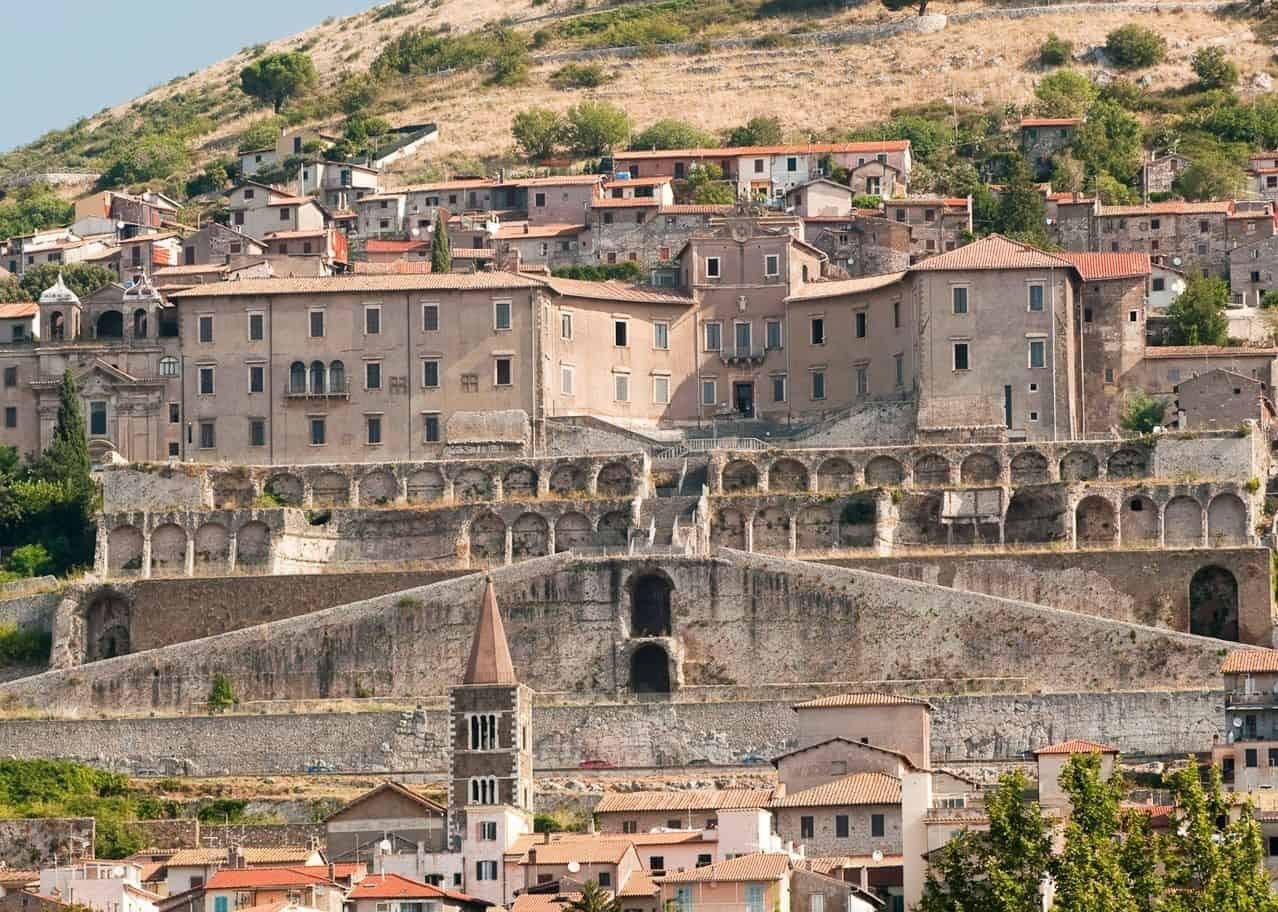
The Sanctuary of Fortuna Primigenia in Palestrina occupies the flank of Monte Ginestro above the Sacco valley, about 40 kilometers east of Rome, and you walk inside it without noticing, because the modern town has grown over it and adopted its foundations as streets, cellars, house walls. You reach Palestrina by car along via Prenestina or on the motorway, from the A24 with the Tivoli exit or from the A1 with the San Cesareo or Valmontone exit, or by bus from the Anagnina station of the Rome metro. The train leaves you at Zagarolo, and from there you continue by road. The visit is organized around two poles: the open-air archaeological area, which you walk up by ramps and terraces, and the Museo Archeologico Nazionale di Palestrina, housed in Palazzo Colonna Barberini, which closes the complex at the top and keeps its materials. Hours and tickets change over time and should be checked on the museum's official channels before leaving.
I'll warn you right away about something no photograph manages to convey: here the monument is a redesigned mountain, not a building. Whoever arrives expecting a temple with columns is left disoriented for a quarter of an hour, then begins to understand that those covered ramps, those hemicycles with stone seats, those rows of niches are the limbs of a single architectural organism that started from the forum of the ancient city and ended, hundreds of meters higher up, in front of a small round temple. It is the largest Hellenistic sanctuary in Italy, and one of the buildings that taught Western architecture how to master a slope.
What the Sanctuary of Fortuna Primigenia in Palestrina is
The Sanctuary of Fortuna Primigenia in Palestrina is the sacred complex built in ancient Praeneste for the goddess Fortuna Primigenia, arranged on six superimposed artificial levels that climb the slope of Monte Ginestro. It is an architectural machine that organizes a pilgrim's ascent from bottom to top, imposing on him an obligatory route made of blind ramps, elbow turns, panoramic terraces and sudden shadows, until it delivers him, at the top, in front of the place where the goddess answered the questions of men.
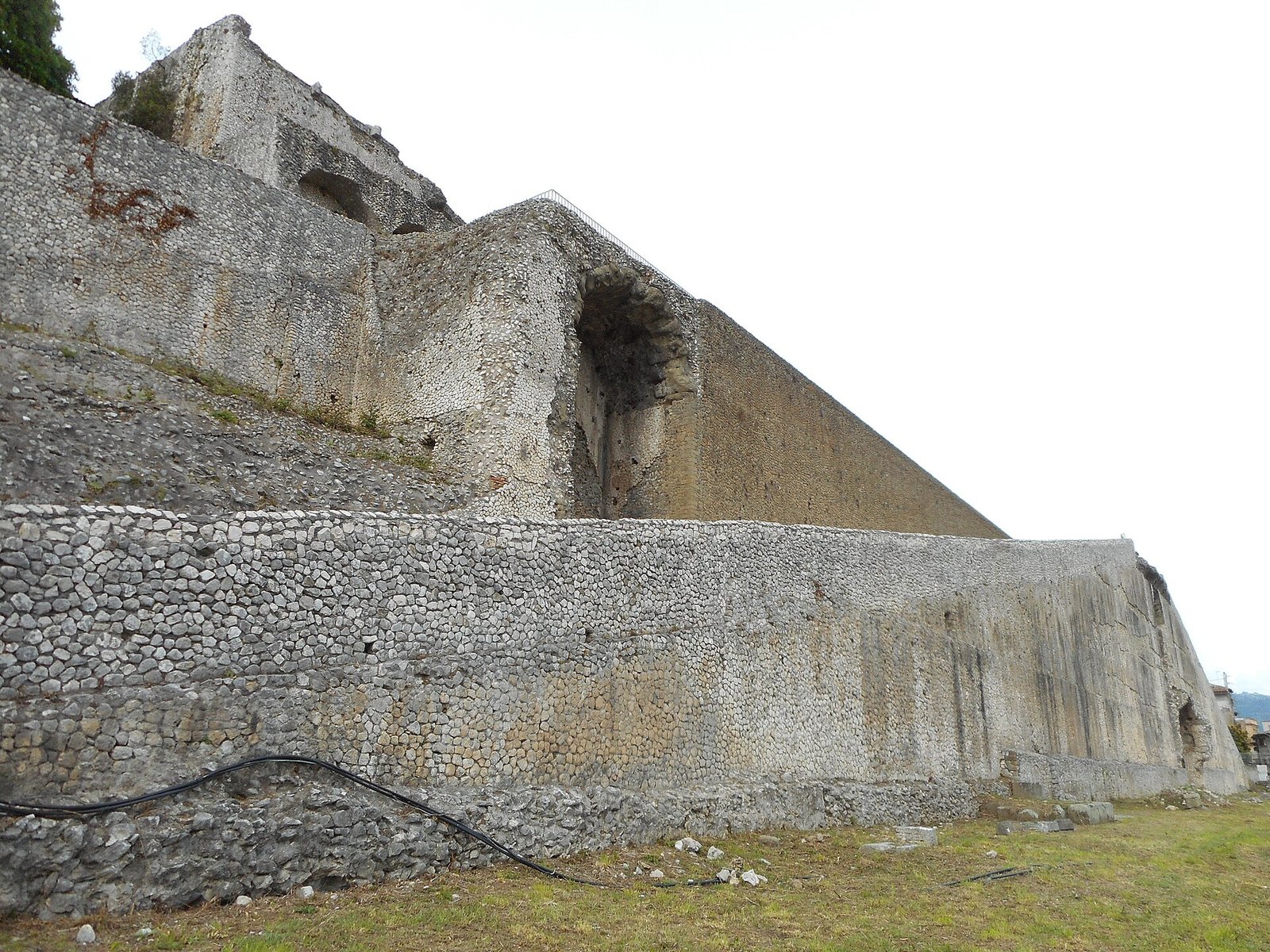
The formula you read in the manuals, "terraced sanctuary of the Hellenistic type," is correct and insufficient. Correct because the model comes from the great complexes of the eastern Mediterranean, from the sanctuaries of Rhodes, Kos and Lindos, where the sacred is distributed on superimposed levels instead of being concentrated in a single building. Insufficient because at Praeneste the model is translated into a building technique the Greeks did not have: Roman concrete, opus caementicium, the barrel vault cast in place. The result is a new architectural language, which at that point stops depending on Greek models.
A sanctuary that is also a city
The upper sanctuary, the one of the monumental terraces, occupies the high part of the ancient town. Below, inside the area of the forum of Praeneste, stretched the so-called lower sanctuary, with the apsidal hall, the grotto called the antro delle sorti, the civil basilica and a fabric of public buildings that today lie under the bishop's palace and the cathedral of Sant'Agapito. Between the two poles ran the daily life of the city and the religious life of the cult, with no sharp boundaries: at Praeneste the forum was the sanctuary and the sanctuary was the civic center, in a continuity that our modern categories struggle to handle.
It's worth keeping this in mind during the visit. When you climb along the ramps you are not crossing a sacred enclosure separate from the world, as happens in an Egyptian temple or a Gothic cathedral: you are crossing the most expensive public monument that a city of central Italy in the 2nd century BC was able to build, its calling card, its declaration of power, its economic engine. The pilgrim brought money, and the money paid for the marble.
Why "Primigenia"
The epithet is one of those that seem transparent and are not. Primigenia means "first-born," "born first": a Fortuna that precedes everything, prior to the gods themselves. But the ancient sources also show her as mother and nurse, with the infant Jupiter and Juno in her lap, in a sculptural group that in Rome would have been inconceivable: Jupiter at the breast, the father of the gods reduced to a suckling of a female Italic divinity older than he. Cicero, who writes of Praeneste with the punctiliousness of a man who had been there, records the oddity without resolving it, and notes that mothers venerated that group with particular devotion.
The apparent contradiction, first-born and mother at once, is probably the residue of two superimposed layers of cult: a local female divinity tied to fertility, to birth, to the protection of newborns, and a Fortuna conceived as a cosmic force that assigns each person their destiny. The sanctuary, with its double nature of maternal place below and oracular machine above, reflects exactly this duality.
Where the Sanctuary of Fortuna Primigenia in Palestrina is and how to read the landscape
Palestrina stands at about 450 meters above sea level, set against Monte Ginestro, one of the Prenestini heights that close the Roman countryside to the east. From the top of the sanctuary, on clear days, you see the Sacco valley, you sense the line of the Colli Albani, and with a bit of luck you can make out the sea toward Anzio. This is not a scenic fact, it is a functional one: the sanctuary was designed to be seen from afar and to let you see far.
The strategic position of Praeneste
The ancient city controlled the passage between the Sacco valley and the Roman countryside, that is, the natural route linking Lazio to Campania. Whoever held Praeneste held a junction. It is no accident that Rome took centuries to normalize relations with this city, and that when it finally managed to, it did so in the most brutal way possible.
The altitude, moreover, guaranteed a climate the Romans appreciated enormously. Horace puts "cool Praeneste" among the places where he would like to retire, next to Tivoli and Baiae, and the adjective is not ornamental: in summer, when Rome becomes an oven, here you can breathe. The ancient sources also mention the walnuts and roses of Praeneste, local products famous in the markets of the capital. A cool, rich, well-positioned city with a famous oracle: the recipe for a prosperity that lasted centuries.
How to get there today
From Rome, the simplest access is via Prenestina, which is also the ancient one, or the A24 motorway with the exit toward Tivoli and the descent along the Prenestina Nuova. If you don't have a car, take an extra-urban bus from the Anagnina station of metro line A. By train you get off at Zagarolo on the line to Cassino and continue with a road connection. The historic center is uphill and cars are left in the lots down below: the final part is done on foot, and rightly so, because the sanctuary was made to be climbed.
The practical tip on altitude
If you come in summer, the climb from the lower terraces to Palazzo Colonna Barberini is done in the first hours of the morning or after five in the afternoon: at midday the slope is exposed and the stones give back heat. If you come in winter, know that there is wind here, and it is the wind that made Praeneste "frigida" for Horace. Wear shoes with a sole that grips: many stretches are paved with ancient stones polished smooth by 2,000 years of feet.
Praeneste before the Sanctuary of Fortuna Primigenia in Palestrina
Before the monumental sanctuary existed there was an ancient, powerful Latin city, with a very rich aristocracy and a network of relations that reached as far as Etruria and Greece. Traces of the settlement go back at least to the 8th century BC, but the moment that best tells the stature of this community is the 7th century, when funerary goods were deposited in the local necropolises that have few parallels in Italy.
The Orientalizing tombs
The Barberini tomb and the Bernardini tomb, excavated in the 19th century, yielded objects that describe an aristocratic world projected onto the Mediterranean: silver cups decorated with motifs from Cyprus and Phoenicia, goldwork in very fine granulation, bronzes, ivories, cauldrons with protomes. These are not chance imports, they are the status symbols of princes who bought prestige where prestige was produced. Those materials are kept today in Rome, at the Museo Nazionale Etrusco di Villa Giulia, and anyone who wants to understand from what root the sanctuary sprouted should see them.
The prosperity of Praeneste, in short, was not born with Fortuna: Fortuna inherits it, monumentalizes it and turns it into a phenomenon of international appeal. The sanctuary of the 2nd century BC is the last act of a story five centuries long, not the first.
The language and the inscriptions
The Latin spoken here had its own forms, and Praeneste left some of the most discussed documents of Latin linguistics. The Praenestine fibula, with its archaic inscription read as "Manios med fhefhaked Numasioi," was at the center of one of the fiercest philological controversies of the 20th century, between those who considered it a 19th-century forgery and those who defended its authenticity. The most recent analyses have rehabilitated the object, which today is kept in Rome at the Museo delle Civiltà. It isn't a scholarly detail: it means that at Praeneste people wrote, in Latin, at a time when written Latin was still a rarity.
The Praenestine cistae
Between the 4th and the 3rd century BC the workshops of Praeneste produced cistae, cylindrical bronze containers for toilet articles, engraved with mythological scenes of surprising finesse. The most famous, the Ficoroni cista, bears the engraved scene of the Argonauts and a Latin signature naming the maker Novios Plautios and the patron. It too is kept at Villa Giulia. These are objects that say two things at once: that there was wealth here to spend on luxury, and that Greek figurative culture was at home long before Rome discovered it.
Relations with Rome
The political history is less serene. Praeneste leaves the Latin League at the beginning of the 5th century BC and sides with Rome, then changes its mind when Rome wavers after the Gallic invasion of 390 BC, fights for a long time against the power growing to the west, loses territory in the 4th century and ends up allied with the status of a federated city, obliged to supply troops. It is an ambiguous condition: formally independent, substantially a satellite. It will last until the Social War, when Roman citizenship will be granted to all the Italic allies, and it will end in the worst way a few years later.
Who Fortuna Primigenia, worshiped in Palestrina, was
The Fortuna worshiped here is not the blindfolded lady with the wheel that the Middle Ages handed down to us. She is a much older and much more ambiguous divinity, who presides over fate as the ordering principle of the world, not as caprice. Her epithet, Primigenia, places her at the origin: before everything, before the other gods, before destiny itself.
The goddess who nurses Jupiter
The cult group that stood on the terrace of the hemicycles represented Fortuna seated with two children in her lap: Jupiter and Juno. The scene, for a Roman educated on the Homeric Olympus, was a small theological scandal. Cicero records it with some perplexity and notes that the place was surrounded by a religious enclosure and honored above all by mothers. The cult of the Praenestine Fortuna was, among other things, a cult of birth and early childhood: newborns were brought here, protection was asked for the first months of life, vows were fulfilled when the child survived.
This domestic dimension coexists with the oracular one without contradiction, because in the ancient world asking if your son will live and asking if the deal will come off are the same question posed to the same power. Fortuna Primigenia governs the "what will happen," in all its forms.
Fortuna, Isis and the traveling deities
In the course of the Hellenistic and then imperial age the Praenestine goddess comes into contact with other female figures of the Mediterranean, and in particular with Isis, the great Egyptian divinity who in the same period spreads across Italy. In the museum of Palestrina statues of Isis-Fortuna are kept, with the attributes of the two goddesses superimposed: the rudder, the cornucopia, the modius. It isn't convenient syncretism, it's the way the ancient world handled the fact that different divinities performed the same function for different peoples.
The Egyptian presence at Praeneste, moreover, doesn't stop at the statues: the absolute masterpiece of the museum, the Nile mosaic, is an illustrated map of Egypt, and its placement in the heart of the sanctuary says that Egypt here was not a decorative exoticism, it was part of the religious discourse.
The legend of Numerius Suffustius and the birth of the sortes praenestinae
Every ancient oracle has a founding myth, and the Praenestine one is among the most concrete and the most beautiful. Cicero tells it in the second book of the De divinatione, explicitly declaring that he draws on the local annals, the Praenestinorum monumenta.
The dreams of an honest man
There was at Praeneste an honest man of noble family, Numerius Suffustius. He began to dream, repeatedly, and the dreams ordered him to go to a precise place and split the rock. He resisted, as one resists dreams that ask ridiculous things. The dreams became threatening. In the end, frightened by the visions and mocked by his fellow citizens, he took his tools and went to split the flint.
From the broken stone, writes Cicero, the sortes came out: oak tablets engraved with characters of ancient writing. The verb he uses, erupisse, "burst out," conveys well the idea of an irruption, not of a discovery. And the detail of the "archaic writing" is the decisive one: the sortes are born already old, already authoritative, already illegible at first glance. It is the legitimation mechanism of every oracle.
The honey on the olive tree
At the same moment, the story continues, in the place where the temple of Fortuna later rose, honey was seen flowing from an olive tree. The haruspices interpreted the prodigy: those sortes would have very great fame. On their advice, a chest was made from the wood of that olive tree, and the tablets were placed in the chest. Since then, Cicero concludes, the sortes are drawn from there when Fortuna allows it.
The story is built with a precision worth admiring. There is the reluctant dreamer, who guarantees good faith. There is the public mockery, which makes the sequel credible. There is the rock, which anchors the revelation to a physical place you can visit. There is the plant prodigy, which brings in the professional interpretation of the haruspices. And there is the sacred container, which turns an unrepeatable event into a procedure repeatable every day. A founding myth perfectly functional to an oracular industry.
The place of the revelation
Cicero specifies that the spot where the flint was split was, in his day, fenced and protected by a religious restriction, and connected to the cult of the infant Jupiter. This means that the sacred geography of the sanctuary had a point zero, a center from which everything else derived, and that this point was still visible and venerated centuries later. The great terraced architecture of the 2nd century BC was built around a nucleus of this kind: it did not invent a place, it monumentalized a place that already existed.
The sortes praenestinae: how the oracle of the Sanctuary of Fortuna Primigenia in Palestrina worked
The mechanism of the Praenestine oracle is one of the few ancient divinatory procedures we can reconstruct in some detail, and its simplicity is exactly what made it effective.
The child who draws
The oak tablets were kept in the olive-wood chest. When a worshiper posed his question, it was not a priest who put his hand in the chest: it was a child. A puer, a boy, chose the tablet blindly, and the tablet held the answer. The choice of the child as mediator is not folklore: it is a logical device. The child is held to be incapable of calculation, without personal interest, not corruptible, not yet part of the network of social relations that could steer the hand. His innocence is the procedural guarantee of the goddess's impartiality.
There is more. The child who draws the sortes recalls the infant Jupiter of the cult group: the puer who chooses and the puer who sits in Fortuna's lap are figures that mirror each other. In the imperial age the title of Iuppiter Arcanus is added, "Jupiter of the chest," divine guardian of the container of the tablets. The sanctuary, put another way, had built a coherent theology around a very simple material gesture: a small hand fishing in a box.
What was written on the tablets
The sortes were not tailor-made answers. They were short formulas, often in verse, of the kind that fit many different questions: encouragements, warnings, proverbial images, admonitions about the right moment and the wrong moment to act. The consultant brought his own question, the tablet supplied a phrase, and the space between the two was the territory of interpretation. This is the secret of all lot oracles: ambiguity is not a flaw of the system, it is the system.
Whoever expects a service of precise forecasts has the wrong era. Those who consulted the Praenestine Fortuna were not looking for information, they were looking for legitimation: a way out of indecision with a mandate that was not only their own. It is a psychological function that has never gone out of fashion, and that explains why the sanctuary prospered for centuries in a society that in the meantime was producing Lucretius and Cicero.
The "drawing of lots" as a social technology
The Roman world used lot-drawing also outside the religious sphere: provinces were assigned by lot, judges were drawn, the voting order of the centuries was drawn by lot. In a political system obsessed with the risk that power would concentrate in one person, chance was considered a neutral arbiter. The sortes praenestinae are not a superstitious anomaly in a rational civilization: they are the religious application of a mechanism that civilization used every day to govern itself.
The end of the oracle
Oracular activity continued throughout the imperial age, with alternating fortunes and under the patronage of several emperors, and died out with the progressive banning of traditional cults between the 4th and the end of the 4th century, when legislation from Constantine to Theodosius progressively closed the pagan places of worship. There was no violent destruction: the flow of visitors and offerings slowly dried up, and then came silence.
Cicero and the Sanctuary of Fortuna Primigenia in Palestrina in the De divinatione
If we know so much about this oracle it is because a skeptical lawyer decided to take it apart in writing. The De divinatione, composed in the 40s of the 1st century BC, is a dialogue in two books: in the first his brother Quintus sets out the reasons of those who believe in divination, in the second Marcus Tullius demolishes them one by one.
The passage on the sortes
In the second book Cicero tells the story of Numerius Suffustius and of the tablets that came out of the rock, and notes that those sortes were engraved "in robore," in oak wood, "priscarum litterarum notis," with the marks of an ancient writing. Then he recalls the olive tree from which the honey flowed, the haruspices who drew from it the announcement of the oracle's future celebrity, and the chest made from that same olive tree.
So far it is chronicle. Then comes the jab. Cicero asks, in essence, what magistrate or what man of rank has ever made use of the sortes. He observes that everywhere else these practices have fallen into disuse and that at Praeneste they survive thanks to the fame of the place and the crowds of common people. And he concludes that the fortune of the oracle depends on reputation, not on truth. It is a sociological argument even before a philosophical one, and anyone who has seen a contemporary shrine prosper on word of mouth understands what he is talking about.
The skepticism that preserves
The paradox is delightful: we owe our knowledge of how the oracle worked to a man who wanted to prove its uselessness. Cicero describes with precision precisely because he wants to refute, and the precision of the refutation has become our main source. It happens often in the history of ancient religions, and it works as a methodological reminder: hostile witnesses are often the most detailed.
Cicero's personal relationship with Praeneste
Cicero knew these places, as the entire Roman ruling class did: Praeneste was a day's travel away, had a pleasant climate and villas, and its sanctuary was a known stop. The skepticism of the De divinatione is not that of an intellectual speaking from hearsay, it is that of a man who saw the line in front of the chest and was not impressed. Which, if you think about it, makes his testimony even more precious when he describes the ritual.
The lower sanctuary of the Sanctuary of Fortuna Primigenia in Palestrina
The part of the complex that is visited most distractedly is, paradoxically, the one that keeps the most extraordinary pieces. The lower sanctuary is at the bottom, in the area of the forum of ancient Praeneste, under and around the cathedral of Sant'Agapito and the bishop's palace, and it is a labyrinth of ancient spaces absorbed into later building.
The apsidal hall
The most famous space is the apsidal hall, a large room ending in an apse, whose floor held the Nile mosaic now kept in the museum. The proportions and position of the room have made generations of scholars argue: it has been thought to be a cult hall, a room for ritual banquets, a representative space tied to the city magistracies. What is certain is that it was one of the most expensive and most carefully made spaces of the whole complex, because the floor laid there is one of the absolute peaks of ancient mosaic art.
Walking in the hall today, with the mosaic removed, is an exercise in imagination: you have to mentally replace the bare floor with a surface of almost 26 square meters covered in tiny tesserae, brilliant with color, depicting an entire foreign country seen from above. Whoever entered here was not looking at a fresco on the walls, they were looking at the ground, and on the ground was the Nile.
The antro delle sorti and the fish mosaic
Next to the hall opens the space that tradition calls the antro delle sorti: an artificial grotto, carved into the rock and finished like a nymphaeum, with the floor decorated by a mosaic depicting a seabed populated with fish. The theme is no accident. The nymphaeum grottoes of Hellenistic and Roman architecture systematically play on the ambiguity between nature and artifice: the rock is dug out, lined with shells, stucco, aquatic mosaics, and the result is a cave more natural than the natural.
The name "antro delle sorti" alludes to the tradition that placed here the rock split by Numerius Suffustius, the point zero of the Praenestine sacred geography. Not all scholars accept the identification, and the discussion has been open for decades. But the atmosphere of that space (the darkness, the water, the fish made of tesserae underfoot, the rock overhead) is exactly the one the ancient world associated with communication with the powers of the underworld.
The basilica and the civic fabric
Around these two spaces stretched the public area of Praeneste, with the basilica, the paved forum, the buildings of the magistracies. The overlap with the medieval and modern town is total: you go down a staircase, open a door, and you are inside a wall of the 2nd century BC. It is the reason why the visit to the lower sanctuary needs to be planned by checking access, because some spaces can be seen only on occasions and in ways that the museum communicates from time to time.
The Nile Mosaic of the Sanctuary of Fortuna Primigenia in Palestrina
If I had to name a single object worth the trip to Palestrina, I would name this one. The Nile mosaic measures 5.85 meters in width by 4.31 in height, is made of tiny tesserae, and represents the course of the Nile from the regions of upper Ethiopia down to the Mediterranean delta. It is the oldest known example of a Nilotic landscape in Roman art, and none of the countless later imitators has even come close to its quality.
How to read the mosaic
It has to be read from top to bottom, as if looking at a map drawn by someone going up the river. At the top, the mountainous and desert zone: bare rocks, hunters with bows and spears, and a fantastic fauna of African animals, some recognizable, others not, accompanied by captions in Greek indicating their names. It is the most "ethnographic" part, the one in which the mosaicist stages the unknown: the edge of the known world, populated by beasts no Italic spectator had ever seen.
Going down, the landscape softens. Waters appear, canals, boats, crocodiles and hippopotamuses, Egyptian buildings with their pylons and terraces. Human figures appear in recognizable activities: hunting, fishing, navigation. In the lower band we are in the delta, in the Hellenized Egypt of the Ptolemies, with Greco-Egyptian architecture, tents, soldiers, and a banquet scene under a pergola that is probably the most famous part of the mosaic: a group of people reclining eat and drink while female musicians accompany the scene.
The question of the flood
Many interpreters read the whole composition as a representation of the annual flooding of the Nile, the event that marked the Egyptian calendar and on which the fertility of the country depended. The water invading the landscape, the buildings emerging like islands, the boats sailing where one normally walks: these are elements consistent with that reading. The flood, after all, is for Egypt exactly what Fortuna is for Praeneste: the cyclical, unpredictable force on which the fate of men depends. The placement of the mosaic in the sanctuary thus acquires a precise meaning.
The dating and the debate
The most authoritative proposal, supported by Paul Meyboom in his monographic study, places the mosaic around 100 BC and makes it an early witness to the spread of Egyptian cults in Italy. Others have thought of a later era, linking it to Octavian's conquest of Egypt, or even to the Hadrianic age and the emperor's passion for Egypt. Claire Préaux has stressed its evasive, almost touristic character. The discussion is not closed, but the late Republican dating is the prevailing one today and fits with the monumental phase of the sanctuary.
The ruinous 17th-century adventure
The modern history of the mosaic is a conservation thriller, and it explains why what we see today is a reconstruction and not the intact original. In 1614 the naturalist Federico Cesi examined it. Cassiano dal Pozzo, the great collector of images who was putting together his "paper museum," had 18 watercolor plates made that document the state of the work before any intervention. Those plates, rediscovered and studied by Helen Whitehouse in the 20th century, are today our key to understanding what the mosaic really was.
Between 1624 and 1626 Cardinal Andrea Peretti had the work detached and cut into fragments to take it to Rome. The transport damaged it severely. In 1640 Cardinal Francesco Barberini recovered it and promoted its return to Palestrina, entrusting the restoration to the mosaicist Giovanni Battista Calandra. The 17th-century restoration, according to the criteria of the time, integrated, recomposed and in several places reinvented. The Barberini removed and repositioned the sections without systematically recording the overall composition. The result is that the current order of some fragments is the product of hypotheses.
Since 1953 the mosaic has been displayed in the seat of Palazzo Colonna Barberini, where shortly afterward the museum would be born, and where it still occupies the room dedicated to it today. You look at it from above, from a walkway, which is the only way to read it as a map and not as a wall. Give it half an hour: it is a work that opens slowly, and every time you go back to look at it you discover an animal, a boat, a figure that had escaped you before.
The dating of the Sanctuary of Fortuna Primigenia in Palestrina
The question of the date is less boring than it seems, because the historical meaning of the whole monument depends on it: if the sanctuary is the work of Sulla, it is a political act of a dictator. If it is earlier, it is the self-representation of an Italic city still proud and autonomous. Two very different stories.
The old Sullan hypothesis
For a long time it was held that the monumental complex had been built by Sulla after 82 BC, as a gesture of reparation or propaganda after the massacre and the founding of the colony. The idea had circulated for some time and had the support of some late sources. A sanctuary so expensive, it was said, could only have been financed by a central power.
The modern revision
The studies of the second half of the 20th century moved the dating back to the end of the 2nd century BC, relying on epigraphic elements, stamps, the characteristics of the masonry and stylistic comparisons. The sanctuary, in this reading, is the work of the Praenestine aristocracy at the moment of its greatest economic splendor, when Italic merchants were masters of the traffic of the eastern Mediterranean and brought home capital, architectural models and skilled workers. Not a monument imposed from above, but a collective investment of a rich community that wanted to show it was rich.
The revision has broad implications. If the great terraced complex predates Sulla, then Roman concrete architecture was not born in the Rome of dictators and emperors, but in the Italic cities of the late Republic, which experimented earlier and better than the capital. Praeneste stops being an illustrated province and becomes a laboratory.
What remains of Sulla
This does not mean that Sulla had nothing to do with it. Interventions of completion, restoration and reorganization in the Sullan age are probable, and the colony settled after 82 BC certainly had a role in managing the sanctuary. But the architectural project, the one that still leaves us speechless today, belongs to the previous generation. It is a distinction to keep in mind while climbing.
Sulla, the siege of 82 BC and the fate of Praeneste
There is a year that divides the history of this city in two, and that year is 82 BC. To understand what happened one has to remember that the Roman Republic was going through the first real civil war of its history, with Lucius Cornelius Sulla on one side and the followers of Gaius Marius on the other.
Marius the Younger inside the walls
Gaius Marius the Younger, son of the great general, took refuge at Praeneste with what was left of his army. The city, which had obtained Roman citizenship a few years earlier at the end of the Social War, found itself hosting the enemy of the victor. Sulla had it blockaded and besieged. The resistance lasted months, while the war was being decided elsewhere, under the walls of Rome, at the battle of Porta Collina.
When the game was over and every hope of relief had vanished, Marius the Younger died at Praeneste. The ancient sources tell of an escape attempt through a tunnel and then death, by suicide or at the hand of a companion. Shortly afterward the city capitulated.
The massacre and the colony
What followed is one of the darkest episodes of the civil war. The male population was exterminated. On the confiscated territory Sulla settled a colony of veterans, that is, he installed his own soldiers on the lands of the defeated. The social structure of the ancient city was erased in one stroke: the aristocracy that had financed the sanctuary, that traded in the Mediterranean, that spoke Greek and bought bronze cistae, simply ceased to exist.
The urban consequence is that the Sullan city was rebuilt partly elsewhere, down below, while the upper part remained occupied by the sanctuary. The historical consequence is that the monument outlives the community that wanted it: it keeps functioning, keeps attracting pilgrims, but its patrons are no longer there. It is an image worth a thought while looking at the Cortina Terrace.
Praeneste under the empire
With the imperial age the city changes function: it becomes a vacation spot for the Roman aristocracy, appreciated for its cool air and its closeness to Rome. The sources link emperors and princes to Praeneste, from Augustus and Tiberius to Hadrian and Marcus Aurelius. Hadrian in particular is said to have stayed there. The oracle keeps working, the sanctuary receives maintenance and additions, and Fortuna Primigenia remains a name known throughout the empire.
The terraced architecture of the Sanctuary of Fortuna Primigenia in Palestrina
We come to the heart of the matter. The sanctuary develops on six artificial levels, superimposed along the slope of Monte Ginestro and connected by ramps and staircases. Describing them in a row risks being dry. I'll try to tell them as they are met by someone climbing.
The lower terraces
The route begins at the bottom, from the area of the city forum, and the first two terraces are reached by side staircases. They are bounded by walls in polygonal masonry, the archaic technique of limestone blocks shaped and fitted without mortar, which here coexists with the more modern techniques and represents their building memory. The second terrace holds five lustral basins, semicircular nymphaea preceded by columns, that is, monumental fountains meant for ablutions: whoever climbed to the sanctuary purified himself with water before proceeding.
The choice to open the route with water is no accident. In a sanctuary on a mountain, water is the first element that declares the power of the patron: bringing it up there, distributing it, making it flow in ornamental nymphaea means having tamed the topography. The pilgrim noticed it before he even began to climb in earnest.
The ramps of the Sanctuary of Fortuna Primigenia in Palestrina
The third terrace contains the central architectural invention of the entire complex: two large porticoed ramps, closed toward the valley by a wall and half covered by vaults, which rise obliquely converging toward the center.
Climbing without seeing
The mechanism is theatrical and deserves a good explanation. Whoever enters one of the ramps finds himself in a space closed on one side, covered overhead for a good stretch, and oriented at a slant to the line of steepest slope. He cannot see where he is going. He cannot see the temple. He cannot see the panorama. He sees the wall, the vault, the succession of supports and the light entering from the open side. The climb is long, the body works, the eyes have nothing to do but register the rhythm of solids and voids.
Then the ramp ends, you turn, and the world opens. It is a device of visual compression and decompression that Baroque architecture will rediscover almost two millennia later, and that here is already perfectly mastered in the 2nd century BC. Whoever designed these ramps knew that religious experience is also made of perceptual sequences, and wrote them in stone.
The tilted capitals
There is a detail architects adore and that distracted visitors always miss: the Doric capitals of the ramps are not horizontal, but tilted according to the slope of the ramp itself. Put another way, the architectural order bends to the topography instead of imposing itself on it. For the classical Greek mentality it would have been almost a heresy: the order is an absolute grammar, it does not adapt to the terrain. Here instead the architecture decides that the slope is a given of the project and that the column can rise diagonally.
It is in details like this that the difference is measured between copying a model and owning it. The Praenestine workers knew the Hellenistic vocabulary perfectly, and precisely because they knew it they allowed themselves to bend it.
The convergence on the axis
The two ramps rise as mirror images and meet at the center, at the entrance of the next terrace. The visitor, who until that moment has walked at a slant, is brought abruptly back onto the axis of symmetry of the sanctuary and from there on will climb in a straight line toward the temple. It is the moment when the route stops being an exploration and becomes a procession. All the architecture of the complex is built on this shift from diagonal to axial movement, and whoever visits the site without knowing it misses half the experience.
The Terrace of the Hemicycles of the Sanctuary of Fortuna Primigenia in Palestrina
The fourth terrace is the one visitors photograph most, and it is also the one that concentrates the greatest number of interpretive problems.
The portico and the exedras
At the back ran a portico of the Ionic order surmounted by an attic, interrupted symmetrically by two semicircular exedras, also porticoed, covered by annular coffered vaults and fitted with seats. These are the famous hemicycles that give the terrace its name. The annular coffered vault is a remarkable piece of technical bravura: a covering curved in plan and in section, decorated with coffers, made in concrete.
The seats tell us these spaces were for stopping. Whoever climbed to the sanctuary did not do it in half an hour: he waited his turn, talked, rested, got information, ate. The hemicycles are the monumental waiting rooms of an oracle with a lot of clientele, and their shell shape creates at once shade, shelter from the wind and a gathered acoustic.
The sacred well and the Fortuna group
On this terrace stand the sacred well and the sculptural group of Fortuna nursing Jupiter and Juno, that is, the two elements that tie the monumental architecture to the founding legend. The well is the type of structure that in ancient sanctuaries signals contact with the underground world, the sculptural group is the devotional center of the maternal cult. That they are found together, halfway up the climb, says that this terrace was one of the fundamental stations of the route, not a simple connecting landing.
How to look at it today
The hemicycles read best from below, against the light, when the raking sun hollows the niches and gives depth back to the apses. Up close it's worth entering one of the two and looking up: the annular vault is the element that explains better than any text why this building site is considered a decisive moment in the history of construction.
The Terrace of the Fornici and the cryptoporticus of the Sanctuary of Fortuna Primigenia in Palestrina
The fifth terrace takes its name from the fornici, the arched openings that mark the rhythm of the substructure. Its back wall alternates Corinthian half-columns, niches and false doors, in a composition that deserves extra attention because it contains one of the most modern ideas of the whole sanctuary.
The false doors
A false door is an architectural element that has the shape of a passage but leads nowhere. It serves the rhythm: alternating with the niches and the half-columns, it produces a wall that looks like an inhabited building instead of a retaining wall. Put another way, the Praenestine architect understood that a continuous surface of that size would have been unbearable, and animated it with a system of elements that simulate depth and access.
It is the principle that will govern Roman architecture of great facades for the next five centuries, from the theater of Marcellus to the Colosseum to the imperial baths: the architectural order holds up nothing, but organizes everything. The structure is the wall and the vault, the columns are the syntax that makes the wall legible to the eye. At Palestrina this idea is already formulated with absolute clarity.
The cryptoporticus
Under the porticoes runs the cryptoporticus, a barrel-vaulted ambulatory, lit by openings high up, that accompanies the upper level. Cryptoporticuses are a building type the Romans will love enormously in their villas: shady corridors in which you stroll in summer, store provisions, support a terrace. Here the cryptoporticus has a structural function and a circulation function at once, and it is one of the passages that stay most impressed, because the jump from the blinding light of the square to the half-light of the gallery is abrupt and vaguely ceremonial.
Walking inside it you feel firsthand what the sanctuary is made of: concrete pours faced with a skin, continuous vaults, thrusts discharged to the ground through the terracing walls. There is not a single lintel in sight. It is an architecture of masses, not of beams, and it is the reason why it could afford spans and heights that no Greek temple with columns could have reached.
The Cortina Terrace of the Sanctuary of Fortuna Primigenia in Palestrina
The sixth and last terrace is Piazza della Cortina, the large U-shaped square that constitutes the culmination of the complex and its compositional masterpiece.
The U shape
The square is bounded on three sides by a double portico of the Corinthian order and remains open toward the valley: whoever arrives up here finds himself inside a space closed behind and on the sides, and wide open onto the landscape in front. The composition has an impressive lucidity. The portico defines an enclosure and at the same time frames the void. The horizon becomes the fourth wall of the architecture.
The name "cortina" derives from the look of the portico that closes the square like a taut curtain. Here the processions ended, here the faithful gathered, here the sanctuary showed its most solemn face. And it is here that the entire scenographic machine of ramps, turns and terraces discharges its effect: after a climb of hundreds of meters made of shadows and blind corners, the visitor emerges into a luminous, ordered space, suspended over the void.
The cavea and the theater
At the center of the back side opens a cavea, that is, a semicircular flight of seats of the theatrical type. It was not necessarily a theater in the sense we give the term: it was the seating from which one watched what happened in the square, rites, processions, perhaps performances. In architectural terms, it is the element that resolves the transition from the horizontal plane of the square to the upper level of the small temple.
The idea of grafting a theatrical cavea into a sanctuary, making the sacred space a place of spectacle and the spectacle an act of worship, is typically Hellenistic and will be taken up in other Italic sanctuaries. But nowhere in Italy does it have the scale and coherence it has here.
The round temple
Above the cavea rose a small circular temple, of which only the foundations remain today, absorbed into the structure of the palace that occupies the summit. The apex of all this colossal apparatus was therefore a tiny building. The disproportion is intentional: the terraces do not serve to show off the temple, they serve to produce the expectation of the temple. When you finally reach it, the worshiper has already crossed half a kilometer of architecture and the scale of the building no longer matters at all, what matters is having arrived.
In the temple the cult statue was kept, and the sources recall a sculpture of the goddess made in white marble and gray Asian marble, as well as a tradition about a gilded bronze image. Of that statue nothing remains in situ. What remains is the most important architectural fact: a circular building at the top of an axis of symmetry running the length of the mountain, that is, the point where a central geometry concludes a linear geometry. It is the kind of solution architects still study today.
Opus incertum, concrete and vaults in the Sanctuary of Fortuna Primigenia in Palestrina
If the sanctuary is important for the history of architecture it is not only for its form: it is because it represents one of the first great large-scale trials of the technique that would make Roman architecture possible.
What opus caementicium is
Opus caementicium is a conglomerate obtained by mixing lime, sand and stone fragments, poured into formwork or against masonry facings. It is not "cement" in the modern sense, but the principle is the same: a material that is poured fluid and hardens into a monolith. The consequence is revolutionary: the form of the building no longer depends on the size of the available blocks, but on the shape of the formwork. You can build anything you manage to imagine.
The sanctuary of Palestrina uses this technique with an ease that surprises, in an era when in Rome people were still exploring its possibilities. Barrel vaults to cover the ramps, annular vaults for the hemicycles, continuous galleries, substructure walls as tall as palaces: the repertoire is already complete.
Opus incertum as a skin
The outer facing, that is, the visible face of the pour, is made in opus incertum: small irregular stones set with their faces flush with the wall, without regular courses, to form a dense, lively texture. At Palestrina opus incertum reaches a finesse of execution that scholars have noted more than once: the stones are small, well squared on the visible side, the joints thin. It was a surface meant to be plastered, but the care with which it is made says a lot about the organization of the building site.
Looking at a wall in opus incertum means looking at the signature of an era: this technique precedes opus reticulatum, which will spread from the 1st century BC with its regular grid of diagonal meshes. Recognizing one or the other lets you date a wall at a glance with an approximation of a few decades, and it is one of the most satisfying games you can play when visiting a Roman site.
The logic of terracing
Then there is an engineering aspect that tends to be taken for granted. Building six terraces on a slope means managing enormous masses of earth, lateral thrusts, seepage water. The terracing walls of the sanctuary are not simple walls: they are retaining structures that must resist the pressure of the ground behind them and must drain rainwater so as not to be undermined. The fact that 2,000 years later they are still standing, having endured earthquakes, wars and the construction of an entire city on top of them, is the best possible review of their builders.
Light, water and staging in the Sanctuary of Fortuna Primigenia in Palestrina
There are monuments you understand by reading and monuments you understand by walking. This one is of the second kind, and the reason is that its design is essentially a design of experience.
The route as a story
Try to reconstruct the sequence. You start at the bottom, in the city, among the houses and workshops. You move on to the lustral basins: water, purification, threshold. You climb the covered ramps: partial darkness, lost orientation, effort. You emerge onto the terrace of the hemicycles: light, panorama, rest, the group of the goddess with the children. You climb again, along the axis, in front of the wall of niches and false doors. You arrive at the Cortina: total openness, Corinthian portico, horizon. You climb the cavea. You enter the small temple. End.
It is a drama in five acts, with a regular alternation of compression and expansion, of shadow and light, of closing and opening. No Renaissance architect could have done better, and in fact Renaissance architects came to study here.
Orientation and the sun
The complex faces south, toward the valley. This means that for much of the day the terraces are hit by direct light and the galleries remain in shadow, multiplying the contrast between the two kinds of space. At sunset, when the sun goes down toward the Colli Albani, the vertical surfaces take on a warm color and the niches become black cavities: it is the moment when the monument is most photogenic and when you best understand how the play of light and shade conceived by the designers worked.
Water as a building material
The lustral basins of the second terrace, the sacred well of the hemicycles, the nymphaeum grotto of the lower sanctuary with its fish mosaic: water runs through the complex from top to bottom. In the ancient world water is not only hygiene and not only a symbol of purification: it is what signals the presence of an underground power. Springs are mouths of the world below, and oracles settle where the underground speaks. The sanctuary of Praeneste is, among other things, an enormous apparatus for staging the water that comes out of the mountain.
Palazzo Colonna Barberini above the Sanctuary of Fortuna Primigenia in Palestrina
The thing that strikes most whoever arrives at the top is that the sanctuary does not end with a ruin: it ends with a palace. And the palace is not set beside the ancient monument, it is built inside it, takes up its plan, absorbs its masonry, inherits the curved shape of the cavea.
The Colonna
The Colonna family dominates Palestrina from the 11th-12th century on, and makes it one of its main possessions. It was then that the baronial palace was built on the structures at the summit, using the ancient substructures as ready-made foundations. The history of the medieval town is the history of the conflicts between the Colonna and the papacy: in 1299 Boniface VIII had Palestrina destroyed, and the destruction was repeated between 1436 and 1437 at the hands of Cardinal Giovanni Vitelleschi, in the context of the struggle against Colonna power.
Every destruction was followed by a reconstruction, and every reconstruction used the ancient walls as quarries and as skeletons. This is how the sanctuary survived: not because it was respected, but because it was convenient. Its vaults became cellars, its porticoes became stables, its cryptoporticuses became service corridors.
The Barberini
In the 17th century the property passes to the Barberini, the family of Pope Urban VIII, who in 1640 had the palace rebuilt at the wish of Taddeo Barberini. The building takes on its present appearance: a severe front, a semicircular courtyard that follows the curve of the ancient cavea, and a dominant position that makes the palace the visual head of the whole town.
The Barberini are also responsible for the story of the Nile mosaic, detached, transported, damaged, restored and finally returned to Palestrina. The historical judgment on this family, in matters of antiquities, is ambivalent: they took apart and dispersed, but they also preserved and documented, and without their interest many things would have been lost altogether.
Reading the palace as an archaeological document
It is worth, once you reach the top, devoting a few minutes to looking at the palace with an archaeological eye instead of a tourist one. The curve of the rear front is the curve of the cavea. The museum rooms rest on structures of the 2nd century BC. In the basements and in the masonry you can recognize ancient stretches absorbed into the building. The palace is not a foreign addition to the sanctuary: it is the last layer of a stratification that has never been interrupted, and that is why the complex is so instructive. Here you see how a city uses its own past.
The Museo Archeologico Nazionale di Palestrina
The museum occupies Palazzo Colonna Barberini and is the natural conclusion of the visit to the Sanctuary of Fortuna Primigenia in Palestrina. Inaugurated in 1956 and reorganized in 1998, since 2024 it has enjoyed scientific, financial, organizational and accounting autonomy within the organization of the Ministry of Culture.
The arrangement of the rooms
The route unfolds on the floors of the palace according to a criterion that is both chronological and thematic. The first rooms are devoted to the cult of Fortuna and to the evidence from the sanctuary, with sculptures of the Hellenistic age and portraits of the Republican period. Then come the sculptures of the imperial age, among them an altar dedicated to the deified Augustus. Further on you meet the funerary goods, with the characteristic pinecone-shaped cippi and the sarcophagi that document the Praenestine necropolises. The room of the Nile mosaic closes the route and is its high point.
The pieces not to miss
Besides the mosaic, the museum holds marble statues of Isis-Fortuna, evidence of the meeting between the local goddess and the Egyptian divinities. It holds the Fasti Praenestini, the Roman calendar compiled by the grammarian Verrius Flaccus and engraved on marble slabs, a capital document for the knowledge of the calendar and religious festivals of Rome. It holds votive bronzes, engraved mirrors and materials that tell of Praenestine craftsmanship. And it holds the ring of Carvilius, a jewel made with the lost-wax technique, one of those objects worth a display case on their own.
Then there is the large reconstruction model of the sanctuary, which is probably the most useful teaching tool of the whole site. Before or after the climb, give it 10 minutes: seeing from above the sequence of terraces, with the ramps rising obliquely and the cortina closing at the top, clarifies in one stroke what on the ground is hard to put back together.
The relationship between museum and archaeological area
The particularity of Palestrina is that museum and monument are not two distinct things: the museum is inside the monument, and from its windows you see the monument. It doesn't happen often. It is an enormous advantage from the point of view of understanding, because it lets you move in a few seconds from the object to the context and back, but it asks the visitor for a small effort of awareness: while you look at a display case, you are standing on the summit of the sanctuary.
The 1944 bombings and the rediscovery of the Sanctuary of Fortuna Primigenia in Palestrina
Here the story becomes bitter and paradoxical, and has to be told without rhetoric.
What happened
In 1944 Palestrina found itself on the line of the Allied advance toward Rome, in a zone of strategic transit. Aerial bombings hit the town repeatedly, destroying much of the medieval and modern fabric that had layered itself on the ancient terraces. There were victims, houses razed to the ground, families who lost everything. There is no way to tell this episode as an archaeological stroke of luck without first recalling that it was a civilian tragedy.
The sanctuary re-emerges
That said, the effect on archaeology was enormous. Under the rubble of the demolished houses appeared the walls of the terraces, the ramps, the hemicycles, the porticoes: structures that had been there for 2,000 years, but that nobody could see because they had been absorbed into later building. Until then the sanctuary was known through fragments, intuitions, drawings by scholars. From that moment its real extent could be read.
Postwar reconstruction had to face a very hard choice: rebuild the houses where they were or free the monument. An intermediate solution was chosen, moving part of the town and keeping the great terraced complex in the open. The houses you see today leaning against certain ancient stretches are the survivors of that selection, and they tell better than any caption what the center was like before 1944.
Excavations and restoration
The investigations that followed, conducted from the postwar period on, led to the systematic survey of the complex and to its partial anastylosis. It is in those years that the sanctuary goes from the status of a local curiosity to that of a fundamental monument of Roman architecture, studied in universities all over the world. The museum in the palace opened in 1956, and the Nile mosaic had already been placed there in 1953.
Fasolo, Gullini, Coarelli: the studies on the Sanctuary of Fortuna Primigenia in Palestrina
Every monument has a history of scholarship, and in the case of Palestrina that history is particularly instructive because it shows how interpretation changes when methods change.
The postwar survey
The work that founds the modern knowledge of the complex is the great study published in the 1950s by Furio Fasolo and Giorgio Gullini, who devoted to the sanctuary a systematic survey and an overall reconstruction. It is the work of architects even before archaeologists, and this is precisely its merit: the plates of that volume taught people to read the monument as a project, with its axes, its proportions, its spatial sequence.
Those reconstructions defined the mental image we all have of the sanctuary, the same one we find in the models and the manuals. Some details of the hypotheses were later discussed and corrected, as is normal, but the overall framework holds.
The chronological revision
The next step was to put the date back in question. Filippo Coarelli, in his work on the Lazio sanctuaries of the Republican age, placed Palestrina in a broader picture, that of the great building season of the Italic cities between the end of the 2nd and the beginning of the 1st century BC, alongside the sanctuaries of Tivoli, Terracina, Gabii, Praeneste itself. In that picture the complex is no longer an inexplicable unicum, but the masterpiece of a tradition.
The discussion on the relations with eastern Hellenistic architecture, on patronage, on financing and on the role of Italic merchants at Delos and in the Aegean has further enriched the picture. The fixed point is that without the capital generated by Mediterranean trade that building site would have been unthinkable.
Why the history of scholarship matters for the visitor too
It may seem a subject for specialists, but it is not. Knowing that the attribution to Sulla has been superseded changes the way you look at the monument: it is not a dictator's showcase, it is the investment of a community that a few decades later would be annihilated by that very dictator. The same stone tells two different stories depending on the date attributed to it, and the second is much more interesting than the first.
The architectural legacy of the Sanctuary of Fortuna Primigenia in Palestrina
Few ancient monuments have had so long and so recognizable a descent. The Praenestine sanctuary was not only admired: it was copied, reread and reused for five centuries of European architecture.
Bramante and the Belvedere Courtyard
When at the beginning of the 16th century Donato Bramante designed for Pope Julius II the link between the Vatican Palace and the Belvedere villa, he faced a problem identical to the Praenestine one: a considerable difference in level, a long distance, the need to turn a slope into a unified composition. The solution, superimposed terraces, axial staircases, a hemicycle at the end, exedras and niches, comes directly from here. The Belvedere building site starts in 1504, and the Praenestine inspiration is recognized by scholars as one of the keys to the project.
The interesting thing is that Bramante works on a monument that in the 16th century was largely invisible, buried under the houses of Palestrina. Renaissance architects knew it through fragments, through outcropping remains, through hypothetical reconstructions drawn from the little that could be seen. They interpreted more than copied, and the result was one of the founding inventions of modern architecture: the terraced garden, which from Rome would spread to all the villas of Europe.
The Italian villas
From Villa d'Este in Tivoli to Villa Aldobrandini in Frascati, from Caprarola to the great Baroque layouts, the repertoire of the Italian garden (ramps, terracing, nymphaea, exedras, perspective axes rising toward a dominant building) descends in a direct line from the lesson of the Lazio sanctuaries of the Republican age, and Palestrina is the model par excellence. Whoever has walked among the terraces of Praeneste recognizes the archetype as soon as they set foot in a 16th-century garden.
The Vittoriano and the 20th century
The descent reaches the contemporary age. The Vittoriano in Rome, built between 1884 and 1911, takes up the idea of the stepped complex with a curved portico at the top. And in the 20th century the sanctuary was studied with attention by architects such as Louis Kahn and James Stirling, interested precisely in what Palestrina teaches: how a route is organized, how an expectation is built, how topography is turned into architecture.
It is no accident that architecture schools still send students today to survey these terraces. It is a monument studied with the tape measure and with the feet, and whoever has done it once carries its trace into everything they draw afterward.
The Pietà of Palestrina and the question of attribution
There is a chapter in the history of this city that does not concern antiquity and that deserves a place in any account of the place anyway, because for a century it fueled one of the hottest discussions in the history of art.
A sculpture in a chapel
The Pietà of Palestrina is a marble group 253 centimeters tall, carved from a reused block that probably comes from an ancient entablature, with traces of the original decoration still legible on the back. The detail is delightful and typically Praenestine: even modern sculpture is obtained from the stones of the sanctuary. The work was in the funerary chapel of Cardinal Antonio Barberini, in the church of Santa Rosalia in Palestrina, and is first mentioned in 1756 by the local historian Cecconi as a "sketch by the famous Buonarroti."
The attribution to Michelangelo
In 1907 the scholar Grenier published the work and explicitly attributed it to Michelangelo, proposing a date around 1550. The hypothesis had immediate and extraordinary success: the Pietà of Palestrina was placed among the artist's late works, next to the Bandini Pietà and the Rondanini Pietà, and read as a further chapter of that meditation on death that fills the last years of Buonarroti. In 1939 the Italian State acquired the work and assigned it to the Galleria dell'Accademia in Florence, where it still is, together with the Michelangelo core.
Why the attribution is rejected today
Later criticism took the hypothesis apart with technical arguments. The disproportions of the legs of Christ, the unusual modeling in some parts, inconsistencies of execution hard to square with the hand of the late Michelangelo led to considering the work as the product of a Michelangelesque milieu rather than of the master: the name of Francesco da Sangallo has been put forward, there has been talk of elaboration by pupils on an idea of Buonarroti, a different date has been discussed. Today the attribution to Michelangelo is generally rejected.
Which, it must be said, takes nothing away from the sculpture. It remains a group of great force, it remains an important piece of the history of taste, and above all it remains an exemplary case study of how much a name weighs in the perception of a work. The same stone, with or without Michelangelo's signature, is admired or ignored by completely different audiences.
How to visit the Sanctuary of Fortuna Primigenia in Palestrina
Let's move to the practical, because a monument of this complexity can be disorienting and it's worth arriving with a plan.
Climbing or descending
There are two strategies. The first is to climb from the bottom, from the area of the ancient forum toward the terraces and then toward the palace, that is, to retrace the path of the ancient pilgrim: it is the most faithful and most tiring mode, and it gives you the final twist of the Cortina. The second is to arrive at the top, visit the museum, look at the reconstruction model and then descend having already understood the scheme: it is the most comfortable and most didactic mode, and has the advantage of saving your legs.
If you come with children or with people who don't walk much, the second strategy is by far preferable. If you come to understand the architecture, do the first, and do it slowly.
How much time you need
A quick tour of the archaeological area and the museum wraps up in two and a half hours. A visit done properly, with time to sit in the hemicycles, walk the cryptoporticus, look at the Nile mosaic more than once and go down to the spaces of the lower sanctuary, takes a good half day. Palestrina is not a stop to squeeze between two commitments: it is an outing.
What to check before leaving
Hours, closing days and access conditions to the different sectors should be checked on the official channels of the Museo Archeologico Nazionale di Palestrina before setting out. Some spaces of the lower sanctuary, in particular, are visited in ways and at times that the museum communicates from time to time, and it's not rare for part of the open-air route to be affected by maintenance work. A phone call or a check of the official website avoids disappointment.
What to combine it with
Palestrina combines well with a day in the Monti Prenestini: the village of Castel San Pietro Romano above the town, with the fortress and the panorama, Zagarolo, Genazzano with its Colonna castle, Olevano Romano, or the descent toward the Sacco valley. Those coming from Rome can fit it into an itinerary that also touches Tivoli, and the comparison between the sanctuary of Hercules Victor at Tivoli and that of Fortuna at Palestrina is one of the most effective lessons in ancient architecture you can give yourself.
Palestrina beyond the Sanctuary of Fortuna Primigenia in Palestrina
It would be a mistake to treat the town as the simple container of its monument. Palestrina has a history of its own worth knowing, and a few things to see that are a few meters from the ancient terraces.
Giovanni Pierluigi da Palestrina
In the 16th century this town gave the world one of the decisive composers in the history of Western music. Giovanni Pierluigi da Palestrina, who took from his birthplace the name by which we know him, is the master of Roman sacred polyphony, the author of a contrapuntal writing of exemplary clarity that became the normative model of the ecclesiastical style for the following centuries. Anyone who has studied counterpoint has studied his rules, often without knowing where Palestrina was on the map.
The town dedicates memory and initiatives to him, and the link between the composer and the sanctuary is deeper than it seems: both are examples of an art that builds great architectures by degrees, lining up simple elements until it achieves an overall effect of solemnity. Counterpoint is, at bottom, a terraced architecture made of voices.
The cathedral of Sant'Agapito
The cathedral stands in the area of the ancient forum, above and inside Roman structures, and is dedicated to the patron saint of the town, the young martyr Agapitus. Its masonry incorporates ancient blocks, and the bell tower is one of the elements that characterize the urban profile seen from the valley. Going in means making one more jump between layers: under your feet is the lower sanctuary, around you is the Middle Ages, and from the doors you see the great terraced complex rising toward the palace.
Castel San Pietro Romano
Above Palestrina, higher up, stands the village of Castel San Pietro Romano, with the remains of the Colonna fortress and one of the widest panoramas in Lazio: from up there you take in the whole Roman countryside as far as the sea. It is also the place where Luigi Comencini shot some scenes of "Bread, Love and Dreams" in 1953, a detail film buffs appreciate. The climb is short, and completes the reading of the relationship between the town, the mountain and the sanctuary.
The landscape of the Sanctuary of Fortuna Primigenia in Palestrina
There is a way of visiting this place that concerns archaeology less and geography more, and it is the one I recommend to those who have already been once.
Monte Ginestro
The height on which the sanctuary rests belongs to the Monti Prenestini, the limestone group that closes the Roman countryside to the east and separates it from the Aniene valley to the north and the Sacco valley to the south. It is a mountain of medium altitude, covered with woods and olive groves, with rocky outcrops that here and there emerge among the vegetation. The sanctuary occupies its southern flank, the one exposed to the sun and facing the plain.
The relationship between the monument and the mountain is not one of simple adaptation: it is one of replacement. The terraces do not follow the slope, they rewrite it. Where there was an irregular, continuous surface, the architecture imposed a succession of horizontal planes separated by vertical drops. Seen from the valley, the mountain looks sculpted, and in a sense it is.
The panorama from the Cortina
From the summit square the gaze runs over the Sacco valley and the countryside to the southwest. On days of clear air, typically after a mistral front or in winter, you can make out the profiles of the Colli Albani and manage to glimpse the line of the Tyrrhenian coast. It is the panorama the ancient pilgrims saw at the end of the climb, and it is the simplest proof that the choice of the site was no accident: an oracular sanctuary must stand at a point from which you dominate the world it pronounces on.
The seasons
Spring, between April and May, is probably the best time: grasses grow among the stones, the light is long, the heat is not yet a problem. Autumn gives colors and clear air. Summer is demanding in the middle hours, but the evenings are splendid and the coolness Horace spoke of still exists. Winter is for the diehards: few people, very low light, and that wind that is never missing here.
Mistakes to avoid at the Sanctuary of Fortuna Primigenia in Palestrina
I list a few with the frankness of someone who has seen them made dozens of times, and in some cases has made them.
Visiting only the museum
It is the most common mistake. You arrive by car, park as high up as possible, go into the palace, look at the Nile mosaic, go out, drive off. The mosaic is extraordinary and justifies the trip, but the monument is outside. Give the terraces at least an hour, even just going down two levels and back up.
Looking for "the temple"
Many visitors wander the site wondering where the temple is, and are disappointed when they discover that of the small circular temple only the foundations remain under the palace. It is a disappointment based on a misunderstanding: here the monument is not the temple, it is the route. If you look for standing columns and sculpted pediments, the sanctuary will seem poor to you. If you look at the ramps, the vaults, the hemicycles and the sequence of spaces, you will understand you are in front of one of the most ambitious projects of antiquity.
Rushing
This complex was designed to be walked slowly, with pauses, in a condition of waiting. Crossing it at a run means switching off exactly the mechanism that makes it extraordinary. Sit in a hemicycle. Stay five minutes in the cryptoporticus without talking. Look at the landscape from the Cortina before turning toward the palace.
Underestimating the climb
The sanctuary develops on a slope, and the overall difference in height between the level of the ancient forum and the summit is not trivial. Whoever arrives in beach flip-flops, with a small bottle of water and no hat in August, regrets it within 20 minutes. Closed shoes, water, and the awareness that the way back is all downhill on smooth stones.
Not looking at the ground
At Palestrina the floors count as much as the walls: the mosaics of the lower sanctuary, the ancient paving, the thresholds reused in the walls of houses. Always raising your eyes toward the panorama loses half the information. Give yourself the gift of looking down for part of the visit.
Daily life around the Sanctuary of Fortuna Primigenia in Palestrina
An oracular sanctuary of this scale was, in modern terms, an economic infrastructure. It's worth trying to imagine what happened here on any ordinary day of the 1st century BC.
Who climbed
Women climbed who carried a newborn child or wanted one. Merchants climbed about to invest in a cargo. Farmers climbed worried about a harvest. Roman travelers climbed who were passing by and who, as happens at all famous places, wanted to be able to say they had been there. And, in all probability, people climbed who did not believe much but who, in doubt, preferred to ask: the largest category in every sanctuary of every era.
Cicero implies that the oracle's clientele was made up mostly of common people, and that men of rank kept away. The statement has to be taken for what it is, that is, a polemical argument, but the general picture is credible: the sortes were an accessible, popular, everyday service, not a rite reserved for an elite.
The economy of the sacred
Around this flow of people a whole economy moved. Offerings in money and in kind, animals for sacrifice, ex-votos in terracotta and bronze, objects to buy, lodging, food. The votive materials kept in the museum (statuettes, little bronzes, anatomical objects) are the archaeological trace of this devotional trade, and it was that trade that paid for the marble, the mosaics and the maintenance.
There is an observation that helps to clear away any residue of romanticism: the terraces are not big because faith was great, they are big because the pilgrims were many. Monumentality is the architectural consequence of a balance sheet in the black. It is true for Praeneste, for Delphi, for Epidaurus and for any great sanctuary in history.
The calendar of festivals
The cult of Fortuna had its own recurrences, and on the occasion of the main festivals the influx must have multiplied. On those days the Cortina filled up, the cavea became crowded, the porticoes housed those who could not find a place. The architecture we see today empty and silent has to be mentally filled with crowd, noise, the smell of smoke and animals. An ancient sanctuary was not a place of recollection: it was a fair with a god inside.
The Sanctuary of Fortuna Primigenia in Palestrina and the other Lazio sanctuaries
Praeneste is not an isolated case. Between the end of the 2nd and the beginning of the 1st century BC the cities of ancient Lazio build a series of great sacred complexes that share layout, technique and ambition. Knowing them helps to frame what you see at Palestrina.
The sanctuary of Hercules Victor at Tivoli
At Tivoli, above the Aniene valley, the sanctuary of Hercules Victor presents a colossal layout on substructures, with a porticoed area, a theater and a temple, and with a road that passes under the complex. Here too the sacred building combines with economic functions (the sanctuary controlled traffic and transhumance) and here too the technique is that of concrete. Visiting Tivoli and Palestrina in the same month is the quickest way to understand what the great Republican building season in Lazio was.
The temple of Jupiter Anxur at Terracina
At Terracina, on Monte Sant'Angelo, the temple known as that of Jupiter Anxur is supported by a long arched substructure overlooking the sea. The principle is the same as at Palestrina: the supporting structure is not hidden, it is the monument. The visitor sees the arcade from afar, not the sacred building. It is the same conceptual revolution that at Praeneste reaches its most articulated expression.
Gabii, Lanuvium, Nemi
The list continues with the sanctuary of Juno at Gabii, with that of Juno Sospita at Lanuvium, with the sanctuary of Diana at Nemi. Each with its own specifics, all traceable to a single phenomenon: Italic communities, enriched by trade and still proud of their identity, invest in sacred architecture on a scale never seen before. It is the last great season of cultural autonomy of the cities of Lazio, and it will end with the Social War and with Sulla.
What makes Palestrina different
The difference lies in the coherence of the project. Elsewhere you find brilliant solutions applied to a local problem. Here you find a complete system, in which every terrace is conceived in relation to the previous and the next, and in which the route is as designed as the buildings. This is why the architectural history manuals devote pages to Palestrina and paragraphs to the other sanctuaries.
What can no longer be seen of the Sanctuary of Fortuna Primigenia in Palestrina
An honest guide must also say what is missing, because the risk with these sites is that the visitor believes they are seeing the ancient monument when they are seeing its skeleton.
The finishes
The walls we admire today for the finesse of the opus incertum were plastered. The columns were covered in stucco. The surfaces were painted, with colors that almost entirely escape us but that in Republican Roman building included intense reds, yellows, blacks. The sanctuary we see is gray. The ancient one was colorful and brilliant, and from the valley it must have been visible for kilometers as a pale mass against the green of the mountain.
The statues
Niches and exedras were populated with sculptures, and the porticoes housed dedications, portraits, offerings. Every empty niche we see today was an occupied pedestal. The museum keeps a part of that heritage, but only a part: much was dispersed, reused as building material, burned in lime kilns to make lime. It is the ordinary fate of ancient marble.
The roofing and furnishings
The roofs of the porticoes are missing, the door and window frames are missing, the altars are missing, the objects of the cult are missing. Above all the olive-wood chest with the tablets is missing: the object around which this whole apparatus was built is exactly the one of which nothing remains. It is a paradox that recurs often in archaeology, and it's worth keeping in mind so as not to confuse what survives with what mattered.
A curiosity about the Sanctuary of Fortuna Primigenia in Palestrina
The curiosity concerns the capitals of the ramps. They are Doric capitals, arranged along the covered climb that leads from the third to the fourth terrace, and they are tilted: their abacus is not horizontal, but follows the slope of the route. Whoever has studied classical architecture stops the first time they notice, because it is like hearing a note out of place in a scale you know by heart.
In the Greek system the architectural order is an absolute grammar: the column stands upright, the architrave lies horizontal, and the relationship between the two is not up for discussion. Bending the order to the slope of a ramp amounts to declaring that architecture is not the repetition of a rule, but the solution of a problem. In the 2nd century BC, in an Italic city that was not even fully Roman yet, someone made this decision and carried it out in stone.
There is a second, very amusing aspect. That detail is not visible from afar: you notice it only by walking inside the ramp, raising your eyes. It means it was made for those who climbed, not for those who looked from the valley. The sanctuary has a public, monumental image, made to be seen from kilometers away, and a series of private refinements reserved for those who enter the mechanism. It is exactly the double nature we find in all great architecture: the face and the secret.
I add a postscript for those who love numbers: the ramps are two, symmetrical, and converge toward the center. This means that the visitor, whichever of the two they take, arrives at the same point having covered the same distance and having seen a mirror image. The project planned two identical and opposite experiences, and made them end in the same perceptual instant. It is not chance: it is direction.
Something nobody tells you about the Sanctuary of Fortuna Primigenia in Palestrina
What guides rarely tell is that we know this monument thanks to a catastrophe, and that the catastrophe is very recent. Until 1944 the sanctuary was invisible. Not buried under the earth like Pompeii, not hidden in a forest like a Maya temple: covered by a living town, with its houses, its workshops, its churches, built inside and on top of the ancient terraces for about a thousand years.
Then came the Allied bombings, in a town that lay on the line of the advance toward Rome. The historic center was largely destroyed. There were dead, displaced people, families who lost home and work. When the rubble was cleared, the walls appeared underneath: ramps, hemicycles, porticoes, cryptoporticuses, the complete skeleton of the largest Hellenistic sanctuary in Italy, which nobody had ever been able to see in full.
This is the part that isn't told, or is told too quickly: our knowledge of this masterpiece is the by-product of a civilian tragedy. Walking on the terraces you are walking where the houses of people who lost them once stood. Postwar reconstruction imposed very hard choices (where to rebuild, what to free, whom to move) and today's Palestrina, with the town descending toward the valley and the sanctuary occupying the heights, is the result of those choices.
The intellectual consequence is not trivial. All the scholarly literature on the sanctuary is later than 1944: the great surveys, the reconstructions, the datings, the debates. A monument that has stood there for 22 centuries entered the history of architecture 80 years ago. When you read that Bramante took inspiration from Palestrina, remember that Bramante could see almost nothing of what you see: he worked on clues, outcrops and imagination. And he got it right all the same.
My advice for visiting the Sanctuary of Fortuna Primigenia in Palestrina
The advice is only one and I say it without beating around the bush: do the climb on foot, from the bottom, and do it in silence for the first stretch. Don't start from the parking lot at the top. Don't go into the museum first. Begin from the lower zone, from the area of the ancient forum, and climb back up as people climbed 2,000 years ago.
The reason is technical, not romantic. This sanctuary is a work of perceptual direction: it deliberately alternates compression and openness, darkness and light, oblique direction and axial direction. If you arrive at the top by car and then go down, you receive all the information in the wrong order and the effect vanishes. The twist of the Cortina Terrace works only if you have first walked the blind ramps. The shade of the cryptoporticus makes sense only if you arrive from the light of the square. Going up, the monument tells you its story. Going down, it summarizes it for you.
Second piece of advice, connected: stop at least once in one of the hemicycles and sit down. Those spaces have seats because they were made for waiting, and they are the only point where you can understand, with your body, what the temperature of ancient time was. Nobody came up here in a hurry. You arrived, you waited, you talked, you looked at the valley, and at a certain point your turn came.
Third: keep the museum for the end. The Nile mosaic and the reconstruction model are the key to reading, and you use a key after you have found the door. If you look at the model before climbing, you will know what you will see. If you look at it afterward, you will understand what you have seen. The difference between the two is the whole difference between being informed and understanding.
Last, very concrete: bring water and choose your hours. The full climb on a July day at midday is an exercise I advise against even for good walkers. Early morning or late afternoon, always. And if you can choose the day, choose it after a windy day: the clean air will give you the horizon all the way to the sea, which is, after all, the reason the sanctuary was built right here.
Another well-known fact, yet rarely cited
Everyone knows the Nile mosaic is the masterpiece of the museum. Almost nobody says that what we see is not exactly what was laid in the sanctuary, and that its modern history is a lesson in the history of restoration.
The mosaic was detached between 1624 and 1626 at the wish of Cardinal Andrea Peretti, who had it cut into fragments to take it to Rome. The transport damaged it. In 1640 Cardinal Francesco Barberini promoted its recovery and return to Palestrina, entrusting the restoration to the mosaicist Giovanni Battista Calandra. The restoration, according to the mentality of the 17th century, did not limit itself to consolidating: it filled the gaps, recomposed the pieces, in several places reinterpreted. And since the original composition had not been systematically surveyed before dismantling, some choices were made by eye.
The twist comes in the 20th century. Cassiano dal Pozzo, the scholar who in the 17th century was building his extraordinary "paper museum" of drawings and watercolors of antiquities, had had the mosaic documented before the interventions: 18 watercolor plates. Those plates, rediscovered and studied by Helen Whitehouse, made it possible to compare the present state with the earlier one and to reconstruct the original arrangement with greater reliability. Without that act of documentation, carried out out of pure collector's curiosity, today we would have no way of knowing how much of the mosaic is ancient and how much is 17th-century.
The well-known fact, then, is that the mosaic is a masterpiece. The rarely cited one is that it is also a palimpsest: an ancient work crossed by a modern intervention, legible only thanks to documentation made for other purposes. Looking at it from the walkway, try asking yourself which tesserae are 2,000 years old and which 400. It is a question no caption can exhaust, and it makes the visit infinitely more interesting.
The right photo to take at the Sanctuary of Fortuna Primigenia in Palestrina
The photo everyone takes is the frontal one of the hemicycles, with the columns and niches in a row. It's a beautiful photo and it's right to take it, but it flattens the monument onto a single front and loses its main characteristic, which is depth on the rise.
The right photo is another one: stand inside one of the covered ramps, back to the valley, and frame along the axis of the ramp going up. You will have the vault above, the wall on the left or on the right, the receding line of supports getting smaller, and at the end the light that marks the exit. It is the only image that conveys the physical sensation of the sanctuary: a compressed space rising toward a promise of openness. Technically it is a backlit photograph, so expose for the shadows and let the background burn out: that white at the end is the subject.
The second photo to take home is from the Cortina Terrace, but turned the opposite way from instinct. Instinct says to photograph the panorama. The panorama, though, almost never works in photos, because the valley is far and haze eats the contrast. Turn your back to the valley instead and frame the front of the palace with the curve of the cavea: you will have in a single shot the ancient sanctuary and the Baroque palace that swallowed it, which is the very theme of Palestrina.
Third option, for those with patience: wait for late afternoon and photograph the complex from the valley, from the road that climbs, when the raking sun hollows out the terraces and makes them legible one by one. It is the image that best explains the scale of the monument, because it includes the mountain. Up close the sanctuary is big. From afar you understand it is enormous.
A technical tip that applies to all three: here the extreme wide angle is a temptation to resist. Distorting the verticals loses the only thing that counts, which is the relationship between the superimposed horizontal planes. A normal focal length, the sensor level, and let the monument create the effect.
Some important events that happened here in history
The first event is the construction itself, at the end of the 2nd century BC. It has no precise date and no named protagonist, but it is the event that counts most: an Italic community of medium size decides to invest a fortune in an unprecedented architectural complex, and the workers who build it test on a large scale the techniques (concrete, vault, terracing) that will give Roman architecture its following five centuries. If there is a place where you can say Roman architecture becomes itself, it is this slope.
The second event is the siege of 82 BC. Gaius Marius the Younger takes refuge at Praeneste during the civil war. Sulla has it blockaded. The resistance lasts months while the game is decided at the battle of Porta Collina. Marius dies here. The city surrenders. The extermination of the male population follows, and the settlement of a colony of veterans on the confiscated lands. In one stroke the ruling class that had built the sanctuary disappears. The monument outlives its patrons, and keeps functioning for a public and a city different from those for which it was conceived.
The third event belongs to the Middle Ages, and is a series: the destructions of Palestrina. In 1299 Boniface VIII, in conflict with the Colonna, has the city razed to the ground. In 1436-1437 the scene repeats at the hands of Cardinal Giovanni Vitelleschi. Each time the town is rebuilt, and each time it is rebuilt using the ancient structures as foundations, quarries and walls. This is the reason why the sanctuary is preserved so well: it was never abandoned, it was continually reused.
The fourth event is from the 17th century: the arrival of the Barberini, the reconstruction of the palace at the wish of Taddeo Barberini in 1640, and the troubled story of the Nile mosaic, detached, transported, damaged, restored and returned. It is the moment when the site enters the circuit of European collecting and begins to be studied, drawn, discussed.
The fifth event is 1944, with the bombings that destroy the town and bring to light the real extent of the complex. From there descend the season of excavations, the great survey published in the 1950s by Furio Fasolo and Giorgio Gullini, the placement of the Nile mosaic in the palace in 1953 and the opening of the Museo Archeologico Nazionale in 1956. 80 years later, the sanctuary is in the manuals of the whole world.
Who has passed through the Sanctuary of Fortuna Primigenia in Palestrina
The list begins with a man of whom we know only the name and the dreams: Numerius Suffustius, the honest Praenestine citizen who according to the local tradition reported by Cicero split the rock from which the sortes came out. He may or may not have existed, but he is the founding character of the whole story, and the fact that the legend attributes to him reluctance and not enthusiasm says how sophisticated the religious culture that produced it was.
Cicero passed through, or at least the sanctuary passed through him: in the second book of the De divinatione he describes its founding legend, the mechanism of the tablets drawn by the boy, the group of Fortuna with Jupiter and Juno in her lap venerated by mothers, and dismisses the oracle by observing that men of rank do not turn to it and that its fortune depends on the fame of the place and the crowds of common people. In trying to take it apart, he preserved it for us.
Sulla passed through, but as an enemy: the siege of 82 BC, the death of Marius the Younger, the massacre, the colony of veterans. For centuries he was credited with the construction of the sanctuary. Today scholarship gives the paternity of the work back to the city he destroyed, which is the kind of historiographical reversal worth a novel.
The emperors passed through. The sources link Augustus and Tiberius to Praeneste, and later Hadrian and Marcus Aurelius, drawn by the cool climate and the closeness to Rome. The oracle continued to be consulted in the imperial age, with the cult of Iuppiter Arcanus guardian of the chest. Horace, in his odes, puts "cool Praeneste" among the places where he would like to retire, next to Tivoli, and with that line he did more for the city's reputation than any promotional campaign.
The Colonna passed through, who made it their main fief from the 11th-12th century and built the baronial palace on the ancient terraces, and the Barberini, who in the 17th century inherited its lordship, rebuilt the palace in 1640 and handled, with mixed results, the archaeological heritage of the place. In their orbit also passed Cassiano dal Pozzo, the collector of images whose watercolor plates allow us today to read the Nile mosaic.
Bramante passed through, in fact: we don't know for certain if he set foot here, but the Belvedere Courtyard begun in 1504 descends in a direct line from the Praenestine idea of resolving a change in level with terraces, axial ramps and exedras. And after him generations of architects passed through, up to Louis Kahn and James Stirling in the 20th century, who came to Palestrina to learn how a route is built.
Finally, and this is the most moving part, hundreds of thousands of nameless people passed through: mothers with newborns in their arms who climbed up here to ask that their child live, merchants anxious about a cargo, farmers worried about the rain. The sanctuary was built for them, with their money, and its greatness is the exact measure of their hope.
Quick questions
Where is the Sanctuary of Fortuna Primigenia in Palestrina
It occupies the flank of Monte Ginestro, above the Sacco valley, about 40 kilometers east of Rome. Palestrina stands at about 450 meters above sea level, in the Monti Prenestini. The modern town has grown over the sanctuary and uses its foundations as streets, cellars and house walls. At the top of the complex is Palazzo Colonna Barberini, which houses the Museo Archeologico Nazionale di Palestrina.
How to get to the Sanctuary of Fortuna Primigenia in Palestrina
By car you take from Rome via Prenestina, which is also the ancient one, or the motorway: the A24 with the Tivoli exit, or the A1 with the San Cesareo or Valmontone exit. Without a car there is an extra-urban bus from the Anagnina station of metro line A. By train you get off at Zagarolo, on the line to Cassino, and continue with a road connection. The historic center is uphill and cars are left in the lots down below, so you do the last stretch on foot.
What are the hours and how much does the ticket cost
Hours and tickets change over time and should be checked on the official channels of the Museo Archeologico Nazionale di Palestrina before leaving. Check the closing days and the access conditions to the different sectors too. Some spaces of the lower sanctuary are visited in ways and at times that the museum communicates from time to time, and part of the open-air route may be affected by maintenance work.
How long the visit to the Sanctuary of Fortuna Primigenia in Palestrina takes
A quick tour of the archaeological area and the museum wraps up in two and a half hours. For a visit done well, with time to sit in the hemicycles, walk the cryptoporticus, look at the Nile mosaic and go down to the spaces of the lower sanctuary, you need a good half day. Palestrina should be thought of as an outing and not as a stop between two commitments. Give the terraces alone at least an hour.
What you see between the archaeological area and the museum
You see a terraced sanctuary on six levels rising up the slope, with covered ramps, hemicycles with stone seats, the cryptoporticus and the Cortina Terrace at the top. In the museum, inside Palazzo Colonna Barberini, you find the Nile mosaic, the Fasti Praenestini, the statues of Isis-Fortuna and the large reconstruction model, useful for understanding the sequence of terraces. Of the small circular temple only the foundations remain under the palace.
When it's best to go and how to organize the climb
Spring, between April and May, is probably the best time, with long light and heat still bearable. In summer it's best to climb in the first hours of the morning or in the late afternoon, because at midday the slope is exposed and the stones give back heat. Bring water and closed shoes with a sole that grips. With children or people who don't walk much it is preferable to arrive at the top, visit the museum and then go down.
Article written by the editorial team of TourLeaderPro, contact them for Private/Corporate/V.I.P. Tours and Experiences.
Planning a trip to Rome? The English guides to visiting the city are on ItalyPlanner.com.