Anagni Cathedral Museum
In short. The Anagni Cathedral Museum, which also goes by the acronym MuCA, occupies the rooms attached to the cathedral basilica of Santa Maria Annunziata, at Via Leone XIII 6/E, 03012 Anagni, Frosinone Province.
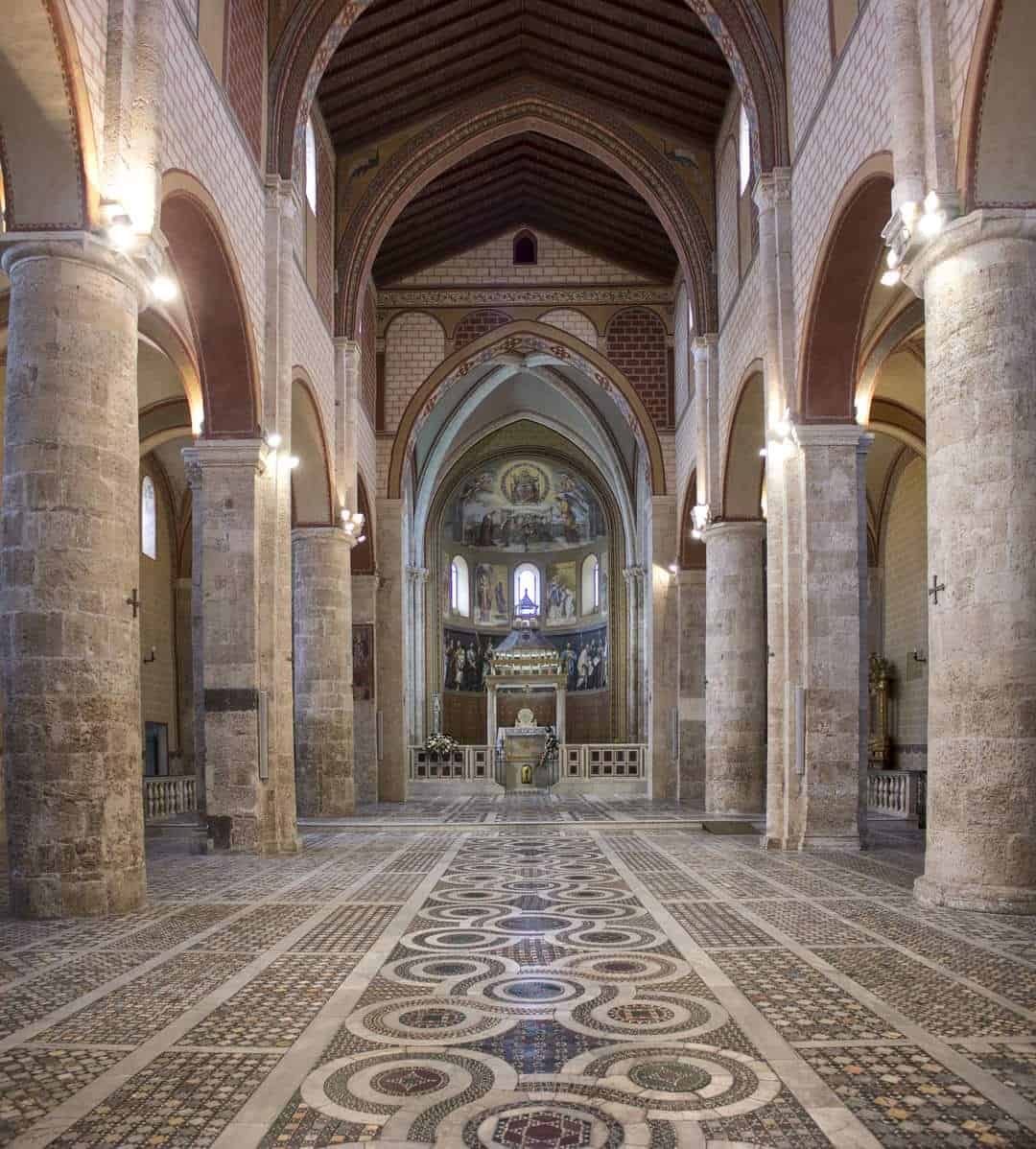
The Anagni Cathedral Museum, which also goes by the acronym MuCA, occupies the rooms attached to the cathedral basilica of Santa Maria Annunziata, at Via Leone XIII 6/E, 03012 Anagni, Frosinone Province. Telephone (+39) 0775.728374, email museo@cattedraledianagni.it. Hours are seasonal: from November to March 9:00-13:00 and 15:00-18:00, from April to October 9:00-13:00 and 15:00-19:00, every day, with entry allowed until 60 minutes before closing and visits suspended during liturgical celebrations. The full ticket costs €10.00, the reduced ticket €7.00, and the special reduced ticket for middle and high schools and for kids between 11 and 18 costs €4.00. Admission is free for people with disabilities, elementary schools, children up to 10 years old, licensed guides and one teacher for every 10 students. No other reductions are offered and the guided tour is not included in the ticket price. Booking is required for everyone, individual visitors included, and is done through the form on the official website, by phone or by email. Entries are staggered every 30 minutes. If you want the museum's own interior guide, request it at least 24 hours ahead. The base cost of the service is €50.00, added to the tickets. The available languages are Italian, English, French, German and Russian, and the guided visit lasts about an hour. By car, leave the A1 Rome-Naples at the Anagni-Fiuggi toll booth, take the 155r state road toward Fiuggi, go up to the historic center along viale Regina Margherita, turn at Porta Cerere onto provincial ring road 230 and leave the car in the multi-story car park before entering the town from via Vittorio Emanuele. By train the reference station is Anagni-Fiuggi, which however is down in the valley, in the Anagni Scalo area. The historic center is at the top of the hill and, without a car, you should plan the climb in advance.
The visit route includes 12 rooms in sequence, all covered by the ticket: the Library, the Chapter Hall, the New Sacristy, the Sacristies, the Old Treasury, the Chapel of the Savior, the Caetani Chapel, the Ambulatory, the Oratory of Saint Thomas Becket, the Crypt of San Magno, the Lapidarium with the archaeological collection and finally the bookshop. If you are looking for other museums and monuments you can reach in a day from Rome, the complete map is on the page of tourist attractions, while the overview of the city of the popes is in the guide to Anagni.

What the Anagni Cathedral Museum Ticket Really Includes
This is the first question to clear up, because in Anagni the word museum means something broader than usual. The single ticket opens 12 rooms spread over three levels: the main floor with the Chapter Library, the Chapter Hall, the New Sacristy and the two rooms of the Sacristies. The church level with the Old Treasury, the Chapel of the Savior and the Caetani Chapel. And the underground levels with the Ambulatory, the Oratory of Saint Thomas Becket, the Crypt of San Magno, the Lapidarium and the archaeological section. Whoever walks in expecting two display cases of chalices comes out two hours later feeling they have crossed 800 years.
The internal guided tour is separate, and on this the museum is very clear: the base cost of the guide service is €50.00, it is added to the tickets and must be requested at least 24 hours in advance. Groups under 15 people are not required to take the guide. In our view, without someone who can read the vaults, the crypt becomes a nice colorful cave and nothing more: the Anagni cycle is a treatise of theology and natural philosophy in paint, and you can't decipher it on your own in 20 minutes. If there are two or three of you and the €50 seems a lot, try to join the slot of a group that has already booked, which the museum allows when the slot has not reached maximum capacity.
The Cathedral of Santa Maria Annunziata, the Building That Contains the Anagni Cathedral Museum
The building site opens in the years immediately after 1068, when the documents name for the first time the Regio Castellum Novum, the plateau on which the new church would rise. The actual construction runs between 1071 and 1104 and carries the name of an extraordinary patron, Bishop Pietro da Salerno, a Benedictine monk from a Norman family who held the diocese for 43 years and died on August 3, 1105. In 1110 Pope Paschal II canonized him. Local tradition attributes part of the cost to the munificence of the Eastern emperor Michael VII Ducas. It is a story that Anagni's guides have repeated for centuries and that should be taken for what it is, a tradition, not an archival fact. The bell tower was completed in 1141 and the consecration came only on September 30, 1179, when Pope Alexander III dedicated the church to the Virgin Annunciate.
The Facade and Bell Tower of Anagni Cathedral
The facade is a plain wall of tartar stone, the spongy travertine quarried right nearby, with three entrances opening to the east. If you arrive early in the morning you see it light up yellow, because the front faces the rising sun. It is an ancient liturgical choice, the reverse of Roman custom, and in fact the apses are on the west, facing the valley with a staircase that supports the whole elevation. Next to the left entrance, behind a grille, a 14th-century fresco is preserved showing the Madonna enthroned between Saint Catherine of the Wheel and Saint Anthony Abbot.
The Romanesque bell tower, separate from the body of the church, measures 30 meters and rises growing lighter by degrees: single-light windows at the bottom, then two-light, then three-light. In 1938 the restorations built an iron tower inside it that bears the weight of the five bells, a solution that is not very romantic and very sensible. The advice for reading the monument is simple: look at the bell tower from the valley side and not from the square, because only from there do you understand how much the church rests on a fortified hill.
The Three-Aisle Interior and the Cosmatesque Floor
Inside, the layout is three aisles with alternating piers and columns, according to a plan that local tradition assigns to the Comacine masters. The original roof of wooden trusses disappears in the 13th century. Bishops Alberto, in office between 1224 and 1237, and Pandolfo, between 1237 and 1255, had the trusses of the central nave replaced with pointed arches and covered the transept with ribbed ogival vaults. This is the moment when the Gothic enters Anagni without demolishing the Romanesque, it sits down inside it.
The Cosmatesque floor of the upper church dates to the years between 1224 and 1227 and is the work of Cosma di Jacopo di Lorenzo, founder of the Roman workshop that gave its name to the adjective Cosmatesque. It was paid for by Bishop Alberto with the contribution of Rainaldo of Anagni, the fellow citizen who would become Pope Alexander IV. Cosma himself, with his sons Luca and Jacopo, signed the floor of the crypt a few years later, finished in 1231. These are two floors that differ in date and in hand, and it is worth not confusing them: the one above is more regular, the one below is more inventive and uses reused marbles of much greater value.
The Presbytery: Ciborium, Cathedra and Paschal Candelabrum
In the main apse there are three marble furnishings of the first rank: the twisted mosaic column that holds the paschal candle, the ciborium above the altar and the episcopal cathedra, with two crouching lions forming the armrests. The cathedra is signed by a member of the Vassalletto family, the other dynasty of Roman marble workers who contest with the Cosmati the primacy of the 13th century, and it was commissioned by Bishop Lando under the pontificate of Urban IV, so between 1261 and 1264. Altar, ciborium and candelabrum date to within the first half of the 13th century. Anyone who tells you that all three works carry the date 1263 is simplifying: the precise dating holds for the cathedra, not for the whole group.
The Apses, the Gagliardi and the Side Chapels
In the background of the central apse, above the painted drapery by Cisterna, stand the Apostles by Borgogna, from the 17th century, each with his own attribute. Higher up run the saints venerated in Anagni, the Annunciation and the Eternal Father, the work of the brothers Pietro and Giovanni Gagliardi, painters of 19th-century Rome who worked at length in Anagni. In the left apse you can recognize the disciples at Emmaus and the adoring angels. In the right one, the marriage of the Virgin to Saint Joseph and the Transit of Saint Joseph.
Onto the space of the church open the baptistery and the Lauri, Caetani and Raoli chapels, the latter also called the Chapel of San Carlo, with the Madonna of Mercy by Frenguelli donated by Pope Leo XIII and two canvases by the Gagliardi brothers at the sides. In the interior lunette above the central door, a Madonna and Child between Saint Magnus and Saint Secondina from the late 13th or early 14th century welcomes whoever enters. It is the pair of patron saints you will find painted everywhere underground.

The Route of the Anagni Cathedral Museum, Room by Room
The museum is visited backward in time: you begin in the 19th century and end in the 2nd century AD, which is exactly the opposite of what almost all Italian diocesan museums do. The choice is intelligent, because it prepares the eye. By the time you reach the crypt you have already seen enough goldwork and enough fresco to understand what is in front of you.
1. The Chapter Library of the Anagni Cathedral Museum
You enter among cabinets built especially for this room at the beginning of the 20th century, which hold 1,814 volumes dating between the 15th and 20th centuries. There are incunabula, that is, prints earlier than 1501, which in Italian are also called quattrocentine. There are the Latin classics, local history and above all a mass of post-Tridentine theology, because the Council of Trent, closed in 1563, gave rise in every cathedral to libraries of controversy and pastoral care. The piece I always point out is a copy of the Corpus Iuris Civilis printed in 1518: Justinian law in a library of canons tells you how much the Chapter of Anagni was a legal machine as well as a liturgical one.
High up, above the cabinets, sits the Paliotto of San Magno, a wood and silver panel with the effigy of the patron saint that was used to cover the cathedral altar on the day of the feast. On the wall there is also an Annunciation in oil on canvas by Pietro Gagliardi, painted between 1880 and 1882. It is the final sketch for the decoration of the central apse basin, so the dress rehearsal of what you have just seen in the church at a height of 20 meters. Looking at them in sequence, first the vault and then the sketch, is one of the small pleasures of this visit.
2. The Chapter Hall
The 19th-century hall preserves furniture in walnut and mahogany in Empire style: each canon is entitled to a numbered cabinet with the corresponding seat, and the geography of chapter power can be read in the numbers. The vault is decorated with plant motifs and winged putti holding a crown of roses. The canons of Anagni appear in documents already in 1068, in the years of the Gregorian reform. In 1250 Pope Innocent IV fixed their number at 24, a very high figure for a provincial Chapter and a precise sign of the city's political weight. Among the privileges accumulated over the centuries is the use of the cappa magna granted by Innocent III, and then donations of land and prerogatives from Boniface VIII, Gregory XVI and Leo XIII.
3. The New Sacristy of the Anagni Cathedral Museum
Also called the New Treasury, it gathers vestments, chalices, pyxes, patens, crosiers, miters and monstrances datable between the 15th and 20th centuries. The showiest core comes from Leo XIII, the pope from Carpineto Romano who always kept an eye on this diocese. The Ambrosian-type monstrances are his, so called because the structure of spires recalls the facade of the Milan cathedral. Two pieces that usually go unnoticed deserve a stop instead: the cruets in green glass and precious metal that belonged to Pope Paul V Borghese and a staurotheca, that is, a reliquary of the True Cross, made of wood and mother-of-pearl.
4. The Sacristies and the Reliquary Busts of 1542
The two rooms of the Sacristies were created in the 19th century by closing off a portico that faced the cloister, and they hold wall cabinets in walnut of Lazio manufacture from the late 19th century, austere and without decoration. Inside the cases of the first sacristy are the museum's two masterpieces of 16th-century goldwork: the reliquary bust of Saint Peter the bishop, in silver sheet on a wooden base, with the inscription IO. PETRUS P LEONARDUS DONO DEDIT A. SALV. MDXLII, and the one of San Magno in embossed silver, also from 1542, with a parchment scroll that reads EX OSS. MAGNI EPI, that is, from the bones of Bishop Magnus.
They are not objects for display only: on August 19, the feast of the patron saint, they come out and parade through the city inside the processional machine that the rest of the year rests in the right aisle of the cathedral. If you happen to be in Anagni on that date, keep in mind that the museum closes in the morning.
5. The Old Treasury, the Historic Core of the Anagni Cathedral Museum
Here is the reason art historians come to Anagni from all over Europe. The bulk of the collection comes from a donation by Boniface VIII, pope between 1295 and 1303 and a native of Anagni, recorded in a parchment manuscript kept in the cathedral archive that lists more than 100 objects. Not all of them have reached us, but what remains is enough to make far more prestigious museums envious. The documents also record older donations, by Pope Leo IV, between 847 and 855, to the earlier cathedral, now vanished.
The collection lines up gold, enamels, ivories, reliquaries, textiles and parchment antiphonaries with gold miniatures. The signature piece is the reliquary casket of Thomas Becket in Limoges enamels, displayed in a corner case: an object that ties Anagni to England and to the most sensational political and religious affair of the 12th century. To the ancient materials were added over time the painted panels of the 13th and 14th centuries that were not part of the original Treasury. One fact that says everything about the jealousy with which the Chapter guards this heritage: the Treasury has left Anagni twice in 150 years, in 1870 for the Great Exhibition of Catholic Worship in Rome and in 1950 for the Jubilee Exhibition of Boniface VIII.
6. The Chapel of the Savior
It was commissioned by Pietro da Salerno at the end of the cathedral building work as the bishop's private chapel, connected to the church by a stair that descended from the presbytery and was later walled up. In the 13th century, under Alberto and Pandolfo, the floor was raised, cross vaults were built and a central ogival arch was inserted with crocket capitals, that is, hook-shaped, in the Cistercian manner: the same grammar the monastic orders were spreading throughout the Sacco valley.
The walls are a palimpsest in three phases. The first shows false marble panels within arches. The second, from the 13th century, is a false masonry facing on an ocher, white and red ground, with a Christ enthroned flanked by San Magno and Santa Secondina in the small apse. The third, from the 15th century, leaves traces of frames behind the wooden crucifix. The wooden works are the real surprise. There is an episcopal cathedra of the 13th century attributed to southern craftsmen of Islamic taste, missing its backboard and reworked, which some guides present as one of the oldest in Europe. There is a crucifix of the late 15th century with a fierce anatomical realism, veins included, fitted with a mechanism at the nape that made the tongue come out during the Passion processions, and it is not a macabre detail but a piece of late medieval devotional theater. There is a painted wooden statue of Saint Anthony Abbot carved from a single trunk, which reached the museum in 1998. Two panel icons complete the picture, a Madonna and Child of 1316 and a Virgin with the priest Rainaldo of 1325 signed by Lello de Urbe.
7. The Caetani Chapel, the Family Monument of Boniface VIII
In 1296 Boniface VIII had a new building added to the left aisle with a double purpose: to give burial to people tied to his person and to stage the dual power, temporal and spiritual, of the Anagni pope and of his house. On the east wall is the Caetani tomb, a two-column ciborium set against the wall and crowned by a pediment with Gothic decoration and Cosmatesque mosaics. There are two sarcophagi. The smaller one carries the mosaic and five heraldic shields of the family, whose name betrays its origin from Gaeta.
The main fresco was executed between the end of 1296 and 1297 and has undergone later repainting. It represents the Virgin enthroned with the blessing Child, flanked by Saint Stephen and, according to a probable but not certain reading, by Thomas Becket, who present two kneeling figures. The identifications proposed are Roffredo II, count of Caserta and brother of the pope, and Cardinal Benedetto II Caetani. In the first sarcophagus rests Pietro, bishop of Todi, teacher of Boniface VIII. In the second, Roffredo II. In the base, the bones of Giacomo Caetani. The walls keep traces of ancient painting that survived because a wooden choir hid them for centuries from later interventions, which is the most ironic way a fresco gets saved: by covering it.
8. The Ambulatory
This is the passage room between the Oratory of Saint Thomas Becket and the Crypt, and originally it was a burial place for the illustrious figures of the city, who aspired to be interred under the cathedral floor as close as possible to the crypt. The stair that descends here from the left aisle is a 17th-century addition. On the west and north walls votive panels are preserved with rows of saints and small kneeling donors, the most direct form of private patronage that the Middle Ages knew.
On the west wall an unidentified bishop saint, San Magno and Santa Secondina flank the Virgin with the Child. On the north wall there are two panels. The first, from the mid-13th century, lines up Saint Oliva, Saint Nicholas of Myra, the archangel Michael, Christ blessing, Saint Peter and Saint John the Baptist. The second shows Christ between James and John the Evangelist with their mother Salome, and unfortunately it is disfigured in the faces. Look at it all the same: the mutilations of faces in medieval paintings are almost never random vandalism, they are ritual gestures, and they tell a story that the intact panel would not tell.
9. The Oratory of Saint Thomas Becket and the Mithraeum
This is the oldest room of the whole complex: a mithraeum of the 1st-2nd century AD, recognizable by the keel-shaped vault typical of Mithraic sanctuaries, with the altar set against the back wall on which bulls were sacrificed and a channel cut to let the blood flow. In the vestibule, where the tombs of illustrious families once were, opens the door that leads into this space, later transformed into a Christian oratory.
The painted cycle has an openly catechetical purpose: on the vault runs Genesis, with the creation of man, Adam and Eve, original sin, the expulsion, Noah's ark and the stories of Abraham and Isaac. The episodes of the New Testament follow, Annunciation, Visitation, Nativity, Adoration of the Magi and Presentation at the Temple, up to the Last Judgment and the triumph of Christ. A row of saints includes Remigius, Leonard, Benedict and Christopher. On the entrance wall is painted the parable of the foolish virgins, the Gospel passage that served to explain in three seconds what happens to those who arrive unprepared. In one spot of the masonry a sinopia survives, that is, the preparatory drawing, with a Templar knight with a cross on his shield: an involuntary signature of the world that frequented this hill.
Four panels tell the life and martyrdom of Thomas Becket, archbishop of Canterbury killed in 1170. In the third you see the four knights bursting into the cathedral and striking the archbishop kneeling before the altar. The same saint returns on the back wall next to the blessing Christ. Since Becket was canonized by Alexander III in nearby Segni on February 21, 1173, these paintings necessarily date to shortly after that date. They are among the oldest depictions of the martyrdom known in Italy, and they were painted when the eyewitnesses were still alive.

10. The Crypt of San Magno
The crypt was built together with the upper church, so within the building period between 1071 and 1104, and is dedicated to San Magno, patron saint of Anagni. It develops on three transverse aisles with three apses, 12 columns and 21 vaults, for a painted surface of about 540 square meters. The current definition, the Sistine Chapel of the Middle Ages, is journalistic and a bit lazy, but it conveys the density: here there is not a centimeter of wall that doesn't speak.
11. The Lapidarium and the Archaeological Collection of the Anagni Cathedral Museum
The Lapidarium is set up in the porticoes of the old cloister and gathers Roman, early Christian, medieval and modern inscribed stones, together with pieces of the fixed liturgical furnishings of the Carolingian cathedral of the 9th century, the one that preceded the present building. The plutei, that is, the slabs of the presbytery enclosures, are the oldest witnesses of the Anagni liturgy. The slabs decorated with Cosmatesque mosaics of the 13th century stand out, which allow you to study up close, at eye level, the same technique you walk on in the floor.
In front of the railing of the ramp are placed the Roman cippi found in the locality called Terme di Piscina, the same area that preserves the imposing Arcazzi di Piscina, the arches of Anagni's ancient hydraulic complex. Reading the cippi here and then going to see the arches down there is one of the few truly coherent archaeological routes you can do in Ciociaria in half a day. Some finds do not come from Anagni or its territory: they come from Rome and the Roman catacombs and were given to the cathedral in different periods. The archaeological collection proper is displayed in glass cases in the cryptoporticus and includes materials of great quality, among them a Greek vase with the figure of Orpheus assigned to the 5th-4th century BC.
12. The Bookshop
It closes the route, at the exit. It is not a detail to dismiss: the scholarly bibliography on the crypt and on the Treasury is almost all in local editions that are hard to find outside Anagni. If the crypt struck you, the catalog bought here is worth more than three hours of searching online.
The Treasury of the Anagni Cathedral Museum: the Textiles of Boniface VIII
The chapter on textiles deserves separate treatment, because it is the reason this museum appears in the international bibliography on medieval embroidery. A parchment inventory datable around 1300, kept in the Chapter Archive of Anagni, lists 101 items donated by the pope: 95 liturgical textiles and 12 liturgical objects in metal and ivory. It is not often that you have the shopping list of a 13th-century pontiff and, in part, the goods as well.
The techniques represented are four and come from different worlds. The opus cyprense, from the second quarter of the 13th century, produced perhaps in Cyprus or in Norman Sicily, is embroidered in gold and silk on red samite and includes a cope, a chasuble and two dalmatics: the motifs imitate precious Eastern fabrics. The opus anglicanum, from the late 13th century, produced in England or in France, includes two copes and a chasuble embroidered entirely with gold thread and polychrome silk and organized in articulated narrative cycles, with the life of the Virgin, the Passion of Christ, the life of Saint Nicholas and crowds of martyr saints. Alongside appear the opus theutonicum and the opus romanum of local production.
Two warnings that the attentive visitor appreciates. The first: these vestments were reworked between 1573 and 1576 to adapt them to the liturgy that came out of the Council of Trent, so the form you see is not always the original. The second: the restorations of the 1960s modified the appearance of some pieces further. The cope known as that of Boniface VIII, the most famous, decorated with symbolic animals that refer to the Boniface conception of the papacy, should be looked at knowing that it has gone through seven centuries of scissors and needles. Put bluntly: it is the single most important object preserved in southern Lazio, and in Anagni they show it in a room that in London would be an entire wing.

The Crypt of San Magno, the Masterpiece of the Anagni Cathedral Museum
The painting campaigns fall between the end of the 12th century and the first half of the 13th and are the work of three distinct workshops, which scholarship has baptized First Master or Master of the Translations, Second Master or Ornatist Master, Third Master or Master of Anagni. The iconographic program tells the story of salvation from the origin of the world to the last judgment, and does so with an intellectual ambition that has few comparisons in Italy.
The Vault of Creation and the Theory of the Elements
On the vault of creation the cosmos is represented with the zodiac signs and with a philosophical construction that puts in proportional relation the four elements, the four ages of man, the four temperaments and the four seasons. It is the doctrine of the microcosm within the macrocosm, of Platonic derivation, translated into wall painting. On a pillar appear Hippocrates and Galen discussing natural philosophy: two pagan physicians painted in a Christian crypt, in dialogue, under the authority of the Church. Anyone who believes the Middle Ages was afraid of ancient science should spend half an hour in front of this pillar and then rephrase the sentence.
The Ark of the Covenant and the Philistines
The Old Testament cycle draws on the first book of Samuel: the clash between Philistines and Hebrews, the capture and journey of the Ark of the Covenant, the misfortunes that strike those who keep it, the election of Saul as king. The choice is not obvious. The Ark is the sacred container par excellence, and painting its adventures on the vaults of a crypt that guards holy bodies means telling the faithful, without a word, what that floor guards and what risks whoever profanes it runs.
The Apocalypse
The apocalyptic cycle stages Christ the judge within the mandorla, the mystic Lamb with seven horns holding the sealed book, the symbols of the four evangelists, the 24 elders and the opening of the first six seals. It is the section that strikes visitors most, and there is a technical reason: the figures of the elders are arranged in a crown on the vaults, so they rotate above the head of the viewer and produce an effect of vertigo that no photographic reproduction conveys.
The Altars, the Holy Bodies and the Floor
On the walls run the stories of the miracles attributed to San Magno and the hagiographies of the saints buried in the altars. The altar of San Magno holds the relics of the patron saint. The one of Santa Secondina preserves, together with hers, the relics of the princesses Aurelia and Noemisia. The third, dedicated to the Martyrs and to Bishop Pietro, carries a fresco of 1324 signed by Lello de Urbe. In the crypt relics of Saint Oliva, Saint Sebastian and Saint Caesarius are also recorded. The Cosmatesque floor, finished in 1231 by master Cosma with his sons Luca and Jacopo, uses reused marbles of the highest quality: green serpentine and red porphyry, with ancient whites and yellows. Walk on it gently and look down at least once, because 90 percent of visitors come in here and never lower their eyes.
The Three Masters and the Link with Rome
The Third Master, the one that scholarship calls Master of Anagni, has also been recognized as the author of the frescoes of the Gothic Hall of the Roman complex of the Santi Quattro Coronati, which re-emerged in 1996 under the whitewash and were returned to the public with the restoration completed in 2014. Those paintings date to the 1240s. The link between Anagni and Rome is therefore not a parochial suggestion: it is the same hand, or the same workshop, working in the provincial crypt and in the cardinal's palace of the capital. Said without diplomacy: whoever visits Anagni understands Rome better than whoever visits only Rome.
The cycle went through a long and delicate restoration between 1987 and 1994, carried out by the central restoration institute, with cleaning and consolidation of the painted surfaces. The microclimate remains enemy number one of these frescoes, and the rule of staggered slots every 30 minutes serves that purpose too: fewer people together, less humidity, less carbon dioxide.

A Curiosity About the Anagni Cathedral Museum
The curiosity I prefer concerns the underground and not the treasure. The oldest room of the complex is not Christian: it is a mithraeum of the 1st-2nd century AD, that is, a sanctuary of the Persian cult of Mithras, recognizable by the keel-shaped vault and by the altar set against the back wall, where bulls were slaughtered. In the stone you can still see the channel cut to drain the blood of the victims. On that same altar, centuries later, Christian mass was celebrated, and the walls were covered with Genesis and with the martyrdom of an English archbishop.
The overlap is not an isolated case in Italy, but here it is legible with the naked eye in a single room and without museographic mediation: you walk in and you touch the passage from one cult to another. It is worth adding the detail that almost nobody tells: on the masonry a sinopia survives, the preparatory drawing traced before the final plaster, with a Templar knight with a cross on his shield. Anagni was a stop on the route between Rome and the South, and the knights returning from the East passed through here.
Then there is the question of orientation. The cathedral has its facade to the east and its apses to the west, the opposite of the Roman norm. It is not a mistake by the builders: it is a liturgical choice from a Benedictine and Norman environment that Bishop Pietro da Salerno brought with him. The practical consequence for the visitor is that the best light on the facade is the first light of morning, while the apses and the western staircase light up at sunset. Whoever arrives in the middle of the day catches the monument at its worst moment, and that is exactly what most tour buses do.
Something Nobody Tells You About the Anagni Cathedral Museum
That booking is required for everyone, even for the single visitor who shows up on foot on a Tuesday in November. This is not the courtesy formula you read in half of Italy: here entries are organized in slots every 30 minutes, with the descent into the crypt staggered, and whoever arrives without having booked risks waiting a long time or not getting in at all. It is a conservation rule before an organizational one, because the 540 square meters of crypt fresco suffer from the humidity produced by bodies.
The second thing nobody says concerns the celebrations. The cathedral is a living parish, not a museum container: during religious services visits are suspended. On patron saint feast days the calendar tightens even more. On August 19, the day of San Magno, the museum stays closed in the morning because the reliquary busts of 1542 go out in procession inside the machine that rests the rest of the year in the right aisle.
The third concerns money. The reductions are the ones written down and that's it: full €10.00, reduced €7.00, special reduced €4.00 for middle and high schools and for kids between 11 and 18, free for people with disabilities, elementary schools, children up to 10 years old, licensed guides and one teacher for every 10 students. No other free entries or reductions are offered and the ticket office makes no exceptions. The free entry of the first Sunday of the month for state museums does not apply here, because the museum belongs to the Chapter of the cathedral and not to the State. Showing up on the first Sunday hoping for free entry is a classic mistake of those who apply Rome's rules to Anagni.
My Advice for Visiting the Anagni Cathedral Museum
Book the first slot of the afternoon and not the morning one. The reason is practical: in the morning the museum absorbs school groups and organized groups arriving by tour bus from the toll booth, while from 15:00 on the pace slackens and in the crypt there are 10 of you instead of 40. If you come between April and October, the last useful slot is the one that keeps you inside until 19:00, and on the way out you find the raking light on the western apses, which is the best photographic moment of the day.
Second piece of advice: allow two hours, not one. The internal guided visit lasts about 60 minutes, but the route includes 12 rooms and the crypt alone deserves half an hour of silent pause after the guide has finished talking. If you have only one day and want to combine something, combine a walk in the historic center, not a second museum: Anagni is visited on foot and the distances between the cathedral, the palace of Boniface VIII and the town hall are a few minutes.
Third piece of advice, the one that counts most. Go down into the crypt with a switched-off flashlight in your pocket and don't use it: it only serves to make you understand how dark the room is without the museum lighting. Then look at the vaults starting from the central bay and turn slowly on yourself, without moving. The iconographic program was designed to be read like this, from a fixed point, raising your eyes. Whoever walks along the walls reading the labels one by one leaves without having seen anything. Bring a scarf even in July: underground it's around 15 degrees and the difference with the outside, in midsummer, is brutal.
Another Well-Known Fact, Yet Rarely Cited
Everyone knows Anagni is the city of the popes. Almost nobody remembers that the title does not come from a generic devotion, but from a precise administrative fact: between the 12th and 13th centuries the Roman curia regularly moved up here to escape the summer of the city and its feuds, and the cathedral functioned to all effects as a papal seat. The Chapter's sources record long stays by Paschal II in 1106 and between 1117 and 1118, by Alexander III between 1159 and 1178, by Gregory IX between 1227 and 1239, by Innocent IV between 1243 and 1254, by Alexander IV between 1255 and 1260 and by Boniface VIII between 1295 and 1302.
The second well-known and badly told fact concerns the number of Anagni popes. Tradition counts four, and the figure circulates on every brochure. The Chapter's papers document with certainty two births in Anagni: that of Ugolino, future Gregory IX, around 1170, and that of Benedetto Caetani, future Boniface VIII, around 1235. On the other two the question is more nuanced than is said, and the families involved, the Counts of Segni above all, had possessions scattered over half the Sacco valley.
Third element rarely cited: here ecclesiastical justice was administered at the highest levels. From the cathedral of Anagni Pope Gregory IX promulgated on September 29, 1227 the first excommunication against Emperor Frederick II, and also from Anagni Alexander III had struck Frederick Barbarossa on March 24, 1160. It was not a holiday: it was a second Lateran, with the papers and the notaries in tow.
The Right Photo to Take at the Anagni Cathedral Museum
Let's start with the rules, because here they matter. Photographing without flash is allowed in all rooms of the museum. Flash, stands (that is, tripods) and selfie sticks are forbidden. Umbrellas, food and drinks are forbidden, as is touching the objects and leaning on furniture and cases. During religious services you do not visit and you do not photograph.
The photo to take, inside, is just one: the vault of the crypt shot from below, vertically, from the central bay, with the 24 elders of the Apocalypse rotating around the lens. Without a tripod you need a steady hand: tuck your elbows against your body, breathe out and shoot at the end of the exhale, raise the sensitivity instead of lengthening the exposure time. A wide-angle lens helps, but don't overdo it, because below 24 millimeters the vaults deform and the design of the bays is lost.
Outside, the right photo is not the facade. It is the western side, with the three apses jutting out over the staircase and the bell tower standing out behind: at sunset the tartar stone turns orange and the structure can be read in full, from the base to the three-light window. You get there by going down from the square and walking around the apse. The second framing I recommend is from afar, from the road that climbs to the historic center: the cathedral appears on the edge of the hill like a ship run aground, and that is how pilgrims arriving from the Sacco valley saw it for 800 years. A contrarian opinion: the frontal facade, the one everybody posts, is the least interesting photograph you can take in Anagni.

Some Important Events That Happened Here in History
The first event that directly concerns these walls is the consecration: on September 30, 1179 Pope Alexander III consecrated the cathedral and dedicated it to the Virgin Annunciate, 75 years after the end of the building work. Alexander III knew Anagni well: he had spent entire years here, and here on March 24, 1160 he had pronounced the excommunication against Emperor Frederick I Barbarossa and against the antipope Ottaviano Monticelli, who had had himself called Victor IV. On November 4, 1176, after the imperial defeat at Legnano, the first treaties between papacy and empire were signed in Anagni, the preliminaries that would lead to the peace of the following year: it is what the local sources call the pactum anagninum.
Saints were made here. In 1161 Alexander III canonized Edward the Confessor, king of England. In 1174 the same pope canonized Bernard of Clairvaux, the most influential Cistercian of the century. In 1215 Innocent III canonized Saint Peter the hermit, patron saint of Trevi nel Lazio. In the spring of 1255 Alexander IV canonized Clare of Assisi, dead barely two years earlier. In 1243 Innocent IV was elected pope in Anagni, and in 1250 the same pontiff fixed at 24 the number of canons of the Chapter.
Emperors were also excommunicated here. On September 29, 1227 Gregory IX promulgated from the cathedral the first excommunication against Frederick II. The hard line against the Hohenstaufen continued with Alexander IV against Manfred of Sicily, to the point that in 1263 the bishops of Anagni, Alatri, Veroli and Ferentino were obliged to dissolve every association in favor of the Swabian king.
Then there are the black dates. On September 7, 1303 the militia of Sciarra Colonna and the envoy of the king of France Guillaume de Nogaret assaulted Boniface VIII in his palace: it is the episode that historiography calls the slap of Anagni, the blow that broke the medieval idea of papal supremacy over monarchies. The pope was freed by the citizens on September 10 and died in Rome a few weeks later. In 1256 a violent earthquake had its epicenter right in Anagni. In August 1348 the plague and the mercenary companies of Werner von Urslingen devastated the city. On August 9, 1378, finally, the cardinals gathered in Anagni declared the election of Urban VI invalid: from that declaration was born the Great Western Schism, which would divide Christendom for 40 years.
Who Has Passed Through the Anagni Cathedral Museum
The list of popes who lived and celebrated in these rooms is long and documented. Paschal II in 1106 and between 1117 and 1118. Adrian IV, the only English pope in history, who died in Anagni on September 1, 1159. Alexander III for almost 20 years on and off, between 1159 and 1178. Innocent III, who granted the Anagni canons the use of the cappa magna. Gregory IX, a native of Anagni, between 1227 and 1239. Innocent IV, elected here in 1243 and present until 1254. Alexander IV between 1255 and 1260. Boniface VIII between 1295 and 1302. Three centuries later Paul V Borghese left here the green glass cruets seen in the New Sacristy, and in the 19th century Leo XIII, pope from Carpineto Romano a short distance from here, covered the cathedral with gifts: the Ambrosian-type monstrances and the Madonna of Mercy by Frenguelli carry his signature as patron.
The adversaries of the papacy have also passed through here, in a less peaceful way. Sciarra Colonna and Guillaume de Nogaret in September 1303. The mercenary companies of Werner von Urslingen in 1348. And the artists passed through: Cosma di Jacopo di Lorenzo with his sons Luca and Jacopo, who between 1224 and 1231 worked on the two floors. A Vassalletto, who signed the episcopal cathedra for Bishop Lando. Lello de Urbe, a Roman painter active in the early 14th century, who left the panel of 1325 with the Virgin and the priest Rainaldo and the fresco of 1324 on the altar of the Martyrs. In the 19th century Pietro and Giovanni Gagliardi, who painted the apses.
Above all, for those who deal with medieval painting, remains a man without a name: the Third Master of the crypt, whom scholarship calls Master of Anagni and to whom the paintings of the Gothic Hall of the Santi Quattro Coronati in Rome have also been assigned, rediscovered in 1996 and returned to the public in 2014. We don't know what he was called. We know that in the 1240s he worked for the cardinals of the curia and that his masterpiece is under the floor of a provincial cathedral, 70 kilometers from Rome.
How Long the Visit to the Anagni Cathedral Museum Takes
The internal guided visit lasts about an hour and covers the 12 rooms. Whoever goes alone and takes the time to look at the vaults of the crypt easily reaches 90 minutes. With the upper cathedral add another 20 minutes. The honest count for a complete visit is two hours. Entries are staggered every 30 minutes and the descent into the crypt happens half an hour after entry: this means your slot has a time and that showing up late means losing it.
The Anagni Cathedral Museum with Kids
It works better than you'd think, under two conditions. The first: children up to 10 years old get in free and so do elementary schools, so the cost for a family is contained. The second: you have to tell the crypt as a story and not as a lesson. The vaults offer perfect material for an eight-year-old, be it the monsters of the Apocalypse, the Ark of the Covenant that brings misfortune to whoever steals it or the four knights who enter the church with swords drawn. The 15th-century crucifix of the Chapel of the Savior, with the mechanism that made the tongue come out during the processions, is the piece that wins them over in three seconds.
Rules to explain before going in: you touch nothing, you don't lean on the cases, you don't speak loudly and you don't eat along the route. The stroller is awkward in the underground levels, better a baby carrier or a child-carrying backpack. A practical warning: it is cold in the crypt all year round.
Accessibility of the Anagni Cathedral Museum
The museum has tackled the problem seriously, which in a medieval complex on three levels was not a given. There are iron and wooden ramps to overcome the differences in level and an elevator that connects the ground floor to the first floor. For the underground levels, the Crypt of San Magno included, a mobile tracked stairlift is available, certified and simple to use, which lets visitors who cannot walk go down with their own wheelchair or with an approved one provided by the ticket office. The weight limit is 80 kilograms and a museum attendant accompanies the visitor along the whole route. The mobile solution was chosen on purpose to avoid bulky electric platforms and invasive works on the historic structures.
There are restrooms that meet the standards and a large private parking area reserved for certified disabled visitors near the entrance. For all this to work you need to give adequate notice when booking, both to organize the service and to authorize access to the parking. My advice: call, don't just use the form, and say in advance how many wheelchairs you have.
When to Go and When to Avoid Anagni
The best period runs from mid-September to the end of October and from April to early June: the light is right, the temperature in the crypt is bearable and the school buses have not yet filled up the morning slots. July and August are less crowded than you'd think, because Ciociaria is not a seaside destination, but the heat on the hill is serious and the temperature swing with the underground levels is felt.
To avoid, or at least to plan with care: August 19, the feast of San Magno, when the museum closes in the morning for the procession. The days of solemn celebrations, when visits are suspended. And the first Sunday of the month, not because it is worse than the others, but because many people arrive convinced they will find the free entry that doesn't exist here. If you want the crypt almost empty, aim for a Tuesday or Wednesday in late November, with the 15:30 slot: it is the moment when this place gives its best.
What to See Around the Anagni Cathedral Museum
The whole historic center is within 10 minutes on foot. The palace of Boniface VIII, built by joining and fortifying existing buildings, is the site of the outrage of 1303. The town hall, built in 1159 to a design by Jacopo da Iseo, called il Lombardo, is reached by walking along via Maggiore from Porta Cerere and is one of the oldest civic buildings in Italy still standing. The city wall in polygonal masonry, which old manuals called Cyclopean, dates to a time shortly after the Roman conquest. Outside the walls are the Arcazzi di Piscina, the great arches of the ancient hydraulic complex, the same locality the Roman cippi of the Lapidarium come from.
If you have two days, Ciociaria offers a compact and underrated itinerary: the megalithic walls and the acropolis of Alatri, the Roman market of Ferentino, the cathedral of Veroli, the charterhouse and caves of Collepardo, the waters of Fiuggi 15 kilometers away and the mountain villages of Guarcino and Vico nel Lazio. Farther south there is Montecassino Abbey. Toward the Simbruini mountains you climb to Subiaco. For those who want to stay with museums, the Frosinone archaeological museum, the Priverno museums and the sanctuary of Fortuna Primigenia at Palestrina complete the picture of ancient southern Lazio.
Quick Questions About the Anagni Cathedral Museum
How much does the Anagni Cathedral Museum ticket cost?
Full €10.00, reduced €7.00, special reduced €4.00 for middle and high schools and for kids between 11 and 18.
Who gets in free at the Anagni Cathedral Museum?
People with disabilities, elementary schools, children up to 10 years old, licensed tour guides and one teacher for every 10 students. No other free entries are offered.
Do you need to book to visit the Anagni Cathedral Museum?
Yes, booking is required for everyone, even for individual visitors. You book through the form on the official website, by phone at 0775.728374 or by writing to museo@cattedraledianagni.it.
What are the opening hours of the Anagni Cathedral Museum?
From November to March 9:00-13:00 and 15:00-18:00. From April to October 9:00-13:00 and 15:00-19:00. Open every day, with last entry 60 minutes before closing.
Does the ticket include the guided tour?
No. The base cost of the internal guide service is €50.00 and is added to the entrance tickets. It must be requested at least 24 hours in advance.
In what languages is the guided tour given?
Italian, English, French, German and Russian.
How long does the visit to the Anagni Cathedral Museum take?
The accompanied visit lasts about an hour. To see the upper cathedral at a relaxed pace as well, allow two hours.
Can you take photographs inside the Anagni Cathedral Museum?
Yes, without flash, in all rooms. Flash, tripods and selfie sticks are forbidden.
Is the Anagni Cathedral Museum wheelchair accessible?
Yes. There are ramps, an elevator between the ground floor and the first floor and a mobile tracked stairlift for the underground levels and the crypt, with a limit of 80 kilograms and accompaniment by an attendant. You need to give notice when booking.
What is the Crypt of San Magno?
It is the underground church of the cathedral, built between 1071 and 1104, with 12 columns, 21 vaults and about 540 square meters of frescoes from the late 12th and the first half of the 13th century.
Why is the crypt called the Sistine Chapel of the Middle Ages?
For the extent and continuity of the painted cycle, which covers vaults and walls without interruption. It is a popularizing definition, not a critical judgment.
Is the crypt included in the museum ticket?
Yes. The Crypt of San Magno is one of the 12 rooms included, and you go down there about half an hour after the time of your entry slot.
What is the mithraeum under the cathedral of Anagni?
A sanctuary of the god Mithras of the 1st-2nd century AD, the oldest room of the complex, later transformed into the Oratory of Saint Thomas Becket. It preserves the altar with the channel for the blood of the bulls.
What is kept in the Treasury of the Anagni Cathedral Museum?
Goldwork, enamels, ivories, reliquaries, liturgical textiles and illuminated antiphonaries, largely tied to the donation of Boniface VIII documented by a parchment inventory of about 1300 with 101 entries.
Where is the cope of Boniface VIII?
In the Old Treasury of the museum, together with the other vestments donated by the pope. They are pieces reworked between 1573 and 1576 for the post-Tridentine liturgy.
Is the Anagni Cathedral Museum a state museum?
No, it belongs to the Chapter of the cathedral. For this reason the free entries of state museums do not apply and there is no free entry on the first Sunday of the month.
How do you get to Anagni from Rome by car?
A1 Rome-Naples motorway, Anagni-Fiuggi exit, then the 155r state road, viale Regina Margherita, Porta Cerere, provincial ring road 230 and the multi-story car park before entering the town.
Can you get to Anagni by train?
The station is Anagni-Fiuggi, but it is down in the valley, in the Anagni Scalo area, while the historic center is at the top of the hill. Without a car you should arrange the connection to the center in advance.
Is the museum suitable for kids?
Yes, especially the crypt and the Chapel of the Savior. Children up to 10 years old get in free. A baby carrier is better than a stroller in the underground levels.
What is the temperature in the crypt?
The underground levels are much cooler than outside all year round: even in August it is a good idea to have a sweatshirt or a scarf in your backpack.
Does the museum close during religious services?
Yes. The cathedral is an active parish and during celebrations visits are suspended. On August 19, the feast of San Magno, the museum stays closed in the morning.
What is the difference between the cathedral and the Anagni Cathedral Museum?
The cathedral is the church, with free entry according to the liturgical hours. The museum is the route of 12 attached rooms, paid and with required booking, which includes the crypt, the oratory, the treasury and the lapidarium.
Is it worth coming to Anagni just for the museum?
Yes. The crypt cycle is one of the three or four most important medieval painted complexes in Italy, and within an hour's drive of Rome there is nothing comparable.
One last thing. In Anagni the temptation is to rush: you arrive, go down into the crypt, take 30 photographs and leave for Fiuggi. Do it the other way around. Book a late afternoon slot, let the guide finish the tour, then stay seated on the steps of the crypt until the next group arrives. Those 10 minutes of silence under the vaults, with low light and nobody talking, are worth the whole trip. It is one of the few places in Lazio you leave without saying a word.
Article written by the editorial team of TourLeaderPro, contact them for Private/Corporate/V.I.P. Tours and Experiences.
Are you planning a trip to Rome? The English guides to visiting the city and Lazio are on ItalyPlanner.com.