Trevi nel Lazio (FR)
In short. Trevi nel Lazio (FR) is a mountain village at 821 meters above sea level, in the province of Frosinone, postal code 03010, perched on the upper Aniene valley between the Simbruini mountains to the north and the Ernici mountains to the south.
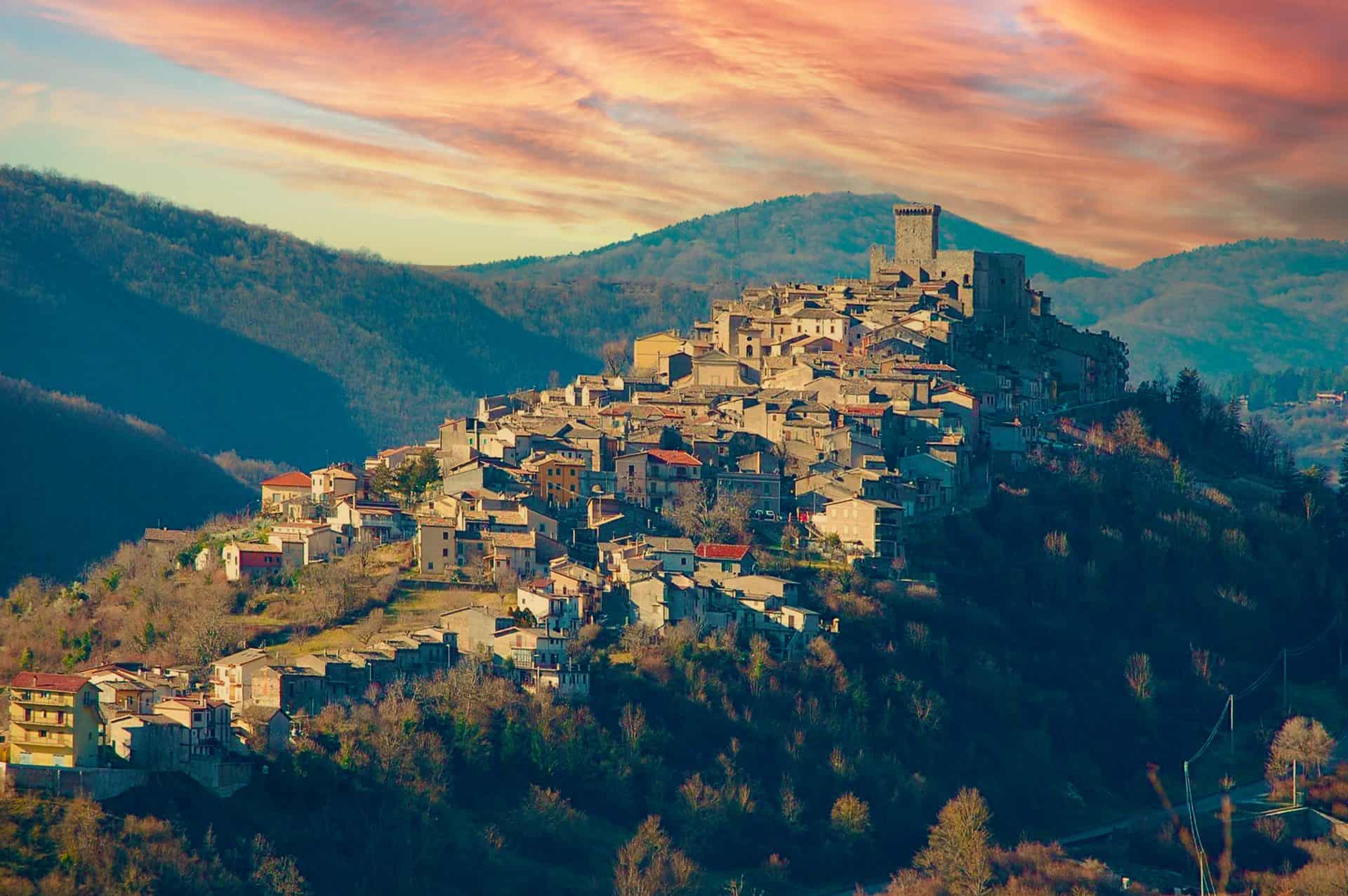
Trevi nel Lazio (FR) is a mountain village at 821 meters above sea level, in the province of Frosinone, postal code 03010, perched on the upper Aniene valley between the Simbruini mountains to the north and the Ernici mountains to the south. Its inhabitants number just under 1,700. The town hall answers at 0775 527001. The main monument, Caetani Castle, is at Via Eresio Fertore 1 and opens to the public on weekends, with contacts at 0775 527001 and 349 6469886: outside those days it's best to phone before setting out, because opening depends on the volunteers and the season. The collegiate church of Santa Maria Assunta is in Piazza Santa Maria Maggiore, at the highest point reachable by car. The Trevi Waterfall, the natural highlight, is about 6.3 kilometers from the historic center along provincial road 193, and is reached on foot in a few minutes from the bridge. The Simbruini Mountains Regional Natural Park, which includes the entire municipal territory, has its information line at 0774 827221. Trevi nel Lazio is awarded the Touring Club Italiano's Orange Flag, the tourism and environmental quality mark reserved for small inland towns.
Frequently asked questions about Trevi nel Lazio (FR)
Where is Trevi nel Lazio and how do you get there from Rome?
Trevi nel Lazio (FR) is in the province of Frosinone, at 821 meters above sea level, in the upper Aniene valley between the Simbruini mountains and the Ernici mountains. From the south you get there by taking the A1 motorway to the Anagni-Fiuggi exit, then the expressway to Fiuggi and finally the provincial road that climbs to the village.
Is the Trevi Waterfall in the town?
No, the Trevi Waterfall is not inside the town of Trevi nel Lazio: the village is perched at 821 meters, while the waterfall is on the valley floor, about 6.3 kilometers along provincial road 193, reachable only by car because there is no reasonable pedestrian link with the historic center.
How much time do you need to visit Trevi nel Lazio?
The village of Trevi nel Lazio can be toured on foot in a good hour and a half, castle included. Adding the Trevi Waterfall and the Comunacque archaeological area brings you to a full half day, while including the Parco della Portella or the Arco di Trevi as well, which takes an hour and three quarters of walking one way alone, calls for a full day.
When is the best time to see the Trevi Waterfall?
The best time to see the Trevi Waterfall in Lazio is the morning, in the central hours, when the light enters fully into the gorge set between rocks and vegetation and lights up the emerald green color of the water in the pool. It's therefore best to visit the waterfall first and then go up to the village, reversing the order followed by most visitors.
Can you ski near Trevi nel Lazio?
Yes, near Trevi nel Lazio you ski at Campo Staffi, the reference resort in the territory of the neighboring comune of Filettino, inside the Simbruini Mountains Regional Natural Park. Elevations reach around 2,000 meters and the ski area claims about 20 kilometers of slopes. Trevi nel Lazio works well as a logistical base because it is cheaper than the resorts up the mountain.
Is Trevi nel Lazio inside a natural park?
Yes, the entire municipal territory of Trevi nel Lazio (FR) falls within the Simbruini Mountains Regional Natural Park, the largest protected area in Lazio with about 30,000 hectares, which includes seven comuni between the provinces of Rome and Frosinone. The highest peak in the park is Monte Viglio, at 2,156 meters.
What is there to see near Trevi nel Lazio?
Within the 20 kilometers around Trevi nel Lazio you find Filettino, the highest comune in Lazio and gateway to Campo Staffi, Vallepietra with the sanctuary of the Santissima Trinità set into the rock, and Fiuggi with its thermal springs. Trevi nel Lazio therefore also works well as a base for itineraries in the area.
From Rome you get there by car by two different roads, and the choice changes the day. From the south you take the A1 to the Anagni-Fiuggi exit, then the expressway toward Fiuggi and from there the provincial road that climbs to the village: between Fiuggi and Trevi there are 17.8 kilometers of curves. From the north you exit the A24 at Vicovaro-Mandela, go down to Subiaco and continue along the SP193 in the upper valley, which passes right in front of the waterfall before climbing to the town. The second route is a few minutes longer and infinitely more beautiful. By public transportation the connection relies on the regional Cotral buses: the schedules change between the school period and the summer period and should be checked on the carrier's website before leaving, because the afternoon return runs are few. The nearest railway station on the Rome-Cassino line is Anagni-Fiuggi, which however stays far from the village and still requires a transfer by road. Those traveling in an organized group can rely on an authorized tour escort: the network of TourLeaderPro routinely works in this quadrant of the Lazio Apennines.
Trevi nel Lazio (FR): where it is and why the town is made of three towns
The first thing to understand about Trevi nel Lazio is that it is not a single settlement. The town is made up of three distinct zones, grown in three different eras and still readable today with the naked eye. At the top, on the hilltop, is the Civita: the ancient settlement perched on the hill, the core that coincides with the old acropolis and that the castle dominates. Below, the band called in mezzo alla terra, from the 16th century, laid out along a little street that bears exactly that name, Mezzo la terra, and that works as a watershed between the old and the new. Further down still, outside the Renaissance walls, the modern part, the one where people actually live, with the postwar houses, the shops and the parking lots.
Anyone arriving by car parks in the third zone and climbs on foot toward the first. It is a route with a real change in elevation, not a flat stroll: closed shoes, always. The reward is that going up you cross five centuries of building in 10 minutes of walking.
The whole settlement preserves a layout that can be called Roman, because the major cardo and decumanus can still be recognized. It is not a brochure fancy: the street grid of the upper core repeats the orthogonal scheme of the ancient town, with the two main axes crossing and the insulae that derive from them. That a mountain town has kept for 20 centuries the urban imprint of the Roman municipium is a rarity worth the trip more than many famous churches.
The territory of Trevi nel Lazio and the Altipiani
Part of the municipal territory falls within the Altipiani di Arcinazzo, the basin of meadow and beech forest that Trevi shares with Arcinazzo Romano and that borders the area of Piglio. The Altipiani have been a mountain resort for more than a century, with a vocation as an old-time Roman holiday retreat that still shows in the 1960s villas along the state road. They are also the starting point of the winter shuttle to the ski lifts, and in summer the right place for a picnic in the shade without having to walk.
At the foot of the village the Aniene is blocked by a dam that forms an artificial lake, the Lago del Pertuso, built for the production of electricity. The reservoir changed the look of the valley floor and today is frequented mostly by trout fishermen. Not far away the Fonte Suria offers water and tables: a banal stop on paper, in practice the place where you understand how a mountain town lives on Sunday.

Caetani Castle in Trevi nel Lazio (FR)
On the origin of Caetani Castle there are no historical sources that allow a precise dating. The most accredited hypothesis dates it to around the year 1000, when the phenomenon of incastellamento fills the whole Apennine ridge with fortresses. For the keep an earlier dating has also been proposed, between the 9th and 10th centuries, with the reuse of stretches of an older defensive circuit. A word of caution: the first is a reasoned archaeological hypothesis, the second a reading of the masonry, and neither of the two is confirmed by a document.
The castle stands on a mass of compact rock and occupies an area of about 800 square meters. The walls are 12 to 16 meters high and at least a meter thick at the base, built in limestone and squared cardellina, the local stone that takes on an almost blue color in winter. It rose above the opus quadratum walls that bounded the ancient acropolis and was connected to a wider circuit of walls that enclosed the highest part of the settlement.
How Caetani Castle is laid out
The structure is divided into three main parts, and recognizing them during a visit completely changes your understanding of the monument. The area on the north and west fronts was the lord's dwelling: residential rooms, chambers, kitchens, the apparatus of representation. The area on the south and east fronts had a mainly military and defensive function, with access from the west gate: here were the guardhouses, the walkways, the storerooms. At the center is the Maschio, the keep, the tower of last defense, 16 meters high. The castle is thus born two-faced, half palace and half fortress, and this double nature can be read in the different thickness of the masonry on one side and the other.
From the top of the keep you can see a large part of the upper Aniene valley. It is the reason the castle is there and not elsewhere: whoever controlled this point controlled the passage between the valley and the Ciociaria, and therefore the toll. Today the castle also hosts a small exhibition of archaeological materials and prehistoric artifacts collected in the municipal territory.
The history of Caetani Castle, from the monks to the Templars to the Caetani
The possession of the fortress is a story of popes, abbots and nephews. Originally the castrum belonged to the abbey of Subiaco. In 1257 Pope Alexander IV granted the fief to his nephew Rinaldo de Rubeis, a figure the local sources also call Rinaldo di Jenne. In 1262, under Urban IV, the fief passed to the abbey of Subiaco. A local tradition, reported by the area guides, holds that in 1263 Clement IV assigned it to the Templars as a garrison on the pilgrimage routes to the Holy Land, and in 1264, again under Clement IV, the fortress returned to Rinaldo de Rubeis. The succession is dense and the sources do not agree on every step: whoever wants the complete documentary reconstruction will find it in the local studies kept at the town hall.
The turning point comes at the end of the 13th century, when the castle is bought by Pietro Caetani, brother of Pope Boniface VIII. The sources waver between 1299 and 1302 for the date of the purchase: the substance does not change, the pope's family enters Trevi around the years of the Jubilee of 1300 and stays there for two centuries. The Caetani oversaw its enlargement, preparing rooms suited for living in. After a fire the castle was probably rebuilt in its present forms. In the north part are the rooms intended as the lord's residence, in the south part those intended for military functions.
The castle's greatest splendor coincides with the Caetani lordship, and ends abruptly in 1471, when Cristoforo Caetani is driven out by the population for misgovernment. Not a siege, not a war between nobles: a village revolt. In 1473 Pope Sixtus IV reassigned Trevi to the monastery of Subiaco and the castle became the seat of the Curia. In 1753 Benedict XIV gave the Comune a different administrative organization and the fortress lost almost entirely any representative function.
From there the physical decline begins. The dwellings of the village leaned against the walls, reducing their defensive potential. In 1915, after the Marsica earthquake, with the rebuilding of the settlement a part of the castle was incorporated into the adjacent houses. The rest was abandoned, with the collapse of some portions of masonry and of all the wooden floors. In 1984 the restoration work began, long and patient, now concluded: the castle can be visited.
In our judgment Caetani Castle in Trevi nel Lazio does not hold up against the great fortresses of Lazio for richness of furnishings, because it has none. It holds up very well for legibility. A castle emptied and restored with judgment teaches medieval military architecture better than a furnished castle, because there is nothing to distract from the masonry. Bring a middle schooler here and he will understand what a keep is in five minutes.

What to see in Trevi nel Lazio (FR): the religious architecture
The ecclesiastical heritage of Trevi nel Lazio is out of proportion to the size of the town, and the reason is historical: until the central Middle Ages Trevi was the seat of a diocese, with its own cathedral. When the diocese was suppressed and annexed to that of Anagni, the territory kept the buildings and the revenues but lost the bishop. Today the parish belongs to the diocese of Anagni-Alatri.
The collegiate church of Santa Maria Assunta in Trevi nel Lazio
The collegiate church of Santa Maria Assunta is the main religious monument. A place of worship dedicated to the Assumption already existed in 1052, because that year it received the remains of Saint Peter the Hermit: it is the oldest document we have on the building, and it counts as a certain date. In 1216 the church is mentioned as an abbey. It was enlarged in the 15th century and rebuilt starting in 1608, reusing the materials of the old cathedral of San Teodoro, which had fallen into ruin after the suppression of the diocese. The presbytery was brought to completion in 1649 by Federico Rivorsini of Urbino, who also had the four-column high altar built. Between 1963 and 1968, on the initiative of the then parish priest Don Sandro Sibilia, a broad restoration was carried out, during which the original colors of the interior were replaced with livelier tones. A further restoration affected the building in 2012.
The stepped facade faces east and is divided by a string course into two registers, both marked by pilasters. The lower register has the central portal with a tympanum and two side windows. The upper one, flanked by scrolls, is crowned by a triangular pediment. Attached to the parish church is the square-based bell tower, with a round-arched single-light window and an oval window on each side of the belfry chamber, covered by a hip roof.
The interior consists of three naves separated by pillars that support round arches, above which runs a molded cornice. The vaults are partly barrel and partly groin. The presbytery is raised by a few steps. The structural peculiarity of the collegiate church of Trevi nel Lazio is that it is in fact two churches placed one over the other, both with three naves: the lower one is dedicated to the holy hermit Peter of Trevi, canonized in 1215 by Pope Innocent III and patron of the town, whose remains are kept right there.
The crypt of Saint Peter the Hermit and the works of the collegiate church
The crypt is the part that truly deserves the climb. It holds the remains of the patron saint and was rearranged in the Baroque era, with stuccoes and worked wrought-iron railings. It is a low, half-dark room, cold even in August: the contrast with the upper church, bright and airy, is the most effective thing in the whole building.
In the apse of the upper church there is a Baroque ciborium in polychrome marbles. The altars in polychrome marbles come, according to local tradition collected by the area guides, from the nearby Villa of Trajan at the Altipiani, the great imperial residence excavated in the territory of Arcinazzo Romano and today open to visitors with its civic museum: if the attribution holds, those marbles saw Trajan pass by before ending up in a mountain church. The baptismal font consists of an Ionic-Italic capital from a Roman temple, with a wooden cover: a capital from the 3rd or 2nd century BC turned upside down and filled with holy water, that is, the most elegant reuse the town has produced. The chapel of Saints Cosmas and Damian holds 17th-century paintings attributed to Juan Andrés Ricci. Among the canvases are noted a Holy Trinity with three saints from 1662 and two altarpieces with Saint Blaise and Saint Peter executed by Gagliardi.
The organ is the work of Ennio Bonifazi and was built between 1633 and 1634. Bonifazi is one of the great Roman organ builders of the 17th century, and finding one of his instruments in a town at 800 meters of altitude is an anomaly that says a lot about the wealth of the collegiate church in that century. If you happen to be in Trevi nel Lazio during a solemn celebration and the organ is playing, stop: it rarely happens and is worth more than any guided tour.
The oratory of Saint Peter the Hermit and the chapels of Trevi nel Lazio
The oratory of Saint Peter the Hermit has a single nave covered with a barrel vault and was built in 1685 on the spot where the patron was believed to have died. Having fallen into neglect, it was restored in 1971. It houses an 18th-century marble sculptural group depicting the death of the saint, taking up the iconography of Bernini's Ecstasy of Saint Teresa of Avila: an ambitious citation for a village church, and the execution suffers for it, but the comparison with the Bernini model is instructive precisely for that reason.
The chapel of the Madonna del Riposo was erected in 1483 and consists of a Gothic vault that houses an icon of the Virgin and Child painted by a painter known as Pietro. The chapel of San Sebastiano was built in 1486 and frescoed by the painter Desiderio of Subiaco, a local artist active in the Subiaco area in the late 15th century. The two chapels are hard to visit, because the openings are irregular: asking at the rectory remains the only method that works.
The town also had a Benedictine women's monastery, which knew its greatest flowering in the 12th and 13th centuries. Few material traces of the community remain, but its existence explains the weight the Benedictine order has had here: Trevi nel Lazio is half an hour from the monasteries of Subiaco, and for centuries was administered by those abbots.

The walls, gates and civil architecture of Trevi nel Lazio (FR)
Around the inhabited core the Roman circuit of walls still stands, overtopped by the medieval one with several towers, square and round, and by a few gaps now widened. The overlap is visible to the eye: below, the squared blocks of the Republican era, above, the irregular medieval masonry. Walking along the perimeter is the best way to understand the growth of the town, and takes a scant half hour.
There have been many modernization works, among them a paving from the early 20th century that replaced the 19th-century one of limestone sampietrini. The crest zone is made up of 15th and 16th-century dwellings, heavily reworked: original portals, lintels and brackets emerge among recent plaster, and anyone with an eye counts dozens of them within a few hundred meters.
The historic center also preserves a few palaces of the 17th and 18th centuries and ends at Porta Napoletana, formerly called Porta Maior. From here Via Maior ran out, which joined the fortress with the Roman town lying on the right bank of the Aniene: there, at the confluence with the Suria stream, stood the cathedral dedicated to San Teodoro. The name Porta Napoletana tells the direction: through that gap you went toward the Kingdom, that is, south. In a mountain town a gate is always also a geopolitical statement.
The Arco di Trevi and La Portella of Trevi nel Lazio (FR)
The Arco di Trevi is the oldest and most enigmatic construction in the territory. It lies on the border between the territory of Trevi and that of Guarcino and has the fascination of megalithic constructions: a barrier of ashlar blocks with a wide arched opening, attributable to the 3rd or 2nd century BC, which probably constituted a controlled passage on the border between the territory of the Aequi and that of the Hernici. A stone customs house, in essence, in the middle of the woods.
The district of the Portella of Civita gives its name, in all likelihood, to the other standout of the territory: La Portella, which besides being a real gate you pass through is a place of worship and contemplation, with its shrine. From the Portella you can see the district it takes its name from. In less than two hours of walking from there you reach the Arco di Trevi, and along the route you meet the kneeler of San Domenico, a rock shaped like a kneeler where according to tradition the saint stopped in prayer.
In August 2006, in the area of the Parco della Portella, some speleologists discovered live caves, that is, active ones traversed by springs of water, extending over more than a kilometer. They are not equipped for tourist visits and should not be sought out alone: the karst of the upper Aniene valley is generous and treacherous in equal measure.

The Trevi Waterfall in Trevi nel Lazio and the Comunacque archaeological area
The Trevi Waterfall is a small cascade of the Aniene: the water gushes from a rock and throws itself into a small pool below, on which the colors of the surrounding vegetation are reflected. The color of the water turns emerald green, the surroundings are ferns and moss, and in August the temperature drops by several degrees compared to the valley floor. It is the second small waterfall of the Aniene, after the one at Ponte delle Tartare.
You reach it from provincial road 193, either coming from Jenne or going down from Trevi nel Lazio, parking along the road near the bar-restaurant. From there a short path goes down to the bridge over the Simbrivio. On the left you find the ruins of the old hydroelectric plant. The Simbruini Mountains Park also marks the access with Tourist Trail 1, which starts from the bridge along the provincial road in the direction of the town. The walk lasts a few minutes and is within anyone's reach, but wet rocks are slippery: flip-flops cause falls here every summer.
Comunacque: where Rome went to get its water
The waterfall is located just before the point where the Simbrivio flows into the Aniene, near the Comunacque archaeological area, ad communes aquas as the Latins called it: to the common waters. The place name has remained identical for 2,000 years, and that is already news.
Here, in all likelihood, the first works for capturing the waters of the Aniene were built, at the origin of the Anio Novus aqueduct, of the 1st century AD, among the most important in ancient Rome for the quantity and quality of its waters. The ruins of a villa and imposing hydraulic works made of megalithic blocks of square type are still visible, in all likelihood attributable to the era of Emperor Claudius, who lived between 10 BC and AD 54. In the territory of Trevi nel Lazio the Acqua Marcia aqueduct also had its origin, the most celebrated of the 11 aqueducts of Rome for the purity of its water.
On this point it is worth stopping a moment, because it is the key to the whole entry: Rome drank the water of this valley for centuries. The Anio Novus and the Acqua Marcia started from here, and the maintenance of those conduits kept alive settlements, roads and garrisons along the whole upper valley. Trevi nel Lazio is not a lost town that happens to have a waterfall: it is one of the faucets of the empire.
Local tradition also places in this area one of the seven castles of Trevi and the first monastery founded by Saint Benedict of Nursia, dedicated to San Salvatore. These are items of tradition, not documented facts, and should be taken for what they are. Documented, instead, is the small hydroelectric plant with three turbines built after the Unification of Italy, whose ruins can still be seen near the bridge over the Simbrivio: industrial archaeology 50 meters from Roman archaeology, in a patch of woods.

Trevi nel Lazio (FR) in the Simbruini Mountains Regional Natural Park
The entire municipal territory falls within the Simbruini Mountains Regional Natural Park, the largest protected area in Lazio with about 30,000 hectares. The park includes seven comuni between the provinces of Rome and Frosinone: Camerata Nuova, Cervara di Roma, Jenne, Subiaco, Vallepietra, Trevi nel Lazio and Filettino. The highest peak is Monte Viglio, 2,156 meters, and several other peaks exceed 2,100 meters.
The name Simbruini comes from the Latin sub imbribus, under the rains: the Romans understood before anyone else that these mountains collect water and give it back in springs. The beech forest is the dominant environment, with downy oak, hornbeam, hazel, chestnut, holm oak and terebinth at the lower elevations. Botanical studies have counted over a thousand plant species, among them wild orchids, gentians and violets. The fauna includes the Apennine wolf, the red deer, the roe deer, the fox, the wild boar, with confirmed presences of the Marsican brown bear passing through from Abruzzo. Among raptors, golden eagle, peregrine falcon, goshawk and sparrowhawk nest. In the waters of the Aniene live the brown trout and the freshwater crayfish, a biological indicator that does not tolerate pollution.
Updated maps and itineraries can be found on the park's official site, parcomontisimbruini.it, which publishes the sheets for the numbered trails and the points of interest. The signage on the ground is discreet but not everywhere flawless: a GPS track downloaded before setting out avoids arguments.
The walking routes that pass through Trevi nel Lazio
Trevi nel Lazio is a node of three major walking routes. The Way of Saint Benedict links Norcia to Montecassino, touching Cascia, Monteleone di Spoleto, Leonessa, Poggio Bustone, Rieti, Rocca Sinibalda, Castel di Tora, Orvinio, Mandela, Vicovaro, Subiaco, Trevi nel Lazio, Collepardo, Casamari, Arpino and Roccasecca: the village is one of the hardest and most beautiful stages of the Lazio stretch. The Way of Saint Peter the Hermit is a system of three loop itineraries between Abruzzo and Lazio that retraces the movements of the saint and ends here, where the hermit died. The Alta Via dei Monti Simbruini and Via dei Lupi complete the picture for those looking for real elevations and elevation gains.
The practical advice for walkers: the springs along the trails of the upper valley are many but not all perennial, and in August many of them dry up. Two liters of water per person from the village, always.

Skiing near Trevi nel Lazio (FR): Campo Staffi and the other resorts
In winter the upper Aniene valley becomes a small ski area, and Trevi nel Lazio works well as a logistical base because it is cheaper than the resorts up the mountain. The reference resort is Campo Staffi, in the territory of Filettino, inside the Simbruini Mountains Park: elevations reach around 2,000 meters, the ski area claims about 20 kilometers of slopes served by two chairlifts, three ski lifts and a magic carpet, with trails distributed among easy, intermediate and difficult. You can also get there by shuttle service from the Altipiani di Arcinazzo, from Trevi nel Lazio and from Filettino. Besides alpine skiing, people do snowboarding, cross-country skiing, snowshoeing, sledding and fat biking on the snow.
Within a radius of a few tens of kilometers there are two other resorts: Livata, above Subiaco, and Campocatino, above Guarcino, which in seasons with little snow often remains the only one open thanks to its basin at a higher elevation. The opening of the lifts and the snow cover change from year to year and should be checked on the resorts' official channels before leaving: here the season depends a lot on the January snowfalls.
Blunt opinion: Campo Staffi is not a ski-vacation destination, and whoever arrives with that expectation is disappointed. It is a day on the snow an hour and a half from Rome, with short lines and reasonable prices. Taken for what it is, it works very well.
The origin of the name of Trevi nel Lazio (FR)
Trevi takes its name from the term treba, that is, trivium, because of the position of the settlement on three important routes of communication. The root is Italic and recurs throughout the central Apennines, where it indicates the crossing, the place where roads divide. In Roman times the municipium was called Treba, and then Treba Augusta.
The second part of the name is recent and administrative: in 1872 the town council decided on the name Trevi nel Lazio, after national unification, to distinguish it from the Umbrian Trevi of the same name, in the province of Perugia. It is a clarification that is still needed today, because the confusion between the two Trevis is daily, and added to it is the confusion with the Trevi Fountain in Rome, which has no relation to the Ciociaria village: the name of the Roman fountain also comes from trivium, but from a completely different urban trivium.
The history of Trevi nel Lazio (FR), from the Aequi to the 20th century
The area belonged to the southern territory of the Aequi, the Italic people who gave Rome a hard time throughout the 5th century BC. After the Roman conquest it became part of the Aniensis tribe, that of the Aniene, established in 299 BC.
The development of a previous Aequian oppidum was probably connected to the Roman occupation, with the construction of several monumental buildings in the 3rd and 2nd centuries BC: an extra-urban sanctuary of which the votive deposits remain, the walls in opera quadrata that enclosed a restricted perimeter, relating to the city's acropolis, also serving as monumental terracing, and a temple of which some Ionic-Italic capitals remain, one of which was reused in the church of Santa Maria Assunta as a baptismal font. The temple was probably erected on an artificial terrace with retaining walls in polygonal masonry, just outside the Porta Maggiore.
In the late Republican era Treba was a municipium, as an inscription attests, and then took the name Treba Augusta. On the slopes facing the Aniene valley, villas were set up on terraces in opera quadrata, the residential model of the Roman elites in the mountains. The territory belonged to the first of the regions of Augustan Italy. In its territory the aqueduct of the Acqua Marcia originated.
With the barbarian invasions this area, far from the main roads and protected by the mountains, was intensely inhabited: the mountain that in peacetime is a periphery becomes a refuge in wartime. After that period the population came down to the valley, with the consequent abandonment of the flourishing local activities. Around the middle of the 11th century the diocese of Trevi also disappeared, annexed to that of Anagni: the local sources give 1060, the most recent historiography 1088, and the exact date remains disputed.
Trevi nel Lazio among popes, abbots and barons
In 1151 the castrum of Trevi was the object of an exchange: Pope Eugene III ceded it to the brothers Oddone and Carsidonio de Columna, who in exchange ceded the half of Tusculum due to them together with Monte Porzio and Montefortino. The fief was then granted by Pope Alexander IV to his nephew Rinaldo de Rubeis in 1257 and passed then in 1262, under Pope Urban IV, to the abbey of Subiaco. It returned to Rinaldo de Rubeis in 1264, under Pope Clement IV.
Between the end of the 13th century and the beginning of the 14th the castle was bought by Pietro Caetani, brother of Pope Boniface VIII, and remained in the family's possession until the expulsion of 1471 at the hands of the local population. In 1473 Pope Sixtus IV assigned Trevi again to the monastery of Subiaco, under whose temporal jurisdiction the town remained until 1753, when Benedict XIV placed it directly under papal government. Local history began to be investigated systematically at the turn of the 17th and 18th centuries, and to those scholars we owe a large part of what we know about the village before the modern age.
Trevi nel Lazio from the Napoleonic era to today
During the Napoleonic occupation Trevi first belonged to the department of Circeo of the Roman Republic, between 1798 and 1799, with Anagni as its capital, and then to the department of the Tiber, between 1809 and 1810, or the department of Rome between 1810 and 1814, annexed to the French Empire. From 1812 it was placed in the arrondissement of Frosinone. In the administrative reorganization of Pope Pius VII in 1816 it became part of the delegation of Frosinone and, within it, was placed under the governor of Guarcino.
After the disappearance of the Papal State in 1870 the comune became part of the Kingdom of Italy, in the district of Frosinone of the province of Rome. In 1872 the town council adopted the present name. In 1927, with the establishment of the province of Frosinone, Trevi nel Lazio was transferred to it, and since then it has been a Ciociaria comune in every respect even though it looks geographically to the Aniene valley.
On January 13, 1915 the Marsica earthquake struck the town hard: the reconstruction that followed changed the look of the upper village and absorbed a part of the castle into the houses. During the Second World War, despite its secluded position, Trevi was involved in some wartime events, among them a massive German roundup that seized the entire population and the many evacuees who had taken refuge there. In the postwar years the town went through a deep demographic collapse, with many inhabitants leaving to look for work: from a few thousand residents to just under 1,700 today. In 2015 the municipal productive fabric counted 90 active businesses with 159 employees in total.
Festivals, traditions and cuisine in Trevi nel Lazio (FR)
The most important festival is that of the patron saint, Saint Peter the Hermit, remembered on August 30: the celebrations take place between August 28 and 31. On August 29 a procession is held that starts from the collegiate church of Santa Maria Assunta, and the streets of the town are taken over by the market. The celebrations take place with the participation of the citizens of Rocca di Botte, the saint's birthplace, who arrive on pilgrimage to venerate his remains: a bond between two towns separated by a ridge that has lasted for almost a thousand years. On August 31 a fair of goods and livestock is held, and the festival closes with musical entertainment and the arrival of the Signora, a paper puppet that is burned. The burning of the Signora is the oldest and strangest part of the rite, and the kind of ceremony that ethnography manuals classify among the rites of expulsion of evil at the end of summer.
In August the Sagra della Ciammaruca is also held, dedicated to snails cooked according to the local recipe. On Thursday the weekly market takes place, the only day when the lower town really fills up.
At the table we are in mountain Ciociaria: homemade pasta, fini fini and sagne, mutton and lamb, sheep and goat cheeses, mushrooms and truffles from the beech forest, chestnuts. The trout come from the Aniene and from the fish farms of the valley. The cuisine of this stretch of the Apennines is poor and fatty at the same time, and is designed for those who worked outdoors in the cold: generous portions, strong seasonings, few vegetables. Anyone arriving in summer should walk a bit uphill before sitting down to eat.
What to see around Trevi nel Lazio (FR)
Trevi nel Lazio works better as a base than as a single destination, because the 20-kilometer radius is dense. Filettino, at 10.4 kilometers, is the highest comune in Lazio and the gateway to Campo Staffi. Vallepietra, at 14.7 kilometers, hosts the sanctuary of the Santissima Trinità, an ancient pilgrimage destination set into the rock face. Fiuggi, at 17.8 kilometers, has its healing waters and thermal springs. Subiaco offers the Benedictine monasteries of Santa Scolastica and the Sacro Speco: the official site of the monastic community gives for Santa Scolastica winter hours from 9:30 to 12:15 and from 15:30 to 17:15, with the afternoon closing pushed back to 18:15 in summer, and mandatory reservation for groups at the Sacro Speco. Guarcino leads to Campocatino, Arcinazzo Romano to the Villa of Trajan and its civic archaeological museum.
Farther west are the ruins of Camerata Vecchia, the town destroyed by a fire in 1859 and never rebuilt, which today is one of the most impressive places in the Simbruini Mountains. Anyone with a full day can close the loop of Subiaco, Comunacque, Trevi nel Lazio, Filettino, Altipiani and return to Rome on the A24: it is seven comfortable hours, five if you rush.
For those planning the trip to Rome and wanting to understand which day trips really hold up, the English guide to day trips in Italy from ItalyPlanner compares travel times and evening returns.
How to really visit Trevi nel Lazio (FR): timing, route, seasons
The village can be toured on foot in a good hour and a half, castle included. Adding the waterfall and Comunacque brings you to a full half day. Anyone who also wants the Parco della Portella or the Arco di Trevi must plan for a full day, because the Arco requires an hour and three quarters of walking one way alone.
The best time to visit Trevi nel Lazio runs from mid-May to the end of June and from mid-September to the end of October. In May the beech forest is a green that lasts three weeks, in October the Simbruini woods turn copper. July and August are crowded on the valley floor and hot in town, except for the week of the patron saint, which however is chaotic by definition. In winter the upper village is cold and windy and openings thin out: the castle, in particular, opens on weekends and should always be confirmed by phone.
Trevi nel Lazio with children
The waterfall works at any age: five minutes of trail, green water, stones to look at. The castle appeals to kids from age seven up, for the keep and the view. The upper village is tiring for the smallest ones, with steep climbs and uneven paving: the stroller is unmanageable above the 16th-century band, so a baby carrier backpack is better. The Altipiani di Arcinazzo are plan B, with meadow, shade and space to run.
Accessibility in Trevi nel Lazio
The upper historic center is not wheelchair accessible: steep slopes, steps, cobblestones. The castle, by its very nature, has internal changes of level and stairs. The lower part of the town and the main square can be walked without difficulty, and the waterfall trail is short but unpaved and gently downhill, with the last stretch on stones. Anyone with specific needs should phone the comune at 0775 527001 before leaving.
How much does a day in Trevi nel Lazio cost
The waterfall, the trail, the walls, the streets of the village and the churches have no ticket. The real expense of a day here is the fuel or the bus, lunch and the possible contribution for the castle visit, which should be asked about directly on site because conditions change with the management. Bring cash: in the villages of the upper valley the ATM is not always within reach.
A curiosity about Trevi nel Lazio (FR)
The nicest curiosity of Trevi nel Lazio is hidden at the back of the nave of the collegiate church of Santa Maria Assunta, and almost no one notices it on entering. The church's baptismal font is not a baptismal font: it is an Ionic-Italic capital, that is, the crowning of a column, from a Roman temple that stood a few dozen meters away, turned upside down, hollowed out and closed by a wooden cover. A piece of pagan architecture from the 3rd or 2nd century BC turned into the place where people became Christians. The reuse of ancient materials in medieval churches is the norm throughout Lazio, but here the gesture is more radical than usual, because it is not a column reused as a support or a sarcophagus turned into an altar: the capital was hollowed out and filled with holy water, that is, it changed jobs and not just address.
The second part of the curiosity concerns the polychrome marbles of the altars. Local tradition, collected by the area guides, has them coming from the Villa of Trajan at the Altipiani di Arcinazzo, the great imperial residence of the early 2nd century AD excavated a few kilometers from here. If the attribution is correct, and it must be said that this is tradition and not a document, inside this mountain church there are marbles that lined the rooms of a Roman emperor. The third curiosity is structural: the collegiate church is formed by two churches placed one over the other, each with three naves, and the lower one holds the body of the patron saint. To enter, go down, come back up, and realize that you have crossed 2,000 years in 20 square meters: this is what makes Trevi nel Lazio a visit for adults and not a postcard outing.
Something nobody tells you about Trevi nel Lazio (FR)
The thing nobody says is that the Trevi Waterfall is not in Trevi. The town is perched at 821 meters. The waterfall is on the valley floor, about 6.3 kilometers along provincial road 193, at a point that is reached by car and that has no reasonable pedestrian continuity with the village. Every summer visitors arrive who park in town, ask where the waterfall is and discover that they have to get back in the car. If you have only one vehicle and a large group, plan the two stops as two distinct stages, not as a single stroll.
The second little-publicized piece of information concerns opening times. Caetani Castle can be visited, but the calendar is geared to the weekend and depends on the availability of whoever runs it: phoning 0775 527001 or 349 6469886 before getting in the car is the only way not to find the door closed. The same holds, to an even greater extent, for the chapel of the Madonna del Riposo and that of San Sebastiano, which have no public hours: the key is at the rectory, and asking politely almost always works, but it is not automatic.
Third point, the most practical of all: the internal change of level of the town. Trevi nel Lazio is made up of three urban bands at different elevations, and whoever arrives thinking of parking next to the collegiate church ends up facing a serious climb. It is not a problem of physical shape, it is a problem of footwear and of timing: at two in the afternoon in July, that climb in the sun is not taken on lightly. Go up early in the morning or after five, and leave the middle of the afternoon to the woods of the valley floor, where the air is cool even at Ferragosto.

The advice I give you for visiting Trevi nel Lazio (FR)
The advice is to reverse the order that almost everyone follows. Most visitors go up to the town first, tour the village, have lunch and then, if time is left over, go down to the waterfall in the afternoon. It is exactly the opposite of what you should do. The waterfall of the Aniene, set between rocks and dense vegetation, gets good light in the central hours of the morning: at nine the green of the water is full, at 16:00 the bottom is already in shadow and the color dies. Do Comunacque and the waterfall first thing, as soon as you arrive, then go up to the town around 11, visit the collegiate church and the castle, have a late lunch and finish with the walk around the walls in the long light of late afternoon.
Second piece of advice: choose Saturday or Sunday, not for the crowd but for the openings. Caetani Castle is the monument that gives meaning to the climb, and on weekdays you risk finding it closed. If you can only come during the week, phone the comune a few days ahead: in small comuni a reasonable request is almost always granted, and sometimes you end up accompanied by someone who knows the castle better than any educational panel.
Third piece of advice, the one worth the most. Do not treat Trevi nel Lazio as a 40-minute stop inside a tour of Ciociaria villages. The town does not defend itself well against a hurried visit: whoever arrives, takes two photos of the gate and leaves, goes home convinced there was not much to it. You need half a day, you need the right shoes and you need to go into the church and down into the crypt. If you have only an hour, go straight to the waterfall and postpone the village to another time: it is an honest choice and will save you from spoiling two places at once. Anyone traveling in a group and wanting to build an upper Aniene valley itinerary that holds Subiaco, Comunacque and Trevi together without rushing will find in TourLeaderPro's professional tourist services in Rome the right setup for real travel times.
Another well-known fact, yet rarely cited
That Rome was supplied by aqueducts everyone knows. That two of its most important aqueducts started here, almost nobody says. In the territory of Trevi nel Lazio the aqueduct of the Acqua Marcia originated, the one the ancients considered the best for the purity and coldness of its water, built in the 2nd century BC. And at Comunacque, at the confluence of the Simbrivio and the Aniene, the first works for capturing the Anio Novus were in all likelihood built, the great aqueduct of the 1st century AD, among the most important of the City for the quantity and quality of its waters.
The traces are still there, and that is the point: it is not a piece of news from a book, but masonry you can touch. Among the vegetation of the archaeological area you can recognize the ruins of a villa and imposing hydraulic works built with squared megalithic blocks, in all likelihood attributable to the age of Claudius, the emperor who between 38 and 52 AD brought both the Anio Novus and the Aqua Claudia to Rome. The Latin place name, ad communes aquas, survived without changes in the local dialect: Comunacque.
The little-cited fact, then, is this: the upper Aniene valley was not a periphery of the empire, it was strategic infrastructure. Maintaining the conduits required garrisons, roads, stable labor and military control of the territory, and this explains why an area that seems remote today was densely inhabited already in the Republican era, with temples, walls in opera quadrata and villas on terraces. When you look at the arches of the Claudian aqueduct from the Park of the Aqueducts in Rome, you are looking at the last stretch of a pipeline that begins here, in a woods in the province of Frosinone. Few other walks in Lazio offer such a sharp reversal of perspective.
The right photo to take in Trevi nel Lazio (FR)
The photograph worth the trip is taken from the top of the keep of Caetani Castle, facing north, with the upper Aniene valley opening up in depth and the Simbruini ridges closing the horizon. It is a view 16 meters higher than the town, but it changes everything: from below Trevi looks like a village among the mountains, from above you understand that the village is a checkpoint on a natural corridor. Go there in the last hour before sunset, when the raking light picks out the ridges and the valley gains depth. With the sun overhead, the same framing is flat and tells nothing.
The second photograph is the waterfall's. Here the problem is not the light but the exposure time: the emerald green water of the pool looks good with a long exposure, half a second or one second, and so you need a stable support. A lightweight tripod is the right tool. Failing that, a dry rock and the timer. Watch your step: the stones around the drop are constantly wet and covered with moss, and every summer someone ends up in the water with the camera in hand.
The third framing, the one few look for, is from the bottom up along the climb to Porta Napoletana, with the 15th and 16th-century houses pressed against each other and the bulk of the castle closing the view at the top. It is the image that best conveys the layering of the town, because three building eras fit in a single frame. If you have a wide-angle lens, this is where you need it. For the group portrait, instead, the right place is not the square but the shrine of the Portella: stone backdrop, diffuse light, no electric wires in the frame.
Some important events that happened here in history
The first documented event of weight is the death of Saint Peter the Hermit, which according to the tradition gathered by the promoters of the walking route dedicated to him took place on August 30, 1052, in a hovel placed under a stone staircase. From that day the town has had a patron saint and a relic, and in the same year the church of the Assunta received his remains: it is the first certain attestation of the building. In 1215 Pope Innocent III canonized him, and since then every end of August the inhabitants of Rocca di Botte cross the mountains to venerate his remains.
The second is the exchange of 1151, when Pope Eugene III ceded the castrum of Trevi to the brothers Oddone and Carsidonio de Columna in exchange for half of Tusculum, Monte Porzio and Montefortino: a feudal barter that says how much control of this valley was worth in the Roman game of the 12th century. The third is the revolt of 1471, when the population drove out Cristoforo Caetani for misgovernment and put an end to almost two centuries of lordship by the family of Pope Boniface VIII. It did not happen often that a mountain town fired its own lord, and even less often that the next pope, Sixtus IV, in effect ratified the change by reassigning Trevi to the monastery of Subiaco in 1473.
The fourth event is administrative but decisive: in 1753 Benedict XIV reorganized the Comune and removed the town from the temporal jurisdiction of Subiaco, closing with a stroke of the pen a relationship that had lasted almost three centuries. The fifth is the Marsica earthquake of January 13, 1915, which devastated the settlement and, in the reconstruction, had a portion of the castle absorbed into the houses, starting its definitive abandonment.
The sixth is the German roundup of the Second World War, which seized the entire population and the many evacuees who had taken refuge here: the mountain that for centuries had been a shelter proved a trap. The seventh, by contrast, is from 1984, when the restoration work on the fortress began, now concluded: 40 years of construction sites to give the town back its monument. The eighth is very recent and naturalistic: in August 2006, in the Parco della Portella, speleologists identified active caves traversed by springs over more than a kilometer in extent, a find that redrew knowledge of the karst of this sector of the Simbruini.
Who has passed through Trevi nel Lazio (FR)
The figure who left the deepest mark is Saint Peter the Hermit, born at Rocca di Botte around the year 1000. Having fled a marriage arranged by his family, he took refuge in Tivoli, received from a bishop the assignment to preach and spent his life moving from town to town. He ended his existence right in Trevi, on August 30, 1052, living in a hovel under a stone staircase and continuing to preach until the end. His body is in the lower church of the collegiate church, and in 1685 the oratory that bears his name was built on the place of his death.
Then there are the Caetani. Pietro Caetani, brother of Pope Boniface VIII, bought the castle between 1299 and 1302 and brought here the most powerful family of the pontificate of those years. His descendants held Trevi for almost two centuries, until the expulsion of Cristoforo Caetani in 1471. Before them the fief had belonged to Rinaldo de Rubeis, nephew of Pope Alexander IV, who received it in 1257 and got it back in 1264. The popes who decided the fate of the town without necessarily setting foot in it must also be named honestly: Eugene III in 1151, Alexander IV, Urban IV, Clement IV, Innocent III for the canonization of the patron saint, Sixtus IV in 1473 and Benedict XIV in 1753. Their presence here is documentary, not physical, and it would be incorrect to tell it otherwise.
On the artistic side, hands of good level have passed through Trevi nel Lazio. Desiderio of Subiaco frescoed the chapel of San Sebastiano in 1486. Ennio Bonifazi, among the greatest Roman organ builders of the 17th century, built the organ of the collegiate church between 1633 and 1634. Federico Rivorsini of Urbino brought the presbytery to completion in 1649 and made the four-column high altar. To the chapel of Saints Cosmas and Damian are referred 17th-century paintings attributed to Juan Andrés Ricci, the Spanish Benedictine painter and theorist who spent the last years of his life in Italy. An anonymous painter indicated as Pietro painted in 1483 the icon of the Virgin and Child in the chapel of the Madonna del Riposo, and Gagliardi executed the altarpieces with Saint Blaise and Saint Peter.
Finally the walkers, who are the real contemporary visitors of the village. Trevi nel Lazio is a stage of the Way of Saint Benedict between Norcia and Montecassino and is the endpoint of the Way of Saint Peter the Hermit: every year thousands of pilgrims cross the town with backpacks, and this passage has changed the local economy more than any tourism plan.
Quick questions about Trevi nel Lazio (FR)
Where is Trevi nel Lazio (FR)?
In the province of Frosinone, postal code 03010, at 821 meters above sea level, in the upper Aniene valley, between the Simbruini mountains and the Ernici mountains, inside the Simbruini Mountains Regional Natural Park.
How far is Trevi nel Lazio from Rome and how do you get there?
From the south you take the A1 to the Anagni-Fiuggi exit, then the expressway to Fiuggi and finally the provincial road that climbs to the village, with 17.8 kilometers between Fiuggi and Trevi. From the north you exit the A24 at Vicovaro-Mandela, go down to Subiaco and continue along the SP193. By public transportation the service is run by the regional Cotral buses, with schedules to be checked on the carrier's website.
Can you visit Caetani Castle in Trevi nel Lazio?
Yes, the restoration begun in 1984 is complete and the castle can be visited. The address is Via Eresio Fertore 1. Opening is concentrated on weekends and the contacts are 0775 527001 and 349 6469886. Phoning first remains the rule.
How much does it cost to enter Caetani Castle?
The entry conditions depend on the current management and should be asked about at the comune or directly on site at the number given on the official website of the Comune di Trevi nel Lazio. It is better to have cash.
Where is the Trevi Waterfall in Lazio?
About 6.3 kilometers from the historic center, on provincial road 193, just before the confluence of the Simbrivio with the Aniene, in the Comunacque archaeological area. It cannot be reached on foot from the village in a reasonable time.
Do you pay to see the waterfall?
No. Access to the Trevi Waterfall in Lazio is free and the trail is short. You park along the provincial road, near the bar-restaurant.
How long is the trail to the waterfall?
A few minutes on foot, gently downhill to the bridge over the Simbrivio. The ground is unpaved and in the last stretch rocky and wet: closed shoes with a treaded sole are needed.
Can you swim in the Trevi waterfall?
The water is icy all year, the currents near the drop are treacherous and swimming is neither organized nor supervised. The prudent choice is to look and photograph, not to dive in.
How much time do you need to visit Trevi nel Lazio?
An hour and a half for the village with the castle, half a day adding the waterfall and Comunacque, a full day if you also want to walk to the Arco di Trevi.
What is the best time to go to Trevi nel Lazio?
From mid-May to the end of June and from mid-September to the end of October. In winter the upper town is cold and openings are reduced. At the end of August there is the patron saint festival, spectacular but crowded.
Is Trevi nel Lazio suitable for children?
The waterfall yes, at any age. The castle interests kids from age seven up. The upper village is steep and uneven: a baby carrier backpack is better than a stroller.
Is Trevi nel Lazio wheelchair accessible?
The upper historic center no, because of slopes, steps and cobblestones. The lower part of the town and the main square can be walked. For precise information it is best to call the comune at 0775 527001.
Can you take photographs in Trevi nel Lazio?
Outdoors without limitations. In places of worship the rules of the place apply: no flash and no tripod during services, and in the crypt the elementary respect due to a burial place.
What is there to see inside the collegiate church of Santa Maria Assunta?
Two churches placed one over the other with three naves, the crypt with the body of Saint Peter the Hermit, the Baroque ciborium in polychrome marbles, the marble altars, the baptismal font made from a Roman Ionic-Italic capital and the organ by Ennio Bonifazi of 1633-1634.
Who was Saint Peter the Hermit, patron saint of Trevi nel Lazio?
An itinerant hermit born at Rocca di Botte around the year 1000, a preacher by episcopal assignment, who died in Trevi on August 30, 1052 and was canonized in 1215 by Pope Innocent III. His remains are in the lower church of the collegiate church.
When is the patron saint festival of Trevi nel Lazio?
Between August 28 and 31. On August 29 the procession starts from the collegiate church, on the 31st the fair of goods and livestock is held and the festival closes with the burning of the Signora, a paper puppet.
What is the Arco di Trevi?
A megalithic barrier in blocks of opera quadrata with a wide arched opening, attributed to the 3rd or 2nd century BC, on the border between the territory of Trevi and that of Guarcino: probably a controlled passage between the Aequi and the Hernici. It is reached in less than two hours of walking from the Portella.
What is the difference between Trevi nel Lazio and Trevi in Umbria?
They are two distinct and distant comuni: Trevi nel Lazio is in the province of Frosinone, Trevi in the province of Perugia. The Lazio name was specified in 1872 precisely to avoid confusion. Neither has any relation to the Trevi Fountain in Rome.
Can you ski near Trevi nel Lazio?
Yes, at Campo Staffi in the territory of Filettino, with elevations around 2,000 meters, about 20 kilometers of slopes, two chairlifts, three ski lifts and a magic carpet, also reachable by shuttle from Trevi nel Lazio. Nearby also Livata above Subiaco and Campocatino above Guarcino.
Is Trevi nel Lazio an Orange Flag town?
Yes, the village has received the Touring Club Italiano's Orange Flag, the tourism and environmental quality recognition reserved for small inland comuni.
Which walking routes pass through Trevi nel Lazio?
The Way of Saint Benedict between Norcia and Montecassino, the Way of Saint Peter the Hermit, which ends here, the Alta Via dei Monti Simbruini and Via dei Lupi.
What do you eat in Trevi nel Lazio?
Homemade pasta such as fini fini and sagne, mutton and lamb, sheep and goat cheeses, mushrooms and truffles from the beech forest, chestnuts, trout from the valley. In August there is the Sagra della Ciammaruca, dedicated to snails.
What can you see around Trevi nel Lazio in a day?
Filettino at 10.4 kilometers, Vallepietra with the sanctuary of the Santissima Trinità at 14.7 kilometers, Fiuggi at 17.8 kilometers, Subiaco with the Benedictine monasteries, Guarcino and Campocatino, Arcinazzo Romano with the Villa of Trajan, the ruins of Camerata Vecchia. Anyone organizing a stay in Rome and wanting to fit the day into the city itinerary will find a complete picture in the English guide to the best things to do in Rome.
Is there a tourist information office in Trevi nel Lazio?
The reference is the Comune of Trevi nel Lazio, 0775 527001, and the information line of the Simbruini Mountains Regional Natural Park, 0774 827221, which provides maps and information on the trails.
Is it worth going to Trevi nel Lazio even without visiting the castle?
Yes, but the day changes. Without the castle you are left with the collegiate church with the crypt, the walk around the walls, the Portella, the waterfall and Comunacque: plenty of material for half a day. The castle, however, is what explains why the town exists, and whoever can choose the day should choose Saturday or Sunday.
Trevi nel Lazio is one of those places that are judged badly in a hurry and well at leisure. If you come convinced you will find a picture-postcard village, you will leave with the feeling of having seen little. If you come knowing that the water of Rome passed up here, that the upside-down capital in the church once held up a pagan column and that the emptied castle saw a Caetani chased away by a crowd of peasants, then the day changes weight. The final advice is banal and definitive: take a full half day, start with the water and finish up high, and do not eat light before the climb.
Article written by the editorial team of TourLeaderPro, contact them for Private/Corporate/V.I.P. Tours and Experiences.
Planning a trip to Rome? The English guides to visiting the city are on ItalyPlanner.com.