Vallepietra (RM)
In short. Vallepietra (RM) is a municipality of a little over 200 inhabitants in the metropolitan city of Roma Capitale, perched at 825 meters on a spur of Monte Faito, at the eastern edge of the province, where Lazio touches Abruzzo.
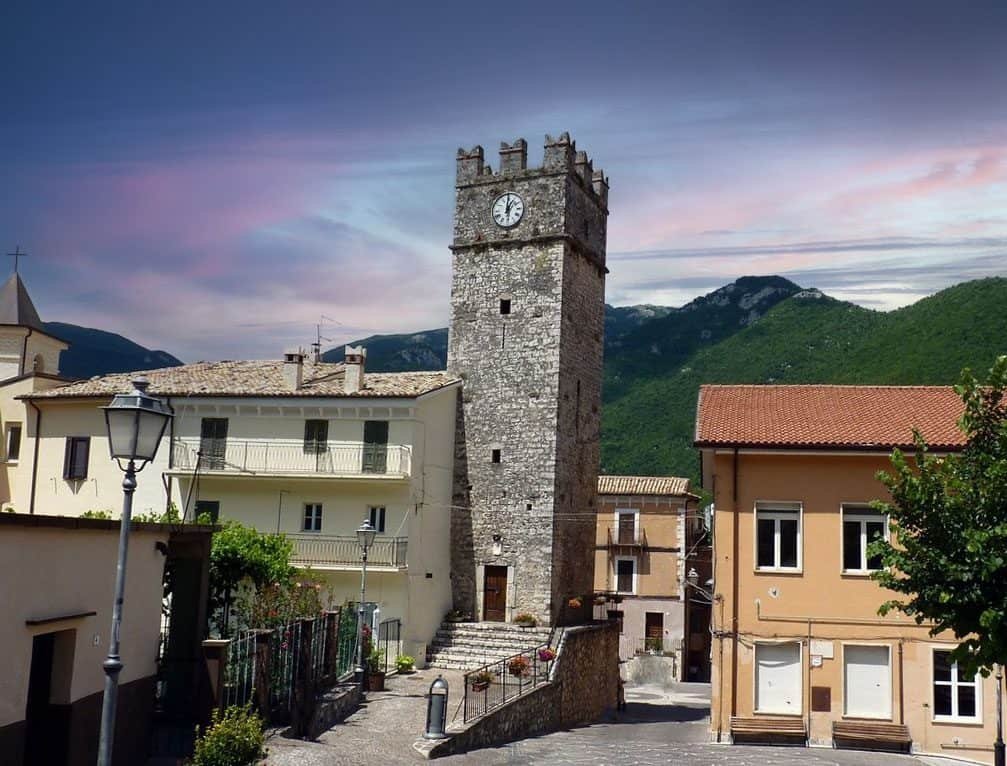
Vallepietra (RM) is a municipality of a little over 200 inhabitants in the metropolitan city of Roma Capitale, perched at 825 meters on a spur of Monte Faito, at the eastern edge of the province, where Lazio touches Abruzzo. The town hall is in Piazza Italia, the main square of the town, and the settlement stretches between 772 and 880 meters of altitude. The monument that brings visitors here, though, is not in town: it's the sanctuary of the Santissima Trinità, set into the wall of Monte Autore at over 1,300 meters, reachable from Vallepietra by 14 kilometers of paved road. The sanctuary, which belongs to the diocese of Anagni-Alatri, opens in spring and closes in fall: the season conventionally runs from May 1 to the end of October, with hours that change from month to month and that it's best to check on the official website before setting out. Entry is free, no booking is needed, and the rectory answers at the parish number, 0774 899084. Weekday Masses are normally mid-morning, holiday ones multiply in the middle hours, and confessions fill the slot between nine and noon. By car from Rome you leave the A24 motorway at Vicovaro-Mandela, go up the Aniene valley to Subiaco and from there take the road that leads to Vallepietra. Public transport to the town is reduced to the bone and should be checked with the regional operator before counting on it.
Whoever arrives in Vallepietra for the first time almost always makes the same mistake: they think they've come to see a mountain church. Vallepietra is a system. There's a medieval town of gray stone slowly crumbling from depopulation, there's a valley, the Simbrivio, which is one of the darkest and most vertical in the Lazio Apennines, there's a rock sanctuary that for centuries has gathered tens of thousands of people in a single day, and there's a mountain, Monte Autore, which is the highest peak of the metropolitan city of Rome. The four things must be read together, otherwise you understand half. To frame the environmental context it's best to start from the page dedicated to the Simbruini Mountains, the massif inside which Vallepietra is wedged.
Where Vallepietra (RM) is and how to get there
Vallepietra closes off the Simbrivio valley, a furrow that descends from the buttresses of the Simbruini toward the Aniene valley. The town is at the bottom of this valley, the sanctuary is 14 kilometers farther up, on a slope facing southwest. The difference between the two places matters: you reach the town by a road that follows the stream, you go up to the sanctuary by hairpins that gain 500 meters of elevation. In winter the second part of the route can be impassable, and in fact the sanctuary stays closed precisely in the months when the road gives the fewest guarantees.
The road from Rome to Vallepietra
The natural route is the A24 motorway toward L'Aquila, exit Vicovaro-Mandela. From there you continue toward Subiaco along the Aniene valley, and from Subiaco you take the road that climbs toward Vallepietra. It's an itinerary that looks short on the map and in reality takes its time, because the last stretch is all curves. It isn't a difficult road, it's a road that doesn't forgive hurry. If you get carsick, sit in front.
A longer but much more beautiful variant goes through Monte Livata and the Campo dell'Osso plateau: it lengthens the trip considerably, you climb among beech woods, and once in sight of the valley you understand why this part of the Apennines kept away for centuries anyone without a good reason to come. Blunt advice: the short road on the way there, the high road on the way back, if you have time and light.
From the town to the sanctuary: 14 kilometers that matter
The 14 kilometers between Vallepietra and the sanctuary are paved and drivable by any car. There is also an access from the Abruzzo side, from the Cappadocia and Camporotondo area, but it's a dirt mountain road and not the entrance to recommend to someone arriving from Rome in a sedan. The sanctuary's parking area is the only point of arrival: beyond it there is the wall.
Parking and access to Vallepietra on pilgrimage days
On the days of the feast of the Santissima Trinità the situation changes completely. The sanctuary road becomes alternating one-way or is regulated by civil protection, the parking lots up high fill at dawn, and whoever arrives mid-morning finds a spot much farther down. The pilgrim companies have priority over everything: their climb is not interrupted and not cut. Whoever wants to see the feast without complications leaves at night or sleeps the evening before in Vallepietra, in Subiaco or in Trevi nel Lazio. Whoever arrives at 11 on a feast day will mostly see the line of cars.

The sanctuary of the Santissima Trinità in Vallepietra
The sanctuary is a building leaning against the rock below Colle della Tagliata, on the southwest slope of Monte Autore. It isn't a church that rises in the middle of a meadow: it's a structure that rests on a natural cavity and that, seen from afar, looks like a fold of the mountain. This is the fact that strikes and that no photograph conveys well: the wall continues above the roof, for hundreds of meters, and the visitor who comes out of the chapel lifts his head and sees rock, not sky.
The grotto and the wall of Monte Autore
The ancient core is the cavity in the rock. Everything built in the following centuries, the chapels, the loggia, the esplanade, the reception structures, served to welcome pilgrims around that point. Next to the old sanctuary a modern structure for celebrations was built in recent times: it's used when the crowd doesn't fit in the old part, and on the big days the crowd practically never fits. Our opinion: the new building is functional and honestly not very moving, the old one is the reason you come. If you have only one hour, spend it in the old part.
The fresco of the Trinity, the heart of the cult in Vallepietra
The devotional focus of the sanctuary is a fresco that depicts the Trinity as three identical figures, seated and side by side, which pilgrims simply call the Santissima. The image is traditionally dated around the 12th century and shows evident Byzantine-style traits: absolute frontality, hierarchy of sizes, repetitive rhythm of the drapery, fixed gazes toward the viewer. It is not refined painting of a city school, and that is exactly the point: it is a cult image meant to be seen from afar, in a grotto, by people who arrived on foot after a day of walking.
The Trinitarian iconography of three identical figures is rarer than people think and has caused discussion: Western theology has produced other solutions, from the Throne of Grace to the dove. Here, instead, the three persons resemble each other to the point of coinciding. It's an image that speaks of equality and not of internal hierarchy, and it has a force that is understood better in silence than with an explanation. Look at it for five minutes without photographing it, then decide if you want to photograph it.
The ex-voto museum of the Vallepietra sanctuary
Below the esplanade, with two convenient entrances, are the rooms of the museum. It collects the most significant ex-votos donated by pilgrims over the years: painted tablets, photographs, objects, mementos of healings and of narrow escapes. The route is organized in a sequence of rooms and also contains a section dedicated to the papal visit, with testimonies and mementos of that occasion. Next to the museum works a documentation center with film, photographic and archive material tied to the sanctuary.
The Vallepietra museum is the part visitors skip most often and that instead explains the sanctuary better than any guide: an ex-voto is a biography compressed into an object. Count on a good 20 minutes.
Hours and opening period of the Vallepietra sanctuary
The sanctuary is seasonal. The season opens on May 1 with a ceremony and closes in fall. In the winter months, from December to April, it stays closed. Hours change from month to month: in May, June and October opening is typically from 08:00 to 16:00, in August it lengthens from 07:00 in the morning until evening, in September on weekdays it closes in the late afternoon. Weekday Masses are normally at 10:30. On holidays the celebrations repeat in the middle hours of the morning and continue in the afternoon. Confessions fill the slot from nine to noon, extended in August to the afternoon too. These are data the sanctuary publishes and updates on its own site: before leaving, a check.
How to behave at the Vallepietra sanctuary
It's a living place of worship, not an archaeological site. The rules are not written in giant letters but they exist and are respected: sober clothing, silence inside the chapel, no flash on people praying, no photographic intrusiveness toward the companies and the Zitelle. On feast days the esplanade is full of people who have walked all night: give them the way and the place in front. The most frequent mistake is treating the procession as a set. It isn't.
The origins of the Vallepietra sanctuary between legend and history
On the origins of the sanctuary there is no ascertained founding date. The sanctuary itself, in its own historical reconstruction, acknowledges that the problem remains hard to solve and that the scholars' hypotheses coexist. What is instead very well documented is the story: two different legends, one popular and one literary, that explain why people pray inside that rock.
The legend of the oxen and the plow
The popular version tells of a farmer who was plowing a field above the wall when the oxen and the plow fell into the void. The man went down expecting the worst and found the animals alive, kneeling before a painting of the Trinity inside a grotto. It's the classic narrative model of the Italian rock sanctuary: the animal that kneels, the place that reveals itself, the choice that doesn't belong to men. It isn't history and nobody claims it is: it's the way a mountain community explained to itself why that point of the wall is different from the others.
The legend of the two men from Ravenna
The learned version is of an entirely different kind. Two men from Ravenna, fleeing the persecution of Nero, took refuge on Monte Autore and met there the apostles Peter and John. An angel brought them food from heaven and made a spring gush from the earth. Here the structure of the story is hagiographic and serves another purpose: to hook a mountain cult to the apostolic preaching and therefore to Rome. The two legends do not exclude each other, because they answer different questions. The first says why there. The second says since when.
The scholars' hypotheses
Historical reconstructions follow two tracks. The first attributes the birth of the place of worship to Eastern monks or hermits, and rests on toponymic clues that in the area are truly striking: in front of the sanctuary there is a Monte Sion, and just past the border, in Abruzzo, there is a town called Cappadocia. The second track looks to Saint Dominic of Sora, the great founder of monasteries in the central Apennines at the turn between the 10th and 11th centuries. Neither is proven. It's worth keeping them distinct by degree of certainty: they are working hypotheses, not established facts, and whoever tells them to you as certainties is simplifying.
A third element, which the old local story often repeats, is the link with the Benedictine monasticism of Subiaco, a few tens of kilometers away. That the two worlds crossed is reasonable, given the weight the Subiaco monasteries have had on the whole upper Aniene valley for centuries. That the sanctuary is a Benedictine foundation is another matter and does not appear proven. Whoever wants to see up close the power of that monastic system can go up to the monastery of Santa Scolastica, the only one of the 13 Subiaco monasteries to have survived without interruption.
The feast of the Santissima Trinità in Vallepietra
The great feast is the Sunday of the Santissima Trinità, that is, the Sunday after Pentecost. Being tied to Easter, which is movable, the date changes every year and ranges between the second half of May and the second half of June. Whoever plans the trip months ahead must calculate it, not guess it: the liturgical calendar fixes it as falling eight weeks after Easter.
Why the date of the Vallepietra feast changes every year
The Trinity is a movable solemnity because it depends on Easter, and Easter depends on the spring full moon. 50 days after Easter comes Pentecost, and the following Sunday comes the Trinity. It follows that in Vallepietra the feast can find the mountain still cold and damp or already in full bloom. It matters for clothing much more than people arriving from Rome imagine: at 1,300 meters, at dawn, at the end of May, the thermometer reads a few degrees above zero even when in the city it's 25.
The entrance of the companies at the sanctuary
The moment worth the trip is the arrival of the companies. The companies are organized groups of pilgrims who climb to the sanctuary from their home towns, many on foot, with their own banners, their own songs and their own internal hierarchies. Each has its order of entry, its repertoire, its way of announcing itself while entering the esplanade. It isn't folklore reconstructed for the benefit of tourists: it's a social structure that keeps working, with families that hand down the role from father to son.
The sanctuary broadcasts the major celebrations live by streaming, including the entrance of the companies, and this is a good way to get an idea of what to expect before deciding to be there in person. Whoever has been there knows: live it's something else, for the noise, for the number, for the tiredness visible on the faces of those who walked at night.
The procession with the painting of the Santissima Trinità
The feast calendar also includes the procession with the painting of the Santissima Trinità that takes place in town, in Vallepietra, with the companies. Whoever wants to see the communal part of the cult, the one that concerns the inhabitants and not only the pilgrims from outside, must go down to town and not stop at the sanctuary esplanade. The solemn celebrations are presided over by the rector of the sanctuary, Monsignor Alberto Ponzi, and on the major occasions by the bishop of the diocese of Anagni-Alatri.
The feast of Sant'Anna
The sanctuary calendar doesn't end with the Trinity: in July the feast of Sant'Anna is celebrated, much more intimate and attended almost only by those who know the place. For those who want to see Vallepietra without the crush of the great feast, it's one of the best windows of the year.
The Pianto delle Zitelle, the song that makes Vallepietra unique
If one thing distinguishes Vallepietra from every other Apennine sanctuary, it's the Pianto delle Zitelle. On the morning of the feast of the Santissima Trinità, on the sanctuary esplanade, a group of young women sings a sacred lauda that evokes the Passion of Christ. It's not a performance, not a sacred representation with stage costumes: it's a handed-down song, performed by local people, in front of pilgrims in the thousands standing.
A sacred lauda from the 1700s
The Pianto belongs to the genre of the sacred lauda, a poetic and musical form born in the 13th century that runs through all Italian devotion. The text performed in Vallepietra is, however, more recent: it was composed at the beginning of the 18th century by the abbot don Francesco Tozzi, in office between 1685 and 1725, with the title of the Mysteries of the Passion. In 1835 don Luigi Tozzi rewrote the text in dramatic form, and later don Salvatore Mercuri senior fixed the structure that is performed today. Three hands in 150 years: the Pianto is a layered text, not a motionless relic.
The 14 Mysteries
The song is organized in 14 Mysteries, which present one after another the objects and characters of the Passion: the chalice, the ropes, the column, the thorns, the cross, the nails, the lance, and then the figures, Judas, Pilate, the Madonna, Magdalene, Martha. The meter alternates seven-syllable and 11-syllable lines. It's a dramaturgy by accumulation: each Mystery adds an element, the tension grows by juxtaposition and not by continuous narrative, and the effect on the listener is that of a list that becomes harder and harder to bear.
The white dresses and the Madonna in black
The Zitelle sing dressed in white. Only one dresses in black, the one who impersonates the Madonna. It's the visual detail everyone remembers and that explains why the Pianto works even for those who don't understand the words: in the middle of the white there is a dark spot that moves, and the eye follows it without needing explanations. The color choice has crossed intact all the transformations of the rite.
From the loggia to the stage
The rite has not always been as you see it today. Originally it took place on the loggia of the sanctuary, preceded by a procession that started from the chapel of San Filippo. Over time, with the increase of pilgrims, the performance moved to a stage built on the esplanade, and the essential form of the origins took on more theatrical traits. It's the fate of almost all folk rites that survive: they change container so as not to die. The opinion, from someone who has seen quite a few traditions end badly: here the passage was handled without turning the song into a show, and that was not a given.
The Pianto delle Zitelle in film
The rite has twice had the honor of a documentary. In 1939 Giacomo Pozzi-Bellini shot in Vallepietra the documentary film titled Il pianto delle zitelle. In 1958 Gian Vittorio Baldi returned to the same subject with another short film of the same name. They are two views, 20 years apart, of the same mountain and the same crowd: whoever is interested in visual anthropology knows how rare it is to have two such documents on a village rite.
The pilgrimage on foot to Vallepietra
The sanctuary of Vallepietra can be reached by car in half an hour from the town, and this is why the pilgrimage on foot keeps all its value: nobody walks because they have to. The companies climb on foot by choice, often leaving at night from their own towns, from the province of Rome and that of Frosinone, with stages fixed for generations.
Why so many routes converge on Vallepietra
Geography explains a lot. Vallepietra is the convergence point of ancient transhumance routes that linked the mountain communities of a substantial part of today's provinces of Rome, Frosinone and L'Aquila. The shepherds' roads became pilgrims' roads, and this explains the persistent popularity of a place that, looking at a modern road map, seems isolated. It was not at all in the geography that counted, that of passes and pastures.
How you walk, today
Whoever wants to climb on foot without joining a company can do it along the road or on the park trails. You need real mountain footwear, water, and the awareness that the elevation difference from town to sanctuary is about 500 meters. The practical advice is trivial: leave early, calculate the return, and don't count on the phone, because in the valley coverage is patchy. In the same area also passes the path dedicated to Saint Peter the Hermit, which links the places of devotion of the upper Aniene valley.
The village of Vallepietra
The town is small, gray, vertical, and for many visitors it's just the place where you park before going up. That's a mistake. Vallepietra preserves the structure of a medieval hilltop village: narrow alleys, outdoor stairs, houses leaning on one another to save wall and heat, tiny squares that open suddenly. You tour it in 40 minutes and gain the context that the sanctuary alone doesn't give.
The church of San Giovanni Evangelista in Vallepietra
The parish church is dedicated to Saint John the Evangelist. The building dates to the 12th century, was completely renewed in the 18th century and restored in the 19th, with a further intervention completed in 2010. Above the main portal you see a lunette fresco depicting the titular saint. The interior preserves the 18th-century structure with one nave and three bays, covered by cross vaults frescoed with a blue starry sky, likely 19th-century. The church also hosts a museum space tied to the devotion to the Santissima Trinità.
The starry sky on the vaults is the reason it's worth going in. It's a decorative solution common in mountain churches and almost always treated as a minor detail: here, in a town where the real sky is seen perfectly because there is no light pollution, the coincidence between painted vault and real vault works better than elsewhere.
The Caetani tower in Piazza Italia
In the center of town, in Piazza Italia, rises the tower of the Caetani, a memory of the rule of one of the families that dominated this sector of the Apennines between the Middle Ages and the early modern age. It's the clearest sign that Vallepietra was not born as a town of devotion: it was born as an outpost, in a border valley, and devotion was added on top. The square is also the seat of the town hall and is the point from which all the walks in the historic center start.

200 inhabitants: what it really means
Vallepietra today has a little over 200 residents. It's a figure to be read against the light: it means closed schools, reduced services, houses that change hands and stay empty 10 months a year, and a town that on feast days multiplies its population by 100. It also means, on the opposite side, that the woods have taken back the cultivated fields and that wildlife has returned to occupy spaces it had lost. The abandonment of agriculture and sheep farming, with emigration toward Rome and the Pontine plain, produced both things together.
Trades and cooking of Vallepietra
The historical economy of the town was that of a closed mountain community: beans, polenta flour, white flour, cauliflowers, and in more recent times potatoes. The trades were those the forest allowed: the hoop-maker, who produced the hoops for barrels, the charcoal burner, who made vegetable charcoal in the charcoal pits, and the making of bark baskets. These are activities that have vanished almost everywhere in the Apennines and that here lasted within living memory. Whoever wants to eat accordingly should look for legumes and soups: the mountain cooking of the Simbrivio is poor in the technical sense of the term, and it works.
The Simbruini Mountains around Vallepietra
Vallepietra is wedged into the southwest slope of the Simbruini Mountains, the range that marks the border between Lazio and Abruzzo in the sub-Apennine sector of Lazio. The name comes from the Latin sub imbribus, under the rains, and it isn't a metaphor: on these mountains over 2,000 millimeters of rain fall per year, which makes them one of the rainiest areas of the central Apennines. All the rest descends from here: the beech woods, the springs, the rivers, the dense vegetation up to altitude.
Monte Autore, the highest peak of the metropolitan city of Rome
Monte Autore measures 1,855 meters and is the third peak of the Simbruini, but it is also the highest peak of the metropolitan city of Roma Capitale. Its territory is divided between the municipalities of Camerata Nuova and Vallepietra. The summit, marked by a cross, is reached without technical difficulty from the Monte Livata area, from the Vallepietra side and from the Abruzzo side of Camporotondo. From above you see Camposecco, Monte Livata and the whole fold of the Simbruini. The sanctuary is on its southwest flank: climbing to the summit and then looking down toward the sanctuary wall is the best way to understand the geography of this place.
Monte Tarino, Monte Cotento and the other peaks
The crown around Vallepietra reaches significant elevations for Lazio: Monte Cotento reaches 2,015 meters and is the highest peak of the Simbruini, Monte Tarino nears 1,960 meters and its summit is shared with the territory of Filettino, in the province of Frosinone, Monte Tarinello reaches 1,844 meters. Colle della Tagliata, in the Monte Autore group, is the relief under which the sanctuary opens. Whoever counts the peaks will discover that quite a few of the highest peaks of the province of Rome are concentrated in this little patch of territory.
The Simbruini Mountains Regional Natural Park
Vallepietra is inside the Simbruini Mountains Regional Natural Park, established by regional law in January 1983. The park covers about 30,000 hectares across seven municipalities, including Subiaco, Vallepietra and Filettino, and is the largest protected area in Lazio. It protects one of the largest beech woods in Europe, a karst system of plateaus and sinkholes, and the springs that feed the Aniene. For those planning hikes, the page dedicated to the Simbruini Mountains and the one on Monte Livata give the picture of the access points.
The beech woods and the forest around Vallepietra
From the valley floor at 750 meters, cultivated for all the 11 centuries of the town's life, you climb quickly among dense woods of broadleaf trees and conifers. Beyond 1,300 meters the wood thins and gives way to grassy pastures and bare rocks covered with mosses and lichens. It's a compressed gradient: in a few hundred meters of elevation you cross environments that elsewhere require kilometers. For a hiker it's a stroke of luck, because it lets you walk in half a day through three different vegetation bands.

The waters of Vallepietra: the Simbrivio, the Aniene and Rome
The Simbrivio valley is a water factory. The stream rises around 1,100 meters of elevation, collects the contributions of the whole mountain arc surrounding Vallepietra and flows into the Aniene. The Aniene, in turn, rises in the Simbruini on the southern slope of Monte Tarino around 1,200 meters, receives the Simbrivio after Trevi nel Lazio giving rise to the Trevi waterfalls, carves a deep valley, widens toward Subiaco, plunges with a 160-meter drop at Tivoli and ends in the Tiber at Ponte Salario with an average flow of about 31 cubic meters per second.
The water of Vallepietra and the aqueducts of Rome
This is the part that in Rome nobody ever connects to their own faucet. From the middle of the 2nd century BC the Roman aqueducts began tapping the waters of the upper Aniene, and among them the Acqua Marcia, which still contributes today to the water supply of the capital. The conveyance system that made imperial Rome possible begins here, in mountains that can't even be seen from the city on clear days. Whoever wants to see the other end of that system can go to the Aqueducts Park, where the same conduits emerge on the surface at the gates of Rome.
The Aniene as a historic axis
The Aniene valley has worked for 2,000 years as a corridor between Rome and the Apennines: imperial villas, monasteries, mills, hydroelectric plants from the end of the 19th century. Trajan's villa at Arcinazzo Romano and Lake San Benedetto at Subiaco lie on the same axis and can be visited on the same day by those coming down from Vallepietra.
The wildlife around Vallepietra
Depopulation has given space back to the animals. In the woods and on the high-altitude meadows around Vallepietra there are the Apennine wolf, the wild boar, the badger on the valley floor, and, intermittently, the Marsican brown bear, which from the nearby Abruzzo, Lazio and Molise National Park makes movements along the Apennine corridors. Among the raptors, the peregrine falcon and the golden eagle are reported.
What chance you really have of seeing something
Slim, and it's good to say so. The wolf exists, can be heard howling on certain winter nights, and doesn't show itself. The bear is a rare presence and must be treated as such: if you should meet one, the rule is to move away slowly without putting yourself between the mother and the cubs and without chasing it with a phone in hand. What you'll see with reasonable certainty are wild boars at dusk, raptors flying over the walls and, if you have patience and binoculars, the peregrine hunting along the wall of Monte Autore. Bring real binoculars: in Vallepietra they matter more than the camera.
The climate of Vallepietra: why it's colder than elsewhere
Vallepietra is in the mountains and moreover closed in by very high reliefs, which in winter limit direct solar radiation to a few hours a day. The result is a climate noticeably harsher than you'd expect at this latitude. In the coldest month, January, the average minimum temperature is about 4 degrees below zero and the average maximum does not exceed 5 degrees. Two or three times per winter peaks of 15 degrees below zero are reached. In the hottest month, July, the average maximum is 24 degrees and the minimum 16, with peaks that can exceed 30.
The memorable winters of Vallepietra
The town keeps precise memory of some extreme episodes. On the night of January 6, 1985 the temperature fell below 20 degrees below zero. In the early morning hours of Friday, December 17, 2010, 15 below zero was exceeded again. The snowfalls of January 1985 isolated Vallepietra for more than 15 days, depriving it of water, electricity, heating and communications, and food reached the inhabitants through air supplies from the army. In January 2005 a snowfall brought more than 150 centimeters of snow. These are episodes that in local narrative count as much as the events of the sanctuary, and for a simple reason: in a mountain community snow is the variable that decides everything.
When to go to Vallepietra
The useful window coincides almost exactly with the opening of the sanctuary, from May to October. Within that window, though, the seasons are not equal.
May and June
The month of the opening and the feast. Bright green, plenty of water in the streams, days still cool. The downside is the crowd on Trinity Sunday and unstable days: it rains here more than elsewhere, by definition.
July and August
The most comfortable season for walking at altitude, with the sanctuary open from early morning until evening in August. It's also the period in which Vallepietra works as a refuge from the Roman heat: 1,000 meters of elevation are worth six or seven degrees less. Advice: leave Rome at six in the morning and return in the late afternoon.
September and October
The season I recommend to those who come for the first time and not for the feast. Few people, beech woods turning color, low light that draws the wall of Monte Autore. The sanctuary hours get shorter, and in October you have to account for the dark: at five in the afternoon in the valley it's already evening.
Vallepietra with children
It works, with a few precautions. The sanctuary esplanade is wide and safe, the ex-voto museum interests kids more than you'd think because it's made of objects and stories, and the town can be toured without traffic. Walks at altitude need calibrating: the elevation gain toward Monte Autore is demanding for short legs, while the paths in the wood around the sanctuary are within everyone's reach. Bring a sweatshirt even in August, because in the evening the temperature collapses. A practical warning: on feast days the crowd is dense and small children must be carried or held by the hand, no exceptions.
Accessibility of the Vallepietra sanctuary
The esplanade can be reached by car and is largely flat, and the museum declares two convenient entrances in the rooms under the esplanade. The ancient part of the sanctuary, though, is leaning against the rock and has level changes, steps and narrow passages: whoever moves in a wheelchair or has mobility difficulties should phone the sanctuary beforehand to understand what is practicable that day, because on days of great turnout the routes are modified. The village of Vallepietra, with its uphill alleys and outdoor stairs, is not an easy environment for those with walking problems.
How much a day in Vallepietra costs
Entry to the sanctuary is free and no booking is required. The museum is part of the sanctuary complex. The real expenses are fuel or the motorway toll, lunch, and any overnight stay in town or at Subiaco. It's one of the few full-day trips around Rome in which the main budget item is gas. Whoever wants to support the sanctuary finds the details for offerings on the official site: it's a choice, not a ticket.
What to see around Vallepietra
Vallepietra combines well with about six nearby destinations, all reachable on the same day or on a long weekend.
Toward Subiaco and the Aniene valley
The natural direction of the return to Rome goes through Subiaco, with the Benedictine monasteries and the monastery of Santa Scolastica, and through Lake San Benedetto. A little farther, Cervara di Roma is the highest town in the province and preserves a tradition of hospitality to artists that has lasted since the 19th century.
Toward Ciociaria
Beyond the watershed ridge line, to the south, open the valley of Trevi nel Lazio, Filettino with the Campo Staffi station and Guarcino with Campocatino, all in the province of Frosinone. Going down further you reach Fiuggi and its waters, and the historic cities of Anagni and Alatri, which belong to the same diocese the sanctuary answers to.
The abandoned towns and the Abruzzo mountains
Whoever has a taste for emptied places finds a short distance away the ruins of Camerata Vecchia, a village destroyed by fire in the 19th century, and the ghost village of Antuni on Lake Turano. Toward Abruzzo, beyond the border that runs on the ridges above Vallepietra, are the Pietrasecca caves near Carsoli and, farther, L'Aquila.
A curiosity about Vallepietra (RM)
The most instructive curiosity of Vallepietra is not in the sanctuary: it's written on the maps. Facing the wall that hosts the sanctuary there's a relief called Monte Sion. A little beyond the regional border, in Abruzzo, there's a town called Cappadocia. Two names that in the Lazio Apennines have no obvious explanation, because they don't derive from terrain features, local saints or feudal families: they are names that come from the Christian East.
On these toponymic clues rests one of the two great hypotheses on the birth of the sanctuary, the one that attributes the origin of the place of worship to Eastern monks or hermits who arrived here in the early medieval period. It's a track, not a proof, and it's best to call it by its name: hypothesis. But it's a hypothesis that has the merit of explaining two things at once, the anomalous toponymy and the iconography of the fresco, which has from Byzantium the frontality, the fixity of the gaze and the construction by symmetries.
The beauty of this curiosity is that you can verify it yourself, without books. Just look at a hiking map of the Simbruini Mountains before going up to Vallepietra and look for the two place names. It's worth doing, because it turns a walk into an open historical problem: how did these names get into a closed valley at 1,200 meters of elevation? The honest answer is that we don't know with certainty. The question, though, is excellent, and it makes the climb to the sanctuary far more interesting than a simple car transfer.
Something nobody tells you about Vallepietra (RM)
The Vallepietra sanctuary is closed for almost half the year. It doesn't reduce hours, it doesn't open on request: it closes. From December to April the season is suspended, and the reopening falls on May 1 with a ceremony. It's a piece of information that seems trivial and instead sends a surprising number of trips to waste, because Vallepietra is told as a mountain destination and the mountain, in the imagination of those who live in the city, is above all a winter thing. Here the opposite holds: in winter you reach the town, not the sanctuary.
There's a second fact almost nobody anticipates: the date of the great feast changes every year. The Sunday of the Santissima Trinità is a movable solemnity, falls on the Sunday after Pentecost, so eight weeks after Easter, and can slide from the second half of May to well into June. Whoever books lodging at Subiaco for the third weekend of May because two years ago the feast fell on that day risks finding the esplanade deserted, or on the contrary finding themselves in the middle of 30,000 people without having foreseen it.
Third warning, one of those you learn on the spot: phone coverage in the Simbrivio valley is patchy. Don't count on maps loaded at the moment, don't count on paying by phone, don't arrange to meet someone at altitude relying on a call. You download everything beforehand, you agree beforehand, and you carry cash. In Vallepietra urban habits work badly, and that's also why it's worth coming.
Frequently asked questions about Vallepietra (RM)
Where exactly is Vallepietra (RM)?
Vallepietra is in the metropolitan city of Roma Capitale, at the eastern end of the province, among the Simbruini Mountains, right next to the border with Abruzzo. The town hall, in Piazza Italia, is at 825 meters of elevation, while the sanctuary of the Santissima Trinità is 14 kilometers farther up, on a slope facing southwest.
How many inhabitants does Vallepietra (RM) have?
Vallepietra (RM) counts a little over 200 residents, which makes it one of the least populated municipalities in the province of Rome. It's a small mountain village, vertical, with narrow alleys and houses leaning on one another.
When is the Vallepietra sanctuary open?
The Vallepietra sanctuary is open from May to October, with the reopening set for May 1 with a ceremony. From December to April the season is suspended and the sanctuary stays closed, a detail that sends several trips to waste because the place is often imagined as a destination practicable all year.
How much does it cost to visit Vallepietra (RM) and the sanctuary?
Entry to the Vallepietra sanctuary is free and requires no booking. The real expenses of a day are fuel or the motorway toll, lunch and any overnight stay in town or at Subiaco.
When is the feast of the Santissima Trinità held in Vallepietra?
The feast of the Santissima Trinità in Vallepietra is held on the Sunday after Pentecost, so the date changes every year and ranges between the second half of May and the second half of June, following the liturgical calendar tied to Easter. During the feast the Pianto delle Zitelle is performed, a handed-down sacred lauda that evokes the Passion of Christ.
Is Vallepietra (RM) suitable for a visit with children?
Vallepietra works well with children, with a few precautions: the sanctuary esplanade is wide and safe, the ex-voto museum interests kids more than you'd think, and the town can be toured without traffic. Walks toward Monte Autore are instead demanding for short legs, while the paths in the wood around the sanctuary are within everyone's reach.
Is the Vallepietra sanctuary wheelchair accessible?
The esplanade of the Vallepietra sanctuary can be reached by car and is largely flat, with the museum declaring two convenient entrances in the rooms under the esplanade. The ancient part of the sanctuary, however, is leaning against the rock and has level changes, steps and narrow passages, so whoever moves in a wheelchair does well to phone the sanctuary first.
Why is it so cold in Vallepietra (RM) in winter?
Vallepietra is in the mountains and closed in by very high reliefs, which in winter limit direct solar radiation to a few hours a day. In the coldest month, January, the average minimum temperature is about 4 degrees below zero and the average maximum does not exceed 5 degrees.
The advice I give you for visiting Vallepietra (RM)
The advice is unpopular: if you come for the first time, don't come on the day of the feast. The Sunday of the Santissima Trinità is an extraordinary event, but it is an event, and an event hides the place. Between the companies arriving, the crowd on the esplanade, the stage of the Pianto delle Zitelle and the logistics of the climb, of Vallepietra you'll see its most exceptional and least representative day. Come on a Tuesday in September. Then, the next year, come back for the feast: you'll understand three times as much.
On organizing the day, the concrete advice is to reverse the order that almost everyone follows. Almost everyone goes straight up to the sanctuary and, coming back, drives through the town. Do the opposite: stop first in Vallepietra, wander the alleys, enter the parish church of San Giovanni Evangelista, look at the Caetani tower in Piazza Italia, and only after that go up the 14 kilometers. You'll reach the wall knowing who lives beneath it, and the sanctuary will stop looking like an isolated object in the middle of the mountain.
Last three things, all practical. Bring a sweatshirt even in August, because the temperature difference with Rome is six or seven degrees and in the shade of the wall the sun never stays long. Bring binoculars, which on these slopes pay off more than the camera. And calculate the return with margin, because the road is all curves and the dark, in the valley, arrives much earlier than on the ridge. For those organizing the day for a group who don't want to handle times, permits and logistics of a mountain like this, there is the option of relying on a professional: the tour accompaniment service of TourLeaderPro was born exactly for this.
Another well-known fact, yet rarely cited
That the Simbruini are mountains of water everyone knows at the level of a slogan. Almost nobody, though, draws the consequence: Rome has been drinking, for more than 2,000 years, from these mountains. The very name of the range says it, because Simbruini comes from the Latin sub imbribus, under the rains, and on these slopes over 2,000 millimeters of rain fall per year, an Alpine-area value that makes the Simbruini one of the rainiest zones of the central Apennines.
That rain becomes spring. From the mountain arc surrounding Vallepietra come down the streams that feed the Simbrivio, the Simbrivio flows into the Aniene, and the upper course of the Aniene is the point where the Roman aqueducts began tapping water for the city from the middle of the 2nd century BC. The Acqua Marcia, one of those ancient conduits, still contributes today to Rome's water supply. The logical chain is all here: without the rains of the Simbruini, ancient Rome could not have reached 1,000,000 inhabitants, because no premodern city grows beyond the quantity of water it manages to bring into its houses.
The fact is well known and rarely cited because it challenges a comfortable idea, that of Rome as a self-sufficient city. Rome, from the water point of view, has always been a city dependent on a mountain hinterland that most Romans today have never seen. In Vallepietra this dependence can be touched: the water coming out of the town's fountains and the water coming out of a nasone in Trastevere belong to the same geological story.
The right photo to take in Vallepietra (RM)
The photograph almost everyone attempts is that of the fresco of the Trinity, and almost everyone gets it wrong. It's in a grotto, the light is scarce and uneven, flash is inappropriate in a place where people pray, and the result is a dark rectangle with three unreadable figures. Forget it. The devotional image is looked at, not taken home in digital format.
The right photo in Vallepietra is another, and it's a photo of scale. You take it from the road, stopping at one of the hairpins before the arrival at the esplanade, and you frame the sanctuary small at the bottom with the wall of Monte Autore rising through the rest of the frame. You need a lens wide enough to hold the rock and you need to give up the temptation to fill the frame with the building. The subject is not the sanctuary: it's the relationship between the sanctuary and the mountain, which is after all the reason this place exists.
The best hour is late afternoon, when the low light reaches the southwest slope and the wall shows the strata, the fractures and the patches of vegetation that the high midday sun erases. Whoever comes on the day of the feast has another formidable photograph available, and it has nothing to do with architecture: it's the arrival of a company on the esplanade, with the banners up high and the line compacting. A rule of good manners, which is worth more than any composition rule: you photograph from a distance, without getting in front of those singing and without using flash. The Zitelle, in particular, are not photographed from one meter.
Some important events that happened here in history
The documented history of Vallepietra is made of episodes that concern three spheres: devotion, the mountain and cinema. On the first front, the most significant passage of recent centuries is the formalization of the Pianto delle Zitelle: the text performed today was born at the beginning of the 18th century by the hand of the abbot don Francesco Tozzi, in office from 1685 to 1725, who titled it Mysteries of the Passion. In 1835 don Luigi Tozzi reworked it in dramatic form. Later don Salvatore Mercuri senior fixed the current structure. In parallel, the rite moved from the loggia of the sanctuary, where it was preceded by a procession from the chapel of San Filippo, to the stage set up on the esplanade, to cope with the growing number of pilgrims.
On the mountain front, the event the community remembers most precisely is the winter of 1985. On the night of January 6 the temperature fell below 20 degrees below zero and the snowfalls of that month isolated Vallepietra for more than 15 days, leaving the town without water, electricity, heating and communications. Food arrived through air supplies from the army. January 2005 brought over 150 centimeters of snow, and on December 17, 2010 the thermometer fell again beyond 15 below zero. These are the dates that mark the collective memory of a high-altitude community.
On the institutional level, the date that changed the destiny of this territory is January 1983, when a regional law established the Simbruini Mountains Regional Natural Park, about 30,000 hectares across seven municipalities, the largest protected area in Lazio. From that moment the Simbrivio valley stops being merely a marginal area in depopulation and becomes a protected asset. Among the events that took Vallepietra beyond its own borders there are also two passages of cinema: the 1939 documentary shot by Giacomo Pozzi-Bellini on the Pianto delle Zitelle and, between 1970 and 1971, the shooting of the Italian western Lo chiamavano Trinità, set in the Campo della Pietra, the plateau between 1,400 and 1,550 meters above the town. Finally, the visit of a pontiff to the sanctuary, remembered today by a dedicated section of the ex-voto museum.
Who has passed through Vallepietra (RM)
The first list of who has passed through Vallepietra contains no famous names: it contains anonymous pilgrims by hundreds of thousands, who arrived on foot from the towns of the Lazio and Abruzzo mountains along the transhumance routes. It's a necessary clarification, because in a place like this history is made by the companies, not by individuals. That said, some names stopped here and left a trace.
Among the clergy, the succession of abbots and rectors marked the very identity of the rite: don Francesco Tozzi, abbot between 1685 and 1725, composed the text from which the Pianto delle Zitelle derives. Don Luigi Tozzi in 1835 gave it dramatic form. Don Salvatore Mercuri senior established its definitive arrangement. Today the sanctuary is run by Monsignor Alberto Ponzi, who presides over the solemn celebrations of the feast of the Santissima Trinità, while on major occasions the bishop of the diocese of Anagni-Alatri, Monsignor Santo Marcianò, goes up to Vallepietra. A pontiff has also come to the sanctuary, and the ex-voto museum preserves mementos and testimonies of that visit.
Two documentary makers passed from the world of cinema 20 years apart: Giacomo Pozzi-Bellini, who in 1939 shot Il pianto delle zitelle, and Gian Vittorio Baldi, who in 1958 returned to the same rite with a short film of the same name. Two works that today count as first-hand anthropological documents, because they fix the rite before and after the great social transformation of the postwar period. A crew of an entirely different kind also passed through the mountains of Vallepietra: that of the spaghetti western Lo chiamavano Trinità, shot partly in the Campo della Pietra between 1970 and 1971. The coincidence between the film's title and the name of the sanctuary is accidental, and in town they still tell it as a curious joke of fate. Whoever needs a broader picture of the Roman destinations before or after the climb to Vallepietra finds a good starting point in the English-language guides dedicated to Lazio by ItalyPlanner.
Quick questions about Vallepietra (RM)
Where exactly is Vallepietra (RM)?
Vallepietra is in the metropolitan city of Roma Capitale, at the eastern end of the province, among the Simbruini Mountains, right next to the border with Abruzzo and not far from the northern limit of the province of Frosinone. The town hall, in Piazza Italia, is at 825 meters of elevation.
How many inhabitants does Vallepietra have?
A little over 200 residents. It's one of the least populated municipalities in the province of Rome, and the actual population varies enormously between winter and summer.
At what altitude is the sanctuary of the Santissima Trinità?
The sanctuary is leaning against the wall of Monte Autore, below Colle della Tagliata, at over 1,300 meters of elevation. The available sources range between 1,240 and 1,337 meters depending on the measuring point: in any case you are above 1,300 meters on arrival.
How far is the sanctuary from the town of Vallepietra?
14 kilometers of paved road, with about 500 meters of elevation gain. By car it's 20 or 30 minutes, on foot count half a day round trip.
When is the Vallepietra sanctuary open?
The season runs from May 1 to the end of October. In the winter months, from December to April, the sanctuary stays closed. Hours change from month to month and are published on the sanctuary's official site.
How much does it cost to enter the Vallepietra sanctuary?
Entry is free and there is no ticket. The sanctuary indicates on its site how to send any offerings.
Do I need to book to visit Vallepietra?
No, an individual visit requires no booking. For organized groups, and in particular for the pilgrim companies, advance contact with the rectory is standard practice.
When does the feast of the Santissima Trinità fall in Vallepietra?
On the Sunday after Pentecost, that is, eight weeks after Easter. Being a movable solemnity, the date changes every year and ranges between the second half of May and the second half of June.
What is the Pianto delle Zitelle?
A sacred lauda composed at the beginning of the 18th century, performed by young women on the morning of the feast of the Santissima Trinità on the sanctuary esplanade. It tells the Passion of Christ through 14 Mysteries, in seven-syllable and 11-syllable lines.
Why are the Zitelle dressed in white?
White is the traditional dress of the whole group. The only exception is the one who impersonates the Madonna, who dresses in black. The color choice has been preserved through all the transformations of the rite.
What are the companies of Vallepietra?
They are organized groups of pilgrims who climb to the sanctuary from their respective towns, often on foot and often at night, with their own banners and songs. They have a consolidated internal structure and an order of entry onto the esplanade.
Can you climb to the Vallepietra sanctuary on foot?
Yes, along the road or on the park trails. You need mountain shoes, water and a realistic assessment of the 500 meters of elevation gain. On feast days the route is very busy.
How do you get to Vallepietra from Rome by car?
A24 motorway toward L'Aquila, exit Vicovaro-Mandela, then the Aniene valley to Subiaco and from there the road to Vallepietra. The last stretch is all curves.
Can you get to Vallepietra by public transport?
Suburban public transport links exist but are limited and must be checked with the regional operator before organizing the day. For the stretch to the sanctuary, your own vehicle remains the realistic solution outside feast days.
Can you take photographs at the Vallepietra sanctuary?
Outside, yes, no problem. Inside the chapel avoid flash and respect those praying. During the celebrations and during the Pianto delle Zitelle you photograph from afar and without intrusiveness.
Is the Vallepietra sanctuary wheelchair accessible?
The esplanade is largely flat and the museum declares two convenient entrances, but the ancient part leaning against the rock keeps steps and narrow passages. It's best to phone the sanctuary before the visit.
Is there a museum in Vallepietra?
Yes, in the rooms under the sanctuary esplanade: it collects the most significant ex-votos donated by pilgrims and a section dedicated to the papal visit. Next to it works a documentation center with film and photographic material.
How long does it take to visit Vallepietra?
Half a day for the sanctuary alone, a full day for sanctuary, museum, town and a walk in the woods. Whoever wants to climb to the summit of Monte Autore should count on a full day of walking.
Is Vallepietra suitable for children?
Yes, with a few precautions: a sweatshirt even in summer, walks calibrated to the elevation gain and care in the crowd on feast days. The ex-voto museum works well with kids.
What animals can you see around Vallepietra?
The Apennine wolf and the Marsican brown bear are present but extremely hard to spot. More realistic is to see wild boars at dusk, the peregrine falcon and, with luck and binoculars, the golden eagle.
What's the weather like in Vallepietra in summer?
In July the average maximum is 24 degrees and the minimum 16, with peaks above 30 in heat waves. Compared with Rome you gain six or seven degrees, and in the evening it drops quite a lot.
Can you ski in Vallepietra?
There are no lifts in the municipality. The nearest stations are Monte Livata above Subiaco, Campo Staffi above Filettino and Campocatino above Guarcino, all reachable by car in less than an hour and a half.
What's the difference between Vallepietra and Subiaco?
Subiaco is a small city with Benedictine monasteries, services, hotels and an articulated historic center. Vallepietra is a town of 200 inhabitants with a rock sanctuary of great popular draw. They can be visited well on the same day, but they are two different experiences.
Where do you eat and sleep in Vallepietra?
The offering in town is minimal and seasonal. Whoever wants a wider range relies on Subiaco or the towns of the Aniene valley, reserving Vallepietra for the day of the visit.
Is it worth coming to Vallepietra outside the feast?
Yes, and for those coming the first time it's the best choice. Without the crowd you see the sanctuary, the wall, the town and the valley in their real proportions.
Can you organize a group visit to Vallepietra?
Yes, and it's advisable to entrust the logistics to someone who knows the mountain and the road times. The group trip organization service of TourLeaderPro follows itineraries of this type for associations, parishes and companies.
What to see near Vallepietra on a weekend?
Subiaco and the Benedictine monasteries, Cervara di Roma, Trevi nel Lazio, Filettino, Fiuggi, the ruins of Camerata Vecchia. Those continuing toward Rome find the picture of the capital's destinations in the English-language guides on things to do in Rome by ItalyPlanner.
Vallepietra isn't a place you conquer in an afternoon. It's a narrow valley, a town that is emptying out and a rock wall inside which, for an unspecified number of centuries, the people of these mountains have climbed to pray before three identical figures painted in a grotto. If I had to name a single moment to come, I'd say the first week of October, early in the morning, with the sanctuary still open and nobody on the esplanade: in that silence, in front of the wall of Monte Autore, you understand in five minutes what on crowd days takes a whole day.
Article written by the editorial team of TourLeaderPro, contact them for Private/Corporate/V.I.P. Tours and Experiences.
Planning a trip to Rome? The English-language guides to visiting the city are on ItalyPlanner.com.