Lake San Benedetto (RM)
In short. Lake San Benedetto (RM) is in Subiaco, in the province of Rome, along the course of the Aniene, below the two Benedictine monasteries and a short distance from the ruins of Nero's villa.
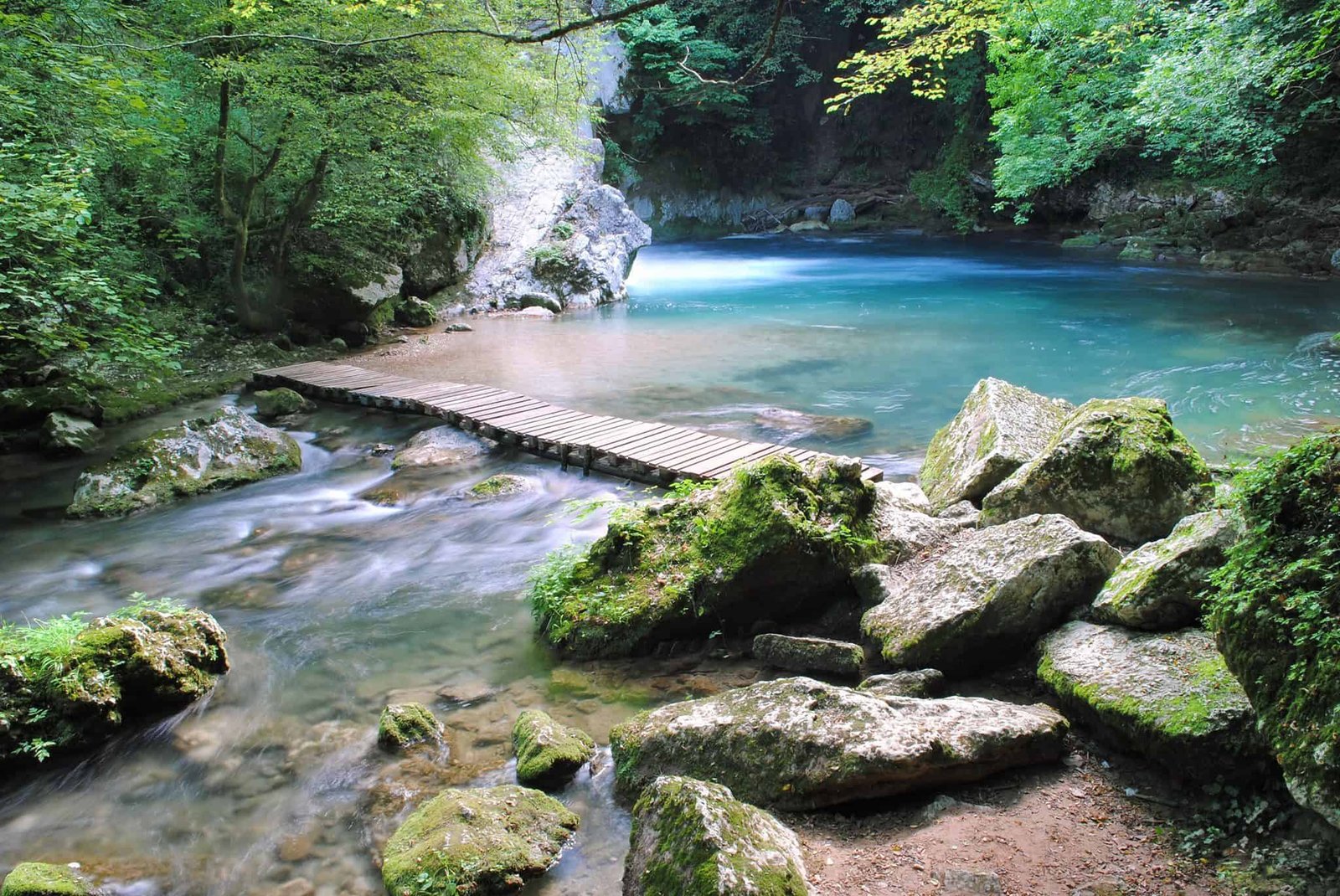

Lake San Benedetto (RM) is in Subiaco, in the province of Rome, along the course of the Aniene, below the two Benedictine monasteries and a short distance from the ruins of Nero's villa. The road reference for getting there is Via San Benedetto, the road that climbs from Subiaco toward the Santa Scolastica Monastery (Piazzale Santa Scolastica 1, 00028 Subiaco) and then toward the Sacro Speco Monastery (Via San Benedetto snc, 00028 Subiaco). There are no ticket offices, turnstiles or cash desks: the small lake is a stretch of river in a state-owned forest inside the Monti Simbruini Regional Nature Park, and access is on foot along a path. Entry to the small lake is free, while the two monasteries have their own hours. Santa Scolastica opens for visits from 9:30 to 12:15 and from 15:30 to 17:15, with afternoon closing pushed back to 18:15 in the summer season, and can be reached at 0774.82421. The Sacro Speco answers at 0774.85039 and for groups asks for a booking at 334.2166558. Anyone coming from Rome without a car leaves from the Cotral terminus at Ponte Mammolo, which is the bus station for Subiaco. Schedules and runs should be checked on the official Cotral website before setting out, because they change between weekdays, holidays and the school period. The parking spaces near the start of the path are very few, on the order of 10, and parking along the monasteries' road exposes you to fines from the Local Police.
A clarification worth reading before you load the towel into the car: Lake San Benedetto is not a bathing establishment and it is not an equipped natural pool. The water comes from the sources of the Aniene and stays ice cold even on Ferragosto, the bottom is bare rock and unstable gravel, the waterfall creates a backwash current, there is no lifeguard service, and rescuers, in case of trouble, have to come down on foot. The municipality of Subiaco and the Park authority regulate the area with measures that change from season to season, including limits on admissions and bans on swimming. Before leaving, check the notices and ordinances published by the municipality of Subiaco and by the Monti Simbruini Park, and where swimming is banned you do not go in the water. The ban on lighting fires outside the equipped areas always applies, throughout the protected territory.
To get your bearings on the area and the rest of the Subiaco valley, it's worth looking at the page on Subiaco and the one on the Monti Simbruini.

Where Lake San Benedetto (RM) really is
The confusion comes from the name. Anyone looking for a lake imagines a body of water with a perimeter, maybe a lakeside promenade and a kiosk. Here the reality is different: Lake San Benedetto (RM) is a widening of the Aniene's bed inside a wooded gorge, a few tens of meters wide, closed off upstream by a drop of water and downstream by a rocky threshold beyond which the river starts running again. You take it all in within a handful of minutes, you walk around it in a few steps, and that is exactly why the place suffers when 300 people arrive together.
The useful address for the GPS
The point to set is not the small lake but the climb to the monasteries: from Subiaco you take Via San Benedetto toward Santa Scolastica and Sacro Speco. Along that road, before the monasteries, you come to the ruins of Nero's villa and the start of the route that goes down to the Aniene. The GPS, if you ask it for the lake, tends to suggest closed forest roads or lay-bys that don't exist: it's better to set Piazzale Santa Scolastica 1 and take it from there.
Parking around Lake San Benedetto (RM)
At the start of the path there is room for about 10 cars. Four or five more spaces are available near the ruins of Nero's villa. Added up, that's 15 spaces for a place that on July Sundays attracts hundreds of people: the numbers don't add up, and the result is the line of cars double-parked along the monasteries' road. The Local Police check that stretch regularly, and the fine arrives. The practical advice is simple: leave the car in Subiaco and walk up, or arrive very early.
Elevation, distances and real times
The Santa Scolastica Monastery stands at 510 meters above sea level, a little above the valley floor where the Aniene runs. The difference in elevation between the road and the small lake is modest. The route takes about 40 minutes at an easy pace starting from Subiaco along the ST2 tourist trail marker, and a scant 20 starting from Nero's ruins. The return time is longer than the outbound one, because it's uphill, and this is the detail that groups invariably forget.
How to get to Lake San Benedetto (RM) from Rome
From Rome to Subiaco it's about 70 kilometers. The most convenient way remains the car, the cheapest the bus, and the smartest on high-season weekends is a combination of the two with a pinch of patience.
By car
You leave Rome on the A24 toward L'Aquila and continue to the Vicovaro-Mandela exit, then follow the Sublacense road toward Subiaco going up the Aniene valley. Alternatively you can take all of Via Tiburtina Valeria, slower and more beautiful, with the river almost always at your side. Traffic gets worse on summer Sundays and on spring long weekends: the last stretch, the climb to the monasteries, is narrow with few places to pass.
By Cotral bus
The runs to Subiaco leave from the Ponte Mammolo terminus, on Metro Line B. The trip crosses the valley and drops passengers in the center of Subiaco, from where you continue on foot or with local connections. Schedules are consulted on the official Cotral website, which also publishes the real-time position of the vehicles, and the ticket is bought at authorized sellers or on the company's online sales channel. Anyone coming back in the evening should check the time of the last run before heading to the small lake: getting stranded in Subiaco at nine in the evening is an experience I recommend to no one.
The local connection in summer
In the good season the municipality of Subiaco organizes a tourist transport service that connects the Cotral terminus, the historic center and the main attractions, small lake included, so as to reduce cars on the monasteries' road. It's a seasonal service and has to be checked year by year on the municipality's website, because activation, route and frequency change.
On foot from Subiaco
The walk from the town is the solution I prefer. You leave the built-up area in the direction of the monasteries, take the ST2 trail marker and in about 40 minutes you reach the water, with the advantage of not having to look for parking and of seeing the valley as the pilgrims saw it. The route is easy and doesn't require particular hiking skills, but it remains a mountain path: closed shoes, water in your backpack, no flip-flops.
The ST2 trail to Lake San Benedetto (RM)
The ST2 trail marker is a Tourist Trail, that is the easiest category of hiking signage: packed surface, moderate slopes, no exposed passages. It is not, however, an urban stroll, and after rain the roots and stones become slippery.
The variant from Nero's villa
Once past the ruins in the direction of the Benedictine monasteries you take the road on the right, the one that goes down to run alongside the course of the Aniene. It's the shortest and busiest way, the one that passes next to the picnic area. After about a kilometer you come to the equipped area, and from there the short connector that leads only to the small lake begins.
The variant from Santa Scolastica
Anyone who drives up to the Santa Scolastica Monastery can leave the car there and continue on foot for about two kilometers on the same ST2, starting near the little church of San Michele Arcangelo. It's the route I recommend to anyone who wants to combine the visit to the monastery and the descent to the river in a single morning, because it avoids the double trip and lets you see the two faces of the Subiaco valley, the built one and the wild one.
The picnic area along the route
The equipped area upstream of the small lake is the place where you eat, not the lakeshore. There are tables and benches, you take your trash away, and fires remain banned outside the designated spaces. Every summer someone lights a little stove among the roots of a beech tree: in a wood that in July is as dry as a box of matches, it's the fastest way to turn an outing into a disaster and a criminal complaint.
What to bring, what to leave at home
You need light hiking shoes or sneakers with a treaded sole, a sweatshirt even in August because in the gorge the sun comes in only a few hours a day, water, a bag for trash and little else. To leave at home: Bluetooth speakers, inflatable mattresses, beach umbrellas, barbecues and the idea of pitching a tent. Lake San Benedetto (RM) can't bear the load of a lido, and its undergrowth wears away under your feet much faster than it can be rebuilt.
Swimming, safety and rules at Lake San Benedetto (RM)
Here the tone changes, and it has to change. The small lake is beautiful and dangerous in equal measure, and the news of recent years has reminded us of it many times with rescue episodes in a gorge where vehicles cannot enter.
The water is ice cold, always
The Aniene rises a little higher up, at the sources inside the territory of the Monti Simbruini Park, and arrives here after a short, shady course. The water temperature stays very low even on the hottest days. A dive when you are overheated into ice-cold water causes an immediate cardiovascular response, what is called thermal shock in everyday terms, and in a deep, narrow basin the swimmer who gets into trouble has no bottom to stand on. It is not a brochure recommendation: it is the reason why swimming here should not be treated like swimming in the sea.
The waterfall and the backwash current
The drop of water that feeds the basin looks small and harmless. Under the jet, however, a whirling motion forms that sucks toward the bottom and holds: it is the same dynamic that makes all river cascades treacherous, even modest ones. Swimming up to the base of the waterfall is the worst possible move, and it's worth saying plainly to the kids who want the photo under the jet.
Bans, ordinances and limited access
The increase in visitors has pushed the administrations to limit entry to the site in order to preserve it, with measures ranging from regulating flows on peak days to seasonal bans. The measures in force can be read in the notices and ordinances of the municipality of Subiaco and in the provisions of the Park authority: they must be consulted before leaving and respected on the spot, because where swimming is banned the only correct behavior is to stay out of the water. Penalties exist, but the real reason is another: the rescue teams who climb into a gorge to recover an imprudent swimmer are teams taken away from another emergency.
The Park rules that apply regardless
The area falls within the Monti Simbruini Regional Nature Park and follows the restrictions of a protected area: no lighting fires outside the equipped areas, no camping, no picking plants, no leaving trash behind, dogs on a leash. They are trivial rules until you see the woods on Monday morning after an August weekend.
A curiosity about Lake San Benedetto (RM)
The real curiosity of this place is that it is not a natural lake, nor a modern artificial lake: it is the last survivor of an imperial hydraulic work. Ancient sources recall that at Sublaqueum, the Latin place name from which the name of Subiaco derives and which literally means the place under the lakes, Nero had the Aniene dammed to create a series of stretches of water in front of his villa. They were the Simbruina Stagna, the Simbruini lakes: three basins in a row along the river, obtained with masonry dams in a gorge where the watercourse runs deeply cut. The project was not only scenic. A restrained river means a regulated flow, mills, fishponds, and above all a tamed landscape in front of the windows of the residence of an emperor who loved water as a building material, as his Roman works show.
Of those three basins only one survives today, and it is precisely Lake San Benedetto (RM). The other two disappeared when the dams gave way in the course of the Middle Ages, leaving the river free to take back its own bed. The surviving small lake owes its existence as much to the Roman work as to the rock: the natural threshold that closes the basin downstream acts as a dam even now that the ancient masonry is gone. Anyone walking along the shore is looking, without realizing it, at the remnant of an engineering idea from the first century AD. The Christian name came later, when in this valley a young man from Norcia withdrew to live in a cave and the place names followed holiness instead of the emperor. It's worth remembering while you look at the green water: in the same spot imperial luxury and monastic renunciation were layered on top of each other, and the second won.
The Simbruina Stagna and Nero's villa above Lake San Benedetto (RM)
The Subiaco valley enters Roman history as a place of imperial holiday living. Nero's residence occupied the slope above the river, arranged on terraces, with rooms facing the stretches of water created by the dams. Today few remains are left, walls and stretches of substructure that you come across along the monasteries' road, and it's easy to walk past them without recognizing them.
What remains of the villa
Anyone looking for columns and mosaics will be disappointed: what you see are ruins in Roman concrete, often absorbed into the vegetation. Their value is documentary more than spectacular. They show where the level of the buildings ran and how large the settlement was, and they explain something that books say in one line and on the spot you understand in a second: the monasteries were not born in a vacuum, but on top of and inside Roman structures that already existed, reused as quarries for material and as foundations.
The monastic reuse of the imperial marbles
The most beautiful proof of that reuse is seen in the Gothic cloister of Santa Scolastica: in the center there is a hexagonal well with a parapet and marble columns that come from Nero's villa, and the north wall of the cloister is decorated with finds collected in the different churches of the monastery and in the villa itself. An emperor whom Christians remembered as a persecutor ended up supplying the columns for the monks' well. This, if you want a firm opinion, is the most eloquent image of the whole valley.
Why the small lake survived
Among the three Neronian basins, the one we now call Lake San Benedetto (RM) was the most deeply cut and the best protected by the morphology of the gorge. When the ancient dams gave way, here the natural rock barrier continued to hold the water. The result is a small basin, deep for its surface, with emerald green water that depends on the combination of depth, shade from the woods and dissolved minerals. The color changes over the course of the day depending on how the rays filter between the branches, and the spray of the waterfall feeds a humid microclimate that maintains an undergrowth very rich in species.
Something nobody tells you about Lake San Benedetto (RM)
Nobody says it openly, but the nickname that made this place famous, the Caribbean of Rome, is also the main cause of its troubles. The phrase was born on social media and spread on travel portals, including the institutional ones of Lazio tourism, and in a few years produced a flow that the valley was not equipped to sustain. The problem is not the number of visitors in itself: it is the kind of expectation that name generates. Anyone who arrives thinking of the Caribbean arrives with beach gear, looks for a place to spread the towel, expects warm water and a sandy bottom, and finds instead a mountain stream at 10 degrees inside a gorge. Disappointment produces behavior worse than ignorance: people trample the undergrowth to win a clearing, move stones to create a platform, leave their trash because there is no bin anyway.
The second thing you almost never read is that the accessibility of the site is by its nature limited and that the administrations chose to limit entry precisely to preserve it. It is not a bureaucratic harassment: the walkable surface around the water is a few tens of square meters, the surfacing roots of the beeches and alders are fragile, and the ecological carrying capacity of a gorge is ridiculously low compared with that of a beach. A place like Lake San Benedetto (RM) can bear a few dozen people at a time, not a few hundred. The third thing, the most prosaic: there is no bar, no public restroom at the shore, no kiosk, and the phone signal in the gorge is intermittent. Anyone bringing small children or elderly people has to get organized beforehand, because once you are down there nothing can be fixed on the spot.
The advice I give you for visiting Lake San Benedetto (RM)
The advice is to reverse the order of the outing. Almost everyone comes to Subiaco for the small lake and, if there is time left over, goes up to the monasteries. Doing it that way you reach the water at the worst hour, in the middle of the crowd, and you dispose of two monasteries that are worth the trip on their own in 20 minutes. It's better to do the opposite: arrive early, be at half past nine when Santa Scolastica opens, give a good hour to the three cloisters and the church, then go up to the Sacro Speco before the buses arrive, and go down to the small lake in the early afternoon, when the bulk of the bathers have already packed up and the light enters the gorge at an angle that is more forgiving.
Second piece of advice, less elegant and more useful: choose the day. A July Sunday here is a single file along the path and a crush on the shore. A Tuesday at the end of September, with the first leaves turning, is another planet, the water has the same color and the woods have a better one. Third: bring a windbreaker even when it's 32 degrees in Rome. In the gorge the difference in perceived temperature is considerable and anyone who comes out of the water wet notices it immediately. Fourth, and here the judgment is clear: if your goal is to swim and nothing else, Lake San Benedetto (RM) is not the right place and never will be. Go for the landscape, for the walk and for the monasteries, and treat the water the way you treat an alpine stream, with respect and with your feet on the shore where the bans require it. Anyone who wants a day in the water finds much better-suited alternatives in the volcanic lakes of Lazio, for example Lake Bracciano, or at Lake Turano in the province of Rieti.

The Santa Scolastica Monastery above Lake San Benedetto (RM)
A few hundred meters from the path that goes down to the water the Santa Scolastica complex opens up, and anyone who skips it makes the worst mistake of the day. Of the 12 monasteries founded by Saint Benedict in the Subiaco valley, this is the only one that survived the earthquakes and the Saracen destructions, and until the end of the 12th century it remained the only monastery of Subiaco. It stands east of the built-up area, at 510 meters of elevation, laid out lengthwise parallel to the valley. The area earned the epithet of holy valley for the centuries of hermits and monks who lived in contemplation there.
The abbey church and its four lives
The present church is the last layer of an impressive superposition. It stands on the first oratory of Saint Benedict, of which traces were discovered in 1962. Under the bell tower and inside the modern structure emerge remains of a second church of the ninth century. A third church, Romanesque, was consecrated in 980 by Pope Benedict VII, and around 1300 it was rebuilt in the Gothic-Cistercian style keeping the dimensions unchanged: in the transept the remains of the original rose window are still visible. In 1769 the architect Giacomo Quarenghi restored it in the neoclassical style following the earlier Gothic structure, taking inspiration from Palladio and in particular from the church of the Santissimo Redentore on the Giudecca in Venice. What you see today is therefore a Latin cross plan, with a single nave of irregular rectangular shape, almost a trapezoid, with a barrel vault, and decorations from the 18th-century restorations. Quarenghi, who a few years later would become the architect of Catherine II in Saint Petersburg, was still working in Italy here: anyone who knows his Russian works recognizes the hand immediately.
The Romanesque bell tower
The five-story bell tower was raised in 1052-53 by the French abbot Umberto. It rests on the earlier bell structure of 980, built in turn on the narthex of the church of the ninth century, characterized by four massive pillars with their arches. It is one of the oldest Romanesque bell towers in Lazio and, seen from the Gothic cloister through the 15th-century arch, it offers the best framing of the whole complex.
The Cosmati cloister
The Cosmatesque cloister is the masterpiece of the monastery. On the archivolt of the south side runs the inscription Magister Jacobus Romanus fecit hoc opus: the author is Jacopo the Elder, a Roman marble worker, son of Lorenzo di Tebaldo. His son Cosma, from whose name the term Cosmatesque art derives, continued the work together with his brothers Luca and Jacopo. The work probably began before 1210 and ended around 1240. The portico has Romanesque arches on twinned or single little columns, twisted, in white Carrara marble, with capitals always different from one another. It is worth looking for two details that almost nobody notices: the devil's face carved on one column and an upside-down human head on another. They are the kind of joke that Roman marble workers allowed themselves inside a sacred work, and they tell you more about the medieval construction site than 10 pages of a textbook.
The Gothic cloister
Built between the end of the 13th century and the beginning of the 14th, it has an irregular six-sided plan that comes from joining two rectangles with different orientations: the sides adjacent to the church keep the orientation of the older monastic part, the others veer toward the east. The name comes from the pointed arches with a double splay, resting on sturdy pillars. In the center is the hexagonal well with a parapet and marble columns of Neronian origin. On the north wall are set finds from the different churches of the monastery and from Nero's villa, including a plaque with a famous Eucharistic symbol: two deer drinking from a vessel resting on a plant. On the west side opens a majestic 15th-century flamboyant arch with a double arcade, through which you frame the Gothic facade of the church and the Romanesque bell tower.
The Renaissance cloister
Construction began in 1580, during the abbacy of Cirillo di Montefiascone, and ended in 1689 with the abbot Michelangelo Inurea: more than a century of work for one cloister. The west side was rebuilt after the damage from the bombing of May 23, 1944. The arches rest on sturdy pillars on the west and south sides. Architecturally it is the least exciting of the three, historically it is the one that best tells the long duration of an institution able to work on a single project across generations of abbots.
The library and Subiaco as book capital
The monastery keeps a library of great importance, which can be contacted at 0774.85424, and the community proudly recalls the recognition of Subiaco as Italian Book Capital 2025, tied to the history of printing in this territory. Anyone with a specific interest in old books should ask for information in advance: access to the collections is not the same as the ordinary visiting tour and has to be arranged.
Hours, contacts and visit
Santa Scolastica is at Piazzale Santa Scolastica 1, in Subiaco, phone 0774.82421 or 333.4077850. Visits are possible from 9:30 to 12:15 and from 15:30 to 17:15, extended to 18:15 in the summer season. On weekends Mass is at 10:00 with Gregorian chant and in the afternoon at 16:30 or 17:30 depending on the period. On weekdays the sung Mass is at 7:45. The complex also hosts an herbalist shop, a guesthouse and a refreshment point: the herbalist shop answers at 0774.8242398 and the guesthouse at 0774.85569. The hours should be confirmed on the monasteries' official website before the visit, because liturgical life takes precedence over tourism and the openings adjust.

The Sacro Speco, the monastery clinging to the rock
A little higher up, along the same road, the Monastery of San Benedetto, commonly called Sacro Speco, is set into the rock overhanging the valley of the Aniene below. Pope Pius II, who visited it in 1461, called it a swallows' nest, and five and a half centuries later there is no better description. The complex is made up of two superimposed churches, chapels and caves frescoed in different periods, and its appeal comes from the combination of architecture that adapts to the wall and the density of the decoration.
The upper church
It is the highest structure of the sanctuary and was the last part to be built. The interior is divided into two irregular bays, in plan and in elevation, a consequence of later modifications: the first, near the entrance, is rectangular and clearly higher than the second, and the two sections are separated by an arch. Every available space is frescoed. Among the scenes you recognize the Crucifixion, the Entry into Jerusalem and the Holy Family. The feeling, on entering, is that of an illuminated book unrolled on the walls: it's best to stand still for five minutes without looking at anything in particular, letting the eye get used to the half-light, and only afterward look for the individual scenes.
The lower church and the Sacro Speco
Between 1244 and 1276 the abbot Enrico renovated the Sacro Speco, and the lower church bears the mark of that work. It develops in three bays with frescoes from different periods, including a blessing Christ among angels. From here you go down toward the cave that tradition indicates as the refuge of the young Benedict of Norcia, the core around which everything else grew. The visiting route is a continuous descent into the rock, with narrow stairs and low ceilings: anyone who suffers from claustrophobia should know before.
How to visit the Sacro Speco
The address is Via San Benedetto snc, 00028 Subiaco, phone 0774.85039 or 334.2166558 for group bookings, email sacrospeco@tiscali.it. The access road is narrow and parking is limited: on peak days it's best to walk up from the lot below. The monastery is an active place of worship, so appropriate clothing, silence, and attention to the signs about photographs, which inside the frescoed churches are often restricted to conserve the paintings.
Why the two monasteries should be seen together with Lake San Benedetto (RM)
They are three faces of the same object: the river that brought the emperor, the cave that brought the saint, the monastery that brought Europe. The Benedictine rule born in this valley organized the work, the time and the knowledge of the continent for centuries. Looking at the green water without climbing 200 meters to see where that rule began means having done half the trip. Incidentally, the link with the Abbey of Montecassino, where Benedict moved after leaving Subiaco, and with Norcia, his city of origin, makes the Subiaco valley the first natural stop of a Benedictine itinerary in central Italy.
Another well-known fact, yet rarely cited
Everyone knows that Subiaco is the cradle of Western monasticism. Almost nobody connects that fact to hydrography, which instead explains it. Benedict did not choose this gorge by chance: he chose it because it was already served by a Roman road, already inhabited by a settlement, already equipped with abundant and regulated water, and at the same time rugged enough to guarantee solitude. The hermit seeks the desert, but the monastery needs logistics, and the 12 monasteries of the valley were born where the water made it possible to run mills and gardens. Santa Scolastica, in particular, was probably carved out of buildings belonging to the nearby Neronian villa: the imperial ruin offered walls, material and a platform.
The second little-cited fact concerns survival. Of the 12 monasteries, 11 vanished among earthquakes and Saracen raids. Until the end of the 12th century Santa Scolastica remained the only monastery of Subiaco, and from there everything else was refounded. The monastery was devastated in the ninth century and rebuilt thanks to papal support, acquired enormous holdings between the 10th and 13th centuries becoming one of the most powerful fiefs of the Papal State, and in 1276 the Holy See reserved the right to elect its abbots. In 1456 the monastery passed into commendam, the regime that entrusted the abbey to outside prelates: among the commendatory abbots are Juan de Torquemada, Rodrigo Borgia, who had the abbey fortress of Subiaco rebuilt, Antonio and Francesco Barberini and Giovanni Angelo Braschi. The commendam was abolished by Pope Pius X in 1915 with the bull Coenobium sublacense, and the abbey returned to the common law of abbeys nullius. From 1514 the monastery belonged to the Cassinese congregation. In 1850 it was assigned to the abbot Pietro Francesco Casaretto, who introduced his reform there, at the origin of the congregation later called Sublacense, today Sublacense Cassinese. None of these events left a plaque on the shore of the small lake, and yet they are the reason why that wood has come down to us intact: an area under the control of a powerful abbey is an area that does not get deforested.
The Monti Simbruini Park around Lake San Benedetto (RM)
The small lake is a tiny point inside the Monti Simbruini Regional Nature Park, the largest nature park in Lazio. The name of the range comes from the Latin sub imbribus, under the rains: they are mountains of water, limestone, permeable, that absorb precipitation and give it back in springs. The Aniene rises right here and from these rocks also comes a large part of the water Rome drinks.
Trails and itineraries beyond the small lake
The Park manages a network of over 60 documented trails, with routes for hiking and for mountain biking, stretches of the European trail E1 and several sections of high route. Among the best-known destinations of the area are Monte Viglio, Monte Tarino with the Tarinello, the sources of the Aniene, Campo Catino, the Valle dell'Inferno and caves like the Grotta dell'Inferniglio. Anyone who arrives at Lake San Benedetto (RM) and finds that the visit lasts 40 minutes has, 10 minutes away by car, material for three days of walking.
The woods, the wildlife and the microclimate of the gorge
Broadleaf trees dominate around the water: beeches in the high shady parts, maples, hornbeams, alders along the shore. The mist produced by the waterfall maintains constant humidity and favors mosses, ferns and liverworts that would not survive on an exposed slope. It's a habitat to look at carefully and to tread on little. At altitude the Park hosts a complete Apennine fauna, with the wolf, which in recent decades has recolonized the whole range: no risk for those who walk, one more good reason to keep the dog on a leash.
The Park's activities and guided excursions
The authority offers an annual program of guided excursions, environmental education activities, cultural and sporting events. For those visiting the valley for the first time it's the best way to see something beyond the small lake: the calendar can be consulted on the Park's official website. The protected territory also touches towns worth putting on the itinerary, from Monte Livata, the mountain resort above Subiaco, to the village of Cervara di Roma, the highest town in Lazio.
The right photo to take at Lake San Benedetto (RM)
The photograph everyone tries to take is the one from above, with the green water in the center and the white waterfall at the back. It is also the most wrong one in the middle hours of a sunny day, because the contrast between the patch of light on the water and the darkness of the woods burns the highlights and blocks up the shadows. The gorge works like a well: the sun enters through a slit for a few hours, and in those few hours the scene becomes impossible to expose.
The good light arrives early in the morning or in the late afternoon, when the sky lights the gorge in a diffuse way and the water stops acting as a mirror. In those conditions the emerald green comes out natural, without artificial saturation. If you have a compact tripod, the photograph worth the trip is not the panorama but the detail of the waterfall at a slow shutter speed, half a second or one second, with a neutral density filter if you have one: the water becomes a veil and the wet rocks stay sharp. With a phone you get a similar effect using the long exposure mode, resting the device on a stone and using the timer.
The second framing to take home is that of Santa Scolastica: the Romanesque bell tower seen from the Gothic cloister through the 15th-century flamboyant arch, which frames together the Gothic facade of the church and the tower. It's one of those compositions that the architecture has already built, and the photographer is left only with the task of finding the right spot. Third idea, less obvious: from the ST2 trail, in the upper stretches, you frame the Aniene sunk in the gorge with the monasteries above. It tells the relationship between water and rock much better than any close-up of the small lake. A serious warning: no photographs leaning out from the wet rocks above the waterfall and no drones without the authorizations required in a protected area.
Some important events that took place here in history
The first event is the construction itself of the Neronian dams in the first century AD, which turned a stretch of gorge into three lakes and gave the place its name: Sublaqueum, under the lakes. It was not just any dam: it was the hydraulic stage set of an imperial villa, and the fact that one of the basins is still here, 20 centuries later, says how solid that idea of landscape was.
The second is the arrival of the young Benedict of Norcia in the valley and the founding of the 12 monasteries, among them Santa Scolastica. From here began the story that would lead to the Benedictine rule and to the European monastic network, and the valley earned the epithet of holy valley for the centuries of hermits and monks who lived in contemplation there.
The third is the Saracen devastation of the ninth century, which wiped out almost the entire monastic system of the valley. Santa Scolastica survived and was rebuilt with the support of the pontiffs: the Romanesque church was consecrated in 980 by Pope Benedict VII, the five-story bell tower was raised in 1052-53 at the wish of the French abbot Umberto, and in the 13th century the Roman marble workers built the Cosmatesque cloister.
The fourth event is political and economic: between the 10th and 13th centuries the monastery accumulated holdings such that it became one of the most powerful fiefs of the Papal State, so much so that in 1276 the Holy See reserved the right to appoint its abbots and in 1456 placed it in commendam. Among the commendatory abbots was also Rodrigo Borgia, the future Alexander VI, who had the abbey fortress that dominates Subiaco rebuilt. The commendam ended only in 1915, with the bull of Pope Pius X.
The fifth is the visit of Pope Pius II in 1461 to the Sacro Speco, which left him with the image of the swallows' nest, one of the most successful definitions in the history of Italian architecture.
The sixth event is the 18th-century reconstruction: in 1769 Giacomo Quarenghi took in hand the abbey church, transforming it in a neoclassical key, in the wake of Palladio. Shortly after, the architect would leave for Russia, and Subiaco remains one of his most significant Italian works.
The seventh, the most painful, is the bombing of May 23, 1944, during the Second World War: the monastery was hit, the west side of the Renaissance cloister was destroyed and was then rebuilt. Anyone walking in that portico today sees a reconstruction, and it's worth knowing.
The eighth event is recent and has no dates for a plaque: the tourist explosion of the small lake, its transformation into a symbolic place of Roman summers and the resulting decision to limit access to it in order to preserve it. This too, in its way, is a historical fact: it is the moment when a place of hermits became a mass destination and had to defend itself.
Who has passed through Lake San Benedetto (RM)
The first name, and the most cumbersome, is Nero's. The emperor had his villa here and wanted the dams on the Aniene: Lake San Benedetto (RM) is, literally, what remains of his hydraulic whim. The stones of his residence then supplied material and columns to the monastery that bears the saint's name.
The second is Benedict of Norcia, who lived in the valley as a hermit and founded the 12 monasteries before leaving Subiaco for the Cassino area. With him his sister Scholastica, after whom the surviving monastery is named, and the host of monks who for centuries have lived in these rocks.
The popes who supported the reconstruction after the Saracens passed through here, and Benedict VII personally consecrated the church in 980. Pius II passed in 1461, and left the definition of the swallows' nest. In the centuries of the commendam there passed some of the heaviest names of the Roman curia: the Spanish cardinal Juan de Torquemada, Rodrigo Borgia before becoming Alexander VI, the Barberini with Antonio and Francesco, and Giovanni Angelo Braschi, who would rise to the throne as Pius VI. They were not tourists: they were the holders of the fief, and their decisions shaped the valley.
The French abbot Umberto passed through, who wanted the bell tower, and the Roman marble workers Jacopo the Elder and his son Cosma with his brothers Luca and Jacopo passed through, who left their signature on the archivolt of the cloister. Giacomo Quarenghi passed through, who built one of his churches here before becoming the architect of the Russian court. Pietro Francesco Casaretto passed through, the 19th-century reformer from whom the Sublacense congregation was born.
In the 19th century the Aniene valley was frequented by the landscape painters of the Grand Tour, who looked for waterfalls and rocks for their studies from life and who made the villages of these mountains famous all over Europe, starting with those around Olevano Romano. In the 20th century came the hikers, the monks as always and, in recent years, the hundreds of thousands of people who have seen a photograph of the small lake and wanted to see it with their own eyes. The story of who has passed through here, in short, is not closed.
When to go to Lake San Benedetto (RM)
The season decides everything, much more than the hour of the day.
Spring
Between April and June the woods are at their best: high water flow after the thaw, a noisy waterfall, tender green, few people on weekdays. It's the season I recommend to anyone coming to walk and take photographs. Temperatures are pleasant on the path and bitter in the water, which is an excellent deterrent for anyone who planned to swim.
Summer
July and August bring the crowds. On weekends the line starts at the parking lot and never ends, the undergrowth gets trampled and the rules tighten. Anyone with no alternative should come very early in the morning, midweek, and keep in mind that they might find limits on entry. The advantage of summer is the high light, which for a few hours brings out the color of the water.
Autumn
October and November are the most beautiful time of year in these parts. The beeches turn, the water stays green, the silence returns and the monasteries can be visited without groups. Watch out for the short days and for rain, which makes the ground slippery.
Winter
In winter the gorge is in shade almost all day and it is truly cold. With ice some stretches of the path become treacherous. Anyone coming in this season should do it for the monasteries and for the snow of the plateau, not for the small lake. A well-built winter day pairs the visit to Santa Scolastica with a quick trip to the snow on the plateau above Subiaco.
Lake San Benedetto (RM) with children
The path is short and has no technical difficulties, so children who walk handle it without problems. The stroller, on the other hand, is unusable: uneven ground, roots, natural steps. With the youngest you need a baby-carrier backpack.
On the shore supervision must be constant and close. The wet rocks are slippery as soap, the water is deep a few steps from the shoreline and the temperature is enough to take an adult's breath away, let alone a child's. On hot days the temptation to put your feet in the water is strong: where it is allowed, do it with suitable shoes and a few centimeters from the shore, where it is banned you don't go down at all. The picnic area along the route is the right place for a snack, with the tables and space to run, and not the narrow shore of the basin.
Accessibility of Lake San Benedetto (RM)
It has to be said frankly: the small lake is not accessible to those with mobility difficulties. The connection is a natural path going downhill, without paving, with narrow and irregular stretches, and the return is all uphill. There are no elevators, ramps or equipped routes, and the shape of the gorge does not make them feasible without distorting the site.
Anyone with difficulty walking can still build a nice day in the valley: arriving by car as far as the Santa Scolastica lot, visiting the monastery, which despite having differences in level and steps is handled much better than the path, and a scenic stop on the monasteries' road, from which the Aniene valley can be seen very well. For the Sacro Speco the situation is more complicated, because the interior route is all stairs and passages carved into the rock: it's best to phone the monastery before organizing the visit.
How much a day at Lake San Benedetto (RM) costs
Access to the small lake has no ticket. The real costs of a day are the trip and the monasteries. By car you count the fuel and any highway toll. By bus the cost is the Cotral fare for the route, which can be bought at authorized sellers or on the company's online channel. The monasteries don't charge a tourist entrance fee in the strict sense, but they also live on visitors' offerings and on sales from the herbalist shop: leaving something is the minimum, considering that the maintenance of those frescoes costs more than any ticket office. Lunch is solved with a sandwich at the picnic area at almost no cost, or at a trattoria in Subiaco with a village bill and not a Rome historic-center one. A full day for two people, trip included, stays well below the cost of a visit to a major museum in the capital.
What to see around Lake San Benedetto (RM)
Subiaco and the abbey fortress
The town deserves more than the 20 minutes granted by the average visitor. The abbey fortress, rebuilt at the wish of Rodrigo Borgia when he was commendatory abbot, dominates the built-up area. Below, the historic center keeps its medieval layout and the stairways that go down toward the Aniene. The page dedicated to Subiaco gathers the rest.
Monte Livata and the high villages
Above Subiaco the plateau of Monte Livata opens the mountain side of the Park, with beeches and pastures. Not far away, Cervara di Roma clings to the rock at over a thousand meters, and Arcinazzo Romano preserves on the plateau the remains of Trajan's villa.
Tivoli and the lower Aniene valley
Going down toward Rome, along the same river, Tivoli offers the most famous pair in Lazio, Hadrian's Villa and Villa d'Este. It's the clearest demonstration of how much the Aniene has mattered in Roman history: from the Subiaco gorge to the cardinals' fountains, it's always the same water.
Other waters of Lazio
Anyone who takes a liking to water outings finds quite a lot of material in Lazio: the Monte Gelato Falls in the Veio Park, the karst caves of Pietrasecca just across the Abruzzo border and the glacial lake of the Duchessa Mountains, in the Apennines of Rieti.
Eating and sleeping near Lake San Benedetto (RM)
At the shore there is nothing: no kiosks, no drinking fountains, no restrooms. Anyone who wants to have lunch outdoors brings everything with them and takes the trash back, using the picnic area along the path. In Subiaco you eat well and at a modest cost in the town's trattorias, where the cooking is that of the Lazio Apennines: fettuccine, lamb, mountain cheeses, mushrooms in season. At the Santa Scolastica monastery there are a guesthouse, reachable at 0774.85569, and a refreshment point, besides the herbalist shop. Sleeping in Subiaco or in the Park's villages lets you start the walk early in the morning, which is the only serious way to enjoy the small lake in summer.
Frequently asked questions about Lake San Benedetto (RM)
Where is Lake San Benedetto (RM)?
Lake San Benedetto (RM) is in Subiaco, along the Aniene River, below the Benedictine monasteries and near the ruins of Nero's villa, inside the Monti Simbruini Regional Nature Park. It is not a real lake but a widening of the river bed inside a wooded gorge, closed off upstream by a waterfall.
How far is it from Rome and how do you get there?
Lake San Benedetto (RM) is about 70 kilometers from Rome, reachable by car or by bus. By car you leave on the A24 toward L'Aquila as far as the Vicovaro Mandela exit, then follow the Sublacense road going up the Aniene valley to Subiaco. The Cotral bus is the cheapest alternative.
Can you swim in Lake San Benedetto (RM)?
Swimming in Lake San Benedetto (RM) is possible but has to be approached with great caution, because the water stays ice cold all year and the gorge has already recorded several rescue episodes, in a stretch where emergency vehicles don't get in easily. Dives from the rocks, swims toward the waterfall and breath-hold contests in cold water should be avoided.
How much does it cost to visit Lake San Benedetto (RM)?
Access to Lake San Benedetto (RM) has no ticket. The real costs of a day are the trip, that is fuel or highway toll or the Cotral fare, and the possible visit to the monasteries, which don't charge a tourist entrance fee in the strict sense.
Is Lake San Benedetto (RM) suitable for children?
The path that leads to Lake San Benedetto (RM) is short and has no technical difficulties, so children who walk handle it without problems, while the stroller is unusable because the ground is uneven and full of roots. On the shore you need continuous and close supervision, because the wet rocks are slippery and the water is deep a few steps from the shoreline.
Is Lake San Benedetto (RM) wheelchair accessible?
Lake San Benedetto (RM) is not accessible to those with mobility difficulties, because the connection is a natural path going downhill, without paving, with narrow and irregular stretches, and the return is all uphill. There are no elevators, ramps or equipped routes and the shape of the gorge does not allow them to be built without altering the site.
How much time do you need to visit Lake San Benedetto (RM) and the nearby monasteries?
A complete visit to Lake San Benedetto (RM) also includes the two Benedictine monasteries, Santa Scolastica and the Sacro Speco, which are worth the trip on their own. It's best to arrive early for the opening of Santa Scolastica, give a good hour to its three cloisters, then go up to the Sacro Speco and finally go down to the small lake, so as to avoid the crowd at the worst hour of the day.
What do you eat near Lake San Benedetto (RM)?
At the shore of Lake San Benedetto (RM) there is nothing, no kiosks, no drinking fountains and no restrooms, so anyone who wants to have lunch outdoors has to bring everything with them and take the trash back. In Subiaco you eat well and at a modest cost in the town's trattorias, with a mountain cuisine of fettuccine, lamb, cheeses and mushrooms in season.
The mistakes I see most often at Lake San Benedetto (RM)
The first mistake is arriving at noon on an August Sunday. The second is parking wherever you can along the monasteries' road, which besides costing a fine blocks the passage of rescue vehicles on a narrow road. The third is treating the basin like a swimming pool: dives from the rock, swims toward the waterfall, breath-hold contests in very cold water. The fourth is bringing beach gear into a protected wood. The fifth is leaving trash, even small, in the belief that someone will come by to pick it up: nobody does. The sixth, the most common, is ignoring the monasteries: you come from Rome, you drive an hour, you take four photos of the water and leave again without having seen the Cosmatesque cloister that is five minutes down the road. Anyone who organizes group excursions in this area, for work or for a company, would do well to rely on licensed professionals: the network of tour leaders and guides at TourLeaderPro works regularly around Rome and knows the logistical constraints of the Subiaco valley, from parking to visiting times.
Quick questions about Lake San Benedetto (RM)
Where is Lake San Benedetto (RM)?
In Subiaco, in the province of Rome, along the Aniene, below the Benedictine monasteries and near the ruins of Nero's villa, inside the Monti Simbruini Regional Nature Park.
How far is Lake San Benedetto (RM) from Rome?
About 70 kilometers. By car you take the A24 to Vicovaro-Mandela and then the Sublacense road. Alternatively you follow the Tiburtina Valeria along the Aniene valley.
Can you get to Lake San Benedetto (RM) without a car?
Yes. The Cotral buses to Subiaco leave from the Ponte Mammolo terminus, on Metro Line B. From the town you continue on foot along the ST2 path or with local transport, when it is running.
How far do you walk to reach the lake?
About 40 minutes from Subiaco on the ST2 trail marker. Starting from the ruins of Nero's villa the time drops to about 20 minutes. From Santa Scolastica it's about two kilometers.
Is the path difficult?
No. It is classified as a tourist trail and doesn't require particular hiking skills, but it remains a natural route: you need closed shoes with a treaded sole and care when the ground is wet.
Can you swim in Lake San Benedetto (RM)?
It is not a beach and it is not an area equipped for swimming. Access is regulated and seasonal bans may be in force: the ordinances and notices of the municipality of Subiaco and the Park's provisions should be checked before leaving, and where swimming is banned you do not go in the water.
Why is the water so cold?
Because it arrives from the sources of the Aniene after a short course, inside a shaded gorge. The temperature stays very low even in August and the temperature drop can make someone who dives in overheated feel ill.
Is Lake San Benedetto (RM) dangerous?
It has the typical risks of a mountain river basin: ice-cold water, rocky and slippery bottom, sudden depth, whirling motion at the base of the waterfall, no lifeguard assistance and rescuers who have to reach the gorge on foot. With caution and respect for the rules it's an easy outing.
Is entry paid?
No, there is no ticket for the small lake. There may, however, be limits on access on the busiest days.
Do you need to book?
For the small lake in ordinary conditions, no. For group visits to the Sacro Speco, yes, by phoning 334.2166558. When limiting measures are in force it's best to check the procedures on the website of the municipality of Subiaco.
Where do you park?
At the start of the path there is room for about 10 cars, plus four or five near the ruins of Nero's villa. They are few: parking along the monasteries' road exposes you to fines.
How much time do you need for the visit?
The small lake itself can be seen in half an hour. With the round-trip walk it comes to two hours. Adding Santa Scolastica and the Sacro Speco, the day fills up completely.
Can you bring dogs?
Yes, on a leash, as required in a protected area. There are no difficulties on the path, but on the crowded shore a dog doesn't do well and the woods around should not be left as a free-running zone.
Are there restrooms or a bar at the lake?
No. No restrooms at the shore, no kiosk, no drinking fountain. The nearest bar is in Subiaco or at the monasteries.
Is Lake San Benedetto (RM) suitable for children?
For children who walk, yes, with constant supervision on the shore. The stroller doesn't get through: you need a baby-carrier backpack.
Is it accessible to people with mobility disabilities?
The path is not. The lot and the Santa Scolastica monastery remain visitable, reachable by car.
Can you take photographs?
Outdoors yes. Inside the frescoed churches of the monasteries the posted instructions apply, which often limit flash and filming. Drones in a protected area require the authorizations provided for.
Why do they call it the Caribbean of Rome?
For the emerald green color of the water, which depends on depth, shade and dissolved minerals. It is a journalistic nickname that made the place's fortune and, at the same time, brought it overcrowding.
Is the lake natural or artificial?
It is the last survivor of the basins created by the dams that Nero had built on the Aniene, the Simbruina Stagna, now held back by the natural rocky threshold. It therefore has an ancient artificial origin and a natural survival.
What are the Simbruina Stagna?
The lakes created in the imperial age in front of Nero's villa at Sublaqueum: there were three, only one remains, that of San Benedetto.
What are the monasteries' hours?
Santa Scolastica can be visited from 9:30 to 12:15 and from 15:30 to 17:15, with closing pushed back to 18:15 in summer. For the Sacro Speco it's best to phone 0774.85039. The hours should be confirmed on the monasteries' official website.
What is the difference between Santa Scolastica and the Sacro Speco?
Santa Scolastica is the historic monastery with the three cloisters, the church and the library, the only survivor of the 12 founded by Saint Benedict. The Sacro Speco is the sanctuary built around the saint's cave, set into the rock wall and entirely frescoed.
What is the best time to visit Lake San Benedetto (RM)?
Spring for the water flow and the green, autumn for the colors and the silence. Summer is the most crowded and most regulated season.
Can you camp or light a fire?
No. In a protected area wild camping is not allowed and fires are banned outside the equipped areas.
Is it worth the trip from Rome?
Yes, provided you consider it an outing in the Subiaco valley and not a day at the beach: small lake, walk and two monasteries that are worth the mileage on their own.
The final advice on Lake San Benedetto (RM)
If I have to say what I think: Lake San Benedetto (RM) is one of the most beautiful places an hour from Rome and one of the most mistreated. It doesn't need more visitors in swimsuits, it needs visitors who know where they have arrived. Go early in the morning on a weekday, walk the path instead of looking for the nearest parking spot, look at the water and then go up to the monasteries, because that is where the valley explains itself. And if someone tells you it's the Caribbean, answer that it's much better: the Caribbean doesn't have a Cosmatesque cloister signed Magister Jacobus Romanus five minutes from the shore. Anyone preparing a trip to Lazio based in Rome will find a general overview of the region in the English-language guide from ItalyPlanner dedicated to Lazio and a roundup of day excursions in day trips in Italy. For professional accompaniment on the territory the reference is TourLeaderPro's tour escort service.
Article written by the editorial team of TourLeaderPro, contact them for Private/Corporate/V.I.P. Tours and Experiences.
Planning a trip to Rome? The English guides for visiting the city are on ItalyPlanner.com.