Piglio (FR)
In short. Piglio is a town of about 4,300 inhabitants in the province of Frosinone, at an elevation of 620 meters on the flank of Monte Scalambra, in the Monti Ernici, with the town hall at Via Umberto I 2.
Piglio is a town of about 4,300 inhabitants in the province of Frosinone, at an elevation of 620 meters on the flank of Monte Scalambra, in the Monti Ernici, with the town hall at Via Umberto I 2. From Rome it is about 74 kilometers: by car you take the A1 toward Naples, exit at Anagni-Fiuggi and go up regional road 155 toward Fiuggi, an hour and a quarter in normal conditions. Alternatively Via Casilina (state road 6), slower by half an hour. By public transport the reference station is Anagni-Fiuggi on the Rome-Cassino railway line, in the valley floor, from where you continue with the regional Cotral buses. Cotral itself runs the services from Roma Anagnina toward Fiuggi and the valley: schedules and stops are checked on the website cotralspa.it, because the runs are few in the middle of the day and rare on Sunday. You park in the lower part of town and at the edges of the historic center, which is visited exclusively on foot. Entry to the village, the churches and the remains of the Castello Colonna is free. The municipal Antiquarium in the castle and the Convento di San Lorenzo are visited according to openings set by the Comune and by the friars, to be checked at comune.piglio.fr.it before leaving. For a serious visit you need a full day and, if the program includes the cellars of the Cesanese del Piglio DOCG, one night. The Sagra dell'Uva Cesanese is held on the first weekend of October.
Piglio is also a stop on Via Francigena del Sud, the pilgrimage route that went down from Rome toward Puglia: anyone who wants to place the town in that context will find the general guide on Via Francigena and, for the mountain side, the page on the Monti Simbruini, which with the Ernici form a single massif seen from two different provinces.
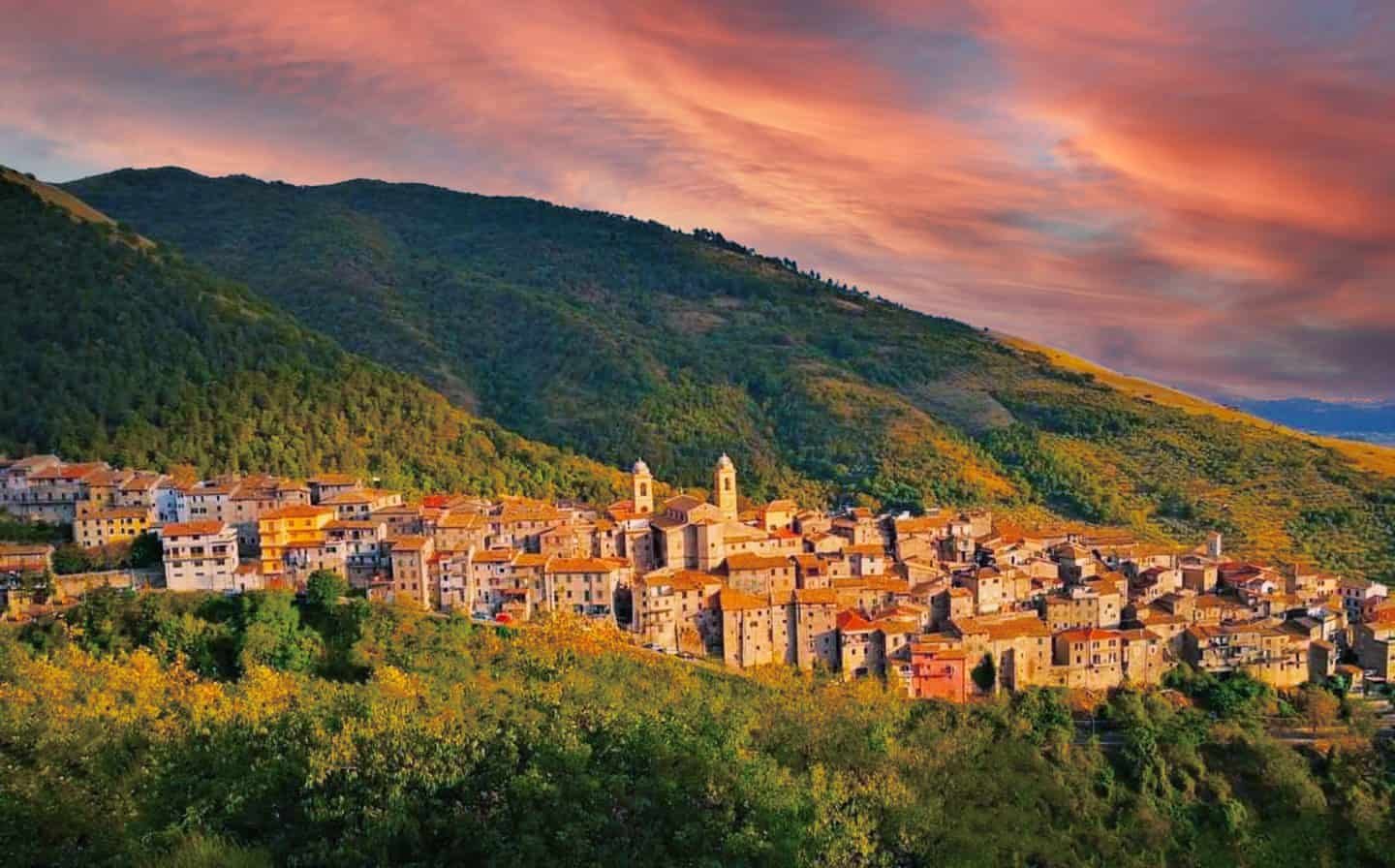
Piglio (FR): Where It Is and Why It's Worth the Trip
There are towns you cross because they happen to lie along the road, and towns you have to decide to reach. Piglio belongs to the second category, and that is the first fact to pack. It is not a village you pass through: it is a village you arrive at. It rests on the southern flank of the Monti Ernici, at 620 meters of altitude, and looks down on the Sacco valley like someone who knows a view by heart and keeps looking at it anyway. Behind it is the real mountain, Monte Scalambra at 1,420 meters, the Retafani, the Pila Rocca, the Colle del Mattone. In front is the valley opening wide toward the southeast, with the towns perched on the other slope and, on tramontana days, the silhouette of the Lepini Mountains on the horizon.
The distance from Rome is deceptive. On the map it is a short outing. In the mental geography of the Roman, everything that lies beyond the Grande Raccordo Anulare automatically becomes an expedition. It is not. You leave after breakfast and come back for dinner without hurry, and the extra time is exactly what you need to understand the place. Piglio is visited in an hour and a half if you treat it as a monument. It is understood in a day if you treat it as a territory. The difference between the two experiences is all the difference that matters.
Three things make Piglio different from hundreds of Lazio villages just as perched and just as beautiful. The first is wine: here, in 2008, the first DOCG of Lazio was born, the Cesanese del Piglio. The second is the historical layering, which runs from a Roman villa at the locality of Fontana di Grano to a castle of the year 1000, by way of a convent that tradition says was founded by Saint Francis in person. The third is the hinge position between Ciociaria, the Aniene valley and Abruzzo, which for centuries made this town a place of passage, of watch and of border. The rest of the guide is the story of these three things, place by place.
How to Get to Piglio (FR) from Rome and from the South
The A1 Autostrada and Regional Road 155: The Route I Recommend
The main route, the one I recommend to anyone with no particular reason to do otherwise, is the A1 autostrada. You take the Grande Raccordo Anulare, get on the A1 toward Naples, exit at Anagni-Fiuggi. From there you follow regional road 155, the former Fiuggi state road, which climbs toward the spa city and continues along the slope of the Ernici touching Acuto and Serrone: in about 20 minutes you are in Piglio. The exit is well signposted, the regional road is a gentle mountain road, with wide curves and reasonable grades, drivable without worry even by those who don't like driving in the hills. The last stretch, the one that leaves the regional road and climbs to the historic center, narrows considerably: that is where you have to slow down and accept the idea that the car, from a certain point on, becomes a burden and not an advantage.
Via Casilina, 2,000 Years of Road
The historic alternative, and I use the adjective in its literal sense, is Via Casilina, that is, state road 6. It follows the route of the ancient consular road that connected Rome to Capua, and anyone who drives it today travels over more than 2,000 years of road history. You leave Rome toward the southeast, pass through Colonna, Zagarolo, Palestrina, Valmontone, Anagni, and at a certain point turn toward the mountain. It is an infinitely slower road than the autostrada, it takes at least half an hour more, but it tells you something. You go through olive groves, you see the villages perched on the hills, you pass road-maintenance houses and trattorias that have existed for 60 years. If you have time, if you are on a real vacation and not a hit-and-run outing, take the Casilina on the way there and the autostrada on the way back: the ratio of costs to benefits, in terms of beauty, tips clearly to the side of the first.
From Frosinone, from Cassino, from Abruzzo
For those arriving from the south, from Frosinone or Cassino, the reasoning is reversed but the logic stays identical: A1 as far as Anagni-Fiuggi, then the regional road. For those coming down from Abruzzo, and it happens more often than you would think because many come from Avezzano and the Fucino, the road is the one that passes through Filettino and Trevi nel Lazio, a high-altitude route of great beauty that crosses the Ernici from side to side and that I recommend to anyone with a free day and no hurry on their back. From Piglio, in the opposite direction, you cross the pass toward the Monti Simbruini and toward Subiaco with less than an hour of scenic road: it is a connection few consider, because mentally we separate the province of Frosinone from that of Rome as if there were a wall, when it is the same massif seen from two slopes.
Train and Bus to Piglio (FR)
Public transport exists, works, but requires planning. The reference railway station is Anagni-Fiuggi, on the Rome-Cassino-Naples line. Mind a detail that trips up many: that station is not in Anagni and even less in Fiuggi, but down in the valley floor, at the locality of Osteria della Fontana, and from the station to the town you still need a Cotral bus or a taxi. From the capital Cotral also connects the terminus of Roma Anagnina, on Metro A, with Fiuggi and the towns of regional road 155. The runs are tailored to residents' needs: concentrated early in the morning and in the late afternoon, with big gaps in the middle of the day and a very reduced service on Sunday. Schedules are checked on cotralspa.it the day before, because being stranded in a mountain village at six in the evening is a formative but not very pleasant experience. In the early 1900s Piglio also had a station on the narrow-gauge Rome-Frosinone railway, closed for decades: the building of the old station is today a reference point for the bike path and for the giant bench I talk about later.
Why Come by Car, and Where to Leave It
The operational advice, without beating around the bush, is to come by car. Not out of laziness, but because the territory around Piglio is made of cellars scattered on the slopes, of contrade two or three kilometers from one another, of trails that start from points reachable only on dirt road. Without your own vehicle you see the town and miss the territory, and in Piglio the territory is at least half of the reason it is worth coming. If the program includes a serious cellar tour with tasting, the discussion changes and you need a designated driver or a service with a driver. Those who organize private and corporate experiences departing from Rome, like the editorial team of TourLeaderPro, solve the problem at the root, and it is not a trivial matter in a place where the main product has a respectable alcohol content.
Parking deserves a paragraph of its own. The historic center of Piglio is medieval in structure, which means alleys wide enough to let a loaded donkey through and not a centimeter more. The parking areas are in the lower part and at the edges of the old core, and that is where you leave the car. Driving up toward the castle is a mistake paid for in desperate maneuvers and pitying looks from residents. The town is explored on foot, uphill, and that is fine: it is the climb itself that makes you understand how it is built. Comfortable shoes are mandatory, not so much for the length of the route as for the surface, which alternates cobblestones, slabs of local stone and steps of fanciful height.
When to Go to Piglio (FR): The Four Seasons of the Town
The season completely changes the town, so the answer is articulated. September and October are the months of wine: the grape harvest fills the streets with tractors and the smell of must, the cellars work at full pace, the Sagra dell'Uva Cesanese, on the first weekend of October, turns the village into a collective party. It is the moment when Piglio is most itself, but it is also the most crowded, and festival days require arriving early. Spring, from April to June, is the season of the trails: the Ernici fill with blossoms, the temperatures are perfect for walking, the vineyards have that tender green that lasts a few weeks, and in June there is the historic skiroll race. Summer is cool compared to the plain, no small thing when Rome hits 38 degrees Celsius, and that is why Roman families came up here to spend the summer. On the evening of August 10, for San Lorenzo, the town celebrates its patron and goes up to the castle to watch the shooting stars. Winter is the season of cellars and fireplaces, with a few snowfalls that whiten the town and make it photographically memorable but complicated on the road: chains or winter tires become indispensable, out of concrete necessity and not formality.
One last logistical note worth its weight in gold: Piglio should not be visited alone. Not in the sense of company, in the sense of itinerary. It stands in the middle of a cluster of towns that all deserve it, and building a day on two or three stops makes more sense than devoting an entire one to a village of 4,000 inhabitants. A few kilometers away is Fiuggi with its spa and a historic center that those who frequent the springs ignore. A little farther down is Anagni, the city of the popes, with a cathedral that alone justifies the trip. To the east open Guarcino and Vico nel Lazio, the latter with a circuit of walls among the best preserved in Lazio. Anyone who wants a reasoned overview of how these destinations fit together, in English, will find it in the regional guide of ItalyPlanner on Lazio, which has the merit of reasoning by itineraries and not by lists.
Essential services: in Piglio you find everything you need for a day or a weekend. Bars, grocery stores, a pharmacy, restaurants, some accommodation among farm stays, bed and breakfasts and vacation homes. Don't expect the offer of a mass tourist resort, because it is not one and doesn't want to be, but not a desert of services either. The phone signal works in town and gets capricious along the trails and in some side valleys: if you have a hike planned, download offline maps before going up. ATMs are there but few: bring some cash, especially if you plan to buy wine directly at the cellar or to stop at a kiosk during the festivals, because not all small producers have a card reader and nobody is ashamed of it.
Cesanese del Piglio: The First DOCG of Lazio
It has to be said right away, the thing that distinguishes Piglio from hundreds of other Lazio villages: this is where the first Denominazione di Origine Controllata e Garantita wine of Lazio was born. The ministerial decree is dated August 1, 2008, published in the Gazzetta Ufficiale on August 18 of the same year, and it promoted to DOCG a denomination that had been DOC since 1973. Before then Lazio, a region that has produced wine since before the word Italy existed, did not have a single DOCG. That recognition came last, and it came up here, on a mountain slope where the vines hang on the hillsides and mechanization is often impossible.
The Cesanese Grape: Two Varieties, One Territory
Understanding why it happened here means understanding Piglio. Cesanese is a very ancient red-berried grape, native to the strip of territory that includes Piglio, Affile and Olevano Romano, that is, the three denominations that carry its name. There are two main varieties that coexist in the production rules: Cesanese di Affile, with a smaller and more compact cluster, considered the noble variety, and common Cesanese, more productive and more widespread. The production rules for Cesanese del Piglio prescribe at least 90 percent Cesanese di Affile and/or common Cesanese, with a maximum share of 10 percent of other red grapes suitable for cultivation in Lazio. This apparent technicality is the heart of the matter: it means that the wine of Piglio is not an international wine disguised as local, but a wine that comes from a genetic heritage that exists only here and that elsewhere, simply, does not give the same results.
The production zone includes the whole of the municipalities of Piglio and Serrone and, in part, those of Acuto, Anagni and Paliano. It is a few square kilometers of slope, and the denomination remains small in terms of vineyard hectares and bottles: it is one of those situations in which the title weighs more than the volume, and the producers know it very well. If you talk to them, the fact of being the first DOCG of Lazio will be told to you with pride within the first five minutes of conversation.
Soil, Exposure, Temperature Range
The reason lies in the soil and the exposure. The slopes that run down from the Ernici toward the Sacco valley are largely limestone, with abundant stony skeleton, good drainage and a decent mineral richness. The vineyards face mostly south and southwest and get sun all day, but because they sit at altitude they undergo a temperature swing between day and night that becomes significant in summer. That swing makes the difference. It keeps the acidity, preserves the aromas, stops the grapes from turning into a sugar bomb with no backbone, and brings them to full phenolic ripeness. The result is a wine with warmth and structure but also a freshness that surprises anyone expecting the classic heavy red of central Italy.
Cesanese del Piglio in the glass
In the glass, Cesanese del Piglio is ruby red with reflections that shift toward garnet as it ages. On the nose it brings ripe red fruit, mostly cherry and sour cherry, then violet, sweet spices, and in some versions an almost minty balsamic note that is the signature of the altitude. On the palate it is warm, with tannins that can still be a little rough in the young versions and that soften into silk in the riserve. It has an unexpected length and a slightly bitter finish, typical of the grape, which the production code itself lists among the wine's characteristics and which the producers defend as a mark of identity and not a flaw to be corrected.
The types: base, Superiore, Riserva
The production code provides for three types, all dry wines. The base Cesanese del Piglio has a minimum alcohol content of 12 degrees and is released on February 1 of the year after the harvest. The Superiore, with lower yields (9 tons per hectare against 11) and at least 12.5 degrees, is released on July 1 of the second year after the harvest. The Riserva is a Superiore with at least 14 degrees and a minimum aging of 20 months, 6 of them in the bottle. They are three different products in structure, concentration and aging potential, and they should be drunk at different moments. The semisweet or sweet versions that some older locals remember belong to a peasant tradition older than the DOCG and fall outside the denomination. If you come across one, it is something else, to be drunk as such.
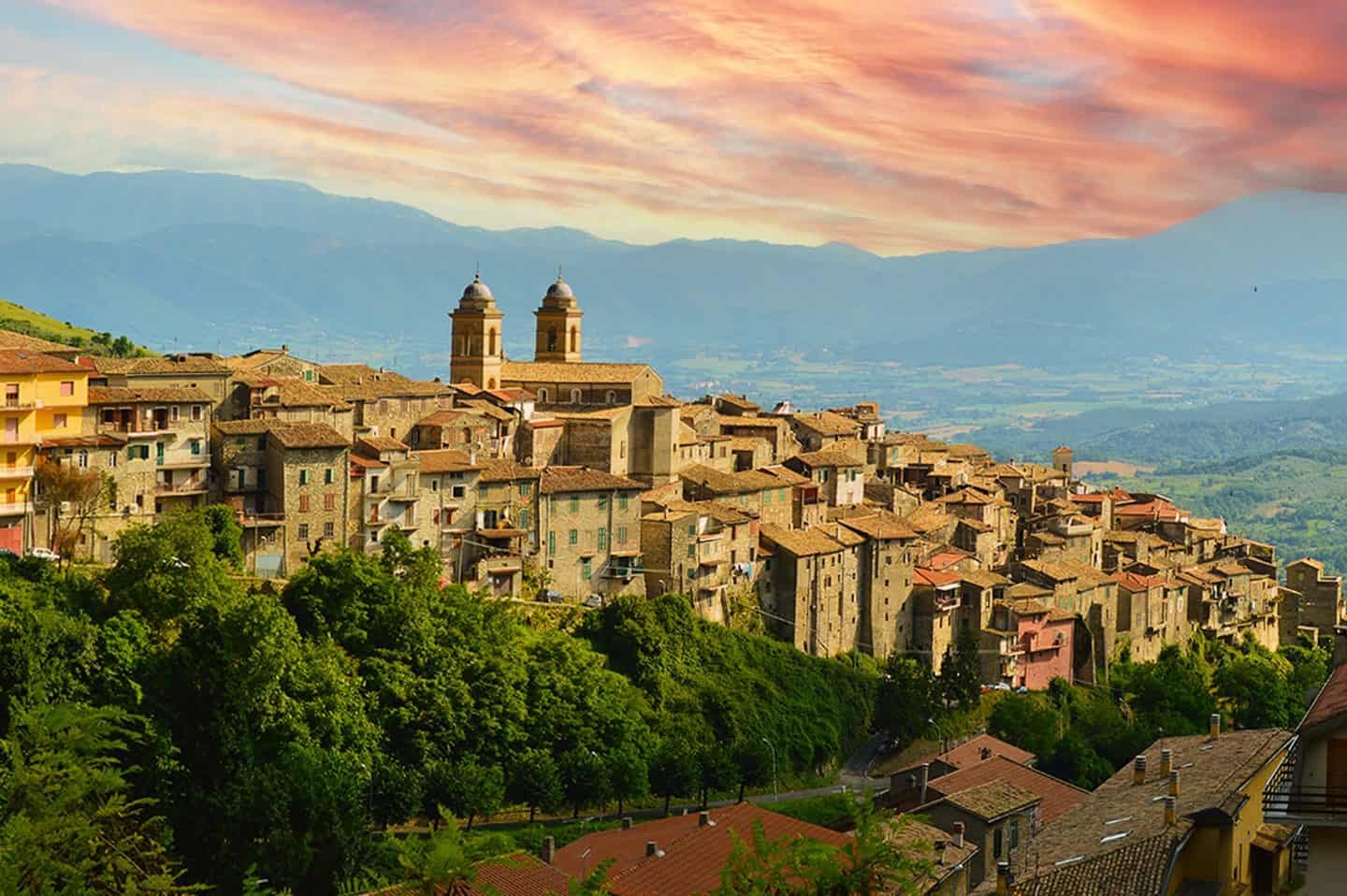
The Cesanese Wine Road and the wineries of Piglio (FR)
The Cesanese Wine Road links Piglio to the other towns of the denomination and to the wineries scattered across the territory. It is not a wine-tourism highway with flashy signs and monumental visitor centers. It is a network of secondary roads, often narrow, that lead to family-sized wineries where the producer is also the agronomist, the winemaker and the person pouring your glass. Some are equipped for visitors, others less so, and practically all of them require a phone call or a reservation in advance. It is a slow-tourism model that has its practical limits but offers in exchange an authenticity that is hard to find elsewhere. Anyone who wants to place Lazio on the Italian wine map, which is usually told only through Tuscany and Piedmont, will find a starting point in English in the food and wine section of ItalyPlanner.
Piglio and Fiuggi: two worlds that touch
The relationship between Piglio and nearby Fiuggi deserves a note. They are two worlds that touch physically but belong to opposite tourist histories. Fiuggi is the spa town that has lived through seasons of great fame, with important hotels, an established flow of visitors and a wellness vocation that has lasted more than a century. Piglio is the farming village that built its identity on working the land. In recent years this closeness has been turning into a mutual resource: people staying at the spa discover the wine, and people who come for the wine discover that the springs are 20 minutes away. It is an integration still under construction, but the direction is clear and, in our judgment, it is the right one.
If I had to sum up Piglio's identity in one sentence, I would say it is a village that has stopped being only agricultural without becoming touristy. It occupies that intermediate, slightly uncomfortable zone in which the land still produces real income and visitors are welcome but not indispensable. It is a fragile condition, because it takes little to slip to one side or the other, and it is the reason it is worth coming now, while the balance holds.
The history of Piglio (FR): from Castrum Pileum to the Colonna
The wine, central as it is, is the last chapter of a much longer story. The area was inhabited in Roman times. In the locality of Fontana di Grano the remains of a villa from the 2nd to 1st century BC have been identified, and the materials now displayed in the castle's Antiquarium come from excavations in the area. The name has a disputed etymology. Scholarly tradition derives it from pileum, the hat, and local legend even ties it to Quintus Fabius Maximus, the Delayer, who supposedly lost his helmet here to a gust of wind. It is a story to be told for what it is, a legend, but it explains why the village chose that Latin name as its own. Other scholars lean toward a pre-Latin root linked to the idea of a height.
Documentary certainty arrives in 1088, when the village appears as Castrum Pileum. In the 11th century it depended on the bishop of Anagni. At the end of the 12th century it passed to the De Pileo family, also called Buccaporco, and then to the De Antiochia, descendants of Frederick II of Swabia, who ruled it for more than two centuries. In the 15th century Odoardo Colonna acquired the territory, and from then on Piglio stayed with the Colonna until the abolition of feudal rights in the first decades of the 19th century. In 1479 the community gave itself the Statutes of the Land of Piglio, which regulated, among other things, the cultivation of the vine and the wine trade. It is the document that shows how, five centuries before the DOCG, Cesanese was already a public matter.
The family that marks the destiny of the village is therefore the Colonna. They held it for four centuries, fortified it, and made it a stronghold of the system of castles that guarded the routes between Rome and the Kingdom of Naples. Castello Colonna, which still dominates the village from the highest position, is the physical sign of that rule. It is not a castle in the fairy-tale sense. It is a military fortification, born around the year 1000 to watch over the pass between Lazio and Abruzzo, built to see far and to resist, with walls that follow the line of the rock and in places seem to continue it rather than rest on it.
Piglio's position, between the Papal States and the southern territories, meant centuries of passing armies, sieges, destruction and rebuilding. In 1347 the village was taken by Cola di Rienzo. In 1526 it was sacked by the troops of Pope Clement VII, at war with the Colonna. In 1799 it suffered destruction at the hands of the French. In 1944 Allied bombing razed about 30 percent of the buildings. Anyone walking through the historic center today crosses an urban fabric that is the sediment of this story: houses pressed against one another for defensive reasons, arches that span the alleys, stone portals with worn coats of arms, outside staircases that climb to second-floor doors because the ground floor was the stable or the cellar. Piglio entered the province of Frosinone in 1927, when it was established. Before that it belonged to the province of Rome.
A curiosity about Piglio (FR)
A village's curiosities are never found where the hurried guide looks for them. They hide in the folds: in a date that doesn't add up, in a dialect word nobody can explain, in a tradition that survives although nobody remembers anymore why it began. From this point of view, Piglio is a deposit. There are quite a few, organized here in four chapters, because a single one would not do justice to the layering of this place.
The wine that waited a thousand years to be recognized
The first curiosity is the biggest and the most paradoxical. Cesanese has been grown on these hills for such a long time that the sources get lost. Latin agronomists knew it, the farm contracts of medieval monasteries attest to it, the Statutes of 1479 regulate it, and a university report from 1942 notes that "the wine is, moreover, much appreciated by all consumers, especially those of the Capital." And yet the highest recognition, the DOCG, arrived only in 2008. A thousand years of documented history and then, at the start of the 21st century, the seal.
The paradox is explained by a thoroughly Italian story. For decades the wine of Lazio was considered, in the collective imagination and unfortunately also in a good part of the critics' view, an everyday wine: good, honest, cheap, but not a wine for reflection. The Castelli Romani produced rivers of white that ended up in the fraschette, Ciociaria produced red that ended up on family tables, and nobody worried much about building a quality identity. The region sold quantity. The result is that, while Tuscany was building the myth of Chianti Classico and Piedmont that of Barolo, Lazio was left without a top denomination.
The change of course in Piglio came from the initiative of a relatively small group of producers who made a bet against the current: reduce yields, abandon cellar practices pushed toward quantity, rediscover the Cesanese di Affile that in many vineyards had been gradually replaced by the more generous common Cesanese, and aim for a product that could hold its own in a blind tasting. It took years, and it took money that nobody guaranteed they would recover. The DOCG recognition came as confirmation of a path already traveled, not as a prize for a promise. Lazio's first DOCG gave Piglio a visibility out of proportion to the size of the denomination, and it became an element of the village's identity, not a mere technical fact.
There is also a detail that almost nobody knows and that I find fascinating: Cesanese is one of the very few native red grape varieties of Lazio to have reached recognition at this level, in a region that preserves dozens of them, many grown on tiny surfaces and at risk of disappearing. When you drink a glass of Cesanese del Piglio you are not only drinking a wine. You are financing, in a small but concrete way, the survival of a plant genetic heritage that without a market would vanish within two generations.
The castle that looks in three directions
The second curiosity concerns Castello Colonna and is strategic in nature before it is architectural. Climb up to the tower and stop to look. From up there you control three routes at the same time. The Sacco valley to the southeast, meaning the road to the Kingdom of Naples. The gap to the northwest, meaning the way that leads to the Simbruini and the Aniene. And the Ernici passes to the northeast, meaning the crossings toward Abruzzo and the Fucino. Three directions, three borders, three potential fronts. The castle of Piglio was not a lordly residence with a few incidental defensive functions. It was a node in a system of territorial surveillance. The fortifications of the area communicated with one another by sight, and Piglio was one of the links in that chain.
The detail that strikes anyone with a little knowledge of military architecture is how the fortress exploits the natural rock, with a drop of 25 meters between the upper palace and the lower one. In some stretches there is no real distinction between the rocky base and the masonry. The medieval builders worked by subtraction where they could, leveling and regularizing the living rock, and by addition only where it was indispensable. It is a technique that greatly reduces construction costs and time, and it is the reason certain mountain fortifications seem to have grown out of the ground instead of being built on top of it.
Another curiosity tied to the castle is its later fate. Like many baronial fortifications, it lost its military function when artillery made vertical walls obsolete, and from that moment the long and sad phase of plundering began. The squared stones of an abandoned castle are ready-made, free building material. Whoever had to raise a house, a retaining wall, an oven, went up and took. Walking through the historic center with a trained eye, you can recognize in the walls of the houses blocks with a different, more careful finish, evidently reused. The castle has not vanished. It has redistributed itself through the village.
The view from the top, and this is no longer a curiosity but a practical tip I am slipping in here, is the real reason the climb is worth it. On tramontana days, when the air clears, the eye reaches very far. You see the whole valley, you see the villages on the other slope, you sense the Tyrrhenian as a different line of light on the horizon. It is the kind of panorama that makes you understand, immediately and physically, why someone a thousand years ago decided to build right there.
The festival that is not just any festival
The Sagra dell'Uva Cesanese deserves a chapter because it differs from the standard model of the Italian sagra, and the difference is instructive. The average sagra in Italy is a food event: you eat a typical product at plastic tables, there is music, there is a raffle, and that's it. That is not a negative judgment, just an observation. In Piglio the grape festival, which in 2025 reached its 51st edition, has a feature that moves it to another category: it is born inside the production cycle, not beside it. It celebrates the moment of the harvest while the harvest is still finishing. The people taking part in the festival are, for the most part, the same ones who spent the previous weeks picking. This changes the tone of the event. It is not the folkloric reenactment of a vanished world, it is the celebration of work just completed.
The most characteristic moment is the costume parade with floats tied to the theme of grapes and wine, with the neighborhoods and districts competing in the preparation. The competition is real, the kind of neighborhood rivalry that in Italian villages is a serious social institution disguised as a game. People prepare for weeks, work in the evenings, keep their plans secret. It is an ancient mechanism of community cohesion that survives because it keeps working. Around it there are tastings, folk groups, exhibitions, open cellars.
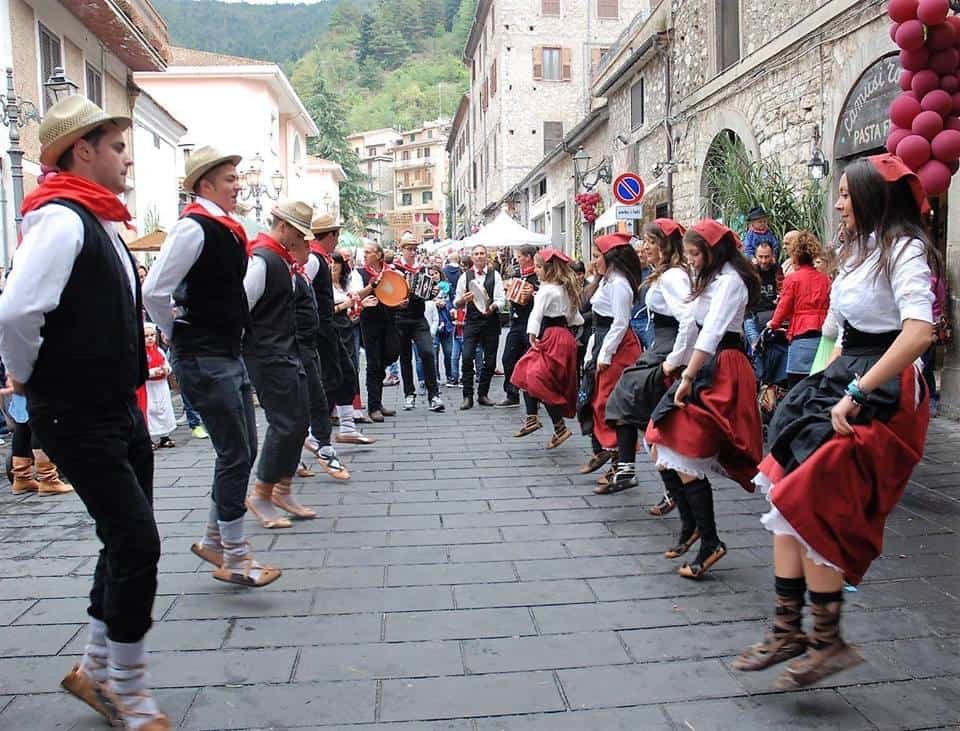
My advice, if you come, is to arrive early and not limit yourself to the official program. The best things happen at the margins: in the private cellars opened for the occasion, in the courtyards where someone has set out a table and brought out last year's wine, in conversations with people who explain why that vintage was difficult or exceptional. The sagra is the pretext. The village, opened up, is the content. A note for those planning the trip: during the days of the sagra the village is full, the parking lots up high are impassable and the access roads may be regulated. Allow for longer times and consider sleeping in the area, also because tasting wine and then driving in the mountains in the dark is a combination I advise against without hesitation.
The dialect, the place names and the words that remain
The fourth curiosity is linguistic, and it is the one that interests the hurried tourist least and those who want to truly understand a place most. The dialect of Piglio belongs to the area of the median dialects, the band that covers southern Lazio, southern Umbria and part of Abruzzo, and it preserves archaic features that modern Romanesco lost long ago. There are words from the agricultural and wine vocabulary that survive in Piglio and have disappeared elsewhere: names for vineyard tools, for the phases of pruning, for cellar vessels, for the weather conditions that matter to the farmer. It is a technical vocabulary built by generations of people who had to name precisely the things their harvest depended on. When you talk with an elderly winegrower and let him tell his story, terms surface that no Italian dictionary records.
The place names are the other interesting chapter. The districts and localities of the municipal territory have names that tell what was there before: references to watercourses, to types of vegetation, to church property, to features of the terrain. Fontana di Grano, where the Roman villa stands, says in two words something about a water source and a crop. A place name is a compressed historical document, and the territory of Piglio is full of them. The town's cadastral map is, in effect, an archive.
Then there is the question of Ciociaria identity, more complex than it seems. Ciociaria is not an administrative region. It is a cultural area with disputed borders, which early 20th-century tourism and then the cinema of the postwar period codified into a precise imagery, made of ciocie on the feet, traditional costumes, a pastoral landscape. That imagery brought fame but also flattened real differences. Piglio, which stands on the mountain slope and has a specific wine-growing vocation, recognizes itself in Ciociaria but with a shade of its own, and if you ask around you get different answers depending on who answers. It is the kind of identity ambiguity that makes a territory interesting instead of boring. And oral memory is still alive: there are people who remember the village before motorization, when the vineyards were worked with animals and the wine came down to the valley on carts. It is a window that is closing, as everywhere, and whoever has the patience to ask a couple of questions in a bar collects stories that in 20 years will no longer exist.
Visiting Piglio (FR) place by place
The historic center of Piglio is laid out like a cone below the castle, with the medieval fabric climbing between the main road and the summit of the hill. The route I describe starts from the top, at Castello Colonna, and descends through the churches to the convent outside the village. It is the order I recommend for a morning, because you tackle the climb with fresh legs and the panorama from the fortress has a sharpness that the midday haze erases.
Castello Colonna and the Antiquarium of Piglio (FR)
The castle, which documents also call Castello Baronale Alto, was born in the early 11th century to watch over the passage between Lazio and Abruzzo. The original structure was double: a Palatium superius, the stronghold proper with the loggia and the cistern, and a Palatium inferius, the lower palace, separated by a drop of 25 meters. Of the whole, what remains today is the square tower and stretches of the curtain wall, which follow the line of the rock. The castle passed from the bishop of Anagni to the De Antiochia, who held it from 1240 to 1480, and then to the Colonna, who kept it until the decline of the feudal system, at the start of the 19th century.
Today the castle houses the municipal Antiquarium, which gathers the Roman materials found in the area. The piece that draws the most attention is a headless female statue datable between the 1st and 2nd century BC, a witness to the villa of Fontana di Grano and to an ancient settlement that precedes the medieval castrum by more than a thousand years. It is a small collection, visited in half an hour, but it is the place where the long history of Piglio becomes tangible: before the wine, before the Colonna, before the village, someone was already cultivating these slopes. The Antiquarium's opening times depend on the Comune, so ask beforehand, because a small village museum does not keep capital-city hours. Even with the museum closed, the climb to the tower is worth the effort on its own, and no exhibition room can compete with what you see from the walls.
The Lower Castle and the Arco della Fontana
The Palatium inferius, the lower castle, is not visited as a monument. You walk through it. It is the cluster of houses pressed together that descends below the stronghold, and its symbolic gate is the Arco della Fontana, the opening that marked the entrance to the lower palace. Passing under it you enter the densest part of the medieval fabric, with alleys as wide as a man with arms outstretched, outside staircases, buttress arches that span the streets to hold the houses up against one another. It is the neighborhood where you take detail photographs and where you grasp the defensive logic of the settlement: no facade looks toward the valley, everything closes inward, and the light enters only at an angle.
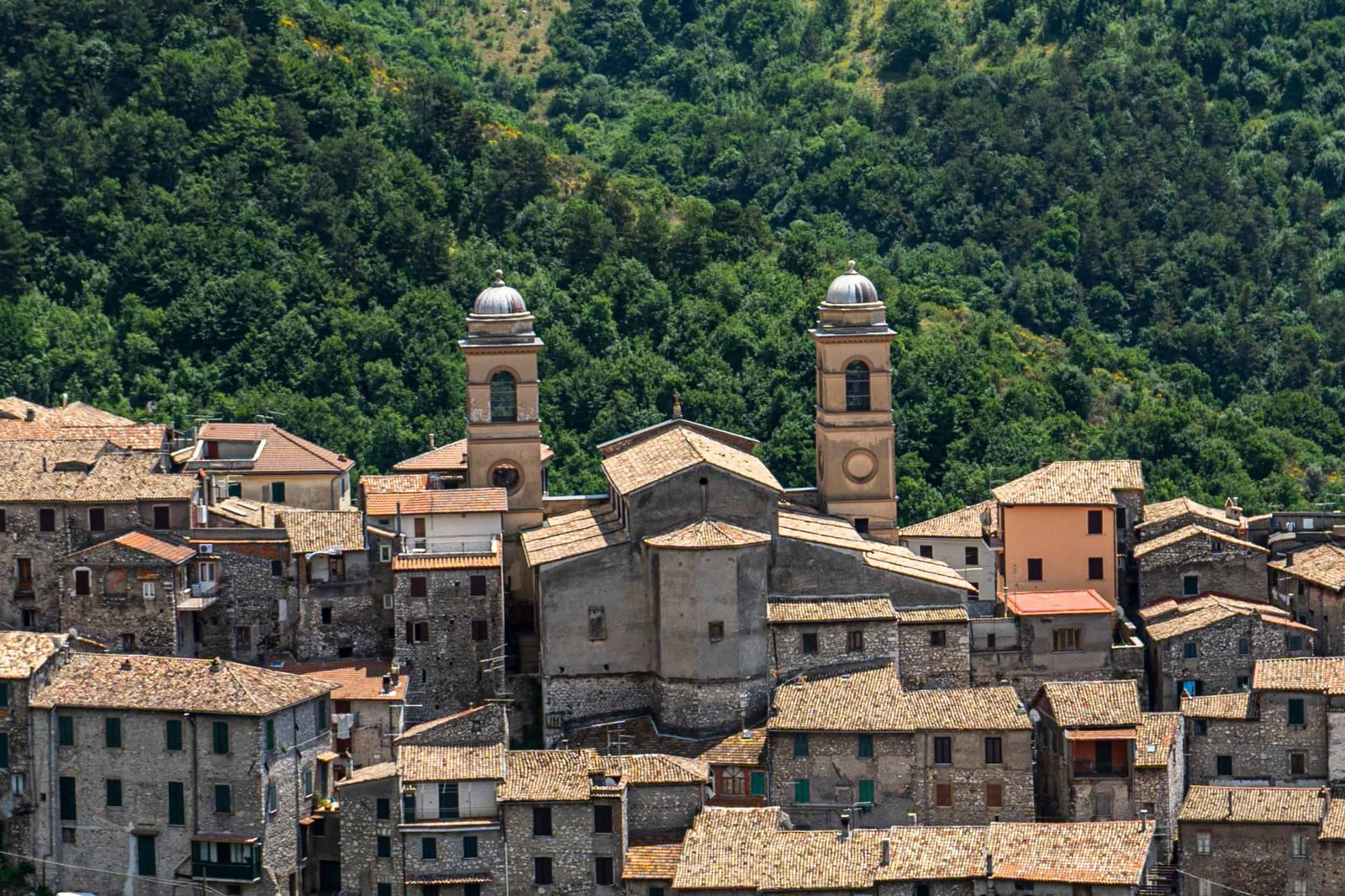
The Collegiata of Santa Maria Assunta in Piglio (FR)
The Collegiata of Santa Maria Assunta, also called Santa Maria Maggiore, is the main religious building of the village and tells its history in its own way. Its origins date to the end of the 13th century. The building was destroyed by the bombing of 1944 and rebuilt after the war, which explains why the whole looks more uniform than its founding date would suggest. The facade is enlivened by the rose window and closed by the twin bell towers, a rare solution in the villages of the area, where as a rule there is only one bell tower and often a detached one. The interior has three naves. Here, from May to October, the statue of the Madonna delle Rose is kept, which for the rest of the year returns to its sanctuary. The transfer takes place with a procession, and on October 30, on the eve of the feast, the village accompanies her on foot.
It is not a museum, it is a place where people still go in on Sundays, and you feel that difference as soon as you cross the door. The churches of mountain villages have a different atmosphere from city ones: more recollected, more used, more alive. Go in without expecting catalogued masterpieces. Expect a community that rebuilt its church from the rubble in a few years and keeps it open. In our judgment it is the postwar reconstruction, and not the antiquity, that deserves respect in this building.
The Sanctuary of the Madonna delle Rose
The Sanctuary of the Madonna delle Rose is a 17th-century building that holds a Byzantine-style fresco of the 14th century, the image to which tradition attributes the end of the plague of 1656. The community's vow survives in two feasts: the day after Pentecost and October 31, with the procession of the eve. In the religious history of inland Lazio, plague Madonnas are many, but here the link between the icon, the plague and the calendar has remained intact for almost four centuries, and the double seat, sanctuary in winter and collegiata in summer, is a solution seen in few other villages. Anyone who happens to be in Piglio at the end of October finds the village in a guise that no grape festival gives back: silent, devout, with candles lit along the route.
The church of San Rocco and the 15th-century fresco
The church of San Rocco, dedicated to another saint who protects against epidemics, keeps a 15th-century fresco of the Madonna between Saint Lawrence and Saint Anthony Abbot. It is a painting of local circles, not a name from the textbooks, but it is the oldest figurative testimony left in the village after the destruction of 1944, and it brings together in a single image the patron of the village, Saint Lawrence, and the protector saint of animals, Saint Anthony, that is, the two devotions of a farming community. Look at it with that eye: it is a painted photograph of what mattered, five centuries ago, to those who lived here.
The Convent of San Lorenzo and Blessed Andrea Conti
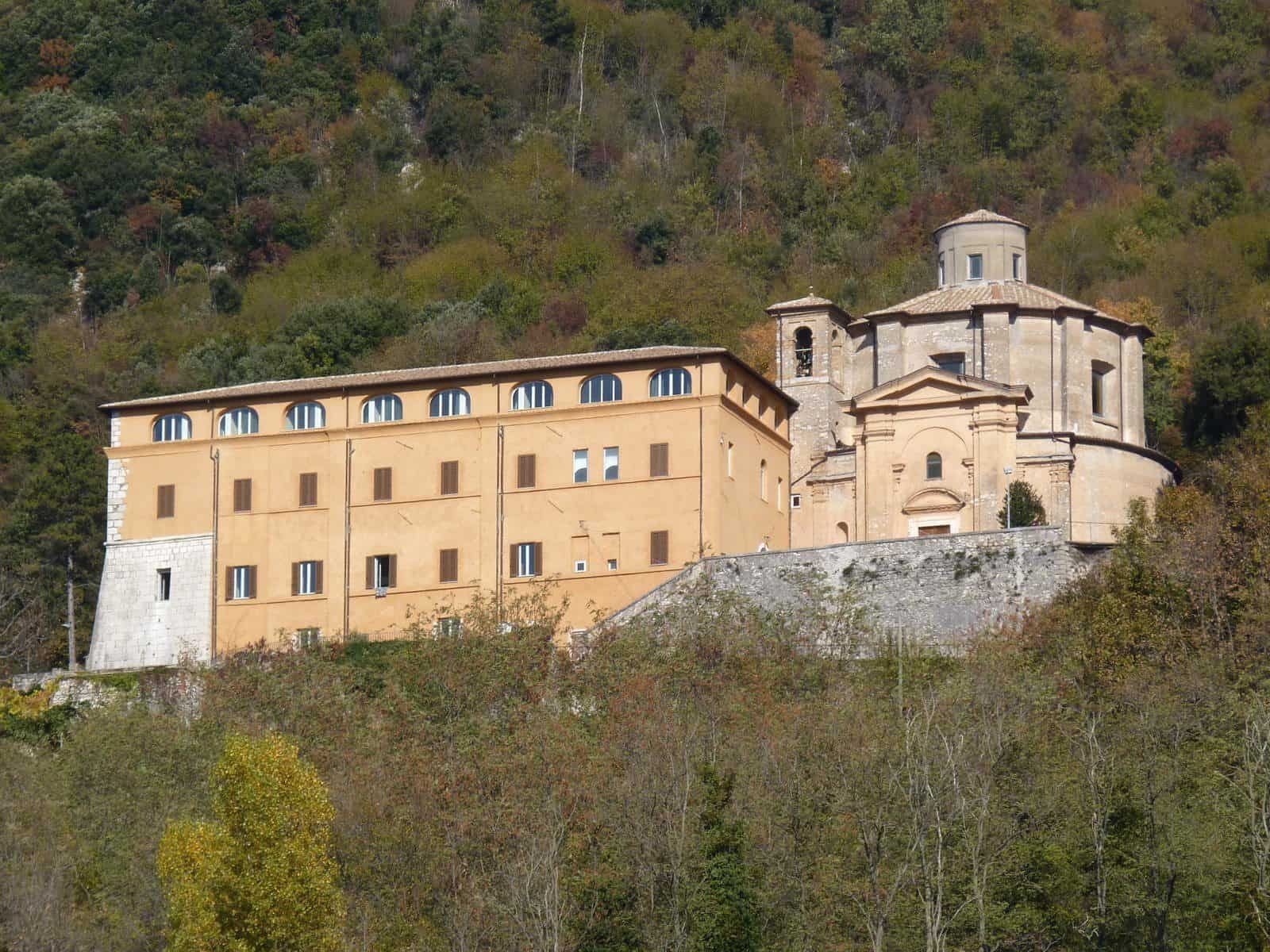
The Franciscan Convent of San Lorenzo stands outside the village, on the slopes of Monte Scalambra, and it is the place I recommend most firmly to anyone who has only half a day. Tradition says it was founded by Saint Francis in person in 1215, during a journey to Subiaco, on land donated by Cardinal Giovanni Colonna, bishop of Sabina. It is a tradition, not a document, but the date and the cardinal's name are consistent with the presence of the Colonna in the area and with Francis's travels in Lazio. The current church dates from the 15th century, perhaps on top of an earlier building, with the chapel of Blessed Andrea Conti attached. It was rebuilt in 1773 by the architect Giuseppe Ferroni, was already abandoned in 1873, suffered the earthquake of 1915 and the bombs of 1944, and was rebuilt in 1954 in its original forms.
The figure who makes this convent special is Andrea dei Conti di Segni, born in Anagni in 1240, nephew of Pope Alexander IV and a close relative of Boniface VIII. After joining the Franciscans, he chose the hermit's life in a cave reachable from the convent, on the flank of the Scalambra. In 1295 Boniface VIII wanted to make him a cardinal and he refused the purple, citing his own inadequacy and his love of solitude. In the Rome of the Caetani and the Colonna, such a refusal was almost a scandal. He died here on February 1, 1302, was buried in the church of San Lorenzo and was beatified on December 11, 1723 by Innocent XIII, a Conti himself. His feast day falls on February 1. The hermitage cave is reached from the convent and is the most intense place in the whole territory: a Franciscan who says no to a pope, in a mountain cavity, a short distance from the wine village.
In 1937 the convent hosted Maximilian Kolbe, the Polish friar who would die at Auschwitz in 1941 and whom the Church has canonized. It was a brief, documented stay, which adds another layer of memory to the place. Visits depend on the community of friars. The convent is a place of religious life before it is a monument, and you enter with the respect that this implies.
The Convent of San Giovanni
The village's second convent, San Giovanni, has a more troubled history. The church existed from the 13th century and was redone in 1632. The convent was built in 1620, suppressed under the 1870 laws on religious orders, damaged by the earthquake of 1915, restored in 1923, destroyed by the bombing of 1944 and rebuilt between 1949 and 1951. Read in sequence, this series of dates is the biography of an entire Apennine village in the 20th century: earthquake, war, reconstruction. It is the least spectacular building on the route, and it is the one that best explains why almost nothing in Piglio has remained as it was built.
The Roman villa of Fontana di Grano
In the locality of Fontana di Grano, within the municipal territory, are the remains of a Roman villa from the 2nd to 1st century BC. Don't expect an equipped site. These are structures in the countryside, readable with the help of the Antiquarium more than on the spot. But their meaning is clear. In the Republican age these slopes were already organized into farms, and the viticulture that the Latin agronomists describe for the area had one of its bases here. Between the Roman villa and today's Cesanese wineries run 21 centuries of cultivation continuity. It is the sentence to remember in front of the headless statue in the museum.
The giant bench and the Paliano-Piglio-Fiuggi cycle path
About two kilometers from the old railway station stands one of the giant benches that have colonized Italian viewpoints in recent years. Without diplomacy: as an object it is a fad, as a viewpoint it works, because it is placed where the Sacco valley opens up best. More interesting is the cycle path that links Paliano to Fiuggi by way of Piglio: a scenic route with no traffic that gives the valley back at a slow pace. Anyone coming by bicycle has in this track the backbone of the day, with the wineries as detours and the Bosco di Paliano as a possible extension.
Wandering through the historic center of Piglio (FR)
After the monuments comes the best part: the aimless stroll through the medieval fabric, the part that spreads below the castle and above the main road, where the houses climb and the alleys open into unexpected small squares. Portals with worn lintels, outside staircases with wrought-iron railings, arches spanning the alley, wooden doors with paint peeling in three layers of different colors. Piglio is generous with details, and the reason is that it was not restored according to a unified plan. The layers have stayed visible, and visible layers are bread and butter for anyone who looks closely. Give yourself an hour without a map. It is the hour that guided groups never have, and the one they almost always remember most.
Something nobody tells you about Piglio (FR)
We now come to the part that guides usually skip, not out of bad faith but because it is uncomfortable to write. Tourist pages describe places at their best, and they are right to do so: nobody sells a territory by listing its limits. But the adult traveler also deserves the rough information, the kind that changes the quality of a day more than a thousand enthusiastic adjectives. Here are three things that nobody says about Piglio and that you need to know before going up.
Piglio lives on work, not on tourism, and this has concrete consequences
The first thing to understand is that Piglio is not a tourist machine. It is an agricultural municipality with a strong wine vocation, where most of the people you meet do something that has nothing to do with hospitality. The 200 active businesses counted in 2015 have on average fewer than two employees each, meaning they are working families. This is the village's main merit: what you see is real, not staged. But it brings a series of practical things that, if you don't take them into account, spoil the day.
It means that the hours are those of a village, not of a tourist resort. The afternoon break exists and it is serious: between 13:00 and 16:00, or even 16:30, a good part of the businesses close. Whoever arrives at two in the afternoon expecting to have a leisurely lunch and then shop finds everything closed and sits on a bench watching the cats. This is not poor service. It is a different rhythm, to be followed and not fought. It means that Monday is often a closing day for restaurants and businesses, and that in low season you may find a village almost at a standstill. Checking beforehand is not fussiness, it is common sense.
It means that the wineries are not showrooms. They don't have staff dedicated to hospitality waiting for visitors. Whoever receives you interrupts their own work to do it, and in the peak production periods, meaning the harvest and the weeks immediately after, that availability drops drastically. It is paradoxical but true: the moment when the tourist most wants to see a winery in operation is the one when the winery has the least time to give. The solution is to book well in advance and accept times that are not very convenient. Finally, it means that the upkeep of the heritage follows the time and resources of a small municipality: not all sites are always accessible, not all routes are perfectly marked, not all signs are up to date. Whoever arrives with the mental standard of a structured destination is disappointed. Whoever arrives knowing they are visiting a real village adapts and enjoys it.
I add a consideration that holds for all of inland Lazio and is particularly evident here: these territories are facing depopulation. The demographic numbers of the Apennine villages are merciless almost everywhere, and every business that closes is the life choice of someone leaving. Slow, conscious tourism doesn't solve the problem on its own, but it is one of the few levers small municipalities really have. Spending here instead of at a chain down in the valley is, without rhetoric, an act with consequences.
Cesanese is not an easy wine, and whoever sells it as one is misleading you
The second thing nobody says, and the one with which I risk displeasing someone. Cesanese del Piglio is not an immediate wine. It is not the soft, fruity, round red that the international market has trained people to expect. It has edges. It has a tannin that in the young versions can still be unruly. It has a bitter finish that people used to polished reds perceive as a flaw. In certain vintages and certain interpretations it has an openly declared rusticity.
This is a real commercial problem for the producers and a problem of expectations for the consumer. If you expect an agreeable wine, the first glass of Cesanese throws you off. If instead you understand that you are drinking a native mountain grape with a precise, non-negotiable identity, then those edges become interesting. It is the same learning curve as Nebbiolo, Sagrantino, Aglianico: grapes that give nothing away at the first taste and then become an obsession. The practical advice is not to judge Cesanese by the first bottle, and above all not to judge it by the wrong bottle. The denomination has remarkable quality variability within it: there are producers working at very high levels and others who stay in a comfort zone. The best way to find your bearings is to get advice on the spot, and better still to taste comparatively in the winery several vintages or several types from the same estate. That is where you understand what the grape can do.
Second warning: Cesanese needs food. It is a wine born for the table, built on a mountain cuisine of meats, pastas dressed with flavor, aged cheeses, cured meats. Tasted alone, in the abstract, as is done in competitions, it shows its limits more than its qualities. Set beside a plate of pasta with meat sauce or a porchetta, it transforms. This is not an excuse. It is the logic of territorial wines, which were selected for generations according to what was eaten there. Third warning: watch out for the types, base, Superiore and Riserva, described above, which are three different wines. Always asking what you are tasting is not pedantry. It is the minimum needed to understand.
Fourth thing, and perhaps the most useful: the quality-to-price ratio of Cesanese del Piglio is, today, among the best in Italy. The denomination doesn't yet have the fame it deserves, and prices remain anchored to a positioning that the great denominations abandoned 20 years ago. Whoever buys now, directly at the winery, takes home bottles that in another region would cost double. It is a window that, like all market windows, will sooner or later close. The wine scene of Lazio, moreover, is going through a phase of deep reorganization, with the rediscovery of native grapes, the reduction of yields and a generational change that brings trained people into the cellar. Piglio is one of the epicenters of this movement, together with the Castelli Romani, the Olevano area and some areas of Tuscia.
The mountain behind Piglio is more serious than it looks
Third thing, and it concerns safety, so I say it without softening it. The Monti Ernici are not hills. From the center of Piglio, looking up, the relief seems tamed: woods, a few clearings, a rounded profile. It is an optical impression due to the distance and the altitude from which you look. As you climb, the mountain becomes progressively more severe: the Scalambra reaches 1,420 meters, and farther east the main peaks of the group are on a different scale altogether, with rock faces, gullies, wind exposure and weather that changes fast.
The trails that start from this stretch of territory differ greatly in difficulty. There are low routes, among vineyards, olive groves and chestnut groves, that are walks suitable for anyone with decent shoes and two free hours. And there are itineraries that climb toward the main peaks of the group, with significant elevation gain, stretches on unstable ground and travel times that well exceed half a day. Confusing the two categories is the classic mistake, and it is the mistake that every year fills the mountain rescue service with work in the central Apennines. Signage is not of the same quality everywhere: some routes are well maintained and well traveled, others are less trodden and in places the trail is lost, especially in autumn when leaves cover the path and in spring when the vegetation explodes. The rule is banal and I repeat it: map downloaded offline, GPS track loaded before leaving, battery charged, no dependence on the phone signal, which disappears in the side valleys.
The weather deserves a paragraph of its own. In this stretch of the Apennines, summer thunderstorms form in the afternoon with a speed that surprises those coming from the plain. The morning is clear, around two the clouds begin to build, around four it pours. The rule of Apennine hiking is to start early and be on the way down by early afternoon, and it is not a precautionary rule. It is the rule. In winter the snow is substantial above a certain altitude and requires specific equipment and skills, crampons and ice axe included on certain itineraries. This is not terrain for improvising.
A little-known and fascinating aspect is the karst. The Ernici are largely limestone, and this means dissolution phenomena: sinkholes, swallow holes, cavities, springs that appear and disappear. It is the same geology that, a bit farther north, feeds the springs of the Aniene in the Monti Simbruini, and the same one that makes the waters of this territorial band famous. At Collepardo, on the eastern side of the Ernici, it has carved caves and a karst shaft of notable size. The practical consequence for the hiker is that surface water is scarce and unpredictable: don't count on finding springs along the route, carry what you need.
There is also wildlife to know about. The wolf has returned permanently to the central Apennines and its presence in this area is documented. It is not a danger to the hiker, and this needs to be said clearly because there is so much misinformation on the subject, but it is a reason to keep dogs on a leash and to behave with the respect owed to a wild environment. There are wild boars, which can be aggressive if you run into a female with her young, and there is birdlife that includes raptors of notable value. Anyone who comes with binoculars and a minimum of patience takes home sightings that repay the climb. It must also be said that this mountain has historically been inhabited and worked, not wild in the strict sense: the chestnut groves are centuries-old plantations managed by people, the high pastures are the result of centuries of transhumance, the dry-stone walls you meet even at altitude are the work of generations of farmers. Walking here means crossing a cultural landscape, not virgin nature.
For those who want to take on the mountain seriously, the best access is not necessarily from Piglio. The starting points for the more demanding hikes are often higher up, toward Guarcino, Vico nel Lazio, Filettino and Trevi nel Lazio. Piglio works very well as a logistical base and as a place to come back to in the evening, with the not small advantage of having a kitchen and a cellar that after eight hours of walking have a therapeutic value that is hard to overstate.
My advice for visiting Piglio (FR)
Here is how it is best done, without the diplomatic caution of the official guides. The main advice, the one from which everything else follows, is this: don't come to Piglio to see Piglio. Come to Piglio to stay in it. It is a difference that sounds rhetorical and is in fact operational, because it determines how you build the day, how much time you allocate, what you put in the program and above all what you leave out.
The tourist who arrives with a "let's see what's here" mentality finishes with Piglio in 90 minutes: a turn through the historic center, a photo of the castle, a coffee, gone. And he leaves convinced he has seen a pretty village but nothing special. He is not wrong, from his point of view: taken as a monument, Piglio doesn't compete with Anagni or the great art centers. Taken as an experience of a territory, it has a density that few places in Lazio reach. The problem is that this density cannot be seen by walking. It is seen by stopping. So the first concrete recommendation is to allocate a whole day, and if possible a night. An overnight stay changes everything for a banal but decisive reason: it lets you taste without driving. And since in Piglio the central experience is about wine, giving up the tasting for road-safety reasons means giving up 90 percent of the reason you came up.
The second recommendation is to book the wineries in advance. It is not a formality: the producers in Piglio are for the most part family-run businesses, where the person welcoming you is the same one who is pruning, bottling or tending a fermentation. Whoever shows up without notice on a busy working day is, at best, seated quickly with two glasses. At worst, they find the gate closed. With a phone call a few days before, instead, you get a real visit: the vineyard, the cellar, the explanation, the guided tasting. The difference between the two experiences is huge.
Third recommendation: no more than two wineries in a day. I know the temptation is to maximize, and I know there are groups that squeeze in four or five. It is a mistake on every level. From the sensory point of view, after the second serious tasting the palate is compromised and you can no longer tell apart the nuances that are exactly the reason for the visit. From the human point of view, rushing from one producer to the next prevents the long conversation that is the best part. From the practical point of view, the sum of the tastings becomes a non-trivial amount of alcohol. Two wineries, well chosen, at an easy pace. The rest is collecting.
Fourth recommendation, on the order of the day. The suggested scheme: early morning in the village, when the streets are empty and the light enters the alleys at an angle. Climb to the castle before the sun gets too high, because the morning panorama has a sharpness that is lost in the midday haze. Visit the Collegiata, pass under the Arco della Fontana and wander through the medieval fabric. Lunch in a local trattoria, unhurried and without looking for signature cuisine, which is not the point here: the point is the mountain and country dishes, the homemade pastas, the meats, the cheeses. Afternoon in the winery. Late afternoon, if there is energy left, the Convent of San Lorenzo and the cave of Blessed Andrea, or a short walk on one of the low trails, just to see the sunset over the vineyards.
Fifth recommendation, the most counterintuitive: leave empty space in the program. In small villages the best things are the ones you can't plan. The gentleman who opens the door of a private cellar because he has understood that the interest is real. The shop that sells three products and sells them well. The procession you didn't know was happening. The dirt road that climbs among the vineyards and is on no tourist map. With a full program, all these things pass by and you don't see them. With two free hours, you catch at least one.
On pairing with other destinations, the suggestion is to build a thematic axis instead of a geographic list. If the theme is wine and food, Piglio pairs with the towns of the denomination, Serrone, Acuto, Paliano, and with the descent toward the valley. If the theme is history, the strong pairing is with Anagni and with Alatri, the latter with a megalithic acropolis that is among the most impressive things in all of Lazio and that strangely remains little known even among Romans. If the theme is the mountain, you go up toward Guarcino and Vico nel Lazio and higher still, where the Ernici become serious. If the theme is wellness, the pairing is with Fiuggi, a perfect contrast between the active day and the recovery afternoon. For those who want to delegate building the itinerary to people who do it for a living, with a driver and a guide, the private and corporate tours of TourLeaderPro leave from Rome and cover Lazio. For a first exploration it is a more than reasonable choice. Then, once you understand the geography, you go back on your own. And that is when the fun begins.
For those traveling in low season, meaning November to March excluding holidays, you should expect that quite a few businesses reduce their hours or close. This is no reason not to come, quite the contrary: winter in a mountain village has a quality that high season never has, with empty streets, lit fireplaces and a general slowness that is almost therapeutic. You do need to check beforehand what is open, and you need to accept that the number of options shrinks.
Piglio (FR) with children and the accessibility of the village
Piglio works with children better than it seems, but it takes some adaptation. The climbs of the historic center tire short legs, so they need to be broken up. The castle, with the tower, the remains of the walls and the view, usually wins over kids more than the church does: tell them about the signals between fortresses and the carved rock, and the climb becomes a game. Wineries are boring for little ones if the visit is all technical, but they become interesting if the producer agrees to show the barrels, the machinery, the place where the grapes come in and become something else. Ask for it explicitly when you book: many are delighted to do it. The giant bench and the cycle path are, with a child, the best way to close the afternoon.
On accessibility we have to be honest. The historic center is medieval: steps, steep slopes, uneven surfaces. A person in a wheelchair can go through the lower part and the main road without too much difficulty, and reach the Collegiata. The castle and the alleys of the lower palace require a companion and, in some stretches, are in practice off limits. The Convent of San Lorenzo can be reached by car, the cave of Blessed Andrea cannot. The wineries, in the countryside, almost always have level access but dirt surfaces: ask when you book. Piglio has no declared equipped routes, and I prefer to say so rather than promise the opposite.
Another well-known fact, yet rarely cited
Everyone in the area knows that Piglio is a roller-ski village. Almost nobody outside mentions it when talking about the Cesanese village. Yet it is one of the most singular facts of its recent history. Roller skiing is cross-country skiing on wheels, the discipline with which cross-country skiers train in summer on asphalt, and Piglio, which has no ski slope, hosted for years an international race of 15 kilometers along the road from Genazzano to Serrone and to Piglio, organized by the Sci Club Madonna del Monte of Piglio and held in June. From 2007 that race entered the World Cup calendar, and in 2009 the village hosted the world championships of the discipline.
The World Cup edition of June 26-28, 2008 gives the measure of the event: a sprint in the center of Frosinone on Thursday, a 5 kilometer individual time trial on Friday, a 15 kilometer road race on Saturday, with a mass start. At the start were Giorgio Di Centa, two-time cross-country world champion, Valerio Checchi, Alfio Di Gregorio, and among the women Mateja Bogatec, who the year before had won the sprint right in Piglio. A village of 4,000 inhabitants in the Ernici, for a few days a year, became the center of a sport born in Scandinavia.
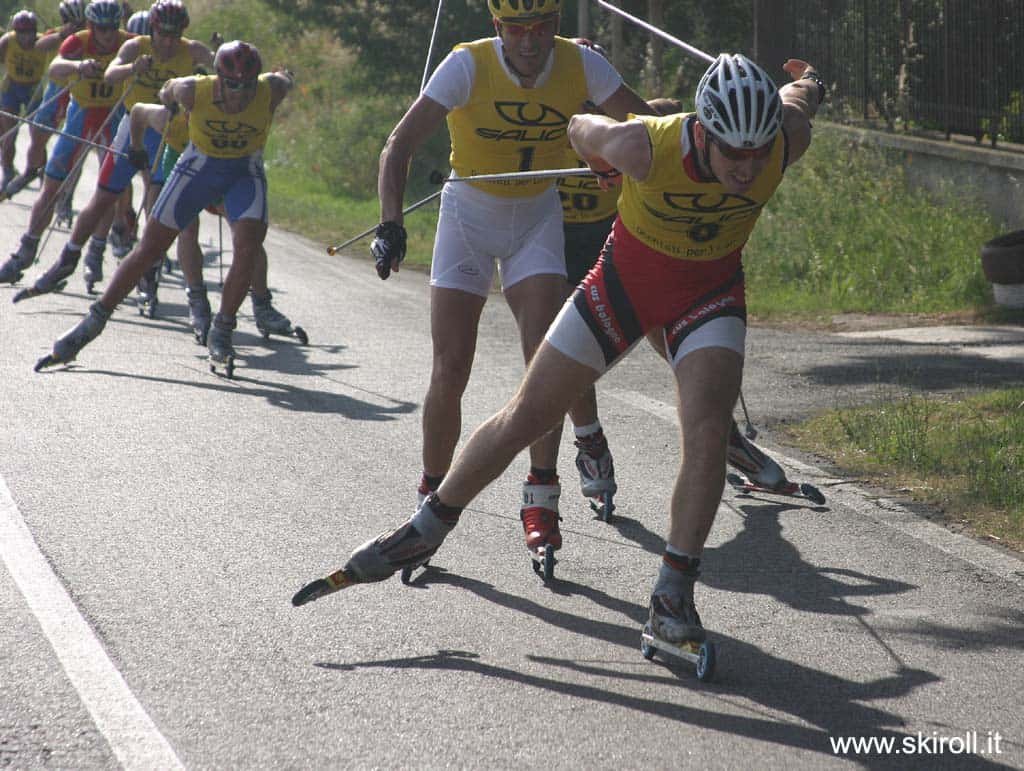
Why here? For the same reason Cesanese grows here: the road. Regional road 155 and its branches offer a long, regular climb, with constant gradients and wide curves, which is exactly the profile a road roller-ski race requires and which doesn't exist on the Lazio plain. The village turned its inconvenient geography, the kind that makes it hard to reach and impossible to mechanize the vineyards, into a sporting advantage. Anyone driving toward Piglio on a Sunday in June and finding the road closed for the race should know that this is not a disservice. It is a tradition that has brought Olympic champions up here. It is the chapter that says the most about the spirit of the place, a village that never asked itself whether it was big enough to do something, and did it.
The right photo to take in Piglio (FR)
Let's talk photography, because in a place like this the difference between the postcard and the image worth anything depends almost entirely on two variables: where you stand and at what time. The rest, equipment included, matters much less than people think.
The signature photo of Piglio, the one anyone recognizes, is the profile of the village with the castle on top seen from below and slightly from the side. The village is laid out like a cone, with the houses climbing narrow and the tower closing the composition at the top. It is an image that works because it has a very clear visual hierarchy: a compact mass of buildings, a ridge line, a dominant vertical element. To do it well you have to leave the built-up area and find a spot on the road that climbs or on one of the side roads that lead to the vineyards. The right distance is the one that lets you frame the whole village without crushing it: too close and you lose the shape, too far and it becomes a dot in the landscape. The hour is the decisive variable. Late afternoon is the best moment by far, because the light comes in low from the west and models the volumes of the houses, brings out the grain of the stone and warms the plaster. In the middle hours, with the sun high, the village flattens and becomes a grayish blot with no relief. Early morning is the second choice, with a colder but often cleaner light, and with the advantage of finding the streets empty of parked cars, which are the ruin of any photograph of a village.
The second photo, the one I recommend even more because few people take it, is the panorama from the castle toward the valley. Here the subject is not Piglio. It is what Piglio looks at. The Sacco valley opening out, the cultivated slopes, the villages on the other side, the Lepini closing off the south. It is a classic landscape photograph, and like all of them it requires favorable atmospheric conditions: with summer haze it doesn't work. With clean air after a tramontana front, or on clear winter mornings, it becomes something remarkable. The trick, so that the image has depth instead of being a horizontal band, is to include a piece of the fortification in the foreground: a corner of the tower, an opening, a stone profile. It gives scale and tells where you are looking from.
The third photo is the vineyards, and it has a precise season: October, when the Cesanese leaves turn and the rows become a palette of yellows, oranges and reds that contrasts with the dark green of the woods above and the gray of the rock. It is the period when Piglio's agricultural landscape reaches its maximum chromatic intensity. The technical advice is to look for a raised spot from which the rows read as lines: the geometry of vineyards on a slope, with the contour lines following the terrain, is an extremely strong graphic subject. Photographed from below and head-on, instead, the rows pile on top of each other and the image becomes confused.
The fourth, and perhaps the most successful, is the detail photograph in the historic center. Not the panorama, not the monument: the particular. A portal with a worn lintel. An outside staircase with a wrought-iron railing. The Arco della Fontana creating a natural frame. A wooden door with peeling paint. An old man's hands resting on a cane in front of the bar. A fifth possibility, for those who come at the right time, is the photograph of the harvest, with an ethical rule to set right away: the people picking are working, not performing folklore. You ask permission, always. The answer is almost always yes and often enthusiastic, but the request must be made, and if the answer is no you accept it without insisting. The images you take home are the kind that count: hands on the grapes, full crates, the morning light between the rows, concentrated faces. It is photography of work, a genre that has a noble tradition in Italy and that is rarely practiced today.
Two technical notes. First: in a stone village the shadows are very deep and the lit areas harsh, so dynamic range is the real enemy. Expose for the highlights and recover the shadows afterward, or deliberately look for the hours when the contrast drops. Second: vertical lines. When shooting upward in a narrow alley, the facades fall backward and the image looks unbalanced. Without a shift lens, you correct it afterward or knowingly accept the distortion and use it as an effect, but you don't leave it there by chance. Third note, on sharing: if you post, geotag. For a village of this size, digital visibility has a real economic impact. A beautiful, correctly tagged photograph brings people, and the people who arrive buy wine, eat in the trattorie and sometimes sleep over. It is the simplest way to give something back to a place that gave you a good day.
Some important events that happened here in history
The chronology of Piglio is that of a border village, and its events often take the form of an army passing through. I list them in order, distinguishing what is documented from what tradition tells.
1088. First documentary mention of the Castrum Pileum, at a time when the village depended on the bishop of Anagni. It is the official birth date of the village, although the castle, by tradition, was born a few decades earlier, around the year 1000.
1215. According to Franciscan tradition, Saint Francis, on a journey to Subiaco, founds the Convent of San Lorenzo on land donated by Cardinal Giovanni Colonna. There is no deed, but the account is old and consistent with the geography of the saint's travels in Lazio.
1302. On February 1, Blessed Andrea Conti dies in his cave on the Scalambra, having refused seven years earlier the cardinalate offered to him by Boniface VIII. The following year, a few kilometers away, in Anagni, Boniface himself will suffer the outrage of Sciarra Colonna and Guillaume de Nogaret. The Colonna, who would govern Piglio for four centuries, are already protagonists of the great history.
1347. Cola di Rienzo, the tribune who for a few months governs Rome dreaming of the ancient republic, takes Piglio in his campaign against the barons. It is a minor episode in his trajectory, but it says how much the village counted in the system of Lazio castles.
1479. The community gives itself the Statutes of the Land of Piglio, which regulate, among other things, the cultivation of the vine and the sale of wine. It is the oldest local public document on Cesanese.
1526. The troops of Pope Clement VII, at war with the Colonna, sack the village. It is the price of belonging to a family in permanent struggle with the papacy.
1656. The plague that devastates the Kingdom of Naples and Rome arrives here too. Tradition attributes the end of the contagion to the intercession of the Madonna delle Rose, and the community's vow is still alive in the feasts of Pentecost and October 31.
1799. The French troops of the Republic bring destruction to the village, as in all of Ciociaria, where peasant resistance to the occupation was hard and the repression ferocious.
1849. Giuseppe Garibaldi passes through Piglio in the year of the Roman Republic. It is a passage, not a battle, but the village remembers it.
1915. The Marsica earthquake, which razes Avezzano on the far side of the Ernici, damages the Convent of San Giovanni and the church of San Lorenzo.
1927. With the establishment of the province of Frosinone, Piglio leaves the province of Rome. It is the moment when the village becomes administratively Ciociaro.
1944. Allied bombing destroys about 30 percent of the buildings, including the Collegiata, the church of San Lorenzo and the Convent of San Giovanni. The Gustav Line ran farther south, but the Sacco valley was the German route toward Rome, and it paid for it. All of Ciociaria was a theater of war: bombing, occupation, retreat, the passage of the Allied armies, displaced people and hunger. This memory also explains the later demographic structure, including the emigration of the 1950s and 1960s toward Rome, the north and abroad.
2007-2009. Piglio enters the roller-ski World Cup calendar and in 2009 hosts the world championships of the discipline.
2008. On August 1 the ministerial decree recognizes Cesanese del Piglio as the first DOCG of Lazio. It is the event that has changed the village's economy over the past 20 years more than any other.
Who has passed through Piglio (FR)
The question "who has passed through here" is one that, in Italian villages, always produces more interesting answers than expected. Not because every village hosted famous figures, but because the geography of passages tells the historical function of a place better than any description. And Piglio, by position, has been crossed a great deal.
The first passage is a legend, and I tell it as such: that of Quintus Fabius Maximus, the consul who wore down Hannibal by avoiding battle, who supposedly lost the pileum, the cap, here to a gust of wind, giving the village its name. There is nothing historical in it, but the legend says two true things: that the territory was Roman in the Republican age, as the villa of Fontana di Grano shows, and that the village has always felt the need to tie itself to Rome.
The second passage, by tradition, is that of Saint Francis, in 1215, on his way to Subiaco. The third, documented, is the stay of Blessed Andrea Conti, nephew of Alexander IV and relative of Boniface VIII, who chose a cave on the Scalambra over a cardinal's purple and died there in 1302. His figure links Piglio to Anagni, to the dynasty of the Conti di Segni that gave the Church Innocent III and Gregory IX, and to the last pope of that family, Innocent XIII, who beatified him in 1723.
The fourth passage is that of the Colonna, and it is not a passage but a stay of four centuries. The baronial family that rivaled the Orsini for control of Lazio and in the struggle for influence over the papacy held this territory as part of its feudal system, from Odoardo Colonna in the 15th century until the start of the 19th. Speaking of the Colonna means speaking of cardinals, condottieri, contested popes and shifting alliances: Cardinal Giovanni Colonna who donates the convent's land in 1215, Sciarra Colonna who outrages Boniface VIII in Anagni in 1303, the Colonna against whom Clement VII sends troops in 1526. Whoever visits Anagni and the Cathedral Museum of Anagni on the same day as Piglio is, perhaps without realizing it, following a route through the two faces of the same conflict.
Then Cola di Rienzo in 1347, the troops of Clement VII in 1526, the French of 1799, Garibaldi in 1849: armed passages, each leaving its own mark in the stone. And in 1937 a silent passage: Maximilian Kolbe, the Polish Franciscan who four years later would die at Auschwitz offering himself in place of another prisoner, a guest at the Convent of San Lorenzo.
There are collective passages, less dramatic and more continuous. The brigands: the border between the Papal State and the Kingdom of Naples ran just to the south, and for centuries that line was a criminal resource before being an administrative limit. The Ernici, with their closed valleys and dense woods, were for generations a territory of refuge, and the stories of brigands survive in place names and in oral memory. It is not a decorative past. It is a past of poverty and violence, and villages like Piglio went through it paying the price. The pilgrims of the southern Via Francigena, who descended from Rome toward the shrines of the Gargano and the Apulian ports along a fine network of minor routes, for whom the mountain villages offered rest and shelter. The Grand Tour travelers, who between the 18th and 19th centuries followed the road to Naples noting landscapes and customs: Ciociaria enters their imagination as a place of rural charm, and from there passes into landscape painting and 19th-century photography. The Roman summer vacationers of the 20th century, the capital's bourgeoisie who went up in summer looking for cool air before the sea became the dominant destination, with Fiuggi as the epicenter.
And then the athletes: Giorgio Di Centa and the cross-country skiers of the roller-ski World Cup, who came up to Piglio in June between 2007 and 2009. And the passages that really count today: the technicians, the winemakers, the wine journalists who in the last 20 years have come up here to understand what was happening, and who built, together with the producers, the road to the DOCG. It is worth adding a category that is usually not cited: the departed, those who left. Emigration from the villages of the Ernici toward Rome, Belgium, Canada and Australia was massive. There are families of Piglio origin on three continents, and second- and third-generation descendants who return to look for their grandparents' houses and the parish registers. It is a quiet roots tourism, with an enormous emotional value for those who practice it.
What to eat in Piglio (FR) and what to bring home
The cuisine of Piglio is the mountain cuisine of Ciociaria, built to accompany a structured red. Homemade pastas, from fettuccine to gnocchi, dressed with long-cooked meat sauces. Pork and lamb. Cured meats and aged cheeses, pecorino first among them. The chestnuts from the centuries-old groves above the village. Oil from the lower slopes. Don't look for signature cuisine, which is not the point here. Look for the trattoria that changes its menu with the season and that has the Cesanese of the producer next door, not the one with the famous label.
On bringing something home: bottles are the obvious choice, and it is better to buy directly at the winery rather than in a wine shop, not so much for the price as because you also carry away the memory of the people who sold them. But don't stop at wine. In the area you find oil, cheeses, cured meats, baked goods and preserves of the same quality level and far less visibility. A well-built basket is worth more than six identical bottles, and it tells the story of the territory more completely.
What is around Piglio (FR): itineraries within an hour
Piglio is a base, and there are four directions. Down toward the valley, Anagni with the cathedral and the frescoed crypt, Ferentino with its polygonal walls and Roman theater, Alatri with the acropolis, Veroli and the Casamari valley. Up toward the mountain, Guarcino, Vico nel Lazio, Collepardo with the Trisulti charterhouse and the caves. To the north, beyond the ridge, Subiaco and the Benedictine monasticism of the origins, with the Monti Simbruini. To the west, the Cesanese road continues through Serrone and Paliano to Olevano Romano, the other capital of the grape, and to the Palestrina of the sanctuary of Fortuna. Each theme opens a different reading of the same landscape, and after three or four passes you notice you have stopped being a tourist. For those planning day trips from the capital in English, the logic of the connections is on the page of ItalyPlanner on day trips in Italy. For a corporate or group experience with tasting outside Rome, the team of TourLeaderPro for team building builds tailor-made formats.
Quick questions about Piglio (FR)
How far is Piglio (FR) from Rome?
About 74 kilometers. By car, on the A1 with the Anagni-Fiuggi exit and then regional road 155, it takes an hour and a quarter in normal conditions. By Via Casilina, at least half an hour more.
How do you get to Piglio (FR) without a car?
Train on the Rome-Cassino line to Anagni-Fiuggi, then a Cotral bus. Or a Cotral bus from Roma Anagnina, metro A, toward Fiuggi. Runs are few at midday and rare on Sundays. Schedules are on cotralspa.it.
How much does it cost to visit Piglio (FR)?
The village, the castle in the open air and the churches are free. The Antiquarium in the castle and the Convent of San Lorenzo have opening times set by the Comune and by the friars. Any tickets or offerings can be checked on comune.piglio.fr.it. Winery tastings cost whatever each business sets for itself.
How much time do you need to visit Piglio (FR)?
An hour and a half for the historic center alone with the castle. Half a day adding the Collegiata, the sanctuary and the Convent of San Lorenzo. A full day, with a night, if the program includes two wineries.
What is Cesanese del Piglio?
A dry red wine from Cesanese di Affile and common Cesanese grapes, at least 90 percent, produced in Piglio, Serrone and part of Acuto, Anagni and Paliano. It has been DOC since 1973 and, since August 1, 2008, the first DOCG of Lazio, in the base, Superiore and Riserva types.
When is the Sagra dell'Uva Cesanese held in Piglio (FR)?
The first weekend of October. The 2025 edition was the 51st, from October 3 to 5, with a costume parade, tastings, folk groups and exhibitions.
Can you visit the wineries of Piglio (FR) without booking?
Better not to. They are family businesses. Without a phone call a few days before, you risk finding them closed, especially during the harvest. With a reservation the visit includes the vineyard, the cellar and a guided tasting.
Is Piglio (FR) suitable for children?
Yes, with the climbs broken into stages. The castle with the tower and the view wins them over. At the winery, ask that the barrels and machinery be shown. The giant bench and the cycle path close the afternoon well.
Is Piglio (FR) wheelchair accessible?
Only in part. The lower part, the main road and the Collegiata yes. The castle and the alleys of the lower palace, with steps and steep slopes, in practice no. The wineries have level but unpaved access. Ask when you book.
Where do you park in Piglio (FR)?
In the parking areas of the lower part and at the edges of the historic center. Don't drive up toward the castle: the alleys don't allow it. During the sagra the upper parking lots are impassable and the roads may be regulated.
What is the best photo to take in Piglio (FR)?
The profile of the village with the castle on top, from below and from the side, in late afternoon. Or the panorama over the Sacco valley from the tower, on a tramontana day, with a piece of wall in the foreground.
What can you see from Castello Colonna in Piglio (FR)?
The Sacco valley to the southeast, the villages on the other side, the Monti Lepini and, on clear days, the light of the Tyrrhenian. The castle controlled three routes: toward Naples, toward the Aniene and toward Abruzzo.
Who was Blessed Andrea Conti of Piglio (FR)?
A Franciscan born in Anagni in 1240, nephew of Pope Alexander IV, who in 1295 refused the cardinalate offered to him by Boniface VIII and died a hermit in a cave on the Scalambra on February 1, 1302. He is buried in the church of San Lorenzo and was beatified in 1723.
Why is Piglio (FR) famous for roller skiing?
Because since 2007 it has hosted stages of the cross-country roller-ski World Cup and in 2009 the world championships, on a 15 kilometer course from Genazzano to Serrone and Piglio organized by the Sci Club Madonna del Monte.
When is the best time to go to Piglio (FR)?
September and October for the wine and the sagra, April to June for the trails and the roller-ski race, August for the feast of San Lorenzo and the shooting stars from the castle, winter for the wineries and the fireplaces, with winter tires.
What is the difference between Piglio (FR) and Fiuggi?
Fiuggi is the spa town, with hotels and a wellness vocation more than a century old. Piglio is the farming wine village, 20 minutes away by road. Together they make a full day: an active morning in Piglio, an afternoon at the springs.
What do you eat in Piglio (FR)?
Mountain Ciociaria cuisine: homemade pastas with meat sauces, pork and lamb, cured meats, pecorino, chestnuts, oil. All of it designed to accompany Cesanese, which alone shows its limits and at the table transforms.
Is Piglio (FR) on Via Francigena?
Yes, on the southern branch, Via Francigena del Sud, which descended from Rome toward Apulia. The village offered pilgrims rest and shelter, and the Convent of San Lorenzo is the most evident trace of it.
What can you see near Piglio (FR) in one day?
Anagni with the cathedral, Alatri with the acropolis, Fiuggi with the spa, Guarcino and Vico nel Lazio toward the mountain, Subiaco beyond the ridge, Olevano Romano along the Cesanese road. Two stops beyond Piglio are the maximum for a sensible day.
Can you buy Cesanese directly at the winery in Piglio (FR)?
Yes, and it is the best way: the quality-to-price ratio is today among the most favorable in Italy. Bring cash, because not all small producers have a card reader.
One last thing: Piglio opens up in proportion to the interest you show. Whoever arrives, looks and leaves takes away a pretty village. Whoever stops, asks questions, listens to the answers, buys a bottle and comes back a second time takes away a territory with a depth they hadn't expected. The first time, come for the wine and the castle. The second time, choose a different theme: the trails, the rural churches, the cave of Blessed Andrea, the descent toward Anagni. By the third time you won't be tourists anymore, and the village will notice before you do.
Article written by the editorial team of TourLeaderPro, contact them for Private/Corporate/V.I.P. Tours and Experiences.
Planning a trip to Rome? The English-language guides to visiting the city are on ItalyPlanner.com.