Arcazzi di Piscina (Anagni)
In short. The Arcazzi di Piscina are in Anagni, in the province of Frosinone, on the northern slope of the hill, in the district that the town has called Piscina for centuries: address Via delle Fontane 21, 03012 Anagni (FR), coordinates 41.7757…
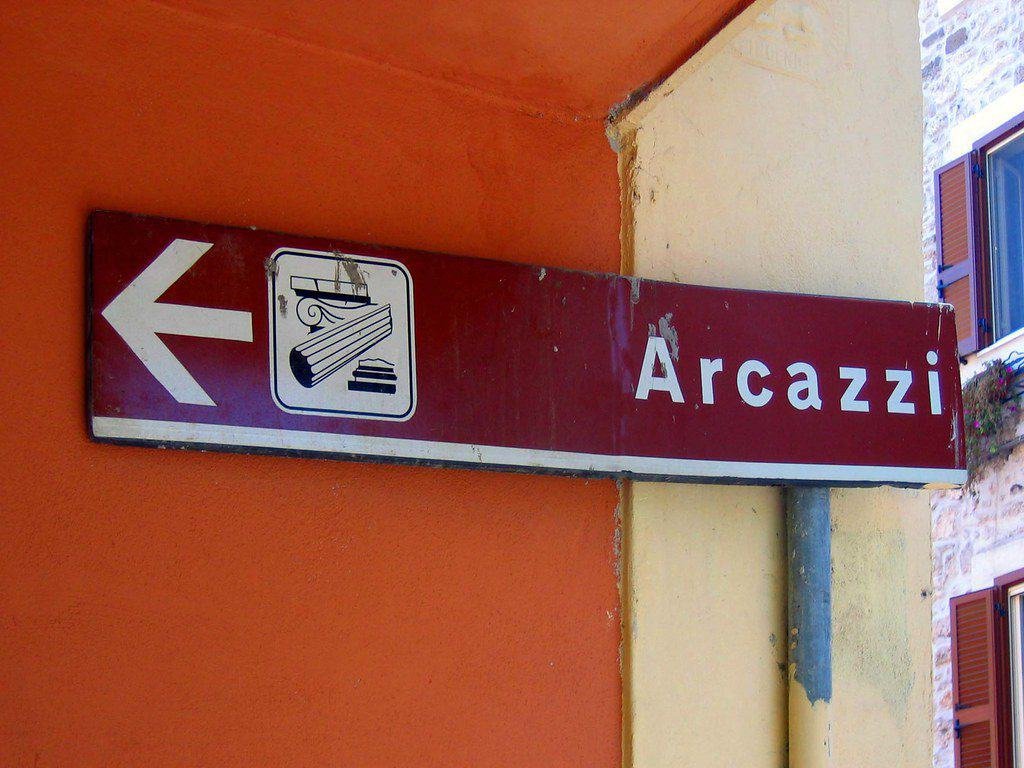
The Arcazzi di Piscina are in Anagni, in the province of Frosinone, on the northern slope of the hill, in the district that the town has called Piscina for centuries: address Via delle Fontane 21, 03012 Anagni (FR), coordinates 41.7757 north and 13.2731 east, below the municipal garden that also faces Via Piscina. They are an open-air monument, visible all year, with no ticket, no opening hours and no staff on duty: nobody tears tickets and nobody opens a gate, because the complex is observed from the public road and from the green area above. By car you exit at the Anagni-Fiuggi toll gate of the A1 Rome-Naples motorway, take the SS 155 Anticolana toward Fiuggi for about 3 kilometers and turn toward the center, another 3 kilometers along Via Cerere Navicella and Viale Regina Margherita. By train you get off at Anagni-Fiuggi station, on the Rome-Cassino line, which is 8 kilometers from the historic center and is connected by a city bus. From the same square leave the regional buses for Colleferro, Fiuggi, Gavignano and Acuto, with runs roughly between 4:50 and 21:40. Anyone arriving without a car should reckon with those 8 kilometers before leaving, because they are the real variable of the day.
Anagni stands at 424 meters of elevation, has a little over 20,000 inhabitants and covers 113 square kilometers between the Monti Ernici and the Sacco valley: it was the capital of the Hernici, passed under Rome in 306 BC and in the 13th century became a papal residence. The Arcazzi are the oldest and most ignored piece of this story. The rest of the city is visited for a fee and with guides. They are not, and for that very reason almost nobody puts them in the itinerary. People are wrong. To frame the city context it's best to start from the page dedicated to Anagni, and then come down here beneath the walls.
What the Arcazzi di Piscina (Anagni) Really Are
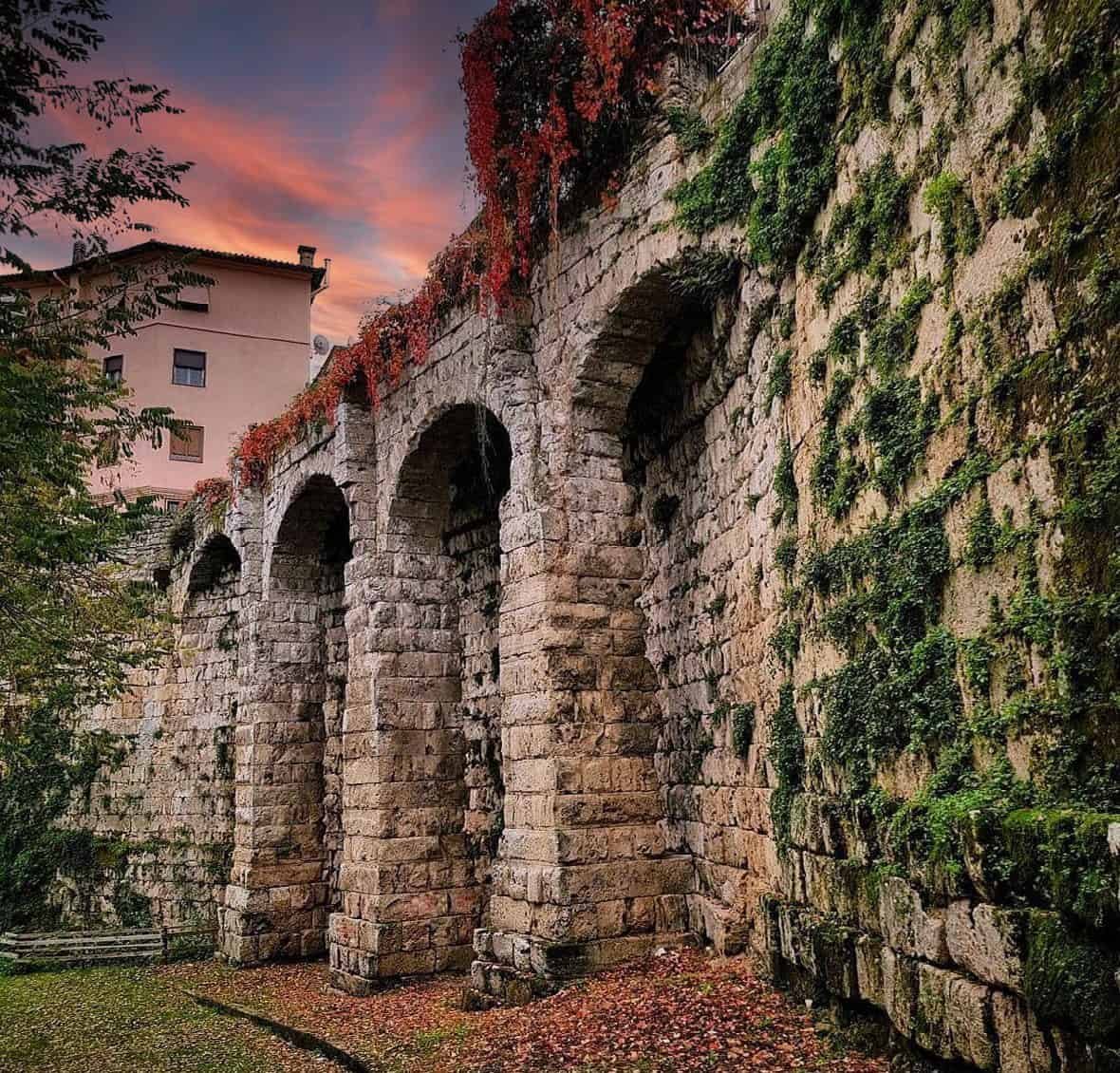
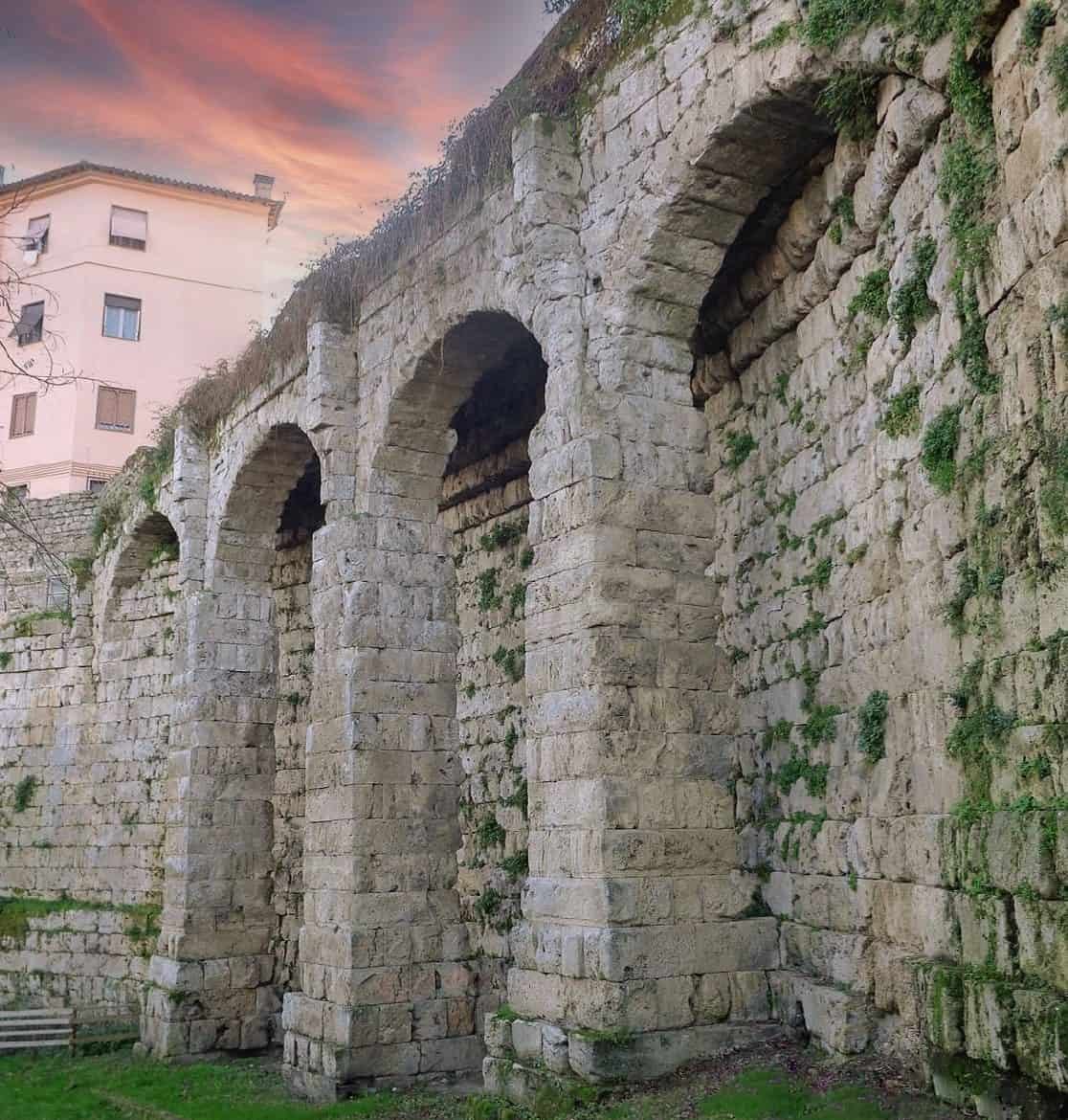
The local word already says a lot: arcazzi, that is, big arches, outsized arches. The monument is formed by a series of piers about 16 meters high, about 4 meters apart, on which three large arches rest. Behind them runs a stretch of wall with a semicircular plan. In plan the complex reads as two hemicycles in squared-block masonry separated by a straight segment, and the western hemicycle preserves the technically most interesting part. The material is local travertine, squared into blocks and laid dry, without mortar, following the technique that the manuals call opus quadratum.
Anyone arriving with the idea of finding a postcard aqueduct, with arches in a row for kilometers as at the Aqueducts Park in Rome, is thrown off. Here the monument is compact, set into the flank of the hill, half absorbed by greenery and 20th-century houses. The first impression is that of a curved rampart topped by three mouths of shadow. The second, the one that matters, comes when you raise your eyes to the false vault.
The Piers and Three Arches of the Arcazzi di Piscina (Anagni)
The piers are the real reason this place is worth the trip. 16 meters of blocks stacked dry, in a context in which contemporary building in southern Lazio was still working mostly in polygonal masonry of shapeless boulders, are a declaration of competence. The regular distance between the supports, around 4 meters, points to a design drawn up beforehand and not an adaptation made along the way. There are three arches and they don't have the lightness of the imperial Roman arch: they are stone abutments that discharge the weight vertically, with an almost dam-like logic.
The False Vault of Projecting Blocks
Above the arches runs the element that has made archaeologists argue for two centuries: a covering obtained not with wedge-shaped voussoirs but with projecting blocks, that is, rows of stones that jut out progressively one over another until they close the space, in four stepped orders. It is the system of the false vault, the same principle as the Mycenaean corridors and the covered galleries of the Lazio acropolises. The total measured projection is just 3.80 meters: a modest span, obtained without ever uncovering the round arch. The local antiquarian literature describes it as a series of opposing steps, and the image is exact.
The detail is not decorative: it is chronological. The false vault of projecting blocks belongs to an archaic building culture and its presence, next to the true arches, is one of the arguments on which the whole game of dating is played. A guide who brings you here and doesn't make you look up at those four orders of stone is stealing your time.
The Half-Piers and the Lost Cornice
Above the large arches you notice half-piers set against the masonry. They hold up nothing of what is visible today: they served to support a crowning cornice, a solution that recurs in other Roman aqueducts and that therefore presupposes an upper level, now gone. If that level held a channel, the Arcazzi were a bridge for water. If it held a walkway, they were a fortification. The stone, for now, does not say.
The Phallus Carved on the Central Pier
At the base of the middle pier a phallus is carved in relief. It is not modern graffiti and it is not a joke: it is an apotropaic sign, that is, meant to ward off evil, the same idea found on the three phalluses carved above the minor gate of the acropolis of Alatri, the one the people of Alatri call the Gate of the Phalluses. In the ancient world the symbol wished good luck on those passing and protected the structure from sieges, collapses, disasters. Whoever entered here, a soldier or a citizen headed to the baths, received a good-omen greeting carved in the stone.
It's worth noticing: this relief is the only figurative element of the monument and 90 percent of visitors miss it, because they look up at the arches and not down at the springing of the middle pier. Look for it before anything else. Then look at the arches.
What the Arcazzi di Piscina (Anagni) Were Used For: Three Hypotheses in the Field
On the original function there is no consensus, and it would be wrong to say otherwise. Three readings have contended for the monument for over a century, and they are not necessarily alternatives.
The Aqueduct Hypothesis
It is the reading most accredited today in local studies. Ancient Anagni took its water from above, from the acropolis on which the Cathedral now stands, and carried it down with an underground conduit as far as the slope and the consistency of the ground allowed. At the gully called Val Fredda, below the walls, the conduit had to pass through the air: the Arcazzi would be the channel bridge of that crossing, with the flow surface placed above the level preserved today. From there the water continued in buried channels to a distribution basin, and from this it branched with lead pipes toward the city and the countryside. A 19th-century scholar, Terrinoni, wrote that the colossal arches were called di Piscina probably because they carried water to a semicircular remnant of a building: a dry sentence worth a treatise. Rodolfo Lanciani, the great topographer of Roman aqueducts, published data on lead fistulae from Anagni stamped with the name of a Claudius Felix, a name that also recurs on pipes of Via Nomentana.
The Substructure Hypothesis
The second reading sees in the Arcazzi a gigantic retaining work. The hill of Anagni, at this point, is partly landslide-prone and partly artificial fill. A curved, thick structure anchored to the rock works like a dam against the thrust of the ground and, in addition, gains buildable surface uphill. On that surface, according to this reconstruction, stood the bath buildings of the Roman city. The semicircular shape, in fact, is the most efficient for containing a distributed thrust: whoever designed it knew what they were doing.
The Defensive Hypothesis
The third reading, supported also by the FAI sheet that lists the place as two large hemicycles with a defensive function derived from Greek models, places the Arcazzi in the circuit of the Roman walls. The height and mass made this side, otherwise the weakest, the hardest to attack. And the curved outline recalls Hellenistic poliorcetics, that is, the science of sieges that in the third and second centuries BC had imposed rounded bastions more resistant to battering rams. Further stretches of the same Roman fortification can be seen along Via Suburbana Sud and Via Dante.
Why the Three Hypotheses Can Coexist
The functions are not mutually exclusive. A retaining wall holding up an embankment can very well carry a channel on top and, at the same time, close the weak flank of the city. Lazio archaeology knows dozens of similar cases, where the boundary between hydraulic engineering, ground engineering and defense is a line that we draw today, not the ancients. When a guide sells you a single explanation as certain, in front of the Arcazzi, be wary.
How Old the Arcazzi di Piscina (Anagni) Are
The current dating, the one that appears in tourist sheets and in the reference archaeological literature, places the work between the end of the third and the beginning of the second century BC, with later interventions between the second half of the second century and the first decades of the first. We are therefore squarely in the Republican age, in the years when Rome comes out of the Second Punic War and the municipalities of southern Lazio reorganize with imposing public works.
There is however a higher proposal. The most recent study published locally, signed by Guglielmo Viti, brings the construction to the fourth century BC, contemporary with the city circuit, and argues precisely on the false vault of projecting blocks, a technique pointing to a phase in which Hernici and Etruscans still had direct contacts. The same study proposes comparisons with the sanctuary of Fortuna Primigenia at Palestrina and with an aqueduct of similar form near Bejaia, in Algeria.
How to keep your balance between the two positions without telling tall tales: the real range runs from the fourth to the second century BC, the majority consensus remains on the third and the second, and the question will be closed only by a serious stratigraphic excavation at the foot of the piers. Until that excavation is done, anyone who gives you a flat date does so for narrative convenience.
The Baths of Piscina and the Water of Roman Anagni
The place name Piscina doesn't come from nowhere. The district owes its name to the memory, survived for centuries in the local speech, of a large pool and a bath complex. The people of Anagni in the early 19th century, questioned by travelers, pointed to those ruins as the theater or as the piscina: two popular names that preserve the memory of different functions and that scholars have then had to take apart.
Fabius Valens, the Man from Anagni Who Commanded the Legions
To the baths of Piscina the learned tradition of Anagni links the name of Fabius Valens, the most striking fellow citizen of the imperial age. His documented biography, the one reconstructed from Tacitus' Histories, is already incredible enough not to need additions: born in Anagni around AD 35 in a family of equestrian rank, he was among Nero's favorites and even appeared as a mime in court shows. He became legate of the Legio I Germanica, led a campaign against the Chatti and helped to quash the revolt of Julius Vindex. In the whirlwind of the year of the four emperors he killed Fonteius Capito, was among the first to push Vitellius to seize power, led the legions against Galba and Otho and won the first battle of Bedriacum. He remained loyal to Vitellius when his colleague Caecina betrayed him. He was captured and executed at Urbinum around the middle of September of 69, and his head was shown to the Vitellian troops to break their morale.
That he financed the baths of his hometown is local memory, not a certain epigraphic datum: it has been told in Anagni for centuries, with the accompaniment of an honorary plaque placed by his fellow citizens at the entrance of the complex. It should be taken for what it is, that is, a tradition, keeping the verifiable facts of his career firm. It is worth recalling anyway, because a general who moved armies and came out of this hill says a lot about the weight Anagni had in the first century.
The Inscriptions of the Restorers
On firmer ground move the stone tablets kept in the lapidary of the Cathedral. Two inscriptions record interventions on the bath buildings: one attributed to a Titus Flavius Vitalis, who had the baths restored in AD 165 because they were almost completely ruined, and one naming Evodius and Marcia Aurelia Cetonia, who at their own expense put back in order facilities abandoned through long neglect, following the Latin formula longa incuria neglectas. They are precious documents for two reasons: they attest that the baths really existed and that in the second century AD they were already in crisis, with private benefactors called on to remedy it. The tablets can be seen today on the route of the Anagni Cathedral Museum.
The Water Clock, the Pools, the Fountain
The district preserves scattered traces of the ancient water system. In a building in the area a so-called water clock is walled in, and in some private basements pools of ancient date can still be recognized. Several local accounts place a monumental fountain at the foot of the monument, a hypothesis that only an excavation could confirm. A distribution basin downstream, remembered by the popular name Vasca Magnaporci, closed the system according to some. None of this can be visited: they are elements on private property or buried, and should be held as clues, not as stops.
A Curiosity About Arcazzi di Piscina (Anagni)
The curiosity doesn't concern the arches but the name the people of Anagni gave to this place before the archaeologists got here. In the early years of the 19th century, when the Roman painter and archaeologist Marianna Candidi Dionigi traveled through southern Lazio to document its ruins, the townspeople pointed out the arches to her calling them the theater. The curved shape, the two hemicycles, the apparent tiering of the false vault had produced in the popular imagination a show building that never existed at that spot. At the same time the other name circulated, the piscina, which instead preserved the right memory, that of water and baths. Two popular place names competing on the same ruin, one wrong and one exact, survived for at least a millennium and a half.
The fascinating thing is that the exact name won: the district is today called Piscina, and the alley that leads to it is called Via Piscina. The theater remained only in the stories of the old people and in the notebooks of travelers. There is a lesson of method in this: popular toponymy is a first-rate archaeological source, because it preserves information that no written document ever recorded. In Anagni it kept for centuries the memory of a vanished bath complex, without anyone knowing any more who had built it.
I add the detail I like best. Candidi Dionigi herself, born in Rome in 1756 and died in Civita Lavinia in 1826, was not a passing amateur: she kept in Rome a salon frequented by composers like Paisiello and Cimarosa, painted landscapes and in 1809 published the Viaggi in alcune città del Lazio che diconsi fondate dal Re Saturno, in which Anagni appears next to Alatri, Ferentino, Arpino and Atina. It was a woman who first surveyed, with measurements and engravings, this wall that her contemporaries still called the theater.
Anagni Before Rome: the Hernici, the Walls, the Territory
To understand the Arcazzi you need to know who was there before. Anagnia was the main city of the Hernici, a people of Italic language settled between the Sacco valley and the mountains that still bear their name. The Hernici were for a long time allies of Rome against the Volsci and the Aequi, then changed sides and in 306 BC the game ended: Rome took the city, stripped it of political autonomy and governed it at first through a prefect, before later granting it municipal status.
The walls tell this sequence better than any chronicle. The oldest circuit of Anagni belongs to the family of fortifications in polygonal masonry, the same technique as the walls of Ferentino, the acropolis of Alatri, Norba and Cori: limestone boulders of irregular shape, fitted dry with a precision that still impresses. The Arcazzi belong instead to a later phase and a different mentality, that of squared-block masonry, of dressed blocks and arches: domesticated stone, not subdued stone. Into the same circuit, much later in time, would be inserted the 16th-century Porta Santa Maria and the Porta Cerere, rebuilt in 1841 with 16th-century features.
A serious tour of ancient southern Lazio puts these stops together in two days: the walls of Alatri and Ferentino, the Roman theater of Ferentino, the sanctuary of Palestrina with its archaeological museum and, for those who want to close the circle on the finds of the valley, the archaeological museum of Frosinone.
Something Nobody Tells You About Arcazzi di Piscina (Anagni)
That the monument is in poor condition and that the area around it has long been the object of an urban-planning tug of war. In the summer of 2020 a photographic report documented a deep, jagged crack running through the false vault between the arches, that is, the technically most delicate and oldest element of the whole complex, asking for an urgent intervention by the Soprintendenza Archeologia Belle Arti e Paesaggio. In December 2024 the local press returned to the subject denouncing neglect, invasive vegetation and the absence of any restoration program, with the observation that on European funds for cultural heritage the site had intercepted nothing.
There is more, and it concerns the ground you walk on. The garden of Piscina, above and beside the Arcazzi, is a 19th-century public park with a historic fountain, classified by the municipal planning instrument as a public green area. At the end of 2019 a municipal resolution proposed carving a parking structure out of it, with piers, ramps and stairs in concrete and steel. 10 citizens' associations, including a local Legambiente group, opposed it solidly, arguing on the risk to the archaeological area and the loss of the only accessible green space in the center. In the meantime the area has continued to be used as informal parking.
Why tell it instead of sticking to the arches: because anyone who arrives here and finds weeds, parked cars and a makeshift fence thinks they have the wrong address. They don't. This is one of the most important Republican monuments of southern Lazio and it lives like this. The FAI has included it in the Luoghi del Cuore census in six editions, from 2010 to 2022, and opened it to the public on a Spring Day of 2016 with the Apprendisti Ciceroni of a classical high school in Frosinone. Six nominations in 12 years are the exact measure of how much the town cares and of how little has been enough.
The Advice I Give You for Visiting Arcazzi di Piscina (Anagni)
First piece of advice, the one that truly changes the visit: go in the morning light, between 9:00 and 11:00, and from October to May. The monument faces north, is set in a gully and in high summer, with the vegetation tall, it is hard to see and worse to photograph. In winter the greenery retreats and the masonry reappears in full, with the joints of the blocks readable with the naked eye.
Second piece of advice: park up high, in the historic center, and walk down. The descent shows you the relationship between the walled city and the gully, which is after all the reason the Arcazzi exist. The climb back costs 20 minutes of breath and serves as a physical measure of that difference in height. Anyone who drives right to the foot of the arches loses half the sense of the place and finds anyway a disorderly parking area.
Third piece of advice, the most practical: don't come here alone and that's it. The Arcazzi on their own are 20 minutes. But if you line them up with the lapidary of the Cathedral, where the bath inscriptions are, and with the Museo Archeologico Ernico, the morning gains a structure and you understand the whole of Roman Anagni in three linked stops. The museum is at Piazza Guglielmo Marconi 2 and opens Friday, Saturday and Sunday from 9:30 to 17:30 from November to March, and from 9:30 to 19:00 from April to October, with a full ticket at €6 and a reduced one at €3.
Fourth piece of advice: closed shoes with lugged soles. The ground at the foot of the arches is uneven, often wet and with tall grass, and the surface hides stones. The monument has no equipped paths or railings: don't climb on the blocks, which besides being forbidden is foolish in front of a structure with reported lesions.
Another Well-Known Fact, Yet Rarely Cited
That Anagni is the city of the popes everyone knows: Gregory IX, Alexander IV and Boniface VIII were born here, here the papal court spent its summers, here in 1303 took place the outrage that went down in history as the Slap of Anagni, when the men of the king of France and the Colonna burst into the bishop's rooms and took Boniface VIII prisoner. The well-known fact that almost nobody connects to the Arcazzi is another: the reason the popes chose Anagni is the same reason the Romans built baths and aqueducts here.
Anagni stands on a defensible spur at 424 meters, lies on the ancient route that connects Rome to the Liri valley and to the South, has abundant water and a drier climate than the Roman countryside. These are exactly the requirements that in the 13th century turn a provincial town into a papal residence, with a population that according to estimates reached very high figures for the time. The link between the two Anagnis, the Roman one and the papal one, is not rhetorical: it is hydraulic and topographic. The aqueduct that according to the most accredited reconstruction ran over the Arcazzi started from the acropolis, that is, from the hill on which the Cathedral of Santa Maria later rose, built in Romanesque forms between 1072 and 1104 and enlarged in Gothic forms in the mid-13th century. Under that church, the crypt of San Magno preserves a cycle of frescoes executed between 1104 and 1255 that is worth the trip to Ciociaria on its own, and the cathedral guards relics of Thomas Becket.
Said without diplomacy: people visit Anagni for the Middle Ages and leave without having understood that the Middle Ages set itself up on top of a Roman urban system still working. The Arcazzi are the material proof of that continuity, and they are the only monument in the city that nobody puts in your program.
The Right Photo to Take at Arcazzi di Piscina (Anagni)
The photograph that does justice to this place is not the frontal one. If you plant yourself in front of the arches and shoot, you get a flat wall that could be anywhere. The right photo is the three-quarter one, taken from below and from the left, with the wide-angle lens resting almost on the ground: from that angle the piers line up in perspective, the 16 meters of height really read and the western hemicycle shows its curve. If you have a recent smartphone, use the ultra-wide lens and hold the camera low, at knee height.
The second image to take home is the detail of the false vault: point upward, inside the arch, and shoot the four orders of blocks that overlap, projecting. In that frame there is the entire technical history of the monument and, if you have read this far, you can also tell it to whoever looks at the photo. A moderate telephoto helps compress the planes and make the projection understood.
The third photo is the phallus carved at the base of the central pier. It needs raking light: early morning or late afternoon in winter, when the low sun comes from the northwest and the worn reliefs regain depth. At noon the relief disappears in flat light and looks like a stain on the stone.
A warning that is worth more than any setting: the northern light here is always cold, and the tall vegetation throws a green cast onto the stone. If you shoot on auto, correct the white balance toward warm, otherwise the travertine will come out blue-gray. And forget about the drone: we are inside a built-up area and above a protected archaeological area.
Some Important Events That Happened Here in History
The first event is the construction itself, between the fourth and the second century BC. It is not a textbook detail: it means that a community of a few thousand people decided to spend a fortune on squared travertine and specialized labor to bring water or to close one flank of the city. In the low chronology, the majority one, the work falls in the decades after the Second Punic War, when the municipalities of southern Lazio rebuild, grow rich and equip themselves with Hellenistic-type infrastructure.
The second event is the season of the baths. In the first century AD the Piscina district hosts a bath complex that local memory ties to Fabius Valens, the general from Anagni who in 69 kept Vitellius's cause on its feet before ending up executed at Urbinum. In the following century the baths are already in difficulty: the inscriptions kept in the lapidary of the Cathedral record the restorations of a Titus Flavius Vitalis in 165 and the intervention of Evodius and Marcia Aurelia Cetonia on buildings abandoned through long neglect. Two generations of private citizens paying out of their own pockets to keep a public service alive: the snapshot of how the provincial Roman cities held up, and of how they began to give way.
The third event is destructive. A landslide, at an unspecified date, carried away what remained of the bath buildings, and since then the district preserves only the retaining wall and the arches. It is the reason we see today the infrastructure and not the building it served.
The fourth is the learned rediscovery: between the end of the 18th and the early 19th century travelers and scholars arrive here with notebooks and surveying instruments, and the arches enter the European archaeological literature on the ancient walls of Lazio. The fifth is very recent and concerns survival: the crack reported in 2020 on the false vault, the parking project rejected by the citizens' associations, the six nominations to the Luoghi del Cuore between 2010 and 2022. The story of this monument, today, is the story of those who try not to let it fall.
Who Passed Through Arcazzi di Piscina (Anagni)
The first name is that of Marianna Candidi Dionigi. Roman, born in 1756, landscape painter and archaeologist by vocation, she traveled through southern Lazio around 1800 and published in 1809 the illustrated account, the Viaggi in alcune città del Lazio che diconsi fondate dal Re Saturno. Anagni appears there next to Alatri, Ferentino, Arpino and Atina. Her survey of the Arcazzi is the first modern documentation of the monument, and her engravings remain a source for what was then still visible. She died in Civita Lavinia in 1826.
The second name is English: Sir Richard Colt Hoare, baronet of Stourhead, born in 1758 and died in 1838, traveler, antiquarian and author of guides that educated generations of British on the Grand Tour, among them the Hints to travellers in Italy of 1815 and A Classical Tour Through Italy and Sicily of 1819. The learned tradition of Anagni counts him among the travelers who dealt with these ruins, and the fact is consistent with his documented interest in Italian antiquities.
Then come the 19th- and 20th-century scholars who have quarreled over these stones without ever seeing them excavated: Giuseppe Marocco, who in his Monumenti dello Stato Pontificio took up Candidi Dionigi. Terrinoni, who in the late 1880s intuited the hydraulic function. Ambrosi De Magistris, who in 1889 wrote that the subsoil of the whole Piscina district should be explored with care because the baths stood there, an invitation that remained essentially unheeded. Rodolfo Lanciani, the topographer who surveyed aqueducts and lead fistulae. And in the contemporary age Silvana Mazzolani and Giovanni Maria De Rossi, who have brought the Arcazzi back into the scientific debate on the walls and the substructures.
Finally, the figures this hill produced or hosted: Fabius Valens, the man from Anagni who commanded Vitellius's legions. The popes Gregory IX, Alexander IV and Boniface VIII, who governed Christendom from here. And the French delegation that in September 1303 climbed up here to capture a pontiff, an episode that Dante would consign to collective memory. None of them, in all probability, looked at the Arcazzi with the eyes with which we look at them. They all walked past a piece of Republican engineering that already then nobody knew how to explain any more.

What to See Around the Arcazzi di Piscina (Anagni)
The Cathedral, the Crypt of San Magno and the Lapidary
They are 300 meters uphill from the Arcazzi and are the reason the world knows Anagni. The Cathedral of Santa Maria was built in Romanesque forms between 1072 and 1104 and reworked in Gothic in the mid-13th century. The crypt of San Magno preserves a painted cycle made between 1104 and 1255 with scenes from the Old and New Testaments, one of the best-preserved medieval ensembles in Italy. On the museum route you also see the Roman inscriptions from the baths of Piscina, that is, the written documents of the monument you have just seen. Hours and rates should be checked on the official site of the Cathedral before going up, because the museum and the crypt have their own access rules and close during services.
The Palazzo di Bonifacio VIII
It is at Via Vittorio Emanuele 238 and is the place of the 1303 slap. It is run by a cultural services company. The full ticket costs €6 with audio guide and €9 with guided visit, the reduced one €3 and €6 for young people between 12 and 18 and for groups. Entry is free under 12, for residents and for people with a disability from 74 percent. From April 1 to August 10 it is open Monday to Saturday 9:30-13:00 and 15:00-19:00, Sundays and holidays 9:30-19:00. From August 11 to October 31 Monday to Friday 9:30-13:00 and 15:00-19:00, Saturdays, Sundays and holidays 9:30-19:00. From November 1 to March 31 every day 9:30-13:00 and 15:00-18:00. Last entry 45 minutes before closing.
The Museo Archeologico Ernico
At Piazza Guglielmo Marconi 2, open Friday, Saturday and Sunday: 9:30-17:30 from November to March, 9:30-19:00 from April to October. Full ticket €6, reduced €3 for groups of 15 people, young people between 12 and 18, school groups and pilgrims. Free entry for residents, for children up to 11, for people with a disability above 74 percent and for primary schools of Anagni. A combined ticket called Anagni Pass joins the museum and the Palazzo di Bonifacio VIII for €10. Besides the Hernican and Roman materials, the museum displays a paleontological collection with evidence of the Pleistocene megafauna of the Latin Valley.
Outside the Walls, Within Half an Hour
From Anagni you reach the baths of Fiuggi in just under half an hour, the walls of Alatri and Ferentino in a little more. Toward the west the landscape changes and you enter the Pontine plain, with the Garden of Ninfa and the village of Sermoneta, Caetani fiefs like Anagni itself. Toward Rome, for those who want to stay on the theme of ancient water, there are the channels of the Aqua Virgo and, toward the mountains, the monasteries of Subiaco.
How to Really Visit the Arcazzi di Piscina (Anagni)
Time needed: 20 to 40 minutes if you limit yourself to the monument, unhurried and with the calm to look at the false vault and the relief. Add an hour if you go up to the lapidary of the Cathedral to connect the inscriptions, and a full half day if you do the complete tour of the historic center. An itinerary that works: arrival in late morning, Arcazzi with the light still good, walk up to the center, lunch, afternoon among Palazzo di Bonifacio VIII, Cathedral and archaeological museum.
Guides and visits: the Arcazzi have no reception service of their own. General tourist information on Anagni is requested from the town's Pro Loco, phone 0775 727852, or from the Municipality offices at Via Vittorio Emanuele 187, switchboard 0775 7301. Extraordinary openings of the monument, when there are any, come through cultural volunteering days and are announced by the channels of the Municipality and local associations.
The Arcazzi di Piscina (Anagni) with Children
They work better than they seem, as long as you tell their story. An eight-year-old in front of a travertine wall sees nothing. The same child, if asked to count the steps of the false vault and to figure out how a roof is closed without using a keystone, spends a quarter of an hour on it. The carved phallus inevitably produces some laughs, and that's fine: it is the chance to explain that the ancients put good-omen signs at the entrance of buildings, exactly like the coral horns some grandmothers still hang in the kitchen.
Watch the ground, though: it's uneven, there are no railings, the vegetation can hide holes and stones. Strollers nearly impossible, sandals not recommended. In summer there is no useful shade in the central hours and there are no services or fountains on site: water and a hat are brought from home. The archaeological museum in the center, with its paleontological section and the megafauna bones, is the natural complement for a family.
Accessibility, Safety and State of Conservation
The monument is not equipped for visiting: no paved path, no ramp, no interpretive signage on site worthy of the name. Those with mobility problems can still see the arches from the area above and from the road, without tackling the uneven ground at the foot of the piers: the view from above works less well, but it exists. The historic center of Anagni, for its part, is made of slopes and ancient paving, and must be factored in.
On the conservation front the situation calls for caution. A deep lesion on the false vault was documented and reported in 2020, and public calls about the decay of the area were repeated until December 2024 without any restoration work site appearing to have started. Keep a distance from the vertical of the arches, don't touch the projecting blocks, don't climb on the structures. They are trivial recommendations that here have a concrete reason.
When to Go to the Arcazzi di Piscina (Anagni)
The ideal season runs from October to May, with the peak between November and March, when the vegetation is low and the masonry can be read in full. The right hour is the morning, because the front faces north and in the late afternoon plunges into shadow. In summer the monument remains accessible but the tall greenery partly hides it and the mosquitoes of the gully are a real factor.
The day of the week matters mostly for the rest of the day: the Museo Archeologico Ernico opens only Friday, Saturday and Sunday, so if you want to combine Arcazzi, museum and Palazzo di Bonifacio VIII it's best to aim for a weekend. On Monday Anagni is sleepy and several places close. In August, with 40 degrees Celsius in the Sacco valley, the climb back from the gully to the historic center is a punishment: if you really go, start at 8:30.
Quick Questions About Arcazzi di Piscina (Anagni)
Can you visit the Arcazzi di Piscina (Anagni)?
Yes. It is an open-air monument, freely visible from the public road and the adjacent green area, with no ticket and no need to book.
How much is the ticket for the Arcazzi di Piscina (Anagni)?
There is no ticket: observing the monument is free. You do pay for the other sites of Anagni, such as the Palazzo di Bonifacio VIII and the Museo Archeologico Ernico.
What are the opening hours of the Arcazzi di Piscina (Anagni)?
They have no opening hours, because they are not a fenced area with a custodian. The practical advice is to visit them in daylight, preferably in the morning.
Where exactly are the Arcazzi di Piscina (Anagni)?
On the northern slope of the hill of Anagni, in the Piscina district, with reference address Via delle Fontane 21. The same area can also be reached from Via Piscina, along the municipal garden.
How much time do you need to see the Arcazzi di Piscina (Anagni)?
20 to 40 minutes for the monument. With the climb to the historic center and the lapidary of the Cathedral it comfortably comes to two hours.
What period are the Arcazzi di Piscina (Anagni) from?
The prevailing dating places them between the end of the third and the beginning of the second century BC, with later interventions. A recent local study instead proposes the fourth century BC.
What were the Arcazzi used for?
There are three hypotheses: a bridge for an aqueduct leading to the baths, a substructure to contain the thrust of the hill, a defensive work of the Roman walls. Many scholars believe the functions coexisted.
Why are they called Arcazzi di Piscina?
Arcazzi is the popular form for big arches. Piscina is the name of the district and preserves the memory of the Roman bath complex that stood behind the structure.
Is there really a phallus carved on the Arcazzi di Piscina (Anagni)?
Yes, at the base of the central pier. It is an apotropaic good-omen symbol, of the same type as the three phalluses carved above the minor gate of the acropolis of Alatri.
Are they suitable for children?
Yes, with supervision. The ground is uneven, railings and equipped paths are missing, so closed shoes and constant attention.
Are they wheelchair accessible?
The area at the foot of the arches is not accessible. An overall view can be had from the area above and from the road, on a surface that is irregular all the same.
Can you take photos at the Arcazzi di Piscina (Anagni)?
Yes, freely. Drone use is to be ruled out: we are in a built-up area and above a protected archaeological area.
Is there parking near the Arcazzi di Piscina (Anagni)?
Parking in the Piscina area is disorderly and has been the subject of urban-planning discussion for years. It's best to leave the car in the historic center and walk down.
How do you get to Anagni from Rome?
By car on the A1 to the Anagni-Fiuggi exit, then SS 155 Anticolana and city streets, for about 6 kilometers in total. By train to Anagni-Fiuggi station on the Rome-Cassino line, then a city bus for the 8 kilometers that separate the station from the center.
How far is the station from the center of Anagni?
8 kilometers. The connection is provided by a municipal bus service. From the same square leave regional runs for Colleferro, Fiuggi, Gavignano and Acuto.
Do you need a guide to understand the Arcazzi di Piscina (Anagni)?
It is not mandatory, but it helps a lot: without someone explaining the false vault of projecting blocks and the relationship with the baths, the monument risks looking like a simple big wall.
Are there guided visits to the Arcazzi di Piscina (Anagni)?
Not regularly. Openings and accompanied visits take place on cultural volunteering days and local initiatives. For information, contact the Pro Loco of Anagni at 0775 727852.
Where are the inscriptions of the baths of Piscina?
In the lapidary of the Cathedral of Anagni, within the museum route. They record the restorations of the bath buildings promoted by Titus Flavius Vitalis and by Evodius and Marcia Aurelia Cetonia.
Is the monument safe?
A deep lesion on the false vault was reported in 2020 and the decay of the area was publicly denounced until December 2024. Better to observe from a reasonable distance and not go near the vertical of the arches.
What is the relationship between the Arcazzi and the walls of Anagni?
The Arcazzi belong to the Roman fortified circuit in squared-block masonry. Other stretches of the same wall can be seen along Via Suburbana Sud and Via Dante, where the 16th-century Porta Santa Maria stands.
What is the difference between the walls of Anagni and those of Alatri?
At Alatri the acropolis is ringed by walls in polygonal masonry with irregular megaliths fitted dry. At Anagni the Arcazzi show instead squared-block masonry, with dressed blocks and arches, a later and more engineered technique.
Is it worth going to Anagni just for the Arcazzi di Piscina (Anagni)?
On their own, no, honestly. Placed in a day that includes the Cathedral, the crypt of San Magno, the Palazzo di Bonifacio VIII and the archaeological museum, they become the piece that holds everything else together.
What is the best time to visit them?
From October to May, in morning light. In high summer the vegetation covers part of the masonry and the gully is hot and humid.
Are there restrooms or refreshment points on site?
No. Cafes, restaurants and services are in the historic center, a few minutes' climb away.
One last thing. The Arcazzi are not an easy monument: they have no ticket office, no decent signs, no lighting, no path. They have 16 meters of Republican travertine laid without mortar, a false vault that the builders knew how to raise when the arch was still a novelty, and a good-omen symbol carved at the base of a pier 2,200 years ago. If you want to see ancient engineering where nobody has cleaned it up for you, this is one of the right places in Lazio. Go on a February morning, with good shoes, and stay as long as it takes to understand how those blocks hold up. Then go up into the city and look at the crypt of San Magno knowing that beneath that Middle Ages there is an aqueduct.
Article written by the editorial team of TourLeaderPro, contact them for Private/Corporate/V.I.P. Tours and Experiences.
Planning a trip to Rome? The English guides to visiting the city are on ItalyPlanner.com.