Pofi Prehistoric Museum “Pietro Fedele”
In short. The Pofi Prehistoric Museum "Pietro Fedele" is at Via San Giorgio 28, in Pofi, in Frosinone Province, and opens only three mornings a week: Tuesday, Saturday and Sunday from 9:30 to 13:00.
The Pofi Prehistoric Museum "Pietro Fedele" is at Via San Giorgio 28, in Pofi, in Frosinone Province, and opens only three mornings a week: Tuesday, Saturday and Sunday from 9:30 to 13:00. On the other four days you can enter only by reservation, so anyone arriving on a Wednesday without phoning first finds the door closed. The number to call is 388 8644122, the email is museopreistoricopofi@gmail.com, and the old municipal number 0775 380380 remains in use for the library and the offices. The ticket costs €2.50 for adults between 19 and 64 and €2.00 for young people between 6 and 18. Under 5, over 65 and for people with disabilities entry is free. The guided visit for a single adult is listed at €10, and for a group of up to 20 people at €20. For young people the guide, the educational workshop and the simulated dig cost €1 each. The museum is municipal, run by the association TUA, Territorio dell'Uomo Antico: no Roman card is valid here, and there is no free Sunday of the state museums.
It's easy to reach by car. From Rome you take the A1 motorway to the Frosinone exit, then State Road 6 Casilina toward Naples to the turnoff for Pofi. From Naples you exit at Ceprano and go up the Casilina toward Frosinone to the same turnoff. By train the Rome-Cassino line stops at the Castro-Pofi-Vallecorsa station, which is at the bottom of the valley and has to be completed with a local bus: the references are Cotral of Frosinone at 0775 3791 and the GEAF bus lines at 0775 200432. The town is perched at 270 meters, the road climbs in hairpin bends and the museum is in the Centro Servizi Culturali, just below the medieval village. Anyone arriving without a car must allow for a whole day and a good margin on the provincial bus schedules.
If this is your first foray out of Rome toward the museums of southern Lazio, it's worth also looking at the general map of the museums of Rome and the nearby Frosinone Archaeological Museum, which tells the story of the same valley in historical times: together they make a coherent weekend.
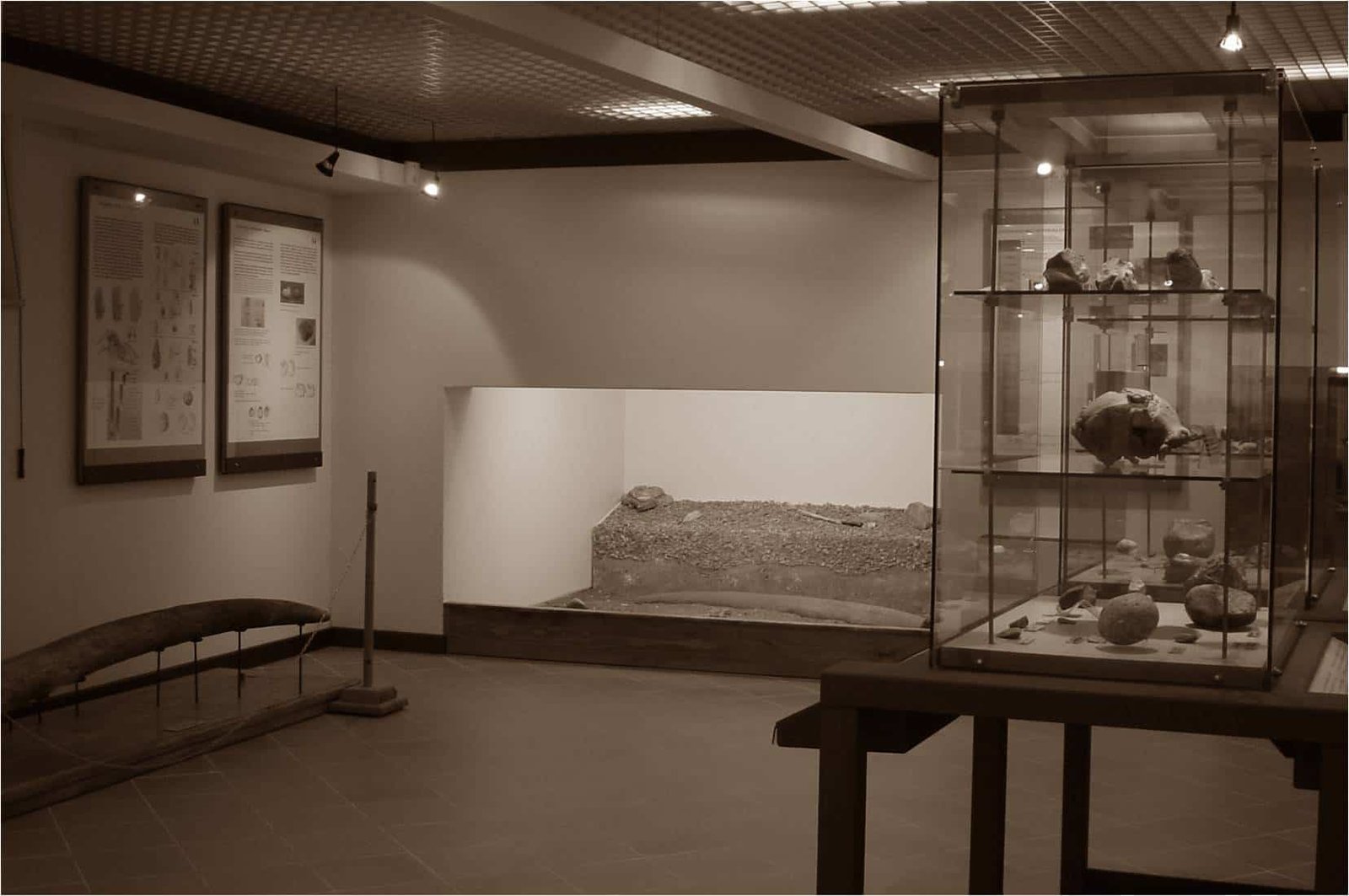
What Is Really on Display at the Pofi Prehistoric Museum
The first point is the one that generates the most misunderstandings, because it is the reason people set out from Rome and drive 90 kilometers of Casilina. The calvarium of Ceprano Man, the one everybody calls Argil, is state property and its custody is entrusted to the Soprintendenza: it is not a piece the Municipality of Pofi can keep in a display case whenever it likes. The museum's paleoanthropological route is built, declaredly, on casts and illustrative displays, and the casts here are many and well chosen. The real bone came to the town only once, for the exhibition of the 30th anniversary of the discovery, from March 13 to April 13, 2024. It was the first time ever that the skull was displayed in Pofi, and local newspapers headlined that Argil was returning to Ciociaria after 30 years. Anyone who absolutely wants to see the original, and not a reproduction, should phone the museum before getting in the car and ask explicitly what is on display that day.
That said, it would be a mistake to conclude that there is nothing authentic at Pofi. There are the human remains of Cava Pompi, which is a site within the municipal territory: an ulna, a tibia and a skull fragment, original material, not casts. There are the four human teeth of Anagni-Fontana Ranuccio, two incisors and two lower molars. There are the Pleistocene faunas of the Sacco valley, with skulls, mandibles and bones still in anatomical connection of ancient elephants and mammoths. There are Acheulean handaxes, thousands of artifacts in flint and lava, tools on elephant bone, conifer cones and fossil seeds recovered at Isoletta during the high-speed railway works. The difference between a provincial museum and a serious provincial museum is all here: at Pofi the material is real, it is local, and it was excavated and studied by those who keep it.
The Ceprano Skull, the Discovery and Its Dates
How Ceprano Man Was Found
On March 13, 1994, Italo Biddittu, an archaeologist trained in prehistory who had moved to Ciociaria in 1958, was surveying the route of a road under construction at the locality of Campogrande, in the Ceprano basin, at the bottom of the Sacco valley. The rains of February and March had washed the clays and the mechanical diggers had cut the deposit. Among the clods, fragments of cranial bone were surfacing. More than 50 were recovered, crumbled by the bulldozer that had brought them to light: the reconstruction took years of patient work, between 1994 and 1999, and produced a calvarium lacking the face but substantially complete in the vault. The nickname Argil comes from the clay that contained it, and was given by Biddittu himself.
From 800,000 to 400,000 Years: Why the Date Changed
For a decade the Ceprano calvarium was presented as the oldest European, with a relative dating between 900,000 and 800,000 years drawn from the geological picture and the associated fauna. In 2001 Giorgio Manzi, Francesco Mallegni and Antonio Ascenzi published in the Proceedings of the National Academy of Sciences a phylogenetic analysis that placed the fossil outside both Homo erectus and the later forms. In 2003 Mallegni and colleagues even proposed a new species, Homo cepranensis. Then the picture flipped. In 2009 a magnetostratigraphic study coordinated by Giovanni Muttoni brought the deposit back to between 500,000 and 350,000 years. In 2017 the digital reconstruction work signed by Di Vincenzo, Profico, Bernardini, Manzi and others in Scientific Reports closed the circle: the calvarium was placed between 430,000 and 385,000 years, in marine isotope stage 11, and reread as an archaic variant of Homo heidelbergensis, that is of the species now considered close to the common ancestor of Neanderthals, sapiens and Denisovans. The species Homo cepranensis, in that work, is explicitly rejected.
Plainly: the chronological downsizing took away from the fossil its publicity record and gave it something far more interesting. An 800,000-year-old skull would have been an isolated curiosity. A 400,000-year-old skull, well preserved and well dated, is a piece inside the moment when Europe decides where we come from. It's worth the trip precisely for this, and the museum panels that still carry the old figure should be read with this warning in your pocket.
A Curiosity About the Pofi Prehistoric Museum "Pietro Fedele"
The curiosity almost nobody tells concerns the birth of the museum, and has nothing academic about it: it begins with a bulldozer and a mayor who doesn't pretend not to notice. In June 1956 the Municipality of Pofi widens the road of the Macchia, in the district of Colle Cece. From the excavation come bones of large animals, evidently not recent. In similar cases, then as now, people carry on. Pietro Fedele, a newly elected mayor, instead reports the find to the Ministry, and from that report everything starts: arriving at Pofi are Luigi Cardini, paleontologist of the Istituto Italiano di Paleontologia Umana, Ciro Drago of the Museo Preistorico Etnografico Luigi Pigorini in Rome and Alberto Carlo Blanc, the geologist and paleoethnologist who in 1939 had recognized the Neanderthal skull of the Guattari Cave at Circeo.
In the autumn of 1959 a dig takes place at Cava Pompi under the direction of Cardini, and on November 13 of that year Cardini and Blanc recognize a fossil human ulna among the megafauna remains. It is the first Middle Pleistocene human bone found in the territory of Pofi. A few weeks later, by resolution of November 13, 1959, the municipal archaeological museum is born. Within a few years the surveys of the territory, carried out with the participation of the population, put together 3,741 stone tools. The museum will truly open to the public only in March 2001, 42 years after the resolution establishing it, and on December 29, 2007 it will be named after the mayor who had picked up the phone in 1956. 42 years of waiting is a fact that says a lot about the Italy of civic museums, and makes it all the more remarkable that today the museum really works.
The Room-by-Room Visit of the Pofi Prehistoric Museum
The route is organized in eight areas and covers about a million years in chronological order. The declared display cases are 40. The captions are bilingual, Italian and English, and the sequence is designed to be read in order: anyone skipping the first two areas to rush to the skull loses exactly the sense of the visit, because the museum is not a case with a famous fossil inside, it is the story of how a valley was inhabited before us.
Area 1, the Geological Section of the Pofi Prehistoric Museum
You begin with stone and not with man, and it's the right choice. The first area contains a stratigraphic reconstruction made with soil samples taken from the different deposits, a model of the territory and a display case with rock and fossil samples. The panels start from far away, from Pangea, and progressively narrow in on local geology, that is on the events that built the landscape within which hominids moved. The central chapter is Hernici volcanism: the polygenic complex of Pofi was active between 430,000 and 110,000 years ago, and four main craters of that phase are still readable in today's landscape. In the display case is a lava bomb of notable size, an object children stare at for a surprising length of time. The town, it must be said, is built on top of that extinct volcano: the volcanic soil explains the fertility of the territory and the flower-growing vocation that still survives.
Areas 2 and 3, the Origin of Man and the Arrival in Europe
Here the museum does something very few provincial museums can afford: it lines up a collection of fossil hominid casts large enough to allow a real comparison. It starts from the Australopithecines, with the reproduction of Lucy, moves to the first African humans, Homo rudolfensis, Homo habilis, Homo ergaster, then to the spread into Asia with the casts of Homo georgicus, the little Caucasian tooth of Dmanisi, and of Homo erectus, and finally to the arrival in Europe with Homo antecessor. At the end of the sequence you reach Ceprano. The display cases have been enriched in recent years with new casts purchased for educational and comparative purposes, and the difference shows: in front of a row of skulls you understand in 30 seconds what 10 pages of a textbook cannot explain, namely that human evolution is not a ladder but a bush.
Also in this part of the route appear the stone artifacts of archaic technique collected in layers below that of the Ceprano skull and in other sites of the area: Arce, Fontana Liri, Castro dei Volsci, Anagni-Colle Marino. They are worked flakes and pebbles that push the human presence in the valley back to about a million years ago. They are not beautiful. They are decisive.
Areas 4, 5 and 6, the Acheulean and the Human Remains of the Pofi Prehistoric Museum
This is the scientific heart of the collection. Around 600,000 years ago human groups attributed to Homo heidelbergensis spread into Europe, bearers of a different technology, the so-called Mode 2: the handaxe appears, the bifacial tool with bilateral symmetry, which is both a tool and a cultural signature. The museum displays handaxes and bone artifacts from the Lazio deposits dated between 458,000 and 250,000 years.
The authentic human remains are in these display cases. From Anagni-Fontana Ranuccio come four teeth, two incisors and two lower molars, attributed to Homo heidelbergensis. The deposit, a pozzolana quarry discovered in 1976 and today excavated under ministerial concession under the direction of Stefano Grimaldi, yielded an archaeological layer dated by the Istituto Italiano di Paleontologia Umana to about 458,000 years, compatible with isotope stage 11. From Pofi-Cava Pompi come the ulna, the tibia and the skull fragment that make up what is called here the Pofi Man, roughly referred to Homo heidelbergensis and placed between 400,000 and 350,000 years ago. Next to them are casts of mandibles and skulls of the same species, to allow comparison.
The paleontological part is imposing. Elephas antiquus, the straight-tusked elephant of Lazio, and the mammoths of the later waves, Mammuthus meridionalis, Mammuthus trogontherii and Mammuthus primigenius, with skulls, mandibles and articulated bones from several regional sites. At Fontana Ranuccio the fauna also includes rhinoceros, hippopotamus and birds, and the tools on elephant bone, some crude and others finely retouched, are among the oldest bone tools known in Europe. From Isoletta, near Arce, excavated during the works on the high-speed line, come conifer cones, seeds and freshwater mollusks: paleobotanical material that lets you reconstruct the landscape, not only the fauna.
Area 7, the Neanderthals of the Valley and the Casts You Can Touch
The presence of Neanderthal groups in inland southern Lazio is documented by flint artifacts worked with the Levallois technique, found both in caves and in the open. The most significant deposits are at Sora and Carnello, where cold-climate fauna fossils accompany the flint. Other materials come from Pofi, Ceprano, Frosinone, Vicalvi, Isola del Liri and Cassino. In the display case are the casts of two famous Neanderthal skulls: Saccopastore 1, found in a gravel quarry in Rome in 1929 and studied by Giuseppe Sergi, and Guattari 1, recognized by Alberto Carlo Blanc in the Guattari Cave at Monte Circeo on February 25, 1939.
In this area is the smartest thing in the whole museum, and it deserves a mention: the cast of the Kebara burial is displayed without protection, you can touch it, and it is designed on purpose for the blind and for children. A museum that gives up glass on an important piece makes a statement. If you go with kids, that is the point where the visit stops being a lesson.
Area 8, the Upper Paleolithic
The spread of Homo sapiens in Europe is placed around 36,000 years ago. In inland southern Lazio the evidence of this phase is scarce and comes mostly from surface collections: the artifacts on display come mainly from Pofi-Mola Sterbini, with rare pieces from Ceprano and Anagni. The reference cave deposit is that of Peschio Ranaro at Collepardo, attributed to the Final Epigravettian and dated to 9,730 years ago. The fauna of those phases includes ibex, roe deer, wild boar, marmot, stoat and wildcat: two ibex skulls recovered in the Cacciatore cave, at Vallecorsa, show that the Lepini and Ernici mountains were frequented by this species in climatic phases colder than the present. Anyone who knows those mountains today, with their pastures and their few raptors, struggles to imagine them with ibex. It's exactly the kind of mental jolt a museum like this must produce.
Neolithic, Copper and Bronze Ages
The final stretch of the route illustrates the last phases of prehistory up to the threshold of protohistory, that is the passage from an economy of taking, hunting and gathering, to an economy of production based on agriculture and herding. The Neolithic materials come from Sora, the Canterno basin and Ceccano. The evidence of the Copper and Bronze Ages comes from Pofi itself, San Giovanni Incarico and Ceprano. These are the arrowheads and stone artifacts that close the educational route. It is a short section and the museum doesn't hide it, but it serves not to leave the visitor stuck in the Paleolithic: between the last Epigravettian hunter and the first protohistoric village of the Sacco valley pass millennia that here are at least named.
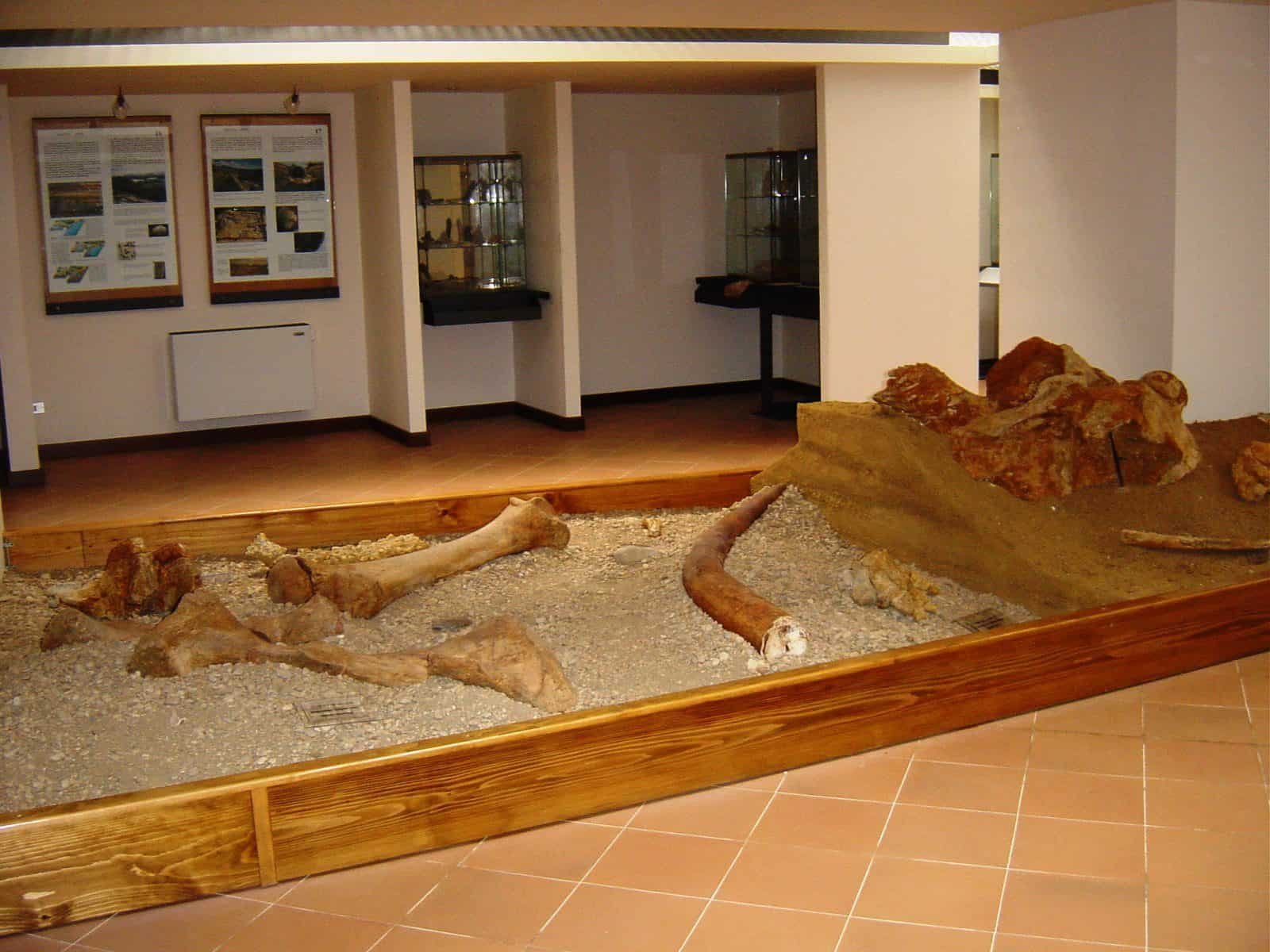
Who Pietro Fedele Was and Why the Museum Bears His Name
Beware of a misunderstanding that goes around a lot: the Pietro Fedele after whom the museum is named is not the historian and Minister of Public Education of the early 1900s, who was from Traetto, today Minturno. The Pietro Fedele of Pofi is the town's mayor between 1956 and 1961, a local administrator with no academic titles who had the lucidity to understand what he had under his feet. His legacy is not a private collection donated to the Municipality, as happens in most Italian civic museums, but a chain of institutional relationships: the report to the Ministry, the arrival of the specialists of the Istituto Italiano di Paleontologia Umana, the collaboration with the Pigorini, the collecting campaign that involved the citizens and produced thousands of artifacts.
The museum was named after him on December 29, 2007. I find it one of the few truly motivated namings I know in Lazio: cultural institutions are usually dedicated to people who had no operational relationship with that institution. Here the relationship is documented and direct, and the section of the route that bears his name contains precisely the finds from the territory of Pofi, those that came out of his reports: the faunas and artifacts of Cava Pompi, the materials and bone artifacts of Fosso Meringo, a selection of the Middle and Upper Paleolithic pieces collected on the surface.
Something Nobody Tells You About the Pofi Prehistoric Museum "Pietro Fedele"
That this is, in all likelihood, the prehistoric museum most accessible to the blind that you will find in Lazio, and that this choice dates from long before accessibility became a buzzword in funding calls. The display cases were designed from the start with a tactile section made for children and for the blind, with texts in Braille. In the Neanderthal room the cast of the Kebara burial is deliberately without a display case, because it is meant to be handled. The casts of fossil skulls and the artifacts allow a tactile understanding of the route that no panel can give.
In September 2025 this approach was carried forward with the Museo del Futuro project, curated by Francesco Colasanti with the scientific supervision of the Soprintendenza archeologia, belle arti e paesaggio for the provinces of Frosinone and Latina and the patronage, among others, of the National Research Council. The project introduced three-dimensional reproductions of the finds printed in 3D with eco-friendly materials, Braille plaques, audio descriptions, videos in Italian Sign Language and even a prehistoric fragrance developed on paleobotanical studies, to add an olfactory channel to the visit. The inauguration took place on Friday, September 26, 2025, with two days of guided visits and workshops over the following weekend.
The second thing nobody tells you concerns the real size of the public. In 2025 the museum recorded just over 3,100 visitors. That is, on average, fewer than 10 people per opening day. Translated: you will almost certainly be alone or nearly so, and the person accompanying you will have all the time to answer your questions. Those used to the crush of Roman museums can't imagine how much the quality of the visit changes when there is a single person in front of the display case.
My Advice for Visiting the Pofi Prehistoric Museum "Pietro Fedele"
Phone. It's not a courtesy recommendation, it's the operating condition of the place. With three mornings of regular opening out of seven days and the opening on the other days subject to reservation, the museum works the way museums run by associations work: someone is there if someone knows you're coming. Call 388 8644122 or write to museopreistoricopofi@gmail.com at least a couple of days ahead, say how many of you there are and ask for the guided visit. €20 for a group of up to 20 people comes to €1 a head: it's among the best-value cultural expenses in Lazio, and without someone to explain the display cases the museum gives you a third.
Second piece of advice, on organizing the day. The museum can be visited at leisure in an hour and a half, two hours if you take the guide and ask questions. Opening at 9:30 and closing at 13:00, the morning is all there: leave Rome around eight, be in Pofi by 10, come out around noon and have the afternoon free for the town, for Ripi or for going up to Anagni. Don't try to squeeze the museum in after lunch: on regular opening days it closes at one, and anyone arriving at half past 12 has barely half an hour.
Third, and here I go against what you read around: don't come to Pofi just to see the skull. If your only goal is that fossil, you risk a disappointment, because the original piece does not reside here permanently. Come for the complete sequence, for the stratigraphy, for the tusks of Elephas antiquus and for the feeling, which you rarely get, of looking at the prehistory of a territory told by the territory itself. With that premise, the disappointment never comes.
Another Well-Known Fact, Yet Rarely Cited
That Pofi is built on top of a volcano. Everyone in town knows it, the first panel of the museum says it, and outside the province of Frosinone almost nobody knows it. The polygenic complex of Pofi is one of the main volcanic centers of the Sacco valley, active between 430,000 and 110,000 years ago, and belongs to the Hernici volcanism complex, a minor and little-publicized chapter of Lazio's volcanic history, crushed in the collective imagination by the Colli Albani and the Vulsini district. Four craters of that phase can still be identified in the landscape, and the soil of the municipality is for the most part of volcanic origin: hence the fertility that made Pofi a flower-growing and market-gardening center.
The detail that makes the matter extraordinary is chronological. The volcanic complex ignites around 430,000 years ago. The Ceprano calvarium, according to the 2017 dating, falls between 430,000 and 385,000 years. The Pofi Man of Cava Pompi between 400,000 and 350,000. Put differently, the hominids who left those remains lived in a valley where the volcano was active, and saw face to face the eruptions that built the hill on which stands today the museum that keeps them. The lava bomb displayed in the first area and the human ulna displayed in the fourth belong to the same landscape and almost the same time. It's the kind of coincidence that no display manages to communicate well with a panel, and that a guide instead can trigger in a sentence.
The Right Photo to Take at the Pofi Prehistoric Museum "Pietro Fedele"
Inside the museum the most effective photograph is not the one of the skull in its case, which with the glass and the point lights almost always comes out badly and gives an object without scale. The right photo is the row of skull casts in areas 2 and 3, shot at three-quarter view along the display case, with the foreground in focus and the sequence fading: in a single frame you read the morphological variability of 2.5 million years of evolution, from Lucy to antecessor. It's a photograph that explains something, which is after all the only serious reason to photograph inside a museum. The second framing to keep in mind is the lava bomb of the geological area, shot from below with the reconstructed stratigraphy behind it.
Ask the staff before shooting anyway, and really ask: in a civic museum with close-set display cases flash is almost always forbidden and in some cases so are tripods, which in narrow corridors become a safety problem. With low lights you need a steady hand and high sensitivity.
Outside, the best photograph of the day is not in the museum. Go up into the medieval village, to the level of the clock tower and the pentagonal bastion, and turn toward the valley: from Pofi, which sits at 270 meters, you take in about 40 towns, from the Prenestini to the Mainarde. The good light is that of late afternoon in autumn or winter, when the haze of the Sacco valley sinks and the profiles of the mountains separate. In summer, around noon, that same panorama is a palette of indistinct grays: don't waste a memory card on it.

Some Important Events Here in History
The first event is banal and decisive at once: June 1956, the works to widen the road of the Macchia di Pofi in the district of Colle Cece intercept bones of large animals. Mayor Pietro Fedele reports the find to the Ministry instead of letting the works go on. From that phone call everything else follows.
Between August and November 1959 a dig is carried out at Cava Pompi. The direction is Luigi Cardini's, of the Istituto Italiano di Paleontologia Umana, with the participation of scholars who will become important names in Italian prehistory. On November 13, 1959 Cardini and Alberto Carlo Blanc recognize in the deposit a fossil human ulna associated with megafauna remains. On the same November 13, 1959 a municipal resolution establishes the archaeological museum of Pofi. In 1976 Italo Biddittu and Aldo Segre return to Cava Pompi and recover other human remains, the tibia and the cranial fragment that complete what we call Pofi Man.
On March 13, 1994, about 15 kilometers from here, at the locality of Campogrande in Ceprano, Biddittu recognizes in the debris of a road construction site the fragments of the calvarium that will become Ceprano Man. It is the event that changes the scale of the museum: from a local collection to a reference point of European paleoanthropology. In 2001 the publication by Manzi, Mallegni and Ascenzi in the Proceedings of the National Academy of Sciences brings the fossil into international journals. In 2003 comes the proposal of the species Homo cepranensis. In 2009 the magnetostratigraphic study by Muttoni and colleagues overturns its chronology. In 2017 the digital reconstruction published in Scientific Reports brings it back to Homo heidelbergensis and places it around 400,000 years.
In March 2001 the museum finally opens to the public, 42 years after the resolution that had established it. On December 29, 2007 it is named after Pietro Fedele. From March 13 to April 13, 2024, for the 30th anniversary of the discovery, the Ceprano calvarium is displayed in Pofi for the first time in the history of the museum. On September 26, 2025 the Museo del Futuro project is inaugurated, with 3D-printed reproductions, Italian Sign Language and audio descriptions. In 2025 visitors pass the 3,100 mark.
A note that concerns the town and not the museum, but that anyone coming here should know: in 1944 Pofi found itself right up against the Gustav Line and suffered bombings and violence. The historic center you visit today still bears the scars of that year, and postwar reconstruction explains many of the discontinuities you notice walking between the church of Sant'Antonino and the castle.
Who Has Passed by the Pofi Prehistoric Museum "Pietro Fedele"
Don't expect emperors and popes: here the famous figures are scientists, and the list is the kind you don't expect in a civic museum of 3,100 visitors a year. Luigi Cardini, paleontologist of the Istituto Italiano di Paleontologia Umana, who lived from 1898 to 1971, directed the 1959 excavations at Cava Pompi. Alberto Carlo Blanc, born in Chambéry in 1906 and died in Rome in 1960, geologist and paleoethnologist, the one who on February 25, 1939 had recognized the Neanderthal skull of the Guattari Cave at Circeo and had proposed its famous and later disproved cannibalistic interpretation, was with Cardini on November 13, 1959 when they recognized the ulna of Pofi. Ciro Drago came from the Museo Preistorico Etnografico Luigi Pigorini in Rome, today merged into the Museum of Civilizations at EUR.
The name that holds together 60 years of research is Italo Biddittu, born in Livorno on July 28, 1937, arrived in Ciociaria in 1958, five years of work in Rome at the Istituto Italiano di Paleontologia Umana in the 1960s, and then a whole life combing the deposits of the Sacco valley. The Ceprano calvarium was found by him, the nickname Argil was given by him, and most of the material you see in the display cases passes through his hands or his reports.
On the research side, the fossil has passed through the laboratories of Giorgio Manzi of Sapienza, of Francesco Mallegni, of Antonio Ascenzi, and more recently of the group that signed the 2017 digital reconstruction, with Di Vincenzo, Profico, Bernardini, Benazzi, Rubini and Tuniz among the authors. The excavations at Fontana Ranuccio, which supply the Lower Paleolithic display cases, have been directed since 2007 by Stefano Grimaldi.
The museum has also hosted research by foreign groups within international collaboration plans: French scholars, arriving from the Centre Européen de Recherches Préhistoriques of Tautavel, Spaniards from the University of Tarragona, and Georgians from the Caucasus, which is after all the region of Dmanisi, that is of the site that yielded the oldest hominids outside Africa. That a town of fewer than 4,000 inhabitants in the province of Frosinone has been for years a meeting point between Tautavel, Tarragona and Tbilisi is a fact that deserves to be told more often.
The Sacco Valley Deposits That the Pofi Prehistoric Museum Tells About
A prehistory museum is worth as much as the territory that feeds it, and the Sacco valley, which geologists call the Anagni basin in the upper part and the Latin valley as a whole, is one of the richest districts in Europe for the Middle Pleistocene. It's worth keeping the geography of the sites in mind while looking at the display cases, because the museum names them continually and anyone who can't place them loses half the story.
Ceprano-Campogrande and Colle Avarone
These are the deposits at the bottom of the valley, where the calvarium appeared in 1994. Besides the human fossil they yielded stone artifacts of archaic technique in layers below that of the skull: it is on this basis that the human presence in the area around a million years ago is supported. Ceprano is about 15 kilometers from Pofi along the Casilina, and also holds the archaeological area of the Latin colony of Fregellae, destroyed by Rome in 125 BC, which is a whole other chapter but rounds out a day well.
Anagni-Fontana Ranuccio and Anagni-Colle Marino
Fontana Ranuccio is a pozzolana quarry identified in 1976 in the Pleistocene basin of Anagni. It yielded the four human teeth displayed at Pofi, an Acheulean industry with handaxes in flint and lava, tools on elephant bone, some crude and others finely retouched, and a fauna that includes Elephas antiquus, the rhinoceros Stephanorhinus hemitoechus and the hippopotamus. The archaeological layer is dated to about 458,000 years. Excavations continue under ministerial concession. Colle Marino, also in the territory of Anagni, belongs instead to the oldest phase of archaic artifacts. Anyone wanting to see the historical context of that city can stop at the Anagni Cathedral Museum and walk the center of Anagni, which is half an hour by car up the valley.
Isoletta di Arce, Lademagne and the High-Speed Railway Works
A substantial part of the display cases owes its existence to a railway construction site. The excavations and recoveries carried out by the Soprintendenza along the route of the high-speed line intercepted extraordinary Pleistocene deposits, in particular at Isoletta, near Arce, and at Castro dei Volsci. From Isoletta come lithics, fauna, and in addition conifer cones, seeds and freshwater mollusks: the material that allows you to reconstruct the vegetation and the waters, not only the hunted animals. Lademagne, in the municipality of San Giovanni Incarico, is another Lower Paleolithic deposit the object of recent research. It's worth remembering when talking about major works and preventive archaeology: here the railway paid the bill and science gained.
Cava Pompi and Fosso Meringo, the Home Sites
Cava Pompi is the site that made Pofi a name in the prehistoric literature: excavated in 1959 and resumed in 1976, it yielded the ulna, the tibia and the skull fragment of Pofi Man, together with remains of elephant and deer and chipped flint artifacts, with rare pieces in lava and on bone, referable to the Acheulean culture. Level 5, the one with the human remains, is placed between 400,000 and 350,000 years ago. Fosso Meringo gave faunas and bone artifacts. Mola Sterbini, also in the municipal territory, is instead the local reference for the Upper Paleolithic. Three sites within the borders of a municipality of a few thousand inhabitants: it's a density that explains why the museum was born here and not elsewhere.
The Pofi Prehistoric Museum with Children and with Schools
It's one of the few museums in the region to recommend without reservation to anyone traveling with children between six and 12, and not out of kindness. The reasons are three and concrete. The first: the tactile section, with the cast of the Kebara burial displayed without glass and skull casts you can touch, turns the visit into a physical experience. The second: the museum offers educational workshops and the simulated dig, that is the activity in which kids work on a prepared sector and recover materials as an archaeologist would, at €1 a head per activity. The third: the scale is right. Eight areas, 40 display cases, an hour and a half. A child can handle this visit. A child can't handle three hours of the Museo delle Civiltà at EUR, however magnificent that museum is.
For schools the museum has always been organized: the workshop and simulated dig activities were born with classes in mind, and the bilingual route and comparative panels work well with middle school. Book ahead, because with three regular openings a week the places for school groups run out early in spring. If you are looking for a second museum to complete an educational program on the prehistory of Lazio, the Roman reference is the Museo di Casal de' Pazzi, where you walk over a Pleistocene river deposit with elephant tusks still in place.
Accessibility of the Pofi Prehistoric Museum
The museum declares an entrance and links between rooms that allow wheelchairs to pass, dedicated restrooms and a reserved parking space on Via San Giorgio. Entry is free for the person with a disability and for the companion. The route for the blind relies on the fossil skull casts and the artifacts that can be handled and on the Braille texts, and since September 2025 has been enriched with audio descriptions and videos in Italian Sign Language. Since it is a facility run by an association, the practical advice is to state your needs when you book by phone: whoever answers will be able to tell you what is active that day and can arrange the accompaniment.
How Long the Visit to the Pofi Prehistoric Museum Takes and How to Organize the Day
An hour and a half on your own, two hours with the guide. The museum opens at 9:30 and closes at 13:00 on regular days, so the useful window is three and a half hours. A suggested day: leave Rome at 8, museum from 10 to 12, lunch in town, afternoon in the medieval village with the church of Sant'Antonino, the clock tower, the pentagonal bastion and the remains of the Colonna castle, then a relaxed return. Those with more time add Ripi, a few kilometers away, with the Museo dell'Energia on Via Meringo Alto and the historic oil wells. Or go up toward Ferentino and Alatri, which have the two most impressive megalithic circuits in Lazio, or toward Veroli and Fiuggi. To the south, instead, you go down to Cassino and the Abbey of Montecassino, or to Arpino and Sora, which is one of the municipalities the Neanderthal materials displayed in the museum come from.
The Village of Pofi and the Territory Around the Museum
Pofi has a little under 4,000 inhabitants and sits on a spur at 270 meters, with the Sacco river marking the border toward Castro dei Volsci. The name first appears in a parchment of 1019 kept in the archive of Montecassino. In the 13th century a local lordship forms, then the town passes to the Caetani and then to the Colonna, who between the 16th and 18th centuries make it the capital of the State of Pofi, an aggregate of 13 communities with a general court. It's a detail that explains the urban caliber of the village: the houses are taller and denser than the current population would justify, because for two centuries people governed and judged here.
Within an hour on foot you see the church of Sant'Antonino di Apamea, of Romanesque layout between the 11th and 12th centuries, the 18th-century church of Santa Maria Maggiore, the church of San Rocco from 1656, the Torre Nova known as the clock tower, the pentagonal bastion, the arch of Sant'Antonio and the remains of the Colonna castle. The panorama from the top reaches the Prenestini on one side and the Mainarde on the other. For eating the town has a few simple addresses, from the Borgo Antico on Via Cavour to the osteria inside the farmhouse on the northern Casilina: nothing gastronomically memorable, but serious portions and provincial prices.
Ripi and the Oil Wells, the Industrial Tail of the Trip
A few kilometers away, Ripi keeps one of the oldest oil fields in Italy. The Petroglie concession dates to 1868. In 1918 the State requisitioned the fields, making Ripi the first oil site administered by Italian government authorities. Between 1918 and 1954 many companies drilled there, AGIP included, and in 1938 there were more than 40 active wells. After a period of inactivity Lumax Oil resumed operations from 1969. Today the concession is held by Pentex Italia and extraction is suspended, so anyone arriving imagining pumps at work will be left empty-handed: what remains is industrial archaeology, and it is told by the Museo dell'Energia on Via Meringo Alto, which organizes guided visits to the historic wells along the route called the oil road, always by arrangement with the staff. The territory also keeps a flower-growing tradition that comes from the same volcanic soils the museum's first room talks about.
Why the Pofi Prehistoric Museum Matters in Italian Prehistory
The museum's educational route presents materials recognized and studied by bodies such as the Istituto Italiano di Paleontologia Umana and the Soprintendenza, and the facility still works as a center for collecting, studying and displaying the prehistoric finds of much of inland southern Lazio. This is not an elegant way of saying there is a storeroom: it means the materials coming out of the area's construction sites and surveys arrive here, are inventoried and, when needed, studied. This explains why French, Spanish and Georgian research groups have worked in a town museum, and why the collaboration with the Pigorini in Rome, with Tautavel and with Tarragona has lasted years.
Our opinion, in comparison with the other provincial archaeological museums of Lazio: Pofi is among the three or four that truly deserve the trip, and it deserves it for a reason that has nothing to do with the famous piece. It has a collection consistent with its territory, a chronological display that holds up, accessible apparatus designed before it became mandatory and people who work there out of conviction. These are things you can't buy with a funding call.
Quick Questions About the Pofi Prehistoric Museum "Pietro Fedele"
Where exactly is the Pofi Prehistoric Museum "Pietro Fedele"?
At Via San Giorgio 28, in Pofi, postal code 03026, Frosinone Province, inside the Centro Servizi Culturali, just below the medieval village. The provincial road that climbs to the town branches off State Road 6 Casilina.
What are the hours of the Pofi Prehistoric Museum?
Tuesday, Saturday and Sunday from 9:30 to 13:00. Monday, Wednesday, Thursday and Friday opening is by reservation. Before leaving it's still worth a phone call: associations running civic museums can change the calendar for holidays, events or educational activities.
How much is a ticket to the Pofi Prehistoric Museum?
€2.50 for adults between 19 and 64, €2 for young people between 6 and 18, free under five, over 65 and for people with disabilities. The rates for the guided visit and the workshop are added to the ticket.
How much is the guided visit to the Pofi Prehistoric Museum?
€10 for a single adult, €20 for a group of up to 20 people. For young people between 6 and 18 the guided visit costs €1, like the educational workshop and the simulated dig.
Do you need to book to visit the Pofi Prehistoric Museum?
On the three regular opening days it's not mandatory, but it's strongly recommended if you want the guide. On the other four days booking is the only way in. The number is 388 8644122, the email museopreistoricopofi@gmail.com.
How long does the visit to the Pofi Prehistoric Museum take?
An hour and a half on your own, about two hours with accompaniment. With a class or a workshop it easily reaches three hours.
Can you see the original skull of Ceprano Man at the Pofi Prehistoric Museum?
The original calvarium is state property, entrusted to the custody of the Soprintendenza, and the museum's paleoanthropological route is built on casts. The original was displayed in Pofi from March 13 to April 13, 2024, for the 30th anniversary of the discovery, and it was the first time. Anyone aiming for the authentic bone should ask for confirmation by phoning before the visit.
How old is Ceprano Man really?
The first estimates put him between 900,000 and 800,000 years. The 2009 magnetostratigraphic revision and the digital reconstruction published in 2017 place him around 400,000 years, between 430,000 and 385,000, in marine isotope stage 11. Several panels and several web pages still carry the old figures.
What species was Ceprano Man?
In 2003 a species of its own was proposed, Homo cepranensis. The 2017 study in Scientific Reports instead brings him back to an archaic variant of Homo heidelbergensis, the form considered close to the common ancestor of Neanderthals, sapiens and Denisovans.
What is Pofi Man?
It is the human remains found at Cava Pompi, in the municipal territory: an ulna recognized on November 13, 1959 by Luigi Cardini and Alberto Carlo Blanc, and a tibia and a skull fragment recovered in 1976 by Italo Biddittu and Aldo Segre. They are dated between 400,000 and 350,000 years ago and roughly referred to Homo heidelbergensis. They are original material, not casts.
Is the Pofi Prehistoric Museum suitable for children?
Very much. There is a tactile section designed for children and for the blind, the cast of the Kebara burial can be touched, and the museum organizes workshops and the simulated dig at €1 per participant. The short duration works in its favor.
Is the Pofi Prehistoric Museum wheelchair accessible?
The museum declares an entrance and links between rooms passable with a wheelchair, dedicated restrooms and a reserved parking space on Via San Giorgio. Entry is free for the person with a disability and for the companion. It's best to state your needs when you book.
Can you take photographs inside the Pofi Prehistoric Museum?
Ask the staff at the entrance. In civic museums with close-set display cases flash is almost always forbidden, and tripods may be too for reasons of space.
Is the Roma Pass or the MIC Card valid at the Pofi Prehistoric Museum?
No. The Roma Pass and the MIC Card are valid in the civic museums of Roma Capitale, and Pofi is a municipality in the province of Frosinone with its own civic museum: neither card has any effect here.
Is entry free on the first Sunday of the month at the Pofi Prehistoric Museum?
No. The free first Sunday concerns state museums, and this is a municipal museum run by an association. The only free entries are those for age and disability.
How do you get to the Pofi Prehistoric Museum from Rome without a car?
By train on the Rome-Cassino line to the Castro-Pofi-Vallecorsa station, then by local bus, or to Frosinone and from there by provincial transport. The phone references are Cotral of Frosinone at 0775 3791 and the GEAF bus lines at 0775 200432. Check the times the day before: the runs are few and calibrated for commuters.
How far is Pofi from Rome?
About an hour and a half by car, with the A1 to Frosinone and then the Casilina toward Naples to the turnoff for Pofi. From Naples you exit at Ceprano and go up the Casilina.
Is there parking at the Pofi Prehistoric Museum?
You park on Via San Giorgio, where a space reserved for people with disabilities is also marked. In the upper village the space is what it is: whoever climbs on foot from the museum gets there faster.
How many finds are there at the Pofi Prehistoric Museum?
The route is organized in eight areas with 40 display cases and covers about a million years. The surveys alone of the years after 1956 had already put together 3,741 stone tools.
What is the difference between the Pofi Prehistoric Museum and the Museo delle Civiltà in Rome?
The Museum of Civilizations at EUR, which absorbed the old Pigorini, is a national museum with a world-scale collection and a very long route. Pofi is a museum of a territory: it tells a single valley, with the materials of that valley, and in an hour and a half. They are complementary, and the two institutes have collaborated since the 1950s.
Is there a cloakroom or luggage storage at the Pofi Prehistoric Museum?
It's a small facility and not equipped like the big museums: don't count on a cloakroom, cafe or bookshop. Bring only the essentials.
Does the Pofi Prehistoric Museum have a bookshop or sell publications?
There is no real bookshop. If you are looking for the scientific bibliography on the valley's deposits, ask the staff: whoever runs the museum knows the publications and can point you in the right direction.
What can you see in Pofi besides the museum?
The medieval village with the church of Sant'Antonino di Apamea, Romanesque between the 11th and 12th centuries, Santa Maria Maggiore, San Rocco from 1656, the clock tower, the pentagonal bastion, the arch of Sant'Antonio and the remains of the Colonna castle, plus the panorama over the Sacco valley. Within 20 minutes are Ripi with the Museo dell'Energia and the historic wells, Ceprano with the Fregellae area and Castro dei Volsci.
When is the best time to visit the Pofi Prehistoric Museum?
Sunday morning, early, in autumn or spring: the museum is open at regular hours, the town is alive and the afternoon stays free for the village and the valley. In summer, in the morning, it's pleasant anyway because the rooms are indoors and cool.
How many visitors does the Pofi Prehistoric Museum receive?
Just over 3,100 in 2025. It means that, except on event days, you will find very few people and will be able to talk with whoever accompanies you.
Does the museum organize activities for schools?
Yes, and it's its original vocation: guided visits, educational workshops and simulated dig. For school groups booking well in advance is essential, especially between March and May.
The Final Verdict on the Pofi Prehistoric Museum
It's wise to distrust museums that live off a single piece: when the piece isn't there, or isn't what the visitor expected, emptiness is left. Pofi is not like that, and that's the reason I recommend it. The Ceprano calvarium is the draw, but the substance is the sequence: a volcano that ignites 430,000 years ago, a valley that fills with elephants and hippopotamuses, human groups chipping handaxes on the banks of the Sacco, Neanderthals bringing Levallois technique into the caves of Sora, and then the silence of the Upper Paleolithic and the first farmers of Ceccano and Canterno. All within 30 square kilometers and within eight display cases.
If you have to choose just one thing to do, take the guide. €20 for 20 people is €1 a head and changes the day: without someone telling you why an ulna is worth more than a famous skull, those display cases remain objects behind glass. And phone first, always. A museum open three mornings a week rewards those who organize and punishes those who improvise.
Article written by the editorial team of TourLeaderPro, contact them for Private/Corporate/V.I.P. Tours and Experiences.
Planning a trip to Rome? The English-language guides for visiting the city are on ItalyPlanner.com.