Alvito (FR)
In short. Alvito (FR) is a municipality of about 2,500 inhabitants in the Val di Comino, in the province of Frosinone, at 738 meters above sea level on the southern slope of Monte Morrone, inside the boundaries of Abruzzo, Lazio and Molise National Park.

Alvito (FR) is a municipality of about 2,500 inhabitants in the Val di Comino, in the province of Frosinone, at 738 meters above sea level on the southern slope of Monte Morrone, inside the boundaries of Abruzzo, Lazio and Molise National Park. The town hall is in Palazzo Gallio, at Piazza Marconi 3 (phone 0776 510101), which also houses the Historical Archive, the municipal Library and the Museum of Folk Musical Instruments from Around the World: the historic rooms can be visited by reservation, Monday to Saturday between 08:30 and 13:30, through the form on the palazzogallio.it website. Cantelmo Castle, on top of the hill in the Castello hamlet, is owned by the municipality: the area is reached on foot and is opened for the summer events, but for a visit to the interiors it's best to ask at the town hall. The churches open during services or on request. None of the sites in Alvito has a published admission ticket. From Rome it's about 120 kilometers: A1 motorway to the Cassino exit, then state road 749 Sora-Cassino and a detour for Atina and Alvito, or the Frosinone exit, the expressway to Sora and state road 749 toward Cassino (an hour and 50 minutes in normal conditions, a good two hours on weekends). By public transport, take the train on the Rome-Cassino line to Roccasecca or Cassino and continue with the Cotral buses toward Atina and Alvito. Schedules are on cotralspa.it. Park in the pull-offs along the road into town and in the lower part, never inside the historic center. A full visit, with the climb to the castle, takes four hours. For the whole valley, a weekend.
Alvito is one of the Lazio municipalities of Abruzzo, Lazio and Molise National Park, and that page is the place to start if you want to build a two- or three-day itinerary among the villages of the Val di Comino and the trails of the Park.
Alvito (FR): where it is and why it has this shape
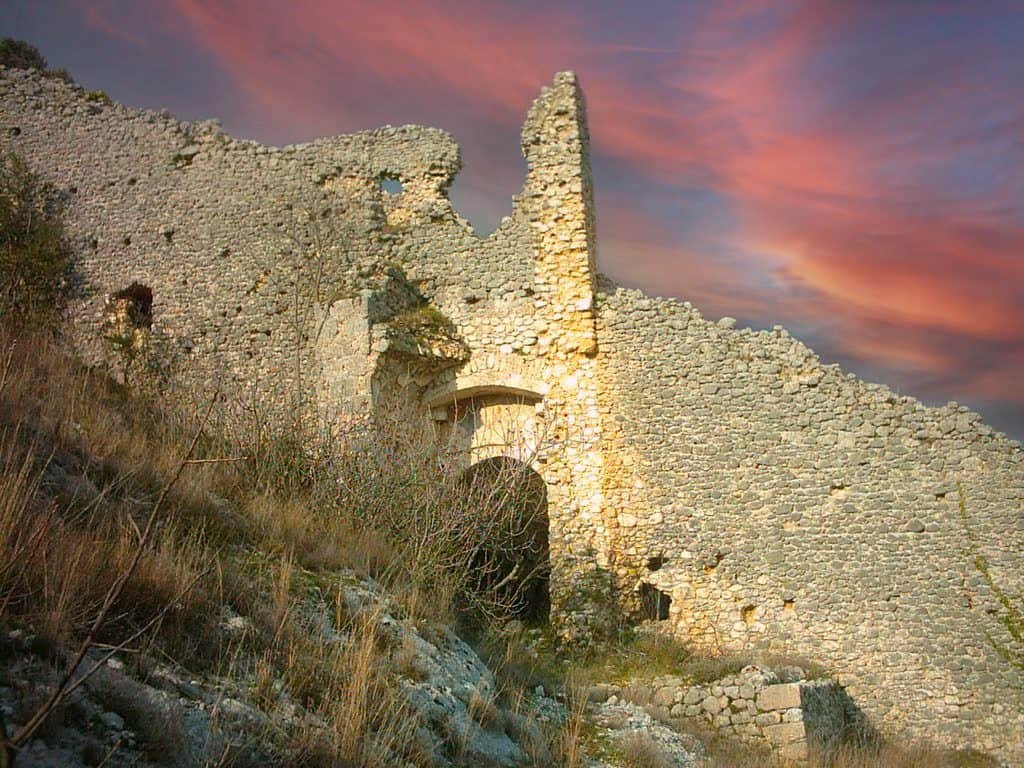
There are towns that announce themselves from far away and towns that hide until the last bend. Alvito belongs to the first category. When the road starts to climb from the plain toward the town, an isolated hill appears beyond the windshield with a crown of stone on top: the walls and towers of Cantelmo Castle, which dominate the village from the summit of Monte Albeto. It's worth stopping in a pull-off before entering town, because Alvito should be looked at before it is driven through. It has a shape, and the shape tells half the story: a castle up high, a cluster of medieval houses coming down the slope, and further down, where the ground levels out, the town of 17th- and 19th-century palaces with its two parallel main streets.
The Val di Comino is a basin closed off to the north and east by the massifs of the central Apennines. The municipal territory of Alvito climbs up to the Serra dei Re, 1,808 meters, and Monte Trani, 1,752 meters, both on the Abruzzo border and inside the Park. To the south and west the valley opens toward the Liri basin and the plain of Sora, and from there it connects with the Latin valley, with Cassino and with Campania. This position determined everything: the valley is a gateway between the Tyrrhenian side and the Apennine interior, between southern Lazio and Abruzzo, and for centuries between the Papal States and the Kingdom of Naples. Whoever controlled it controlled a pass, and every isolated hill in the basin still carries a fortress on top: Vicalvi, Alvito and Atina are sentinels placed within sight of each other. The hill of Alvito is the best of the group, steep on three sides and with a view that covers the valley from end to end.
A geological detail few visitors know: above the town opens the Fossa Maiura, a karst sinkhole about 100 meters deep and a kilometer wide at the upper rim, one of the largest in Lazio. It's the same limestone nature that carved the sinkhole of Campoli Appennino and feeds the springs of the Fibreno, and it explains why water, in this town, has always been a problem up high and a wealth down below.
The climate is real mountain climate: January averages a little under 5 degrees, August a little over 22. If Rome has 20 degrees in October, in the evening in Alvito you'll find 8. Pack thinking of Abruzzo, not Lazio.

How to get to Alvito (FR) from Rome
In the Val di Comino logistics is not a detail: it's the difference between a beautiful day and a day spent on hairpin bends. Alvito is about 120 kilometers from Rome, which as the crow flies seems short and by road becomes an hour and 50 minutes, a good two hours on bad days. It's the right distance for a long day trip or, much better, for a weekend.
By car: the two gates of the valley
Take the A1 toward Naples. From there the possible exits are two, and the choice depends on what you want to see along the way. The first is the Cassino exit: from there you take state road 749 Sora-Cassino north, go up the Melfa valley and in about 20 kilometers, passing through Atina, you reach Alvito. The second is the Frosinone exit: you follow the expressway to Sora and then the same state road 749 in the opposite direction, going down to the southeast through Broccostella, Posta Fibreno and Vicalvi. It's the more scenic approach and a little slower.
My advice for a first time: enter from Sora and leave from Cassino. Make a loop instead of an identical round trip and you take home twice the landscape. From Sora you skirt Lake Posta Fibreno, the reserve with the floating island that really does move. You see the perfect cone of the Vicalvi fortress against the mountains. You arrive in Alvito with your eye already used to the scale of the valley. On the way back via Cassino you cross Atina, which deserves a stop for its historic center and the viewpoint, and you find yourself on the motorway without noticing.
How long it really takes
The GPS promises an hour and 40 minutes. The last stretch, from the motorway exit to the valley, runs on two-lane roads with curves, villages to cross, tractors and, in winter, shaded stretches that stay damp until noon. Count two full hours from north Rome, an hour and 50 minutes from south Rome. On summer weekends add the queues at the entrance to the A1: on Sunday evening the return between Frosinone and Valmontone can become painful. Better to head back either very early, before 17:00, or very late, after 21:00, having dinner in the valley. Both options are better than heading back at 19:00.
The GPS and the trap of the two Alvitos
Alvito has two cores with different names and different elevations. If you enter the name of the town generically you risk ending up in the lower part, which the inhabitants call Alvito Piazza: it's the administrative and commercial center, with Palazzo Gallio, the main streets and the Baroque churches, but it's not the medieval village you saw from the road. The upper core, under the fortress, is called Alvito Castello or simply il Castello, and it is connected to the lower part by a carriage road completed in 1914. If you're heading for Palazzo Gallio, enter Piazza Marconi. If you want to go straight up to the upper village, follow the signs for the Castello in town. This duality is the key to everything and we'll come back to it later.
Parking and shoes
The golden rule of hill towns applies here too: don't try to take the car into the historic center. The streets narrow progressively and at some point you find yourself in an alley where maneuvering is a nightmare. Leave the car in the pull-offs along the main road or in the parking areas of the lower part and continue on foot. Toward the Castello there are spots where you can stop along the road, but on summer weekends and holidays they fill up early. At 09:00 you find a space anywhere, at 11:30 you don't.
Shoes seem a banal detail and they aren't. Alvito is visited walking uphill on old paving, uneven steps and dirt stretches. The last part toward Cantelmo Castle is a path with loose stones and a real slope. Sneakers with a lugged sole, at a minimum. If you also plan a trail in the Park, hiking boots. You often see people give up the most beautiful view because they have espadrilles on their feet.
By public transport: it can be done, with patience
The Val di Comino has no railway of its own and the bus connections are designed for residents. The logic is this: from Roma Termini you take a regional train on the Rome-Cassino line to Roccasecca or Cassino, and from there you continue with the regional Cotral buses toward Atina, Alvito and the other towns of the valley. Alternatively you reach Sora, which is the terminus of the Cotral runs to the valley. The runs are concentrated in commuter hours and reduced on holidays, and the connections are not designed for anyone who wants to do a round trip in a day: check the schedules on cotralspa.it before leaving. If you don't have a car you can rent one at the Cassino or Frosinone station: it costs a day of rental but gives back the freedom to move among the villages, which in this area is everything. The most elegant solution remains an overnight stay in the valley: you sleep in Alvito or nearby and move around at an easy pace.
When to go to Alvito (FR) and how much time to give it
Every season has its argument, but they are not equivalent. Spring, from April to mid-June, is in our view the best time of all: the valley is emerald green, the mountains still have snow on the peaks, the light is clear, the temperatures are perfect for walking and the trails are dry. Summer is the season of social life: the feast of Sant'Anna on July 26, San Rocco on August 16, the pop festival CastellinAria in August, the food festivals, the concerts in the squares, and the cool altitude that makes the evenings pleasant when Rome is a furnace. The flip side is that August brings the mass return of emigrants and summer residents, and finding a table without a reservation becomes complicated.
Autumn is the second choice: October in the Val di Comino deserves to be told more often, with the beech woods of the Park turning copper, the grape harvest just finished, mushrooms, chestnuts, the Val di Comino Literary Prize and a low light that sets the stones aflame. From the end of September, moreover, the town's workshops begin to produce torrone, which is made until January. Winter is for those who love bare landscapes and silence: the upper village under the snow is a spectacle, the Immaculate Conception fair on December 8 and the Christmas torrone are a good excuse, but from November to March chains on board on the high-altitude provincial roads are not optional.
If you come only for Alvito, a good half day is enough to see the monumental center, climb to the castle and eat something. It would be a waste. The Val di Comino makes sense as a system: Alvito, San Donato Val di Comino, Campoli Appennino, Posta Fibreno, Vicalvi, Atina, and further down Sora and Isola del Liri with the waterfall in the middle of town. Two full days are the right measure for a first exploration, three if you want to add a serious hike in the Park. Whoever organizes trips in the less-traveled Lazio knows this, and in fact the Val di Comino always appears as a block of at least two nights, never as a hit-and-run stop. Anyone who prefers an itinerary built by a professional, with a driver and a guide, can turn to the tourist accompaniment service of TourLeaderPro, which also works with small groups and private requests.
Essential services and accessibility in Alvito
In Alvito you find what you need: grocery stores, a pharmacy, bars, tobacconists, a bank counter, a fuel station in the lower part. Don't expect the commercial density of a city: many businesses close in the afternoon and on Sunday the town slows down. Fill the tank before heading into the mountain roads, because at altitude quite a few kilometers pass between one station and the next. Phone coverage in town is good. In the gorges and on the high trails it can disappear, so download maps in advance if you plan hikes.
The upper village is not accessible to anyone with significant mobility difficulties: paving, steps, steep slopes. The lower part, the two main streets and the Palazzo Gallio area are much more practicable, and even from there the view of the castle is remarkable. With elderly people or strollers plan a visit to the lower part and enjoy the view from the valley floor: it remains a good day.
The history of Alvito (FR): from Sant'Urbano to the duchy of the Gallio
To understand Alvito you have to accept an idea that seems strange today: this quiet town was for centuries a center of power. Capital of a county and then of a duchy that included about 20 lands between Lazio and Abruzzo, seat of a court, the place where justice was administered and the revenues of dozens of villages were collected. When you walk among its oversized churches and the palaces with their coat-of-arms portals, you are walking through the remains of a capital in miniature.
Sant'Urbano and the birth of Albetum
The first documented settlement is not on the hill: it is the Civitas Sancti Urbani, a foundation of Abbot Aligerno of Montecassino, attested in 967 and recorded as a founding act in 976, at the foot of the mountain. The name of the town appears instead in 1096, with the first fortified core on the mons Albetum, and in 1157 the sources mention a Landolfo de Albeto as lord of the castle. The castrum Albeti appears in the Catalogus Baronum of the Norman kingdom as a dependency of Landolfo d'Aquino, bound to provide 10 knights and 30 sergeants: a weighty fief, for the time. The etymology of the name is debated. The most followed hypothesis ties it precisely to Monte Albeto, with a root that refers to the height or to the pale color of the rock. Sant'Urbano, as the castle grew, declined until it disappeared in the course of the 11th century.
The d'Aquino, the earthquake of 1349 and the Cantelmo
In the 13th century Alvito belongs to the counts of Aquino, the family of Saint Thomas. The Battle of Benevento in 1266, which hands the kingdom to the Angevins, costs them the fief. Adenolfo II recovers it in part in 1293 under Charles II of Anjou. Then comes the date that changes everything: on September 9, 1349 a devastating earthquake strikes the central Apennines and destroys the castle of Alvito. Under the rubble die Adenolfo IV d'Aquino, his wife and 10 notables of Pescasseroli who had come to visit. The fief passes to the Cantelmo, a family of Provençal origin who arrived in the South in the train of the Angevins, and from 1350 Restaino Cantelmo rebuilds the fortress, entrusting the works, according to local tradition, to a master Landolfo. Between 1350 and 1380 the Cantelmo reorganize the administration. Around 1381 the fiefs are divided among Restaino's nephews and, in the years of the Western Schism, Giacomo Cantelmo inherits Alvito. In the 15th century the castle receives a second perimeter of walls and in 1454 the family obtains the ducal title. From that moment Alvito is the capital of a duchy.
Navarro, Cardona, Gallio: the 16th century of the new lords
The story of the Cantelmo is the typical one of southern feudalism: alliances, marriages, shifts of loyalty between Angevins and Aragonese, confiscations and restitutions. In the 16th century the duchy passes to the condottiero Pietro Navarro and then to the Folch de Cardona, with the viceroy of Naples Raimondo and his sons Ferrante and Antonio. In the meantime the valley has become the economic center of the whole area, with 400 hearths recorded in the 16th century, and Alvito, according to local sources, reaches its demographic peak. In 1595 the fief is bought by Cardinal Tolomeo Gallio, from Cernobbio near Como, Secretary of State to Gregory XIII and one of the most influential men of the Curia. In 1606 Philip III of Spain raises Alvito to a duchy for the Gallio family, who will hold it until the abolition of feudalism at the beginning of the 19th century. More than two centuries of rule that can still be seen everywhere.
Their most visible legacy is the Ducal Palace, begun in 1596 at the cardinal's wish and completed in 1633 under Francesco I Gallio, third duke. It is not built on top of the hill but in a low and comfortable position, and this detail tells of a change of era: the lords of the 17th century no longer needed an uncomfortable fortress, they wanted a representative residence with courtyards, loggias and rooms for receiving guests. In 1633 the Descrittione del Ducato di Alvito also came out, attributed to Giovanni Paolo Mattia Castrucci and reprinted in 1686 and 1863: one of the first printed portraits of a small feudal capital, still today the starting source for anyone who studies the valley. In 1666 the via Gallia is opened, today's Corso Gallio, the straight axis along which in the following two centuries the palaces of the emerging families will line up.
The earthquake of 1654
In the night between July 23 and 24, 1654, shortly after midnight, a shock of estimated magnitude 6.3 with its epicenter near Casalvieri, on the border between the Kingdom of Naples and the Papal State, struck the Liri valley and the Val di Comino. Casalattico, Posta Fibreno, Santopadre, Opi and the Civitavecchia of Arpino were razed to the ground. Alvito, Casalvieri, Sora, Isola del Liri and Pescosolido suffered serious damage. The victims were about 200, of whom 115 in Arpino alone. A local chronicle notes: “L'Anno 1654 luglio giovedì 23 notte seguente a hore sei fu il terremoto con gran danno di molti Luoghi.” For Alvito it was the second great earthquake of its history, and from that moment the investment of the community and the dukes concentrates in the lower part, more stable and more comfortable, while the upper village begins the slow demographic decline that makes it a semi-depopulated place today. The castle, however, held: at the end of the 19th century it was still substantially intact, and its decay is a story of the 20th century.
The 18th century: Baroque reconstruction and the visit of a king
Once the acute phase was over, the town got back on its feet and in the 18th century renewed its churches according to the taste of the time: the carved and gilded wooden ceiling of the collegiate church of San Simeone bears the date 1721. This is why in Alvito you find rich Baroque interiors, stuccos and polychrome altars that surprise anyone expecting the simplicity of a mountain town. The rank of the city was confirmed by a royal dispatch of 1739 and by a royal diploma of Charles of Bourbon, king of Naples and Sicily, in 1744: the same year in which, according to the documentation of Palazzo Gallio, the king was hosted in the ducal palace, reorganized over the course of the century precisely for these representative functions. Those recognitions were confirmed by decree of the President of the Republic on June 4, 1987.
The 19th century: the notables' palaces, emigration, the painters
With the abolition of feudalism the duchy dissolved and Alvito became a municipality like any other. The ducal palace, in 1839, was bought at auction by a group of citizens and donated to the Comune, which has had its seat there ever since. Along Corso Gallio the residences of the families that had taken the place of the dukes were built: Palazzo Graziani in 1841, at the wish of Marco Graziani, of a family originally from Villetta Barrea. Palazzo Sipari in 1858, for the marriage of Carmelo Sipari of Pescasseroli to Cristina Cappelli. Villa Mazzenga at the end of the century. These are the palaces of the Abruzzo sheep-farming bourgeoisie, who kept their flocks in the mountains in summer and their business in the valley in winter, and who had chosen Alvito as their urban residence. It was also the century of emigration, with flows directed to Turkey, Bulgaria, Brazil, the United States and France, and with a dark page: the trafficking of minors sent to the French glassworks, documented by the papers of the municipal Historical Archive. The territory went through the very harsh season of post-unification brigandage, like the whole border between Lazio and Abruzzo, and in 1873 another earthquake damaged the valley without causing victims.
The 20th century: the Park, the war, the province
In 1914 the road linking Alvito Piazza to the Castello was completed. In 1919 Vincenzo Mazzenga founded the first agricultural colony of Terra di Lavoro for the orphans of those fallen in the Great War, active until the 1930s. In 1922, with Erminio Sipari, born in Alvito, as president, Abruzzo National Park was born. In 1927 the municipality passed from the province of Caserta to the new province of Frosinone. In the Second World War the valley found itself right behind the Gustav Line and the Cassino front. Alvito, seat of a German command, was spared the aerial bombings, but on May 11, 1944, on the eve of the breakthrough of the front, in the locality of Fontanelle the Abruzzo partisan Giuseppe Testa was shot, later decorated with the gold medal for military valor. The earthquakes of 1901, 1915 and 1984 shook the town without erasing its heritage. Since the 1990s the Comune has acquired the castle and in 1994 the Province of Frosinone started a first restoration on a design by the architect Giulio Rossetti.

Visiting Alvito (FR) place by place
Alvito reads like a book leafed through backward. You start from the bottom, from the lordly 17th century of Palazzo Gallio and the 19th-century palaces of the two main streets, you climb through the Baroque churches and the small noble palaces, and you arrive at the Middle Ages of the upper village and the fortress. It's the right order, and further on I explain why. Here I describe each place in the sequence in which you'll meet it.
Palazzo Gallio, or the Ducal Palace, of Alvito
It's the building that defines the face of Alvito Piazza. Begun in 1596 for Cardinal Tolomeo Gallio and completed in 1633 by Francesco I, third duke, it's a late Renaissance palace of imposing size, reorganized in the 18th century and turned into the town hall from 1839, when a group of Alvito residents bought it at auction and donated it to the town. It is not a museum with a ticket office: it's a public building visited by reservation, Monday to Saturday between 08:30 and 13:30, and this detail needs to go in your calendar before you leave. Inside, three rooms are worth the reservation. The Galleria, the big civic hall with four 17th-century canvases of the Neapolitan school. The Gabinetto Ducale, frescoed with scenes from Tasso's Gerusalemme Liberata: a chivalric-themed cycle in a feudal residence of the early 17th century is a programmatic choice, and says what idea of itself a family from Como that had become ducal in the Kingdom of Naples had. The Sala del Trono, today the municipal theater, which has taken the place of the town's old historic theater as the stage for the drama and music seasons.
The palace also houses the municipal Historical Archive, specialized in documentation on emigration between the 19th and 20th centuries (passports, circulars, papers on child labor and on the patronati), the Città di Alvito municipal Library and the Museum of Folk Musical Instruments from Around the World. The instrument museum is a small surprise that nobody expects in a mountain town hall, but the room that stays with you is the Gabinetto Ducale. The courtyard is the natural stage for the summer events.
Corso Gallio: Palazzo Graziani, Palazzo Sipari, Villa Mazzenga
Opened in 1666 as via Gallia, Corso Gallio is the straight axis of the lower town, and walking it means reading in a row the social history of the town after the dukes. Palazzo Graziani, from 1841, was built by Marco Graziani, of a family that came from Villetta Barrea. In the first decades of the 20th century it housed a private archaeological museum, and the neoclassical facade is still the most composed on the street. Palazzo Sipari, from 1858, is the palace of a family from Pescasseroli and the birthplace of Erminio Sipari, the founder of Abruzzo National Park: a plaque on the facade commemorates him. Benedetto Croce was a guest here several times, son of Luisa Sipari, sister of the owner Carmelo: the philosopher was thus a cousin of Erminio, and step by step this street has seen one of the greatest Italian intellectuals of the 20th century pass by. Villa Mazzenga, from the end of the 19th century, with its garden now public, is owned by the municipality and is reached from Porta Jacobelli, one of the surviving gates of the lower walls. Practical advice: walk the street twice, on the way out looking at the facades, on the way back looking at the doorways, the coats of arms and the dates carved into the keystones of the arches.
Corso Silvio Castrucci and the noble palaces
Parallel to Corso Gallio, Corso Silvio Castrucci lines up the palaces of the families of the duchy and of the 19th century: Palazzo Castrucci, 19th century, of the family of the historian who described the duchy in 1633. Palazzo Rosati, 17th century. Palazzo Santoro, 19th century. Palazzo Ferrante, 18th century. Palazzo Panicali, 17th century. These are not buildings you can visit inside, but the facades, the portals with monolithic lintels and the wrought-iron balconies tell of a society of notaries, doctors, administrators and sheep-farming landowners who for two centuries made Alvito the cultured capital of the valley. In the Ospedale district stands Palazzo Elvino, 16th century, considered the oldest private dwelling in the town: look for the portal and the Guelph-cross windows.
The collegiate church of San Simeone Profeta
It's the mother church of Alvito and the richest. It began as a 13th-century chapel attached to a hospice outside the built-up area, was rebuilt in the mid-16th century on the initiative of Bishop Tommaso Gigli and took its present appearance with the 18th-century remodelings. The interior is dominated by the carved and gilded wooden ceiling of 1721, a piece of cabinetmaking that alone justifies the stop. On the high altar the altarpiece is attributed to Andrea Solario, a Lombard painter active between the 15th and 16th centuries: the attribution comes from local tradition and from scholarship, not from a document, but the presence of a Lombard panel in a collegiate church of the Ciociaria is well explained by the patrons from Como. Local tradition also recalls a Crucifixion attributed to Giuseppe Cesari, the Cavalier d'Arpino, born a few kilometers from here. The oldest work is a painted cross from the first third of the 13th century, restored between 2017 and 2018: a rare object, predating the earthquake of 1349, which survived all the town's catastrophes. The church opens during services. Outside Mass times, ask at the parish or at the town hall.
The other churches of Alvito Piazza: San Giovanni Evangelista, Santa Teresa, San Rocco, Santa Maria del Campo
The lower town has a density of churches out of proportion to its inhabitants, and this is the clearest sign of the rank it once had. San Giovanni Evangelista and Santa Teresa are the Baroque churches of the center, with stucco interiors and polychrome altars rebuilt after 1654. San Rocco is the church of the August 16 feast, with the procession that is one of the most heartfelt moments of the Alvito summer, when the town is full of returning emigrants. Santa Maria del Campo, as the name says, stands on the plain, toward the cultivated fields, and belongs to the web of rural churches of the valley. None of these has published opening hours: you enter during services, or you ask. The rule is simple: when you find an open door, go in right away, because in an hour it might be closed.
The convent of San Nicola and the Capuchin convent
The convent of San Nicola, 16th century, belongs to that network of Franciscan foundations that between the 16th and 17th centuries dotted the whole Val di Comino, and its position, just outside the built-up area with the garden and the woods, is the typical one of the settlements of the reformed friars. The Capuchin convent completes the picture of the mendicant orders present in town. These are places to see from the outside and for their setting, more than for their works: the silence around San Nicola, early in the morning, is one of the best moments of the visit.
The upper village: Alvito Castello
Alvito Castello is the original core. It clings to the slope under the fortress, with houses that hold each other up, alleys that turn into stairs, buttress arches between one building and the next, low doors, small windows. It's a medieval urban organism in its purest form: no real square, no perspective, no symmetry. Everything is determined by the slope and by defense. The highest houses were those of the people closest to the lord, access was through controlled gates, water went up on the shoulder. Here stands the church of Santa Maria Assunta, which keeps the remains of Saint Mesia Elia martyr, patron of the Castello, distinct from the patron of the whole town, Saint Valerius martyr, celebrated on the Saturday after Pentecost. Two patron saints for two towns: the Alvito duality begins with the calendar.
The upper village is in a condition halfway between abandonment and care, which is the most moving of all. Perfectly restored houses next to ruins with ivy inside the rooms. Pots of geraniums on a windowsill and, three meters further on, a wall that stands up out of habit. If you go up on a winter weekday you probably won't meet anyone for 20 minutes: only the wind, a dog in the distance, your steps on the paving. Then you go down below and it's another movie. A kilometer and a half of distance, 800 years of distance. Give it at least an hour and don't treat it as an appendix: Palazzo Gallio is understood in 20 minutes, the upper village needs time, silence, pauses. That's where Alvito speaks.

Cantelmo Castle in Alvito
The castle occupies the leveled top of Monte Albeto with a trapezoidal plan, built according to the logic of military economy: it adapts to the hill instead of correcting it. The defensive system has three levels. The first circuit, five meters high, was protected on the side of the town by a moat just as deep, now barely readable. The second circuit has four cylindrical corner towers 14 meters high, with a circumference of 11 meters at the base and 9 at the top, sloping walls and Guelph battlements. In the center, the quadrangular keep rose 11 meters above the rest of the fortress, with an octagonal tower defending the access. The noble rooms faced south, the servants and the garrison occupied the other spaces. Between the two circuits opens the parade ground, the grassy space you see in the photographs and which in summer becomes an audience for the shows.
The castle you see is the one rebuilt by Restaino Cantelmo after 1350 and reinforced in the 15th century with the second perimeter. It went through 1654 and the 19th century substantially intact. It was the earthquakes and the abandonment of the 20th century that brought down the most conspicuous elements, from the keep to the battlements. Since the 1990s it belongs to the Comune, which has made it the seat of summer events and for a time of an outpost for the recovery of birds of the Park. In 1994 the Province started a restoration on a design by Giulio Rossetti, with the reconstruction of parts of the towers, the restoration of the battlements and the main entrances with the original stones and the consolidation of the vaults, and some rooms are still under construction. From 1997 to 2013 the parade ground hosted the Castello Reggae, a self-managed summer festival of reggae, ska and dub that for 16 years brought thousands of young people to the top of a Ciociaria hill. It is not a manor with a ticket office and a bookshop: it's a half-restored fortress, and you reach it on foot from Alvito Castello along a path with loose stones and a real slope.
In our view the partial restoration was a stroke of luck. A fully rebuilt castle would have been a stage set. The consolidated ruin, with its overlapping phases of masonry and the reused blocks in view, is an honest document and teaches how people really built. And there is the purely aesthetic fact: a castle in ruins lets the light through. At sunset the sun passes through the openings in the walls and the fortress becomes a filter, the stones light up orange, the shadows lengthen over the parade ground, and the broken profile stands out against the sky with an irregularity that no architect could design. A detail to note: the castle is not at the center of the village, it is above it. It doesn't embrace it, it overlooks it. It's a geometry of power, and whoever lived below knew it every day by raising their head.
One last note, practical and serious: the fortress is not entirely made safe. There are high walls without parapets, stretches where the ground gives way, unstable blocks. Don't climb on the walls, hold children by the hand from start to finish, don't go near the edges with a phone in your hand looking at the screen. Respect fences and signs. If the weather turns, go down: a thunderstorm on top of an isolated hill, inside a stone structure, is not where you want to be.

Torre Palombara, Villa di Collebuono and Peschio
Outside the two cores, the municipal territory preserves three minor places that complete the picture. Torre Palombara belonged to Mario Equicola, the humanist born in Alvito who ended up at the court of Isabella d'Este in Mantua: a country tower with the name of the man who owned it, and a reminder that men of letters of European rank came out of this town. Villa di Collebuono, 17th century, in the locality of Collebiono, is the suburban residence of a family of the duchy. In the hamlet of Peschio, the church of the Santissima Trinità is the reference point of the districts scattered toward the mountain. None of the three can be visited inside: you see them along the country roads and from the trails, and they are the right excuse to travel the territory instead of just the center.
The Fossa Maiura and the trails toward the Park
Above the town the Fossa Maiura is a karst sinkhole about 100 meters deep and a kilometer wide at the top. It is reached on foot by marked trails and, with a guide, it is the natural first stage toward the high altitudes: the municipal territory climbs up to the Serra dei Re and Monte Trani, on the border with Abruzzo, and in 2018 a trail linking Alvito to Pescasseroli through the Park was dedicated to Erminio Sipari, joining the founder's native town to the historic seat of the park authority. It's a long and demanding hike, to be done with a guide and with the permission of those who manage the strict reserve zones. For half a day, the low trails toward the sinkhole and the beech woods are enough.
The Duke of Alvito's fishing lodge, in Posta Fibreno
There is a monument of the duchy that is not in Alvito but should be seen together with Alvito: Villa Gallio, known as the Duke's fishing lodge, along provincial road 141 in Posta Fibreno, on the ancient via Vandra that linked Rome and Naples. Cardinal Tolomeo Gallio, right after buying the fief in 1595, commissioned it as a representative residence on the waters of the Fibreno river, and it was completed at the end of the 16th century. Inside survives something rare: 20 stuccos forming a continuous decoration in the main hall and the four adjoining rooms, almost intact, depicting the family's residences and the towns of the fief as they appeared at the end of the 16th century. It's the photograph of the duchy of Alvito taken in plaster four centuries ago. The building and the fishpond are in dilapidated condition, the site is not regularly open to visitors and has been nominated several times for the FAI Luoghi del Cuore between 2010 and 2022. Photographs of the stuccos have been shown in exhibitions in Sora. From the road, though, you can see the villa and the canal of the fishpond, and the stop on the way to the lake is worth 10 minutes. The verdict is clear: it's the most important and most neglected monument of the valley, and if one day it is restored it will change the hierarchy of things to see in the Val di Comino.

A curiosity about Alvito (FR)
In the 19th century Alvito was, for a few decades, one of the most painted towns in Italy. Not for the castle and not for the palace: for its women. The Alvito women's costume, with the brick-red skirt trimmed with blue or green braid down to the ankles, the blue apron with decorated inserts and the sunny smile that the catalogs of the time note as a distinctive trait, became between the 1830s and the 1870s a sought-after subject for the foreign painters working in Rome, and the Ciociaria models who posed in the studios of via Margutta and piazza di Spagna often wore precisely the dress of Alvito. At the Paris Salon of 1847 four works on the Alvito costume were exhibited at the same time. Local studies have counted over 70 paintings with the name of Alvito in the title: among the authors are the Germans August Riedel and August von Heckel, the French Félix-Joseph Barrias, William-Adolphe Bouguereau, Charles Landelle and Ernest Hébert, the Swiss Jacques Alfred van Muyden, the American Sanford Robinson Gifford, the English William Waterhouse and John Hadwen Wheelwright, and even Jean-Baptiste Camille Corot. The illustrator Carl Emil Doepler left a description of it in 1876.
Why Alvito in particular? Because the costume was showy, well preserved and recognizable, and because the valley supplied Rome with models, in a seasonal migratory chain that brought the families of the Ciociaria to pose for the artists of the capital. In a single season a painter could portray the same girl as a Madonna, as a peasant and as a brigand's woman, and in the catalog the work was called Donna di Alvito. The curiosity has a bitter tail: those same families, a few generations later, would emigrate to Brazil, the United States and the glassworks of France. The costume survives in the canvases of collectors and, in town, in the festivals and reenactments.
It's the curiosity that changes the way you look at the town more than any date. When you stroll on Corso Gallio, think that the same facades serve, from afar, as the background of canvases kept in museums and collections between Europe and the United States, and that the face of Alvito in the 19th-century European imagination was not a fortress but a girl in a red skirt.
One thing nobody tells you about Alvito (FR)
Alvito has a heritage that, in a town with more inhabitants and more resources, would be organized into a museum circuit with a single ticket, fixed hours and staff. Here it isn't so, and not through anyone's fault: it's the arithmetic of the inland areas. A municipality of 2,500 inhabitants cannot keep open every day a ducal palace, a theater, six churches, two convents and a fortress at altitude. The result is that access to the heritage is variable geometry. Some churches open at liturgical hours and that's it. Others open when there is a volunteer. Palazzo Gallio is visited by reservation in the morning hours of weekdays and Saturday, and it is alive when it hosts exhibitions, concerts and conferences. The castle is open for events and for the rest of the year depends on the state of the building sites.
What to do, concretely. First: find out before leaving, by phoning the town hall and asking not “can the palace be visited?” but “will it be open on Saturday the 12th and at what hours?” Second: make the visit coincide with an event, because the summer events, the patron saint's feast, San Rocco, CastellinAria and the national days dedicated to heritage are the moments when the town truly opens up. Third: build an itinerary that holds up even with closed doors. If the plan includes the upper village, the castle, the view, lunch and a round of the wine cellars, a closed door is a disappointment, not a disaster. And don't take it out on the town: you sometimes see tourists get irritated because a church is closed at 11:00 on a Wednesday, as if someone owed them something. These communities struggle to maintain a heritage inherited from an era when the population was triple. The fact that it's still standing is already a result.
The second thing nobody tells you concerns your legs. Looking at the photographs, the upper village and the castle seem like a 20-minute stroll. The elevation difference between the lower part and the summit of the hill is significant, the ground is uneven, the last stretch is a path with loose stones, roots and stretches eroded by rain. Count at least an hour and a half for the way up, the time at the top and the way back, more if you stop to take photographs. Bring water even in winter. In summer bring a hat, because the final stretches are exposed and the valley floor in July goes above 35 degrees. After rain the paving becomes slippery. In late spring brambles and nettles can eat up the paths if maintenance is not recent: long pants solve 90 percent of the problem and protect against ticks, which are in the Apennine meadows as everywhere in central Italy. A check in the evening is not alarmism, it's mountain hygiene.
The third thing is cultural. Alvito is in the province of Frosinone, so Lazio, so administratively close to Rome. But whoever arrives expecting the Roman countryside is left disoriented: until 1927 this was territory of the province of Caserta, that is, of the Terra di Lavoro of the Kingdom of Naples, and the Val di Comino belongs by language, architecture, cuisine and climate to the Apennine world, much closer to Abruzzo than to the capital. You hear it in the speech, which has traits of the central-southern group with Abruzzo influences clearly distinct from Romanesco. You see it in the architecture: exposed stone, pitched roofs, portals with monolithic lintels, houses pressed against each other to defend against the cold. You taste it at the table, where the cooking is mountain food, with legumes, mutton, cheeses and polenta, and has nothing of Roman cuisine. You see it in the calendar, with festivals and rites that look toward the Apennine sanctuaries. And there is a tourism consequence: because they are Lazio, these towns stay outside the flows of Abruzzo tourism that concentrate on Pescasseroli, Scanno and Sulmona. Because they are far from Rome, they also stay outside the flows of the Castelli and the lakes. A shadow cone between two systems. For the visitor it's an enormous stroke of luck: trails with 10 people instead of 500, and free tables where elsewhere there would be a line.
The last thing is the most important: here tourism is not yet an industry. There are no signs in four languages, no souvenir shop open all year, no concierge who solves everything with a phone call. There is something else: there is truth. The deal is clear. On one side you receive what no longer exists in saturated destinations: uncrowded landscapes, reasonable prices, people who talk because they want to talk, food cooked the way it's cooked at home, silence. On the other you have to put in something of your own: plan, phone ahead, accept the unexpected, get around by car, adapt to the local hours. If the deal seems lopsided, Lazio has hundreds of more comfortable destinations. If it seems like a good bargain, get ready to grow fond of it.
My advice for visiting Alvito (FR)
Here you need a method, not a list. Lists of things to see are found everywhere. The method, meaning the order and the rhythm, makes the difference between a visit and a great day.
First: visit Alvito backward, from the new to the old, and always climb at the end. The natural temptation is to head straight for the castle, because it's what you see from far away. Resist. Start from the lower part, have a coffee, get the barista to tell you where the bakery is, walk around Palazzo Gallio, walk the two main streets, go into San Simeone, look at the portals. Then start to climb, letting the street narrow, and finally, with warm legs and a trained eye, take on the last stretch toward Cantelmo Castle. It works for two reasons. The first is narrative: you climb back in time, from the 18th century to the 17th to the 14th, while the stones become rougher and the streets narrower. The second is physical: you reach the top at the end, and the view becomes the crowning moment of the day instead of an appetizer. Whoever climbs first then comes down listless and misses half the town.
Second: the right time is late afternoon. Arrive in the valley around 14:00, eat at an easy pace, tour the lower town between 16:00 and 17:00, and climb to the castle in the last hour and a half of light: around 19:00 in summer, around 15:30 in winter. The raking light gives volume to the mountains, brings out the color of the stones and draws the long shadows of the roofs on the slope. Besides, the heat drops, and in July the climb at noon is a trial I don't recommend to anyone. One warning: Palazzo Gallio is visited only in the morning, by reservation. If you also want to see the interiors, the day starts early: palace at 10:00, lunch, upper village and castle in the afternoon.
Third: don't do Alvito alone. Alvito alone is half a day. Alvito inside a loop of the Val di Comino is a memorable weekend. Three recommended combinations. The historic and scenic loop, one full day: entry from Sora, a stop at Lake Posta Fibreno for the walk along the shores and the floating island, a stop at the Duke's fishing lodge along the provincial road, a photograph at Vicalvi with the fortress on its cone, lunch in Alvito, afternoon at the palace and the upper village, the castle at sunset, return via Atina and Cassino. The nature and mountain loop, two days: the first in Alvito, overnight in the valley. The second in San Donato Val di Comino, the most direct Lazio gateway to the gorges of the Park, with a walk toward the beech woods and the ridges of the Meta mountains. The water and industrial archaeology loop, a day and a half: the upper valley on the first day. On the second, Sora and above all Isola del Liri, where the river plunges in a waterfall next to the castle in the middle of town, and a finish at Campoli Appennino, land of truffles and of a large karst sinkhole. Anyone who wants all this without driving can have a custom program designed by the specialists of TourLeaderPro's custom experiences for small groups, who also work outside Rome.
Fourth: book lunch, always. It seems excessive for a town of 2,500 inhabitants, but it's precisely the small size that makes it necessary. The places are few, some open by reservation, many close one weekday, and on weekends the tables are taken by big family gatherings. A phone call in the morning solves it.
Fifth: talk to people. The useful information here is not on signs: it's in people's heads. The man in front of the bar knows which trail was cleared recently. The woman at the grocery store knows whether the church is open today. The wine producer knows the scenic dirt road that doesn't appear on the maps. Ask calmly: here hurry is considered a form of rudeness, and they're not wrong.
Sixth: bring cash. At farms, from small producers, at the little markets and in certain bars cash remains the simplest tool, and in some cases the only one. 50 euros in your pocket avoid embarrassment.
Seventh: check the opening hours of the heritage sites. The churches, the palace and the castle don't have the continuous hours of a state museum. Many spaces open on the occasion of events or on request through the Comune and the associations. Build the itinerary so that, even with closed doors, the day holds up: the village, the landscape, the climb to the castle and the valley have no opening hours.
Eighth, the most important: slow down. Alvito is not a destination to tick off. It doesn't have an absolute masterpiece that justifies the trip by itself. It has an ensemble that works if you give it time. Whoever arrives with a list mentality ends up disappointed and says it was a pretty town but nothing special. Whoever sits on a low wall for 20 minutes looking at the valley goes home with something. It's the difference between consuming a place and frequenting it.
Another well-known fact, yet rarely cited
Everyone knows that Abruzzo, Lazio and Molise National Park is the oldest Italian national park together with Gran Paradiso. Few remember that its founder and first president was born in Alvito. Erminio Sipari was born on December 1, 1879 in the family palace on Corso Gallio, studied civil engineering in Turin and specialized in electrical engineering in Liège, was a deputy from 1913 to 1929 and undersecretary of the Navy in 1921. On November 25, 1921 he set up the autonomous Park authority, on September 9, 1922 he inaugurated it privately in Pescasseroli, and with the royal decree of January 11, 1923, which gave the Park its legal basis, he became its president, until 1933, when the Fascist regime dissolved the autonomous park authorities. His cousin Benedetto Croce wrote for the occasion the historical monograph on Pescasseroli and dedicated it to him. Sipari died in Rome on January 28, 1968. Alvito remembers him with the plaque on the palace and, since 2018, with the trail that bears his name and links the town to Pescasseroli through the Park.
Why is the fact rarely cited? Because the history of the Park is told from the Abruzzo side, with Pescasseroli as the capital and Opi and Civitella Alfedena as showcases, and the Lazio side remains an appendix. It's a historical injustice, because the idea of the Park was born in a family that had its flocks and houses in Pescasseroli and its urban palace in Alvito, and that saw the mountain from both sides. Whoever wants to understand the Park should start here, from the valley that the Sipari crossed to go from the pastures to the drawing room.
There is a second well-known and rarely cited fact, and it concerns rank. Alvito was the capital of a duchy for more than three and a half centuries, from the ducal title of the Cantelmo in 1454 to the abolition of feudalism in 1806, with the Spanish confirmation to the Gallio in 1606. The duchy included towns that are Abruzzo today, Pescasseroli included, and Lazio towns of the valley and the Liri. When, in a square in Alvito, you hear the word “duchy” pronounced with a certain naturalness, it isn't folklore: it's an administrative memory that structured the valley until two centuries ago, and that explains why a town of 2,500 inhabitants has a palace with a Throne Room. It's the fact that most helps you not get the scale wrong. Alvito is not a pretty village, it's a small capital that declined with dignity, and it should be visited with the respect owed to capitals.
The right photo to take in Alvito (FR)
Alvito is a generous town for anyone with a camera, but it requires some care. Five spots that are truly worth it, with the best time and the why.
The castle from below, with the village under it
It's the signature photograph of Alvito. You get it from the road that climbs toward the town, at the points where the vegetation opens up and lets you frame in a single shot the profile of the towers up high and the cluster of medieval houses coming down the slope. The ideal composition puts the castle high at a third of the frame and lets the houses occupy the middle band, with a bit of green in the foreground to give depth. When: early morning or the last hour of light. At noon the high sun flattens everything and the slope becomes a mash of grays and greens. In autumn and winter the sun stays low all day. How: with a medium focal length or a small telephoto, which compresses the planes and stacks the village up. The wide angle, here, is almost always a mistake, because it pushes the subject away and fills the frame with useless sky and trees.
The panorama over the Val di Comino from the parade ground
From the castle the whole basin opens up: the towns on the opposite slopes, the geometric fields of the valley floor, the barrier of the Meta mountains in the background. Wide panoramas, in photography, tend to come out empty. The trick: always put something in the foreground that gives scale, a stretch of wall, a tower, an arrow slit. Photographing the valley through an opening in the walls is far more effective than photographing it in the open air. And wait for the right conditions: the low haze of early morning, with the ridges emerging like islands, or the summer after-storm, when the clouds tear apart and the light falls in beams.
The detail of the upper village of Alvito
It's the photograph nobody takes and that is worth more than all the others. In the medieval core there are dozens of tiny subjects: a buttress arch between two houses, an external stone staircase, a walled-up door, an alley that ends in a shaded flight of steps with a blade of light at the end, a pot of red geraniums against a gray wall. These are composition photos, not panorama, and they work at any hour because in shade the light is soft and constant. Look for contrasts, stone and plant, abandonment and care, and work in vertical format, which renders the verticality of the village.
Palazzo Gallio and the Corso
A big building in a tight setting is always a photographic problem, because you can't step back far enough. Two solutions: give up the overall view and photograph the details, the portal, the windows, the courtyard. Or photograph the palace in its context, from far away, included in the profile of the town, where its mass reads against the houses. On Corso Gallio, in the morning, the light comes in from the side and draws the wrought-iron balconies: it's the right time for the facades.
The night above Alvito
If you sleep in the valley, go out after dinner. The sky of the Val di Comino, far from urban lights and shielded by the mountains, is of remarkable quality, and on clear summer nights the Milky Way is visible to the naked eye. A tripod, a fast lens, a 20-second exposure, and you have a photograph that nobody expects from a town two hours from Rome. The castle in silhouette against the starry sky is the perfect subject. Two rules of respect: in the upper village people live, few but they live, so no photographs into windows and no entering private property. And drones, in a national park area, have further limitations beyond the general rules, to be checked before sending a buzz over the town at 08:00 in the morning. Everyone takes photo number one, few take number three, and it's the one you'll remember.
Some important events that happened here in history
976: the foundation of Sant'Urbano. Abbot Aligerno of Montecassino founds the Civitas Sancti Urbani at the foot of the mountain, already mentioned in 967. It's the birth certificate of the community, in an era when the abbey was rebuilding its network of possessions after the Saracen destruction. Today's town is the heir of that Benedictine foundation moved up onto the hill.
September 9, 1349: the earthquake that kills the count. The shock in the central Apennines destroys the castle. Under the rubble die Adenolfo IV d'Aquino, his wife and 10 notables of Pescasseroli. It's the event that hands Alvito to the Cantelmo and that explains the look of the present castle, rebuilt by Restaino from 1350.
1454: Alvito becomes a duchy. The Cantelmo are granted the ducal title, and for three and a half centuries the town will be the capital of a territory straddling Lazio and Abruzzo.
1595 and 1606: the Gallio arrive. Cardinal Tolomeo Gallio buys the fief. In 1606 Philip III of Spain confirms the ducal title to the family. In 1596 work begins on the palace, finished in 1633, the year the Descrittione del Ducato comes out in print.
July 24, 1654: the night of the Sora earthquake. A shock of magnitude 6.3 with its epicenter near Casalvieri devastates the Liri valley and the Val di Comino, with about 200 victims. Alvito suffers serious damage. From this come the Baroque reconstruction of the churches and the shift of the center of gravity toward the lower town.
1744: a king in the palace. Charles of Bourbon, king of Naples and future Charles III of Spain, grants Alvito the royal diploma that confirms its rank and, according to the documentation of Palazzo Gallio, is hosted in the ducal palace. The recognition will be confirmed by the Republic on June 4, 1987.
1839: the town buys the duke's palace. With the post-feudal auction, a group of Alvito residents buys Palazzo Gallio and donates it to the Comune. It's a rare gesture: a community deciding to inhabit, as an institution, the house of those who had governed it.
1847: Alvito at the Paris Salon. Four paintings on the Alvito costume are exhibited at the same time at the official Paris exhibition. It's the peak of the town's pictorial fortune in the 19th century.
1919: the agricultural colony for war orphans. Vincenzo Mazzenga founds the first agricultural colony of Terra di Lavoro for the orphans of those fallen in the Great War, active until the 1930s.
1922-1923: the Park. A man from Alvito, Erminio Sipari, inaugurates and presides over Abruzzo National Park. Alvito enters the perimeter on the Lazio side.
1927: from Caserta to Frosinone. The municipality leaves the province of Caserta, that is, the historic Terra di Lavoro, for the new province of Frosinone. It's the day Alvito becomes, on paper, Lazio.
May 11, 1944: the shooting of Giuseppe Testa. On the eve of the final offensive on Cassino, in the locality of Fontanelle the Abruzzo partisan Giuseppe Testa is shot, decorated with the gold medal for military valor. It's the page of war that the town remembers, in a valley that, though the seat of a German command, was spared the aerial bombings.
1994 and 1997: the castle comes back to life. The restoration of Cantelmo Castle begins on a design by Giulio Rossetti and, three years later, the parade ground hosts the first edition of the Castello Reggae, which will last until 2013. A 14th-century fortress as the stage of a self-managed festival: it's the kind of story that makes Alvito different from a postcard village.
Who has passed through Alvito (FR)
A town of this size doesn't have a list of postcard celebrities. It has something better: for centuries it had a role, and whoever has a role sees people pass through. Here is who.
The d'Aquino and the Cantelmo. The family of Saint Thomas held the castle in the 13th century and lost a count there in the earthquake of 1349. Restaino Cantelmo rebuilt it, his descendants made it a duchy in 1454 and for a century and a half held court there with notaries, chaplains, men-at-arms and artisans. Sigismondo Cantelmo is remembered among the town's illustrious sons.
Mario Equicola. Born in Alvito around 1470, a humanist, he was secretary and counselor to Isabella d'Este at the Gonzaga court in Mantua and the author of treatises on love and on the vernacular language. Torre Palombara, in the municipal territory, was his. From a mountain town of the Kingdom of Naples came one of the intellectuals of the Po Valley courts of the Renaissance: it should make anyone who imagines the Ciociaria as a periphery think.
Tolomeo Gallio and the dukes from Como. The cardinal Secretary of State of Gregory XIII certainly did not come to live in Alvito, but he made it the center of a dynastic investment, and his descendants, from Francesco I onward, brought to the valley the administrative culture and the architectural taste of the Rome and Lombardy of the late 16th century. The palace and the fishing lodge are the monuments of this passage.
Giovanni Paolo Mattia Castrucci. The historian who in 1633 sent to press the Descrittione del Ducato di Alvito, the first written photograph of the small capital. His family still has a palace and a street with its name. Giacomo Castrucci, an archaeologist, continues the family's scholarly tradition in the 19th century.
Charles of Bourbon, 1744. The king of Naples, future Charles III of Spain, is the highest-ranking guest the palace remembers. His diploma of 1744 confirmed the rank of the city.
The painters of the 19th century. Corot, Bouguereau, Hébert, Landelle, Barrias, Riedel, von Heckel, Gifford, Waterhouse, Wheelwright, van Muyden: some came to the valley, others portrayed the Alvito models in Rome, all left the name of the town in the title of their canvases.
Benedetto Croce. Son of Luisa Sipari, he was a guest in the family palace on Corso Gallio and dedicated to his cousin Erminio the monograph on Pescasseroli written for the birth of the Park. It's hard to find another town of 2,500 inhabitants that can say it hosted, in a private house, the greatest Italian philosopher of the 20th century.
Erminio Sipari. Born here in 1879, an engineer, deputy, founder and first president of Abruzzo National Park from 1922-1923 to 1933.
Giulio Calvi, bishop, and Antonio Fazio. Among the sons of Alvito the town remembers a bishop, Giulio Calvi, and Antonio Fazio, born here in 1936 and Governor of the Bank of Italy from 1993 to 2005.
Giuseppe Testa and the soldiers of two armies. In 1943 and 1944 German troops passed through, garrisoning and retreating, then the Allied forces, and with them partisans, stragglers and escaped prisoners trying to reach the lines through the mountains, often helped by peasants at the risk of their lives. The Abruzzo partisan shot at Fontanelle on May 11, 1944 is the name that sums up all the others.
The Grand Tour travelers, or rather their absence. The Val di Comino was not a stop on the classic Grand Tour: travelers went down toward Naples along the consular road or the coast, and the interior mountains were considered uncomfortable and unsafe. Only with the Romantic taste of the 19th century did draftsmen, watercolorists and the first photographers arrive, in search of costumes, brigands and medieval ruins. From that season comes the pictorial fortune of the Alvito costume.
The emigrants who came back. The most important human flow of the last 150 years: tens of thousands of people who left for Turkey, Bulgaria, Brazil, the United States, France, England, Canada and Australia, and came back for a visit, for a vacation, to die in the town as people used to say. Every Alvito family has a branch overseas. Every summer that branch comes back and fills the squares. The Historical Archive in Palazzo Gallio keeps their passports.
The nature scientists and the young people of the Castello Reggae. From 1922 onward naturalists, zoologists, botanists and park rangers have crossed the Lazio side of the Park to study the Marsican brown bear, the Apennine chamois and the wolf. For a few years the castle itself hosted a recovery center for birds. And from 1997 to 2013 thousands of young people slept in tents under the towers for a self-managed festival. Whoever passes through here today, among walkers on the Apennine trails, cyclists on the passes and attentive travelers who choose inland Italy, finds in the English-language guide to the Lazio region by ItalyPlanner and in the one for Abruzzo the context for joining the two sides in a single trip.
And the visitor. In a town where tourism is not yet an industry, whoever arrives is not an extra: they see you, they recognize you if you come back, they remember you. Here everyone's presence weighs, for better or worse. It's worth being aware of it.
What to eat in Alvito (FR): torrone, pan'a moll' and the Cabernet of the Val di Comino
The torrone of Alvito
Alvito is the town of torrone, and has been for three centuries. Production goes back to the 18th century, when in town they prepared a soft torrone based on white royal paste, candied fruit and white glaze. From the beginning of the 20th century the range widened to the reduced format of the torroncino, and already in the 19th century the inhabitants of the neighboring municipalities climbed up to Alvito around Christmas to buy it. Today the Torroncino di Alvito is a Traditional Agri-food Product of Lazio and carries the Natura in Campo mark of the Lazio parks. There are three types, classic, royal paste and croccantino. The recorded processes are 14. The ingredients are almonds, hazelnuts, honey, caramelized sugar, dark chocolate also with orange, cinnamon and natural flavorings, with a wafer or chocolate coating. The sizes range from 8 to 20 centimeters and from 20 to 250 grams. The production season runs from September to the end of January: if you come in spring you find the stocks, if you come in December you find the workshops at work. In our view the royal paste torroncino covered in dark chocolate is the most identity-defining product of the valley after the wine, and the right gift to bring back to Rome.
Pan'a moll' and mountain cooking
The dish of memory is pan'a moll', a soup of legumes, vegetables and pork rind poured over stale bread: subsistence cooking turned into an identity dish, found at food festivals and in some trattorias in the cold months. Around it is the Apennine cooking of the valley: cured meats, sheep and goat cheeses, legumes, polenta in winter, homemade pasta, lamb, mushrooms and truffles from the woods in season, and the cannellini beans of Atina, a stronghold of niche agriculture. It's cooking that asks for appetite and time. You don't sit down to eat in 40 minutes.
The Cabernet of the Val di Comino
This is the curiosity that throws everyone, and it's the most fun to tell at the table. In an Apennine valley of southern Lazio, surrounded by mountains and very ancient peasant traditions, one of the most identity-defining wines is made with Cabernet. The Atina DOC denomination, which covers a good part of the Val di Comino including the territory of Alvito, recognizes Cabernet as the reference variety, and it is one of the very few areas of central-southern Italy where this Bordeaux grape is not a recent graft dictated by the market but a historic presence. The explanation, according to local tradition, is from the 19th century: in the second half of the century some landowners with contacts across the Alps and an experimental mindset brought French vine cuttings here and planted them, and the climate of the valley, with strong temperature swings between day and night, drained soils and good exposure, proved suitable. The result is a Cabernet that resembles neither a Bordeaux nor a Tuscan: notes of undergrowth, mountain herbs, dark fruit that isn't jammy, tannin that is present but not aggressive, acidity that holds the whole thing up. A true table wine, for meat, for aged cheeses, for long lunches.
Next to the Cabernet the valley is recovering native grape varieties of great interest: maturano, a white, almost vanished for years and back thanks to the stubbornness of a few producers, and capolatino. The wine scene is small in volume and very high in personality: family wineries, limited production, people who let you taste in the cellar while telling the story of last year's harvest like a family episode. Dedicate an afternoon to the wineries, without expecting designer tasting rooms: you walk into farms, you talk with the person who pruned the vines, you taste from ordinary glasses. If you drive, spit or limit your tastings: the roads of the valley have curves that don't forgive. The elegant solution is to rely on those who organize group trips with a guide in Italy and a driver, or to stay overnight in the valley and move on foot among the nearest wineries.
Alvito (FR) with children
Alvito works well with children from age six up, provided you manage two things: the climb and the ruin. The climb to the upper village is a game for a child who likes to walk and a nightmare with a stroller. Choose a baby carrier backpack for the little ones. The castle, with the cylindrical towers, the grassy parade ground and the arrow slits, is the place children remember, but it has to be taken by the hand: walls without parapets, drops, unstable stones. In the lower part the garden of Villa Mazzenga is the green space where you can let them run, and the Museum of Musical Instruments in Palazzo Gallio is, for a child, the right museum: objects that make sense without explanation. Lake Posta Fibreno, a quarter of an hour away, with its flat walk and the floating island, is the second natural stop of the day, and a torrone workshop in December finishes it off nicely. In the Park, the low trails toward the beech woods are within reach of an 8-year-old child with suitable shoes. The high gorges are not.
What to see around Alvito (FR)
Within 10 minutes by car: Vicalvi with the fortress on its cone, Posta Fibreno with the lake and the Duke's fishing lodge, Atina with the historic center, the viewpoint and the wineries of the DOC, San Donato Val di Comino, gateway to the Park. Within half an hour: Campoli Appennino with the truffle and the sinkhole, Sora, Isola del Liri with the waterfall in the middle of town, and to the south Cassino with the Abbey of Montecassino, the mother house of the Benedictines who founded Sant'Urbano in 976. Anyone with an extra day to the west finds Veroli and the abbeys of the Liri valley. All of it fits the logic of the multi-day trips outside Rome that the English-language guide to day trips by ItalyPlanner organizes for those arriving from abroad: the Val di Comino, in that logic, is the perfect base for joining Lazio and Abruzzo.
The Park from Alvito: rules and common sense
From the Val di Comino you access the Lazio side of Abruzzo, Lazio and Molise National Park, and the access is real, not symbolic: from the towns of the valley, roads climb toward the gorges and the trails that lead to the beech woods and the ridges of the Meta mountains, in one of the most important natural environments in Europe, with the Marsican brown bear, the Apennine wolf, the Abruzzo chamois, the deer and an extraordinary flora. What they don't tell you: it's a national park, so there are rules, and they're not decorative. Zones with different levels of protection and regulated access, trails with a mandatory escort in certain periods, a ban on leaving the marked routes in certain areas, dogs on a leash where allowed and forbidden where not, a ban on collecting, on wild camping, on fires. Check the official website of the authority before going, because the rules change with the season. If you're lucky enough to see a bear, don't approach, don't chase it, don't use the flash, don't leave food, don't post the position in real time: every bear used to humans is a doomed bear. And the Apennine mountain is not tamed: the altitudes are not Alpine but the weather changes quickly, afternoon summer thunderstorms are frequent and violent, fog rises from the gorges in a few minutes, phone coverage is patchy. Leave early, come back early, tell someone where you're going, bring water, a windproof jacket, a headlamp and a map that doesn't depend on a battery. Without experience, rely on a guide: in the valley and in the Park work licensed professionals who, besides safety, give a key to reading the forest that you don't have on your own.
Quick questions about Alvito (FR)
Where is Alvito (FR)?
In the province of Frosinone, in the Val di Comino, on the southern slope of Monte Morrone at 738 meters above sea level, inside Abruzzo, Lazio and Molise National Park, about 120 kilometers from Rome and about 20 from Sora and from Cassino.
How far is Alvito from Rome and how long does it take?
About 120 kilometers via the A1, exiting at Cassino or Frosinone: an hour and 50 minutes in normal conditions, a good two hours on summer weekends.
How do you get to Alvito without a car?
Regional train Rome-Cassino to Roccasecca or Cassino, then Cotral buses toward Atina and Alvito. Or Cotral from Sora. Runs are rare on holidays: check cotralspa.it and consider renting a car at the station.
How much does it cost to visit Alvito?
The village, Corso Gallio and the castle area can be walked freely. For the historic rooms of Palazzo Gallio a reservation through palazzogallio.it is needed. No admission fee is published, ask when booking. The churches are free.
When is Palazzo Gallio in Alvito open?
Monday to Saturday, from 08:30 to 13:30, by reservation. Town hall phone 0776 510101. Outside those hours the palace opens for events, exhibitions and concerts.
Can you visit Cantelmo Castle in Alvito?
The outer area is reached on foot from the upper village. The castle is owned by the Comune, has been under restoration since 1994 and is opened for the summer events. For a visit to the interior spaces, ask at the town hall. Some parts are not made safe.
How long does a visit to Alvito take?
A good half day for the monumental center, the upper village and the castle. An hour and a half just for the climb and descent from the fortress. Two days for the Val di Comino with Posta Fibreno, Vicalvi, Atina and San Donato.
Is Alvito suitable for wheelchair users?
The lower part, the two main streets and the Palazzo Gallio area are practicable. The upper village and the castle are not, because of paving, steps and steep slopes. From the valley floor the view of the castle remains remarkable.
Is Alvito suitable for children?
Yes from age six up, with suitable shoes and a firm grip on the hand at the castle. Villa Mazzenga, the musical instruments museum, Lake Posta Fibreno and the torrone workshops are the stops that work best.
Where do you park in Alvito?
In the pull-offs along the entrance road and in the lower part. Never inside the historic center. Toward the Castello there are few spots along the road, filled early on summer weekends: arrive by 09:00.
What is the difference between Alvito Castello and Alvito Piazza?
Alvito Castello is the upper medieval village, under the fortress, semi-depopulated and silent. Alvito Piazza is the lower town with Palazzo Gallio, the main streets, the shops and the town hall. They are linked by a road from 1914 and even have two different patron saints.
What is there to see in Alvito in a day?
Palazzo Gallio in the morning by reservation, Corso Gallio and Corso Castrucci, the collegiate church of San Simeone, the climb to the upper village and Cantelmo Castle in the afternoon, sunset from the parade ground.
What are the churches of Alvito?
The collegiate church of San Simeone Profeta with the ceiling of 1721, San Giovanni Evangelista, Santa Teresa, San Rocco, Santa Maria del Campo, Santa Maria Assunta at the Castello, the Santissima Trinità at Peschio, the convent of San Nicola and the Capuchin one.
Who was the Duke of Alvito?
The ducal title was granted to the Cantelmo in 1454 and confirmed to the Gallio, from Como, in 1606. The Gallio held the duchy until the abolition of feudalism and built the palace (1596-1633) and the fishing lodge at Posta Fibreno.
What is the Duke of Alvito's fishing lodge?
Villa Gallio at Posta Fibreno, on provincial road 141, a representative residence of the late 16th century on the Fibreno river, with 20 stuccos depicting the towns of the duchy. It's dilapidated and not regularly open to visitors. It can be seen from the road.
What is the torrone of Alvito and when can you find it?
A royal paste torrone with almonds, hazelnuts and honey, covered in wafer or dark chocolate, produced since the 18th century and recognized as a Traditional Agri-food Product. It is made from September to the end of January.
What are the festivals of Alvito?
San Valerio martyr, patron saint, on the Saturday after Pentecost. Sant'Anna on July 26. CastellinAria in August. San Rocco on August 16. The Val di Comino Literary Prize in October. The Immaculate Conception fair on December 8.
Who was born in Alvito?
The humanist Mario Equicola, the historian Giovanni Paolo Mattia Castrucci, Erminio Sipari, founder of Abruzzo National Park, and Antonio Fazio, Governor of the Bank of Italy from 1993 to 2005. Benedetto Croce was a guest there in the palace of his Sipari cousins.
What is the best time to visit Alvito?
From April to mid-June for the dry trails and the snow on the peaks. October for the colors, the grape harvest and the freshly made torrone. August for the festivals, allowing for the crowd of returning emigrants.
Can you take photos and fly a drone in Alvito?
Photos yes, with respect for those who live in the upper village. The drone falls under the general rules and, in a national park area, under further limitations: find out beforehand from the park authority.
What is the difference between Alvito and Vicalvi?
Vicalvi is a fortress on an isolated cone, to photograph and to walk in half an hour. Alvito is a small capital with a ducal palace, two main streets, six churches and a three-circuit fortress. You see them together, in sequence, entering the valley from Sora.
Where to sleep to visit Alvito and the Val di Comino?
In the valley, in Alvito or in nearby towns, in small accommodations: it's the only way to do the wineries without driving, climb to the castle at sunset and see the night sky. Book ahead in August and check the openings in low season.
When you come down from the castle, stop at the first bar and order something. Then buy a bottle of Cabernet directly at the winery and a box of torroncini, take them to Rome and open them on a winter evening: they will bring you back to the valley more than any photograph. And next time, instead of coming for a day, stay for three: San Donato as a base for the Park, a day among the waters between Posta Fibreno and Isola del Liri, and Alvito to close, with its palace, its upper village and its fortress. It's the right itinerary for those looking for the Lazio that nobody knows.
Article written by the editorial team of TourLeaderPro, contact them for Private/Corporate/V.I.P. Tours and Experiences.
Planning a trip to Rome? The English-language guides to visit the city are on ItalyPlanner.com.