Atina (FR)
In short. Atina is in the province of Frosinone, in the Valle di Comino, about 490 meters above sea level and a little under two hours by car from Rome: you leave the A1 motorway at the Cassino toll booth and go up the valley's state roads…
Atina is in the province of Frosinone, in the Valle di Comino, about 490 meters above sea level and a little under two hours by car from Rome: you leave the A1 motorway at the Cassino toll booth and go up the valley's state roads following the signs for Atina, with a travel time of around an hour and 40 minutes from the Grande Raccordo Anulare. By public transportation you get there with the Cotral regional buses, which connect Atina with Cassino (where the train station on the Rome-Naples line is) and with Sora. The buses stop in Piazza Garibaldi, at the foot of the historic center. The village is lived in and can be visited freely, with no ticket and no hours. There are three places you can visit. The Ducal Palace, in Piazza Saturno, is the seat of the municipality and opens to the public for visits every Sunday from July to September. The Giuseppe Visocchi Archaeological Museum of Atina and the Valle di Comino is on Via Vittorio Emanuele II, phone 0776 628100 and 349 2603957, email museoatina@gmail.com. Hours and tickets change during the year and should be asked of the museum before you leave. Palazzo Visocchi, a private historic residence at Via Samuele Pagano 9, can be visited only by reservation, by writing to palazzovisocchi@gmail.com. The Pro Loco answers at 0776 609309. The patron saint is St. Mark Galileo, celebrated on October 1. The village is part of the Most Beautiful Villages of Italy circuit and has the Orange Flag of the Touring Club Italiano.
Anyone planning a day or a weekend in the Valle di Comino will do well to read Atina together with the pages on San Donato Val di Comino and Alvito, the two villages that with Atina form the historic triangle of the valley. Atina is the oldest of the three, the richest in Roman stone and the only one with an archaeological museum that truly deserves an hour of your time.
Where Atina (FR) Is and How to Get There from the Capital
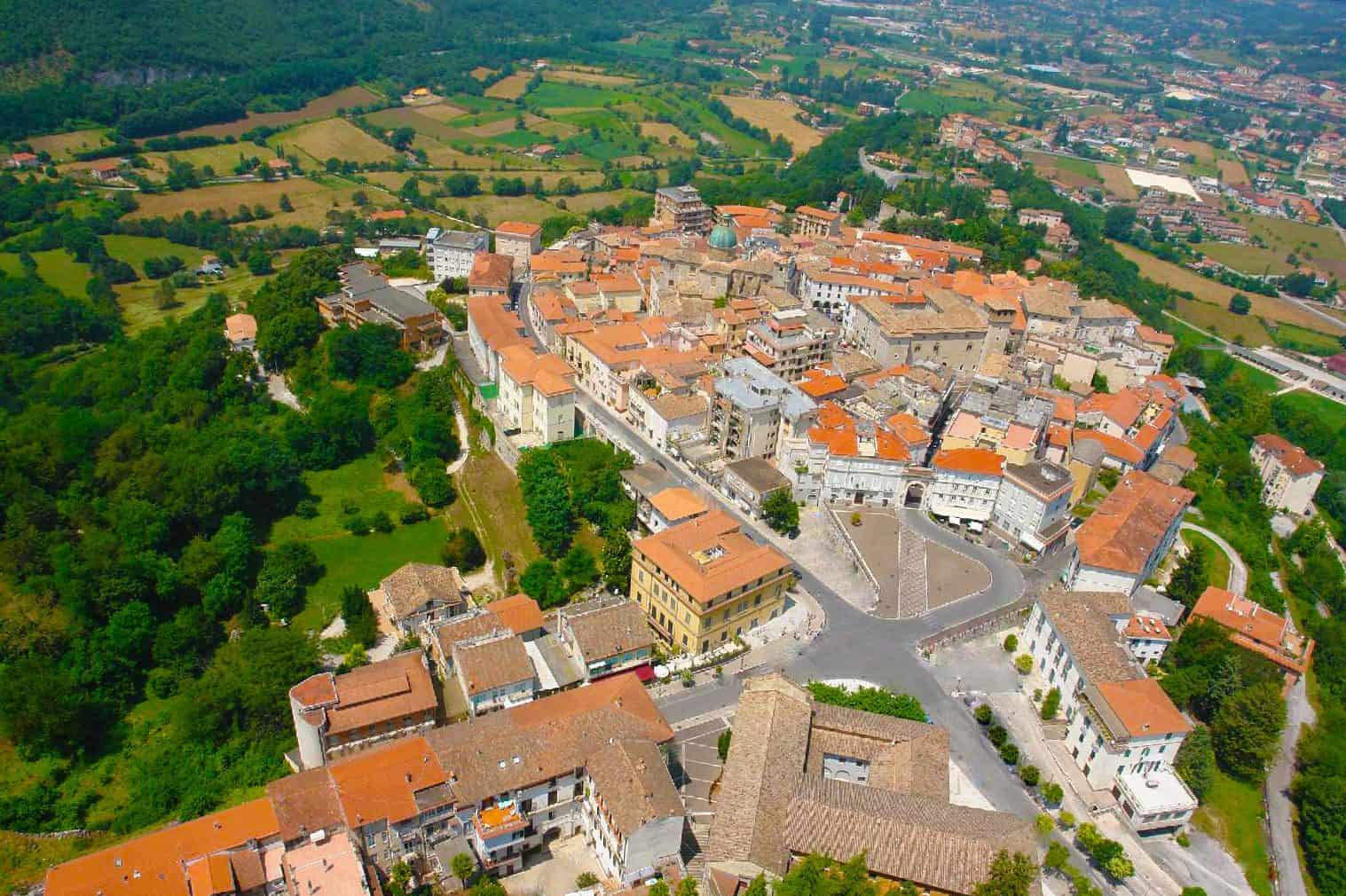
Atina occupies a hill that closes the Valle di Comino to the southeast, the Apennine basin lying between the Meta massif, the Mainarde and the course of the Melfa river. The historic center leans against the slopes of the hill of Santo Stefano, a spur of Monte Prato, and looks down on the plain where the Melfa flows. The valley is a border land: to the north is Abruzzo with the National Park, to the east Molise, to the south the plain of Cassino and Via Casilina. This position explains the whole history of Atina, from the Volsci to the Germans of 1944.
By car from Rome you take the A1 toward Naples to the Cassino exit and continue north along the regional and state roads that go up the valley. The whole trip is about an hour and 40 minutes. From Naples it takes an hour and 20 minutes using the same toll booth. From the city of Frosinone it is three quarters of an hour. If you come by train, you get off at Cassino, on the Rome-Naples line via Cassino, and from there take the Cotral bus to Atina. A second Cotral line serves the valley from the Sora side. The useful terminus for the village is Piazza Garibaldi, the lower square from which the climb to the old town starts.
Upper Atina and Ponte Melfa: The Two Faces of the Municipality
The municipality of Atina has two centers, and it's good to know that before you set the navigator. The first is the ancient town on the hill, closed in by walls, with about 500 residents, the monuments and the museum. The second is Ponte Melfa, the modern settlement that grew on the plain along the river from the postwar period on, where several municipal offices, the services, the supermarkets, the banks and the commercial businesses have moved. Ponte Melfa is today the real commercial hub of the Valle di Comino, and anyone looking for a gas station, an open pharmacy or a large parking lot will find it there. Anyone looking for Atina, the Atina of Virgil and Cicero, has to climb.

Why Atina (FR) Is One of the Most Beautiful Villages in Italy
Atina entered the association of the Most Beautiful Villages in Italy with the most solid reason a town in southern Lazio can claim: an intact medieval urban fabric, rebuilt after the earthquake of 1349 on a unified plan wanted by the Cantelmo, and an ancient substratum that surfaces everywhere, from the polygonal walls to the inscriptions set into the facades of the palaces. It also received the Orange Flag of the Touring Club Italiano, the label reserved for small inland towns that combine heritage and hospitality.
The difference with so many villages of Ciociaria is the layering. In Atina you walk on three overlapping cities: the pre-Roman one of the cyclopean walls, the Roman one of the municipium rich in magistrates and temples, and the late medieval one drawn after the quake, with the Ducal Palace at the center and the streets opening in concentric circles around it. Whoever has a trained eye puts the three cities back together in an afternoon. Whoever doesn't still leaves with the feeling of having seen a place where history is longer than memory.
The Origins of Atina: Saturn, the Saturnian Cities and Virgil's Atina potens
The Legend of the Founding of Atina
Tradition attributes a divine origin to Atina. It is said to have been founded by Saturn, the god who reigned in Lazio during the golden age, together with other cities whose name begins with the letter A: Alatri, Anagni, Arpino, Atina and Ferentino (which in this version of the legend would be called Antino). The five Saturnian cities have in common their walls in polygonal masonry, those gigantic blocks that visitors of the 1700s and 1800s called cyclopean, and the legend arose precisely from the need to explain who on earth could have lifted such stones. In Atina the memory of Saturn is still written in the place names: the square of the Ducal Palace is called Piazza Saturno, and under the cathedral, according to tradition, stood the temple of the god.
It's worth adding that the myth was taken seriously for centuries. The cycle of the Saturnian cities appears in local chronicles and in the scholarly repertories of the modern age, and the people of Atina adopted it as an identity card. The pages on Alatri, Anagni, Arpino and Ferentino tell about the sisters in this cycle, and a trip that touches all five is one of the most instructive you can make in ancient Lazio.
Virgil and Powerful Atina
The literary sources confirm that Atina existed before Rome. In the seventh book of the Aeneid, when Virgil lists the cities of Lazio that prepare arms to come to the aid of Turnus against Aeneas, Atina opens the list with the epithet potens, powerful. The adjective is not a poetic whim. Atina was the city that controlled the passage between the Liri Valley and Samnium, and it was close to the iron deposits of Monte Meta, a resource that in pre-Roman Italy was worth as much as a silver mine. Atina potens is still today the motto the citizens use to speak of their city, and you find it written on the municipality's publications and on the signs of the associations.
Volsci, Samnites and the Roman Conquest of Atina
In all likelihood Atina was a Volscian city, placed on the road that connected Sora to Casinum. In the 4th century BC, when Samnite power came into contact with Rome on the edge of the Liri Valley, Atina appears among the cities of the Samnite league, almost certainly in the territory of the great tribe of the Pentri, the same as Alife, Cassino and Venafro. The Roman conquest took place during the Samnite wars: modern sources give 293 BC as the year in which the city definitively entered the Roman state. Atina was enrolled in the Teretina tribe, became a prefecture and then a municipium. From that moment its history is that of a small Italic city that romanizes quickly and well.
Roman Atina: The Municipium That Cicero Called Mother of Illustrious Men
Cicero, Gnaeus Plancius and the Praise of Atina
Roman Atina has an illustrious advocate. In 54 BC Cicero defended Gnaeus Plancius, a magistrate from Atina accused of electoral fraud after his election to the aedileship. The speech, the Pro Plancio, has come down to us, and it contains the passage that every native of Atina knows by heart: Atina is the mother of many illustrious men, so that no city in Italy can be called richer. Cicero did not say it out of courtesy. Plancius had hosted and protected him during his exile, when the orator had been forced to leave Rome, and the defense of 54 was also a way of repaying that debt. The bond between the great man of Arpino and the Valle di Comino is, besides, a physical one: Arpino, Cicero's birthplace, is half an hour from Atina, and the page on Arpino tells the other half of this story.
After the Social War of 90 BC, when the Italic cities definitively obtained Roman citizenship, Atina supplied the republic and then the empire with administrators and soldiers of rank. The inscriptions that cover the village confirm it: names of magistrates, dedications, offices, an epigraphic heritage that for a city of this size is out of the ordinary.
Temples, Forum, Baths and Aqueduct of Roman Atina
The inscriptions speak of temples and cults dedicated to Ceres, Venus and Augustus. There was a forum with baths, imperial baths and an aqueduct that reached the city by a conduit starting from the springs of Chiusi, and in all likelihood an amphitheater, whose trace is hypothesized in the shape of some lots outside the walls. In the Augustan arrangement Atina was included in the first region, Latium et Campania. The temple of Saturn is said to have stood under the present cathedral, that of Jupiter in the area where the church of San Marco arose. These are established traditions, not excavations, and should be taken as such. What you can touch, instead, is the stone: the paving slabs of the Roman road at the Old Cemetery, the cistern in Piazza Garibaldi, the columns in the courtyard of the Ducal Palace, the mosaic with the Samnite warrior. For a reader who wants to place these finds in a broader picture, the page on the Archaeological Museum of Frosinone offers a comparison with the rest of ancient Ciociaria.
A Curiosity About Atina (FR)
The curiosity that surprises most people who arrive in Atina is not archaeological but about wine. The first Cabernet grown in Italy, according to the historical reconstruction accepted by the Italian Sommelier Association of Lazio and by the denomination's production rules, grew here, in the Valle di Comino, and not in Piedmont or the Veneto. The man behind it was Pasquale Visocchi, agronomist and entrepreneur of the family that in the 1800s transformed the economy of the valley. Starting in 1860 Visocchi imported from France, and in particular from the Bordeaux area, the best varieties of red and white grapes, and planted them on the hills around Atina, where the limestone soil and the altitude seemed to him suited to reproducing the conditions of the Gironde. The experiment succeeded. The French vines adapted, the wine pleased, and the Visocchi Brothers Winemaking Establishment, whose historic building is still listed among the things to see in the village, became one of the first Italian wineries to work international grape varieties with method.
The sequel to this story is entirely contemporary. In 1998 the Valle di Comino obtained the controlled designation of origin Atina, built around Cabernet, with the decisive contribution of the producer Giovanni Palombo and the ampelographic studies of Attilio Scienza. The designation today includes four reds (Rosso, Rosso Riserva, Cabernet and Cabernet Riserva) and a white based on Semillon, a Bordeaux grape that almost nobody in Italy grows. The consortium brings together about 15 producers. The paradox is delicious: the city that Virgil called powerful for the iron of its mountains has become, a century and a half after Visocchi, a little Apennine Bordeaux. Whoever tastes an Atina Cabernet Riserva in August, during CantinAtina, when the historic cellars of the village open their doors, understands that this is not a guidebook curiosity, but one of the reasons it is worth coming all the way here.
The Village of Atina Step by Step: From Porta dell'Arco to Piazza Garibaldi
Porta dell'Arco, Monumental Entrance to Atina
You enter the ancient town through Porta dell'Arco, one of the three main entrances of the wall circuit. The arch you see today is a reconstruction of 1948: the original was brought down by the destruction of the Second World War, when Atina found itself for months right behind the Gustav Line. The gate is in any case the right way to begin, because it puts the visitor immediately inside the scale of the village: narrow streets, tall buildings, stone everywhere. A second historic access is Porta Santa Maria, while of the great Porta Aurea of antiquity only the name remains, handed down by the sources and by the place names.
Piazza Garibaldi, the Fontanone and the Convent of San Francesco
Piazza Garibaldi is the lower square of Atina, the one where the buses stop and where you park. It is dominated by the Fontanone, a monumental fountain that is a faithful reproduction of the original, removed in the 1960s and then rebuilt from living memory. On the side of the square stands the San Francesco complex, a convent built in 1630, with a cloister and the attached church. The layout is L-shaped, with a longitudinal body lit by a regular series of windows. In the square you can also see the cippus of a Roman funerary monument, which local tradition links to the name of Lucius Aelius Aurelius Commodus. From Piazza Garibaldi start the climb toward Piazza Saturno and the Ducal Palace and, in the opposite direction, the road that goes down to Ponte Melfa.
The Roman Cistern of Atina in Piazza Garibaldi
The oldest find in the square is the Roman cistern, datable between the 3rd and 1st century BC, brought back into view a few years ago. It has walls in polygonal masonry and a terracotta floor, and it stood inside the city walls: it served to guarantee water to the city even in case of siege, when the aqueduct from the springs of Chiusi could be cut by the enemy. Look at it carefully, because it is the clearest proof of how Atina thought in military terms already in the Republican age: a powerful city is a city that doesn't die of thirst.
The Cantelmo Ducal Palace of Atina, Seat of the Municipality
The Facade and Towers of Palazzo Cantelmo
Palazzo Cantelmo, which everyone in town calls the Ducal Palace, is the most important civil monument of Atina and the pivot around which the city was redesigned after the earthquake of 1349. It was built by the Cantelmo, the family that from 1348 held the Valle di Comino and that also owned the castle of Alvito, on the site where the fortress of the counts of Aquino had previously stood. The facade on Piazza Saturno has two towers, of which only the one on the right is completed: an asymmetry that visitors often don't notice and that tells of an interrupted building site. Above the entrance portal a reused Roman bas-relief is set into the wall, and the front is animated by Gothic mullioned windows and rose windows. In front of the facade stands a toga-clad statue of the Roman age, without its head, while in the inner courtyard are gathered inscriptions and column fragments from the ancient buildings of the city. The palace is today the seat of the municipality of Atina.
The Chapel of Sant'Onofrio in the Ducal Palace of Atina
Inside the palace is preserved the chapel of Sant'Onofrio, a rectangular room with an apse that holds wall paintings of the 14th century, executed in the decades of the post-quake reconstruction. The cycle depicts the Madonna with Child and St. John the Baptist, Christ in glory and Saints Onofrio, John the Evangelist and Michael the Archangel. They are paintings of the southern late Gothic milieu, sober and well preserved, and they constitute the highest testimony to the Cantelmo's patronage. Three frescoes of the same century, detached from the palace, are today in the archaeological museum.
The Mosaic of the Samnite Warrior
The piece that deserves the visit, though, is a floor. In the palace is displayed a Roman mosaic in white and black tesserae, dated to the 2nd century AD, which depicts a Samnite warrior in four attack positions: one same man, armed in the Italic manner, repeated in four successive attitudes like the frames of a film. It is a rare image. The Romans, who had fought for generations against the Samnites, usually portrayed them as gladiators. Here, in a city that had been Samnite, the warrior appears instead as a figure of prestige, almost a family emblem. My opinion is that this mosaic alone is worth the climb to Piazza Saturno, and that it is the reason it's best to visit Atina on a Sunday, in the months from July to September, when the Ducal Palace is open.
The Cathedral of Santa Maria Assunta in Atina
History of the Cathedral: From the Temple of Saturn to the Facade of 1725
The co-cathedral of Santa Maria Assunta, in Piazza Veroli, stands on the site of the early Christian cathedral, which according to tradition Bishop Leo built on the remains of the temple of Saturn. The first documentary mention is in the privilege of Pope Innocent III of 1208, where the church appears with the title of San Giovanni sopra il muro di mezzo. The earthquake of 1349 destroyed it completely. By 1405 it was almost rebuilt, in 1514 it was enlarged toward the south, and between the end of the 1500s and the beginning of the 1600s it received further enlargements. In 1722 it took the present title of Santa Maria Assunta and in 1725 began the great 18th-century restoration that remade its facade. The works, concluded in 1746 according to the most widespread dating, gave the church the layout we see today.
The Convex Facade and the Two Bell Towers
Two low bell towers frame the facade, which has a slightly convex shape, with a curvilinear course, strongly projecting cornices and a central balcony on the first floor that critics have called coquettish. It is a measured Baroque, provincial in the best sense: the spaces are clean and geometric, marked by pilasters and frames, and the whole stays severe despite the curves. Whoever arrives from Piazza Saturno sees it at an angle, with the Ducal Palace in the background, and this is the point of view from which the facade looks best.
The Baroque Interior of the Cathedral of Atina and Its Works
The interior has three naves, with the central one wider and longer, ending in a rectangular apse. The high dome with lantern replaced the hexagonal tiburio, destroyed by the wartime events of the 20th century. The decoration is Baroque and the paintings are largely of the Neapolitan school. The Neapolitan painter Luigi Velpi, whom local sources also call Aloisio Volpi, painted the Glory of St. Mark in 1768 and, the following year, the Consecration and the Martyrdom of St. Mark. Vespasiano dell'Aquila is of the same school. The native of Atina Teodoro Mancini, who lived between 1796 and 1868, frescoed the dome and the central vault and painted the Assumption of the Virgin Mary. In 1904 Vincenzo Galloppi added the frescoes of the apse with the Coronation of the Virgin. In the chapel of the Blessed Sacrament there is a Last Supper by an anonymous artist.
The wooden furnishings are of great quality: the Baroque baptistery of 1750, the work of Neapolitan craftsmen, the 19th-century choir, the ambo with the old coat of arms of Atina and the 18th-century organ made by the Catarinozzi, the famous family of organ builders from Affile, still working. The cathedral holds the relics and the statue of St. Mark Galileo, transferred here after the church dedicated to him was destroyed during the Second World War.

St. Mark Galileo, the Bishop Patron of Atina
Mark Galileo, or Mark of Atina, is according to tradition one of the disciples of the apostle Peter, by whom he is said to have been consecrated bishop and sent to evangelize the Marsica, lower Lazio and some areas of Campania. He is said to have suffered martyrdom in Atina under Domitian, in AD 96. The Church remembers him on April 28, but Atina celebrates him on October 1, the day of the dedication of the cathedral that keeps his relics. It is a very ancient cult, which made Atina a pilgrimage destination for centuries: the Palazzo della Prepositura, which I discuss further on, was built precisely to house the pilgrims of the feast of St. Mark.
One Thing Nobody Tells You About Atina (FR)
No guide warns you that the most impressive part of Atina is not inside the village but above it, and that to see it you have to walk. The polygonal walls of Atina extend for about 6 kilometers of perimeter and are considered among the largest of the Italic world. In the village you see stretches of them, walled into houses, cellars and terraces. But the real circuit runs on the hill of Santo Stefano, right behind the historic center, where at the top you find the mighty pre-Roman walls, the remains of the acropolis and the medieval fortress. The climb is short, less than half an hour at an easy pace, among tall trees that make the hill a small natural oasis, and the view over the Valle di Comino from the summit is the best you can have of the valley without climbing a real mountain.
The walls were built at different times and in three manners of polygonal work, the ones archaeologists distinguish by the degree of working of the blocks: from the first manner, with barely roughed-out boulders, to the third, with perfectly fitting joints. The fact of finding all three in the same circuit tells of a city that kept fortifying itself for centuries, in all likelihood between the 7th and the 2nd century BC. The oldest datings, like the legendary extensions, should be taken with caution: the chronology of polygonal work is still debated. But for a visitor the lesson is simple. Bring walking shoes, go in the morning before the heat, and give the hill of Santo Stefano the same time you give the cathedral. No other village in the valley has an archaeological walk of this level five minutes from the square.
Palaces and Noble Houses of Atina: Prepositura, Visocchi and the Walled-In Inscriptions
The Palazzo della Prepositura, Called Le Pennate
The Palazzo della Prepositura, which the people of Atina call Le Pennate, has an elongated, slightly curved facade that follows the line of the street. It was built in 1598 at the wish of Cardinal Tolomeo Gallio, duke of Alvito, the powerful secretary of state of Gregory XIII who had bought the duchy a few years earlier. The purpose was practical: to give decent lodging to the pilgrims who came to Atina for the feast of the patron saint, St. Mark Galileo. It is a service building born of a princely commission, and the contrast between the modesty of the function and the name of the patron says a lot about the religious weight Atina had in the 1500s.
Palazzo Visocchi, Historic Residence of Lazio
Palazzo Visocchi, at Via Samuele Pagano 9, is listed in the network of Historic Residences of Lazio and is one of the last great 18th-century works of Atina. It was designed by the architect Rocco Bernasconi, with workers who came from Naples and Abruzzo, in particular from Alfedena and Pescocostanzo, and it has a T-shaped plan that sets it apart in the small-scale fabric of the historic center. The 18th-century spaces are intact: cellars, kitchens, the formal floor and apartments. The atrium has a pavilion vault and a floor of stone cobbles with terracotta bands, of neoclassical taste. On the main floor the dining room keeps a rare example of 19th-century wallpaper, the so-called French paper, produced by the Lefebvre paper mills of Isola del Liri, the same town as the Liri waterfalls. The private chapel is dedicated to the Madonna of Loreto and opens to the public on feast days. The palace can be visited by reservation, writing to palazzovisocchi@gmail.com. For those who love period interiors it is the most precious visit in the village, and it should be organized before you leave.
The Roman Inscriptions in the Facades of Atina
Walking around the village you meet Roman inscriptions set into the facades of the palaces, some at eye level, others under the windows, still others in the porticoes. It's an old habit: when families rebuilt their houses after 1349 they used the stone of the Roman city, and the inscriptions with magistrates' names and dedications ended up on the facade as a sort of certificate of nobility. On Via Vittorio Emanuele you can also see the arae, reused Roman altars, which the tourist signage lists among the things to see. Bring with you some notions of Latin epigraphy, or at least the patience to read the abbreviations: Atina rewards those who stop.

The Giuseppe Visocchi Archaeological Museum of Atina and the Valle di Comino
History and Location of the Museum of Atina
The civic museum was established in 1978 and set up in its present form between 1999 and 2000. It is on the first floor of an elegant classical-style building on Via Vittorio Emanuele II, in the historic center, and is named for Giuseppe Visocchi, of the family that marked Atina's 1800s. The route is organized in five large rooms and covers a chronological span from the 8th century BC to the late Middle Ages, with materials from Atina and the Valle di Comino: inscriptions, pre-Roman and Roman ceramics, mosaics, burials with their grave goods. The museum is part of the SIF Cultura museum system of the province of Frosinone and of the network of museums of the Lazio Region. Next to the museum, in the same building, the municipal Library holds volumes of great interest for the history and archaeology of the valley. Phone 0776 628100 and 349 2603957, email museoatina@gmail.com. Opening hours and tickets should be asked before the visit.
Room 1: The Funerary Lion and the Burial Chamber of Atina
The first room is dedicated to Atina as a Roman city and presents the remains of a funerary lion, one of the sculptures that topped the great tombs along the roads outside the walls, and a reconstructed funerary chamber. The lion is the kind of find that explains the wealth of imperial Atina better than many inscriptions: a sepulchral monument with a stone lion was expensive, and whoever commissioned it wanted to be remembered.
Rooms 2 and 4: The Necropolises of Ominimorti at San Biagio Saracinisco
The second and fourth rooms display the grave goods from the three necropolises of Monte Santa Croce, in the locality of Ominimorti, in the territory of San Biagio Saracinisco. They are burials datable between the 7th and 5th century BC and between the 4th and 3rd century BC, therefore earlier than and contemporary with the Roman conquest. The materials are mainly pre-Roman ceramics, weapons in iron and bronze and ornamental objects. The most famous piece is the disc-cuirass, the bronze chest protection typical of Italic warriors, which appears in male tombs of rank. Whoever has seen the Samnite grave goods in the museums of Molise will find here the same culture, and that is the point: the Valle di Comino, before Rome, looked east.
Room 3: The Models of Roman Military Deployments
The third room houses models that reconstruct Roman military deployments, a teaching tool that children and school groups like a lot, and that for adults serves to read the Samnite wars as maneuvers on the ground and not as dates in a book. Given Atina's position, on the border between Lazio and Samnium, the display has its own logic.
Room 5: The Reconstructed Tombs and the Votive Offerings of Casale Pescarolo
The last room presents two necropolises reconstructed from the territory of San Biagio Saracinisco, with the reproduction of the tombs and the original arrangement of the grave goods, and the votive offerings from the Italic sanctuary of Casale Pescarolo, in the territory of Casalvieri: small terracottas, votive offerings, objects left to the deity that tell of the everyday religiosity of the valley. The route is completed by a multimedia section titled Medioevie, dedicated to the abbeys, hermitages and castles of southern Lazio, and by the three 14th-century frescoes detached from the Ducal Palace. My advice is to visit the museum before the village and not after: the walls, the inscriptions and the warrior mosaic read better when you have already seen the disc-cuirass and the tombs of Ominimorti.
The Museum of Folk Arts and Traditions of Atina
Atina's second museum is set up in a municipally owned space and collects, preserves and studies the material concerning the history, culture, economy, dialects, costumes and folklore of the inhabitants of the Valle di Comino. It is an ethnographic museum in the full sense: farm tools, looms, clothing, household objects, documents of the peasant civilization that populated the valley until the years of emigration. An entire section is dedicated to international traditional costume, set up with the clothes donated by the folklore groups that perform every year at the Atina International Folklore Festival. It is the only museum I know in which the costumes of half the world have ended up in display cases as gifts from the guests, and that says a lot about the character of the festival. Opening hours depend on the season and should be asked of the Pro Loco.
The Advice I Give You for Visiting Atina (FR)
The advice is to choose the day with care, because Atina is not visited in the same way in every week of the year. If you can, come on a Sunday between July and September. It is the only period in which the Ducal Palace is regularly open to the public, and without the palace you miss the chapel of Sant'Onofrio and the mosaic of the Samnite warrior, the two things that set Atina apart from any other village in Ciociaria. Reserve Palazzo Visocchi in advance by writing to the residence's address and phone the archaeological museum the day before to confirm the hours. With these three moves a day in Atina becomes complete. Without them it remains a pleasant stroll in a beautiful village, which is much less.
The itinerary I recommend is this, in order. You arrive in Piazza Garibaldi in late morning, leave the car and look at the cistern, the Fontanone and San Francesco. You go up to the archaeological museum, a good hour. You have lunch in the village, where the restaurants of the historic center cook cannellini beans in every way and serve the valley's Cabernet. In the early afternoon you visit the cathedral and the Ducal Palace in Piazza Saturno, and you leave by Porta dell'Arco. Around 17:00 you climb the hill of Santo Stefano, with the light starting to lower over the valley. If you have a second day, devote it to the sites outside the village, the Old Cemetery and San Marciano, and then San Donato Val di Comino or Alvito.
A professional warning: Atina is an uphill village, with stairs and cobbles, and in July the heat in the Valle di Comino is not that of the mountains. Water, a hat and closed shoes. And if you come for Atina Jazz, in mid-July, book your bed months in advance: the places in the village are few and they go fast.
The Polygonal Walls of Atina and the Hill of Santo Stefano
Three Manners, 6 Kilometers, 15 Centuries
The walls of Atina deserve a chapter of their own, because they are the reason the city was called powerful. The remains in polygonal masonry are found in the historic center and in the adjacent areas, built at different times and in three different manners. Beyond the legendary aspects, which concern both the dating and the extent, they are datable with good approximation between the 7th and the 2nd century BC. The overall perimeter of about 6 kilometers places them among the widest circuits of pre-Roman Italy, larger than that of many cities that are more famous today. The ancient city, perched entirely on the hill, must have looked impregnable to anyone looking at it from the valley, and this is exactly the meaning of Virgil's epithet.
The Acropolis and the Fortress on the Hill of Santo Stefano
On the summit of the hill of Santo Stefano, at 577 meters, are the remains of the ancient acropolis and of the medieval fortress, which reused the pre-Roman walls as its foundation. The hill is covered with tall trees and is in effect a natural park right behind the historic center, with paths of medium difficulty that continue toward Monte Prato, at 1,087 meters. The view from the top takes in the whole Valle di Comino as far as the mountains of the Abruzzo National Park. It is the place where Atina is understood all in one glance: the ancient city on the hill, the modern city on the plain, the river in between and the mountains around like a crown.

Outside the Walls of Atina: Old Cemetery, San Marco, the Collegiata and San Marciano
The Paved Road and the Domus of the San Marco Area
Just outside the village, in the area of the Old Cemetery, are the remains of a paved Roman road, with the large stone slabs still in place, and of a domus with a terrace in polygonal masonry, in the archaeological area of San Marco. The church of San Marco, destroyed in the Second World War, is said to have been built on the site of the temple of Jupiter, according to a tradition that excavations have neither confirmed nor refuted so far. The Roman tombs visible in this area were 22 on a map of 1910. Today three remain. It's a fact that tells better than any speech how much heritage was lost in the 20th century, between war, reconstruction and neglect.
The Collegiata of Santa Maria, the Medieval Church of Atina
The Collegiata of Santa Maria is the most important medieval church in Atina. It stands, according to tradition, on the site of the temple of Saturn, and this double attribution, shared with the cathedral, says how hard the myth of the founding god worked in the city's memory. It is a sober church, with the layout and forms of southern Romanesque, and it stays outside the circuit of hurried visits: whoever looks for it finds it in the residential fabric of the village, and comes away with the idea of a medieval Atina more withdrawn and poorer than the Baroque one of the cathedral.
The Church of San Marciano and the Early Christian Burial Ground
The church of San Marciano stands on a vast funerary area used since antiquity and largely reuses architectural elements that belonged to an imposing Roman funerary monument: blocks, cornices, sculpted fragments that can be recognized in the walls. Recent restorations have brought to light an early Christian burial ground datable between the 5th and 6th century AD, the proof that Atina became Christian very early, consistent with the tradition of Bishop Mark. For an attentive visitor San Marciano is the synthesis of the whole layering of Atina: a Roman tomb that became a Christian cemetery that became a church.

Another Well-Known Fact, Yet Rarely Cited
Everybody knows that Atina was destroyed by an earthquake in 1349 and rebuilt by the Cantelmo. Few stop to consider what this means for the shape of the village they are visiting. The quake of September 1349 was one of the most violent the central Apennines remember, the same one that seriously damaged Rome and that Petrarch described in his letters. In Atina it left almost nothing standing, cathedral included, and the city was rebuilt a few decades later. The interesting point is that the reconstruction was not spontaneous. The Cantelmo, who had just obtained the Valle di Comino, laid out the new Atina around their palace, and the city developed in concentric circles around the ducal residence, with the streets that go around Piazza Saturno following the contour lines. Whoever looks at the plan of Atina, or simply walks the streets of the village, recognizes this design: the Ducal Palace at the center, the rings of dwellings around it, the cathedral on the flank, the gates at the edges.
This makes Atina a rare case of a planned medieval city, where the urban planning of the 1300s is still readable without heavy overlays. And it explains something else that is generally not said: the Roman inscriptions walled in everywhere are not a scholarly whim of the 1800s but the result of that building site, when the ancient city, shattered by the earthquake, became the quarry of the new city. The Ducal Palace itself has a Roman bas-relief above the portal and ancient columns in the courtyard. The Atina of 1349 is, literally, made with the stones of the Atina of Cicero.
The Right Photo to Take in Atina (FR)
The photograph to take home is the view of the whole village on its hill, taken from the plain of Ponte Melfa or, better, from the road that climbs from the valley. From there Atina is seen as Virgil saw it: a compact city, perched, closed above the spur of the hill of Santo Stefano, with the dome of the cathedral and the towers of the Ducal Palace emerging from the profile of the roofs and the mountain behind. The right moment is early in the morning, when the sun enters the valley from the east and lights the front of the village, leaving the mountain behind in shadow, or a summer evening, around 20:00, when the stone warms with an orange light and the windows begin to light up.
Inside the village, the best photo is the one of the facade of the Ducal Palace in Piazza Saturno, taken from the cathedral side so as to have in the frame the two towers, the completed one and the unfinished one, with the Gothic mullioned windows and the bas-relief above the portal. You need a wide-angle lens, because the square is narrow. A second framing that few people take is from the top of the hill of Santo Stefano toward the valley, with the polygonal walls in the foreground and the Valle di Comino open behind: it is the photo that explains why the city was built here. For the mosaic of the Samnite warrior, in the Ducal Palace, the light is artificial and photos come out better without flash, from above, holding the camera parallel to the floor. My opinion is that the view from the valley is worth more than all the others put together: Atina is a village you understand from outside before you do from inside.
The Middle Ages of Atina: Lombards, Bishops, Montecassino and the Dukes of Alvito
The Lombard Destruction and the Rebirth of 626
The Roman city ended with the Lombards: in 589 Atina was destroyed by Duke Zotto of Benevento, and it was rebuilt in 626, entering the Duchy of Benevento. In the year 800 it appears as a bishop's seat, as one reads in a diploma of Charlemagne that describes its territorial extent with precision. The memory of the bishopric is entrusted to the figure of St. Mark Galileo, considered the first bishop of the city. Atina then became part of the county of Capua and finally of the kingdom unified by the Normans, the Kingdom of Sicily, later the Kingdom of Naples and of the Two Sicilies, and it stayed in the province of Terra di Lavoro until the creation of the province of Frosinone in the 20th century.
Montecassino, the Counts of Aquino and the Earthquake of 1349
At the end of the 12th century Atina was part of the domains of the Abbey of Montecassino, the great monastic power of the area. Later it passed into the possessions of the counts of Aquino, the family of St. Thomas, who had a fortress in Atina on the spot where the Ducal Palace stands today. Aquino, the dynasty's city of origin, is half an hour away by road. In 1349 the earthquake destroyed Atina, which was rebuilt in the following decades under the new lordship.
Cantelmo, Cardona and Gallio: Atina in the Duchy of Alvito
Like a good part of the Valle di Comino, Atina was included in the county and then the duchy of Alvito. The Cantelmo held it from 1348 to 1595. The Folch de Cardona followed and, from 1595, the Gallio, with Cardinal Tolomeo Gallio, who left Atina the Palazzo della Prepositura. Despite its dependence on Alvito, Atina kept a city identity of its own, with its churches, its palaces and its patron saint, and in the 1500s it saw the rise of the residences of the Visocchi and Fasoli families, in a period of stability the valley had not known for centuries. The Cantelmo castle still dominates Alvito, and whoever wants to understand the relationship between the two towns would do well to see them on the same day.
Atina from the 1800s to Today: The Visocchi, the Ironworks, the War
The Paper Mill of 1845 and the Hydroelectric Plant
The protagonist of Atina's 1800s is the Visocchi family. To the Visocchi's initiative are owed the paper mill, introduced in 1845, and, toward the end of the century, the hydroelectric plant of Castellone, in the territory of Picinisco, which exploited the fall of the Melfa's waters through a penstock to power the machinery. The same family planted the French vineyards from which the Cabernet comes, and built the palace on Via Samuele Pagano. It is hard to find in a town of this size a bourgeois dynasty that left such a mark on the landscape, the economy and the culture.
The Iron Mines of the Meta and the Rosanisco Ironworks
The exploitation of the iron mines of Monte Meta, mostly limonite, to which the history of Atina and the Valle di Comino is tied from the most remote antiquity, continued with ups and downs in the modern age too. It had a revival from 1774, with the construction of an ironworks in the Canneto valley, closed in 1799 during the French occupation. In 1852 the Bourbon government thought of a determined exploitation of the area's mineral resources, with the construction of the Magona, or Royal Ironworks, in the locality of Rosanisco, whose start local sources date to 1854. The project, which was in the phase of completion, stopped with the Piedmontese annexation of 1860. Of Atina's iron there remains thus a long history of attempts and an echo in the name of Virgil.
Atina in the Second World War: The Atina Maneuver and the Liberation of 1944
In the winter of 1943-1944 Atina found itself right behind the Gustav Line, the German defensive line that ran from Cassino toward the Adriatic. In January 1944 the French general Alphonse Juin conceived the so-called Atina maneuver: to outflank the defenses of Cassino from the north, through the mountains, to reach the Sant'Elia Fiumerapido-Atina cross route and cover the right flank of the American II Corps. The 2nd Moroccan Infantry Division and the 3rd Algerian Division conquered between January 12 and 15 Costa San Pietro, Monna Casale and Monna Acquafondata, paying more than 700 men in 48 hours, and between January 21 and 24 they fought for Monte Santa Croce above San Biagio Saracinisco, taken and lost again. On January 24 the command of the Fifth Army suspended the offensive to concentrate on Cassino, and the front stopped in the mountains until May. Atina was reached by the 6th Brigade of the 2nd New Zealand Division between May 27 and 28, 1944, the day after the fall of Montecassino. The church of San Marco, Porta dell'Arco and the tiburio of the cathedral were among the losses. The gate was rebuilt in 1948, the tiburio replaced by the present dome. The page on Cassino tells the rest of the battle.
Some Important Events That Happened Here in History
The first event is the Roman conquest of 293 BC, in the last phase of the Third Samnite War: with it Atina, a city of the Samnite league, entered the Roman state and the Teretina tribe, and in a few decades it turned from an Italic stronghold into a prefecture and then a municipium. It is the passage that decided everything else, and that explains why a city with cyclopean walls speaks Latin in every one of its stones.
The second is the trial of Gnaeus Plancius in 54 BC. Plancius, a native of Atina and aedile-elect, was accused of fraud and defended by Cicero in the speech that bears his name. The acquittal, or in any case the favorable outcome that historians accept, is not the point. The point is that in that trial, before a Roman court, little Atina was proclaimed mother of illustrious men by the greatest orator of the republic, and since then no city in Ciociaria has had a calling card to compare.
The third event is the martyrdom of St. Mark Galileo in AD 96, under Domitian. It is a fact of tradition, not documented by contemporary sources, but it had concrete historical consequences: Atina became a bishop's seat, as attested by the diploma of Charlemagne of 800, and a pilgrimage destination into the modern age, so much so that in 1598 a cardinal secretary of state built a palace to house the pilgrims.
The fourth is the Lombard destruction of 589 at the hands of Duke Zotto and the reconstruction of 626, which marks Atina's passage from the Roman world to the Beneventan and then the Norman one. The fifth is the earthquake of 1349, which razed the city and the cathedral and gave the Cantelmo the chance to redesign it around their palace: the Atina you visit is the child of that disaster.
The sixth is the planting of French grape varieties by Pasquale Visocchi starting in 1860, the first Cabernet grown in Italy, which changed the valley's economy and today supports a designation of origin with 15 producers. The seventh is the Atina maneuver of January 1944 and the liberation of May 27-28 of the same year, with the French, Moroccan, Algerian and New Zealand troops who fought on these mountains. The last, for now, is 1986: that year Vittorio Fortuna founded the Atina International Jazz Music Festival, which in 2026 celebrated its 40th edition and which has made this village of 500 inhabitants a name known to musicians from half the world.
Who Passed Through Atina (FR)
The first name is Cicero's, who had a relationship of gratitude with Atina: Gnaeus Plancius, a native of Atina, had welcomed and protected him during the exile of 58 BC, when he was quaestor in Macedonia, and the orator defended him in 54 BC with the Pro Plancio. That Cicero physically came to Atina is not documented, but Arpino, his city, is a few kilometers away, and the valley was his land.
The second name is David Herbert Lawrence. On December 13, 1919 the English writer and his wife Frieda left Rome by train for Cassino, continued by bus to Atina and from there, partly on a donkey cart and partly on foot, reached the house of Orazio Cervi in the countryside of Picinisco, where they stayed eight days. Lawrence had to assess if the area was habitable for an English friend, Rosalind Baynes. He concluded that it was too cold and too primitive, and on December 22, at 05:30 in the morning, after a snowfall, the two retraced on foot the 8 kilometers to Atina to take the bus to Cassino and then the train to Naples and Capri. The experience ended up in the novel The Lost Girl, published in 1920, where Picinisco becomes Pescocalascio and Atina becomes Ossona, the market town at the top of the pass, with oxen, sheep, pigs and peasant women in costume. Atina's Monday market, which is still held, is the one Lawrence described.
The third passage is military: in January 1944 General Alphonse Juin gave the name of Atina to the maneuver with which he tried to outflank Cassino, and in May of the same year the New Zealanders of the 2nd Division entered the village. The fourth passage is musical and continues every July. Since 1986 Atina Jazz has brought musicians of the first rank to Piazza Marconi. The 40th anniversary edition, from July 15 to 19, 2026, had on stage Emma Smith, China Moses, Bill Frisell with Gregory Tardy, Irene Fornaciari and Eliane Elias. For a guitarist like Frisell or a pianist like Eliane Elias, playing in a village of 500 inhabitants in the Valle di Comino is not a fallback: it is a tradition that musicians know and respect.
The Atina PDO Cannellini Bean and the Atina DOC Cabernet
The Atina PDO Cannellini Bean
The Atina cannellini bean has had protected designation of origin since August 4, 2010. It is grown only in six municipalities of the Valle di Comino: Atina, Villa Latina, Picinisco, Casalvieri, Casalattico and Gallinaro, on the alluvial soils along the Melfa and Mollarino rivers. It is sown between June 15 and July 15 and harvested between September 10 and October 30. Drying takes place within 45 days of the harvest. The bean is white, opaque, kidney-shaped, between 9 and 14 millimeters long, with a very thin skin that is its commercial hallmark: it cooks without soaking and becomes tender and almost melting in the mouth. Its fame is old. Already in 1811 the statistics of the Kingdom of Naples listed it as a product of high quality. The protection Consortium is based in Atina. The August bean feast and the festival of the cannellini bean and the Cabernet are the occasions to eat it the way it should be eaten: with the valley's olive oil, pork rinds or clams, and a glass of red.
The Atina DOC Cabernet
On the slopes of the hills grow the vineyards from which the Atina DOC comes, a designation recognized in 1998 and built around the Cabernet planted by Pasquale Visocchi from 1860. The types are Rosso, Rosso Riserva, Cabernet and Cabernet Riserva, plus a white based on Semillon. The limestone soil and the altitude give elegant wines, with lively tannins. The valley's Merlot is fruity and crisp, the Cabernet more enveloping. The consortium brings together about 15 producers on a territory that rises from the valley toward the Apennine heights between Lazio and Abruzzo. CantinAtina, in mid-August, opens the village's historic cellars for tastings. My opinion is firm: an Atina Cabernet Riserva holds up against many more prestigious Lazio reds, and costs less.
Events, Traditions and Folklore of Atina (FR)
Atina Jazz, the Festival Since 1986
Atina Jazz is the international jazz music festival founded in 1986 by Vittorio Fortuna, held every year in mid-July in Piazza Marconi. It is directed today by the agency Kunoichi Promotion with the support of the municipality of Atina and the Lazio Region, and the program ranges from traditional jazz to soul and modern fusions. The 40th edition was held from July 15 to 19, 2026. There is also a winter offshoot, Atina Jazz Winter. Ticket information is on the festival's website and on the municipality's.
The International Folklore Festival and the Religious Feasts
Between the end of July and the first days of August Atina hosts the International Folklore Festival, with groups in costume from all over the world. The costumes donated by the groups ended up in the Museum of Folk Arts and Traditions. The religious calendar has three fixed dates: the feast of the Madonna del Carmelo in July, the feast of the Assumption on August 15, with religious rites and the Ferragosto celebration, and the feast of the patron saint St. Mark Galileo on October 1, followed by the feast of the Holy Cross, also in October. In spring the Ballarella is held, in April.
The Calendar of the Atina Summer
Atina's summer is packed. In July: open-air cinema nights in the historic center, free admission. The tournament of the contrade. The stopover of the Milano-Taranto motorcycle rally. The agriculture festival with vintage machines, heir to the old threshing festival. The midsummer fair and the emigrant's festival. Atina in festa along Corso Munazio Planco. The Atina Summer Festival. The international review of folk instruments. In August: the bean feast. The Gran Galà of opera. CantinAtina. The Festival delle Storie, the traveling event of writers and journalists that closes the valley's summer. The ball-bearing cart race, a downhill contest with homemade carts that the village's kids build by themselves. The festival of the cannellini bean and the Cabernet. Cycling events are a constant: the Trofeo Bastianelli, an international race reserved for Elite and Under 23, and the Ciociaria in Giro for juniors. In fall the new wine festival, in November. In the Christmas period the nativity scene market exhibition. Among the recurring initiatives, the Gran Premio dell'Arco and the review Una scultura per Atina are also worth noting. The dates change from year to year and should be checked on the municipality's channels.
Sports, Nature and Excursions Around Atina
Atina offers paths of medium difficulty with excursions on the hill of Santo Stefano and on Monte Prato, and higher up, toward the Pizzo del Prato Caselle at 1,365 meters, the landscape becomes that of the real Apennines. The municipal territory descends to the Melfa, at about 340 meters, and rises to the mountains that close the valley. For organized sports there are the kart track, the motocross track and facilities for soccer, basketball, tennis, horseback riding and bocce. The valley is also cyclists' land, as the races held there every summer show. A few kilometers away, Lake Posta Fibreno is the most beautiful nature reserve in the area, with its spring waters and the floating island, and the village of Posta Fibreno is worth the detour.
Around Atina (FR): The Valle di Comino and Ciociaria
Atina is the natural starting point for the Valle di Comino. San Donato Val di Comino
is the village at the gates of the Abruzzo National Park. Alvito keeps the Cantelmo castle. Vicalvi has a Lombard fortress. Campoli Appennino is the truffle town. Down the valley, Sora is the city of Vittorio De Sica, Isola del Liri has the waterfall in the built-up area and the paper mill that produced the French paper of Palazzo Visocchi, and Arpino is Cicero's homeland. Toward the south, Aquino and the Abbey of Montecassino close the itinerary. Whoever has an extra day can go up Ciociaria toward Veroli, the city that gives its name to the square of Atina's cathedral. The Liri waterfalls, San Biagio Saracinisco with the necropolis of Ominimorti and Casalvieri with the sanctuary of Casale Pescarolo complete the picture of the places the museum's finds come from.
Atina with Children, Accessibility and Best Time
Atina with Children
Atina works well with children from age six and up. The archaeological museum has the models of the Roman deployments and the reconstructed tombs, which are exactly the things kids like to look at. The hill of Santo Stefano is a walk in the woods with a castle at the top. The mosaic of the warrior in four positions is a comic strip from 2,000 years ago. The ball-bearing carts of August are the show best suited to little ones of the whole summer. The village, though, is uphill and cobbled: strollers suffer, baby carriers work.
Accessibility
The historic center has slopes and steps that make a visit in a wheelchair difficult, as in all the hill villages of Ciociaria. Piazza Garibaldi, Piazza Saturno and the stretch of the corso between the two are the points reachable with the least difficulty. The museum is on the first floor of a historic building and the presence of an elevator should be asked by phone before leaving. The Ducal Palace and the cathedral have access with steps.
When to Go to Atina and When to Avoid It
The best season is from May to October, with two peaks: the week of Atina Jazz in mid-July, for those who want the music and accept the crowd and the room prices, and the second half of September, when the bean is harvested, the air is clear and the village has gone quiet again. The Sunday between July and September is the only sure day for the Ducal Palace. Avoid the days of high August in the middle hours, when the heat in the valley is heavy, and deep winter, when many activities in the village are closed and the valley, as Lawrence discovered, is cold.
Quick Questions About Atina (FR)
Where is Atina and in which province?
Atina is in the province of Frosinone, in southern Lazio, in the Valle di Comino, about 490 meters above sea level, on the border with Abruzzo and Molise.
How far is Atina from Rome and how do you get there?
About an hour and 40 minutes by car from the Grande Raccordo Anulare, on the A1 to the Cassino toll booth and then the valley roads. By train you get off at Cassino and continue with the Cotral bus to Piazza Garibaldi. A second Cotral line comes from Sora.
Do you pay a ticket to visit Atina?
No. The village is lived in and can be visited freely. Any tickets concern only the archaeological museum and, if requested, guided visits to the private residences.
When is the Ducal Palace of Atina open?
The Ducal Palace, seat of the municipality, opens for visits every Sunday from July to September. At other times it's best to ask the municipality or the Pro Loco, number 0776 609309.
What are the hours and prices of the Archaeological Museum of Atina?
Hours and tickets vary with the season and should be asked of the museum, phone 0776 628100 and 349 2603957, email museoatina@gmail.com. The museum is on Via Vittorio Emanuele II.
How long does a visit to Atina take?
Half a day for the village, the cathedral and the museum. A full day if you add the Ducal Palace, the hill of Santo Stefano and the sites outside the walls. With Palazzo Visocchi by reservation you need a full day.
What is there to see in Atina in one day?
Piazza Garibaldi with the Roman cistern and the Fontanone, the Giuseppe Visocchi Archaeological Museum, the cathedral of Santa Maria Assunta, the Ducal Palace with the mosaic of the Samnite warrior, Porta dell'Arco and the climb to the hill of Santo Stefano.
Why is Atina called the city of Saturn?
Because of the legend that has it founded by the god Saturn together with Alatri, Anagni, Arpino and Ferentino, the Saturnian cities of Lazio. The square of the Ducal Palace is called Piazza Saturno.
What does Atina potens mean?
It is the epithet Virgil gives Atina in the seventh book of the Aeneid, among the cities that arm Turnus against Aeneas: powerful Atina, for its position and for the iron mines of Monte Meta.
Can you see the polygonal walls of Atina?
Yes. Stretches are visible in the village and in the adjacent areas. The most imposing circuit is on the hill of Santo Stefano, reachable on foot from the historic center, with the remains of the acropolis and the fortress.
What is the mosaic of the Samnite warrior of Atina?
A Roman mosaic in white and black tesserae from the 2nd century AD, kept in the Ducal Palace, which depicts a Samnite warrior in four attack positions.
Can you visit Palazzo Visocchi in Atina?
Yes, only by reservation, writing to palazzovisocchi@gmail.com. It is at Via Samuele Pagano 9 and keeps the dining room with the French paper and the chapel of the Madonna of Loreto.
When is Atina Jazz held?
In mid-July, in Piazza Marconi, since 1986. The 2026 edition, the 40th, ran from July 15 to 19. There is also a winter edition, Atina Jazz Winter.
What do you eat in Atina?
The Atina PDO cannellini bean, which cooks without soaking, and the wines of the Atina DOC, in particular the Cabernet. The August bean feast and CantinAtina are the best occasions.
Who is the patron saint of Atina and when is he celebrated?
St. Mark Galileo, bishop and martyr according to tradition, celebrated on October 1. His relics are in the cathedral of Santa Maria Assunta.
Is Atina suitable for children?
Yes, from age six and up: a museum with models and reconstructed tombs, a walk on the hill, the warrior mosaic. The village is uphill and strollers struggle.
Is Atina accessible in a wheelchair?
Only in part: Piazza Garibaldi, Piazza Saturno and the corso are the most practicable stretches. The museum is on the first floor and the availability of the elevator should be asked beforehand.
Where do you park in Atina?
In Piazza Garibaldi and along the road that climbs from the valley. At Ponte Melfa, on the plain, the parking lots are larger, but you then have to go back up to the village by car or by bus.
What is the difference between Atina and Alvito?
Alvito was the capital of the duchy and has the Cantelmo castle. Atina was the ancient city of the valley, with the pre-Roman walls, the Roman municipium and the archaeological museum. They can be visited well on the same day.
What does D.H. Lawrence have to do with Atina?
Lawrence passed through Atina on December 13 and 22, 1919, going to and coming back from Picinisco, and described it in the novel The Lost Girl under the name Ossona, the market town.
Is Atina one of the Most Beautiful Villages in Italy?
Yes, and it is also an Orange Flag of the Touring Club Italiano.
Can you take photographs in the museum and the Ducal Palace of Atina?
Normally yes, without flash and without a tripod. In the Ducal Palace, which is the seat of the municipality, the staff may ask you to limit yourself to the rooms open to the visit.
My Verdict on Atina (FR)
Atina is the village of the Valle di Comino that I recommend to those who want to understand the valley and not just cross it. The neighboring villages have the castle, the park, the lake. Atina has three overlapping cities and a museum that explains them. Go on a Sunday, between July and September, go into the Ducal Palace to see the Samnite warrior, climb the hill of Santo Stefano before sunset, and take home a bottle of Cabernet Riserva and a kilo of cannellini. The rest of Ciociaria will gladly wait for another day.
Article written by the editorial team of TourLeaderPro, contact them for Private/Corporate/V.I.P. Tours and Experiences.
Planning a trip to Rome? The English-language guides to visiting the city are on ItalyPlanner.com.