Pescasseroli (AQ)
In short. Pescasseroli (AQ) is the main center of the Abruzzo, Lazio and Molise National Park and sits at 1,167 meters above sea level, in a basin at the mouth of the upper Sangro valley, in the province of L'Aquila.
Pescasseroli (AQ) is the main center of the Abruzzo, Lazio and Molise National Park and sits at 1,167 meters above sea level, in a basin at the mouth of the upper Sangro valley, in the province of L'Aquila. From Rome you get there in about two and a half hours by car: A25 Rome-Pescara, Pescina or Celano exit, then state road 83 Marsicana along the Sangro through Gioia dei Marsi, Bisegna and Opi. Alternatively, A1 as far as Cassino or Ceprano and then the Comino valley and the Forca d'Acero pass, a slower road but by far more beautiful. Without a car there are bus runs from Rome's Tiburtina station toward the Alto Sangro, operated by the Abruzzo regional transport company: the frequency changes a lot between winter, summer and the in-between seasons, and the times should be checked on the carrier's website before leaving, because on low-season weekdays the runs are few. The nearest useful railway station is Avezzano, on the Rome-Pescara line, and from there you continue by bus or taxi: there is no train that reaches the town. In town you park along the ring road and in the open spaces at the entrance to the settlement, partly paid in the peak months. The historic center can be seen only on foot and costs nothing. The town itself is free: you pay to enter the Park Visitor Center with the natural history museum and the wildlife area, the house museum of Palazzo Sipari and the ski lifts. Hours and fares of the Visitor Center are published by the Park Authority on its official website and vary between high and low season. Guided visits to Palazzo Sipari are arranged with the Sipari Foundation at the numbers 0863 910748 and 334 3495164, last about an hour and do not follow continuous hours: a phone call before setting out avoids a closed door. For the ski pass and the opening status of the slopes, the reference is the company that manages the Monte delle Vitelle lifts.
Whoever is building a wider itinerary inside the protected area finds the general picture on the page dedicated to the Abruzzo, Lazio and Molise National Park, and can combine with Pescasseroli the nearby La Camosciara Nature Reserve, which is about 15 kilometers away.

How to get to Pescasseroli (AQ) without taking the wrong road
By car from Rome to Pescasseroli (AQ)
The fast route is the A25 motorway toward Pescara, exit at Pescina or at Celano, and then the descent toward the Sangro on state road 83. It's about 170 kilometers and two and a half real hours, not the optimistic two hours that navigators tell: the last stretch is all curves, you travel inside the Park and speed is low by law and by common sense, because wildlife crosses. The second route is the southern one, A1 to Cassino, Comino valley, Alvito or Villetta Barrea depending on the pass: you go through Forca d'Acero, elevation 1,538, and in winter the pass can close for snow. Whoever has time should do the outbound from the north and the return from the south, or vice versa: they are two different landscapes and the loop costs not one kilometer more than it is worth.
A serious warning, not a ritual formula. Inside the Park the speed limits are low and checks exist, but the real reason to slow down is another: on the state road between Opi and Pescasseroli wildlife collisions are a documented problem, and an adult bear against a car is a disaster for both. At dusk and dawn you drive with low beams and a light foot.
Bus and train to Pescasseroli (AQ)
The Abruzzo regional bus lines link Roma Tiburtina to the Alto Sangro with direct runs, and Pescasseroli is one of the reference terminals of the Park area. The service is seasonal in frequency: in summer and on winter weekends the runs increase, in the in-between seasons they shrink to a few departures a day. Whoever arrives by train gets off at Avezzano and continues by road. The practical advice: check the return run before even buying the outbound, because being left on foot in an Apennine valley at 8 in the evening is a far more concrete problem than it seems when you look at a timetable from the couch at home.
Where to leave the car and how to get around town
The settlement is flat, rare for an Apennine village, and that changes everything: you walk without effort, internal distances are a few hundred meters and even those with walking difficulties manage to get around the center. The useful parking lots are along the ring road and in the area toward the Visitor Center. In high season, meaning August and the snow weeks, the town fills up and finding a spot near Piazza Sant'Antonio at 11 in the morning is a small feat: arrive early or allow 200 meters more of walking.
Pescasseroli (AQ): the town, the basin, the stone
The first fact to fix is geographic. Pescasseroli occupies the floor of a wide basin, with open pastures and meadows, closed by mountains that exceed 2,000 meters: Monte Marsicano to the east, the Meta range to the south, the Serre group to the west. The Sangro rises a little further upstream, under the slopes of Monte Turchio, and here it is still a thin stream crossing the meadows. This conformation explains the settlement's history better than any chronicle: wide pastures mean sheep farming, sheep farming means transhumance, transhumance means tratturi, the drove roads, and the tratturi built the economy of this valley for 20 centuries.
The urban core developed on the flat, around the old Benedictine abbey, and not on top of a hill as happens almost everywhere in Abruzzo. The reason is that the defense was elsewhere: on the hill above the town, where the ruins of Castel Mancino remain. When the castle was abandoned, in the 14th century, the population had already come down to the valley and had no reason to climb back.
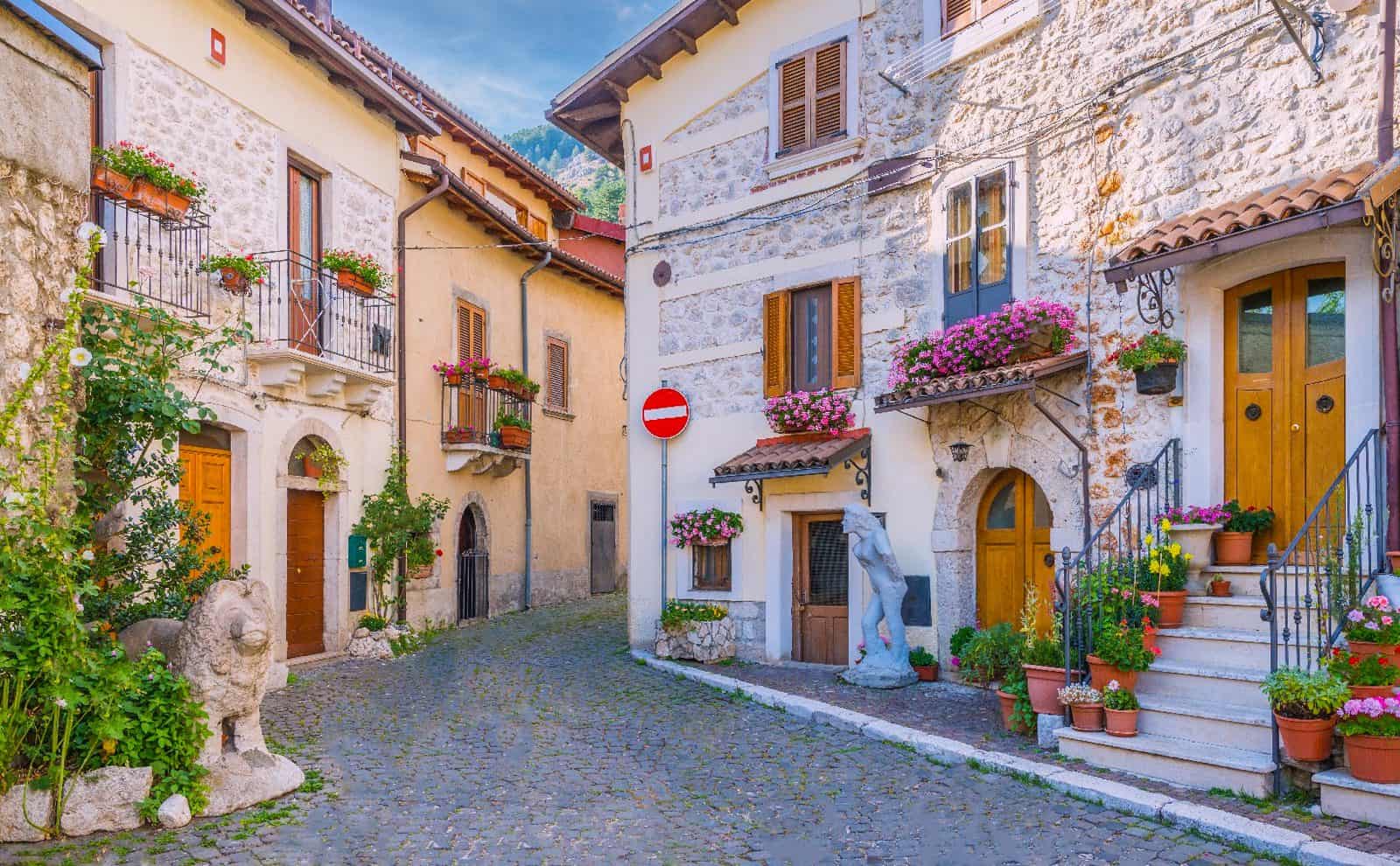
Traditional building is in rubble masonry and mortar, with windows framed by jambs of local cut stone, the so-called pietra gentile, named after the mountain from which it was quarried. It's a detail worth learning to recognize: in the streets of the center the pietra gentile frames are the only decorative element of otherwise bare houses, and they distinguish historic building from recent reconstructions. Look at the lintels: where the stone is gray and slightly soapy to the touch, you are in front of the original material.
Piazza Sant'Antonio, the living room of Pescasseroli (AQ)
The main square takes its name from a church that no longer exists, and that's already a story: place names keep vanished buildings much longer than stones do. It's the hub of town life, shaded by beeches and lindens, with the town hall on one side and a fountain topped by a statuette of the Immaculate Virgin. In July the lindens bloom and the square changes smell for two weeks. It's one of those things no guide writes and that anyone who has spent a summer here remembers.
Blunt opinion: the square should be experienced in the evening, after seven, when the day groups have left and the vacationers and townspeople remain. At midday in August it's only crowded.
What to see in Pescasseroli (AQ), place by place
The Church of Saints Peter and Paul in Pescasseroli (AQ)
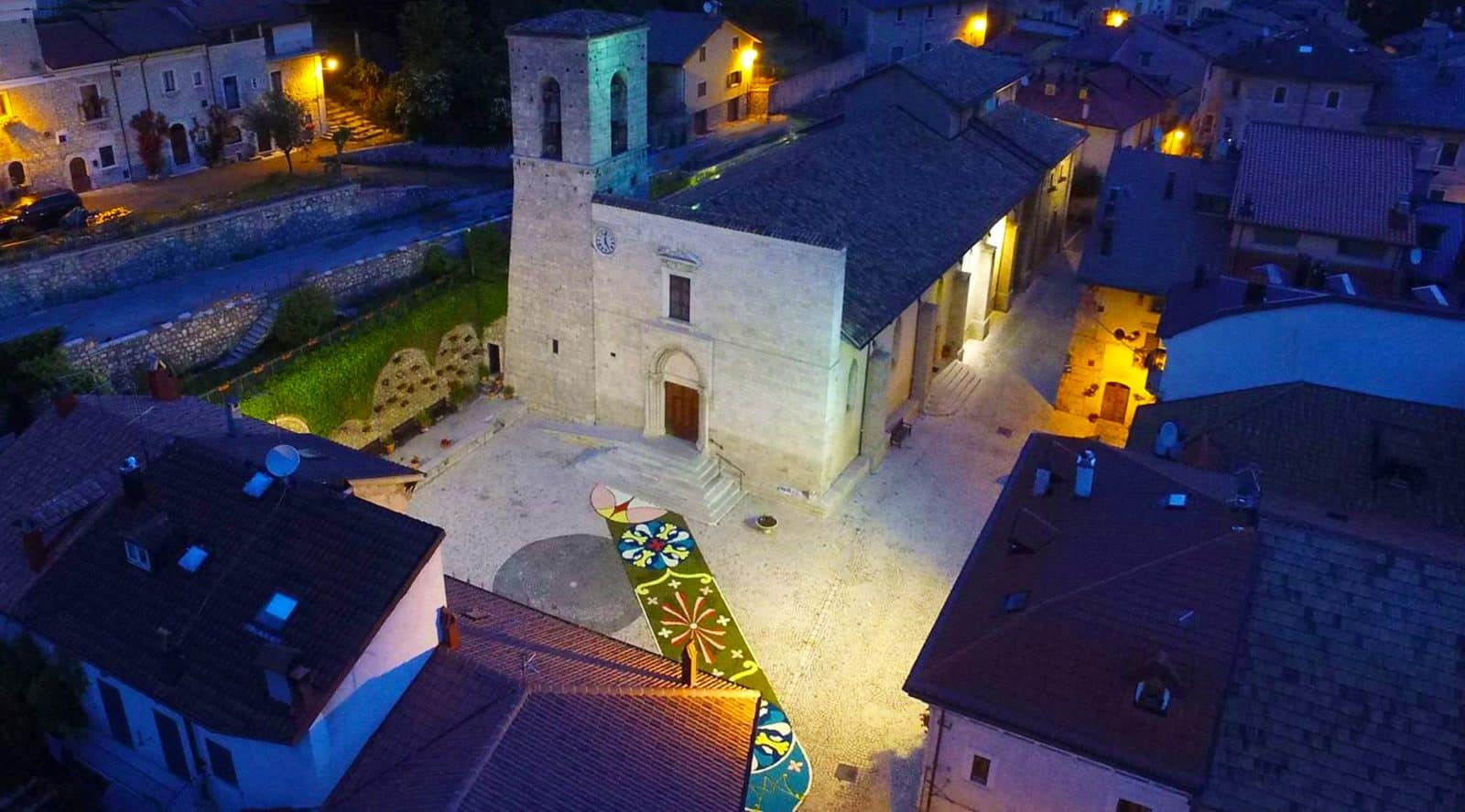
It's the most important building in the town and the most layered. It stands on an early medieval Benedictine monastic cell, perhaps dependent on Montecassino or San Vincenzo al Volturno: local sources place that first core between the 8th and 9th centuries, but this is scholarly tradition, not archaeological fact. The first certain document is from 1115, a bull of Pope Paschal II that names the church. This is the date to keep in mind, and it also clarifies why old information sheets speak generically of a foundation around 1100.
The earthquake of 1349, which devastated half of central-southern Italy, destroyed the building. The reconstruction took place in late Abruzzese Gothic, with cross vaults. A later quake damaged the facade and apse, rebuilt in late Renaissance forms: it is in this phase that the title of Saint Peter is placed beside that of Saint Paul. Between the 17th and 18th centuries the interior was clad in stuccoes, gilding and marble altars, with the altar of Saint Joseph and that of the Madonna Incoronata, and a carved walnut choir. The Marsica earthquake of January 13, 1915 did very serious damage and the church stayed closed until the restoration of 1937, which brought to light 15th-century elements hidden by Baroque overlays. Other works followed after the Second World War.
What to really look at, in front of the original: the juxtaposition between the Gothic vaults and the 18th-century decoration. It's a coexistence that you often see in Abruzzo and is always instructive, because it tells of two different religious mentalities layered in the same space.
The Black Madonna Incoronata, the piece worth the trip
Inside the church is venerated a wooden statue of the Madonna and Child, dark in color, attributed to the 13th century. Local tradition says the original was moved here from a castle chapel around the 15th century. On September 8, 1752 the sculpture was solemnly crowned with a gold crown sent by the Vatican Chapter: from that moment she is the Madonna Incoronata of Pescasseroli, and the feast of September 8 and 9 remains the most deeply felt of the year. Pope Eugene IV, in the 15th century, had already granted plenary indulgence to those who visited the church on the feasts of the Nativity, the Purification, the Assumption and the Visitation: a privilege that says how ancient and important the cult was.
The 1998 restoration recovered the original polychromy of the sculpture, bringing to light a dark blue garment with white decorations and a golden mantle with geometric motifs. It's a fact that changes the reading of the work: the Madonna wasn't born black, she became so through the oxidation of the varnishes and the smoke of candles over the centuries, as happened to many other dark madonnas of Europe. Whoever arrives convinced of finding an intentionally dark statue does well to know how things stand.
The Church of the Madonna del Carmine in Pescasseroli (AQ)
Also called the church of the Carmelo, it was built in the course of the 18th century. It is the devotional building for the feast of the Madonna del Carmelo, which falls on July 15 and 16, and on those two days the town revolves around it. Outside those dates it is a small, sober church, which you visit in 5 minutes and which serves above all to understand the relationship between the 18th-century confraternities and the urban fabric of a mountain town.
The Chapel of the Addolorata and the link with the Sipari
Also called the church of Santa Maria degli Angeli, it appears for the first time in a document of 1638. It stands next to Palazzo Sipari and is included in the assets of the foundation named after Erminio and Zel Sipari. The physical closeness between the chapel and the palace is no accident: it is the classic model of the 19th-century noble residence that annexes a pre-existing place of worship and makes it, in effect, its own private chapel.
The Church of Santa Lucia
Mentioned in a document of 1693, it is the most discreet of the churches of Pescasseroli and the easiest to miss. It is worth the detour for those who look for minor religious building, the kind without famous works of art and with the whole social history of the town carved into the gravestones and the poor furnishings.
The Sanctuary of Santa Maria di Monte Tranquillo
This deserves a chapter of its own because it is not in town: it stands at 1,597 meters elevation on Monte Tranquillo, about 10 kilometers from Pescasseroli, and you reach it on foot along the trail that climbs from the pass. The construction probably dates from the early 12th century and tradition attributes it to Saint Berard, bishop of the Marsi, as a refuge for pilgrims crossing the passes of the Marsica. Earthquakes between the 17th and 18th centuries, then the quake of 1915, then the Second World War: the building was reconstructed in 1956.
The statue of the Black Madonna you see today is a copy made in 1982 to replace the original, stolen in 1980. Tradition holds that the sculpture had been brought here from Foggia to remove it from the iconoclasts, which links the sanctuary to the transhumance route toward the Tavoliere: one more clue to the long relationship between this valley and Puglia. The feast falls on the last Sunday of July and the procession leaves from the Church of Saints Peter and Paul, in mountain dress or on horseback. An authorization of Charles I of Anjou in 1283 granted a fair on the occasion of the feast of the Madonna Incoronata on September 8: the Angevin document says, indirectly, that these cults were already rooted in the 13th century.
A professional's opinion: the climb to Monte Tranquillo is the best half day Pescasseroli offers to those who walk reasonably well. It's not difficult, the elevation gain is manageable, and the sanctuary at the top repays the breath spent.

Palazzo Sipari, where Benedetto Croce was born
In the historic center rises the palace of the Sipari family, built in 1839 in place of the palace of the Massa barons, the last feudal lords of the place. The building is late Renaissance in style with Neoclassical decorations, covers about 1,000 square meters and is laid out over four floors. Emidio Agostinoni, in Altipiani d'Abruzzo, described it like this: "It bears the imprint of an exquisite, very simple architecture combined with the last elements of the languishing Neoclassical period and with some reminiscence of the triumphant empire. The vast palace, rich in a garden terrace and immense halls, is notable especially for a strange foresight of the Sipari ancestor who wanted it. When it was built, the valley was crossed only by a mule track, the carriage to Pescasseroli was still a dream. And yet the doors were opened so wide, the entrance halls designed so comfortable, as to allow, after a century, free movement to the most powerful automobile."
That judgment contains the finest detail of the palace: the doors and entrance halls were designed with measurements that at the time served nobody, because no carriages reached the valley, and that a century later made it possible for cars to drive in. Call it far-sightedness or call it ostentation: the result is a building that absorbed without trauma the passage from the age of the mule to that of the motor.
On February 25, 1866 the philosopher Benedetto Croce was born on the second floor, son of Luisa Sipari. In the course of the 19th and 20th centuries the palace hosted Victor Emmanuel III, Duke Amedeo of Aosta and other members of the Royal House and of the government. Today it is the seat of the house museum run by the foundation named after Erminio Sipari, deputy, naturalist and first president of the Park, and his wife Zel. The guided visit covers the rooms lived in by the family from 1839 to 2006, with readings of passages from the Discorso di Pescasseroli and a deeper look at the birth of the protected area. It lasts about an hour and is booked by phone.
A blunt and unpopular opinion: whoever enters Palazzo Sipari thinking only of Croce misses half the story. The most interesting part is the one about Erminio, not Benedetto. The naturalist cousin is the man who invented nature conservation in Italy, and his house is the right place to understand how he managed it.
Castel Mancino, the castle that gave the town its name
On the hill above the settlement, between 1,275 and 1,332 meters elevation, in the locality of Colle del Castello, remain the ruins of an enclosure castle: perimeter walls, building foundations, lookout towers. It was built by the Borrello lords starting in the 11th century to defend the territory from raids, and it was gradually abandoned in the course of the 14th century, after strong earthquakes and with changing economic conditions. In the Middle Ages it identified the core called Serule, then Pesculum ad Serule: that is, literally, the name from which Pescasseroli derives.
The place name Castel Mancino is late and uncertain: it appears to have been used for the first time in the 20th century by the shepherd-poet Cesidio Gentile. It's worth knowing, because in guidebooks you often read it as if it were a medieval name, and it isn't.
The nature trail that takes you there is less than 2 kilometers long, suitable for anyone with decent shoes, and gives a view over the whole basin and the peaks that close it. It's the right walk for the early afternoon of the arrival day: it serves to understand where you've ended up.
The archaeological sites of Pescasseroli (AQ)
Besides the castle ruins, the territory keeps traces of ancient occupation. In the Park Visitor Center is displayed the burial with the remains of a woman who lived here in the 6th century BC: it is the find that concretely links this valley to the world of the pre-Roman Marsi, and that disproves the idea of a depopulated mountain before the Middle Ages. Between Campomizzo, in the territory of Gioia dei Marsi, and Pescasseroli, ruins of villages and villas of the Roman age are also reported. They are not areas equipped for visits: they are indications for those who read the landscape, not museum sites.
The Visitor Center, the natural history museum and the wildlife area
The Park Visitor Center is the facility that makes Pescasseroli something more than a nice mountain town. It hosts the natural history museum, which explains the geology, flora and fauna of the protected area, and the wildlife area, where animals found injured or otherwise no longer able to survive in the wild live. Here you see the Marsican brown bear, the Apennine wolf, the roe deer, the lynx and recovered raptors. It has to be said clearly, because too many arrive with the wrong expectation: these animals are not on display for entertainment, they are housed because they cannot return to freedom.
Hours and fares are given by the Park Authority on its official website and change with the season, so they need to be checked beforehand. Advice: give it at least an hour and a half and visit it at the start of your stay, not at the end. The museum teaches you to look at the forest, and it is of little use when you have already crossed the forest.
The Apennine garden and the botanical garden
Next to the Visitor Center extends the Apennine garden, where the plant species typical of the Park are gathered, arranged by altitude band. It's the place to learn to tell the beech from the sycamore maple and the black pine from the mountain pine before finding them in front of you at altitude. In the garden you easily observe squirrels, woodpeckers, tits, treecreepers and finches: an hour with binoculars here yields more than 3 hours of walking at random.
La Camosciara and the Ninfe and Tre Cannelle waterfalls
A few kilometers away, in the territory of Civitella Alfedena, opens the strict nature reserve of the Camosciara, the first historic core of protection of the Park. The Scerto stream plunges onto the rocks below forming the Ninfe waterfall and the Tre Cannelle one: two drops reachable with a short, flat walk from the parking lot, suitable even for those with small children. It's the cheapest way to see something memorable in this valley, and in summer you go early in the morning or give up the silence.
The history of Pescasseroli (AQ), from the Marsi to the 20th century
The origin of the name Pescasseroli
The etymology has lent itself to several hypotheses, and Benedetto Croce discussed them in the monograph he devoted to his native town. The generic pesclum, peschio or pesco, means a high and steep place, and in this specific case it indicates the ridge on which the castle ruins stand: on this there is agreement. The problem is seroli. Some derived it from serra, meaning the closing of the gap that joins the Serre mountains. The geographer Roberto Almagià proposed the serretta, the small serra that extends from Monte Forcella toward the Sangro. Croce found neither convincing and suggested considering the attested forms Pesclum ad Serolum, Pesculum ad Serule and Pesclum Ansericum in the sense of peschio near the Sangro, from the Latin Sarus, which rises not far away and flows under that mountain, still small and poor in water: Sarolus, little Sangro.
Let's distinguish the degrees of certainty, because here it's needed. That the first element is pesclum is an established fact. That the second refers to the nascent Sangro is Croce's hypothesis, elegant and never demonstrated. That it derives from serra or serretta remains the competing hypothesis. Whoever tells you the etymology as a certain fact is simplifying for you.
Pescasseroli (AQ) in antiquity: Marsi, Peligni and Samnites
The initial slope of the upper Sangro valley was a land of passage for the Marsi, the Peligni and the Samnite tribes. A misunderstanding that has circulated for centuries needs correcting: the ancient city of Plestinia, which Marsican historians like Muzio Febonio placed among the heights of Campomizzo and Pescasseroli, should in all probability be identified with the remains of the Rocca Vecchia of Pescina, in the Giovenco valley. It is a classic case of 17th-century erudition handed down by inertia.
After Roman colonization the area fell within the ager of the Volscian city of Atina, while beyond Barrea one entered that of the Pentrian city of Aufidena. At the end of the Samnite wars the upper-Sangro ager marsorum was not overturned: the territories near the boundary marked by Monte Marsicano, in particular the oppidum of the Val Fondillo of Opi and the Pescasseroli area, were included in the gens Sergia.
The Pescasseroli-Candela tratturo, the road that made history
This is the chapter nobody tells enough. The Pescasseroli-Candela tratturo was born in the imperial era as a military road traveled by the legions, and some scholars propose that it follows the route of Via Traiana. From the Middle Ages it became the great pastoral route of transhumance from the Abruzzo mountains to the Tavoliere delle Puglie. It is 211 kilometers long, in some stretches up to 60 meters wide, and is the third longest tratturo of southern Italy. They also called it the wool road.
60 meters of width is the measure that strikes whoever hears it for the first time. It was not a road: it was a state-owned grassy corridor, protected by law, along which tens of thousands of sheep came down every autumn and went back up every spring. The name of Pescasseroli appears at the northern end of that corridor: it means that this town was a recognized starting point in the economic system of the Kingdom of Naples, not a peripheral village. Whoever wants to follow the theme can then look elsewhere in Lazio for historic ridge routes, like the Sentiero dei Briganti, which tells of another way of crossing the Apennines.
Pescasseroli (AQ) between the Middle Ages and the modern age
The locality took the place name Serule and later Pesculum ad Serule. Fallen into ruin, the fortified center was definitively abandoned in the 14th century in favor of the settlement that had developed in the valley. Pescasseroli fell among the domains of the Borrello family in the 11th century and as a sub-fief of the Di Sangro. From these, after the fall of the Swabians, it passed to the d'Aquino. In 1349, when Adenolfo II d'Aquino perished with his whole family under the ruins of the castle of Alvito, the fief went to the branch of the counts of Loreto. In 1461 the barony was inherited by Antonella d'Aquino, marchioness of Pescara.
At the end of the 16th century the fief was sold to Giovan Giacomo di Sangro, who died in 1607. Put up for auction, it knew until the early 18th century a long succession of owners, until in 1705, for 15,770 ducats, it was bought by the Massa family of Sorrento, last barons of Pescasseroli before the rise of the 19th-century bourgeoisie, represented here by the Sipari.
Notice the coincidence of dates: 1349 is the year the earthquake brings down the church and the year the lord of the fief dies under the rubble of another castle. In the memory of this valley the 14th century is the century in which everything collapses, and it isn't a metaphor.
The contemporary age and the 20th century in Pescasseroli (AQ)
From the Napoleonic age, from 1811, until the unification of Italy in 1860 the town was part of the district of Avezzano, then of the Marsican circondario until 1927. On January 13, 1915 the Marsica earthquake partly damaged the historic center and closed the parish church for over 20 years. After the damage of the Second World War the center began to repopulate thanks to tourism. Having also overcome the crisis that followed the 1984 earthquake in central-southern Italy, the town became one of the region's reference tourist destinations, above all for the sports and accommodation infrastructure born following the establishment of the park authority. In 1971, the year the mountain communities were established, the territory entered the Comunità Montana Alto Sangro e Altopiano delle Cinquemiglia, abolished in 2013. Today the inhabitants are just over 2,000.

The Abruzzo National Park and the birth of Italian conservation
The Abruzzo National Park was inaugurated with a solemn ceremony right in Pescasseroli. On September 9, 1922, at the San Rocco fountain, at the entrance to the town coming from Bisegna and Gioia dei Marsi, the stone inscription was unveiled: "The Abruzzo National Park, born for the protection of the woodland beauties and the treasures of nature, inaugurated here on the IX of September MCMXXII". The formal recognition by the State came on January 11, 1923. The administrative seat of the authority is still here.
Behind that ceremony is Erminio Sipari, deputy and naturalist, Croce's cousin, who led the political battle for establishing the protected area and was its first president. And there is Croce himself, who as minister of Public Education presented the bill For the protection of natural beauties and of buildings of particular historical interest, approved as law 778 of 1922: the first legislative foundation of the Italian national parks. Two men born in the same family, in the same palace of a town of 2,000 inhabitants, wrote the foundations of environmental protection in Italy. It's a fact that in Pescasseroli is taken for granted and elsewhere is not known at all.
The ancient beech forests, UNESCO World Heritage
In 2017 five cores of ancient beech forests, over an area of more than 1,000 hectares spread among the municipalities of Lecce nei Marsi with the Selva Moricento, Opi with Cacciagrande and Val Fondillo, Pescasseroli with Coppo del Principe and Coppo del Morto, and Villavallelonga with the Val Cervara, were inscribed on the World Heritage list within the serial site of the primeval beech forests of the Carpathians and other regions of Europe. Some of these trees are about 560 years old. It is the first UNESCO recognition of the entire Abruzzo region.
What "ancient" means, in concrete terms: a beech forest never cut, in which dead wood stays on the ground and feeds the cycle, with trees of all ages present at the same time. In western Europe very few remain, and that is why UNESCO has protected them. Coppo del Principe and Coppo del Morto are in the territory of Pescasseroli and can only be reached on foot, along regulated routes: access to an ancient core is not a free walk, and the Park Authority sets the methods and periods.
Skiing at Pescasseroli (AQ): the Monte delle Vitelle resort
The ski area develops on the slope of Monte delle Vitelle, starting from the valley floor at 1,167 meters. There are six lifts between chairlifts and surface lifts. A detachable quad chairlift takes you to around 1,820 meters, and the maximum elevation of the area is given as 1,945 meters. There are 14 downhill runs, about eight kilometers in total, spread among easy, intermediate and two black. The most demanding is the Direttissima, which descends from the summit with serious gradients and off-piste variants.
The cross-country is this resort's best card, and almost nobody says so: on the Macchiarvana plain, between Pescasseroli and Opi, about 25 kilometers of loops of 5, 10, 20 and 30 kilometers are groomed. For cross-country skiers it is one of the most beautiful settings in the central Apennines, with the advantage of being flat and crossing real woods.
There are ski schools, a beginners' practice area and a snowtubing facility open all year. There are also ski-mountaineering routes and snowshoe trails, and several huts at altitude and in the valley work as refreshment points.
Opinion without beating around the bush: whoever looks for a big downhill ski area should look at Roccaraso, not Pescasseroli. Whoever looks for a family-sized mountain, with short lines, human prices and a living town around the slopes, will find here exactly what is needed. The two things don't overlap, and confusing them produces unfair reviews.
The ski pass of Pescasseroli (AQ) and the Alto Sangro area
The resort issues seasonal, daily, multi-day and hourly passes, the latter a formula very useful for those who ski half a day with children. Pescasseroli is part of the Alto Sangro area, which also includes Roccaraso, Rivisondoli, Pescocostanzo and the Barrea area: the single ski pass opens up a set of downhill and cross-country runs much larger than the local one. Fares change every season and are consulted with the company that manages the lifts. Multi-day passes pay off from the third day.
What to do in summer at Pescasseroli (AQ)
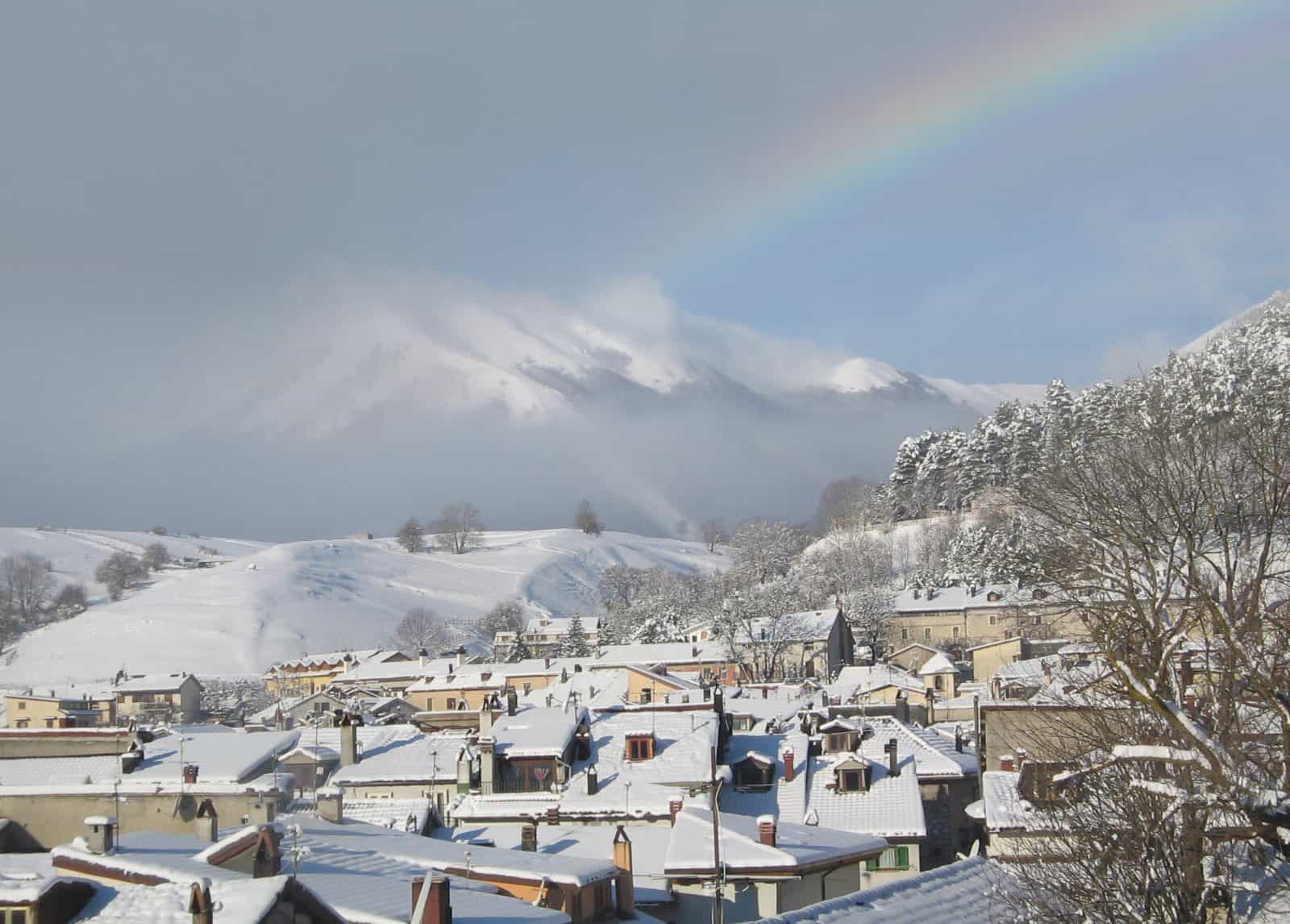
In summer the town changes function and becomes what it always was before skiing: a climatic resort. With the valley floor at 1,167 meters, in August in the evening you put on a sweatshirt, and that is enough to explain why generations of Romans and Neapolitans have spent their holidays here. You come to walk, to bike and to be outdoors.
The hiking possibilities are wide: on foot, by mountain bike or on horseback, with riding stables offering programs dedicated to children and teens. At the ski lifts a bike park works with equipped routes. In town there are tennis, soccer and volleyball courts, a riding center, a skating rink and an archery range. The Park's wildlife area remains the most requested visit, and in August it's best to go at the first opening in the morning.
A last note on behavior, which here is not pedantry. Pescasseroli is one of the few towns in Europe where a bear can cross the street at night. Garbage is kept closed, food isn't left in the garden, and dogs are kept on a leash. The coexistence of a tourist town and a population of Marsican brown bears is a fragile balance built over 100 years: whoever comes from outside has a duty not to break it.
Hikes and trails from Pescasseroli (AQ)
The Park's trail network is marked with a sector letter and a number. These are the itineraries starting from the Pescasseroli area, with travel time and difficulty grade according to the managing authority's classification, where F stands for easy, M for medium and D for difficult.
- (A1) La Canala - Rifugio Pratorosso: 1 hour, F
- (A2) Rifugio Pratorosso - Terraegna: 1 hour, F
- (A3) Terraegna - Valico Carapale: an hour and a half, D
- (A4) Rifugio Pratorosso - Valico Campitello: 1 hour, M
- (A5) Rifugio Pratorosso - La Cava: 1 hour, M
- (A6) Pratorosso - Monte Marsicano: 4 hours, M
- (B1) Vallone Pesco di Iorio - Valico Aceretta: an hour and a half, M
- (B2) Capo Vallebona - Sorgente Puzza: 2 and a half hours, M
- (B4) Sorgenti - Rifugio di Iorio: 1 hour, M
- (B5) Valico Aceretta - Rifugio di Iorio: 1 hour, F
- (B6) Valico Aceretta - Monte delle Vitelle: half an hour, F
- (C1) Bocca del Petroso - Statale di Forca d'Acero: 3 hours, F
- (C2) Curva Casale - Macchia la Rocca: a quarter of an hour, F
- (C3) Fonte della Difesa - Monte Tranquillo: 2 and a half hours, M
- (C4) Camporotondo - Campo Lungo: 40 minutes, F
- (C5) Valico di Monte Tranquillo - Rifugio di Iorio: 2 and a half hours, M
- (D1) Campeggio dell'Orso - Colli Alti: 2 hours, M
- (D2) Campeggio dell'Orso - Le Prata di Opi: 1 hour, F
- (D3) Campeggio dell'Orso - Macchiarvana: 2 and a half hours, M
- (D4) Campeggio dell'Orso - Valle Mancina: an hour and a half, M
- (D5) Portella - Camporotondo: 2 hours, M
- (D6) Pescasseroli - Colli Alti: an hour and a half, M
- (BN1) Castel Mancino Nature Trail
To these is added the Sipari trail, part of the Sentiero Italia, which links Alvito to Pescasseroli and which in 2018 the managing authority named after Erminio Sipari. It is the route that joins the Lazio side to the Abruzzo side of the Park, and for whoever wants to understand the geography of the protected area it is worth more than 10 maps.
Trail openings are regulated seasonally to protect wildlife: some itineraries stay closed in certain periods of the year. Before leaving you check the updated list at the Visitor Center, and you don't improvise. The mountain here is severe and snow cover lasts a long time.
Traditions, feasts and folklore at Pescasseroli (AQ)
- Feast of San Antonio Abate, on January 17, with the winter bonfires
- Candlemas feast, in February
- Corpus Domini flower carpet, in June, with carpets of flowers along the procession route
- Feast of Saint Paul, patron of Pescasseroli, on June 29 and 30
- Feast of the Madonna del Carmelo, on July 15 and 16
- Madonna di Monte Tranquillo, the last Sunday of July, with the climb to the sanctuary
- Feast of the Madonna Incoronata, on September 8 and 9, the best attended of the year
- Premio Croce, a national culture prize named after the philosopher, with sections for fiction, literary journalism and essays
- Weekly Wednesday market
- Guided snowshoe hikes in the woods organized by the Park Authority in the winter season
The calendar says one precise thing: six of eight occasions are Marian or patronal, and three concern the same image, the Madonna Incoronata, celebrated in town in September and at altitude in July. It is not generic devotion: it is the sign of a cult central to the identity of the community.
What to eat at Pescasseroli (AQ)
The cooking is the pastoral cooking of the Alto Sangro, poor in ingredients and long in cooking times. The signature dish is agnello al cotturo, cooked slowly in a copper pot with mountain herbs: it was born as the shepherds' meal on the pastures and today is found at festivals and in some trattorias. Then there are patate maritate, the sheep and goat cheeses of the valley, and ricotta.
On the sweet side two preparations deserve the name: torcinelli, a fried Christmas sweet, and P'plla, an Easter sweet whose dialect name has no elegant translation in Italian. These are things found at the right time and not all year: asking for a P'plla in August is like asking for chestnuts in May.
I name no places, for a precise reason: in towns of 2,000 inhabitants managements change and advice written today ages fast. The criterion that always works in Abruzzo is simpler: go in where the local old people eat at midday.
Pescasseroli (AQ) with children
It is one of the Apennine destinations best suited to families, and not as a slogan. The town is flat and can be done with a stroller. The wildlife area offers an encounter with bear and wolf in protected conditions. The natural history museum has displays understandable even to the little ones. The Castel Mancino nature trail is short and has a panoramic reward at the end. The Camosciara waterfalls are reached with a flat walk. In winter the practice area and snowtubing cover the under-six band, the one for which elsewhere there is nothing to be done.
The concrete advice: two full days are more than enough for a family with small children. The first dedicated to the Visitor Center, wildlife area and the town, the second to the Camosciara and a short walk. The third day, if there is one, is to be spent on Monte Tranquillo with the older kids.
Accessibility and visiting Pescasseroli (AQ) with reduced mobility
The flat settlement is a rare advantage: the streets of the center, the square and the main services are covered without significant slopes, something that in Apennine villages almost never happens. The Park Visitor Center and the wildlife area are recent structures designed with largely accessible routes. The specific conditions should be asked of the Park Authority. The story is different for Castel Mancino, for the Monte Tranquillo sanctuary and for the trails at altitude, which remain out of reach for those who move in a wheelchair. The historic churches have steps at the entrance, as almost everywhere in Italy.
When to go to Pescasseroli (AQ) and when to avoid it
The best season for walking is the second half of June, when residual snow has melted, the meadows are in flower and there is nobody yet. September is the other good moment: clear air, woods turning, and the feast of the Madonna Incoronata on the 8th and 9th. October gives the foliage of the beech forests, which here is of European level and which very few come to see.
To avoid, if you look for tranquility: the week of Ferragosto, when the town doubles its inhabitants, and weekends of fresh snow, when the lifts draw the entire Roman and Neapolitan basin. If you go anyway on those days, move before 9 in the morning: at 11 the game is already lost.
A climate fact useful for packing: here it rains and snows a lot, over 1,500 millimeters a year, and summers are cool. A waterproof shell in the backpack in August is not excessive prudence, it's experience.
What to see around Pescasseroli (AQ) within half an hour's drive
Opi, five kilometers away, is the ridge town you see from the state road and is worth the stop more than its fame suggests. Civitella Alfedena hosts the Apennine wolf wildlife area and the museum dedicated to it. Villetta Barrea and Lake Barrea close the valley to the southeast. Alvito and the Comino valley open the Lazio side beyond Forca d'Acero. Farther away, but in the same travel logic, are Scanno with its lake, the city of L'Aquila and the Campo Imperatore plateau in the Gran Sasso, as well as Santo Stefano di Sessanio.
Whoever returns toward Rome unhurried can break the trip at the Monti Simbruini or at the Grotte di Pietrasecca, in Carsoli, both a small detour from the motorway. Whoever comes down the southern side finds Atina, Sora and Lake Posta Fibreno. For an overall picture of excursions outside Rome the tourist attractions section remains useful.
Whoever is organizing the trip for a group or a company, and wants a guide who knows the valley, can turn to TourLeaderPro for tour escort services. For custom private experiences there is the page of personalized experiences for small groups. Whoever travels with foreign friends finds the English guide to the region at ItalyPlanner, Abruzzo section, and an overview of Italian mountains on the page mountains and nature.
A curiosity about Pescasseroli (AQ)
The curiosity is not about the bear, nor skiing, nor Croce. It is about an illiterate shepherd who taught himself to read and write walking behind the sheep along the tratturo, and who ended up being studied by the greatest Italian philosopher of the 20th century.
Cesidio Gentile, known as Jurico, was born in Pescasseroli on June 27, 1847 and died on October 14, 1914 at Civitanova del Sannio, from a fall from a horse. He was a massaro, meaning the person in charge of a flock, and every year he made the transhumance from Abruzzo to the Tavoliere delle Puglie. An absolute self-taught man, he relied on an uncommon memory: he composed in his head along the way and set down on paper only afterward. He wrote the Leggenda Marsicana, published in 1904, an unfinished epic poem on the history of the Marsi, and then Poesie Boscarecce, Poesie Sacre, Satira Patrio, a Storia dei Marsi.
Benedetto Croce took an interest in him and gave a precise reading: Gentile's work seemed to him a form of mediation between cultured literature and popular feelings and concepts, despite its markedly local character. Put in other terms: the philosopher of aesthetics recognized in a shepherd of his valley the role of hinge between two worlds that normally do not speak to each other.
There is a second layer, even more enjoyable. The name Castel Mancino, which everyone now uses for the ruins on the hill, is attested for the first time in the 20th century precisely in Gentile. A shepherd-poet baptized the oldest monument of the town, and his baptism won out over the documents. In 2024 his figure came back under the spotlight thanks to a film with Antonio Albanese inspired by the story of the shepherd-poet, and Pescasseroli found itself explaining to a national audience who Jurico was.
Something nobody tells you about Pescasseroli (AQ)
That the very idea of a national park, in Italy, was born here for an economic reason before an ecological one, and that the credit is to be split between two relatives who did not particularly get along.
Erminio Sipari was a deputy with business interests and a naturalist's training. When in the 1910s and 1920s he carried forward the battle for the protected area, he was not only defending chamois and bears: he was defending a development model for a valley that sheep farming was abandoning and that emigration was emptying. Tourism, in that vision, was the economic replacement of transhumance. It is exactly what happened, with 50 years of delay.
His cousin Benedetto, as minister of Public Education in Giolitti's fifth government, put his signature on the bill for the protection of natural beauties, which became law 778 of 1922. The two moves fit together: the national law and the local park arrive in the same year, and the inauguration of September 9, 1922 at the San Rocco fountain is the point where the two trajectories touch. In a few months, in Italy, the legal instrument and the first concrete case in the Apennines are born at the same time.
What nobody tells is the sequel: fascism put the authority under commissioner administration in 1933 and protection loosened for decades, with heavy consequences for wildlife. The Park we see today is the result of a second foundation, in the 1950s and 1960s, not of a continuous line. Whoever visits Pescasseroli thinking of 100 uninterrupted years of protection is looking at a simpler story than the true one.
The advice I give you for visiting Pescasseroli (AQ)
The advice is counterintuitive: don't come in August and don't come for a single day. Pescasseroli as a day trip is a trip-design error. Two and a half hours of curves out, two and a half hours back, and in between three effective hours in town: the ratio between effort and yield is terrible, and whoever goes home saying there wasn't much there simply picked the wrong format.
The right format is two nights, better three. With two nights you do this: arrival afternoon on the Castel Mancino trail to take the measure of the basin. Full morning at the Visitor Center, natural history museum, wildlife area and Apennine garden. Afternoon in town among the church of Saints Peter and Paul, Palazzo Sipari booked by phone and Piazza Sant'Antonio. Second full day on the climb to Monte Tranquillo or to the Camosciara with the waterfalls. Return on the third day with a stop at Opi and Civitella Alfedena.
On the season: the best is the second half of June, with meadows in flower and free roads. If you have to choose between a snowy weekend in January and a sunny one in October, take October without thinking. The foliage of the beech forests of the upper Sangro valley is a spectacle that has few comparisons in Italy, and in October you find room everywhere and different prices.
Last practical recommendation: always phone first. Palazzo Sipari opens for arranged guided visits, the Visitor Center has seasonal hours, the minor churches open for services. In a town of 2,000 inhabitants nothing works as in a city, and whoever understands that before leaving comes home happy.
Another well-known fact, yet rarely cited
That Benedetto Croce, the Neapolitan philosopher par excellence, was born here and from here drew a precise part of his own identity, and said so publicly in a speech worth reading in full.
The sentence is this: "And yet I have always kept alive the awareness of something that in my temperament is not Neapolitan. When the sharp clairvoyance of that population turns into skepticism and gay indifference, when there is need not only of agile intelligence and versatile spirit, but of firm will and persistence and resistance, I have often said to myself in a low voice, between me and me, and sometimes I said it aloud too: you are not Neapolitan, you are Abruzzese, and in this memory I found a bit of pride and much strength". The text is collected as Il Discorso di Pescasseroli in the Rivista Abruzzese of 1966.
The circumstances matter as much as the words. Croce had recently been named senator of the Kingdom, was 44 years old and returned for the first time since birth in August 1910. On August 21 he spoke from the balcony of Palazzo Sipari. He apologized to his fellow citizens for not having returned sooner, and the reason he gave is of disarming sincerity: he feared, using the word ghost, scattering the images he had built of the village as a child listening to the stories of his mother, Luisa Sipari. He was afraid reality would be worse than the dream.
It was not. Pescasseroli seemed to him, he said, more beautiful, broader, gayer and even more civilized than he had imagined it. And he closed with a prophecy: that the name of his native town would become in a few years familiar to everyone, because vacationers and excursionists would come from everywhere. He was right, and largely thanks to him. After that visit he donated to the Municipality the manuscript of the Logica, published in 1909 and dedicated to his parents, and wrote the monograph on Pescasseroli later placed in an appendix to the History of the Kingdom of Naples.
The right photo to take at Pescasseroli (AQ)
The postcard everyone takes is the town seen from the state road arriving from Opi, with the roofs below and the mountains behind. It's a good photo and you'll take it anyway. But the right photo is another, and it requires 40 minutes of walking.
Climb the Castel Mancino nature trail in the late afternoon, an hour before sunset. From up there, between 1,275 and 1,332 meters, you dominate the whole basin: the town on the flat in the center, the Sangro cutting through it, the pastures, and the crown of peaks all around. With the low sun the light enters raking from the west and separates the planes, the meadows turn gold, the beech forests stay dark. If there's haze on the valley floor, better still: the layers detach. Frame with a ruin of the walls in the foreground on the left and the town below on the right, and you'll have an image that explains at a glance why this settlement is where it is.
The second photo, the winter one, is taken from Macchiarvana on the cross-country loops, with the parallel tracks on the snow and the bare beeches as a backdrop. You need a day after the snowfall, with a clear sky.
Two rules worth more than any technical setting. The first: in the Park you don't leave the trails to look for the shot, ever, and you don't chase wildlife. The second: bears are not photographed by getting closer. If an animal changes behavior because of you, you're too close, and the photo isn't worth the disturbance. Telephoto lenses exist for this.
Some important events that took place here in history
On September 9, 1922, at the San Rocco fountain, the inauguration ceremony of the Abruzzo National Park with the unveiling of the plaque. It is the founding event of nature conservation in Italy, and it took place at the entrance of this town. State recognition followed on January 11, 1923.
On August 21, 1910, the Discorso di Pescasseroli from the balcony of Palazzo Sipari: Benedetto Croce, recently a senator, returns for the first time to his birthplace and delivers the text that ties his name forever to this valley.
On February 25, 1866, the birth of Croce on the second floor of Palazzo Sipari. A date that, for once, is not tradition but document.
On January 13, 1915, the Marsica earthquake. The quake that razed Avezzano severely damaged the historic center of Pescasseroli and forced the closure of the parish church, reopened only after the restoration of 1937. 22 years without the mother church, in a mountain town of the early 1900s, are a social wound before an architectural one.
In 1349, the earthquake that destroyed the church of Saints Peter and Paul and, the same year, the death of Adenolfo II d'Aquino with his whole family under the ruins of the castle of Alvito, which sent the fief to the counts of Loreto. Two collapses in the same year, one material and one dynastic.
On September 8, 1752, the solemn crowning of the Black Madonna with the gold crown sent by the Vatican Chapter: the act that consecrates the local cult at the Roman level.
In 1705, the purchase of the barony by the Massa family of Sorrento for 15,770 ducats, a figure that gives the measure of the economic value of this pastoral fief in the 18th century.
In 1839, the construction of Palazzo Sipari in place of the palace of the Massa barons: the passage of local power from the feudal aristocracy to the 19th-century bourgeoisie, made visible in a building.
In 2017, the inscription of the ancient beech forests on the UNESCO World Heritage list, the first recognition of its kind for Abruzzo.
Who passed through Pescasseroli (AQ)
Benedetto Croce (1866-1952), born here and returned in 1910, author of the monograph Pescasseroli and promoter of law 778 of 1922 on the protection of natural beauties. The link is documented and productive: his signature on that law also arises from this valley.
Erminio Sipari (1879-1968), deputy, naturalist, Croce's cousin, architect of the establishment of the Abruzzo National Park and its first president. The house museum that bears his name, with that of his wife Zel, is inside Palazzo Sipari.
Victor Emmanuel III and Duke Amedeo of Aosta, guests of Palazzo Sipari, together with other members of the Royal House and members of the government. The presence of the court in a mountain town of inland Abruzzo says a lot about the prestige the Sipari had built.
Cesidio Gentile known as Jurico (1847-1914), the shepherd-poet, author of the Leggenda Marsicana, studied by Croce and responsible for the name Castel Mancino.
Emidio Agostinoni, author of Altipiani d'Abruzzo, who described Palazzo Sipari with the page quoted above: it is the literary testimony that fixes the look of the building before the 20th-century transformations.
Muzio Febonio (1597-1663), Marsican historian, who placed the ancient city of Plestinia here. He was wrong, but his hypothesis conditioned local historiography for three centuries, and that makes him in any case a figure who passed through here, at least with his pen.
Roberto Almagià (1884-1962), the greatest Italian geographer of the 20th century, who weighed in on the etymology of the place name by proposing the derivation from serretta: a minimal detail that says how much the name of this town has engaged serious scholars.
I add a collective category, which is worth more than many single names: the transhumant shepherds. For centuries, every autumn, tens of thousands of sheep and hundreds of men set out from here along the tratturo to Candela and came back in spring. They left no monuments or signatures, but they built the landscape that is photographed today.
Quick questions about Pescasseroli (AQ)
How far is Pescasseroli (AQ) from Rome?
About 170 kilometers and two and a half hours by car for the fastest route, A25 exiting at Pescina or Celano and then state road 83. The southern route over Forca d'Acero is longer in time and more beautiful in landscape.
Can you get to Pescasseroli (AQ) by train?
No. There is no railway station in town. You get off at Avezzano, on the Rome-Pescara line, and continue by bus or taxi.
Are there direct buses from Rome to Pescasseroli (AQ)?
Yes, the Abruzzo regional bus lines link Roma Tiburtina to the Alto Sangro, with a frequency that varies a lot by season. The times are checked on the carrier's website, and it's best to fix the return before the outbound.
How much does it cost to visit Pescasseroli (AQ)?
The town, the churches and the walks cost nothing. You pay for the ticket to the Park Visitor Center with the natural history museum and wildlife area, the guided visit to Palazzo Sipari and the ski lifts in winter. Updated fares are on the websites of the Park Authority, the Sipari Foundation and the lift company.
How much time do you need to visit Pescasseroli (AQ)?
Two full days, three if you want to add a long hike. As a day trip from the capital it's the wrong format: you spend more time in the car than in town.
Can you see bears at Pescasseroli (AQ)?
In the Visitor Center's wildlife area you see specimens of Marsican brown bear that cannot be reintroduced to the wild. In the wild a sighting is possible but rare and cannot be planned, and it should not be sought: approaching wild fauna is dangerous and forbidden.
Is Palazzo Sipari visitable?
Yes, as a house museum, with guided visits of about an hour arranged with the Sipari Foundation at the numbers 0863 910748 and 334 3495164. It has no continuous hours: phone first.
At what altitude is Pescasseroli (AQ)?
The town is at 1,167 meters above sea level. The peaks around exceed 2,000 meters.
How many inhabitants does Pescasseroli (AQ) have?
A little over 2,000 residents, who multiply in August and on winter weekends.
Where do you park at Pescasseroli (AQ)?
Along the ring road and in the open spaces at the entrance to the settlement, partly paid in peak periods. The center is done on foot.
Is Pescasseroli (AQ) suitable for children?
Very. Flat town, wildlife area, natural history museum, short trails, Camosciara waterfalls reachable on the flat, practice area and snowtubing in winter.
Can you visit Pescasseroli (AQ) in a wheelchair?
The town is flat and that helps a lot. The Visitor Center is a recent structure with largely accessible routes, to be checked specifically with the Park Authority. Trails at altitude, Castel Mancino and Monte Tranquillo are not accessible.
How many kilometers of slopes are there at Pescasseroli (AQ)?
About eight kilometers of downhill on 14 runs, with six ski lifts, plus about 25 kilometers of cross-country loops on the Macchiarvana plain.
Is the Pescasseroli (AQ) ski pass also valid at Roccaraso?
With the Alto Sangro area ski pass yes: it includes Roccaraso, Rivisondoli, Pescocostanzo and the other resorts of the circuit. The local ski pass is valid only on the Monte delle Vitelle lifts.
What is the difference between Pescasseroli (AQ) and Opi?
Opi is a ridge town, small and vertical, with a more photogenic urban scenery. Pescasseroli is on the flat, bigger, and is the Park's services center. They are visited together, they are five kilometers apart.
When is the feast of the Madonna Incoronata at Pescasseroli (AQ)?
September 8 and 9. The feast of the Madonna di Monte Tranquillo, with the climb to the sanctuary, falls instead on the last Sunday of July.
What do you eat at Pescasseroli (AQ)?
Agnello al cotturo, patate maritate, mountain cheeses and ricotta. Among the sweets, torcinelli at Christmas and P'plla at Easter.
Can you visit the UNESCO beech forests?
Coppo del Principe and Coppo del Morto are in the territory of Pescasseroli and can be reached on foot, but access to the ancient cores is regulated by the Park Authority: methods and periods must be asked at the Visitor Center.
Does it snow a lot at Pescasseroli (AQ)?
Yes. Precipitation exceeds 1,500 millimeters a year and winter snow cover is substantial. In winter you need suitable tires and chains on board, and the Forca d'Acero pass can close.
What is the best time to go to Pescasseroli (AQ)?
The second half of June for the flowers and the silence, September for the clear air and the patron feast, October for the foliage of the beech forests. Ferragosto and weekends of fresh snow are the most crowded moments.
We'll close with our opinion. Pescasseroli is not a postcard village, and anyone who judges it by that yardstick leaves disappointed: the houses are plain, the old town is short, and there's no whole castle to photograph. The value of this place is elsewhere, and it's the kind you can't see in three hours. It lies in the basin, in the pastures, in the woods that start where the houses end, and in a cultural history out of proportion to the 2,000 inhabitants who live here: this is where the Italian idea of protecting nature was born, this is where the philosopher who gave it its first law was born, and this is where an illiterate shepherd wrote a poem. Come with the right shoes, book a phone call at Palazzo Sipari, stay at least two nights and look at the basin from above at sunset. Then tell me if I was wrong.
Article written by the editorial team of TourLeaderPro, contact them for Private/Corporate/V.I.P. Tours and Experiences.
Planning a trip to Rome? The English guides to visiting the city are on ItalyPlanner.com.