Scanno (AQ)
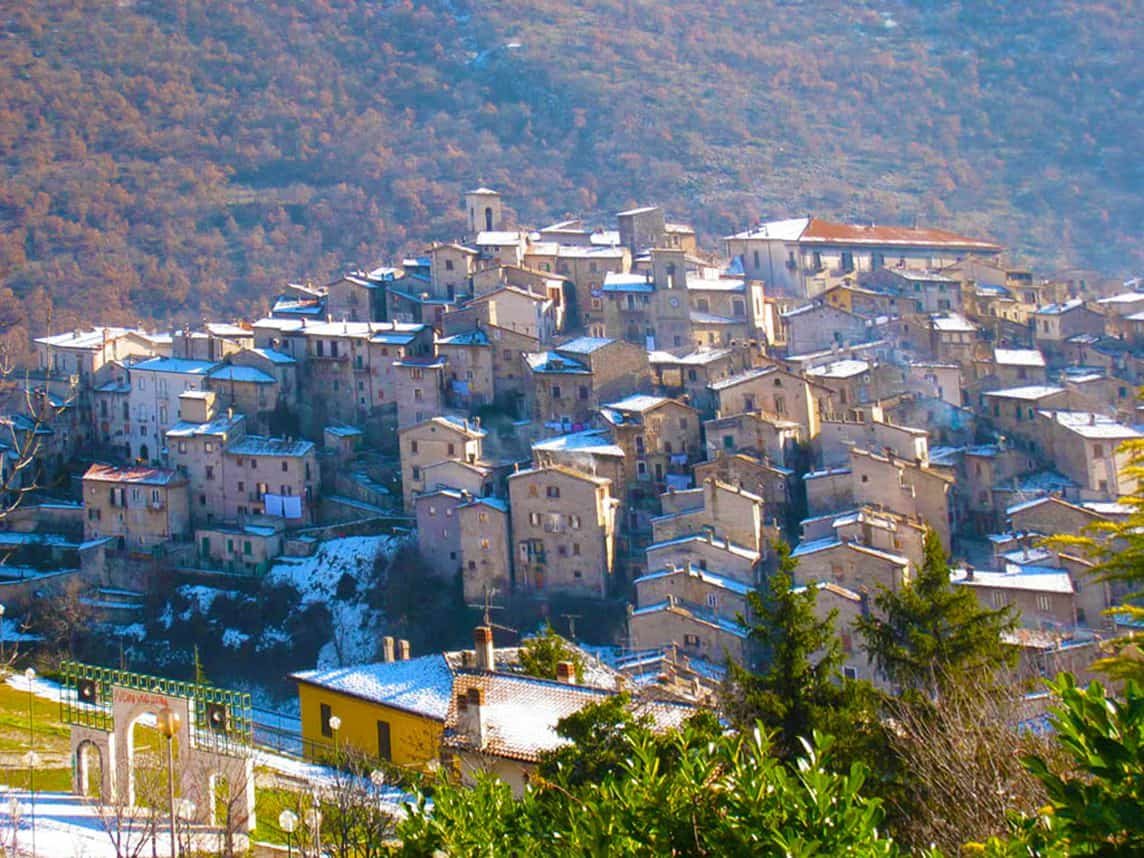
In short. Scanno (AQ) is a mountain village in the upper Sagittario valley, in the province of L'Aquila, at 1050 meters of altitude among the Marsican mountains.

Scanno (AQ) is a mountain village in the upper Sagittario valley, in the province of L'Aquila, at 1050 meters of altitude among the Marsican mountains. The town hall is in Piazza Santa Maria della Valle, in the historic center, and the whole town is covered on foot. From Rome you get there in a little over two hours and about 160 kilometers: A24/A25 to the Cocullo exit (alternatively Pratola Peligna-Sulmona), then Regional Road 479 Sannite, which goes up the Sagittario Gorges passing through Anversa degli Abruzzi and Villalago. Without a car you take the train to Sulmona on the Rome-Pescara line and continue with the TUA regional bus on the Sulmona-Anversa-Scanno line. The timetables change between weekdays and holidays and between summer and winter, so it's best to check them on the transport company's website before leaving. The village has no entrance ticket and neither does Lake Scanno, which is three kilometers upstream along the same 479: you only pay for entry to the museums and for the services of the equipped beaches. The parking lots are outside the walls, along the ring road and in the squares downhill from the church of the Madonna della Valle. In summer and on snowy weekends they fill up by morning, and the signage on the blue-line spaces changes with the season. The historic center is a limited traffic zone for much of the year. For the hours of the municipal museums and of the churches, which follow seasonal calendars and the availability of volunteers, the reliable information is that of the Municipality of Scanno and of the information office in town.
Scanno belongs to the outer protection zone of the Abruzzo, Lazio and Molise National Park, and this is the key to understanding the place: a village of shepherds closed in between limestone walls, which tourism discovered late and through photography.

Why Scanno (AQ) Doesn't Look Like the Other Villages of Abruzzo
The difference shows in half an hour of walking. Scanno has no castle. It has watchtowers and a circuit of walls that was never really fortified, because the mountains did the defending: the valley narrows like a funnel and whoever came up from below was seen long before arriving. During the barbarian invasions the town remained unharmed. With the Saracens it went differently, and the sack remains in local memory.
The second difference is economic. Here there was no lord who built a fortress and a court: there was transhumance. The flocks wintered in Puglia and came back in summer to the pastures of the Marsicans, and the wealth of wool paid for the stone portals, the loggias, the noble palaces and the goldsmith workshops. Scanno is a pastoral village that bought itself the civic architecture of a small city. Anyone who arrives expecting the usual medieval town perched around a castle is thrown off, and rightly so.
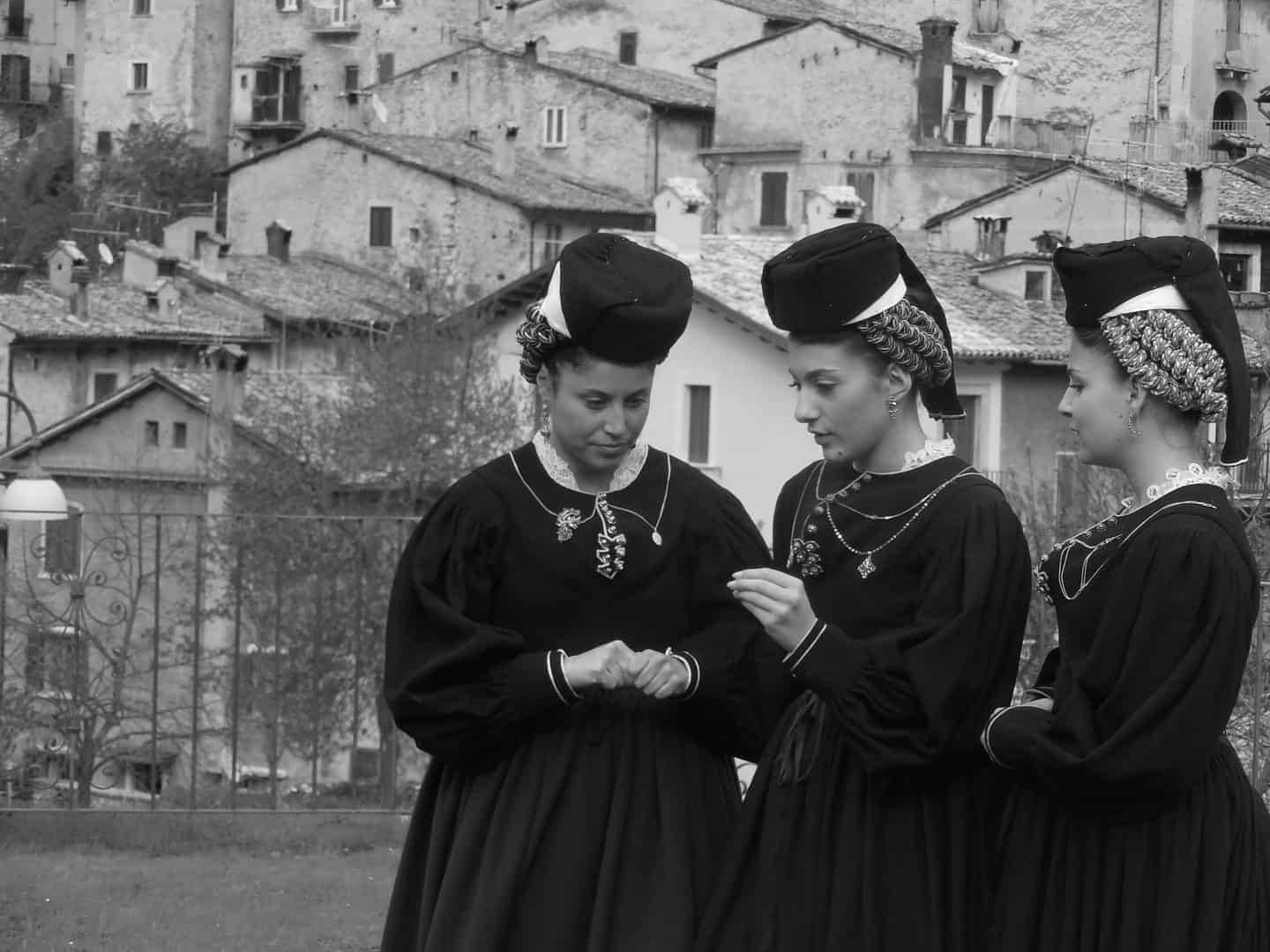
The third difference is the women's costume, which in Scanno is not a festival disguise: until the 1960s it was the everyday dress of most of the women, and some elderly women still wear it. It is the only reason why, in a town of just over 1500 inhabitants, the greatest photographers of the twentieth century passed through.
The Touring Club Italiano awards Scanno the Orange Flag, the tourism and environmental quality mark that the Touring reserves for small inland towns with valuable heritage and organized hospitality. The recognition is not a beauty prize: it is lost if services get worse, and it has to be renewed.
The Lake of Scanno (AQ): How It Formed and How to Look at It
The lake is at 922 meters of altitude, three kilometers above the town, and it is the largest natural lake in Abruzzo. Its surface is about one square kilometer and the maximum depth varies between 30 and 32 meters depending on the level of the reservoir. Mind a detail that almost no guide mentions: the lake is not all Scanno's. About three quarters of the body of water falls in the municipality of Villalago and only a quarter in that of Scanno, and the division was formally defined in recent times.
The Monte Rava Landslide and the Disputed Dating
The lake is a barrier lake: an enormous landslide detached from the overlying Monte Rava and blocked the course of the Tasso stream, which has been filling the basin ever since. For centuries the cause was attributed to the earthquake of 217 BC, the one Livy records among the prodigies of the Second Punic War. It is a fascinating learned tradition and an unfounded one. The most recent geological studies place the detachment in a much older range, between about 12800 and 3000 years ago, at the end of the last glaciation or already in the postglacial period. The archaeologically interesting fact is that the landscape you photograph today is, on a geological scale, very young.
The hydrology is equally instructive. The only inflow is the Tasso, with an average flow on the order of 350 liters per second. There are no stable surface outflows: the water leaves by karst routes, underground, and resurfaces downstream feeding the Sagittario river and its gorges. The blue-green color comes from the combination of algae and microalgae, the limestone chemistry of the rocks of the basin and the reflection of the surrounding woods. In recent years the level has dropped dramatically in seasons with little snow, and whoever arrives at the end of summer finds the shore much wider than in the postcards.
The Heart Trail, and the Truth About the Heart Shape
The lake looks like a heart only from above and only from certain points. The best known is the trail that climbs the slope above the shore, renamed precisely the heart trail, which leads to a viewpoint from which the view is that of an enormous heart closed in among the woods. The climb is short but steep, on stony ground: hiking shoes, not sandals. The second vantage point, which almost nobody uses, is Regional Road 479 itself on the hairpin bends above the lake, where a few wide spots allow you to stop safely.
A flat opinion: the heart photograph is the least interesting one you can take away from here. People climb in single file to retake the same shot already seen 10000 times, while the shore of the Tasso and the church of the Annunziata at the water's edge remain empty. Do the heart in five minutes, then go where there's nobody.
The Lake in Summer: Swimming, Sports and Crowds
In summer the lake is swimmable and its waters and its beaches have received the Blue Flag. People swim, go paddle boating and canoeing, fish with a license. Among the fish there are trout, tench, eels, rudd, perch, whitefish, pike, catfish and carp. Among the birds, mallards and coots. The water stays cold even in July: it's a mountain lake fed by a stream, not a swimming pool.
The worst moment to come is the afternoon of a Saturday in August. The best is the early morning of a September weekday, when the water is still, the parking lot is empty and the raking light draws the woods on the other shore.
The King of Battifolo and the Wizard Pietro Bailardo
The local legend on the birth of the lake stages a mythical king of Battifolo fighting against the Emperor of Rome, or in other versions against the wizard Pietro Baialardo. The narrative substance is the same in all the variants: a pact, rising water, a submerged village. Legends of villages swallowed by lakes are a widespread motif across the whole Apennines, and here it took root on a true geological fact, the landslide. Folklore had understood before the geologists that the lake hadn't always been there.

The Historic Center of Scanno (AQ), Neighborhood by Neighborhood
The historic center is the real museum of the town, and it should be read as a stratigraphy: it formed by the successive aggregation of nuclei that came down progressively lower.
Betifulo, Later the Sant'Angelo Neighborhood
The oldest part of the village is the Betifulo, later renamed the Sant'Angelo neighborhood after the name of the church. The place name refers to the pagus Betifulus, a Paelignian settlement mentioned by ancient sources and whose fortification must have stood on the southern slopes of the hill of Sant'Egidio. A tablet found in the locality of Acque Vive commemorates a decurion of Betifulo: proof that it was a center with its own institutions, not a group of huts.
Scamnum and the Merger of 1447
Between the 12th and 13th centuries the inhabitants moved to the locality of Scamnum, which corresponds to the present height of the church of Sant'Eustachio. The two nuclei merged around 1447, descending ever lower, to the Madonna della Valle district, where today there is the parish and main church of the town. It is the moment when Scanno stops being two villages and becomes a town.
Terravecchia, or the San Michele District
The Terravecchia district, also called San Michele, preserves the tightest fabric: houses pressed against one another, alleys that slip under arches, staircases. The street system here is much more intricate than elsewhere, in particular among Via Arco Santa Croce, Via Simone and Via Ciorla. Anyone who wants to understand what the town was like before the 1800s has to get lost in these three streets, not in the square.
The Expansion of the 1500s and the Ciambella
In the 16th century the town expanded toward the southwest, and you can read it in the architectural style: wide houses and noble palaces, with portals and loggias, very different from the compressed buildings of Terravecchia. The road axis that divided the settlement in two is still perfectly legible from the church of Santa Maria della Valle to the Sarracco fountain and to Piazza San Rocco, the old square of the town, from where the road continued toward the mountains. The route called in dialect the ciambella then returns to the main square through Via Silla and Via de Angelis. Do the ciambella at least once clockwise and once counterclockwise: everything changes, because the facades in front of you change.
The Walls, the Arches and the Speculative Tower
The town walls were already incorporated into the houses when they were demolished in 1909 to open the Scanno-Barrea road. With them fell the bell tower of the church of San Rocco, that is, the medieval tower that preceded the present one, and some palaces. Today the medieval circuit of walls is completely replaced by private homes, which however keep its course: if you follow the line of the houses on the outer edge of the historic center, you are walking along the walls.
The arches remain, and there are five: the arch of Sant'Eustachio, the arch of Case Roncone, the arch of the Croce or Porta Croce, the arch of the Nocella (datable perhaps between the 15th and 18th centuries) and the arch of the Zazzarotta, from the 18th century. Near the gate of Sant'Eustachio, in the square of the church of the same name, there is a tower called speculative, so called probably because of its resemblance to another tower near the church of the Madonna di Costantinopoli.
The Cemmause, the Architectural Signature of Scanno (AQ)
The cemmause are the most Scanno thing there is, and no sign will explain them to you. They are external staircases giving access to the dwellings, ending in a gallery or landing. The steps, locally called the schèle, are of stone. An arch supports the staircase. Above, a roof rests on wooden beams on which run wooden boards, called scànzule, generally of beech, and then the tiles, called pinci.
The function was practical: the ground floor served as a stable or storeroom, the dwelling was above, and the outside staircase kept the two lives apart. The aesthetic result, unintended, is the play of shadows that has driven photographers crazy for seven decades. If you have to look at only one thing in detail in Scanno, look at how the covering of a cemmausa is made.

The Churches of Scanno (AQ), One by One
For a town of this size the number of churches is out of proportion, and it is the sign of a society of confraternities, of families that competed to endow their own chapel and of a pastoral devotion that multiplied the patron saints.
Church of Santa Maria della Valle
Also called the church of the Madonna Assunta, it is the parish church and the main church of the town. It is laid out on three naves and is supported by two pillars with pinnacles, placed to reinforce the structure after the earthquake of 1915. The exterior, in local stone, is in the Abruzzo Romanesque style. The facade with a horizontal crown has three portals, surmounted by as many rose windows, of which the central one is the largest.
Inside, on the first columns after the entrance, traces of medieval frescoes can be seen: they are the clue that the building is much older than its present appearance. In the presbytery, besides a polychrome altar, there is a wooden choir. The confessionals and the pulpit, also in wood, are the work of the artist Ferdinando Mosca of Pescocostanzo, a leading name of Abruzzo carving between the 17th and 18th centuries: Pescocostanzo was then a craft capital and its workshops worked all over inland Abruzzo.
The chapel to the right of the entrance is dedicated to San Costanzo and keeps a relic of his, which arrived in Scanno around the 1700s. It is worth explaining how that devotional trade worked: in Rome the catacombs were opened and the bodies of unknown martyrs that came out of them were baptized with the names of virtues and distributed to provincial churches. Many relics in Apennine towns have this origin, and knowing it takes nothing away from the devotion: it adds a chapter of modern Church history.
Church of Sant'Eustachio
It is the patronal church, on the height corresponding to the ancient Scamnum. Inside are kept several statues: Saint Agatha, Saint Apollonia, Faith and Hope, Saint Lucy, Saint Barbara and of course the titular Saint Eustace. The saint, a hunter converted by the vision of the stag with the cross between its antlers, is a patronal choice that says a lot about a town of mountains and woods.
Church of San Rocco
Dedicated also to the Madonna del Carmine, it bears on an outer wall a fresco depicting Saint Christopher. The pairing is no accident: Roch protects against the plague, Christopher protects travelers, and for centuries the two fears went together along the transhumance roads. The medieval bell tower of the church was demolished in 1909 along with the walls.
Church of the Madonna di Costantinopoli
Next to Piazza San Rocco, it keeps above the high altar what is probably the most valuable work of art in Scanno: a fresco of a Madonna and Child seated on a throne, on a background imitating gold flowers, with a taste close to Sienese art of the 15th century. The commission is attributed on documentary grounds to a certain De Ciollis, around 1418: a traditional attribution, not an absolute certainty. And it is exactly the piece that visitors skip, because the church is small and has no facade that stops your step.
Church of Sant'Antonio da Padova
Once flanked by a convent, it has sumptuous Baroque interiors, studded with gilded stuccoes and good-quality canvases, and a peculiar organ. The contrast with the austerity of the outer stone is typical of inland Abruzzo: mountain outside, Naples inside. The L'Aquila earthquake of 2009 caused it slight damage.
Church of Sant'Antonio Abate
It is on Strada Ciorla. A plaque on the facade dates it to 1569 and names the patron as a certain Ercole Ciorla, but other documents suggest an earlier foundation: the plaque says when it was rebuilt, not when it was born. It is the church from which, every January, the procession of the feast of Sant'Antonio Abate Barone departs.
Church of San Giovanni Battista
The history of this building is a summary of the town's social history. After the plague epidemic of 1764 it was used as a lazaretto. Then it was used as an elementary school, a polling station and a theater. Today it houses a permanent exhibition of sacred statues set up by Michele Rak.
Church of the Madonna delle Grazie
On Via De Angelis, it has a Greek cross plan and is the seat of the confraternity of the same name. It too suffered slight damage in the 2009 earthquake. The central plan, rare in mountain towns, indicates a building conceived on the drawing board and not grown by additions.
Church of the Annunziata, or Madonna del Lago
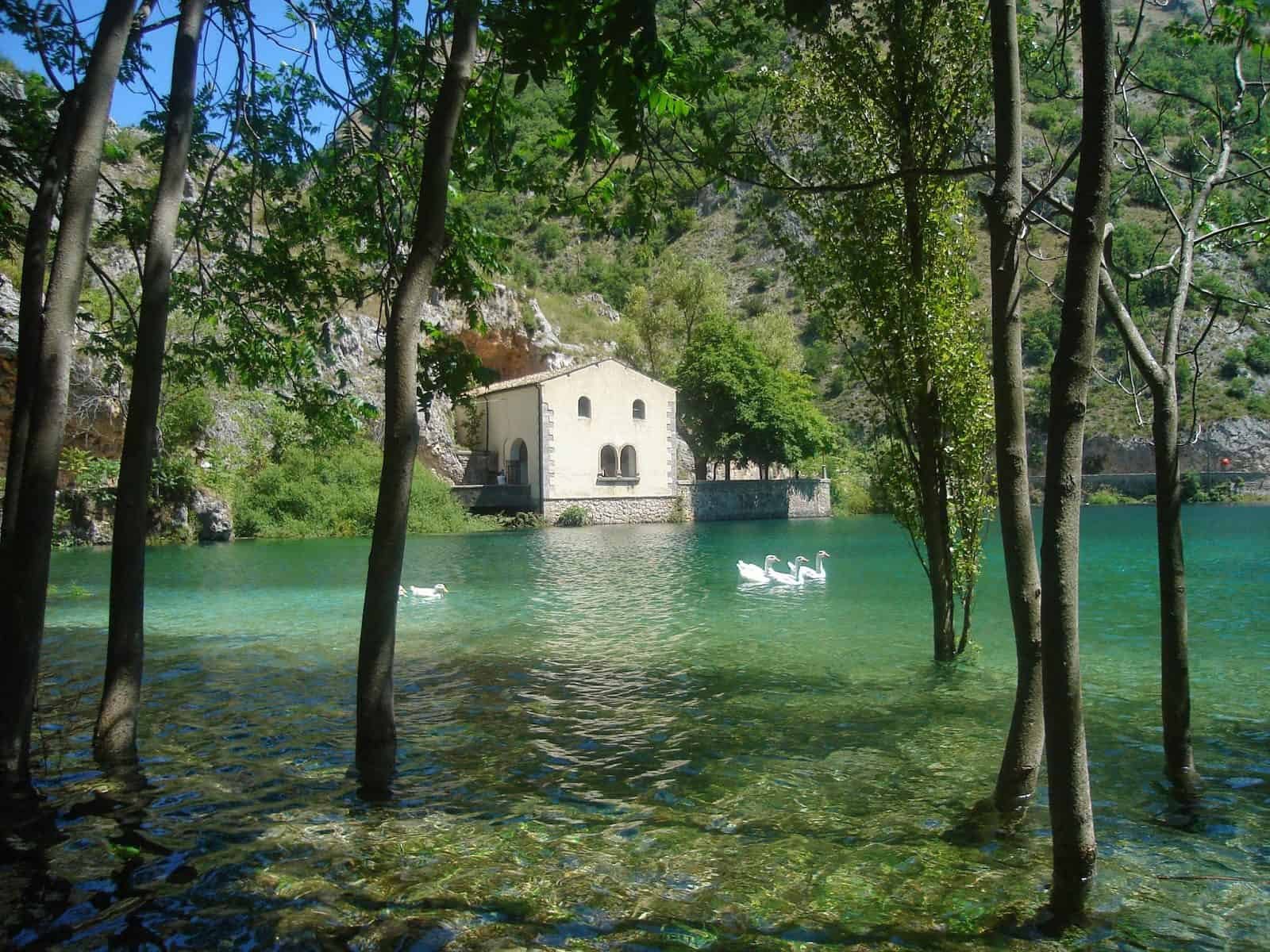
This is the little church on the lakeshore, the one that appears in half the photographs of Scanno with the water behind it. Inside are paintings by the local artists Silvio and Arcangelo Centofanti and an altar in painted stones. Go at sunset: the light arrives raking from the west and the bell tower stands out against the mountain.
Church of San Michele Arcangelo
By the cemetery, it predates 1576. The Michaelic dedication, very frequent along the transhumance routes and on high-altitude sites, is one of the oldest signs of use of the place.
Chiesetta degli Alpini
In the locality of Collerotondo, near the ski lifts, it can be reached only by chairlift or by the parallel trail. You recognize it at once by the Swiss chalet structure, with a steeply sloping roof: a twentieth-century building, of military and mountain devotion, that has nothing to do with the architecture of the village and is interesting precisely for this.
Church of San Liborio
It is three kilometers from Scanno on the SS 479 Sannitica, in the direction of Passo Godi and Villetta Barrea. Though privately owned, its feast is celebrated every July 23. In the locality of San Liborio, on July 4, 2011, a bronze statue of Pope John Paul II, born Karol Wojtyla, who was a frequent visitor to these mountains, was placed.
Church of San Lorenzo a Jovana
Built in the locality of Jovana, it is celebrated on August 10. Of the ancient Jovana essentially only the little church remains, restored and reopened to the public in 1952.
Hermitage of Sant'Egidio
On the hill of the same name, between the town and the lake, it was built in the 17th century in rural Romanesque forms. It keeps above the altar, inside the apse, a fresco of Sant'Egidio made by masters of the Neapolitan school in 1796. It's the right walk for those who have two hours and don't want to take the car.
Church of San Tommaso
It completes the list of sacred buildings of the Scanno territory. Like many minor churches of the village, it opens on the feast day of its patron and on a few other dates: ask in town, don't take it for granted that you'll find it open.

The Palaces and Portals of Scanno (AQ)
The civic heritage of Scanno is what really distinguishes the village. Walk with your nose up: almost every portal has a date, a coat of arms or a grotesque mask.
Palazzo di Rienzo and Palazzo Colarossi
Palazzo di Rienzo was originally the seat of the Università, that is, the Town Hall of Scanno, and was later lived in by the feudal lords with the title of princes. The Di Rienzo family owned most of the flocks that wintered in Puglia, and its name still returns today in the January feast.
Palazzo Colarossi, at Via Silla 32, is also called the casina or the other Palazzo di Rienzo. It has doorways, windows, balconies and mezzanine windows. The portal has a straight finish and cushion rustication, the pediment of the windows is broken, the crowning has zoomorphic corbels with references to Pescocostanzo-style motifs, that is, to the workshops of Pescocostanzo. Another loggia of the settlement is precisely that of Casa Colarossi, and the windows and portal of Casa Colarossi at Via Giuseppe Tanturri 3 have a late 16th-century taste, with carved corbels.
Palazzo De Angelis, Palazzo Mosca, Palazzo Serafini
Palazzo De Angelis, at Strada Ciorla 3, has finely made decorations around the portal, with the De Angelis coat of arms. On the rear side, at Via Ciorla 13, one of the town's loggias opens.
Palazzo Mosca is recognizable by the decorations under the cornice, with putti and dancing seraphim, while the main facade is Baroque.
Palazzo Serafini, in the Codacchiola district, has as its only real merit the coat of arms above the doorway, with three little seraph angels: a case of a modest house ennobled by the heraldic element alone.
Palazzo Serafini-Ciancarelli, Castellaro, Palazzetto Nardillo
Palazzo Serafini-Ciancarelli, in Piazza San Giovanni, has undergone several transformations over the centuries: two floors in one part, four in the main body, with prominent balconies.
The Castellaro is one of the largest palaces in Scanno and gives its name to the district in which it stands. It is in Baroque-Romanesque style, has a characteristic T plan and keeps 18th-century pediments.
Palazzetto Nardillo, at Via Porta Sant'Antonio 18, has a fine cornice and a Baroque portal with a curved transom. One window has a shell-motif pediment. The loopholes converging toward the entrance were a deterrent against ill-intentioned people and today are a point of interest for those who look.
Case Roncone, Casa Tanturri, Casa Antonio Silla
The Case Roncone have a characteristic three-light window and an underpass arch. The most typical loggia of the town is theirs, in Vico I Strada Silla.
Casa Tanturri keeps a fine three-light window on the top floor on Via De Angelis, a putto on the side facade and straight-cut windows with jambs. The curious piece is the grotesque mask on Via De Angelis, perhaps apotropaic but certainly meant to mark an important urban node, as the chamfering of the corner shows.
Casa Antonio Silla, at Via Calata Sarracco 5, has an imposing portal with a base built to hold up the balcony above. The arch of the portal is a round arch and the transom is topped by a grotesque mask in line with the keystone.
Portals, Loggias, Two-Light and Three-Light Windows
Decorated portals do not belong only to noble palaces: houses of ordinary citizens have them too, and this is the interesting social fact. The wealth of wool was widespread, not concentrated in one family.
Loggias, two-light and three-light windows open on the top floor of noble and bourgeois palaces. They served as a space of light and passage between inside and outside, for hanging out laundry, for drying, for working. Other examples are found on Via De Angelis and on Via del Castellano, the latter now closed.
Fountains, Statues and Monuments of Scanno (AQ)
In Scanno there are the Sarracco Fountain and the Pisciarello Fountain, two reference points in the local place names even before being monuments. Behind the church of Santa Maria della Valle is the Statue of the Woman of Scanno, inaugurated in 2006: a bronze slightly larger than life size, it portrays a local woman in traditional dress. It is the most photographed monument of the town after the lake, and it works better in the evening, when the raking illumination gives back the weight of the drapery.
In the building across from the Sarracco Fountain there is a sundial, the work of the Franciscan friar Nunzio Farina. In Piazza San Rocco, between the seat of the local cultural association and the church of the Madonna di Costantinopoli, are the Monument to the fallen of the two world wars, with the list of Scanno's fallen, and the Monument to the fallen of Nassiriya, inaugurated in August 2010. Read the list of the fallen: in a town so small, the length of that list alone explains the depopulation of the twentieth century.

The Museums of Scanno (AQ)
The Museo della Lana gathers agricultural implements and tools and those of the whole wool chain: shearing, carding, spinning, weaving. Don't expect a scenographic museum. Expect the opposite, that is, the real objects on which the economy of this valley rested for centuries. The museum also keeps a Roman tablet, the material proof that Scanno was already inhabited in Roman times, at the northern edge of the territory of the Samnites.
In Frattura there is a similar museum, the museum of folk arts and traditions, which gathers more or less the same type of tools and is next to the central church of the hamlet. If you have seen in Rome the large museum of folk arts and traditions at EUR, here you see the same material in the place where it was born, which is a different lesson.
The hours of both follow seasonal calendars and the availability of the associations that run them: before going up, a phone call to the Municipality of Scanno or to the information office avoids the closed door.
The Workshops of Scanno (AQ): Goldsmithing and Bobbin Lace
The establishment of Scanno's goldsmith workshops falls between the end of the 19th and the beginning of the 20th century, but the first documented record of a local goldsmith dates to 1718. For the period in between the information is fragmentary and scarce. The symbol piece is the presentosa, the star-shaped or heart-shaped jewel with two hearts in the center that was given to the bride-to-be. It is found all over Abruzzo, but here it is still an object of current production and not a souvenir.
The other art is the tombolo, lace worked on a pillow with bobbins, handed down from generation to generation. If you are lucky enough to find a lady working on her doorstep, stop: the speed of the hands over 20 or 30 bobbins is a spectacle that no shop window gives back. Buy in the workshop, not at passing stalls, and always ask whether the piece is made in Scanno.
The Costume of the Women of Scanno (AQ)
The Scanno costume is the object that made the town famous. The skirt, of heavy dark green cloth, can weigh several kilos and is protected at the bottom by a strip of red wool called the pedéra. The bodice, ju cummudene, has a pointed shape and gold or bone buttons, with silk hems. The apron, the mandera, is of brocade on festive occasions. The headdress is the most complex and most discussed piece: ju cappellitte is made of veil, pillowcase and bands, and it is what evokes an oriental turban for visitors.
Prudence is needed here. The thesis of an oriental origin of the headdress, tied to Saracen or Ottoman raids, is a local tradition repeated for generations but undocumented. Studies scale it down and point rather to an autonomous development of the dress in an isolated town, with elements that recall the fashion of the Kingdom of the Two Sicilies in the Spanish era. On the page the rule of honesty applies: the tradition is told as tradition, not as an established fact.
A detail that almost nobody explains: the colors of the laces were not decorative but a code. Red for Sant'Eustachio, light blue for the Madonna delle Grazie, brown for the Madonna del Carmelo, black for mourning, white for weddings. A dressed woman communicated, without speaking, her condition and her devotion to anyone who passed her in the street.
Around the Village: Mountains, Hamlets and Trails of Scanno (AQ)
Monte Rotondo, or Collerotondo
It hosts two mountain huts and the Chiesetta degli Alpini. In summer the Concerto aperitivo nel bosco is held there. In the 2000s the Deer Wildlife Oasis was inaugurated, by the artificial basin that serves the programmed snowmaking of the nearby slopes, with three specimens released at the start. It is the right destination for a morning with small children: you go up by chairlift, walk a little and see something.
Passo Godi
The pass is at 1630 meters above sea level, on the road that leads toward Villetta Barrea. There are downhill lifts, a cross-country ski track 10 kilometers long and the ridge of the Scalone, terrain for mountaineers. Nearby are a monumental beech and the sheepfold of Ze messe, mangled into Ziomas or Zio Mas on the maps of the military cartographers.
On the origin of the name it's worth being precise, because it's a small textbook case. The popular hypothesis derives it from Zio Mas, diminutive of Massimo or Tommaso, but no document supports it and the area has been uninhabited since time immemorial: there is no trace of any Zio Mas. The most solid hypothesis is that Ze Messe comes from the local dialect zu messe, with zu the article and messe in the sense of boulders, given that the area is strewn with blocks of rock. When a folk etymology and a linguistic etymology conflict, the second is usually right.
Le Prata
It is reached from State Road 479 Sannite, arriving at the road maintenance house located between the town and Passo Godi and then continuing on foot for 6 kilometers of trail. The locality is in the initial stretch of the Tasso river. From here several trails branch out like a comb, of different difficulty, which start from Monte Marsicano and arrive at the Sella della Terratta: it is terrain for trained hikers, with serious elevation gains and no services along the route.
Torre di Jovana
It is reached by a trail that starts from the same road maintenance house, continues through the Vallone delle Masserie and arrives in the basin where the locality stands. This pagus was inhabited at least from the beginning of the 15th century. Today what remains are the church of San Lorenzo, the ruins of a tower and a few scraps of rural dwelling. The area is used for livestock raising, agriculture and farm stays, and comes back to life between August 7 and 10 for the feast of San Lorenzo. Going there on August 10 is the most authentic experience Scanno offers in the whole summer, and no brochure advertises it.

Frattura Vecchia and Frattura Nuova
Frattura Vecchia was destroyed by the Marsica earthquake of 1915, the one of Avezzano, and has been only partially restored: what remains is a medieval village in ruins, on a rocky spur overlooking the valley. The new village of Frattura was rebuilt on another spur, a little farther south, around the new church of San Nicola. The comparison between the two settlements, a few hundred meters from each other, is the most effective lesson on the relationship between seismicity and settlement in the central Apennines.
Lake Pantaniello, Monte Greco and the Sagittario Gorges
In the surroundings there are the plateaus of Monte Greco and Lake Pantaniello, a tiny high-altitude basin, and of course the nature reserve and WWF oasis of the Sagittario Gorges, which you cross going up from Anversa degli Abruzzi. Those who want to widen the trip find a little farther south Pescasseroli, capital of the Park, and the Camosciara.
Wildlife: the Marsican Brown Bear and Its Neighbors
The proximity to the Park means that the Scanno territory enjoys a fauna that elsewhere in Italy simply no longer exists. The Marsican brown bear, a subspecies endemic to the central Apennines reduced to a few dozen individuals, strays into the area with some frequency, and the thing regularly ends up in the newspapers. There are also the Apennine wolf, the deer, the Abruzzo chamois at high altitude.
A rule of behavior, and it is not an optional piece of advice: you don't chase a bear to photograph it, you don't leave food in open bins, you don't leave the trails at dawn and dusk hoping for an encounter. A confident bear is a doomed bear. If you want to see wildlife seriously, book an outing with a Park guide.
What to Eat in Scanno (AQ)
Scanno cooking is pastoral, and should be taken for what it is: fatty, essential, made for people who worked outside 10 hours a day. The chapter of the cheeses is the serious one: in the area pecorinos and caciotte of great quality have been produced, and Scanno is tied to the memory of Gregorio Rotolo, shepherd and experimenting cheesemaker of Villetta Barrea and the valley, known well beyond Abruzzo for his cheeses and for his mutton ham. He passed away some years ago: ask in town who carries on that school, because names change and so do signs.
Then there are the mostaccioli, the sagne with beans or with ricotta, the angioletti and diavoletti, that is, sweet and spicy salamis, the tratturo salamelle, the so-called coglioni di mulo and the pan dell'orso, a dried-fruit focaccia covered in chocolate found in the town's pastry shops. Add the arrosticini, which here are mutton and not lamb, and the wine of the Sulmona area.
A professional's opinion: the pan dell'orso is excellent but has become the standard gastronomic souvenir and you find it everywhere. The sagne with beans are the dish you will remember, and you eat them in any trattoria midweek.
The Festivals and Traditions of Scanno (AQ)
Ju Catenacce, on August 14
It is the best-known festival of the town. Every August 14 a historical reenactment recreates a wedding procession in traditional Scanno costume. The couple that gets married is only one, truly. All the others who take part in the procession are relatives who parade strictly in pairs, a man and a woman. The name means the bolt, because the procession seen from above recalls its shape. The festival ends in Piazza della Madonna della Valle, after the wedding and a long parade through the streets of the town. At the end the participants dance the quadrille while the organizers offer the spectators the sweets of Scanno.
The documentation of the tradition is old: Scanno's wedding customs already appear in a dialect poem by Romualdo Parente of 1765, and were later studied by the folklorists Antonio De Nino and Giovanni Pansa. This is why Ju Catenacce is not a tourist invention of the twentieth century, as happens elsewhere, but the staging of a rite documented for two and a half centuries.
The Feast of Sant'Eustachio, in September
The patron saint is celebrated in September. It is the festival of the residents more than of the tourists, and indeed it is the most beautiful to watch: the women who own the costume wear it with the red laces, the saint's.
The Rites of the Passion, at Easter
At Easter the procession of the Hooded and the more recollected one of the dead Christ take place, which goes through the streets of the village to the sound of the Miserere. Those who know only the processions of big cities are struck by the silence: here the town truly goes dark, and the singing arrives before the light of the torches.
The Procession of the Beams, in June
In June Scanno celebrates Saint Anthony of Padua with a parade of large mules loaded with firewood: it is the Procession of the Beams. The wood was a collective offering, and the mule was the only means of bringing it down from the mountain. Seeing it today means seeing the last working remnant of an economy of animal transport.
Sant'Antonio Abate Barone, in January
The January feast has an almost feudal structure. Once, early in the morning, the Di Rienzo family, which owned most of the flocks wintering in Puglia, had one or more copper cauldrons filled with steaming sagne with ricotta set out outside their house. For decades the devotees, after mass in the nearby church of Sant'Antonio Abate, set off with the priest at the head of the procession toward the Di Rienzo house, where the ritual of the soup is repeated still today. It is the most interesting chapter of anthropology in the Scanno calendar: a lordly food distribution that survived the end of the system that produced it.
The Glories of San Martino, in November
In November three very tall bonfires are lit in town for the Glories of San Martino: an old, noisy folkloric event, of the kind organized by district that ends in an undeclared contest over who builds the tallest pile. November in Scanno is cold and almost empty of tourists: it is the date I recommend to anyone who wants to see the town unfiltered.
The Serenade of the Chezette, at Epiphany
The Befana in Scanno is awaited with the serenade of the chezette, sung under the windows of the local girls, or of anyone who explicitly requests it. The next day the singers go around collecting the fruits of the sowing at the homes of the damsels who were serenaded and, within two days, everyone goes together to a trattoria to eat. The structure of the rite, sung begging followed by a collective banquet, is very ancient and widespread across central Italy.
The Premio Scanno
Since 1972 the town has hosted in September the Premio Scanno, an interdisciplinary award named, since the year of his death, after its creator, the journalist Riccardo Tanturri, who died on the eve of the 30th edition. The sections have multiplied over the years and include economics, medicine, ecology, law, sociology, food, music, cultural anthropology and folk traditions, as well as an award for civic commitment. Manfredi Tanturri de Horatio, son of the founder, carries on the work of the Foundation. A national prize of this weight in a town of 1700 inhabitants is an anomaly worth noting.
Scanno dei Fotografi and the Tuesday Market
The Premio Internazionale Scanno dei Fotografi, established in 1998, was born from the relationship between the village and the great photography of the twentieth century. On Tuesday, instead, there is the weekly market, which is the most useful thing to see in order to understand how the town lives off-season.
History of Scanno (AQ), from the Pagus Betifulus to Today
There are two explanations for the origin of the name. The most widespread traces it back to the Latin scamnum, stool, because the hill on which the historic center grew is said to resemble a small bench. The second, linguistically sounder, brings the term closer to the Abruzzo phytotoponyms scandalo and scannèlla, which indicate a rustic variety of barley or the places where it was cultivated. Between a landscape etymology and an agrarian one, in a valley of high-altitude farmland, the second makes more sense.
From the Roman age remains the tablet kept in the Museo della Lana: Scanno was inhabited at the northern edge of the territory of the Samnites, in an area of contact with the Paeligni. The pagus Betifulus, identified with a minor Paelignian center, and the tablet of the decurion of Betifulo found at Acque Vive complete the picture of an ancient and organized settlement.
In 1067 Scanno appears as a dependency of the monastery of San Pietro Apostolo in Villalago: that year the counts of Valva Todino, Oderisio and Bernardo, donate the monastery to Montecassino, and with it all its possessions. During the Middle Ages the town follows the feudal events of the Paelignian county. In 1447 the two inhabited nuclei merge. In the 1500s the expansion toward the southwest begins. In 1764 the plague empties the town and turns San Giovanni Battista into a lazaretto. In 1909 the walls and the bell tower fall to make room for the road to Barrea.
On January 13, 1915 the Marsica earthquake razes Frattura Vecchia to the ground. During the Second World War local tradition has it that Carlo Azeglio Ciampi, later an honorary citizen, found refuge in Scanno, hosted by a local family. It is a circumstance handed down in town and not supported by consultable documentation, and as such it must be reported. In 1956 the filming of Uomini e lupi, with Silvana Mangano and Yves Montand, takes place in Scanno and surroundings. In 2009 the L'Aquila earthquake causes slight damage to the church of the Madonna delle Grazie and to that of Sant'Antonio da Padova.
How to Really Visit Scanno (AQ): Timing, Route, Seasons
For the historic center alone count two and a half hours walking calmly, three if you go into the open churches. With the lake, the viewpoint and a stop at the table, the day is full. If you add Frattura, the hermitage of Sant'Egidio or Passo Godi, you need two days and it's best to sleep in town: in the evening, when the buses are gone, Scanno becomes another place. For a visit accompanied by a licensed professional, or to organize a group day in this valley, the reference is the TourLeaderPro network.
The route I recommend starts from Piazza Santa Maria della Valle, climbs along the ciambella to Piazza San Rocco, slips into Terravecchia between Via Arco Santa Croce and Via Ciorla, touches Sant'Eustachio from the arch of the same name and goes back down along Via Silla and Via De Angelis, with a detour to the Sarracco Fountain. The lake comes after, by car or with a walk along the old road.
The seasons completely change the town. In winter there is snow and the lifts of Passo Godi and Monte Rotondo work. In spring the woods open up and the Sagittario Gorges are at their best. In summer the lake gets crowded. In autumn, between the end of October and November, you see the beeches and nobody else: it is the best season here.
Scanno (AQ) with Children and Accessibility Questions
With children the combination of the lake plus the Monte Rotondo chairlift works, with the deer oasis and the mountain huts. The historic center can be done, but it is all uphill and downhill, with staircases and cobblestones: a stroller is awkward, a sling or a baby carrier backpack makes more sense.
On accessibility, caution is a must. The old village has slopes, steps and narrow alleys, and cannot be easily covered in a wheelchair in its upper part. The lower zone, around the parish church and the main squares, is more practicable. At the lake, the flat lakeside promenade and some equipped beaches are the most accessible part of the visit. For precise information on ramps and services it's best to contact the Municipality of Scanno, which also manages the reception services.
How Much a Day in Scanno (AQ) Costs
The town itself is visited free of charge: streets, squares, open churches and views have no ticket. You spend on the museums, on the chairlift or the lifts in season, on the services of the equipped beaches at the lake, on renting paddle boats and canoes, and of course on eating and sleeping. Fares and hours change from year to year and from season to season, so the exact numbers must be asked of the bodies that charge them: the Municipality for the museums, the operators for the lifts.
Those who want to save should come in low season, sleep in town instead of in Sulmona and have the big meal at midday with the trattoria menus. Those organizing a group, on the other hand, need an escort who knows the valley and the real travel times on the 479: the network of professionals at TourLeaderPro works exactly on this.
A Curiosity About Scanno (AQ)
The real curiosity of Scanno is not the heart-shaped lake, which is a matter of perspective and luck. It is that a town of just over 1500 inhabitants, closed in an Apennine valley, became one of the most photographed places in Europe in the twentieth century, and that one of those photographs ended up in the collection of the Museum of Modern Art in New York.
In October 1957 Mario Giacomelli, a photographer from Senigallia, took in Piazza Sant'Antonio, in front of the church of Sant'Antonio da Padova, the image now known as Il bambino di Scanno, or Scanno Boy: a little boy with his hands in his pockets, in focus, advancing among blurred women in black. In 1964 John Szarkowski, director of the photography department of MoMA, included it in the exhibition The Photographer's Eye, whose catalog came out in 1966. From there the photograph entered the world canon of twentieth-century imagery.
The paradox is that whoever arrives in Scanno today walks past that square without knowing it. There is no monumental installation saying: here one of the most famous photographs of the century was taken. The square has remained a square. And that, when you think about it, is the reason why that photograph still works: Giacomelli did not photograph a monument, he photographed the way a town walks.
Add a second fact: six years earlier, in 1951, Henri Cartier-Bresson had passed through here and produced his Abruzzo series, with the Scanno shots now fetching prices at international photography auctions. Two of the most important photographers of the century, six years apart, on the same paving.
Something Nobody Tells You About Scanno (AQ)
Nobody will tell you that Lake Scanno, for the most part, is not Scanno's. About three quarters of the body of water fall in the municipal territory of Villalago, and only a quarter in that of Scanno. The formal definition of the division is recent. The name won over administrative geography, as often happens, and Villalago has been paying for a century the price of a place name that doesn't do it justice.
There is a second thing that is almost never read, and it concerns chronology. The classic explanation of the birth of the lake, the landslide caused by the earthquake of 217 BC that Livy speaks of, is a modern learned construction: an earthquake documented by ancient sources was taken and applied to a geological event that the ancient sources do not describe at all. Recent geological datings move the detachment of the landslide from Monte Rava to an interval between about 12800 and 3000 years ago. The difference is not a specialists' detail: it means that the lake had already existed for millennia when the Paeligni inhabited this valley, and that no Roman ever saw it being born.
Third thing. The town has a particular acoustic, due to the narrow alleys and the underpass arches of Terravecchia: if you stop under the arch of the Zazzarotta or under that of Case Roncone on a winter evening, you hear the footsteps arrive well before the people. It's a detail that no printed guide reports and that, once noticed, changes the way you walk in a mountain village.
The Advice I Give You for Visiting Scanno (AQ)
There is only one piece of advice and it goes against everything visitors do: arrive in the afternoon and sleep in town. Tourism in Scanno is almost entirely day tourism, with arrival late in the morning, a stop at the lake, a stroll in the center and departure in the afternoon. Between five and seven in the evening the town empties, the buses leave, and what remains is the real town and the best light of the whole day on the stone.
Second piece of advice, a practical one: don't do the lake first. Do it after the historic center. The reason is technical and has to do with light. In the morning the lake is in shade on the road side and the viewpoint of the trail is backlit. In the afternoon the wall opposite lights up. The historic center, on the contrary, is perfect early in the morning because the raking sun enters the alleys.
Third, about the road. Regional Road 479 through the Sagittario Gorges is splendid and narrow, with tunnels cut into the rock and sheer stretches. It is not a road on which you look at the view while driving. There are wide spots: use them, stop, look, set off again. In winter it can have ice in the shade of the walls even when in town the road is dry, and chains on board are not optional.
Fourth, about time. Whoever has only half a day should sacrifice the lake and not the historic center. It's exactly the opposite of what everybody does, and the reason is simple: there are dozens of beautiful mountain lakes in Italy, while villages with this civic architecture and this textile history are very few. If you then want to build a multi-day itinerary between Rome and inland Abruzzo, the section dedicated to the region on ItalyPlanner lines up the real distances.
Another Well-Known Fact, Yet Rarely Cited
Everybody knows that Scanno has no castle. Almost nobody asks why, and the answer explains the whole town.
Scanno never had a castle because it was never a center of military power: it was a center of pastoral economic power. Its defense was orographic, entrusted to the walls that close the valley, and its circuit of walls was not a serious fortification but a fiscal and sanitary enclosure, incorporated into the houses from the origin and demolished in 1909 without anybody crying scandal. In place of the fortress there are the watchtowers, which served to see, not to resist.
The urban consequence is enormous. In a village with a castle, the hierarchy of space is radial: everything points upward, toward the lord. In Scanno the hierarchy is inverted: the town moved progressively downward, from Betifulo to Scamnum to Madonna della Valle, following the water, the road and the wool trade. This is why the most important church is at the bottom and not at the top, and this is why the noble palaces line up along the through routes and not around a parade ground.
The well-known fact, in short, is not a void: it is the key to reading. When you walk the ciambella you are following a commercial route, not a defensive layout, and the houses that look at you were built with the money of the flocks coming back from Puglia.
The Right Photo to Take in Scanno (AQ)
The right photo in Scanno is not the heart of the lake. The heart is the photo everybody takes, it is obtained only from the viewpoint of the trail and with a wide enough lens, and by the time you upload it online it is already the 10000th identical one.
The right photo is a cemmausa backlit in the early morning, in Terravecchia. Look for an external staircase with the arch below and the wooden roof above, position yourself so that the light enters from the end of the alley, and wait for someone to climb. It is the photograph that Cartier-Bresson and Giacomelli took, and the technical reason it works is that the narrow alley creates a very strong contrast between the stone in shadow and the band of sky, with the human figure as the only moving element.
The second photo I recommend is the church of the Annunziata on the lake at blue hour, that half hour after sunset in which the water becomes a mirror and the bell tower stands out sharply against the mountain. You need a tripod and patience, but no particular skill.
The third is the hardest and the most interesting: a detail of the costume, the laces of the headdress or the buttons of the bodice, with the permission of the person wearing it. Always, always ask before shooting a woman in costume. Many visitors don't, and every time it happens that tradition becomes a little less willing to be seen. A portrait granted is worth a hundred stolen shots.
Some Important Events That Happened Here in History
The first event is from 1067 and is a legal act that decided three centuries of local history: the donation of the monastery of San Pietro Apostolo in Villalago to Montecassino by the counts of Valva Todino, Oderisio and Bernardo. With the monastery all its possessions passed to the abbey, Scanno included. Whoever controlled the souls controlled the pastures, and whoever controlled the pastures controlled the wool.
The second is the merger of the two inhabited nuclei around 1447: the administrative and urban birth of the town as we see it.
The third is the plague of 1764, which throughout the Kingdom of Naples followed the great famine of the previous year. In Scanno the church of San Giovanni Battista was converted into a lazaretto. Turning a church into a hospital for plague victims was a drastic decision: it means the ordinary places were no longer enough.
The fourth is the demolition of 1909, when to open the Scanno-Barrea road the walls, by then incorporated into the houses, the medieval bell tower of San Rocco and some palaces fell. It is the moment when the town chooses the modern road and pays in heritage.
The fifth, and the most tragic, is the Marsica earthquake of January 13, 1915: Frattura Vecchia was completely destroyed and the center was rebuilt a little farther south. The old settlement remains in ruins and can be visited.
The sixth is from 1956, with the filming of Uomini e lupi, a film shot in Scanno and surroundings with Silvana Mangano and Yves Montand: a whole town finding itself on the set of an international production.
The seventh is from 1964, with the entry of Giacomelli's photograph in the MoMA exhibition in New York curated by John Szarkowski.
The eighth is from 1972, with the first edition of the Premio Scanno, later named after Riccardo Tanturri, which has brought scientists, jurists, economists and writers up here for half a century.
The ninth is from April 6, 2009: the L'Aquila earthquake, which here caused slight damage but reminded everyone on what fault line they live.
Add, for those who love sports, that the Giro d'Italia has come to Scanno several times in the twentieth century, with stages won by Gastone Nencini in 1955, Franco Bitossi in 1969, Marino Lejarreta in 1991 and Pëtr Ugrumov in 1993: the final climb on this valley is one of those the riders remember.
Who Has Passed Through Scanno (AQ)
The first list is that of the photographers, and it has no equal for a town of this size. Henri Cartier-Bresson arrived in 1951 and his Scanno images circulate today in international auctions. Mario Giacomelli came in October 1957 and took Il bambino di Scanno. Before them the German Hilde Lotz-Bauer had passed through. After them Renzo Tortelli, Gianni Berengo Gardin, Ferdinando Scianna, Mario Cresci, and the list continues down to the contemporaries. The Premio Internazionale Scanno dei Fotografi, since 1998, is the formalization of this relationship.
The second list is that of the cinema. In 1956 Silvana Mangano and Yves Montand shot Uomini e lupi here, the story of Apennine wolf hunters: two stars of European cinema at the height of their careers, in a town that at the time was reached with difficulty.
The third is that of the scholars. The traditions of Scanno were described by Romualdo Parente as early as 1765, in a dialect poem on wedding customs, and then studied by the folklorists Antonio De Nino and Giovanni Pansa between the 19th and 20th centuries. Scanno is one of the laboratories of Italian demology, together with a few other places in the South. The Scanno costume also attracted the attention of Gabriele d'Annunzio.
The fourth concerns republican history: local tradition has it that Carlo Azeglio Ciampi, future president of the Republic and honorary citizen of the town, found refuge here during the Second World War, hosted by a Scanno family. The story is well established in town, but does not rest on consultable documentation, and as such it must be reported.
The fifth is devotional: in the locality of San Liborio, since July 4, 2011, there has been the bronze statue of Pope John Paul II, who was an assiduous visitor to these mountains in the years of his pontificate.
The sixth, finally, is the continuous flow of travelers: from the nineteenth-century naturalists who came up to study the fauna of the upper valley to the groups of photographers who return every year for the August festival. If you are preparing an itinerary for foreign friends, the English guide to Abruzzo and the page on Pescasseroli and the National Park help to frame the area.
What's Around Scanno (AQ) Within an Hour
Villalago, on the lake, is a few minutes away, with the hermitage of San Domenico overlooking its little lake: it is the most reproduced Abruzzo photograph after the heart of Scanno, and it is a short step away. Anversa degli Abruzzi, at the mouth of the Sagittario Gorges, has the upper village and the reserve. Sulmona, about 40 minutes away, offers the medieval aqueduct, Piazza Garibaldi and the sugared almonds. To the south you enter the central part of the Park, with Villetta Barrea, the Camosciara and Pescasseroli.
Those returning toward Rome can break the trip at the Rieti lakes, Lake Turano and Castel di Tora, or on the Cammino dei Briganti, which crosses the same border pastoral culture. Those heading north find Campo Imperatore and the Gran Sasso. To organize it all, the my trip section and the list of tourist attractions help line up the stops.
Quick Questions About Scanno (AQ)
How far is Scanno (AQ) from Rome?
About 160 kilometers, a little over two hours by car along the A24/A25 and Regional Road 479. By train you reach Sulmona on the Rome-Pescara line and continue with the regional bus.
Do you pay to enter Scanno (AQ)?
No. The village, the squares, the open churches and the lakeside have no ticket. You only pay for the museums, the ski lifts, the services of the equipped beaches and the rentals.
How much time do you need to visit Scanno (AQ)?
Two and a half or three hours for the historic center alone, a full day with the lake and the viewpoint, two days if you add Frattura, the hermitage of Sant'Egidio or Passo Godi.
Is Lake Scanno swimmable?
Yes, in summer you can swim and the waters and the beaches have received the Blue Flag. The water stays cold even in midsummer because it is fed by the Tasso stream.
Where do you see the heart-shaped lake?
From the viewpoint of the heart trail, which climbs the slope above the shore, and from some wide spots of Regional Road 479 on the hairpin bends above the lake. From the shore you can't perceive the shape.
How long and how hard is the heart trail?
It is a short but steep climb, on stony ground, suitable for those with hiking shoes. It is not a walk for sandals and it is not advisable on wet ground.
Is Lake Scanno in the municipality of Scanno?
Only in part. About three quarters of the body of water fall in the municipality of Villalago and about a quarter in that of Scanno.
How deep is Lake Scanno?
The maximum depth is 30 to 32 meters, depending on the level of the reservoir, over a surface of about one square kilometer. It is the largest natural lake in Abruzzo.
How did Lake Scanno form?
By damming: a landslide detached from Monte Rava blocked the course of the Tasso stream. Recent geological studies place the event between about 12800 and 3000 years ago, not at the earthquake of 217 BC of the learned tradition.
Can you visit Scanno (AQ) in a wheelchair?
The lower part of the village, around the parish church and the main squares, is the most practicable. The upper part has slopes, steps and cobblestones. The lakeside is the most accessible portion of the visit. For precise information it's best to contact the Municipality.
Is Scanno (AQ) suitable for children?
Yes, above all the combination of the lake and the Monte Rotondo chairlift with the deer oasis. In the historic center bring a sling or a baby carrier backpack instead of a stroller.
Where do you park in Scanno (AQ)?
In the parking lots outside the walls, along the ring road and in the squares downhill from the parish church. In summer and on snowy weekends they fill up by morning. Check the signage, because the rules change with the season.
Can you get to Scanno (AQ) without a car?
Yes: train to Sulmona on the Rome-Pescara line and then the regional bus on the Sulmona-Anversa-Scanno line. The timetables change between weekdays, holidays and seasons, so they must be checked before departure on the transport company's website.
Do you need to book to visit Scanno (AQ)?
For the village, no. For the museums, the guided visits and the tables at the restaurants on high-season weekends, yes, and the booking is made directly with whoever provides the service.
When is Ju Catenacce held?
Every August 14. It is the reenactment of the Scanno wedding procession in traditional costume and it ends in Piazza della Madonna della Valle with the quadrille.
Can you photograph the women in costume in Scanno (AQ)?
Only by asking permission. The costume is a garment, not an attraction: a portrait granted is worth infinitely more than a stolen shot.
What is the difference between Scanno and Villalago?
Villalago is the municipality that owns most of the lake and keeps the hermitage of San Domenico. Scanno is the historic village with the civic architecture, the churches, the museums and the costume. They are visited on the same day.
Can you ski in Scanno (AQ)?
Yes, in season, with the lifts of Passo Godi and Monte Rotondo and a 10-kilometer cross-country ski track at Passo Godi. Opening and fares depend on snow cover and on the operators.
Do you see bears in Scanno (AQ)?
The incursions of the Marsican brown bear into the area are documented and recurring, but a sighting is neither guaranteed nor something to seek on your own. If you want to try, do it with a Park guide and respecting the rules of behavior.
What is the best time to go to Scanno (AQ)?
Late September and October for the climate, the colors and the quiet. July and August for the lake and the festivals, with many more people. January and February for the snow. November is the month in which you see the town without tourists.
What do you eat in Scanno (AQ)?
Sheep cheeses and mutton ham, sagne with beans or with ricotta, mostaccioli, angioletti and diavoletti, tratturo salamelle, pan dell'orso. The arrosticini here are mutton.
What is a cemmausa?
It is the external staircase giving access to Scanno dwellings, of stone, ending in a gallery, resting on an arch and covered by a roof of beams, beech boards and tiles. It is the architectural element that identifies Scanno more than any monument.
What is the main church of Scanno (AQ)?
Santa Maria della Valle, also called the church of the Madonna Assunta: three naves, an Abruzzo Romanesque facade with three portals and three rose windows, a wooden choir and furnishings by Ferdinando Mosca of Pescocostanzo.
One last thing, from someone who has brought many groups to this valley. Scanno is not used up in an afternoon: it is understood when the buses have left, when four elderly people remain in the square and the sound of footsteps becomes the only sound again. If you have only one day, spend it well: historic center in the morning, lake in the afternoon, and the evening in town. If you have two, go up to Frattura Vecchia and look for a long time at the town destroyed by the earthquake of 1915 from the new Frattura. No heart-shaped photograph will stay with you like that.
Article written by the editorial team of TourLeaderPro, contact them for Private/Corporate/V.I.P. Tours and Experiences.
Planning a trip to Rome? The English guides to visiting the city are on ItalyPlanner.com.