WWF Oasis Sagittario Gorges
In short. The WWF Oasis Sagittario Gorges is a guided Regional Nature Reserve of about 450 hectares in the comune of Anversa degli Abruzzi, in the province of L'Aquila: the entrance and the visitor center are on Strada Comunale Fiume Sagittario,…
The WWF Oasis Sagittario Gorges is a guided Regional Nature Reserve of about 450 hectares in the comune of Anversa degli Abruzzi, in the province of L'Aquila: the entrance and the visitor center are on Strada Comunale Fiume Sagittario, locality Sorgenti del Cavuto, in Anversa degli Abruzzi (AQ). Entry to the reserve is free and the area is open all year. The guided visits, educational workshops and excursions with the guides, however, are paid and must be booked in advance on 327 9411980 or by writing to riservagolesagittario@gmail.com. By car you exit at the Cocullo toll booth on the A25 Rome-Pescara and drive less than five kilometers. From Sulmona it is 17 kilometers, from Scanno 15, from Pescasseroli 30. By train you reach Sulmona station, on the Rome-Pescara and Naples-Pescara lines, and continue by bus to Anversa degli Abruzzi. From Rome's Tiburtina station there are bus runs to Sulmona and Pratola Peligna. Rates for the guided visits, the museum's opening calendar and the visitor center hours change with the season and should be confirmed by phone or on the reserve's official site before getting in the car.
If you are looking for other pages on this kind of protected nature within a day's reach of Rome, you will find material in the guide to Abruzzo, Lazio and Molise National Park, which begins a few tens of kilometers from here.
The gorges are told poorly in words and very well with the legs. From Rome you leave at seven, at nine you are at the Cavuto, and at 10 the light enters the ravine from above the walls and transforms it. This is a small reserve in hectares and enormous in density: a limestone canyon, almost 800 plant species recorded, the Marsican brown bear that really does pass through, an abandoned village on a spur that a Dutch engraver made famous worldwide and a hermitage hanging over an artificial lake 10 minutes away by car. Anyone who dismisses it as a scenic stop on the road to Scanno has the wrong trip in mind.
Where the WWF Oasis Sagittario Gorges is
The Sagittario Gorges cut into the mountainous lower Abruzzo in the province of L'Aquila, in the stretch of valley between the territories of Cocullo, Anversa degli Abruzzi and Villalago. It is the lower part of the Tasso-Sagittario Valley, southwest of the Monte Genzana group, with the peaks of the Marsicani Mountains to the west and the outer protection zone of Abruzzo, Lazio and Molise National Park reaching to touch the boundary of the protected area. The reserve covers about 450 hectares and rises from the bottom of the ravine to the 1,500 meters of Pizzo Marcello, the peak that closes the picture to the north.
The geography here is readable with the naked eye, which is rare. Whoever arrives from the west sees the last houses of Anversa degli Abruzzi and right after them the mountain opens in two: the road enters the cut, the walls rise, the river disappears below the level of the asphalt. The first outgrowths of the gorges begin right at the edge of the town, no more than five kilometers from the A25 toll booth at Cocullo. You pass through in four minutes by car without noticing anything: the point of the WWF Oasis Sagittario Gorges is to stop and get out.
Strada Statale 479 Sannite inside the WWF Oasis Sagittario Gorges
The axis that crosses the gorges is Strada Statale 479 Sannite, which goes up the valley from Cocullo to Scanno and Passo Godi. It is a beautiful, narrow road, in places in a tunnel and in places cantilevered over the void, with very few useful pullouts to stop. The best photographs are not taken from the window or by stopping wherever you happen to be, because the roadway does not allow it safely: they are taken from the trails and from the equipped points of the reserve. The practical advice counts double on August weekends, when the 479 becomes the line of cars to the lake.
The river that carved the WWF Oasis Sagittario Gorges
The Sagittario rises below the town of Villalago, from springs fed by Lake Scanno. Upstream of the lake the same watercourse bears the name Tasso River. It descends northward cutting into the limestone, receives the Gizio on the right bank and the Pezzana on the left and flows into the Aterno at Popoli. Its drop was exploited early: the Enel Sagittario power plant, which went into operation in 1927, has a capacity of 20 megawatts and is fed by the artificial Lake San Domenico, while the complementary Anversa plant, from 1929, with its dam at the foot of the town, is worth half a megawatt. These are two dates that explain much of the present landscape, starting with the fact that the lake below the hermitage is not a natural lake.

How to get to the WWF Oasis Sagittario Gorges from Rome
The reserve is one of the few protected areas of this caliber reachable from Rome in a morning, and this makes it a realistic day trip even for those who do not want to sleep away from home.
By car to the WWF Oasis Sagittario Gorges
From Rome you take the A24 toward L'Aquila and Teramo, stay on the A25 branch toward Pescara at the Torano junction and exit at Cocullo. From the toll booth to the reserve it is less than five kilometers: you follow the 479 toward Anversa degli Abruzzi and Scanno and in a few minutes you are at the mouth of the gorges. The trip, with ordinary traffic and no stops, takes about an hour and a half. The convenient parking is that of the Sorgenti del Cavuto area, at the start of the route. On July and August weekends it fills up early, and the difference between arriving at 9:00 and arriving at 11:00 lies right there.
By train and bus to the WWF Oasis Sagittario Gorges
Without a car you aim for Sulmona, a station served by the Rome-Pescara and Naples-Pescara lines, from which buses leave for Anversa degli Abruzzi: it is 17 kilometers. From Rome's Tiburtina station there are also bus connections to Sulmona and to Pratola Peligna. Local bus schedules are few and geared to school needs, so they must be checked the day before: if in doubt, anyone traveling by train should base themselves in Sulmona and think of the day as two half stages, gorges in the morning and village in the afternoon.
How much time do you need to visit the WWF Oasis Sagittario Gorges
Three hours is the bare minimum for the classic loop that goes from the Cavuto up toward Castrovalva and returns: it is the measure I recommend to anyone leaving Rome in the morning and wanting to be back for dinner. With the visitor center, the botanical garden and a stop in Anversa degli Abruzzi the day fills up without strain. Anyone adding Lake Scanno and the hermitage of San Domenico must plan for a second half day, and at that point it is best to sleep in Scanno or Sulmona. Squeezing everything into six hours is the recipe for driving a lot and looking at little.
Hours, tickets and guided visits at the WWF Oasis Sagittario Gorges
The point that generates the most confusion is the relationship between free access and services. The reserve, as a protected area, is open all year and access to the trails is free: there is no turnstile, there is no ticket to walk along the river. The organized activities, instead, are paid and by reservation, and include the guided visits to the botanical garden and the visitor center, the workshops on the river, the outings with mountain guides and the educational routes for schools. The right way to organize is to phone 327 9411980 or write to riservagolesagittario@gmail.com a few days ahead, say how many people you are and what interests you, and get confirmation of hours and updated rates.
How much does a visit to the WWF Oasis Sagittario Gorges cost
Walking costs nothing. The rates for the guided activities vary by type, duration and number of participants and change from season to season: ask the reserve directly, because any figure reported secondhand ages quickly and makes you arrive with the wrong wallet. It is worth saying clearly: the guide here is not a luxury. On one kilometer of trail a reserve guide shows you five endemic species that you would have trampled on your own.
When is the right time for the WWF Oasis Sagittario Gorges
May and June are the months of the blooms and of water still full: it is the period when the reserve gives its best, with warm walls and a cool valley floor. September and early October are the moment of the maples, and they are the best season, because the low light enters the ravine at an angle that does not exist in summer. July and August work only if you leave early: after 11:00 the sun beats on the cliffs and the traffic toward Scanno slows everything down. Winter calls for real caution, ice on the shaded stretches and short days, but it gives a silence you do not hear in the other seasons.
How the Sagittario Gorges were formed
The shape of the gorges is a V, the typical profile of river incision: the water cuts downward faster than the slopes manage to retreat, and the result is a narrow cleft with almost vertical walls. The Sagittario has taken millions of years and keeps working. That is why the Sagittario Gorges are cited among the most important examples of river erosion in the central-southern Apennines: not for their length, which is modest, but for the sharpness of the phenomenon.
The rocks of the WWF Oasis Sagittario Gorges
The walls are limestones of marine origin: carbonate sediments formed by corals, algae and foraminifera in a warm, shallow sea. The deposits would have formed over a span between 200 and 20 million years before the uplift of the Apennine chain brought them where they are now. In terms of a visit: what you have over your head, hanging hundreds of meters up, was sea floor.
The fossils of Pizzo Marcello
The proof lies in the fossil shells collected on Pizzo Marcello, the highest peak of the area. The very steep face of the peak, today the domain of raptors and chamois, was once a reef: the discovery of the shells documents it without any need for reconstructions. It is the perfect detail for school groups, because in 30 seconds it lines up geology, deep time and landscape, and no kid forgets it.
Karst and the springs of the WWF Oasis Sagittario Gorges
Limestone does not merely let itself be cut: it dissolves. Slightly acidic rainwater widens fractures, digs conduits and re-emerges where the system meets an impermeable layer. The Sorgenti del Cavuto, from which the main route of the WWF Oasis Sagittario Gorges starts, are the visible outcome of this underground hydraulics: crystal-clear water, a nearly constant temperature all year, a vegetation of damp environment that changes completely within 10 meters compared to the sunbaked cliff above. Anyone who wants to understand what microclimate means in a protected area sees it here without having to have it explained.
The numbers of the WWF Oasis Sagittario Gorges
The reserve was established in 1997 and includes the lower part of the valley traversed by the Sagittario, from Villalago toward Cocullo: the area of the gorges begins at the San Domenico dam, near which the hermitage of the same name stands. It is about 450 hectares, managed by the Comune of Anversa degli Abruzzi with the technical-scientific support of the Istituto Abruzzese per le Aree Protette, under the WWF Oases brand. The area is also a Special Area of Conservation of the Natura 2000 network with the code IT7110099: this means that protection does not depend only on regional law, but on a European constraint tied to habitats and species of community interest.
Regional reserve and WWF Oasis: how the double role works
It often happens that visitors ask if the WWF Oasis Sagittario Gorges is a public reserve or a private area of the association. The two coexist: the territory is a guided Regional Nature Reserve, so a protected area established by the Abruzzo Region, and at the same time it is part of the network of WWF Oases, which handles its nature management, environmental education and visitor reception. The Abruzzo formula of the guided reserve, after all, was born precisely for this: small protected areas entrusted to the comuni and managed with outside technical expertise.
The relationship with Abruzzo, Lazio and Molise National Park
The WWF Oasis Sagittario Gorges touches the outer protection zone of Abruzzo, Lazio and Molise National Park, officially established on January 11, 1923 by royal decree-law and administered from Pescasseroli. The park covers 25 comuni between the provinces of L'Aquila, Frosinone and Isernia and has been organized since 1987 into four zones, from the strict reserve with banned or regulated access to the development areas of the inhabited centers. For wildlife this boundary does not exist: the bears and wolves that frequent the gorges belong to the same population that lives in the park, and the continuity between the two areas is the true natural capital of the valley.
The flora of the WWF Oasis Sagittario Gorges
The floristic census of the reserve reaches 789 plant species on 450 hectares. It is a density with few comparisons in the central Apennines, and the reason is the layering of environments: in an elevation change of a few hundred meters you go from the damp gravel of the river to the vertical south-facing cliff, from the cool ravine woods to the high-altitude grassland. Each band brings with it its own set of species, and the ravine works as a refuge for plants that elsewhere the climate pushed away millennia ago.
The endemic species of the WWF Oasis Sagittario Gorges
The reserve has 54 endemic species, representing 6.83 percent of its flora. Among these two names count more than the others: Centaurea scannensis, the Sagittario cornflower, and Ephedra major, the Nebrodi ephedra. The cornflower is a plant that grows clinging to the limestone cliffs of the valley and is found nowhere else: a pinpoint endemic, the kind of species that a landslide, a widened road or a fire can wipe off the planet in an afternoon. The ephedra is a shrub with an almost prehistoric look, without true leaves, glaucous green, a very distant relative of the conifers: it represents a relict of past arid climates, survived on the hottest and driest walls. Seen up close they look like two ordinary bushes. They are, until you know what they are.
Species protected by international conventions
The reserve has 13 species covered by the Washington Convention, the international agreement that regulates trade in threatened species: among them butcher's broom, Ruscus aculeatus, great yellow gentian, Gentiana lutea subsp. lutea, and again Centaurea scannensis. The regional red lists include 31 entities, 30 classified as lower risk and one vulnerable. Seven species enjoy direct protection under Abruzzo regional legislation, by virtue of regional law 45 of September 11, 1979 and regional law 66 of June 20, 1980. The great yellow gentian in particular is a plant that has paid dearly for the liqueur use of its roots: picking it is forbidden, and the ban here is applied for real.
Alien species and novelties for the Abruzzo flora
Of the species of the reserve, 37 are alien, that is, arrived from outside through the direct or indirect action of humans, and two of these are new to Abruzzo: Erophila verna subsp. spathulata and Melilotus infestus. Four other entities were reported here for the first time in the region: Crepis foetida subsp. rhoeadifolia, Portulaca granulato-stellulata, Allium porrum subsp. polyanthum and Dactylis glomerata subsp. lobata. It is news for specialists, and I understand that at first glance it looks like bookkeeping. It matters because it says two things: that this piece of valley is studied by serious botanists and continuously, and that a flora is not a photograph but a process, with entries and exits that can be measured.
The six ecosystem units of the WWF Oasis Sagittario Gorges
The reserve is described through six ecosystem units, and knowing them in advance changes the way you walk. The grasslands occupy the upper slopes and the plateaus above the ravine, with the blooming that climbs in elevation as the season advances. The cultivated and fallow lands are the memory of a mountain agriculture almost vanished, and today represent a precious environment for insects and open-country birds. The cliffs are the kingdom of the endemic species and the nesting raptors. The river and riparian environment, along the Sagittario and around the springs, hosts the hygrophilous vegetation and the aquatic fauna. The woods cover the shaded slopes and are the corridor that large animals use to move. The urban fabric, the sixth unit, includes the built environment: whoever considers it a foreign body in a protected area is wrong, because the old dry-stone walls, attics and ruins are inhabited by swallows, swifts, bats and little owls.
The maples of the valley
The Sagittario valley hosts five species of maple, and this detail explains why one of the reserve's routes bears the name Maples Trail. In October the difference between the species becomes visible to the naked eye in the color of the crowns, and the valley floor lights up in bands. Go in mid-October with the morning light and then tell me if you needed to take a plane.

The fauna of the WWF Oasis Sagittario Gorges
The mammal list of the reserve is that of a piece of the Apennines still functioning: Marsican brown bear, wolf, Apennine chamois, red deer, roe deer, wild boar, porcupine, wildcat, pine marten, badger and the rare Italian hare. Among birds, the golden eagle, peregrine falcon, red-billed chough, rock thrush, wallcreeper, rock partridge, goshawk and honey buzzard nest in or frequent the area. To these are added the hazel dormice, small hazel-colored rodents related to dormice, and the owls that hunt along the edges of the woods.
The Marsican brown bear in the WWF Oasis Sagittario Gorges
Ursus arctos marsicanus is an endemic Italian subspecies, described by Altobello in 1921, and according to published estimates numbers between 55 and 85 individuals in all: numbers of a critically endangered species. It is smaller than its northern relative, with a much lower layer of fur and fat, adapted to a temperate Apennine climate. Males can reach 230 kilograms in autumn, females rarely exceed 140. The diet is about 90 percent plant, among roots, tubers, chestnuts, hazelnuts and wild berries, with a larger share of meat in spring. The main cause of death is not nature: between 1970 and 2018 poaching and road and rail collisions accounted for 53 percent of documented deaths. Bear hunting has been banned in Italy since 1940, and protection today goes through the Action Plan for the Protection of the Marsican Brown Bear and through genetic monitoring projects.
In the WWF Oasis Sagittario Gorges the bear is not a brochure icon: it is an animal that crosses the valley. Let's say things as they are, though. Nobody guarantees you a sighting, whoever promises one is selling you something, and the probability of seeing a bear in a morning on the trail is very low. What you can do, with a guide, is learn to read the signs: prints in the mud of the springs, scat full of seeds, scratches on trunks. And it is much more instructive than a photograph.
The Apennine wolf and the other carnivores
The wolf uses the gorges as a natural corridor between the Peligna Valley and the Marsican massifs. It moves at night, covers distances no hiker imagines and is heard far more often than it is seen. Beside it the reserve hosts the wildcat, the pine marten and the badger, three elusive carnivores that the average visitor will never meet, and precisely for this reason it is worth knowing that they are there. The porcupine, on the other hand, leaves its black and white quills lying around with a generosity that makes it the easiest to document.
Apennine chamois, red deer and roe deer
The Apennine chamois, with its collar of dark fur, is the emblem species of the rocky slopes of this sector: the population of Abruzzo, Lazio and Molise National Park is estimated at about 600-700 individuals and the Camosciara, a little farther south, is the area that gave it its name. Red deer and roe deer frequent the woods and the edges of abandoned fields, and in September and October the bellowing of the stags can be heard rising up the valley in the hours around sunset. Anyone who wants to hear it must accept staying out when the light drops, with a flashlight in the pocket and the phone charged.
Raptors and cliff birds in the WWF Oasis Sagittario Gorges
The vertical walls of the gorges are a vertical condominium. The golden eagle glides on the mid-morning thermals, the peregrine falcon uses the overhangs as a runway for diving hunts, the red-billed chough, recognizable by its curved red bill, moves in noisy groups. The wallcreeper, the most difficult and most beautiful bird of the repertoire, walks on vertical rock and opens crimson wings at every hop: in winter it comes down in elevation, and that is when there is a real chance of seeing it. The rock thrush and the rock partridge complete the picture, the goshawk and the honey buzzard hunt along the woods. A pair of binoculars with 8 or 10 magnification is worth more here than any lens.
The river and the macroinvertebrates
One of the reserve's educational workshops concerns the recognition of the river's macroinvertebrates, and whoever dismisses it as an activity for children has not understood what it is about. Larvae of stoneflies, mayflies and caddisflies are biological indicators of water quality: their presence and abundance tell the state of health of the Sagittario better than any sign. Turning over a stone in the clear water of the springs, with the guide beside you naming what moves, is an hour that changes the way you look at a stream forever.
The visitor center, museum and botanical garden of the WWF Oasis Sagittario Gorges
Inside the reserve there are a visitor center, a museum, a botanical garden and an equipped picnic area, all concentrated around the entrance of the Sorgenti del Cavuto. It is the part that hurried visitors skip to go straight to the trail, and they get the order of operations wrong: half an hour at the visitor center before walking is worth twice the same half hour after.
The visitor center of the WWF Oasis Sagittario Gorges
The visitor center is the place where guided activities are booked and begin, where information on the state of the trails is collected and where you learn what the current season allows you to see. Whoever arrives with a group, a class or small children finds here the right person to ask what is within reach and what is not. The reserve organizes all year round, by reservation, visits to the botanical garden and the visitor center, workshops on the river and on the recognition of macroinvertebrates, readings for children, teenagers and adults, educational-artistic workshops, plant identification courses, basics of climbing on rock walls and excursions on the trails with mountain guides.
The museum of the WWF Oasis Sagittario Gorges
The reserve's museum is the natural complement of the visitor center: it serves to give name and measure to what outside is seen only in passing. It is a protected-area museum, so do not expect the halls of a civic museum: its value is the direct connection between what is observed in the display case and what lives 200 meters from there. For opening, which follows the calendar of activities and not a continuous schedule like a big institution, it is best to check with the reserve first.
The botanical garden of the WWF Oasis Sagittario Gorges
The botanical garden is the intelligent shortcut for understanding the valley's flora. In a contained space the species that you then meet along the trail are gathered and identified, including those nobody would recognize alone: the endemic species, the cliff plants, the damp-environment species. It is exactly the principle of a city botanical garden like the Rome Botanical Garden, applied however to a territory that begins just outside the gate. One hour here and the walk that follows becomes something else.
The picnic area and the rules of conduct
The equipped picnic area is designed for families and for those who make the reserve the central stop of the day. The rules are those of any serious protected area, and it is worth recalling them without beating around the bush: you stay on the marked trails, you do not pick plants or flowers, you do not light fires, trash goes back in the backpack, dogs must be kept on a leash and in certain periods and sectors may be excluded for the tranquility of the wildlife. On the dog point, before leaving, phone the reserve: it is a question that prevents a ruined day.
The trails of the WWF Oasis Sagittario Gorges
Inside the reserve wind some trails marked by the Club Alpino Italiano, and the system, though limited in length, offers different combinations for effort and duration.
From the Sorgenti del Cavuto toward Castrovalva
It is the reference route. From the Sorgenti del Cavuto you walk toward the village of Castrovalva, perched on a spur that detaches from the ridge of Monte Sant'Angelo at 820 meters of elevation. The climb does not forgive inattention: the ground is stony, the elevation gain is concentrated in a few stretches and in the heat it is best to start early. The reward is the view of the cut of the gorges from above, which is the reason the village entered 20th-century art history.
The Maples Trail and the Floristic Trail
From Castrovalva you continue toward the Maples Trail and from there you reach the Floristic Trail, the two routes that make the WWF Oasis Sagittario Gorges interesting for those who look down instead of up. The first crosses the maple formations that give the valley its October. The second is the route that lines up the endemic species and the rare species, and that without a sign or a guide risks looking like any ordinary trail.
Colle San Michele and the loop of the WWF Oasis Sagittario Gorges
Following instead the road to Castrovalva you reach Colle San Michele, where a little church stands out at 800 meters of elevation. The return to the starting point is along another route, so as to close a loop itinerary: the whole circular route takes about three hours and is the perfect measure for a day trip. I recommend it even to those with little mountain experience, on two conditions: shoes with a treaded sole and enough water. Sneakers on wet limestone are the number one reason for sprains in this valley.
The WWF Oasis Sagittario Gorges with children
The stretch around the springs and the botanical garden is suitable even for the youngest and is covered in very short time. The three-hour loop becomes realistic from age seven or eight up, with stops. The workshops on the river and the readings organized by the reserve are designed for precisely this age group, and work better than any screen. The stroller, instead, is not a suitable tool for these surfaces.
Accessibility of the WWF Oasis Sagittario Gorges
The mountain trails of the reserve are not passable in a wheelchair and the stretches around the entrance have natural surfaces and variable slopes. Anyone with specific accessibility needs has only one serious way to organize: phone the reserve and ask what is feasible in the current season. A live answer is worth more than any symbol on a map.

Anversa degli Abruzzi, the town of the WWF Oasis Sagittario Gorges
The village that gives its name to the entrance of the reserve has a little over 300 inhabitants and in 1901 had 1,934: the figure of Apennine demographic decline, stated without rhetoric. The place name would derive from the position relative to the watercourse, according to the traditional reading that traces it to the Latin formula oriented toward the Sagittario river. In the Middle Ages the fief belonged to the Normans, who built the castle there, and was part of the diocese of Sulmona. Two earthquakes marked its building history: that of 1706, the Maiella quake, and that of 1915 in the Marsica.
The Norman castle above the gorges
Of the castle ruins remain, and they are eloquent ruins: they dominate the mouth of the valley and explain at a glance why a fortress was built here. Whoever controlled this point controlled the passage toward the upper Sagittario valley and toward Scanno. The triptych that the castle housed was later moved to the church. 10 minutes inside those walls, before or after the trail, complete the day better than a third coffee.
The church of Santa Maria delle Grazie
The 16th-century church of Santa Maria delle Grazie, with three naves and a Romanesque plan, preserves significant works of sacred art and is the main monument of the village. The town also retains medieval gates and evidence of ancient settlement in the territory, including necropolises. It is a minor heritage in a purely dimensional sense, and whoever passes through with attention comes away with the correct idea of what an Abruzzo mountain center was before depopulation.
Castrovalva and Escher's lithograph
Castrovalva is the only frazione of Anversa degli Abruzzi and is known well beyond regional borders for a precise reason: in 1929 the Dutch engraver Maurits Cornelis Escher made from it a lithograph that entered the repertoires of half the world. The comune dedicated a hairpin bend of the road to the artist, from which the village is observed exactly from the perspective of the work. The documentary history of the place is old: the first document that mentions it dates to 1079, under the name Castro di Valva. In the 16th century it was a fief of the Di Sangro, then passed to the D'Avalos and the Paschale barons, and in 1817 Ferdinand I of the Two Sicilies united it definitively with Anversa. If I had to point to a single viewpoint on the WWF Oasis Sagittario Gorges, I would point to that one.
The Literary Park named after Gabriele d'Annunzio
The Sagittario Gorges reserve is also recognized as a Literary Park dedicated to Gabriele d'Annunzio, established in 1997 in the village of Anversa: it is the only literary park in Abruzzo. The link between the town and the poet runs through one precise tragedy, The Torch Under the Bushel, which d'Annunzio called the perfect one among his tragedies.
The Torch Under the Bushel
The work was written in 1904 and premiered on March 27, 1905 at the Teatro Manzoni in Milan. It is set in Anversa degli Abruzzi itself, within the walls of the ancient Sangro house, and the ruin of the castle works there as an image of the decline of a noble family. In 1905 the poet visited the village and was struck by the ruins. It is not mannered literature dropped from above onto a landscape: it is a text that uses this place, its walls and its decay as dramatic material.
The summer activities of the Literary Park
The initiatives of the Literary Park, organized together with the Comune of Anversa degli Abruzzi, the WWF Oasis Sagittario Gorges and the associations active in the area, are concentrated in the good season and fill the town's summer: nature excursions, yoga classes, meetings on aromatic plants, activities on the animals of the territory, clay working, courses on honey and bees, craft workshops, climbing on rock walls, traditional storytelling, folk dances, cinema under the stars, poetic walks, recitations in the corners of the village, poetry recitals, cultural meetings, book presentations and classical music concerts. The calendar changes every year and can be found at the Comune and the reserve.
A sentence attributed to d'Annunzio circulates on this trail and sums up the sense of the thing better than any commentary: if you come with me on a path you have walked 100 times, the path will seem new to you.
What to see around the WWF Oasis Sagittario Gorges
The reserve is the center of a system of places that within a 20-kilometer radius make an itinerary of two full days.
The Hermitage of San Domenico and the dam lake
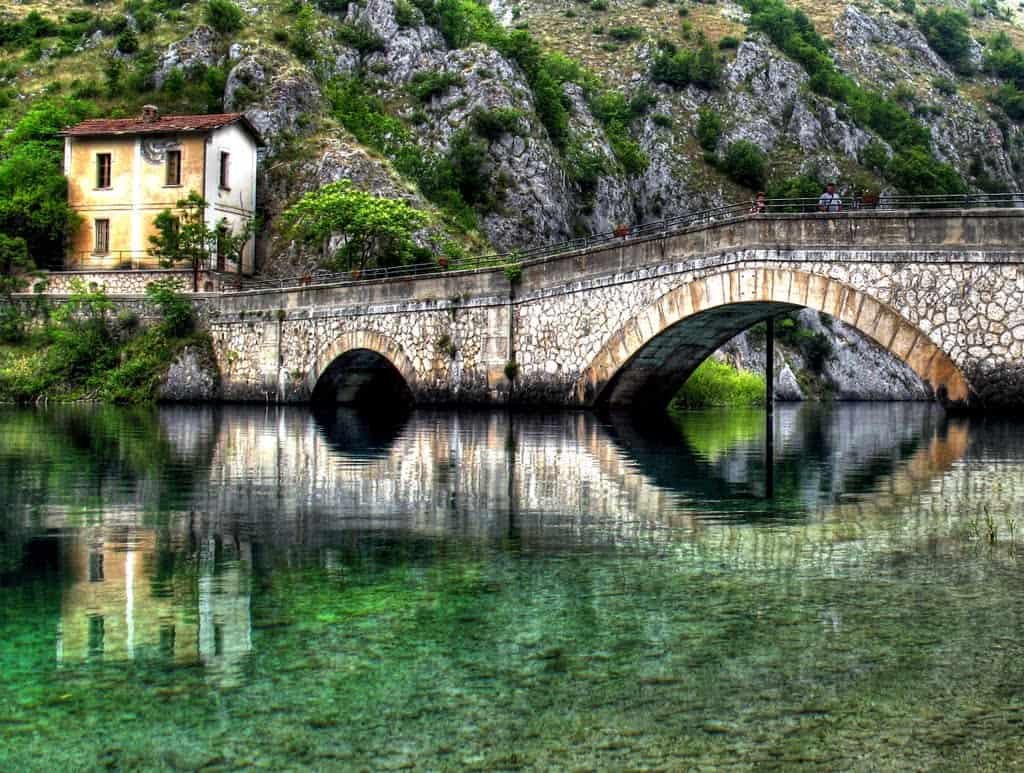
Going up the valley toward Villalago you reach the point where the gorges begin, at the San Domenico dam, and at the hermitage that gives it its name, on the shore of the lake of the same name. According to tradition, around the year 1000 the Benedictine monk Saint Dominic of Sora lived here in a cave dug into the limestone rock. The hermitage proper was built around the 15th century, when the cult of the saint spread. The dam, built in 1929, changed the look of the complex: before, the hermitage had a portico with two-light windows and a recessed facade with a large window, and with the dam a new stone bridge was built and the facade redone. Inside, a single nave and a 17th-century portico with four paintings from 1938 by the painter Alfredo Gentile dedicated to episodes from the life of the saint. The turquoise of the basin below the walls is the most shared photograph of the whole valley, and you should know that it is reservoir water and not a natural lake.
Scanno, the lake and its heart-shaped profile
15 kilometers from the reserve, Scanno is one of the most photographed villages of the Apennines, with its lake just below. Lake Scanno formed when an ancient landslide that detached from the overlying Monte Rava dammed the Tasso river, in an interval between 12,820 and 3,000 years ago. Today it sits at an elevation of 922 meters above sea level, reaches a depth that varies from 30 to 32 meters in flood periods and is the largest natural lake in the region, with about three quarters of the surface in the territory of Villalago and the rest in that of Scanno. The heart-shaped profile, which made the place famous, can be seen only from certain viewpoints, in particular from the Frattura Nuova belvedere: from the lakefront it is not visible, and whoever arrives convinced of the opposite is disappointed.
Cocullo and the Festival of the Snake Handlers
Cocullo, the town of the motorway toll booth, is known for the Festival of the Snake Handlers, linked according to tradition to ancient rites celebrated by the Marsi and dedicated to Saint Dominic of Sora, the same one as the hermitage of Villalago: the saint, who arrived in the 10th century, left relics invoked against snakebites and toothache, and in the procession snakes are laid on the statue. The festival falls on May 1, a date fixed after legislative decree 138 of 2011 modified the old calendar of the first Thursday of the month. Anyone combining the Sagittario Gorges with Cocullo on May 1 should allow for crowds, closed roads and distant parking: it is one of the most studied folk festivals in Italy, and worth that price.
Abruzzo, Lazio and Molise National Park and the other nearby reserves
30 kilometers away is Pescasseroli, seat of Abruzzo, Lazio and Molise National Park, and on the same line are the Camosciara and the most frequented trails of the park. In the immediate vicinity of the WWF Oasis Sagittario Gorges there is also the Monte Genzana and Alto Gizio Guided Nature Reserve, which protects the opposite side of the valley. Farther north, toward L'Aquila, opens the world of the Gran Sasso and of Campo Imperatore: another Abruzzo, equally reachable in a day from Rome.

A curiosity about the WWF Oasis Sagittario Gorges
The least predictable curiosity of this place concerns neither the bear nor the canyon: it concerns a flower. Centaurea scannensis, the Sagittario cornflower, grows on the limestone cliffs of this valley and nowhere else in the world. A pinpoint endemic of this type means that the entire existence of a plant species depends on a few rock walls between Anversa degli Abruzzi and Villalago, on their exposure, on their slope, on the fact that nobody opens a quarry there or widens a roadway. The plant is included among the species protected by the Washington Convention, the international agreement that regulates trade in threatened species, and appears in the regional red lists.
The paradox is this: 99 percent of the people who cross the gorges by car pass a few meters from one of the rarest plants in Europe without knowing it, while turning to look at the green water under the bridge. It is not their fault, because the cornflower is discreet, makes no show and resembles a thousand other composites. You need someone to point it out, and that is exactly why the reserve has a botanical garden and a Floristic Trail.
The second part of the curiosity is even nicer. Next to the cornflower lives Ephedra major, the Nebrodi ephedra, a shrub without true leaves, with green jointed stems, that belongs to a very ancient group of plants, distantly related to the conifers and without flowers in the sense in which we understand them. It survives on the hottest and driest cliffs of the WWF Oasis Sagittario Gorges as a relict of more arid climatic phases. In an Apennine valley where everyone looks for the bear, the two most extraordinary living things are two bushes clinging to the stone.
Something nobody tells you about the WWF Oasis Sagittario Gorges
Nobody will tell you that the turquoise lake below the hermitage of San Domenico, the one that fills the postcards and the social profiles of Abruzzo, is an artificial reservoir created by the dam built in 1929, and that its level depends on the operation of a hydroelectric plant. The Sagittario plant, running since 1927 and fed by the artificial San Domenico lake, has a capacity of 20 megawatts. The complementary Anversa plant, from 1929, with the dam at the foot of the town, is worth half a megawatt. It means that the water you see, and its color, are the result of management: certain days the basin is full up to the feet of the hermitage, other days it uncovers banks of gravel and mud.
The practical consequence is clear: if you have in mind a specific photograph seen somewhere and want to redo it, find out about the state of the reservoir first. Nobody tells you, and many go home disappointed, convinced the place was overrated, when the problem was only the water level that week.
There is a second thing that usually stays out of the stories, and it concerns the hermitage itself. Before the dam the complex looked different, with a portico with two-light windows and a recessed facade with a large window. With the reservoir a new stone bridge was built and the facade redone. What is photographed today as a medieval hermitage suspended over the water is, in its present form, a building reshaped by 20th-century hydraulic engineering on a structure built around the 15th century, in turn tied by tradition to the stay of Saint Dominic of Sora in a limestone cave around the year 1000. Knowing it takes nothing away from the beauty of the place: it adds three layers of history.
Frequently asked questions about the WWF Oasis Sagittario Gorges
How much does it cost to enter the WWF Oasis Sagittario Gorges?
Entry to the reserve of the WWF Oasis Sagittario Gorges is free. The guided visits to the botanical garden and the visitor center, the educational workshops on the river and the excursions with guides are paid, and by reservation: rates can be asked at 327 9411980 or at the address riservagolesagittario@gmail.com.
How do you get to the WWF Oasis Sagittario Gorges from Rome?
From Rome you take the A24 toward L'Aquila and Teramo, stay on the A25 branch toward Pescara at the Torano junction and exit at Cocullo. From the toll booth to the reserve of the WWF Oasis Sagittario Gorges it is less than five kilometers, which makes the trip doable in a day even without staying overnight away from Rome.
When is the WWF Oasis Sagittario Gorges open?
The protected area of the WWF Oasis Sagittario Gorges is open all year and access to the trails along the river is free, with no turnstile or ticket to walk. The calendar of the organized activities, such as the guided visits and workshops, changes instead depending on the season.
What animals can you see at the WWF Oasis Sagittario Gorges?
The reserve hosts a rich Apennine fauna: among mammals are the Marsican brown bear, the wolf, the Apennine chamois, the red deer, the roe deer and the rare Italian hare, while among birds the golden eagle, the peregrine falcon and the rock partridge nest in or frequent the area. It is one of the stretches of the central Apennines with the most intact fauna.
What is there to see at Castrovalva near the WWF Oasis Sagittario Gorges?
Castrovalva is a village perched on a spur that detaches from the ridge of Monte Sant'Angelo at 820 meters of elevation, made famous by the Dutch engraver Maurits Cornelis Escher, who in 1929 made a lithograph there that became one of his most recognizable Italian works. The Comune dedicated to Escher the hairpin bend from which he drew that view.
Is the San Domenico lake near the WWF Oasis Sagittario Gorges natural?
No, the turquoise lake below the hermitage of San Domenico is an artificial reservoir created by the dam built in 1929, and its level depends on the operation of the Sagittario hydroelectric plant, running since 1927 with a capacity of 20 megawatts. It is a little-known detail compared to the photographic fame of the place.
When is the best period to photograph the Sagittario Gorges?
It is best to book a guide and do the loop early in the morning, not in the early afternoon: between 9:00 and 11:00 the sun enters from above the walls of the gorge lighting the bottom without flattening it, while after noon the light crushes the landscape and in the evening it goes out completely.
The advice I give you for visiting the WWF Oasis Sagittario Gorges
There is one piece of advice and it admits no discounts: book a reserve guide and do the three-hour loop early in the morning, not in the early afternoon. There are three reasons, all concrete. The first is the light: the ravine is narrow and deep, and between 9:00 and 11:00 the sun enters from above the walls illuminating the bottom without flattening it, while after noon it crushes it and in the evening it puts it out completely. The second is the wildlife: animals move at dawn and dusk, and fresh tracks in the mud of the springs are read better before half a day of hikers has walked over them. The third is the traffic on the Statale 479, which on summer weekends becomes the line toward Scanno.
On what to wear and what to bring I am equally categorical, because this is where days get ruined: hiking shoes with a treaded sole, never smooth sneakers on wet limestone, at least a liter and a half of water per person in summer, a pair of binoculars, which here is worth more than a telephoto lens, a sweatshirt even in July, because the bottom of the gorge is several degrees cooler than the plain. And a charged phone: in some stretches of the valley the signal is weak or absent.
The last part of the advice concerns pace. The most common mistake I see is treating the WWF Oasis Sagittario Gorges as a 40-minute stop on the road to Lake Scanno. Whoever does so sees a rocky narrows, takes two photographs and leaves convinced they have seen it. The reserve is small and asks to be walked slowly: half an hour at the visitor center, an hour at the botanical garden, three hours of loop, an hour for Anversa degli Abruzzi. Six hours, and it is one of the best days you can have an hour and a half from Rome. Anyone with a group to organize who does not want to improvise can rely on licensed professionals of tour escorting.
Another well-known fact, yet rarely cited
That the Sagittario Gorges are among the most important examples of river erosion in the central-southern Apennines, everyone writes. Almost no one, however, draws the consequence: the rock that forms these walls is a sea floor. They are limestones built by corals, algae and foraminifera in a warm, shallow sea, with deposits whose formation falls in an interval between 200 and 20 million years before the uplift of the Apennine chain brought them to altitude. The field check exists and does not require a laboratory: on the slopes of Pizzo Marcello, the highest peak of the area, fossil seashells have been found, and that wall, today vertical and sunbaked, was a reef.
The fact is well known in the sense that you read it everywhere in the form of a catchphrase, and rarely cited in the sense that almost nobody turns it into a visiting experience. Try it: stop at the entrance of the ravine, raise your head to the top edge of the walls and say out loud that up there, 200 meters above, there was salt water and there were corals. Then look at the Sagittario flowing a couple of steps from you. In between lie millions of years of tectonic uplift and river incision, and that perfect V that contains you is the way time signed the work.
I add the lesser-known corollary, which concerns the invisible water. Limestone is a rock that dissolves, and the karst system of the valley collects the rains of the high slopes to give them back below at the Sorgenti del Cavuto, with a nearly constant temperature. It is this constancy that explains how a few meters from a scorching cliff you can find a damp-environment vegetation: two plant worlds that live side by side about 10 steps apart. In the WWF Oasis Sagittario Gorges the microclimate is not an abstract textbook concept, it is the physical reason why 789 plant species cohabit in 450 hectares.
The right photo to take at the WWF Oasis Sagittario Gorges
The photograph worth the trip is not taken inside the gorge: it is taken from Castrovalva. The village occupies a rocky spur that detaches from the ridge of Monte Sant'Angelo at 820 meters of elevation, and the Comune dedicated to Maurits Cornelis Escher the hairpin bend from which the Dutch engraver made in 1929 his lithograph, recognizable all over the world. From the same point you can frame the same scene: the town clinging to the ridge, the valley that drops away, the mountains that close the background. It is not an easy photograph, because the field is wide and the light changes everything: in the early morning the slope is in shadow and the contrast becomes unmanageable, while in the late afternoon the raking light separates the planes and draws the profile of the spur.
Inside the reserve there are three other good framings. The first is the Sorgenti del Cavuto, with the crystal-clear water and the hygrophilous vegetation: here you need a polarizer, otherwise the reflection erases the bottom and the whole point of the shot. The second is the canyon seen from below with the walls narrowing: you keep the river in the foreground and let the cliffs converge upward, and it is one of the rare cases in which an extreme wide-angle really helps. The third is the October photograph of the maples, with the morning light lighting up the crowns in the still-shaded valley floor.
Outside the reserve the best-known postcard remains the hermitage of San Domenico on its lake, and the recommendation already given holds: the color and the level depend on the reservoir, so find out first. A safety warning, because every year someone ignores it: do not shoot by stopping on the Statale 479. It is narrow, with blind curves and very few pullouts, and the photograph you want is not worth a flashing emergency light behind you. Stops are made at the equipped points and the reserve's parking lots.
Some important events that happened here in history
The first event that changed the face of this valley is the construction of the San Domenico dam, in 1929, with the reservoir that submerged the floor of the narrows at the foot of the hermitage and forced the rebuilding of the facade and the construction of a new stone bridge. Two years earlier, in 1927, the Sagittario hydroelectric plant had gone into operation, 20 megawatts. In 1929 the complementary Anversa plant followed, with its dam at the foot of the town. In a little over five years an Apennine river was turned into a chain of energy production, and the landscape that is photographed today as natural carries that industrial decision inside it.
The second event is literary and has a precise date: March 27, 1905, when at the Teatro Manzoni in Milan The Torch Under the Bushel premiered, the tragedy that Gabriele d'Annunzio had written in 1904 setting it in Anversa degli Abruzzi, within the walls of the ancient Sangro house, and that he considered the perfect one among his tragedies. In 1905 the poet visited the village and was struck by the ruins of the castle. From that encounter descends, almost a century later, the establishment in 1997 of the Literary Park dedicated to d'Annunzio, the only one in Abruzzo.
The third block of events is seismic and marked the town's buildings: the earthquake of 1706, the Maiella quake, and that of the Marsica in 1915. In a village that in 1901 counted 1,934 inhabitants and today counts a little over 300, earthquakes worked together with emigration: the ruins that d'Annunzio looked at were already the sign of a community in retreat.
The fourth event is recent and administrative, and for nature it is the most important of all: in 1997 the area becomes a guided Regional Nature Reserve, entrusted to the Comune of Anversa degli Abruzzi with the technical-scientific support of the Istituto Abruzzese per le Aree Protette and included in the network of WWF Oases. Later the territory enters Natura 2000 as Special Area of Conservation IT7110099. Without those two decisions, the valley would today be a scenic stretch of highway and nothing more.
Who has passed through the WWF Oasis Sagittario Gorges
The first name, in order of fame, is Maurits Cornelis Escher. The Dutch artist arrived at Castrovalva at the end of the 1920s and in 1929 made from it a lithograph that became one of his most recognizable Italian works: from that hairpin bend, now named after him, the village appears suspended over the void of the valley. Escher traveled central Italy on foot in those years and brought back dozens of views, but few have the verticality of this one.
The second name is Gabriele d'Annunzio, who tied to Anversa degli Abruzzi his tragedy of 1904, first performed on March 27, 1905, and who in 1905 visited the village and was struck by its ruins. The ancient Sangro house, which in the tragedy is the theater of the decline of a noble family, recalls the fief historically tied to the Di Sangro, who in the 16th century also held Castrovalva before it passed to the D'Avalos and the Paschale barons.
Before them came the travelers of the British Grand Tour. Around the middle of the 19th century Keppel Richard Craven and Edward Lear described the Sagittario Gorges, and the judgment they entrusted to their pages holds together the two faces of the place: frightening and beautiful. Lear, whom many today know mostly as the author of limericks, was also a tireless landscape artist and a walker in pre-railway southern Italy: getting here then meant days on mule tracks.
Much further back there is the hagiographic tradition, with Saint Dominic of Sora, the Benedictine monk who around the year 1000 is said to have dwelt in the limestone cave where the hermitage stands, after passing through the Benedictine monastery of San Pietro de Lacu and through Cocullo, where tradition credits him with the healing of a girl bitten by a snake and the taming of a wolf. And before that the Normans, builders of the castle that dominates the mouth of the valley, and the Marsi, to whose rites tradition traces the Cocullo snake handlers' festival. Anyone walking today in the WWF Oasis Sagittario Gorges follows a necessary passage that people have used for millennia.
Quick questions about the WWF Oasis Sagittario Gorges
How much does it cost to enter the WWF Oasis Sagittario Gorges?
Entry to the reserve is free. The guided visits, educational workshops and excursions with guides are paid, and by reservation: rates should be asked directly of the reserve at 327 9411980 or at the address riservagolesagittario@gmail.com.
When is the WWF Oasis Sagittario Gorges open?
The protected area is open all year. The calendar of the visitor center, the museum and the guided activities follows the season instead and should be confirmed by phone or on the official site before leaving.
Do you need to book to visit the WWF Oasis Sagittario Gorges?
To walk on the trails, no. For everything else, yes: guided visits, workshops on the river, routes for schools and outings with mountain guides are booked in advance, and on high-season weekends it is best to leave a few days of margin.
How long does the visit to the WWF Oasis Sagittario Gorges last?
The classic loop from the Sorgenti del Cavuto toward Castrovalva and Colle San Michele takes about three hours. Adding the visitor center, botanical garden and a stop in Anversa degli Abruzzi, you comfortably reach a full day.
How do you get to the WWF Oasis Sagittario Gorges from Rome?
By car: A24 toward L'Aquila, A25 branch toward Pescara, Cocullo exit, then less than five kilometers on the Statale 479 toward Anversa degli Abruzzi. About an hour and a half. By train: to Sulmona, on the Rome-Pescara and Naples-Pescara lines, then bus to Anversa. From Rome Tiburtina there are also bus connections to Sulmona and Pratola Peligna.
What is the address of the WWF Oasis Sagittario Gorges?
Strada Comunale Fiume Sagittario, località Sorgenti del Cavuto, Anversa degli Abruzzi (AQ).
How big is the WWF Oasis Sagittario Gorges?
About 450 hectares, from the bottom of the ravine up to the 1,500 meters of Pizzo Marcello. The reserve was established in 1997 and is also a Special Area of Conservation of the Natura 2000 network with the code IT7110099.
Can you see bears in the WWF Oasis Sagittario Gorges?
The Marsican brown bear really does frequent the valley, but the total population is estimated at between 55 and 85 individuals and the animal is shy: the probability of a sighting in a morning is very low. With a guide you learn instead to recognize prints, scat and scratches, and that is a guaranteed result.
Are there wolves in the WWF Oasis Sagittario Gorges?
Yes, the wolf uses the gorges as a corridor between the Peligna Valley and the Marsican massifs. It moves mostly at night and is rarely sighted.
Is the WWF Oasis Sagittario Gorges suitable for children?
The stretch around the springs and the botanical garden is within reach of the youngest, and the reserve organizes workshops on the river, readings and educational-artistic activities designed for them. The three-hour loop becomes realistic from age seven or eight up, with stops. The stroller is not suited to these surfaces.
Can you bring dogs into the WWF Oasis Sagittario Gorges?
In a protected area dogs must be kept on a leash and in some periods or sectors access may be limited for the tranquility of the wildlife. Phone the reserve before leaving: it is the question that avoids a wasted trip.
Is the WWF Oasis Sagittario Gorges wheelchair accessible?
The mountain trails of the reserve are not passable in a wheelchair and the surfaces around the entrance are natural and irregular. To find out what is feasible in the current season it is best to contact the staff directly.
What shoes do you need for the WWF Oasis Sagittario Gorges?
Hiking shoes with a treaded sole. Wet or polished limestone, with a smooth sole, is the main cause of slips in this valley.
What is the best period for the WWF Oasis Sagittario Gorges?
May and June for the blooms and full water, September and early October for the maples and the low light. In July and August you have to leave at dawn. In winter the reserve is splendid and silent, but you have to reckon with ice and short days.
Can you swim in the Sagittario river inside the reserve?
The waters of the gorge are cold, fast-flowing and in a protected area: swimming is not the intended use of this environment, and any restrictions should be checked on site. Anyone looking for water for swimming should head for Lake Scanno, which has equipped pebble beaches.
Is there a picnic area in the WWF Oasis Sagittario Gorges?
Yes, the reserve has an equipped picnic area, together with the visitor center, the museum and the botanical garden.
What is the difference between the Sagittario Gorges and Abruzzo National Park?
The Sagittario Gorges are a 450-hectare guided Regional Nature Reserve managed by the Comune of Anversa degli Abruzzi within the network of WWF Oases. Abruzzo, Lazio and Molise National Park is a national protected area established on January 11, 1923, based in Pescasseroli, covering 25 comuni in three provinces. The reserve touches the outer protection zone of the park and shares its fauna.
Why are the Sagittario Gorges a Literary Park?
Because Gabriele d'Annunzio set The Torch Under the Bushel in Anversa degli Abruzzi, written in 1904 and first performed on March 27, 1905 at the Teatro Manzoni in Milan. The Literary Park dedicated to him was established in 1997 and is the only one in Abruzzo.
What is Castrovalva and why is it famous?
It is the only frazione of Anversa degli Abruzzi, on a rocky spur at 820 meters of elevation, already mentioned in a document of 1079. Its worldwide fame is owed to the lithograph that Maurits Cornelis Escher dedicated to it in 1929. The hairpin bend from which the artist looked at the village is now named after him.
Is the Hermitage of San Domenico part of the WWF Oasis Sagittario Gorges?
The area of the gorges begins at the San Domenico dam, near which the hermitage stands, in the territory of Villalago. It is the natural complement of the visit and is a few minutes by car from the entrance of the reserve.
How far is Lake Scanno from the WWF Oasis Sagittario Gorges?
Scanno is 15 kilometers away. The lake, at 922 meters of elevation, formed when the Tasso river was dammed by a landslide detached from Monte Rava. The heart-shaped profile can be seen from some viewpoints, in particular from the Frattura Nuova belvedere.
Can you get to the WWF Oasis Sagittario Gorges without a car?
Yes, by train to Sulmona and the bus to Anversa degli Abruzzi, or with the bus connections from Rome Tiburtina to Sulmona and Pratola Peligna. Local bus schedules are few: check them the day before.
Are there other reserves near the WWF Oasis Sagittario Gorges?
In the immediate vicinity operates the Monte Genzana and Alto Gizio Guided Nature Reserve. A little farther south you enter Abruzzo, Lazio and Molise National Park with the Camosciara. Anyone who collects ravines and gorges on day trips from Rome can also look at the Farfa Gorges in Sabina and the Marmore Falls in Umbria.
Which other WWF Oases can you visit starting from Rome?
Among the most convenient are the WWF Oasis of Macchiagrande on the Roman coast, the WWF Oasis of Lake Alviano in Umbria and the WWF Oasis of Lake Burano in Maremma. They are completely different environments from an Apennine ravine, and precisely for this they fit well into a year of outings.
What do you do at the WWF Oasis Sagittario Gorges when it rains?
In the rain the rocky stretches become slippery and the long loop is not recommended. The visitor center, the museum and the botanical garden remain, and Anversa degli Abruzzi remains with the church of Santa Maria delle Grazie and the ruins of the Norman castle. The honest plan B, however, is to move the trip by a week.
Do you need a guide to visit the WWF Oasis Sagittario Gorges?
It is not mandatory, but it changes the day. On one kilometer of trail a reserve guide shows endemic species, wildlife signs and geological marks that alone would go unnoticed. For organized groups, school classes or company trips there are licensed professionals for group trip organization in Italy.
Why go back
We leave you with our opinion on this valley. The WWF Oasis Sagittario Gorges is the right place for those who say they have already seen everything within two hours of Rome, because it dismantles the idea that big nature begins far away. Here, in 450 hectares, there is a ravine carved into an uplifted sea floor, the rarest plant of the region, the rarest bear in Europe, a village that a Dutch engraver made immortal and a hermitage that a dam reshaped. You do not need a plane and you do not need a week: you need to leave early, walk slowly and book a guide. If I had to choose a single day of the year, I would take a mid-October morning, with the maples lit up and the bellowing of the stags rising up the valley floor. And if after the loop you have an hour left, go up to Castrovalva and stay silent for 10 minutes on Escher's hairpin bend: from there the valley explains itself. Anyone reading in English and preparing a trip to this region will find material in the guide to ItalyPlanner's Abruzzo and in the section dedicated to mountains and nature in Italy.
Article written by the editorial team of TourLeaderPro, contact them for Private/Corporate/V.I.P. Tours and Experiences.
Planning a trip to Rome? The English guides to visiting the city are on ItalyPlanner.com.