Marmore Falls (TR)
In short. Marmore Falls is located in Marmore, a hamlet of Terni, along State Road 209 Valnerina, about seven kilometers from the center of Terni and a little over an hour and a half by car from Rome.
Marmore Falls is located in Marmore, a hamlet of Terni, along State Road 209 Valnerina, about seven kilometers from the center of Terni and a little over an hour and a half by car from Rome. The reference address for the lower viewpoint is Strada Statale 209 Valnerina, 05100 Terni (TR). The park's phone number listed on the official site is +39 0744 67561. The full ticket published by the official operator costs €12 for visitors aged 10 and up. The reduced ticket costs €10 (children aged five to nine, people over 70, members of alpine clubs and affiliated associations), while children up to four years old enter for free. On winter days without water release, a reduced rate of €6 applies. The park opens at varying times depending on the season, generally at 10.00 in the cold months and at 9.00 in midsummer, with closing times ranging from late afternoon in winter to 22.30 in August. The detail that matters most is not the price but the time the water is released. The waterfall runs on controlled flow and reaches full force only in precise time slots, so it's best to arrive inside the park a quarter of an hour before the sluice gates open. Prices, hours and the release schedule change from month to month. Check them on the official website before you go, because a visit at the wrong time shows a wet rock wall instead of the 165 meters of water.
How to get there without a car: the lower viewpoint is served by a bus stop where the lines connecting it to Terni railway station pass, in particular the direct urban line marked 7 barrato Terni-Cascata, the urban line 7 Terni-Torre Orsina, and the extra-urban line 621 toward Arrone, Ferentillo, Montefranco and Scheggino. The upper viewpoint is reached from the Marmore interchange on the Rieti-Terni expressway. It is served by the small Marmore station, on the secondary Terni-L'Aquila railway, and by a stop on extra-urban line 624 Terni-Colli sul Velino. By car from Rome, take the Salaria or the highway as far as Rieti, then the Rieti-Terni expressway, exiting at Valnerina for the lower viewpoint or at Marmore for the upper one. Visitors arriving by train in Terni will find city buses right in front of the station.
This guide works well alongside the other waterfalls of Lazio and central Italy that we collect in the index of tourist attractions, starting with Parco di Villa Gregoriana in Tivoli, the artificial waterfall that follows Marmore for height in central Italy.

What Marmore Falls really is
The first thing to clarify, because it changes the way you look at it, is that Marmore Falls is not a natural phenomenon in the way a spring or a glacier is. It is a Roman hydraulic work over 2,000 years old, the oldest and largest artificial waterfall in the world still in operation. The water that falls is real water from the Velino River, but the drop that makes it fall was opened by engineers of the Roman Republic in 271 BC. Since then, generations of technicians, popes and architects have corrected, enlarged and regulated it. Those who arrive expecting an untouched wonder of nature are a little thrown off when they discover the sluice gates, the hydroelectric plant and the opening hours. Those who arrive knowing they are standing before a hydraulic machine more than 2,000 years old look at it with a very different kind of respect.
The total drop is 165 meters spread over three falls. This places it among the waterfalls with the greatest drop in Europe and at the top of the Italian ranking for controlled-flow waterfalls. The first drop is the highest and most spectacular, with over 80 meters of free fall. The other two complete the descent through the Nera Gorge. The name comes from the calcium carbonate deposits that centuries have left on the rocks: white, glossy incrustations that recall marble, hence Marmore. The waterfall is formed by the Velino River, which, reaching the hamlet of Marmore, flows out of Lake Piediluco and plunges noisily into the gorge below, carved by the Nera River, of which the Velino is a tributary.
My verdict is clear: Marmore Falls should be seen at least once at full force and at least once at the first morning release, when the park is still empty and the roar arrives before the crowds. The rest, the kiosks, the parking and the buses, is just background. The heart of the experience lasts the few minutes in which the sound signal announces the opening of the sluice gates, and in an instant the dry rock becomes a wall of water.
Marmore Falls on controlled flow: why it's not always open
This is the point that sends uninformed visitors home disappointed, so it deserves a whole chapter. The Velino River has an average flow of around 50 cubic meters per second. Under normal conditions, only part of this water is allowed to fall over the drop of the waterfall: the rest is diverted into penstocks toward the Galleto hydroelectric plant, one of the most important in central Italy, which has been using this drop to produce power since the early twentieth century. When the floodgates are closed, the waterfall runs at minimum flow and exposes the rocks, the travertine and the vegetation of the drop. When they open, the flow rises within a few minutes and the wall goes back to looking like the one in the photographs, with clouds of spray rising from the gorge.
Before each opening, an acoustic signal sounds, a siren that warns visitors and anyone along the river downstream. In those few minutes you can watch the water advance, swell and fill the drop. It is one of the most beautiful sights in the park, and it's worth getting into position early at a panoramic viewpoint to watch it from the start. Release times depend on the season. In the winter months, releases are concentrated on weekends, usually in two time slots such as 12.00-13.00 and 14.00-15.00. In spring they extend to every day, with longer slots in the morning and afternoon. In midsummer the water runs almost without interruption for a large part of the day, and on Saturday evenings an evening session is added with the waterfall lit up. These are general indications: the official release schedule should be checked on the park's website shortly before your visit, because it varies from year to year and with hydrological conditions.
At night, on summer opening evenings, Marmore Falls is lit by a latest-generation LED system that spreads an even beam of light across the three drops. It's a different view from the daytime one, more theatrical, and on August evenings the evening queue is worth it.

The Lower Viewpoint and the Upper Viewpoint of Marmore Falls
The park has two entrances, at different elevations, and understanding the difference before you set out avoids mistakes. The lower viewpoint is at the base of the waterfall, along State Road 209 of the Valnerina, and it is the most scenic spot: from here you look at the drop from below upward, with water plunging right at you and spray that, on days at full flow, reaches the railing. From this entrance, the trails start that climb toward the intermediate drops and toward the famous Balcone degli Innamorati. It's the viewpoint I recommend to those coming for the first time and who want the full visual impact.
The upper viewpoint is at the top, in the town of Marmore, and offers the overall view: from up there you can see where the water comes from, the lip of the first drop, and the panoramic view over the Valnerina and the Ternana basin. It's the best spot for understanding the geography of the place and for wide photographs. The two viewpoints are connected on foot by the park's trails, so with one ticket and a bit of legwork you can see both, climbing from the bottom or descending from the top. Those short on time or unwilling to walk can also drive between the two entrances, but they miss the best part, which is precisely the climb beside the water.
The Numbered Trails of Marmore Falls, One by One
The park is crossed by six numbered and marked trails, each with its own name, length and level of difficulty. Choosing them well makes the difference between a rushed visit and a full day. I describe all of them, because each one shows Marmore Falls from an angle the others don't offer. The length, elevation gain and duration figures are those on the park's trail signs. Check at the entrance which trails are open on the day of your visit, because in case of rain or maintenance some sections are closed for safety.
Trail 1 of Marmore Falls, the Antico Passaggio and the Balcone degli Innamorati
This is the most famous and the most demanding. The Antico Passaggio connects the lower viewpoint to the upper one with a staircase of about 600 steps, an elevation gain of around 150 meters and 20-30 minutes of climbing at an easy pace. Along the way you pass the Balcone degli Innamorati, a small terrace looking directly over the first drop. It's the point where you get closest to the water, and on days at full flow you come out soaked by the spray. It's not suitable for strollers or for anyone with mobility problems, and on high-flow days the surface becomes slippery. Wear closed shoes with good soles and, if you have a camera, bring a bag to protect it. It's the trail that gives you the physical thrill of the waterfall, not just the visual one.
Trail 2 of Marmore Falls, the Anello della Ninfa
A short loop suitable for families, about 330 meters for a quarter of an hour of walking, with wooden bridges and small natural caves near the second drop. It's the trail I prefer for people who come with kids who already walk well: short, varied, with the water always close and a few passages that are fun. Here too, strollers don't get through well because of the steps and the bridges.
Trail 3 of Marmore Falls, the Meeting of the Waters
The shortest, about 10 minutes, designed for people who have little time. It leads to the point where the waters of the waterfall join the Nera River, inside the canyons the river has carved into the rock. It's the right choice for a quick stop along the way, when you can't spend more than half an hour at the park.
Trail 4 of Marmore Falls, the Majesty
If I had to point out just one to someone who has never been, I'd point to this one. The Majesty, about 520 meters for 20-30 minutes, is the only trail from which you can see all three drops together, the complete view of the 165 meters. Limited difficulty, maximum panoramic views: it's the best ratio of effort to spectacle in the whole park.
Trail 5 of Marmore Falls, the Cliff and the Man
The only flat trail, about 770 meters with no elevation change, fully accessible to people with mobility difficulties and passable with strollers. It tells the story of the relationship between man and this cliff, that is, the history of the hydraulic works that built the waterfall. And to those who wonder whether Marmore Falls can be seen from a wheelchair: yes, from this trail and from the panoramic points reachable without stairs.
Trail 6 of Marmore Falls, the Wise Holm Oaks
The longest and most strenuous, about 1,600 meters with 160 meters of elevation gain and about 40 minutes of uphill walking through the holm oak forest above the gorge. It's the route for those who like to walk and want to see the waterfall from above, surrounded by vegetation, away from the crowds at the lookout. Those with good legs and half a day will be rewarded with views that other visitors don't see.
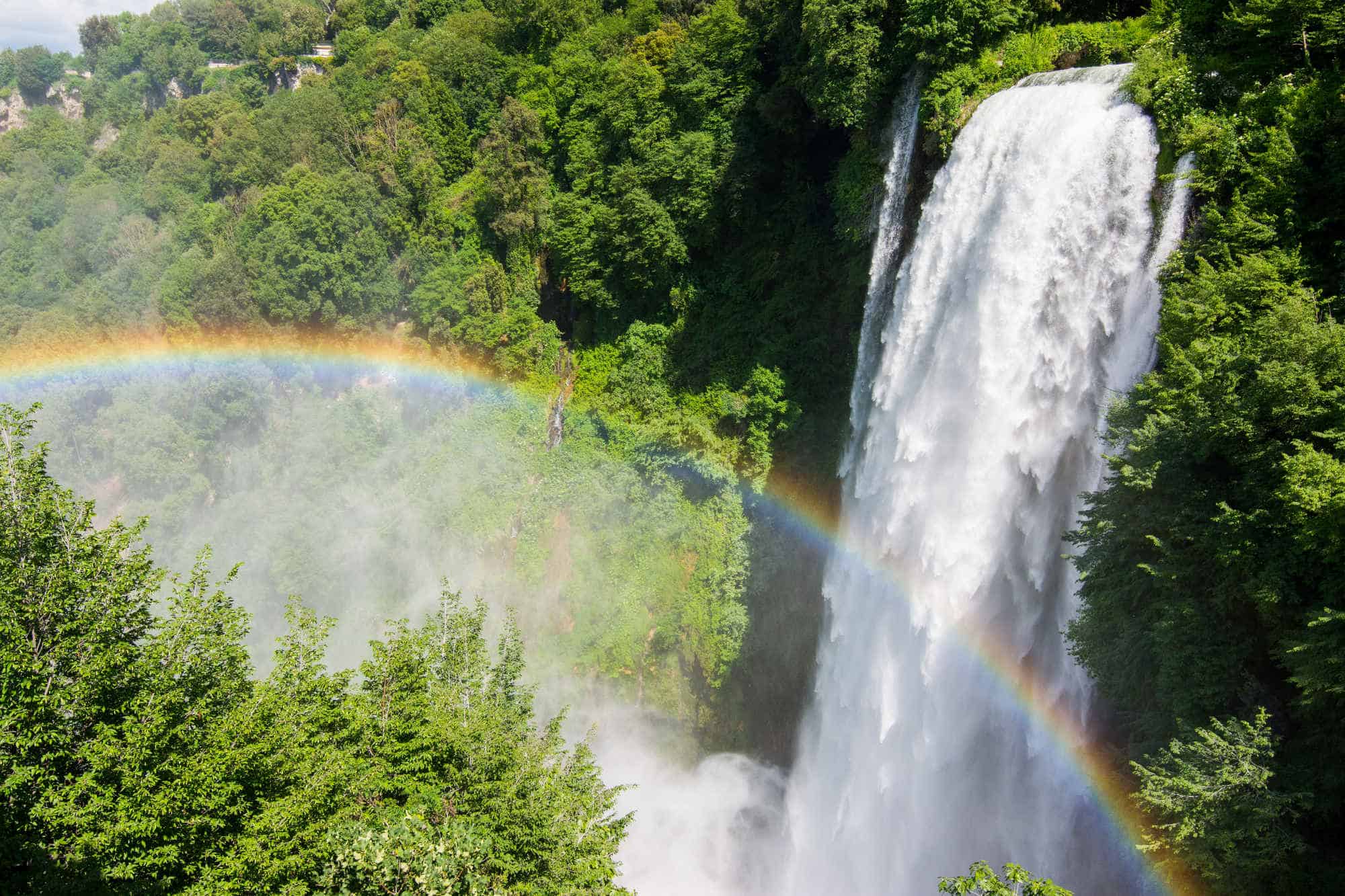
The Caves, Stalactites and Travertine of Marmore Falls
An aspect of the park that is still little visited is the caves. Over the centuries, water rich in calcium carbonate has both carved out and built up, inside the travertine, cavities with stalactites and stalagmites. Some of these caves can be visited along the trails and represent a part of Marmore Falls that most visitors ignore, caught up as they are in the main drop. The travertine itself is an open-air geology lesson: it's the stone that water deposits day after day, the same stone the Romans used to build half the city, and here you can see it forming in real time on the rocks of the drop. It's worth slowing down and looking closely at the white crusts: they're the reason for the name and the chemical signature of the place.
The History of Marmore Falls from 271 BC to Today
The history of this place is the history of a hydraulic problem faced for 20 centuries. It's worth telling it in full, because every stone of the waterfall carries the name of those who worked on it.
Manius Curius Dentatus and the Roman Cut of 271 BC
About 2,000 years ago, where the small Lungo and Ripasottile lakes remain today, the vast Lake Velino stretched out, a marshy body of water that waterlogged the Rieti plain. In 271 BC the Roman consul Manius Curius Dentatus ordered the digging of a canal, the Cavo Curiano, to drain the stagnant waters of the lake toward the natural rock drop at Marmore: from there the water plunged directly into the Nera River, a tributary of the Tiber. It was a colossal land reclamation project for the time, and in doing it the Romans created, without fully meaning to, the waterfall we admire today.
The Dispute Between Rieti and Terni and Cicero in the Senate in 54 BC
Solving one problem opened another. When the Velino was in flood, the enormous amount of water poured into the Nera threatened the town of Terni downstream. A centuries-long dispute arose between the two cities: Rieti wanted the water drained away, Terni feared flooding. In 54 BC the matter came before the Roman Senate, and the two cities were represented by the best lawyers of the era: Rieti by Cicero, Terni by Quintus Hortensius Hortalus, the two most celebrated orators of the Republic. The case ended with nothing decided, and things stayed that way for centuries. It's one of the few cases in which a provincial hydraulic dispute enters the history of great Latin oratory.
The Medieval Waterlogging and the Cavo Gregoriano of 1422
With the fall of the Western Roman Empire, maintenance of the channel ceased. The outflow diminished, the Cavo Curiano clogged and the Rieti plain gradually returned to being a marsh, with the fevers and health problems that marshes brought. After a series of events, in 1422 a new channel was dug to restore the original flow, the Cavo Reatino, also called Cavo Gregoriano for the intervention of Pope Gregory XII. From here on the history of the waterfall becomes a history of engineer popes.
Antonio da Sangallo the Younger and the Cava Paolina of 1545
In 1545 Pope Paul III commissioned Antonio da Sangallo the Younger, one of the greatest architects of the Renaissance, to open another channel, the Cava Paolina. The work functioned, but only for about 50 years, then the clogging returned. The fact that the architect of Saint Peter's Basilica was called on to deal with the outflow of the waterfall says how seriously the matter was considered in Rome.
Giovanni Fontana and the Cava Clementina of 1598
The idea was then to widen the old Curian channel and build a regulating bridge, a kind of valve to govern the outflow. The work was inaugurated in 1598 by Pope Clement VIII, who had entrusted the project to Giovanni Fontana, brother of the better-known Domenico Fontana, the architect who had raised the Vatican obelisk in Rome. The new channel took the name Cava Clementina. In the two centuries that followed, however, this work created quite a few problems for the plain, obstructing the outflow of the Nera and flooding the countryside.
Andrea Vici and the current shape of the waterfall in 1787
The decisive arrangement came at the end of the 18th century. By order of Pope Pius VI, in 1787 the architect Andrea Vici worked directly on the drops of the waterfall, shaping the leaps and giving the whole the look we see today. In essence, the Marmore Falls we photograph is Andrea Vici's: a work of the late 18th century built on top of a cut from the third century BC, corrected by one pope after another. Few things in the world have a historical stratigraphy so readable.
The industrial waterfall: the steelworks and hydroelectric power
In the 19th century the force of the water changed jobs. In 1896 the newborn Terni Steelworks powered their machinery using the water of the Cavo Curiano, and in the following years the drop was exploited intensively to produce hydroelectric power. Terni became for this reason the city of steel and electricity, the Italian Manchester, and the Marmore Falls was the engine of that industrial revolution. The controlled flow that today determines the opening hours is born right from here: the water serves the turbines, and what remains for the waterfall is the portion that the calendar sets. A panoramic view of the whole can be enjoyed from the medieval village of Torreorsina, the only town of the Valnerina directly overlooking the drop, which between 1901 and 1960 was connected to Terni by the Terni-Ferentillo tramway, built to serve the industry of the valley.
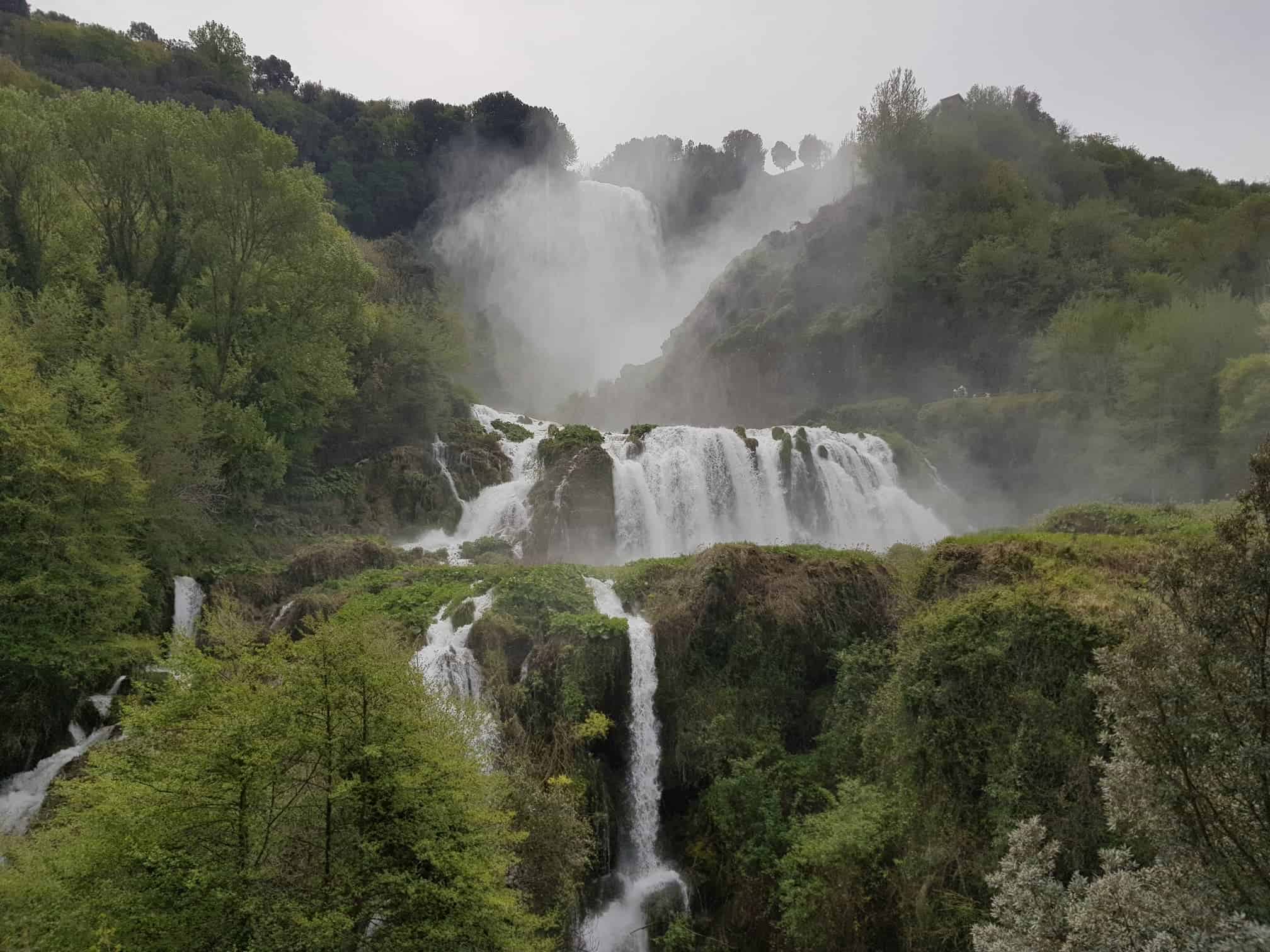
The Nera Gorge and the meeting of the two rivers below the Marmore Falls
It's worth understanding where the water that plunges from the 165 meters ends up. Below the last drop the Marmore Falls throws itself into the Nera Gorge, the canyon that the river has carved for millennia in the limestone rock of the Valnerina. Here the Velino, after the fall, joins the Nera and increases its flow: two rivers that mythology turned into two lovers and that geography brings together at the foot of the drop. The gorge is one of the most beautiful settings in the park, with emerald-green water running narrow between the walls, and you can observe it well from the low trails, in particular from Trail 3, the Meeting of the Waters, which leads right to the point of confluence. On full-flow days the gorge fills with spray and water mist, and the noise makes it hard to talk: it's the wildest and loudest part of the visit. This stretch is part of the Nera River park, the protected area that safeguards the entire course of the river and its environments.
How you really visit the Marmore Falls: duration, route, guide
For organizing the day, the answer is always the same. Arrive early, before the opening of the sluice gates indicated for that day. Enter from the lower viewpoint, settle on a panoramic spot and watch the first release from the start, when the water advances and fills the drop: those are the best minutes. Then take the trails: first Trail 4, the Majesty, for the overall view of the three drops, then, if your legs hold up, Trail 1, the Ancient Passage, to climb up to the Lovers' Balcony and come out wet under the first drop. Whoever still has time goes down or up to the opposite viewpoint for the complementary view. In all, a full visit takes three or four hours. Guided tours and outdoor activities are run by qualified park staff, who have an Environmental Education Center, services and refreshment points: for those who really want to understand the hydraulic history of the place, a guide is worth the extra cost. Check the availability of guided tours and of the caves, when open, directly with the park.
The legend of Nera and Velino
On the origins of the Marmore Falls, popular tradition, entrusted to the fairy-tale figure of the Gnefro, the water sprite, tells a love story. A nymph named Nera fell in love with the young shepherd Velino. For the two it was difficult to see each other, because they belonged to worlds too different. Juno, furious because the nymph had broken the rules that forbade love with human beings, turned Nera into a river. Velino, believing that his beloved was drowning in those waters appeared from nowhere, threw himself headlong from the cliff of Marmore. Jupiter, to spare him death, during the flight turned him into water, so that he could rejoin Nera for eternity. It's the mythological tale that explains the names of the two rivers that meet here, the Velino that leaps and the Nera that receives him, and that the Romans already knew: it's one of those legends constructed after the fact to give a human face to a geography.
The flora and fauna of the Marmore Falls park
Around the waterfall the vegetation is that of the Mediterranean scrub, but the real richness of the place is the biodiversity tied to the water and to the constant humidity of the spray. The area is recognized at the European level as a Site of Community Importance and as a Special Protection Area of the Natura 2000 Network, which tells you it isn't just scenery but a protected environment. Primitive plant forms grow there such as blue and green algae, mosses, liverworts and lichens, along with fungi, ferns and flowering plants, all favored by the humid microclimate created by the waterfall. The flora is accompanied by a varied fauna of insects, amphibians, fish, reptiles, birds and small mammals.
For those who love birdwatching the park offers rare encounters. Along the banks and in the bed of the Nera feed the dipper, able to walk underwater, and the gray wagtail. During the winter migrations you can see the colorful kingfisher. On the bare rock walls the crag martin and the blue rock thrush nest, while the white wagtail builds its mud nest under the roofs of the houses near the waterfall. The nightingale lives in the humid vegetation, and in the calmer waters you see the moorhen and the mallard. Bringing binoculars to the Marmore Falls isn't a specialist's affectation: it doubles the visit.
A curiosity about the Marmore Falls (TR)
The curiosity almost nobody knows concerns its deep nature: the Marmore Falls is the oldest and largest artificial waterfall in the world still in operation. It's not a tourist turn of phrase. The drop we see falling exists because in 271 BC a Roman consul decided to drain a lake, and since then no one has ever let it go back to how it was: for 20 centuries popes, architects and engineers have regulated it continuously. It means we are looking at a work of hydraulic engineering of the Roman Republic that is still perfectly operational, today at the service of a power plant. Few human works so ancient still carry out, without interruption, the function for which they were built.
There is a second layer of curiosity, usually ignored: the first drop, the one of more than 80 meters that plunges into the gorge, was never dug by man. It's the natural rock edge over which the Romans merely channeled the water. Put another way, the Marmore Falls is half nature, the drop, and half engineering, the water that feeds it. This double soul is its real uniqueness, and it explains why it fascinates the geologist and the historian alike.
One thing nobody tells you about the Marmore Falls (TR)
The thing that quick guides and posters don't explain, and that decides whether the visit is memorable or disappointing, is that the waterfall at full flow lasts only a short time and runs at fixed hours. Many visitors arrive mid-morning, find the falls at minimum flow, meaning a rock wall with a thin trickle of water, and leave convinced that Marmore Falls is overrated. They haven't seen the waterfall. They've seen the dry riverbed between one release and the next. The practical secret is simple, and nobody shouts it loudly enough: arrive at the park a quarter hour before the opening time of the floodgates listed for that day, take up a spot at a panoramic viewpoint, and wait for the acoustic signal. Within a few minutes you go from bare rock to 165 meters of water, and it's precisely that transition, not the waterfall already full, that is the most beautiful spectacle.
The second little-known point is that one ticket covers both viewpoints if you walk the trails, and that the climb on foot beside the water is worth more than the view from the railings. Those who stick to the lower viewpoint plaza see the postcard view. Those who take the Antico Passaggio and climb up to the Balcone degli Innamorati feel the waterfall on their skin. It costs 600 steps of effort, but it's the difference between looking and crossing.
The tip I give you for visiting Marmore Falls (TR)
The advice comes down to three moves. First, choose the day based on the release schedule, not your own convenience. A Saturday or Sunday in spring, or any day in August, guarantees more hours of full water than a weekday in winter, when the falls can stay closed almost the entire time. Second, enter from the lower viewpoint, walk up Sentiero 1 to the Balcone degli Innamorati for the close-up impact, then switch to Sentiero 4, the Maestosità, to see all three falls together, and if you have the legs and the time, finish with Sentiero 6 in the woods. Third, plan at least half a day. Anyone who gives it only half an hour sees a tenth of the park.
One more tip that visitors underestimate: dress as if for a hike, not for a day in town. Closed shoes with a sole that grips, because wet steps are slippery. A light rain jacket, because under the first falls you really do get wet. And a waterproof case for your phone or camera. Anyone who arrives at Marmore Falls in flip-flops and a blouse regrets it before the end of the first trail. The best moment of all is the first morning release in summer, when the light is low and raking, the park is empty, and the water is already full.

Another well-known fact, yet rarely mentioned
Every guide repeats that Marmore Falls is 165 meters high. What is rarely mentioned is where those numbers come from and what they really mean. The 165 meters is the total drop of the three falls, but the first one alone covers more than 80 meters of almost free fall, and it's this first leap, not the sum, that creates the effect everyone photographs. The comparison you often hear, that it would be the tallest artificial waterfall in Europe, should be taken with caution. More accurately, it is among the waterfalls with the greatest drop on the continent, and the tallest in Italy among those with controlled flow. The distinction matters, because Europe has natural waterfalls that are much taller. The record of the Marmore is that of being a human-made work of exceptional size, not of being the tallest of all.
The second little-known point concerns its link with energy. The same water that makes the waterfall famous feeds the Galleto hydroelectric power plant, and this connection has lasted for over a century. Marmore Falls is both a tourist destination and an active energy infrastructure. When you admire the falls at full flow, you are looking at water that, at another time of day, turns turbines. It's a fascinating short circuit between landscape and industry, and in Terni you feel it everywhere.
The right photo to take at Marmore Falls (TR)
The photo that really captures Marmore Falls isn't the one snapped in a hurry from the railing of the plaza. It's the one taken from the Balcone degli Innamorati, on Sentiero 1, during a full-flow release. From there you frame the first fall from below, with water filling the frame and spray veiling the lens. You need a few precautions, though. With a smartphone or a DSLR, a long exposure turns the water into a silky streak, but it requires a steady support or a small tripod, because handheld shots come out blurred. A fast shutter speed, on the other hand, freezes the droplets and conveys the power of the fall. These are two different photos, so try both.
For the overall view of the three drops, the right spot is Trail 4, the Maestosità, the only point from which the whole waterfall fits in the frame. The best light is in the early morning or late afternoon, when the low sun lights up the spray. With a bit of luck and the right angle to the sun behind you, a rainbow appears over the gorge. One last tip from someone who has photographed it in every season: always protect your lens, because the veil of water that makes the photo epic is the same thing that ruins the lens. A cloth and a bag are worth the photo.
Some important events that happened here in history
The first major event is the birth of the waterfall itself in 271 BC, with the cutting of the Cavo Curiano commanded by Manius Curius Dentatus. It was a land reclamation work that drained Lake Velino and gave rise to the drop. The second is the famous dispute between Rieti and Terni that reached the Roman Senate in 54 BC, with Cicero defending Rieti and Quintus Hortensius Hortalus defending Terni. It was the highest oratory of the Republic put to the service of a quarrel over water, closed without winners.
In the modern era, the waterfall was the site of a long papal construction site: the opening of the Cava Paolina by Antonio da Sangallo in 1545, the inauguration of the Cava Clementina by Giovanni Fontana in 1598 under Clement VIII, and finally, in 1787, the decisive intervention of Andrea Vici at the wish of Pius VI, which gave Marmore Falls its present form. In the contemporary era, the event that changed the site forever was the arrival of industry. In 1896 the Acciaierie di Terni began to harness the water of the drop, and from there came the hydroelectric exploitation that still regulates the flow today. In short, every era has left its mark here: the Republic, the papacy, the Industrial Revolution.
Who Has Passed Through Marmore Falls (TR)
Marmore Falls is one of the oldest destinations of cultured European tourism, a fixed stop on the Grand Tour in the 17th and 18th centuries, when nobles, artists and writers included it in their Italian itineraries. The most famous figure who described it is Lord Byron. In the fourth canto of Childe Harold's Pilgrimage, published in 1818, he dedicated some lines, which remain famous, to the Velino's drop. He praised the concept of horrid beauty and called the cataract horribly beautiful. This is the romantic image par excellence of the waterfall, that of a natural force both terrible and magnificent. Byron's account is documented by the text of the poem itself.
Before him, the Neapolitan painter Salvator Rosa, in the 17th century, was among the first to leave a trace of his admiration. His words described the scene as something capable of driving any restless mind out of its wits. Literary tradition has it that the waterfall had already struck the imagination of the ancients, and some interpreters have wanted to read echoes of the Velino's drop in verses by Virgil and in a passage of Dante. But here we enter the field of disputed attributions, to be taken as tradition and not as documented fact. What is certain is that, from the Renaissance onward, generations of view painters and Grand Tour travelers have drawn, painted and written about Marmore Falls, making it one of the most reproduced images of central Italy. Anyone who arrives today with a smartphone continues, without knowing it, a gesture that is more than three centuries old.

Visiting Marmore Falls with Kids
It's one of the most rewarding family outings in central Italy, as long as you choose the right trails. Kids like the roar of the water, the acoustic signal before the release, the wooden bridges and the caves. The Anello della Ninfa, Trail 2, is designed specifically for them: short, varied, with the water always close. If the kids are small or you're traveling with a stroller, Trail 5, the Rupe e l'Uomo, is flat and can be walked without stairs. Avoid Trail 1 with its 600 steps if you have the youngest kids, since it's tiring and slippery. Bring a change of clothes. Under the first drop you get wet, and for a kid, coming back drenched in the car is less fun than it sounds. Marmore Falls is among the Family and Kids suggestions precisely for this combination of nature, water and easy trails.
Accessibility of Marmore Falls
I'm asked this question often: can Marmore Falls be seen by people with mobility difficulties or in a wheelchair? The answer is yes, partly. Trail 5, the Rupe e l'Uomo, is entirely flat and accessible, and several viewpoints on the lower belvedere can be reached without stairs. The trails that climb toward the intermediate drops and the Balcone degli Innamorati are not accessible, however, because they involve steps and steep changes in elevation. The ticket includes free admission for people with a certificate of severe disability and for their companion. For a tailored visit, it's best to contact the park in advance and check which paths are open and accessible on the day you choose.
How much it costs and how to save at Marmore Falls
The full-price ticket set by the official operator is €12 for ages 10 and up. The reduced ticket of €10 applies to children aged five to nine, people over 70, and members of partner associations such as alpine clubs and similar groups. Children up to age four enter for free, as do people with severe disabilities and their companion, with the appropriate certification. On winter days without water release there is a reduced rate, around €6, but this corresponds to a visit when the falls are not at full flow. There are family packages and rates for organized groups of more than 15 people, plus agreements with regional tourist cards. The saving tip is not about the price but about value: paying €12 and seeing the drop at minimum flow is the real waste. It's better to pay the full price and choose a day with full release, so the ticket pays off. Check prices and rates on the official website before your visit, because they change from season to season.
When to go and when to avoid Marmore Falls
The best period runs from spring to early autumn, when release times are longer and spread across all days. Summer offers the most hours of water and the evening opening with the falls lit up, but also the most visitors: on August weekends and at midday you'll find crowds, so the first morning release is better. Spring, with the highest river flow due to snowmelt and the vegetation at its peak, is the best season. Winter needs careful consideration: on weekdays the release may be absent or reduced to a few hours on weekends, and the falls mostly stay at minimum flow. Anyone visiting in winter should check the schedule carefully, or risk finding the rock dry. In every season, the worst time is the gap between one release and the next: check the clock before you look at the drop.
What to see around Marmore Falls
The falls sit in the middle of a rich area. A few minutes away is the Valnerina, the valley carved by the Nera River, with its villages such as Arrone, Ferentillo and Scheggino, and a little farther up Lake Piediluco, the body of water from which the Velino River flows out, a place for rowing and walks along the shores. Terni, the steel city, has a historic center and an industrial heritage that tell the same story of water and energy as the falls. Those with more days can combine the visit with an Umbrian itinerary that includes Narni, with its fortress, and the Santuario di Greccio, where according to tradition Saint Francis set up the first nativity scene. For those heading back toward Rome, the natural stop is Tivoli, where Villa d'Este and its water garden ideally echo the Marmore Falls, and where the artificial waterfall in the Parco di Villa Gregoriana is the closest Lazio relative of this drop.
Lazio waterfalls to see after Marmore Falls
Anyone who gets into waterfalls during a visit to the Marmore Falls will find several destinations in Lazio worth a trip. Near Tivoli, the already mentioned Parco di Villa Gregoriana houses the large artificial waterfall commissioned by Gregory XVI, second in height in central Italy after the Marmore Falls. North of Rome, in the Parco di Veio, you'll find the Cascate di Monte Gelato, very popular for their clear waters, and the Cascata dell'Inferno. In the Tuscia area, the Cascata del Pellico near Canino and the Cascate di Diosilla are worth a detour. Completing the picture are the Cascata del Picchio, the Cascate dell'Acqua Rossa, the Cascate del Salabrone and the Cascatelle di Cerveteri. If you link Marmore Falls to an Umbrian itinerary, you can add the Santuario di Greccio, and if you stay in the Tivoli area, don't skip Hadrian's Villa and Villa d'Este, with the full index of destinations in Tivoli.
Quick questions about Marmore Falls (TR)
How much does the ticket for Marmore Falls cost?
The full-price ticket set by the official operator is €12 for ages 10 and up, and the reduced ticket of €10 is for children aged five to nine, people over 70 and members of partner associations. On winter days without water release the rate drops to around €6. Check the current prices on the official website before your visit.
Do kids pay admission at Marmore Falls?
Children up to 4 years old enter free, from 5 to 9 years old they pay the reduced fare, from 10 years old and up they pay the full price. Family packages are also offered.
What time does the water flow at Marmore Falls?
The waterfall runs at full flow only during the release times, which vary with the season: in winter mainly on weekends in a few time slots, in spring every day with wider time slots, in summer almost all day with an evening session on Saturday. The exact release schedule should be checked on the official website right before your visit.
Why isn't Marmore Falls always at full flow?
Because most of the Velino River's water is diverted to the hydroelectric power plant: only during the release times do the floodgates open and the waterfall return to full. Outside those time slots it flows at minimum and exposes the rocks.
How long does a visit to Marmore Falls take?
To see both viewpoints and at least a couple of trails well, you need about half a day. If you have little time, you can limit yourself to the lower viewpoint and Trail 3, the shortest, in just under half an hour, but you'll only see part of the park.
How many trails are there at Marmore Falls?
Six numbered and marked trails of different lengths and difficulty: from the Antico Passaggio with 600 steps to the flat, accessible Sentiero 5, passing through the Maestosita, the only one from which all three drops can be seen.
What is the Balcone degli Innamorati at Marmore Falls?
It's a small balcony overlooking the first drop directly, along Trail 1, where you get closer to the water. On full-flow days you come out wet from the spray. It's the most exciting spot in the park.
Is Marmore Falls accessible by wheelchair?
Partly. Sentiero 5, which is flat, is accessible, and some viewpoints on the lower viewpoint can be reached without stairs. Trails with steps and changes in elevation are not. For people with severe disabilities and their companion, entry is free with certification.
Can you take photos at Marmore Falls?
Yes, and it's one of the most photographed places in Italy. The best spots are the Balcone degli Innamorati for a close-up of the first drop and Sentiero 4 for the view of all three drops together. Protect your lens from the spray.
What's the difference between the upper and lower viewpoints at Marmore Falls?
The lower viewpoint, at the base, offers the close-up impact with the drop and the start of the trails, the upper viewpoint, at the top in the town of Marmore, offers the overall view. With a single ticket you can see both by walking along the trails.
Do you need a reservation to visit Marmore Falls?
For an individual visit you usually buy the ticket on site or online and no reservation is needed, for guided tours, groups and educational activities, it's best to book in advance through the official website.
How high is Marmore Falls?
The total drop is 165 meters spread over three drops, the first drop, the most spectacular, alone exceeds 80 meters of almost free fall. It's the tallest in Italy among the flow-controlled waterfalls.
Is Marmore Falls natural or artificial?
It's artificial in the sense that the water's outflow was created by the Romans in 271 BC, but the first drop uses a natural rock ledge. It's the oldest and largest artificial waterfall in the world still in operation.
Where does the name Marmore Falls come from?
From the calcium carbonate deposits the water leaves on the rocks: white, shiny encrustations similar to marble. That's where Marmore comes from.
How far is Marmore Falls from Rome?
About an hour and a half by car, via Rieti and the Rieti-Terni expressway. It's about seven kilometers from Terni, in Umbria, at the end of the Valnerina.
How do you get to Marmore Falls by train or bus?
By train to Terni, then by the urban and suburban buses that connect the station to the park: the direct urban line 7 barrato Terni-Cascata and urban line 7 toward Torre Orsina serve the lower viewpoint, while the upper viewpoint is served by line 624 and the Marmore small station.
Can you see Marmore Falls at night?
On summer opening evenings the waterfall is lit by an LED system that covers the three drops with even light. On summer Saturdays an evening release session is scheduled, with the waterfall lit up.
Is Marmore Falls suitable for kids?
Yes, it's among the family destinations. The recommended routes with the little ones are the Anello della Ninfa, Trail 2, and flat Trail 5. With kids, it's better to avoid the 600 steps of Trail 1. Bring a change of clothes, because you get wet under the drop.
What to see near Marmore Falls?
The Valnerina with its villages, Lake Piediluco, the city of Terni, and farther away Narni and the Greccio sanctuary. Heading back toward Rome, Tivoli with the Villa d'Este and the Villa Gregoriana waterfall.
In which season is it best to visit Marmore Falls?
From spring to early autumn, when the releases are most frequent. Spring offers the heaviest flow, summer the longest hours with water and the evening opening. Winter needs careful consideration, because on weekdays the release may not happen.
One last warning, the only one that really matters: at Marmore Falls the timing beats everything else. Choose the day on the release calendar, arrive before the sound signal, climb on foot alongside the water instead of stopping at the railing, and leave only after seeing at least one full opening of the floodgates. Done this way, it's one of the most beautiful day trips you can take from Rome. Done at the wrong time, it's a rock wall with a trickle of water. The difference is up to you, looking at the clock.
BUY YOUR TICKET ONLINE FOR MARMORE FALLS BY CLICKING HERE
Article written by the editorial team at TourLeaderPro, contact them for Private/Corporate/V.I.P. Tours and Experiences.
Planning a trip to Rome? English-language guides to visiting the city are on ItalyPlanner.com.