Acquarossa Waterfalls (VT)
In short. The Acquarossa Waterfalls lie along the stream of the same name, in the territory of the Comune of Viterbo, a few hundred meters downstream from the fork between provincial road 5 Teverina and the branch for Bagnaia and Vitorchiano, in the Pian del Cerro area.
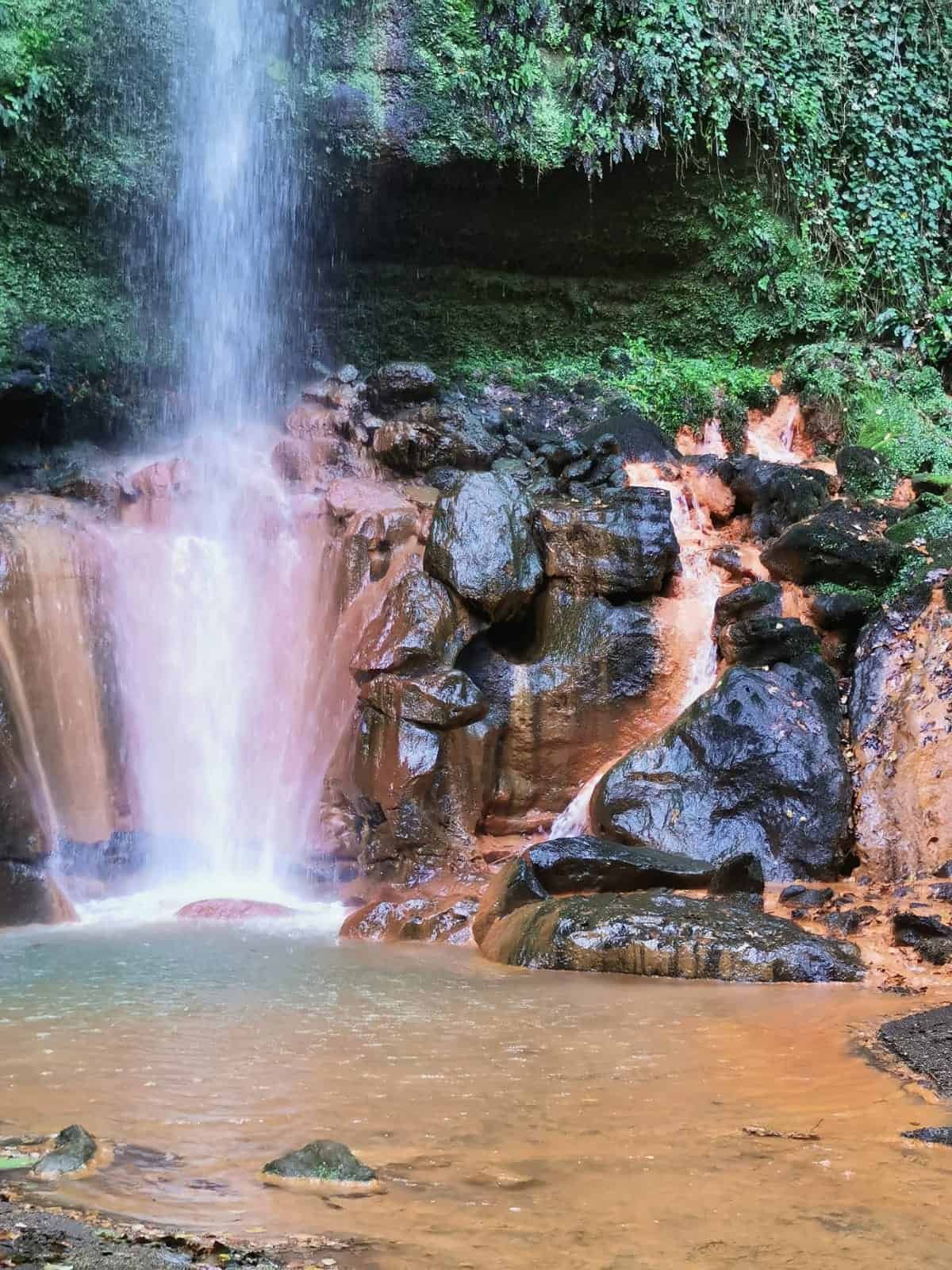
The Acquarossa Waterfalls lie along the stream of the same name, in the territory of the Comune of Viterbo, a few hundred meters downstream from the fork between provincial road 5 Teverina and the branch for Bagnaia and Vitorchiano, in the Pian del Cerro area. There is no ticket office, no gate, no opening hours: the waterfall and the spring that feeds it are in a free area and entry is free. There is also no kiosk, restroom, drinking fountain or signposted parking lot: you leave the car in the dirt widening before the bridge over the stream and continue on foot for about 50 meters. The path is short but rough, with roots, wet tuff and mud after rain. Closed shoes with a lugged sole are the bare minimum. There is no useful public transport: the bus runs that go up the Teverina have no stop at the fork and the walk from the city would be about six kilometers on a road with no sidewalk. Anyone arriving without a car should plan for a taxi or a rental from Viterbo.
A warning worth giving right away, before any description: the Acquarossa stream is not among the bathing waters designated by the Region, so it is neither a monitored nor a classified watercourse, and the pool under the drop is not an equipped natural swimming pool. You go to look, take photos and walk, not to swim.
Where Exactly Are the Acquarossa Waterfalls (VT)
The place name confuses two different things that lie a few dozen meters apart: the waterfall proper, meaning the drop of the stream over a step of tuff, and the archaeological site of Acquarossa, the Etruscan settlement that occupied the plateau above. The waterfall is downhill, at the bottom of the gorge. The city is up high, on the tableland. The name, in both cases, comes from the color of the wet rocks, which here turn copper red and in some spots dark brick.
By Car from Viterbo Toward the Acquarossa Waterfalls
From Viterbo you take provincial road 5 Teverina, which in its first urban stretch carries the name Via Francesco Baracca, and continue northeast. After about six kilometers the road flattens into a straight stretch that goes down and then up again: at the lowest point, before the climb starts again, the fork for Bagnaia and Vitorchiano opens on the right, with a large restaurant on the opposite side. That is the good landmark, and whoever drives it for the first time recognizes it without hesitation. After taking the turnoff, after about 300 meters the roadway crosses the bridge over the Acquarossa stream.
The Parking Lot and the Start of the Trail to the Acquarossa Waterfalls
Pull over before the bridge, on the packed-earth widening. The path starts on the left relative to the direction of travel and goes down toward the stream: in less than a minute of walking you reach the ruins of the mill and, right after, the waterfall. Continuing a few more meters along the bank you reach the spring, which stays on the left of the path. The overall elevation difference is modest, on the order of 20 meters, but the ground is slippery and in some stretches you have to help yourself with your hands. A practical tip: never go down alone with the stream in flood, because the noise of the water drowns out every call and phone coverage in the gorge is uncertain.
The Trail to the Archaeological Area Above the Acquarossa Waterfalls
Whoever wants to climb to the plateau of the Etruscan settlement finds the second entrance a little past the bridge, on the left coming from the Teverina, a few meters from the waterfall path. The route climbs the slope and leads to the tableland where the Swedish archaeologists worked. I'll make one thing clear right away that avoids disappointment: up there are no standing columns or tall walls. There are alignments of foundations in tuff blocks, plowed earth, brambles, and a very wide view of the valley. It is a place for those who can read the terrain, not for those looking for a photogenic monument.

What You See at the Acquarossa Waterfalls (VT)
The gorge is narrow, covered with thick vegetation, and on sunny days the light reaches the bottom in oblique beams. The first look lasts a few seconds and that's all of it: a drop of modest height, a shallow pool, and a bed of stone that instead of being gray like everywhere else in the volcanic Tuscia is red. Whoever knows only the waterfalls of the Apennines is thrown off, because here the protagonist is not the volume of water but the color of the rock.
The Drop and the Pool of the Acquarossa Waterfalls
The stream plunges from a step of tuff for a few meters and gathers in a basin. The flow changes enormously with the season: between November and April the jet is full and noisy, in August it shrinks to a veil running over the stone. Don't expect the roar of the Marmore: whoever has that model in mind should look at the page on the Marmore Waterfall and understand that here we're talking about an entirely different scale. The pool has cold water and an uneven bottom, with blocks that barely show just under the surface: getting in is not recommended, and in periods of flood it is frankly dangerous.
The Red Rocks: Iron and Marcasite
The color comes from the minerals that the water carries in solution and deposits on the stone. Iron, oxidizing on contact with air, leaves patinas ranging from orange to copper red. Local sources also point to marcasite, the iron sulfide that gives the encrustations their darkest shades. The result is a palette that changes hour by hour with the light and month by month with the flow: after a dry period, with a thin veil of water, the red is more intense because the deposit stays exposed.
The Ruins of the Mill on the Acquarossa Stream
Before the waterfall you meet the remains of a water mill, reduced to low masonry eaten by ivy. It's not an ancient ruin: it belongs to the rural economy of the Viterbo area, the one that exploited every drop of a stream to grind. The Acquarossa stream had one because the step of tuff offered the right drop without the need for costly works. In the area, sources also recall activities tied to alum and iron in the centuries following the destruction of the nearby Roman city, which makes this corner of the gorge a small industrial palimpsest as well as a natural one.
The Hypothermal Spring Above the Acquarossa Waterfalls
Going up the stream a few meters past the drop you reach the spring pool, on the left of the path. The water comes out at a constant temperature given by local sources as between 22 and 24 degrees, a value that places it among the hypothermal waters: lukewarm compared with a mountain spring, cold compared with the boiling waters of the Bullicame in Viterbo, which exceed 50. It has a metallic taste and a clear fizziness, due to dissolved carbon dioxide. The correct hydrological classification is that of carbonic-ferruginous water.
Why the Water of the Acquarossa Waterfalls (VT) Is Red
The answer is geological and has to do with two extinct volcanoes. The whole territory north of Viterbo rests on the products of the Cimino complex, the oldest, and of the Vico volcano, the most recent: tuffs, peperini, ignimbrites. Under that blanket the residual heat and deep gases keep circulating, and the carbon dioxide that rises loads the aquifers. Water saturated with carbon dioxide is a weak acid, and as such it effectively dissolves the ferrous minerals it meets on its underground path.
From the Cimino to the Stream: The Underground Path of the Water
When that iron-laden water resurfaces and meets the oxygen in the air, the iron precipitates in the form of oxides and hydroxides: it's the same chemistry as rust, applied to a riverbed. The deposit accumulates year after year on the wet surfaces and paints them. Whoever has seen the Rio Tinto in Andalusia recognizes the mechanism, even if here the scale is tiny and the origin is volcanic and not mining.
A Widespread Phenomenon in the Tuscia, Rare in This Form
There are dozens of mineral springs in the area, and the thermal fame of Viterbo is born from exactly this: Dante's Bullicame, the free pools, the sulfurous waters. The particularity of Acquarossa is the combination of elements that are all found within a radius of 200 meters: a mineral spring, a waterfall, a mill ruin, a necropolis and an Etruscan settlement. In Lazio I don't know another spot where these five things touch.
Safety and Health at the Acquarossa Waterfalls (VT)
This chapter matters more than the prose. The Acquarossa Waterfalls are a free, unmanaged site: no body sells a ticket, nobody watches over the path, nobody guarantees the quality of the water for human use.
Swimming: Unclassified Waters
The regional classification of bathing waters covers only the areas designated by the Lazio Region as intended for bathers: stretches of coast and lake shores. Watercourses, streams and river mouths remain outside that system because they have different functions and characteristics. In the 2026 season the regional network counts 221 monitored areas, with 93 percent classified excellent and no area of poor quality: an excellent figure that however does not concern this stream in any way, which does not figure among bathing waters and is not subject to seasonal sampling. Translated into practice: there is no bulletin here saying if the water is suitable, so immersing yourself is a choice at your own risk and with no health coverage.
No Healing Promises
A literature of therapeutic virtues has circulated for centuries about ferruginous waters. It is not reported here, because a mineral composition described by local sources is not equivalent to recognition as a mineral water for therapeutic use, which in Italy goes through precise ministerial and regional procedures. The Acquarossa spring is not an authorized thermal facility, has no published analyses available to the visitor and has no drinking-water treatment. The spring water must not be drunk. Whoever seeks certified healing waters should turn to the authorized establishments of the Viterbo area, which declare their own parameters.
Instability, Floods and Prudent Behavior
The gorge is subject to rapid floods after thunderstorms, and wet tuff has a friction coefficient that betrays. Some fallen trunks have closed off the route for long periods, and the state of the path changes after every rainy season. Go in light hiking clothing, not flip-flops. Avoid the bottom of the gorge when a weather alert is in effect. If you bring a dog, keep it on a leash: the bottom of the pool hides scrap metal.
The Illegal Dump at the Entrance
At the start of the route there has been for years an accumulation of abandoned waste, with large bulky items: appliances, mattresses, construction material. There is a posted ban and a sign declaring the area under video surveillance, and despite this the dumping continues. It's a serious wound for a place that would have what it takes to enter a nature and archaeology itinerary of the Viterbo area. Whoever goes should take away their own trash and, if they can, some of other people's: reports to the Comune of Viterbo are the formal tool, but the real cleanup of a site like this requires an administrative will that has so far been missing.
The Etruscan City of Acquarossa Above the Waterfalls
Here we pass from nature to archaeology, and the jump in importance is notable: Acquarossa is one of the key sites for the knowledge of Etruscan domestic building, and not by chance.
Before the Etruscans: Neolithic, Chalcolithic, Iron Age
The plateau was frequented long before the Etruscan age. Investigations have recognized traces of the Neolithic and Chalcolithic and a village of huts from the Iron Age, that is, a continuity of occupation that spans millennia. The reason is always the same: a tableland defended by gorges on three sides, with plenty of water at the foot. The plateau rises at the confluence of three watercourses, the Fornicchio, the Vezza and the Acquarossa, and this hydrographic condition explains both the choice of settlement and the sacred character attributed to the place.
The Swedish Excavations, from 1966
The first modern research dates to the early 1900s, with the Viterbo archaeologist Luigi Rossi Danielli. The campaign that changes everything, however, begins in 1966, when the Swedish Institute of Classical Studies in Rome opens a systematic excavation destined to last until the mid-1970s. Gustav VI Adolf of Sweden, a sovereign passionate about archaeology, took part in the excavations in person: a detail still told with pride in the Viterbo area, and which explains why so much of the bibliography on this site is in Swedish and English before Italian.
The Plateau and the Excavation Zones
The tuff plateau measures roughly a thousand meters in length by 600 in width. The excavations divided it into zones marked by letters. Zone B yielded a house that scholars have compared in layout to the Roman regia. Zone G stood out for the richness of its terracotta decorations. Zone F, in the northwest sector, preserves the most important monumental complex and is today the only visible and protected portion. The other areas, once documented, were covered over again: this is correct conservation practice, and explains why the visitor on the surface finds little.
The Three-Room Houses, the Real Treasure of Acquarossa
The recurring building type is a quadrangular construction with three aligned rooms, sometimes two, often preceded by a porch. The recognized functions are kitchen, resting room and storeroom. The foundations are in squared tuff blocks. The upper structure combined wattle covered with clay, rubble stone and mudbricks, with wooden beams stiffening the whole. It seems little, read like that. In reality it is a great deal: everyday Etruscan houses have almost always disappeared, because they were built with perishable materials, and the documentation of Acquarossa is among the most complete in Etruria. Hence the full-size reconstructions that the Viterbo museum exhibits.
The Monumental Complex of Zone F
In the northwest sector, in a context of the 6th century BC, you can make out a central courtyard bounded by porticoed buildings, with wooden columns and peperino capitals. The literature also describes a sacred building of small size, on the order of 10 by 11 meters, with three cells preceded by a portico, an almost exact north-south orientation and no podium. The sacred enclosure was bounded by a portico with capitals of the archaic Etruscan Doric type. Here the attribution must be taken with the caution that the sources themselves use: the functional reading of these spaces remains a matter of discussion among scholars.
The Architectural Terracottas
The part that strikes anyone entering the museum most is the terracotta decoration of the roofs. From Acquarossa come painted tiles with horses and deer, cornices with geometric motifs, rosette antefixes, griffin heads modeled in clay, and revetment slabs with figured scenes: Hercules wrestling the Cretan bull and the Nemean lion, banquet scenes, Dionysian subjects. The proposed datings place the main pieces in the third quarter of the 6th century BC and in the last quarter of the same century. They are among the oldest testimonies of decorated roofs in the Etruscan area, and that is why the name Acquarossa appears in every manual of Etruscan architecture.
The Destruction, Between 550 and 500 BC
The settlement ended abruptly. The sources oscillate between a date around the middle of the 6th century BC and one around 500, and on the causes they propose two alternative hypotheses: an earthquake or an attack by a rival city, with the suspicion that it was the center that occupied the area of Viterbo. The fact of the destruction and the sudden character of the abandonment are documented. The rest remains a working hypothesis. The survivors, according to the most widespread reconstruction, moved to the nearby hill of Pianicara, where the city the Romans called Ferentium would have arisen.
Where to See the Finds from the Acquarossa Waterfalls
The materials are at the Museo Nazionale Etrusco di Rocca Albornoz, in Piazza della Rocca 21b in Viterbo, where the rooms dedicated to Acquarossa include the full-size reconstructions of Etruscan buildings. The official website of the Direzione Regionale Musei Nazionali Lazio indicates opening from 08:30 to 19:30 with last entry at 18:30, closed on Mondays and on the holidays of January 1 and December 25, full ticket €7 and reduced €2 for the 18 to 25 age group. Hours and fares of state museums change, so it's worth rechecking them on the museum's official page before leaving. In the same museum you find the mosaic from Musarna and the Etruscan bronze chariot from Ischia di Castro.

The Necropolises Around the Acquarossa Waterfalls (VT)
The plateau was surrounded by burial grounds, and the archaeological literature indicates three main ones: Tre Marie, San Cataldo and Macchia Grande. They are chamber tombs dug into the tuff along the sides of the gorges, often overgrown with vegetation and sometimes reused over the centuries as shelters for livestock. Whoever walks in the area comes across their entrances almost by chance, dark squares in the tuff wall. Two recommendations: don't enter unequipped cavities, because the tuff flakes and collapses are documented. And don't touch anything, because those lands are subject to archaeological protection and collecting material is a crime.
Ferento, Heir of the Destroyed City
Less than a kilometer as the crow flies from the waterfall lie the ruins of Ferento, and the relationship between the two sites is genealogical before it is geographical: one is born from the end of the other.
From the Hill of San Francesco to the Hill of Pianicara
The water that feeds the waterfall comes down from the hill of San Francesco, which faces the hill of Pianicara, the one occupied by the Roman city. The stream runs between the two rises. A visitor who in the same morning goes down to the waterfall and then climbs to Ferento covers, in a few hundred meters, a leap of five centuries of settlement history.
The Roman Theater of Ferento
Ferento became a Roman municipium and reached its greatest development in the Augustan age, with a population that current estimates place at around 10,000 inhabitants over some 30 hectares. The theater, built in the first decades of the 1st century AD and restored in the Antonine and Severan ages, could hold about 3,000 spectators. The outer front in peperino preserves 27 arches, and it is the photograph everyone brings back from Ferento. The eight statues of Muses found in the theater, from the imperial age, are displayed in the Etruscan museum of Viterbo. Next to the theater you can make out the baths, with the usual sequence of cold, lukewarm and hot rooms, geometric mosaic floors and marble cladding, and the paved decumanus.
The End of Ferento in 1172
The city was sacked and burned by the people of Viterbo. The chronicles place the decisive assault on the night of January 1, 1172, and local tradition justifies it with an accusation of heresy: in Ferento a crucifix with open eyes, an image of the Savior alive on the cross, was supposedly venerated and judged heterodox. That the religious pretext covered an ordinary border war between communes is the interpretation that convinces most historians, but the distinction must be held firm: the date and the destruction are documented, the crucifix belongs to tradition. The survivors scattered into the Tiber valley and memory has it that Grotte Santo Stefano was born from them.
The Cult of Waters Around the Acquarossa Waterfalls (VT)
A spring that comes out lukewarm, fizzy and colors the stone red could not go unnoticed by communities that made water a religious matter. In the Etruscan world springs and confluences were places of worship, and the triple confluence of streams under the plateau fits exactly that model. Let the degree of certainty be clear: that the site was sacred is a reading by scholars based on context and materials, not an inscription declaring it. That said, walking in the gorge with the water tinting the boulders copper makes the hypothesis very easy to understand, even without reading a manual.
When to Go to the Acquarossa Waterfalls (VT)
The Right Seasons
The best period runs from mid-October to the end of April, when the stream has flow and the vegetation lets the light through. March and November are the months when the contrast between the green of the mosses and the red of the stones is strongest. In midsummer the drop shrinks and the gorge becomes a den of mosquitoes: not recommended. The day after heavy rain the water is muddy and the red is hard to see, so it's better to wait two or three days of dry weather.
The Hours of Light
The gorge is narrow and oriented so that direct sun reaches the bottom for a few hours around noon. For photography the diffuse light of a slightly overcast day is preferable, which saturates the reds and avoids blown-out patches. At dawn and at sunset you see little at the bottom of the gorge.
The Acquarossa Waterfalls (VT) with Kids
The route is short and that works in its favor. The slippery ground and the closeness of the water work against it. With children under six you need one adult per child, no exceptions, and the stroller is out of the question: the path can't take it. From seven years up the walk works very well, especially if told as a color hunt: the red stone, the moss, the remains of the mill. Bring a change of shoes for the car, because mud here is guaranteed.
Accessibility of the Acquarossa Waterfalls (VT)
None. The path is not accessible to wheelchairs or to people with mobility difficulties: natural ground, roots, rock steps, irregular slope. There are no handrails or parapets. Whoever doesn't feel up to going down can stop at the bridge, from which you get a sense of the gorge, and devote the visit to Ferento or the museum in Viterbo, both far more practicable.
What to Put in Your Backpack
Hiking shoes or at least sneakers with a lugged sole, drinking water brought from home, mosquito repellent from April to October, a bag for your own trash, a headlamp if you think of climbing back up after sunset, and light gloves if you plan to help yourself with your hands on the rocks. Leave the big tripod at home: in the gorge there's no room to open it and it would end up in the water.
What to See Around the Acquarossa Waterfalls (VT)
The waterfall alone is worth half an hour. The trip is justified only if you fit it into a wider day, and the Tuscia is generous in this. A few minutes by car away you can visit the park of Villa Lante in Bagnaia, with its 16th-century fountains, and the village of Vitorchiano, which rises on a spur of peperino. Toward the mountains you reach Soriano nel Cimino and the beech forest, or San Martino al Cimino with its Cistercian layout. To the north open Lake Bolsena, the town of Bolsena and the fortress of Montefiascone. For those aiming at Etruscan archaeology the pair Tarquinia and Tuscania is best, while those who love perched villages should plan Civita di Bagnoregio and Graffignano. Toward the south you visit Caprarola with the Farnese palace, Vetralla and the sunken roads of Blera. Toward the Tiber, Orte and Bassano in Teverina.
Frequently Asked Questions About the Acquarossa Waterfalls (VT)
How Much Does It Cost to Visit the Acquarossa Waterfalls?
Visiting the Acquarossa Waterfalls costs nothing, because the site is free, with no ticket office and no custody. The only expense to count on is fuel to get there by car or the cost of a taxi from Viterbo, since there is no public transport service dedicated to the place.
Are There Opening Hours for the Acquarossa Waterfalls?
No, the Acquarossa Waterfalls have no opening hours, because with no fence there is not even a gate to open or close. Common sense suggests moving in daylight anyway, because the gorge is dark and the path leading to it is not lit.
Can You Swim at the Acquarossa Waterfalls?
Swimming at the Acquarossa Waterfalls is not recommended: the site is not among the waters classified by the Lazio Region as intended for bathers, so nobody guarantees the quality of the water for human use or watches over the path. Whoever decides to enter the pool anyway does so at their own risk, in a free and unmanaged stretch.
Why Is the Water of the Acquarossa Waterfalls Red?
The water of the Acquarossa Waterfalls colors the stone bed red through a geological phenomenon tied to the extinct Cimino and Vico volcanoes: residual heat and deep gases rise and load the aquifer with carbon dioxide, making the water a weak acid that dissolves and then deposits iron on the rock, with an effect that varies depending on how much stone is exposed to the air.
Are the Acquarossa Waterfalls Suitable for Children?
With caution. The route to the Acquarossa Waterfalls is short, which works in its favor, but the slippery ground and the closeness of the water work against it: with children under six you need one adult for each child, no exceptions, and the stroller is out of the question because the path can't take it. From seven years up the walk works well, especially told as a color hunt.
Are the Acquarossa Waterfalls Wheelchair Accessible?
No, the path of the Acquarossa Waterfalls is not accessible to wheelchairs or to people with mobility difficulties, because of the natural ground, the roots, the rock steps and the irregular slope, with no handrails or parapets. Whoever doesn't feel up to going down can stop at the bridge, from which you get a sense of the gorge, and devote the visit to Ferento or the museum in Viterbo.
What Is the Best Time to Go to the Acquarossa Waterfalls?
The best period to visit the Acquarossa Waterfalls runs from mid-October to the end of April, when the stream has flow and the vegetation lets the light through, with March and November as the months of greatest contrast between the green of the mosses and the red of the stone. In midsummer the drop shrinks and the gorge becomes a den of mosquitoes, so a visit is not recommended.
What Is There to See Near the Acquarossa Waterfalls?
Less than a kilometer as the crow flies from the Acquarossa Waterfalls are the ruins of Ferento, the Roman city heir to the Etruscan settlement destroyed in antiquity, and the relationship between the two sites is genealogical before it is geographical. Within a few minutes by car you can add Villa Lante in Bagnaia and the village of Vitorchiano.
Visiting the Acquarossa Waterfalls (VT) with a Guide
A site with no panels, no marked route and an archaeology that is almost invisible on the surface is exactly the kind of place where a tour leader changes the day. Whoever organizes groups in the Viterbo area finds certified professionals through the tour escort service of TourLeaderPro, and whoever needs to build a tailor-made itinerary among Ferento, the museum of Viterbo and the gorge can write directly from the contacts page. For foreign travelers who are planning Lazio in English, the regional picture is summarized in the ItalyPlanner guide to Lazio, while whoever arrives first in Rome finds the selection of the best things to do in Rome on the same site.
A Curiosity About the Acquarossa Waterfalls (VT)
The name of the place entered the history of world archaeology through a fortunate misunderstanding. When the Swedish Institute of Classical Studies chose where to dig, in the 1960s, it wasn't looking for a waterfall: it was looking for an Etruscan settlement whose domestic layout was unknown, because everything that was known about Etruscan houses came from the tombs that imitated them. The plateau above the stream met the requirement. The site had no known ancient name, and to identify it the place name of the stream that skirts it was adopted. So a watercourse that the peasants called Acqua Rossa for the color of the stones gave its name to a site that today appears in manuals of Etruscan architecture in half the world, in Swedish, English and German before Italian. The consequence is curious: an archaeology student at Uppsala or Oxford knows the name Acquarossa better than many people from Viterbo, and almost always doesn't know there is a red waterfall under that plateau. And whoever comes here for the waterfall, conversely, almost always doesn't know they are walking on the site that taught the world what Etruscan houses were like. Two parallel fames, on the same hectare of tuff, that never met. The second curiosity is that the King of Sweden Gustav VI Adolf came in person to dig here: a reigning sovereign with a trowel in his hand, in a gorge of the Tuscia, in front of peasants who were making do with their cows.
Something Nobody Tells You About the Acquarossa Waterfalls (VT)
That the red is not always the same red, and that the moment of the visit decides what you see. The ferrous patina is deposited when the water evaporates and oxidizes on the exposed stone. If the stream runs full, the veil of water covers the deposit and dulls it, if the stream is almost dry the stone is uncovered and the color explodes. The paradox is that the most beautiful waterfall to photograph, the one with more water, is also the one with the dullest red, and vice versa. I find the compromise at the end of October and in March, when the flow is medium. The second piece of information you almost never read concerns access: this path stayed impassable for years because of a large trunk fallen across it, and no body removed it officially. The route has reopened and is passable today, but the lesson remains: nobody maintains this path, and a thunderstorm can close it again tomorrow morning. Whoever sets out from Rome for two hours of driving would do well to allow for the scenario of finding the bottom of the gorge blocked. Third thing, less poetic: the direct crossing of the stream, the one that would let you go from the waterfall to Ferento without turning back, is not practicable. You have to climb back up to the provincial road and reach Ferento from the Ferentana road, about two kilometers. Whoever had in mind a loop on foot is disappointed: it's an out and back.
The Advice I Give You for Visiting the Acquarossa Waterfalls (VT)
Reverse the order everyone follows. Most visitors arrive, go down in five minutes, photograph the drop, climb back up and leave with the impression of a modest little waterfall. Better to devote the second part of the morning to the gorge and not the first: start from the Museo Nazionale Etrusco di Rocca Albornoz in Viterbo, look at the reconstructions of the Acquarossa houses and the roof terracottas, then go up to Ferento and walk in the theater, and only at the end go down to the stream. In that order the waterfall stops being a red pool and becomes the source that kept a settlement standing for centuries. The opposite, that is starting from the waterfall, produces half an hour of disappointment and a trip that isn't justified. Second piece of advice, on shoes: don't do as those who go down in sandals, because wet tuff is a bar of soap and the nearest emergency room is in Viterbo. Third, on the season: if you have only one day and it's summer, change destination and keep Acquarossa for autumn. It isn't a summer place, it has no cool shade for a picnic and you can't swim. Fourth: bring people here who can imagine. With whoever wants the ready-to-use monument this outing doesn't work.
Another Well-Known Fact, Yet Rarely Cited
Everyone knows that Viterbo is the city of hot springs, that the Bullicame is cited by Dante and that in the Viterbo area you leave the road and find a hot spring. Almost nobody connects that fame with the red waterfall, yet the phenomenon is the same, in a cold variant. The subsoil of the Tuscia is a reservoir of gas and residual heat left by the volcanic complexes of Cimino and Vico. The waters that cross it load up with carbon dioxide and salts and resurface in dozens of points with temperatures ranging from a little over 20 degrees at Acquarossa to over 50 at the boiling springs west of the city. It is the same hydrothermal system, read at two different points. The second well-known and little connected fact concerns the continuity of exploitation: the Tuscia extracted alum and iron minerals for centuries, and the area around the destroyed Roman city appears in the sources for activities of this kind in the centuries after 1172. The mill on the stream, the ruins of later plants, the ferrous patinas on the stone tell of an economy that used the stream to grind, to work and finally to forget it. Third element little cited: the plateau is cultivated. A large part of the archaeological area is farmland, plowed every year, and this explains why after the excavation campaigns the trenches were filled in again. Protection, in a case like this, coincides with invisibility.
The Right Photo to Take at the Acquarossa Waterfalls (VT)
Forget the frontal shot of the drop with the pool in the foreground: it's the photo everybody takes, it flattens the color and tells nothing. The right photo is taken by going down three meters along the right bank, positioning yourself edge-on to the fall, and composing with the red of the wet rock on a third of the frame and the green of the mosses and ferns on the rest. The contrast between the two complementaries is the whole sense of this place. Technically you need an overcast day or the time slot when the sun doesn't enter the gorge, because direct contrast blows out the highlights on the water and kills the red in the shadows. With a tripod, or resting the camera on a dry boulder, an exposure between half a second and two seconds makes the veil of water silky and lets the color underneath be read. A polarizer helps enormously: it removes the reflections from the wet surface of the stone and brings out the true saturation of the oxides. With a phone, activate the long-exposure mode and lean your body against a stable rock. The second photograph I recommend isn't about the waterfall: it's the close-up detail of a ferrous crust, 10 centimeters of stone with its orange and brown layering. It is the image that explains the phenomenon better than any panorama. The third, if you climb to the plateau, is the plowed field backlit with the valley in the background: there are no ruins to frame, but that earth is the Etruscan city, and an honest photo of an invisible archaeological site is worth more than a reconstruction.
Some Important Events That Happened Here in History
The first event is the birth and end of the Etruscan settlement. Between the middle of the 7th century BC and the central decades of the 6th, a city developed on the plateau above the waterfall with three-room houses, streets, open spaces and roofs decorated with painted terracotta. Then, at some point between 550 and 500 BC, everything ended at once: scholars debate if it was an earthquake or an armed assault, and in this case prudence requires keeping both hypotheses open. What is documented is the sudden abandonment, with the materials left on the spot, which is also the reason the site has preserved so much. The second event is the move of the survivors to the hill of Pianicara and the birth of the city that would become Ferentium, a Roman municipium, homeland of the emperor Otho, born in AD 32 and raised to the throne in 69 during the year of the four emperors, and of the family of Flavia Domitilla the Elder, wife of Vespasian. The third event is the persecution of Aurelian, around 270, in which tradition places the martyrdom of Saint Eutizio, a young priest linked to Ferento. The fourth is the night of January 1, 1172, when the militias of Viterbo assaulted and destroyed Ferento: local memory makes it a war of religion against a crucifix held heretical, historians read in it a settling of scores between expanding communes. The fifth, much closer to us, is 1966: the arrival of the Swedish mission, which in some 10 campaigns turned a cultivated plateau into one of the international reference points for the study of Etruscan domestic building, with the direct participation of King Gustav VI Adolf. The sixth event, unfortunately, belongs to recent decades: the degradation of the entrance, the illegal dump and the abandonment of the path, which in this sequence of millennia is the least honorable chapter.
Who Has Passed Through the Acquarossa Waterfalls (VT)
The most illustrious figure, and the one who really got his hands dirty here, is Gustav VI Adolf of Sweden, king from 1950 to 1973 and archaeologist by vocation: he took part in person in the excavation campaigns on the plateau above the waterfall, in an age when a reigning sovereign on the work site was news. Before him, at the beginning of the 1900s, Luigi Rossi Danielli had worked in the area, the Viterbo archaeologist who first recognized the importance of these lands. With them passed generations of scholars of the Swedish Institute of Classical Studies in Rome, who from 1966 and for some 10 years made Acquarossa a training site: many of the names who sign today's manuals of Northern European Etruscology learned the trade in this valley. Going back in time the list necessarily becomes collective: the Etruscans who lived here and who after the destruction founded the city on the hill opposite, the Romans of Ferentium, among them the family that gave the empire Otho and the mother of Titus and Domitian, the millers who for centuries used the drop of water to turn a millstone, the quarrymen and the alum and iron workers. In the modern age the stream was ground of the people of Viterbo, not of travelers: the Grand Tour passed elsewhere, on the Cassia, and no famous diary is known that describes this waterfall. It's an absence that says a lot. Today hikers, photographers and the occasional school group pass through, and the place remains a card to play with someone who has already seen everything else in the Tuscia.
Quick Questions About the Acquarossa Waterfalls (VT)
How Much Does It Cost to Visit the Acquarossa Waterfalls?
Nothing. The site is free, with no ticket office and no custody. The only expense is fuel or the taxi from Viterbo.
Are There Opening Hours?
No, with no fence there are no hours. Common sense suggests moving in daylight, because the gorge is dark and the path is not lit.
Can You Swim at the Acquarossa Waterfalls?
The stream does not figure among the bathing waters designated by the Lazio Region, so it is neither monitored nor classified and there is no health judgment on its suitability. The pool has an irregular bottom, outcropping blocks and sometimes trash. The advice is not to enter the water.
Can You Drink the Spring Water?
No. It is an uncaptured spring, with no drinking-water treatment and no published analyses available to the visitor. Bring water from home.
Does the Acquarossa Water Have Healing Properties?
Local sources describe it as hypothermal carbonic-ferruginous water, around 22-24 degrees. No recognition as a mineral water for therapeutic use appears to be associated with this spring, and for use of that kind specific authorizations are needed. Whoever seeks certified thermal waters should turn to the authorized establishments of the Viterbo area.
How Long Does the Visit to the Acquarossa Waterfalls Take?
From the parking lot to the waterfall and back, 20 minutes is enough. Adding the spring, the mill ruins and the climb to the archaeological plateau, you comfortably reach two hours.
Is the Trail Difficult?
It is short but rough, with roots, wet rock and an elevation difference of about 20 meters. It has no exposed passages, but the ground is slippery in every season.
Are the Acquarossa Waterfalls Wheelchair Accessible?
No. There are no walkways, ramps or handrails, and the path is on irregular natural ground.
Can You Go with Children?
Yes, from seven years up the walk works well. With the smallest you need one adult per child and the stroller must be left in the car.
Can You Bring a Dog?
Yes, on a leash. Watch out for the trash abandoned at the entrance and the glass in the streambed.
Where Do You Park?
In the dirt widening before the bridge over the stream, along the road to Bagnaia and Vitorchiano, about 300 meters from the fork with the Teverina provincial road. It is not an equipped parking lot and spaces are few.
Can You Get There by Public Transport?
Not in a practical way. There is no useful stop at the fork and the walk from Viterbo exceeds six kilometers on a road with no sidewalk. You need your own vehicle.
What Is the Best Time to Go to the Acquarossa Waterfalls?
From mid-October to the end of April, with March and November as the best months for color contrast. In summer the flow drops and mosquitoes abound.
Why Are the Stones Red?
Because of the iron carried in solution by the carbonic water, which oxidizing in the air deposits patinas from orange to copper red. Local sources attribute the darkest shades to marcasite.
How High Is the Waterfall?
It is a contained drop, of a few meters, over a step of tuff. Whoever seeks great heights will be disappointed: the value of the place is in the color and the context, not in the size.
Can You Take Photos and Use a Drone?
Photographs have no limitations. For drones the national aviation rules apply and any restrictions on archaeological areas: it's worth checking current regulations before taking off.
What Is the Difference Between the Acquarossa Waterfalls and the Archaeological Site of Acquarossa?
The waterfall is the drop of the stream at the bottom of the gorge. The archaeological site is the Etruscan settlement on the plateau above. Same place name, two distinct places connected by an uphill path.
Can You See Etruscan Ruins on the Surface?
Very little. Only zone F remains visible and protected, while the other excavation areas were covered over again after documentation and the plateau is largely cultivated.
Where Are the Finds from Acquarossa Kept?
At the Museo Nazionale Etrusco di Rocca Albornoz, in Piazza della Rocca 21b in Viterbo, which also exhibits the full-size reconstructions of the Etruscan buildings of the site.
How Far Is Ferento from the Acquarossa Waterfalls?
Less than a kilometer as the crow flies, but the direct crossing of the stream is not practicable: you have to go back to the provincial road and reach Ferento from the Ferentana road, about two kilometers.
Can You Combine the Visit with Viterbo?
Yes, and it's the best solution. Etruscan museum in the morning, Ferento at midday, gorge in the afternoon: a full day with no long transfers.
Are There Restrooms, Cafés or Refreshment Points?
No, no services on site. The nearest café is along the Teverina provincial road or in the town of Bagnaia.
Is There Phone Signal?
On the surface yes, at the bottom of the gorge coverage is uncertain. Better to tell someone your itinerary before going down.
Are the Acquarossa Waterfalls Suitable for an Organized Group?
With small numbers and a tour leader yes, as long as you plan for the total absence of services and manage the descent in batches: the path is narrow and a group of 30 people in a line on wet tuff is a needless risk.
To close, a clear verdict, the kind some people won't like. The Acquarossa Waterfalls don't deserve a trip on their own: they deserve a day built well around them. Whoever arrives with the idea of a natural swimming pool leaves unhappy and leaves cans behind. Whoever arrives knowing that underfoot are the source of an Etruscan city, the step that turned a millstone for centuries and the chemistry of an extinct volcano comes out of that gorge with something extra. If someone then decided to clean up the entrance and put up two serious panels, this would become one of the most interesting places in the Viterbo area. For now it remains what it is: beautiful, fragile and neglected.
Article written by the editorial team of TourLeaderPro, contact them for Private/Corporate/V.I.P. Tours and Experiences.
Planning a trip to Rome? The English guides to visiting the city are on ItalyPlanner.com.