Castello di San Martino (Villa Tolomeo Gallio)
In short. Let's clear up a misunderstanding right away, because it's the most common one when people hear this place named.
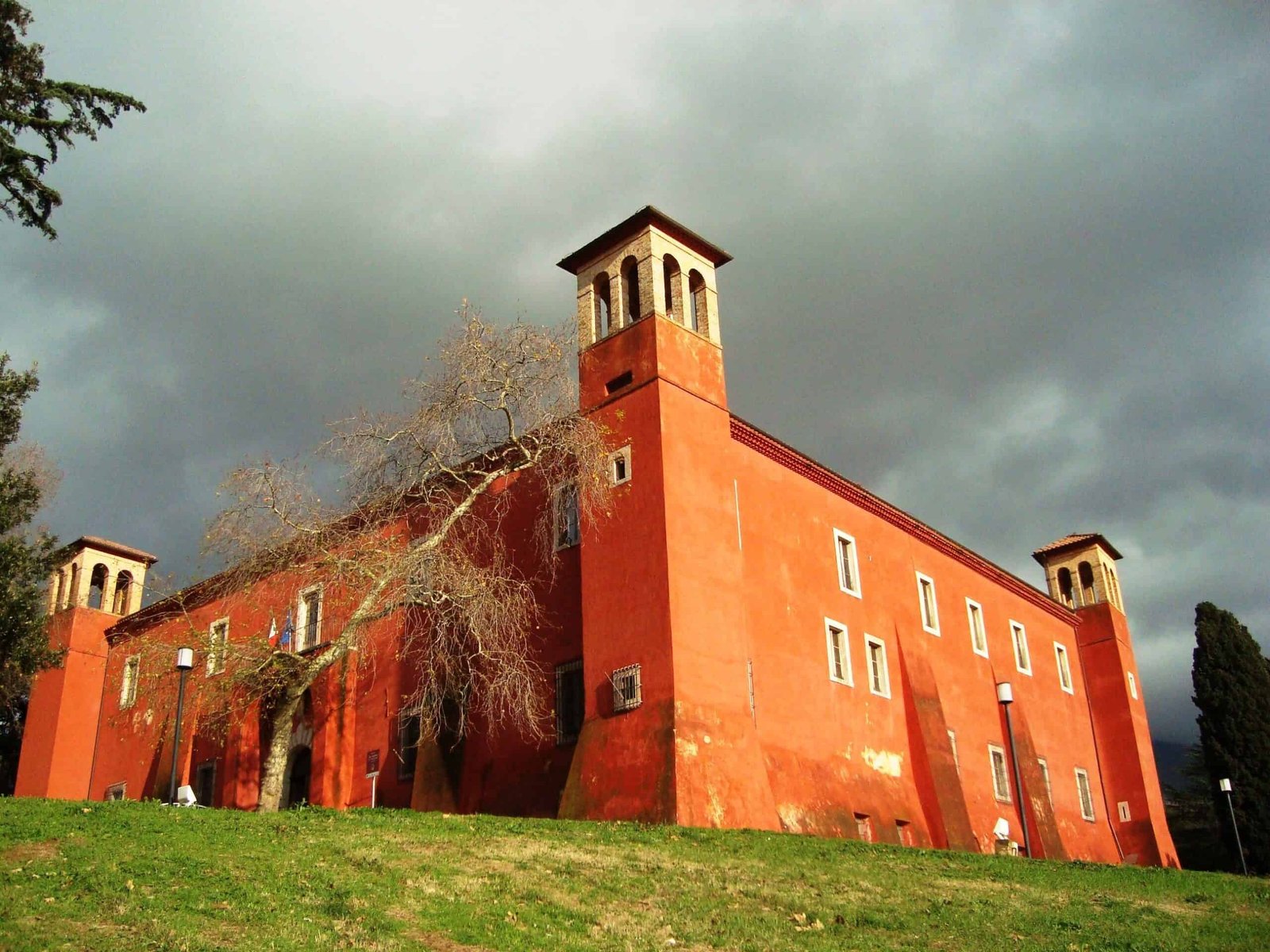
Where the Castello di San Martino (Villa Tolomeo Gallio) Really Is
Let's clear up a misunderstanding right away, because it's the most common one when people hear this place named. When someone says "Castello di San Martino" many think of the Cistercian village of San Martino al Cimino, above Viterbo, with the abbey and the palazzo of the Doria Pamphilj. It's a beautiful place, but it's not this one. The Castello di San Martino (Villa Tolomeo Gallio) I'm telling you about is much farther south, in the province of Latina, in the territory of Priverno, at the address Via San Martino 24, in the countryside that rises gently toward the Lepini Mountains. The coordinates fall around 41 degrees 27 minutes of latitude and 13 degrees 11 minutes of longitude. We are in the heart of that part of southern Lazio which the Romans already called deep antiquity, the land of the Volsci, the Amaseno valley.
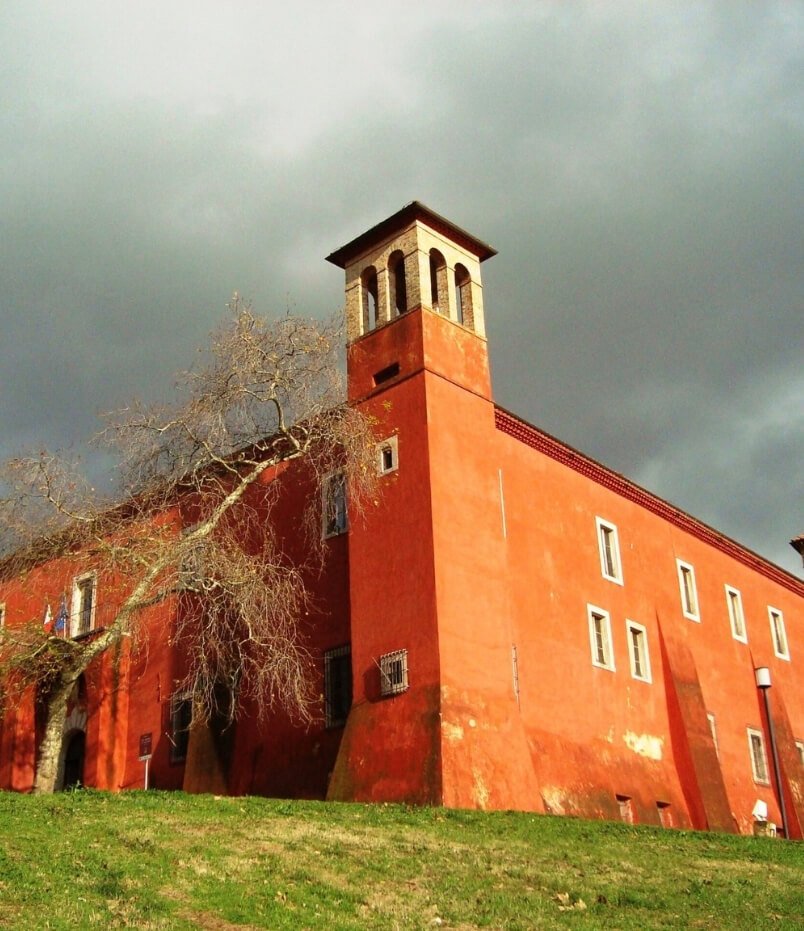
I care about this clarification because it changes everything. It changes the air you'll breathe, it changes the light, it changes the landscape around you. Here there is no dark tuff of Tuscia, there are the pale stones of the Lepini and the Mediterranean scrub. There is no damp cold of the volcanic lakes, there is the breeze that rises from the Pontine plain and, when the wind turns, you can even smell the salt of the Tyrrhenian Sea, which is not far. The Castello di San Martino (Villa Tolomeo Gallio) is a natural balcony on this world, and anyone who reaches it without knowing is taken aback by the amount of green that wraps it.
Priverno, the municipality that today looks after the complex, is a small center of very ancient memory, set on a hill a short distance from Via Appia. From the town to the castle you climb a few kilometers of road that crosses olive groves and vineyards, and at a certain point the woods open and the park appears. It's an entrance worth the trip in itself: the noise of traffic disappears, the birdsong and the rustle of branches remain. In the last minutes it's best to lower the car windows, because the Castello di San Martino (Villa Tolomeo Gallio) has to be smelled even before it is seen.
Why the Castello di San Martino (Villa Tolomeo Gallio) Is Called That
The double name tells two overlapping stories, and it's the first thing to explain in front of the portal. "San Martino" is the name of the district, of the old place name, of the saint to whom a small preexisting chapel was dedicated that stood right here before the castle took shape. "Villa Tolomeo Gallio" is instead the name that ties the building forever to its patron, Cardinal Tolomeo Gallio, the man who in the 16th century decided to turn two modest agricultural plots into a noble residence.
In the everyday language of these parts the place has always been "the castle", with that familiarity that towns have for their monuments. But the term "villa" is more precise than it seems: in the 16th century the villa was not just a country house, it was an idea, a way of being in the world. It was the place where the powerful man withdrew from the affairs of the city to cultivate the soul, receive guests, manage his lands and show his taste. By calling it "Villa Tolomeo Gallio", therefore, you don't just give it a surname. You recognize a function, that of a residence for display and cultured leisure.
The name carries a beautiful tension. On one side "San Martino", the saint of the poor, the one who cuts his cloak to give half to the beggar, a name of humility and charity. On the other the name of a prince of the Church among the richest of his time. The Castello di San Martino (Villa Tolomeo Gallio) holds these two souls together, the devout and the sumptuous, and perhaps this is why it has such a particular charm.
Who Tolomeo Gallio Was, the Cardinal Behind the Castello di San Martino (Villa Tolomeo Gallio)
To truly understand the Castello di San Martino (Villa Tolomeo Gallio) you have to know the man who wanted it. Tolomeo Gallio was born at Cernobbio, on Lake Como, in 1526, in a family of modest condition. There was nothing, in his childhood on the shores of the Lario, that foretold the extraordinary arc that would take him to the top of the Roman Curia. Yet Gallio had intelligence, prudence and that rare ability to make himself indispensable to the powerful without ever putting them in the shade.
He entered the orbit of Pope Pius IV, who appreciated him and wanted him close as secretary, a very delicate post that was more or less equivalent to that of a modern foreign minister of the Holy See. Dispatches, negotiations, appointments, balances between crowns passed through those hands. Gallio became a cardinal while still young and kept his political weight through several pontificates, which was not a given in an age when every new pope tended to surround himself with his own loyalists.
With office came wealth, and with wealth patronage. The name of the Gallio is tied to one of the most famous villas in Italy, the one on Lake Como, at Cernobbio, which would later become the present Villa d'Este, one of the symbols of European luxury hospitality. But the cardinal did not stop at the Lario: his fortune extended to landholdings scattered over half of Italy, and so it was that his gaze also fell on the district of San Martino, in the territory of Priverno.
It's a detail that helps you imagine the Castello di San Martino (Villa Tolomeo Gallio) not as an isolated ruin but as one piece of a network of power and taste that covered the peninsula. A man who started from a fishing village on the lake and, having reached the top, sows residences from one end of Italy to the other: the villa at Priverno is one of the fruits of that dizzying trajectory.
The Birth of the Castello di San Martino (Villa Tolomeo Gallio) in 1565
The date to keep in mind is 1565. In that year Cardinal Tolomeo Gallio, having obtained on emphyteusis two plots of land in the district of San Martino, had the castle erected. Emphyteusis, for those who don't chew on ancient law, was a form of long-term concession: not full ownership but a perpetual right of use in exchange for a fee, the way in which, then, church or communal lands were put to use. Gallio took those lands and built his residence on them.
The castle did not come out of nowhere on a virgin meadow. It rose on the ruins of a preexisting chapel, the one dedicated to San Martino from which the district took its name. It's a detail I love to stress because it tells a method typical of the 16th century: the past was not erased, it was incorporated. The stones of the old chapel became, in part, the foundations of the new building, and the spirit of the place, its ancient sacredness, flowed into the villa.
Imagine the building site, in those years around the middle of the 16th century. The Council of Trent had just ended, the Church was redrawing itself, and a powerful cardinal decided to mark the territory with a building that was at once home, outpost and declaration of taste. The local workers, the stonecutters of the Lepini, the masons of the Amaseno valley worked the pale stone of the area to give body to an idea that came from far away, from the refined culture of the Renaissance courts.
In front of the oldest masonry of the Castello di San Martino (Villa Tolomeo Gallio) you feel that 1565 still runs under your hands: almost half a millennium, and the stone is still there bearing the weight of history.
The Camaldolese and the Donation of 1597 to the Castello di San Martino (Villa Tolomeo Gallio)
The history of the Castello di San Martino (Villa Tolomeo Gallio) takes an unexpected turn in 1597. In that year Cardinal Tolomeo Gallio, by now elderly, decided to donate the properties and the building to the Camaldolese order. It was not a gift without conditions: the deed imposed on the religious the obligation to build a church dedicated to San Martino and a monastery. The lay patron, in short, was returning the place to its original sacred vocation, that chapel whose stones he had reused.
The Camaldolese are a monastic order of Benedictine matrix, founded by Saint Romuald at the beginning of the 11th century, famous for their balance between community life and hermit life, between the choir and the solitude of the cell. An order of silence, work and study. That the splendor of a cardinal's villa should turn into a house of monks is one of those reversals that make this place fascinating: the rooms designed to receive illustrious guests became spaces of prayer and rule.
This monastic phase left a deep mark on the identity of the place. The Castello di San Martino (Villa Tolomeo Gallio) is not only a Renaissance residence, it is also a former religious complex, and this double nature can still be sensed today walking among its structures. There is the logic of the palazzo and there is the logic of the cloister, and sometimes, in certain proportions of the rooms, in certain windows, you guess which hand prevailed in which season.
This passage of 1597 is the moment when the castle stops being just one man's villa and becomes an institution, a community, a rooting in the territory. From here on its fate will be intertwined with that of the great landowners and finally with that of the community.
The Borghese, Fossanova and the Castello di San Martino (Villa Tolomeo Gallio)
In the course of the 19th century the estate passed to one of the most powerful families of the Papal State, the Borghese princes. It's no accident: the Borghese already owned Fossanova, the famous Cistercian abbey that stands a few kilometers from here. By acquiring the Castello di San Martino (Villa Tolomeo Gallio) they consolidated their dominion over an important portion of this territory, putting together, under a single house, two of the most significant places in the area.
The Borghese name is everywhere in Rome: the Gallery, the park, the palace, the chapel in Santa Maria Maggiore. They are one of those families that shaped the face of the city and its surrounding countryside. Seeing them appear in the history of a castle in the Priverno countryside reminds us how dense the network of interests was that tied the capital to its outlying territories. The lands of Priverno, with their olive groves and woods, thus became part of the holdings of a house with a European reach.
The link with Fossanova is, for me, the most evocative. The abbey and the castle look at each other from afar across the countryside, two poles of the same culture. At Fossanova, in 1274, Saint Thomas Aquinas died, the greatest theologian of the Middle Ages, while on his way to the Council of Lyon. Knowing that the very same owners held the abbey where the Aquinate breathed his last and the villa of San Martino adds a depth to these places that goes beyond architecture.
The Castello di San Martino (Villa Tolomeo Gallio) should be tied in your mind to Fossanova: they are two chapters of the same book, and reading only one means missing half the story of this land.
The 20th century: the Di Stefano family and the public return of the Castello di San Martino (Villa Tolomeo Gallio)
The next step takes us to the 20th century. In 1914, on the eve of the Great War, the property passed to the Di Stefano family. It was one of the many transitions that large landed estates went through between the 19th and 20th centuries, when the old aristocratic houses began to sell and new families of landowners took over the management of the farming estates.
For a good part of the century, then, the Castello di San Martino (Villa Tolomeo Gallio) remained private property, tied to the farming life of the area, looked after and altered according to the needs of whoever lived in it. These are the least documented years, the ones in which the castle lives away from the spotlight, but for that very reason important: it is the phase in which the building survives the passing of fashions and waits, you might say, for its public redemption.
That redemption came with the purchase by the Municipality of Priverno. Today the Castello di San Martino (Villa Tolomeo Gallio) is municipal property, and this is the turning point that allows anyone, no longer just a prince or a family, to cross its threshold. The move into public hands meant restoration, opening to the public, cultural enhancement: a cardinal's villa has become everyone's heritage.
I tell this story gladly because it is a small lesson in the democracy of places. A building born for the privilege of one person, after centuries of different hands, ended up in the hands of the community. Entering the park, or the castle when it opens for an event, you exercise a right that for four centuries belonged to very few.
The 15-hectare park around the Castello di San Martino (Villa Tolomeo Gallio)
If there is one thing visitors underestimate before they arrive, it is the park. The Castello di San Martino (Villa Tolomeo Gallio) stands inside a green area that extends all around for about 15 hectares. Those 15 hectares come to 150,000 square meters: not a garden, but a real tamed woodland, a lung that wraps around the building and protects it from the outside world.
This proportion between built space and green is the key to reading the place. The castle doesn't dominate the landscape by crushing it, as a fortress would on a rocky spur. On the contrary, it lets itself be embraced by the vegetation, almost hides among the trees, and has to be discovered on foot. It's an experience that has more to do with a walk than with a museum visit: you enter through the gate, follow avenues and paths, go around the woods, and finally the building appears.
The park of the Castello di San Martino (Villa Tolomeo Gallio) is meant to be enjoyed slowly. There are clearings where you can sit, views that open onto the valley, stretches of deep shade and stretches of sun. Families bring their children, older people come to walk, nature lovers find quiet and biodiversity. It is a democratic place in this respect too: you can enjoy the park without necessarily going into the castle, and that makes it a precious asset for the area.
Plan on at least an hour just for the park, without hurry. You don't cross 15 hectares in 10 minutes, and it would be a shame to reduce to a shortcut a place designed for a slow pace.
The trees and scents of the park of the Castello di San Martino (Villa Tolomeo Gallio)
The park of the Castello di San Martino (Villa Tolomeo Gallio) is a small treatise on Mediterranean botany. As you walk you meet the scrub typical of southern Lazio: holm oaks with dark, compact crowns, oaks that stretch out their branches like arms, mastic and strawberry tree shrubs, the resinous scent of a pine or two. In the areas most exposed to the sun olive trees appear, witnesses to the farming vocation of this land, and lower down, toward the edges of the estate, the vegetation grows thicker and shadier.
The changing colors of the park of the Castello di San Martino (Villa Tolomeo Gallio)
Every season repaints the park with a different palette. In spring the undergrowth bursts with tender greens and blossoms, and the air is saturated with the scent of broom and wild herbs. In summer the cool shade of the holm oaks dominates, a precious refuge when the Pontine plain burns under the sun. In autumn the oaks turn bronze and gold, and the strawberry tree offers its red berries. In winter, with the deciduous branches bare, the evergreens keep the green lit and the structure of the castle re-emerges from the woods.
Birdsong and silence in the park of the Castello di San Martino (Villa Tolomeo Gallio)
What strikes you most, though, is the sound. Or rather, its quality. The park of the Castello di San Martino (Villa Tolomeo Gallio) is an island of silence where natural noises take their space back: birdsong, the hum of insects on hot days, the rustle of wind among the leaves, the creak of branches. Whoever arrives stressed from the city takes just a few minutes to slow their breathing. It is a form of therapy that needs no medical prescription: just walk and listen.
The architecture of the Castello di San Martino (Villa Tolomeo Gallio)
The building is Renaissance in origin, and this kinship with the 16th century can be read in its lines. Don't expect the fairy-tale castle, with crenellated towers and drawbridges: the Castello di San Martino (Villa Tolomeo Gallio) is rather a fortified villa, a noble residence that combines defensive solidity with the elegant measure of the country villa. The walls in the light stone of the Lepini, the compact volumes, the orderly arrangement of the windows speak of a sober, controlled taste, typical of post-Tridentine architectural culture.
Its position, set in the park and slightly raised, guaranteed both control of the territory and coolness. It is a very old principle: the Roman villa and the Renaissance villa always looked for the right spot where the landscape offered itself to the eye and the climate turned mild. The patron, Cardinal Gallio, came from Lake Como and knew well the lesson of the lakeside villas of Lario. It is likely that this sensitivity to the relationship between building and nature carried over here too, into the countryside of Priverno.
Looking at the whole, you notice the layering of the eras. There is the 16th-century core, there are the interventions tied to the Camaldolese monastic phase, there are the adaptations of the 19th- and 20th-century owners, and finally the restorations of the public management. The Castello di San Martino (Villa Tolomeo Gallio) is like a palimpsest: every hand has written and rewritten, and reading its layers is half the pleasure of the visit.
It's worth looking at the details of the masonry: where the stone changes color or texture, the century often changes too. They are subtle clues, but they tell more than a thousand captions.
It's also worth pausing on the relationship between the building and the light. The windows of the Castello di San Martino (Villa Tolomeo Gallio) are placed to catch the sun at different hours of the day, and as you move from room to room you notice how the brightness changes character: warm and golden on the west-facing fronts in the late afternoon, cooler and more subdued in the north-facing rooms. This was a science that Renaissance builders mastered with precision, because daylight was the only lighting available and organizing spaces around the sun meant making the building livable. Watching how the villa converses with the day is one of the subtlest pleasures of the visit, and it often escapes those who look only at the stones without ever raising their eyes toward the openings.
The interior rooms of the Castello di San Martino (Villa Tolomeo Gallio)
A premise: according to the Network of Historic Residences of Lazio, the castle is accessible on the occasion of events, so the rooms can only be seen on those days.
Once across the threshold, the interiors of the Castello di San Martino (Villa Tolomeo Gallio) reveal the place's domestic and at the same time institutional soul. The rooms follow one another with that slightly labyrinthine logic of buildings that grew by addition, where each room tells of a function: the reception hall, the spaces that were monastic, the service areas. The attentive visitor picks up the shift between the scale of the villa and that of the convent, between the gesture of receiving and that of praying.
Today many of these rooms host cultural activities, exhibitions and educational programs. It is the vocation the castle took on after the public purchase: not a crystallized museum but a living space, where things get done. The rooms that once saw cardinals and monks now welcome students, families, the curious, and this continuity of use is perhaps the best way to honor its history.
It's best to go through the interiors without hurry, often looking up. In the ceilings, in the door frames, in the thickness of the walls lie the traces of different eras. The Castello di San Martino (Villa Tolomeo Gallio) doesn't shout its beauty: it whispers it, and you have to listen closely.
The Castello di San Martino (Villa Tolomeo Gallio) and mathematics
There is a nickname around here that surprises whoever hears it for the first time: the "Castello della Matematica." Over the years the Castello di San Martino (Villa Tolomeo Gallio) has in fact become a center for science outreach dedicated to the most abstract and fascinating of disciplines. A place born for a cardinal's splendor and then passed through the prayers of monks now hosts the very serious game of numbers, shapes, theorems.
It's a pairing I love to tell, because it breaks every cliché. Mathematics, which we often associate with a gray classroom and a test, here dresses in Renaissance stone and greenery. The outreach programs offer interactive experiences, mathematical machines, geometric games, demonstrations you can touch. It is science that becomes physical experience, and for children it's a revelation.
The match is not as random as it seems. The Renaissance was the age in which mathematics, art and architecture walked together: perspective, proportions, the geometry of building plans. A 16th-century castle is, in a sense, built mathematics. Hosting a program on numbers within these walls means bringing the place back to the culture that produced it.
For families with kids, it is the part of the Castello di San Martino (Villa Tolomeo Gallio) that wins people over most: you leave convinced that mathematics is not a punishment but a game.
Mathematics becomes a game at the Castello di San Martino (Villa Tolomeo Gallio)
What makes the outreach offering of the Castello di San Martino (Villa Tolomeo Gallio) special is the idea that knowledge is won with the hands even before the head. The programs invite you to handle, to try, to get it wrong and try again: you assemble figures, explore symmetries, discover how an abstract theorem governs a concrete shape you can touch. For kids it's the discovery that behind a boring assignment lay a world of wonders, and for adults it's often a belated redemption with a subject they had learned to fear at school. It happens that parents get more hooked than their children, argue over a puzzle, leave with their heads full of questions. It's exactly what a place of culture should do: not fill you with facts, but spark curiosity.
A building born for power and passed through faith now puts itself at the service of children's intelligence. It's as if the Castello di San Martino (Villa Tolomeo Gallio), after serving princes and monks, had finally found its noblest mission: to educate, without distinction, anyone who wants to learn.
Priverno, the town that keeps the Castello di San Martino (Villa Tolomeo Gallio)
You can't understand the Castello di San Martino (Villa Tolomeo Gallio) without knowing Priverno, the municipality it belongs to. Priverno is a town of very ancient origin, perched on a hill in southern Lazio, with a medieval historic center made of alleys, arches, churches and a splendid square. It is one of those small towns that the big tourist flows barely touch, and for that very reason they have kept an authenticity that has been lost elsewhere.
The name Priverno comes from ancient Privernum, the city of the Volsci later Romanized, which I'll talk about further on. In the Middle Ages the center moved to the hill, where the present town stands, for reasons of defense. The cathedral, dedicated to Santa Maria Annunziata, holds relics and works that deserve a visit, and the main square, with its town hall, is one of the most elegant drawing rooms in the province of Latina.
Priverno lives on agriculture, tradition, honest and flavorful cooking. It is the ideal base from which to head to the Castello di San Martino (Villa Tolomeo Gallio), to the abbey of Fossanova, to the archaeological area of Privernum. Give the town at least half a day, because rushing through means losing the living context in which the castle is set.
Privernum, the Roman city near the Castello di San Martino (Villa Tolomeo Gallio)
A short distance from the Castello di San Martino (Villa Tolomeo Gallio), on the plain, lie the remains of ancient Privernum, one of the most interesting and least known archaeological areas of Lazio. Here, where there is countryside today, stood a real city, with its forum, its paved streets, its mosaic-decorated domus, baths, public buildings. It is the Roman chapter of this land, the one that precedes the cardinal's villa by centuries.
Privernum was born as a center of the Volsci, the Italic people who long opposed the expansion of Rome, and was later absorbed into the Roman world, becoming a municipium. The excavations have yielded mosaic floors, remains of homes, evidence of a refined urban life. The archaeological museum of Priverno, set up in the historic center, collects and tells the story of these finds, and it is the perfect stop to complete your understanding of the area.
I'll confess that I particularly love this connection. The Castello di San Martino (Villa Tolomeo Gallio) and the area of Privernum are close together, yet more than 1,500 years separate them. Strolling among the Roman mosaics in the morning and through the castle's Renaissance rooms in the afternoon is like leafing through a history book with your legs: the land is the same, but civilizations have followed one another layer upon layer.
Fossanova, the twin abbey of the Castello di San Martino (Villa Tolomeo Gallio)
Fossanova, already mentioned when talking about the Borghese, deserves a chapter of its own, because it is the natural companion of every visit to the Castello di San Martino (Villa Tolomeo Gallio). The abbey of Fossanova is one of the most extraordinary examples of Cistercian architecture in Italy, a masterpiece of that Gothic-Burgundian current that the white monks brought to the peninsula in the 12th and 13th centuries. Its church, of a moving purity and sobriety, is a hymn to light and measure.
Fossanova is tied to a supreme name: Saint Thomas Aquinas. It was here that the great Dominican philosopher and theologian died on March 7, 1274, while heading to the Council of Lyon. The cell in which he breathed his last is a pilgrimage destination, and the thought that one of the most powerful minds in Western history ended within these walls gives Fossanova an aura that goes beyond art.
Being a few kilometers from both a Cistercian masterpiece and a Renaissance cardinal's villa is a rare privilege. It's best to combine the two visits in the same day: Fossanova in the morning, with its Gothic stillness, and the Castello di San Martino (Villa Tolomeo Gallio) in the afternoon, with its 16th-century elegance and its park. They are two different ways of understanding the relationship between God, man and nature, and together they tell the deep soul of this land.
The Monti Lepini in the background of the Castello di San Martino (Villa Tolomeo Gallio)
Behind the Castello di San Martino (Villa Tolomeo Gallio) rise the Monti Lepini, the limestone chain that separates the Sacco valley from the Pontine plain. They are rugged, beautiful mountains, covered with woods and pastures, dotted with perched villages like Sermoneta, Norma, Bassiano, Sonnino. For centuries they have given this land building stone, spring water, refuge and frontier.
The presence of the Lepini shapes the climate and landscape of the area. They hold back the clouds, feed the springs that run down toward the plain, create that play of shadow and light that makes sunset, around here, a daily show. The castle's park, set against the first slopes, enjoys this natural protection and the coolness that comes with it.
It's worth turning your eyes toward the mountains. The Castello di San Martino (Villa Tolomeo Gallio) is not an isolated point: it is set in a natural amphitheater that runs from the Lepini to the Pontine plain, from the Tyrrhenian Sea to the Amaseno valley. Understanding this geography means understanding why a cardinal wanted to build his villa right here, and not elsewhere.
The seasons at the Castello di San Martino (Villa Tolomeo Gallio)
There is no wrong season to visit the Castello di San Martino (Villa Tolomeo Gallio), but each offers a different experience, and it's worth knowing them to choose the one that suits you best.
Spring at the Castello di San Martino (Villa Tolomeo Gallio)
Spring is perhaps the most magical time. The park fills with blossoms, the air is mild and fragrant, the colors are vivid. It's the ideal season for long walks in the greenery, for bringing children to play, for photographing the castle surrounded by the explosion of nature. The days grow longer and the late-afternoon light sets the stone aglow with warm reflections.
Summer at the Castello di San Martino (Villa Tolomeo Gallio)
In summer the park becomes a precious refuge from the heat. While the Pontine plain burns, under the crowns of the holm oaks of the Castello di San Martino (Villa Tolomeo Gallio) it's cool and shady. It's the season of evening events, cultural festivals, walks at sunset when the heat gives way to the breeze coming down from the mountains.
Autumn and winter at the Castello di San Martino (Villa Tolomeo Gallio)
Autumn gives the colors of Mediterranean foliage, the bronze of the oaks, the red of the strawberry tree, and a golden light that photographers love. Winter, more intimate and silent, strips the deciduous trees and lets the structure of the castle re-emerge from the woods. It is the season in which the Castello di San Martino (Villa Tolomeo Gallio) also hosts Christmas-themed displays that turn the park into an enchanted place.
How to get to the Castello di San Martino (Villa Tolomeo Gallio)
Reaching the Castello di San Martino (Villa Tolomeo Gallio) is simpler than its secluded position would suggest. By road, the reference point is Priverno, in the province of Latina. Coming from Rome you can go down along Via Pontina or take the Appia state road heading south, then exit toward Priverno and follow the signs for contrada San Martino, at Via San Martino 24.
By car to the Castello di San Martino (Villa Tolomeo Gallio)
The car is the most convenient way. From Rome the trip takes roughly an hour and a half, depending on traffic, through a landscape that grows more and more rural and appealing. The last kilometers, the ones that climb from the town toward the castle, are the most beautiful: a narrow road, olive groves, and then the sudden opening of the park. I recommend driving calmly and enjoying the approach.
By public transport to the Castello di San Martino (Villa Tolomeo Gallio)
If you don't have a car you can rely on the train to Priverno-Fossanova station, on the line connecting Rome to the towns of lower Lazio, and then continue with a short taxi ride or local connections. It's not the most immediate solution, but it's doable, and the station's closeness to the abbey of Fossanova lets you combine the two visits. For organized groups the bus remains the most flexible and comfortable solution.
When to go and how much time to give the Castello di San Martino (Villa Tolomeo Gallio)
The most frequent question is: how much time do you need? The answer is: it depends on what kind of visitor you are. If you only want to see the castle and the heart of the park, half a day may be enough. But if you really want to savor the Castello di San Martino (Villa Tolomeo Gallio), stroll through the 15 hectares, see the interiors when the castle opens for an event, maybe join an activity, then you need a whole day, and you'll still leave wanting to come back.
My advice is to check the opening hours in advance, which can vary depending on the season and on the events underway, and to see if exhibitions or special initiatives are scheduled. The Castello di San Martino (Villa Tolomeo Gallio) is a living place, its program changes, and finding out beforehand avoids disappointment and lets you catch the best occasions.
As for the time of day, I prefer late afternoon, when the light turns golden and the heat eases. It's the hour when the castle gives its best, and the park, with long shadows among the trees, becomes a theater of silence and beauty. But early morning has its charm too, with the dew and the waking of the woods.
One last recommendation on the pace of the visit. The Castello di San Martino (Villa Tolomeo Gallio) is not a place to get through in quick sequence, the way you scroll through a gallery of paintings one after another. It is rather a place to alternate: a stretch of walking in the park, a pause on a bench, a step into a room, then the open air again. This alternation of inside and outside, built and natural, history and landscape, is the true signature of the experience. Whoever understands it walks out of the gate feeling both rested and taught, which is the finest gift a place can give to those who visit it. And almost always, before even getting into the car for the return, they turn back for one last look at the bulk of the villa among the trees, promising themselves to return in another season, to see it dressed in different colors.
What to eat around the Castello di San Martino (Villa Tolomeo Gallio)
A visit to the Castello di San Martino (Villa Tolomeo Gallio) is not complete without a stop at the table, because this land has a genuine and flavorful gastronomic tradition. Priverno and the villages of the Monti Lepini keep dishes that tell of the area's farming civilization: homemade pasta, legumes, wild greens, slow-cooked meats, sheep's cheeses.
The signature dish: bazzoffia
The dish that most identifies Priverno is bazzoffia, a humble and spectacular spring soup based on seasonal vegetables like fava beans, peas, artichokes, chard, enriched with egg and stale bread. It is country food, what you made with what the vegetable garden offered, and today it has become a point of local identity pride for the town. Tasting it after a walk at the Castello di San Martino (Villa Tolomeo Gallio) closes the circle between landscape and flavor.
Olive oil and the products of the land
The Monti Lepini produce an extra virgin olive oil of great quality, with intense aromas and a decisive taste, which is the soul of local cooking. To this you can add legumes, cheeses, wood-fired bread, traditional sweets. I recommend looking for the trattorias of Priverno and the nearby villages, where people still eat the way they used to, with generous portions and honest prices.
The Castello di San Martino (Villa Tolomeo Gallio) for families
If I had to name an ideal audience for the Castello di San Martino (Villa Tolomeo Gallio), I'd say without hesitation families with children. Few destinations manage to bring different generations together like this one. The children have the space of the park to run, explore, play outdoors. The grown-ups have the history, the architecture, the quiet. All together they can try the mathematics programs, which turn learning into play.
The safety of the fenced park, the absence of traffic, the abundance of natural stimuli make the castle a place where the little ones can move freely, something increasingly rare. It's not unusual to see children who are normally glued to screens spend a whole afternoon chasing butterflies and collecting acorns, with their parents watching in disbelief and delight.
The practical advice is to bring comfortable clothing, shoes suited to walking on unpaved ground, water and maybe a blanket to sit on the lawn. The Castello di San Martino (Villa Tolomeo Gallio) rewards those who take it in with the right spirit, that of slow and curious exploration. It's not a playground with rides: it's something better, a piece of nature and history to discover with your own steps.
The Castello di San Martino (Villa Tolomeo Gallio) for events and weddings
Thanks to its beauty and public ownership, the Castello di San Martino (Villa Tolomeo Gallio) has over the years become a sought-after setting for cultural events, festivals, concerts and ceremonies. The pairing of Renaissance architecture and the centuries-old park creates a scene that few places can offer, and the community of Priverno has known how to make the most of it with a rich program, especially in the warm months.
In the good season the park hosts outdoor shows, presentations, family initiatives. In the Christmas period, as I mentioned, the castle turns into an enchanted place with themed displays, lights and activities for the little ones, becoming a destination for families from all over the province. It is the sign of a place that doesn't live only on its past but keeps generating experiences in the present.
It's no surprise that the Castello di San Martino (Villa Tolomeo Gallio) is also a popular location for ceremonies and receptions. Getting married or celebrating in a cardinal's villa set in 15 hectares of greenery is a dream for many, and the charm of the place does the rest. If you happen to be there during an event, stop and watch: you'll see how a 500-year-old building can still be a protagonist of today's life.
The Amaseno valley and the waters around the Castello di San Martino (Villa Tolomeo Gallio)
One of the elements that shapes the landscape around the Castello di San Martino (Villa Tolomeo Gallio) is water. Not far off flows the Amaseno river, the watercourse that gives its name to the whole valley and that has fertilized these lands for millennia. A river already cited by Latin poets, tied to ancient legends, that descends from the Monti Lepini and crosses the countryside before losing itself toward the Pontine plain. The presence of water explains the farming richness of the area, the fertility of the soil, the vocation for olive groves and vegetable gardens that has always characterized Priverno.
The Pontine plain, which stretches a little farther downhill, is itself a fascinating chapter of this geography. For centuries it was an expanse of malarial marshes, feared and almost uninhabited, before the great land reclamations of the 20th century transformed it into one of the most productive farmlands in Italy. The Castello di San Martino (Villa Tolomeo Gallio), overlooking from the first slopes of the Lepini, has witnessed this metamorphosis of the territory, from the kingdom of the mosquito to the land of cultivated fields.
I love telling visitors about this relationship between the castle's height and the plain below. Whoever built on a hill, in the past, also did so to escape the unhealthy air of the lowlands. Cardinal Gallio, choosing this raised and shaded position, followed an ancient wisdom: being up high meant health, coolness and control of the territory. Every choice, in these places, has a reason rooted in a deep knowledge of the land.
The land of the Volsci and the ancient roots of the Castello di San Martino (Villa Tolomeo Gallio)
Even before the Romans, before the cardinals and the monks, this land belonged to the Volsci, one of the proudest and most combative Italic peoples of pre-Roman Italy. The Castello di San Martino (Villa Tolomeo Gallio) stands in a territory that was the theater of centuries of struggles between the Volsci and Rome, struggles that Latin historiography made legendary. Just think of the figure of Coriolanus, the Roman general who, according to tradition, allied himself with the Volsci against his own city.
This historical depth gives the place a thickness that goes far beyond the 16th century. When I walk in the park I think that under these trees, in a very remote time, Volscian warriors, merchants and farmers of vanished civilizations passed by. The contrada of San Martino was not born with the castle: it is a fragment of a landscape inhabited for thousands of years, where every era has left its own layering.
That's why I always insist on context. The Castello di San Martino (Villa Tolomeo Gallio) is not an isolated object, dropped from above into a void. It is the Renaissance chapter of a story that begins with the Volsci, continues with Roman Privernum, passes through the Cistercian Middle Ages of Fossanova and arrives up to us. Visiting it with this awareness means multiplying the pleasure of discovery.
Silence and slowness as an experience at the Castello di San Martino (Villa Tolomeo Gallio)
We live in an age that has made haste a religion, and for that very reason places like the Castello di San Martino (Villa Tolomeo Gallio) have a value that goes beyond historical or artistic interest. They are outposts of slowness, spaces where time slows down and the mind unwinds. There is no crush of the big tourist sites, there are no lines, there is no anxiety about having to see everything quickly before the next appointment. There is, simply, space and time.
I advise those who arrive to leave the phone in their pocket for at least part of the walk. The park of the Castello di San Martino (Villa Tolomeo Gallio) is made to be listened to, not constantly photographed. The birdsong, the rustle of leaves, the scent of the earth and the trees: these are experiences that a screen doesn't capture and that instead fill the soul. A couple of hours among these trees is enough to leave more relaxed than you arrived.
There is a Japanese word, shinrin-yoku, that means "forest bathing," the practice of immersing yourself in nature for your own wellbeing. Well, the Castello di San Martino (Villa Tolomeo Gallio) offers an Italian-style forest bath, with the added beauty of a historic building and the depth of half a millennium of events. It is a richness that is not measured in tickets torn or review stars: it is measured in the slower breath with which you go home.
Why the trip to the Castello di San Martino (Villa Tolomeo Gallio) is worth it
There are people who, faced with the idea of driving an hour and a half from Rome for a provincial castle, turn up their nose. So it's worth explaining why the Castello di San Martino (Villa Tolomeo Gallio) really deserves the trip. The first reason is rarity: very few places bring together a Renaissance villa, a former monastic complex, a 15-hectare park and a contemporary cultural vocation. The second is authenticity: here there is none of the commodification of the big tourist circuits, there is a real place, lived in by the community.
The third reason is the context. By reaching the Castello di San Martino (Villa Tolomeo Gallio) you discover an entire territory: Priverno with its historic center, the abbey of Fossanova, the archaeological area of Privernum, the Monti Lepini, the local cooking. You don't go home with a single visit, but with the experience of a piece of southern Lazio that most people don't know at all. It's tourism of discovery, the kind that gives the greatest satisfactions.
The fourth reason, finally, is the most heartfelt. Going to the Castello di San Martino (Villa Tolomeo Gallio) means supporting the enhancement of a public asset, giving value to a place that the community saved and returned to everyone. Every visitor who crosses that gate helps keep history alive. And this, at bottom, is the deepest meaning of traveling well: not consuming, but taking care.
A curiosity about the Castello di San Martino (Villa Tolomeo Gallio)
Here is a curiosity that few people know. The man who commissioned the Castello di San Martino (Villa Tolomeo Gallio), Cardinal Tolomeo Gallio, is tied to another of the most famous and luxurious villas in Italy: the one on Lake Como, in Cernobbio, that would later become the present Villa d'Este, today a world-famous hotel, a symbol of luxury hospitality and a gathering place of crowned heads and international celebrities.
The connection is surprising. The same taste, the same hand that gave impetus to one of the queens of the Lombard lakes also settled on this secluded corner of southern Lazio, giving rise to the Castello di San Martino (Villa Tolomeo Gallio). It seems hard to believe: the international glamour of Villa d'Este and the rural quiet of Priverno have the same father. It's a sign of how vast the ambitions of a Renaissance cardinal were, able to leave his mark hundreds of kilometers away.
This hidden kinship gives the Castello di San Martino (Villa Tolomeo Gallio) an extra coat of arms. It is not a forgotten provincial castle: it is the modest, secluded cousin of one of the most famous villas in the world, born from the same vision and the same desire for beauty.
Something nobody tells you about the Castello di San Martino (Villa Tolomeo Gallio)
There is an aspect of the Castello di San Martino (Villa Tolomeo Gallio) that guidebooks and brochures almost never underline, and it is the paradox of its identity. This place has changed skin so many times that it has become a kind of chameleon of history. It was born as the lavish villa of a prince of the Church. It became a monastery of Camaldolese monks bound to silence and the Rule. It passed to a powerful aristocratic family, the Borghese. It ended up with private landowners, the Di Stefano. And it finally landed in the public hands of the Municipality, where it hosts, of all things, mathematics.
Nobody tells you, in short, that the Castello di San Martino (Villa Tolomeo Gallio) is a building without a single identity, but with five or six overlapping identities. Splendor and humility, wealth and prayer, private and public, art and science: everything coexists within these walls. It is a very rare case of a building that has gone through almost every possible function without ever losing its dignity.
Once you understand this, you look at the castle with different eyes. It is not a monument frozen in an era, locked in one aesthetic. It is a living organism that has continually reinvented itself. And perhaps this very capacity for transformation is its deepest secret, the reason it survived when so many similar buildings fell into ruin.
The advice I give you for visiting the Castello di San Martino (Villa Tolomeo Gallio)
If I can give you just one piece of advice to truly enjoy the Castello di San Martino (Villa Tolomeo Gallio), it's this: don't treat it as a stop to tick off quickly. This is not a hit-and-run place, a selfie and off you go. It is a place that reveals itself only to those who give it time. Arrive without the anxiety of the clock, bring water and comfortable shoes, and give yourself permission to slow down.
The second piece of advice is to combine the visit with Fossanova. The two places are a few kilometers apart and together they tell the soul of this land: the Gothic spirituality of the Cistercians and the Renaissance elegance of the cardinal's villa. Do Fossanova in the morning, have lunch with local cooking in Priverno, and give the afternoon to the Castello di San Martino (Villa Tolomeo Gallio) and its park, when the light is most beautiful.
The third piece of advice is to always check hours and events before leaving. The program changes with the seasons, and happening on a day of an exhibition or special initiative can enormously enrich the experience. Finally, bring curiosity: ask, observe, look up. The Castello di San Martino (Villa Tolomeo Gallio) rewards attentive visitors with details and stories that would escape a distracted eye entirely.
Another well-known fact, yet rarely cited
There is a fact that the people of Priverno know very well but that casual visitors almost always ignore: the founding date of the Castello di San Martino (Villa Tolomeo Gallio) goes back to 1565. Can you imagine? When the first stones were laid here, in Italy Michelangelo had been dead for barely a year, the Council of Trent had only recently closed its doors, and in Europe the years of the great wars of religion were being prepared. This building has lived through more than four and a half centuries of history.
It's a well-known fact, it's written on every information sheet, yet rarely do we stop to grasp its scale. 460 years of events, wars, earthquakes, changes of ownership, architectural fashions, and the Castello di San Martino (Villa Tolomeo Gallio) is still there, standing, functioning, open to visit. How many generations of people from Priverno have grown up in the shadow of these walls? How many have worked these lands, prayed in this church, played in this park?
I like to touch the stone and think of everything it has seen. 1565 is not just a date on a sign: it is the birth of a silent witness that has watched half a millennium go by. Few things give a sense of time like standing in front of such an ancient building and realizing that it keeps living, changing, welcoming. The Castello di San Martino (Villa Tolomeo Gallio) is, at bottom, a time machine that we carry around without noticing.
The right photo to take at the Castello di San Martino (Villa Tolomeo Gallio)
Every place has its perfect photograph, and the Castello di San Martino (Villa Tolomeo Gallio) is no exception. Here is where to point the lens. The right photo is not the front-on, close-up one that flattens the building. It's the one that catches the castle set in its park, with the vegetation in the foreground and the bulk of the villa emerging among the trees, maybe with the Monti Lepini closing off the background. You need a bit of distance, and you need to step back until you find a view where the green frames the stone.
The ideal moment is late afternoon, the so-called golden hour, when the low sun sets the pale stone aglow with warm reflections and the long shadows of the trees draw patterns on the lawn. The raking light of that hour sculpts the volumes of the architecture and gives depth to the woods. A photo taken at noon, with flat, vertical light, will never render the same magic.
My suggestion is to look for a raised spot or a clearing that offers the right perspective, and to wait for a gust of wind to move the branches: the Castello di San Martino (Villa Tolomeo Gallio) photographed with the trees in motion takes on a living, breathing quality that overly static images lack. And if you happen to come in autumn, with the foliage ablaze, you'll have the perfect postcard of this secret corner of Lazio.
Some important events that happened here in history
The history of the Castello di San Martino (Villa Tolomeo Gallio) is marked by a few passages worth fixing as milestones. The first is 1565, the year in which Cardinal Tolomeo Gallio, having obtained on long lease two plots in the contrada of San Martino, had the castle erected on the ruins of a pre-existing chapel. It is the birth certificate, the moment when a Renaissance idea takes shape in the stone of the Lepini.
The second crucial event is 1597. In that year the cardinal donated the property and the building to the Camaldolese monks, with the obligation to build a church dedicated to San Martino and a monastery. It was the transformation from noble villa to religious complex, a reversal of function that marked the identity of the place for centuries. The Castello di San Martino (Villa Tolomeo Gallio) passed from the logic of privilege to that of prayer.
The third passage is the acquisition by the Borghese princes during the 19th century. Already owners of the nearby abbey of Fossanova, the Borghese consolidated their dominion over the territory by taking in the castle as well. Next, in 1914, comes the passage to the Di Stefano family, which opened the long 20th-century phase of private ownership. Finally, the last and perhaps most important event of recent history: the acquisition by the Municipality of Priverno, which returned the Castello di San Martino (Villa Tolomeo Gallio) to the community, opening its doors to all and dedicating it to culture, outreach and events.
Each of these events left a visible or invisible mark within these walls. Putting them in a row means reading the history of Italy in miniature: the Renaissance of the cardinals, the Counter-Reformation of the monks, the landed aristocracy of the 19th century, the owners of the 20th century, and finally the public enhancement of our days.
Who has passed through the Castello di San Martino (Villa Tolomeo Gallio)
To finish, the figures who, one way or another, have crossed the history of the Castello di San Martino (Villa Tolomeo Gallio). The first name is obviously that of Cardinal Tolomeo Gallio, the patron, the man from Lake Como who became secretary to Pope Pius IV, who wanted his villa here. His figure hovers over every stone: without him, none of this would exist.
Then came the Camaldolese monks, the spiritual sons of Saint Romuald, who from 1597 lived in these spaces, turning them into a place of prayer and rule. Faceless names, for the most part, but real presences who for generations filled with silence and song the rooms that had been reception halls. And the Borghese princes came, one of the great Roman houses, who tied the castle to their name and to nearby Fossanova, bringing to this countryside the echo of papal power.
In the background, geographically very close, stands one of the loftiest figures in the history of thought: Saint Thomas Aquinas, who died at Fossanova in 1274, a few kilometers from here. He did not physically pass through the castle, which would arise almost three centuries later, but his shadow stretches over this whole land and makes it a place of deep spirituality. And finally, the protagonists of today: the families, the children, the students, the curious who every day cross the gate of the Castello di San Martino (Villa Tolomeo Gallio). Because the history of a place is made not only of those who owned it, but also, and above all, of those who live it. And today, fortunately, that privilege belongs to all of us.
Quick questions
Where is the Castello di San Martino (Villa Tolomeo Gallio)
It's in Priverno, in the province of Latina, at Via San Martino 24, in the countryside that climbs toward the Monti Lepini. Don't confuse it with San Martino al Cimino, above Viterbo: that's a different place, much farther north. From the town you climb a few kilometers among olive groves and vineyards, then the woods open and the park appears. Today the complex is owned by the Municipality of Priverno.
How do you get to the Castello di San Martino (Villa Tolomeo Gallio)
The car is the most convenient way: from Rome allow about an hour and a half, depending on traffic, going down along Via Pontina or the Appia state road and exiting toward Priverno, then follow the signs for contrada San Martino. Without a car, take the train to Priverno-Fossanova station and continue with a short taxi ride or local connections. It's doable, but less immediate.
How much time the visit takes
It depends on what you want to do. To see the castle and the heart of the park, half a day may be enough. If you want to walk the 15 hectares and take part in an event, you need a whole day. The interiors, according to the Network of Historic Residences of Lazio, are accessible only on the occasion of events, and the park has controlled access. For the park alone, allow at least an hour, without hurry. Opening hours can vary with the season and the events underway, so check them before leaving.
What you see at the Castello di San Martino (Villa Tolomeo Gallio)
You see a fortified villa of Renaissance origin, commissioned in 1565 by Cardinal Tolomeo Gallio and then passed to the Camaldolese monks, inside a park of about 15 hectares with holm oaks, oaks, olive trees and Mediterranean scrub. Many interior rooms host exhibitions, cultural activities and educational programs. Locals also call it the Castello della Matematica, for the interactive programs with mathematical machines and geometric games.
Is it suitable for children
Yes, families with children are the ideal audience. The park is fenced and traffic-free, so the little ones can run and explore freely, and the mathematics programs turn learning into play with hands-on experiences. Bring comfortable clothing, shoes suited to unpaved ground, water and maybe a blanket to sit on the lawn. It's not a playground with rides: it's nature and history to discover on foot.
What is near the Castello di San Martino (Villa Tolomeo Gallio)
A few kilometers away is the Cistercian abbey of Fossanova, where Saint Thomas Aquinas died in 1274: it's worth combining it in the same day, Fossanova in the morning and the castle in the afternoon, when the light is most beautiful. Not far off you'll also find the archaeological area of Privernum, with the archaeological museum in the historic center of Priverno. In town you can stop for lunch and try bazzoffia, the typical vegetable soup.
Article written by the editorial team of TourLeaderPro, contact them for Private/Corporate/V.I.P. Tours and Experiences.
Planning a trip to Rome? The English-language guides for visiting the city are on ItalyPlanner.com.