Posta Fibreno (FR)
In short. Posta Fibreno is a comune of just over a thousand inhabitants in the province of Frosinone, leaning at 430 meters of altitude on a hill that overlooks the lake of the same name, and the reason people go there is the Lago di Posta…


Posta Fibreno is a comune of just over a thousand inhabitants in the province of Frosinone, leaning at 430 meters of altitude on a hill that overlooks the lake of the same name, and the reason people go there is the Lago di Posta Fibreno Regional Nature Reserve, established by regional law of January 29, 1983, no. 10, published the following February 28, 345 hectares that cover almost half of the municipal territory and that the managing body, the Comune di Posta Fibreno, administers from its seat in Contrada Carpello, 03030 Posta Fibreno (FR). The Reserve's contacts are 0776 888021, 0776 887184 and 331 6728772, and the email riservapostafibreno@regione.lazio.it. The nature trails that descend to the lake can be walked freely and without a ticket. Museo Naturalistico Etnografico at Piazza Cesare Battisti 4 and the guided visits open instead by reservation, at the numbers 0776 8887276 and 331 6728772. The visitor center "Il mulino ad acqua", which is also the operational seat of the Reserve, is at Via San Venditto 2-22, phone 0776 8887276. You get there from Rome in about an hour and three quarters, by the A1 motorway to Ferentino or Frosinone and then the expressway toward Sora. From Sora it is a little over 10 kilometers. For seasonal hours, museum openings and the state of the trails, a phone call to the Reserve before getting in the car is advisable.
Whoever is looking for other destinations in southern Lazio finds on the page dedicated to the Lago di Posta Fibreno a deeper look at the basin and its waters, while the broader mountain context is that of the Abruzzo, Lazio and Molise National Park, which begins a few bends further north.

Where Posta Fibreno (FR) is and how to get there
Posta Fibreno occupies the northeastern corner of the province of Frosinone, on the edge between the Liri plain and the southern slopes of the Monti della Marsica. Administratively it is Lazio. Geographically and culturally it is already Val di Comino, that group of villages arranged like a fan under the mountains of the national park. The old village is high up, on the hill. The modern settlement and the farming districts, Carpello and San Venditto first of all, are down below, at water level. This double elevation explains almost everything about Posta Fibreno: the town looks at the lake from above the way you look at a backyard, and the lake gives the town a temperature, a morning fog and a fauna that you don't meet in the rest of the Ciociaria.
By car from Rome to Posta Fibreno (FR)
The ordinary route is the A1 motorway toward Naples, Ferentino or Frosinone exit, then the Frosinone-Sora expressway to its end, and from Sora the road for Vicalvi and the Val di Comino. From the Grande Raccordo Anulare you count roughly 130 kilometers and, with ordinary traffic, an hour and three quarters. The second route, slower and much more beautiful, is the Casilina to Anagni and then the inland climb through Alatri, Veroli and Sora: it adds almost an hour, but you pass through towns that deserve a stop. A third possibility, for those arriving from the north or from Abruzzo, is the A24 and then the descent to Avezzano and the Val Roveto, entering Val di Comino from Sora: it is the route that makes you best understand where the lake's waters come from, because you travel it literally above the aquifer that then resurfaces at Posta Fibreno.
From Sora, from Frosinone and from the Val di Comino
From Sora it is 10 or 12 kilometers depending on the route, a little under 20 minutes. From Frosinone you count about 50 kilometers of expressway. Whoever comes from Atina, from Alvito or from San Donato Val di Comino takes the valley-floor road of the Comino and climbs to Posta Fibreno in a few minutes. From Vicalvi, the castle that watches over the valley from the crag opposite, it is less than five kilometers, and it is worth doing them in the right order: first the castle, to understand the geography from above, then the lake.
By public transport
The useful rail connection is the line to Sora and Avezzano, changing at Roccasecca or at Cassino depending on the run. From Sora you continue with the scheduled buses of the Ciociaria basin, which serve Posta Fibreno and the towns of the Val di Comino with frequencies designed for students and commuters, so frequent in the early morning and early afternoon, sparse on Sundays. Timetables and connections must be checked on the carrier's official channels before leaving. Frankly: without a car you can reach Posta Fibreno, but you visit it badly, because the trails start from three different entrances far from one another and the museum opens by appointment.
Where to park in Posta Fibreno
The two bases are Piazza San Venditto, down below near the old mill, and Piazza Carpello, on the opposite side of the reserve. From the first start the Taurino trail, the Puzzillo, the Lago Chiaro, the Benessere and the trail of the Dolina la Prece. From the second, the Catannovo. On the August weekends, when the town celebrates the festival of the Crocifisso del Lago, both fill up early: it's best to arrive before 10 or after 17.
The Lago di Posta Fibreno Regional Nature Reserve
345 hectares are not many in absolute terms. They are a great many if you consider that inside that perimeter coexist a 30-hectare lake, a 50-hectare reed bed, a river, a stream, a system of karst sinkholes, the valley-floor farmland and the terraced hill slopes of the northeastern shore. The Reserve protects a hydraulic machine, not a panorama: the basin works as an enormous spring outcrop, fed by the waters that fall on the mountains of the Marsica and on the upper Sangro valley, descend into the karst for tens of kilometers and re-emerge here, at 289 meters above sea level, at a constant temperature of 10 or 11 degrees all year.
Establishment, surface and managing body of the Posta Fibreno Reserve
The founding act is the regional law of Lazio of January 29, 1983, number 10, published in the official bulletin on February 28 of the same year. Management is entrusted to the Comune di Posta Fibreno, a not-frequent case in the Lazio protected area system, where autonomous park authorities prevail: here the town hall directly administers its own most important asset, with a park ranger office, a territorial laboratory, a museum, a fish hatchery and a visitor center. The area is also classified as a Special Protection Area for birdlife, a recognition that depends on the lake's role as a migratory stopover and as a wintering place.
Why the lake of Posta Fibreno does not look like the other lakes of Lazio
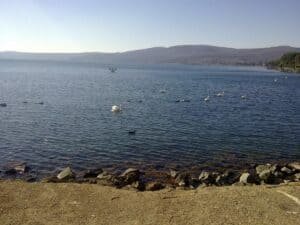
The Lazio lakes that people know are volcanic: Bracciano, Vico, Albano, Nemi, Bolsena. They are craters filled with water, deep, with seasonal thermoclines and waters that warm at the surface in summer. Posta Fibreno is the exact opposite. It is shallow, with an average depth of two and a half meters, elongated, with no surface inflows, fed from the bottom and from the banks by a forest of springs, and with a turnover so rapid that scholars liken it to a lotic environment, that is, of running water, rather than a lentic one of still water. A river disguised as a lake: it is the most honest definition one can give, and it is the reason salmonids live there, which demand cold, oxygenated water and would not survive a summer in the warm lakes of Lazio.
The numbers of the basin
The surface of the water body is about 0.287 square kilometers, the perimeter measures 5,163 meters, the maximum length 1,096 meters, the maximum width 570 meters and the average width 261. The maximum depth, 15 meters, is recorded in a pit in the Carpello locality that the villagers call Codigliane. The average, as said, is two and a half meters. The springs feed the system with something like six cubic meters of water per second, and the only outflow is the Fibreno river. The elongated, narrow shape, set against the hills of the northeastern shore, is the one that from above suggests a boomerang and that explains why the lake never had a bathing vocation: there is no real beach, there are vegetated banks and walkways.

A curiosity about Posta Fibreno (FR)
The lake you see today is not the lake that used to be. Until about a thousand years ago in this plain there were two distinct bodies of water, called Giuliano and Taurino, separated by a strip of marshy, peaty ground. It was the agricultural reclamation works carried out around the year 1000 that unified them into a single basin, and of that vanished geography what remains today is the name of the first nature trail you meet going down from Piazza San Venditto: the Taurino, precisely, 500 meters of wooden walkway along the right bank, inaugurated in the spring of 2014. Walking on it means walking on the edge of a lake that no longer exists.
The curiosity stretches back in time. The oldest document that names these bodies of water dates to 970 AD: Ildeprando, count of Sora and Vicalvi, donated to the abbey of Montecassino the entire half of the lakes Torino and Giuliano. A lake, in the 10th century, was a first-rate economic asset: it meant fish on lean days, and the Cassinese monks knew it better than anyone. From that donation descends a very long continuity of fishing management that arrives at the modern-age fishponds and, in a straight line, at the fish hatchery that still today produces trout fry for the restocking of the lake and the river.
Then there is a detail that escapes even many inhabitants of the Ciociaria: until 1957 Posta Fibreno was not an autonomous comune. The lake and the settlement belonged to Vicalvi, the castle you see from the opposite shore, and municipal autonomy is therefore younger than the Republic. A comune born almost yesterday that administers a natural asset documented for over a thousand years: the disproportion is one of the things that make this place interesting.
The Rota, the floating island of the lake of Posta Fibreno
It is the reason most visitors come all the way here, and for once the main attraction truly deserves its fame. In the lake of Posta Fibreno there is an island that moves. The villagers call it the Rota, the wheel, for its circular shape and for the slow movement with which it rotates on itself and drifts from one side of the water body to the other depending on the wind and on the flow of the nearby springs.
What the Rota is made of
It is not land. It is a floating block of peat, rhizomes and interwoven roots, about 30 meters in diameter, with an inverted conical shape, the tip pointing downward. The most accredited explanation of its detachment calls into play an anomalous underground current that would have lifted a portion of the peaty bottom from a depth of almost nine meters, detaching it from the lake bed and letting it rise to the surface, where the vegetation continued to grow and to compact it. On top grow reeds, sedges and hygrophilous shrubs, and from outside it looks like a patch of reed bed like many others: until you come back the next day and the patch is elsewhere.
Where you can see the floating island of Posta Fibreno from
Two observation points, very different from each other. The first is the hide that closes the "Puzzillo" nature trail: 600 meters of walkway inside the reed bed, 30 minutes of walking, 10 meters of elevation change, tourist difficulty, and at the end a wooden window that frames the island and the waterbirds up close, at water level. The second is from above, along the Dolina la Prece trail, which climbs from the lake to the historic center gaining 133 meters of altitude: from up there the Rota can be read in its entirety, you understand the circular shape and measure by eye how much it has moved since the previous time. The Prece trail, however, has an uneven and in some stretches slippery surface, is not suitable for strollers or for those with mobility difficulties, and to date is closed because of a landslide: before counting on it, a phone call to the Reserve.
A rare phenomenon, not a unique one
Floating islands are not an exclusive of Posta Fibreno: they are known in some European peat lakes and in a few Italian basins. What makes the Rota a case study is the combination of its size, its stability over time and the context in which it moves, that is, a spring-fed lake at constant temperature that neither freezes nor warms. The island is not an ornament: it is the visible part of a peat bed that keeps fermenting and producing gas, and that every so often, it is presumed, could give back other floating clods.

One thing nobody tells you about Posta Fibreno (FR)
In the lake of Posta Fibreno lives a fish that exists nowhere else in the world. It is called the carpione del Fibreno, it is a salmonid, and its range coincides with this basin and with the submerged karst caves that communicate with its waters. It is not a local subspecies of something: it is a species in its own right, born from the isolation of a population of salmonids in a cold, constant environment that worked as a closed evolutionary laboratory for millennia. Whoever comes here for the floating island and leaves without knowing about the carpione has seen the cover and skipped the book.
The reason almost nobody tells it is simple and a bit melancholy: the carpione is elusive, lives in the depths and in the submerged cavities, and no visitor will ever see it from the walkway. It doesn't lend itself to photography, it has no dedicated hide, it doesn't end up on the posters. Yet it is the real reason this reserve exists and why the Region funded a fish hatchery in a town of a thousand inhabitants. Alongside the carpione lives the macrostigma trout, which in peninsular Italy survives almost only here and in Sardinia, and which the European Union classifies as a priority species: the hatchery of Piazzale San Venditto handles its artificial reproduction for the genetic improvement of the strain and for the restocking of the lake and the river.
There is a practical corollary that concerns the visitor. The quality of these waters is not a tourist selling point, it is a condition of survival for species that elsewhere have already disappeared. This explains why the Reserve strictly regulates access to the banks, navigation and fishing, and why the wooden walkways run above the reed bed instead of inside it: it is not environmental bureaucracy, it is a matter of not switching off the only place in the world where a certain fish continues to be born. The behavior rules of the protected area are published by the managing body and should be read before going down to the shore.
The waters, the springs and the temperature of the lake of Posta Fibreno
The catchment basin that feeds Posta Fibreno is not the one you see. The mountains surrounding the lake collect rain and snow, of course, but the mass of water that re-emerges here comes from much farther away: from the upper Sangro valley, in Abruzzo, and from the karst massifs of the Marsica. The water enters the limestone rock at altitudes between 1,000 and 2,000 meters, travels for years inside the system of fractures and conduits of the karst, and resurfaces at the base of the slope with an overall flow of the order of six cubic meters per second. No river enters the lake: the mountain enters, from below.
The constant temperature
10, 11 degrees. In winter and in August. It is the datum that explains everything else: the transparency, because cold water hosts fewer suspended algae, the penetration of light to notable depths, which allows the submerged vegetation to grow on the bottom too, the dense food chain that follows, with top predators like the gray heron, the marsh harrier and the fox, and of course the survival of the salmonids. Whoever puts a hand in the water on Ferragosto understands in two seconds why people don't swim here for pleasure.
The transparency and the lake bed
The lake bed has an undulating course and a submerged plant cover that in some places looks like a meadow. They have always been a draw for divers, and the town has built around this vocation a part of its summer identity, with a divers' festival that accompanies that of the Crocifisso. Diving in a spring-fed lake at 11 degrees is not an experience to improvise: it requires proper equipment, certification and respect for the prescriptions of the managing body, which regulates access. Whoever doesn't dive gets a fifth of the same spectacle simply by leaning out from the walkway of the Benessere trail, where the water is so clear that the stones on the bottom seem 20 centimeters away.
The sinkholes and the karst at the surface
The karst doesn't work only underwater. On the slope that climbs toward the town open some sinkholes, that is, basins of collapse and dissolution of limestone: the Prece, along the trail of the same name, and higher up Fossa Canini and Valle Risa, which you meet walking the Catannovo. They are forms that tell the visitor what cannot be seen, namely the underground void inside which the water traveled before re-emerging in the lake. Looking at a sinkhole and then looking at a spring pool, in the same afternoon, is the quickest way to understand this territory.
The Fibreno river
The Fibreno is born where the lake ends: its main channel forms from the confluence of the basin's waters with those of the Carpello stream, and from there it descends toward the Liri on a course of about 11 kilometers. The banks, which in the first stretch widen to about 20 meters, accompany a course initially regular that further downstream becomes winding, among farmland, rows of poplars and old mills. The Fibreno's hydrographic basin belongs to the national Liri-Garigliano basin and covers 96.4 square kilometers. The flow stays of the order of six cubic meters per second, and the biological quality of the waters is overall good, without significant alterations of the aquatic environment.
The fishponds of the Fibreno
At the point where the Carpello stream, the lake and the river meet, on the left bank, two ancient structures survive that served as fishponds. They were not farms in the modern sense: they were holding tanks, where fishermen kept the trout that had not yet completely spawned, to return them to the reproductive cycle instead of taking them to market. A form of management of the fish resource of ancient peasant wisdom, which anticipates by centuries the concept of minimum size and fishing ban, and which has a direct line of descent with the 20th-century hatchery.
From the lake to the Liri, and the memory of Cicero
The Fibreno is a short river with a very long literary citation. Marcus Tullius Cicero, who was from Arpino, sets in the second book of De Legibus a conversation on precisely this watercourse: Atticus proposes to change place and move "in insula quae est in Fibreno", to the island that is in the Fibreno, and shortly afterward the text describes the arrival, "Ventum in insulam est. Hac vero nihil est amoenius", we came to the island, and nothing is more pleasant than this one, explaining that the river splits "quasi rostro", as against a ship's ram, dividing into two equal branches that then flow together again. Cicero adds that the Fibreno, flowing into the Liri, loses its more obscure name like someone entering a patrician family. Be careful not to confuse the places: the island Cicero speaks of is not the Rota, it is the little river island in the Arpino stretch of the Fibreno, near the family villa, and that page remains the first great literary portrait of these waters.

The fish of the Posta Fibreno Reserve
The carpione del Fibreno
An exclusive endemic salmonid, present in this lake and in the submerged karst caves connected to its waters, and in no other place on the planet. Its existence depends entirely on the thermal constancy and the oxygenation of the basin: any significant alteration of the spring regime, of the temperature or of the chemical quality would be, for this species, final. It is the kind of heritage that cannot be remade: it is preserved or it is lost.
The macrostigma trout
Salmo trutta macrostigma is the Mediterranean trout, an ancestral form that the European Union considers a priority species and that in Italy is preserved almost only in Sardinia and, on the peninsula, in very few stations, this one among them. Recognizing it from the restocking brown trout takes an eye: parr marks persistent even in adults, a more contrasting coloring, a contained size. Its value is not aesthetic but genetic, because it represents an evolutionary line that decades of introductions of Atlantic strains have almost erased from Italian rivers.
The fish hatchery of Piazzale San Venditto
Built in the 1920s and renovated several times, the Reserve's fish hatchery is in Piazzale San Venditto and answers at 0776 888021. Here the artificial reproduction of the macrostigma trout is practiced, for the genetic improvement of the local strain and for the restocking of the lake and the river. From February to May it is a destination very popular with school groups, because it lets you observe the phases of the life cycle of fish that in nature remain invisible: the eyed eggs, the hatching, the fry with the yolk sac, the first juveniles. For children it is the only part of the visit that doesn't require silence and patience, and it always works.
The other fish species
Alongside the two salmonids live the stickleback, a small armored fish with complex reproductive behaviors, and the minnow, a cyprinid of cold running waters. In the aquatic population also appear the river crab, an indicator of good quality, and two alien presences that weigh on the balance of the system: the coypu and, since 2002, the red swamp crayfish, which digs the banks and competes with the native species.
The birds of the lake of Posta Fibreno
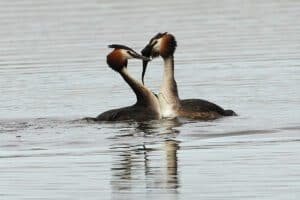
The classification as a Special Protection Area is not an administrative stamp: it depends on what lands here during the migrations and on what spends the winter here. During the seasonal passages protected herons such as the little egret and the great egret stop over. In the cold months the anatids arrive, the pochard, the teal and the shoveler, which exploit a basin that never freezes. All year remain the mallard, the coot and the moorhen, with the floating nests of the coots visible from the Taurino walkway a few meters away. The cormorant occupies the perches of the southwestern shore, where in the morning it dries its wings in the cross pose that makes it unmistakable even from afar. The gray heron holds the edges of the reed bed, motionless for whole minutes, and the marsh harrier appears in low flight above the reeds, with the wing held in a V that distinguishes it from any other raptor of these environments.
When and how to watch them
The first two hours after dawn and the last one before sunset are worth all the rest of the day put together. The Puzzillo hide is the right place, and 8x42 binoculars are the right tool: more magnification helps little, because the distances are short and the light inside the reed bed is scarce. A rule of behavior that no sign writes clearly enough: birds don't react to presence, they react to movement and voice. Whoever enters the hide, sits and stays quiet for 10 minutes sees three times as much as whoever enters, looks and leaves.
The flora of the Posta Fibreno Reserve
The plant population of the lake is, to use the right word, peculiar. It contains a contingent of species of boreal affinity, relics of the last postglacial period that found here a cold and stable microclimate able to preserve them while the rest of central Italy was warming. The most cited case is that of the Sphagnum palustre, the moss of northern peat bogs, which at Posta Fibreno reaches its southernmost populations, accompanied by large lake expanses of panicled sedge. A piece of northern Europe survived at 41.5 degrees of latitude.
The reed bed
Along the perimeter of the basin develops a reed bed of about 50 hectares, formed by the common reed and accompanied by cattail, horehound, water hemp, water mint and horsemint. 50 hectares of reed bed around 30 hectares of lake: the proportion says by itself that here open water is the minority and that the real habitat is the transition band. The wooden walkways of the Puzzillo and the Lago Chiaro cross precisely this band, and in June the smell of crushed mint rising from below is the thing you remember longest.
Trees, lichens and orchids
The dominant tree species are the willows, the white willow and the basket willow, and the poplar. Near the houses appears the weeping willow, of ornamental planting. The Lago Chiaro trail crosses hazels and large willows, with a damp understory of water hemp, water iris, water mint and watercress. A survey conducted in the protected area counted 77 species of lichens, a figure that indirectly confirms the quality of the air. In spring the meadows and woodland margins of the reserve give a bloom of wild orchids that the Comune promotes with dedicated initiatives: it is the period when it is worth walking looking down instead of toward the lake.
The other animals of the Reserve
Among the mammals are the fox, the badger, the squirrel and the hedgehog, and above all 10 species of chiroptera, that is, bats, a very high number for an area of this extent and a direct consequence of the combination of karst cavities, historic buildings and an out-of-scale production of aquatic insects. The invertebrates are the most surprising chapter: about 27 species of dragonflies, which make the lake one of the richest odonatological sites in Lazio, and an endemic caddisfly, Apatania volscorum, which lives exclusively in this reserve and to which the Benessere trail dedicates its own spring stretch. A species that exists nowhere else, a few millimeters wide, and that no visitor will ever photograph: but knowing you are walking beside it changes the way you look at the water.
The nature trails of the Posta Fibreno Reserve
Six marked routes, all short, almost all of tourist difficulty, designed to be combined in half a day. None requires mountaineering equipment. Two require serious shoes.
"Taurino" nature trail
Via Carpello 56. Half a kilometer, 15 minutes, difficulty T, no elevation change. It is reached from Piazza San Venditto by walking about a hundred meters along the shore. The route is a wooden walkway of about 500 meters on the right bank of the lake, accessible to families with strollers. From here you observe up close the riparian vegetation and the waterbirds, coots with their floating nests, moorhens, mallards, dragonflies, seen from a water-level point of view that is the real quality of the route. Opened in the spring of 2014, it takes its name from one of the two historic lakes, the Taurino and the Giuliano, which the agricultural reclamations unified around the year 1000. Benches at the entrance, none along the route, no tactile or audio aids for the visually impaired.
"Puzzillo" nature trail
It starts in the Sorgentina locality, well signposted: you follow the Fosso Cerreto, turn left and enter the reed bed. 600 meters, 30 minutes, 10 meters of elevation change, difficulty T. The route runs largely on wooden walkways across the Fibreno plain and the reed bed that covers the undeveloped shore. The flat terrain makes it passable with a stroller, while aids for the visually impaired are lacking. At the end is the observation hide, which is the best point in the reserve to watch the floating island and the species that stop over and nest in the protected area. Parking on Via San Venditto near the old mill or in Piazza San Venditto. The adjoining Orto delle Mole area offers wooden benches and tables for a stop.
"Lago Chiaro" nature trail
Entrance on Via San Venditto, beyond Orto delle Mole picnic area. 300 meters, 15 minutes, difficulty T. A first dirt stretch runs along the Fosso Cerreto, then the route becomes a wooden walkway and looks out over the water. It is the shortest trail and the most suitable for a first contact with the lake: hazels and large willows overhead, water hemp, water iris, water mint and watercress at water level, coots, mallards and moorhens in continuous view. The Reserve provides a photographic guide in pdf and a kml track for orientation.
"Dolina la Prece" nature trail
The most demanding of the six. It starts near Piazza San Venditto, measures about 650 meters by 600 meters of declared development, 30 minutes, with an uphill elevation gain of 133 meters and difficulty E. It connects the lake to the historic center of the town, and halfway along meets the karst sinkhole called la Prece. The surface is uneven and in some points slippery, the route is not suitable for families with strollers or for people with mobility disabilities, and there are no indications for the visually impaired. In return it offers the view from above over the lake, the Fibreno plain and the floating island. It is listed as closed because of a landslide: the Reserve communicates updates on its own channels, and before going up it's best to ask.
"Catannovo" nature trail
You park on Via Carpello, continue on foot to Piazza Carpello and follow the signs uphill. 900 meters, 45 minutes, 92 meters of positive elevation change and 93 of negative, difficulty T but a bumpy dirt-track surface, so unsuitable for strollers and for those with walking problems. The route crosses two sinkholes, Fossa Canini and Valle Risa, the historic agricultural terraces of the slope, the dry-stone walls and the ancient shepherds' shelters used as stables. A wooden hide with benches, toward the end, opens the panorama over the lake and the surrounding wetlands. It is the trail that tells of man's work on this mountain, and it is the one visitors skip most often: a mistake.
Benessere nature trail
You go down a few steps in the La Dova locality, in San Venditto. 300 meters, five minutes, five meters of elevation change, difficulty T. Built with naturalistic engineering techniques, it lets you walk and sit beside the icy, crystal-clear waters of the Fibreno, in the stretch where the endemic Apatania volscorum finds its habitat. It is the shortest route and the most contemplative: five minutes of walking and half an hour of sitting, if you are in the right spirit.
The advice I give you for visiting Posta Fibreno (FR)
The advice is to reverse the order in which almost everyone approaches this reserve. The average visitor arrives around noon, parks at San Venditto, walks the Taurino in a quarter of an hour, photographs the water, looks in vain for the floating island from the wrong spot and leaves disappointed within an hour. The right way is different. You arrive early, with raking light and steam on the water. You start from the Puzzillo, which leads to the hide and to watching the island and the birds at the moment when they are active. Then you go up to the town, even by car if the Prece is closed, to see the lake from above and understand the shape of the basin. Finally you go down along the Taurino and the Lago Chiaro, which with the sun high give back the transparency of the lake bed better than any other hour.
Second piece of advice, less romantic and more decisive: phone. The museum, the mill, the territorial laboratory and the hatchery do not have the continuous hours of a city museum. They open on the occasion of the Reserve's initiatives or by reservation at the numbers 0776 8887276 and 331 6728772. Showing up without warning almost certainly means finding closed doors and reducing the visit to the outdoor part alone. A phone call two or three days before turns a one-hour outing into a full day, and often lets you tag along on a guided visit already scheduled for a school group.
Third, clothing. Even in August, along the water, the perceived temperature at dawn is several degrees lower than that of the valley floor. In November the walkways are damp and wet wood is slippery. Shoes with lugged soles, a light jacket even in summer, and for the Catannovo and the Prece real hiking footwear. Whoever arrives in sandals does half the reserve. The clear opinion, then, is this: Posta Fibreno is not a passing stop on the way to the National Park, it is a destination that holds a full half day, and treating it as a photo stop is the surest way not to understand it.
The visitor center "Il mulino ad acqua"
Via San Venditto 2-22, phone 0776 8887276, email riservapostafibreno@regione.lazio.it. It is the operational seat of the Reserve and, for visitors, the most sensible entrance. The original building was built in 1810 in the Sorgentina locality as a mill for grinding grain, exploiting the drop in water that the Fibreno offered just downstream of the springs. Between 1905 and 1908 the structure was enlarged and a small hydroelectric plant was added, which after the Second World War for a period powered the public lighting of the neighboring comuni. In the early 2000s the buildings were restored and the original machinery, turbines and generators included, brought back to working condition.
The value of the place is that it lines up two things usually told separately: water as an ecosystem and water as energy. Within the same perimeter you understand why salmonids are born here and why here, before electric current arrived from the national grid, a mountain town had electric light while much bigger towns did not. The hydraulic machine that feeds the lake is the same one that turned the millstone and then the turbine.
Museo Naturalistico Etnografico of Posta Fibreno
Piazza Cesare Battisti 4, 03030 Posta Fibreno, phone 0776 888021. Set up in 1998 in the restored rooms of the former elementary school, it keeps the material memory of the town and is arranged in four thematic rooms. The visit requires a reservation at the numbers 0776 8887276 and 331 6728772. The museum opens on the occasion of the initiatives organized by the Reserve or on an agreed guided visit.
Room One: the ecosystem of the lake
The entrance room reconstructs the lake ecosystem and displays fossil materials and a sequence of seasonal photographs of the Reserve. It is the room that serves to orient the eye before going out onto the trails: whoever skips it then looks at the reed bed without knowing what they are looking at.
Room Two: agriculture and fishing
Tools of farm work and traditional fishing, with at the center the "nauè", the lake boat, of ancient Italic design, built entirely of wood and able to carry three or four quintals of cargo. The room tells of a subsistence economy in which the lake was not landscape but pantry and road, and local craftsmanship the practical consequence of that condition.
Room Three: the house
A traditional Posta Fibreno kitchen reconstructed with period furnishings and household objects. They are the objects that in every ethnographic museum risk looking the same as everyone else's, and that here take on meaning because the lake and its trout went into those pots.
Room Four: the territory and biodiversity
A model of the municipal territory and a series of illuminated panels give back the ecological diversity of the protected area, from the wet plain to the terraced slopes. It is the room where children stop longest, because the model finally lets you see the lake, the river, the sinkholes and the town together.
The Territorial Laboratory of the Reserve
Via Fontana Carbone 16, also carved out of an old school building and built with funding from the Environment Department of the Lazio Region. It is a real chemical-naturalistic laboratory, not a generic teaching room, and it offers guest quarters to researchers and trainees. It offers guided visits for families, schools and organized groups and takes part in the GENS Program of the Lazio Region. In the conference room, which holds about 20 people, the three-dimensional video "Il mondo di Gabriella" is shown, in which an animated trout accompanies the viewer through the biodiversity of the reserve: designed for primary school classes, it works very well also with adults who know nothing about lake ecology. Phones 0776 8887276, 0776 888021 and 331 6728772.
Another well-known fact, yet rarely cited
That this lake is cold and clear is known by everyone who has been there. What almost nobody connects to that fact is the story of its ownership, which explains why today there is a reserve and not a tourist village. In the 17th century the Gallio dukes, a family from Como who came here by feudal route, turned the lake into a pleasure place reserved for guests and notables: fishing outings, private fishponds, a residence overlooking the water. In the same century, and this is the part that is told least, the citizens of Posta Fibreno constituted their own Universitas civium and the first town parliament, that is, a body of community self-government that negotiated with the feudal lord the use of the waters, pastures and woods.
Two parallel powers over the same body of water, one lordly and one communal, both interested in not depleting the resource. The result of that tension is a lake that reached the 20th century without having been drained to gain arable land, as happened to dozens of bodies of water in central Italy, and without having been surrounded by construction. When in 1983 the Lazio Region established the Reserve, it did not have to recover a compromised environment: it had to confirm by law a balance that four centuries of local bargaining had already built.
There is an equally little-cited administrative corollary. The managing body of the protected area is the Comune itself, not a supra-municipal park authority. It means that the decisions on the reserve are made by the administration of the town of a thousand inhabitants who live there, with all the advantages of proximity and all the limits of resources that follow. Whoever visits and finds a trail closed by a landslide or a museum open only by reservation is observing exactly this: a heritage of European relevance managed with the budget of a small mountain comune.
The village of Posta Fibreno: what to see
The church of Santa Maria Assunta
It is the main church of the town, founded by the Benedictines in the 13th century, and the link with Montecassino is not a decorative detail: it descends from the same monastic network that from 970 controlled the waters of these lakes. Later renovations gave it its present 18th-century appearance, with three naves and a tall dome that signals the village from the valley floor from kilometers away. Whoever arrives from the lake meets it at the end of the climb, and it is the best way to close the Prece route when the trail is passable.
Villa Gallio
South of the lake. The Cardinal from Como Tolomeo Gallio, among the many possessions he accumulated in this territory, came into possession at the end of the 16th century of a rustic lodge that he had transformed into a sumptuous leisure residence. When in the early 17th century the fief was elevated to Duchy of the Kingdom of Naples, the building, equipped with its own fishpond, continued throughout the century to be embellished with frescoes and stuccoes by will of the heirs. It is the architectural translation of the story told a little above: the lake as the private garden of a Lombard cardinal family, 300 kilometers from Como.
The old mill and Orto delle Mole
The mill of 1810 and the square of San Venditto form the center of gravity of the visit. Next to it, the equipped area Orto delle Mole offers benches and wooden tables in the shade, and is the right place for a packed lunch between one trail and the next. The name preserves the memory of the millstones, the mole, that turned here.
The districts and the agrarian landscape
Carpello, San Venditto, Sorgentina, La Dova: the place names of the districts mark out the lower part of the comune and each corresponds to a different way of using water, the mill, the spring, the fishpond, the ford. On the slopes, the terraces and dry-stone walls you meet along the Catannovo tell the dry side of the same economy, with the shepherds' shelters reused as stables.
The submerged crucifix and the Festival of the Crocifisso del Lago
Since 1975, in the Codigliane locality, at the point of maximum depth of the basin, a cross rests on the bottom, placed to protect the lake and those who frequent it. The work, in steel and platinum, is by the sculptor Pino Bonavenia, now deceased. Every year, on the first weekend of August, divers bring it back to the surface. On Saturday evening the cross is led in procession on the waters, along a route marked by torches, accompanied by a procession of boats and canoes. The following morning, after the Mass celebrated on the shore, it is replaced by the divers in its original position.
It is the event that gathers the town and half of the Val di Comino, and it is also the occasion on which the relationship between Posta Fibreno and scuba diving becomes evident: the festival of the Crocifisso and the divers' festival are, in fact, the same thing seen from two perspectives. Whoever wants to see it must allow for a full town, saturated parking and a lake that, for one night, lights up with torches. Whoever seeks silence and birds should do the opposite and choose any other weekend of the year.

The right photo to take in Posta Fibreno (FR)
The photograph everyone attempts is the floating island from the shore, and it almost always fails: at water level the Rota blends with the reed bed behind it and the image comes out as an indistinct green band. The right photo is another, and it is double. The first is taken from above, from the slope that climbs to the historic center, when the Rota stands out like a dark disc inside the blue-gray of the water and the elongated shape of the basin fits entirely in the frame: you need a moderate telephoto, an 80 or 130 millimeter equivalent, and morning light, because in the afternoon the opposite slope goes into backlight.
The second is the one almost nobody takes, and it is the best: the close-up of the spring water along the Benessere trail or in the initial stretch of the Lago Chiaro. A constant 10 degrees and absolute transparency mean that, with a polarizing filter, you photograph the pebbles and algae of the bottom as if there were no water in between, with the ripples of the springs deforming the surface. Aperture around f/8, long exposure if you want silk on the thread of current, a stable support because on the walkways a tall tripod vibrates with everyone else's steps.
Third indication, seasonal. On the cold mornings of December and January the lake, which never freezes, produces evaporation fogs that rise in columns above the surface while the banks are frosted. It is the most spectacular photographic phenomenon of Posta Fibreno and coincides with the only period of the year when the reserve is completely empty of visitors. Alarm at six, thermos, and one single recommendation: the Puzzillo hide before eight, because by nine the sun has already melted the scene.
Some important events that took place here in history
The first documented fact is from 970 AD, and concerns the ownership of the water: Ildeprando, count of Sora and Vicalvi, donates to the abbey of Montecassino the entire half of the lakes Torino and Giuliano. It is the act that brings this corner of the Val di Comino into the great monastic history of the Mezzogiorno and that, in practical terms, hands the management of fishing to an institution able to administer it over long time spans.
The second event has no date and changed the geography: the agricultural reclamations carried out around the year 1000 drained the marshy strip that separated the two basins and fused them into a single lake. Whoever walks today on the Taurino walkway follows the margin of that operation, and the name of the trail is the last surviving document of an erased lake.
The third is the passage, in the Middle Ages, of figures that the territory remembers with pride, starting with Francis of Assisi, and the rise of the noble house of the della Posta, who took their name precisely from this place. A surname born from a place name is, for a local historian, the most solid proof that the place mattered.
The fourth event is 17th-century and double: the Gallio dukes of Como turn the lake into a pleasure place for guests and notables, and in the same years the citizens give life to the Universitas civium and to the first town parliament. Feudalism and self-government grow together, and from their friction is born the balance of use that has preserved the basin.
The fifth is industrial: between 1905 and 1908 the mill of 1810 is enlarged and equipped with a small hydroelectric plant, which after the Second World War comes to power the public lighting of the neighboring comuni. In the 1920s the fish hatchery is born. The lake goes from being a pantry to being infrastructure.
The sixth is administrative: in 1957 Posta Fibreno separates from Vicalvi and becomes an autonomous comune. The seventh is from 1975, when Pino Bonavenia's cross is lowered to the bottom at Codigliane, giving rise to the festival that still today marks the town's summer. The eighth is from January 29, 1983, with regional law number 10 that establishes the Lago di Posta Fibreno Regional Nature Reserve and places 345 hectares under protection. The ninth, silent and negative, is from 2002: the appearance of the red swamp crayfish in the waters of the reserve, that is, the arrival of an alien species that no regional law can send back.
Who passed through Posta Fibreno (FR)
The figure who more than any other tied his name to these waters probably never set foot on the shore of the lake, but wrote about the river that flows out of it as nobody would again. Marcus Tullius Cicero, born in Arpino in 106 BC, sets the beginning of the second book of De Legibus along the Fibreno, in the Arpino stretch. The dialogue begins with Atticus proposing to move "in insula quae est in Fibreno", to the island that is in the Fibreno. Shortly after, the text records the arrival, "Ventum in insulam est. Hac vero nihil est amoenius", and describes the river that splits "quasi rostro", as on a ship's ram, dividing into two equal arms that immediately rejoin. Cicero notes that the Fibreno, plunging into the Liri, loses its more obscure name like someone entering a patrician family, and he claims that land with a phrase still quoted in Arpino: "haec est mea et huius fratris mei germana patria", this is the true homeland of me and my brother.
In the Middle Ages, local tradition records the passage of Francis of Assisi along these valley roads, and the documentation of the protected area remembers him among the figures who made the village a crossroads. From the place name also took its name the noble house of the della Posta, who originated here.
The 16th and 17th centuries bring Cardinal Tolomeo Gallio, one of the most influential men of the Roman Curia of his time, who acquired vast possessions in this territory and made the residence overlooking the lake into a leisure villa. His heirs, the Gallio dukes, continued to embellish it throughout the century and to treat the lake as a lordly hunting and fishing reserve. Even earlier, in the 10th century, the power of the counts of Sora and Vicalvi had passed through here, and with Ildeprando the name of these lakes entered the archives of Montecassino.
In the 20th century the figure who left the most visible mark is the sculptor Pino Bonavenia, author of the steel and platinum cross that since 1975 rests on the bottom of the lake. And then there are the passages that have no proper name: generations of millers, trout fishermen, builders of the nauè, and from the 1970s on the teams of divers who made this small basin one of the most frequented inland-water dive sites in central Italy.
What to see around Posta Fibreno (FR)
Posta Fibreno does not hold a weekend on its own, but it is the perfect pivot of a two-day itinerary in the Val di Comino and the Liri valley. Distances are short, roads narrow and scenic, and every town adds a piece.
Vicalvi, the castle that looks at the lake
Less than five kilometers. Vicalvi is the comune to which Posta Fibreno belonged until 1957 and its castle, perched on the crag, offers a reading from above of the whole Fibreno plain. Going there before descending to the lake changes the perception of everything else: from up there you understand where the karst ends and where the peat bog begins.
Campoli Appennino, the truffle and the bears
Campoli Appennino is 6.6 kilometers away and is known for the Fiera del Tartufo Bianco held in November and for the presence of the Marsican brown bear in the surrounding beech forests, at the gates of the national park. The town overlooks a vast cultivated sinkhole, and the comparison with the miniature sinkholes of the Catannovo is instructive.
San Donato Val di Comino and Alvito
San Donato Val di Comino is one of the most intact villages of the valley and one of the Lazio gateways of the Abruzzo, Lazio and Molise National Park. Alvito, with its castle and ducal palace, keeps the memory of the fief that governed this part of the valley. Together they make up the day after the one at the lake.
Atina and the Melfa plain
Atina guards the other side of the Val di Comino, with its polygonal walls and a historic center worth the detour. It is also the point from which you descend toward the Melfa valley and the gorges that cut into it.
Arpino, Sora and Isola del Liri
Arpino is the homeland of Cicero and keeps on the acropolis of Civitavecchia the polygonal walls and the pointed arch, besides hosting every year the Certamen Ciceronianum Arpinas, the international Latin translation contest that the Comune organizes together with the humanistic studies center. Sora is the reference city of the valley and the hub of connections. Isola del Liri is the town with the waterfall that plunges in the built-up area, a rare spectacle in Italy and the perfect hydrological complement to the day on the Fibreno, because the Fibreno ends exactly in that river.
Aquino and Montecassino
Aquino, homeland of Thomas Aquinas and a first-rate Roman site, and the Abbey of Montecassino, which from 970 appears in the records concerning these lakes, close the historical picture toward the south. Whoever has two full days should do the lake and the Val di Comino the first, Arpino and the Liri valley the second.
When to go to Posta Fibreno (FR)
April and May are the best period by far: high water, reed bed still low and transparent, birds in reproductive activity, orchids in bloom on the meadows, mild temperatures and no crowds. June is excellent in the early morning. July and August have the advantage of coolness along the water and the disadvantage of the crowded town on the first weekend of August, when the Crocifisso del Lago is celebrated. September and October give low light and warm colors on the terraced slopes. December and January, for those who don't fear the cold, offer the evaporation fogs at dawn and a practically deserted reserve. The only period frankly not recommended is the one after prolonged rains, when the walkways are slimy and the uphill trails, Prece and Catannovo, become slippery.
Posta Fibreno (FR) with children
It works, and it works better than many city museums, on two conditions. The first is to book the fish hatchery between February and May, because seeing the eyed eggs and the fry is the only experience of the day that produces an immediate effect on an eight-year-old child. The second is to choose the right trails: Taurino, Puzzillo, Lago Chiaro and Benessere are all on walkways, flat, short and passable even with a stroller, while Prece and Catannovo have an uneven surface and should be left alone with little ones. The model in the fourth room of the museum and the video "Il mondo di Gabriella" in the territorial laboratory complete the picture. Half a day is the right measure: after three hours the attention threshold collapses and the observation hide becomes counterproductive, because it requires stillness and silence.
Accessibility of the Posta Fibreno Reserve
The wooden walkways of the Taurino and the Puzzillo are flat and the body's documentation indicates them as suitable for families with children in strollers. The same goes for the Lago Chiaro and for the Benessere, which is 300 meters long with five meters of elevation change, though with some initial steps in the La Dova locality. The Dolina la Prece trail is explicitly declared not accessible to people with mobility disabilities, and the Catannovo, which runs on a dirt track with an uneven surface, is not either. None of the routes has tactile or audio aids for people with visual disabilities. Whoever has specific needs does well to call the managing body before the visit, because the state of the walkways changes with the seasons and with maintenance.
Rules of behavior in the Reserve
You walk on the marked trails and on the walkways, without going down into the reed bed. Dogs must be kept on a leash. Plants are not picked and wildlife is not disturbed, and in the breeding season the observation hide must be used in silence. Swimming, boating, fishing and diving are subject to the prescriptions of the managing body, which publishes the founding act and the behavior rules among its official documents: whoever plans a dive or a fishing outing must inquire beforehand with the Comune di Posta Fibreno. It is not pedantry: in a lake where an endemic species lives that is exclusive in the world, every wrong behavior weighs more than elsewhere.
Frequently asked questions about Posta Fibreno (FR)
How far is Posta Fibreno from Rome and how do you get there?
Posta Fibreno (FR) is about 130 kilometers from Rome, an hour and three quarters by car taking the A1 motorway to Ferentino or Frosinone and then the expressway to Sora. The village is in the northeastern corner of the province of Frosinone, on the border with the Liri plain, geographically and culturally already part of the Val di Comino.
Do you pay a ticket to enter the Posta Fibreno Reserve?
The nature trails of the Posta Fibreno Reserve can be walked freely and without a ticket. The museum, water mill, territorial laboratory and fish hatchery are instead visited by reservation, at the Reserve's numbers 0776 8887276 and 331 6728772, and not through free entry.
What is the Rota, the floating island of Posta Fibreno?
The Rota is an island of the lake of Posta Fibreno that really moves: the villagers call it that, the wheel, for its circular shape and for the slow movement with which it turns on itself and drifts from one side of the water body to the other depending on the wind and on the flow of the nearby springs. It is the reason most visitors come all the way here, and it is an attraction that truly deserves its fame.
Does a fish that exists nowhere else really live in the lake of Posta Fibreno?
Yes: in the lake of Posta Fibreno lives the carpione del Fibreno, an endemic salmonid that is not a local subspecies but a species in its own right, whose range coincides exclusively with this basin and with the submerged karst caves connected to its waters. Its survival depends entirely on the thermal constancy and the oxygenation of the lake.
Is Posta Fibreno suitable for a trip with children?
Yes, Posta Fibreno works very well with children, better than many city museums, on two conditions: book the fish hatchery between February and May to see the eyed eggs and the fry, and choose the right trails, such as Taurino, Puzzillo, Lago Chiaro and Benessere, all on walkways, flat, short and passable even with a stroller.
Is the Posta Fibreno Reserve wheelchair accessible?
Largely yes: the wooden walkways of the Taurino and the Puzzillo are flat and indicated as suitable for families with children in strollers, as are the Lago Chiaro and the Benessere, the latter 300 meters long with five meters of elevation change, though with some initial steps in the La Dova locality. The Dolina la Prece trail is instead explicitly declared not accessible to people with motor disabilities.
When is the best time to visit Posta Fibreno?
April and May are the best period by far for Posta Fibreno: high water, reed bed still low and transparent, birds in reproductive activity, orchids in bloom on the meadows, mild temperatures and no crowds. June in the early morning is also excellent, while July and August offer coolness along the water but a more crowded town, especially on the first weekend of August, when the Crocifisso del Lago is celebrated.
Guided visits, groups and organized trips
The Reserve offers guided visits and educational activities by reservation at the numbers 0776 8887276 and 331 6728772, and also provides a series of virtual tours dedicated to the museum, the water mill, the floating island with the Dolina la Prece and the lake, useful for preparing the visit or for those who cannot reach the place. Whoever organizes a group, a school trip or a company outing in the Val di Comino and needs a professional to hold together transfers, timing and admissions can turn to the tour guide service of the TourLeaderPro network, which also handles organizing group trips in Italy. For English-speaking visitors building an Italian itinerary, the ItalyPlanner pages dedicated to mountains and nature in Italy and to day trips frame well the kind of excursion that a day in Posta Fibreno represents.
Quick questions about Posta Fibreno (FR)
How far is Posta Fibreno from Rome?
About 130 kilometers, an hour and three quarters by car on the A1 motorway to Ferentino or Frosinone and then the expressway to Sora.
Do you pay a ticket to enter the Posta Fibreno Reserve?
The nature trails can be walked freely. The museum, mill, territorial laboratory and hatchery are visited by reservation at the Reserve's numbers, 0776 8887276 and 331 6728772.
How big is the Lago di Posta Fibreno Nature Reserve?
345 hectares, almost half of the municipal territory, of which about 30 are occupied by the water body.
When was the Reserve established?
By the regional law of Lazio of January 29, 1983, number 10, published on February 28, 1983.
Who manages the Posta Fibreno Reserve?
The Comune di Posta Fibreno, with the Reserve's seat in Contrada Carpello, 03030 Posta Fibreno (FR).
What is the Rota?
It is the floating island of the lake: a block of peat, rhizomes and roots about 30 meters in diameter and of inverted conical shape, which moves with the wind and with variations in the flow of the springs.
Where can you see the floating island of Posta Fibreno from?
From the observation hide that closes the "Puzzillo" nature trail, at water level, and from above along the Dolina la Prece trail, when it is open.
How deep is the lake of Posta Fibreno?
The average depth is two and a half meters, the maximum 15 meters, in a pit in the Carpello locality called Codigliane.
What temperature is the lake water?
10 or 11 degrees, constant all year, because the basin is fed by deep karst springs.
Can you swim in the lake of Posta Fibreno?
Swimming is subject to the prescriptions of the managing body and should be checked with the Comune. In any case the water stays around 11 degrees even in August.
Can you fish in the lake of Posta Fibreno?
Fishing is regulated by the rules of the protected area: you must inquire beforehand with the managing body, also because of the presence of species of great conservation value.
Can you scuba dive?
The lake has a well-established diving tradition and a divers' festival in August, but dives follow the rules of the protected area and require certification and equipment suited to cold water.
How many trails are there in the Posta Fibreno Reserve?
Six: Taurino, Puzzillo, Lago Chiaro, Dolina la Prece, Catannovo and Benessere.
Which is the easiest trail?
The Benessere, 300 meters in five minutes, and the Lago Chiaro, 300 meters in a quarter of an hour. Both of tourist difficulty.
Are the trails suitable for strollers?
Taurino, Puzzillo and Lago Chiaro run on flat wooden walkways and are indicated as passable with a stroller. Prece and Catannovo are not.
How much time do you need to visit Posta Fibreno?
Half a day for the main trails and one observation point. A full day if you add the museum, mill and hatchery by reservation.
What fish live in the lake of Posta Fibreno?
The carpione del Fibreno, exclusively endemic to this basin, the macrostigma trout, the stickleback and the minnow, as well as the river crab.
What birds can be seen at the lake of Posta Fibreno?
Mallard, coot and moorhen all year. Gray heron and cormorant frequently. Little egret and great egret during the migrations. Pochard, teal and shoveler in winter. Marsh harrier over the reed bed.
What is the best time to go?
April and May. Alternatively the dawns of December and January, when the lake smokes with fog and there is nobody around.
Is Posta Fibreno suitable for children?
Yes, provided you choose the trails on walkways and book the fish hatchery between February and May, when eggs and fry can be seen.
What is the submerged crucifix of the lake?
A steel and platinum cross by the sculptor Pino Bonavenia, placed on the bottom in the Codigliane locality since 1975 and brought back to the surface every first weekend of August for the procession on the waters.
What do you visit in Museo Naturalistico Etnografico?
Four rooms: the lake ecosystem with the fossils, the farm and fishing tools with the nauè, the reconstructed traditional kitchen, the model of the territory with the panels on biodiversity.
What is the nauè?
The traditional boat of the lake, of ancient Italic design, entirely of wood, able to carry three or four quintals of cargo.
What do you see in the visitor center "Il mulino ad acqua"?
The mill of 1810 with the restored and working machinery, including the turbines and generators of the small hydroelectric plant added between 1905 and 1908.
Has Posta Fibreno always been an autonomous comune?
No: until 1957 the lake and the settlement were part of the comune of Vicalvi.
What is the relationship between Cicero and the Fibreno?
Cicero, born in Arpino, sets the beginning of the second book of De Legibus on the river island of the Fibreno in the Arpino stretch, and describes the river dividing into two branches and then flowing into the Liri.
Does the lake of Posta Fibreno freeze in winter?
No. The spring feeding keeps the water around 10 or 11 degrees, and on cold mornings it produces evaporation fogs above the surface.
Are there areas for a packed lunch?
Yes, the equipped Orto delle Mole area, next to Via San Venditto, with wooden benches and tables.
Where do you park in Posta Fibreno?
In Piazza San Venditto, near the old mill, for almost all the trails, and in Piazza Carpello for the Catannovo.
Can you get to Posta Fibreno by public transport?
By train to Sora and then scheduled bus toward the Val di Comino. Timetables must be checked on the carrier's official channels, and without a car the visit is in any case less convenient.
Much more famous places surprise less. Posta Fibreno asks for one thing only, which is also the hardest to grant on an outing: to stop. 20 minutes sitting on the Benessere walkway, or inside the Puzzillo hide without talking, are worth all the rest of the day. If you have only one hour, come back another day with half a day: the lake doesn't run away, the island does, and that is exactly the point.
Article written by the editorial team of TourLeaderPro, contact them for Private/Corporate/V.I.P. Tours and Experiences.
Planning a trip to Rome? The English guides for visiting the city are on ItalyPlanner.com.