Monte Catillo Nature Reserve
In short. The Monte Catillo Nature Reserve is in Tivoli, in the province of Rome, on the hills that close off the Roman countryside to the east.
The Monte Catillo Nature Reserve is in Tivoli, in the province of Rome, on the hills that close off the Roman countryside to the east. The protected area's office is on Via Munazio Planco, in Tivoli, and its phone number is 0774 453634. Entrance is free. It's a regional protected natural area, not a fenced park with a ticket office: the trails are open and free all year, from dawn to dusk, and anyone who wants to walk doesn't have to book anything. From Rome you get there in a little under an hour: the FL2 regional train connects Roma Tiburtina to Tivoli station, COTRAL buses leave from the terminals east of the city, and by car you take Via Tiburtina or the A24 motorway with the exit at Tivoli. From there the two most convenient access points to the web of trails are the hamlet of Colle Ripoli, north of the center, and the locality of Fonte Bologna, where there is a picnic area equipped with barbecues. There are no closing hours to respect, no turnstile, no fee: what you need is suitable shoes, water and a minimum of caution on the exposed stretches. Those who pass through Tivoli for the monumental villas almost always ignore that above the city, within walking reach, there is this green mountain of just over 1,300 hectares.
To get your bearings in the area it helps to keep the pages of the nearby places in front of you too: Hadrian's Villa, the Villa Gregoriana Park, the historic center of Tivoli and, to the north, the Monti Lucretili, of which Monte Catillo is the southernmost offshoot.
Where it is and what the Monte Catillo Nature Reserve is
The Monte Catillo Nature Reserve occupies the Monti Tiburtini just above Tivoli, at the point where the last wave of the Apennines drops toward the great alluvial plain that leads to Rome. It was established by the Lazio Region with the regional law of October 6, 1997, number 29, and since then it has been part of the system of protected areas of Lazio with a precise task: to conserve the botanical and wildlife richness of this strip of mountain and regulate how it is visited. Management is entrusted to the Metropolitan City of Rome Capital, which looks after the trails, the patrols and the environmental education activities. In the official list of Italian protected areas the reserve appears with the EUAP code 1038.
The area is just over 1,300 hectares. The different official sources range between 1,319 and 1,340 hectares, a difference due to surveys and boundary drawings made at different times: the figure to keep in mind is the order of magnitude, just over 13 square kilometers of mountain, not a cadastral detail. The peak that gives its name to the whole area, Monte Catillo proper, reaches 612 meters above sea level. It's a modest height, and for that very reason the view surprises: 600 meters are enough, when the mountain looks out over the void of the Aniene valley and the plain toward the capital, to open up one of those vistas that usually cost far greater elevation gains.
The Monti Tiburtini and Monte Catillo's place between Rome and the Sabina
To really understand Monte Catillo you have to look at it from above on a map, not just from its trails. The peak belongs to the Monti Tiburtini, the small limestone system that rises immediately east of Tivoli and acts as a threshold between the plain and the true mountains. Toward the north the Tiburtini join the Monti Lucretili, that is, the southern slope of the Sabina that the Latin poets sang of. Toward the south they instead descend into the Roman countryside and the Cornicolano area, where the perched towns of Sant'Angelo Romano and Montecelio remind us that here too, once, the plain was border land. Monte Catillo is the most advanced point of this system toward the capital: it is the last balcony of rock before the landscape spreads out into plain. This outpost position is what gives it views so out of proportion to its modest elevation. Whoever climbs doesn't simply look at another mountain in front of them: they look at the void of the plain from a natural parapet, with Rome in the background on clear days. It's a geography the eye grasps at once and that makes the effort of the climb immediately understandable.
The summit cross, in this sense, is also a point for reading the territory. From up there you can pick out, as on a relief model, the furrow of the Aniene valley coming down from San Polo dei Cavalieri, the travertine step of Bagni di Tivoli where the Acque Albule gush out, the dark mass of the Lucretili to the north and the uncertain line of the sea horizon to the west. You don't have to be a geographer: one climb is enough to understand how the surroundings of Tivoli are laid out, better than any map would explain it.
The geology of Monte Catillo: limestone, karst and the shape of the peak
Monte Catillo is limestone by nature. Its frame is made of Mesozoic rocks, formed between 100 and 200 million years ago on the floor of an ancient sea, then lifted and folded by the same tectonic push that built the entire Apennine spine. On this limestone water has worked for millennia, dissolving the rock along the fractures and drawing the typical features of karst: small sinkholes, swallow holes, corroded surfaces. It's a geology that explains many of the things you see as you walk. It explains why the ground is often thin and stony, why surface water is scarce and hides in the bowels of the mountain, why the vegetation has had to adapt to dry summers and poor soil.
Geographic position is the key to everything. Monte Catillo is a border peak, set between two worlds. To the northeast it continues without a break into the southern offshoots of the Monti Lucretili, the great mountain system of the Sabina. To the southwest it looks over the Roman countryside and the Cornicolano area, that plain dotted with low river terraces, tuff hillocks and limestone islets that follows the course of the Aniene to the gates of Rome. Being a hinge between mountain and plain, between limestone and tuff, between the Apennine climate and the milder one of the countryside, is the first reason for its natural value. On the border you meet species that elsewhere you would never meet.

The flora of the Monte Catillo Nature Reserve: the pseudo-cork oak and the scrub
If you had to explain in one word why this mountain was protected, the word would be botany. The richness of the floral and vegetation heritage is the reason the reserve exists, and it is no small richness. The climatic border condition allows species from different environments to live together on the same slope: plants of an eastern character next to western plants of an Atlantic nature, which love a wetter, more oceanic climate. This coexistence is easy to read in the Sirividola cork oak grove, a patch of woodland that hosts the cork oak in an unusual position for inland Lazio.
The pseudo-cork oak, the symbol of Monte Catillo
The plant that best tells the story of the reserve is the pseudo-cork oak, Quercus crenata. It's a rare oak, a spontaneous hybrid between the cork oak and the Turkey oak that shares with the former its thick, corky bark and with the latter its resistance to inland cold. Its presence here is so significant that the managing body has made it its emblem: the official logo of the protected area is the stylized profile of a pseudo-cork oak leaf. Finding it along the trail, recognizing its rough bark and its toothed-edged leaves, is one of those small rewards that repay whoever walks with open eyes instead of with their head bent over a phone.
Mediterranean scrub, mixed woodland and the scents of the trail
On the warmer, sunnier slopes the Mediterranean scrub dominates, with its low-growing aromatic species. Calamint grows along the edges of the trails and all it takes is rubbing a leaf between your fingers to understand how fragrant this mountain is in high summer. Where the soil is deeper and the exposure cooler, the scrub gives way to a mixed woodland of downy oak and other Apennine broadleaf trees, with an understory that lights up with blossoms in spring. The plant picture, in short, is not uniform: it changes constantly as you climb a windy ridge or descend into a shady gully, and this variety is exactly what botanists come looking for. The reserve is a mosaic, not a carpet.
The Sirividola cork oak grove and border botany
The most studied piece of woodland in the reserve is the Sirividola cork oak grove. The cork oak is a Mediterranean plant, used to heat and to the nearness of the sea: finding it here, inland, on a mountain facing the Apennines, is a small ecological paradox that is explained only by the play of microclimates. On that slope the heat stored by the limestone rock and the sheltered exposure recreate conditions mild enough to let the cork oak survive far from the coast. Around it live species of opposite origin: plants of an eastern nature, which love continental winters, and plants of an Atlantic character, which ask for humid, oceanic air. It is this unlikely meeting, even more than the individual specimens, that makes Monte Catillo a precious place for botany. It's not a garden, it's a natural laboratory where species that in theory shouldn't meet share the same slope.
Anyone who walks with a minimum of botanical curiosity finds material for a whole season. In spring the dry meadows fill with wild orchids, small and easy to trample without noticing, and for that very reason to be looked for with respect along the edges of the trail and never picked. On the walls and sunny rocks grow the aromatic herbs of the scrub, while in the cooler gullies the mixed woodland holds the humidity and completely changes the set of plants. The rule here is that every change of exposure brings a change of flora: climbing a ridge and descending into the next gully means crossing two different plant worlds within a few minutes.
The wildlife of Monte Catillo: birds of prey and the animals of the woods
The sky above the Monte Catillo Nature Reserve is birds-of-prey territory. The limestone walls and open clearings offer ideal perches and rising air currents, and with a bit of patience and binoculars you can pick out the kestrel, which can stay still in the air beating its wings in place before dropping on its prey, and the buzzard, larger, which climbs in wide circles using the afternoon thermals. As the light fades the night raptors take the stage: the tawny owl with its round call, the little owl, the scops owl that in spring marks the night with a monotonous, insistent whistle. Recognizing these calls, in the evening, near Fonte Bologna, is worth as much as a good daytime sighting.
In the thick of the woods lives a discreet but plentiful mammal fauna. The wild boar is by now a regular presence, as on all of Lazio's peaks. The fox moves at dusk along the edges. The badger digs its deep dens on the slopes. The weasel and the stone marten, agile and nocturnal, complete the picture of predators. To them add the amphibians and reptiles tied to the few pools and the sun-warmed dry-stone walls. It's not a spectacular fauna on demand, like that of an African park: it's a fauna that shows itself to those who slow down, stay quiet and know how to wait. The mountain doesn't put on a show. It rewards slowness.
Birdwatching at Monte Catillo: where and when to watch the sky
For those who love watching birds, Monte Catillo is a comfortable and generous observation point. The open clearings on the valley are natural lookouts onto the rising currents that raptors use to climb without flapping their wings: in the central hours of a sunny day, when the ground heats up and generates the thermals, the buzzard draws its slow, wide circles in the sky. The kestrel, by contrast, is recognized by its hovering, that stationary flight on rapid wingbeats with which it scans the meadow before dropping on its prey. Spring adds passing migrants to the scene, and April and May evenings are the best for listening, more than for seeing, to the night raptors: the insistent whistle of the scops owl, the deep call of the tawny owl, the dry cry of the little owl. A practical tip from someone who has spent hours standing still with binoculars: position yourself with the sun behind you and stay motionless for a few minutes. The sky above Monte Catillo fills up when you stop moving.
The trails of the Monte Catillo Nature Reserve, one by one
The reserve is crossed by a network of numbered trails marked by the Italian Alpine Club, described in the Monte Catillo trail map, for which digital tracks you can download also exist. It's not a labyrinth: these are well-identified routes that cross at recognizable points and let you put together loops of different lengths depending on your legs and your time. It's worth getting to know them one by one before setting out, because the choice of trail completely changes the day.
CAI trail 330, from Tivoli to Colle Cucco
The 330 is the classic gateway from the city. It starts in Tivoli and climbs toward Colle Cucco, and it is the natural link between the town and the heart of the mountain. Whoever arrives by train or bus and has no car uses it as an access route: you start walking practically from the last houses and gain elevation quickly, with the city shrinking behind you and the valley widening. It's the trail that best tells the passage from the urban world to the wild one, all in one climb.
CAI trail 331 and the 331B toward Fonte Bologna
The 331 runs from the Hotel Sant'Angelo junction toward San Polo dei Cavalieri, while its branch 331B leads to the shelter and the spring of Fonte Bologna, which is the most frequented meeting point of the reserve. Here the picnic area equipped with barbecues serves as base camp for families and groups: you leave the car, eat in the shade and from there set off on the shorter loops. Fonte Bologna is the name that anyone who frequents the mountain says first when arranging to meet.
CAI trail 332, the Sentiero Fantini
The 332 bears the name Sentiero Fantini and is one of the routes that regulars prefer for the variety of environments it crosses. It alternates stretches of cool woodland with open clearings overlooking the valley, and for that very reason it is a good testing ground for botany: within a few hundred meters you go from damp understory to sunny scrub.
CAI trails 333, 334 and 335 toward Monte Sterparo and Colle Lecinone
The innermost and highest part of the reserve is served by three trails that interweave. The 333 links the Quadrivio to Monte Sterparo. The 334 joins Colle dei Travi to Colle Lecinone. The 335 closes the design between Colle Lecinone and Monte Sterparo. These are the routes for those who want to move away from the most beaten spots and look for the silence of the inner ridges, where the mountain turns sterner and the views open toward the Lucretili and the Sabina. Combining them builds the longest and most rewarding loops.
The long-distance walks that cross Monte Catillo: the Sentiero Coleman and Via dei Lupi
The reserve is not a closed world: two long-distance routes cross it as a stage of a wider walk. The Sentiero Coleman passes through with its seventh stage, while Via dei Lupi includes it in the first. For those who walk for several days with a backpack, Monte Catillo becomes a link in a chain that holds together the peaks between Tivoli and the Sabine mountains. It's worth knowing even just to understand that these trails are not born and do not end here: they are part of a much larger geography of walking.

The climb to the summit and the cross of Monte Catillo
The top of Monte Catillo can be recognized from afar, even from the valley floor, by a large cross planted on the summit. It's the sign that gave the peak its popular nickname of Monte della Croce, and for generations of people from Tivoli it has been the goal of the Sunday walk: you climb, you touch the cross, you look out over the void and you go back. The loop that leads to the summit and back down generally takes a few hours of walking and an elevation gain on the order of 300 to 400 meters, a measure within reach of anyone with a minimum of fitness and decent shoes. It's not a high mountain and doesn't demand technical equipment, but some stretches on limestone can be slippery after rain and a few overlooks are exposed: caution, here, is never too much.
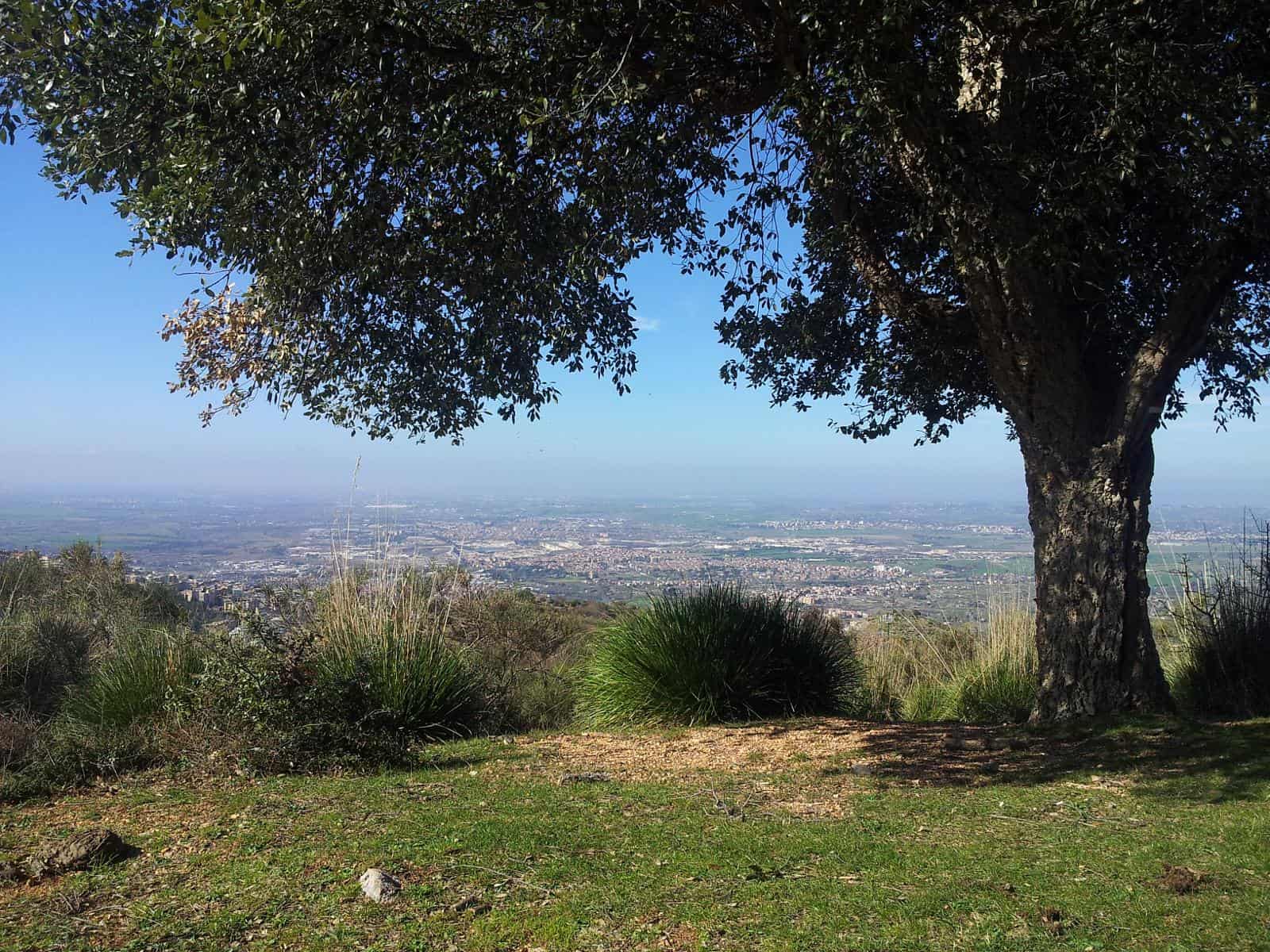
From the cross the gaze runs in all directions. To the southwest the Roman countryside spreads out, and on clear days, when the tramontana has cleaned the air, you can make out the outline of Rome on the horizon. To the northeast rise the first buttresses of the Lazio Apennines. Below, set deep, the Aniene river carves its valley, and from some points you can even sense the waterfalls that make nearby Villa Gregoriana famous. It's the kind of view that repays all the effort of the climb in one go.
The relationship between Monte Catillo and the villas of Tivoli
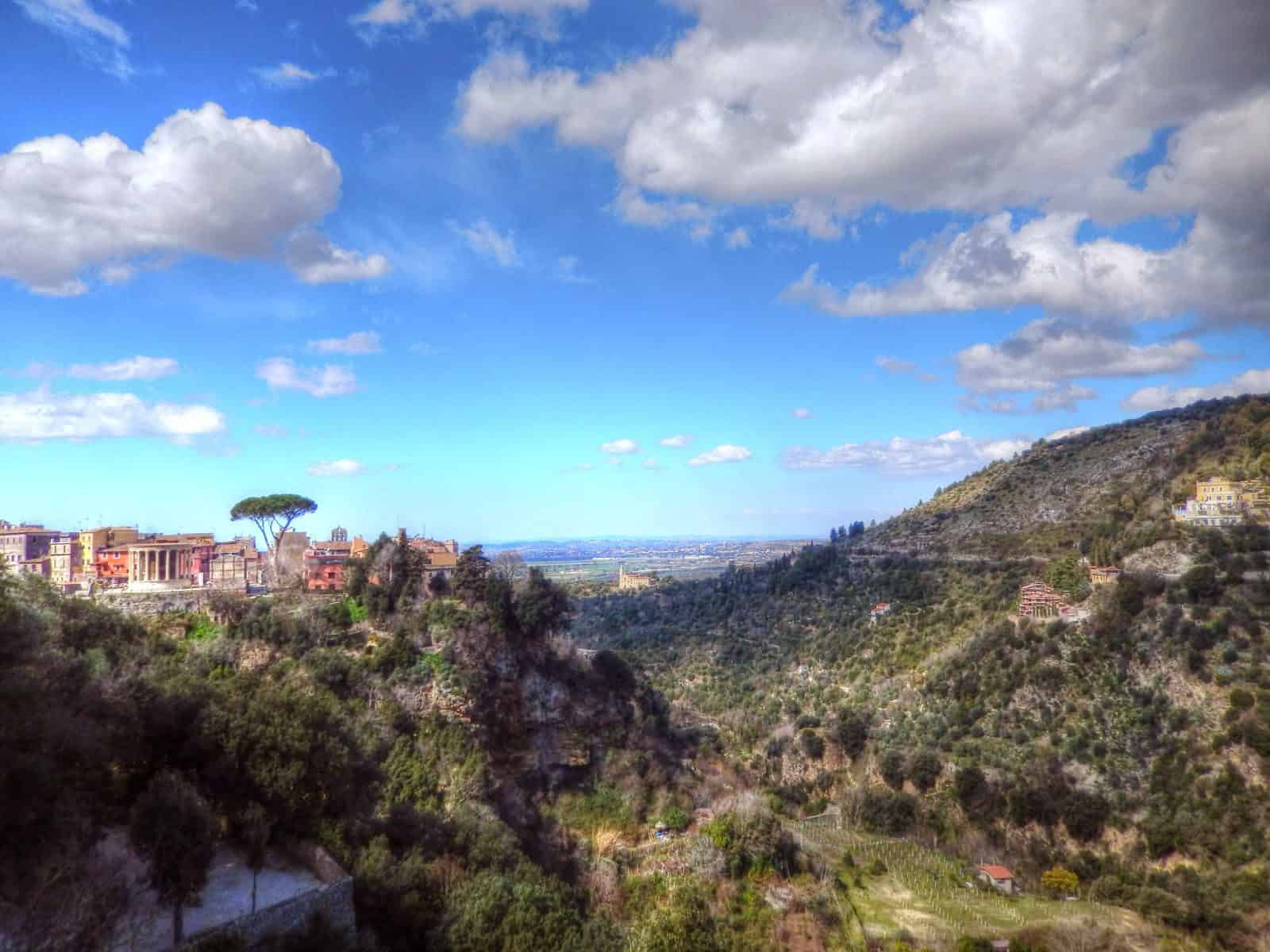
Those who come to Tivoli come for the villas, and rightly so. But Monte Catillo is not the forgotten back of those marvels: it is their backdrop and, in a sense, their explanation. The Hadrian's Villa of Emperor Hadrian, the great complex built starting in the 2nd century AD at the foot of the Monti Tiburtini, stands right under these peaks and drew water, coolness and stone from them. The Villa Gregoriana Park, with its waterfalls and its gorge carved by the Aniene, is the work of the same river that Monte Catillo overlooks from above. And the Renaissance Villa d'Este, with its theater of waters, owes everything to the same resource. Looking at Tivoli from Monte Catillo means understanding why so much beauty gathered here: the water of the Aniene and the position between mountain and plain made this corner of Lazio irresistible to emperors, cardinals and painters.
A little farther off, toward the plain, the mineral springs of the Acque Albule at Bagni di Tivoli also deserve a detour, known since antiquity for their properties. Whoever wants to widen the loop further can look north, toward the Monti Lucretili, or follow the course of the water into the Valle dell'Aniene Reserve: they are all pieces of the same landscape.
A curiosity about the Monte Catillo Nature Reserve
The curiosity that almost nobody knows concerns the leaf that stands out on the reserve's symbol. The official emblem of the protected area is not a view, not the summit cross, not an animal: it is the stylized profile of a pseudo-cork oak leaf, Quercus crenata. It's a revealing choice, because it tells what naturalists consider truly precious here. The pseudo-cork oak is not just any oak: it is a spontaneous hybrid, a natural cross between the Mediterranean cork oak and the Apennine Turkey oak, and its very existence depends on that climatic border condition that characterizes the mountain. Where Mediterranean heat meets the coolness of the interior, a species that shouldn't exist finds its space. Putting that leaf on the logo means saying, without words, that the value of Monte Catillo is not in the postcard view but in this capacity to make opposite botanical worlds live together. It's a curiosity that changes the way you look: next time you climb, look for the corky bark and the toothed leaves, and you'll know you have in front of you the very reason this mountain is protected.
Something nobody tells you about the Monte Catillo Nature Reserve
The thing the tourist guides don't say is the simplest and the most useful: here you pay nothing and you don't need to book anything. In a town like Tivoli, where every villa has its ticket office, its hours, its line and its price, the mountain above your head is free, open, no-cost and always accessible. It's a practical piece of information worth gold, because it overturns the way you organize the day. Whoever has seen Villa Adriana in the morning and doesn't know how to fill the afternoon, instead of rushing to buy yet another ticket, can simply climb trail 330 from the center and find themselves, within half an hour of walking, in a silent wood with Rome on the horizon. The second thing nobody says is that water, on this limestone mountain, is scarce: the karst swallows it and hides it, and the reliable springs are few. Whoever sets out has to bring something to drink, especially in summer, because counting on finding a spring along the way is a mistake that limestone doesn't forgive.
The advice I give you for visiting the Monte Catillo Nature Reserve
My advice is to choose the season with care and ignore the height of summer. There are people who climb Monte Catillo in July, at noon, convinced that a mountain is always cool, and come back cooked, because at 600 meters, on white limestone and low scrub, the midsummer sun beats down without pity and the shade is stingy. The reserve is at its best in spring and autumn. April and May are the months of blossoms, when the mixed woodland lights up and wild orchids pop up in the meadows. October and November give the clearest air of the year, the kind that pushes your gaze all the way to Rome from the summit cross. If you really want to go in summer, go at dawn: set out in the cool from the center of Tivoli, be at the top before nine and come down before the sun turns nasty. Bring more water than you think you'll drink, shoes with a lugged sole because wet limestone is slippery, and a light pair of binoculars: without them, the raptors stay dots in the sky, with them they become the best memory of the day. One last piece of advice, the most underrated: download the trail track before you leave, because phone signal on the inner ridges comes and goes.
Another well-known fact, yet rarely cited
The well-known fact that is rarely cited is that the very name of this mountain sinks its roots into the legend of Tivoli's origins. Tibur, ancient Tivoli, according to the tradition gathered by the Latin poets, was founded by three brothers, Tiburtus, Coras and Catillus the younger, sons of an older Catillus who came to Italy from Greece. The city took its name from the eldest of the three, Tiburtus. But the mountain that overlooks it kept the name of the forefather, and for centuries it was called in Latin mons Catillus. Virgil, in the Aeneid, lines up Catillus and Cora among the warriors who face Aeneas, and describes them as Tiburtine twins who came down into battle. It's a detail that usually stays confined to local history books, yet it changes the way you look at the climb: when you touch the summit cross, you are on the peak that the ancients tied to the mythical founder of their city. Walking on Monte Catillo, in short, is not only a matter of nature. It is putting your feet inside the story of Tivoli's origins, where myth and rock bear the same name.
The right photo to take at the Monte Catillo Nature Reserve
The right photo is not the close-up of the summit cross, which everyone takes anyway. The right photo is the one that brings together, in a single frame, the two worlds this mountain keeps in balance: in the foreground the cross or a branch of pseudo-cork oak, and in the background the Aniene valley plunging on one side and the Roman countryside stretching out on the other to the distant outline of Rome. To get it you need the right light. The summit faces west toward the plain, so the golden moment is late afternoon, when the low sun warms the limestone, lengthens the shadows on the ridges and lights the haze over the countryside orange. Position yourself so that the cross is backlit, slightly off-center, and let the valley act as the backdrop. If you climb in the morning instead, the light comes from behind you and the Roman countryside comes out sharper but flatter: excellent for a documentary view, less so for an image with soul. A technical tip from someone who has tried it many times: don't rely only on the wide-angle, which shrinks everything and cheapens distances. Try a small telephoto pointed toward Rome at blue hour, when the city lights start to come on and the capital seems to float at the bottom of the plain.
Some important events that happened here in history
The history of this mountain is not made of great battles fought on its summit, but of slow, deep events that left their mark on the landscape. The first, and the oldest, is geological: the limestone we walk on formed on the floor of a tropical sea between 100 and 200 million years ago, and the mountain itself was born from the uplift and folding of those seabeds, pushed up by the same force that built the Apennines. Every step on Catillo is a step on an ancient sea floor lifted to altitude.
The second great chapter is the Roman one. When Hadrian chose the plain at the foot of these mountains to build his immense villa, in the 2nd century AD, Monte Catillo became part of the system of resources that made that marvel possible: the water coming down from the peaks, the stone from the quarries, the coolness of the higher elevations. For centuries after, the mountain was shepherds' land: pastoralism and transhumance shaped the high-altitude pastures, opened the clearings, traced many of the trails we walk today for leisure and that once served to move flocks between plain and mountain. The open landscape we like so much is not entirely natural: it is also the fruit of centuries of pastoral work.
The most recent chapter is that of protection. In 1997, with regional law number 29, Monte Catillo became a nature reserve, and this administrative act, unflashy but decisive, saved its botanical richness from building expansion and abandonment. It's the event that lets a reader today still find the pseudo-cork oak in its place and the raptors in the sky. Without that signature, much of what makes the mountain special would have been lost.
Who has passed through the Monte Catillo Nature Reserve
The first to pass through here, if you believe the tale of the ancients, was a mythical figure: Catillus, the forefather who according to Latin tradition gave the mountain its name and fathered the founders of Tibur. Virgil handed him down to literature by lining up his descendants Catillus and Cora among the warriors of the Aeneid, and since then the name of the mountain has been tied by a double thread to that of Tivoli's legendary origins.
But the mountain was truly trodden, century after century, by a crowd of concrete people. Hadrian's legionaries and hydraulic engineers passed through, who in the plain below built one of the largest villas of the Roman world. Generations of shepherds passed through, who with their flocks opened the pastures and the trails. And between the 18th and 19th centuries the travelers of the Grand Tour passed through: Tivoli was one of the fixed stops of that cultural pilgrimage that brought to Italy the artists and writers of Europe, drawn by the waterfalls of the Aniene and the ancient ruins. Painters such as the vedutisti who portrayed the Roman countryside climbed these heights to capture the view that still takes our breath away today: the valley, the river, the ruins, the light. Today those who pass through Monte Catillo are the hikers of the Alpine Club, the botanists who come to study its border flora, the families who go up to Fonte Bologna and the people of Tivoli who, as they always have, go up to the cross on Sundays the way you go up on the roof of your own house.

The Aniene valley seen from Monte Catillo
The Aniene is the real invisible protagonist of this landscape. It's the river that comes down from the Apennines, passes through Tivoli carving the gorge where the Parco Villa Gregoriana can be visited today, feeds the fountains of Villa d'Este and continues toward Rome to flow into the Tiber. Monte Catillo overlooks its course from above, and this very elevated position lets you read at a glance what from the valley floor you catch only in pieces. From certain overlooks you sense the drop of the waterfalls, you follow the ribbon of water that winds between the peaks, you understand how the same force that sculpted the valley made the life and wealth of Tivoli possible. Looking at the Aniene from up here helps put things in order: water brought the ancients, the ancients built the villas, the villas made Tivoli famous. The mountain, spectator of it all, has remained the point from which you see the whole design. Whoever wants to follow the river more closely can then go down into the Valle dell'Aniene Reserve, which tells of another stretch of it toward the city.
Walking safely on the trails of Monte Catillo
Monte Catillo is not a difficult mountain, but its apparent ease is deceptive. Wet limestone is insidiously slippery, and the steep stretches that give no trouble going up become delicate coming down, especially on rotting autumn leaves. Some scenic overlooks are exposed and call for attention with children and with dogs on a leash. In summer the danger is not the rock but the sun: the scrub is low, the shade is scarce and heatstroke comes quickly to those who start late and without water. The karst, moreover, makes springs rare and not guaranteed, so water has to be brought from home. Simple rules, old as the world: shoes with a lugged sole, a generous water supply, a rain shell in the pack even when it's sunny, and a look at the weather before climbing. On the open ridges, during a thunderstorm, there is nowhere to shelter: if the sky turns black, you give up and come back another day. The mountain stays there.
Accessibility of the Monte Catillo Nature Reserve
It must be said honestly: Monte Catillo is a mountain environment and its trails, unpaved, steep and stony, are not suitable for wheelchairs or strollers. Those with mobility difficulties won't find equipped routes to the summit. The picnic area of Fonte Bologna, reachable by car, remains however a pleasant rest stop in the open air, where you can enjoy the woods and a lunch in the shade without tackling the demanding stretches. For up-to-date information on any easier routes and on the body's activities, it's best to contact the reserve's management directly.
How to organize the visit to the Monte Catillo Nature Reserve
How to get to Monte Catillo from Rome
From Rome the simplest way without a car is the FL2 regional train, which connects Roma Tiburtina to Tivoli station in a little under an hour. Alternatively, COTRAL buses reach Tivoli from the city's eastern terminals. From the station or the center of Tivoli you walk to the start of trail 330, which climbs directly toward the mountain. By car you take Via Tiburtina or the A24 motorway with the exit at Tivoli, and head for the hamlet of Colle Ripoli north of the center, or for the locality of Fonte Bologna, where you can park more conveniently near the picnic area.
How long it takes and how demanding the visit is
It depends on the loop you choose. A short walk to a viewpoint and back takes a couple of hours. The classic loop to the summit cross generally takes three hours or a little more, with an elevation gain on the order of 300 to 400 meters. Combining the inner trails toward Monte Sterparo and Colle Lecinone easily fills a day. You don't need mountaineering skills, but you do need legs trained for climbing and hiking shoes: some stretches on limestone are steep and, when wet, slippery.
Monte Catillo with children
The reserve is suitable for children as long as you measure out the ambition. The Fonte Bologna picnic area is the ideal starting point for families: you arrive by car, eat in the shade and from there short, undemanding stretches set off, perfect for a first walk in the woods looking for traces of animals and insects. Climbing to the summit cross with small children is instead a serious undertaking, for the elevation gain and the exposure: better to put it off until the short legs have grown. With older kids, on the other hand, the summit loop becomes an adventure within their reach and an excellent way to teach them to read a trail and recognize a raptor.
The shepherds, the transhumance and the trails of Monte Catillo
The trails we walk today for leisure weren't born for free time. For centuries Monte Catillo was shepherds' land, and its tracks are first of all working routes. Transhumance, that is the seasonal movement of flocks between the low pastures of the plain and the high ones of the mountain, has carved this landscape much more deeply than it seems. It was the sheep, with their patient grazing, that kept open the clearings that now give us the views. It was the shepherds, with their passages repeated generation after generation, who beat the grooves that the Alpine Club then took up, numbered and marked. Walking here means putting your feet in an ancient geography of work, not on a route drawn for tourism. The open, bright mountain we like so much is partly a human work: without centuries of grazing, many of these clearings would today be dense woodland, and the great overlooks onto the valley would not exist. The Mediterranean scrub and the woods are slowly taking back the spaces that the end of traditional pastoralism left free, and it's a change that those who have frequented the mountain for many years notice well: where flocks once grazed, today juniper and young downy oak advance.
A half-day itinerary on Monte Catillo
For those who want a concrete plan, here is how to set up a sensible half day. You start early from the center of Tivoli and take trail 330 toward Colle Cucco, gaining elevation right away with the city shrinking behind you. Alternatively, whoever has a car leaves it at Fonte Bologna and starts from there, saving the first climb. Once on the ridge, you aim for the summit cross following the markings: the climb asks for breath but not technical skill, and the reward comes at the top, where you stop for the time of a sandwich and many photographs. On the way back, whoever still has energy can extend toward the inner trails in the direction of Monte Sterparo, to savor the silence of the ridges far from the most beaten spots. Whoever is already satisfied descends by the same route or closes a loop toward Fonte Bologna. In all, three or four hours of walking with stops, an elevation gain within reach of ordinary legs and a view worth double the effort. It's the kind of outing that fits perfectly into a day in Tivoli: villas in the morning, mountain in the afternoon, or vice versa.
When to go and when to avoid Monte Catillo
Spring and autumn are the right seasons. From April to June the mountain is at the height of its botanical life, with blossoms, scents and days that are still cool. From October to November the air turns crystalline and the views reach their greatest extent. Full summer, July and August at noon, is the window to avoid: strong heat, scarce shade, no water. If you can't do otherwise, the only sensible strategy is to set out at dawn. Winter is doable on clear, dry days, when the tramontana gives extraordinary visibility, but after rain the wet limestone and rotting leaves make the steep stretches treacherous. The golden rule remains one: look at the sky before leaving and don't climb with thunderstorms on the way, because on the open ridges there is nowhere to shelter.
What to see around Monte Catillo
The beauty of Monte Catillo is that it fits into a very rich territory. Within a radius of a few kilometers there are the two complexes that made Tivoli famous worldwide, Hadrian's Hadrian's Villa and the Renaissance Villa d'Este, and the magnificent Villa Gregoriana Park with its great Aniene waterfall. The historic center of Tivoli, with its alleys and its ancient temples, deserves at least half a day. Toward the plain you find the sulfur springs of the Acque Albule at Bagni di Tivoli. Toward the mountains open the Monti Lucretili and the Valle dell'Aniene Reserve. Whoever loves Lazio's protected areas can widen the radius further toward the Monterano Reserve or, on the coast to the north, toward the Macchiatonda Nature Reserve: different landscapes, same logic of protection.
Quick questions about the Monte Catillo Nature Reserve
How much does it cost to enter the Monte Catillo Nature Reserve
Nothing. It's a regional protected natural area with free trails: no ticket, no ticket office, no turnstile. Access to the routes is free all year.
Do you need to book to visit Monte Catillo
No. To walk the trails on your own you don't need any reservation. Booking may be needed only if you rely on a guided visit or an organized activity, but for a free walk you set off whenever you like.
What are the hours of the Monte Catillo Nature Reserve
The trails are open and walkable during daylight hours, all year. The offices of the managing body, on the other hand, keep office hours: for paperwork or information it's best to call the reserve's number, 0774 453634.
How long is the loop to the summit of Monte Catillo
The classic loop to the summit cross generally takes three hours or a little more, depending on pace and stops. Whoever wants to walk less can choose short routes from Fonte Bologna. Whoever wants to walk more combines the inner trails to fill the whole day.
How high is Monte Catillo
The summit reaches 612 meters above sea level. It's a modest height, but the position overlooking the Aniene valley and the Roman countryside gives views much wider than the elevation would lead you to imagine.
How do you get to Monte Catillo without a car
By the FL2 regional train from Roma Tiburtina to Tivoli station, or by COTRAL buses. From Tivoli you walk to the start of trail 330, which climbs toward the mountain starting practically from the last houses of the town.
Are there picnic areas in the Monte Catillo Nature Reserve
Yes. At Fonte Bologna there is a picnic area equipped with barbecues, much used by families and groups as a starting point for shorter walks.
Can you barbecue at Monte Catillo
Only in the equipped area of Fonte Bologna, where the barbecues are set up. Lighting fires outside the permitted areas is forbidden, especially in summer when the fire risk on the dry scrub is high.
Is there water along the trails of Monte Catillo
Little, and not guaranteed. The mountain is limestone and the karst swallows surface water, so reliable springs are rare. It's best to set out with enough water, especially in the warm season.
Are the trails of Monte Catillo marked
Yes. They are numbered routes marked by the Italian Alpine Club, described in the Monte Catillo trail map, for which digital tracks also exist that you can download, to load on your phone or GPS before setting out.
Is Monte Catillo suitable for children
For the short walks from Fonte Bologna, yes, and it's an excellent nature training ground. For the climb to the summit cross, which has an elevation gain and a few exposed stretches, better to wait until the children are older.
Can you bring dogs into the Monte Catillo Nature Reserve
Dogs are generally allowed on the trails if kept on a leash, out of respect for wildlife and other hikers. Specific rules apply in protected areas: if in doubt, it's best to check with the managing body before setting out.
What animals do you see at Monte Catillo
In the sky, raptors like the kestrel and the buzzard. At night, tawny owl, little owl and scops owl. In the woods, wild boar, fox, badger, weasel and stone marten, as well as amphibians and reptiles. With patience and binoculars sightings are frequent, especially at dawn and at sunset.
What is the symbol plant of Monte Catillo
The pseudo-cork oak, that is Quercus crenata, a rare oak born from the spontaneous cross between cork oak and Turkey oak. Its stylized leaf is the reserve's official emblem.
Why is Monte Catillo called that
From the name of Catillus, a figure of Latin tradition tied to the mythical founding of Tibur, ancient Tivoli. The peak that overlooks the city kept in Latin the name of mons Catillus.
Why is there a cross on the top of Monte Catillo
The big summit cross is a devotional sign visible even from the valley floor and gave the mountain its popular nickname of Monte della Croce. For the people of Tivoli it has been, for generations, the goal of the high walk.
What is the best time to climb Monte Catillo
Spring, from April to June, for the blossoms, and autumn, from October to November, for the clear air and long views. Summer at noon is to be avoided because of the heat and the scarcity of shade.
What is the difference between Monte Catillo and Villa Gregoriana
They are two different experiences of the same landscape. The Villa Gregoriana Park is a romantic park with the great Aniene waterfall, paid and largely downhill inside a gorge. Monte Catillo is a free nature reserve that looks at that same valley from above, with mountain trails and open views. Each completes the other.
Do you need a guide to visit Monte Catillo
No, the marked trails can be walked on your own. A nature guide, though, adds a lot: it helps you recognize the pseudo-cork oak, the wild orchids and the calls of the raptors, things that are easy to miss on your own.
How are the CAI trails of Monte Catillo marked
The routes are numbered according to the Italian Alpine Club convention, with white and red trail markers along the way and numbers from 330 to 335, plus the Sentiero Fantini and the stretches of the long-distance walks. The Monte Catillo trail map describes them all, and the digital tracks can be loaded on your phone before setting out.
Can you climb Monte Catillo in winter
Yes, on clear, dry days winter gives the clearest air of the year and the longest views toward Rome. It should be avoided right after rain, when the wet limestone and the leaves make the steep stretches slippery, and always with thunderstorms on the way, because on the open ridges there is no shelter.
Where can you see Rome when climbing Monte Catillo
From the area of the summit cross and from the western overlooks onto the Roman countryside. On clear days, especially after the tramontana, the outline of Rome can be made out on the horizon beyond the plain: late afternoon and blue hour are the best moments to catch it.
How much time do you need to see both Tivoli and Monte Catillo
A full day is plenty. Half a day for one of the monumental villas and the historic center, half a day for the Monte Catillo loop: the two things complement each other and are a few minutes apart. Whoever has more time can add the Parco Villa Gregoriana or the Acque Albule.
Where do you park to climb Monte Catillo
The two most convenient access points by car are the hamlet of Colle Ripoli, north of the center of Tivoli, and the locality of Fonte Bologna, where the picnic area works as a base camp for the shorter walks. Whoever arrives by train or bus can do without the car and set out on foot from the city with trail 330.
Is there phone signal on the trails of Monte Catillo
Not everywhere. On the inner ridges and in the gullies the signal comes and goes, so it's best to download the trail track in advance and not count on a connection to find your way. It's good practice to tell someone the planned route and the time you'll be back.
Do you meet wild boar at Monte Catillo
The wild boar is present, as on all of Lazio's peaks, but it's a shy animal that tends to avoid people. Encounters, when they happen, resolve themselves by keeping your distance, not approaching the young and not leaving food or trash along the way. Keeping the dog on a leash reduces any risk of reaction.
Is the Monte Catillo Nature Reserve a national or regional park
It's a regional nature reserve, established by the Lazio Region in 1997 and managed by the Metropolitan City of Rome Capital, within the system of Lazio's protected areas. It is not a national park: it is protection at the regional level, designed above all to conserve the mountain's botanical richness.
If you had to say just one thing to someone wondering if it's worth it, it would be this: Tivoli is visited for the villas, but it is understood from Monte Catillo. Climb to the cross on a clear autumn evening, look at the valley carved by the Aniene, the countryside running toward Rome and the mountains behind you, and you'll understand at once why emperors and cardinals chose exactly this corner of Lazio. It costs a three-hour climb and not a single euro. It's the best deal Tivoli can offer.
Article written by the editorial team of TourLeaderPro, contact them for Private/Corporate/V.I.P. Tours and Experiences.
Planning a trip to Rome? The English-language guides for visiting the city are on ItalyPlanner.com.