Acque Albule Springs – Bagni di Tivoli (Rome)
In short. The Acque Albule Springs are in Tivoli Terme, the hamlet of Tivoli that until the last century was called Bagni di Tivoli, and the establishment that uses them has a precise address: Via Tiburtina Valeria, km 22,700, 00019 Tivoli Terme…
The Acque Albule Springs are in Tivoli Terme, the hamlet of Tivoli that until the last century was called Bagni di Tivoli, and the establishment that uses them has a precise address: Via Tiburtina Valeria, km 22,700, 00019 Tivoli Terme (Rome), telephone 0774 408500. You get there by train with the regional trains that leave from Roma Termini and Roma Tiburtina and stop at Bagni di Tivoli, a station that the operator places 150 meters from the entrance. By bus with the Cotral runs from Ponte Mammolo, the terminus on metro line B, which stop in front of the establishment. By car from the A24, Tivoli exit when coming from Rome, Settecamini exit when coming from Tivoli, or from the Grande Raccordo Anulare at exit 13 for Via Tiburtina. The internal parking lot is entered from the driveway of the Victoria Terme Hotel and the first hour of parking is free. The pool park opens every day from 9:30 to 17:00, on Saturday and Sunday from 9:30 to 18:00, weather permitting. The daily admission costs €17 from Monday to Friday and €22 on Saturday, Sunday and holidays, with the lounger at €6, the cabin at €10 and the umbrella by reservation at €20. Children under 1.20 meters enter free if accompanied by a paying adult. The covered spa treatments have different hours from the pools and some are done only by reservation: it's best to phone before leaving, because the pool calendar is seasonal and the price list changes from year to year. The two spring lakes, the Regina and the Colonnelle, are not for swimming and can't be freely visited: you swim in the establishment's pools, not in the springs.
If you're building a whole day around here, the page on Tivoli collects the rest of the city, from the villas to the ravines.

What the Acque Albule Springs Really Are
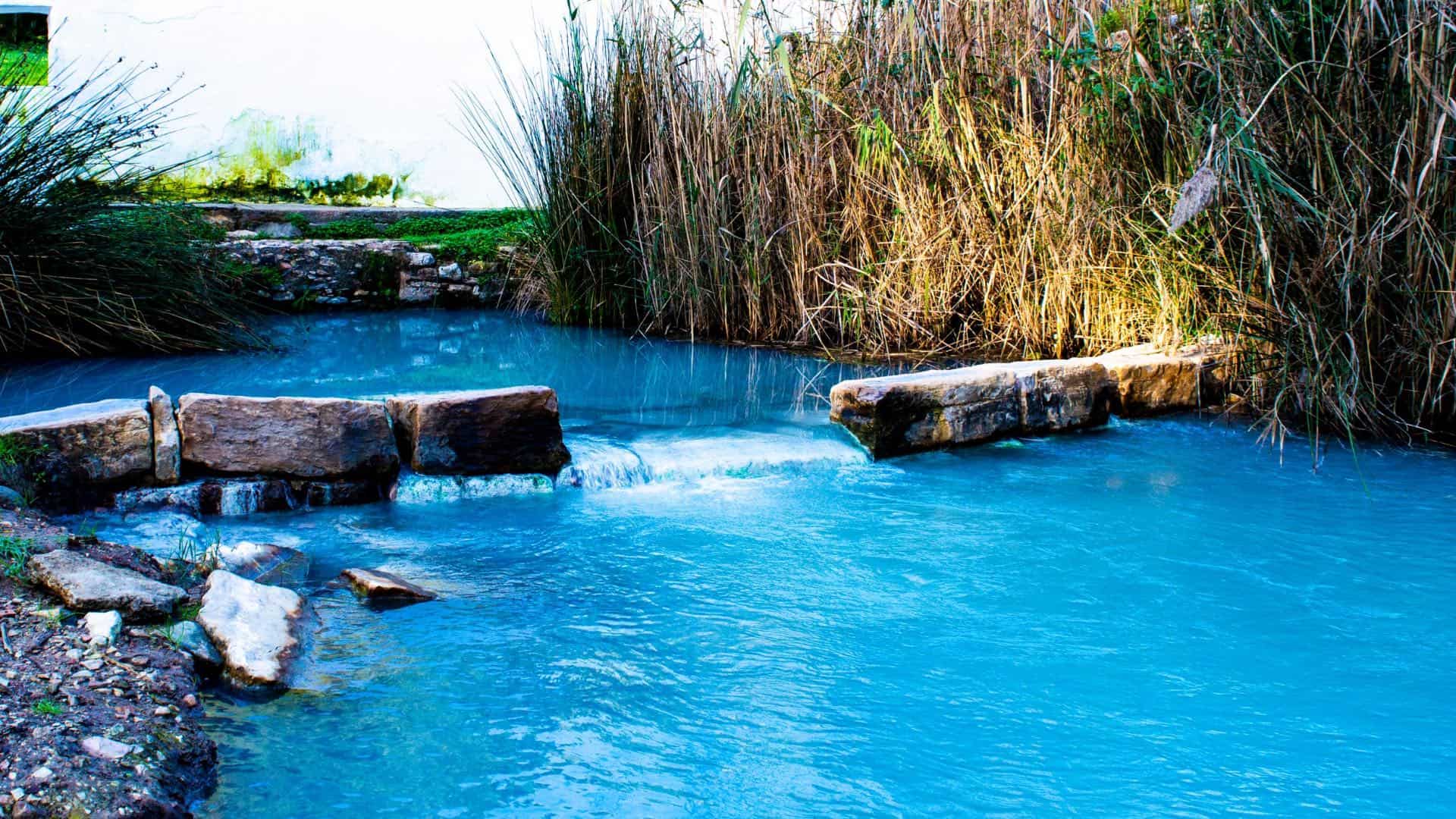
The Latin name is Aquae Albulae, the white waters, and it doesn't describe a color of still water: it describes the effect you see on the surface when the liquid arrives from the subsoil and loses pressure. The water comes out saturated with carbon dioxide and hydrogen sulfide. As soon as the pressure drops, the gases are released in myriads of bubbles and the mass of water takes on that milky appearance, bluish against the sun, that struck the Romans and still strikes those who arrive for the first time. The smell, it has to be said right away, is that of sulfur. Those who find it unpleasant would do well to know it before driving for half an hour.
We're on a plain between Tivoli and Guidonia, east of Rome, which geologists call the Acque Albule basin. It's no ordinary spring area. Here a deep thermal aquifer rises along a system of faults and reaches the surface with total flows on the order of several cubic meters per second: the descriptive notes of the Geological Map of Italy devoted to sinkholes, published by ISPRA, speak for the thermo-mineral area of the Acque Albule of springs with flows of over two cubic meters per second. These are river numbers, not drinking-fountain numbers. And it is exactly this enormous mass of hot water loaded with calcium carbonate that built, over the course of 100,000 years, the travertine platform on which you walk today.
The temperature is the second thing to make clear. The operator gives the Acque Albule a constant temperature of about 23 degrees throughout the year. 23 degrees is not a hot bath: in summer it's a blessing, in November it's something else. Those who arrive imagining the steaming pool of an alpine spa are thrown off. These are hypothermal sulfurous waters, and hypothermal is a technical word that means exactly this: warmer than the average of the groundwater of the area, but below the temperature of the human body.
The Acque Albule in Three Numbers
Three figures are enough to understand the scale of the phenomenon. The first is the flow: the springs of the larger lake alone have been estimated at around 3,000 liters per second. The second is the depth: beneath the apparently placid surface of the Regina there are tens of meters of vertical shaft. The third is the surface of the modern pools: about 6,000 square meters of sulfurous water spread over four outdoor pools, according to what the establishment declares. Keep these three numbers in mind: they explain why the Acque Albule are not a local curiosity but the most important spa complex in Lazio after those of the Tuscia.
The Two Spring Lakes of the Acque Albule: Regina and Colonnelle
The Acque Albule come out of the ground in two circular bodies of water, a few hundred meters from each other, about a kilometer and 700 meters north of Via Tiburtina. They aren't lakes in the ordinary sense of the term. They are sinkholes, that is, collapse pits filled with water, and their almost perfectly circular shape gives it away at a glance.
Lago della Regina, the Main Spring of the Acque Albule
It's the larger of the two and also bears a second name, Lago delle Isole Natanti, because of the vegetal rafts that the rising current pushes around on the surface. The diameter reaches 150 meters. On the depth the sources give close but not identical figures: you read 39 meters and you read 36, measured on different occasions and with a bottom that keeps changing. Take the order of magnitude, a few tens of meters, and forget the decimal. The original cavity, reconstructed by geologists, was a cylindrical shaft of about 60 meters.
The water temperature is that of the Acque Albule, 23 degrees. The milky color and the smell of rotten eggs come from the same mechanism: dissolved carbon dioxide and hydrogen sulfide that are released when the pressure drops. A canal, now covered, carries the water from the springs to the spa establishment without its being contaminated along the way. In the 19th century and the early 20th the canal ran in the open and was part of the landscape. Having closed it was a hygienic choice, not an aesthetic one.
A clarification that's needed, because the misunderstanding is frequent: Lago della Regina is not a natural pool. It has no equipped banks, no assistance, and swimming is not allowed. Beneath the surface there is a deep shaft with continuous upwelling of gas. You swim in the establishment's pools, which receive that water by canal.
Lago delle Colonnelle, the Smaller and Deeper One
The second body of water is about 50 meters wide, a third of the Regina, but is decidedly deeper: estimates put it at around 60 to 70 meters. It's the paradox that makes the Colonnelle interesting for those who deal with geology: less surface, more shaft. The cavity formed by the dissolution of the carbonate matrix by aggressive fluids rich in carbon dioxide and hydrogen sulfide that rose along the faults, a process that technicians call deep piping, and the collapse of the vault then opened the funnel at the surface.
Around the Colonnelle in 1983 lithic artifacts, pottery and bone fragments attributed to the Upper Paleolithic and the Neolithic came to light. It's not a footnote detail: it means that humans frequented these springs thousands of years before a Roman thought of building a pool over them. A point of warm, constant water, visible from afar because of the steam, on an otherwise bare plain: it was a draw for animals and therefore for hunters. Lago delle Colonnelle too, like the Regina, is not for swimming.
The Vanished Lakes of the Acque Albule Basin
The Regina and the Colonnelle are the two survivors. There were others. Lago di San Giovanni, a little to the north, was probably born between 1692 and 1698 according to cartographic reconstructions: in 1860 Palmieri measured it at 22 meters deep at the center, today the depth has dropped to about 16 meters with a diameter of around 57. Lago dell'Inferno, fed by a sulfurous spring, died out in 1915. This is the point that escapes anyone passing distractedly along Via Tiburtina: the plain of the Acque Albule is not a still landscape. It is born, it is pierced, it dries up and it is pierced again, on a scale of decades.
The Sinkholes of the Acque Albule Plain
Those who live between Bagni di Tivoli and Guidonia know very well that the ground, every now and then, gives way. It's not folklore. The technical literature of ISPRA on the Acque Albule basin reports eight collapses that occurred over the last decade considered, in areas now urbanized, in addition to the three historic lakes. The mechanism is twofold.
The first factor is natural and is the one that created the lakes: deep pressurized fluids, aggressive because loaded with carbon dioxide and hydrogen sulfide, that rise along active faults and dissolve the carbonate from the inside, carving cavities that sooner or later collapse. The second factor is human, and concerns the water that is removed. The travertine quarries of the plain, in order to work dry, pump on the order of 2,800 liters per second, intercepting the thermal aquifer. The measured effect is a lowering of the piezometric surface by four or five meters. An aquifer that drops five meters is an aquifer that stops supporting the roof of the cavities.
That's why Lago della Regina is shrinking. It's not an aesthetic phenomenon: it's the water balance of a plain that supplies water to the spas, the wells and the quarries at the same time. The old local story that the lake is shrinking because of withdrawals is substantially correct, and geology confirms it with numbers.
The Travertine of the Acque Albule: The Stone Rome Is Built From
This is the part that almost no guide tells well, and it's the most beautiful. Travertine is not a rock that happens to be found here: it's the direct product of the Acque Albule. The water comes out saturated with calcium bicarbonate, loses carbon dioxide as soon as it reaches the surface, and the carbonate precipitates. Repeat the operation for hundreds of thousands of years over a whole plain and you get a bank of stone tens of meters thick.
The Romans called it lapis tiburtinus, the stone of Tivoli, and from that name, by popular corruption, comes the word travertine. The Theater of Marcellus, Porta Maggiore, the outer ring of the Colosseum, the colonnade of St. Peter's, the fountains of Piazza Navona and the Trevi Fountain, the Tiber embankment walls, EUR and the Olympic Stadium are made with this stone. Rome, seen up close, is in large part solidified sulfurous water.
How the Stone of the Acque Albule Was Quarried
The ancient method is documented and worth knowing before looking at a block of the Colosseum. The quarrymen, the quadratarii, scored the perimeter of the block with pick blows, then drove wooden wedges into the cracks and wet them repeatedly: the wood swelled and opened the rock along the desired plane. At that point they used wooden poles as levers and the block came away. The rough squaring was done at the quarry, the finishing at the building site.
Transport, at first, was by river along the Aniene, then carts drawn by animals. From 1879 a steam tramway between Rome and Tivoli, with a stop at Bagni di Tivoli, brought the extraction to an industrial scale. It's the same infrastructure that in the same years began bringing Roman bathers here: the stone went out, the sick came in.
The Confetti di Tivoli
There is a minor and fascinating phenomenon tied to the same chemistry. A canal connected the larger lake to the Aniene. Along that route, by precipitation of carbonate around grains and debris, rounded concretions formed that in Tivoli took the name Confetti di Tivoli. They are, in essence, pearls of travertine grown in concentric layers like real confetti, produced by moving water. Anyone who has seen one in a local museum understands in three seconds all the rest of the geology of this plain.
The So-Called Baths of Agrippa at the Acque Albule
On the shore of the larger lake there are Roman ruins that tradition calls the Baths of Agrippa, or also the Baths of Zenobia. They have to be told with precision, because there is a gap between what is repeated and what is proven.
What is documented: there was a large spa complex occupying around 6,000 square meters, with a vast rectangular double-apsed hall of about 27 by 12 meters, in all likelihood covered by a barrel vault, corner buttresses in opus caementicium, floors in opus tessellatum, service rooms on the sides and pools made directly on the banks of the lakes, lined with cocciopesto. The dating comes from brick stamps: four of the six found are from the Hadrianic age, two belong to the restorations of Antoninus Pius, between 138 and 161 AD. The building as we know it is therefore of the 2nd century, plausibly a rebuilding of older imperial structures.
What is tradition and not proof: the attribution to Marcus Vipsanius Agrippa. It comes from the fact that Agrippa was the great builder of baths of his generation, but Thomas Ashby, who understood the topography of Lazio like few others, observed that the material evidence doesn't support it. We call them the Baths of Agrippa because that is what Tivoli has called them for five centuries, knowing that the name is an affectionate label, not a document.
Five Centuries of Excavations at the Acque Albule
The history of the research is almost more instructive than the ruins. In the 16th century people dug with predatory intent, to quarry marble. Andrea Bacci, physician and author of a famous treatise on spas, was the first to describe an imposing central bath surrounded by smaller ones. The columns of verde antico marble ended up in Rome at the will of Pope Julius III. A colossal statue of Apollo, a statue of Hygieia and two marble herms came out of here. Digging continued in the 18th century, then in 1856 under Pius IX, and finally in 1902, when other herms and votive inscriptions came to light.
Among the inscriptions there are two that would attest the construction of a temple dedicated to Cybele, and a metrical dedication to the Limniad Albula, the nymph of the lake. The most surprising piece is the poem of Samis, which tells of the healing of a wounded horse thanks to these waters: a votive tablet for an animal, a very rare thing, and proof that the therapeutic fame of the Acque Albule did not concern only men.
The current state deserves a frank sentence. The ruins are enclosed in a fenced area of 44 meters by 30, occupied by an 18th-century country house: the southern wing has become a farmhouse, the western one is abandoned, and the remains suffer from plowing. For a complex of this importance that is little, and it's the reason no one proposes a visit there.
The Acque Albule in the Ancient Authors
The quotation everyone cites is from Pliny the Elder, and it's worth reading in full in the form in which it circulates: Iuxta Romam Albulae aquae volneribus medentur, egelidae hae. Near Rome the Albule waters heal wounds, and they are lukewarm. That adjective, egelidae, is the exact Latin equivalent of what today is written hypothermal: Pliny had already warned the reader about the temperature.
The Acque Albule also appear in Strabo, in Vitruvius, in Virgil and, much later, in Isidore of Seville. The recurring theme is always the same: white water, strong smell, wounds that close. For ancient medicine a spring that stank of sulfur and healed sores was gold, and the road to Tivoli was easy.
Be careful how you read all this. The ancient sources say that the Romans attributed healing virtues to the Acque Albule. They are, obviously, not a modern health certification. Today's therapeutic indications are those declared by the spa and regulated by the National Health Service, and you'll find them further on.
Acqua Puza, Acqua Zolfa and the Baths of the 1800s
Between the end of antiquity and the modern age the Acque Albule don't disappear, they change name. In the ninth century the documents record the place name Acqua Puza, which needs no translation. In 1532 Acqua Zolfa appears. They are working names, given by people passing by with their carts, and they show that the place was perfectly well known even when nobody was building anything on it.
The Tiburtine Renaissance brings these waters back into a learned context. Local tradition has it that Cardinal Ippolito d'Este, the patron of Villa d'Este, used them on medical advice. It's an item you often read and that counts as tradition. The link between the villa of the 100 fountains and the plain of the hot springs, however, is culturally real.
The real leap came in the 19th century. In 1837 the physician A. Cappello published a Ragionamento dei bagni minerali presso Tivoli and recognized in the waters properties useful for skin, urinary, respiratory and intestinal conditions. Around 1860 Pius IX financed with 1,000 scudi the construction of a new establishment. From there on the story is that of a facility that grows continuously: drinking cures, baths, mud, inhalations, and in the 20th century the mass dimension, with Romans arriving first by tram and then by train. The old name of the hamlet, Bagni di Tivoli, tells exactly this. Today it is called Tivoli Terme.
The Acque Albule Spa Today: What You Actually Do
The springs are managed by the company Acque Albule, which operates the establishment known as Terme di Roma, on Via Tiburtina Valeria at kilometer 22.700. It's useful to tell apart four different things that live in the same enclosure, because people who call asking generically about the spa often end up in the wrong department.
The Acque Albule Pool Park
Four outdoor pools, about 6,000 square meters of sulfurous water surface, temperature around 23 degrees. This is the swimming part, the one that fills up in summer with Roman and Tiburtine families. Declared hours: every day from 9:30 to 17:00, Saturday and Sunday until 18:00, weather permitting. Admission €17 on weekdays, €22 on weekends and holidays. Lounger €6, cabin €10, umbrella by reservation €20. Children under 1.20 meters are free when accompanied by a paying adult. Multi-entry passes and lounger passes exist, with discounted formulas for those who come only on weekdays. There is an on-site food service. The swimming season has its own calendar: the subscription price list indicates a validity that ends in the first days of September, so well into September it's best to call before getting in the car.
Thermal Treatments Under Agreement
This is the health side, and it runs on different rules. The facility provides inhalation treatments (nebulizations, aerosol, humage, micronized nasal shower), mud and bath therapy, balneotherapy, therapy for rhinogenic deafness with endotympanic insufflations, and drinking-water cures. The indications declared by the operator cover chronic respiratory conditions, osteoarticular disorders, skin conditions, ear, nose and throat problems and some gastroenteric disorders. Through the National Health Service you are entitled to one annual cycle of 12 days with a €55 co-pay. The amount drops to €3.10 for children up to six years old, people over 65 and civil invalids from 67 percent, while war invalids with a lifetime pension and civil invalids at 100 percent are fully exempt. You need the referral from your family doctor stating the condition and the prescribed treatment, plus the medical examination at the facility, which is mandatory and free. The hours of the departments are in the morning: inhalations Monday to Saturday from 8:00 to 15:00 with last entry at 14:30, otolaryngology from 8:00 to 14:00, mud and bath therapy from 8:00 to 13:00 by reservation, closed on Sundays and holidays.
The Spa and the Beauty Center
The wellness department and the beauty center follow a separate calendar: Monday to Friday from 10:00 to 17:00, Saturday from 10:00 to 18:00 by reservation, Sundays and holidays from 10:00 to 17:00 by reservation, closed on Tuesday. That closed Tuesday is the classic trap: many people show up on a Tuesday convinced everything is open because the pool park is.
Physical Therapy, Dermatology, Specialist Medicine
There is a physical therapy department and specialist clinics, including a line dedicated to psoriasis, all by reservation. Here too the general rule applies: the Acque Albule are not a water park with a few medical services next to it, they are a thermal complex with a pool park attached. The difference shows in the hours and the procedures.
The Composition of the Acque Albule According to the Official Analysis
The data that follow are the ones published by the operator. Fixed residue between 100 and 1050 degrees: 2.7290 grams per liter. Total alkalinity expressed as calcium carbonate: 1.315 grams per liter. Specific gravity referred to the range between 4 and 15 degrees: 1.002639. Dissolved gases: carbon dioxide 0.0285 grams, hydrogen sulfide 0.02085 grams, nitrogen 0.02068 grams. The classification is that of a hypothermal sulfurous water, with a constant temperature around 23 degrees.
On the therapeutic side, the facts are what count: the valid indications are the ones the facility declares and that the National Health Service recognizes for the treatments provided under agreement, that is respiratory, ear, nose and throat, skin and osteoarticular conditions treated with inhalations, mud, baths and insufflations under medical supervision. Everything more that you read around about sulfurous waters supposedly curing this or that should be taken for what it is: advertising or tradition. A pool at 23 degrees is good for your mood in August, the rest is up to the doctor who signs the referral.
A Curiosity About Sorgenti Acque Albule, Bagni di Tivoli (Roma)
The real curiosity is not about the water but about what the water left on the ground. Rome is the city it is, architecturally, also because 20 kilometers away it had a natural factory of cut stone fed by these springs. The travertine of the Acque Albule forms because the water comes out saturated with calcium bicarbonate and, as it loses carbon dioxide, deposits it: layer on layer, with the voids and cavities typical of the stone that give it that unmistakable spongy look. The Romans did not need to look for distant quarries or to haul stone up rivers for months: they had an enormous bank of it a few hours away by cart, on a river route that was already navigable, the Aniene.
From this comes a consequence that almost nobody points out. The second century BC, when travertine begins to be used on a grand scale, is the same moment in which Roman architecture discovers the vault and the arch on a monumental scale. A material that is abundant, resistant to compression, cuttable into regular blocks and available 20 kilometers from the building site is a technical precondition, not a detail of taste. When you stand in front of the outer ring of the Colosseum, or under the colonnade of St. Peter's, or at the foot of the Trevi Fountain, what you are touching is water from the Acque Albule that had a few tens of thousands of years to solidify.
I'll add the second part of the curiosity, the one that usually draws the amazed face in a group: the plain that produced the stone is the same one that is being punctured. Quarrying travertine means keeping the quarries dry, keeping them dry means pumping out the thermal aquifer, and taking water out of an aquifer full of cavities encourages collapses. The same water that built Rome is making the ground of Guidonia and Bagni di Tivoli sink, a piece at a time. It is one of the most elegant and most unsettling stories of applied geology in Lazio, and it takes place within a radius of three kilometers from the highway toll gate.
Something Nobody Tells You About Sorgenti Acque Albule, Bagni di Tivoli (Roma)
That the lakes are not for visiting. This is the information missing from nine pages out of 10, and it's the one that ruins the most days. The Regina and the Colonnelle are not equipped for swimming, are not classified as bathing waters, and have no lifeguards, safe banks or public entrances. They are sinkholes tens of meters deep with a continuous rise of hydrogen sulfide and carbon dioxide, fed by a pressurized aquifer. Anyone who arrives in Tivoli Terme imagining spreading a towel on a sulfurous shore in the middle of the countryside goes home disappointed. Swimming happens in the facility's pools, which receive that water through a covered channel.
The second thing they don't tell you is that the pool park is seasonal and depends on the weather. The operator writes in black and white that it opens weather permitting, and the passes have an expiration date set at the beginning of September. Translated: from mid-September on, and for the whole cold season, the answer to the question "can I come for a swim" is probably no, while the answer to the question "can I do inhalations or mud treatments" is probably yes. They are two facilities inside the same gate, with two calendars that don't coincide.
Third thing, less dramatic but just as practical: 23 degrees. I repeat it because it's the real dividing line between people who leave happy and people who leave chilled. The water of the Acque Albule is not hot. On an August day with 36 degrees in the shade it's exactly what you need. On a windy day in May it's a test of character. Anyone looking for a steaming pool should look elsewhere, for example among the free pools of the Tuscia such as the Piscine Carletti, which have a different chemistry and a different temperature.
Fourth, and I say it as a professional: the smell stays on you. Not only on your hands, but on your swimsuit, your towels, your hair. Bring a bag for wet things to keep them separate and don't wear your good swimsuit. It's not a detail for the fussy.
Frequently Asked Questions About Sorgenti Acque Albule, Bagni di Tivoli (Roma)
Where exactly are the Sorgenti Acque Albule?
The Sorgenti Acque Albule are in Tivoli Terme, a district of Tivoli formerly called Bagni di Tivoli, in the province of Rome. The facility is on Via Tiburtina Valeria at kilometer 22.700, while the two spring lakes, the Lago della Regina and the Colonnelle, are about one kilometer and 700 meters north of Via Tiburtina.
How much does it cost to enter the Acque Albule pools?
The price list given by the operator of the Acque Albule is €17 Monday to Friday for access to the thermal pools. Entry is free for children under 1.20 meters tall if accompanied by a paying adult, and in summer the facility also offers summer camps for children from four to 13 years old.
Can you swim in the lakes of the Sorgenti Acque Albule?
No, the two spring lakes of the Sorgenti Acque Albule, the Lago della Regina and the Colonnelle, are not for visiting and are not equipped for swimming: they are not classified as bathing waters, they have no lifeguards or safe banks, and they are sinkholes tens of meters deep with a continuous rise of hydrogen sulfide and carbon dioxide. Swimming is possible only in the pools of the managed facility.
Why are the Acque Albule linked to Rome's travertine?
For hundreds of thousands of years the Sorgenti Acque Albule produced travertine, the stone that much of Rome is built with, including the Colosseum: the water comes out saturated with calcium bicarbonate and, as it loses carbon dioxide at the surface, deposits it layer on layer, forming a bank of cut stone.
Are the Acque Albule suitable for children and families?
Yes, the pool park of the Acque Albule works well with children: entry is free under 1.20 meters tall if accompanied by a paying adult, and in the summer season the facility runs summer camps for children from four to 13 years old, with weekly fees between €90 and €160.
When is the best time to go to the Acque Albule?
For swimming, the best period at the Acque Albule runs from June to early September, preferably on a weekday: entry costs €5 less and the difference in crowding compared with the weekend is enormous. The Acque Albule have been managed by the company Acque Albule, which operates the facility known as Terme di Roma.
What is there to see around the Sorgenti Acque Albule?
Within 10 kilometers of the Sorgenti Acque Albule, in Tivoli, is one of the richest quadrants of Lazio: Hadrian's Villa, the imperial residence, is the closest and most important destination, together with the historic center of Tivoli with Villa d'Este and its gardens. Those organizing groups can rely on the tour operator services described on the TourLeaderPro page dedicated to Rome.
What do the ancient sources say about the Acque Albule?
Pliny the Elder wrote of the Acque Albule that they heal wounds and are lukewarm, using the Latin adjective egelidae, which corresponds to what today is called hypothermal. The springs changed names over the centuries, appearing in documents as Acqua Puza in the ninth century and as Acqua Zolfa from 1532, names given by people who passed by with their carts.
My Advice for Visiting Sorgenti Acque Albule, Bagni di Tivoli (Roma)
The big piece of advice is one, and it has to be said first: don't come here as your only stop. The Acque Albule, taken alone, are an honest thermal pool park with an enormous history that is hard to read on site, because the ruins can't be visited and neither can the lakes. Taken as the second half of a day in Tivoli, they become an excellent idea instead. If you travel in a group or want a day built to measure between Tivoli and the thermal plain, you can rely on a professional tour escort: the accompagnamento turistico service is for exactly this. In the morning Hadrian's Villa, which is best visited early and is only a few kilometers from here, or Villa d'Este with its fountains. In the afternoon the sulfurous water, which after three hours of walking on the paving stones has an effect that no guide can explain well until you try it.
Second piece of advice, on timing. Arrive at opening, 9:30. The internal parking lot gives one free hour and then you pay, but above all on weekends in July and August you feel the park's capacity: shaded areas and lounge chairs disappear early. If you go on a Saturday or Sunday, count on the €22 holiday entry fee and the crowd. If you can choose, come on a Thursday, pay €17 and find half the people. On Tuesday, instead, remember that the wellness department is closed.
Third, how to get there. Here the train beats the car, and not by a little. The Bagni di Tivoli station is 150 meters from the facility's entrance, and regional trains leave from both Termini and Tiburtina: you get off and you've arrived, without looking for parking and without the stretch of Tiburtina that at rush hour is what it is. The alternative is the Cotral bus from Ponte Mammolo, the terminus of metro line B, with frequent runs and a stop in front of the facility.
Fourth, the health side. If you're coming for the treatments and not for swimming, call 0774 408500 beforehand and have them tell you, department by department, the hours and reservations: inhalations and mud treatments close in mid-morning or a little after, and arriving at 11 hoping to do a cycle is wasted time. Bring the referral from your family doctor already filled in with the condition and the treatment, because without it the agreement doesn't start and the medical examination at the facility is useless.
Fifth, a blunt verdict: if you have only one day for Tivoli and have to choose between the Acque Albule and Villa Gregoriana, choose Villa Gregoriana. The Acque Albule are for people who come back, for people who live in Rome, for people who are hot, for people with a wrecked back or bronchi that aren't cooperating. They are not a cultural visit in the strict sense of the term, and whoever sells them to you as one is telling you something you won't find on site.
Another Well-Known Fact, Yet Rarely Cited
The well-known fact is that the Roman baths were here. What is rarely cited is their architectural quality and the reason why you can't see them today. We are talking about a complex of 6,000 square meters with a double-apsed hall measuring 27 meters by 12, that is a space wider than many churches, probably covered with a barrel vault, with corner buttresses in opus caementicium and mosaic floors. It was not a village bath: it was a facility on an imperial scale, built in the second century with Hadrianic brick stamps and restored under Antoninus Pius between 138 and 161.
The second part of the fact is more bitter. The complex was taken apart piece by piece starting in the 1500s: the green antique marble columns brought to Rome at the wish of Pope Julius III, the statues dispersed, the marbles quarried by anyone who needed them. Today what remains is inside an enclosure of 44 by 30 meters, with an 18th-century farmhouse built on top, one wing turned into a farmhouse, the other abandoned, and the remains suffering from plowing. Anyone expecting an archaeological area with a ticket office and educational panels has to resign themselves: there isn't one, and it's not an isolated case in Rome's eastern suburbs.
I'll add the detail that makes the whole thing almost literary. Among the materials that came out of these excavations is a metrical dedication to the Limniad Albula, that is the nymph of the white waters, and the carmen of Samis, a votive tablet that thanks the Acque Albule for the healing of a wounded horse. 2,000 years later, in a plowed enclosure, what remains is the written trace of a man who brought his horse to heal in a lake that stank of sulfur. It's worth more than three museum rooms.
Last note, also well known and also always badly told: two inscriptions found in the area would attest to the presence of a temple dedicated to Cybele. The Phrygian Great Mother, associated with water and healing, in a plain of springs: it is consistent, and it is documented by the epigraphs, but nothing visible remains of the temple itself. "Would attest," in the conditional, because that is how things stand.
The Right Photo to Take at Sorgenti Acque Albule, Bagni di Tivoli (Roma)
The photo that works at the Acque Albule is not the panorama: it's the detail. Get close to the edge of a pool with the sun low, first thing in the morning or in the last hour, and frame the surface against the light. The bubbles of carbon dioxide and hydrogen sulfide rising up create a texture that disappears at high noon and with raking light becomes metallic, almost silvery. That is the real subject: the gas coming out of the water, which is the reason this place is called white waters.
The second shot is the color. The milky look of the Acque Albule changes noticeably with the sky: deep blue when it's clear, gray-green when it's overcast. If you want the postcard, wait for a clear day and put in the frame a portion of pool plus a portion of green, with no horizon: it looks like a tropical image shot 20 kilometers from the Colosseum, and nobody guesses where it was taken.
Third idea, the one I recommend to people with a real camera. Go and photograph the travertine, not the water. A quarry block, a boundary wall, the edge of a pool: the stone of the Acque Albule has cavities, laminations and colors ranging from white to ocher, and in macro it tells the whole geological story of the place in one frame. If you then photograph a pillar of the Colosseum the same week and put the two images side by side, you have the most effective travertine lesson that can be given.
A technical warning you won't hear elsewhere. Air saturated with hydrogen sulfide is not good for electrical contacts or silvered surfaces, and the sulfurous humidity settles on lenses. Clean your equipment the same evening, don't leave the camera open at the poolside, and if you use your phone watch out for wet pants: every summer someone in the group drops it in the water. Last point, one of good manners before regulations: in the pools and changing areas you photograph your own things and your own people, not other people's.
Some Important Events That Happened Here in History
The first event has no precise date and goes back to the Upper Paleolithic. In 1983, near the Lago delle Colonnelle, stone tools, pottery and bone fragments were recovered, attributed to the Upper Paleolithic and the Neolithic: the material proof that these springs were a reference point for hunters long before Rome. Water at a constant temperature that steams in winter, in an open plain, is a draw for fauna and therefore for humans.
The second event is Roman exploitation. From the third century BC the Acque Albule enter an economic system: travertine is quarried, water is channeled, pools are built on the banks. The peak is in the second century AD, with the monumental bath complex whose brick stamps date the building to the age of Hadrian and the restorations to Antoninus Pius, between 138 and 161.
The third is the long medieval and modern dissolution, marked by place names: Acqua Puza in the ninth century, Acqua Zolfa in 1532. The name changes, the use declines, the place remains known. In the 1500s the systematic plundering of the ruins begins and Andrea Bacci is the first to describe the large central bath surrounded by smaller ones.
The fourth event is the birth of one of the lakes. Cartographic reconstructions place the formation of the Lago di San Giovanni between 1692 and 1698: a piece of the plain that sinks and becomes a sheet of water in a few years, before the eyes of the people who lived there. In 1860 Palmieri measured it at 22 meters deep at the center.
The fifth is the 19th-century rebirth: the treatise by A. Cappello of 1837, the excavation of 1856 promoted under Pius IX, the 1,000 scudi that the same pontiff allocates around 1860 for the construction of a new facility, and finally 1879, the year of the Rome-Tivoli steam tramway, with a stop at Bagni di Tivoli, which transforms both the travertine trade and thermal tourism.
The sixth is the Marsica earthquake of January 13, 1915, the one of Avezzano. At the Acque Albule the event left a documented hydrogeological mark: the little Regina lake, at the moment of the shock, had a surge that raised its level by one meter, and afterward the level dropped permanently by 30 centimeters. In the same year the Lago dell'Inferno went extinct. An earthquake 80 kilometers away that rewrites the regime of a spring: it happens, and here it is written in the reports.
The seventh, less spectacular and more serious, is contemporary. The expansion of the travertine quarries has pushed pumping to around 2,800 liters per second, with a lowering of the piezometric surface of four or five meters and the appearance of sinkholes in areas that are now built up: the ISPRA literature counts eight in a decade between Guidonia and Bagni di Tivoli. The Lago della Regina, meanwhile, keeps shrinking. It is the most important event happening here right now, and it has no plaque.
Who Has Passed Through Sorgenti Acque Albule, Bagni di Tivoli (Roma)
Let's start with the names that can't be proven and say so clearly. Tradition links these baths to Marcus Vipsanius Agrippa and the ruins on the lake are still called Bagni di Agrippa, but Thomas Ashby verified that the material evidence does not support the attribution. The same goes for the second popular name, Bagni di Zenobia, which recalls the queen of Palmyra confined to Tivoli after Aurelian's triumph: a nice story, no document. Even the news that Augustus took cures here belongs to tradition, repeated by many local pages, not to a contemporary source that can be cited with certainty.
Those who passed through here in a documentable way are instead the ancient authors who wrote about it. Pliny the Elder devotes to the Albulae aquae one exact line in the Naturalis historia, saying that they heal wounds and that they are lukewarm. Strabo includes them in his geographical description, Vitruvius mentions them in his discussion of waters, Virgil names them, Isidore of Seville takes them up centuries later. That a technical writer like Vitruvius and an encyclopedic one like Pliny knew them means that, for a cultured Roman of the first century, the Acque Albule were an obvious reference point.
Then there are those who passed through and left their name in writing, even though they were not famous. Samis, the author of the votive carmen for the healed horse, is my favorite character in this whole story: not an emperor, a grateful owner. Next to him, the anonymous people who dedicated the epigraphs to the Limniad Albula, the nymph of the white waters.
In the modern age the scholars pass through. Andrea Bacci, a physician and author of one of the most widely read treatises on baths of the 1500s, describes the central bath surrounded by smaller ones. Pope Julius III has the green antique columns brought to Rome. Cardinal Ippolito d'Este, according to local tradition, uses these waters on medical advice while a few miles away he builds Villa d'Este. In 1837 the physician A. Cappello signs the treatise that reopens the scientific discussion, and around 1860 Pius IX puts up the 1,000 scudi that give rise to the modern facility. Under the same pontiff, in 1856, the ruins are excavated again.
Finally, and without irony, half of Rome has passed through here. From the 1879 tramway onward, the Acque Albule were for generations of Romans the place where you went to treat children's bronchi, grandparents' arthritis and the skin of people who found no remedy elsewhere, in the decades when insurance-funded thermal care was a normal part of Italian health life. It is a passage of people less glorious than Pliny and much bigger in numbers.

What to See Around the Acque Albule in Half a Day
For those organizing the day in English, the list of things to see in the city is collected in the guide best things to do in Rome, while the services for groups and tour operators in the capital are described on the page Roma di TourLeaderPro.
The 10-kilometer radius around Tivoli Terme is one of the richest in Lazio, and this is the real reason to come down here. Hadrian's Villa is the most ambitious imperial residence ever built in Italy and can be reached in a few minutes by car: 120 hectares of Maritime Theater, Canopus, Pecile, Large and Small Baths, a UNESCO site. Villa d'Este is in upper Tivoli, with its 16th-century garden and fountains that still work on gravity alone. Villa Gregoriana, under the acropolis, is the gorge of the Aniene with the Great Waterfall: the most tiring of the three and the most memorable.
Those who prefer to walk have the Riserva naturale di Monte Catillo above Tivoli, with trails that climb among holm oaks and meadows and the view of the Acque Albule plain from above, which is the best way to understand the geography you've been reading about so far. Further north open the Monti Lucretili, and to the east the valley that leads toward the Monti Simbruini and Subiaco, where water is the protagonist again with the Benedictine monasteries and the lakes of Nero.
In the town of Tivoli there is also the Sanctuary of Hercules Victor, one of the largest Republican sanctuary complexes in central Italy, long forgotten under a paper mill and now open to visitors. On the way back to Rome along the course of the Aniene you meet the Riserva naturale Valle dell'Aniene, and a little further the Aqueducts Park, where you see how Tivoli's water arrived in the city. Those who want to close the circle on Roman thermal culture can look at the Baths of Caracalla and understand what the very idea of baths meant to a Roman. The collection of other terme in Lazio is a click away.
The Acque Albule With Kids and Families
The pool park works well with children, and the numbers say so: free entry under 1.20 meters tall, if accompanied by a paying adult, and in the summer season the facility runs summer camps for children from four to 13 years old, with weekly fees between €90 and €160. It is information that Roman families care about more than all the epigraphs on this page.
Two practical warnings for those coming with kids. The first is temperature: 23 degrees is perfect for an adult in August, but for a small child who stays in the water for an hour it becomes cold, so shorten the turns and dry them right away. The second is the smell: children notice it far more than adults and some protest. Explaining it to them beforehand, telling them it's the sulfur coming from a lake 60 meters deep, usually turns the protest into enthusiasm. It works almost every time, and it's the cheapest way to give a geology lesson.
On accessibility: the facility is a health structure under agreement with departments of physical therapy and treatments, so it is equipped for users with reduced mobility, but the specific conditions of access to the individual pools should be asked at reception at 0774 408500 before you come. The internal parking lot is reached from the driveway on Via Tiburtina Valeria at kilometer 22.700 and the first hour is free.
When to Go to the Acque Albule
Those arriving from abroad and thinking in terms of day trips from Rome will find a useful framing in the English guide to day trips from Rome, where Tivoli appears with real travel times by train and bus.
For swimming, from June to early September, preferably on a weekday. Entry costs €5 less, the water is the same and the difference in crowding is enormous. The best days are those of dry heat and clear sky, when the milky color turns toward blue and the pools look their best.
For thermal treatments, the calendar is different and longer: the inhalation and mud therapy departments work in the morning Monday to Saturday, and the 12-day cycle under agreement is scheduled with your doctor. The cold season, for people with respiratory problems, is often when inhalations are most needed.
To avoid: Tuesday if you're interested in the wellness department, because it's closed, weekends in July and August if you hate crowds, and unsettled days, because the pool park opens weather permitting and a thunderstorm can close everything. From mid-September on, a phone call before leaving saves you a wasted trip.
Quick Questions About Sorgenti Acque Albule, Bagni di Tivoli (Roma)
Where exactly are the Sorgenti Acque Albule?
In Tivoli Terme, a district of Tivoli formerly called Bagni di Tivoli, in the province of Rome. The facility is on Via Tiburtina Valeria at kilometer 22.700, postal code 00019. The two spring lakes are about one kilometer and 700 meters north of the Tiburtina.
How much does it cost to enter the Acque Albule pools?
The price list given by the operator is €17 Monday to Friday and €22 on Saturday, Sunday and holidays. Lounge chair €6, cabin €10, umbrella by reservation €20. Multiple-entry passes exist. Prices should be confirmed on the official website before your visit.
What are the Acque Albule's hours?
The pool park is open every day from 9:30 to 17:00, Saturday and Sunday from 9:30 to 18:00, weather permitting. The treatment departments work in the morning, the spa from 10:00 and closed on Tuesday. The thermal reception is open Monday to Saturday from 8:00 to 16:00 and Sunday from 10:00 to 16:00.
Do children pay at the Acque Albule?
Children under 1.20 meters tall get in free if accompanied by a paying adult. Above that height they pay the full rate on the price list of the day.
Can you swim in the Lago della Regina or the Lago delle Colonnelle?
No. The two spring lakes are not swimmable, have no equipped banks or assistance and are not classified as bathing waters. They are sinkholes tens of meters deep with a rise of hydrogen sulfide. Swimming happens in the facility's pools, fed by the same water through a covered channel.
How warm is the water of the Acque Albule?
About 23 degrees, constant all year. It is hypothermal sulfurous water: warmer than ordinary groundwater, colder than the human body. It is not a hot bath.
Why is the water of the Acque Albule white?
Because it comes out of the ground saturated with carbon dioxide and hydrogen sulfide. When the pressure drops, the gases are released in very fine bubbles and the mass of water takes on the milky look that gave it its Latin name Aquae Albulae, white waters.
Why do the Acque Albule smell like rotten eggs?
The smell comes from the dissolved hydrogen sulfide, which the official analysis puts at 0.02085 grams per liter. It is the typical signature of sulfurous waters and does not indicate any hygiene problem.
Are the thermal treatments at the Acque Albule covered by the National Health Service?
Yes. The operator indicates one annual cycle of 12 days with a €55 co-pay, reduced to €3.10 for children up to six years old, people over 65 and civil invalids from 67 percent, with total exemption for war invalids with a lifetime pension and civil invalids at 100 percent. The referral from your family doctor and the examination at the facility are required.
What treatments are done at the Acque Albule?
Inhalation treatments (nebulizations, aerosol, humage, micronized nasal shower), mud and bath therapy, balneotherapy, endotympanic insufflations for rhinogenic deafness and drinking-water cures. The declared indications concern respiratory, ear, nose and throat, skin and osteoarticular conditions.
Do you need to book at the Acque Albule?
For the pool park usually not, except for the umbrella. For mud and bath therapy, spa, beauty center, physical therapy and specialist clinics, yes, a reservation is required. The number is 0774 408500.
How do you get to the Acque Albule by train?
With regional trains from Roma Termini or Roma Tiburtina to the Bagni di Tivoli station, which the operator gives as 150 meters from the facility. It is the way I recommend, because it avoids traffic and parking.
How do you get to the Acque Albule by bus?
With the Cotral buses leaving from the Ponte Mammolo metro B station, with a declared frequency of about every 15 minutes and a stop in front of the thermal facility.
How do you get to the Acque Albule by car, and is there parking?
From the A24, Tivoli exit if you're coming from Rome, Settecamini exit if you're coming from Tivoli. From the Grande Raccordo Anulare, exit 13 Via Tiburtina. The internal parking lot is entered from the driveway on Via Tiburtina Valeria at kilometer 22.700 and the first hour of parking is free.
How far is Rome from the Acque Albule?
About 20 kilometers from the center of Rome and about eight from upper Tivoli. By train the trip takes a few dozen minutes.
Can you visit the Roman baths of the Acque Albule?
No. The remains of the ancient bath complex, traditionally called Bagni di Agrippa, are in a private enclosure occupied by an 18th-century farmhouse, partly turned into a farmhouse dwelling and partly abandoned. There is no visitor route.
Why are they called Bagni di Agrippa?
By tradition, tied to the fame of Marcus Vipsanius Agrippa as a builder of baths. The archaeologist Thomas Ashby found that the material evidence does not support the attribution. The brick stamps date the building to the age of Hadrian with restorations under Antoninus Pius.
Are the Acque Albule in Tivoli or in Guidonia?
The thermo-mineral basin extends between Tivoli and Guidonia Montecelio. The thermal facility and the railway station are in the territory of Tivoli, district of Tivoli Terme.
What are the Confetti di Tivoli?
Rounded limestone concretions that formed by precipitation of calcium carbonate along the channel that connected the larger lake to the Aniene. The name comes from their resemblance to sugared almonds.
What is the relationship between the Acque Albule and Rome's travertine?
Direct. Travertine, the lapis tiburtinus of the Romans, is the deposit left by these waters over hundreds of thousands of years. The Colosseum, the Theater of Marcellus, Porta Maggiore, the colonnade of St. Peter's, the Trevi Fountain and the Tiber embankment walls are built with that stone.
Is it true that the ground is sinking around the Acque Albule?
Yes, and it is a studied phenomenon. The ISPRA literature on the Acque Albule basin documents recent sinkholes in urbanized areas between Guidonia and Bagni di Tivoli, caused by deep carbonate dissolution and aggravated by the pumping of the travertine quarries, which lowers the water table by four or five meters.
Are the Acque Albule suitable for a day trip from Rome?
Yes, but better paired with another visit. The combination I recommend is Hadrian's Villa or Villa d'Este in the morning and the sulfurous pools in the afternoon.
Is there a restaurant at the Acque Albule?
Yes, the pool park has an internal food service. The hours follow those of the facility.
Are the Acque Albule open in winter?
The treatment departments and the spa work all year with their hours. The pool park instead has a seasonal calendar and opens weather permitting. Off season it's best to call before leaving.
The Verdict on the Acque Albule
The Acque Albule are the most underrated and worst-told place in the Tivoli area. Underrated because a plain that produced the stone of the Colosseum, that swallowed three lakes in four centuries and that keeps spouting 3,000 liters of sulfurous water per second would deserve a visitor center, not a plowed enclosure. Worst told because almost everyone sells it as a spa, and a spa is its least interesting part. If you can come only once, come on an August afternoon after a morning at Villa Adriana, stay in the pool until six, and before leaving stop and look at a wall of travertine up close. In that wall there is everything: the water, the gas, geological time and Rome.
Article written by the editorial team of TourLeaderPro, contact them for Private/Corporate/V.I.P. Tours and Experiences.
Planning a trip to Rome? The English guides to visiting the city are on ItalyPlanner.com.