Abbey of Valvisciolo
In short. Valvisciolo Abbey is at Via Badia 14, in the territory of Sermoneta, in the province of Latina, and is inhabited by a community of Cistercian monks of the Congregation of Casamari.
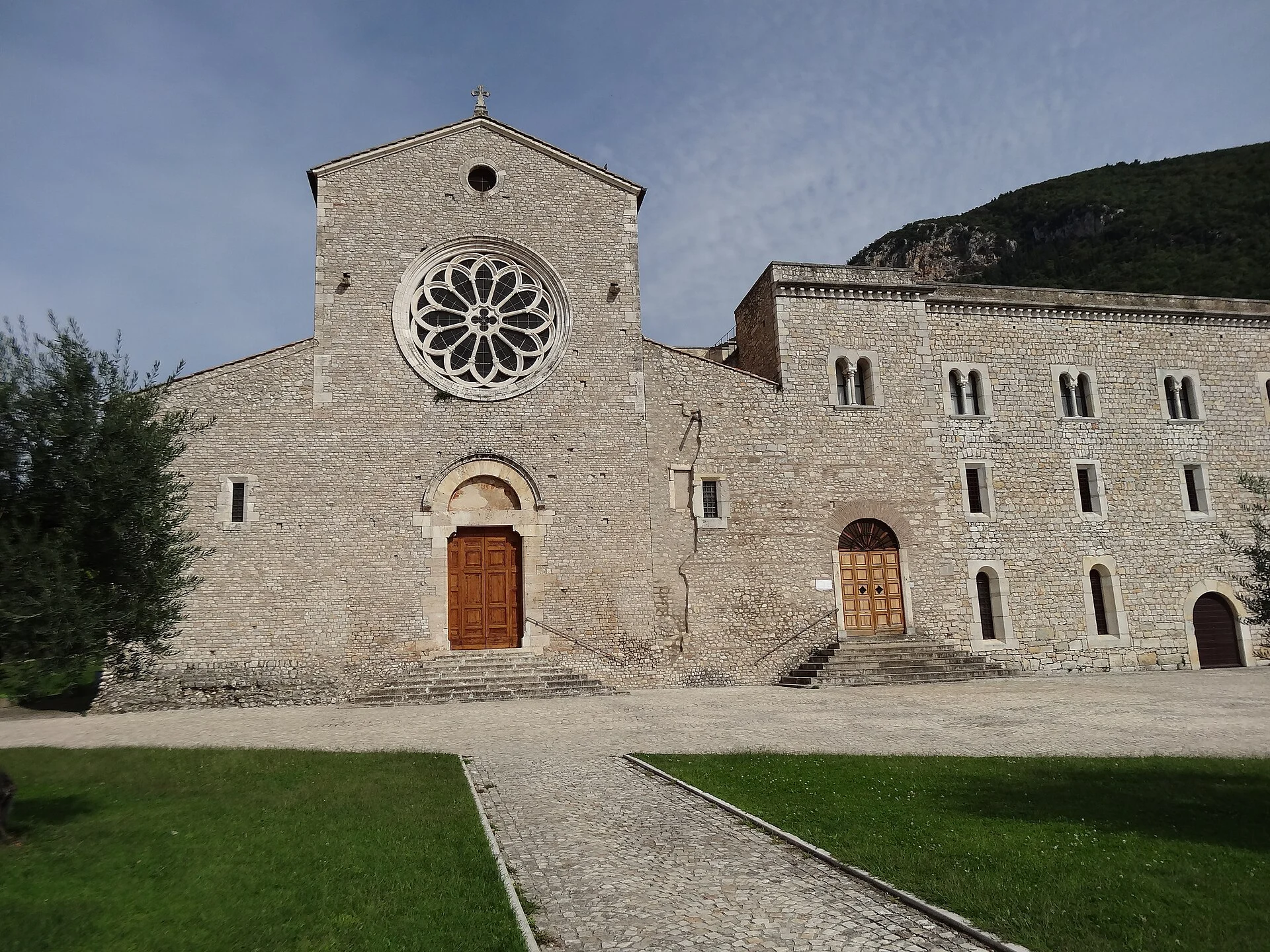
Valvisciolo Abbey is at Via Badia 14, in the territory of Sermoneta, in the province of Latina, and is inhabited by a community of Cistercian monks of the Congregation of Casamari. The church and cloister are free to enter, with no reservation. The phone number given by the Municipality is 0773 30013. Guided tours are optional and paid, the small museum inside keeps its own hours, and during Masses the church is not toured.
Almost everyone comes here for two words: Templars and Sator. The legend of the knights, the crack on the lintel, the cross in the rose window, and above all the circular graffito of the palindrome SATOR AREPO TENET OPERA ROTAS in the cloister. The reason to come is another one. The cloister with its paired little columns and the chapel frescoed by Pomarancio are worth the trip even for those who don't want to hear about the Templars.
The hours, Masses, contacts and connections reported in these lines were checked on September 28, 2026 on the pages of the Municipality of Sermoneta, the abbey's museum and the local guides who lead the visits. On opening hours the sources don't agree, and it's worth knowing right away because it changes your day: before leaving, call the abbey's number and have the hours for the day confirmed, especially on Sunday and holidays.
Where it is and what you really see
The abbey sits on a spur at about 116 meters above sea level at the foot of the Lepini Mountains, above the small valley that medieval tradition calls the valley of the nightingale. The complex lies between the town of Sermoneta, the Garden of Ninfa and the Latina Scalo area, along the foothill road that connects the Lepini villages. From the square in front of the church, on clear days, the view reaches the Circeo and the islands.
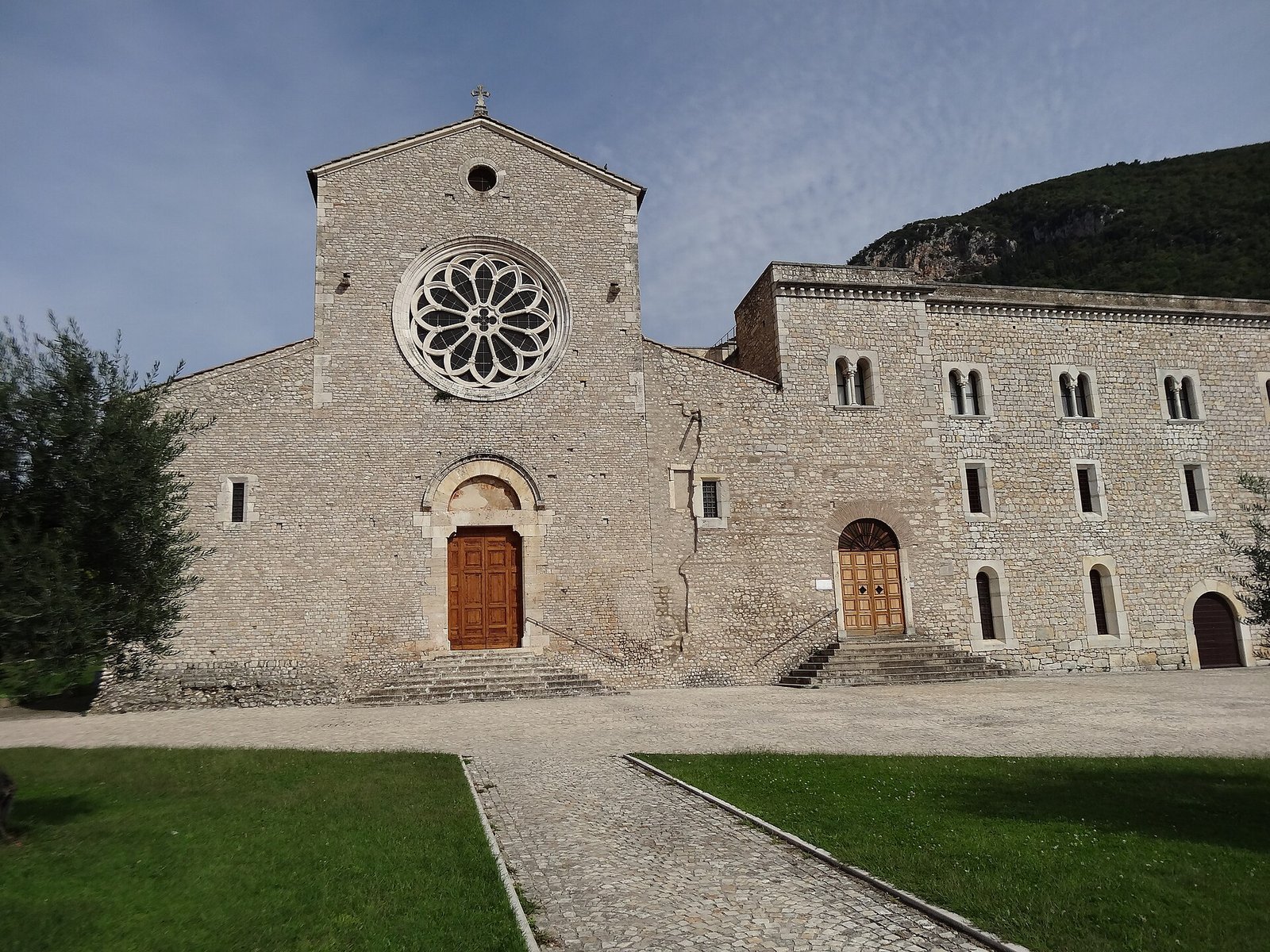
The church is dedicated to Saint Stephen the protomartyr and follows the Cistercian model: a severe facade with a single portal, a large rose window, an interior with three aisles separated by pointed arches and covered by cross vaults. The walls are almost completely bare, as the rule of the order required. On the existence of the transept the sources don't agree, and the difference can only be understood by walking to the presbytery and looking at the volumes carefully.
The rose window measures about five meters in diameter and is made of 12 interlaced little columns joined to a central disk in the shape of a quatrefoil. Above the portal, in the lunette, there is a fresco of the Virgin enthroned with the Child between Saints Stephen and Peter. It's the first detail almost everyone skips, caught up in looking for the cross in the rose window, and yet it tells of the monastery's original double dedication.
To the right of the facade you enter the cloister, which is the real center of the complex. Square plan, galleries marked by round arches on paired little columns, 112 in all according to the local guides, a well-kept garden with hedges and flowers and a well in the center. From the cloister you reach the monastic rooms: the chapter house, the refectory, the calefactorium and the dispensarium, where the museum is housed today.
What you don't see: the enclosure, that is, the areas where the monks live, and the service rooms. Whoever arrives expecting a medieval citadel with towers and moats is disappointed. Valvisciolo is a secluded monastery, you tour it in half an hour if you look in a hurry, in an hour and a half if you stop in the cloister, in the chapel of San Lorenzo and in the art gallery. The right time is the second.
Hours, Masses and how to get in
Entry to the church and the cloister is free of charge, and the Municipality of Sermoneta also notes an access ramp. On hours the sources don't agree: the local guides give 9:00-12:00 and 14:30-18:00, with the afternoon moving to 15:00-19:00 from April to October, other pages report opening from 7:00 in the morning to 12:30 and from 15:00 to 19:00. In practice, count on the morning until noon and on the afternoon after 15:00.
There is no ticket office and no ticket to buy online, so be wary of anyone offering you priority entry. The official channel for information is the abbey's phone number published by the Municipality of Sermoneta, 0773 30013. The optional guided tours are organized by the guides of the project Conoscere per tutelare, which publishes rates and contacts.
The published rates for the guided tour are €5 per person for individuals and €50 in total for a group, lasting about 45 minutes. The tour runs every day by reservation, while on Sunday at 10:30 there is a turn with no reservation. For those who don't know Cistercian architecture it's a sensible expense: without someone pointing out the details, half of the signs carved in the cloister escape you.
The Masses according to the Municipality: on weekdays and Saturday at 17:00, which becomes 18:00 in summer, on Sunday and holidays at 7:30, 9:30, 11:30 and at 17:00, here too with the shift to 18:00 in summer. The local guides also note a weekday Mass at 7:15 and the rosary half an hour before the evening Mass. During the services the church is closed to visits, and this holds especially for Sunday morning.
The abbey's museum, named after Abbot Stanislao White, declares on its own site daily hours from 9:00 to 12:30 and from 14:30 to 16:30. The museum price is not published plainly: the site refers to the contact form and the social pages. Whoever wants to see the print gallery must therefore arrive by mid-afternoon, even though the church stays open longer.
A curiosity about Valvisciolo Abbey
The name Valvisciolo was not born here. According to the reconstruction published by the Municipality and by Cistercian sources, Valvisciolo was originally the name of a monastery in the mountains of Carpineto Romano. In the 14th century that community came down to the valley and joined the monks who already lived near Sermoneta, bringing the old name with it. The lowland monastery, until then dedicated to Saints Peter and Stephen, changed identity.
On the etymology there are two hypotheses and neither is proven. The first points to the valley of the nightingale, and poets like it. The second points to the visciole, the wild cherries that grow on the Lepini, and appeals to those who know the dialect of the area. In our judgment the second is more likely, but it's an opinion, not a fact: the medieval documents don't explain why a place name came about.
The curious thing is that the migrated name made people forget the original one. For almost two centuries the lowland community was called Santi Pietro e Stefano di Marmosolio, after the destroyed monastery near Ninfa from which the first monks came. The memory of that double dedication survives in the lunette of the portal, with the two saints on either side of the Virgin, and in the church's dedication to Saint Stephen.
If you want to see where the name came from, the town of Carpineto deserves a detour, even only for the Museo la Reggia dei Volsci. Whoever is curious about the dedication to Saint Stephen finds in Rome the most famous case of a church dedicated to the protomartyr, Santo Stefano Rotondo on the Celian Hill, with a circular plan that, by an amusing coincidence, recalls the shape of the Sator of Valvisciolo.
Templars and Sator: documents, tradition, legend
Here the rule I apply to all stories of knights holds: three separate levels, never mixed. The first level is that of documents, meaning what can be proven with papers and dates. The second is that of tradition, meaning what has been told for centuries and has some foothold but no full proof. The third is legend, meaning the tale nobody claims is true but everyone repeats.
What the documents say. Cistercian sources and local historiography place the birth of the lowland community after 1165, when the troops of Frederick Barbarossa destroyed the abbey of Marmosolio and the monks moved into the territory of Sermoneta. After 1312 the community from Carpineto arrived with the name Valvisciolo. In 1411 the monastery fell into commendam to the Caetani. None of these papers, as far as has been published, names a Templar settlement.
What tradition says. According to local tradition the Templars occupied and restored the complex in the 13th century and stayed there until the suppression of their order, at the beginning of the 14th century. Even the sites that support it most firmly write that the presence is plausible but that the documentary proof is not conclusive. The cited clues are material: some crosses carved in the floor, in the cloister and on the rose window, and the Sator graffito.
What is legend. It's told that on the day the last grand master Jacques de Molay was burned at the stake, in 1314, the lintels of Templar churches cracked, and that the crack visible on the lintel of the portal of Valvisciolo is the sign of that day. It's a medieval tale, nice to hear in front of the door. A crack on a stone lintel, in a seismic zone, doesn't need a stake in Paris to explain itself.
One observation concerns the crosses. The cross with arms that widen outward, the one the public calls Templar, is a very widespread sign in medieval art and appears on churches, gravestones and coats of arms that have nothing to do with the Order of the Temple. Finding it carved in the rose window proves that someone carved it, not who they were. The leap from cross to knights is the weak point of the whole construction.
Another observation concerns the dates. 1312 is the year in which the papacy suppressed the Templar order, and it is also the year after which, according to the sources, the Cistercian community of Carpineto moved here. Those who support the Templar presence read this coincidence as a handover. Those who look at the papers note that the Cistercians were already present from the previous century. Two readings of the same date, and the sources don't agree.
I add a contemporary element that confuses things even more. According to local chronicles, at some celebrations members of a modern association that refers to the Templars appear, with the mantle marked by the red cross. It's a presence of today, legitimate, but whoever sees it without explanation leaves convinced that the knights are still at home. Whoever wants the Roman picture of these suggestions finds our itinerary on Esoteric Rome.
The Sator: where it is and what it looks like
The graffito is on the western side of the cloister. The local guides describe it like this: you enter through the main door, pass the door of the parish office and the panels with the portraits of the popes, take the first gallery on the right and after a few steps you see it on the right-hand wall. It is carved in the original plaster and emerged during restorations. For some years a plexiglass panel has protected it from deterioration.
The shape is what makes it different from all the others. The 25 letters of SATOR AREPO TENET OPERA ROTAS are not arranged in the usual five-by-five square but in five concentric circular rings, each divided into five sectors, with an effect that recalls a target. The encyclopedic sources cite it as the example of a radial arrangement of the palindrome, and so far no other circular cases are known.
Next to the Sator, also in the cloister, the sources note another graffito, the so-called triple enclosure: three concentric squares connected by segments, a sign found carved on stones and steps in half of Europe and read sometimes as a symbol, sometimes as a simple game board. Ask the guide to show it to you, because without directions it gets confused with devotional carvings and visitors' signatures.
The dating of the circular graffito is not published. As far as the available sources show, there is no study that places it with certainty in a precise century, and the expression restorations of the beginning of the century used on some pages doesn't even make clear if the 20th or the 21st is meant. Anyone who tells you with confidence that the Sator is the work of the Templars is proposing a hypothesis as if it were a fact.
The text means more or less the sower Arepo holds the wheels with care, or, in one of the most widespread readings, the sower with the plow holds the wheels with difficulty. Arepo remains a word of uncertain meaning. The scholar Grosser noted that the 25 letters can be recomposed into a cross with the word PATERNOSTER crossing on the N, with two A and two O left over at the ends, like alpha and omega.
Something nobody tells you about Valvisciolo Abbey
The Sator is more than a thousand years older than the Templars. The oldest known examples come from Pompeii: an incomplete one found in 1925 in the house of Paquius Proculus, a complete one found in 1936 on a column of the Palestra Grande, carved before the eruption of AD 79. Whoever links the palindrome to the knights of the Temple forgets that the order was born in the 12th century. The Sator was already circulating in Roman Campania.
It must be said clearly: the Templar label is the most overrated thing about Valvisciolo. It sells well, fills the buses and the mystery sites, but it shifts attention from the real monument to a story without papers. The cloister with its paired little columns and Pomarancio's chapel are documented, dated, visible facts. The Templars are a tradition that no archive has yet confirmed. Come for the stone.
The Sator, for that matter, is not an exclusive of this valley. In Italy it is found carved on the wall of Siena Cathedral, at the pieve of San Giovanni in Campiglia Marittima, on the facade of the church of Santa Lucia in Magliano de' Marsi. None of these places is told as Templar with the same insistence. The difference is made by local tradition, not by the inscription itself, and it's good to know that before coming up here.
The fact remains that the circular version at Valvisciolo is truly a rare case, and that is enough to justify the visit for those who love epigraphs. The value of the graffito doesn't need the knights: it's a document of how a Latin wordplay survived for centuries in religious communities, rewritten and reinvented. For those who love Roman layers, the Basilica of San Clemente offers the same lesson on a large scale.
My advice for visiting Valvisciolo Abbey
Arrive in the morning on a weekday, around 9:30, and begin with the cloister, not the church. The cloister in the low morning light gives back the rhythm of the little columns better than at any other time, and at that hour there are no groups. You see the church afterward, calmly, and leave the museum for last, knowing it closes at 12:30.
Avoid Sunday morning, unless you want to attend Mass. With three celebrations between 7:30 and 11:30 the church is in effect closed to visits for much of the morning, the square fills with cars and the cloister becomes a place of passage. If Sunday is the only possible day, aim for the guided turn at 10:30 and concentrate on the monastic rooms.
Before leaving, call 0773 30013. The hours published by different sources don't match, and a call tells you if there are extraordinary services, weddings, retreats or closures that day. The monks answer at monastery hours, not tourist-office hours: call mid-morning, and if nobody answers try again after lunch, without insisting during prayer time.
Dress as you would for a church, because it is a church. Covered shoulders and trousers below the knee avoid arguments, and in summer a scarf in your bag solves everything. In the cloister, speak in a low voice: the galleries amplify, and the monks live a few meters away. It happens that groups are gently reminded about the volume, and that reminder spoils the mood of the visit more than any wrong hours.
The parking lot next to the abbey is free and, according to the published information, always open. Those who travel by car have no problems. Those who arrive by public transportation must instead plan the last stretch carefully, because from the station connections are few and on Sunday the local lines don't run. I talk about it in the chapter on getting there from Rome, and you should read it before choosing the day.
The chapel of San Lorenzo and Pomarancio
In the left aisle opens the chapel of San Lorenzo, the only richly decorated room in the church. The frescoes are by the painter Niccolò Circignani, known as Pomarancio, executed between 1586 and 1589 on commission from Cardinal Enrico Caetani and Duke Onorato IV. In those years the abbey was a secular priory with Cardinal Caetani as commendatory abbot, and the chapel is in effect a manifesto of the family.
Look at the vault carefully. Among the grotesques there are very many ducal crowns held up by putti, an explicit way of reminding whoever entered who paid and who ruled the territory. The sources also note a self-portrait of the painter hidden among the decorations of the vault: look for it patiently, and if you have the guide ask them to point it out, because on your own it's easy to pass over it.
The local sources link the decoration to a visit by Pope Sixtus V, and tradition tells of the chapel as prepared for that occasion. The contrast with the rest of the church is deliberate: on one side the bare walls of the Cistercian rule, on the other the exuberance of a baronial family that used art to assert its power. To understand who the Caetani were in Rome, look at the Torre dei Caetani.
Besides Pomarancio, in the church the museum's sources note paintings by Savonanzi and Minnoccheri, and large canvases donated by Pope Pius IX in 1863. They are not works that justify the trip on their own, but they complete the picture of a building that over the centuries has been embellished by very different patrons. Whoever wants a comparison with another Cistercian abbey in Lazio can look at the Abbey of Tre Fontane in Rome.
Another well-known fact, yet rarely cited
The monks had to buy the abbey back. After the suppressions of the Napoleonic period and then those of the unified State, the complex ended up at municipal auction. On July 5, 1888 the prior Bartolomeo Daini redeemed it by paying 10,150 lire. It's a passage that can be read in all the histories of the abbey but that nobody tells on a visit, and it explains well why the community is so attached to this place.
Before that buyback the history had been a coming and going of orders. From 1600 to 1605 the abbey was inhabited by the Feuillants, a reformed Cistercian congregation. Between 1619 and 1635 the Minims of Saint Francis of Paola took over, then the Feuillants returned until the Napoleonic suppressions. When people talk about monastic continuity at Valvisciolo, it must be remembered that the continuity was rebuilt several times, not inherited intact.
The return of the Cistercians of the Congregation of Casamari dates to around 1864, and the community celebrated the 150 years of that presence in 2014. The tie with the mother house is close, and whoever wants to understand it should see the Abbey of Casamari, on which the whole congregation depends. The products you find in the shop too, as we'll see, come from recipes born there.
The other rarely cited fact is the role of the Cistercian orders in the Pontine landscape. Fossanova, Casamari and Valvisciolo are not three isolated monuments, but nodes of a network that for centuries governed lands, waters and crops between the Lepini and the sea. The Abbey of Fossanova, larger and more famous, makes that scale evident. Valvisciolo shows the same idea in a secluded version.
The right photo to take at Valvisciolo Abbey
There is only one photo and you take it in the cloister, from a corner, along the diagonal. Stand in the corner opposite the light, crouch down to the height of the capitals and let the vanishing line of the paired little columns carry the eye toward the end of the gallery. In horizontal, this time: the strength of the cloister is repetition, and the wide format stages it better than vertical.
The second shot is the facade with the rose window, taken from the square with a slight step back. The five-meter rose window carries the composition by itself: center it in the upper half and leave the portal at the bottom, with the frescoed lunette legible. It works better early in the morning or in the late afternoon, when the stone takes on color. At noon the facade becomes flat and white.
The Sator must be photographed with care, because it is behind a plexiglass panel that reflects everything. Approach from the side, rest the lens almost against the panel and turn off the flash, which otherwise gives you only a glare. The graffito is thin and reads better in raking light: if the cloister is in shadow, wait a few minutes for the sun to move. Remember that it is carved in the plaster and must not be touched.
Avoid photos inside the church during services and always ask before photographing the monks. It isn't a matter of written rules, as far as is known there are no published bans, but of respect for those who live in that place. In the chapel of San Lorenzo the light is scarce: raise the sensitivity, lean on a pillar, and give up the tripod, which in a church open for worship only creates problems.
The monks' products and the shop
The abbey has a small shop where the products of the monastic farm and some typical items of the Cistercian tradition are sold. According to the local guides, the shop is open from Tuesday to Sunday from 10:00 to 12:15 and from 15:00 to 18:15, closed on Monday. These are different hours from the church, and whoever arrives on Monday finds the church doors open and the shop's closed.
The production includes oil, wine, honey, pollen, royal jelly and liqueurs, according to what is published. The sources also mention candies, an orange-flavored honey and abbey beers, but the assortment changes with the seasons and with the year's production. The community also works orchards and beekeeping, and honey is the product that ties the shop most to the Lepini territory.
The most curious product is the Gocce Imperiali, also called Tintura Imperiale: a very high-proof herbal distillate, bright yellow from the saffron. The recipe, according to the sources, dates to 1766 and was perfected by Brother Eutimio Zannifoschi in the Abbey of Casamari, from which it spread to the other communities of the congregation. It is used by the drop, as a digestive, not as a liqueur in a shot glass.
One concrete tip: buy in the shop and not online, if you can. Some online stores offer Valvisciolo-brand products, but the price includes intermediaries and shipping, and the choice is much smaller. In the shop you also find books on the history of the abbey, useful if you want to go deeper into the events I talk about here. The operator doesn't publish prices, so ask before filling the basket.
How to get there from Rome
By train you take the regional FL7 line from Roma Termini toward Formia and Minturno and get off at Latina station. A station called Sermoneta on the FL7 does not exist: Latina station is in the hamlet of Latina Scalo, about nine kilometers from the center of the provincial capital, on the north side toward the Lepini. The trip takes about an hour, and according to the sources the frequency is hourly, with runs every half hour in the afternoon.
From Latina Scalo the last stretch to the abbey is missing, and that is the weak point. The Municipality of Sermoneta publishes the local transport timetables, with runs from the station toward Sermoneta, Monticchio and Doganella, active from Monday to Saturday. On Sunday and holidays the service is not active. The published lines show no stop in front of the abbey, so for the last stretch count on a booked taxi or on a ride.
For the Cotral regional lines the Municipality refers to the toll-free number 800 174 471, active from Monday to Saturday from 7:00 to 20:00, and to the timetable search on the Cotral site. Call before leaving and ask explicitly about the stop closest to the Badia di Valvisciolo. The local service also has a published contact number, 0773 318630, useful for checking the day's hours.
By car the abbey is about 80 kilometers from Rome. The published directions suggest the A1 highway with exit at Valmontone and then the road toward Bassiano and Sermoneta through the Lepini, a slow but pleasant route. The alternative is the Pontina to Latina and then the climb back toward Latina Scalo and the foothill road. The parking lot next to the abbey is free, and this makes the car the most comfortable choice.
The recommendation is simple: if you don't have a car, go on a weekday and plan on a taxi from Latina Scalo for the round trip. Trying on Sunday with public transportation means risking being stuck at the station. Those with time and good legs can instead climb on foot from Norma, along the path in the woods that the sources link to Via Francigena.
Some important events that happened here in history
The valley was inhabited long before the monks. In the area of Valvisciolo and Caracupa archaeologists have documented a terraced settlement with megalithic structures, occupied until the 6th century BC. One hypothesis is that this population later moved to the nearby Latin city of Norba, a colony already at the beginning of the 5th century. The walls of Norba can be seen from above, and the link is evident.
According to medieval tradition, the first monks of the place were Greek Basilians, linked to the figure of Saint Nilus, and the sources don't agree on the date, which ranges between the 8th century and the year 1000. The link with Saint Nilus leads directly to the Greek Abbey of San Nilo in Grottaferrata, still today the home of monks of the Byzantine rite. For Valvisciolo, however, we remain in the field of tradition.
The first fixed point is 1165. That year the troops of Frederick Barbarossa devastated several cities of Lazio and destroyed the Cistercian abbey of Marmosolio, near Ninfa. Between 1166 and 1168 the community moved to the territory of Sermoneta, and the sources place the construction of the present church between 1150 and 1170, although the dates don't fully match each other.
After 1312 the community from Carpineto arrived with the name Valvisciolo. In 1411 the monastery was given in commendam to Paolo Caetani, and from that moment the family of Sermoneta controlled its revenues and appointments. In 1523 Pope Clement VII downgraded it to a simple priory, and in 1529 it became a secular priory. Between 1586 and 1589 Pomarancio frescoed the chapel of San Lorenzo.
The Napoleonic suppressions closed the monastery in the early years of the 19th century, and on the exact dates the sources don't agree. Pope Pius IX visited the abbey in 1863 and 1865, donating large canvases and supporting the restorations. Around 1864 the Cistercians of Casamari returned, in 1888 the prior Daini bought the complex back at auction, and in the first decades of the 20th century restorations were begun that brought parts of the original plaster to light.
In 1957 the cloister was fully restored, and during the works medieval elements emerged that were then reused in the reconstruction. In 1998 the sources record an overall restoration, and in 2003 the art gallery dedicated to Abbot Stanislao White, who lived between 1838 and 1911, was born in the rooms of the old dispensarium. In 2014 the community celebrated the 150 years of the Cistercian presence from Casamari.
Who passed through Valvisciolo Abbey
Frederick Barbarossa, without ever setting foot here. It was the destruction of Marmosolio by his troops, in 1165, that pushed the monks toward this valley. It's one of those cases where a German emperor decided the monastic geography of an Italian province without knowing it, and the monks who rebuilt their community here remembered him as the cause of their migration.
The Caetani family, for a long time lords of Sermoneta. Paolo Caetani obtained the commendam in 1411, Cardinal Enrico Caetani and Duke Onorato IV commissioned the frescoes of the chapel of San Lorenzo. To understand their presence in the territory you have to go up to the town and visit the castle, which dominates the plain. In town there is also the Museo della Ceramica.
Niccolò Circignani, Pomarancio, a Tuscan painter active in Rome and Lazio in the second half of the 16th century. At Valvisciolo he left the chapel of San Lorenzo and, according to the sources, his own self-portrait hidden among the grotesques. It's the abbey's most important signature, and whoever knows his Roman works recognizes his hand at once in the elongated figures and the painted frames.
Pope Pius IX, who visited the abbey in 1863 and 1865 and donated the large canvases seen in the church. His interest coincided with the return of the Cistercians of Casamari, and it's no accident: the pontiff supported the rebirth of many monasteries in southern Lazio in the last years of temporal power. Without that support the community would have had much more difficulty returning.
Abbot Stanislao White, who lived between 1838 and 1911, after whom the museum's art gallery is named. The collection includes original prints by Dürer, Rembrandt, Canaletto, Piranesi and Goya, drawings by Curti, Giordano and Camuccini, manuscripts, antiphonaries, coins and medals. For an abbey of this size it's a surprising collection, and it deserves the half hour that almost everyone denies it to run to the Sator.
Jacques de Molay never passed through here, as far as we know, and yet he is the most cited figure in front of the portal. The legend of the crack brings him to Valvisciolo by proxy, through the stake of 1314. I name him in this list precisely to make the difference clear: the others really passed through, he only lives in the tales. And his narrative presence has ended up overshadowing those who built and saved the abbey.
When it's closed and what not to expect
The church is closed to visits during Masses and in the lunch break, which depending on the sources runs from noon or 12:30 until 14:30 or 15:00. The shop is closed on Monday. The museum closes at 16:30. Whoever arrives in the early afternoon of a winter Monday risks finding only the church open, and maybe not even that if a service is going on.
Don't expect structured tourist services. There are restrooms, parking and the shop, but not a cafe, not a separate bookshop, not panels everywhere. The museum has audio guides, but the church and the cloister can only be understood with a guide or with preparation done beforehand. It's an inhabited monastery, not a theme park, and that is its best quality.
On accessibility the Municipality notes an access ramp, and the cloister is level. The monastic rooms and the chapter house have steps and uneven floors, and an overall accessibility statement for the route is not published. Whoever uses a wheelchair would do well to call first and ask which rooms can be reached, so as not to find out on the spot after an hour on the road.
Eating in the area
The area between Sermoneta, Norma and Ninfa lives a lot on day tourism, especially on spring weekends, when the garden opens to the public. This has produced a certain offering built for the passing visitor, next to serious trattorias frequented by local families. Telling them apart isn't hard if you know what to look at, and it holds for the Lepini villages as much as for the center of Rome.
First sign: menus with photos of the dishes, laminated and translated into several languages. A place that has to show you the picture of a fettuccina is speaking to someone who doesn't know what it is. Second sign: the lady rolling fresh pasta in the window or in the street. It's theater, not a guarantee: good pasta is prepared in the morning in the kitchen, not in front of the dust and the exhaust fumes.
Third sign: the person at the door who invites you to come in. A place that has to stop passersby has no regular customers, and regular customers are the only guarantee that counts. The same goes for places open continuously, without a break between lunch and dinner: a real kitchen has a rhythm and a crew that stops. Fourth sign: items with no price or with the wording according to market.
Last sign, more frequent in front of monuments and at scenic points: the price that adapts to the customer, or the menu that changes between the indoor room and the outside tables. Always ask the price before ordering. Romans, and the people of Sermoneta, don't frequent these places not out of snobbery but from experience: they know quality costs less a few meters farther on, on a side street.
So you don't have to go by trial and error, we have a public list of addresses we really frequent, in Rome and out of town, which we keep updated when places and managements change: our list of the places where we eat. In the Lepini villages it's best to call first anyway, because many trattorias open only on weekends or close early in the evening, and in winter the hours get shorter.
What to combine in a day
The natural pairing is Sermoneta, the Caetani village that dominates the plain with its castle. Half a day at the abbey and half in town make the classic day, and the two places tell the same story from two sides: feudal power above, the monks below. The Garden of Ninfa is not far away, but it follows its own opening calendar that it's best to check well in advance.
Those who prefer archaeology go up to Norma and the ruins of Ancient Norba, with the polygonal walls that look over the Pontine plain. Farther north, Cori preserves the Temple of Hercules and the Museo della Città e del Territorio. A little farther on is Lake Giulianello, good for an outdoor stop after the visit.
On the side of the Lepini villages, Bassiano has the Museo delle Scritture Aldo Manuzio, dedicated to the great printer born in the town, while Sezze and Priverno lead toward Fossanova. Those who still have time go down to the sea toward the Circeo National Park, the same profile you see from the abbey's square.
For a multi-day Cistercian itinerary, Valvisciolo ties in with Fossanova, Casamari and the Certosa di Trisulti, which is Carthusian and not Cistercian but completes the picture of the great monasteries of southern Lazio. Those who love mountain shrines can add the Santuario della Mentorella and the Holy Trinity Sanctuary of Vallepietra, pilgrimage destinations deeply felt throughout the region.
Those coming from Tuscia can build a comparison with the Santuario di Santa Maria della Quercia, which also has an important cloister. On the Benedictine front the references are the Abbey of Montecassino, the Sacro Speco of Subiaco and the Abbey of Farfa. And for those who love ghost stories and legends, in Rome there is our itinerary on the ghosts of Rome.
Frequently asked questions
How much does it cost to enter Valvisciolo Abbey?
Entry to the church and the cloister is free of charge, with no reservation, as the Municipality of Sermoneta states. Only the optional guided tours are paid, with published rates of €5 per person for individuals and €50 in total for groups. The price of the museum inside is not published and must be asked at the abbey's number, 0773 30013.
Where exactly is the Sator?
The graffito is on the western side of the cloister. Entering through the main door and passing the parish office, you take the first gallery on the right and see it after a few steps on the right-hand wall. It is carved in the original plaster and protected by a plexiglass panel. The letters are arranged in five concentric circular rings, and not in the usual square.
Were the Templars really at Valvisciolo?
The Templar presence is a local tradition, not a documented fact. The sources that support it speak of a plausible presence between the 13th and 14th centuries, but admit that conclusive documentary proof is lacking. The published papers tell a Cistercian story from the 12th century on. The crack on the lintel linked to the burning of Jacques de Molay in 1314 belongs instead to legend.
What are the abbey's hours?
The sources don't agree. The local guides give 9:00-12:00 and 14:30-18:00, with the afternoon becoming 15:00-19:00 from April to October, other pages report 7:00-12:30 and 15:00-19:00. During Masses the church is closed to visits. The museum is open from 9:00 to 12:30 and from 14:30 to 16:30. Before leaving it's always best to call 0773 30013 to confirm.
What can you buy in the monks' shop?
The shop sells the products of the monastic farm: oil, wine, honey, pollen, royal jelly and liqueurs, including the Gocce Imperiali, a saffron-yellow herbal tincture born at Casamari in 1766. According to the local guides the shop is open from Tuesday to Sunday, from 10:00 to 12:15 and from 15:00 to 18:15, and closes on Monday.
Can you get there by train from Rome?
Yes, with the regional FL7 line from Roma Termini to Latina station, which is at Latina Scalo, in about an hour. A Sermoneta station on the line does not exist. From the station the local runs toward Sermoneta operate only from Monday to Saturday and show no stop in front of the abbey, so the last stretch is best done by booked taxi.
How much time does the visit take?
For the church and the cloister 30 or 40 minutes is enough, but to see the chapel of San Lorenzo, the Sator, the monastic rooms and the art gallery at a relaxed pace you need at least an hour and a half. The guided tour lasts about 45 minutes. If you combine Sermoneta or Ninfa in the same day, keep the abbey for the morning, when the cloister has the best light.
Is there parking near the abbey?
Yes, next to the abbey there is a free parking lot, which according to the published information stays always open. On weekdays you find a spot with no problem, while on Sunday morning, during the Masses, the square fills up quickly. In that case it's best to arrive before 9:00 or after noon, also to find the church free of services and visitable at ease.
Who wrote this page
This page comes from the editorial team of Tour Leader Pro, the Rome-based company that designs itineraries, tours and cultural events across Rome and Lazio. The hours, Masses, guided tour rates and connections reported here come from official and local sources as of the date given at the start. Being an inhabited monastery, the hours may change without notice: check them again and tell us what you find different.
Lining up a day between the Lepini and the Pontine plain means fitting together Masses, Monday closures, gardens on a calendar, buses that don't run on Sunday and taxis to book at the station, for yourself or for a group of 40 people. Whoever faces this kind of puzzle finds on Tour Leader Pro working materials designed for those who accompany and for those who organize on their own.
For the big picture, that is regional trains and seasonal schedules, rentals, airports, transfers between one province and another and destinations in Lazio outside the center of Rome, from the Castelli to the volcanic lakes of the north to the Pontine coast and the villages of the interior, a useful resource for putting together a multi-day itinerary is Italy Planner.