Aldo Manuzio Museum of Writing in Bassiano
In short. Via Sezze 30, 04010 Bassiano (LT), inside the restored basement of the 16th-century Palazzo Caetani that also houses the town hall: this is where you visit the Aldo Manuzio Museum of Writing.
Via Sezze 30, 04010 Bassiano (LT), inside the restored basement of the 16th-century Palazzo Caetani that also houses the town hall: this is where you visit the Aldo Manuzio Museum of Writing. Telephone 0773 355226, email informazioni@museoaldomanuzio.it, official site museoaldomanuzio.it. The ticket costs €3.00 per person and includes the guided visit. School groups pay €5.00 each and the price covers the visit and the educational workshop. The hours given by the museum are these: Tuesday to Saturday 9:30-12:30 and 15:00-18:00, Sunday 15:30-18:30, while on Monday you can enter only by reservation. One blunt tip that holds for every day of the week: call first. The museum is small, the staff is small, the visit is accompanied, and a call in the morning keeps you from finding the door shut because at that moment a school class is inside or a shift is uncovered. Bassiano sits at 562 meters above sea level in the Lepini Mountains: you get there by car from Via Pontina or from the Monti Lepini road, from the Sezze Romano railway station on the Rome-Naples line via Formia, or with the Cotral intercity bus line that links the town to the Latina bus terminal. Bus times need to be checked on the company's site: there are few, and they are tied tightly to commuter movements, not to the convenience of visitors.
If you are building a day outside Rome and want to see what else there is within an hour's radius, it is worth passing through the page on tourist attractions before getting in the car.
Where the Aldo Manuzio Museum of Writing in Bassiano is and how to get there
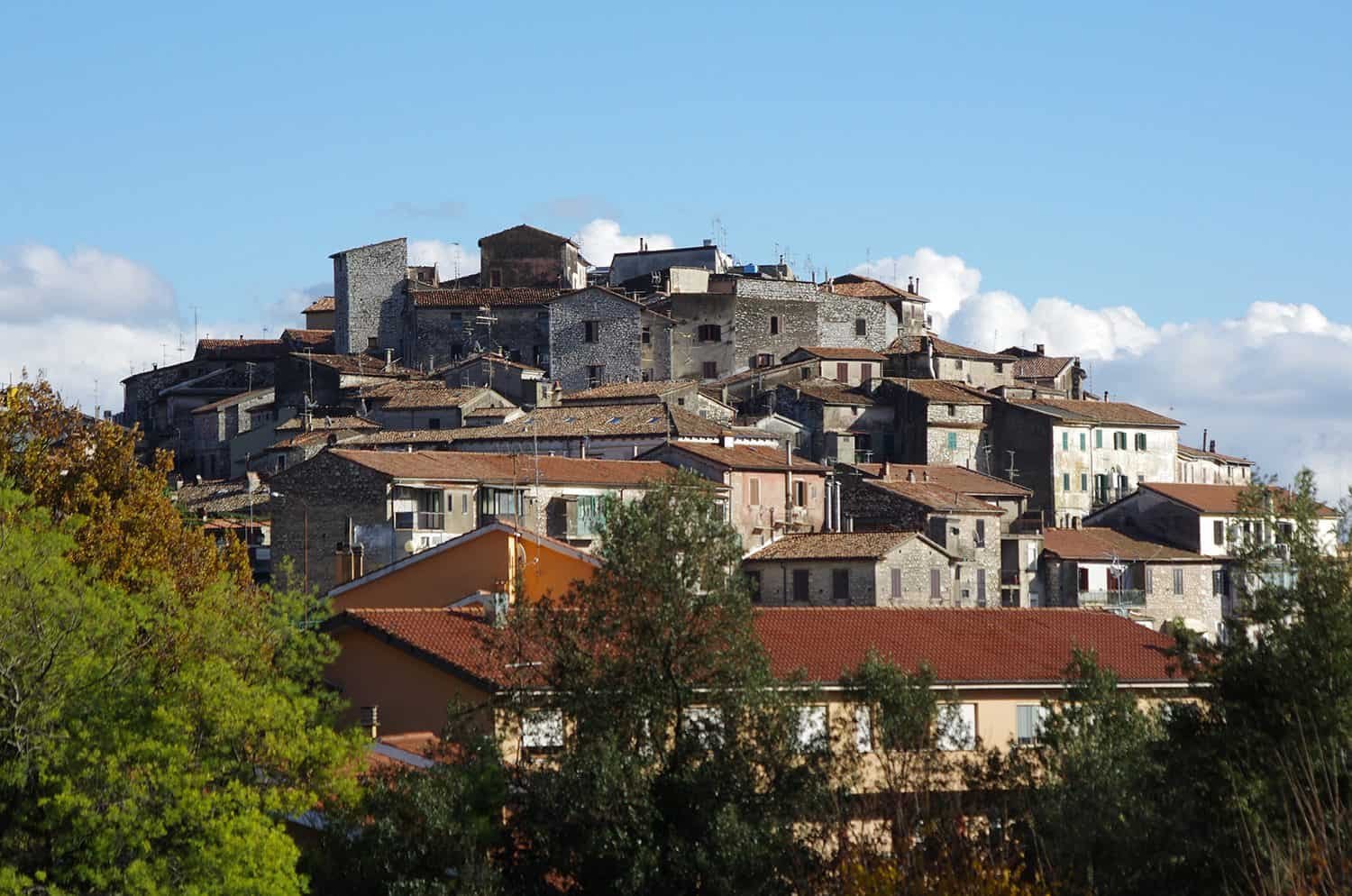
Bassiano is one of those towns you understand better by arriving from below. The road climbs from the Pontine plain, turns around the flank of the mountain, and at a certain point the village appears all at once, perched, enclosed by a ring of walls that wraps around it like a spiral. It is not a figure of speech: the castle walls the Caetani had built in the 1200s wrap around the settlement in a helical course, with nine towers and three entrance gates, and the spiral plan is what urban history books call a curtain settlement, that is, a town where the houses themselves form the defensive wall. The Museum of Writing is inside this perimeter, in Palazzo Caetani, which is also the seat of the town government.
The exact address of the Aldo Manuzio Museum of Writing
The museum's official site gives Via Sezze 30, Bassiano (LT), postal code 04010. Other institutional sources report the address of the town hall building with different numbering, and the reason is mundane: Palazzo Caetani has several entrances, an administrative one and a museum one, and the museum occupies the lower floors. If you arrive and cannot find the entrance, look for the town hall building: you are in the right place. In a town of just over 1,400 residents, asking is quicker than checking a map, and everyone will answer you.
How to get to Bassiano by car
From Rome by car you take Via Pontina as far as Latina, then climb toward the Lepini Mountains following the signs for Sermoneta and Bassiano. Alternatively you arrive from the Monti Lepini regional road that comes down from Frosinone. The last stretch is a mountain road of switchbacks, narrow but well paved, with blind curves and a few dry-stone walls at the edge of the roadway. If it's your first time driving it, take it slowly. The thing nobody tells you is that on winter mornings fog settles at mid-slope and the last kilometer can have reduced visibility, while 300 meters higher up there is full sun.
Train and bus to the Aldo Manuzio Museum of Writing in Bassiano
The most convenient railway station is Sezze Romano, on the Rome Termini-Naples line via Formia. From there and from the Latina bus terminal the connection is left to the Cotral intercity bus lines, which serve Bassiano with runs concentrated in school and work time slots. Anyone arriving without a car has to reckon with this: the good run for the trip out is almost always there, the good one for the return much less so. Check the times on the Cotral site before leaving and, if the combination doesn't hold up, consider a taxi from Sezze or a rental car. The town repays the effort, but improvised schedules are not forgiven.
Where to park in Bassiano
The historic center is practically impossible for traffic: lanes as wide as a cart, flights of steps, arches. You leave the car in the open spaces just outside the wall circuit and enter on foot through one of the gates. From the parking to the museum's door it is a five or six minute walk, on a moderate uphill, over uneven paving. Comfortable shoes, always. This goes for photography too: if you have a tripod, bring a light one, because you will be dragging it up and down the steps of the village.
Tickets, hours and reservations for the Aldo Manuzio Museum of Writing in Bassiano
Three euros. It is the price of a single admission given by the museum, and it includes the guided visit: not a secondary detail, because without someone explaining the conceptual layout of the rooms the route risks looking more cryptic than it is. School groups pay five euros per student and the price also covers the workshop activities. Booking is done by phone at 0773 355226 or through the form the official site puts on the page dedicated to reservations. The Ministry of Culture, in its entry for the museum, reports the opening as subject to reservation on every day of the week: one more reason not to show up at the door without having called.
How long it takes to visit the Aldo Manuzio Museum of Writing
The route is divided into 13 areas. A quick visit wraps up in 50 minutes. A visit done properly, with the guide stopping at the graffiti and leaving you time to read a few engravings, takes 90. If you bring middle schoolers and ask for the workshop, count on two hours. Our opinion: here the time badly spent is the time rushed, because the museum does not work on the rare object to be looked at quickly, it works on the idea, and ideas need pauses.
Can you visit the Aldo Manuzio Museum of Writing in Bassiano on your own?
Formally the admission includes accompaniment. In practice, whoever arrives outside the group shifts finds a staff member who opens up, introduces and stays available. Don't expect audio guides in five languages and an automatic ticket office: this is a mountain civic museum with serious scientific direction and a minimal staff. It is exactly its strength and its limit.

Palazzo Caetani, home of the Aldo Manuzio Museum of Writing
The palace that houses the museum was commissioned by Bonifacio Caetani, who in 1554 had a building constructed in Bassiano meant at once as a refuge and a healthy place to stay, incorporating pre-existing medieval structures. The date matters, and it matters above all for anyone who arrives here thinking of walking where Aldo Manuzio walked: Manuzio had died in Venice 39 years before this palace existed. The link between the building and the humanist is a link of the town, not of biography.
The Caetani family and the fief of Bassiano
The first written records on Bassiano go back to 1169. The town was governed by the Annibaldi until 1297, when it passed to the Caetani, the family that with Boniface VIII built in these years a very solid territorial lordship between southern Lazio and Marittima, holding together Sermoneta, Ninfa, Bassiano and the nearby fortresses. The Caetani kept the fief until the abolition of feudalism, with the sole interruption of the Borgia interregnum between 1492 and 1502, when Alexander VI stripped the family of its castles to assign them to his own relatives. Anyone who wants to see the other end of this territorial story will find the castle and the village a few kilometers away, at Sermoneta, and the garden the Caetani carved out on the ruins of the abandoned medieval town at the Ninfa Garden.
From the palace basement to the rooms of the Aldo Manuzio Museum of Writing
The rooms that now house the museum route were anciently used as a prison. It is the fact that explains everything else: the walls preserve the graffiti of the inmates, and the museum was built around those walls, not on top of a collection. The restoration consolidated the plaster, lit the engravings and turned a cell into a document. It is a museographic operation of which Italy offers few examples as rigorous in centers of this size.
Aldo Manuzio, the man from Bassiano who invented the modern book
If right now you are reading a text in which a word is in italics, if you have in your pocket a book that fits in a bag, if a sentence contains a semicolon: all of this passes through a man born in Bassiano around 1449. The date wavers, and the more cautious biographical sources place it between 1449 and 1452, because no birth record exists. The place, instead, is agreed: Bassiano, then in the territory of the Caetani of Sermoneta.
From Bassiano to Rome, then Ferrara
Manuzio left the town as a child, around the age of eight, sent to Rome for classical studies. Between 1467 and 1475 he studied letters in the capital with Domizio Calderini and Gaspare da Verona, two names that carry a lot of weight in Roman humanist philology. Then he moved to Ferrara, where he perfected his Greek at the school of Battista Guarini, son of Guarino Veronese. In Ferrara began his friendship with Giovanni Pico della Mirandola, and from that friendship came the post that changed his life: tutor to Pico's nephews, Alberto and Lionello Pio, lords of Carpi. They were the ones who financed his first publishing ventures. Put in modern terms: the first publisher in the full sense in European history started out with noble family capital and a cultural project written before the business plan.
Venice 1495: the grammar of Constantine Lascaris
Manuzio arrived in Venice between 1489 and 1490. The city was then the typographic capital of Europe, with dozens of workshops and an already mature book supply chain. The first edition to come out under his name is the Greek grammar of Constantine Lascaris, between February and March of 1495: a tool for learning the language, not a collector's masterpiece. It is the key to the man. Manuzio did not print to impress, he printed to put into scholars' hands the Greek texts that risked disappearing with the fall of Constantinople and the diaspora of Byzantine scholars.
Right after came the undertaking that won him immediate fame: the Aristotle in five folio volumes, published between 1495 and 1498. Printing Aristotle in Greek meant preparing type, correcting from discordant manuscripts, finding revisers able to read them. Manuzio gathered in Venice a team of Hellenists that is, in fact, the first editorial staff in history.
Francesco Griffo's italic and the 1501 Virgil
In 1496 came out Pietro Bembo's De Aetna, set in a roman type cut by Francesco Griffo of Bologna: that design, revived in the 1900s under the name Bembo, is still a typographic standard today. But the breakthrough came in April of 1501 with the Virgil in octavo, the first book printed entirely in italic, again on Griffo's punches. The italic was born to imitate the chancery handwriting of the humanists and served a practical end: taking up less space, and so fitting more text on small pages. On March 23, 1501 the Venetian government granted Manuzio the exclusive privilege on the use of that type, extended the following year to all the types cut by Griffo. It was the first great intellectual property battle in publishing history, and Manuzio lost it anyway in the field: the counterfeiters of Lyon copied the Aldine italic within a few months and spread it all over Europe.
Pocket books: the octavo format
The octavo format adopted by Manuzio measures roughly 154 by 94 millimeters. It sounds like a detail for bibliographers. It is in fact the birth of the portable book: until then the printed book was an object for the lectern, heavy, expensive, immobile. With the Aldine enchiridia the classical text goes into a satchel, is read on a boat, on a trip, in bed. The book changes and the reader changes. Anyone who today reads a paperback on the metro is using an invention from Bassiano that is 525 years old.
The anchor and the dolphin: Festina lente
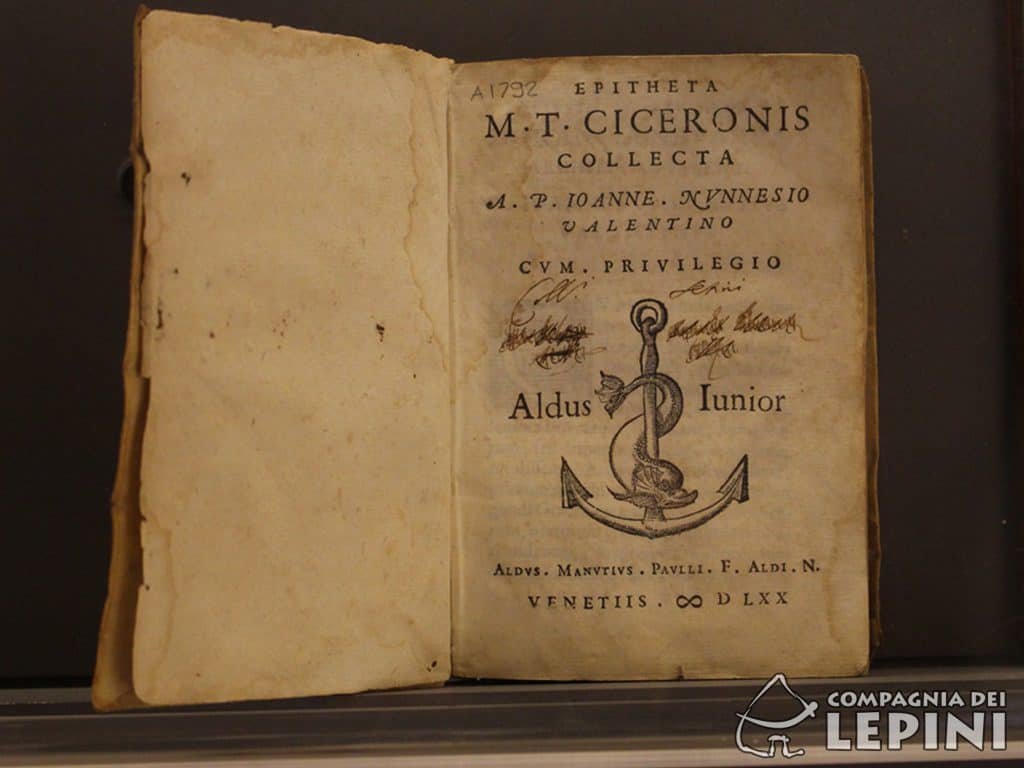
The Aldine printer's mark appears in June of 1502, in the second volume of the Poetae Christiani veteres: an anchor wrapped by a dolphin. The anchor is stability, the dolphin speed, and together they translate into an image the motto festina lente, hasten slowly. The image derived from an ancient Roman coin given to Manuzio by Pietro Bembo. The mark also served to defend against counterfeits: it was the guarantee brand of a publishing house, four centuries before they were called that. The museum in Bassiano has made that motto its emblem, and the sense of the phrase applied to a visit is literal: here you gain by slowing down.
The Aldine Academy and Erasmus of Rotterdam
Around 1502 Manuzio gathered in Venice a circle of Hellenists that went down in history as the Aldine Academy. The members pledged to speak among themselves only in Greek, and whoever slipped paid a fine: the fines financed the banquets. It sounds like a Renaissance student-prank anecdote, and in part it was, but behind it was a method of collective work on texts. In 1508 Erasmus of Rotterdam stayed in Venice and had his Adagia come out with Manuzio, the collection of ancient proverbs and sayings that would become one of the most-read books of 16th-century Europe. Erasmus also left a portrait of the Aldine workshop at work: chaotic, crowded, feverish.
The death in 1515 and the dynasty
Aldo Manuzio died in Venice on February 6, 1515. His body was taken to Carpi, to the Pio family. In just over two decades of activity he had produced a catalog that the different reconstructions place between 130 and 150 editions, with a clear predominance of Latin and Greek classics and a handful of titles in the vernacular: Petrarch's Cose volgari in 1501, Dante's Terze rime in 1502, in editions edited by Pietro Bembo that fixed the reference text for centuries. After his death his father-in-law Andrea Torresano and his brothers-in-law kept the workshop going until the sons came of age. Paolo Manuzio, born in 1512, carried on his father's enterprise and took it to Rome as well. Aldo Manuzio the Younger, the grandson, ran the press until 1590. Three generations, almost a century of books. Anyone who wants to see up close what it means to keep an old book alive can look at the work of the Istituto centrale per la patologia del libro Alfonso Gallo, in Rome.
The route of the Aldo Manuzio Museum of Writing, room by room
The museum was born in 2009, created in collaboration with the University of Rome La Sapienza, curated by Francesco Sinopoli and Laura Campagna, with texts by Vincenzo Padiglione and original research by Antonio Perri and Nadia Truglia. The scientific direction is Vincenzo Scozzarella's. It should be said right away what it is not: it is not a museum of printing, it is not a collection of presses. It is an anthropological museum that stages the ways in which people write, in our culture and in others, along with the lifestyles, the body postures and the forms of thought that are tied to those ways. The route unfolds in 13 areas, and these are the titles under which the museum itself presents them.
In the beginning. Different forms and functions
The entrance to the route occupies a space that architecturally speaks for itself: it was for a long time the gateway into the town. The room tells of the parallel invention of writing, and the formula needs explaining well because it is the concept on which the whole museum rests. Communicating by graphic signs is a human universal: all cultures do it. But to have writing, those conventional signs must combine to form a stable graphic code, able to refer back to a language. This step happened independently, for different reasons, in at least three areas of the world: the Middle East, the Far East, pre-Columbian America. Sumerians, China, Mesoamerica did not copy one another. The display takes them together both as historical references and as exemplary cases, and the conclusion it leads you to is less obvious than it seems: writing is not a unique achievement of the West, it is a solution that humanity found more than once, on its own, when it needed it to count goods, fix calendars, give a voice to the gods.
Writing as habitus in the making
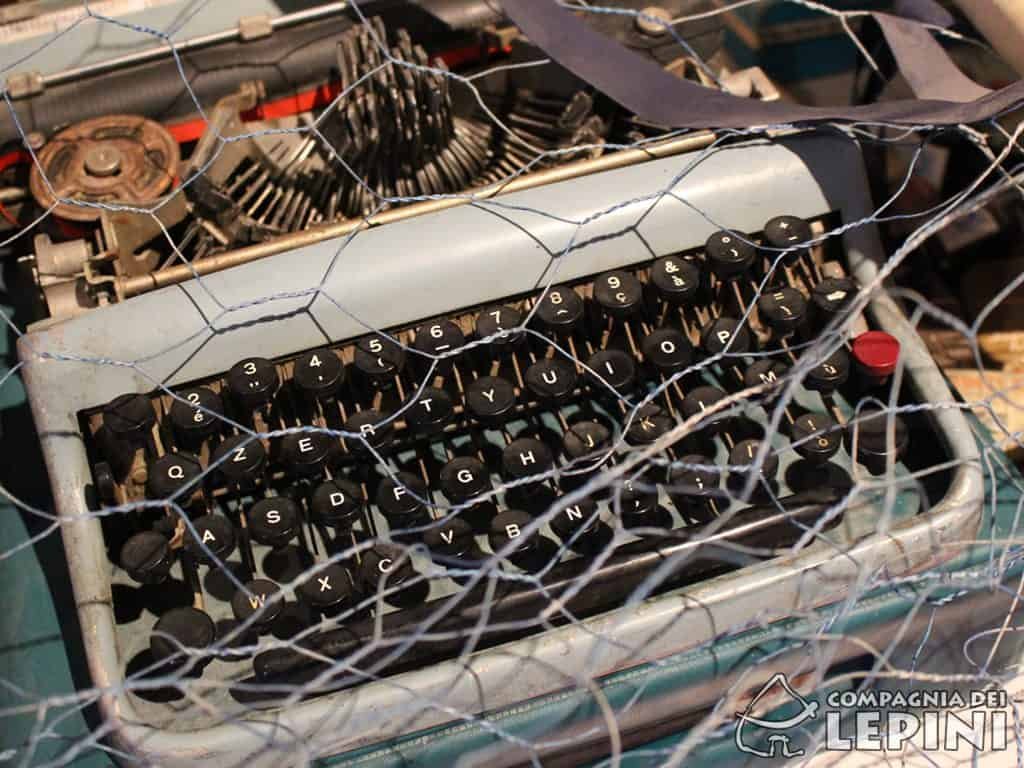
Adjacent room, and a change of register: here you look at the evolution of tools and supports. Clay tablets and styluses, papyri, parchments, quills, up to the little printing press and the recent computing inventions that dematerialize the act of writing and bring it closer again to speaking. The key word of the title is the second one: habitus, that is, habit of the body. Writing is not only a technology, it is a posture. The Sumerian scribe squatting with the tablet on his knee, the copyist bent over the slanted desk, the schoolchild with his elbow planted on the desk and the pen in the inkwell, the person dictating on the phone while walking: these are four different bodies, four ways of thinking while writing. The room makes you notice that you changed bodies along with the medium, and that you did not realize it.
What characters
Here the museum gets into the substance of typography: the characters, their design, their history, their ability to give a text a tone before the reader has even read its meaning. It is the room where the link with Manuzio becomes technical. A typeface is not a decoration: it is an infrastructure of reading. If Griffo's roman has stayed in use for five centuries, there is a reason, and it has to do with how the eye recognizes the shapes of letters at the speed at which it recognizes them.
Past present. Impossible interview with Aldus Manutius
The most successful idea of the display. A set design welcomes the return of Aldo Manuzio from the past: the museum has his voice speak, answering the questions of a present-day journalist who asks the great humanist publisher about the influence and the future of print in culture and society. The parodic genre of the impossible interview lends itself wonderfully to ironizing about the present through the estranged gaze of a man of the 1500s. It is also a lesson in method: hearing a Renaissance publisher reason about the Gutenberg era and about new means of communication forces you to ask what, in our way of reading, would have seemed senseless to the man who invented the modern book. A flat opinion: it is the moment in the route when adult visitors stop looking at the clock.
Aldo Manuzio. The heritage
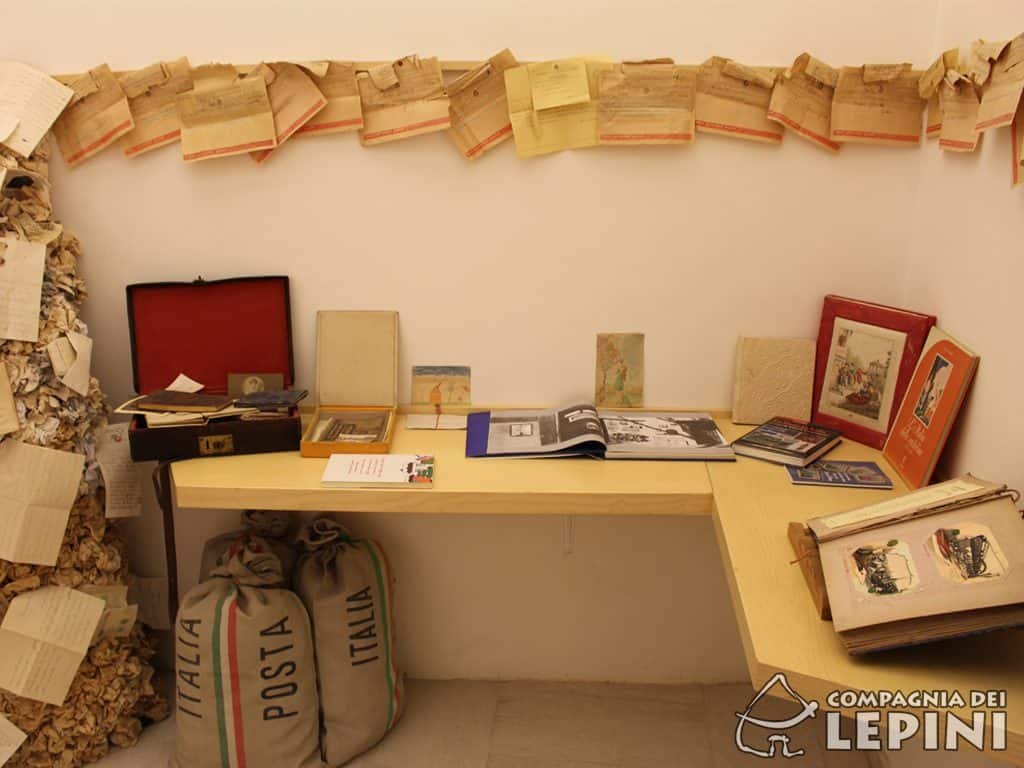
The section dedicated to the Aldine legacy gathers the memory of the Aldine Works and of the printing machines that are at the very origin of the museum institution: before the Museum of Writing, in Bassiano a collection of printing machinery and a Museum of Aldine Works had been born, created to honor the dynasty of printers that weighed so heavily in the Italian Renaissance. The present museum preserves that root and frames it in a broader discourse. Among the materials on display in the rooms of the complex there are also Aldine 16th-century printed books, that is, volumes that came out of the Venetian workshop in the century of the Manuzios: whoever has some practice with old books should linger on the proportions of the page, on the margins, on the relationship between the printed area and the white space. There lies the real invention.
Journey among visual codes
This is the big hall, the gravitational axis of the museum, and at the same time its most explicit homage to multiculturalism. The theme is the encounter with non-European writing systems and the question, impossible and always attempted, of the translatability of writing systems into one another. The display looks like a bazaar, with many distinct points of attraction: drapes covered in non-alphabetic writing and computer stations form separate environments, each dedicated to a graphic tradition. Chinese, Korean, and even the writing of Easter Island. Pictographic and syllabic writing systems are placed in evidence, with their history, their characters and the functions that distinguish them from speech.
The room goes on with the graphic systems invented in modern and contemporary times: Morse code, Braille, Italian Sign Language, cryptography and secret codes. The result is that you leave this room with a different idea of what a writing system is. A system of signs does not need to be alphabetic to work, and does not need to be ancient to be a true writing system. Anyone who wants to continue the reasoning on material cultures and on the codes of non-European societies has in Rome the Museum of Civilizations, which works on the same terrain with enormous collections.
Pinocchio, or On the difficulty of reading and writing
In the museum the room also carries the extended title Della fatica e del piacere del leggere e dello scrivere, and marks the return to microhistory and to the local dimension. Here writing is valued for the content of the texts, while in the earlier rooms the forms of expression and communication had been favored. The visitor enters the set design of a school classroom dominated by an enormous Scala d'oro with books arranged on the steps. Scala d'oro was a series for young readers that in the first decades of the 1900s bet on illustrating books to encourage reading specific to each age: one of the first Italian publishing operations built on the gradual nature of learning.
The theme of the room is becoming literate, that is, the acquisition of texts as cultural tools that mediate relationships between people, the relationship with the outside world and inner experience. For a child it is a complex symbolic process, in which psychophysical transformations also take place, and in which strategies of discipline, of enticement and of resistance operate. Put in plain words: learning to read is both a labor and a pleasure, and in the middle is the school that pushes, rewards and punishes. Anyone who remembers desks with an inkwell, the primer and the blackboard finds here the reconstruction of a classroom of that type, with the objects that taught two generations of Italians to write.
Graffiti, or On the secondary advantages of isolation
This is the room worth the trip. Because of the presence of layers of traces of the past, it is the most significant space in the palace and the most meaningful with respect to the very theme of the museum: a document in itself, which has required restoration and focused enhancement work. The walls of a good part of the room show graffiti and charcoal drawings of remarkable graphic and historical-cultural value. You can make out texts of denunciation, reproductions of landscapes, symbols of religious entrustment, narratives in images, faces, exercises in boredom, and much else not always easy to identify and even harder to understand.
It is reasonable to suppose that these writings, largely dating to the late 1700s and the first decades of the 1800s, were produced by people confined here: the rooms were anciently used as a prison. It is legitimate to presume that a significant part of the graffiti and drawings evokes stories and mentalities of that period, and lets us enter at least a little into the minds of inmates who turned to writing on walls as a form of testimony and resistance, as the conquest of an imaginary space of freedom and poetry, as a last cry of protest. On the degree of certainty it is best to be precise: that the rooms were a prison is documented, that the graffiti are the work of the inmates is the current and quite plausible reading of the scholars who worked on the room, not a signed and dated fact.
The atmosphere recreated by the display goes in the direction of the memorial, the shrine, so that the visitor, besides receiving information, approaches the graffiti in the frame of mind of someone who knows how to catch rebellion, suffering, pain in them. And draws from it a broader reflection: confinement and separation often induce a need to externalize the self, and so to write. A secondary advantage of isolation can be access to the imaginary. It is a didactic occasion to reason about the theories of inspiration and concentration, and I would be dishonest if I did not add that it is also a room where you lower your voice without anyone having asked you to.
Signs of ownership
Next come the rooms that show the use of writing to indicate identity and ownership: marks, monograms, ex libris. An ex libris is the label the owner pastes on the endpaper of a volume to declare it his, and around that small object turns a story of collecting, bibliophile pride and small obsessions. The ownership marks on tools, animals, furniture tell the same thing in the peasant world: you write to say that a thing is mine. Between this room and the Aldine mark of the anchor with the dolphin there is a direct thread, and the guide will point it out to you.
The memory room: written and oral autobiographical testimonies
Here writing becomes the construction of the self. The move is to the diary-form transposition of memories of experience and to other biographical traces: it is the dialogic and reflective self that finds in the practice of writing a model of construction. In the Memory Room diaries are on display, and videos reproduce life accounts of people from the Lepini Mountains belonging to different generations. It is the section where the anthropological museum puts down roots in the territory: the voices are from here, the dialects are from here, the stories of emigration, of war, of land reclamation and of work are those of the mountain that looks out over the Pontine plain. Anyone who wants to go deeper into the chapter of land reclamation and the founded cities will find in Latina the Pontine Land Museum.
The educational workshop
A workshop also dedicated to writing, with activities in calligraphy, storytelling, graphics and comics. For schools it is included in the reduced group ticket. For families who arrive outside school periods it is best to ask at the time of booking if it is running that day: it depends on the staff available.
The Auditorium
The large Auditorium screens films and videos on a continuous loop. It is also the space where the museum hosts presentations and meetings, and in the months of the cultural season it is the place where the town gathers. A practical tip: if you are traveling with someone who tires from walking, the Auditorium is the place to sit them down while you finish the rooms.
Temporary presences
The temporary exhibitions of artists unfold along the fortification towers of Bassiano. It is an exhibition solution few museums can afford: using the 13th-century wall circuit as a gallery. Films and screenings in the Auditorium, exhibitions in the towers, educational workshop and permanent route all work together to make the encounter with this museum a formative experience for a quite varied audience.
The Civic Collection of the Artist's Book at the Aldo Manuzio Museum of Writing
In 2019 a Civic Collection of the Artist's Book was established in Bassiano, named after the Roman artist Valeria Gramiccia. The artist's book is a precise genre: it is not an illustrated book, it is a work of art that takes the form of a book, and that often puts in crisis the very functions of reading, turning a page, holding text. Placing a collection of them in a museum of writing carved out of a former prison, in a town that gave birth to the first modern publisher, is one of those curatorial choices that work because they close the circle.
The collection grows thanks to Il Silenzio dell'Inchiostro, a contemporary visual arts series that since 2018 has promoted the artist's book and that takes place right at the Museum of Writing: the works exhibited then become part of the civic collection. The curator is Vincenzo Scozzarella, with the collaboration of Antonio Fontana and Monica Giovinazzi. To find out if an edition is under way during your visit, call or check the museum's official channels.
A curiosity about the Aldo Manuzio Museum of Writing in Bassiano
The best curiosity about this museum is that its eponymous hero never set foot in the rooms that bear his name, and not out of a spite of fate, but out of pure chronology. Aldo Manuzio died in Venice on February 6, 1515. Palazzo Caetani, the building that houses the museum, was built by order of Bonifacio Caetani in 1554: 39 years later. The man who invented the pocket book and italic left Bassiano as a child, around the age of eight, to go study in Rome, and as far as we know he never returned to live there. The museum, in short, does not preserve Manuzio's birthplace or his Venetian presses: it preserves the idea the town has made of him.
There is more, and here the matter becomes truly curious. The town dedicated its municipal library to Manuzio, while the museum is named for Writings, in the plural, and only by extension bears the humanist's name. The distinction is not bureaucratic: it says that in Bassiano they decided not to turn Manuzio into a tourist relic, but to use him as a gateway to a bigger theme, which is writing as a universal human fact. A town of 1,400 residents that gives up the easy souvenir of its illustrious son and chooses the anthropology of writing is a town that had someone with clear ideas at the right moment. The result is that the visitor arrives thinking to find a room with a few 16th-century printed books and ends up reasoning about the writing of Easter Island, about Braille and about the graffiti of prisoners. Whoever arrives with the wrong expectation often leaves happier than whoever arrives with the right one.
One last detail, for those who love symmetries: the motto the museum has adopted, festina lente, hasten slowly, is the same one Manuzio printed on his books next to the anchor and the dolphin. The image had been suggested to him by an ancient Roman coin that Pietro Bembo had given him. A coin from 2000 years ago, taken up in 1502 by a Venetian publisher, adopted in 2009 by a mountain museum: the history of culture is also made of these rebounds.
Something nobody tells you about the Aldo Manuzio Museum of Writing in Bassiano
Nobody tells you that this museum was built backwards. In the vast majority of cases a museum starts from a collection: someone gathers objects, then looks for a home, then calls someone to arrange them. Here the opposite happened. There was a room, in the basement of Palazzo Caetani, with walls covered in 18th-century graffiti left by the inmates of the old prison. That room had to be saved and made legible. It was precisely with the intention of enhancing it that, in relation with the University of Rome La Sapienza, the project of a Museum of Writing was arrived at, which opened to the public in 2009. The theme was chosen for the room, not the room for the theme.
From this origin everything else descends, and so does the thing that most throws visitors off: the museum displays very few precious objects. It is a choice, and what's more a declared choice. The museographic approach combines two styles that usually travel separately, the theatrical or atmospheric one and the hands on one, interactive, in which you learn by doing. The result is a clear overcoming of the demonstrative pedagogy founded on the cult of the object, in favor of a mainly conceptual exhibition language, which like much contemporary art in its installations pairs formal care with a pronounced self-reflective tendency. Translated for whoever walks in with a ticket in hand: don't come here to see rare things, come to understand a complicated matter.
The practical consequence, which I spare you from discovering on your own, is that the museum works badly if you cross it in silence reading the panels, and works very well if you ask questions of the person accompanying you. The guided visit is included in the ticket. Use it. It happens that families get through the route in 20 minutes because nobody explained to them that the drape with the incomprehensible signs was Korean writing and why it was there. And it happens that the same families go back after five minutes of conversation with the staff member. The difference between the two outcomes is one question.
The advice I give you for visiting the Aldo Manuzio Museum of Writing in Bassiano
Call. Before everything else, call 0773 355226 or write to informazioni@museoaldomanuzio.it and agree on a time. The museum lists Monday as a reservation-only day, and the Ministry of Culture's entry goes so far as to present access as subject to reservation on every day of the week. A civic museum with a reduced staff lives on fragile balances: a school class on a visit, a permit, an event in town, and the door stays shut for half an hour. Whoever arrives announced never has problems. Whoever arrives unannounced, sometimes does.
Second tip, about timing. If you can choose, come in the afternoon shift, between 15:00 and 18:00 from Tuesday to Saturday. Reason: morning is the slot when school classes arrive, and with a middle school class inside the rooms the route loses its silence, which here is a resource, especially in the graffiti room. Sunday afternoon, opening from 15:30 to 18:30, is the best window for anyone coming from Rome: you leave after breakfast, you arrive for lunch in Bassiano, you eat, you visit, you head back in the light.
Third tip, about the manner. Don't treat this museum as a stop to tick off between Sermoneta and Ninfa. Give it at least an hour and a half and ask the guide to stop twice: in the room of the impossible interview with Manuzio and in the graffiti room. Those are the two moments when the museum is at its best, and they are also the two you lose if you rush. The house motto serves as instructions for use: hasten slowly. I add a warning you won't find in the guides: the basement rooms are cool even in July and damp in winter. A sweatshirt in your bag, always, even in August.
Fourth and last. Combine it with the town. Leave the museum and walk around the walls, go into the Collegiata di Sant'Erasmo, climb the civic tower, and buy prosciutto at one of the historic shops. The museum takes 90 minutes, Bassiano deserves another 90, and the day works out only if you put them together.
Another well-known fact, yet rarely cited
That Aldo Manuzio invented the italic typeface, many people know. That the italic was born for purely economic reasons, few say. The Aldine italic, cut by Francesco Griffo of Bologna and used for the first time in the octavo Virgil of April 1501, imitated the handwritten chancery script of the humanists, the slanted and narrow one in which documents were penned. Slanted and narrow means one thing only in typography: it takes up less horizontal space. Less horizontal space means more words per line, more lines per page, fewer pages per book, less paper, lower cost, reduced format. Italic was not born to emphasize a word in the middle of a sentence, as we use it today: it was born to fit the Aeneid in a pocket.
The second little-cited fact concerns what came next. On March 23, 1501 the government of the Serenissima granted Manuzio the exclusive privilege on the use of italic, and the following year extended it to all the types cut by Griffo. It was one of the first protections of intellectual property in publishing history, and it served practically no purpose: the workshops of Lyon copied the type very quickly and flooded Europe with Aldine counterfeits, complete with forged anchor and dolphin. Manuzio reacted by publishing notices explaining how to tell his authentic editions from the flaws of the copies. It is the first documented case of anti-piracy communication by a publisher.
Third, and perhaps the most overlooked: in 1498 Manuzio published a catalog with the prices of his own editions, and in 1499 he introduced page numbering. The catalog with prices means a book market existed that could be addressed directly. Page numbering means you could cite a passage, build an index, cross-reference from one point of the volume to another. They are two innovations you don't see, and without which our idea of the book would simply not exist. The museum in Bassiano works on exactly this: the revolutions of writing are almost always invisible, and almost always practical.
The right photo to take at the Aldo Manuzio Museum of Writing in Bassiano
The right photo is not the portrait of Manuzio and it is not the display case with the 16th-century printed books. It is the graffiti wall, photographed at an angle. The engravings on the walls of the graffiti room are shallow, often drawn in charcoal or scratched with a nail, and head-on they disappear: the diffuse light flattens them and the camera gives back a gray plaster. If instead you stand almost parallel to the wall and take advantage of the raking light the display designed for exactly this purpose, the grooves cast shadow and the marks jump out. Look for a face, a date, a boat: they are the recurring motifs. Set a high ISO, keep the aperture around f/4, give up the flash. The flash cancels the raking light and gives you the flat wall again.
Check on the spot if photographs are allowed and if there are limits: in museums with fragile materials the rule can change from one room to another and during temporary exhibitions. Ask at the entrance, not afterward.
The second right photo, the one to take outside, is the village from outside the walls, in the early afternoon in winter or after 18:00 in summer, when the light comes in low from the west and traces the nine towers of the 13th-century circuit. Bassiano is a spiral town: from a raised point along the road that climbs, or from the viewpoint over the plain, you can read the shape of the settlement winding around itself. With the Pontine plain below and the sea on the horizon on clear days, that is the photograph you will take home and that will explain to your friends why you went all the way up here.
Third option, for those who love details: the signs and plaques of the town. In a village that has made writing its own museum, the walled-in inscriptions, the ceramic street numbers and the old shop signs make up an open-air collection that nobody set up and nobody protects. Photograph them. In two decades they will be a document.
Some important events that happened here in history
The first documented event concerning this place is not a fact of culture, it is a fact of power. The first written records on Bassiano go back to 1169. The town was ruled by the Annibaldi until 1297, the year it passed to the Caetani: these are the years of the pontificate of Boniface VIII, the Caetani pope, and the transfer of Bassiano is part of the great operation with which the family built a compact domain between Marittima and Campagna, putting together Sermoneta, Ninfa, San Donato and the fortresses of the Lepini. The Caetani held the fief until the abolition of feudalism.
Second event: the Borgia interregnum, between 1492 and 1502. Alexander VI stripped the Caetani of their castles to assign them to his own family, and for 10 years Bassiano changed masters. The restitution came only after the pope's death. These are the same years in which, in Venice, the town's most illustrious son was printing the grammar of Lascaris and the Aristotle in five volumes: while Bassiano was losing its lords, a man from Bassiano was changing the history of the European book forever. Neither of the two, in all likelihood, knew of the other.
Third: 1554, when Bonifacio Caetani had built the palace that today houses museum and town hall, as a refuge and as a healthy place to stay, incorporating pre-existing medieval structures. It is the birth certificate of the building, and therefore, four and a half centuries later, of the museum too.
Fourth event, and the most painful: the use of the basement as a prison between the end of the 1700s and the first decades of the 1800s. On the walls remain the graffiti of the inmates, texts of denunciation, faces, landscapes, religious symbols. We don't know the names of those people and we don't know their crimes. We do know their marks, however, and they are the only thing of theirs that has reached us. If there is a definitive argument in favor of the idea that writing is a need and not a luxury, it is that wall.
Fifth: 2009, the opening of the Museum of Writing, born from the project developed with the University of Rome La Sapienza. In 2019 comes the establishment of the Civic Collection of the Artist's Book named after Valeria Gramiccia, fed by the series Il Silenzio dell'Inchiostro, active since 2018.
Sixth and last, a recent fact that says how much the museum weighs for the territory: on May 15 and 16, 2021, on the occasion of the 29th edition of the FAI Spring Days, Bassiano opened seven places to the public, among them the Museum of Writing with the graffiti of the former prison and the Civic Collection of the Artist's Book, the library named after Aldo Manuzio, the historic shops along the walls and the church of San Nicola di Bari. In two days the town recorded 2,321 visitors: more than double its own residents.
Who has passed through the Aldo Manuzio Museum of Writing in Bassiano
Let's start with who has not passed through, because it is the honest premise. Aldo Manuzio, born in this town around 1449, never saw these rooms: the palace that contains them dates from 1554 and he had died in 1515. Those who really did pass through here, and left the most literal mark imaginable, are the inmates of the 18th-century prison, authors of the graffiti on the walls. They are the anonymous inhabitants of this place, and for once the term is not rhetorical: their presence is documented by their own hands.
The Caetani passed through here, naturally: Bonifacio Caetani, who wanted the palace in 1554, and his descendants, in a family that from the Lepini managed to reach the papal throne with Boniface VIII and that in the 1800s and 1900s gave Italy figures like Michelangelo Caetani, the learned duke, friend of Liszt and commentator on Dante, and Marguerite Chapin Caetani, founder of the magazine Botteghe Oscure. The same family that a few kilometers away created the garden of Ninfa on the ruins of the abandoned city.
In the museum's recent history, the scholars who conceived it have passed through. The scientific project was born in relation with the University of Rome La Sapienza. The curators are Francesco Sinopoli and Laura Campagna, the texts are by Vincenzo Padiglione, a museum anthropologist among the most active in Italy in the field of ethnographic and demo-anthropological museums, and the specific, original research on which the layout rests is by Antonio Perri and Nadia Truglia. The scientific direction is entrusted to Vincenzo Scozzarella, who also curates the artist's book series together with Antonio Fontana and Monica Giovinazzi.
The artists of the artist's book have passed through, edition after edition of Il Silenzio dell'Inchiostro since 2018, leaving as gifts the works that now form the Civic Collection named after Valeria Gramiccia. And the FAI volunteers and visitors have passed through, who in May 2021 brought to Bassiano more than 2,300 people in a single weekend.
Finally, every year, the school classes pass through. They are the largest category of visitors and the reason this museum exists in this form. Anyone who works with kids knows that a museum is also judged by how it holds up a third-year middle school class at 11 in the morning: here it holds up, because it does not ask them to admire display cases, it asks them to try writing.
Bassiano around the Aldo Manuzio Museum of Writing: what to see in 10 minutes on foot
Stepping out of the door of Palazzo Caetani you are already in the historic center, and in 10 minutes of walking you see almost everything. The Collegiata di Sant'Erasmo, dedicated to the patron saint the town celebrates on the second Sunday of June, is the main church. A short distance away are the church of San Nicola and that of Santa Maria, and above the settlement rises the civic tower. Outside the wall circuit, the Santuario del Crocifisso preserves frescoes from the 15th and 16th centuries, and there is also the Santuario della Trinità.
But the thing to do in Bassiano is walk along the walls. The 13th-century circuit with its nine towers and three gates is not an isolated ruin: it is the very structure of the town, and the lanes run alongside it, tracing the spiral on which the settlement is built. The medieval tower-houses are recognizable by their overhang and small windows. On the fortification towers, in the exhibition season, the museum sets up its temporary exhibitions, and the stroll becomes an exhibition route.
For the rest of the Lepini, the page on the Lepini Mountains and the one on Bassiano tell the story of the territory in detail.
The Aldo Manuzio Museum of Writing in Bassiano with children
It works, and works better than the word museum would lead you to suspect. The reason is that the display is interactive by design: there are stations to use, drapes to look at up close, a reconstructed school classroom where children recognize desks and blackboard, and an educational workshop dedicated to calligraphy, storytelling, graphics and comics. The Scala d'oro room, with the books for young readers arranged on the steps, is the point where the smallest ones stop on their own.
Ideal age range: from second grade up. Under six the museum gives little, because its language is conceptual and asks you to reason by comparison. From nine to 14 it is instead one of the best museums for kids in southern Lazio, and I say so after having visited quite a few.
Two practical warnings. The first: the graffiti room requires some mediation, because it tells of detained people, and with small children it has to be introduced with a few more words. The second: ask when booking if the workshop is running on the date you are interested in. With school groups the workshop is included in the five-euro ticket. For families it has to be arranged.
Accessibility and services of the Aldo Manuzio Museum of Writing
It has to be said frankly: the museum occupies the lower levels of a 16th-century palace inside a sloping medieval village, and this means steps, changes in level and narrow passages. Anyone who moves in a wheelchair or has mobility difficulties must call 0773 355226 beforehand and have the route described: only the staff can say which areas are reachable in the specific condition of the visitor. The approach also has to be assessed, because from the outside parking to the walls you climb on foot over uneven paving.
Services: the museum has an auditorium and an educational workshop, and offers guided visits and thematic workshops. For coat check, luggage storage, bookshop and cafeteria the prudent answer is not to count on them and to plan accordingly: this is a small civic museum, not a metropolitan museum complex. The town's bars and shops are in any case a couple of steps away.
When to go to the Aldo Manuzio Museum of Writing in Bassiano and when to avoid it
The best period is the shoulder season: April, May, late September, October. At 562 meters above sea level spring arrives later than on the plain and autumn is long and clear, with days when you can see the sea from the wall circuit. Summer is hot on the plain but breathable up here, and the museum's basement rooms are cool: on the July and August days when the Pontine plain is unbearable, this is a smart escape.
When to avoid it: weekday mornings in the school period, because of the classes visiting. And Monday, if you haven't booked, because that day entry is by appointment only. Also avoid the Sundays of the big patron saint festivals and food fairs if you are looking for silence, while they are perfect days if you are looking for the town alive. The feast of Sant'Erasmo falls on the second Sunday of June.
Personal opinion: the ideal window is a Sunday afternoon in October. Opening from 15:30 to 18:30, low light on the walls around five, very few people, and time to finish the visit and walk around the village before dark.
What to eat in Bassiano after the Aldo Manuzio Museum of Writing
The prosciutto crudo of Bassiano is a serious matter. The curing happens with the windows open, taking advantage of the mountain air, for no less than 12 months, and the result is a ham of intense flavor, fragrant and sweet, different from those of the plain because of the climate in which it matures. The historic shops along the walls sell it sliced and whole, and it is worth taking a piece home. Alongside the prosciutto there are the cheeses of the Lepini, the cured meats, the local bread, the mountain mushrooms and truffles, the olives.
The town also hosts good food and wine events: the provincial competition L'Olio delle Colline and the series Rosso Borgo, which intertwines wine and antique books. The latter, in a town that gave birth to the first modern publisher, is not a random pairing.
A full day: what to combine with the Aldo Manuzio Museum of Writing in Bassiano
Bassiano alone does not fill a day starting from Rome, and it shouldn't. Here are three pairings that really work, tested in the field.
Bassiano and Sermoneta
It is the natural pairing: 25 kilometers, the same feudal family, two opposite outcomes. At Sermoneta you find the restored Caetani castle and a more polished and more visited village. At Bassiano you find the authentic town and the museum. Morning at Sermoneta, lunch, afternoon at Bassiano with the museum open from 15:00. It works perfectly.
Bassiano and the Giardino di Ninfa
The Ninfa Garden is a handful of kilometers away and has to be booked well in advance, because admissions are capped. If you have the reservation in the morning, the afternoon in Bassiano is the perfect tail: from the medieval city abandoned and turned into a garden to the prison basement turned into a museum, the thread of the day is the second life of ruins.
Bassiano and the archaeology of the Lepini
For those with an interest in the ancient world, the Lepini Mountains offer serious material. Ancient Norba preserves one of the best-readable polygonal masonry circuits in Lazio, above Sezze. At Cori the Museo della città e del territorio tells the story of the settlement of the area. At Priverno the archaeological and medieval museums complete the picture with the Roman villa of Privernum and the nearby abbey.
The thread of the book, from Bassiano to Rome
Anyone who leaves here with a head full of types, italics and 16th-century printed books has in Rome the natural continuation of the discussion. The Biblioteca Casanatense and the Biblioteca Angelica preserve leading old collections and reading rooms among the most beautiful in Europe. The Biblioteca Vallicelliana adds the Oratorian chapter. The Biblioteca Nazionale Centrale is the great modern container. It is an itinerary that can be done on a second day and that gives Manuzio the context he deserves.
Quick questions about the Aldo Manuzio Museum of Writing in Bassiano
How much is the ticket for the Aldo Manuzio Museum of Writing in Bassiano?
Single admission costs €3.00 and includes the guided visit. School groups pay €5.00 per person, a figure that includes the visit and the educational workshop. The rates are those given by the museum on its own site. For any discounts it is best to ask at the time of booking.
What are the hours of the Aldo Manuzio Museum of Writing?
Tuesday to Saturday 9:30-12:30 and 15:00-18:00, Sunday 15:30-18:30. On Monday access is by reservation only. The Ministry of Culture's entry reports the opening as subject to reservation every day: a call beforehand settles any doubt.
Do you need to book to visit the museum?
Yes, it is strongly recommended, and on Monday it is mandatory. You book at 0773 355226, by email at informazioni@museoaldomanuzio.it, or by filling in the form on the reservations page of the official site.
Where exactly is the Aldo Manuzio Museum of Writing in Bassiano?
At Via Sezze 30, 04010 Bassiano, Latina Province, inside Palazzo Caetani, which also houses the town hall. The palace is in the historic center, inside the wall circuit.
How long does the visit to the Aldo Manuzio Museum of Writing take?
From 50 minutes to an hour and a half depending on pace. With the educational workshop it comes to two hours. The route includes 13 areas.
Is the museum suitable for children?
Yes, particularly from age seven to 14. The display is interactive, there is a reconstructed school classroom, the Scala d'oro with books for young readers and a workshop dedicated to calligraphy, storytelling, graphics and comics. Under six it delivers less.
Can you take photographs inside the Aldo Manuzio Museum of Writing?
Ask at the entrance: conditions can vary between permanent rooms and temporary exhibitions. In any case, in the graffiti room the flash is counterproductive even technically, because it cancels the raking light that makes the engravings legible.
Is the museum wheelchair accessible?
The museum occupies the lower levels of a 16th-century palace in a sloping medieval village, with steps and changes in level. Before leaving, call the museum and have the route described in detail.
What is the difference between the Aldo Manuzio Museum of Writing and a printing museum?
A printing museum displays presses, matrices and machines. This is an anthropological museum: it stages the ways of writing of different cultures, the tools, the body postures and the social contexts of writing. The printing machines were at the origin of the collection, but they are not the center of the discussion.
Was Aldo Manuzio really born in Bassiano?
Yes. Biographical sources agree on the place and put the birth around 1449, with fluctuations up to 1452 because no birth record exists. He left the town around the age of eight to study in Rome.
Did Aldo Manuzio live in the palace that houses the museum?
No. Palazzo Caetani was built at the wish of Bonifacio Caetani in 1554, 39 years after Manuzio's death, which occurred in Venice on February 6, 1515.
What are the graffiti at the Aldo Manuzio Museum of Writing?
They are engravings and charcoal drawings on the walls of a room on the route, largely datable between the end of the 1700s and the first decades of the 1800s. The rooms were anciently used as a prison, and the current reading attributes them to the people confined here. You can make out texts of denunciation, landscapes, religious symbols, faces.
Is the Aldo Manuzio Museum of Writing free on any day of the year?
No ordinary free openings are listed: the museum is civic and does not fall under the free Sundays of state museums. Extraordinary or free-admission openings may be scheduled on occasions such as the FAI Days or the museum's own series. Ask the museum.
Are there guided tours at the Aldo Manuzio Museum of Writing in Bassiano?
Yes, and they are included in the €3.00 ticket. The museum also offers educational visits and thematic workshops, designed above all for schools.
How do you get to Bassiano without a car?
The reference railway station is Sezze Romano, on the Rome-Naples line via Formia. From Sezze and from the Latina bus terminal the connection is left to the Cotral intercity bus lines. The times, few in number, must be checked on the company's site before setting out.
How far is Bassiano from Rome?
A little over an hour and a half by car, via Via Pontina and climbing toward the Lepini. The real distance is modest, but the last mountain stretch of switchbacks lengthens the time.
How far is Bassiano from Sermoneta?
About 25 kilometers, which in this area means a good half hour of driving. It is the pairing most visitors do.
What is the Civic Collection of the Artist's Book of Bassiano?
A collection established in 2019 and named after the Roman artist Valeria Gramiccia, which gathers the works shown in the series Il Silenzio dell'Inchiostro, active since 2018 at the museum. The artist's book is a work of art that takes the form of a book.
Is there parking near the Aldo Manuzio Museum of Writing?
You park in the open spaces outside the wall circuit and enter on foot. From the parking to the museum it is a five or six minute walk on a slight uphill over uneven paving.
Is the Aldo Manuzio Museum of Writing in Bassiano worth the trip?
Yes, on one condition: that the trip also includes the town and at least one other stop in the Lepini. As a single stop from Rome it is out of proportion. As the pivot of a day among Sermoneta, Ninfa and Bassiano it is one of the smartest outings you can make south of Rome.
What is the motto Festina lente?
It means hasten slowly. It was the motto of Aldo Manuzio, who printed it on his books next to the mark of the anchor wrapped by the dolphin, which appeared in June 1502. The anchor stands for stability, the dolphin for speed. The museum in Bassiano has made it its own.
What are the closing days of the Aldo Manuzio Museum of Writing?
Monday is not scheduled as an ordinary opening day: you enter only by reservation. For holidays and extraordinary closures, contact the museum directly.
Can you buy tickets online?
The museum handles visit requests through the booking form on its own official site and by phone. Payment is made on the spot.
What is there to see in Bassiano besides the museum?
The 13th-century wall circuit with the nine towers and three gates, the Collegiata di Sant'Erasmo, the churches of San Nicola and Santa Maria, the civic tower, the Santuario del Crocifisso with frescoes from the 15th and 16th centuries, the Santuario della Trinità, the historic prosciutto shops and the spiral lanes of the village.
The last word on the Aldo Manuzio Museum of Writing in Bassiano
The proposal of a small-town civic museum usually brings the face of someone who fears the wasted half hour. In Bassiano that face lasts until the third room. Then something happens that almost never happens in big museums: people start talking among themselves, telling each other how they were taught to write, comparing their own handwriting with their children's. A museum that manages this with a three-euro ticket and 13 rooms dug under a town hall has understood something that escapes many richer museums.
If I had to say one thing to someone deciding if to climb all the way up here, I would say this: go for the graffiti room. The rest of the route is intelligent and well made, but that wall is a unique document, and it needs no mediation to get across. People shut in a cell took a nail and wrote on the wall because they had no other way to exist. 200 years later, in a house where the history of writing is told, the strongest piece is not an Aldine 16th-century printed book: it is a scratch. Festina lente, and give yourself the time to look at it.
Article written by the editorial team of TourLeaderPro, contact them for Private/Corporate/V.I.P. Tours and Experiences.
Planning a trip to Rome? The English guides for visiting the city are on ItalyPlanner.com.