Museum of the Central Institute of Book Pathology Alfonso Gallo
In short. The Museum of the Central Institute of Book Pathology Alfonso Gallo is at Via Milano 76, 00184 Rome, in the Monti district, on the southwestern slopes of the Viminal, about 100 meters from Via Nazionale.
The Museum of the Central Institute of Book Pathology Alfonso Gallo is at Via Milano 76, 00184 Rome, in the Monti district, on the southwestern slopes of the Viminal, about 100 meters from Via Nazionale. It is not a museum with a ticket office, turnstiles and continuous opening hours. It is the exhibition space of a research institute of the Ministry of Culture, and you visit it by appointment arranged with the institute, phone 06 482911, email ic-pal@cultura.gov.it. The offices work Monday to Friday, and the building is closed on Saturday and Sunday. The specialist library, which occupies the top floor of the small building, can also be consulted only by reservation, by writing to ic-pal.biblioteca@cultura.gov.it. You get there by Metro line A, Repubblica stop, or line B, Cavour stop, and by buses 64, 70, 71, 117, 170 and H, Nazionale/Palazzo Esposizioni stop. From there you turn into Via Milano and climb for 200 meters. If you walk from Termini, it takes just under 12 minutes. Before you leave, agree on a date and time with the institute, because the opening of the exhibition area depends on the availability of the scientific staff and the calendars change.
If you are putting together a Rome itinerary off the usual circuits, this guide sits alongside the other pages on tourist attractions in Rome. The museum at Via Milano 76 is one of the few places in Italy where the book is studied as a body, with its diseases and its therapies.
What the Museum of the Central Institute of Book Pathology Alfonso Gallo really is
Try explaining it to a group at the gate: here they don't keep beautiful books, they keep sick books. The collection was born in 1938 inside the Royal Institute of Book Pathology, created by Alfonso Gallo, and since then it has gathered the case history of damage to the book and archival heritage: volumes gnawed, charred, flooded, moldy, badly fixed, even worse bound. It is a museum of pathological anatomy applied to paper, and the medical metaphor is not the narrator's affectation. It is the word Gallo chose to found a discipline.
The tour is divided into three sections: the materials and manufacturing techniques of ancient and modern documents, the damage and the many factors that cause it, and prevention and restoration. On top of these there is a room set up as a laboratory, where you can handle the restoration materials and watch period documentaries and recent footage on the most demanding interventions tackled by the institute's laboratories. The current layout dates from 2001 and is designed for teaching. School groups, along with scholars, are the historic audience of this place.
It is one of the three or four Roman museums that change the way you look at an everyday object. Walk out of here and you won't open an old book with the same casualness again. It is worth more than many crowded galleries in the center, and nobody knows about it.
What the institute that houses the Museum of the Central Institute of Book Pathology Alfonso Gallo is called today
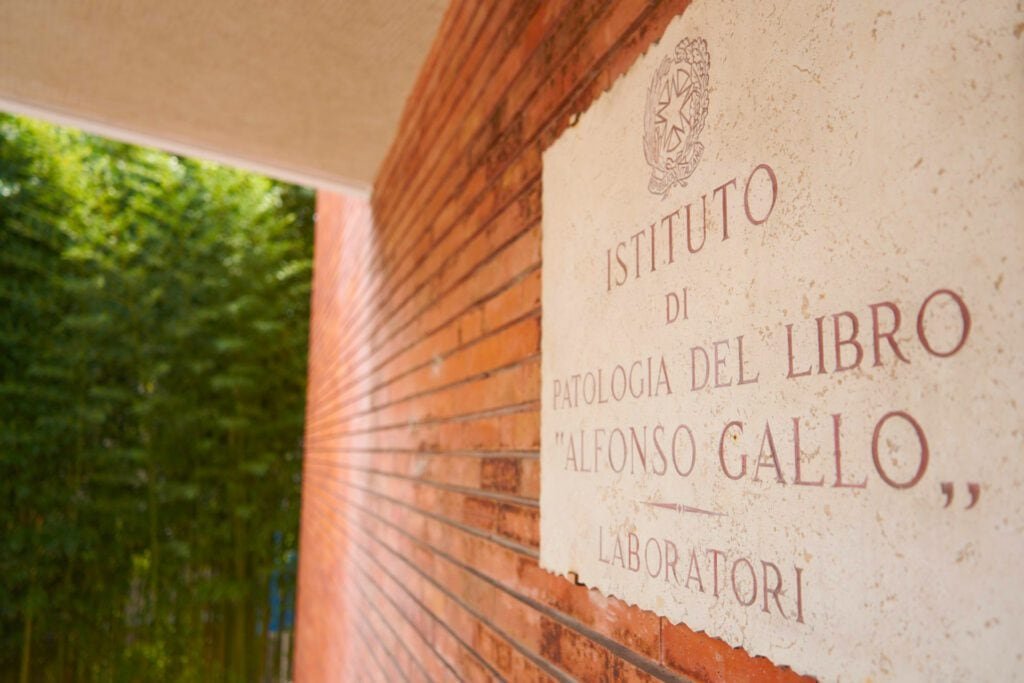
The ministerial name has changed several times and it's worth keeping in mind, because all the earlier versions still circulate on maps and in guidebooks. The body founded in 1938 was called the Royal Institute of Book Pathology, and after Alfonso Gallo's death in 1952 it was named after him. In 2007, with Presidential Decree No. 233 of November 26, 2007, the Central Institute of Book Pathology merged with the Center for Photoreproduction, Bookbinding and Restoration of the State Archives, created in 1963 at the Ministry of the Interior, and the resulting body took the name Central Institute for the Restoration and Conservation of Archival and Book Heritage, abbreviated ICRCPAL. With Prime Ministerial Decree No. 169 of December 2, 2019, article 33, the name became the current one: Central Institute for the Pathology of Archives and Books, ICPAL. Its internal organization was then regulated by Ministerial Decree No. 46 of February 3, 2022. It is an office with special autonomy, with scientific, financial, organizational and accounting autonomy.
The museum, on the other hand, kept the founder's name. Whoever looks for the Museum of the Central Institute of Book Pathology Alfonso Gallo and whoever looks for the ICPAL exhibition area is looking for the same address and the same door. A practical tip: when you write to book, cite both names. They will answer you sooner.
Alfonso Gallo, the man who invented book pathology
Alfonso Gallo was born in Aversa on March 24, 1890 and died in Rome on December 1, 1952. He earned a degree in literature in Naples, where he studied with Michelangelo Schipa and Giuseppe De Blasiis, and he also attended the medical school up to the fifth year without graduating. It is a biographical detail that explains everything else. When he later talks about diseases, diagnoses, therapy and prophylaxis applied to books, he won't use literary images, he'll use the vocabulary he had studied at his school desk. In 1919 he completed his training at the school of paleography in Florence with Luigi Schiaparelli.
His career unfolded among schools, libraries and universities. He taught in secondary schools from 1919, became a bibliographic inspector in 1926, held the chair of bibliography and library science in Rome until 1949, was among the founders of the Italian Library Association in 1930 and headed the National Agency for Popular and School Libraries. In 1929 he managed to create a small laboratory at the abbey of Grottaferrata, with modest technical means. It is the prototype, on the smallest scale, of what would become the Roman institute.
At the beginning of 1938 Gallo presented the project to Giuseppe Bottai, then minister of National Education, who approved it. Gallo himself drafted the texts of Royal Decree No. 1038 of June 23, 1938 and Royal Decree No. 1444 of September 13, 1940, which established the Institute of Book Pathology. He directed the institute until his death. He published two books that remain the foundation of the discipline in Italian: Le malattie del libro, le cure ed i restauri, published in Milan in 1935, and Patologia e terapia del libro, in Rome in 1951. The institute's activity was documented year by year in the reports published in Accademie e biblioteche d'Italia and in the new Bollettino dell'Istituto di patologia del libro. He was invited to give lectures in Switzerland in 1948 and 1952, in Spain in 1950, and in Belgium in 1951.
A personal judgment, which you won't find on the plaques: Gallo is one of the very few Italian cultural officials of the 20th century to have invented a discipline instead of merely administering it. The fact that his name is known to a few hundred specialists and to no one else is a small Roman injustice.
Why books get sick: the discipline born on Via Milano
Book pathology starts from an elementary and uncomfortable observation. A book is a composite object: cellulose, glues, gelatins, alum, tanned hides, hemp thread, cardboard, metals, pigments, binders. Each of these materials ages on its own schedule and reacts with its neighbors. A 16th-century volume and a 1965 paperback degrade in different ways, and for different reasons. Gallo's idea was to study the book in its materiality with the tools of the natural sciences, calling chemists, biologists and physicists to work alongside librarians, and to treat restoration as a therapy to prescribe after a diagnosis, not as a workshop trade handed down by eye.
The institute's modern diagnostics confirm that approach. The Biology Laboratory, for example, is divided into two sections, microbiology and entomology, and identifies filamentous fungi, bacteria and insects with classic culture methods, biochemical and molecular analyses, scanning electron microscopy, metabarcoding and metagenomics. On the other side of the corridor, chemists and physicists measure the pH of paper, identify inks and assess the effect of light. The museum is the teaching showcase of this work. What you see in the display cases is the clinical case history accumulated over 85 years.
The home of the Museum of the Central Institute of Book Pathology Alfonso Gallo: a garden with a tower inside
The area occupied by the institute has a remarkable urban stratigraphy. In Roman times, from the Republic to the late empire, a neighborhood developed here with public buildings, the Lavacrum Agrippinae and the Thermae Olimpiadis, private homes and rich patrician residences. They were abandoned between the 5th and 6th centuries, when the zone between the Viminal and the Esquiline was redrawn by the new basilicas, starting with Santa Maria Maggiore.
On the map of Rome engraved by Giovanni Battista Nolli in 1748 the area belongs to the Poor Clare nuns of San Lorenzo in Panisperna, with the convent and the church. After September 20, 1870 and the transfer of the capital, Quintino Sella's plan assigned the Viminal to the great Botanical Garden of Rome and to the scientific and medical institutes of La Sapienza University. The state expropriated church and monastery in 1873, exotic and rare species were planted on the hill, and the new homes of the Institutes of Physics and Botany went up. Then the city decided to open Via Palermo and Via Milano, which cut the zone in two, and in 1883 the Botanical Garden was moved to its current home at Villa Corsini alla Lungara. In 1913 work began on the Ministry of the Interior on the Viminal. In 1938 the scientific institutes moved for good to the University City, and the area of the Institute of Botany and the Institute of Histology and Physiology was assigned to the Royal Institute of Book Pathology.
One thing follows that visitors don't expect: the main building of the ICPAL is the building that housed the Institute of Botany, and the garden around it keeps traces of the 19th-century Botanical Garden. Very rare plants survive, the Aghatis and the Araucaria, both native to Australia, and the Phytolacca, native to Brazil and Argentina, present in one of the few specimens imported by Prince Ladislao Odescalchi, a passionate botanist, on his return from a trip to South America.
And then there is the tower. In the garden stands a small tower called the Capocci tower, already marked on Nolli's map, probably built for guard duty and defense. A document in the Vatican Archive, in the Registers of Petitions, volume 1116, folio 95, year 1501, reports that the tower was brought as a dowry to the nuns of San Lorenzo, together with the surrounding gardens, by a young woman of the Capocci family. Hence the name. In times closer to ours, a printing workshop and a paper mill rebuilt on medieval models operated inside the tower. Keep that in mind: in a garden on the Viminal, inside a 15th-century tower, paper was made by hand as in the 13th century.
The route through the Museum of the Central Institute of Book Pathology Alfonso Gallo, display case by display case
The 2001 layout organizes the story in a sequence of introductory panels and numbered display cases. I'll describe them all, because it is the only way to give an idea of what you see. There are no masterpieces to photograph, there are 60 consecutive demonstrations. Anyone who walks in thinking they'll get through it in 20 minutes has miscalculated.
The introductory panels of the Museum of the Central Institute of Book Pathology Alfonso Gallo
The first panel presents the Central Institute of Book Pathology: what it is, when it was born, what skills it brings together. The second illustrates the institute's activities, that is restoration, conservation, research, consulting, prevention, training, international cooperation and scientific information. The third panel concerns the museum as such, its teaching function and the criterion by which the objects were chosen. The fourth reconstructs the history of the museum, from the initial collection of 1938 to the current layout. These are four panels that many visitors skim quickly to get to the display cases. They are wrong, because without that frame the display cases that follow look like a collection of oddities instead of an argument.
Display cases 5, 6 and 7 of the Museum of the Central Institute of Book Pathology Alfonso Gallo: anatomy, materials and nomenclature
Display case 5, Anatomy of the Book, takes the volume apart into its pieces: gatherings, leaves, sewing, headbands, spine, boards, stubs, pastedowns. Display case 6, The Materials of the Book, lines up the substances the book is made of: plant fibers, animal skins, glues, threads, metals. Display case 7, Nomenclature of the Book, teaches you to call things by their name, which in restoration is not pedantry but a working condition. Whoever can't tell a guard from a patch can't describe damage or document an intervention. These three display cases are the grammar of the museum. I recommend reading them slowly, otherwise the 60 display cases that follow become a list.
Display cases 8, 9 and 10: the journey of paper and the rags
Display case 8, The Journey of Paper, tells the path of paper from the Chinese invention to the birth of the Fabriano manufacture, passing through the Arab world and Spain. Display case 9, From Rags to Paper, explains the making: linen and hemp rags macerated, shredded, reduced to pulp and gathered by hand with the mold. Display case 10, The Sheet of Paper, shows the result, with laid lines and chain lines impressed by the wire mesh.
It is worth knowing what happened in Fabriano, because the museum takes it for granted. In 1264 the trade in cotton paper is attested in the Esino valley. The Fabriano master papermakers introduced three innovations that changed the history of the European book: the hydraulic stamper with multiple hammers, an adaptation of the wool-processing machine, which replaced the Arab hand beating. Sizing with animal gelatin, obtained from the scraps of the local tanneries, in place of starch glue. And the watermark. The second innovation had a legal effect: gelatin-sized paper was strong enough to dispel the distrust that in 1231 had led Frederick II to ban its use for public documents.
Display case 11: the watermark and the countermark
Display case 11 is devoted to the watermark, from its invention to the countermark, a mark similar to the watermark but different in the size of the design or in the use of letters in place of a figure. The watermark is the signum you see by holding the sheet up to the light, obtained by sewing a shaped metal wire onto the mold. It appears in the last decade of the 13th century and serves to mark a paper mill's production. The oldest documented Fabriano marks date to 1293 and come from the municipal historical archive: a Greek cross, the infinity symbol, the letters I and O.
For anyone studying manuscripts and incunabula, the watermark is a formidable dating tool. By identifying the mark you narrow the chronological range of a sheet to within a few years. It is not a scholar's nicety. It is the reason the institute has built up, over time, one of the most important Italian collections of watermarked papers.
Display cases 12 and 13: the papers of our time and the Paper Project
Display case 12, Papers of Our Time, deals with industrial paper: the paper that made the book accessible to everyone and that, by a trick of chemistry, lasts less than the paper made by hand five centuries ago. Display case 13, devoted to the Paper Project, shows the analysis carried out on over 1,600 sheets from books of the 15th century to study their evolution: composition, thickness, sizing, behavior over time. It is the kind of serial research that makes the difference between an opinion and a data point.
If I had to name the most instructive display case in the museum for a contemporary reader, I'd name these two. An incunabulum from 1470 on rag paper is often in better condition than a novel from 1955 on wood-pulp paper. Modernity, in a library, ages worse.
Display case 14 of the Museum of the Central Institute of Book Pathology Alfonso Gallo: before paper, from tablets to papyrus
Display case 14 shows the writing materials that came before paper: the tablets of the Greek and Latin world, waxed and unwaxed, Egyptian papyrus, the styluses and the other tools used for writing. Papyrus comes from the pith of Cyperus papyrus, cut into overlapping strips laid in two crossed layers and pressed. The plant's own sap acts as the glue. It is light, it rolls up, it takes writing well on one side only, and in a dry climate it lasts millennia. In a humid climate, like the Italian one, it flakes apart. Wax tablets were used for notes and accounts, erased with the back of the stylus and reused: the school notebook of antiquity.
Display case 15: the format of the sheets
Display case 15 explains a matter that seems technical and instead decides the look of every old book: the format. The sheet produced at the paper mill was folded once to get the folio, twice for the quarto, three times for the octavo, and so on. The format determines the arrangement of the watermarks, the direction of the laid lines, the number of leaves per gathering and, ultimately, the price of the book and its audience. Bibliographers have used it for centuries to spot forgeries.
Display cases 16 and 17: parchment, skin and lime
Display case 16 is devoted to parchment and case 17 to the relationship between skin and parchment. Parchment is made from sheep, goat and calf skins, not tanned but dehaired in a lime bath, stretched on a frame, scraped with the crescent knife and thinned to the point of transparency. The name comes from Pergamum, and the ancient tradition, reported by Pliny, ties its spread to the rivalry between the library of Pergamum and that of Alexandria. Parchment is the support of the European medieval codex. It reacts to humidity by warping, shrinks with heat and readily hosts fungi, but if well kept it outlives paper by a long way.
The museum also shows the less noble side of the matter: parchment is skin, and skin is an organic material that the institute's biologists study the way they would study a tissue. In front of these two display cases it is worth remembering: an illuminated codex is, from a material point of view, a dead animal that someone has painted on.
Display case 18 of the Museum of the Central Institute of Book Pathology Alfonso Gallo: inks and pigments
Display case 18 shows the pigments used to make inks, including lampblack, and the binders that make the ink adhere to the support, including gum arabic and gum tragacanth. It is one of the most important display cases in the museum, because it introduces the great culprit in the degradation of European manuscripts: iron gall ink, made from oak galls, ferrous sulfate and a binder. Beautiful, stable, indelible, and acidic. In the worst cases it eats through the paper, boring holes along the line of the writing, and the text reads in negative, like lace.
Display cases 19 and 20: the birth of printing and the spread of the book
Display case 19 tells the birth of movable-type printing and case 20 the spread of the printed book. For Rome it is worth recalling a fact that concerns this city directly: printing arrived in Italy in 1465 at Subiaco, in the monastery of Santa Scolastica, with the Germans Conrad Sweynheym and Arnold Pannartz, who three years later moved to Rome, into the house of the Massimo family. Rome was therefore, together with Venice, one of the first great printing centers on the peninsula. The museum doesn't tell this story in detail, but the two display cases serve to frame the passage from the copied book to the multiplied book, and with it the change of scale in the conservation problem. When books number in the thousands, damage becomes a statistical phenomenon.
Display cases 21, 22 and 23: making the codex, clasps and wooden boards
Display case 21 shows how a codex is made, that is, how you go from loose gatherings to the sewn volume. Case 22 displays clasps, bosses and corner pieces, and case 23 the wooden boards. The two display cases present elements that protect the binding and decorate it at the same time. The bosses keep the board raised off the shelf when the book lies flat, the corner pieces save the corners, the clasps close the volume and stop the parchment from warping. The wooden boards are the actual covers of medieval codices, oak or beech, covered in leather.
Whoever pictures the library as a place of books standing on shelves has to redraw the picture. Until the 16th century volumes lay horizontally, often chained to the desk, and all the hardware displayed in these cases served to protect them in that position.
Display cases 24, 25 and 26: skins, leathers and decorated covers
Display case 24 is devoted to skins and leathers, case 25 to making the book, case 26 to decorated covers. You see the techniques for decorating the cover: blind impressions with tools and rolls, gilding with gold leaf, leather mosaics, marbling. The binding is the part of the book most often sacrificed by careless restorations, and yet it is the part that carries the most precious information on the circulation of the copy: who owned it, where it was bound, when it was reworked.
Display cases 27 and 28: binding through the centuries and the census of medieval bindings
Display cases 27 and 28 show the evolution of cover decoration and of the techniques for sewing the gatherings, and document the census of medieval bindings, one of the institute's long-term research projects. The census serves to build a typology: raised cords of alum-tawed leather or rope, chain-stitch sewing, headbands on a core, spine linings. From these details an expert binder derives place and period with a margin of error of a few decades.
In front of these display cases, look at the spine, not the board. The board is the public face, the spine is the medical chart.
The enemies of the book in the display cases of the Museum of the Central Institute of Book Pathology Alfonso Gallo
From display case 29 to 40 you enter the clinical part of the collection: the damage caused by fungi, insects, other animals, fires, wars, natural disasters and incorrect use of the book. It is the section that kids remember for years, and not out of a taste for the macabre. It is because it is the first time they see a familiar object attacked by a living organism.
Display case 29: damage to the book
Display case 29 introduces the classification of damage, which in the institute's tradition falls into three big families: physical agents, chemical agents, biological agents. The distinction is not academic. It serves to decide what to do. Active biological damage requires immediate treatment to stop the infestation, chemical damage requires an intervention on the support, and physical damage often requires only a new housing and a different placement.
Display case 30 of the Museum of the Central Institute of Book Pathology Alfonso Gallo: paper degradation and acidity
Display case 30 shows the degradation of paper. Acidity is enemy number one, and it comes from several directions: from the alum used in gelatin-based sizing and the rosin used in industrial paper, from iron gall inks, and from air pollution, in particular sulfur compounds. Acid hydrolysis breaks the glycosidic bonds and depolymerizes the cellulose chains. The paper loses mechanical strength, yellows, becomes brittle and crumbles at a touch. On top of this comes oxidation, which attacks the reducing ends of the chains and triggers further degradation processes.
I'll translate for those who haven't spent time in a laboratory: an acidic sheet is a sheet that is eating itself, slowly, even shut in a cabinet in the dark. That is why deacidification, which a later display case covers, is not cosmetics but therapy.
Display case 31: environmental factors of degradation
Display case 31 deals with environmental factors. There are four and they act together: relative humidity, temperature, light and pollutants. High relative humidity activates chemical processes and opens the way to biodeterioration. To prevent it, the advice is to keep it under 65 percent, and lower still where the risk of foxing is high. The reference temperatures for storage rooms are around 20 degrees Celsius, avoiding swings, which are more harmful than the absolute values. Light, and in particular the ultraviolet component, causes color changes and weakens the fibers.
If you have family books at home, this display case is worth the trip by itself. The rule: no book above a radiator, no book against a damp outer wall, no book exposed to the sun from a south-facing window. You need nothing else to extend the life of a 50-year-old home library.
Display case 32: microorganisms
Display case 32 shows microorganisms: filamentous fungi and bacteria. Fungi are the first to arrive when humidity rises, because their spores are everywhere and are just waiting for the right conditions. They produce enzymes that break down cellulose, pigments that stain irreversibly, and organic acids that keep working even after disinfection. A mold stain on old paper is never just a stain. It is the sign of an episode of condensation or flooding, and the restorer reads it the way a doctor reads a scar.
Display case 33: some insects
Display case 33 presents the insects that frequent libraries. There are fewer of them than imagination suggests, but relentless. They need starch, glue, gelatin, cellulose and protein, and in a book they find everything together. Living alongside humans has made them discreet. They work in the dark, in volumes that nobody has opened in 20 years, and that is why in historic libraries the periodic check of the least consulted shelves is the real preventive measure.
Display case 34: termites
Display case 34 is devoted to termites, which can gnaw through volumes, even carving out big voids inside them. The termite is a structural problem before it is a library problem. It attacks the wood of shelves, frames and floors, and reaches the book as a consequence. A termite infestation in an archive is not solved by treating the volumes. It is solved by working on the building.
Display case 35 of the Museum of the Central Institute of Book Pathology Alfonso Gallo: woodworms
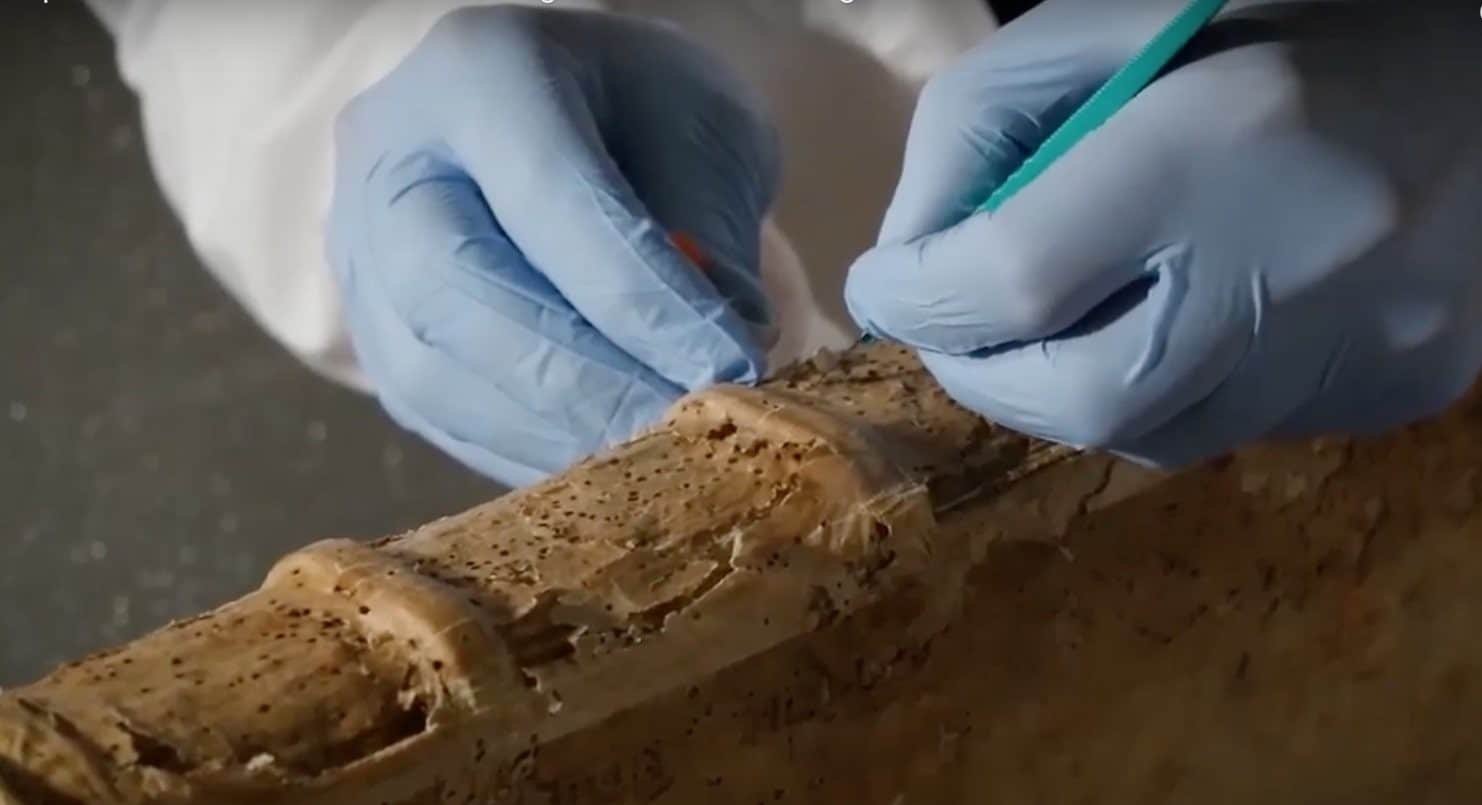
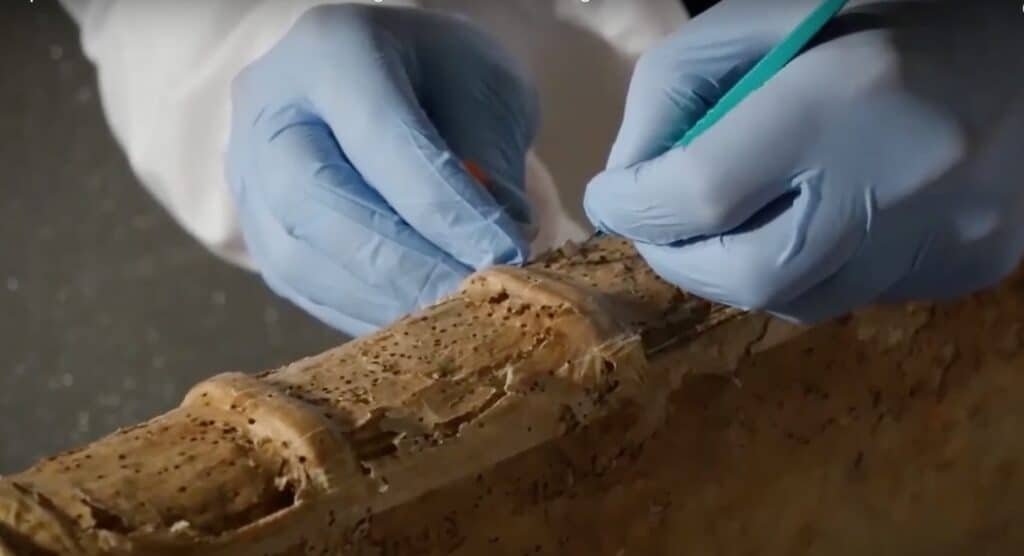
Display case 35 is the one on woodworms, that is, the larvae of anobiid beetles that dig tunnels through the gatherings. The woodworm's tunnel is recognizable by eye: a round hole, one or two millimeters wide, that runs through dozens of leaves in an almost straight line, with light-colored boring dust showing when you leaf through. Whoever sees a heap of very fine dust under a volume should know it isn't dust. It is the book coming out of the book.
The museum also displays a fact that always amuses visitors: there are insects that are parasites of parasites. Scleroderma lays its eggs on the larvae of the anobiids, and its own larvae feed on the still-living host larvae. Biological control, in this field, has a long experimental history.
Display case 36: the other animals, from silverfish to the mouse
Display case 36 collects the other animal enemies, and each deserves a paragraph.
The silverfish does surface damage: it gnaws the surface of sheets, with a preference for those where mold is present. Besides starch it needs protein, which it gets from the gelatin of photographic emulsions and from the adhesives of prints and bindings. It has sensory organs that let it detect sources of water. A large presence of silverfish signals high humidity in the room. It is a warning light before it is damage.
The booklouse feeds on mold and on the glues in paper. Moving from one volume to another, it leaves droppings that molds colonize. Some fungal spores pass unharmed through its digestive system and are expelled with the feces, giving rise to new colonies. It is a vector, as well as a pest.
Cockroaches eat anything: paper, leather, cloth, adhesives. Their chewing apparatus adapts to different needs. They leave comma-shaped droppings with a characteristic smell, which damage the support and encourage bacterial infections, and while chewing they release a liquid that stains. They are also a vehicle for diseases such as typhus and cholera, which makes their presence a hygiene problem even before a conservation one.
The house mouse, Mus musculus, gnaws books and library furnishings, including electric cables, with a risk of short circuits, and attacks shelves until they sometimes collapse. Its presence is established from the type of gnawing and from the droppings. In a historic library the mouse is the least elegant damage and the most expensive.
Display case 37: fires
Display case 37 is devoted to fires. Fire produces three types of damage: combustion proper, which destroys. Heat, which chars the margins and shrinks parchment until it is stiff as horn. And the water used to put the fire out, which often ruins more than the flames. In Italian history the episode behind this display case is the fire at the National University Library of Turin, in the night between January 25 and 26, 1904, which destroyed or mutilated about 1,500 manuscripts, a third of the collection, as well as tens of thousands of volumes and periodicals and archives of the library. There were no deaths, but the loss had international resonance and produced two lasting consequences: new rules on safety in cultural institutions, and the birth, in 1905, of the first Italian restoration laboratory, at the Castello del Valentino, directed by Carlo Marrè, which turned out about 650 recovered manuscripts.
Display case 38: wars
Display case 38 concerns wars. Bombings, arson, requisitions, emergency transfers to damp shelters: 20th-century Europe invented new ways of destroying libraries. The theme touches the institute closely, born in 1938, that is on the eve of the conflict that would test every protocol for protecting Italian book heritage.
Display case 39: natural disasters
Display case 39 is the one on natural disasters. At the origin of the collection there are two specific events that the 1938 museum wanted to document: the Turin fire of 1904 and the Messina earthquake of 1908. Since then the list has grown longer: floods, landslides, collapses, and in recent times the earthquakes of central Italy, which struck parish archives and convent libraries. The display case serves to say something uncomfortable: in conservation, risk is not a possibility, it is a design variable.
Display case 40: use and abuse
Display case 40 closes the section with the damage caused by people in everyday use: pages with dog-eared corners, spines broken to keep the book open, adhesive tape, metal paper clips that rust, underlining, cut-outs, stamps, home repairs with the wrong glues. The truth the museum tells without beating around the bush is that the distracted reader does more damage than the woodworm, because the woodworm works on a few volumes and the reader on all of them.
Foxing and the stains that nobody can fully explain
There is a kind of damage that appears in almost every family library and that almost nobody can name: foxing, which Italians call fioritura. It shows up as areas, stains and speckling of reddish brown or yellowish brown color, small, with irregular edges, which radiate from a central point in all directions or move from the margin inward. Under ultraviolet light the stains fluoresce. They affect ordinary paper, banknotes, stamps, photographic prints and even textiles, and they are more frequent in paper produced with mechanical techniques between the end of the 18th century and the 19th century.
On the causes, the debate has been open for decades. One explanation points to metal deposits, iron and copper, present in the raw material or released by the iron parts of mechanical beaters. Another attributes the phenomenon to the growth of fungi or bacteria, encouraged by humidity. A third, today the most accepted, considers foxing a multifactorial phenomenon, in which chemical, biological and environmental components come together, with relative humidity above 50 percent as the trigger. Historical treatments involved bleaching solutions such as calcium hypochlorite or hydrogen peroxide and reducing agents such as sodium borohydride. Recent research has also tried ultraviolet laser technologies.
A firm opinion: foxing is the damage most mistreated by private owners. There are 19th-century books ruined for good by household bleach applied with cotton. If you have a book with foxing, the right thing to do is lower the humidity and leave it alone.
Display case 41 of the Museum of the Central Institute of Book Pathology Alfonso Gallo: Amori... molesti, the bibliophile with the scissors
Display case 41 is titled Amori... molesti and tells the mania of Pio Amori, a bibliophile who cut emblems, mottos, letters and characters of different alphabets out of entire books to build thematic collections for himself. His collection, which entered the institute in 1940, includes about 2,400 watermarked sheets and 28,000 pieces. The display case plays on the double meaning of the name: the love of books that turns into a nuisance to books. It is the most ironic piece in the layout and also the most instructive, because it shows that collecting can be a form of destruction.
Something some people won't like: a bibliophile's library is almost never a safe place. Respect for the object and the urge to own a fragment of it sit badly together.
Museum of the Central Institute of Book Pathology Alfonso Gallo
Prevention at the Museum of the Central Institute of Book Pathology Alfonso Gallo
The third section of the tour changes register: after diagnosis, prophylaxis. These are the display cases that interest people who work in libraries and archives the most, and the ones the general public walks through too fast.
Display case 42: indirect prevention
Display case 42 concerns indirect prevention, that is, everything done on the environment and not on the object: control of temperature and relative humidity, air filtering, light shielding, choice of furnishing materials, design of storage rooms, management of consultation routes. It is the least spectacular and most effective part of the trade. A well-designed storage room saves decades of restorations.
Display case 43: direct prevention
Display case 43 covers direct prevention: dusting, custom-made enclosures in acid-free cardboard, retaining bands, supports for consultation, correct handling. Here too, minimal gestures with enormous effects. The right box around a degraded volume is worth more than a postponed restoration.
Display case 44: the principles of conservation
Display case 44 sets out the principles of conservation, that is the implicit code of ethics of the contemporary restorer: minimum intervention, reversibility of the materials used, recognizability of additions, chemical and physical compatibility with the original, complete documentation of every operation. Whoever thinks of restoration as remaking is left disoriented. Here the declared goal is to remove as little as possible and add as little as possible.
Display case 45: the fight against insects and disinfestation without poisons
Display case 45 shows a device for fighting insects. The principle is anoxic disinfestation. The infested volume is sealed in a barrier enclosure, the air inside is extracted and replaced with nitrogen, the residual oxygen drops to values close to zero and the insects die at every stage of development, eggs included. The method applies to paper, parchment, wood, leather, textiles and composite objects, leaves no toxic residues, doesn't alter the materials and doesn't require poisonous gases like those used in the first half of the 20th century. It is one of the silent revolutions in conservation of the last few decades. It has made it possible to treat entire collections without endangering operators and readers.
Restoration in the display cases of the Museum of the Central Institute of Book Pathology Alfonso Gallo
The last part of the tour follows the restorer's work step by step. There are 15 display cases, and whoever arrives tired gets through them in five minutes. A shame, because this is the section where the museum moves from describing the damage to demonstrating the method.
Display case 46 of the Museum of the Central Institute of Book Pathology Alfonso Gallo: the restorer's tools
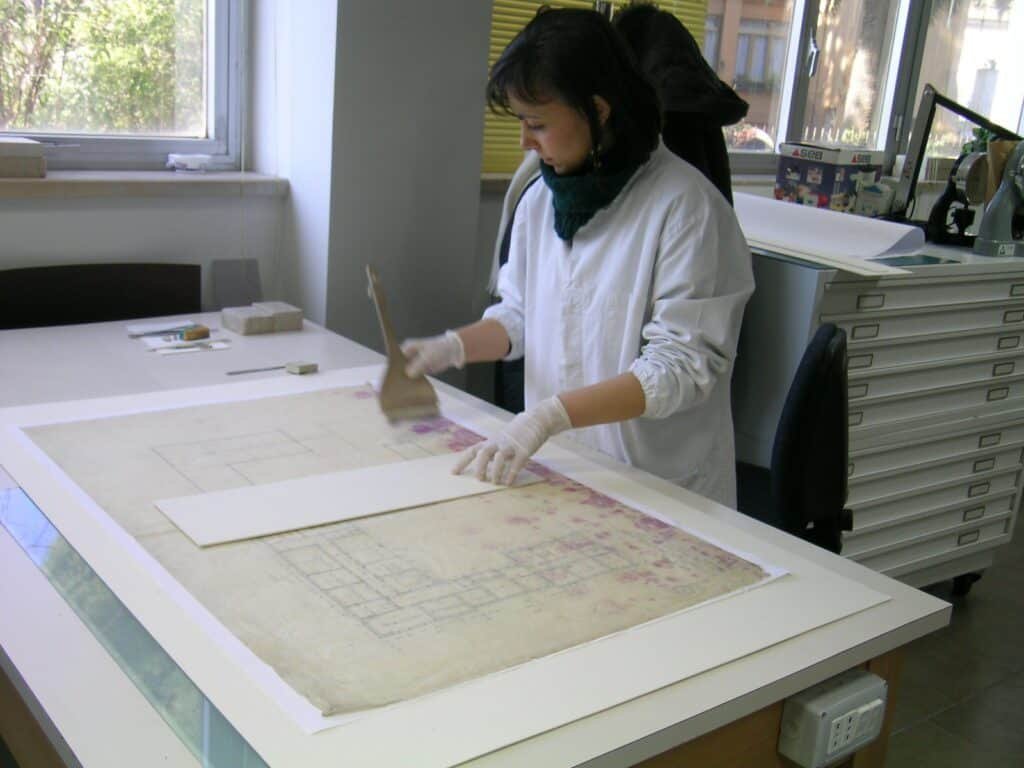
Display case 46 shows the tools of the trade, many of them old and surprisingly simple: scalpels, spatulas, brushes of different hardness, bone folders, spoons, needles, tweezers, frames, presses, covered lead weights, support boards. A restoration bench looks more like an operating table than a chemistry lab. The historic tools kept here also document the evolution of the profession. Some come from the institute's first equipment and are still in use today in almost identical form.
Display case 47: the preliminaries of restoration
Display case 47 concerns the preliminaries: examination of the object, survey of its state of conservation, systematic photography before the intervention, pH measurements, solubility tests of the inks, restoration record. No hand touches the volume before this phase is closed. The principle is that restoration erases evidence. What isn't documented beforehand is lost forever.
Display case 48: washing the paper
Display case 48 shows washing, that is the controlled immersion of the sheets in water to remove soluble degradation products, stains and old glues. It seems a brutal operation, and in inexperienced hands it is. Before wetting a sheet you have to know whether the inks hold, whether the miniatures are stable, whether the paper still has enough cohesion. Well-executed washing restores elasticity and lowers acidity. Badly executed washing dissolves the document.
Display case 49: deacidification
Display case 49 covers deacidification, the treatment that neutralizes the acidity of the support and deposits an alkaline reserve meant to counter future acidification. It is done by immersion in aqueous solutions or by other methods, including non-aqueous ones, for materials that can't tolerate water. Together with washing, it is the intervention that extends the life of a 19th- or 20th-century paper more than any other.
Display cases 50 and 51: restoring parchment and restoring paper
Display case 50 is devoted to the restoration of parchment and case 51 to that of paper. They are two different trades. Parchment is treated with controlled humidity and gradual tensioning, because it reacts like a skin: it softens, stretches, dries under weight. Paper is mended with Japanese paper, very thin and long-fibered, and with reversible adhesives based on starch or methylcellulose. Losses are also filled by machine, with the veiling technique or with pulp filling. The criterion stays the same: the repair must be recognizable on close examination and removable without damage.
Display case 52 of the Museum of the Central Institute of Book Pathology Alfonso Gallo: Ego... ligavi istum librum
Display case 52 takes its title from the Latin formula Ego... ligavi istum librum, the colophon with which the medieval binder declared that he had bound the volume. Besides the manuscript that bears that wording, the display case illustrates the three goals that modern restoration pursues together: safeguarding the historical information deposited in the object, restoring the function, that is giving back a book that can be opened and read, and protecting the aesthetic appearance. When the three goals conflict, and they often do, the first one wins.
Display case 53: a partial intervention
Display case 53 documents a paradigm shift introduced in the 1980s: the choice of limited interventions, aimed at stabilizing the volume instead of fully remaking it. It is the practical consequence of the principle of minimum intervention. A book that holds together, can be consulted and doesn't get worse is a restored book, even if it stays visibly wounded.
Display case 54: intervening without altering
Display case 54 shows how to intervene without altering, that is with compatible materials, reversible adhesives, sewing that reuses the original holes, repairs that respect the direction of the fibers. Invisible restoration, which in the 20th century was an ideal, is now considered a mistake. It falsifies the history of the object.
Display case 55: restoring the wooden boards and the metals
Display case 55 concerns the restoration of the wooden boards and the metal parts of the binding: consolidation of wood degraded by insects, replacement of missing parts, cleaning and stabilization of bosses, clasps and corner pieces, treatment of corrosion. It is the point where book restoration meets the restoration of wooden and metal artifacts, and where the institute works in close contact with other specializations.
Display case 56: conserving in order to study
Display case 56 shows volumes that it was not possible to restore and that are kept as they are, for study. It is a precise methodological choice: when an intervention would cause a loss of information greater than the benefit, you give it up. In a culture that insists on repairing everything, this display case is a lesson in professional humility.
Display cases 57 and 58 of the Museum of the Central Institute of Book Pathology Alfonso Gallo: Restoration?
Display cases 57 and 58 carry a title with a question mark and show badly done restorations: crude repairs, irreversible glues, cut-outs, trimmings that amputated margins and ownership notes, adhesive tapes applied with the best intentions. The dilemma these two display cases pose is the real one of the trade: how far should you intervene, and is it really wise to intervene at all? Many of the damages displayed here were produced by people who wanted to save the book.
Display cases 59 and 60: Per gradus
The last two display cases, grouped under the title Per gradus, document Italian interventions of the late 19th century, with the date 1898 as a reference point. They serve to close the circle. They show that book restoration has a history of its own, with dated and recognizable techniques, and that every era believed it was the definitive one. In 50 years, someone will display our interventions with the same gaze.
The laboratory of the Museum of the Central Institute of Book Pathology Alfonso Gallo where you touch the materials
The tour ends in a room set up as a laboratory, where you can handle the materials used in restoration: Japanese papers of different weights, parchments, skins, glues, threads, cloths. In the same room you watch period documentaries and more recent footage that tell the evolution of the institutional history and the most demanding interventions tackled by the laboratories. For schools it is the best part of the visit, and for adults too. Japanese paper has to be touched at least once to understand why it changed 20th-century restoration.
The nine laboratories behind the Museum of the Central Institute of Book Pathology Alfonso Gallo
The museum is the visible part of a scientific machine organized into nine technical and scientific laboratories: Restoration, Preventive Conservation, Conservation of Digital Media, Technology, Environment, Biology, Chemistry, Physics, Film Restoration. Alongside these there are a specialist library, a historical archive, a photo library and the teaching exhibition space.
It is worth pausing on two entries in that list, because they explain how far the discipline has widened. The laboratory for the conservation of digital media tackles a problem Gallo could not have imagined: the fragility of electronic formats, which age not through corrosion but through the obsolescence of the reading devices. The film restoration laboratory deals with film stock, that is, supports that have a specific pathology, from the decomposition of nitrate films to the vinegar syndrome that affects those in triacetate. Book pathology, born for codices and 16th-century printed books, now covers the entire range of memory supports.
The 1966 Florence flood and the role of the institute
On November 4, 1966 the Arno flooded Florence. At the National Central Library the water reached the storage rooms and involved a mass of volumes estimated at around a million. Almost 100,000 belonged to the historic collections and were seriously hit. The Magliabechiano collection lost or suffered damage to almost 60,000 units. About 6 million catalog cards were destroyed and tens of thousands of years of periodicals were damaged. In the city the flood caused 39 deaths and left more than 70,000 families homeless.
What happened next is the reason Italian book restoration became an international school. A laboratory of a size never seen before was set up, described at the time as the largest in the world, which began work in the boiler room of the railway station and at Forte di Belvedere, then moved inside the library. The organization was industrial, with separate departments for assessment, cleaning, patching and binding, and the volumes were classified in categories by year of printing. In March 1967 the manuscript rooms reopened. On January 8, 1968 the library became accessible to the public again. Thousands of volunteers, Italian and foreign, went down in history as the mud angels.
The Institute of Book Pathology was called to respond to the Florentine emergency, which appears among the most demanding interventions tackled by its laboratories. 1966 was a watershed between workshop restoration and modern restoration. Before, people limited themselves to removing a stain or resewing a volume. Afterward they began to consider the book a unit composed of different parts, each with its own needs. Starch-based adhesives, methylcelluloses, calcium hydroxide for deacidification, Japanese paper for repairs, quick techniques like guarding, systematic photography, descriptive records, protocols and philological checks came into current use. It was also a lesson in limits. The assembly line made it possible to treat an enormous quantity of material, but it fragmented the work, and from that experience came the reflection that leads to today's documented and recognizable restoration.
Among the interventions that have marked the history of the laboratories are also the restoration of 35 leaves of Boccaccio's Decameron, that of manuscript Piana 3.207 of the Biblioteca Malatestiana, and the recovery of parchment fragments of the Koran datable to the 7th and 8th centuries. It is the measure of the level at which they work behind the door of Via Milano 76.
The specialist library of the Museum of the Central Institute of Book Pathology Alfonso Gallo
The library was born with the institute, in 1938. Gallo described it like this: on the top floor of the building is the seat of the nascent library of the Institute, in which publications of direct interest to our special studies are being gathered. Today it holds about 15,000 volumes and 400 periodical publications, and it is one of the Italian reference collections for conservation, restoration, the history of paper and the archaeology of the book. It takes part in the catalog of the National Library Service.
The special collections are the most precious part. The Pio Amori collection, acquired in 1940, includes about 2,400 watermarked sheets and 28,000 pieces. The Fortini collection, from 1941, gathers 40,000 typographic prints bound in 64 volumes. The Zonghi collection, which came in 1942, holds 135 specimens of Italian watermarked paper from the 13th to the 16th century. The name refers to the Fabriano brothers Aurelio and Augusto Zonghi, the first a canon, the second a mathematician and watermark scholar, who lived between 1840 and 1916, and whose studies on the marks of the old Fabriano paper mills remain the foundation of Italian watermark studies. The Del Pelo Pardi collection, from 1946, counts 8,000 pieces among woodcuts, maps and papal bulls. To these are added the Gallo collection, with the fundamental works on book conservation, and the Bonaventura collection, with scientific texts from 1906 onward.
Consultation is by reservation only, by writing to the library's email address. Anyone with serious research to do finds it open and well assisted. Someone passing through out of curiosity is not who the service is for. If your interest is the history of paper, though, know that in Rome there is no other place like it.
The School of Advanced Training and Study
The institute's declared strength is the School of Advanced Training and Study, active since 2010, attached to Via Milano site. It awards a diploma equivalent to a master's degree and qualifies graduates to work as cultural heritage restorers in professional training track number 5, which covers book and archival material, paper and parchment artifacts, and photographic, film and digital material. The course lasts five years and admission is limited.
Frankly: it is one of the most selective schools in Italy in a field where the jobs really exist, and it remains little known outside the field. Anyone accompanying a young person interested in restoration should bring them here before enrolling them in any private course.
The Museum of the Central Institute of Book Pathology Alfonso Gallo and the Palazzo delle Esposizioni
Via Milano is the street that runs alongside the Palazzo delle Esposizioni, the big building by Pio Piacentini begun in 1880 and inaugurated on January 21, 1883, with its main entrance at Via Nazionale 194 and a ground-floor access right on Via Milano. The palace was born to host the exhibitions of the Società degli Amatori e Cultori di Belle Arti and, between 1931 and 1943, the national art Quadriennali. After the restoration of the first decade of the 2000s it gained a greenhouse, a cinema and an auditorium.
The urban coincidence is more than chance: the same street, opened by the city in the 1880s by cutting the area of the scientific institutes in two, hosts a few dozen meters apart the 19th-century temple of art exhibitions and the laboratory where books are treated. Whoever plans a morning of sightseeing can combine them: an exhibition at the Palazzo delle Esposizioni and, by appointment, the museum at Via Milano 76. It is a five-minute walk, slightly uphill. A little further up, on the other side of Via Nazionale, you reach the Scuderie del Quirinale and the Quirinal Palace in 10 minutes.
A curiosity about the Museum of the Central Institute of Book Pathology Alfonso Gallo
The real curiosity is not about an object in a display case, it is about the garden. Inside the institute's enclosure rises a medieval tower, small and square, built in all likelihood for guard duty and defense, already drawn on the map of Rome engraved by Giovanni Battista Nolli in 1748. It is called the Capocci tower, and the name has a documented explanation: a deed kept in the Vatican Archive, in the Registers of Petitions, volume 1116, folio 95, of the year 1501, reports that the tower was brought as a dowry to the nuns of San Lorenzo in Panisperna, together with the surrounding gardens, by a young woman of the Capocci family. To avoid confusion, it must be said that this is not the better-known Capocci tower, the one that dominates the square of San Martino ai Monti. This is another one, much more discreet, and almost nobody knows it exists.
The sequel is even more curious. In recent times, inside that tower, a printing workshop and a paper mill rebuilt on medieval models have operated. It means that in a corner of the Viminal, in a building of the Middle Ages, paper has been made by hand with the techniques of the 13th-century Fabriano master papermakers: macerating the rags, the mold, the felts, the press, the drying. A museum that exhibits the damage done to paper has built next to itself the place where paper is made. It is the kind of consistency that almost never happens in Rome, and it is worth asking permission to look into the garden when you ask for the visit.
I'll add a detail that completes the picture: the plants in the garden are not recent decoration. They are the survivors of the 19th-century Botanical Garden that occupied this piece of hill before 1883. What remains is an Australian Aghatis and Araucaria and a South American Phytolacca, one of the few specimens imported by Prince Ladislao Odescalchi on his return from a trip to South America. Between an Australian conifer and a 15th-century tower, the museum of sick books has the most improbable courtyard in Rome.
Something nobody tells you about the Museum of the Central Institute of Book Pathology Alfonso Gallo
That it isn't a museum. I say it without a pun: it has no ticket office, no bookshop in the usual sense of the term, no gallery staff to accompany you at the time you prefer, no calendar published month by month like the civic museums. It is the exhibition space of a scientific office, and access depends on the availability of the people who work there. Anyone who shows up at the door of Via Milano 76 without an appointment doesn't get in, however far they've come and however motivated they are. Visits are arranged beforehand, and school groups often get priority because the museum was born for teaching.
The second thing nobody tells you is that response times follow the rhythms of a research institute, not those of an online ticket office. It's best to write at least two or three weeks ahead, say how many of you there are, what kind of interest you have, and propose two or three alternative dates. A message that just says "I'd like to visit the museum" risks ending up at the bottom of the pile. A message that says "we are six cultural heritage conservation students, we are especially interested in the section on biological damage, we are available on these three mornings" gets an answer much faster.
The third, and maybe the most useful: the schedule of the exhibition area can be suspended, for works, reinstallations or service needs. Before organizing a trip, ask for explicit confirmation of the opening for the date you want. It is not a generic cautionary formula. The exhibition spaces inside the Ministry's technical institutes follow the life of the institute, and the life of an institute that restores objects for all of Italy is made of emergencies.
The advice I give you for visiting the Museum of the Central Institute of Book Pathology Alfonso Gallo
Go with a question in your pocket. It is the wrong place for a generic visit and the right place for someone who arrives with a concrete problem: a family book that is crumbling, a thesis on the history of paper, a curiosity about manuscript ink, a parish archive to save. The person who accompanies you works with the materials every day, and the difference between a mediocre visit and a memorable one is made by the quality of the questions you bring.
Second piece of advice, on method: follow the tour in order and don't skip the four opening panels. The museum is built as an argument in three stages, materials, damage, cures, and whoever enters in the middle of the second section sees a collection of ruined books without understanding why they are ruined in that way. Allow at least an hour and a half. With an in-house guide and a group that asks questions, you easily reach two hours.
Third, bring a magnifying glass. Many of the things that matter in these display cases are seen from a few centimeters away: the woodworm's boring dust, the watermark against the light, the corroded line of iron gall ink, the fiber of Japanese paper. A 10x magnifier in your pocket changes the visit. If you have vision problems, ask in advance whether it is possible to get close to the display cases and whether supports are available.
Fourth, and here I give an opinion some will find harsh: don't pair it with a day full of other museums. This place demands attention and gives back a lot to those who have it. Put at most one exhibition at the Palazzo delle Esposizioni and a stroll through the Monti district next to it, and end the day there. Squeezing it between the Colosseum in the morning and the Vatican Museums in the afternoon is the best way to remember nothing of it.
Another well-known fact, yet rarely cited
That Italy invented a discipline and then exported it. In 1938, when Alfonso Gallo obtained from Giuseppe Bottai the approval of the project and wrote in his own hand the texts of Royal Decree No. 1038 of June 23, 1938 and Royal Decree No. 1444 of September 13, 1940, restoration laboratories existed in Europe, but there was no institute that united in a single structure chemists, biologists, physicists, librarians and restorers with the mandate to study the book as an organism. The idea that the degradation of a volume could be diagnosed with scientific method, measured and prevented, and not simply repaired, was born here, in a building that until shortly before had been the Institute of Botany of the University of Rome.
What followed is documented: Gallo was invited to give lectures in Switzerland in 1948 and 1952, in Spain in 1950, in Belgium in 1951, and the Italian model was discussed and imitated. After the 1966 Florence flood that primacy became evident to everyone, because the largest book restoration site ever organized in the world found itself operating in Italy and with Italian expertise, under the eyes of scholars and volunteers who had come from half of Europe and from the United States.
The rarely cited fact is the consequence: many of the conventions that today govern book restoration all over the world, from the reversibility of adhesives to systematic photographic documentation, from Japanese paper for repairs to the recognizability of the intervention, were developed or codified in Italy between 1938 and the 1970s, and in large part at this address. Rome has dozens of monuments that tell its imperial past and none that tells this story, except 60 display cases behind a gate on Via Milano.
The right photo to take at the Museum of the Central Institute of Book Pathology Alfonso Gallo
First rule, and it is not a formality: ask for permission when you book. In the Ministry's technical institutes, photography in the exhibition area and in the laboratories is subject to authorization, and some materials under restoration belong to third-party bodies that don't allow them to be filmed. If permission comes, it comes with conditions, usually no flash and no tripod. Follow them to the letter, because flash is one of the degradation factors that the museum itself documents in the display case on environmental factors.
The best photo, from a narrative point of view, is the cross-section of a volume attacked by woodworm: the tunnel that runs through dozens of leaves in an almost straight line, with the light edges of the boring dust. In a single image there is the whole meaning of the museum, the cultured object and the organism that feeds on it. You need a camera able to focus up close, raking light and patience to find the angle that eliminates the reflections from the glass.
The second image to take home is the watermark against the light, if and when it is possible to see it on a support displayed that way. It is a difficult photograph, because the mark appears only with the light behind the sheet, and it gives a result that surprises anyone who has never seen a 13th-century watermarked paper.
Outside the rooms, the most beautiful photograph is the tower in the garden, with the vegetation of the old Botanical Garden around it: ask whether you can look out. If you don't get permission to photograph inside, you still have the facade on Via Milano, with the slope and the plane trees, and you still have Piacentini's palace a few steps away, which allows as many photographs as you like. A personal opinion: here the right lens is not the wide angle, it is the macro. This museum is photographed from up close.
Some important events that happened here in history
The first event is the founding. In 1938, after the ministerial approval of the project, the area that had housed the Institute of Botany and the Institute of Histology and Physiology was assigned to the Royal Institute of Book Pathology, in the same year in which the university's scientific institutes moved to the University City. In that same 1938 Alfonso Gallo established the museum, to represent the broad case history of damage to the book heritage, and the specialist library on the top floor of the building. An institute, a demonstration collection and a research library were born together, at the same moment and under the same roof.
The second event is the death of the founder, on December 1, 1952, and the naming of the institute after him. From that moment the structure grew without its creator, and continuity was ensured by the school of restorers and researchers he had trained.
The third is November 4, 1966. The Florence flood set in motion the biggest book rescue operation in European history and involved the laboratories of the Roman institute, which the Florentine emergency counts among its major interventions. From that trial came methods, protocols and a generation of restorers.
The fourth is 1974, with the birth of the Ministry for Cultural and Environmental Heritage wanted by Giovanni Spadolini, established by Decree-Law No. 657 of December 14, 1974. The Alfonso Gallo Institute of Book Pathology was absorbed by the new ministry with Presidential Decree No. 805 of December 3, 1975, leaving the orbit of Public Education and entering that of cultural heritage.
The fifth is 2001, the year of the museum's reinstallation, which took on the three-part form and the teaching vocation it has today, designed to be readable at every age.
The sixth is 2007. With Presidential Decree No. 233 of November 26, 2007 the Institute of Book Pathology merged with the Center for Photoreproduction, Bookbinding and Restoration of the State Archives, born in 1963 at the Ministry of the Interior. The Center's assets and skills flowed into Via Milano 76, and the structure took the name Central Institute for the Restoration and Conservation of Archival and Book Heritage. Two different traditions, that of libraries and that of archives, found themselves in the same building. It is the deepest transformation this site has known since 1938.
The seventh is 2010, with the start of the School of Advanced Training and Study, which gave the institute a training role recognized at the university level. The eighth is Prime Ministerial Decree No. 169 of December 2, 2019, which led to the current name of Central Institute for the Pathology of Archives and Books, followed by Ministerial Decree No. 46 of February 3, 2022 on internal organization.
Who has passed through the Museum of the Central Institute of Book Pathology Alfonso Gallo
The first name is that of the founder, Alfonso Gallo, who was the creator and director of this house from 1938 to 1952. Here he brought the experience of the small laboratory created in 1929 at the abbey of Grottaferrata, and here he wrote the second of his major works, Patologia e terapia del libro, published in Rome in 1951.
The second is that of Giuseppe Bottai, minister of National Education, who at the beginning of 1938 approved Gallo's project and made the founding of the institute possible. It was a political signature that, beyond the historical judgment on the man and on the regime, produced a scientific structure that outlived the person who had authorized it.
The directors who succeeded one another over the decades passed through here, among them Nino Grillo, head of the institute from 1952 to 1956, and Giovanni Muzzioli, from 1956 to 1961, in years when the discipline was consolidating and Italian book restoration was beginning to become known beyond national borders.
Then there is a crowd without proper names that counts more than the names: the restorers trained in these laboratories, who after 1966 worked in Florence and, in the following years, in half of Italy. The scholars of paper history who came to consult the watermark collections. The foreign delegations who came to study the Italian model. The tens of thousands of students who have gone through the teaching laboratory from 2001 to today. And there are the collectors, present here through their collections: Pio Amori, the bibliophile who cut emblems and mottos out of books and whose collection entered the institute in 1940, the Zonghi brothers of Fabriano, Aurelio a canon and Augusto a mathematician, whose watermarked papers document five centuries of Italian production, and Del Pelo Pardi, whose collection of woodcuts, maps and papal bulls arrived in 1946.
Finally, and I say it because it is the passage that matters most to a reader: the books pass through here. The Decameron in 35 leaves, manuscript Piana 3.207 of the Biblioteca Malatestiana, the Koran fragments on parchment of the 7th and 8th centuries. In this place the list of illustrious guests is made of objects, not people.
The Museum of the Central Institute of Book Pathology Alfonso Gallo with children and with schools
The museum was born as a teaching museum and remains one. The 2001 layout was explicitly designed to meet the needs of teaching and information for every age group, and the laboratory where you touch the materials is the part that works best with the youngest. The section on damage caused by insects and animals captures even children less interested in the history of the book: the woodworms, the termites, the silverfish and the library mouse have an immediate effect.
Classes are booked through the institute, with ample notice. For elementary school, a visit focused on the making of paper and on the enemies of the book works well, with the final laboratory. For middle and high schools you can raise the level and insist on the chemistry of degradation, prevention and the restorer's trade, which is also excellent career guidance. For children under seven I don't recommend it: the tour is made of display cases and texts, and the attention span required is high.
Accessibility of the Museum of the Central Institute of Book Pathology Alfonso Gallo
The site occupies a historic small building in a complex with a garden, on sloping ground: Via Milano climbs from Via Nazionale toward Via Panisperna, and you feel the difference in elevation. Since access is by appointment anyway, the correct way to proceed is to state your specific needs when booking, wheelchair, mobility difficulties, sensory disabilities, and have the institute point out the practicable route and the most suitable entrance. It is the only way to get a reliable answer instead of a generic promise.
Those who arrive by bus get off at the stop on Via Nazionale in front of the Palazzo delle Esposizioni and face a short uphill stretch. Those who arrive by metro at Repubblica station have a longer but more regular route. By car, the area is inside the limited traffic zone of the historic center and street parking is very scarce: anyone who needs to get close with a vehicle should mention it when booking.
How long it takes to visit the Museum of the Central Institute of Book Pathology Alfonso Gallo
An hour and a half is the sensible minimum. 60 display cases plus the introductory panels and the laboratory can't be crossed in half an hour, and the densest part, the one on damage and restoration, arrives when attention starts to flag. A group of enthusiasts asking questions takes a good two hours. A school class, with the final laboratory, fits comfortably in 90 minutes.
An operational suggestion for those short of time: if you have to compress, compress the first section, the one on materials, and keep the second and third intact. The damage and the cures are the reason this museum exists. The history of paper can be made up from books, the sight of a volume eaten by woodworms cannot.
What to see around the Museum of the Central Institute of Book Pathology Alfonso Gallo
The museum is an excellent excuse for a day in the Monti district and on the Esquiline, which is the part of Rome where you can walk best without running into too many crowds. 50 meters away is the Palazzo delle Esposizioni, with its program of exhibitions. Climbing toward the hill you reach the Scuderie del Quirinale and the square of the Quirinal Palace, with the view over the city from the lookout.
Going down toward the Esquiline instead, in a quarter of an hour you are at Santa Maria Maggiore and at the basilica of Saints Silvestro and Martino ai Monti, which preserves a 3rd-century building under its floor. A little further on, on Via Merulana, the Palazzo Brancaccio houses the collections of the National Museum of Oriental Art Giuseppe Tucci, where among other things you see Eastern writing materials that complete well the discussion begun on Via Milano.
Toward the Forums, in about 10 minutes, you reach the Trajan's Markets, and in 20 the Crypta Balbi, which of all the Roman museums is the one that most resembles this one in approach: both explain a method instead of showing off masterpieces. If the day is rainy, between Via Nazionale and Piazza Colonna there are two covered passages worth a detour, the Galleria Sciarra, with its painted cycle dedicated to women, and the Galleria Alberto Sordi.
The other historic libraries of Rome, for those who have developed a taste
Whoever leaves here with curiosity lit should continue to the city's historic libraries, where the same conservation problems are seen applied to collections in service. The National Central Library of Rome, at Castro Pretorio, is the largest in Italy together with the one in Florence. The Biblioteca Casanatense, on Via di Sant'Ignazio, preserves a monumental 18th-century hall among the most beautiful in Europe. The Biblioteca Angelica, at Piazza Sant'Agostino, is the first European library open to the public. The Biblioteca Vallicelliana, next to the Chiesa Nuova, holds the collections of the Oratorians.
Anyone who has seen on Via Milano what happens to a book left in a damp room looks at the reading rooms of these libraries with completely different eyes. They start noticing the dehumidifiers in the corners, the curtains at the windows, the little tags on the shelving. It is a form of training the eye that few museums know how to give.
When to go to the Museum of the Central Institute of Book Pathology Alfonso Gallo and when to avoid it
The best time is a weekday morning, between 09:30 and noon, when the institute is fully operational and the chance of meeting the people who work in the laboratories is highest. Avoid the periods when schools besiege the bookings, that is the second half of March, April and May. If you are a small group of adults you will have more room in January, February, October or November.
August is the worst season, as for almost all the Ministry's technical facilities: staffing shrinks and extraordinary openings become rare. Anyone who comes to Rome in summer and has only one week available should put this museum at the top of the list of places to book first, well in advance, or postpone it to a later trip.
One last seasonal note: on the occasion of national initiatives of extraordinary opening of cultural institutes, the ICPAL sometimes takes part with guided visits with limited places. These are the best occasions for those without a group, because you can sign up individually. It's worth keeping an eye on the institute's official website, icpal.cultura.gov.it, and its communication channels.
Who the Museum of the Central Institute of Book Pathology Alfonso Gallo is interesting for
It is the right museum for librarians, archivists, restorers, cultural heritage conservation students, book historians, binders, collectors, literature teachers and students in career orientation. It is interesting also for those who have none of these qualifications but own a house full of family papers and would like to stop ruining them. It is perfect for those who have already seen Rome three times and are looking for something that is on no list.
It is not the right museum for those looking for spectacular objects, for those traveling with very small children, for those who have two days in Rome and haven't yet seen the Forums. And it is not the right museum for those who can't stand the idea of booking. That said, if you fall in the first category, put it at the top of the list: few visits leave such a lasting mark.
Quick questions about the Museum of the Central Institute of Book Pathology Alfonso Gallo
Where is the Museum of the Central Institute of Book Pathology Alfonso Gallo
At Via Milano 76, 00184 Rome, in the Monti district, on the southwestern slopes of the Viminal, a few steps from Via Nazionale and the Palazzo delle Esposizioni.
How do you get to the Museum of the Central Institute of Book Pathology Alfonso Gallo
By Metro line A, Repubblica stop, or line B, Cavour stop, and by buses 64, 70, 71, 117, 170 and H, Nazionale/Palazzo Esposizioni stop, from which you turn into Via Milano. From Termini it is about 12 minutes on foot.
Do you need to book to visit the Museum of the Central Institute of Book Pathology Alfonso Gallo
Yes. Access is by appointment arranged with the institute. There is no free entry with continuous hours. You write to ic-pal@cultura.gov.it or call 06 482911.
How much is the ticket for the Museum of the Central Institute of Book Pathology Alfonso Gallo
The museum has no ticket office and visits are arranged with the institute. The conditions of access must be checked directly when booking, on the official website or by email.
What are the hours of the Museum of the Central Institute of Book Pathology Alfonso Gallo
The institute's offices operate Monday to Friday, and the building is closed on Saturday, Sunday and holidays. The time of the visit is set together with the institute when you book.
How long does the visit to the Museum of the Central Institute of Book Pathology Alfonso Gallo last
Between an hour and a half and two hours. With a school class and the final laboratory it takes 90 minutes. A group of enthusiasts asking questions reaches two hours and more.
Can you take photographs at the Museum of the Central Institute of Book Pathology Alfonso Gallo
Photography must be authorized: ask for permission when you book and stick to the conditions given, generally no flash and no tripod. Some materials being worked on belong to third-party bodies and cannot be photographed.
Is the Museum of the Central Institute of Book Pathology Alfonso Gallo suitable for children
Yes from seven or eight years old up, and it works very well with elementary and middle school classes, especially for the section on insects and for the laboratory where you touch the materials. Under seven the tour, made of display cases and texts, is tiring.
What exactly can you see at the Museum of the Central Institute of Book Pathology Alfonso Gallo
60 display cases and four introductory panels divided into three sections: materials and manufacturing techniques of the book, damage and the factors that cause it, prevention and restoration. At the end a laboratory with materials to touch and period footage.
Is the Museum of the Central Institute of Book Pathology Alfonso Gallo wheelchair accessible
Accessibility needs must be stated when booking. The site is a historic small building in a complex with a garden on sloping ground, and the institute can point out the practicable route and the most suitable entrance.
What is the institute called today
Central Institute for the Pathology of Archives and Books, abbreviated ICPAL, the name adopted with Prime Ministerial Decree No. 169 of December 2, 2019. It was previously called the Central Institute for the Restoration and Conservation of Archival and Book Heritage, and before that the Central Institute of Book Pathology.
Who was Alfonso Gallo
A librarian and scholar born in Aversa on March 24, 1890 and died in Rome on December 1, 1952, founder of the institute in 1938 and its director until his death, author of Le malattie del libro, le cure ed i restauri of 1935 and of Patologia e terapia del libro of 1951.
What is book pathology
The discipline that studies the book as a material object subject to diseases. It identifies the physical, chemical and biological agents that degrade it, diagnoses them with scientific methods and defines the therapies, that is prevention and restoration.
Can you visit the library of the Museum of the Central Institute of Book Pathology Alfonso Gallo
Yes, for study and research purposes, only by reservation, by writing to the library's email address, ic-pal.biblioteca@cultura.gov.it. It holds about 15,000 volumes and 400 periodicals.
Does the Museum of the Central Institute of Book Pathology Alfonso Gallo have a bookshop
It is not a museum with structured commercial services like those of the big state museums. The institute's publications and research results are requested directly from the body.
How many laboratories does the institute have
Nine: Restoration, Preventive Conservation, Conservation of Digital Media, Technology, Environment, Biology, Chemistry, Physics, Film Restoration. In addition there are the library, the historical archive, the photo library and the teaching exhibition space.
What is the relationship between the Museum of the Central Institute of Book Pathology Alfonso Gallo and the Palazzo delle Esposizioni
They are street neighbors: the Palazzo delle Esposizioni has its main entrance at Via Nazionale 194 and an access on Via Milano, the same street that at number 76 houses the institute. They pair well in a single morning.
What does the Museum of the Central Institute of Book Pathology Alfonso Gallo have to do with the 1966 Florence flood
The Florentine emergency appears among the most demanding interventions tackled by the institute's laboratories, and from that trial modern book restoration was born, with protocols, photographic documentation and reversible materials.
Can you go into the restoration laboratories
The laboratories are working environments and are not part of the ordinary exhibition route. On the occasion of extraordinary openings or visits arranged for study purposes, access may be provided, but it must be requested and authorized.
Is there a school for becoming a restorer
Yes, the institute's School of Advanced Training and Study, active since 2010, with a five-year course with limited admission that awards a diploma equivalent to a master's degree and qualifies graduates to work as restorers in professional training track number 5.
Is the Museum of the Central Institute of Book Pathology Alfonso Gallo open on Sunday
No. The site follows the calendar of a technical institute of the Ministry and is closed on weekends, except for extraordinary initiatives announced on the official website.
Can you bring a damaged book to have it examined
The institute works on the heritage of the State and other public bodies, it is not a restoration laboratory for private individuals. During the visit, though, you can ask questions about conservation at home, and it is the most useful part an ordinary visitor takes home.
What is the difference between the Museum of the Central Institute of Book Pathology Alfonso Gallo and a historic library
A historic library displays and preserves books to be read. This museum displays books to show how they get ruined and how they are cured. They are two opposite points of view on the same object, and visiting them in sequence is the most instructive experience Rome offers on the subject.
Where do I find up-to-date information on the opening of the Museum of the Central Institute of Book Pathology Alfonso Gallo
On the institute's official website, icpal.beniculturali.it, and by writing to the institutional mailbox ic-pal@cultura.gov.it.
To close, a judgment without hesitation. Among the less visited Roman museums, this is the most useful. It doesn't teach art history, it teaches fragility: that a library is an organism, that conservation is a daily and invisible job, that heritage is lost in silence much more often than it is lost with a bang. If you are accompanying someone who loves books, take them to Via Milano 76 and leave them in front of the woodworm display case for five minutes without saying anything. On the way back they will thank you.
Article written by the editorial team of TourLeaderPro, contact them for Private/Corporate/V.I.P. Tours and Experiences.
Planning a trip to Rome? The English guides for visiting the city are on ItalyPlanner.com.