Ceramics Museum in Sermoneta
In short. The Museum of the History of Ceramics occupies the ground floor of Palazzo Ada Caetani, at Corso Garibaldi 62, in Sermoneta, province of Latina.
The Museum of the History of Ceramics occupies the ground floor of Palazzo Ada Caetani, at Corso Garibaldi 62, in Sermoneta, province of Latina. Entrance is free and open: the Municipality, which owns the building and holds the museum, indicates opening every day from Monday to Sunday from 10 to 13 and from 15 to 17, and notes the presence of architectural barriers in the palace. No ticket needed, no booking needed, no bookshop. Since it is a civic museum in a village of just under 10,000 inhabitants, the hours can vary with the seasons and with events: a phone call before setting out avoids a wasted climb. The numbers are those of the Municipality of Sermoneta, switchboard 0773 30151, and of the Area for Culture, Tourism, Sports and Entertainment, 0773 30262 and 0773 316077, or 345 7741889. The email is protocollo@comunedisermoneta.it. The scientific direction is entrusted to Vincenzo Scozzarella. The exhibited core numbers about 300 pieces, from prehistory to the 20th century, with an archaeological section dedicated to the Caracupa necropolis. You get there by car from Rome in a little over an hour (about 83 kilometers), or by train to Latina station, which is in the hamlet of Latina Scalo on the Roma-Formia-Napoli line, and from there by Cotral bus or taxi to the village. For those who want to get a sense of the town before entering the museum, there is an overall portrait on the page about Sermoneta.
Details and updates on the palace can be read on the official page of the Municipality of Sermoneta.

What the Ceramics Museum in Sermoneta is and why it's worth going in
Let's say it right away, without beating around the bush: people who climb to Sermoneta climb for the castle. Castello Caetani dominates the village and the plain, has a fame that reaches well beyond the Monti Lepini, and takes almost all of the visits. The ceramics museum, which is 100 meters farther down along the corso, receives a fraction of those visitors. It's an error in the distribution of attention, and it's worth fixing.
The museum was born in 2004 and occupies three rooms on the ground floor of a 16th-century palace. It is not an encyclopedic collection and doesn't pretend to be. It is a territorial collection, built with archaeological materials entrusted by the Soprintendenza and with private donations, that follows a single thread: fired clay, from the Iron Age to the 20th century. The advantage of such a small museum is that the thread shows. In three quarters of an hour you cross an arc of almost 3,000 years of the same technical gesture, and you leave understanding something that in the big museums escapes through excess of material.
Our opinion: the ceramics museum is the best half hour spent in Sermoneta after the castle, and the best of all if it rains. It's free, it's indoors, it's 50 steps from the square. Giving it up to make another round of souvenirs on the corso is a choice I don't recommend to anyone.
Where the Ceramics Museum in Sermoneta is and how to get there
The exact address of the Ceramics Museum in Sermoneta
Corso Garibaldi 62, 04013 Sermoneta (LT). The building is Palazzo Ada Caetani, also called Palazzo Caetani, and the museum occupies the ground floor. The corso is the main axis of the walled village: you enter through the gate and go up it toward Piazza del Popolo and the Loggia dei Mercanti. The palace's portal is on the right going up, recognizable by its bulk and by the inner courtyard with the staircase leading to the piano nobile. No monumental sign: look for the doorway, not the billboard.
How to get to the Ceramics Museum in Sermoneta by car
From Rome you go down the A1 motorway to Valmontone and then toward the Lepini, or along Via Pontina to Latina and from there you go back up the foothill road. The distance is about 83 kilometers and the real time depends almost entirely on Pontina traffic, not on the mountain. The final road is a switchback climb that arrives under the walls. The historic village is pedestrian in its upper part: you park outside the walls, in the open spaces along the ring road and in the area under the fortress, and you walk up. Those driving a long vehicle or a coach should consider that the final curves are tight and that maneuvering at the top is limited.
How to get to the Ceramics Museum in Sermoneta by train and bus
The rail reference is Latina station, which is in the hamlet of Latina Scalo, on the Roma-Formia-Napoli line. The station is served by regional trains and Intercity, and has a ticket office, an underpass, interchange parking, an urban transport stop, a Cotral intercity stop and a taxi stand. From there to the village of Sermoneta the connection is by road. The practical advice is to check the Cotral timetable for the exact day of the visit: on weekends the runs toward the hill towns thin out, and being stuck on foot at Latina Scalo at seven in the evening is an ending that ruins the day. For those traveling two or three together, considering the taxi cost divided by heads, it often gets you there faster and costs little more.
Palazzo Ada Caetani, home of the Ceramics Museum in Sermoneta
The De Marchis, the Caetani and the name of Ada Wilbraham
The palace that houses the museum dates to the 16th century and was built by the De Marchis family. The Caetani acquired it in the following century. The name by which the town calls it today is neither that of the builders nor the generic one of the house: it is that of Ada Wilbraham Caetani (1846-1934), mother of Roffredo Caetani, last duke of Sermoneta. An English woman, then, gives her name to the most civic building of the village, and it's no small detail in a town that for six centuries identified itself with a fortress.
Important signs of the old layout remain on the upper floor: in the noble hall there are a coffered wooden ceiling and frescoed decorations on the walls, referred to the 17th century. Many of the building's frescoes were covered in 1871, when the palace was assigned to the Congregazione di Carità: a covering that, paradoxically, protected them from wear and from 19th-century repainting. Whoever visits the museum on the ground floor passes under those rooms without knowing it.
From the Scuola Pia to the nursery for farm laborers' children
The social history of this palace is more interesting than the dynastic one, and it's worth telling in full. After 1871 the building hosted the Scuola Pia for girls' education, active until 1879. From 1914 to 1979 the Ada Caetani nursery school operated there, intended for the children of poor farmers and for children affected by malaria. 65 years of peasant childhood inside a noble palace, in a territory where malaria was not an exotic disease but the ordinary condition of the plain until the land reclamations of the 20th century.
Keep this fact in mind while you look at the display cases: many of the older people who live in Sermoneta today learned to walk in these rooms. It is one of the reasons why the museum, in the town, is not perceived as a foreign body. The palace already belonged to everyone before becoming a museum.
The recent restorations of Palazzo Ada Caetani
The building has come out of a long cycle of works. A first contract, concluded in December 2024 and funded by the Lazio Region with 380,000 euros, redid the roof, the main facade and the extraordinary maintenance of the second floor and part of the first. A second contract, closed in August 2026 with municipal funds, covered the conservative restoration of the plasters of the inner courtyard, the stone materials of the staircase leading to the first floor and the installation of an anti-bird net. The municipal councilor for public works Nicola Minniti declared that the administration will continue working to make the palace ever more attractive and functional, and requests are under way for further regional funding to complete the conservative restoration.
There is also a regional funding approved for the enhancement of the exhibition rooms: information totem, catalog, meetings with schools and retrospectives. Whoever visits the museum in the coming months might therefore find a display in evolution. It's good news, not an inconvenience: it means the body that manages it is really funding it.
The room-by-room visit to the Ceramics Museum in Sermoneta
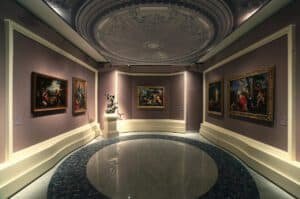
The route is laid out in three rooms on the ground floor, and follows a clear chronological progression. There is no obligatory direction imposed by barriers or rope lines, but following the order is the only way to understand the argument.
The first room of the Ceramics Museum in Sermoneta: archaeology
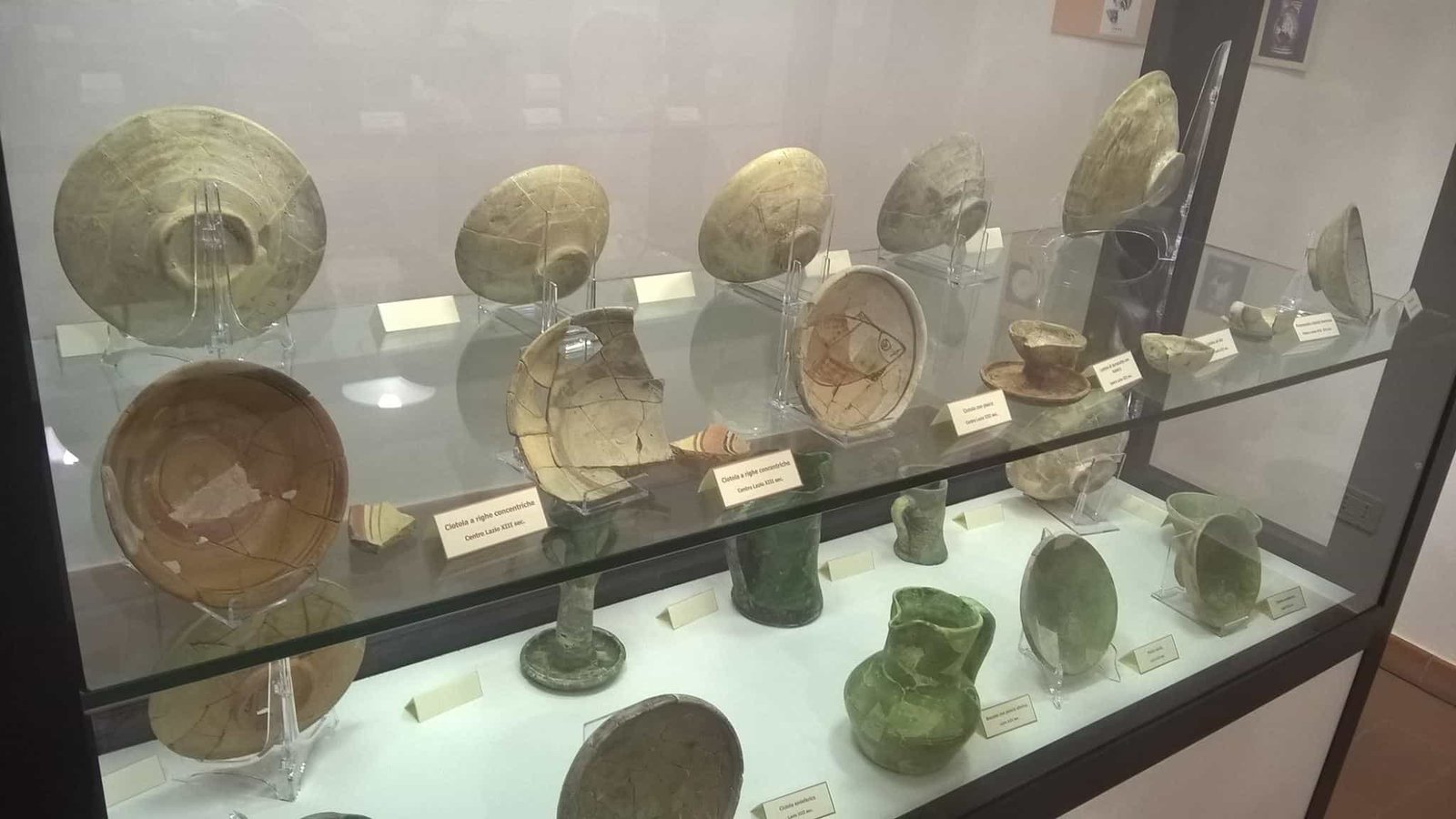
It opens with the materials of archaeological provenance entrusted by the Soprintendenza for Lazio. Here there are pottery, grave goods, votive objects in terracotta and bricks. The most important group comes from the Caracupa necropolis, the protohistoric site located in the territory between Sermoneta and Norma, at the foot of the Lepini.
What to really look at. The dark, coarse, hand-modeled fabrics: these are the Iron Age vases, the ones where the wall has no constant thickness and the surface still carries the memory of the fingers. Then the technical leap: when the wheel appears, the profile becomes regular and the vase loses its asymmetries. It is the most important transition in the whole history of ceramics and in this room you see it with the naked eye, with no need for captions. Bring the kids in front of these two display cases and have them notice the difference: they understand in 10 seconds what technological revolution means.
The votive terracotta objects deserve a stop of their own. They are anatomical ex-votos and figurines mass-produced from molds, at a popular price, intended for the sanctuaries. They are the proof that ancient Lazio already had low-cost mass production, and that devotion moved a market. It's not display-case archaeology: it's economics.
The second room of the Ceramics Museum in Sermoneta: the Middle Ages
The second room gathers the medieval ceramics, which reached the museum by private donation. The collection is traditionally traced back to Mr. Tito Coluzzi. It is the section to look at most calmly, because it is the one the public skips.
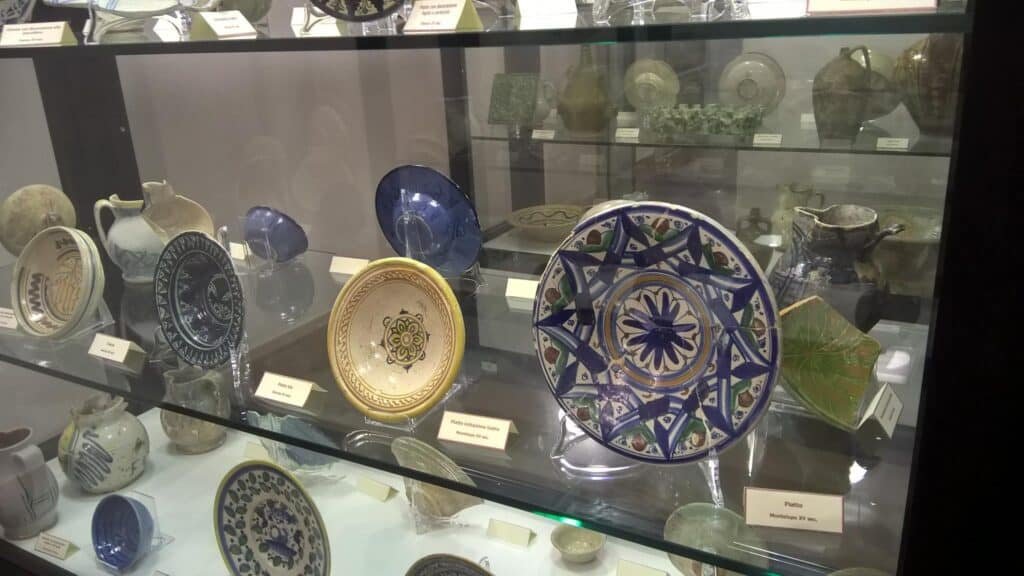
The Middle Ages of Italian ceramics is the story of a technical problem: how to make a porous vessel waterproof. The solutions follow one another and in this room you can read them. First the lead glaze, a transparent glassy coating that lets the color of the ceramic body show and that turns toward yellow and green. Then the graffito technique, in which the vessel is coated with a pale engobe and the decoration is obtained by incising the coating to let the dark clay underneath re-emerge. Finally the archaic maiolica, with the white, opaque tin-glaze coating that hides the body and offers the painter a neutral surface to work on in copper green and manganese brown.
Look at the bases of the jugs and the handles. In medieval Lazio productions the decoration is sober, geometric, often reduced to bands and stylized plant motifs, and for that very reason it reads well. Whoever arrives here used to the great Renaissance services finds little spectacle and a lot of substance. A clear opinion: this is the most instructive room of the museum, and it is the one in front of which people pass fastest.
The third room of the Ceramics Museum in Sermoneta: the 19th and 20th centuries
The third room reaches the ceramics of the 19th and 20th centuries and widens the view to the great centers of the peninsula: Deruta, Faenza, Viterbo. These are three names that in the discourse of Italian ceramics count as three distinct schools.
Deruta, in Umbria, is the center of luster, the third-firing technique in a reducing atmosphere that deposits on the surface an iridescent metallic film. Its production between the 15th and 16th centuries established a canon that workshops went on repeating for centuries, and the 19th-century forms displayed here are to be read as heirs of that canon. Faenza gave its name to faïence in half of Europe, and its greatest contribution is white: the famous white of Faenza, a pure tin-glaze surface used with minimal or no decoration, which in the 17th century changed the taste of the table. Viterbo represents the tradition of upper Lazio, with a long history of locally made graffito and engobed ceramics.
In the same section you can read the 19th century's passage from workshop to manufactory: standardized forms, printed decoration, falling prices. It's the moment when ceramics stops being a luxury and becomes tableware. If you have at home a set inherited from your grandmother, in this room you understand where it comes from.
The contemporary section of the Ceramics Museum in Sermoneta
The museum didn't stop at the last century. In June 2025 it received as a gift two contemporary sculptures: Nuovi dinamismi by Mariangela Calabrese and Anima by Nicoletta Piazza. The two artists had exhibited shortly before at Palazzo Caetani with the show Di spaesamenti e spazi sognati, the first event in the first-floor room after the restoration works. The works were received by the president of the city council and delegate for Culture Pierluigi Torelli together with the scientific director Vincenzo Scozzarella.
The idea is clear and I share it: a clay museum that stops at 1900 tells a dead language. Adding contemporary sculpture to a route that begins with an Iron Age impasto vase is the cheapest and smartest way of telling the visitor that technical gesture never stopped.
The Caracupa necropolis and the archaeology of the Ceramics Museum in Sermoneta
What Caracupa is
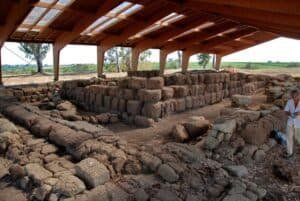
The territory of Sermoneta preserves evidence from the early Iron Age, from the 9th century BC, and the areas of Caracupa and Valvisciolo are among the most significant sites for understanding Latium Vetus and the so-called Latial culture. The necropolis was identified and excavated between 1901 and 1903 by the archaeologists Luigi Savignoni and Raniero Mengarelli. It yielded 76 inhumation graves and four cremation graves, with grave goods in ceramic, bronze, iron and imported materials, datable between Latial phase II B, roughly 830-770 BC, and phase IV, roughly 720-580 BC.
The archaeological literature describes a prevailing rite of pit inhumation, often with a wooden chest, and attributes to the latest phase some burials with a chariot. The total number of burials investigated is sometimes given as about a hundred: the counts vary depending on later surveys being included or not.
Why Caracupa matters, and why it matters in here
A necropolis of this era is a social archive. In the grave goods you read who was who: the spindle and distaff in the women's tombs, weapons and razors in the men's, imported pottery in the tombs of the richest. The presence of imported materials in a hill community of the Lepini means that this slope was not a periphery: it was on an exchange route. The same reason, many centuries later, would make the fortune of Sermoneta as control of the foothill road between Rome and Naples, when the marshiness made the Appia impassable.
The fact that these materials are displayed in Sermoneta and not in a storeroom of a big city is the best thing that has happened to this museum. In 2020, on the occasion of the FAI autumn days, the archaeological section dedicated to the prehistoric site of Caracupa was presented to the public as a novelty of the display, and it is now an integral part of the route together with the exhibition on the finds.
The ceramic techniques explained in the display cases of the Ceramics Museum in Sermoneta
From impasto to the wheel
The first chapter is the impasto: local clay purified little or not at all, with visible inclusions, modeled by hand or by coiling, fired at low temperatures in a pit or a simple kiln. The result is dark, porous, fragile to thermal shock. The fast wheel changes everything: the wall thins, the profile becomes continuous, production speeds up. It's not a specialists' detail. It's the moment when the potter stops being every family and becomes a trade.
Glazing and maiolica
The second chapter is the coating. Lead glazing makes the surface waterproof and shiny but leaves it transparent. The tin-glaze coating, opacified with tin oxide, produces instead that compact white we call maiolica and that works like a canvas: from then on the vessel becomes a support for painting. In between are the engobe techniques, in which a pale slip is spread on the dark body and then incised to obtain graffito decoration. If in a display case you see a fragment where the drawing appears as a pale, incised line on a colored ground, this is the technique.
Why the three centers of Deruta, Faenza and Viterbo
They are not names put there for prestige. Deruta, Faenza and Viterbo are the three poles that explain the circulation of forms in inland Lazio: from the north come the Umbrian and Romagnol models, from the capital of the Tuscia come the graffito productions, and in the homes of the Lepini they mix. A village museum that displays the three centers next to its own local materials is doing exactly the job that falls to it: showing that the material culture of a village is not born in isolation.
A curiosity about the Ceramics Museum in Sermoneta
The strongest curiosity of this museum is not about an object but about the room that contains it. The palace that now hosts the display cases was for 65 years, from 1914 to 1979, the Ada Caetani nursery school: a nursery expressly intended for the children of poor farmers and for children affected by malaria. It's worth stopping on that last word. Before the land reclamations of the 20th century the Pontine plain at the foot of Sermoneta was one of the most severe malarial areas in Italy, and hill villages like this existed also because altitude offered relative shelter from the fever. The population worked below and slept above.
Inside a 16th-century palace built by the De Marchis and then passed to the Caetani, for two thirds of a century the diapers of farm laborers' children were thus changed. Even earlier, from 1871 to 1879, the same building had hosted the Scuola Pia for girls' education, at a time when literacy for country girls was by no means a given.
There's more, and it concerns the frescoes. In 1871, with the installation of the Congregazione di Carità, many of the palace's painted decorations were covered to preserve them. An administrative gesture, not an aesthetic one, that in fact put the 17th-century decoration into mothballs. The noble hall still preserves today the coffered wooden ceiling and the wall paintings of the 17th century. Whoever looks at a medieval jug on the ground floor has above their head, without realizing it, a Baroque ceiling and layers of paint that have passed unscathed through a century and a half of improbable uses. A ceramics museum inside a nursery inside a baronial palace: the best stratigraphy of Sermoneta is not underground, it's in the building.
Something nobody tells you about the Ceramics Museum in Sermoneta
No guide in circulation will tell you that this museum has an editorial policy. It seems an excessive claim for three village rooms, and yet it is documented. In February 2026 the Municipality launched a series titled I quaderni del Museo. Sermoneta a porte aperte, whose first volume is dedicated to Benozzo Gozzoli and the Madonna in gloria con la città di Sermoneta, the painting that shows the Virgin holding the fortified profile of the village, dated to around 1457 and tied by tradition to a gift from the Senate of Rome to the community for the end of the plague. The second issue, presented on March 19, 2026 at the museum's premises, is dedicated to the Museum of the History of Ceramics and reconstructs its story and its role in protecting the local ceramic tradition. The author of both is Vincenzo Scozzarella, director of the museum.
The second thing nobody says is that the museum doesn't work alone. In October 2024 Sermoneta joined the Network of Museums of the province of Latina, bringing the count to 10 municipalities and 20 museums among civic and private institutions. The mayor of Sermoneta Giuseppina Giovannoli commented on the membership with a dry phrase, "together we go far." The mayor of Latina Matilde Celentano called Sermoneta an added value of the network.
What it means for those who visit. It means that the small free museum you are entering is a node of a provincial system, not a collection left to itself, and that its rooms host presentations, retrospectives and meetings with schools. If you happen to come on a day when the first-floor room is occupied by an event, it's not a setback: it's how this place works.
The advice I give you for visiting the Ceramics Museum in Sermoneta
The advice is just one and goes against the instinct of anyone who climbs up here: reverse the order. Don't do the castle and then, if time is left, the museum. Do the museum first, and the castle after.
The reason is practical. Castello Caetani is visited only with a guided tour in a booked time slot, lasts about an hour and costs 8 euros per person for individuals, with free entry for accompanied children under 12. It's managed by Fondazione Roffredo Caetani and tickets are bought online. This means your schedule in Sermoneta is already nailed down by the castle. The ceramics museum, on the other hand, is free, needs no booking and is visited in the times you decide: it's the only flexible element of the day, so it should be used to fill the wait before the slot, not to chase it afterward.
The second reason is of a mental order. If you enter the castle first, you come out full of crenellations, painted halls and Borgia stories, and the display cases of jugs will seem minute. If you enter here first, you arrive at the castle having already understood with what materials people lived in this village, and the fortress rooms fill with real objects.
Third thing, the most concrete: wear shoes with a rough sole. The corso is uphill and in stone polished by centuries of passage, and in the rain it becomes a ski slope. The palace, as the Municipality notes, has architectural barriers, and the interior staircase leading to the upper floor is not a route for everyone. Whoever has walking difficulties should visit the ground floor, which is the real museum part, and not be talked into going up.
Another well-known fact, yet rarely cited
That Sermoneta is a film set everyone knows around here: the town has been used as a backdrop for over 90 films since 1909, obtained the title of Città in 2021 and carries the Touring Club's Orange Flag. What is rarely cited is the cultural consequence of this vocation, and it concerns the museum itself.
A village that lives on image has a permanent temptation: to turn into scenery, that is, into a surface without depth. It has happened to dozens of Italian towns, which today sell a stone profile and a row of shops with Turkish ceramics hand-painted somewhere very far away. Sermoneta made a different choice and made it with a free civic museum, open seven days a week, that displays the everyday objects of its people instead of the souvenir of its silhouette.
The second rarely cited fact concerns historical geography. Sermoneta owes its importance to the control of the foothill road, the link between Rome and Naples that became crucial when the marshiness made Via Appia unusable on the plain. It's not an erudite note: it's the reason why in 1297 Boniface VIII Caetani bought Sermoneta, San Donato and Bassiano from the Annibaldi for 140,000 gold ducats. You buy a toll, not a view. And the imported materials found in the grave goods of Caracupa, almost two millennia earlier, say that this transit corridor was already working in the Iron Age. The museum, without declaring it, is the place where this continuity can be touched with the eyes.
The right photo to take at the Ceramics Museum in Sermoneta
The right photo is not the display case. The display cases in the civic museums have thin glass and ceiling lights that throw back your reflection and the window's: any handheld shot taken straight on gives you a medieval tankard with your face in it. If you still want to photograph a piece, bring the lens close to the glass until it almost touches, rest the edge of your smartphone on the surface, and shoot at an angle to the light source. No flash: flash on glazed surfaces produces a white spot that wipes out half the decoration, and it's rude anyway in a small space.
The photograph that is really worth taking here is the one of the palace's inner courtyard. It's the space whose plaster and stone staircase to the first floor have just been restored, and it's the only point in the building where architecture and natural light work together. Frame the staircase from below, keeping one side of the portico in the foreground to give depth, and wait for the light to be raking: mid-morning or late afternoon, never at noon.
The third shot, the one that closes a day's photo report well, is taken on your way out of the doorway: from Corso Garibaldi, turning to look up, the castle appears above the houses in foreshortening. A tankard in the display case and the fortress above the roof are the same story told twice, at a different scale. If you have time for only one photo in Sermoneta, take this one and not the usual view over the plain, which 100,000 people have already taken.
Some Important Events That Happened Here in History
The first event that directly concerns the collections dates to 1901-1903, and it did not happen in these rooms but a short distance away: Luigi Savignoni and Raniero Mengarelli excavated the necropolis of Caracupa and brought to light 76 inhumation tombs and four cremation tombs, with grave goods spanning the eighth to the sixth century BC. Those excavations are the reason the first room exists today.
1871 is the date that changes the life of the building: the Congregazione di Carità is founded, the frescoes are covered over to preserve them, and the palace enters a long phase of charitable use. From 1871 to 1879 the girls' Scuola Pia operates there, and from 1914 to 1979 the Ada Caetani kindergarten.
2004 is the year the museum was founded, set up on the ground floor with materials from the Soprintendenza and private donations.
In 2020, at the FAI autumn days on Sunday, October 18 and Sunday, October 25, with opening hours from 10:00 to 13:00 and from 14:30 to 18:00, the museum presented the new archaeological section dedicated to the prehistoric site of Caracupa, together with the special opening of the synagogue, the convent of San Francesco, the church and crypt of San Michele Arcangelo and the Diocesan Museum with the cathedral of Santa Maria Assunta.
In October 2024 the museum joins the Network of Museums of the Latina Province. In December 2024 the first restoration contract for the palace closes, with 380,000 euros of regional funding. In June 2025 two contemporary sculptures arrive as a gift. In February 2026 the series I quaderni del Museo is born, and on March 19, 2026 the volume dedicated to the museum itself is presented on site. On May 23, 2026, for the European Night of Museums, the museum stays open until 22:00 with a guided visit at 19:00 and free admission, together with the Diocesan Museum of Sacred Art. In August 2026 the second restoration contract ends, covering the courtyard plaster and the stone staircase.
Who Has Passed Through the Ceramics Museum in Sermoneta
The honest answer to this question starts with who passed through the building before it was a museum, and it's a crowd that carries no illustrious names. From 1914 to 1979, generations of Sermoneta children came through here, the children of farm laborers of the Agro Pontino, many of them marked by malaria. Before that, between 1871 and 1879, the pupils of the Scuola Pia. This is why in town the palace isn't called by the name of the family that built it, the De Marchis, but by that of Ada Wilbraham Caetani, the English noblewoman who was the wife of Onorato Caetani and the mother of Roffredo, the last duke of Sermoneta, in whose memory the kindergarten was named.
In the present, the names become more precise. The scientific director Vincenzo Scozzarella, who is also the author of the monograph on this museum, leads the rooms and the presentations. Pierluigi Torelli, president of the city council and delegate for Culture, welcomed here in June 2025 the sculptors Mariangela Calabrese and Nicoletta Piazza, who had just exhibited on the first floor of the palace and who donated two works to the museum, Nuovi dinamismi and Anima. On March 19, 2026, in the museum's room, the mayor Giuseppina Giovannoli, Torelli himself, Ferruccio Pantalfini for the Diocesan Museum and Scozzarella spoke at the presentation of the second quaderno.
In 2020, for the FAI autumn days, the visits in these rooms were led to staggered groups by student volunteers: a generation of Sermoneta kids told outsiders about the vases of their own ancestors. If you're looking for the big names of history, Lucrezia Borgia and Charles V, they passed through the castle above your heads, not this palace: the fortress hosted them, and the two episodes belong to the story of Castello Caetani. Down here on the main street, history passed by with other faces.
How Long the Visit to the Ceramics Museum in Sermoneta Takes and How to Organize It
The Right Time for the Ceramics Museum in Sermoneta
Three rooms, about 300 pieces: 40 minutes is the honest measure for someone who reads the captions, 25 for someone who walks and looks, a good hour for someone who lingers over the funerary goods. It's not a museum you do in five minutes and it's not a half-day museum. Fitted into a day in Sermoneta, it takes the slot between 10:00 and 11:00 or the one between 15:00 and 16:00, which are exactly the hours when the sun makes the walk along the main street unpleasant.
The Ceramics Museum in Sermoneta with Children
It works, on one condition: that someone tells the story. The display cases alone don't entertain an eight-year-old. But the sequence of handmade vase against wheel-thrown vase, and the story of the clay that is fired to become stone, are perfect material for the little ones, and the museum organizes meetings with schools. Add that admission is free, so there's no regret about a paid ticket if after 10 minutes they want to leave. Quick tip: give them the task of finding the oldest vase and the newest vase in the collection. They take 20 minutes and spend them really looking.
Accessibility of the Ceramics Museum in Sermoneta
The Comune reports that the building has architectural barriers. The museum part is on the ground floor, which is the best possible condition in a 16th-century palace, but the access is from the main street, which is sloped and paved in stone. Anyone who moves in a wheelchair or with mobility difficulties should phone the Comune beforehand to be told the easiest entrance point and any assistance available. The upper village, in general, is demanding: the climb from the gate to the castle shows no mercy.
When to Go to the Ceramics Museum in Sermoneta and When to Avoid It
Spring and autumn are the right seasons for the whole Lepini area. August on the plain is heavy, but here the altitude helps and the town comes alive with events. To avoid, if you're looking for silence: the weekends of the big summer events, when the village fills up and the main street becomes a river of people. To seek out, if you're looking for the opposite: the European Night of Museums, which in 2026 fell on Saturday, May 23 with opening until 22:00 and a guided visit at 19:00. A town museum visited in the evening, free and guided, is a different experience from the same visit made at 11:00 in the morning.
What to See Around the Ceramics Museum in Sermoneta
Castello Caetani, Above the Ceramics Museum in Sermoneta
Via della Fortezza. The original fortress belongs to the Annibaldi, early 13th century, with the keep and the counter-tower. The Caetani rebuilt the Hall of the Barons and added the House of Cardinal Borgia. The Borgia completed the fortifications with the citadel designed by Antonio da Sangallo. During the Anzio landing in 1944, the castle stayed inhabited by the Caetani and the population. Today it's run by Fondazione Roffredo Caetani, and hosts restoration courses in collaboration with ICCROM and musical activities. Guided visit only, about one hour, by reservation, individual ticket 8 euros, free for accompanied children under 12, 6 euros per person for groups of 25 and up. Phone 0773 632231. Information and tickets on the website of the Fondazione Roffredo Caetani.
The Collegiata di Santa Maria Assunta and the Diocesan Museum
The church is documented from the 12th century, with a square bell tower and round arches, and it preserves 14th-century frescoes with the Last Judgment and 15th-century lunettes. The most famous panel is the Madonna attributed to Benozzo Gozzoli, the one that holds up the fortified profile of Sermoneta, the subject of the museum's first quaderno. Next to it, the Diocesan Museum of Sacred Art collects altarpieces by Girolamo Siciolante, a painter born in Sermoneta in 1521, and by Francesco da Castello, Matteo Rosselli and Odoardo Vicinelli. The two museums of the village, the ceramics one and the diocesan one, open together on special occasions.
Valvisciolo, Ninfa and the Lepini
The Abbey of Valvisciolo, below the town, is one of the most important Cistercian complexes in southern Lazio and is a few minutes away by car. The Ninfa Garden, on the ruins of the abandoned medieval city, is the destination that brings the most visitors in the whole area and can be visited only on set days with a reservation. For the general picture of the mountain range and the other villages, it's worth looking at the page on the Lepini Mountains.
The Other Villages and Museums of the Area
A short distance away are Bassiano, home of Aldus Manutius, Norma with its balcony over the plain, Sezze and Priverno. If you've taken a liking to the civic museums of the area, you'll find a coherent route in the museums of Priverno and in the Museo della città e del territorio di Cori, in the village of Cori. To understand the plain below the town, that is the land reclamation and the founding cities, the reference is the Museo della terra pontina. For a day at the sea at the end of your visit there's Lido di Latina. If you want to widen out to the Roman side of the mountains, you can look at Carpineto Romano, and if you're after a comparison with a major archaeological collection in Lazio, there's the Museo archeologico di Palestrina.
Quick Questions About the Ceramics Museum in Sermoneta
How much does a ticket to the Ceramics Museum in Sermoneta cost?
Nothing. Admission is open and free. It's a civic museum owned by the Comune and has no ticket office.
Where exactly is the Ceramics Museum in Sermoneta?
On the ground floor of Palazzo Ada Caetani, Corso Garibaldi 62, 04013 Sermoneta, in the Latina Province.
What are the opening hours of the Ceramics Museum in Sermoneta?
The Comune indicates opening from Monday to Sunday from 10:00 to 13:00 and from 15:00 to 17:00. Since it's a small civic museum, the hours can change with the season and with events: it's best to check by phone with the Comune before setting out.
Do you need to book to visit the Ceramics Museum in Sermoneta?
No, a self-guided visit doesn't require a reservation. Guided visits organized for events may instead require registration.
How long does the visit to the Ceramics Museum in Sermoneta take?
From 25 to 40 minutes for a normal visit, a good hour for someone who reads everything and lingers over the archaeological finds.
How many rooms does the Ceramics Museum in Sermoneta have?
Three, all on the ground floor: archaeology, medieval ceramics, 19th- and 20th-century ceramics, with the addition of contemporary works.
How many objects are on display in the Ceramics Museum in Sermoneta?
About 300 pieces, according to the Comune's data, covering a span from prehistory to 1900, in addition to the archaeological materials from Caracupa.
When was the Ceramics Museum in Sermoneta founded?
In 2004, with the setup on the ground floor of Palazzo Ada Caetani.
Who runs the Ceramics Museum in Sermoneta?
It's a museum owned by the Comune, attached to the Culture, Tourism, Sport and Entertainment Area of the Comune di Sermoneta. The scientific direction is Vincenzo Scozzarella's.
Is the Ceramics Museum in Sermoneta wheelchair accessible?
The Comune reports architectural barriers in the building. The exhibition part is on the ground floor, but access is from the sloping main street: better to phone first to arrange the entrance.
Can you take photographs in the Ceramics Museum in Sermoneta?
Ask about the rules at the entrance. In any case avoid flash: on glazed surfaces it produces reflections that wipe out the decoration.
Is the Ceramics Museum in Sermoneta suitable for children?
Yes, as long as you accompany them with a story. The comparison between a hand-modeled vase and a wheel-thrown vase works very well with the little ones, and the museum organizes meetings with schools.
What is the difference between the Ceramics Museum in Sermoneta and the Diocesan Museum?
The first is civic and tells the story of material culture, that is clay and its uses from the Iron Age to the 20th century. The second is diocesan and dedicated to sacred art, with altarpieces from the 16th to the 18th century, next to the Collegiata di Santa Maria Assunta.
Where do the archaeological finds in the Ceramics Museum in Sermoneta come from?
For the most part from the necropolis of Caracupa, in the territory between Sermoneta and Norma, entrusted by the Soprintendenza archeologica del Lazio, as well as from private donations.
What is the necropolis of Caracupa?
A burial ground of the early Iron Age excavated between 1901 and 1903 by Savignoni and Mengarelli, with 76 inhumation tombs and four cremation tombs, datable between the eighth and the sixth century BC.
Why are Deruta, Faenza and Viterbo in the Ceramics Museum in Sermoneta?
Because they are the three centers that explain the circulation of forms and techniques in inland Lazio between the Middle Ages and the modern era, and their models can be found in the local productions.
Is there parking near the Ceramics Museum in Sermoneta?
You park outside the walls, in the spaces along the ring road and in the area under the fortress, and walk up along the main street.
How do you get to the Ceramics Museum in Sermoneta without a car?
Take the train to Latina station, in the Latina Scalo district on the Rome-Formia-Naples line, then a Cotral bus or a taxi to the village. Check the timetables for weekend runs.
How far is Sermoneta from Rome?
About 83 kilometers. By car it takes a little over an hour when the Pontina is flowing.
Can the Ceramics Museum in Sermoneta be combined with Castello Caetani on the same day?
Yes, and it's the natural pairing. The castle is visited with a guide in a booked time slot and with a paid ticket, so it's best to fix that first and use the museum, which is free and needs no reservation, to fill the wait.
Does the Ceramics Museum in Sermoneta have a bookshop or a catalog?
The museum has its own editorial series, I quaderni del Museo. Sermoneta a porte aperte, whose second issue is dedicated to the museum itself. For the availability of the volumes, the reference is the Culture Area of the Comune.
Does the Ceramics Museum in Sermoneta take part in the European Night of Museums?
Yes. In 2026 the free special opening was on Saturday, May 23, until 22:00, with a guided visit at 19:00 together with the Diocesan Museum of Sacred Art.
Does the Ceramics Museum in Sermoneta have contemporary works?
Yes. In June 2025 two sculptures donated by their authors entered the collection, Nuovi dinamismi by Mariangela Calabrese and Anima by Nicoletta Piazza.
Is it worth going up to Sermoneta just for the Ceramics Museum?
For the museum alone, no. For the museum within a day that includes the village, the castle, the Collegiata and maybe Valvisciolo, absolutely yes: it's the piece that holds all the others together.
Let's close with our opinion on this area. Small museums are judged by one thing only: if on the way out you look at the town differently from how you looked at it on the way in. This one does. After half an hour among Iron Age clay mixes, sgraffito tankards and 19th-century manufactured plates, the main street of Sermoneta stops being a postcard and becomes again what it has always been: a street where for 3,000 years someone has kneaded earth, fired it and eaten out of it. Go in, it costs nothing, and come out richer than when you went in.
Article written by the editorial team of TourLeaderPro, contact them for Private/Corporate/V.I.P. Tours and Experiences.
Planning a trip to Rome? The English-language guides for visiting the city are on ItalyPlanner.com.