Casamari Abbey
In short. Casamari Abbey is at via Maria 25, in the Casamari district of Veroli, in the province of Frosinone.
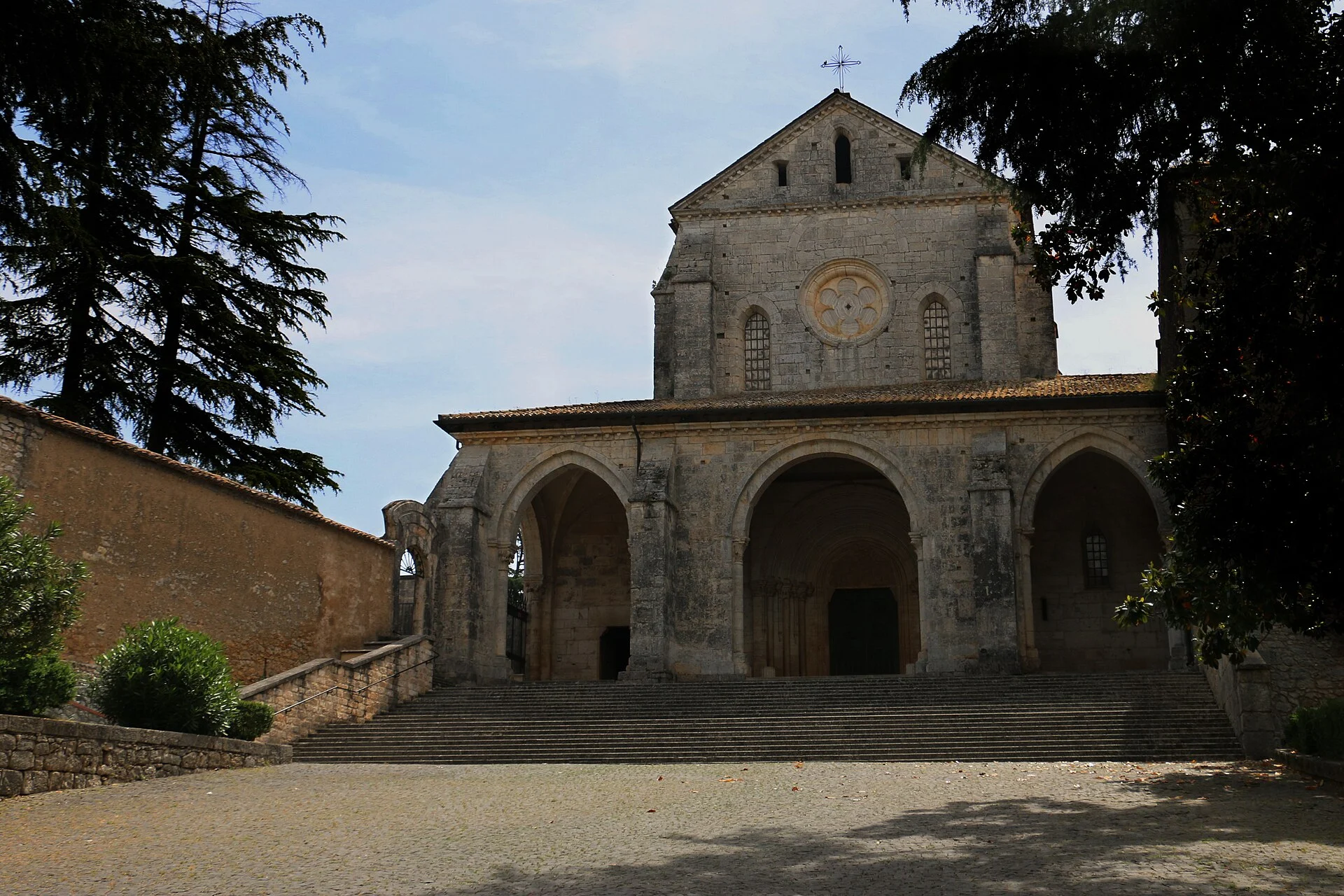
Casamari Abbey is at via Maria 25, in the Casamari district of Veroli, in the province of Frosinone. Entry is free, visiting hours are 9-12 and 15-18, no booking is needed if you come on your own, while groups do well to call 0775 282371. It's a national monument owned by the State, entrusted to the Lazio National Museums Regional Directorate, and inside lives and prays a community of Cistercian monks.
This double track explains everything you'll find. On one side, a 13th-century Gothic complex that the Ministry protects as a public good, on the other a real monastery, with bells marking the hours, the conventual Mass, the guesthouse and the shop where the monks sell liqueurs, honey and herbal preparations. Casamari is not a museum with monks as extras. It's a lived-in house that opens its door.
The practical information was checked on September 28, 2026 on the abbey's website, on the page of the Lazio National Museums Regional Directorate and on the other institutional sources mentioned below. Visiting hours can change because of celebrations, holidays and the needs of the community, and the museum opens on request. Before setting out from Rome, a phone call to the abbey's number removes any doubt.
Where it is and what you really see
Casamari stands in open Ciociaria countryside, along the road that goes down from Frosinone toward Sora, at an altitude of about 300 meters. The municipality of Veroli places it about 10 kilometers from the historic center, and indeed the town stays up on the hill, invisible from the abbey. Around it are the hamlet's village, a few houses, the free car park and the bus stop right in front of the entrance.
You enter by passing under the abbot's palace, through a large round arch, and find yourself in a cobbled courtyard on a slight slope. Above the arch runs a loggia with paired mullioned windows. At street level there are two passage arches, of different sizes: one for carts and one for people on foot. It's the first sign that everything here was designed to work, not to impress.
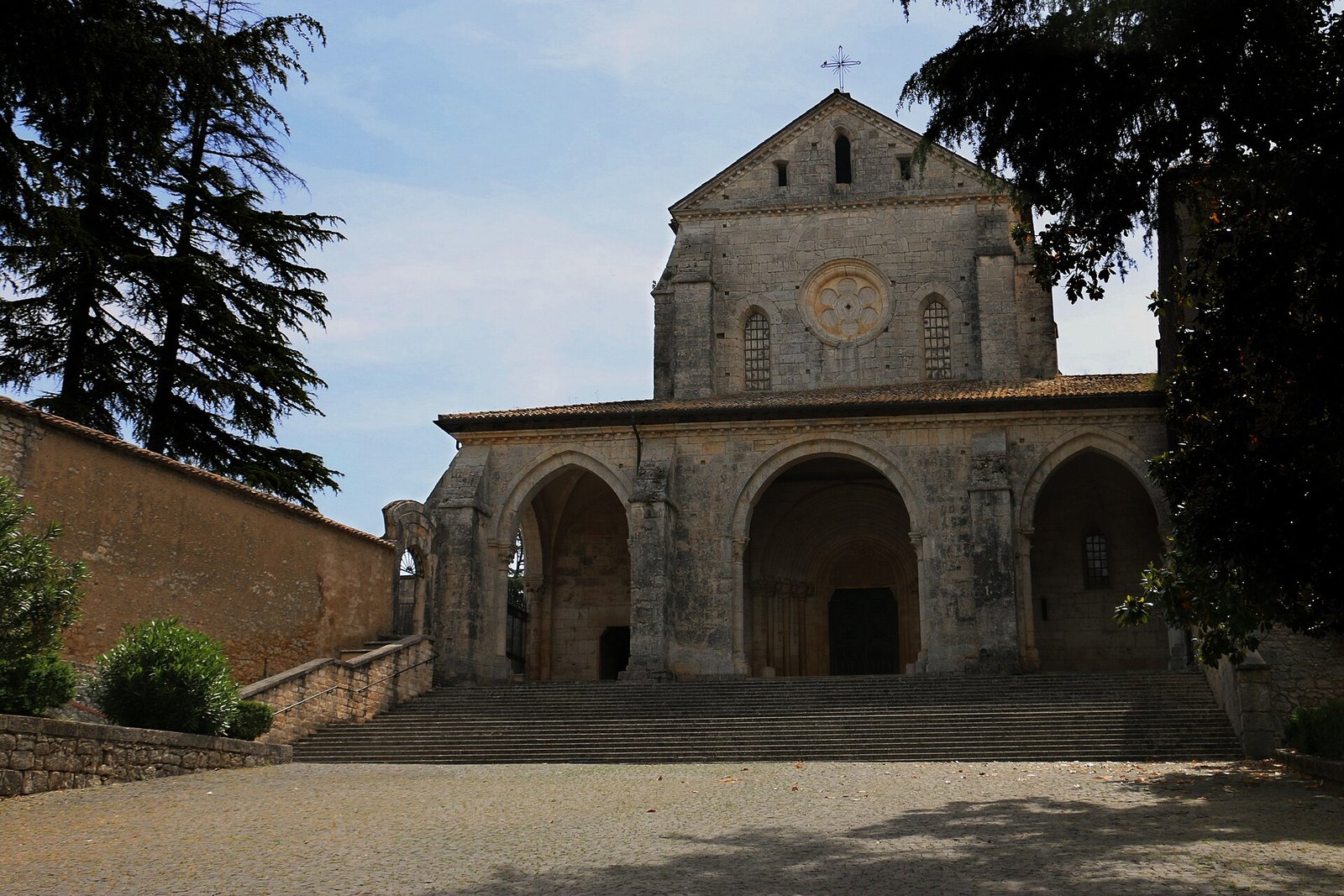
From the courtyard a long staircase climbs to the church facade, preceded by a narthex with three arches, the central one round and the side ones pointed. Inside, the basilica has a Latin cross plan, with three aisles on clustered piers and ribbed cross vaults. The presbytery ends with a flat apse lit by a six-lobed rose window and five single-light windows. No frescoes on the walls, no gold.
From the side of the church you pass to the square cloister, with galleries on paired columns, smooth or twisted, and carved capitals. On the east side opens the chapter house, with three aisles and four clustered piers. Further on is the refectory, with two aisles on massive cylindrical columns, and from the south gallery of the cloister you enter the museum, set in the monks' old work rooms and in the calefactorium.
What you don't see: the cloister enclosure, the monks' dormitory, the guesthouse, the spaces of the state library, except by appointment, and the production rooms of the pharmacy. The free route covers the church, cloister, chapter house and refectory. The Regional Directorate indicates about an hour for the visit. Those with a trained eye for architecture spend twice that, while those after just the photo get it done in 40 minutes.
A curiosity about Casamari Abbey
The name has nothing to do with the sea. Casamari comes from the Latin Casa Marii, the house of Marius, and the Marius in question is Gaius Marius, the general who was consul seven times and clashed with Sulla in the civil war of 88 BC. The ministry sources recall that the abbey stands on the remains of a Roman center called Cereatae Marianae, and that second name leads back to him again.
It helps to separate the levels. What the documents say: the Roman center of Cereatae existed, and the abbey's museum holds finds from the Roman era, inscriptions and coins. What tradition says: Marius was supposedly born here, and the name of the place preserves the memory. What is legend: the monastery was supposedly built over a temple of Mars, a claim that circulates widely but that no published excavation has proven.
The name Cereatae, according to the current reading, points to Ceres, the goddess of the harvest. An agricultural goddess beneath a monastery that for eight centuries has lived off fields, olive groves and vineyards is a coincidence visitors like a lot, to be told without loading it with meanings. The real continuity is in the fertile soil of the valley, not in a handover between deities.
The question of Marius's birthplace, incidentally, has a nearby rival. Arpino claims the general as an illustrious son together with Cicero, and the two traditions can be reconciled: Plutarch has him born in a village in the territory of Arpino, and Cereatae in all likelihood fell within that area. Arpino keeps the big name, Casamari keeps the place name. Neither town has reason to quarrel, and in fact they don't.
Something nobody tells you about Casamari Abbey
The church's first dedication was not to the Virgin. The Benedictine community that settled here in the 11th century named its church after Saints John and Paul, the two Roman martyrs who have their basilica on the Caelian Hill in Rome, the Basilica of Saints John and Paul. When the Cistercians arrived the church passed to Santa Maria Assunta, as in all the Order's foundations, and the two martyrs slipped into the background.
The second thing that goes unmentioned concerns the founding dates. The abbey's website speaks generically of the dawn of the second millennium, some tourist pages write 1005, the municipality and the Touring Club give 1035, the Ministry's portal of monastic libraries says around 1036. The sources do not agree, and the divergence comes from the fact that a community of priests and a stable monastic foundation are two different moments, told as one.
The same goes for the arrival of the Cistercians. You read 1140, you read 1152, you read between 1143 and 1152. Some texts attribute the change to Pope Innocent II, others to Eugene III, who however was elected only in 1145, and so the combination of 1140 with Eugene III doesn't hold. The most prudent reading is the ministerial one: a reform begun in the 1140s and completed under Eugene III.
Third point, the most delicate. On the portal called the lay brothers' portal and on some capitals there are symbols, such as the tree of life, tau-shaped crosses, a snake biting its own tail, which recent literature reads in a Templar, alchemical or Masonic key. The documents support none of this. They are motifs common in Romanesque and Gothic sculpture, and the esoteric reading is a modern legend, fun to listen to but with no archival backing.
Hours, admission and Masses
The visiting hours published by the abbey and the Regional Directorate are 9-12 and 15-18. Admission is free and there is no ticket office. Individuals don't need to book, for groups it is recommended. The museum, according to the Regional Directorate, is open on request on site: when you get to the porter's lodge, ask them to open it, and keep in mind that opening depends on the staff's availability at that moment.
You buy nothing to get in, so there is no advance-sale channel to look for. There are two official references: the Casamari Abbey website, run by the community, with hours, liturgy and shop, and the page of the Lazio National Museums Regional Directorate, with the email address drm-laz.casamari@cultura.gov.it. Anyone selling you a ticket for Casamari is selling you something else, usually transport.
Holiday Masses are at 7, 8:30, 10, 11:30 and in the evening at 17 during standard time, at 18 during daylight saving time. On weekdays Mass is celebrated at 7:30 and 12. During services the church is a place of worship in use, and anyone coming in with a camera around the neck must wait until the end or sit down and take part. On Sunday morning, with four Masses in a row, visiting the church gets complicated.
The monks' prayer is public and follows a precise schedule. On weekdays the Office of Readings and Lauds are at 5:15, Terce at 7:15, Sext and None at 12:45, Lectio Divina and Vespers at 18:45, Compline at 21. On holidays Lauds are at 8 and Vespers at 16 during standard time, at 17 during daylight saving time. The sung Vespers are the best moment of the day.
For groups the abbey's phone is 0775 282371, the same one given by the Regional Directorate, and the general email is info@abbaziadicasamari.it. The operator does not mention a paid guided-visit service or a group rate. For groups the rule is simple: call a few days ahead, say how many people and at what time, leave an offering. Nobody will ask you for one, but it's the right thing to do.
The pharmacy and the monks' liqueur shop
The abbey's pharmacy has a documented history. The community's old website says it was opened in 1760 by the prior Father Gioacchino Castiati, as a small shop serving the monastery's infirmary and the surrounding towns. Abbot Romualdo Pirelli, in office from 1790 to 1822, built a larger one, more open to the public, with a room for selling liqueurs and medicines and one for preparing the remedies.
Official recognition came in 1821, when Brother Giacobbe Margiore obtained the apothecary's license in Rome. Today the pharmacy is near the abbey's entrance, is run by a monk and occupies three rooms: a sales room of about seven meters by seven lined with Tuscan wood-and-glass shelving, a modern laboratory and a storeroom. It sells medicines and, in the community's own words, a few delicious liqueurs.
The monks' shop is the liqueur shop. The catalog published on the website lists the Gocce Imperiali, the Elixir di San Bernardo, the Genziana, the Nocino, the Liquirizia and the Sambuca di Casamari, a single-varietal grappa, rosolios and herbal elixirs. Alongside are extra virgin olive oil, honey and hive products, jams, candies, herbal preparations, cosmetics and books of Cistercian spirituality. The shop also ships to your home, through the website.
The hours of the shop and the pharmacy are not published. The contact given by the community for the shop is negozio@abbaziadicasamari.it, with the same general phone 0775 282371. Don't take for granted that the shop follows exactly the hours of the visiting route, because no official source states it. If your main goal is to stock up on liqueurs, a phone call first saves you a wasted trip.
A note from someone who has taken quite a few home. The herbal liqueurs of Lazio's monasteries are a specific genre: bitter, alcoholic, made for digestion and not for cocktails. Anyone who knows the eucalyptus liqueur of the Trappists at the Abbey of Tre Fontane in Rome finds the same shop logic here. Taste the Genziana before buying the big bottle, because it sharply divides palates.
My advice for visiting Casamari Abbey
Arrive around 17:30 on a weekday, visit the cloister and chapter house in low light and then go into the church for the Vespers at 18:45. The monks' singing in a 13th-century Cistercian church is the reason these buildings were made so bare: the stone is there to carry the voice. Watch out though, the visit closes at 18, so the cloister has to be seen beforehand.
If you can't stay until evening, choose early morning. At 9 the courtyard is empty, the coach groups arrive later and the light from the east comes through the apse's rose window straight into the nave. Avoid Sunday between 10 and noon: Masses in sequence, full car park, families coming out and parish groups going in. The church is still beautiful, but the visit becomes a slalom.
Start with the cloister, not the church. It's the right order to understand the monastery: the cloister is the center of communal life, the church is one of its sides. Walk the galleries slowly, look at the capitals one by one, then enter the chapter house and stay at least five minutes in silence. Only at the end go up to the church, and you'll notice that the proportions repeat those you have just seen.
Put Casamari in the same day as the Certosa di Trisulti, in the mountains above Collepardo. They are two opposite ways of understanding monasticism: the Cistercians in the valley floor, near roads and fields, the Carthusians up high, in the woods, isolated. Seeing them one after the other is worth more than any explanation. You need a car, and you need to leave Rome early, because the two visits take time.
One last practical tip. Dress for church, not for the beach: shoulders covered and trousers below the knee, even in August, because it's a church in use inside an inhabited monastery. Bring a few coins for the offering. And don't ask the monks to act as guides unless they have said yes: their day starts at 5:15 and is organized to the quarter hour.
Another well-known fact, yet rarely cited
Casamari is not just an abbey, it's the mother house of a congregation. In 1929 it was established as an autonomous monastic Congregation attached to the Cistercian Order, and since then other monasteries in Italy and abroad depend on it. The sources mention the Abbey of San Domenico in Sora, incorporated in 1833, the Certosa di Pavia, the abbey of Piona, Chiaravalle della Colomba and several communities in Eritrea. On the overall numbers of monks and houses the sources do not agree.
Among the houses linked to Casamari is the Abbey of Valvisciolo, at the foot of Sermoneta, entrusted to its jurisdiction in 1864. Anyone who has been to Valvisciolo and then comes to Casamari recognizes the same way of living the monastery, with the same liturgy and the same sobriety. It's a network that runs from Ciociaria to the Lepini Mountains, and then much farther, to the Horn of Africa.
The presence in Eritrea is the least known part of this story. The communities of Asmara, Keren and Halay were born from the 20th-century expansion, and today some of the congregation's monks come from there. It's a link that crosses the Mediterranean from Ciociaria and that few visitors know about. For a Ciociaria monastery founded in the 11th century, it's an opening to the world that few expect.
The second little-cited fact is the library. Since 1907 it has been under the State's authority, and the encyclopedia entry lists it among the Italian state public libraries. The collection is estimated at about 70,000 volumes by the community's website, 80,000 by other sources. In the 1873 inventory the books were only 1692: the growth all came after the suppression, that is, it is the fruit of the work of the monks who returned.
The church, the cloister and the chapter house, piece by piece
The church was begun in 1203, with the first stone blessed by Innocent III, and consecrated on September 15, 1217 by Honorius III. The sources name a monk, Guglielmo da Milano, as the designer. 14 years of construction for a church of this size is little, and explains the unity of the whole: there are no second thoughts, no overlapping stylistic phases. It's a single project, built by a crew that knew exactly what it wanted.
The aisles count seven bays, supported by clustered piers from which spring the hanging half-columns that carry the ribbing of the vaults. The transept has square chapels on the east side, following the Order's scheme. The light is diffuse and even, because the windows are small and the panes are alabaster slabs, not colored glass. Saint Bernard did not want images that distracted from prayer, and here the rule was taken literally.
The exception catches the eye: the ciborium above the high altar, in polychrome marbles and stuccoes, donated by Clement XI in 1711. It's a Baroque object inside a Cistercian Gothic church and, in our judgment, a mistake of taste, respectable as a papal gift but out of place in that apse. Behind it, the wooden choir dates from 1940, with the Mascioni organ of the same period, and a swan is depicted in one of the choir's inlays.
The cloister is square, with covered galleries and arcades on paired columns. Some columns are smooth, others twisted, and the capitals change from one pair to the next: leaves, stylized plant motifs, a few figures. On the south side is the most discussed capital, the one with the faces that tradition identifies as Frederick II of Swabia and his minister Pier delle Vigne. Next to it, according to some, the face of the abbot of the time.
The chapter house is the most beautiful room in the whole complex, and one of the most beautiful in medieval Lazio. Square plan, three aisles, four clustered piers carrying ribbed vaults. Toward the east three single-light windows, toward the cloister two mullioned windows. Here the community gathered every day to read a chapter of the Rule and for communal decisions, and the space has a proportion you feel as soon as you enter.
The current refectory, according to the architectural records, began as a pantry in the 13th century. It is a rectangular room with two aisles over seven bays, with massive cylindrical columns and blunted octagonal capitals. The monks' dormitory, instead, is a single large space as the Rule of Saint Benedict prescribed, with thick walls and rare, narrow windows to keep out the cold. It can't be visited, but from the right transept you can sense the access.
The bell tower stands on the right side of the church and is low compared to the mass of the building. It isn't the original: the old spire was struck by lightning in 1683 and the tower was rebuilt in the 17th century, with large mullioned windows on groups of three columns. Looking at the church from the courtyard, you get the impression of a facade without a tower. It's an effect intended by the Cistercian rule, which forbade monumental bell towers.
The right photo to take at Casamari Abbey
There is one photo and you take it in the cloister, from the southwest corner, with the gallery in the foreground and the mullioned windows receding toward the opposite corner. Crouch down to the height of the paired columns and let the sequence of arches guide the eye. In the upper part of the frame, the side of the church and the sky come in. It works in mid-morning, when the sun lights the garden and leaves the galleries in shade.
The second shot is the facade from the far end of the courtyard. Stand at the start of the staircase, a little off to the side, and shoot vertically: narthex, rose window and pediment fit in a tall format and lose strength in a horizontal one. Late afternoon is the right moment, because the facade faces west and catches the raking light that warms the stone. In the morning it's backlit and the narthex becomes a dark blotch.
Inside the church the photo that works is along the axis of the central nave, from the back toward the apse, with the six-lobed rose window in the center. Shoot without flash, leaning on a pier to keep the camera steady. The Regional Directorate states that photographs are allowed. During Masses and the monks' prayer, however, the camera stays in the bag: it's a matter of common sense before it's a matter of rules.
A detail almost nobody photographs well is the chapter house. The light comes in from the eastern single-light windows and from the mullioned windows on the cloister, and draws the ribs of the vaults. Stand in a corner, shoot the diagonal that crosses the four piers and keep the exposure on the highlights. The result is a photo that looks almost black and white even in color, and gives back the stone for what it is.
Avoid the frontal photo of the abbot's palace from the road with cars parked in front. It's the easiest and the ugliest. If you want the entrance, go into the courtyard and shoot the arch from the inside outward, with the loggia above and the light of the street at the back. It's a frame that tells the passage from the world to the monastery, which is exactly the function that arch was built for.
How to get there from Rome
By car, take the A1 motorway toward Naples and exit at Frosinone, which is about 90 kilometers from Rome. From the toll booth follow the expressway toward Sora and exit at the interchange marked Sora, Monte San Giovanni Campano, Boville Ernica. From Frosinone to the abbey it's about 15 kilometers. The free car park is near the entrance. Without traffic the trip from the Ring Road takes a little over an hour.
By public transport the simplest solution is the Cotral bus. The Regional Directorate indicates a request stop called Veroli Abbazia di Casamari, right in front of the entrance, with the return stop on the opposite side of the road. From the Anagnina terminal, the end of metro line A, depart the runs of the line to Sora that pass through Casamari: on weekdays the trip takes around an hour and a half. Remember to request the stop from the driver.
On holidays the runs from Anagnina exist but are less frequent and slower, because they leave the motorway at Anagni instead of Frosinone. Always check the schedule for the day on the official search engine Cotral ricerca orari, setting the abbey's stop as the arrival. Don't trust schedules found on third-party sites or on old slips of paper: the province's lines change with the school calendar and with the seasons.
The alternative is the train. From Roma Termini the regional FL6 line to Cassino stops at Frosinone, with runs about every hour, and the regional trains take from a little under an hour to over an hour and a half depending on the run. From Frosinone you continue with the Cotral bus of the Frosinone-Sora line, which serves the Casamari stop on weekdays and with fewer runs on Saturday. On Sunday this solution, in practice, doesn't work.
A taxi from Frosinone is quick, but finding one at the station on holidays isn't a given and the return has to be arranged beforehand. Groups do better to rent a minibus: combining Alatri, Veroli and Trisulti in a single day is only possible with your own vehicle. With public transport Casamari is best visited on its own, or combined with a stop in Sora or Isola del Liri, on the same line.
Some important events that took place here in history
The community was born in the first half of the 11th century, when some religious men from Veroli decided to live together under the Benedictine rule on the ruins of Cereatae. The ministry portal of monastic libraries links them to the figure of Domenico da Foligno, who had organized communities in the Sora area. It's the Benedictine world that already had its center at Montecassino and its roots at Subiaco.
Between 1140 and 1152 the monastery passes to the Cistercians, the monks of the reform of Bernard of Clairvaux, and in a few decades they rebuild it from scratch. In 1203 the first stone of the present church is laid, in 1217 Honorius III consecrates it. These are the years when Casamari becomes a center for spreading Gothic forms of Burgundian origin in central-southern Italy, with foundations in Tuscany, Calabria, Basilicata and Sicily.
In 1430 Pope Martin V entrusts the monastery in commendam to Cardinal Prospero Colonna. It's the beginning of the decline: the commendatory collects the revenues, the monks dwindle, the buildings age. In 1623, according to the encyclopedia entry, the monks were reduced to eight. In 1717 Clement XI entrusts the abbey to the reformed Cistercians, the Trappists, who came from the Tuscan abbey of Buonsollazzo and who bring back spiritual life, study and work.
On May 13, 1799 a detachment of French soldiers retreating from Naples enters the abbey and sacks it. Six monks stay to defend the tabernacle and are killed. The martyrdom was recognized by a decree of May 27, 2020, the beatification took place on April 17, 2021. A few years earlier, between 1811 and 1814, the Napoleonic government suppresses the community, which returns with the Restoration.
During the 19th century the clashes between Bourbons and Piedmontese bring fires and damage. In 1873 the suppression laws strip the abbey of its property, and the following year the State declares it a national monument. In 1929 the Congregation of Casamari is born, in June 1957 Pius XII raises the abbey church to a minor basilica. The museum opened to the public on July 10, 2003.
Who passed through Casamari Abbey
Joachim of Fiore, the Calabrian abbot of the age of the Spirit, whom Dante places in the heaven of the Sun in Paradise next to the great doctors. Around 1182-1184 he was a guest of Abbot Giraldo at Casamari, and worked on his commentaries here. He is the most important figure to have passed through these walls, and the least talked about by those who visit them. A pity, for a thinker whose ideas on history weighed on European religious movements for centuries.
Frederick II of Swabia, the emperor who protected the abbey and favored its properties. Local tradition dates a visit by him to 1221, and the cloister capital with the face attributed to him is the most cited memento of that relationship. Beside it is his minister Pier delle Vigne, the jurist from Capua whom Dante meets in the wood of the suicides. The bond between the emperor and the Cistercians was close, even in years of conflict with the papacy.
The 13th-century popes who made the church. Innocent III, of the counts of Segni, blessed the first stone in 1203. Honorius III consecrated the building in 1217. These are the years when the papal curia spent long periods at Anagni, a few dozen kilometers away, and Casamari lay within the direct range of the papacy, a position that explains the funding and the speed of the construction.
Prospero Colonna, the commendatory cardinal of 1430, nephew of Martin V. He was not a destroyer, but the commenda system he inaugurated hollowed out the monastery for almost three centuries. Clement XI, born Giovanni Francesco Albani, set it back on its feet twice: in 1711 with the gift of the ciborium, in 1717 with the arrival of the Trappists. In the history of Casamari he is the pope of the revival, and it's right to acknowledge it.
The six monks killed in 1799 have names and surnames that the abbey's website remembers one by one: the prior Simeone Cardon, Domenico Zawrel, Maturino Pitri, Albertino Maisonade, Modesto Burgen and Zosimo Brambat. The surnames betray French and central European origins, like those of many 18th-century Trappists. They died at the hands of French soldiers. Today they are blessed, and the community keeps their memory.
Dom Eugenio Romagnuolo, the current abbot named by the community's website, leads 16 monks according to the abbey's website, 20 according to other sources. He is the latest in a series spanning 900 years. Those who come for Vespers see him in the choir with his brothers. He is not a figure to seek out for a photograph: he is the superior of a religious house, and the respect due is the same as for any host.
Casamari and Fossanova, the twin that isn't a twin
All the guides write that Casamari is the twin of the Abbey of Fossanova, near Priverno. A contrarian view: the label is lazy and leads to choosing badly. It's true that they are the two great Cistercian Gothic churches of southern Lazio, built a few years apart with the same Burgundian language. But anyone who visits both notices that the resemblance stops at the plan.
The facts are these. Fossanova passed to the Cistercians around 1135 and its church was consecrated by Innocent III on June 19, 1208, nine years before Casamari. Since 1936 it has been entrusted to the Conventual Friars Minor, that is, Franciscans, not Cistercians. At Casamari, on the other hand, the Cistercian community is still there, with its liturgy, its pharmacy, its congregation. One is a monument inhabited by others, the other is a living monastery.
Fossanova has the more famous name going for it: Thomas Aquinas died there in March 1274, on his way to the Council of Lyon, and the room of his death draws pilgrims and scholars. That's why people choose Fossanova when they have to choose. Those who have followed the saint's traces between Roccasecca and Aquino naturally end up there. But to understand what a Cistercian monastery was, Casamari teaches more.
If you have to choose only one of the two, choose Casamari and arrive at the hour of Vespers. If you have two days, do both, and perhaps add the Museums of Priverno for the archaeological context. But don't go to Casamari thinking you'll see Fossanova again in another province: they are two different experiences, and treating them as duplicates means losing exactly what distinguishes them.
The museum and the library
The museum occupies the monks' old work rooms and the calefactorium, the heated room of the monastery, and is reached from the south gallery of the cloister after the refectory. The archaeological section runs from prehistory to the Roman era: marble boundary stones, pagan altars, fragments of mosaic floors, inscriptions, statues, votive terracottas, oil lamps, amphorae and unguent bottles, Greek and Roman coins up to Constantine. The most curious piece is a prehistoric elephant tusk found in 1923.
The painting section holds a work by Giovanni Serodine, copies after Annibale Carracci and Simone Cantarini, altarpieces by Onofrio Avellino and paintings attributed to Bilivert and to Francesco da Castello. The most important core, however, is the remains of early 13th-century frescoes with the martyrdom and glorification of Saint Thomas Becket, detached from the nearby church of Reggimento. An Archbishop of Canterbury painted in Ciociaria a few decades after his death.
Anyone who wants a wider archaeological context for the area finds material at the Archaeological Museum of Frosinone and at the Roman Theater of Ferentino. The Casamari museum is small and shouldn't be mistaken for a civic museum: it's the collection of a monastery, with a monastery's display criteria. Ask at the porter's lodge and have it opened, because the Becket frescoes alone justify the request.
The library is housed in the old refectory of the lay brothers and in rooms carved out of the monastery's mill and olive press. It holds manuscripts, incunabula and rare books, including a copy of the Rule of Saint Benedict from the end of the 12th century. Many ancient codices were scattered during the commenda. It's a study library, not a place to visit: it's consulted by appointment, asking through the abbey's general number.
When it's closed and what not to expect
Outside the 9-12 and 15-18 slots the complex is closed to visits, even though the church stays open for Masses and for the monks' prayer. Between noon and three you can't enter the cloister, and anyone arriving at one o'clock finds the gate of the route closed and has to wait. The operator doesn't indicate weekly closing days, but the major liturgical solemnities can change the organization of the day.
Don't expect a museum's services. There are no audio guides, no café inside, the panels are few and guided visits have no public calendar. Everything you understand depends on what you know before arriving or on the guide you bring. That's why I recommend reading the history at home: the monastery has a lot to say, but only to those who know where to look.
On accessibility, a full statement about the route doesn't appear to be published on the official channels. The courtyard is on a slope, the church is reached by the staircase, the cloister and the rooms around it have changes of level. Anyone using a wheelchair or with difficulty climbing stairs should phone the abbey before leaving and ask which rooms are reachable and with what arrangements.
Don't expect to sleep in the guesthouse like in a hotel either. The abbey hosts priests, religious, single men who want to share a few days of monastic life, pilgrims on the Cammino di San Benedetto and Via Francigena del Sud, parish groups, schools and scouts. For groups there is the Grangia di Antera, about six kilometers away, with 70 beds and a self-catering kitchen. The website doesn't publish rates: you ask directly.
Eating in the area
Around the abbey, restaurants live off two kinds of customers: coach groups on weekdays and Sunday families, often after a Mass, a baptism or a first communion. It's a different world from Rome's tourist centers, but some traps repeat identically, and it's worth recognizing them before sitting down. The signs are always the same, in Ciociaria as in Piazza Navona.
First sign: the menu with photos of the dishes. A place that has to show you the picture of the fettuccine is talking to someone who doesn't know what they are, and that isn't you. Second sign: the lady rolling out pasta in the window, in front of passersby. It's a scene staged to stop you, not a guarantee. Well-made fresh pasta is prepared in the kitchen in the morning, away from the street.
Third sign: someone at the door inviting you in. Whoever has to find customers on the sidewalk has no regulars, and regulars are the only guarantee there is. Fourth: the kitchen always open, with no break between lunch and dinner. A real kitchen has a crew that stops and prepares. Fifth: items with no price, the catch of the day sold by an undeclared weight, different menus inside and outside.
Then there are the places set up in front of monuments, which adjust the bill to the customer: the more you look like someone passing through just once, the higher the price goes. Always ask the cost before ordering, especially for dishes of the day recited by voice. Romans don't go to these places not out of snobbery, but because they know you eat worse and pay more, and that's practical information, not a moral judgment.
The criterion in the province is to look at who's seated. Workers, town hall employees and local families speaking Ciociaro at lunch on a weekday are the right sign. On holidays book, because the good dining rooms fill up with family lunches. To get your bearings without trial and error there is our list of the places where we eat ourselves.
What to combine in a day
The natural pairing is with Veroli and Alatri. Veroli has an uphill historic center and a daily life that hasn't bent to tourism, Alatri has the acropolis with its polygonal-masonry walls that alone are worth the trip. From Casamari you go up to both by car in a short time. Do them in the morning and keep Casamari for the afternoon, so as to close the day with Vespers.
Anyone who wants to stay on the medieval theme goes to Anagni, with the Cathedral Museum and the frescoed crypt, and with the Palace of Boniface VIII. Ferentino and Fumone are a short distance away on the same route. It's the Ciociaria of popes and castles, the same world that in the 13th century financed the Casamari construction site, and it makes sense to see it on the same day.
To the east the road leads to Sora, to the Isola del Liri waterfalls and to Lago di Posta Fibreno, with its clear waters and floating island. To the south are Castro dei Volsci and the Falvaterra Caves. And a few minutes' drive from the abbey is Boville Ernica, a walled village few people visit.
For an itinerary of Lazio's monasteries, Casamari pairs with the Sacro Speco and the Monastery of Santa Scolastica, with the Farfa Abbey in the Sabina and with the mountain sanctuaries, from the Mentorella to the Santissima Trinità of Vallepietra, in the massif of the Simbruini Mountains, the same one as Trevi nel Lazio.
Further north, in the Tuscia, the Sanctuary of Santa Maria della Quercia completes the picture with a Renaissance architecture that is the opposite of Cistercian sobriety. Lining them up in a multi-day itinerary helps you understand how varied Lazio's religious landscape is. Anyone with only one day who leaves from Rome stays in Ciociaria, and also takes half an hour for the baths of Fiuggi on the way back.
A variation for families: Casamari in the morning, a packed lunch on the meadows near Lago di Posta Fibreno, afternoon at Isola del Liri with the waterfall in the middle of town. Kids can't take more than an hour of cloisters and capitals, but they take water very well. It's a trip that needs a car, because the lake isn't on the line that serves the abbey, but the distances are short.
Frequently asked questions
How much does it cost to enter Casamari Abbey?
Entry to Casamari Abbey is free. There is no ticket office and no booking is needed for individual visits, while for groups the abbey recommends calling 0775 282371. The offering is voluntary and isn't requested. The complex is a national monument owned by the State, managed by the Lazio National Museums Regional Directorate, and inhabited by the Cistercian community.
What are the visiting hours?
The hours published by the abbey and the Regional Directorate are from 9 to 12 and from 15 to 18. The museum is open on request on site, so you have to ask at the porter's lodge. The church also stays open for Masses and the monks' prayer, but during services the tourist visit is suspended. Before leaving it's always best to phone to confirm.
What time are the Masses?
On holidays the Masses are at 7, 8:30, 10, 11:30 and in the evening at 17 during standard time, at 18 during daylight saving time. On weekdays Mass is celebrated at 7:30 and 12. The monks' Vespers are at 18:45 on weekdays, while on holidays at 16 during standard time and at 17 during daylight saving time.
What can you buy at the monks' liqueur shop?
The abbey's shop sells liqueurs produced by the community, such as the Gocce Imperiali, the Elixir di San Bernardo, the Genziana, the Nocino, the Liquirizia and the Sambuca di Casamari, plus a grappa, extra virgin olive oil, honey, jams, candies, herbal preparations, cosmetics and books. Hours are not published. The contact given is negozio@abbaziadicasamari.it, and you can also order with shipping.
How do you get there from Rome without a car?
The most direct connection is the Cotral bus from the Anagnina terminal, the end of metro line A, on the line to Sora, with the request stop Veroli Abbazia di Casamari in front of the entrance, in about an hour and a half on weekdays. Alternatively take the regional train to Frosinone and then the Cotral to Sora. Schedules should be checked on the Cotral website the day before.
How much time does the visit take?
The Regional Directorate indicates about an hour for the route through the church, cloister, chapter house and refectory. With the museum and a stop at the monks' shop it easily reaches an hour and a half. Anyone who wants to attend Vespers must also allow for the wait between the closing of the visit, at 18, and the start of the evening prayer, at 18:45 on weekdays.
Can you sleep at the abbey?
The abbey offers guesthouse hospitality to priests, religious and single men who want to share a few days of monastic life, and welcomes pilgrims on the Cammino di San Benedetto and Via Francigena del Sud. For parish groups, schools and scouts there is the Grangia di Antera, with 70 beds and a kitchen. The conditions are not published and must be requested from the abbey.
Are Casamari and Fossanova the same thing?
No. They are the two great Cistercian Gothic abbeys of southern Lazio, similar in plan and architectural language, but Fossanova was consecrated in 1208 and since 1936 has been entrusted to the Conventual Friars Minor, while Casamari was consecrated in 1217 and is still inhabited by Cistercian monks. At Fossanova Thomas Aquinas died, at Casamari Joachim of Fiore was a guest.
Who wrote this page
This page comes from the editorial team of Tour Leader Pro, the Rome-based company that designs itineraries, visits and cultural events across Rome and Lazio. The hours, contacts and access arrangements given here come from the official sources mentioned in the text as of the date indicated at the start. Since this is an inhabited monastery, with a liturgical life that has its own priorities, check them again before leaving and let us know what you find changed.
Lining up a day in Ciociaria means fitting together monastery hours with midday breaks, provincial buses that thin out on Sunday, hill roads that look short on the map and villages that deserve more time than you'd think, for yourself or for a group of 40 people. Anyone facing this kind of puzzle will find on Tour Leader Pro working materials designed for those who guide and for those who organize on their own.
For the wider picture, that is regional trains and seasonal schedules, rentals, airports, travel between one province and another and destinations in Lazio outside central Rome, from Ciociaria to the volcanic lakes of the north to the Tyrrhenian coast and the villages of the interior, a useful resource for building a multi-day itinerary is Italy Planner.