Certosa di Trisulti
In short. The Certosa di Trisulti is at Via Trisulti 8, in the territory of Collepardo (FR), and today it is run by the State: the Ministry of Culture through the Regional Directorate of National Museums of Lazio, with the Lazio Region handling…
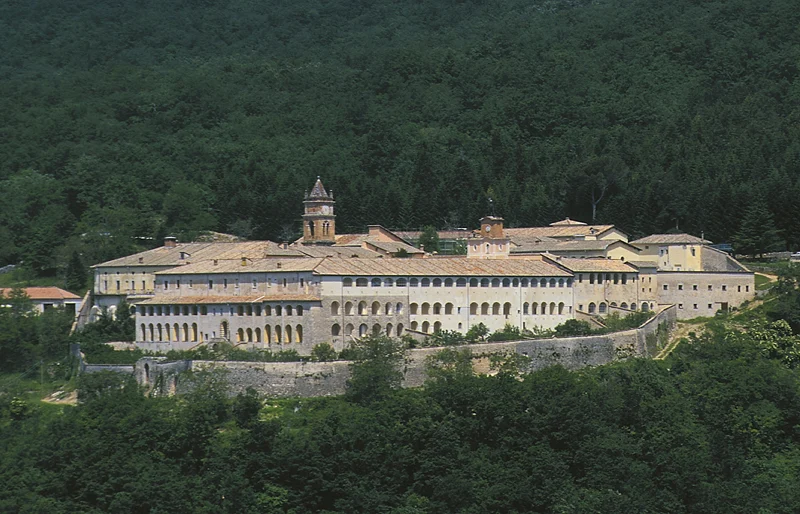
The Certosa di Trisulti is at Via Trisulti 8, in the territory of Collepardo (FR), and today it is run by the State: the Ministry of Culture through the Regional Directorate of National Museums of Lazio, with the Lazio Region handling guided visits and promotion. The ticket costs five euros, two reduced, free on the first Sunday of the month. It is bought on site or with the Musei Italiani app, and weekend guided visits are booked by email.
For six years the name of Trisulti ended up in the newspapers for reasons that had little to do with the Carthusians. In 2018 the complex was given in concession to a private association, the concession was annulled in 2019, appeals followed until 2026. Here we tell the affair in order, with dates. But the reason to climb all the way up here remains the same as before: the pharmacy, the church of San Bartolomeo with its two wooden choirs, the garden of boxwood clipped into odd shapes.
Hours, fares, contacts and the state of the management given here were checked on September 28, 2026 on the pages of the Regional Directorate of National Museums of Lazio, the Ministry of Culture and the Lazio Region, as well as the local press. The management of the certosa is changing right in these months, with a new party for reception and security, so before leaving write to the official addresses and have the day and hours confirmed.
Where it is and what you really see
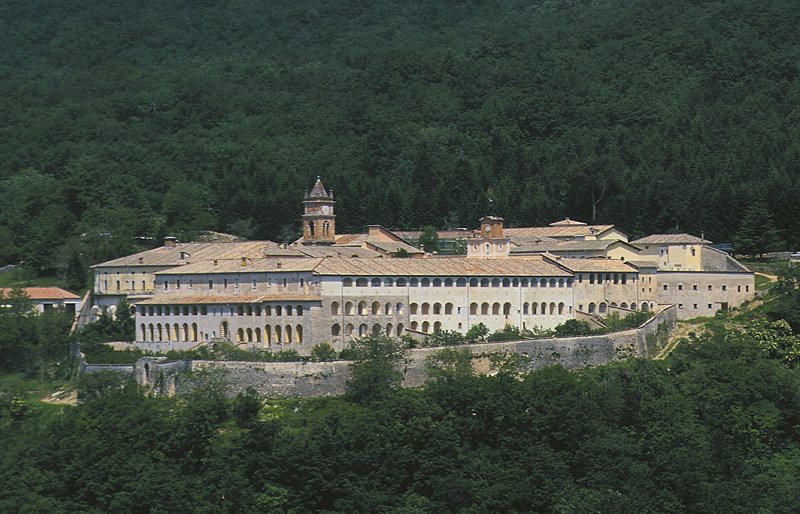
The certosa is in the Monti Ernici, on the flank of Monte Rotonaria, about six and a half kilometers from the town of Collepardo along the provincial road and about 20 kilometers from the Abbey of Casamari. Tourist sources give an elevation of around 825 meters. From Rome it is a little over 100 kilometers, but the last bends among the chestnut and beech woods lengthen the trip more than the map says.
The complex is large and closed in on itself, as a certosa should be. You arrive on a forecourt dominated by the Palazzo di Innocenzo III, the guesthouse building with a portico of Romanesque and Gothic forms, which today houses the state library. Opposite opens the route toward the church, the cloisters and the pharmacy. All the rest, the cells, the gardens and the lands, you understand by walking around and looking at the perimeter walls.
The visiting route touches the church of San Bartolomeo, with the eighteenth-century facade and the bust of the saint above the portal, the sacristy with walnut cabinets, the chapter hall with its wooden stalls, the refectory, the small cloister with the monks' cemetery and the large cloister. Then the pharmacy with the little salon decorated by Filippo Balbi and the Italian garden. The Directorate indicates an hour for the visit, and it is an honest estimate.
Among the medieval pieces the Directorate points out a lion sculpture, which many visitors walk past without noticing. The library holds a substantial book collection, but on the number of volumes the sources do not agree: the Ministry writes about 25,000, the Region's valorization agreement 37,000, other entries 36,000 or 40,000. The library is a research institution, not an exhibition hall, and whoever wants to consult it must ask separately.
What you do not see: the monks' cells in their original form, the cloistered areas, most of the farmland that for centuries supported the community. The certosa was inhabited until a few years ago and some spaces still have the air of a house left in a hurry. If you expect a museum set up with panels and display cases on every wall you will be surprised, for better and for worse.
Who runs the certosa today
Ownership is the State's. The complex was handed over to the Polo museale del Lazio in the mid-2010s, and in December 2019 the Polo became the Regional Directorate of Museums, today the Regional Directorate of National Museums of Lazio. On the exact date of the handover the sources do not agree: the free encyclopedia says December 2014, the chronology attached to the Region's agreement July 29, 2015. It is the Directorate that sets hours and tickets and collects the proceeds.
Since August 30, 2021 there has been a valorization agreement between the Directorate and the Lazio Region, renewed in 2025 for three years. Under that agreement the Region, through its company LAZIOcrea, has guaranteed reception staff, presence on site, guided visits and cultural activities. In September 2025 the regional government approved a strategic plan for the certosa. It is the model that allowed the reopening after the end of the private concession.
On July 24, 2026 the regional government approved a supplementary act to that agreement. According to the news reports published in those days, reception, security and visitor management pass to ALES, the Ministry's in-house company, while the Region keeps cultural promotion, guided visits and educational activities. The new division is starting up, and the operator does not yet say if hours or booking channels will change.
For completeness it must be said that the change was not welcomed by everyone in the same way. A local association, Trisulti Bene Comune, has publicly complained about the lack of involvement of local communities, the Monday closing introduced from August 3, 2026 and the reduced hours. These are positions that someone arriving from outside is not required to share, but they explain why people in the town still talk about it so much.
The concession affair, in order
On October 28, 2016 the Ministry published a call to entrust the certosa in concession to non-profit bodies. The Cistercians of Casamari, who had kept it since 1947, had decided to leave it for lack of vocations, and according to the Catholic press the local bishop had looked in vain for another religious order willing to take it. The complex is large, isolated and costly to maintain: nobody stepped forward.
On June 16, 2017 the tender was awarded to the Dignitatis Humanae Institute, a private non-profit association, for 19 years. The agreement was signed on February 14, 2018, with a rent reported by the press at 100,000 euros a year. The announced project was a school for political and cultural training, and the international press linked it to Steve Bannon, former adviser to U.S. President Trump. On December 31, 2018 about 300 people marched from Collepardo to the certosa.
On May 31, 2019 the Ministry announced the start of the revocation procedure, after an inspection and an opinion of the State Attorney's Office noting defects in the award and breaches of contractual obligations. On October 16, 2019 the award was annulled. The association filed an appeal with the TAR of Lazio, Latina section, on November 19, 2019, and in May 2020 the administrative court ruled in its favor.
The Ministry appealed. On March 15, 2021 the Council of State, sixth section, overturned the ruling and confirmed the annulment: according to the judges the association did not meet, at the time of the application, the requirements set by the call. On July 26, 2021 the keys went back to the Ministry, into the hands of the director general of Museums. On November 9, 2021 the certosa reopened to the public with free visits.
The last judicial chapter is from June 2026. The TAR of Latina rejected the association's remaining pending appeal and ordered it to pay costs to the Ministry and the Region. At the end of June the local press reported the association's intention to consider an appeal to the European Court of Human Rights. As of our verification date no other decisions are on record. The certosa, as far as the visitor is concerned, is public and open.
A curiosity about the Certosa di Trisulti
The name does not come from a saint or a family. Local sources derive it from the Latin tres saltibus, three passes or three crossings, that is, the mountain passages that from here connected the Ernici valleys. It is a place name from wayfarers and shepherds, and it already says why the monks chose this place: far from everything, but on a route that led somewhere. Carthusian solitude needed roads.
The real curiosity, though, is in the pharmacy. Filippo Balbi, the Neapolitan painter who worked at length at the certosa in the nineteenth century, painted in 1854 an anatomical head made up of small nude men who, intertwined, form the muscles and features of a face. The painting was shown at the Paris Universal Exposition of 1855. At Trisulti you see a copy of it. The original took another road.
The original is in Rome, at the Museum of the History of Medicine of the Sapienza. Those with time can make the comparison a few weeks apart: in the city you see the canvas in the context of surgical instruments and wax models, here you see it hanging next to the jars where the monks kept their herbs. Same subject, two different meanings. In the museum it is a document of the history of science, in the certosa an ornament with a touch of irony.
The other curiosity concerns the garden next to the pharmacy. The boxwood hedges are clipped into bizarre shapes, and the tourist entries attribute the invention to the monks. The garden began as a garden of simples, the ground where medicinal plants were grown for the preparations. Today the medicinal plants are few, the boxwood remains. Look at it knowing it was an open-air laboratory and not a decorative flower bed.
The pharmacy: what is really there
The pharmacy is the piece the certosa is known for, and the Directorate describes it as eighteenth-century, with nineteenth-century furnishings, display cases with pharmacy jars and cabinets with the boxes for herbs. On the dating of the layout the sources do not agree: the Ministry's entry places it in the seventeenth century. What is certain is that what you see is the result of layered interventions over two centuries, not a space born all at once.
The vault of the main room bears Pompeian-style decorations attributed to Giacomo Manco, painted at the end of the eighteenth century, at the moment when the excavations of Pompeii and Herculaneum made that repertoire fashionable all over Europe. The corridor and the little waiting salon are instead by Filippo Balbi, with fake architecture, trompe l'oeil and the jar labels painted on the wall. Two languages, two eras, in the same route of a few meters.
In the little salon is the life-size portrait of Fra Benedetto Ricciardi, who according to the tourist entries ran the pharmacy until 1863. The monk pharmacist looks at the visitor from the wall, surrounded by his flasks. It is a portrait of a trade, painted by a friend, and it says more about life in the certosa than many devotional frescoes. Stop in front of it. It is the portrait of a man who worked, not of a saint.
On the shelves are glass and ceramic jars, beech boxes with the names of the preparations, containers for ointments. Tourist sources say the monks produced remedies based on mountain herbs and also liqueurs, and some mention preparations with snake venom. On this point it is best to distinguish: the production of medicines is documented by the furnishings themselves, the specific recipes circulate by oral tradition.
On this room the position is contrarian, and sharp. The pharmacy is beautiful, but almost everyone looks at it as if it were the original shop of an eighteenth-century apothecary left intact. It is not. It is a nineteenth-century staging, decorated by an academic painter for a community that wanted to show its pharmacy to visitors. Once you understand this, you appreciate it more, because it becomes the portrait of how the monks wanted to be seen.
Those who want a comparison with a convent pharmacy in the city have in Rome the Antica Spezieria di Santa Maria alla Scala in Trastevere, tied to the Carmelites, where the trade was kept up until the twentieth century. For the botanical side, the Botanical Garden of Rome helps to recognize the medicinal plants that at Trisulti you see only written on the labels of the jars.
Something nobody tells you about the Certosa di Trisulti
Admission is no longer free, and half the web keeps saying the opposite. After the 2021 reopening the visit was free, and many tourist entries, travel blogs and even provincial promotion portals still write it. A decree of the director of the Regional Directorate of Museums of March 7, 2025 introduced the ticket, in force from June 3, 2025: five euros full, two reduced, 10 for the annual pass.
It is not a figure that changes your day, but it changes the organization. The ticket is paid with the Musei Italiani app or at the kiosk, according to what the agreement between Directorate and Region says. In the mountains, six kilometers from the nearest town, the phone signal is not always generous: download the app and buy the ticket before leaving the valley, so you don't end up walking back and forth across the forecourt looking for reception.
The hours you find online are often old too. For a long time the certosa had split hours with a lunch break and no weekly closing. Today the Directorate indicates continuous opening and closing on Monday. The entries you see online with hours from 10:00 to 13:30 and from 14:30 to 18:00 are not made up, they were simply written before the latest changes.
The second thing nobody says concerns the telephone. The certosa's historic number, 0775 47024, appears in all the guides, but on the Directorate's page it is listed as temporarily out of service. The channel that works is email: drm-laz@cultura.gov.it for general information, prenotazionicertosatrisulti@laziocrea.it for guided visits. Write a few days ahead and put in the subject line the date you want to come up.
Third thing: there are no more monks. Those who arrive thinking they will find a religious community, hear vespers or buy the liqueur from the hands of a friar end up disappointed. The Cistercian community had left its custody before the 2018 concession, and today the certosa is a state museum. For a living Cistercian community the right road leads to Casamari, 20 kilometers farther down the valley.
My advice for visiting the Certosa di Trisulti
Go on a Saturday or Sunday and book the guided visit. The Region's strategic plan indicates four shifts on the weekend: in summer at 10:30, 11:30, 15:30 and 16:30, in winter at 10:30, 11:30, 14:30 and 15:00. The Directorate specifies that the guided visit is included in the ticket. On weekdays you go around on your own, and on your own half the rooms stay mute, because there are few signs.
Choose the 10:30 shift. The reason is practical: you arrive with the morning light coming into the large cloister, you finish the visit by 11:30 and you have the rest of the day for the town, the caves and the Pozzo d'Antullo. The afternoon shift forces you to come down the mountain in the dark in winter, and the bends of the provincial road at night are no walk in the park.
Bring a sweater even in August. We are above 800 meters, the cloisters are in shade, the church and the pharmacy have thick walls and hold the cold. In spring and autumn the difference with Rome is quite a few degrees. Comfortable shoes, because the floors are uneven and the garden has dirt paths. Those traveling with a stroller must expect a few steps to get over by hand.
It pays to enter the church after the pharmacy, not before. The pharmacy is colorful, light, almost fun. The church is dark, with the iconostasis separating the area of the lay brothers from the monks' choir, and after the pharmacy the contrast makes you understand what Carthusian life was: concrete work on one side, silence and liturgy on the other.
Last advice on organized groups. The Ministry's entry indicates a maximum of 15 people plus the guide for each shift, rising to 25 with amplification systems. If you accompany a larger party you have to split it, and it is best to agree on this by email well in advance. The answer comes, but it takes patience and willingness to accept the time they propose.
Hours and tickets
The page of the Regional Directorate of National Museums of Lazio gives these hours: from April 16 to October 15 from 10:00 to 19:00, from October 16 to April 15 from 10:00 to 16:00, last entry half an hour before closing. Closed on Monday and on December 25. On this point the sources do not agree: other pages report summer closing at 18:00 with a lunch break, and the local press of July 2026 speaks of summer opening from 10:00 to 18:00.
The ticket is really bought in two ways: on site, at the kiosk, or with the Ministry's Musei Italiani app, indicated both by the entry on cultura.gov.it and by the page of the Regional Directorate of National Museums of Lazio. Those who instead want the certosa inside a guided hike, among the Valle dei Santi, the hermitage of San Domenico and the Madonna delle Cese, find on GetYourGuide a six-hour guided trek from Collepardo.
The published fares are five euros full, two euros reduced, which the Region's strategic plan reserves for European Union citizens between 18 and 25, and 10 euros for the annual pass. The plan indicates free admission for those under 18. Entry is free for everyone on the first Sunday of the month and on April 25, June 2 and November 4.
Weekend guided visits are booked by writing to prenotazionicertosatrisulti@laziocrea.it, the address the Directorate still publishes today. With the supplementary act of July 2026 reception passes to ALES, while the guided visits stay with the Region: the operator does not say if the booking address will change. For general information the email is drm-laz@cultura.gov.it, and the Ministry's entry also gives drm-laz.certosatrisulti@cultura.gov.it.
Photographs are allowed, the Directorate says so plainly. The Directorate indicates a free parking lot nearby. The Directorate specifies that the certosa can be reached only by private vehicle, and I come back to this further on. No detailed information has been published on the accessibility of the individual spaces: the Region's strategic plan mentions planned works for people with reduced mobility, so ask first by email.
Another well-known fact, yet rarely cited
Trisulti was not born Carthusian. Before the Carthusians, at the end of the tenth century, in this valley there was a Benedictine monastery founded by San Domenico, the abbot whom tradition ties to Sora. The free encyclopedia gives the date 996. When Innocent III, in 1204, decided to build the new complex and entrust it to the Carthusians, he was not starting from an empty place but from a monastic presence of two centuries.
The Benedictine monastery was not exactly where the present certosa stands. Its traces and the memory of San Domenico are tied to the hermitage that bears his name, lower in the valley, reachable by a trail. Those who do the Valle dei Santi trek pass through it. Those who arrive at the certosa by car usually don't know it, and miss the oldest piece of the history of this mountain.
The second rarely cited fact concerns the Madonna delle Cese, the cave sanctuary a short distance away. Local tradition tells that in the sixth century the Virgin appeared to a hermit, leaving her image imprinted in the rock. Here we keep the three levels separate: that the cave was inhabited by hermits is plausible and repeated by the sources, the dating to the sixth century is tradition, the imprinted image is devotional legend.
The third fact is administrative and explains a lot. The certosa was recognized as a national monument by ministerial decree of July 17, 1879 and declared of cultural interest on January 18, 1963. On the first date the sources do not agree, because some entries report 1873 or 1890, but the Region's agreement cites the 1879 decree. The complex has been protected as a national monument for almost a century and a half, and in the twentieth century the monks lived in it as custodians.
The right photo to take at the Certosa di Trisulti
The photo is the boxwood garden seen from the pharmacy door. You stand on the threshold, with the doorpost in the foreground on the left, and let the clipped hedges fill the lower two thirds of the image, with the walls of the certosa and the woods in the background. In that frame there are the laboratory, the garden and the mountain, that is, the whole economic reason for the place.
The second photo is the large cloister, built according to the tourist entries around 1700 at a lower level than the church. Go down to a corner and shoot the run of the arcades on the diagonal, with the morning light coming in from one side. The cloister is empty, clean, geometric. In a central, frontal shot it becomes flat, on the diagonal it gains depth and conveys the size of the enclosure.
Inside the pharmacy the temptation is to photograph everything. Choose a detail instead: a row of jars with labels, or a piece of Balbi's fake architecture where the trompe l'oeil shows up close. The room is small, the light comes from the windows and the vault is low. A wide-angle shot of the whole distorts everything and gives you back a crooked corridor.
Avoid the photo of the facade from the forecourt in full daylight. The facade of the church, which the sources attribute to Paolo Posi and date to 1798, with the sun high and the light walls around, confuses the automatic exposure. If you want the facade, look for side light or an overcast day, when the stone doesn't reflect and the bust of San Bartolomeo above the portal reads well.
A last note. The mountain around is the most photogenic part of Trisulti and almost nobody shoots it. Along the provincial road, when the woods open, the complex appears enclosed among the trees with its perimeter walls. It is the photo that explains why the Carthusians chose this place. Stop only where there is a safe wide spot, because the road is narrow and the bends are unforgiving.
How to get there from Rome
By car. It is the only sensible way, and the Directorate says so too: the certosa can be reached only by private vehicle. From Rome you take the A1 motorway south and then the provincial roads toward Alatri and Collepardo. Tourist sources give about 111 kilometers and between an hour and a half and an hour and three quarters of travel. On the weekend, with the traffic leaving Rome, count on the longer estimate.
The last stretch, from Collepardo to the certosa, is about six and a half kilometers on the provincial road, with bends and a few narrow points. In winter the road can ice over in the coldest hours, and the area is not always covered by phone signal. Fill up with gas in the valley before going up, so you don't have to look for a pump on mountain roads, and download the map to your phone if you use the navigator.
By public transport the day gets complicated. Tourist sources indicate the train to Frosinone, then a bus to Collepardo, and from there the six and a half kilometers of climb are missing, which are done on foot on a trail or by a taxi booked in advance. Some foreign guides indicate Sora and Isola del Liri as closer stations. In all cases, without a car the day stretches out a lot.
I do not give bus lines and times because they depend on the season and the day of the week: check them on the Cotral and Trenitalia sites the day before, paying particular attention to the afternoon return runs. The real risk is not getting there, it is being stuck in Collepardo at six in the evening on a Sunday with no more runs to get down to the valley.
Those who get there on foot almost always do so from Collepardo, with the trails that climb through the Valle dei Santi passing by the hermitage of San Domenico. It is a half-day route, marked, with waterfalls and little wooden bridges. Those who don't know the area can rely on a hiking guide: in that case the visit to the certosa fits inside a day of walking and takes on a different meaning.
Some important events that happened here in history
In 996 San Domenico founds a first Benedictine monastery in the area. In 1204 Pope Innocent III starts the construction of the present complex and entrusts it to the Carthusians, who move in, according to the Ministry's entry, in 1208. In 1211 the church dedicated to San Bartolomeo is consecrated. The palazzo bearing the pontiff's name on the forecourt recalls this commission.
In 1564 the Carthusian masters make the first of the church's two wooden choirs, attributed to a master Iacobo. In 1683 Giuseppe Caci frescoes the vault with the Glory of Paradise. In 1688 a second choir comes from the hands of a brother Stefano. The church therefore has two choirs, one for the monks and one for the lay brothers, divided by the iconostasis, following the Carthusian custom that separated the two components of the community.
Between the seventeenth and eighteenth centuries the complex grows: the large cloister around 1700, the pharmacy, the Baroque and neoclassical facade of the church, Giacomo Manco's Pompeian decorations at the end of the century. In the nineteenth century Filippo Balbi arrives. On his years of stay the sources do not agree: one biography gives the period from 1859 to 1863, the tourist entries from 1857 to 1865.
On July 17, 1879 the certosa becomes a national monument. In 1947 the Carthusians give way to the Cistercians of the Casamari congregation, who stay until the mid-2010s of our century. On January 18, 1963 comes the declaration of cultural interest. Then the handover to the Polo museale, the 2016 call and the concession affair told above.
From 2021 onward the chronology is that of a state museum: reopening on November 9, 2021, first valorization agreement with the Region on August 30 of the same year, ticket introduced from June 3, 2025, new three-year agreement in 2025, strategic plan approved by the Region in September 2025, TAR of Latina ruling in June 2026 and supplementary act of July 24, 2026 with the passage of reception to ALES.
Who passed through the Certosa di Trisulti
San Domenico, Benedictine abbot, who according to local sources came from Foligno and whose memory is tied to Sora and this valley. To him is owed the first monastic foundation, and the hermitage below the certosa is named for him, with a bronze bust that guided hikes point out as a stop. Without him the certosa would have no prehistory, and the valley would be called something else.
Innocent III, the pope who in 1204 wanted the new complex for the Carthusians. He came from the family of the counts of Segni and knew this piece of southern Lazio well, the same one of the cathedrals and papal palaces of Anagni. The guesthouse palazzo that bears his name is the first thing you see on arriving, and it is also the oldest part that reads well from the outside.
Filippo Balbi, born in Naples in 1806 and died in Alatri in 1890, a painter of academic training. At Trisulti he left the decoration of the pharmacy, paintings in the church including a Massacre of the Innocents, lunettes, caricatures and portraits. He also worked for Alatri and for Frosinone. It is the name that comes up most often during the visit, and rightly: a large part of what stays with those who leave is his work.
Giuseppe Caci and Giacomo Manco, the two painters of the vaults: the first with the Glory of Paradise in the church and, according to the tourist entries, probably with the eight canvases of the Magdalene in the chapter hall, the second with the Pompeian decorations of the pharmacy. Alongside them the sources cite Vincenzo Manenti for the altar canvases and Jacopo Lo Duca for the bust of San Bartolomeo on the facade.
Fra Benedetto Ricciardi, the monk pharmacist portrayed by Balbi, who ran the pharmacy until 1863. And then the Cistercians of Casamari, who arrived in 1947 and stayed until the end, when according to the Catholic press a single father was left to celebrate Sunday Mass. They are the ones who kept the certosa open for 70 years, in a period when nobody spoke of valorization.
Finally the protagonists of recent news, whom it is best to name without adjectives. The Dignitatis Humanae Institute association with its director Benjamin Harnwell, concessionaire between 2018 and 2021. The Ministry officials who in July 2021 took back the keys. The local associations that had joined the proceedings in support of the Ministry. This too is by now the history of the place.
Collepardo, the caves and the Pozzo d'Antullo
The certosa pairs by force with the town that gives it its comune. Collepardo is a small center in the Monti Ernici, known for centuries for medicinal herbs, and local tradition has built on it the myth of the garden of the centaur Chiron, the teacher of medicine in Greek mythology. It is legend, and they know it in the town too, but it explains why the Carthusians' pharmacy was not born by chance.
The Grotte di Collepardo were called the Grotte dei Bambocci for the shapes of the concretions, and were renamed Grotte Regina Margherita after the queen's visit in 1904. The cave operators' site gives the number 0775 47065 and the email grottedipastena@gmail.com for information. Hours change with the seasons and with groups, so write first. Those who like the genre find a second karst system at the Grotte di Falvaterra.
The Pozzo d'Antullo is a collapse sinkhole, that is, a cave whose ceiling has fallen in leaving an open chasm in the woods. The operator's site writes 60 meters deep and 300 wide, the free encyclopedia 80 meters maximum depth and 300 circumference: the sources do not agree. The operator publishes a ticket of two euros, summer opening from 09:00 to 19:00 and winter from 10:00 to 16:25.
A legend circulates about the Pozzo that the German historian Ferdinand Gregorovius recorded in the nineteenth century: the Virgin supposedly punished the peasants who were threshing grain on the day of the Assumption by making the threshing floor sink. It is a folk tale, not a fact, and belongs to the same family of stories that explain with a divine punishment the karst chasms of half of Italy. Good to know before going down, because they will tell it to you anyway.
When it is closed and what not to expect
The certosa is closed on Monday and on December 25. The Monday closing is recent, introduced from August 3, 2026, and many pages online do not report it yet. There may be extraordinary closings for maintenance or for the handover between the parties managing reception and security: in these months of transition it is best to write before setting out, especially on holidays.
Don't expect a shop of monastic products. The liqueurs and preparations the monks produced are part of the history of the place, but today the certosa is a state museum and not a monastery with a shop. Those looking for herb-based products find them in the towns of the area, in Collepardo in particular, from local producers. The operator does not indicate the presence of a bookshop or an on-site refreshment point.
Don't expect detailed panels in every room. The route is essential and much information comes only from the weekend guide. Don't expect to enter the library during the ordinary visit either: it is a research institution with its own rules. And don't expect an active place of prayer: the church can be visited as a museum space, and the Region's page on the certosa reports only one Mass on holidays at 11:00.
On the local debate a pragmatic position is best. Those who live here ask for longer hours and more involvement of the territory, and have their reasons. Those who arrive from outside only need to know that the certosa is open, that it costs little and that the staff do what they can with the means they have. After years of closed doors and courtrooms, a certosa open six days out of seven is already a result.
Eating in the area
Around the certosa there is almost nothing, and that is the first thing to know. You eat in Collepardo, in Alatri, in Veroli or in Fiuggi. The cooking of the area is mountain and hill food: homemade pasta, meats, legumes, sheep cheeses, wild herbs. In the villages tourist traps are less common than in Rome, but they exist, especially in through places along the main roads.
The first signal to avoid is menus with photographs of the dishes, laminated and translated into several languages. A place that has to show you the picture of fettuccine is talking to someone who doesn't know what they are, and prepares what that public expects. Same for the lady rolling out the sheet of pasta in the window: it is a theatrical lure. Good pasta is made in the kitchen, in the morning, away from the street.
The second signal is the person at the door inviting you in. A place that needs to stop passersby has no regular customers, and regular customers are the only guarantee. Be wary too of places open without a break from morning to night: a real kitchen has a pause. And of tables in front of the monument with items without a price, or with different price lists between inside and outside.
Romans don't go to those places, and not out of snobbery. They simply know that the price adjusts to the passing customer and that the cooking is built for the tourist who will not return. The criterion is to look at who is sitting: if at lunch on a weekday you find workers, office staff and local families, you are in the right place. Always ask the price of items without a figure before ordering.
In the towns of the Monti Ernici many trattorie open only for lunch on weekdays and close early in the evening. Phone first, especially out of season, and don't count on finding a table at three in the afternoon after the visit. To avoid trial and error, here is our list of the places where we eat.
What to pair it with in a day
The natural pairing is with the Cistercian abbeys. The Abbey of Casamari is about 20 kilometers away, still inhabited by a community, and closes the discussion opened at Trisulti: on one side the certosa now a museum, on the other a living monastery. Those who want to complete the picture of the Cistercians in Lazio have the Abbey of Fossanova and the Abbey of Valvisciolo in the province of Latina.
Those who prefer art cities have half an hour away Alatri with its acropolis of polygonal walls, Ferentino with the Roman theater, and Anagni with the Cathedral Museum and the Palazzo di Bonifacio VIII. Choose just one city: the certosa plus an art city is already a full day, and with two you rush.
For the mountain side, from Collepardo you climb toward Vico nel Lazio, a walled village of the Monti Ernici, and Guarcino. Farther north, beyond the mountains, are Trevi nel Lazio and Filettino at the sources of the Aniene, inside the Monti Simbruini Park. These are mountain roads, and should be driven slowly.
Those building an itinerary of mountain sanctuaries can tie Trisulti to the Sanctuary of the Santissima Trinità above Vallepietra and to the Sanctuary of the Mentorella. And those following the Benedictine trail find at Subiaco the Sacro Speco and the Monastery of Santa Scolastica, and farther south the Abbey of Montecassino.
To stay on the Carthusian theme without leaving Rome, the city has its own certosa inside the Baths of Diocletian. The Basilica of Santa Maria degli Angeli began as a church of the Carthusians, and the Michelangelo Cloister inside the museum of the Baths of Diocletian was their large cloister. Seeing it after Trisulti makes you understand how uniform the rule was, from the city to the mountain.
Those traveling toward the Liri valley can end the day at Isola del Liri, with the waterfall in the middle of town, or at Sora, which keeps the memory of San Domenico. For kids, Fumone with its castle works better than any cloister. And families who want to stay outdoors find in Fiuggi parks and walks without elevation changes.
Frequently asked questions
Who runs the Certosa di Trisulti today?
The certosa is State property and is run by the Ministry of Culture through the Regional Directorate of National Museums of Lazio. A valorization agreement with the Lazio Region entrusts guided visits and cultural activities to the Region. With a supplementary act approved by the regional government on July 24, 2026, reception and security pass to ALES, the Ministry's in-house company.
Can the Certosa di Trisulti be visited?
Yes. The certosa is open from Tuesday to Sunday. According to the page of the Regional Directorate of National Museums of Lazio the hours are from 10:00 to 19:00 from April 16 to October 15 and from 10:00 to 16:00 the rest of the year, with last entry half an hour before. Other sources report summer closing at 18:00, so it is best to ask for confirmation by email before leaving.
How much does the ticket cost?
The full ticket costs five euros, the reduced two euros and the annual pass 10 euros. The reduced ticket, according to the regional strategic plan, applies to European Union citizens between 18 and 25, and those under 18 get in free. Entry is free for everyone on the first Sunday of the month, April 25, June 2 and November 4.
Is the pharmacy open to the public?
Yes, the pharmacy is part of the ordinary visiting route and the Directorate lists it as visitable, with the nineteenth-century furnishings, the display cases with jars and the cabinets with the boxes for herbs. You visit the main room with the decorated vault and the little salon painted by Filippo Balbi, from which you exit onto the boxwood garden.
How do you book the guided visit?
Guided visits are held on Saturday and Sunday, are included in the ticket and are booked by writing to prenotazionicertosatrisulti@laziocrea.it, the address published by the Directorate. Groups have a limit of 15 people plus the guide, 25 with amplification systems. The number 0775 47024 is listed as temporarily out of service on the official page, so use email.
What happened with the 2018 concession?
In 2017 the Ministry awarded the certosa for 19 years to the Dignitatis Humanae Institute, with an agreement signed in February 2018. In October 2019 the award was annulled. The TAR of Latina ruled in the association's favor in 2020, the Council of State confirmed the annulment on March 15, 2021. In June 2026 the TAR rejected the last pending appeal.
Can you get there by public transport?
The Directorate indicates that the certosa can be reached only by private vehicle. By train you reach Frosinone and by bus Collepardo, but from the town there remain about six and a half kilometers of climb, to be done on foot or by a booked taxi. Run times must be checked on the Trenitalia and Cotral sites the day before.
Are there still monks at Trisulti?
No. The Cistercians of the Casamari congregation, who had kept the certosa since 1947, left it for lack of vocations before the 2018 concession. Today the complex is a state museum. The church is visited as a museum space and the Region's page reports a Mass on holidays at 11:00. An active Cistercian community is found at the Abbey of Casamari.
Who wrote this page
This page comes from the team at Tour Leader Pro, the Rome-based outfit that designs itineraries, visits and cultural events across Rome and Lazio. Hours, fares and the state of the management come from the official sources cited in the text as of the date stated at the top. The management of the certosa is in the middle of a handover between different parties: recheck everything before leaving and tell us what you find changed.
Lining up a day in the Monti Ernici means fitting together the hours of state museums in transition, guided visits only on the weekend, mountain roads that ice over in winter and trattorie that close early, for yourself or for a group of 40 people. Whoever faces this kind of work will find on Tour Leader Pro materials designed for those who lead and for those who organize on their own.
For the wide picture, that is regional trains and seasonal schedules, car rentals, airports, moves from one province to another and Lazio destinations outside Rome, from the Ciociaria to the volcanic lakes of the north to the Pontine coast and the villages of the Apennines, a useful resource for putting together a multi-day itinerary is Italy Planner.