Holy Trinity Sanctuary of Vallepietra
In short. The Santuario della Santissima Trinità is on Via Santissima Trinità, in the territory of Vallepietra (RM), below the wall of Monte Autore, at an altitude of about 1,337 meters.
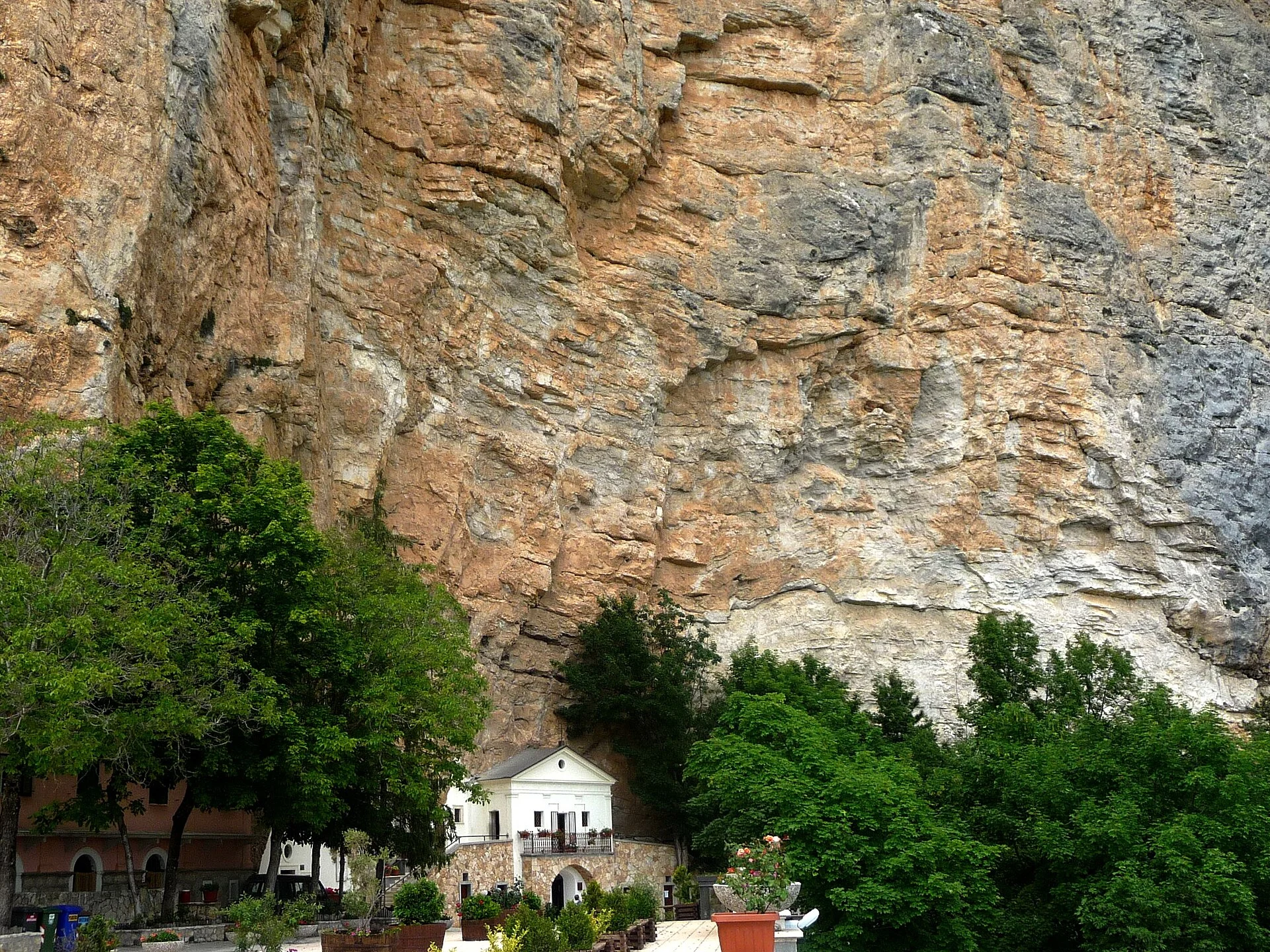
The Santuario della Santissima Trinità is on Via Santissima Trinità, in the territory of Vallepietra (RM), below the wall of Monte Autore, at an altitude of about 1,337 meters. It belongs to the diocese of Anagni-Alatri, admission is free and you don't book anything. It opens only from May 1 to October 31: for 2026 these are the dates, and in the remaining six months the cave stays closed and the mountain does the rest.
You come up here for a single image. Inside a cave under 300 meters of rock there is a medieval fresco with three identical figures seated side by side, who bless in the same way and hold the same book. Around that image, for centuries, the companies of pilgrims who arrive on foot from Lazio, Abruzzo and Campania have moved, and on Trinity Sunday the girls of the village sing the Pianto delle zitelle.
The practical information reported here comes from the sources consulted on September 28, 2026: the local press that gave the dates of the 2026 season, the sheets of the Parco dei Monti Simbruini, the Istituto centrale per il patrimonio immateriale and the Touring Club. Mass times change from month to month and the sanctuary publishes them on its own website. Before leaving, phone 0774 899084, because at this altitude a thunderstorm changes the program of the day.
Where it is and what you really see
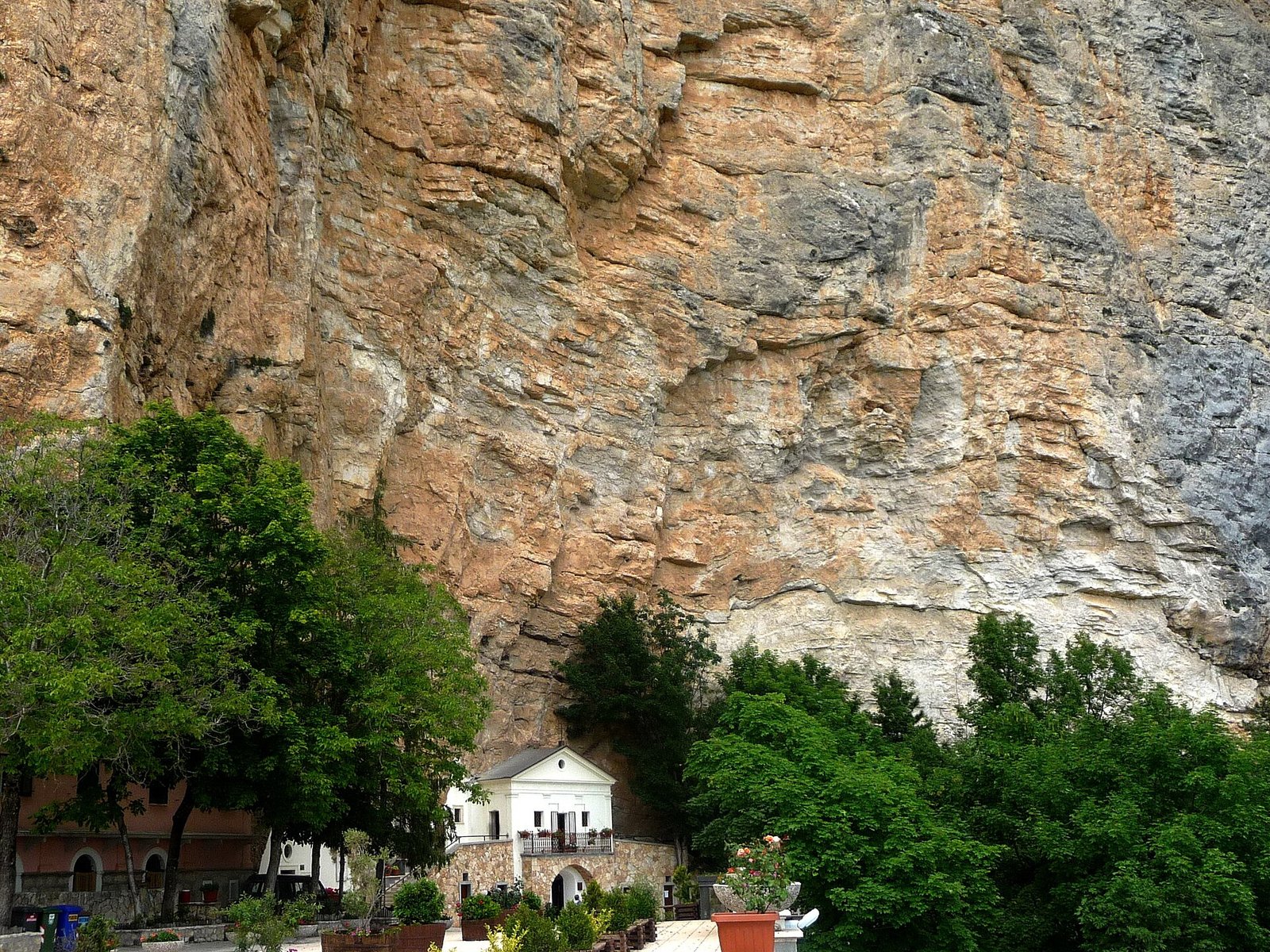
The sanctuary occupies the foot of a great sheer cliff of the Monte Autore group, on the southwest slope of the Monti Simbruini, on the border between Lazio and Abruzzo. The wall that looms over it is called Colle della Tagliata: local descriptions give it as about 300 meters high and a kilometer wide, bare, layered limestone that you recognize from far away, already from the road that climbs from Vallepietra.
The core is the cave, closed off toward the outside by a masonry construction. Inside is the fresco of the Trinity, with other medieval and 15th-century paintings on the walls. Next to the old sanctuary a small modern structure has been built for open-air celebrations, because on feast days the cave holds a tiny fraction of the people who arrive. The difference between the two parts is seen at once, and not everyone appreciates it.
The minor chapels are three. The Cappella del Crocefisso, the Cappella di San Giuseppe, restored and today devoted to Eucharistic adoration, and the Cappella di Sant'Anna, dug into the rock. To these is added a small museum organized in rooms that, according to the Park's sheet, collects historic photographs, relics and furnishings linked to the noble families of the area. The whole route takes under an hour, if there is no crowd.
The rest is landscape and movement of people. Along the stretch on foot that leads to the sanctuary, stalls line up with candles, souvenirs and local products, and anyone who arrives expecting the silence of a hermitage is thrown off. On weekdays in September the trade shrinks and the mountain becomes the protagonist again. On weekends in July and August the opposite happens, and it is worth knowing before choosing the date.
A curiosity about the Santuario della Santissima Trinità di Vallepietra
Pilgrims leave the cave walking backward. It is not the oddity of some isolated devotee: the sheet of the Istituto centrale per il patrimonio immateriale of the Ministry of Culture describes the gesture as part of the rite. You go in, touch the rock above your head with your hand, and go out backward so as not to turn your back on the image. On feast days this produces very slow traffic, which has to be respected without losing patience.
The catalog of gestures is longer and almost all pre-Christian in form. People carry branches and plants, what ethnographers call dendrophory. They build small cairns of stones along the path, they throw stones from the bridges over the streams as an image of sin cast away. On the first stretch of the way back someone still walks backward. Someone looking from outside sees folklore. Someone doing it sees a precise sequence.
Then there is the comparatico, which is the most interesting part for those who study mountain communities. Two people dip their hands together in the water and become compari, that is, bound by a spiritual friendship that in the past had concrete social consequences: help with work, presence at baptisms, mutual obligations. The pilgrimage was also the place where these alliances were built between families from distant villages, who saw each other once a year.
On these rites, the editorial position is clear. Anyone who looks at them with condescension from the city is wrong, and anyone who photographs them up close like an attraction is more wrong. These are living practices, carried out by people who have walked two days to get here. Watch from a distance, don't push into the line with your phone raised, and if someone explains the meaning of a gesture, listen: you won't find that explanation written down.
The Fresco of the Trinity, Seen Up Close
The fresco shows the three divine persons seated on a single throne, perfectly equal in face, robe and gesture. All three bless in the Greek manner and hold an open book. Below runs the Latin inscription IN TRIBVS HIS DOMINVM PERSONIS CREDIMVS, that is, in these three persons we believe in the Lord. The Park's information sheet gives the measurements: 2.10 meters high by 1.60 wide.
On the dating, the sources disagree. The ministry's information sheet and most of the studies cited locally speak of the 12th century, while the Simbruini Mountains Park sheet writes 11th. The difference is not a detail for specialists: the century you choose changes the context, because it ties the image either to the phase of the monastic foundation or to the period when the sanctuary already appears in the documents of Anagni.
The iconographic problem is what makes the image rare. Depicting the Trinity means saying at once that God is one and that the persons are three. Western art has solved the question in many ways, often with the old man, the young man and the dove. Here the painter takes the Eastern route, Byzantine in form, with three identical figures: unity is expressed by equality, plurality by number. It is a solution you rarely see in Italy.
The cave walls carry other paintings too. Historical descriptions cite a Saint Juliana of Bithynia and a Saint Dominic of Foligno, that is, the Dominic whom tradition calls of Sora, as well as 15th-century figures of saints and of Madonnas with Child. They are works of uneven quality, repainted and touched up over time by devotion. Look at them anyway, because they tell you whom the sanctuary considered important in the following centuries.
One Thing Nobody Tells You About the Sanctuary of the Most Holy Trinity of Vallepietra
The return is the tiring part, not the trip there. Anyone arriving by car leaves it in the large parking lot up above and goes down to the sanctuary on dirt path and steps: visitor accounts speak of 20 or 30 minutes at an easy pace. On the way down it feels like a stroll. After Mass, with the July sun on the white rock and a crowd climbing back up at the same moment, that stretch becomes a real climb.
This changes how the visit should be organized with elderly people or small children. A paid shuttle runs between the parking lot and the sanctuary, and recent reviews describe it as expensive for the distance covered. For people who have trouble walking uphill, it is money well spent. For anyone in good shape, it makes more sense to walk down, visit at a relaxed pace and climb back up before the peak hour.
For anyone with a disability permit, things are different. According to the replies given to visitors, access for disabled drivers' cars up to the sanctuary parking area is allowed by authorization, which must be requested beforehand. The operator doesn't publish a written procedure: phone the sanctuary a few days before your visit, explain the situation and have them tell you the hours and conditions. Showing up at the barrier without having called rarely works on busy days.
The second thing nobody says: the altitude fools you. The sanctuary sits above 1,300 meters, the parking lot is higher still, and in May or October the temperature can be 10 or 15 degrees lower than Rome's at the same hour. Vallepietra has high-mountain winters. A heavy sweatshirt in your backpack, even in August, is not excessive caution. It's experience.
The Origins: Documents, Tradition and Legend
Let's start with what the documents say. The Ministry of Culture sheet gives as the first written records two charters of 1079 and 1112, kept in the archive of the cathedral of Anagni and concerning donations. It's little, but it's solid. It says that at the end of the 11th century the sanctuary already existed, owned property and mattered enough to be named in formal acts of a major episcopal see.
Archaeology also brings material data, with a few contradictions. Local descriptions report prehistoric flint arrowheads found in the area, but the sources disagree on the year of the discovery, which one dates to 1894 and another to 1984. In the courtyard you can see stretches of Roman-era masonry in opus reticulatum, and two columns bear the carved name T. Alfius. Ancient use of the place is therefore documented. A pagan temple, however, remains a hypothesis.
Then comes the historiographical tradition, which proposes specific founders. One line attributes the consecration to the Trinity to the Benedictines of Subiaco together with Basilian monks of the Greek rite, and this would explain the Eastern iconography. Another points to Saint Dominic of Sora, the monk born in Foligno who founded monasteries throughout the central Apennines. The Park's sheet links the foundation to the year 1031, which is when tradition places the saint's death.
Finally the legend. The most commonly told version is that of the farmer who was plowing above the cliff and saw his oxen plunge into the void for 300 meters. When he climbed down to look for them, he found them alive, kneeling before a cave where the Trinity was painted. According to local tradition, a curved rock formation resembling a plow can still be made out on the wall, and pilgrims point it out with a finger as they climb.
A second legend, less well known and reported by the ministry's sheet, moves everything to the age of Nero. Christians who fled from Ravenna to escape persecution are said to have taken refuge in these mountains and to have had a vision of the Trinity together with Saints Peter and John. It has no documentary support and looks very much like a story constructed to give the sanctuary an apostolic antiquity. It should be told as such.
My advice for anyone leading groups is to keep the three levels separate even when the story wants to merge them. The kneeling oxen work wonderfully in front of the wall, and it would be a shame not to tell them. But right afterward you have to say that the first charter is from 1079, that the fresco is medieval and that the plow-shaped rock is an interpretation. The audience respects you more when you make the distinction.
My Advice for Visiting the Sanctuary of the Most Holy Trinity of Vallepietra
Go on a weekday in September, early in the morning. That's when the season is still open, the stalls are few, the road is clear and the August heat has passed. In the cave you can stay in front of the fresco as long as you need, without the line that on feast days pushes you out in 30 seconds. October works, but the days get shorter.
Here is the contrarian position. The feast of the Most Holy Trinity, the one everybody names as the moment to experience, is the worst day for a first visit if you want to understand the place. Many thousands of people, congested road, continuous Masses, a cave that is in practice inaccessible. It is a powerful anthropological experience, but it is a different visit. First get to know the sanctuary empty, then come back for the feast.
Call before you leave. The sanctuary number given by the guides is 0774 899084, and the Touring Club also lists the mobile 335 1254126. Ask three things: the schedule of the day's Masses, if the shuttle is running, and if any organized pilgrimages are arriving. A company of 300 people entering the cave at 11:00 completely changes your morning, and on the phone they will tell you.
Bring cash in small bills. Parking is paid, with a per-vehicle fee that all accounts describe as modest, and the guides recommend having coins. The shuttle is paid separately. The stalls work in cash. In the mountains phone coverage is irregular, and counting on electronic payments when the signal disappears is the quickest way to end up stuck at the barrier.
One last note, on shoes. Even those who arrive by car walk on dirt path, steps and rock polished by centuries of footsteps, which becomes slippery when damp. Light hiking shoes, or at least sneakers with a treaded sole. On the steps down to the sanctuary, twisted ankles are not rare, and it always happens in sandals and loafers, always on the final stretch, when people look at the wall instead of looking where they put their feet.
How to Get In: Hours, Season and Rules
Admission is free, as for any church, and there is no ticket or reservation for an individual visit. The 2026 season opened on Friday, May 1 and closes on Saturday, October 31: the winter closure is due, according to the announcements issued for the reopening, to the severe weather conditions that characterize the altitudes of Monte Autore. From November to April the sanctuary stays closed.
There are no sales channels to look for, because there is nothing to sell. The official reference is the website of the Sanctuary of the Most Holy Trinity of Vallepietra, which publishes the page with the sanctuary's hours, news about the feasts and live streams of the main celebrations. Anyone who offers you a paid visit to the sanctuary is selling the transport or the accompaniment, not the access. A place in the cave can't be bought.
Opening hours vary with the months. The Touring Club gives an indicative daily opening from 7:00 to 18:00, specifying that days and hours may change, and hiking guides report longer openings in July and August and shorter ones in October. The sanctuary publishes the calendar month by month. The exact information for the day you are going should be checked there or asked by phone, not taken from a third-party site.
The same goes for Masses. The operator gives no fixed schedule valid for the whole season, and on pilgrimage days Mass is celebrated almost continuously. For the May 1, 2026 opening, for example, the program included the departure on foot from Vallepietra at 6:30, the Eucharistic celebration at 10:00 presided over by Bishop Emeritus Lorenzo Loppa, a second Mass at 11:30 and the return to the village.
The rules are those of a heavily visited place of worship. Decorous clothing in the cave, silence during celebrations, no flash photos of the fresco. On feast days the companies enter as a group, with the banner at the head, and the individual visitor waits his turn: that's as it should be, because they have walked to get here. Anyone entering as a tourist gets in line and waits, without negotiating.
Another Well-Known Fact, Yet Rarely Cited
May 1, in Vallepietra, is not only the reopening day. In 1944 German soldiers retreating from the Cassino front aimed their weapons at the villagers and threatened to shoot a number of civilians if they did not reveal the hiding place of some partisans. The community did not speak. The local press, presenting the 2026 reopening, explicitly recalled this link between the date and the village's memory.
The fact is known in the valley and almost absent from the guides. Yet it explains why the opening pilgrimage, with the departure at dawn from the village and the return at noon, carries a different weight for the residents than any ordinary seasonal ceremony. Anyone who climbs on May 1 walks beside families who know that story from their grandparents' direct telling. It's worth knowing beforehand, to understand what you are seeing.
The Cassino front, after all, is closer than a Roman's mental geography suggests. The Abbey of Montecassino lies less than 100 kilometers away as the crow flies, and the German retreat of spring 1944 also went up the inland valleys between Lazio and Abruzzo, far from the main roads. Anyone who leads groups in these villages would do well to remember it, because local memory of those months is still very present.
A second rarely cited fact concerns institutional recognition. The feast of the Most Holy Trinity of Vallepietra is cataloged by the Central Institute for Intangible Heritage of the Ministry of Culture, alongside the great Italian popular feasts. It is not a tourist brand. It is the recognition that this system of songs, gestures and journeys on foot constitutes a cultural heritage to be documented, on the same footing as a fresco or a Romanesque portal.
The Feast of the Most Holy Trinity and the Pianto delle Zitelle
The main feast falls on the Saturday and Sunday of the solemnity of the Most Holy Trinity, that is, the weekend after Pentecost, and so it changes date every year. In 2026 it was celebrated on May 30 and 31. On Saturday evening the solemn Mass was presided over by the bishop of Anagni-Alatri Santo Marcianò, with the companies present, and on Sunday the first Mass was set for 5 a.m.
The most awaited moment of Sunday morning is the Pianto delle Zitelle, the Lament of the Spinsters. The young women of Vallepietra, dressed in white, perform a sacred lauda that retraces the Passion of Christ in dramatic, sung form. The ministry's sheet considers it probably dating back to the 12th century. Today the Pianto is also performed in other places and on other occasions, but it is here, in front of the wall, that it has its full meaning.
The Pianto also has a cinematic history. In 1939 Giacomo Pozzi Bellini dedicated to it the documentary titled precisely Il pianto delle zitelle, and in 1958 Gian Vittorio Baldi shot a short film on the pilgrimage. They are two early looks by Italian cinema at a popular mountain devotion, and anyone who sees them before going up then recognizes on the spot many of the gestures, the banners, the same rock wall in the background.
The second feast of the year is that of Sant'Anna, on July 26, tied to the chapel carved into the rock next to the cave. It draws fewer people than the Trinity but remains a strong event for the communities of the area. The sanctuary publishes the program of the Sant'Anna feast on its website every year a few days beforehand. Here too, times of Masses and processions should be checked in the same week.
Anyone who decides to go up for the feast of the Trinity must reckon with big-event numbers. The Park's sheet speaks of hundreds of thousands of visitors a year, concentrated in a few days. Slow road, parking full early, long waiting times in the cave. Vallepietra is a village of a few hundred inhabitants with few beds, so anyone who wants to sleep in the area has to move well in advance.
The Companies of Pilgrims on Foot
Pilgrims don't arrive in dribs and drabs. They organize in companies, one per village or parish, each preceded by its banner with the image of the Trinity. They come from Lazio, Abruzzo and Campania, and many walk for days following ridge routes handed down from generation to generation. Once at the sanctuary, they sing the hymn to the Trinity, enter the cave brushing the rock and leave it walking backward.
A documented example is the company of Guarcino, in Ciociaria. The Simbruini Mountains Park has described its itinerary in three stages: from Guarcino to Campocatino, then from Campocatino to Filettino via Monte Viglio, finally from Filettino to the sanctuary across Monte Tarino. Each stage takes about 7 hours of walking. It is a high-mountain route, to be tackled only with experience and training.
The Guarcino banner tells well how tradition changes without breaking. The original, according to the company's history, was a gold embroidery commissioned from the Benedictine nuns. Today the company walks behind a contemporary banner signed by the artist Corrado Galuppi. Anyone who thinks of the companies as a frozen folkloric relic is wrong: they are living associations, with their own rules, their own conflicts, their own young people.
If you meet a company on the trail, stop at the edge and let it pass. The rhythm is that of the song, not of trekking, and stopping or cutting through the group to photograph the banner is a discourtesy that pilgrims notice. Many of them sleep in makeshift shelters near the sanctuary, and on the night between Saturday and Sunday the area becomes a camp. Respect the spaces, even if they look open to everyone.
The Right Photo to Take at the Sanctuary of the Most Holy Trinity of Vallepietra
The photo that tells the story of the place isn't taken in the cave. It's taken from the trail that climbs from Vallepietra, on the last stretch, when the wall of Colle della Tagliata opens above you and the sanctuary appears tiny at its base. Frame it vertically, with the rock filling two thirds of the image and the buildings at the bottom. It is the proportion between man and mountain that gave rise to the cult.
The right light is the one that hits the wall edge-on and brings out the layering of the limestone, and it changes with the season: watch it as you climb and shoot when half the rock is in shadow. In full sun the wall becomes a uniform white surface that blows out the highlights on any phone. Lower the exposure and leave the shadows dark: the photograph of the wall lives on contrast, not on detail.
Inside the cave, photograph the fresco only if you don't disturb anyone, without flash and without stopping in front of the image while someone is praying. The light is poor, the candles alter the colors, and the result almost always disappoints. The memory of five minutes sitting and looking at the three figures is worth more than a blurry photograph. The good image of the fresco is published everywhere.
The third shot is the one of people, and it has to be asked for. A banner coming down the trail with the wall behind it, a line of pilgrims leaving the cave backward. They are strong images, but they are images of people in a religious moment. Ask with a gesture, accept the no, and don't publish recognizable faces of minors without the parents' permission. Respect shows in photos too.
How to Get There from Rome
By car from Rome you take the A24 highway toward L'Aquila and exit at Vicovaro-Mandela, then follow the Aniene valley to Subiaco and from there the signs for Vallepietra through the Park. The guides estimate about 110 kilometers and a little over 2 hours. From Vallepietra to the sanctuary there remain a good dozen kilometers of paved mountain road, narrow and with many hairpin bends.
Anyone coming from Ciociaria can go up from Frosinone toward Alatri and Fiuggi, then head for Trevi nel Lazio and from there to Vallepietra. It's shorter in kilometers but not in time, because the provincial roads are slow. There is also an approach from the Abruzzo side, on a dirt road across the karst plateau of Campo della Pietra: I advise against it for anyone who doesn't know the area and doesn't have a suitable car.
By public transport the trip is possible but inconvenient. The Cotral runs to Subiaco leave from the Ponte Mammolo terminus, on Metro line B, and take more than an hour. At Subiaco you change to the Cotral bus serving Jenne and Vallepietra, with very few runs a day. Schedules should be checked on the Cotral website or at the toll-free number 800 174 471, because on holidays the service is greatly reduced.
The critical point is the last stretch. Between Vallepietra and the sanctuary there is no public connection: either you walk, or you find a ride. The trail from the village is the natural solution for anyone arriving by bus, but keep in mind that the return run leaves at a precise time and that missing it means staying in the village. By public transport, the visit becomes a full day with no margin.
For those coming by car, the sanctuary parking lot is large and paid, with a per-vehicle fee that accounts describe as modest. It is located higher up than the sanctuary, and the last stretch is done on foot downhill on dirt path and steps, or by shuttle. On feast days arrive early, because when the lot fills up cars stop along the road and the walk gets a lot longer.
The Trail from Vallepietra, the Pilgrims' Climb
The climb on foot is the right way to arrive, and it is the reason the sanctuary was born. The trail follows route 683a of the Simbruini Mountains Park, classified as hiking. From the village square you pass the old gates, reach the fountain and continue along the Simbrivio river on the road, then between cultivated fields to the start of the mule track. Descriptions give about an hour and three quarters.
For a shorter walk, start from the Ponte del Tartaro, at 787 meters, where there is room to leave the car. From there the hiking guides give about an hour and a half of climbing and a little over an hour of descent, with a total elevation gain of about 560 meters and 5.6 kilometers round trip. You pass through the localities of La Rimessa, the Cona dello Spirito Santo at 1,076 meters, and Carpinetto.
The mule track alternates woods and rocky stretches. At some point you meet a small shrine with the crosses left by pilgrims, then the wall of Colle della Tagliata begins to dominate the view. The last stretch climbs steeply on bare rock, polished by passing feet. It is not a difficult trail for people who walk in the mountains, but it has uneven stretches and should not be underestimated in city shoes or in the rain.
Start early. Part of the route is exposed to the sun, and in July and August after 10:00 the climb gets heavy. Bring plenty of water, because along the mule track there are no reliable marked refill points. The return by the same route requires attention precisely on the final stretch, the steepest, where wet rock or rock covered in fine gravel makes you slip.
Anyone who chooses the trail on feast days shares the mule track with the companies. It is an extraordinary experience, and it has rules: you walk at the pace of the group ahead, you don't pass during the songs, you leave room for the banners. On ordinary days the trail is almost empty, and the hour-and-a-half climb with the wall growing before your eyes remains the best part of the whole visit.
Some Important Events That Happened Here in History
Use of the area is very ancient. The flint arrowheads found near the sanctuary indicate a prehistoric human presence, even if the sources disagree on the year of the find. In Roman times the place hosted masonry structures in opus reticulatum, still visible in the courtyard, and the columns with the name T. Alfius. The remains do not say with certainty if it was a temple or another type of sacred building.
The first written charters arrive at the end of the 11th century. The documents of 1079 and 1112 kept in the archive of the cathedral of Anagni concern donations to the sanctuary, and they say that the cult was already organized and endowed with property. According to local historiography, before passing under Anagni the sanctuary depended on Trevi and was linked for a period to the Benedictines, in a border zone where jurisdictions overlapped.
In 1227, again according to the local reconstruction, Pope Gregory IX assigned the sanctuary to the church of Anagni. It is not a casual detail: Gregory IX, born Ugolino of the counts of Segni, belonged to a family tied to Anagni, and in that century the city was the center of papal power outside Rome. Anyone who visits the Palazzo di Bonifacio VIII understands how much that seat weighed in the choices of the curia.
In the following centuries the territory passed to the Caetani, who held it as a fief until Pius VII abolished feudal privileges in the Papal States. In the 19th century the sanctuary saw major works: the chapel of Sant'Anna carved into the rock is attributed to Abbot Mercuri around 1870 by the ministry's sheet, while the Park dates it to 1886. The sources disagree, and the 16-year difference remains open.
The 20th century brings the outside gaze. Giacomo Pozzi Bellini's documentary on the Pianto delle Zitelle dates from 1939, Gian Vittorio Baldi's short film from 1958. In between comes May 1, 1944, with the threat of shooting the civilians of Vallepietra by German soldiers retreating from Cassino. Today the curia of Anagni runs the sanctuary, has restored it several times and opens it from May 1 to October 31.
Who Passed Through the Sanctuary of the Most Holy Trinity of Vallepietra
Saint Dominic of Sora, born in Foligno and died in Sora, is the founder whom tradition names most insistently. A Benedictine monk, hermit and builder of monasteries across Umbria, Lazio and Abruzzo, he is the kind of itinerant saint who left his name to dozens of places in the Apennines. That he founded this very sanctuary is not documented. That his figure is painted on the cave walls, on the other hand, the descriptions say.
The Benedictines of Subiaco, as a body, are the other candidate. The Sacro Speco and the Monastery of Santa Scolastica are a few dozen kilometers away, and the Aniene valley was their territory for centuries. The proximity makes a monastic presence up here plausible too. The fact remains that the first charters are in Anagni, not in Subiaco, and this weighs in the reconstruction.
Gregory IX, pope from 1227 to 1241, is the name that ties the sanctuary to its diocese. According to local historiography, it was he who assigned it to the church of Anagni. One of the counts of Segni and a relative of Innocent III, he is the pope of the canonization of Saint Francis and of the great conflicts with Frederick II. For the sanctuary it meant a stable place inside a strong diocese, which lasts to this day.
The directors Giacomo Pozzi Bellini and Gian Vittorio Baldi came through here with a movie camera, and without them the image of the Pianto delle Zitelle would be entrusted to memory alone. The 1939 film remains the best way to prepare for the feast. Anyone who watches it today recognizes the faces of the grandparents of today's pilgrims, the same banners, the same rock wall in the background.
The last names are those of the bishops who preside over the 2026 celebrations, Santo Marcianò for the feast of the Trinity and Bishop Emeritus Lorenzo Loppa for the May 1 reopening. But the real protagonists remain anonymous: the generations of pilgrims of the companies, the girls who have sung the Pianto, the farmers of Vallepietra who kept the road open. The sanctuary is theirs before anyone else's.
When It's Closed and the Mountain Risks
From November to April the sanctuary is closed and the area should be considered winter mountain in every respect. Vallepietra, at about 825 meters, records January average lows below zero and very intense cold spells in hard winters, with heavy snowfalls. The road up to the sanctuary has no guaranteed winter maintenance. Driving up in those months is a bad idea even when the day in Rome feels like spring.
Anyone thinking of arriving on foot out of season, for example for a winter hike, should know they will find the cave closed and terrain that changes by the hour. Under a rock wall, ice and stones are a concrete risk, the trail has steep stretches and darkness comes early. Ask the Simbruini Mountains Park authority in Jenne, phone 0774 827219, about trail conditions before setting out.
Even in season the mountain requires attention. Summer thunderstorms over the Simbruini arrive fast in early afternoon, and on the bare rock below the wall there is no natural shelter. If the sky closes in behind Monte Autore, head back sooner. On foggy days the access road requires very low speed, and after the curves you may find animals on the roadway.
The fauna of the area includes wolves and bears, as well as golden eagles, according to descriptions of the Vallepietra territory. It's no reason for alarm, because encounters are rare and the animals avoid frequented areas. It is, however, a reason not to leave trash along the trail, to keep dogs on a leash and not to stray from marked paths at sunset. The Park gives precise guidance on this.
Eating in the Area
On ordinary days, around the sanctuary you eat little and simply: a few kiosks and the stalls along the route. Vallepietra is a small village, and the offer concentrates on weekends in the summer season. Anyone going up for a hike does well to bring lunch. Anyone who wants to sit at a table has to go down toward Subiaco or the villages of the valley, where however the rules of caution of any tourist area apply.
First signal to recognize: the menu with photographs of the dishes. A place that has to show you the picture of the carbonara or the fettuccine is speaking to a passing public that doesn't know what to order, and cooks accordingly. Laminated menus translated into 5 languages, with portions photographed under a yellow light, are the sign of a kitchen designed for people who will not return.
Second signal: the lady rolling out pasta dough in the window or on the sidewalk. It is a scene staged to stop passersby, not a sign of quality. Well-made fresh pasta is prepared in the kitchen, in the morning, away from the street dust. When you find it on display in front of the entrance, what works is the visual lure, and the bill reflects it without mercy.
Third signal: the person at the door inviting you in. A place that has to get customers by stopping them on the street has no regular customers, and regular customers are the only guarantee that exists. The same goes for places open without a break from morning to late at night: a real kitchen has a pause, because it has a crew that needs to rest and prepare the next service.
Fourth signal, which in sanctuary villages you often see on feast days: the price adapted to the customer. Items with no price on the menu, vague labels like dish of the day, different price lists between the indoor room and the outdoor tables. Romans don't go there, not out of snobbery but because they have learned to read these signals. Always ask the price before ordering, even just a sandwich.
The criterion is to look at who is sitting and in what language they order. If at lunch on a weekday there are workers, local families and people speaking the valley dialect, you've found it. To find your way without trial and error you can use our list of the places where we eat, and in mountain villages always phone before going up.
What to Combine in the Same Day
The most natural pairing is Subiaco, which you pass through anyway coming from Rome. The Sacro Speco is another sanctuary built against the rock, with one of the most complete medieval painted decorations in Lazio. Comparing the two caves on the same day helps you understand what it meant for the Middle Ages to pray inside the mountain, and why in this very valley.
Anyone with time for a stop along the road will find Lake San Benedetto on the Aniene, at the foot of Subiaco, and higher up Monte Livata, the Simbruini mountain resort with its beech woods. On the Cervara side, Cervara di Roma has the staircase with sculptures on the rock, and the ruins of Camerata Vecchia are a short walk.
Heading down toward Ciociaria opens the tour of the abbeys. From Trevi nel Lazio, with the Portella, you reach Collepardo and the Certosa di Trisulti, then the Abbey of Casamari. These are two separate days, not one. Combining them with the sanctuary on the same day means spending more time in the car than at the places.
To stay on the theme of Lazio's mountain sanctuaries, the most useful comparison is with the Sanctuary of the Mentorella, also on a cliff, in the Prenestini Mountains. Anyone who loves Cistercian abbeys will find another stop in the Abbey of Valvisciolo, and in the Viterbo area the Sanctuary of Santa Maria della Quercia tells of a devotion born, there too, from an image in an unexpected place.
Anyone traveling from Anagni can link the sanctuary to the city that keeps its documents. In Anagni the Cathedral Museum holds the treasury and gives access to the frescoed crypt, one of the most important medieval cycles in Italy. Seeing first the Trinity of Vallepietra and then the crypt of Anagni lets you compare two painting languages of the same period, one popular and one courtly.
For those following the trail of rock and hermitage sanctuaries, outside the Simbruini, the Holy Valley of Rieti offers the Sanctuary of Greccio, the Sanctuary of Fonte Colombo and that of Poggio Bustone. On the road back toward Rome, instead, Tivoli with Villa d'Este closes well a day that started at dawn.
For families with kids who tire quickly of churches, the Aniene valley has outdoor alternatives. The Aniene Valley Nature Reserve offers easy trails, and Arsoli and Anticoli Corrado are compact villages to walk around in an hour. Anyone who wants to go deeper into pilgrimage culture will find useful material at the Museum of Popular Arts and Traditions in Rome.
Frequently Asked Questions
When is the Sanctuary of the Most Holy Trinity of Vallepietra open?
The sanctuary opens only in the summer season, from May 1 to October 31, and stays closed from November to April because of the mountain's climate conditions. Daily hours change from month to month and are published on the sanctuary's website. The Touring Club gives an indicative opening from 7:00 to 18:00, with possible variations. It's always best to phone 0774 899084 before leaving.
Do you pay to enter the sanctuary?
No, admission to the sanctuary is free, as for any place of worship, and there's no need to book an individual visit. You do pay for parking, with a per-vehicle fee that accounts describe as modest, and for the shuttle between the parking lot and the sanctuary, if you take it. For organized groups and pilgrimages it's best to notify the sanctuary in advance, to agree on times and celebrations.
How far do you walk from the parking lot?
From the large lot above to the sanctuary you walk down on dirt path and steps, in about 20 or 30 minutes according to visitor accounts. The return is uphill and takes more effort, especially in the hot hours. A paid shuttle runs on the final stretch. For people with disabilities, car access to the lot has to be authorized by the sanctuary, by asking first by phone.
Can you walk up from Vallepietra?
Yes, and it's the traditional way. Route 683a of the Simbruini Mountains Park starts from the village and climbs along the Simbrivio and then on a mule track to the sanctuary, in about an hour and three quarters. Starting from the Ponte del Tartaro, count about an hour and a half of climbing and 560 meters of elevation gain. You need hiking shoes, water and an early morning start.
When is the feast of the Most Holy Trinity celebrated?
The feast is celebrated on the Saturday and Sunday of the solemnity of the Most Holy Trinity, the weekend after Pentecost, so the date changes every year. In 2026 it fell on May 30 and 31. On Sunday morning the young women of Vallepietra perform the Pianto delle Zitelle. The second feast of the season is that of Sant'Anna, on July 26, with the chapel carved into the rock.
What is the Pianto delle Zitelle?
The Pianto delle Zitelle is a sacred lauda that evokes the Passion of Christ, sung on the Sunday morning of the feast of the Trinity by the young women of Vallepietra dressed in white. The Ministry of Culture sheet considers it probably dating back to the 12th century. In 1939 Giacomo Pozzi Bellini dedicated a documentary to it, and today it is also performed in other places and on other occasions.
Can you get there by public transport?
You can get as far as Vallepietra by Cotral buses, changing at Subiaco: the runs to Subiaco leave from Ponte Mammolo, on Metro line B. The line that goes up to Vallepietra has very few runs, reduced on holidays. From the village to the sanctuary there is no public service and you continue on foot. Check the schedules on the Cotral website or at the toll-free number 800 174 471 before leaving.
Is the Vallepietra Trinity sanctuary the same as the Trinity of the Pilgrims in Rome?
No, they are two different places. The Vallepietra sanctuary is a frescoed cave in the Simbruini Mountains, above 1,300 meters, open only from May to October. The Santissima Trinità dei Pellegrini is a church in Rome's historic center, in the Regola district, tied to the welcoming of pilgrims headed to Saint Peter's. The similar name creates confusion in searches, but history and function have no points in common.
Who Wrote This Page
This page comes from the editorial team of Tour Leader Pro, the Rome-based organization that designs itineraries, visits and cultural events across Rome and Lazio. Season dates, hours and access arrangements reported here come from the sources cited in the text as of the date indicated at the opening. Since this is a mountain sanctuary with seasonal hours, recheck them before you leave and tell us what you find changed.
Organizing a climb to the sanctuary means fitting together bus runs with few departures, a mountain road that fills up on feast days, a trail to do in the cool hours and celebrations that change time from month to month, for yourself or for a group of 40 people. Anyone facing this kind of problem will find on Tour Leader Pro materials designed for those who guide and for those who organize on their own.
For the broad picture, meaning regional trains and seasonal schedules, rentals, airports, moves between one province and another and Lazio destinations outside central Rome, from the Simbruini to Ciociaria and on to the volcanic lakes of the north and the Tyrrhenian coast, a useful resource for putting together a multi-day itinerary is Italy Planner.