Santuario di Santa Maria della Quercia
In short. The Santuario di Santa Maria della Quercia is in Piazza del Santuario, with the mailing address at Via del Santuario 59, in the hamlet of La Quercia, about two kilometers outside the center of Viterbo on the road to Bagnaia.
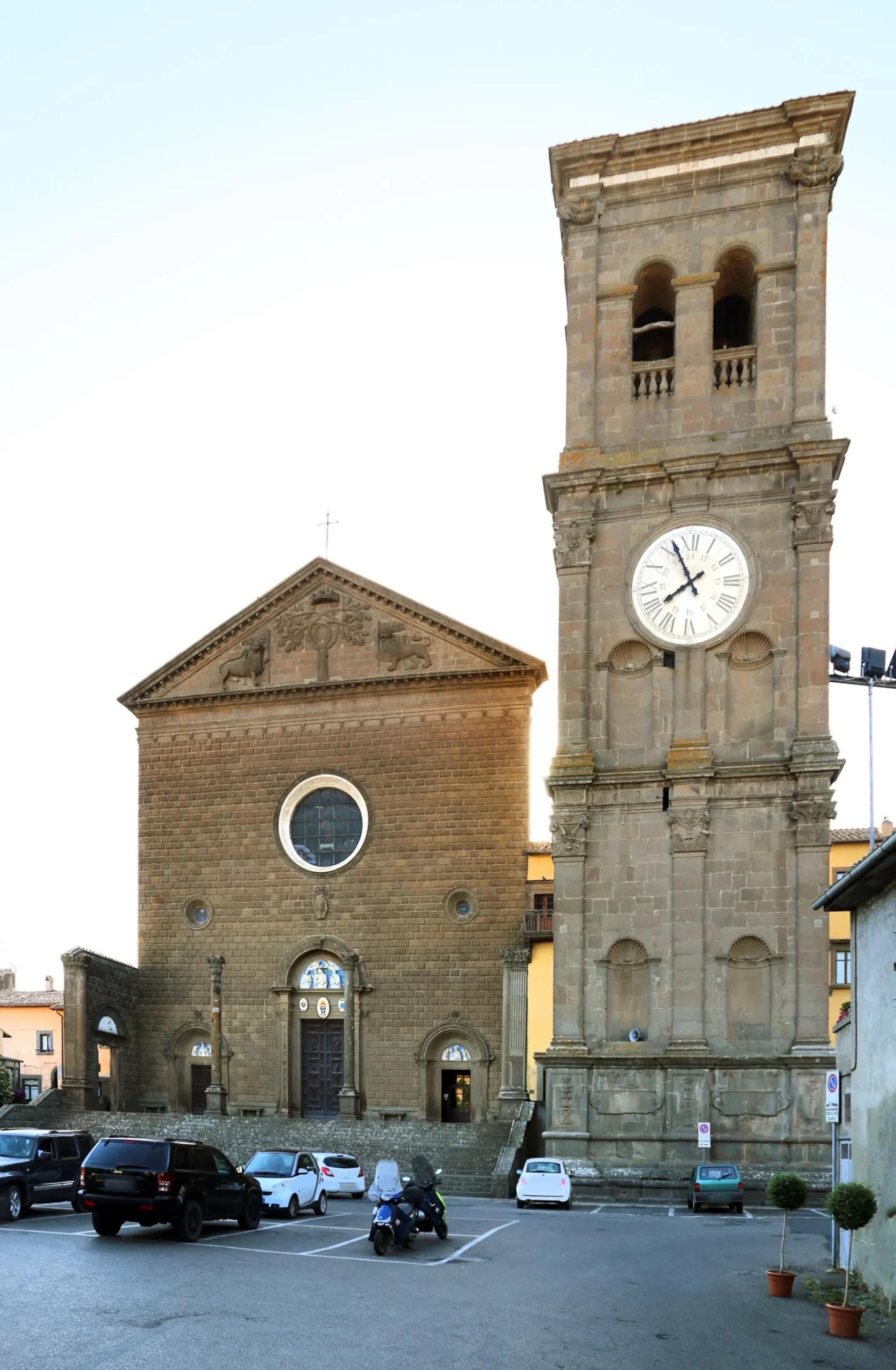
The Santuario di Santa Maria della Quercia is in Piazza del Santuario, with the mailing address at Via del Santuario 59, in the hamlet of La Quercia, about two kilometers outside the center of Viterbo on the road to Bagnaia. Entry is free, nothing needs to be booked, and the church is open every day from 7:00 to 12:00 and from 15:30 to 19:30. The building is entrusted to the Lazio Regional Directorate of National Museums, and its religious life to the parish of the diocese of Viterbo.
The reason to come all the way here is a roof tile. In 1417, according to tradition, a craftsman from Viterbo had the Virgin with Child painted on a flat tile and hung it on an oak along the road. 50 years later, during the plague of 1467, that image became the center of a mass devotion, and around the tile the Dominicans built one of the most accomplished Renaissance basilicas in Lazio.
The practical information given here comes from the official sources as of September 28, 2026: the Ministry of Culture page dedicated to the sanctuary, the notes of the diocese of Viterbo and the materials published by the city transport operator. Church and museum hours change with services and with the September festivities, so before leaving Rome make a phone call to the number given further on and have everything confirmed.
Where it is and what you actually see
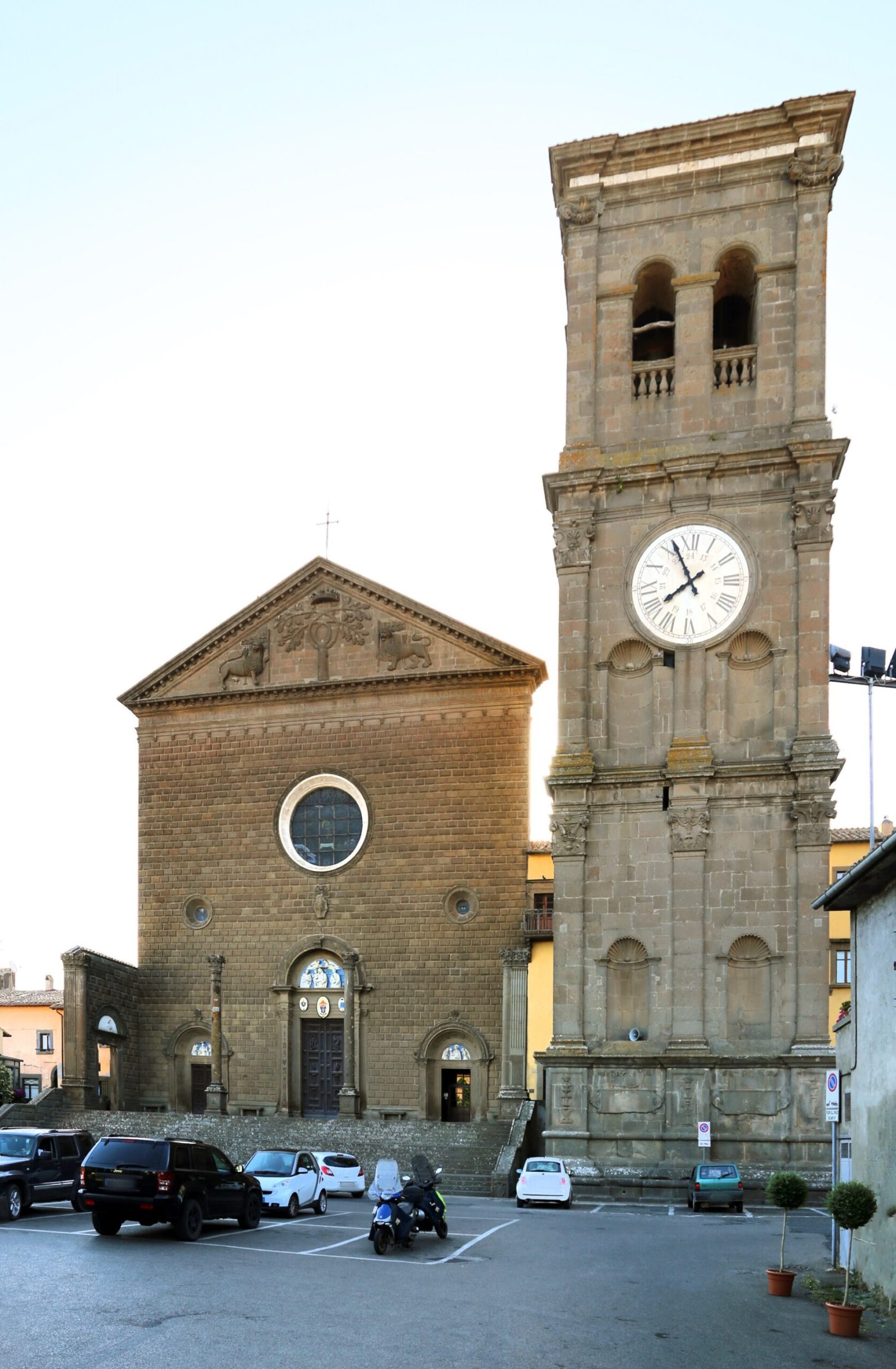
La Quercia is a hamlet northeast of Viterbo, grown up along the old road that leads to Bagnaia and to Villa Lante. The sanctuary occupies the far side of a wide square, with its facade facing the square. In front there is a free parking lot that the Ministry lists as free of charge, and in the Tuscia that is a detail that makes the difference between a 20-minute stop and a morning lost driving around.
The facade is sober, almost severe, and the first thing that catches the eye is the three glazed terracotta lunettes above the portals. They are by Andrea della Robbia, dated between 1504 and 1508, and the descriptive notes recognize in them the Madonna della Quercia, Saint Peter and Saint Thomas Aquinas. Florentine white and blue on Tuscia stone: the contrast says by itself who paid and who worked.
Inside, the church has three naves. Above the central nave runs the coffered ceiling designed by Antonio da Sangallo the Younger and carried out, according to the ministry's note, by Giovanni Pazera. Sources report that Paul III Farnese donated 60 kilograms of gold to cover it. Among the coffers you can recognize the symbols of the Virgin, the lion of Viterbo, the pope's coat of arms and the Farnese lilies. It's the piece everyone photographs with their nose in the air.
At the far end of the central nave, at the point where according to tradition the oak grew, stands the marble tempietto by Andrea Bregno, from 1490, which holds the painted tile. The choir behind the high altar keeps the inlaid stalls that the Ministry's note assigns to Francesco di Domenico del Tasso, a Florentine woodworker, and collaborators. The bell tower, visible from the square, is the work of Ambrogio da Milano between 1481 and 1505.
From the side of the church you pass into the cloisters, of which there are two. The first, called della Cisterna, has a lower level still Gothic in layout and an upper one that is Renaissance, with a cycle of frescoed lunettes that tell the miracles attributed to the Madonna. The second, called Grande or della Fontana, is wider and has at its center a 17th-century fountain. The ex voto museum occupies the rooms of the old women's cloister.
What you don't see: the convent rooms not open to the public and the rooms that are closed from time to time for works. At the moment a public fundraiser is open to restore the frescoes of the sacristy and those of the cloister lunettes, so don't be surprised to find scaffolding or sheets. A visit to the church alone, according to the Ministry, takes 30 or 40 minutes. With cloisters and museum, count double.
A curiosity about the Santuario di Santa Maria della Quercia
At the entrance to the sacristy hangs a piece of cloth that has nothing to do with the Tuscia. It's the pennant of a Turkish ship captured at the battle of Lepanto, in 1571, and according to the sanctuary's sources it was donated by Pope Pius V. The connection is no accident. Pius V was a Dominican, the Dominicans ran La Quercia, and the victory over the Ottoman fleet was attributed by the Church to the intercession of the Virgin of the Rosary.
The diocese of Viterbo records the gift among the notable elements of the basilica, and the museum's note also speaks of a Turkish ship's banner among the preserved materials. If it is the same object moved over time or two different pieces, the sources available don't make clear in any unambiguous way. Ask in the sacristy: the local answer is worth more than any panel, and it usually arrives with an anecdote.
For anyone who thinks like a historian, the geography of the gift matters. A flag taken in the Gulf of Patras ends up in a hamlet of the Tuscia because here there was a Dominican community tied to a Dominican pope. It's the same mechanism that brings to Rome, in the big Dominican church of the center, Santa Maria sopra Minerva, a concentration of Dominican memories that in any other Roman church would be out of proportion.
The museum also holds, according to the Tuscia tourist portal, a cope attributed to Pope Gregory XIII, the one of the calendar reform. Here too the mechanism is that of the prestige gift to a sanctuary with a large draw. In the 16th century La Quercia was not a country church. It was a pilgrimage destination in which the popes invested money, fabrics and names, and the richness of the ceiling is the most visible proof of this attention.
The tile and the oak: documents, tradition, legend
It's best to separate the three levels right away, because guides mix them up. What the documents say: in 1467 a serious plague struck Viterbo and northern Lazio, and the city chronicle of Niccolò della Tuccia records huge crowds gathered around the image of the oak. In the same year Pope Paul II authorized the building of a chapel. These are the documentary foundations that hold up everything else.
What tradition says: in 1417 a craftsman from Viterbo had the Virgin with Child painted on a tile and hung it on the branches of an oak, on a piece of his land along the road. The name of the patron comes in different spellings, Battista Luzzante, Ruzzante or Magnano Juzzante, and the painter is called Monetto, in some texts master Martello known as il Monetto. The sources don't agree on the names, they agree on the date and the gesture.
What is legend: the horseman. The story goes that around 1467 a man on horseback, chased by enemies, threw himself at the foot of the oak praying to the Madonna and became invisible to his pursuers, who rode past. The tale is depicted among the miracles painted in the cloister and is repeated on every visit. It has no documentary confirmation, and doesn't need any: it works as a founding story, not as a chronicle.
The plague, instead, is chronicle. The published reconstructions take from the 15th-century chronicle the figure of 30,000 people gathered in a single day at Campo Graziano to ask for the end of the contagion, and of 40,000 who came back to give thanks. The diocese's note uses the same 30,000 for the dead of the plague. The sources don't even agree on the meaning of the number, but they tell of a real mobilization of the whole Viterbo countryside around that tree.
The most interesting material fact is the support. A flat tile, that is, a piece of building roofing, not a panel prepared by a workshop. It means a poor image, meant to stand outdoors, on the road, among the fields. All the magnificence you see around, the Sangallos, Bregno, the Farnese gold, was built to protect and honor an object that at the origin cost very little. That's the contrast that makes the visit make sense.
The gesture of hanging a sacred image on a tree along the road is not a Viterbo invention. In central Italy painted or carved Madonnas fixed to trunks, crossroads and field boundaries were widespread, and quite a few generated sanctuaries with similar names, from Tuscany to the Marche. The case of La Quercia is different in scale: from a country image a basilica was born on which the best architects of the Roman and Florentine Renaissance worked.
One thing nobody tells you about the Santuario di Santa Maria della Quercia
The golden ceiling is the least interesting thing in the church. I say it knowing it's the reason most groups come in, take photos and leave. It's work of the highest level, but it's a Farnese coffered ceiling like others you see, and in Rome anyone who has seen Santa Maria Maggiore already has the model in mind. Here the unique part is something else.
The unique part is the votive tablets. More than 200 paintings on wood, from the late 15th century to the 19th, in which ordinary people had painted the moment when they risked dying: falls from horses, collapses, shipwrecks, fevers, attacks on the road. They are documents of social history that you won't find in any archive, because they tell the everyday fear of farmers, craftsmen, muleteers and mothers. The ceiling tells of a pope, the tablets tell of Viterbo.
The second point nobody mentions concerns the lunettes of the Cisterna cloister. They are a cycle of 26 scenes painted in the first half of the 17th century, according to the ecclesiastical heritage note, and they do the same thing as the votive tablets, that is, they tell the miracles, but in an official version, with the language of commissioned painting. Comparing them with the ex votos is the best way to understand how the Church organized popular devotion.
Third point, less poetic: conservation. The restoration project for the frescoes of the sacristy and the cloister lunettes is published on the ministerial Art Bonus platform with a planned cost of €80,000, and the donations recorded stood at €5,500. The deterioration of the lunettes is visible to the naked eye. A basilica with this historical weight shouldn't depend on individual donations to save its most legible painted cycle.
Hours, entry and who runs it
The basilica is open every day from 7:00 to 12:00 and from 15:30 to 19:30, according to the note of the Lazio Regional Directorate of National Museums, which lists the sanctuary among its sites. Entry is free. During religious services visits are suspended, and this applies especially on Sunday mornings and on feast days. The number published by the same ministerial note is 0761 303430, and it's the one to call for any doubt.
There is no ticket, no advance sales, no paid guided visit run by the sanctuary with a published official channel. Anyone who offers you priority entry to La Quercia is selling you something you don't need. For organized groups the channel remains the parish, the Parrocchia Basilica Santuario Santa Maria della Quercia, to be contacted at the number published by the Ministry. Structured guided visits are organized with licensed guides of the province, not with the sanctuary.
For groups there is a courtesy rule that matters more than any reservation. Notify the parish a few days ahead giving day, time and number of people, so as not to arrive at the same time as a funeral or a wedding. Speak quietly in the nave, because the church is used all day by worshippers from the neighborhood. And keep the group together in the cloisters, where the spaces are narrow and the lunettes get damaged by contact.
Religious life belongs to the parish, established in 1920 and started in 1923 according to the ecclesiastical heritage note, within the diocese of Viterbo. The pastor rector is given as don Massimiliano Balsi, who speaks at the presentation of the September festivities. The Dominicans, who ran the sanctuary for centuries, remain in the memory of the place more than in daily management, and the monumental complex remains entrusted to the Ministry.
The ex voto museum has shorter hours than the church. The city's tourist notes give opening from 9:00 to 12:00 and from 16:00 to 18:30, with closing during services. The operator gives no published fare for the museum, so before going call 0761 303430 and ask if the room is open that day and if an offering is requested. With groups you always need to give notice first.
On accessibility the ministerial note is clear: the visiting route of the church is given as fully accessible. Cloisters and museum are on the same level as the church, but for the museum you won't find a separate statement. Anyone who moves in a wheelchair does well to ask by phone if the museum rooms are reachable that day, especially if works are under way in the cloister.
My advice for visiting the Santuario di Santa Maria della Quercia
Enter through the cloister first, not the church. Do the loop of the Cisterna lunettes, read two or three painted miracles, then go to the ex voto museum, and only at the end enter the basilica and go straight to Bregno's tempietto. In this order you arrive in front of the tile knowing what it meant to those who prayed here. In the reverse order you see a nice ceiling and a marble altar.
Choose a weekday and the window between 9:30 and 11:30. The church opens at 7:00, but before 9:00 the museum is closed, and after 11:30 the groups doing the Tuscia tour by coach start coming in. The afternoon is fine only in winter, when groups are few, because the museum closes at 18:30 and the cloister in low light becomes hard to read.
Avoid Sunday morning if you want to see the art and not take part in the liturgy. With masses going on, visits are suspended, and every service blocks the nave for an hour. If instead you want to understand the sanctuary as a living place, come on the very Sunday of September of the Patto d'amore, which is the city's festival, and give up the historical visit: you will come back another day for that.
Bring a small pair of binoculars or use your phone's zoom. The ceiling is high and the details of the coffers, with the coats of arms and the lilies, blur together to the naked eye. The same goes for the Della Robbia lunettes on the facade, which from the level of the square read only as masses of color. The detail of the faces and the fruit garlands can only be caught by enlarging, and that's where you recognize the Florentine hand.
Last piece of advice: an offering in the sanctuary's box is not mandatory but it's the most direct way to contribute to the upkeep of a place that, as you have read, is looking for funds for restoration. The sanctuary lives on this. Anyone who brings a group of 40 people and leaves nothing is using a free service without giving anything back, and the custodians remember it.
The ex voto museum
The museum was inaugurated on December 22, 1978, according to the city's tourist notes, and occupies the rooms of the old women's cloister. It gathers the votive offerings that for centuries were hung on the walls of the basilica, and that at a certain point were taken down, as happened in almost all the big Italian sanctuaries when liturgical taste changed. Here, unlike elsewhere, they didn't end up in a storeroom.
The core is the tablets painted on wood. The magazine Credere, in a 2017 feature on the sanctuary, counts 206: 15 from the late 15th century, most between the 16th and 17th, 21 from the 18th, four from the first half of the 19th. The oldest show clothes, tools, carts and houses of the Tuscia of five centuries ago, with a naive quality of drawing that is part of their value.
Alongside the tablets are the silver ex votos, including a heart, which according to the same source survived in good numbers. The tourist notes then list paintings on canvas, including a Madonna della Quercia with saints from the 16th century and a Baptism of Christ attributed to the school of Sebastiano del Piombo, illuminated choir books from the 16th century, architectural fragments recovered from the basilica and 20th-century wrought iron work.
The section that strikes foreign visitors most is the one from the 20th century. Photographs of soldiers in uniform, brought as thanks for a return, and even fragments of aerial bombs from the Second World War, which local memory ties to the bombings of Viterbo. It's the point where the devotion of five centuries ago meets the memory of grandparents, and where the visit stops being art history.
A practical warning. No audio guides are published for the museum, and the captions need to be read slowly. To read the tablets you need a bit of patience: look first at the scene below, that is, the danger, then at the Madonna above, in a corner, finally at the initials VFGA or a similar formula, which means vow made, grace received. After five tablets you've understood the code.
Another well-known fact, yet rarely cited
For centuries La Quercia was one of the great Marian sanctuaries of central Italy, on a par with those that today draw much higher numbers. The ministerial note defines it as the most important Marian place of worship in the province of Viterbo. In 1867 Pius IX raised it to minor basilica, and in 1873 it was recognized as a national monument, the first in the province according to the magazine Credere.
The rarely cited data point is the date of the basilica title. The international directory of Catholic churches gives the title of minor basilica as effective from August 20, 1867, six years after the unity of Italy and three years before the taking of Rome. Pius IX, who was losing temporal power, was handing out titles to the sanctuaries of his remaining territory. It's a political gesture as much as a religious one, and it is rarely read that way.
Also rarely cited is the role of the city in the Patto d'amore. It is not just a procession of worshippers: the mayor of Viterbo, in the name of the population, renews a formal commitment to the Madonna every year. In a country that has separated State and Church for a century and a half, a city administration that signs a pact every year with a sacred image is a rare case, and the people of Viterbo defend it with a certain pride.
Finally, according to the ecclesiastical heritage note, the tile left the sanctuary for the first time after five centuries only with the Peregrinatio Mariae of 1948 and 1949, when the image was carried around the diocese in the postwar climate. The fact that for 500 years nobody had moved it says how inseparable the link between image and place was considered. The oak was part of the miracle.
The Patto d'amore between Viterbo and the Madonna
The first procession of the Patto d'amore, according to the reconstruction published by the Constantinian Order for its pilgrimage to the sanctuary, took place on September 20, 1467, at the end of the plague, and since then it has been renewed over the centuries. The magazine Credere speaks of a September 1467 and of a mutual commitment: the Madonna protects the city, the city binds itself to her forever. On the exact date of the first pact the sources don't agree.
Today the festival falls on the second Sunday of September, according to the Lazio Region tourist portal. A long procession of worshippers leaves the city and reaches the sanctuary, and there the mayor renews the Pact in the name of all the people of Viterbo. In case of rain the procession is canceled and the renewal takes place inside the basilica. In the days around it there are food stands run by the Pro loco and concerts in the square.
Anyone who knows Viterbo knows September is the month of the two festivals. On the evening of September 3 the city carries around the Macchina di Santa Rosa, a few days later it sets off toward La Quercia. Recently the two worlds have touched, with the Santa Rosa bearers called to carry the effigy in procession. For a person from Viterbo they are two faces of the same civic pact with the sacred.
If you want to attend, go on foot with the procession at least for the last stretch. The distance from the center is a couple of kilometers on the road, and the sense of the festival lies precisely in the arrival of the crowd in the square, with the Della Robbia facade in front. Taking the car that day is a bad idea: the square is occupied, the access roads are closed, and the free parking becomes a memory.
The right photo to take at the Santuario di Santa Maria della Quercia
The right photo is in the Cisterna cloister, from the upper loggia if it is accessible, otherwise from a corner of the ground floor. Frame diagonally the Gothic arcade below and the Renaissance one above, with the center of the courtyard at the bottom. In a single shot you tell two centuries of construction. Best light is mid-morning, when the sun comes in from one side and leaves the other in soft shadow.
The second is the facade, but not head-on. Move to the side on the square, about 30 meters, to the point where the bell tower enters the frame, and use Ambrogio da Milano's bell tower as a vertical backdrop. The Della Robbia lunettes, shot from the front, get lost in the gray of the peperino. At an angle, with afternoon sun striking the terracotta, the white and the blue stand out from the stone and the photo gains depth.
Inside the church, shooting the ceiling works only if you stand in the middle of the nave, near the entrance, and hold the phone up vertically pointing straight up. Diagonally the coffers distort. Don't use flash: besides being useless at that distance, it disturbs people praying and in an active sanctuary it's a lack of respect that the custodians will point out to you, rightly.
In the museum photograph the details, not the whole display cases. A tablet with an overturned cart, a shipwreck, a child fallen into a well, shot up close and with light that doesn't reflect on the glass, says more than any overall shot. Ask first if photography is allowed, because the rules of church museums change. If they say no, take notes: you will need them.
How to get there from Rome
By train the line to use is the FL3 of the Lazio regional network. Trains to Viterbo leave from Roma Tiburtina and pass through Roma Ostiense and Roma San Pietro, and arrive at Viterbo Porta Romana and then Viterbo Porta Fiorentina. The timetable published by RFI for the 2025 changes gives journey times of around two hours between Tiburtina and Viterbo. Service is at regular intervals but sparse, roughly one run an hour.
Get off at Viterbo Porta Romana. From there you take urban line 6 of the Francigena company, which runs public transport in Viterbo, in the direction of Bagnaia. The ministerial note gives the stop on the sanctuary's square. Runs are spaced out and holiday service differs from weekday service, with a dedicated Sunday line: check times and route on the Francigena website before leaving.
The alternative is a Cotral intercity bus. The Ministry's note gives the Viterbo Vitorchiano line, which goes through La Quercia. Check times on the Cotral website the evening before, because on holidays the frequency drops a lot, and ask the driver for the sanctuary stop. On foot from the center it's about two kilometers on a busy road, doable but not very pleasant.
By car from Rome you take the Cassia bis toward Viterbo, or the A1 motorway to Orte and then the expressway to Viterbo. From there you follow the signs for Bagnaia and La Quercia, and park on the sanctuary's square, where parking is free. With no traffic from north Rome you need an hour and a quarter, an hour and a half. It's the most convenient solution if you want to pair it with Villa Lante.
A practical tip on trains: the regional ticket from Rome to Viterbo is bought on the Trenitalia website or at the station, and doesn't include the city bus, which is a separate ticket. Ask at the Viterbo station where to buy it before going out. Anyone coming on Sunday has to check the holiday line, count on Cotral or a taxi, or allow for the walk. It happens that groups of pilgrims wait in vain at the wrong stop.
Some important events that happened here in history
1417 is the starting date according to tradition: the tile painted and hung on the oak. 50 years later, in 1467, the plague and the mass devotion. Pope Paul II authorizes the building of a chapel, and between 1467 and 1469 the first building rises. Management soon passes to the friars of the Order of Preachers, who replace the Gesuati: the date given is 1469, but some notes move it to 1497.
From 1470 the great basilica gets under way, which descriptive sources attribute to a design by Giuliano da Sangallo. The building site lasts decades: Ambrogio da Milano's bell tower between 1481 and 1505, Bregno's tempietto in 1490, the Della Robbia lunettes between 1504 and 1508. The ceiling by Antonio da Sangallo the Younger arrives under Paul III. Some reconstructions date the consecration to 1577, by the hand of Cardinal Gambara.
In 1571 the victory of Lepanto brings to La Quercia the Turkish pennant donated by Pius V. Between 1602 and 1650 the cycle of lunettes in the Cisterna cloister is painted. In 1698 Giovan Ventura Borghesi paints the Mystic Marriage of Saint Catherine. These are the golden centuries of the sanctuary, with the pilgrimages, the wax shop for ex votos active since 1468 and the city renewing the pact every year.
In those same decades lesser-known painters also work at La Quercia, whom the ecclesiastical heritage notes record precisely. Carolino da Viterbo paints at the end of the 15th century a Madonna enthroned with Child, Cesare Nebbia paints the 12 apostles in the sails of the nave, and the cycle of the cloister lunettes involves several hands. A church of a long building site, where each generation added something without erasing the previous one.
Then comes the French period. According to the ecclesiastical heritage note the convent is closed in 1810, during the Napoleonic suppressions, and bought back by the Dominicans in 1816. In 1867 the minor basilica, in 1873 the recognition as national monument, and in the same year the community is recorded as reduced to seven friars. Today the complex is among the sites of the Lazio Regional Directorate of National Museums.
In 1920 the church is established as a parish and in 1923 the parish starts operating. During the Second World War Viterbo suffers heavy bombing, and the museum keeps fragments of ordnance tied to that memory. In 1948 and 1949 the tile goes out for the Peregrinatio Mariae. In 1978 the ex voto museum opens. In 1984 John Paul II comes, in 2009 Benedict XVI.
Who has passed through the Santuario di Santa Maria della Quercia
Paul II, the Venetian Pietro Barbo, pope from 1464 to 1471, was the first pontiff to deal with La Quercia, authorizing the chapel in 1467. Behind his decision is the logic of a pope who saw a huge popular cult being born a few miles from Rome and chose to frame it instead of ignoring it. The sanctuary is institutional from the first day, entrusted to a religious order.
Paul III, Alessandro Farnese, the pope of the Council of Trent, tied the family name to the golden ceiling. The Farnese were at home in the Tuscia: their system of fiefs and residences runs from Caprarola, with the Palazzo Farnese, to Farnese, the village that gives the family its name, to the Roman palace in Piazza Farnese. The lilies on the ceiling are a signature, not a decoration.
Pius V, Michele Ghislieri, a Dominican, pope from 1566 to 1572. His passage through La Quercia consists of an object, the Lepanto pennant, more than a documented physical presence. Gregory XIII, his successor, left a cope according to the museum's notes. They are the popes of the Counter-Reformation, and the sanctuary in those years is an instrument of their devotional policy, as the great Roman Marian basilicas are.
Cardinal Gianfrancesco Gambara, bishop of Viterbo, appears in some reconstructions as the consecrator of the basilica in 1577. It is the same name tied to the palazzina and the gardens of Villa Lante at Bagnaia, a few minutes away by road. The fact that the same figure consecrates the sanctuary and builds the villa says a lot about how, in the Tuscia of the 16th century, faith and display walked together.
The artists, as a group: Giuliano and Antonio da Sangallo, Andrea Bregno, Andrea della Robbia, Ambrogio da Milano, Michele Tosini, of the circle of the Ghirlandaio, with frescoes dated 1570, Cesare Nebbia with the 12 apostles in the sails of the nave. Anyone who wants to see Bregno in Rome finds him in Santa Maria del Popolo, anyone who wants the Roman Dominicans goes to Santa Sabina on the Aventine.
And then the pilgrims, who are the real protagonists. Farmers, soldiers, mothers, sailors, porters, who left their mark in the tablets. In the 20th century two popes: John Paul II on May 27, 1984, Benedict XVI in 2009. Every September a mayor. Anyone who comes to La Quercia today joins a line six centuries long, and if you keep that in mind the visit changes tone.
When it's closed and what not to expect
The church has no published weekly closing days, but every day it closes at lunchtime, from 12:00 to 15:30, and during services visits are suspended. Saturday weddings, funerals and celebrations of Marian feasts are the most frequent causes of a stop. Anyone who arrives at 11:50 with the idea of doing the full tour is out after 10 minutes. Plan to arrive at least an hour and a half before closing.
Don't expect structured tourist services. There is no ticket office, no bookshop or audio guides are published, and the information side goes almost entirely through the people you find in the sacristy. The sanctuary is a parish that keeps a state monumental complex, not a museum with a development plan, and you can feel it. For those looking for silence it's a plus, for those looking for explanations it's a limit.
Don't expect a monumental oak to admire in the square. Tradition places the original tree where Bregno's tempietto stands today, that is, inside the church. Anyone who arrives with children promising the miraculous tree risks a letdown. Better to tell first the story of the tile hung on a branch, and then show the image inside the marble as the exact spot where it stood.
Don't expect the museum to always be open at the stated hours either. Management depends on the staff and volunteers available, and in the low-season months it can happen to find it closed even during the hours. That's the reason I insist on the phone call. A trip from Rome to find a closed door is the most frustrating thing, and it's avoided with two minutes on the phone.
Eating in the area
La Quercia is a residential hamlet and doesn't have the problem of historic centers invaded by tourism. The real risk is in Viterbo, on the streets that lead to the Palazzo dei Papi and in the squares of the San Pellegrino district, where groups pass. There the signs of traps are the same as in Rome, and it's best to know them before sitting down with midday hunger.
First sign: the menu with photos of the dishes, laminated and translated into five languages. A place that has to show you the picture of the fettuccine is speaking to those who don't know what they are, and prepares its kitchen for that public. Second sign: the person at the door who stops you and invites you in. A place with regular customers doesn't need to get them on the street.
Third sign: the lady rolling out the sfoglia in the window or on the sidewalk. It's a scene staged to stop the passerby, not a sign of quality. Well-made fresh pasta is prepared in the kitchen, in the morning. Fourth: places open without a break from morning to night, because a real kitchen has a pause. Fifth: items without a price, fish by undeclared weight, a different menu inside and outside.
The people of Viterbo don't go there for a simple reason, not for snobbery: they know that a few meters away is the osteria where they eat their everyday lunch, with a handwritten menu that changes with the season and a bill that doesn't depend on who you are. Look at who is sitting and in what language they order. Workers, office staff, local families at two in the afternoon are the only reliable review.
The cooking of the Tuscia has dishes that are rarely found in Rome: acquacotta, lombrichelli, chickpea and chestnut soup in autumn, grilled meats from the Cimini. Always ask for the dish of the day and the local wine. To get your bearings without trial and error, find our list of the places where we eat, not sponsored and updated when places change.
What to combine in a day
The natural pairing is Villa Lante at Bagnaia, three kilometers farther along the same road and the same line 6. The morning at the sanctuary and the early afternoon in the Italian gardens: in between there is time for lunch at Bagnaia. Anyone with a car can then go up to Lake Vico and the nature reserve that surrounds it, or stop at San Martino al Cimino.
Those who stay in Viterbo have the medieval center, the San Pellegrino district and the Palazzo dei Papi, all reachable with a short bus ride. For the evening, the Piscine Carletti offer open-air thermal water with free entry, a few kilometers from the center. North of the city are the remains of Ferento with its Roman theater, to the west the rock-cut necropolis of Castel d'Asso.
Anyone with two days can go farther. To the west Tuscania with its Romanesque basilicas and the necropolis of Norchia, to the north Montefiascone and Lake Bolsena with Bolsena, farther north Civita di Bagnoregio and the abandoned village of Celleno. These are destinations that each ask for half a day.
Toward the east the road to Bagnaia continues to Vitorchiano, perched on peperino, to the Park of the Monsters at Bomarzo and to Soriano nel Cimino, with the village of Chia a little farther. For families there is Sant'Angelo di Roccalvecce, the town of fairy-tale murals. Without a car this part requires Cotral timetables in hand.
Anyone doing a route of Lazio's sanctuaries finds in La Quercia the Renaissance chapter. The medieval and monastic chapter is to the south, with the Casamari Abbey, the Certosa di Trisulti and the Valvisciolo Abbey. The mountain chapter is at the Santuario della Mentorella and the Holy Trinity Sanctuary of Vallepietra.
To complete the Marian map, in Rome there is the Santuario del Divino Amore, which has a surprisingly similar story: an image painted outdoors, a miracle of rescue, a popular devotion grown around it. In the Sabina the Santuario di Greccio offers the Franciscan side, at Subiaco the Sacro Speco the Benedictine one. Three orders, three ways of keeping a place.
Frequently asked questions
How much does it cost to enter the Santuario di Santa Maria della Quercia?
Entry to the basilica is free, according to the note of the Lazio Regional Directorate of National Museums, which manages the complex. No booking is needed for an individual visit. For the ex voto museum the operator gives no published fare, so it's best to ask at 0761 303430 if an offering is expected. A contribution to the sanctuary's box is always welcome, given the restoration under way.
What are the opening hours?
The basilica is open every day from 7:00 to 12:00 and from 15:30 to 19:30, with visits suspended during religious services. The ex voto museum, according to the city's tourist notes, opens from 9:00 to 12:00 and from 16:00 to 18:30, with closing during services. Hours may change on the occasion of the September festivities, so it's good to phone first.
Who painted the Madonna della Quercia?
According to tradition the image was painted on a tile in 1417 by a painter called Monetto, on commission from a craftsman from Viterbo whose name comes in different spellings, Battista Luzzante in the most common version. The sources don't agree on the names. The image shows the Virgin holding the Child and is today kept in the marble tempietto by Andrea Bregno.
What is the Patto d'amore?
It is the mutual commitment between the city of Viterbo and the Madonna della Quercia, born at the end of the plague of 1467. Every year, on the second Sunday of September, a procession leaves the city and reaches the sanctuary, where the mayor renews the pact in the name of the population. In case of rain the procession doesn't take place and the renewal happens inside the basilica.
How do you get there from Rome without a car?
You take the regional train FL3 from Roma Tiburtina, Ostiense or San Pietro to Viterbo Porta Romana, about two hours of travel. From there you continue with urban line 6 of the Francigena company, which stops on the sanctuary's square, or with the Cotral runs of the Viterbo Vitorchiano line. On holidays the urban service changes, so check the times on the operator's website.
Who runs the sanctuary today?
The building is state property entrusted to the Lazio Regional Directorate of National Museums. Religious life belongs to the Parrocchia Basilica Santuario Santa Maria della Quercia, of the diocese of Viterbo, with don Massimiliano Balsi given as pastor rector. The Dominicans, who ran the complex for centuries from the 15th century on, remain its main historical memory.
How much time does the visit take?
The Ministry gives 30 or 40 minutes for the church alone. With the two cloisters and the ex voto museum you need at least an hour and a half, more if you want to read the miracle lunettes and the votive tablets carefully. Anyone who pairs Villa Lante at Bagnaia in the same day should give the sanctuary the morning and the gardens the afternoon.
Is the sanctuary accessible for wheelchair users?
The ministerial note gives the visiting route of the church as fully accessible, and the parking on the square is free and close to the entrance. For the cloisters and the ex voto museum there is no separate statement, and the situation can change when restoration works are under way. It's best to phone first and ask which rooms are reachable that day.
Who wrote this page
This page comes from the team at Tour Leader Pro, the Rome-based outfit that designs itineraries, visits and cultural events across Rome and Lazio. Hours, entry and connections given here come from the official sources cited in the text as of the date given at the start. Since it's an active sanctuary, with services and festivals that change the calendar, recheck them before leaving and tell us what you find has changed.
Lining up a day in the Tuscia means fitting together regional trains that run once an hour, city buses that don't run on Sundays, parish museums with hours tied to volunteers and gardens with seasonal hours, for yourself or for a group of 40 people. Anyone facing this kind of puzzle will find on Tour Leader Pro working materials designed for those who guide and for those who organize on their own.
For the wider picture, that is regional trains and seasonal timetables, car rentals, airports, moves between one province and another and destinations in Lazio outside the center of Rome, from the Tuscia to the volcanic lakes to the Tyrrhenian coast and the villages of the interior, a useful resource for building a multi-day itinerary is Italy Planner.