Piazza Farnese and Palazzo Farnese
In short. Piazza Farnese is free to cross at any hour. The palace that gives it its name can be visited only on a guided tour booked and paid for in advance on the official website, four days a week, never on Wednesday, never on Saturday, never on Sunday.
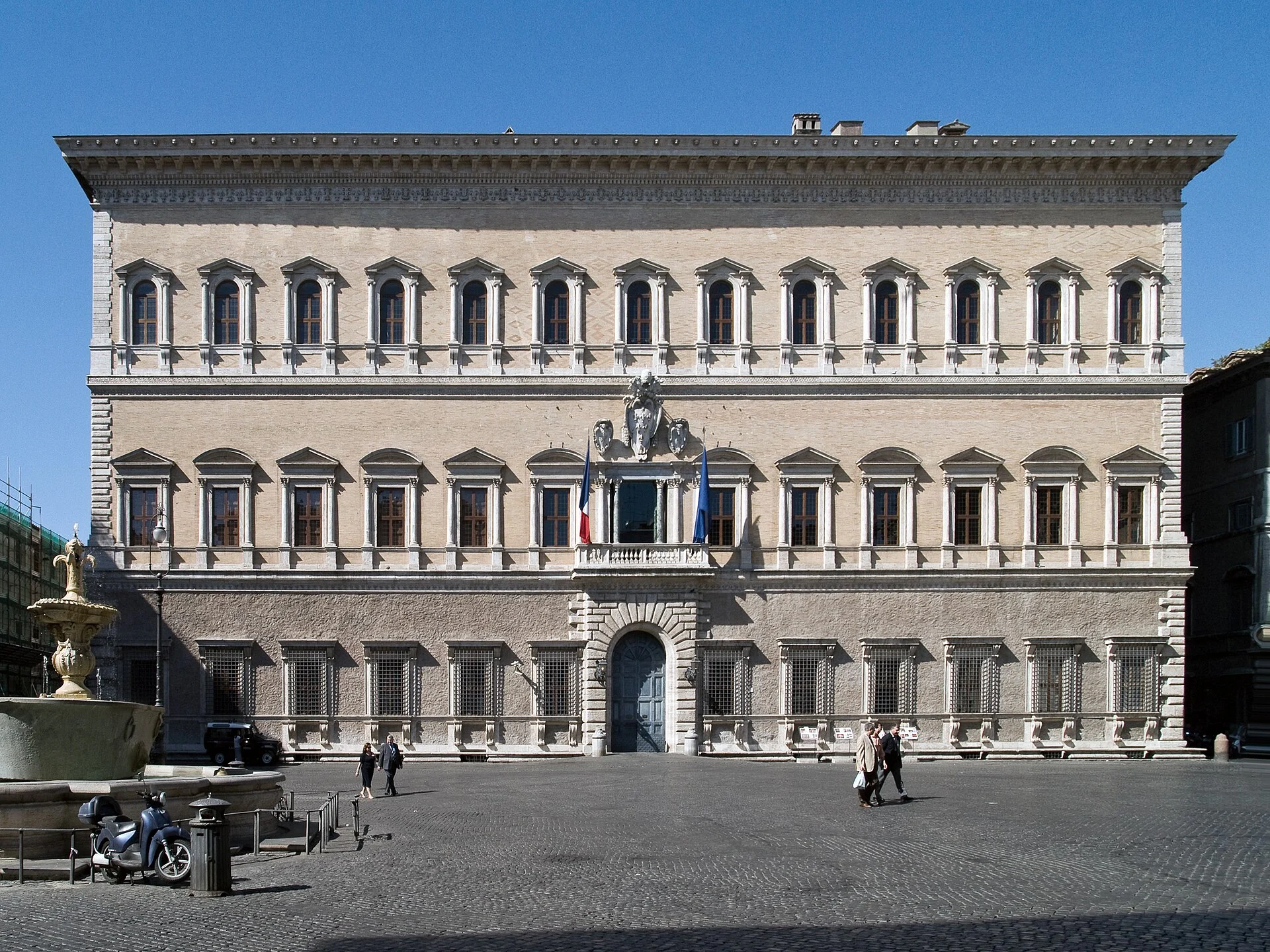
Piazza Farnese is free to cross at any hour. The palace that gives it its name can be visited only on a guided tour booked and paid for in advance on the official website, four days a week, never on Wednesday, never on Saturday, never on Sunday. The basic ticket costs €15.00, the one that includes the underground rooms €20.00, the one with the library of the École française de Rome €22.00. You need first name, last name, date and place of birth and document number for each person, and at the entrance the document must be shown in the original. A driver's license is not enough.
Anyone who arrives at Piazza Farnese 67 without a reservation sees a closed gate, two soldiers, a courtyard you can only guess at. The Carracci Gallery, which is the reason you go in, stays closed behind 13 travertine windows. This is the point that trips up the most people: the palace is visible from outside, so it looks accessible, and instead it is a diplomatic seat with the checks of a diplomatic seat.
The square, on the other hand, is always open, and it's worth a stop on its own. There are two basins of Egyptian granite as big as boats, pulled out of the Baths of Caracalla, brought here in the 16th century and turned into fountains only in 1626. They are the two biggest pieces of Roman antiquity you can touch in a square in the center without paying a euro.
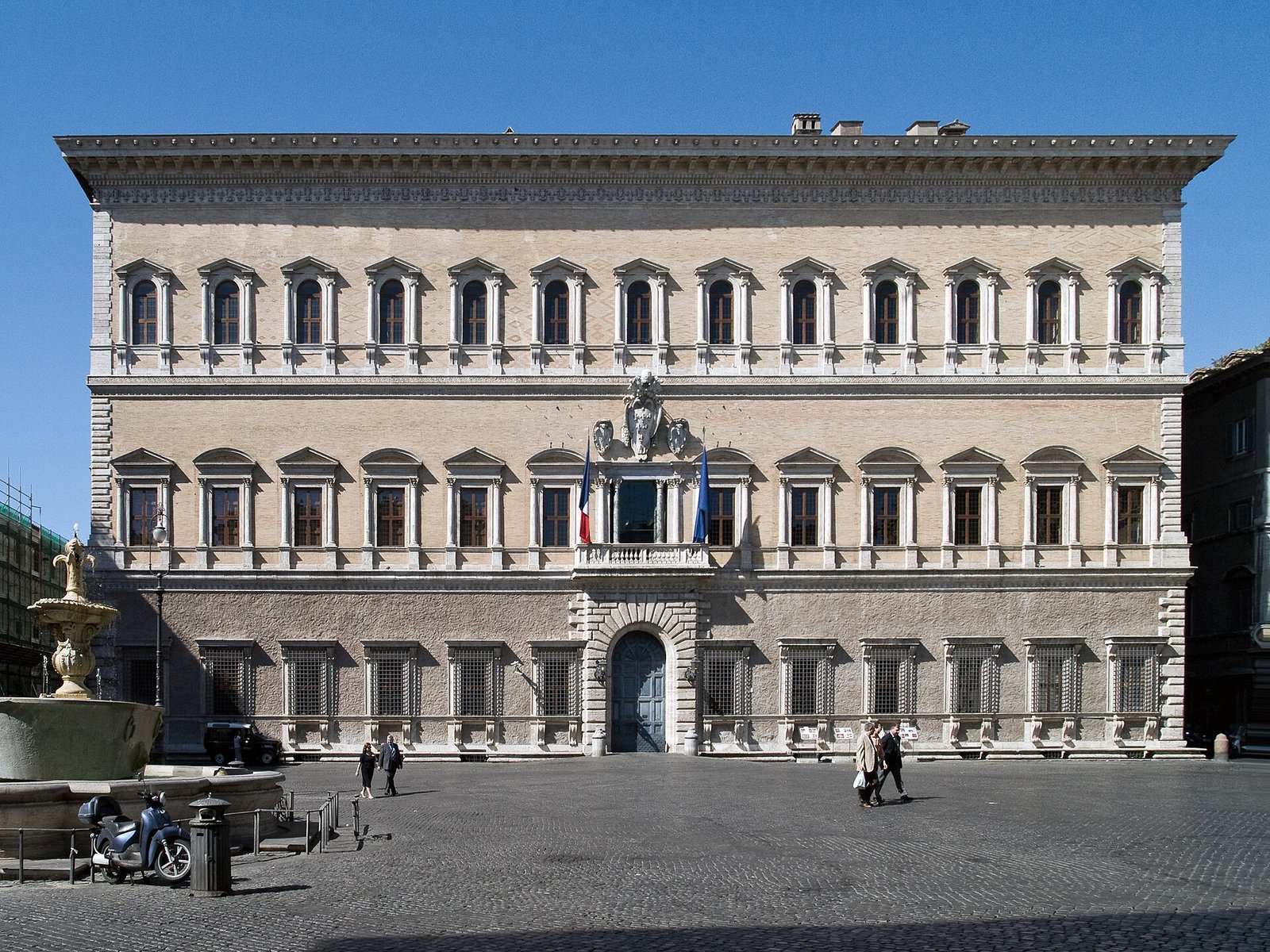
What you see and what you don't
From the outside you see the facade in three tiers, 13 windows on the first and second floors, 12 on the ground floor, the rusticated portal with the balustraded loggia above it and the coat of arms of Paul III, and the projecting cornice with the frieze of lilies and the lion heads. From the far end of the square you can guess the vestibule beyond the gate, with its rows of granite columns. Everything else, courtyard included, stays out of reach without a ticket.
Inside, on the guided tour, you walk through the vestibule, the courtyard, the garden, the Hall of Hercules with its 17th-century tapestries and ancient sarcophagi, the Camerino frescoed by Annibale Carracci and the Carracci Gallery on the piano nobile. The Gallery is the big piece: a vault frescoed with subjects taken from Ovid's Metamorphoses, where painting, fake sculpture and fake architecture pile up until they confuse the eye.
The underground rooms are a recent addition: open to the public since May 29, 2024, they hold two mosaic floors in white and black tesserae, one with animals and sea monsters, the other with the desultores, the acrobats who jumped from one galloping horse to another in the circus. Children under 12 are not admitted, and the rooms can't be reached by people with mobility difficulties.
You don't see the Farnese collections. The ancient sculptures and paintings that filled this palace have been in Naples for almost three centuries, ending up there with the inheritance of Elisabeth Farnese and her son Charles of Bourbon. Anyone who walks in imagining the marbles in their place will be disappointed: the rooms are furnished like an embassy, not like a museum.
A curiosity about Piazza Farnese and Palazzo Farnese
The two basins in the square changed address three times before stopping here. They start out as basins of the Baths of Caracalla, Egyptian granite, worked in an imperial building site of the third century. In 1466 Pope Paul II Barbo had them brought in front of his palace at Piazza San Marco, today's Piazza Venezia. In 1545 Paul III Farnese had one of them moved here in front, to what was then called Piazza del Duca.
For more than 30 years that basin stayed a monumental ornament. There wasn't enough water in the area to make it spout, so it sat there like a piece of furniture, dry. In 1580 Cardinal Alessandro Farnese the Younger got permission to take the second basin from Piazza San Marco too, and for a few decades the square had two ornamental basins and zero fountains.
1626, and 40 ounces of water
The turning point comes when Cardinal Odoardo Farnese obtains from Pope Gregory XV 40 ounces of water from the Acqua Paola, the aqueduct that Paul V had put back into operation on the Janiculum a few years earlier. At that point Girolamo Rainaldi adapts the two basins into real fountains, adds the travertine pools underneath, the lion protomes, the central bowls with the Farnese lilies from which the jet comes out. The inauguration is on September 23, 1626.
The lilies you see today are not Rainaldi's. They were travertine, they wore away, and in the works of 1938 they were redone in marble. Since then the fountains have had other interventions in the 1970s, a complete restoration in 1992 and 1993, then again in 2007 and 2024. Anyone who wants to understand how the supply of these fountains works has to go back to the Acqua Paola fountain on the Janiculum, which is the monumental end point of the same aqueduct.
The original basins, the imperial ones, are still there. You can rest a hand on them. No barrier, no ticket, no line. It's one of the few occasions in Rome when a piece of imperial baths can be touched with nothing in between, and almost none of the passersby knows it. For the original context it's worth a trip to the Baths of Caracalla to look at the niches these basins were taken from.
Something nobody tells you about Piazza Farnese and Palazzo Farnese
The palace does not belong to France. It belongs to the Italian state, and France rents it. The story is more tangled than people tell it: the Farnese allowed the French to put their diplomatic seat there as early as 1635, the embassy settled in permanently in 1874 with a lease signed with the Bourbons, and France bought the building in 1911.
Then it sold it again. In 1936 the two states signed a cross agreement: Italy takes back ownership of Palazzo Farnese, France keeps it on a lease for 99 years at a symbolic sum, and in exchange Italy gets the seat of its own embassy in Paris on the same terms. A swap between two palaces, not a market rent.
What changes for visitors
Quite a lot, and you feel it. The checks at the entrance are those of an embassy: original document, no photocopies, no backpacks even small ones, no trolleys, no cloakroom to leave them in. Women's handbags pass. The phone has to be kept on silent and not used to make calls. The guards can refuse entry to anyone who doesn't follow the rules, and they do.
Who does the talking changes too. Leading the visit by outside guides not authorized by the embassy is explicitly forbidden. Whoever accompanies a group can't give their own explanation inside the palace, you go in with the guide of the official service. For anyone who organizes itineraries this is a heavy constraint and clients need to be told beforehand, not in front of the gate.
The restoration of the facades, completed on July 10, 2026 after five years of work begun in 2021, was paid for by the French state: €8.5 million, directed by the architect Pierre-Antoine Gatier, head of the French architects of historic monuments, under the oversight of the Roman Superintendency. A tenant who spends €8.5 million on the facade of someone else's house shows what kind of contract this is.
The basins, the square, and why the square is empty
Piazza Farnese was born by emptying out a block. Cardinal Alessandro Farnese, before becoming Paul III, bought the houses of Cardinal Ferritz and others around them, had them torn down and carved out the open space in front of the residence he was building. There was no growth by accretion here like in so many other Roman squares. This is a space designed to show off a palace, and it behaves accordingly.
That explains the strange feeling it gives. It has no porticoes, no shops underneath, none of the constant foot traffic of Campo de' Fiori, which runs next to it 50 meters away. By day it's a passage, in the evening it fills with people sitting on the edge of the fountains. The difference in human temperature between the two squares, within 100 meters, is one of the most Roman things there is.
The names it has had
Piazza del Duca, because Pier Luigi Farnese was the Duke of Parma. Piazza di Napoli, when the palace passed to the Bourbons of Naples. Then Farnese again. Romans have always called the palace by yet another name: the die, because of its squared bulk. The nickname comes from a rhyme that listed the four wonders of Rome, the cymbal of Borghese, the die of Farnese, the staircase of Caetani and the great door of Carboniani.
Festivals, tournaments and the first summer flooding
Before becoming the quiet drawing room of today, this square was a playing field. Tournaments, bullfights and popular festivals were held here. Here, for the first time in modern Rome, the summer flooding of the square was practiced, that custom of closing the drains and letting the water of the fountains cover the paving to cool the air and amuse the people. The idea then passed to Piazza Navona, which took all the fame for it.
Sangallo, Michelangelo, Vignola, Della Porta: who did what
Four architects in 75 years, and you can see where one ends and the other begins. The commission starts in 1513 from Alessandro Farnese, then a cardinal, and work begins in 1514 on a design by Antonio da Sangallo the Younger. The building site stops with the Sack of Rome in 1527 and restarts in 1541, when the patron has become pope under the name of Paul III.
Sangallo dies in 1546. Michelangelo takes over, and the part most confidently attributed to him is the upper one: the bracketed cornice that closes the facade, the balcony above the central portal with the large coat of arms, the third floor, and in the courtyard the first-level gallery where he lowered the arches of the vaults to make a mezzanine for the servants. Anyone following his Roman architecture will find the full picture on the page about Michelangelo in Rome.
The cornice, and why it gets talked about so much
The cornice is the piece that architectural historians always cite, and the reason is technical before it is aesthetic. It projects much farther than 16th-century practice allowed, it is rhythmed by brackets, it carries a frieze of Farnese lilies and a band with lion heads alternating with drops. From the ground it looks simple. From the right distance you understand that it's what holds together, visually, an otherwise flat facade.
On this point the sources don't argue: the cornice is by Michelangelo. On other parts of the palace the attributions are more fluid, and anyone who writes with certainty who designed each window is going beyond what the sources really say.
Vignola and Giacomo Della Porta
Jacopo Barozzi, known as Vignola, directs the works in the following phase: the sources give slightly different periods, some 1550-1573, some 1565-1575, some 1569-1573, and the divergence concerns the start more than the end. To him is owed the completion of the rear part, toward the river, and the choice to close with windows the courtyard arches that were originally open.
Giacomo Della Porta arrives last and closes the building site in 1589. His are the loggias of the facade toward the Tiber and the third floor of the courtyard, where he followed the windows-only solution already set by Vignola. The date of completion is not a guess: it is written on the balustrade of the loggia toward Via Giulia, in a Latin inscription that credits Cardinal Alessandro Farnese with completing the building in the year MDXXCIX.
The bridge that was never finished
Michelangelo had in mind to connect the palace to the Farnese property on the other side of the Tiber, that is to the Villa Farnesina, with a private bridge. The death of Paul III in 1549 stopped everything. What remains of that project is the first stretch, the ivy-covered arch that spans Via Giulia, which Romans call the arch of the Farnese. You walk under it for free and within 10 minutes of the square.
Worth noting that Villa Farnesina and Palazzo Farnese are two distinct buildings in two different rioni, and that Palazzo Farnese at Caprarola, in the Viterbo area, is a third thing altogether, pentagonal and in the countryside. There are visitors who buy the wrong ticket or turn up at the wrong place.
The legend of the Colosseum travertine
You hear it repeated that the palace was built with stones from the Colosseum. It's a convenient story but it doesn't hold up: the sources point to the ruins of Ostia and those of the Temple of the Sun as salvage quarries, while the new travertine came from the quarries of Tivoli and the ceiling beams, of unusual sizes, arrived from the forests of Carnia. The Colosseum supplied material to half of Rome, but this building site got its supplies elsewhere.
The Carracci Gallery, and the dates that don't match
The Gallery is a long room on the piano nobile, with the vault entirely frescoed by Annibale Carracci, assisted at first by his brother Agostino. The subjects come largely from Ovid's Metamorphoses: loves of the gods, transformations, processions. The construction of the whole is the part that strikes: fake pictures hanging, fake bronze statues, fake architectural frames, all painted, all calculated to fool the eye from below.
The dates vary by source, and it helps to know that before repeating a number. The Embassy of France gives June 2, 1601 as the inauguration date of the vault. The official visits website speaks of work carried out between 1597 and 1608. Other popular sources give 1597-1604 or 1597-1607. The fixed points are the start in 1597 and the inauguration of the vault in 1601. The rest concerns the completion of the walls, which continued afterward.
Who worked on it besides the two brothers
Domenichino and Giovanni Lanfranco, pupils of the Bolognese workshop, are also associated with the Gallery building site. The Camerino, the smaller room also frescoed by Annibale, is older: the sources date it from 1595. Anyone who wants to understand the Roman context in which this undertaking was born can compare it with what was happening in the same years at the Contarelli Chapel, and with the rest of the works collected on the page about Caravaggio in Rome.
Historians consider the Carracci Gallery the arrival point of a century and a half of painterly research and the starting point of what comes after. On Roman ground this means that without that vault neither the Baroque of Bernini nor the solutions of Borromini can be explained well, and the general itinerary is collected on the page about Baroque Rome.
How to book the visit to Palazzo Farnese
There is only one channel and it's called visite-palazzofarnese.it. It's the official site for the cultural visits of the palace, run on behalf of the Embassy of France in Italy by Mirabilia Art Wonders. The embassy itself, on its own pages, points to that portal. There are no other channels: anyone selling tickets elsewhere is reselling at a markup or selling an outside walk.
You pay by credit card or PayPal, directly on the portal. Tickets can be bought up to 90 days before the date of the visit and up to five days before the visit itself. Maximum eight tickets per single purchase. They are named, non-refundable and non-transferable: once the transaction is closed nothing can be changed anymore, unless you chose the flexible ticket.
The flexible ticket, what it allows
The flexible ticket lets you change date, time and names without penalty, by writing to the booking office of Mirabilia Art Wonders, provided there is availability and the request arrives by the seventh day before the originally purchased date. The new itinerary must be the same as the first: you can't switch from the basic visit to the one with the underground rooms by changing your mind afterward.
The data you need at the time of purchase
For each visitor you have to enter first name, last name, place and date of birth, email address, phone number and document number. The accepted document is the identity card or the passport. A driver's license is not accepted, and on this point the rules leave no room. At the entrance you must show the same document indicated at the time of purchase, in the original: photocopies are turned away.
When the purchase is finished a confirmation email arrives. That email does not have to be shown at the entrance, but it's worth printing it or saving it as a PDF because it contains all the references of the booking. Whoever enters shows the document, not the ticket.
Prices
Entrance and guided tour of Palazzo Farnese: €15.00. Palazzo Farnese plus the Underground Rooms: €20.00. Palazzo Farnese plus the École française de Rome: €22.00. Children up to age six get in free, paying visitors are those from age seven up. Groups of 15 participants or more pay €2 more per person as a presale fee, and school groups are exempt from that surcharge.
Days and times
The visit to the palace is held on Monday at 15:00, 16:00 and 17:00, and on Tuesday, Thursday and Friday at 15:00 and 16:00. The version with the underground rooms is on Monday at 17:00 in Italian, Tuesday at 17:00 in English, Thursday at 17:00 in French. The version with the École française de Rome is on Friday at 17:00. On Wednesday, Saturday and Sunday you can't get in.
I'm flagging an inconsistency inside the official site, because anyone reading in a hurry falls for it: the descriptive page of the palace still lists the underground rooms on Tuesday in English and on Thursday in Italian and French, while the tickets page publishes the notice that from 2026 the scheme is Monday Italian, Tuesday English, Thursday French. The tickets page is the authority, since it's the one you buy on. Data read on September 28, 2026.
Real duration, checks included
The basic visit lasts 60 minutes, the one with the underground rooms or with the École française 90. To these you add 30 minutes of security checks, which are not a possibility but a mandatory part of the program: you have to show up at the gate half an hour before the time written on the ticket, so at 14:30 for 15:00, at 15:30 for 16:00, at 16:30 for 17:00.
Groups
Groups of 15 people or more book through the booking office by writing to prenotazioni@artwonders.it, after checking on the site that there are enough free places for the chosen day and time. The office replies with payment instructions and blocks the tickets once payment is made. Visiting groups are at most 33 people, which drops to 25 for the visits on Tuesday, Thursday and Friday at 17:00.
Photos, luggage, accessibility
Taking photographs is not allowed inside Palazzo Farnese. No exceptions, no phone raised in the Gallery. The cell phone must be kept on silent and you can't make or receive calls during the visit. There is no cloakroom, so trolleys, luggage and backpacks stay outside even if small. Women's handbags are allowed.
The palace is accessible to people with disabilities, with two declared exceptions: the École française de Rome and the Underground Rooms. The Underground Rooms, moreover, are closed to children under 12. Anyone with a person in a wheelchair in the party must therefore choose the basic visit and not the one at €20.00 or €22.00.
My advice for visiting Piazza Farnese and Palazzo Farnese
Book as soon as you have your travel dates, not once you arrive in Rome. A 90-day window seems like a lot, but the places for the Monday 17:00 visit in Italian with the underground rooms sell out fast, and the five-day limit cuts out anyone who decides at the last minute. Anyone with only one week in the city who wants to see the Gallery has to buy before leaving.
Choose the language based on the content, not on convenience. The visit with the underground rooms exists in Italian only on Monday at 17:00: if you want the mosaics and you understand Italian well, that is your slot and there are no others. English speakers have Tuesday, French speakers Thursday. It can't be combined any other way.
What to bring and what to leave at the hotel
Leave the backpack at the hotel, period. There is no cloakroom and nobody will hold it for you, so anyone who shows up with a backpack has two options: go back or lose the visit, and the ticket is named and non-refundable. Bring the original document you indicated when you bought, not a photo on the phone and not a photocopy.
Arrive half an hour before for real, not 20 minutes before. The security checks are counted in the program and anyone who arrives late risks not getting in. For groups it's best to gather at Campo de' Fiori 45 minutes earlier and then walk, because latecomers are caught up there and not in front of two soldiers.
How to fit the visit into a day
The afternoon times tie everything down: if you have the 15:00 visit, the morning is free and the afternoon is done. What works is keeping the morning for Galleria Spada, which is two minutes away and has Borromini's false perspective, and then walking up Via dei Giubbonari toward the Ghetto or toward Largo Argentina.
After the visit, coming out at 16:00 or 18:00, the stretch I recommend is the descent toward the river: Via del Mascherone, then Via Giulia as far as the arch of the Farnese, and from there Ponte Sisto to cross over to Trastevere. It's 20 minutes at a slow pace and the route doesn't have one bad bend.
The position that isn't everyone's: the Gallery is not the best reason to come
Here I go against what many people say. The Carracci Gallery is one of the most important vaults in Europe and I don't dispute that. What I dispute is the math: 60 minutes in total, part of them in the vestibule, courtyard, garden and Hall of Hercules, means you spend a few minutes in the Gallery, standing, among 33 people, unable to take photos and unable to go back over anything.
For someone staying in Rome three days with a long list, those €15.00 and those two and a half hours counting the checks yield less than they would elsewhere. With the same money and the same time you can get into Palazzo Barberini or Palazzo Doria Pamphilj, where you stay as long as you like, go back to the same room and take photos.
The position is this: Palazzo Farnese is worth it for those who already know what the Farnese Gallery is and come to see it with trained eyes, or for those returning on a second or third trip to Rome. For everyone else the real reason to come to Piazza Farnese is the basins, the facade at sunset and the square at nine in the evening, which cost nothing and can't be booked.
I'll add the second part, even less popular. The version with the underground rooms at €20.00 I recommend over the basic one. 30 more minutes and two ancient mosaics below street level, with the explanation of how the center of Rome is layered, are worth the €5 difference more than yet another quick pass through a furnished hall is. Anyone looking for other free things in the area will find the full picture on the page about free Rome.
Another well-known fact, yet rarely cited
The embassy is not the only thing in the palace. Since 1875 the second floor has housed the École française de Rome, a research institute and library, and it counts for real: we're talking about one of the most substantial centers of historical and archaeological studies in Europe, with a specialist library that scholars actually use. The Friday 17:00 visit, the €22.00 one, includes exactly that part.
This explains something many visitors notice and can't interpret: the palace is a workplace. Diplomats, researchers, librarians pass through. No museum emptied out and refitted for the public. Here the building has worked without interruption for 150 years. 2025 marked exactly 150 years of French presence in the palace, and the restoration of the facades closed the year after.
The vestibule, the piece everyone walks through without looking at it
Past the gate you enter a vestibule divided in three by two rows of 12 columns of ancient granite, with a barrel vault. It's the best moment of the whole visit to understand how Sangallo thought, and it's also the one where the group walks fastest because it has just finished the checks. Stop for three seconds and look up before following the guide into the courtyard.
On the portal, outside, there are two green columns that come from the baths of the Acque Albule near Tivoli, and on the architrave the coat of arms of Paul III. They are reused materials, like the basins of the square: the whole palace is an operation of reusing the ancient done on an industrial scale, and this is easier to see from outside than from inside.
The courtyard and the servants' mezzanine
The courtyard is square, five arches per side, Doric half-columns, cornice with metopes and triglyphs at the first level. Michelangelo, raising the upper floor, lowered the arches of the vaults and carved out a mezzanine for the household staff. It's a practical solution before a formal one, and it tells you more about life in the palace than the tapestries do.
The right photo to take at Piazza Farnese and Palazzo Farnese
Inside you can't take photos and you might as well make your peace with it: nobody takes the Carracci Gallery home. Outside, though, there's a photo that always works, and it's not the frontal one of the palace that everybody takes, flattened and with the gate in the middle like a postcard from 60 years ago.
The good photo is taken from the corner with Via dei Baullari, at the mouth of the square from Campo de' Fiori, putting one of the two granite basins in the foreground and letting the facade fill the whole background, at three quarters. That way you read the real scale of things: the imperial basin as big as a car, the palace behind it, and the perspective that holds together 17 centuries.
The right time
The facade faces west, so it gets the light in the late afternoon. In summer that means between 18:30 and 20:00, in winter between 15:30 and 16:30. The travertine at that hour turns honey-colored and the cornice casts a sharp shadow that shows how far it projects. At noon the same facade is white and flat, and the photo says nothing.
Late in the evening, with the lights on, the two fountains spout lit up and you can work with long exposures resting the camera on the edge of the basin. You need a steady surface and there is one. Anyone photographing Rome at night finds more pointers on the page about Rome at night.
The detail few people frame
The lion protomes on the basins and the Farnese lilies on the central bowls are the subjects that pay off most up close. The lily is marble from 1938, the lions and the relief rings are ancient. A close-up that holds together the worn granite and the redone marble tells 2,000 years of mending better than any caption.
Some important events that happened here in history
1466. Pope Paul II Barbo has the two basins of the Baths of Caracalla moved in front of his palace at Piazza San Marco. Without that move, today there would be nothing in Piazza Farnese.
1514. Work begins on the palace to a design by Antonio da Sangallo the Younger, for Cardinal Alessandro Farnese.
1527. The Sack of Rome stops the work. The palace stays unfinished for 14 years, and the restart in 1541 happens in a completely different context: the patron has been pope since 1534.
1545. Paul III has the first basin brought into the square in front of his house, where it stays dry for decades because the water doesn't arrive.
1546. Sangallo dies, Michelangelo takes over. From here come the cornice, the central balcony, the third floor.
1580. Cardinal Alessandro Farnese the Younger obtains permission to take the second basin from Piazza San Marco too. The pair is back together.
1589. Giacomo Della Porta closes the building site. The inscription on the loggia toward Via Giulia dates the year.
1595 and 1597. Annibale Carracci begins the Camerino, then the Gallery. The vault of the Gallery is inaugurated on June 2, 1601.
1626. On September 23 the fountains of Girolamo Rainaldi are inaugurated, fed by the Acqua Paola thanks to the 40 ounces of water obtained by Cardinal Odoardo Farnese.
1635. The Farnese allow the French to host their diplomatic seat in the palace. It's the beginning of a relationship that lasts to this day.
1731. Elisabeth Farnese, last of the family, marries Charles of Bourbon. The Roman assets pass to the Bourbons and the collections take the road to Naples and Caserta.
1874 and 1875. The Embassy of France settles in the palace with a lease signed with the Bourbons. The following year the École française de Rome arrives.
1911 and 1936. France buys the palace, then sells it back to the Italian state within the cross agreement on the two embassies, 99 years at a symbolic rent for each of the two parties.
1938. Restoration of the fountains: the worn travertine lilies are redone in marble.
May 29, 2024. The Underground Rooms with the two ancient mosaics open to the public.
July 10, 2026. The restoration of the facades ends, five years of work and €8.5 million paid by the French state, under the direction of Pierre-Antoine Gatier and the oversight of the Superintendency.
Who has passed through Piazza Farnese and Palazzo Farnese
Alessandro Farnese, twice. The first is the cardinal who starts the building site in 1514 and who in 1534 becomes Pope Paul III, the one who convened the Council of Trent and who called Michelangelo to the Last Judgment. The second is his grandson, called the Great Cardinal, who completes the palace, obtains the second basin and puts his own name on the inscription of 1589.
Michelangelo Buonarroti worked here in the last three years before devoting himself almost only to St. Peter's. Antonio da Sangallo the Younger died on it, in the sense that the building site accompanied him to the end. Vignola and Giacomo Della Porta spent their professional maturity here. Four names that alone fill half a century of Italian architecture.
The painters
Annibale and Agostino Carracci came from Bologna and within a few years changed the way a vault was painted in Rome. With them, on the building site or in their circle, Domenichino and Giovanni Lanfranco. Anyone who wants to follow the traces of this generation in the city can use as a thread the page about Baroque Rome and then widen out to the Vatican Museums.
Saint Bridget of Sweden, who lived across the way
On the side of the square there is the church of Santa Brigida with the house where the Swedish saint lived together with her daughter Catherine from 1350 until her death in 1373. In there Bridget, founder of the Order of the Most Holy Savior, also opened a hospice for her compatriots. The church was erected in 1391, the year of her canonization.
The later history of that complex passes through Paul III, who in 1534 granted it to Olaus Magnus, Bishop of Uppsala, through Pius IV in 1557, and through Sixtus V who in 1589 gave the house to Sigismund III Vasa, King of Poland and Catholic King of Sweden. Between 1695 and 1705 Clement XI commissioned its reconstruction from Pietro Giacomo Patriarca. A Scandinavian and Polish corner in the middle of the Regola rione.
Baldassarre Peruzzi and Alessandro Specchi, on the other side
The Palazzo del Gallo di Roccagiovine, also on the square, was begun by Baldassarre Peruzzi in 1520 and renovated by Alessandro Specchi in 1720. In the courtyard there's a double-flight staircase that is a piece of 18th-century stage design, and that acts as a counterpoint to the severity of the Farnese facade across the way. You catch a glimpse of it from the gate when it's open.
How to get to Piazza Farnese
Address: Piazza Farnese 67, 00186 Rome, rione Regola. The palace gate is at number 67, on the long side of the square. The square is pedestrian in practice, with limited parking, and no regular bus enters it.
The nearest stops are two groups. The first on Corso Vittorio Emanuele II, where the surface lines connecting Termini and the Vatican pass, including the 40 and the 64: from there you head down toward Campo de' Fiori and arrive in six or seven minutes on foot. The second on Via Arenula and Largo Arenula, where tram 8 from Trastevere passes and the lines heading toward the Ghetto: from there it's eight minutes along Via dei Giubbonari.
On the line numbers of Corso Vittorio it's best not to trust what you read in a printed guide. ATAC routes in the center change often, because of construction and detours, and the same stop switches side of the street. Check the same day on the official app before leaving, especially if you have an entry time to respect to the minute.
The metro doesn't serve the area. The nearest stop is Colosseo on line B, which however is a good 25 minutes' walk, and I don't recommend it to anyone who has to arrive on time. If you're coming from outside Rome get off at Termini and take a bus, or get off at Trastevere and cross the river on foot from Ponte Sisto.
By bike it's easy, with the warning about the cobblestones of Via dei Giubbonari and the limited traffic zones of the historic center. Cyclists will find the picture of the bike lanes that really work on the page about Rome by bike.
What's around, on foot
The Regola rione is one of the densest pieces of the center and from Piazza Farnese you can walk to everything without ever taking transport. A short step away is Galleria Spada, with the Borromini perspective that looks 30 meters long and measures nine. A little farther on Santa Maria dell'Orazione e Morte, the church of the confraternity that collected abandoned corpses, with skeletons carved on the portal.
Toward the river you take Via Giulia, laid out by Julius II, with the ivy-covered arch of the Farnese and facades that follow one another without a break. In the opposite direction there are Santa Maria in Monserrato, the Spanish national church, and San Paolo alla Regola, which gives the rione its name.
Going up toward Corso Vittorio you reach Santa Maria in Vallicella, the Chiesa Nuova, and Palazzo della Cancelleria, which together with Palazzo Farnese forms the most important pair of Renaissance palaces in this part of the city. Farther still, Piazza Navona and Palazzo Altemps.
Toward the east there are Santissima Trinità dei Pellegrini, the Jewish Ghetto with the Turtle Fountain, and then Largo Argentina with the sacred area. Once across the river at the Tiber Island you're already in Trastevere.
For those with little time who have to fit this area into a tight schedule, the pages on Rome in one day and three days in Rome give the order of march. Anyone with a week can afford to squeeze in Palazzo Venezia, Galleria Colonna and the Capitoline Hill, following the one week in Rome itinerary.
Eating in the area
We're between Campo de' Fiori and the Ghetto, which is one of the most beaten quadrants of Rome and therefore one of the trickiest. The density of places built for people passing through once is very high here, and the signs for recognizing them have been the same for 20 years.
The warning signs
The menu with photographs of the dishes is the first. No place that lives off Romans needs to show you the photo of the carbonara: the photo is for those who can't read the word, that is for those passing by by chance. Second sign, the lady rolling out pasta in the window or directly on the sidewalk. It's stage scenery, not a clue to the kitchen: good pasta is made in back, not on display.
Third, the person at the entrance who invites you to sit down while you walk. Whoever has full tables doesn't need to stop people in the street. Fourth, the place open without a break from morning to late at night: a real kitchen has a pause between lunch and dinner, and one that doesn't is reheating ready-made preparations.
Fifth, the position factor. Places facing directly onto well-known monuments set the price for the customer in front of them: items with no written price, fish by undeclared weight, cover charge and service that appear only at the end, and different price lists between the outdoor seating and the dining room. Before sitting down, the posted menu has to be read in full, prices included, and if a price is missing you go elsewhere.
The chains with the repeated sign
In the center of Rome there are chains with the same sign repeated at intervals of a few hundred meters, run as tourist attractions more than as restaurants. They work well for what they are: location, long hours, predictable menu, fast service, staff who speak four languages. There's nothing scandalous in it.
The point is something else: Romans never go in there, and that says it all about the relationship between what you pay and what you eat. It's not snobbery, it's arithmetic. Whoever lives here has alternatives 200 meters away that cost the same and give double, so they use those.
The criterion, just one
Look at who is sitting and in what language they order. If at the tables there are people who order in Italian without opening the menu, the place holds up. If there are only people with backpacks and the phone raised over the plate, keep walking. Anyone who wants an already filtered reference can use Daniele Dezi's personal list on Google Maps, a curated and unsponsored collection. The extended reasoning is on the page about where to eat in Rome, and for old-established shops there's the one on historic cafés and shops.
A practical note tied to the visit times. If you enter at 15:00, have lunch before 13:30 and keep it light, because standing for an hour and a half with a full stomach feels bad. If you enter at 17:00 and come out at 18:30, you're in the worst time to find an open kitchen: many reopen at 19:30. That gap fills in nicely with a stop in the square, sitting on the edge of the basin.
Frequently asked questions about Piazza Farnese and Palazzo Farnese
Can you enter Palazzo Farnese without booking?
No. Entry to Palazzo Farnese happens only with a guided tour bought in advance on the official visits website, and there is no ticket office on site. Tickets can be bought up to five days before the chosen date, so anyone who shows up at the gate without a reservation doesn't get in under any circumstances, not even by paying more. The square in front, on the other hand, is open and free at any hour.
How much does it cost to visit Palazzo Farnese?
The ticket with entrance and guided tour costs €15.00 for the basic route. The version that includes the Underground Rooms costs €20.00, the one that includes the École française de Rome €22.00. Children up to age six get in free and you pay from age seven up. Groups of 15 participants or more pay €2 more each as a presale fee, with an exemption for school groups. Prices read on the official site on September 28, 2026.
Which days is Palazzo Farnese open?
Visits are held on Monday at 15:00, 16:00 and 17:00, and then on Tuesday, Thursday and Friday at 15:00 and 16:00. The 17:00 slot on Tuesday and Thursday is the one with the Underground Rooms, the Friday one at 17:00 includes the École française de Rome. On Wednesday, Saturday and Sunday no visits are held. Times can change for reasons of diplomatic service: checking before you leave is a must.
What document do you need to enter Palazzo Farnese?
You need the identity card or the passport, in the original. The driver's license is not accepted and neither are photocopies. The document shown at the entrance must be the same one whose number was entered when the ticket was bought, because the tickets are named. At purchase you also need first name, last name, place and date of birth, email and phone number of each participant.
How far in advance do you have to book Palazzo Farnese?
Tickets can be bought up to 90 days before the visit and no later than five days before. In practice that is the useful window: from three months before up to five days before. The Italian-language slots, in particular the Monday 17:00 one with the Underground Rooms, fill up first. Anyone traveling in high season or wanting a specific date should buy as soon as they have their plane tickets.
Is there a minimum age to visit Palazzo Farnese?
For the basic route no minimum age is published, and children up to age six get in free. For the Underground Rooms, on the other hand, access is forbidden to children under 12, and the same part can't be reached by anyone with a motor disability. Anyone traveling with small children should therefore go for the €15.00 ticket and forget the €20.00 one.
Can you take photos inside Palazzo Farnese?
No, taking photographs is not allowed inside Palazzo Farnese, and the ban applies to the Carracci Gallery too. The phone has to be kept on silent and not used to call or answer during the visit. Since it's a diplomatic seat, the security staff enforces the rule without exceptions. Anyone who wants images of the Gallery will find them on the embassy's official channels.
Can you bring a backpack to Palazzo Farnese?
No. Trolleys, luggage and backpacks are forbidden even if small, because there is no cloakroom inside and nowhere to leave them. Women's handbags are allowed. Anyone who arrives with a backpack has no alternative on site: the ticket is named and non-refundable, so the only solution is to leave the bag at the hotel or in a storage place before approaching the gate.
How long does the visit to Palazzo Farnese last?
The basic guided visit lasts 60 minutes, the one with the Underground Rooms or with the École française de Rome 90 minutes. To these are added 30 minutes of security checks, which are part of the program: if you have the ticket for 15:00 you show up at the gate at 14:30, for 16:00 at 15:30, for 17:00 at 16:30. The total time to allow is therefore an hour and a half or two hours.
Can you visit Piazza Farnese at any time?
Yes. Piazza Farnese is a public space open 24 hours a day, with no ticket, no gates and no hours. The two fountains with the ancient basins can be looked at and touched freely, and the facade of the palace is fully visible from any point of the square. The only limitation concerns the inside of the building, which stays accessible only with the booked guided tour.
Are Palazzo Farnese in Rome and the one in Caprarola the same place?
No, they are two different buildings about 70 kilometers apart. The one in Rome is the 16th-century palace of Piazza Farnese, today the Embassy of France. The one in Caprarola, in the Viterbo area, is the pentagonal residence of the same family, with Vignola's royal staircase, and it has its own ticket office and hours. Villa Farnesina, in Trastevere, is a third thing altogether, and it should not be confused with the other two.
Who wrote this page
This page is curated by the editorial team of Tour Leader Pro, the Roman project office that designs and coordinates visits, itineraries and cultural events in Rome and Lazio. The fares, hours and access conditions given here were checked, at the date of publication, against the official sources cited in the text, that is the official website for Palazzo Farnese visits, the pages of the Embassy of France in Italy and the page of the Capitoline Superintendency on the fountains of Piazza Farnese. It's worth rechecking them before leaving, because they change.
Anyone lining up a Roman day who has to make limited-capacity entries, diplomatic seats with long checks, churches run by religious communities and not by tourist bodies, and walking distances that look short on paper all add up, for themselves or for a group, will find working tools on Tour Leader Pro, where we collect materials designed both for those who accompany groups for a living and for those who organize on their own.
For the wide picture on trains, rentals, airports and destinations in Lazio outside the center of Rome, from the Castelli to the lakes and the coast, the resource to keep open alongside is Italy Planner.