Santa Maria in Monserrato
In short. Santa Maria in Monserrato is the Spanish national church in Rome and stands at Via di Monserrato 115, in the Regola district, halfway between Campo de' Fiori and the Tiber embankment, with a second entrance at number 151 on Via Giulia.
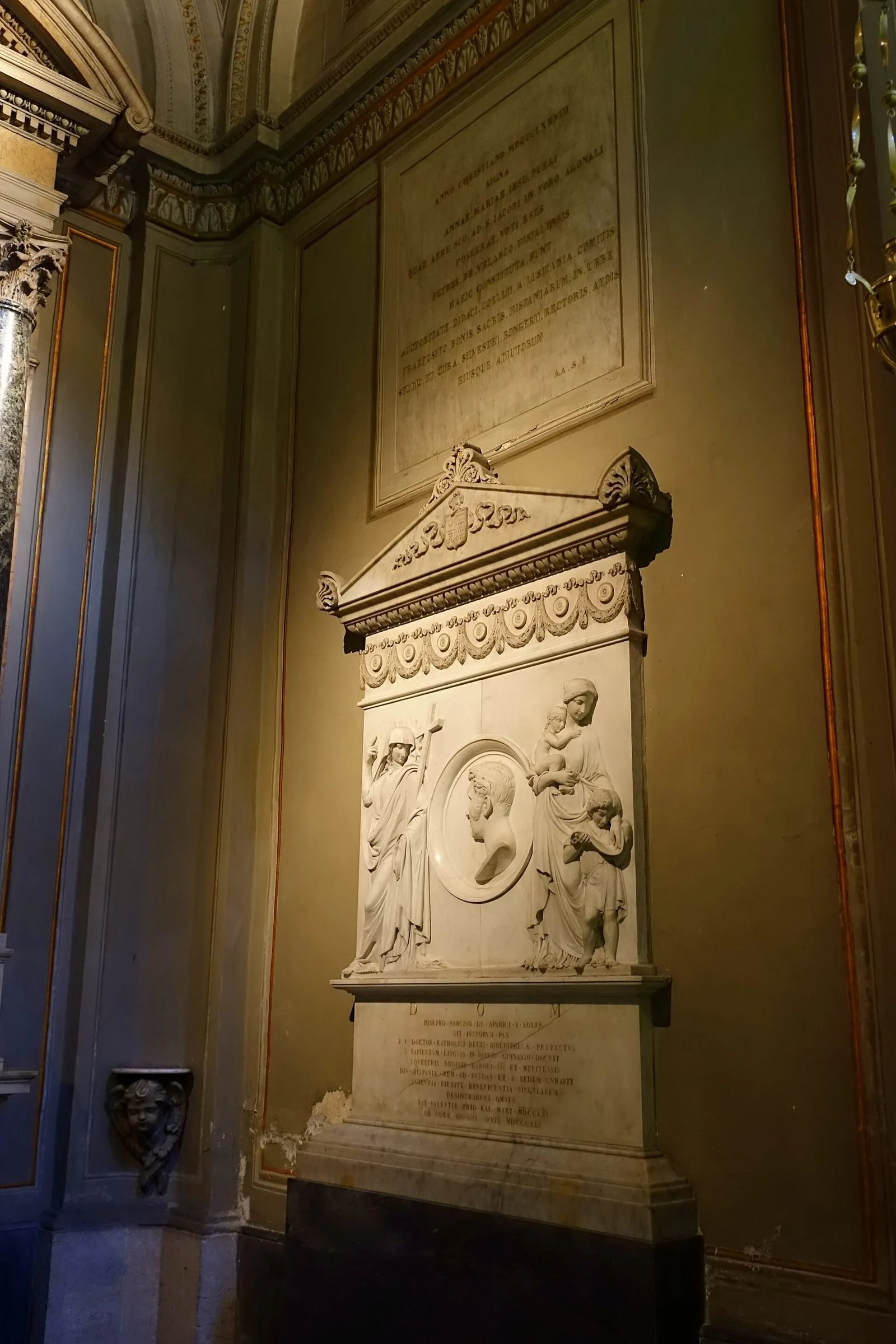
Santa Maria in Monserrato is the Spanish national church in Rome and stands at Via di Monserrato 115, in the Regola district, halfway between Campo de' Fiori and the Tiber embankment, with a second entrance at number 151 on Via Giulia. Inside there are two things you can't find anywhere else: the tombs of the two Borgia popes, Callixtus III and Alexander VI, brought here from the basilica of St. Peter's in the Vatican and now gathered in a nineteenth-century monument, and a sculpture by the young Gian Lorenzo Bernini, the bust of the Spanish prelate Pedro de Foix Montoya, made when the sculptor was just over 20. The delicate point is another one, and it's best to say it right away: this is one of the Roman churches that is most easily found closed. It has no ticket office, no museum hours and doesn't appear in the paid circuits. Anyone who walks past by chance, on an ordinary day, has a good chance of finding the door ajar and leaving without having seen anything. The lines that follow are meant to explain what is inside, how access works and how to organize yourself so you don't make the trip for nothing.

Where Santa Maria in Monserrato is and how to get there
The address is Via di Monserrato 115, Regola district, in the part of the historic center between Corso Vittorio Emanuele II, the Tiber and Via Arenula. The church occupies a block that opens onto two parallel streets: the facade looks onto Via di Monserrato, while the Spanish college complex next to it has an entrance on Via Giulia, at number 151. It's a location that throws off first-time visitors, because the facade can't be seen from afar: Via di Monserrato is narrow, the buildings are tall and the front can only be read when you are almost in front of it.
On foot from the center
From Campo de' Fiori it takes less than 5 minutes: you take Via dei Cappellari or you pass in front of Palazzo Farnese and take Via dei Baullari toward the river, then turn onto Via di Monserrato. From Piazza Navona the walk is 10 minutes: you cross Corso Vittorio Emanuele II at Palazzo della Cancelleria and go down toward Campo de' Fiori. From Ponte Sisto, and therefore from Trastevere, 7 or 8 minutes are enough going up Via Giulia. From Castel Sant'Angelo the trip is a little over a quarter of an hour: you cross Ponte Sant'Angelo, take Via Giulia at the basilica of San Giovanni dei Fiorentini and walk the whole length of it.
By public transport
There is no nearby metro stop, and this is the fact that really matters for people coming from outside Rome. Lines A and B don't touch this part of the historic center: the solution is the surface bus. The useful stops are those along Corso Vittorio Emanuele II, served by the lines that connect Termini to the Vatican (among them the 40 and the 64), from which you get off at Campo de' Fiori or the Cancelleria and finish the route on foot in 3 or 4 minutes. If you are coming from Trastevere you can use tram 8, which runs along Via Arenula, get off at Largo Argentina or Ponte Garibaldi and walk for about 10 minutes to the west.
Finding your way between Via Giulia and Via di Monserrato
The two streets run parallel and a few meters apart, connected by very short alleys such as Via della Barchetta and Vicolo del Polverone. If you look for the church while walking along Via Giulia you won't see it: you have to cut through one of the alleys and come out on Via di Monserrato. It's a mistake that happens all the time to independent visitors, who stay convinced they'll find it on the more famous of the two streets. Via Giulia has other things worth seeing on the same walk, from the Oratorio del Gonfalone to the church of Santa Maria dell'Orazione e Morte, up to the small church of Sant'Eligio degli Orefici, attributed to Raphael.
Hours, entrance and what to know before going
Entrance to Santa Maria in Monserrato is free and there is no ticket: no organization sells access to this church, and any offer of paid entry should be viewed with suspicion. What isn't free is your time: the church opens in narrow time slots, tied to the liturgical life of the Spanish community and to how the institution that runs it works, and it doesn't guarantee that staff are present continuously.
Why it is found closed so often
This isn't a tourist church and it doesn't behave like one. It has no fixed reception service, no information desk, and isn't included in the routes of the big ticket offices. It opens for Masses and for a few hours in the middle of the day, and in August it cuts its activity almost to zero. Anyone who arrives at 3 p.m. on a Tuesday in July may very well find everything shut with no notice on the door explaining why. Let's say it clearly, because it's the most useful practical fact on the whole page: if you go at random, the chance of staying outside is high. You have to factor it in.
The hours: how we handled them
Some sources specialized in the churches of Rome report, for the years between 2018 and 2019, opening on weekdays from 08:30 to 13:00 and from 15:00 to 17:00, and on holidays from 10:00 to 12:30 and from 17:30 to 19:30, with a weekday Mass at 8 and a Sunday Mass at 12:30, and closing in the month of August except for the Sunday Mass. These hours are not confirmed by an up-to-date official source and are several years old: we report them as an order of magnitude, not as information valid today. Before going they must be checked by contacting the organization that runs the church. Inventing an hour, here, would mean making the reader lose a morning.
Who to really ask
The church depends on the Obra Pia de los Establecimientos Españoles en Italia, the historic body that administers the Spanish properties in Rome and that is also responsible for the adjacent college. For information on Masses and visits, the official tourist portal of the City of Rome gives the phone numbers 06 6889651 and 06 6792231 and the website obrapia.org. Groups need advance notice: this isn't a church you can approach by showing up with 20 people without warning anyone, and this holds even more if you also want to see the part of the complex that isn't the church.
What it means to be a Spanish national church
Santa Maria in Monserrato is the national church of the Kingdom of Spain in Rome, that is, the place of worship that a foreign community settled in the city built and maintained for itself, with its own clergy, its own language and its own charitable institutions. Rome is full of churches of this kind, and it's a phenomenon you understand only by looking at the city as the capital of Western Christendom: every Catholic nation, between the fifteenth and seventeenth centuries, wanted a physical bridgehead near the pope.
A network of foreign churches in the historic center
Within one kilometer of Via di Monserrato you can count the national churches of half of Europe. France has San Luigi dei Francesi, which houses the three canvases of Caravaggio's Contarelli Chapel. Portugal has Sant'Antonio dei Portoghesi, a stone's throw from the Tiber embankment. The Florentines, who functioned in Rome as a nation of their own, have the basilica of San Giovanni dei Fiorentini at the start of Via Giulia. They are buildings that share one logic: the church, a hospice for pilgrims from the same country, often a college, almost always a confraternity that manages the assets.
What it means today
The function didn't end in the nineteenth century. Santa Maria in Monserrato is still the reference church for the Spanish-speaking community in Rome: the liturgy is celebrated in Spanish, the Spanish national and religious holidays are celebrated here, and the complex houses the Spanish priests' college, where Iberian priests in training or serving in the Vatican institutions live. For visitors, this has a practical consequence: the church's calendar follows the life of a real community, not that of a museum, and changes in hours depend on things like a celebration, a funeral, an institutional visit. The feast of Our Lady of Montserrat falls on April 27 and is celebrated solemnly.
From the Catalan hospices to the church of 1518
The first stone of the present church was laid on June 13, 1518, but the history of the institution begins more than 150 years earlier, with two charitable initiatives by Catalan and Majorcan women settled in Rome. Here the sources must be handled with care, because the dates and names change slightly from one reconstruction to another and the subject lends itself to simplification.
The fourteenth century: hospices for pilgrims of the Crown of Aragon
In 1354 a Catalan woman from Barcelona, whose name appears in the sources as Jacoba Ferrándiz or Jacoba Ferrandes, bought a property in this area to found a hospice for her fellow countrymen, dedicated according to some reconstructions to St. Nicholas and according to others to St. James. A few years later, in 1363, Margarida Pau of Majorca (whom some Italian sources call Margherita Paluzzi) founded a second hospice, dedicated to St. Margaret. The two institutions served the same population, the subjects of the Crown of Aragon, and ended up converging. The variation of names in the sources isn't a pedantic detail: it's the sign that this is fourteenth-century documentation reconstructed after the fact, and that absolute precision on these passages isn't available.
1495 and the Aragonese confraternity
In 1495 Pope Alexander VI, a native of Valencia and therefore a subject of the Crown of Aragon before being pope, established a confraternity of the Aragonese crown under the patronage of Santa Maria di Monserrato, the Catalan Marian sanctuary par excellence, on the jagged mountain northwest of Barcelona. The step is decisive: from that moment there is a single legal entity, with assets, capable of planning a large church. The year 1506 appears in several sources as a reference year for the construction of a hospice for Spanish pilgrims linked to the confraternity, and it is the date that some institutional profiles give as the foundation.
The building site: Sangallo, Valperga, Francesco da Volterra
The design of the church was entrusted to Antonio da Sangallo the Younger, the architect who in those same years was working on the building of St. Peter's and on Palazzo Farnese, a little farther along in the same area. After his death, in 1546, the site passed to others: the sources cite Bernardino Valperga and Francesco Capriani da Volterra. The work proceeded with the slowness typical of building works financed by a confraternity: the high altar was consecrated in 1594, the vault of the nave was completed in 1598, and then the site stopped for decades. The apse and a new high altar arrived only in 1675, by the hand of Giovan Battista Contini.
The nineteenth century: the French closure and the restoration
The French occupation of the late eighteenth century scattered part of the assets and interrupted the life of the institution. After 1815 the Spanish authorities decided to concentrate all the resources here, abandoning the other Roman site. A general restoration followed between 1818 and 1821, with reconsecration of the high altar in 1822, under the direction of the architect Pietro Camporese the Younger. It's the moment when the church takes on the look it has today, and when a large part of what you see inside comes in from elsewhere.
The merger with San Giacomo degli Spagnoli
For centuries the Spanish community in Rome had two distinct churches, and understanding how they became one explains half of the artistic content of Santa Maria in Monserrato. The second was San Giacomo degli Spagnoli, facing Piazza Navona, tied to the Castilian component, while Monserrato was the church of the Catalans and the Aragonese.
1803, 1807 and what followed
The two institutions merged in 1803, and Pope Pius VII approved the canonical union in 1807. In 1817 it was decided to close the church of San Giacomo, and in 1878 the building was sold: today that church on Piazza Navona still exists, much transformed, as Nostra Signora del Sacro Cuore. Between 1818 and 1882 furnishings, altars, tombs and sculptures that belonged to the old site arrived at Monserrato, at different times. Whoever visits Santa Maria in Monserrato today therefore sees a double stratification: what was born here and what was moved from Piazza Navona over the course of a few decades.
The facade, the portal and the sawed mountain
The facade of Santa Maria in Monserrato has two orders, and the two orders are almost three and a half centuries apart. The first, sixteenth-century, is the work of Francesco da Volterra, who built the right half between 1582 and 1584 and the left half in 1593: a rhythm that says a lot about how these building sites were financed, one piece at a time, depending on what came into the till.
The eighteenth-century portal
The main portal was designed by Tommaso de Marchis in 1726, and the sculptural group that surmounts it is by Carlo Monaldi, datable between 1731 and, according to other reconstructions, the years between 1673 and 1675 for the older part of the apparatus. On this dating the sources diverge, and we point it out instead of choosing arbitrarily. What doesn't change is the subject, and it's the best thing about the facade: the Child with a saw in his hand, among jagged rocks. It is a sculpted pun, and we explain it in the dedicated chapter.
How the interior is laid out
The interior of Santa Maria in Monserrato has a single nave of about three and a half bays, three chapels on each side opening onto wide arches, a presbytery and an apse with a semi-dome. Composite pilasters of giant order, in very low relief, support an entablature that runs around the whole perimeter. It's a space taller than it is wide, regularly articulated, without the spatial surprises that the Roman seventeenth century left not far from here.
The other chapels
The Chapel of the Annunciation holds a cycle by Francesco Nappi from 1624, with the altarpiece of the Annunciation and, on the side walls, the Nativity and the Assumption of the Virgin. The Chapel of Our Lady of Montserrat has a gilded stucco decoration attributed to Carlo Francesco Bizzaccheri and frescoes by Giovanni Battista Ricci da Novara with episodes linked to St. Raymond of Penyafort and to the holy Catalan mountain. The wooden statue of the Madonna seen here is not the Catalan original but a copy made by Manuel Martí Cabrer in 1950, a gift of the monastery of Montserrat. The Chapel of St. James the Greater keeps the statue of the apostle by Jacopo Sansovino, which came from San Giacomo degli Spagnoli and was placed here in 1882.
High altar and apse
On the high altar there is a Crucifixion by Girolamo Siciolante da Sermoneta, datable to 1564 or 1565. The apse, as said, was redone in 1675 by Giovan Battista Contini, who solved a practical problem pointed out by the confraternity: the earlier presbytery was considered insufficient for the solemn services of a national church. In the presbytery there is also the cenotaph of Alfonso XIII.
The tombs of the Borgia popes: Callixtus III and Alexander VI
In the first chapel on the right of Santa Maria in Monserrato are the remains of two popes, Callixtus III (pope from 1455 to 1458) and Alexander VI (from 1492 to 1503), uncle and nephew, both of the Borja family of Xàtiva, in the Kingdom of Valencia. They are the only two popes buried in a foreign national church in Rome, and they got here by a long road, which we reconstruct with precision because it is exactly here that the versions diverge.
Who they were
Alfons de Borja, elected pope in 1455 under the name Callixtus III, was the first pontiff of Valencian origin. His nephew Roderic de Borja became Alexander VI in 1492 and is, for reasons that have more to do with the propaganda of his opponents than with historical analysis, one of the most debated popes in the history of the Church. We don't deal here with the moral judgment on him, which is the ground of historians and not of guides: what interests us is the material fact, namely that two popes buried in St. Peter's ended up in a church on Via di Monserrato.
The departure from St. Peter's
Alexander VI died in August 1503 and was buried in St. Peter's in difficult conditions, without solemn funeral rites, because of the disorders that followed his death. In those years the basilica was a building site: the old Constantinian basilica was being demolished to make room for the present one, and hundreds of medieval and Renaissance burials had to be moved. In that context the remains of the two Borgia popes were removed, transferred to Vatican premises and finally handed over to the Spanish national church.
The date of the translation: 1610, and why you also read something else
The date the sources give most often for the placement of the remains at Santa Maria in Monserrato is 1610, and the translation took place thanks to the permission granted by Pope Paul V, whose pontificate runs from 1605 to 1621. Yet you find it written around, even on popular material, that the tombs were brought here in the nineteenth century. The misunderstanding arises from the fact that for almost three centuries the remains stayed in the church without a monument: they were kept in a chest, without a visible monumental arrangement, and only in 1889 did they receive the sepulcher you see today. Whoever tells the story starting from the monument dates it to the nineteenth century, whoever tells it starting from the bones dates it to the seventeenth. Both pieces of information are true and concern two different moments: the physical transfer of the remains is from 1610, their monumental display is from 1889.
The monument by Felipe Moratilla, 1889
The present sepulcher is the work of the Spanish sculptor Felipe Moratilla and was completed in 1889. It is a neo-Baroque monument, with the portraits of the two pontiffs and the inscriptions that identify them, placed on the right wall. It lacks the grandiloquence of the great papal tombs in the Vatican, and for that very reason it strikes you: two Renaissance popes gathered in a nineteenth-century slab of modest size, inside a church that almost nobody opens.
The bust of Pedro de Foix Montoya and the young Bernini
The marble portrait of Monsignor Pedro de Foix Montoya, made by Gian Lorenzo Bernini in 1621 and 1622, is tied to Santa Maria in Monserrato and counts among the sculptor's early works: Bernini was born in 1598, so he was working on this marble at just over 20, in the same months in which he was setting his hand to the great groups for Cardinal Scipione Borghese. The attribution to Bernini is accepted by the specialist literature and is not one of those open attributions found in so many Roman churches: here the critics agree.
Who Montoya was
Pedro de Foix Montoya was born in Seville in 1559, arrived in Rome by 1595 and died there in 1630. He was a papal jurist, a member of the Academy of Salamanca, referendary of the two Signaturae, that is the administrative tribunals of the curia, and belonged to the archconfraternity of the Resurrection of Christ, which was based at San Giacomo degli Spagnoli. He was, in essence, a senior Spanish official of the papal machine, with the means to commission a sepulcher from the most promising sculptor in the city.
The anecdote reported by Baldinucci
Filippo Baldinucci, Bernini's biographer, tells that some cardinals went to see the just-finished portrait and were struck by the likeness. One of them exclaimed that this was Montoya turned to stone. Just at that moment Montoya himself walked in, and Cardinal Maffeo Barberini, the future Pope Urban VIII, touched first the man and then the marble, attributing to each of them their respective identities. The episode should be taken for what it is, that is a workshop anecdote handed down by a biographer who was a friend of the family, but it is also the oldest testimony we have of the way the portrait was perceived by contemporaries. Maffeo Barberini himself, according to the sources, is said to have suggested Bernini's name for the commission.
The monument, and its move
The bust is part of a larger funerary monument: the architectural layout is attributed to Orazio Torriani and the stone execution to Santi Ghetti. The sepulcher was originally in San Giacomo degli Spagnoli, the Castilian church on Piazza Navona, and was brought to Santa Maria in Monserrato in 1820, in the great transfer that followed the merger of the two institutions. It is the same journey made by the Sansovino statue and by other furnishings.
Where the bust is today, and why you aren't guaranteed to see it
This is the point to clarify before leaving, because it produces disappointment. The portrait of Montoya is not displayed in the nave of the church. The sources indicate different locations, all inside the complex, not in the church open to the public: some place it in the vestibule of the cloister, some in the portico of the Spanish college, some in the refectory of the college. The difference between these descriptions depends in part on the date of the source, because the work was moved over time within the same complex. The practical consequence is only one: whoever enters the church during ordinary opening hours has no guarantee of seeing the bust, and to reach the parts of the college you need an arrangement made in advance with the institution. It must be asked beforehand, not on the spot.
Blessed Soul and Damned Soul
There is a second Bernini chapter tied to Montoya, and it is not in this church. The two famous marble heads known as the Blessed Soul and the Damned Soul, which represent the saved soul and the lost soul according to the doctrine of the Last Things, appear in 1619 in an inventory of Montoya's possessions as two half-busts of stone. This has led part of the critics to hold that Montoya was their first owner rather than the direct patron. Since 1943 the two marbles have been at Palazzo di Spagna, the seat of the Spanish embassy to the Holy See, at Piazza di Spagna, and cannot be freely visited. If you want to follow the thread of Bernini's works in the city you can start from our Bernini itinerary, which touches places much more accessible than this one, starting with the Fountain of the Four Rivers.
The Spanish works and what came from Piazza Navona
A large part of what you see inside Santa Maria in Monserrato wasn't born here but was brought from the church of San Giacomo degli Spagnoli between 1818 and 1882. It is one of the few Roman churches where the heritage reads like a national archive: Spanish works, Spanish artists, Spanish patrons, together with Italian masters who worked for the Iberian colony.
Sansovino's St. James
The statue of the apostle James the Greater is the work of Jacopo Sansovino, a Florentine sculptor and architect active in Rome before the Sack of 1527 and then in Venice, where he became the protagonist of the architecture of the State. The statue stood in San Giacomo degli Spagnoli, from which it took its meaning, and was placed here in 1882. It is a marble that deserves the longest stop in the whole nave after the Borgia monument: the rendering of the drapery and the twist of the body belong to early sixteenth-century Florentine sculpture, and it is rare to see an example of this quality in a minor church.
Annibale Carracci and St. Didacus
The altarpiece with St. Didacus of Alcalá in the first chapel on the right is attributed to Annibale Carracci, the Bolognese who left the Galleria Farnese in Rome, a few steps from here, and who changed the direction of Italian painting together with Caravaggio. St. Didacus was an Andalusian Franciscan canonized in 1588, a central figure of Spanish devotion at the time: the presence of his image here is no accident, it answers the religious demand of the community that financed the church.
Alfonso XIII, the king who was buried here for 40 years
Alfonso XIII of Spain, king from 1886 to 1931, died in exile in Rome in 1941 and was buried in Santa Maria in Monserrato. His remains stayed here until 1980, when they were repatriated and transferred to the Pantheon of the Kings in the monastery of the Escorial. The cenotaph remains in the church, that is the monument without a body.
How he ended up here
Alfonso XIII left Spain in April 1931, at the proclamation of the Second Republic, without formally abdicating. He spent his last years between Paris and Rome, and in Rome he died on February 28, 1941. The Spanish national church was the natural place for the burial of a sovereign in exile: Spanish territory in an institutional sense, inside a city that at that moment was the capital of a state allied with those who had just won the civil war in Spain.
A curiosity about Santa Maria in Monserrato
Above the main portal of Santa Maria in Monserrato there is a pun carved in marble: the Child Jesus holds a saw amid jagged rocks. It isn't a whim of the sculptor. Montserrat, in Catalan, means sawed mountain, from the sawtooth profile of the massif that houses the Marian sanctuary northwest of Barcelona. The group, attributed to Carlo Monaldi on a portal designed by Tommaso de Marchis in 1726, translates the place name into an image.
Why almost nobody notices it
The reason is banal and has to do with the geometry of the street. Via di Monserrato is narrow and the sculptural group is high up: to see it you have to stop and tilt your head back, something nobody does while walking by.
Something nobody tells you about Santa Maria in Monserrato
The thing that almost no guide says about Santa Maria in Monserrato is that the Bernini sculpture many people go there for isn't in the church accessible to the public, but in a room of the adjacent Spanish college, and that to see it you need a permit arranged beforehand. The descriptions in the sources swing between the vestibule of the cloister, the portico of the college and the refectory: the location has changed over time, but the point stays the same, namely that the bust is beyond the door of the church.
What it means for whoever organizes the visit
It means that there are two different visits and that they must be planned differently. The first is the church: free, no reservation, dependent only on opening hours, and it includes the Borgia monument, the Sansovino statue, the chapels and the cenotaph of Alfonso XIII. The second concerns the rooms of the college and is obtained only through prior contact with the Obra Pia de los Establecimientos Españoles. Anyone who arrives hoping to do both on an improvised stroll makes only half the trip.
The advice I give you for visiting Santa Maria in Monserrato
The practical advice for Santa Maria in Monserrato is just one and boils down to two moves: phone beforehand, and go on Sunday morning at the time of the Spanish community's Mass, which several sources place around 12:30 but which needs to be confirmed. It is the moment when the church is certainly open, because it has to be, and when you understand what a national church really is: a place where people pray in another language 200 meters from Campo de' Fiori.
Our verdict, without beating around the bush
This church doesn't stand up to the comparison with Rome's main destinations for someone who has two days and has to choose. If it's your first time in the city, skip Monserrato and go to the Pantheon and to St. Peter's. If instead it's your third or fourth time, if you have already seen the big circuit and are looking for the Rome of foreign institutions and side stories, then it's worth the try, knowing that the try can fail because of a closed door. Whoever doesn't accept this risk shouldn't go: it's a place that rewards those who organize and punishes those who improvise.
Another well-known fact, yet rarely mentioned
Santa Maria in Monserrato is the seat of a cardinalatial title established in 2003, and this places it, from the standpoint of ecclesiastical law, in the narrow circle of Roman churches tied to the College of Cardinals. It's a fact that appears in the technical sheets and that nobody ever tells visitors, because it requires explaining a mechanism a thousand years old.
What a cardinalatial title is
In the first centuries the cardinals were the clergy of Rome, and each had a church in the city. When the College of Cardinals became international, the link remained in symbolic form: every cardinal receives a church in Rome of which he becomes titleholder, even if he lives and works on the other side of the world. The title brings a formal relationship and generally also a concrete one, made of visits, contributions and presence on solemn occasions.
The right photo to take at Santa Maria in Monserrato
The photo that works at Santa Maria in Monserrato is the detail of the portal with the Child and the saw, taken from the opposite sidewalk of Via di Monserrato with a telephoto lens or with your phone's zoom, around mid-morning. The street runs roughly from northwest to southeast and stays in shade for much of the day: direct light on the facade arrives in a short window, and in the remaining hours you work with a soft reflected light, which works well on marble.
Inside: low light and no flash
The interior is dark, like almost all single-nave Roman churches with high windows. Flash is forbidden and flattens the image anyway. If you want the Borgia monument you have to rest your phone on a railing or on a chair back, keep the exposure long and shoot with the self-timer so as not to move it. During services you don't take photos at all.
Some important events that happened here in history
The chronology of Santa Maria in Monserrato is measured on six dates: 1354 and 1363 for the Catalan hospices, 1495 for the Aragonese confraternity, June 13, 1518 for the first stone, 1610 for the arrival of the remains of the Borgia popes, 1889 for the monument that holds them. Everything else revolves around these.
1518: the laying of the first stone
June 13, 1518 is the date that opens the building site on a design by Antonio da Sangallo the Younger. In those years Via Giulia was Julius II's great urban operation, conceived as a straight axis to connect the bridge with the papal tribunals: the church is born inside a neighborhood in transformation, not in a peripheral area.
1610: the two popes arrive
With the permission of Paul V, the remains of Callixtus III and Alexander VI leave the Vatican area and arrive on Via di Monserrato. No significant ceremony is documented, and the remains stay for a long time without a monument.
1889 and 1926: the monument and the facade
In 1889 Felipe Moratilla completes the sepulcher of the two popes. In 1926 Salvatore Rebecchini finally builds the second order of the facade, designed 70 years earlier by Giuseppe Sarti. In 1929 the Migliorini organ comes into service.
1941 and 1980: the king and his return
Alfonso XIII dies in Rome in 1941 and is buried here. In 1980, with Spain returned to democracy and monarchy, the remains leave for the Escorial. The cenotaph in the presbytery remains.
Who has passed through Santa Maria in Monserrato
Through Santa Maria in Monserrato have passed, as buried, patrons or makers, two Valencian popes, a king of Spain, one of the greatest sculptors of the Renaissance and the most important sculptor of the Roman Baroque. For a church of this scale it is an outsized concentration, and it can be explained only by the national function of the building.
Gian Lorenzo Bernini
Bernini worked for Montoya around 1621 and 1622, at one of the decisive moments of his career, when Maffeo Barberini's protection was about to turn into a papal commission. If you want to measure the distance between this portrait and the works of his maturity, you can compare it with what the same sculptor left at St. Peter's and at Piazza Navona.
What to see around, between Via Giulia and Campo de' Fiori
Santa Maria in Monserrato is in one of the densest sectors of the historic center: within a 10 minute walk there are about 15 places you can visit, almost all with more generous hours than those of the Spanish church. The stop here fits into a walk on Via Giulia between San Giovanni dei Fiorentini and Ponte Sisto.
On Via Giulia and in the Regola district
On the same axis you meet the Oratorio del Gonfalone with its Mannerist cycle, Santa Maria dell'Orazione e Morte with the carved skulls on the portal, the tiny Sant'Eligio degli Orefici, the basilica of San Giovanni dei Fiorentini, the church of Santissima Trinità dei Pellegrini and San Paolo alla Regola. A little farther on, below the Capitoline Hill, the church of San Giovanni Decollato tells a Rome of confraternities no less particular than this one.
Toward Campo de' Fiori and Corso Vittorio
To the east, in a few minutes you reach Campo de' Fiori, the Galleria Spada with Borromini's perspective, Palazzo della Cancelleria, the Museo Barracco, the basilica of Sant'Andrea della Valle and the Fountain of the Tureen. If you follow the Borromini thread you can use our Borromini itinerary, which starts right from Sant'Ivo alla Sapienza.
Toward Piazza Navona and the Pantheon
To the north you enter the system of Piazza Navona, with the Stadium of Domitian below street level, the Museo di Roma at Palazzo Braschi, the Pantheon and Santa Maria sopra Minerva. Staying on the theme of foreign national churches, a few minutes away there are San Luigi dei Francesi, with Caravaggio's Contarelli Chapel, and Sant'Antonio dei Portoghesi.
Toward the river, the Ghetto and the Vatican
To the south and west you go down toward Ponte Sisto, the Villa Farnesina and Santa Maria in Trastevere. Toward the southeast you reach Largo Argentina, the Turtle Fountain, the Jewish Ghetto, the Portico of Octavia, the Theater of Marcellus and the Tiber Island. Toward the northwest you cross Ponte Sant'Angelo, pass alongside Castel Sant'Angelo and enter Vatican City.

Eating between Via Giulia and Campo de' Fiori: how to choose
The area around Santa Maria in Monserrato is among the most exposed in Rome to passing tourism, and the average level of the places between Campo de' Fiori and the Tiber embankment shows it. We don't name names, as an editorial choice: a list of signs ages in a few months and teaches nothing. We give instead the criteria we use in the field.
The five signs that point to a trap
The first: the woman rolling fresh pasta in the window or right in the street. It's a lure designed for passersby, not the sign of a kitchen. The second: the menu with photos of the dishes, which is for people who don't speak Italian and have no intention of understanding what they order. The third: the person at the threshold who invites you to sit down, sometimes with the price list in hand. A place that works with the neighborhood's customers doesn't need to stop anyone in the street. The fourth: the kitchen open from morning to night with no break, which doesn't exist in a real kitchen. The fifth: the position in front of a famous monument, where the price tends to follow the tourist in front of them, with items not priced on the menu or a different price list at the outside table than the inside one.
The chain places in the center
In recent years the historic center has seen a multiplication of a type of place with the same sign repeated in several spots of the city, an identical menu and a line managed with ticket numbers. We don't name them and we don't recommend them. The useful observation is another: Romans don't go there, and in a city where you eat well at normal prices off the beaten track, that line is made almost only of visitors.
The simplest test there is
Before sitting down, you look inside: who is sitting at the tables and in what language they order. If at 2 p.m. on a Tuesday the place is full of people ordering in Italian and chatting with the waiter, it's a good sign. If at the tables there are only foreigners with backpacks and menus open to the photos, you walk another 5 minutes. Five minutes, in this area, completely change the picture: it's enough to head up toward Via dei Cappellari or move away from the main squares.
Daniele Dezi's list
For those who want a starting point that is already filtered, there is Daniele Dezi's personal list on Google Maps, a curated, unsponsored collection, built over time in the field. It isn't advertising: it's a reasoned selection.
Accessibility and best time to go
The church is on the street, with a modest threshold step typical of sixteenth-century Roman buildings, and the single-nave interior is flat and free of significant internal barriers. The exact access conditions for wheelchair users must however be confirmed with the managing body, because no official accessibility sheet appears to be published and Via di Monserrato has narrow or absent sidewalks. With children two things work: the Child with the saw on the portal, which you treat as a riddle, and the story of the two popes taken away from St. Peter's in a chest.
When to go
The worst period is August, when activity is reduced to a minimum: the good months run from October to June. The feast of Our Lady of Montserrat falls on April 27: the church is certainly open and in operation, with a solemn celebration, but it is also full, and it isn't the right day to look at the works calmly.
Frequently asked questions about Santa Maria in Monserrato
How much does it cost to enter Santa Maria in Monserrato?
Entrance to Santa Maria in Monserrato is free: there is no ticket office and no circuit sells access to this church. Contributions left in the boxes for the upkeep of the building are welcome. Visits to the rooms of the adjacent Spanish college, where Bernini's bust is, follow different rules and must be arranged in advance with the body that administers the complex.
What are the hours of Santa Maria in Monserrato?
Santa Maria in Monserrato opens in narrow time slots and doesn't publish a stable schedule like a museum. Specialized sources referring to the years between 2018 and 2019 give, on weekdays, the slots 08:30 to 13:00 and then 15:00 to 17:00, on holidays 10:00 to 12:30 and then 17:30 to 19:30, with closing in August except for the Sunday Mass. These are data not confirmed by an official source: they must be checked with the Obra Pia de los Establecimientos Españoles before leaving.
Where is Santa Maria in Monserrato and how do you get there?
Santa Maria in Monserrato is at Via di Monserrato 115, in the Regola district, with a second entrance at number 151 on Via Giulia. There is no nearby metro stop: you use the buses that run along Corso Vittorio Emanuele II, among them lines 40 and 64 from Termini, getting off at Campo de' Fiori, or tram 8 on Via Arenula with a 10 minute walk.
Why are the Borgia popes at Santa Maria in Monserrato?
Callixtus III and Alexander VI rest at Santa Maria in Monserrato because the church is the Spanish national church and the two popes were Valencians, of the Borja family. Their remains were removed from the Vatican area during the works on the new basilica of St. Peter's and placed here in 1610, with the permission of Pope Paul V. The monument that holds them, the work of Felipe Moratilla, was completed only in 1889.
When were the tombs of the Borgia popes moved?
The tombs of the Borgia popes arrived at Santa Maria in Monserrato in 1610, not in the nineteenth century as is often read. The misunderstanding arises from the fact that for almost three centuries the remains stayed in the church without a monumental arrangement: the sepulcher visible today dates from 1889. Whoever tells the story starting from the monument places it in the nineteenth century, whoever starts from the translation of the remains places it in the seventeenth.
Can you see Bernini's bust at Santa Maria in Monserrato?
The bust of Pedro de Foix Montoya sculpted by Bernini in 1621 and 1622 is not in the nave of the church but in a room of the adjoining Spanish college, indicated by the sources now as the vestibule of the cloister, now as the portico of the college, now as the refectory. To see it you need an arrangement made in advance with the Obra Pia de los Establecimientos Españoles: whoever enters only the church during ordinary hours may not see it at all.
How long does it take to visit Santa Maria in Monserrato?
20 or 30 minutes are enough to visit Santa Maria in Monserrato when the church is open: single nave, three chapels per side, the monument to the two Borgia popes on the right, Sansovino's statue of St. James and the cenotaph of Alfonso XIII in the presbytery. Whoever reads the inscriptions and reconstructs where the works came from gets to 40 minutes. It's best to fit it into a wider walk through the Regola district.
Is Santa Maria in Monserrato still an active church?
Santa Maria in Monserrato is still the reference church of the Spanish-speaking community in Rome, with liturgy in Spanish and a priests' college in the same complex. The feast of Our Lady of Montserrat is celebrated solemnly on April 27. This explains the irregular hours: the calendar follows the life of a real community and the celebrations, including the institutional ones with the Spanish diplomatic delegation, suspend visits.
Who wrote this page
This page is curated by the editorial team of Tour Leader Pro, the Roman project office that designs and coordinates visits, itineraries and cultural events in Rome and Lazio. The hours, fares and access conditions given here were checked on the publication date against the official sources named in the text: it's best to recheck them before you leave, because they change often. If you find outdated information, let us know.
If you are building an itinerary in the Regola district and want to fit Santa Maria in Monserrato together with Via Giulia, Campo de' Fiori and the other foreign national churches of the center, keeping in mind narrow hours and access that has to be arranged, you will find planning tools and operational support at Tour Leader Pro.
For the broader picture, from rail connections to destinations in Lazio outside Rome, up to the logistics of a multi-day trip in Italy, a useful resource is Italy Planner.