Santa Maria in Vallicella, the Chiesa Nuova
In short. Santa Maria in Vallicella faces Corso Vittorio Emanuele II, at the height of Piazza della Chiesa Nuova, and almost nobody calls it by its name.
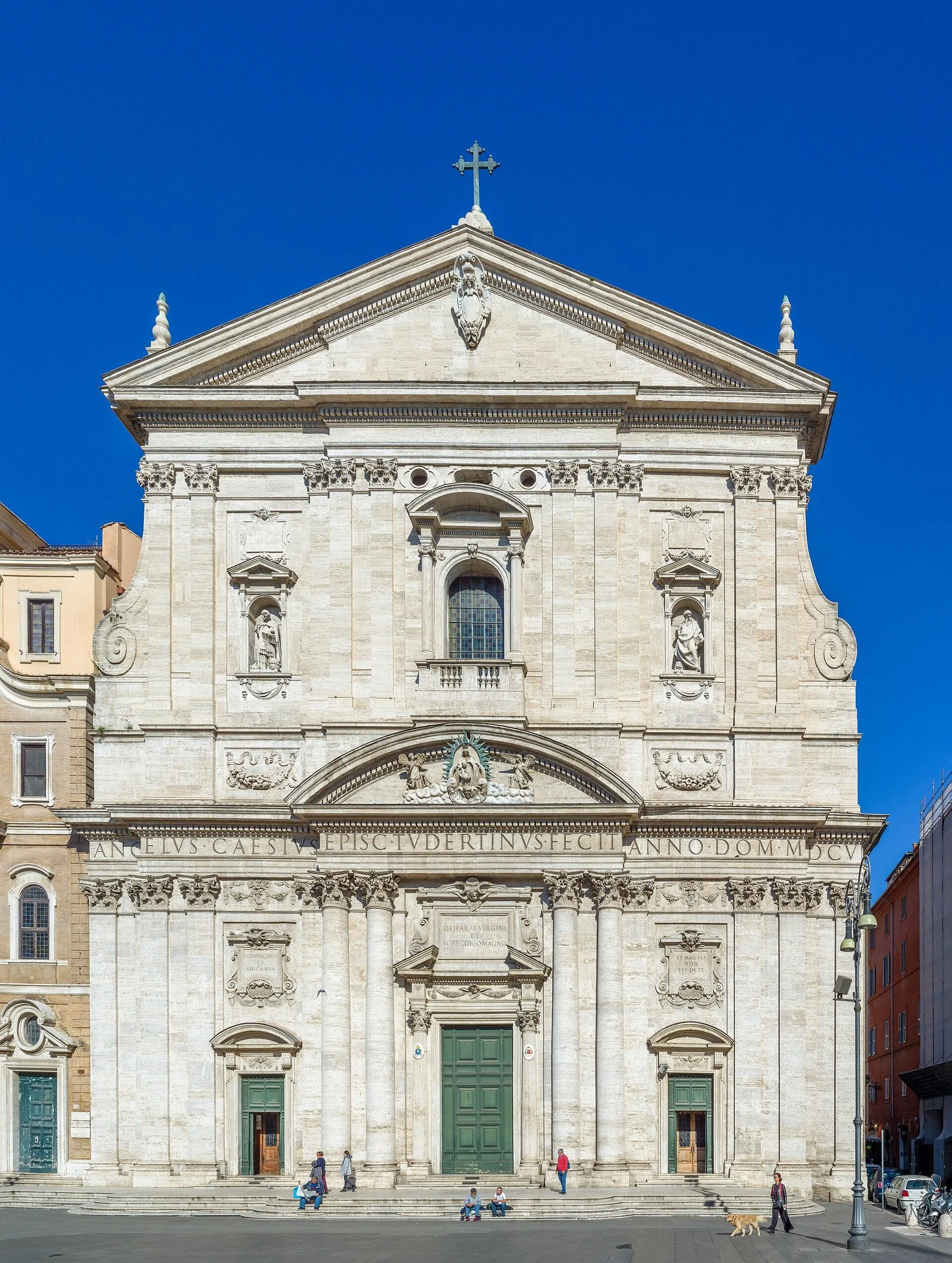
Santa Maria in Vallicella faces Corso Vittorio Emanuele II, at the height of Piazza della Chiesa Nuova, and almost nobody calls it by its name. In Rome it is the Chiesa Nuova, and it has been for four and a half centuries, that is since it stopped being new for almost everyone. Inside are three slate panels painted by Rubens on the high altar, a copper sheet that lifts to reveal a 14th-century fresco, the vault and dome frescoed by Pietro da Cortona, the body of Saint Philip Neri in an urn and, next to it, Borromini's Oratorio dei Filippini with its curved brick facade. On the sidewalk in front tens of thousands of people pass every day and the vast majority walk straight on. This page explains what is really there, what you can manage to see and when, where the sources diverge, and which things told around about this church don't hold up to verification.
Where the Chiesa Nuova is and how to get there
The address is Piazza della Chiesa Nuova 1, in rione Parione, on the south side of Corso Vittorio Emanuele II. The facade looks onto the corso and the small square in front, while the Oratorian complex extends behind and on the left side, toward Via dei Filippini and Piazza dell'Orologio. The Congregation's phone is 06 6875289.

By public transit
Corso Vittorio Emanuele II is one of the best-served axes of the historic center: the surface lines that run along it stop a few tens of meters from the facade, in both directions. There is no subway stop nearby, and this is the point many underestimate. The closest is the one at Piazza Venezia or Via Nazionale depending on the route chosen, with a walk of no less than 15 minutes. The routes of Roman buses change often because of construction sites and detours: check the same day on the transit company's app. For the general picture we have a page on getting around Rome.
On foot, which is the right way
Whoever arrives from Piazza Navona takes barely five minutes passing in front of Pasquino and taking Via del Governo Vecchio. From Campo de' Fiori six or seven are enough, crossing the corso at the height of the basilica of Sant'Andrea della Valle. From Castel Sant'Angelo it is 10 minutes along the Tiber and then into the fabric of the lanes. The Chiesa Nuova works as a node of passage, not as an isolated destination, and that is how it is best treated.
Why it is called the Chiesa Nuova
The nickname comes from a building site, and the date is precise. On July 15, 1575 Pope Gregory XIII approved with the bull Copiosus in misericordia Deus the Congregation of the Oratory founded by Philip Neri and assigned it a small medieval church that stood here, dedicated to Santa Maria in Vallicella. The Oratorians found it in poor condition and too small for what they did, and decided to rebuild it from scratch. The first stone of the reconstruction dates from the same 1575. Romans began to call it the new church to distinguish it from the old one, and the name stuck.
What Vallicella means
The place name indicates a hollow, a small valley. The area of the southern Campus Martius, before the reclamations and the gutting, had a natural lowering of the ground right here, and the name of the medieval church recorded it. The documentation of the Biblioteca Vallicelliana recalls that the building was also known as Santa Maria al Pozzo Bianco, for an ancient marble well that stood nearby. They are two names that describe the place, not the devotion, and a good clue to how modest that little church was.
Philip Neri, the Oratorians and what they really did
Philip Neri was born in Florence on July 21, 1515 and died in Rome on May 26, 1595. He arrived in the city at around 18, stayed 60 years and almost never left. He was ordained a priest on May 23, 1551, rather late and almost reluctantly, and began to gather groups of people in a room above the church of San Girolamo della Carità to talk about spiritual subjects, read, discuss and sing. That room was called an oratory, that is a place where one prays, and from there comes the name of the congregation.
The Seven Churches walk
The longest-lasting Roman devotion invented by Neri is the visit in a single day to the seven major basilicas, instituted according to Oratorian tradition on the Fat Thursday of 1552 as an alternative to the carnival revelry. The route touches Saint Peter's, Saint Paul Outside the Walls, San Sebastiano, St. John Lateran, Santa Croce in Gerusalemme, San Lorenzo fuori le Mura and Santa Maria Maggiore. It is more than 20 kilometers on foot and the Congregation of the Vallicella still organizes it today.
The dilation of the heart
Oratorian tradition places on Pentecost of 1544, at the catacombs of San Sebastiano, the episode the biographers call the dilation of the heart: Neri is said to have had a violent mystical experience that left him with a permanent chest deformation. The examination of the body after death did record an anomaly of the ribs, and this fact appears in the hagiographic sources and in later medical literature. The anatomical fact is documented, the explanation given for it depends on what one believes: the two things must be kept separate, and around you almost always find them welded together.
A curiosity about Santa Maria in Vallicella
Philip Neri wanted this church white. The documentation of the Biblioteca Vallicelliana reports that the founder imagined it large, simple, with lightly plastered walls, in line with the sobriety that the Council of Trent recommended and that he practiced by temperament. Today inside there is not a square centimeter that is not painted, gilded, inlaid or clad in marble. The church is exactly the opposite of what its founder had asked for.
How it happened
What happened is that Neri died in 1595 and the decoration came afterward. The church was consecrated in 1599, the facade finished around 1605, the frescoes of the vault and dome are by Pietro da Cortona between 1647 and 1666, that is between 50 and 70 years after the founder's death. In the meantime the Congregation had become rich, had aristocratic and cardinal patrons, and a canonized saint to display. Sobriety was no longer a program: it had become a memory.
What remains of it
Of the original project the plan remains: three wide naves, deep side chapels, a barrel vault, a hall conceived to let a sermon be heard by many people. The layout is functional, almost an auditorium. The richness is all surface, added on top of a skeleton designed for listening. Whoever enters and looks up sees the triumphant 17th century. Whoever looks at the proportions of the plan still sees Neri's idea.
The three Rubens slates on the high altar
Peter Paul Rubens arrives in Rome young, works in Italy between 1600 and 1608 and the Vallicella commission is the last and most important of his Italian stay. The works are three, all painted on slate slabs, and they occupy the presbytery: the central altarpiece above the high altar and two panels on the side walls. The financier was Monsignor Giacomo Serra, from Genoa.
What they depict
The central altarpiece shows angels and cherubs arranged in concentric circles adoring the image of the Madonna della Vallicella. On the left wall of the presbytery are Saints Gregory the Great, Maurus and Papias, on the right Saint Flavia Domitilla with Nereus and Achilleus. They are the saints whose relics were tied to this church, and not a free iconographic choice of the artist. One detail closes the circle: the Congregation of the Vallicella still serves today the church of Santi Nereo e Achilleo, on the Appia, so the link painted by Rubens in 1608 is still operative.
Why slate
The first version of the altarpiece was not on slate but on canvas, and was rejected. The reason the sources report consistently is optical: the surface reflected the light in such a way as to make the painting unreadable from below, in the real position and under the real lighting of the presbytery. Rubens redid everything on slabs of slate, which absorb light instead of sending it back. It is one of the few documented times an artist of that level redoes an entire work for a visibility problem and not a problem of subject.
Where the first version ended up
The rejected canvas still exists and is in the Musée de Grenoble, cataloged as Saint Grégoire pape, entouré de saints et de saintes, vénérant l’image miraculeuse de la Vierge à l’Enfant, dite de Santa Maria in Vallicella. Rubens kept it for himself. Whoever compares the two solutions understands the problem better: in the Grenoble version all the saints and the Virgin are in a single field, in the Roman one the composition was broken into three parts to fit the architecture of the presbytery. It was not just a question of reflections, it was a rethinking of the whole layout.
The mechanism that reveals the Madonna della Vallicella
Above the high altar, at the center of Rubens's altarpiece, is an oval copper plate painted by Rubens himself with a Madonna and Child giving a blessing. That plate is movable. It lifts with a system of ropes and pulleys designed at the time, and underneath appears the image the church truly venerates: a 14th-century fresco, much smaller and much cruder, detached from a wall and kept here as a relic.
What the image underneath is
The fresco dates from the 14th century and was originally on an exterior wall, according to the most widespread reconstruction near a bath building or a public bath in the area. The event that made it an object of worship is placed in 1535: struck by a stone, the image is said to have bled. From that moment the Madonna della Vallicella becomes a destination of devotion, and 40 years later it is the reason this little church is chosen as the seat of a growing congregation. The entire monumental complex is born around a street fresco.
How it works and when it opens
The mechanism is the original one in principle, ropes and counterweights, but today it is operated electrically and the sacristan controls it remotely. On how often it opens, the popular sources agree on one point, namely that the image is uncovered at the end of the Saturday evening vigil Mass and on the main solemnities, in particular May 26, the feast of Saint Philip Neri. We did not find this calendar published on the Congregation's official website: whoever cares must ask in the sacristy, which is also the quickest way to know whether that day is planned. On the mechanism, its history and how to look at it we have a dedicated page on Rubens's motorized painting, and there the subject is covered in depth.
Something nobody tells you about Santa Maria in Vallicella
The sentence you read everywhere is that the oratorio was born here as a musical genre, and that it was invented by Saint Philip Neri. Said like that it is wrong in at least three points, and the way it is wrong is instructive, because it shows how a founding legend is built starting from true facts.
First point: Neri did not invent a musical genre
What Philip Neri organized were prayer meetings in which spiritual laude were sung, that is devout songs in the vernacular, often built on secular melodies and on madrigals already in circulation. The collections exist and have documented authors: the Oratorian father Giovenale Ancina published the Tempio armonico, Father Agostino Manni wrote the texts. They are repertoires of lauda, not dramatic compositions. Neri was an organizer of meetings with music, not a composer or a theorist.
Second point: the word comes from the place
Oratory, originally, is only the name of the room: the space where people gather to pray. The passage from place to musical genre happens in the 17th century, gradually, because the habit took hold of indicating with the name of the hall the type of music performed there. The Treccani describes it exactly like this, as a transition from a designation of space to a designation of form. No one, in Philip Neri's lifetime, called a musical composition an oratorio.
Third point: Borromini's oratory has nothing to do with it
The point that does the most damage. The performance considered decisive for the birth of the genre is the Rappresentatione di Anima et di Corpo by Emilio de’ Cavalieri, on a text by Father Agostino Manni, given in the oratory of the Vallicella in 1600, with the new accompanied monodic style. But the Oratorio dei Filippini seen today next to the church, Borromini's one with the curved facade, was begun in 1637. In 1600 it didn't exist. The hall in which that music was performed was an earlier space of the Oratorian complex, and whoever indicates the Borromini hall as the place of the first performance is off by 37 years.
What holds up, then
What holds up is that the musical genre takes its name from the Oratorians' meeting halls, that the musical practices of those halls were the environment in which the genre formed, and that a cardinal work of that passage was performed at the Vallicella in 1600. That is already a great deal, and doesn't need to be inflated. Whoever wants to see how music was played and with what instruments in those years finds material at the Museo degli strumenti musicali, and whoever wants a comparison with another Roman space dedicated to confraternity sacred music can look at the Oratorio del Gonfalone, which is a frescoed hall born for the same type of use.
Pietro da Cortona: the vault, the dome, the apse
Pietro Berrettini da Cortona works in this church in several stages, and his intervention here is one of the major decorative undertakings of the Roman 17th century together with the ceiling of the salon of Palazzo Barberini. The dates the sources report for the church cycle fall between 1647 and 1666, that is almost 20 years of intermittent building site. Even earlier, in 1633 and 1634, he had painted the sacristy ceiling with angels carrying the instruments of the Passion.
The vault of the nave
The subject is the vision that Oratorian tradition attributes to Philip Neri in 1576: the Madonna holding up with her hand the roof beam of the church under construction, keeping it from collapsing on the workers. It is an episode internal to the founding legend, painted over the heads of the faithful in the very place where it is said to have happened. Looking at that vault without knowing the story means seeing a generic Marian glory.
The dome and the pendentives
In the dome Cortona painted the Triumph of the Trinity, with the Father and the Son on the cap and the Holy Spirit in the lantern, so that the highest and brightest point of the building coincided with the theological apex of the scene. In the pendentives are four prophets: Jeremiah, Ezekiel, Isaiah and Daniel. The apse basin hosts the Assumption among angels and saints. It is a unified program, read from the back of the nave toward the altar and then upward.
The intervention on the light, which is the most interesting thing
In 1650 Pietro da Cortona laid hands on the dome itself, not just its painted surface: the sources record a structural modification with the addition of a lantern to bring more light inside. A painter who has the architecture modified to make his own fresco work is a case that says a lot about the balance of power among the arts in mid-17th-century Rome. The dome was changed so that the painting could be seen better, and not the other way around.
The chapel and rooms of Saint Philip Neri
The body of Philip Neri is in the chapel to the left of the presbytery, built between 1600 and 1606 on a design by Onorio Longhi and financed by Neri Del Nero, a relative of the saint. The vestibule that precedes it, oval in plan, is the work of Luca Berrettini. The translation of the body into the chapel is placed by the sources in 1602, seven years after his death and 20 years before the canonization.
What is inside
The chapel is lined with marbles, alabasters, jasper, mother-of-pearl, lapis lazuli, coral, onyx, agate and amethyst, in a layering of precious materials that is exactly the opposite of the white walls Neri had asked for. The small dome with lantern is by Pietro da Cortona and dates to 1650. The canvases with scenes from the saint's life are by Cristoforo Roncalli known as il Pomarancio, painted between 1596 and 1599, that is right after the death and even before the canonization process came to a conclusion.
The rooms, which are something else
Above the sacristy are preserved the rooms in which Philip Neri lived his last years: the so-called Camera Rossa with reliquaries and a portrait attributed to Guercino, a spiral staircase, the private chapel where he celebrated Mass, the bed, the confessional. They are small, bare rooms, kept as they were, and they are not part of the church's free route. You reach them from the transept side, accompanied.
How they are really visited
The visit to the rooms is by reservation. The channel indicated by the Congregation on its website is a mail address dedicated to guided visits, oratorioartefede at gmail dot com, in addition to the house phone, 06 6875289. Unofficial tourist listings report fixed opening windows, for example Tuesday, Thursday and Saturday from 10:00 to 12:00 with groups limited to 15 or 20 people, free admission and a fee for organized groups. The same source however notes that the visits have been suspended for restoration. This information does not appear on the Congregation's website and should be considered indicative: before planning anything you must write or phone and have the day confirmed.
The advice I give you for visiting Santa Maria in Vallicella
The advice is not to treat it as a 10-minute stop between Piazza Navona and Castel Sant'Angelo. The Chiesa Nuova is a complex, not a church: there is the hall with Rubens and Cortona, there is the saint's chapel, there are the rooms visited only by appointment, there is Borromini's oratory next door and there is a state library with a monumental hall open to the public for free. Four different entrances, four different schedules, four different bodies. Whoever doesn't notice sees a quarter of the place.
The practical way to fit things together
Monday, Tuesday or Friday morning is the window in which everything is open together: the church from the early hours of the morning, the Salone Borromini of the Biblioteca Vallicelliana from 10:00 to 13:00 with free entry, the Archivio Storico Capitolino with its reading room. In two hours you see the church, the Borromini hall and the courtyard of the complex. On Wednesday and Thursday the hall is visited in the afternoon but only by reservation, on Saturday and Sunday the library is closed: whoever comes on the weekend sees the church and that's all.
How much time to allow
For the church alone, looked at properly, you need 40 minutes: 10 for the nave and side chapels, 10 sitting looking at the vault, 10 in the presbytery in front of the Rubens panels, 10 in the saint's chapel. With the Salone Borromini it comes to an hour and a half. With the rooms of Saint Philip, when they are visitable and by appointment, you come close to two and a half hours. Whoever counts on 10 minutes, as many itineraries suggest, has already decided to see nothing.
Borromini's Oratorio dei Filippini, next to the church
To the left of the facade, looking at it from the corso, another building begins: brick instead of travertine, curved surface instead of flat, no statues. It is the Oratorio dei Filippini. Francesco Borromini obtained the commission by winning a competition internal to the Congregation, beating among others Paolo Marucelli, who had already worked on the complex. Work starts in 1637.
The facade with folded wings
The facade is not flat and not curved uniformly: it is articulated on a concave and convex course that alternates recesses and projections, with the pilasters set on a curved plan. Borromini himself, according to the critical tradition, compared it to a human body with open arms welcoming whoever enters. The description is apt and explains why the building, which is neither tall nor large, seems to move when you walk along it.
The brick detail, which is the real masterpiece
The patron imposed brick, a poor material, so that the oratory's facade would not compete with the travertine one of the church. Borromini responded with a piece of masonry that has to be looked at up close, with your nose a meter from the wall: the central area and its pilasters are in thin bricks laid with joints of two or three millimeters, straw-yellow in color, while the remaining parts have pinkish bricks. It is a chromatic modulation obtained only with the clay mix and the precision of the laying. No photograph reproduces it, and from the opposite sidewalk you don't see it.
The clock tower
On the side facing Piazza dell'Orologio, Borromini built between 1647 and 1649 the tower that gives the square its name, with the dial framed by a curved structure and a metal cage above. It is one of the most visible Borromini pieces in Rome and one of the least looked at, because the square is small, whoever passes through passes in a hurry and to see the tower you have to stop and lift your head. Whoever wants to line up the other buildings of his Roman catalog finds a route on our page about Borromini in Rome, which includes San Carlo alle Quattro Fontane and Sant'Ivo alla Sapienza.
What can be visited and what can't
This is the point the guides get wrong. The hall of the oratory proper, the one where music was made, is not open as a visitable monument with fixed hours: it can be seen during concerts, conferences and special openings, and whoever wants to enter must follow the events calendar. The rest of the complex was acquired by the State after 1870 and today houses several bodies: the Archivio Storico Capitolino since 1922, based at Piazza dell'Orologio 4 with a reading room open to all, the Istituto Storico Italiano per il Medio Evo since 1924, the Casa delle Letterature since 2000, and a theater on Via dei Filippini side. They are different entrances, with different rules, inside the same building.
The Biblioteca Vallicelliana and the Salone Borromini
The Biblioteca Vallicelliana is a state public library, with its entrance at number 18 Piazza della Chiesa Nuova. It was born from the Oratorians' book collection, has about 130,000 volumes, 3,000 manuscripts, incunabula, prints and photographs, and is one of the most important collections in Italy for ecclesiastical history. The hall that houses it is the one designed by Borromini and completed in 1643. We have a dedicated entry on the Biblioteca Vallicelliana, with the details of services and collections.
You can go in and see it, for free
The fact almost nobody knows: the Salone Borromini can be visited without paying anything. The hours published by the library indicate Monday, Tuesday and Friday from 10:00 to 13:00 with free entry, Wednesday and Thursday from 15:00 to 18:00 by reservation only. On Tuesday morning a welcome guided by the staff is planned, by reservation. Groups of more than 15 people must always book, at least 48 hours ahead, writing to the library's education address. Saturday and Sunday it is closed, as on holidays.
If instead you want to study there
The reading room has its own, wider hours: Monday, Tuesday and Friday from 08:15 to 15:00, Wednesday and Thursday from 08:15 to 19:00, closed on weekends. Access is allowed from age 16 with an identity document, bags are left at the entrance and consulting the manuscripts requires a written statement of the research purpose. The library closes in the second 10 days of August, with a reduced service for information and returns. Whoever compares this with the other great historic Roman libraries can look at the Biblioteca Angelica, the Biblioteca Casanatense and the Biblioteca Nazionale Centrale.
Another well-known fact, yet rarely cited
In one of the side chapels there is a Caravaggio, and it is not a Caravaggio. The Deposition that Michelangelo Merisi painted between 1602 and 1604 was commissioned by Girolamo Vittrice for the family chapel in this church, the one that had belonged to his uncle Pietro Vittrice. The painting on the altar today is a copy from the early 19th century, the work of the Austrian painter Michael Köck, and the sources judge it modest.
Why the detail matters
Among all the Caravaggios in Roman churches, this is the only one that was actually requisitioned in the Napoleonic era. The canvases of San Luigi dei Francesi, those of Sant'Agostino and those of Santa Maria del Popolo stayed in their place. Whoever goes around Rome chasing Caravaggios in situ should know that at the Chiesa Nuova the box has been empty for more than two centuries, and that the original must be looked for in the Vatican.
What is instead original, and nobody looks at
In the left transept is the Presentation of the Virgin in the Temple by Federico Barocci, datable to 1593 and 1594, and in one of the left chapels his Visitation. Barocci is a painter that popular writing treats as minor and who counted for a great deal in the Roman 17th century: his light and pastel colors are an obligatory passage for understanding where Pietro da Cortona comes from. Oratorian tradition says that Philip Neri spent hours in prayer in front of the Visitation. It is a hagiographic report, not a document, and must be taken as such, but it indicates how much that painting counted for the house.
The sacristy, which is a piece on its own
The sacristy was begun in 1621 on a design by Mario Arconio and completed by Paolo Marucelli in 1629. Inside is a marble group of Saint Philip with an angel sculpted by Alessandro Algardi, one of the two great sculptors of Bernini's Rome, and the ceiling painted by Pietro da Cortona in 1633 and 1634 with angels carrying the instruments of the Passion. The sacristy doesn't work as a service room, it is a monumental space of its own, and access depends on the activities under way. Ask first.
The right photo to take at Santa Maria in Vallicella
The photo that really works is not the facade of the church. It is the brick facade of the Oratorio dei Filippini shot at an angle, from the left, standing on the sidewalk at the mouth of Via dei Filippini, with the raking light of late afternoon coming in from the west along the corso. In raking light, the concave and convex course stands out and can be read. Head-on and at midday the surface flattens and the photograph becomes illegible.
The square
Piazza della Chiesa Nuova, in front of the facade, hosts the fountain called the Terrina, which Romans call the soup tureen. It is a simpler and friendlier photographic subject than the church, with its covered shape and the inscription on the lid, and it has a history of moves that we told in the entry on the soup tureen of Corso Vittorio. Framed low, with the church facade blurred behind, it is the photo that best tells the place.
Some important events that happened here in history
The chronology of the Chiesa Nuova reads like a very long building site that starts from a small neighborhood church and arrives at a monumental complex. What follows is the skeleton with the dates found in multiple sources, with an explicit note of the points on which the sources don't agree.
1535 and 1575: the cult and the bull
The cult of the Madonna della Vallicella is born in 1535, when a Marian image frescoed on an exterior wall in the area is struck by a stone and, according to the account handed down, bleeds. 40 years later, with the bull Copiosus in misericordia Deus the pope approves the Congregation of the Oratory and assigns the church of Santa Maria in Vallicella to Philip Neri. In the same year the first stone of the reconstruction is laid. The Oratorians had a community that had been meeting for over 20 years and for the first time they have a home of their own.
1577: the first Mass in the building site
The nave is usable and Mass is celebrated. The church is still a single body, without the transept and without the dome. On the direction of the works in this first phase the sources diverge: some indicate Matteo di Città di Castello, others Pietro Bartolini. We are not able to settle it and we flag it instead of choosing.
The 1580s: Martino Longhi the Elder enters
Martino Longhi the Elder modifies the project substantially, adding chapels and transforming the layout. Here too the dates diverge: some sources place his entry in 1583, others in 1586. In the same span of years there also appear in the documentation Giacomo Della Porta, with a 1585 project for the naves, and Giovanni Antonio Dosio and Domenico Fontana for the decorations.
1591 to 1599: the church takes shape and is consecrated
In 1591 the apse, transept and dome are completed, and the building takes on in plan the form it has today. Philip Neri is still alive and is 76 years old. He dies on May 26, 1595 in the house next to the church. In 1602 the body is moved to the chapel to the left of the presbytery and on March 12, 1622 Gregory XV proclaims him a saint. The consecration of the church dates from 1599, when the structure is complete and the decoration still has to arrive almost in full.
1594 to 1614: the facade and the staircase
The design of the facade is by Fausto Rughesi, approved in 1594, and the building site closes around 1605 and 1606. The pediment is attributed to Carlo Maderno, the statues of Saint Gregory the Great and Saint Jerome in the niches to Giovanni Antonio Paracca. The side volutes take up the scheme worked out for the church of the Gesù. The staircase in front of the portal dates from 1614.
1602 to 1629: Rubens, Caravaggio, the sacristy
The commission of the three slates of the presbytery, financed by Monsignor Giacomo Serra, closes in 1608 with Rubens's departure from Italy. In the same years, between 1602 and 1604, Caravaggio paints the Deposition for the Vittrice chapel. The sacristy is begun in 1621 on a design by Mario Arconio and completed by Paolo Marucelli in 1629. In 1633 and 1634 Pietro da Cortona paints its ceiling.
1637 to 1666: Borromini next door, Cortona inside
Francesco Borromini wins the competition for the oratory and the residential complex and opens the building site in 1637. In 1640 the oratory is in use, in 1643 the library is completed, between 1647 and 1649 he builds the clock tower, in 1650 he leaves after relations with the fathers deteriorate and Camillo Arcucci takes over. Inside the church, between 1647 and 1666, Pietro da Cortona paints the vault, dome, pendentives and apse basin, and in 1650 has the lantern added to the dome.
1666 to 1895: bell tower, side, floor
The bell tower is raised in 1666 by Camillo Arcucci. In 1675 Carlo Rainaldi clads the right side of the church, the one seen walking along the corso toward Piazza Venezia. The marble floor is redone in 1895, and that is why walking in the hall you don't get the feeling of treading on something ancient.
1797 to 1816: the Caravaggio goes and doesn't come back
The Deposition is requisitioned after the Treaty of Tolentino and taken to Paris, to the Musée Napoléon. It returns to Italy in 1816 but ends up in the papal collections and doesn't return to the church. In its place comes the copy by Michael Köck, which is still on the altar.
After 1870: the State takes the complex
The Oratorian complex is acquired by the State and the library becomes state-run. From 1922 it houses the Archivio Storico Capitolino, from 1924 the Istituto Storico Italiano per il Medio Evo, from 2000 the Casa delle Letterature. The church stays with the Congregation, which is still here and serves it every day.
Who passed through Santa Maria in Vallicella
The list of people tied to this place is short and of very great weight. In less than a century a saint, the greatest Flemish painter of his generation, the inventor of the Roman Baroque ceiling and the most radical architect of the 17th century worked or lived here.
Philip Neri
He didn't pass through here: he lived and died here. He obtained the church in 1575, followed the building site for 20 years, lived in the house next door and died on May 26, 1595. The rooms visited by appointment are his. He is buried about 20 meters from where he slept.
Peter Paul Rubens
He was just over 30 when he obtained the most prestigious commission of his Italian stay. He redid the altarpiece from scratch changing support and composition, designed the movable device that reveals the venerated image and left Rome in 1608, never to return. The three slates of the Vallicella are the last act of his Italian formation and the first of the mature Rubens.
Francesco Borromini
He designed the oratory, the library, the courtyards and the clock tower, quarreled with the patrons and left in 1650. The Vallicella complex is his only large civic and residential intervention in Rome, and for this reason it is less known than his churches while being just as experimental.
Emilio de’ Cavalieri and Agostino Manni
The composer and the Oratorian father who wrote the text of the Rappresentatione di Anima et di Corpo, performed in the oratory of the Vallicella in 1600. They are the two names hidden by the sentence, repeated everywhere in approximate form, according to which the musical oratorio was born here.
Hours, admission and opening regime
The church is a parish of the Diocese of Rome run by the Congregation of the Oratory, not a monument managed by a tourist body. Admission is free, there is no ticket office and there is no reservation for the hall. The Congregation publishes the hours on its website and changes them twice a year, with a summer regime and a winter one: they are the data worth rechecking before leaving, because a page written today goes out of date in a few months.
The published hours
The summer schedule in force from Sunday, July 12, 2026 indicates opening on weekdays from 07:30 to 12:00 and from 17:00 to 19:45, on holidays from 08:00 to 12:00 and from 17:00 to 20:00. Weekday Masses are at 08:00, 10:00 and 19:00, those on holidays and solemnities at 10:00, 11:00, 12:00 and 19:00. For confessions you go to the sacristy. The midday closure is long and firm: whoever arrives at 13:00 finds the door shut and there is no way around it.
The four accesses, clearly
The church can be visited freely during opening hours. The chapel of Saint Philip Neri is part of the free route. The rooms of Saint Philip are visited only by reservation, writing to the mail address indicated by the Congregation for guided visits or phoning 06 6875289, and can be suspended for restoration. The Salone Borromini of the Biblioteca Vallicelliana has its entrance at Piazza della Chiesa Nuova 18 and its own hours, with free visits on Monday, Tuesday and Friday morning. They are four distinct regimes in the same block.
What you don't see
You don't see the hall of the Borromini oratory except at events. You don't see the Caravaggio, because it is in the Vatican. You don't see the fresco of the Madonna della Vallicella except at the moments when the copper is lifted. You don't see the conventual and residential spaces of the house. Whoever arrives knowing these four exclusions is not disappointed, whoever arrives believing everything will be open leaves unhappy and blames the place.
Accessibility of the church
The facade is preceded by a staircase, built in 1614, that makes the main entrance problematic for those using a wheelchair. We did not find a published accessible route declared for the hall nor the indication of an alternative level entrance: this must be asked by phone, because in many Roman churches there is a usable side door that appears nowhere. For the general picture of the city we refer to our page on accessible Rome.
What to see around
The Chiesa Nuova stands at the point where Corso Vittorio Emanuele II cuts through the medieval and Renaissance fabric of rione Parione. The 19th-century gutting split a very dense neighborhood in two, and the result is that north and south of the corso there are two different Romes, both reachable in a few minutes on foot.
To the north, toward Navona
Via del Governo Vecchio starts right from Piazza della Chiesa Nuova and leads to Pasquino and to Piazza Navona, with the Fountain of the Four Rivers and, underneath, the Stadium of Domitian. On the corso side is the Museo di Roma at Palazzo Braschi, which is the right place to understand what the city was like before the gutting, and a little further on the Museo Barracco. Continuing east you reach San Luigi dei Francesi, the basilica of Sant'Agostino, Sant'Eustachio and Sant'Ivo alla Sapienza.
To the south, toward the Tiber
Going down the opposite side you enter the grid that leads to Via Giulia: San Giovanni dei Fiorentini, Sant'Eligio degli Orefici, the church of the Orazione e Morte with its underground cemetery, the Oratorio del Gonfalone and the Santissima Trinità dei Pellegrini, which is the church of the confraternity founded by Philip Neri to assist pilgrims. A little further on, Campo de' Fiori and the Galleria Spada, with Borromini's perspective in the courtyard.
Along the corso
Walking toward Piazza Venezia you meet the basilica of Sant'Andrea della Valle, with one of the tallest domes in the city, and further on the church of the Gesù, the basilica of Santa Maria sopra Minerva and Sant'Ignazio di Loyola. In the opposite direction, toward the Tiber, you reach Castel Sant'Angelo and then Saint Peter's.
Two less obvious detours
10 minutes toward Campo Marzio is Sant'Antonio dei Portoghesi, a small national church and very little visited. In the same block as the Chiesa Nuova, on Piazza dell'Orologio, the reading room of the Archivio Storico Capitolino is open to all. To know when you get into museums for free there is our page on free museums, and for the summer events the one on the Estate Romana.
Eating in the area: Corso Vittorio, Governo Vecchio, Campo de' Fiori
Around the Chiesa Nuova three different situations are concentrated and all of them are difficult. Corso Vittorio Emanuele II is a transit axis with places that live off passersby and tour buses. Via del Governo Vecchio, which starts from the square, is one of the most trodden streets in the center. Campo de' Fiori, seven minutes away, is the Roman textbook case of a square that stopped serving the neighborhood. Whoever stops at random in this triangle, nine times out of 10, pays a lot and eats badly.
The signals that work here, and they are always the same
The menu with photographs of the dishes remains the most reliable signal: whoever has to show the photograph of a carbonara is selling it to someone who doesn't know what it is. The lady rolling out fresh pasta in the window or at a little table on the sidewalk is stage scenery: it serves to stop passersby, it tells nothing about the kitchen behind it. The person on the threshold inviting you to sit and reciting the dishes in three languages is a walking billboard. A place that stays open without a break from breakfast to night doesn't have a crew working defined services, it has a kitchen that reheats.
The price that changes depending on who you are
In the squares and along the tourist axes of the center it happens that the price list is elastic. The signals to check are three and can be seen before sitting down: items without prices on the menu, generic formulas like fish of the day with no figure next to them, and different price lists between the table inside and the one outside. If the price of a course isn't written, the figure will be decided by someone afterward, looking you in the face. The cover charge and the service must be read first, not at the end.
The repeated-sign chains
In the center of Rome, in recent years, a dining style with a repeated sign has grown, with the same menu in several points of the city, staff in uniform and often a line outside. It works very well as an attraction, and is entirely legitimate: the problem is that that model sells a standardized product and Romans don't go there. It's not snobbery, it's that people who live in the city don't stand in line to eat something they will find identical in another neighborhood. The same goes for the places around the Chiesa Nuova that replicate a format: they are tourist products, and it is fine to know what you are buying.
The criterion, just one
Look at who is sitting and in what language they order. If the tables hold people who speak Italian, don't look at the menu and call the waiter by name, the place holds up. If there are only backpacks, maps and simultaneous translations, move on. It is a rough criterion and works better than any review, because it measures who comes back and not who passes through once.
Where the field widens
Leaving the triangle you can breathe. Toward Regola, the Portico d'Ottavia and the lanes south of Corso Vittorio the density of tourists drops and the proportion between price and plate improves. They are detours of 10 minutes on foot that change the day. Whoever wants an already filtered reference can consult Daniele Dezi's personal list on Google Maps, a curated and unsponsored collection. The full reasoning on how to choose in Rome is on our page about where to eat in Rome, and for historic places there is the one on historic cafes and shops of Rome.
Frequently asked questions about Santa Maria in Vallicella
How much does it cost to enter the Chiesa Nuova?
Entrance to Santa Maria in Vallicella is free, as in all Roman churches open for worship, and there is neither a ticket office nor a reservation for the hall. The visit to the Salone Borromini of the Biblioteca Vallicelliana, in the building next door, is also free during the published hours. If you find online a ticket referring to the Chiesa Nuova, it is a third-party operator's package and not a fee of the church.
What are the hours of the Chiesa Nuova?
The hours of Santa Maria in Vallicella published by the Congregation for the summer regime in force from July 12, 2026 indicate opening on weekdays from 07:30 to 12:00 and from 17:00 to 19:45, on holidays from 08:00 to 12:00 and from 17:00 to 20:00. The hours change twice a year with the switch between summer and winter regime: before leaving it is best to recheck them on the Congregation's website or phone 06 6875289.
When can you see the Madonna della Vallicella under Rubens's painting?
The copper plate painted by Rubens that covers the 14th-century fresco is lifted on set occasions, not continuously. The popular sources agree in indicating the end of the Saturday evening vigil Mass and the main solemnities, including May 26, the feast of Saint Philip Neri. This calendar does not appear to be published by the Congregation: the sure way to know it is to ask in the sacristy.
Can you visit the rooms of Saint Philip Neri?
The rooms of Saint Philip Neri above the sacristy are visited only by reservation, through the mail address the Congregation indicates for guided visits or by phoning 06 6875289. Some tourist listings report fixed windows on Tuesday, Thursday and Saturday morning with limited groups, and note suspensions for restoration. Before planning anything you must have the day confirmed.
Is there a Caravaggio at the Chiesa Nuova?
At the Chiesa Nuova the Caravaggio is no longer there. The Deposition painted between 1602 and 1604 for the Vittrice chapel was requisitioned in 1797 after the Treaty of Tolentino, taken to Paris and not returned to the church when it came back to Italy in 1816: today it is in the Pinacoteca Vaticana. On the altar is a 19th-century copy by the Austrian painter Michael Köck.
Can Borromini's Oratorio dei Filippini be visited?
The hall of the Oratorio dei Filippini doesn't have an opening regime as a monument: it can be seen during concerts, conferences and special openings. Of the Borromini complex, what can be visited is instead the Salone of the Biblioteca Vallicelliana, with free entry on Monday, Tuesday and Friday from 10:00 to 13:00, and the reading room of the Archivio Storico Capitolino on Piazza dell'Orologio. The curved brick facade is looked at from outside, for free.
How much time does it take to visit the Chiesa Nuova?
To visit Santa Maria in Vallicella with attention you need about 40 minutes: the nave and chapels, Pietro da Cortona's frescoes looked at from a seat, Rubens's three slates in the presbytery and the chapel with the saint's body. Adding the Salone Borromini brings it to an hour and a half, and with the rooms of Saint Philip by appointment you comfortably exceed a couple of hours.
Is the Chiesa Nuova accessible for people with mobility difficulties?
The main entrance of Santa Maria in Vallicella is preceded by the staircase built in 1614 and no indication of an alternative accessible route appears to be published. Many Roman churches have a usable side door that appears nowhere: it is best to phone and ask. The Biblioteca Vallicelliana next door declares an elevator on request and the installation of a stair lift.
Who wrote this page
This page is maintained by the editorial team of Tour Leader Pro, the Rome-based project office that designs and coordinates visits, itineraries and cultural events in Rome and Lazio. The hours, contacts and access conditions reported here are checked at the date of publication against the official sources cited in the text, that is the website of the Congregation of the Oratory and that of the Biblioteca Vallicelliana. They change often, and twice a year they certainly change: recheck them before leaving and let us know what you find different.
Whoever has to build a Roman itinerary keeping together the hours of churches that close at midday, monumental halls inside state libraries with calendars of their own, spaces that open only by reservation and walking distances that look like nothing on paper and aren't in the traffic of the corso, for themselves or for a group, finds planning tools on Tour Leader Pro, which gathers materials designed for those who accompany visits and for those who organize alone.
For the wider picture, meaning rail connections, airports, rentals and destinations in Lazio outside central Rome, from the Castelli to the lakes to the coast, a useful resource is Italy Planner.