Norchia
In short. Norchia can be visited freely, on foot, with no ticket and no hours, but in practice you reach it only by car and you walk in a gorge where the path is dirt and the streams have to be forded.
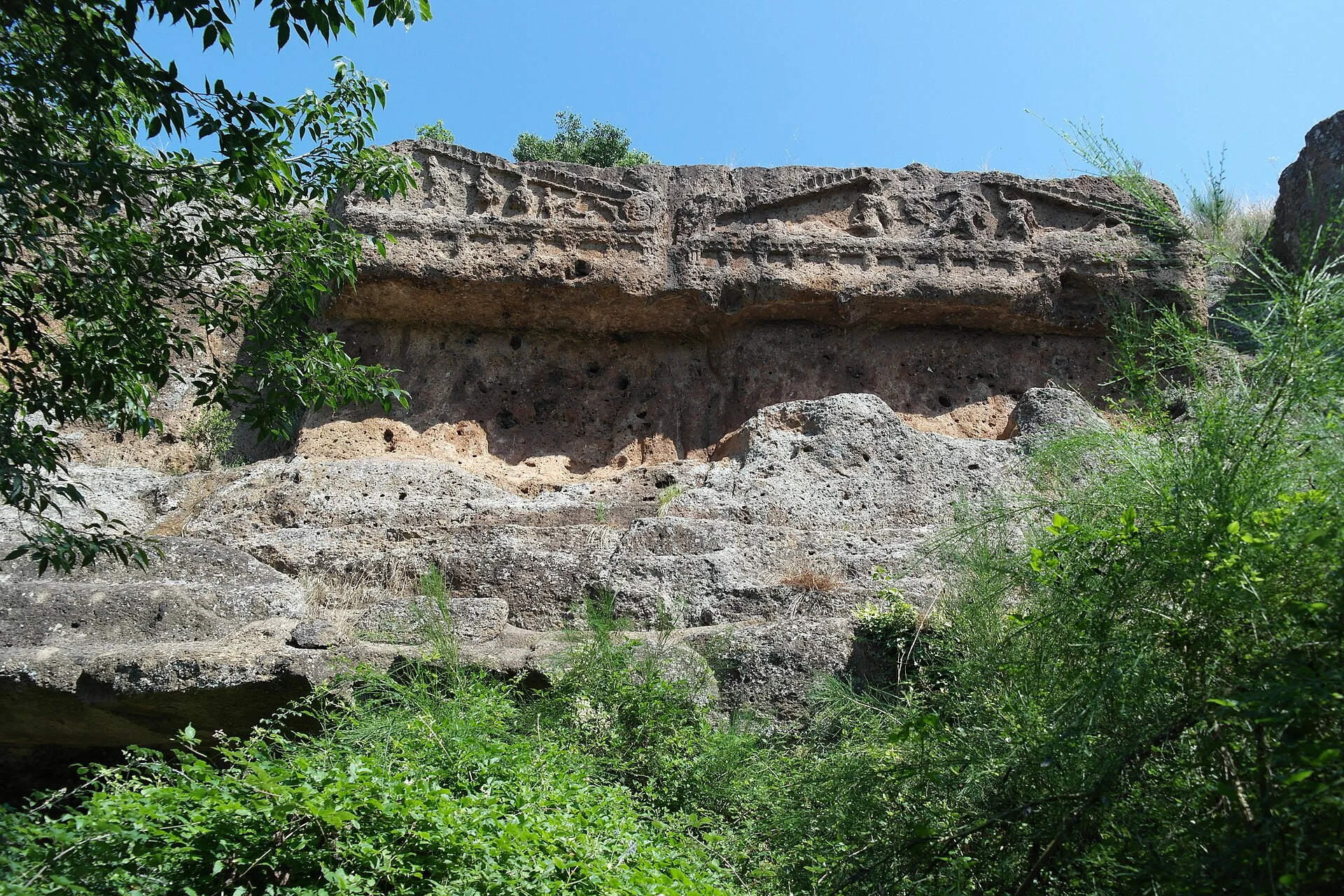
Norchia can be visited freely, on foot, with no ticket and no hours, but in practice you reach it only by car and you walk in a gorge where the path is dirt and the streams have to be forded. It is an Etruscan rock-cut necropolis in the territory of Vetralla, in the province of Viterbo, dug into the tuff walls of three valleys. There is no ticket office, no bathroom, no café. This needs to be known before leaving.
The difference from Cerveteri and Tarquinia is sharp and it is best to say it right away. There you enter a fenced area, with guards, signs, clean paths and a museum a few minutes away. Here you leave the car in an unpaved clearing and go down a mule track into a wooded valley, where the tomb facades emerge from the rock above your head. Whoever expects the Banditaccia necropolis or the painted tombs of the Monterozzi of Tarquinia is left wrong-footed.
Data checked as of September 28, 2026 against the institutional sources cited in the text. The access conditions of a site without permanent staff change with the seasons, with the vegetation and with restoration work sites. Before getting in the car it is best to check again.
What Norchia is and where exactly it is
Norchia occupies a tuff plateau at the confluence of two streams, the Pile and the Acqualta, which then flow into the Biedano. The necropolises develop on the sides of the valleys carved by these three watercourses, on superimposed terraces. The area affected by the tombs exceeds 20 hectares according to the Pro Loco of Vetralla, and some count much more by including the settlement and the marginal areas.
The official road indication from the Ministry of Culture is dry: S.S. 1 Aurelia bis, between Vetralla and Monte Romano, municipality of Vetralla (VT). There is no street number, because there is no building. The practical reference on site is the locality of Cinelli, a hamlet of Vetralla, from which the secondary road that leads to the parking clearing starts.
The ancient name is not established. The entry in the Enciclopedia dell’Arte Antica on Treccani hypothesizes a connection with Nyrtia and with the Etruscan goddess Nortia, and derives the medieval place name from Orcus, attested in documents as Orda and then Horchia. Other popularizing reconstructions propose instead Orclae. The sources diverge and neither hypothesis is demonstrated.
The three necropolises, in order of encounter
Coming down from the parking area you meet first the necropolis of the Pile, the richest in cube tombs and portico tombs. From there, continuing to the right and fording the stream, you reach the Acqualta, where the two so-called temple tombs are found. The Biedano, divided into a north sector and a south sector, is the largest and the least trodden, and includes the zone of the Lattanzi tomb.
The dominant type is the cube: a cubic block carved out of the wall, with the facade imitating a house, a false door in the center and the real chamber dug beneath, reachable from a corridor or from a side stair. Treccani speaks of several hundred rock-cut tombs arranged on terraced levels, with an organization that recalls that of Blera and Sovana.
The chronology of the Etruscan settlement is concentrated between the 4th and the 2nd century BC, in the orbit of Tarquinia, along the route of Via Clodia. Norchia was never a large autonomous city on the model of Tarquinia or Cerveteri. It was a strong center, well positioned on a road, with a local ruling class that had monumental tombs built for itself.
A curiosity about Norchia
The cube tombs of Norchia have a door that does not open. The false door sculpted in the center of the facade leads nowhere. It is solid, carved in the tuff, and serves to represent the entrance of the dead person's house. The real access to the burial chamber is elsewhere, often low down or on the side, and in many cases today it is buried or hidden by brambles.
Whoever arrives without knowing it spends half an hour trying to understand how to get in. The answer is that in most cases you don't get in at all, because the chambers are full of earth that has fallen over the centuries. The facade, that one yes, is the work. It was made to be seen from below, from the valley floor, by those who traveled the road.
A second detail that almost nobody notices concerns the workmanship. The walls of the gorge were regularized with blows of the punch before the tombs were carved into them, and in some stretches you can still see the tool marks on the rock, long and parallel. It is not natural erosion. It is an Etruscan building site, left there.
How to visit today, and the contradiction between the sources
Access to the area is free and without charge, with no ticket and no booking, according to the information sheet of the Pro Loco of Vetralla and according to the local hiking literature. There are no opening and closing hours because there is no manned gate. You enter by a path that starts from the parking clearing.
The information sheet of the Ministry of Culture says something else, however. Under hours it reports the necropolis as currently closed every day of the week, and under booking it reports that it is not required. The two indications, read together, are contradictory even within the same page.
The most probable explanation is that the hours field of the ministry database was never filled in for a site without staff, and that the default value shows up as closure. The fact remains that an institutional source writes closed. Whoever wants to go on a sure thing writes to the competent Soprintendenza before leaving, and puts it in writing.
Who manages Norchia and whom to write to
Protection falls to the Soprintendenza Archeologia, Belle Arti e Paesaggio for the province of Viterbo and for southern Etruria. On the institutional site the Viterbo office is listed at Piazza della Rocca 21b, telephone 345 5806583, and the Rome office at Via Cavalletti 2, telephone 06 67233002. The email address is sabap-vt-em@cultura.gov.it, the certified email sabap-vt-em@pec.cultura.gov.it.
There is no toll-free number dedicated to Norchia, no booking portal, no office on site. Whoever reads somewhere a telephone number of the necropolis is reading an invented datum or the contact of a private operator who sells excursions. Paid guided visits exist, organized by associations and licensed guides of the Tuscia, but they are not the official service of the site.
Signage on site exists and is of two types. Road signs of approach, information boards of the Soprintendenza at the entrance of the area, wooden signs along the internal route. The path coincides in part with CAI 105. Maintenance is not constant: the same Pro Loco notes that the paths are often muddy and that in some stretches the vegetation covers the minor tombs to the point of making them hard to spot.
One thing nobody tells you about Norchia
A substantial part of the necropolis is not visitable, and not for archaeological reasons. The monumental area of the Lattanzi tomb falls inside the Monte Romano military range, therefore inside a training area of the Army. You don't enter it walking, you don't enter it with a permit requested by email the day before, and you don't enter it following a track found online.
Another sector, in the locality of Guado di Sferracavallo, falls on private property and is visited only with the agreement of whoever owns the land. This too does not appear in the enthusiastic accounts that circulate. The practical result is that the free visitor sees the Pile, the Acqualta, a good part of the Biedano and the medieval settlement, and does not see some of the most cited things.
The thing can be turned around, and it is the reason it is worth keeping an eye on the announcements of the Soprintendenza. When the Army and the Soprintendenza organize the special openings, you enter the range in an accompanied group, free, and you see the excavation site. There are few dates a year, communicated with little notice, and they sell out fast.
How to get to Norchia
You get there by car, and for most people this is the only real option. I say it plainly because the criterion by which I think about outings is that you go and come back in a day. With public transport Norchia cannot be done in a day, unless you accept a taxi or a ride for the last stretch.
From Vetralla you take the S.S. 1 Aurelia bis toward Monte Romano and after about eight and a half kilometers you turn right, toward the locality of Cinelli, then following the secondary road to the parking clearing. The distances given by local sources vary, from about six kilometers after the junction to some 15 kilometers in total from Vetralla, because the starting point and the route chosen change. From Tarquinia the turn comes on the left after Monte Romano.
The parking clearing is unpaved and unguarded. Don't leave anything in view inside the car, because nobody passes for hours. In case of heavy rain the ground becomes heavy and with a low small car it is best to stop earlier and walk a few hundred meters more.
The train is there, but it doesn't arrive
Vetralla has a station on the Rome, Capranica, Viterbo railway line, served by the regional trains of Trenitalia with Roman termini at Ostiense and Tiburtina. On weekdays the frequency is roughly hourly in the off-peak bands, on weekends it thins out. So far so good.
The problem starts afterward. From the station of Vetralla to the necropolis there remain several kilometers of state road and then secondary road, without sidewalks and without a bus line serving the archaeological area. There is no shuttle, there is no stop in front of the site. Walking along the Aurelia bis is not a reasonable option.
Whoever doesn't drive has two workable ways: join an organized excursion that leaves by coach or in shared cars, or rent a car for the day and string Norchia together with other things in the area. The second solution is the best for small groups, because the Tuscia without a car forces painful choices.
The advice I give you for visiting Norchia
Download the GPS track before leaving and keep it on the phone in offline mode. Phone coverage inside the gorge is weak or absent, the internal signage is discontinuous and in late spring tall grass covers the forks. With the track you walk serenely, without it you lose an hour looking for the right ford and end up seeing half of what you came to see.
The second thing is the arrival time. Leave early and count on at least three hours on site, better four if you also want to reach the medieval settlement. In the gorge the sun comes in late and leaves early: in winter at four in the afternoon you are already walking in full shade and the wet ground becomes truly slippery.
Third thing: bring water for everyone. There is no fountain, no kiosk, nobody to ask. Two liters a head in summer is not excessive. A headlamp is useful for looking inside the chambers and in the stretches of sunken road, where darkness arrives even at noon.
Who to go with and who not to go with
Norchia works well with a group of adults able to walk two or three hours on uneven ground, and works badly with those who move with difficulty. There is no accessible route, no ramps, no level stretch equipped from which to see anything significant. Whoever has walking problems sees the plateau and little else.
With children it can be done, from seven or eight years old up, if they are used to walking. The appeal of the thing, for them, is that it is a place where you really go down into the rock. It should be kept in mind that there are drops, terraces without parapets and fords: you need eyes on them and it is not a stroller walk.
Large groups do better to split in two, because on a narrow path 20 people in a line become unmanageable and whoever walks at the back hears nothing. The gorge has a strange acoustic, it booms and at the same time absorbs: if you talk as 25, half don't understand a word.
The cube tombs and the two temple tombs
The cube tomb is the signature of the inland rock-cut Etruria and at Norchia they are counted in the hundreds. The model is always the same: a parallelepiped isolated on three sides from the wall, with molded cornices, a false door in the center and sometimes a stairway that climbs onto the roof, where the rite was performed. The same forms are found at Blera, at Barbarano Romano and throughout the Biedano valley.
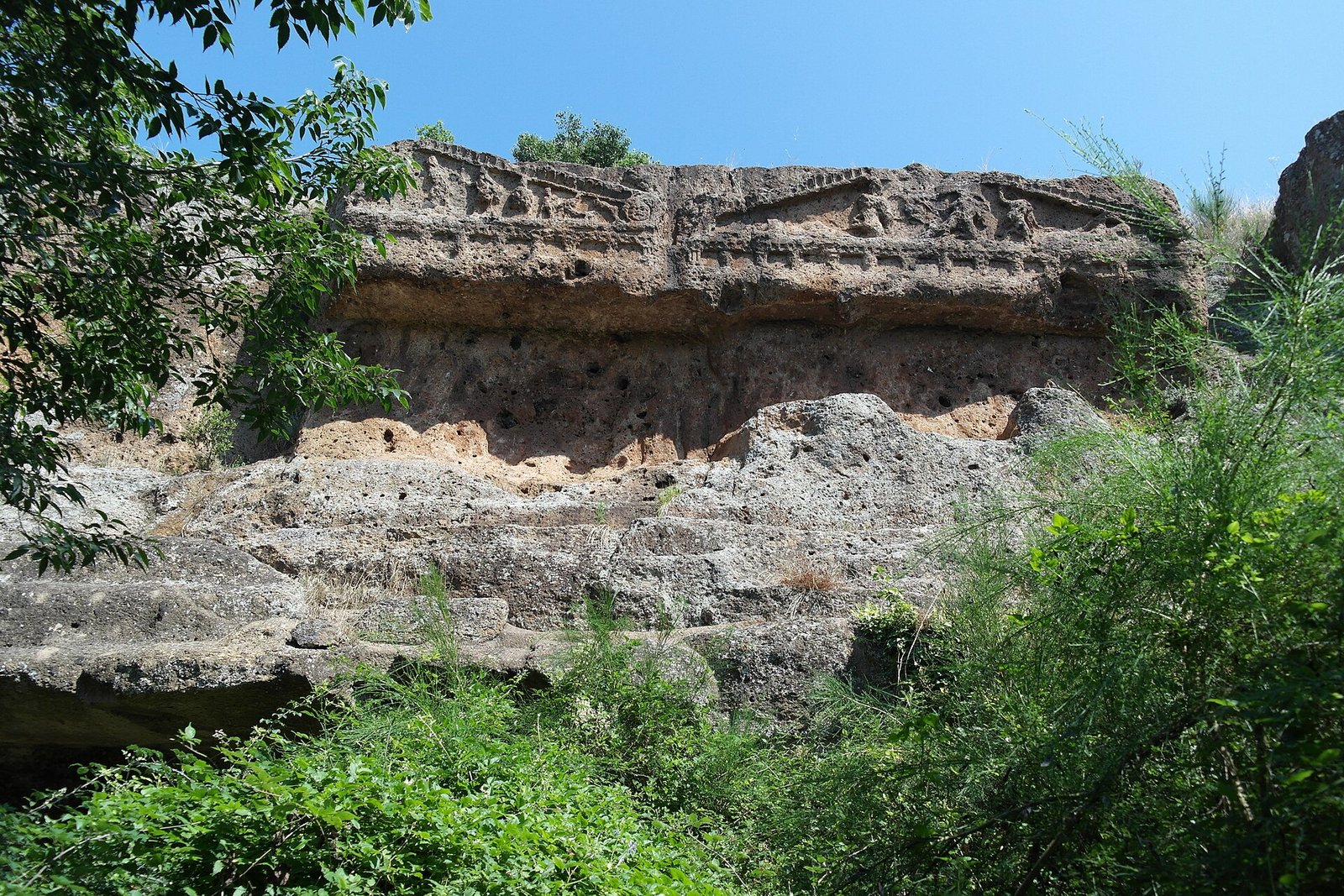
The two so-called temple tombs are instead in the valley of the Acqualta stream and are the reason Norchia appears in every manual of Etruscan architecture. The Art Bonus sheet of the Ministry describes them as a reproduction of Greek temple facades of the distyle in antis type, made in two phases: the first between the end of the 4th and the beginning of the 3rd century BC, the second between the middle and the end of the 3rd.
In the first phase the two porticoes were distinct, with false colonnades and human protomes in the spaces of the metopes. In the second phase the porticoes were unified and a relief frieze with magistrates and hanging weapons was added, surmounted by a pediment with Gorgon heads at the volutes. This is the official description, not a fanciful reconstruction.
What you really see today
Honesty is needed here. The same ministry sheet writes that the site occupied by the tombs is partly covered by thick vegetation, that the reliefs of the frieze are almost illegible and that the higher reliefs of the pediment remain readable but heavily eroded. Algae, mosses and lichens attack the tuff. The conservative restoration project includes mechanical cleaning, biocide treatment, filling of the fractures, consolidation and a protective covering.
The estimated cost of the intervention is a million and a half euros, with an open fundraising in favor of the Soprintendenza of Viterbo. The amount raised indicated in the sheet refers to a survey years old and should not be taken as a current figure. Whoever wants the updated number reads it on the project page.
Translated for whoever goes there: expect two great architectural backdrops carved into the wall, with the layout perfectly readable and the decoration reduced to shadows. The first impression remains strong because it is the scale that impresses, not the detail. Whoever arrives hoping to read the procession of magistrates as on a museum sarcophagus comes back disappointed.
The other tombs that are always cited
The tomb of the Three Heads takes its name from the divine protomes sculpted on the facade. The Prostyle tomb owes its name to the portico with columns on the front. The Smurinas tombs, which bear the name of the family, have L-shaped porticoes. In the Biedano sector the tomb of the 40 funerary beds is cited, so called for the number of burials carved in the chamber.
All these names are of scholarly and 19th-century origin or of local tradition, and do not always correspond to a certain attribution. Some facades today are covered by brambles for months of the year and reappear after cleaning operations. The comparison between a photo from 10 years ago and the current situation, in certain spots, is merciless.
The comparison I hear made most often is with Sovana, in the Maremma, where the Ildebranda tomb and the Pola tomb are found. The total number of Doric temple tombs in Etruria changes from source to source, between two and three, depending on which monuments are accepted in the category. When you read a flat number, know that behind it is a classification choice, not a closed census.
Another well-known fact, yet rarely cited
Under Norchia runs Via Clodia, and it runs inside the rock. The artificial cut known as Cava Buia is about 400 meters long and up to 10 deep, carved in the tuff to bring the road down into the valley with a slope sustainable for carts. You walk inside it, between two vertical walls, and the sound of your steps changes.
The sunken road is the reason Norchia exists in that form. The monumental facades look at the road, not at the landscape: they were signs, family messages aimed at those passing through. Whoever visits the necropolis without taking the road into account does not understand the logic of the layout and mistakes it for a scenic cemetery.
The sunken roads of the Tuscia are dozens and many are still walkable. Here the added interest is that the stretch is datable and readable, with the traces of the roadway and the cuts that regularize the walls. The fact that it is little cited depends on the fact that it does not make a good frontal photo, and what circulates online is what photographs well.
The Lattanzi tomb, the excavation and the special openings
The Lattanzi tomb is a monumental sepulchre with a portico on a podium, with two superimposed orders of columns and Italic-Corinthian capitals. The dating oscillates among the sources: Treccani places it in the 3rd century BC, the Soprintendenza of Viterbo defines it as Hellenistic, end of the 4th century BC. The divergence is real and concerns the building phase taken as reference.
Since 2022 the area has been the object of an excavation concession entrusted to an international team directed by Professor Vincent Jolivet, of the CNRS and the École Normale Supérieure in Paris. Some local sources attribute the campaign to the University of Paris 1 Panthéon Sorbonne. The indication of the Soprintendenza is the one I report above, and it is the source to prefer. The same group had previously excavated the nearby Grotte Scalina tomb.
The tomb is inside the Monte Romano military range. Access happens only on the occasion of special openings agreed between the Soprintendenza and the Army, in an accompanied group. There were openings in the summer of 2023, a public visit in July 2024 and four free visits between August and the early days of September 2026, tied to the presentation of the results of excavation, restoration and securing.
Booking opens with the announcement and the channel changes from time to time. There is no fixed address to write to in order to enter the range whenever you like. Whoever cares about it periodically checks the news on the site of the Soprintendenza in the months of June and July, when the calendars come out.
From the recent excavations also comes an Etruscan red-figure stamnos attributed to Marce Atie, recovered intact and then displayed at the Museo Nazionale Romano and subsequently at the archaeological museum of Tarquinia. Whoever wants to see excavation materials from the Tuscia in a museum, besides, has in Rome the National Etruscan Museum of Villa Giulia and the Museum of Etruscan and Italic Antiquities.
The right photo to take at Norchia
The right photo is taken from the valley floor, looking up, with the cube tombs stacked on the wall and a piece of sky above. It is the perspective for which those facades were built: whoever passed on the road saw them like this, from below, superimposed like the windows of a palace. From the upper terrace, instead, you photograph a tuff wall and nothing else.
The best time is mid-morning in spring and autumn, when the light enters obliquely in the gorge and detaches the cornices from the shadows. At midday in summer the wall goes into flat light and the moldings disappear. Late afternoon works only on the west-facing slopes, and they are few.
For the temple tombs of the Acqualta you need a fairly wide lens and a camera position set back, which the vegetation often denies. If you find a clean gap, photograph it right away: two months later it may be closed by brambles. A detail photo of the pediment requires a telephoto and raking light, because the relief is eroded and in frontal light it cannot be read.
One tip: also take a bad but useful photo, that is the path with people in it. It serves to give back the scale of the place, which in close-up photos is lost completely. Without a human figure beside it, a cube tomb of Norchia looks a meter and a half tall.
The medieval settlement, San Pietro and the castle
On the plateau above the necropolises are the remains of a medieval settlement, and many visitors miss them because they stay down below. The site was refortified in the 12th century, in a context tied to the pontificate of Adrian IV, and in the 13th it passed to the Prefetti di Vico, the family that dominated a good part of the Tuscia. Of the castle there remain ruins and the readable perimeter.
The church of San Pietro is the most recognizable building, above all for the apse. It has a Romanesque layout and the Pro Loco traces its origins back to the 9th century. Part of the local popularization claims it stands on a previous Etruscan-Roman temple. The news circulates a lot, but it does not appear confirmed by a weighty archaeological source, so I report it as tradition and not as datum.
On the date of abandonment too the sources diverge. One reconstruction ties the end to 1435, with the destruction of the castle. Another speaks of 1453 and of a serious malaria epidemic. Treccani limits itself to saying that the abandonment in the medieval age was due to the progress of malaria, without fixing a year. The three versions are not necessarily incompatible, because military destruction and depopulation by disease can be successive.
Why it ended this way
The damp valley floor, the stagnant streams and the progressive abandonment of the reclamation works made the area unhealthy, and what had been a road junction became a place to leave. The population moved toward the centers on the dry plateaus, starting with Vetralla. The plateau of Norchia stayed empty and the scrub took everything back.
The same story can be read in other ghost villages of Lazio, with different times and causes. Whoever has developed a taste for this kind of place can string together Monterano with its nature reserve, the abandoned village of Chia and, in a version anything but abandoned but on the edge of the cliff, Civita di Bagnoregio.
A note that concerns the present and not the past: 40 years of agricultural abandonment have damaged the monuments more than 25 centuries of time, according to those who have documented the site for years. Roots that split the tuff, vegetation that holds moisture, paths that disappear. The problem of Norchia today is not mass tourism. It is the opposite.
Some important events that happened here in history
Between the 4th and 3rd century BC the center knows its monumental season: the great facades are carved, the temple tombs of the Acqualta are built in two successive phases, the necropolis is organized on terraces. It is the moment when a local elite, within the orbit of Tarquinia, decides to make itself visible along the road.
With Romanization Via Clodia becomes stable infrastructure and the cut of the Cava Buia takes the form seen today. The center does not disappear, it shrinks. The tombs stop being built and the valley becomes above all a passage, as it will be for centuries.
In the 12th century the site is refortified and again counts as a control point of the territory. In the 13th century the castle passes to the Prefetti di Vico. In the 15th century the story closes: destruction of the castle in 1435 according to the most widespread reconstruction, definitive abandonment by the middle of the century, with malaria indicated as the determining cause.
The rediscovery and the present time
In the 19th century Norchia enters European archaeological literature and becomes a stop on the learned journey in Etruria. In the 20th century it remains, however, to use the words of the encyclopedia entry, a site never the object of systematic study, despite the antiquarian interest that had invested it.
Since 2022 an excavation campaign with a three-year concession has restarted on the area of the Lattanzi tomb, inside the military range, with ministry funding for excavation, restoration and securing. In August 2026 the first results are presented to the public during the special openings.
In parallel the Art Bonus fundraising remains open for the conservative restoration of the temple tombs, with a project of a million and a half euros in favor of the Soprintendenza of Viterbo. The issue, for once, is not the lack of a project. It is the distance between the project and the money needed to carry it out.
Who passed through Norchia
George Dennis devoted a chapter to Norchia in The Cities and Cemeteries of Etruria, published in London in 1848 in two volumes. The book can be consulted in a digitized edition on the portal of the Universitätsbibliothek Heidelberg and it is the reason the site entered the circuit of the cultured travelers of the 19th century.
The comparison with Petra, which today is read everywhere in headlines, was born precisely from that season of travel literature. The 19th-century authors likened the facades carved into the wall to the Nabataean ones, and the formula has passed unscathed through 170 years of popularization. It is a comparison that serves to sell, not to understand: the two architectures have nothing in common except the fact of being carved in the rock.
In the present the recurring name is that of Vincent Jolivet, who directs the campaign at the Lattanzi tomb on behalf of the CNRS and the École Normale Supérieure of Paris, after having worked for years at the nearby Grotte Scalina. Alongside him pass every summer Italian and foreign students and postgraduates, who are then the people you meet on the path if you happen to be there in the right period.
There also passes, and it is right to say so, a local volunteer group that cuts brambles with gardening tools in the months of February and March. Without that work, most of the minor facades would be invisible for half the year. It is not a folkloric detail. It is the practical reason a March visit pays off more than a June visit.
Shoes, season and equipment: how to prepare
Hiking shoes with a lugged sole, not sneakers. The ground alternates packed earth, smooth rock, muddy stretches and fords. Wet tuff rock is treacherous because it seems rough and instead slips, and the terraces have no parapet. Whoever arrives with the wrong shoes gives up halfway, and it happens more than once.
Long pants, always. The brambles along the path are generous and in summer the ticks in the tall grass are not a theoretical hypothesis. Add water in quantity, a headlamp, a hat in the warm season and a change of socks if the fords are high after the rains.
The right seasons are spring and autumn. In spring the vegetation is already green but not yet invasive and the streams have low water. In autumn, after the first rains, the wood is clean and the light is good. Summer is hard because of the heat and the tall grass that covers the paths. Winter works on dry days, with short days and heavy ground after rain.
After rain, postpone
The ford of the Acqualta in normal conditions is crossed with a few centimeters of water. After two days of continuous rain the flow changes, the stepping stones disappear and the crossing becomes a pointless risk. The rule I apply is simple: if it rained hard in the previous 48 hours, you move the outing.
Whoever goes anyway must count on giving up part of the route, because from the Pile to the Acqualta you pass only that way. Same-day alternatives in the same area are not lacking: Tuscania with its churches, the Tuscania nature reserve, or the museum in Rome if you are already on the way back.
A practical signal to tell if the day is good: look at the level of the Biedano from the approach bridge before parking. If the water is turbid and fast, the ford downstream will be worse, not better. You don't need a stream gauge, you need an honest glance.
The contrarian position: Norchia is not the place to start from
A thesis circulates about Norchia that I consider wrong: that it is better than Cerveteri and Tarquinia because it is wild, free and without tourists. Whoever sustains it confuses the quality of the experience with the quality of the understanding. A site without readable panels, without a museum, without a guaranteed route and with half the monuments covered by brambles is a marvelous place for whoever already knows, and a mute place for whoever doesn't.
Whoever is on a first visit to the Etruscan world should start from the painted tombs of the Monterozzi and the museum of Tarquinia, or from the streets of tumuli of Cerveteri. There you learn what a burial chamber is, how bodies were laid, what they put inside. Then you come to Norchia and the facades begin to speak, because you have in your head the reverse side of the architecture.
The second part of the contrarian position is that the comparison with Petra does harm. It raises expectations about a scale and a state of conservation that are not here, and prepares disappointment. Norchia should be told for what it is: a provincial Etruscan funerary architecture, of very high design level, eroded, incomplete and difficult. Said that way it disappoints nobody.
Last thing, and it counts as a flat opinion. The real added value of Norchia is not the two temple tombs, which are the most photographed and the most ruined. It is the rows of cube tombs of the Pile seen from below, which nobody photographs because they don't look good in a square thumbnail. Those are the ones that stay in your head.
Eating in the area
Inside the archaeological area you eat and drink nothing that you didn't bring yourself. There is no kiosk, no vending machine, no drinking fountain. The sandwich has to be prepared beforehand and the trash has to be carried back, because there are no bins and what is left there stays for years. For sitting there are stones and logs, no tables.
For the real meal you go down to the villages around, and here the usual rules apply. The menu with photographs of the dishes displayed at the entrance says that the place speaks to those who don't understand the language and will never come back. Where you eat well the menu is a written list, often short and often changed by hand. The photographs serve those who have to point with a finger.
The lady rolling out the pasta sheet in the window or directly on the sidewalk is a scenic lure, not a clue to a kitchen. It works very well as street theater and in some cases the pasta is even good, but the gesture in the window exists to stop you, not to inform you. Judging a place by that scene is like judging a hotel by the doorman's uniform.
The person at the entrance who invites you to sit down is the clearest signal of all. A place that has customers sends nobody into the street to collect them. If you have to be persuaded to go in, the reason is that the chairs are empty, and empty chairs at lunch in a village of the Tuscia almost always have an explanation.
Be wary of the place open continuously from morning to night without a kitchen break. A real kitchen stops, because the cook cleans, reorganizes and starts again. The continuous opening serves to intercept the flow at any hour, and to sustain that rhythm you work with ready preparations to reheat. It is a service model, not a cooking model.
At high-traffic points, in front of the most visited monuments, you find the other trap: the price that adapts to the customer. The signals are items unpriced on the board, fish or meat by weight without clear indication, different price lists between the indoor room and the tables outside, the cover charge that appears only on the receipt. Ask the price before ordering and ask it out loud: whoever works honestly answers right away.
On the repeated signs you meet in the center of Rome and in the tourist towns of Lazio the position is without snobbery. Those places work as tourist attractions: they guarantee a product identical to itself, long hours and no surprises, and for those traveling with tired children it is a real service. Simply, Romans don't go there, and the reason is that a few meters away you eat better spending the same.
The only criterion is this: look at who is sitting and what language they order in. If at the long tables there are local families, workers at lunch, people greeting the owner by name, you are in the right place. If there are only backpacks, paper guidebooks and orders in English, the price is made by the position and not by the cooking. It works in Rome, it works in Vetralla, it works everywhere.
The places I really go to and keep updating I hold in a public list on Google Maps, so whoever wants can carry it on the phone without depending on rankings: Daniele's list. It is not a ranking and it is not sponsored, they are addresses I go back to.
One last practical note about the area. In the villages of the Tuscia lunch ends early and the kitchen often stops around half past two, while in the evening in low season many places take a midweek rest day. Leaving Norchia at three in the afternoon with accumulated hunger, the concrete risk is to find everything closed: phone ahead or bring your lunch.
Norchia as a day trip from Rome, and what to pair it with
From Rome it is about 80 kilometers as the crow flies, with real travel time depending on the traffic leaving the city more than on the distance. Leaving at half past seven you are at the parking area around half past nine, you walk until one, you have lunch in the village and in the afternoon there is time left for a second stop. The day holds up well, without rushing.
The most logical pairing is with another rock-cut site, for direct comparison. Blera and Barbarano Romano are a short distance away and show the same types in more compact contexts and easier to walk. Whoever wants to close the circle in a museum key adds Tarquinia, which however by itself is worth a whole day.
Whoever prefers to break up the archaeology with something else can go down toward Tuscania, go up to Viterbo for the medieval quarter, or aim at the gardens of Villa Lante at Bagnaia and the palace of Caprarola. They are all things that fit with Norchia in one afternoon, provided you are not already worn out by the walk.
If you are traveling with children or with people who are out of shape
The combination that works best is Norchia in the morning, short, stopping at the Pile without pushing on to the fords, and in the afternoon something comfortable. The amphitheater and the necropolis of Sutri are visited in a little over an hour on an easy route, and the town is walked on foot. The Park of Monsters at Bomarzo is the other winning card with kids.
Whoever wants to end with water has several options within half an hour or a little more: the Picchio waterfall near Nepi, the Diosilla waterfalls in the Monterano reserve, Lake Vico for a flat walk along the shore.
For those who want to end in hot water, the free hot springs of the Carletti pools at the gates of Viterbo are the classic ending of a day in the Tuscia after a walk in the mud. Bring flip-flops and a towel, because it is free and equipped it is not.
Other things of the Tuscia that go well in the same trip
Whoever comes back to the area several times sooner or later also strings together Montefiascone above Lake Bolsena, Marta on the opposite shore, Soriano nel Cimino, Ronciglione and Civita Castellana. They are real towns, not stage sets, and they are visited in two hours each.
On the naturalistic and geological side the area offers the solfatara of Nepi, the beech wood of Oriolo Romano, the Mola park, the Monte Casoli reserve and the Treja valley park with Calcata.
Toward the sea, at a distance compatible with the same day, there are the Bagni di Sant’Agostino and the Tarquinia salt pans, while in the Tolfa mountains there remain Tolfa and Allumiere. Whoever wants only the festival and not the archaeology should keep an eye out in September for the Macchina di Santa Rosa.
A reminder on costs: at Norchia you pay nothing, but the museums and state parks of the area have a ticket. On the first Sunday of the month entry to the state archaeological parks is free, and whoever organizes the day can use it by putting Norchia in the morning and a ticketed site in the afternoon. The updated conditions can be read on the page Sunday at the Museum.
Frequently asked questions
Do you pay to enter Norchia?
Entry to the archaeological area of Norchia appears to be free and without charge, with no ticket office and no booking, according to local sources and the Pro Loco of Vetralla. The information sheet of the Ministry of Culture however reports the necropolis as closed every day, probably because the hours field was not filled in. The two indications diverge: whoever wants certainty writes to the Soprintendenza of Viterbo before leaving.
Are there opening and closing hours?
Real opening hours do not exist, because the site has no permanent staff or manned gate. Daylight rules: you enter when you can see and leave before dark, which inside the gorge comes much earlier than on the plateau. In winter this means leaving by four in the afternoon.
Can you get to Norchia by public transport?
You cannot reach the necropolis by public transport. The station of Vetralla on the Rome, Capranica, Viterbo line is served by regional trains, but it is several kilometers from the archaeological area and no bus line serves the site. The last stretch is a secondary road without sidewalks. In practice you need a car, your own or rented, or an organized excursion.
How long does it take to visit Norchia?
For a visit that includes the necropolis of the Pile, the temple tombs of the Acqualta and a part of the Biedano you need at least three hours of actual walking. Adding the climb to the medieval settlement and the church of San Pietro it comes comfortably to four or five hours. Whoever has only an hour and a half should stop at the Pile and not attempt the fords.
What shoes do you need and what season is best?
You need hiking shoes with a lugged sole and long pants, plus water, a headlamp and a GPS track downloaded offline. The best seasons are spring and autumn. Summer is penalized by the heat and the tall grass that covers the paths, winter works only on dry days. After two days of heavy rain it is best to postpone, because the fords become problematic.
Can you visit the Lattanzi tomb?
The Lattanzi tomb is inside the Monte Romano military range and is not freely accessible. You enter only during the special openings agreed between the Soprintendenza and the Army, in an accompanied group and by booking. There were openings in the summer of 2023, in July 2024 and four free visits between August and the early days of September 2026. The dates are announced on the Soprintendenza site.
How many temple tombs are there and what state are they in?
The so-called temple tombs at Norchia are two and are in the valley of the Acqualta stream. The Art Bonus sheet of the Ministry describes them as reproductions of Greek temple facades of the distyle in antis type, made in two phases between the end of the 4th and the end of the 3rd century BC. Their conservation is problematic: almost illegible frieze reliefs, eroded pediment, thick vegetation and biological attack on the tuff.
Is Norchia suitable for children and for people who walk with difficulty?
For children used to walking, roughly from seven years up, the visit works well and has a strong adventurous appeal. Drops, terraces without parapets and fords must however be considered, so constant supervision. For those with mobility difficulties the site is not suitable: there are no accessible routes, ramps or equipped stretches, and the ground is uneven everywhere.
Are there bathrooms, a café or an information point on site?
Restrooms, cafés, refreshment points and information points do not exist inside the area. The parking is an unpaved, unguarded clearing. The only equipment is the information boards of the Soprintendenza and the wooden signs along the route, whose maintenance is not constant. Everything you need, water included, has to be brought from home.
Who wrote this page
The page is edited by the editorial team of Tour Leader Pro, the Roman outfit that designs, prepares and coordinates visits, itineraries and cultural events across Rome, Lazio and southern Etruria. The access conditions, contacts and dates reported here come from the official sources cited in the text as of the date of publication. For a site without permanent staff they change often: before leaving, one more check does no harm. If you find an outdated datum, report it.
Building a day outside Rome on a site with no ticket office, no published hours, with a part of the area inside a military zone and another on private property, with paths whose passability depends on the previous week's rains, is a job done at the desk before leaving. Whoever accompanies groups or organizes on their own will find at Tour Leader Pro planning materials designed exactly for these cases, where ordinary tourist information stops.
For the overall picture on regional trains, car rentals, airports and destinations in Lazio beyond the center of Rome, from the Tuscia to the lakes to the Tyrrhenian coast, a useful resource is Italy Planner, which reasons on real travel and not on straight-line distances.