Monterozzi Necropolis of Tarquinia
In short. The Monterozzi Necropolis is the place where you can see the most important ancient painting of the western Mediterranean, and almost nobody in Rome goes there.
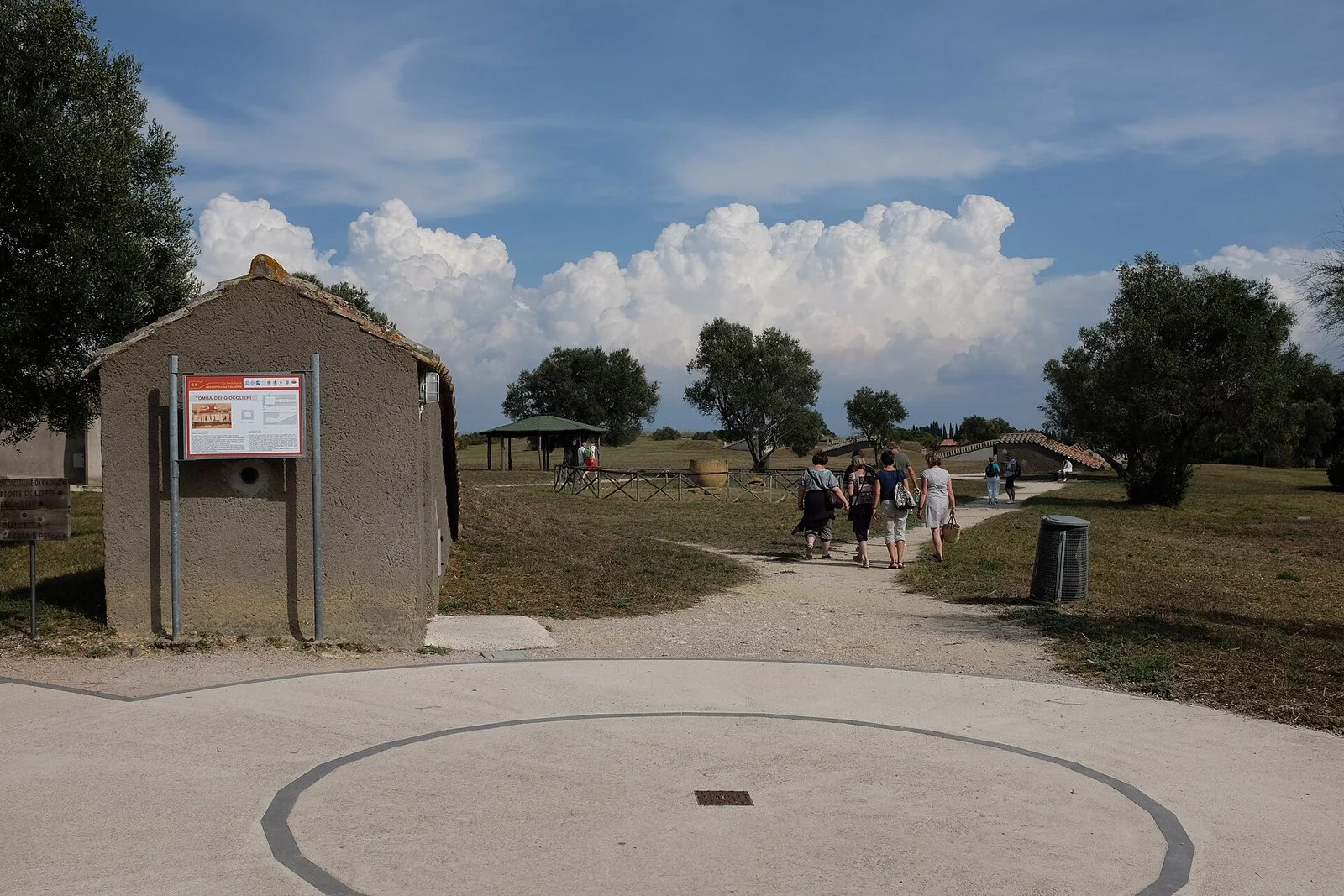
The Monterozzi Necropolis is the place where you can see the most important ancient painting of the western Mediterranean, and almost nobody in Rome goes there. It occupies the hill that runs parallel to the coast behind Tarquinia, 90 kilometers north of the capital, and preserves more than 6,000 tombs cut into the rock, about 200 of them painted. The section open to the public today lets you go down into 22 decorated chambers, one at a time, five people at a time, looking through a glass panel. Together with the Banditaccia Necropolis of Cerveteri it has been on the UNESCO World Heritage List since 2004. This page lines up what you actually see, what you don't see, how much it costs, how to get there without a car and why some of the tombs you find in books remain closed.
Where the Monterozzi Necropolis is and what it really is
The address is Via Ripagretta, 01016 Tarquinia, in the province of Viterbo. The Monterozzi hill runs for about 6 kilometers parallel to the Tyrrhenian coast, between the sea and the Civita plateau where the Etruscan city stood. The Archaeological Park of Cerveteri and Tarquinia, the state body that manages the site, indicates this location in the site's official page, and the Municipality of Tarquinia confirms it on its page about the sights.
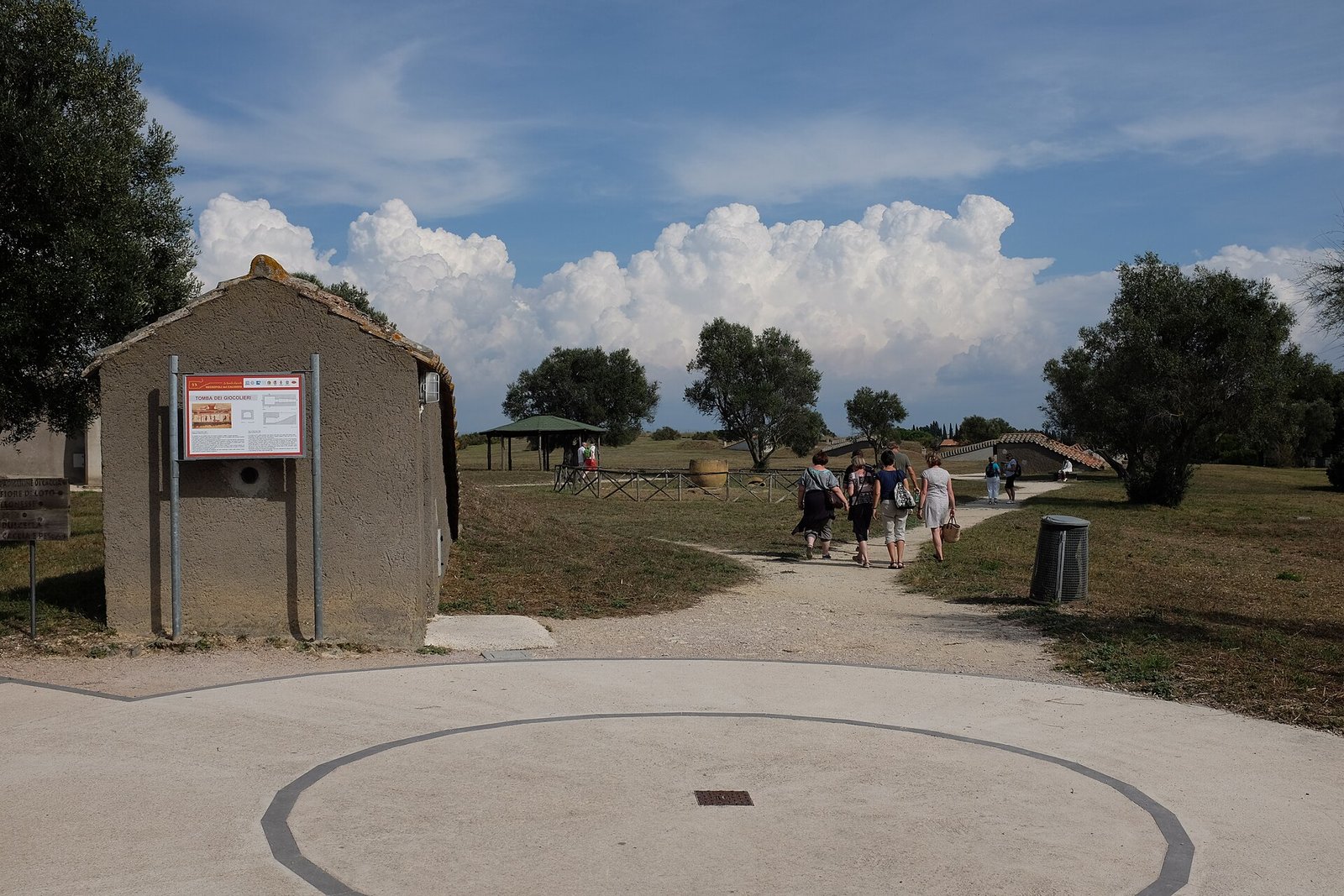
The popular name comes from the mounds. Each burial chamber was covered by a heap of earth, and a century ago more than 600 of them were counted on the hill: farm work has leveled almost all of them, so that today the ground looks like a slightly undulating meadow. Anyone who arrives expecting a landscape of artificial hills is thrown off. The Monterozzi necropolis is seen underground, not on the surface.
The city of the living and the city of the dead
Etruscan Tarquinia, Tarchuna, stood on the Civita plateau, on the other side of the valley from the Monterozzi, and its monumental area included the temple known as the Ara della Regina, the one the Winged Horses now in the museum come from. The Etruscans buried outside the settlement, on a separate rise, and that is why today the archaeological site and the modern town are two distinct things with 2.5 kilometers of road in between.
The numbers, and where they come from
The numbers circulate in different versions and it helps to know which source says what. The page of the Archaeological Park of Cerveteri and Tarquinia speaks of more than 6,000 known tombs and about 200 painted tombs. The site's UNESCO page, available on the World Heritage Centre portal, indicates 6,000 burials cut into the rock and about 200 painted tombs, with the oldest dating to the 7th century BC. The Soprintendenza responsible for Viterbo and southern Etruria specifies that the painted chambers are about three percent of the total and that many of those known in the 1800s no longer have a certain location, because they were closed up again after being discovered.
The figures to repeat, then, are three and should be kept separate. 6,000 tombs recorded, about 200 painted, 22 visitable on the ordinary route. The third is the one that concerns whoever buys the ticket, and it is the only one that changes from one year to the next. The figure of 22 hypogea is the one published by the Archaeological Park on its site page and repeated by the Municipality of Tarquinia: it is a snapshot of the situation on the date we write, not a constant.
The 2004 UNESCO listing and what it includes
The listing dates to 2004 and concerns a single site titled Etruscan Necropolises of Cerveteri and Tarquinia. They are not two twin sites listed separately: they are two components of a single property, and this explains why the two necropolises are always named together even by those who visit only one of the two. The recognized criteria are the first, the third and the fourth of the World Heritage Convention.
Criterion one, that of a masterpiece of human creative genius, applies above all to the paintings of the Monterozzi. Criterion three recognizes the unique testimony of a vanished civilization, the only urban-type civilization of pre-Roman Italy. Criterion four concerns the funerary architectural types preserved at the Banditaccia, which reproduce forms of dwelling lost elsewhere. The reasons are published on the World Heritage Centre website and in Italian on the UNESCO portal of the Ministry of Culture.
How to get to the Monterozzi Necropolis from Rome
The real question is not how to get to Tarquinia, which is easy, but how to get to the necropolis without a car, which is the part almost all guides gloss over. There are three steps to solve and not just one: Rome, then the Tarquinia station, then the historic center, then the archaeological site. Between the last useful train and the last entry to the necropolis there are narrow margins, especially in winter.
By train to Tarquinia
The Tarquinia station is on the Tirrenica railway, the line that goes from Rome up toward Civitavecchia, Grosseto and Pisa. Regional and fast regional trains headed north stop there, as well as some long-distance trains. Travel times from Roma Termini are around an hour and 20 minutes for regional trains, with lower times on the fast connections. Not all regional trains leaving Rome continue beyond Civitavecchia: check the final destination before boarding, because the suburban line toward Civitavecchia and the long Tirrenica line share the tracks but not the terminus.
From the station to the historic center
This is the point the typical client underestimates. The Tarquinia station is not in town: it is about three kilometers from the historic center and about as far from the seaside hamlet of Lido. The Pro Loco of Tarquinia states explicitly that the station is about three kilometers from the built-up area and is connected by city buses. The city service exists, is run by a local operator and has different winter and summer timetables, set on the school calendar: anyone arriving on a Sunday or in August should check the runs the same day, because the frequency drops.
From the historic center to the necropolis
From the main gate of the historic center to the entrance of the necropolis on Via Ripagretta it is a little over two kilometers, which on foot is worth 25 or 30 minutes on a paved road, partly without shade. The route is simple and signposted, but in summer, with the 11 o'clock sun, it becomes tiring. The Archaeological Park's regulations explicitly recommend comfortable shoes and a hat in the hot season, and it is not a figure of speech.
By car
From Rome you take the A12 motorway toward Civitavecchia. The Civitavecchia-Tarquinia stretch opened in March 2016 and noticeably shortened the trip, which before ended on the Aurelia with mixed traffic. The total distance is about 90 kilometers and the real time, outside rush hours, is around an hour and a quarter. On summer weekends the exit junction from Rome toward the coast gets congested and the count goes up.
Those coming from Viterbo use the Orte-Civitavecchia expressway with the Monte Romano est exit and then the Aurelia bis, for about 45 kilometers, or go through Tuscania on slower and more beautiful provincial roads. Those landing in Civitavecchia from the ferry or a cruise ship have about a quarter of an hour of road. Those landing at Fiumicino have about an hour: for the full picture of airport connections we have a dedicated page on the airports of Rome.
Hours, tickets and seasonality
The closing day is Monday, for all four sites of the Archaeological Park. There is no ambiguity on this and it applies to both the necropolises and the two museums. Anyone planning a Monday outing finds the gates shut in Tarquinia as in Cerveteri.
The necropolis hours change three times a year
The Archaeological Park publishes a three-band seasonal calendar for the necropolises. In the long season, from March 29 to October 12, 2026, opening is from 09:00 to 19:30 with last entry at 18:30. From October 13 to 24, 2026 it switches to 09:00 to 18:30 with last entry at 17:30. From October 25, 2026 to March 27, 2027 the winter schedule applies, 09:00 to 17:00 with last entry at 16:00. The data are published on the Archaeological Park's hours and rates page and should be rechecked before leaving.
The museums have a different and longer schedule, 09:00 to 19:30 all year with last entry at 18:30. The difference matters for those arriving in the afternoon in winter: in December the necropolis closes entries at 16:00, the museum at 18:30. A winter visit that leaves Rome after lunch manages to see the museum and does not manage to see the tombs.
The ticket is single, and not bought separately
This is the question we get most often and the official answer is clear. The Archaeological Park does not sell a ticket for the necropolis alone or one for the museum alone: it sells a cumulative site ticket, which includes the museum and necropolis of the same town, at a cost of €13, valid for up to 30 days from the date of issue. Anyone who wants to see only the tombs pays €13 anyway and takes home a museum entry that can be used on another day within the month.
There is then the Circuito PACT ticket at €21, valid four months, which covers all four sites of the Park: necropolis and museum of Tarquinia plus necropolis and museum of Cerveteri. With four months of validity it is the sensible solution for those who want to spread the two visits over two different weekends, which is what we recommend. There are also an annual pass at €30 and one for residents of the two municipalities at €20.
Free entry, discounts and surcharges
Minors under 18 enter free. European Union citizens between 18 and 25 pay €2. Other free entries follow the general rules of the Ministry of Culture. Every first Sunday of the month admission is free in state museums and archaeological parks, and the Cerveteri and Tarquinia Park is part of the initiative: our page on the free Sundays in state museums explains how it works and which days count, and the one on state museums frames the system.
Weather alerts
The Park warns that on weather alert days the archaeological areas may stay closed as a precaution: these are open-air sites, with trees and paths on natural ground, and closure for wind or heavy rain really happens. The phone number of the Monterozzi necropolis, published by the Park, is 0766 856308.
A curiosity about the Monterozzi Necropolis
A large part of the painted tombs of the Monterozzi was not found by digging, but by looking into the ground without opening it. Between the 1950s and the 1970s the Lerici Foundation, founded in 1946 on the initiative of the engineer Carlo Maurilio Lerici and linked to the Politecnico di Milano, applied to archaeology the geophysical prospecting methods used to look for mineral deposits. Magnetometry, electrical resistivity, seismics: tools designed for industry, brought to an Etruscan hill.
The probe that took photographs in the dark
The decisive step was a photographic probe patented by the laboratory, which was lowered into a hole a few centimeters wide drilled in the vault of a buried chamber and took 360-degree photographs of the interior. The system made it possible to know whether a tomb was painted before excavating it, and therefore to decide where to invest a real excavation. The Foundation registered its instruments among the photographic and television probes for the non-invasive exploration of buried cavities, and the method was then copied across half the world.
Why this changes the reading of the site
The practical result is that the catalog of the painted tombs of Tarquinia swelled rapidly from the late 1950s, so much so that scholars had to rewrite the chronology of Etruscan painting. The Soprintendenza notes that the Lerici Foundation's surveys identified in the subsoil of the Monterozzi more than 1,000 burial chambers, and that on about 50 of them traces of painted decoration were recognized. That figure explains why the number of known painted tombs is higher than the number of visible ones: many were opened, documented and closed up again.
How you really visit: stairs, glass panels, five people at a time
A visit to the Monterozzi is nothing like a museum visit. You walk on a meadow crossed by paths, you arrive in front of a low structure of concrete and glass that protects the mouth of a tomb, you go down a covered staircase, you look in through a glass panel. Then you come back up and start again. 22 times, if you do them all.
The dromos and the descent
The chambers are reached through a long dromos, the sloping corridor the Etruscans dug to reach the burial. Today the dromos is equipped with a staircase and in many cases covered by a modern structure. The descent is several steps, often steep, and has to be done again uphill on the way out. Multiplied by 20 tombs, this is the reason you end the visit far more tired than you would expect from a flat meadow.
The thermal-break doors
At the bottom of the staircase you do not enter the chamber. Between the visitor and the paintings there is a transparent thermal-break door, that is, a double-pane window with an insulating gap, which the Archaeological Park describes as the tool that allows viewing of the paintings while keeping the thermal and hygrometric parameters of the hypogeum constant. Translated: you look from behind a glass, always, and no ordinary visitor sets foot inside the painted chambers.
The reason is banal and final. Every human body that enters a closed underground space brings heat, water vapor and carbon dioxide. In a chamber cut into limestone rock, with walls plastered with lime and paintings two and a half millennia old, the variation in temperature and relative humidity triggers cycles of condensation and salt crystallization that detach the color from the support. The glass panel separates two climates and keeps them apart.
Five at a time
The Park's public entry regulation, published in 2023 and valid for the Banditaccia and for the Monterozzi, sets an explicit limit: for the safety of the places and the people, access to each tomb is allowed to a maximum of five visitors at the same time. The limit concerns the space at the bottom of the stairs, small and with no alternative escape routes. With a school group ahead of you, the wait can reach 10 minutes.
Something nobody tells you about the Monterozzi Necropolis
The most famous tombs of Tarquinia, the ones in every art history textbook, are in large part not part of the ordinary route. The Tomb of the Bulls, the oldest with complex figurative decoration, the Tomb of the Augurs, the Tomb of the Baron, the Tomb of Orcus with its infernal Nekyia, the Tomb of the Shields: none of these appears in the list of the 22 chambers open to the public published by the Archaeological Park.
How do you see them, then
They are seen on occasions of special openings with a guided visit and mandatory booking, organized by the Park on specific days. On the European Heritage Days of September 26 and 27, 2026, for example, the Park scheduled guided visits at fixed times to the Tomb of the Shields on Saturday and to the Tomb of Orcus on Sunday, plus afternoon visits to the tombs of the Bulls, the Baron and the Augurs on both days. The Park specifies that places are limited, that booking must be done by email and that some of those tombs, outside the main enclosure, can be reached only with your own vehicle.
The practical consequence
Anyone who arrives at the Monterozzi on any given Tuesday with the images of the Tomb of Orcus in mind will see something else: magnificent tombs, but not those. Anyone who cares about a specific chamber must write to the Park in advance and build the visit around a special opening date, not the other way around.
Why they don't open them all
There are three reasons. Conservation: some chambers have paintings too delicate for a continuous flow. Logistics: several tombs are scattered on the hill outside the fenced area, among private land, with no access that can be supervised. Staff: every open tomb requires supervision, and the Park manages four sites across two municipalities.
The tombs you can see today
The list published by the Archaeological Park on the site's official page includes 22 hypogea. They are, in alphabetical order as the Park lists them: Baccanti, Bartoccini, Caccia al Cervo, Caccia e Pesca, Padiglione di Caccia, Cardarelli, Caronti, Claudio Bettini, Demoni Azzurri, Due Tetti, Fiore di Loto, Fiorellini, Fustigazione, Giocolieri, Gorgoneion, Guerriero, Leonesse, Leopardi, Mauro Cristofani, Massimo Pallottino, Mario Moretti, Pulcella.
The three that alone justify the trip
The Tomb of the Leopards, datable to around 470 to 460 BC and discovered in 1875, has two facing leopards on the pediment and below a banquet scene with reclining couples, servants, and players of the aulos and the lyre. The ceiling is a checkerboard of reds, blacks, yellows and blues. It is the tomb that best explains, in 30 seconds, how a painted chamber in Tarquinia worked: figured frieze on the walls, geometric motif on the gabled ceiling.
The Tomb of Hunting and Fishing, discovered in 1873 and dated between 530 and 500 BC with variations among scholars, is the most important of the 22 and probably the most important of all pre-Roman painting. On the walls of the inner chamber the landscape takes over from the figures: sea, rocks, birds, dolphins, boats, a diver in flight toward the water. The reduction of the human figure to a small element inside a large natural setting has no known precedent in either Greece or Etruria, and it is the reason this chamber appears in every history of ancient painting.
The Tomb of the Blue Demons was discovered in 1985 and belongs to the second half of the 5th century BC. The subject marks a break: demons of the underworld with blue and black skin appear, with snakes, in a funerary imagery that until then Tarquinia did not have. It is the tomb that shows the moment when the Etruscan afterlife stops being a banquet and becomes a place of fear.
Temporary closures are the norm
Between June 2025 and March 2026 the Park kept the site open with limitations on the route, because of works under the National Recovery and Resilience Plan on accessibility and energy efficiency. About 13 tombs stayed closed on a rotating basis, among them the Leopards and the Funeral Bed, and on March 19, 2026 the Park announced the reopening of most of the hypogea of the Calvario sector. It normally works like this: one construction site at a time. Check the notices before leaving.
The painting technique and why it is so fragile
The rock of the Monterozzi is a soft limestone, the macco, which can be dug with simple tools and has a porous and irregular surface. The first painted tombs, in the 7th and 6th centuries BC, receive the color almost directly on the stone, with minimal preparation. Only later does true plaster arrive.
The plaster layer
With the arrival of craftsmen of East Greek training, around the middle of the 6th century, a thin preparation layer appears, one to three millimeters thick, spread on the wall to receive the color. On top goes a lime wash, on which the preparatory drawing is incised and the pigments are applied while the lime is still fresh. In the 4th century the stratigraphy is articulated into three layers, with a base of pozzolanic tuff, a layer of sand and lime and a finish of carbonated lime.
What ruins them
The main enemy is water, in all its forms. The seepage water that comes down from the farmland above the chambers carries dissolved salts with it: when it evaporates on the painted surface the salts crystallize and lift the paint layer. The condensation that forms when warm, humid air enters a cold space does the same work, faster. Molds and bacteria colonize the damp plasters. Light, over the long term, alters the organic pigments.
The combination of insulating glass, timed lighting and entry limited to five people answers this list of problems one by one. It is not a symbolic precaution: it is the reason painted chambers open to the public still exist, while other necropolises have had to close entirely or replace the originals with copies.
My advice for visiting the Monterozzi Necropolis
Don't do the necropolis and the museum in the same handful of hours. The cumulative site ticket is valid 30 days and the circuit ticket four months: the validity is long on purpose, and those who use it see twice as much. The necropolis demands two full hours of stairs and waiting in front of glass panels, the museum demands another two and requires fresh attention. Added together in a single day, the second half turns into a parade past display cases without looking at them.
The right order
If you have to squeeze everything into one day, start with the necropolis early in the morning, when the light is low and the groups haven't arrived yet, and keep the museum for the afternoon, which has longer hours all year. The reverse order works badly: leaving the museum at four in the afternoon in December means finding the necropolis ticket office already closed.
Another well-known fact, yet rarely cited
The painted tombs are about three percent of the total. Out of 6,000 recorded burials, 200 have painted decoration. This figure, which the Soprintendenza highlights, says something precise about the Etruscan society of Tarquinia: funerary painting was not a widespread custom, it was a privilege of a small number of aristocratic families, and what we see is not the life of the Etruscans but the representation that a ruling class gave of itself.
Why the difference matters
Every time you read that the tombs of Tarquinia tell of the daily life of the Etruscans you are taking a shortcut. They tell of the banquets, hunts, games and funerals of a few dozen rich families over five centuries. The rest of the population of Tarquinia, the great majority, lies in the other 5,800 tombs, the ones without color, and of those lives we know very little.
The duration of the phenomenon
The other little-cited fact is the duration. The Archaeological Park notes that in Tarquinia the practice of painting tombs is documented from the 7th to the 2nd century BC, that is, for almost the whole life of the city. In other Etruscan centers funerary painting appears in fits and starts. Here it is a continuous tradition of 500 years, and this very continuity makes it possible to follow the evolution of style and of ideas about the afterlife as in no other place in the Mediterranean.
Cerveteri and Tarquinia: why the two necropolises are not the same thing
The two components of the UNESCO site are always named together and this creates the idea that they are interchangeable. They are not at all, and those who visit only one choose between two very different experiences. The simplest distinction is this: at Cerveteri you look at the architecture, at Tarquinia you look at the painting.
What you see at the Banditaccia
The Banditaccia Necropolis of Cerveteri is a city of the dead built with streets, crossings, blocks and houses. The great earth mounds on tuff drums are standing and you walk through them. Inside, the chambers reproduce the interiors of Etruscan homes, with beds cut into the rock, false beams on the ceiling, chairs, columns and, in the famous Tomb of the Reliefs, household utensils modeled in stucco on the walls. UNESCO recognizes Cerveteri for the criterion of funerary architectural types that no longer exist elsewhere.
What you see at the Monterozzi
At the Monterozzi the mounds have been leveled and the chambers are for the most part of simple plan, a rectangular room with a gabled roof meant for a couple. The architecture is not the point. The point is the painted walls, and to see them you go down and look from behind a glass without going in. The area is vast, 130 hectares, and the route is a series of separate descents divided by stretches of meadow.
Anyone who wants to understand what the Etruscans thought about death, how they dressed, how they feasted, what music they played and when they began to fear the afterlife goes to Tarquinia. Massimo Pallottino, the greatest Italian Etruscologist of the 1900s, defined these paintings as the first chapter of the history of Italian painting, and the Archaeological Park takes up the phrase on its site page.
If you have to choose one
With small children choose Cerveteri: you walk outdoors, you go into the tombs, you touch, there is no discipline of glass panels and lines. With an interest in art history choose Tarquinia, which has no comparison. With a car and a whole weekend do both with the €21 Circuito ticket, which lasts four months: the two towns are about 40 kilometers apart on the Aurelia and link up well, maybe with a stop at the Cerveteri waterfalls or at the Palo castle in Ladispoli.
The third point of comparison
The National Etruscan Museum of Villa Giulia, in Rome, holds the materials that make the two necropolises legible. Whoever stops by Villa Giulia before leaving arrives on site with the right categories. For the minor objects there is also the Museum of Etruscan and Italic Antiquities of Sapienza.
The National Archaeological Museum of Tarquinia and the Winged Horses
The museum occupies Palazzo Vitelleschi, in Piazza Cavour, inside the walls of the historic center. The building was constructed between 1436 and 1439 at the behest of Cardinal Giovanni Vitelleschi and is one of the most important monuments of the early Renaissance in Lazio. The museum institution dates to 1916 and the museum opened to the public in the spring of 1924, which means that in 2024 it turned 100 years old.
What it contains
The route gathers two 19th-century collections, the Municipal Collection and the private one of the Bruschi Falgari counts, plus the materials from the excavations in the ancient settlement and in the necropolises. It covers from the Iron Age to the Roman era. On the ground floor is the sarcophagus of the Priest, Parian marble of Greek manufacture with the chest painted by a local artist, which held the remains of Laris, founder of the Partunu family.
The Winged Horses
The Winged Horses are a terracotta slab decorated in high relief with a pair of winged horses pawing in the act of taking flight. They were placed at the end of one of the great beams of the pediment of the Ara della Regina temple, on the Civita plateau, in its 4th-century BC phase. They are the symbol of the city and the absolute masterpiece of Etruscan coroplastic art, that is, of terracotta sculpture.
Anyone who has seen many Etruscan architectural terracottas at Villa Giulia recognizes the difference at once: here the modeling has a muscular tension and a rendering of movement that have no comparison. The slab is displayed in a dedicated room and deserves a long stop, not the two-minute pass-through it usually gets. It should be looked at thinking that it was mounted high up, backlit against the sky, on the pediment of a temple.
The painted tombs inside the museum
The rooms host the reconstruction of some funerary contexts, among them the chamber tomb of the Versna and four painted tombs detached from the walls in the 1950s and 1960s and reassembled in the museum. Among these is the Tomb of the Triclinium, decorated at the beginning of the 5th century BC by a Greek artist active in Tarquinia, which is one of the most famous chambers of the site and which in the necropolis you do not see because its paintings are here.
This explains an absence that otherwise seems inexplicable. Anyone looking for the Triclinium in the list of the 22 open tombs does not find it, and the reason is not a temporary closure: the walls were torn off 70 years ago and taken indoors. Detachment was at the time the technical answer to deterioration. Today the preference is to conserve in place, and that is why nobody detaches anything anymore.
The current exhibition
From July 10 to November 15, 2026 Palazzo Vitelleschi hosts the exhibition In viaggio nel Regno delle Ombre, devoted to the masterpieces of Etruscan painting between Tarquinia and Orvieto, with the detached paintings of the tombs of the Chariots, the Triclinium, the Funeral Bed, the Olympics, the Ship, the Black Sow and the Bruschi Tomb, plus the two Golini tombs from Orvieto. Those who go to Tarquinia in this window pay a €2 surcharge and see gathered material that is normally scattered. The exhibition calendar changes: check the Park's website.
The right photo to take at the Monterozzi Necropolis
The photo everyone tries to take, and that almost always comes out badly, is the one of the painted wall through the glass panel. The glass reflects, the interior light is warm and timed, the space in front is narrow. The result is an image with your reflection over the dancers. It is fixed by bringing the lens close to the glass without touching it and shielding with your body the source of the reflection behind you.
What the regulation says
Photographic and video shooting is allowed for private use. It is forbidden to bring in professional-type optical and audio equipment, so no tripods, no microphones, no work cameras, and for any shooting for professional or commercial purposes a formal authorization is required, to be requested from the Park's administration. Drones are forbidden without authorization. The tripod, which would be the obvious technical solution in a dark environment, cannot be used.
The photo that works best
The photograph that really delivers, and that almost nobody takes, is the one on the surface: the Monterozzi meadow with the small low buildings that cover the access to the tombs, lined up on the green, with the hill sloping toward the sea. They tell the site better than a blurry fresco detail. Take it backlit in the late afternoon in summer, when the sun sets toward the Tyrrhenian and the structures stand out.
Some important events that took place here in history
The necropolis does not have a history of events in the sense that a square does. It has a history of discoveries, and the discoveries have changed several times what we know about the Etruscans. It is worth lining them up because each corresponds to a turning point in the studies.
The 1800s of the excavations
During the 1800s the great tombs enter the catalog one after another. The Tomb of the Baron is found in 1827. The Tomb of Hunting and Fishing in 1873. The Tomb of the Leopards in 1875. These are the years in which Etruscan painting becomes a chapter of European art history and in which the descriptive names we still use today are assigned in the field, based on what could be seen on the newly discovered wall.
The geophysical revolution
From 1958 on the surveys of the Lerici Foundation produce such a harvest of new painted tombs as to force a revision of the chronology and the interpretations. It is the moment when Italian archaeology moves from sample-based research to systematic reconnaissance of the subsoil. In the 1970s the same Foundation identifies on the Calvario the traces of a Villanovan settlement, with at least 25 huts: the hill, before being a necropolis, had been a place of life.
2004 and 2024
In 2004 comes the UNESCO listing together with Cerveteri. In 2024 the Palazzo Vitelleschi museum turns 100 years since its opening to the public, an anniversary also celebrated with an ordinary-mail stamp of the Italian Republic. Between 2025 and 2026 the Archaeological Park carried out on the two sites a construction project funded by the National Recovery and Resilience Plan for accessibility and energy efficiency, with partial closures on a rotating basis.
Who has passed through the Monterozzi Necropolis
The list of people tied to this hill is made almost only of scholars, and this already says a lot about the kind of place. No sovereigns on visits have come through here. A discipline was formed here.
Massimo Pallottino
The greatest Italian Etruscologist of the 1900s is the figure who tied his name most to Tarquinia. His is the definition of Tarquinian painting as the first chapter of the history of Italian painting, which the Archaeological Park reports on the site's official page. One of the 22 visitable tombs bears his name, as happens with chambers discovered in recent years and dedicated to those who studied them.
Carlo Maurilio Lerici
The Milanese engineer who brought industrial geophysics into archaeology is the other decisive name. The Foundation he established in 1946 and that operated for decades between the Politecnico di Milano and a Roman office changed the way tombs are searched for, and the Monterozzi hill was its main testing ground. Without those probes, half of the painted tombs we know would still be underground.
Giovanni Vitelleschi
The cardinal who had the palace that now hosts the museum built between 1436 and 1439 is the only non-archaeological figure on this list, and he is the man who made available, five centuries earlier, the right container. Palazzo Vitelleschi is a high-quality building of the early Renaissance in Lazio, and the fact that the Winged Horses are displayed in there instead of in a modern shed is part of the pleasure of the visit.
When to go, and how it fits with the sea
The shoulder seasons are the best: April, May, late September and October give bearable temperatures on the uncovered meadow and fewer organized groups. In winter the site is almost empty and the raking light of January on the hill is the most beautiful of the year, but the last entry at 16:00 forces you to build the trip around the morning train. Monday is always closed, and the first Sundays of the month are free and therefore crowded.
In summer it's best to enter at opening, at nine, and leave by one. The afternoon is long, the schedule runs to 19:30 and the last hour is the best for the light on the surface, but the heat accumulated on the limestone makes the climbs up the stairs unpleasant. Those who combine the necropolis with the sea find a few kilometers away the Lido di Tarquinia, the Tarquinia salt pans with their nature oasis and the Bagni di Sant'Agostino. To the south, on the same coast, are Santa Marinella and the Santa Severa castle.
Accessibility: what can be done and what cannot
The route on the surface is on meadow and paths, with modest elevation changes but natural ground. The tombs, all of them, are reached by going down a staircase inside the dromos. There are no painted chambers reachable without steps. This is the starting fact and it must be said plainly to anyone who uses a wheelchair or has reduced mobility.
What to ask beforehand
The Archaeological Park has a section dedicated to the plan for removing architectural barriers, and the National Recovery and Resilience Plan works carried out between 2025 and 2026 had among their stated goals precisely improving accessibility. The situation may therefore have changed from what is described here: it is best to phone the necropolis number, 0766 856308, and ask specifically which structures are reachable today. For the general picture on the city we have a page on accessible Rome.
With children
The Monterozzi work with middle and high school kids, who have the tools to understand what they are looking at, and work less well under eight years old. The mechanism of the visit, going down 20 stairs to look through a glass without being able to enter, tests the patience of little ones, and the limit of five per chamber forces waiting turns.
The right-sized alternative
With small children, the Banditaccia of Cerveteri is a much better choice: you really go inside the tombs, you walk in an area shaded by pines, and the idea of the city of the dead with its streets is immediate to explain. The €21 Circuito ticket covers both, so it is not giving anything up. More ideas are on our page on Rome with kids.
What to see around, between Tarquinia and the upper Tuscia
The necropolis takes half a day. The rest of the day is easy to build, because this corner of northern Lazio has a high density of things and a low density of visitors.
The town
The historic center of Tarquinia, which until 1922 was called Corneto, is a walled medieval town with noble towers, Romanesque churches and a long view of the sea from the panoramic promenade. Santa Maria di Castello, off the tourist circuit, is one of the most important Romanesque churches in Lazio. The town can be walked in a couple of hours and still has a life of its own, ordinary shops and squares used by the inhabitants.
The rest of southern Etruria
To the north, on the Aurelia, is Montalto di Castro and a little farther the archaeological park of Vulci, with the Devil's Bridge and the Abbadia castle, which is the third great Etruscan city of the coast. Inland Tuscania preserves two of the most beautiful Romanesque basilicas in Italy and a necropolis of its own, surrounded by the Tuscania nature reserve. Farther in there are Blera with its sunken roads and Roman bridges, and the Selva del Lamone toward the Tuscan border.
Toward Viterbo and the lakes
From Tarquinia you can easily go up to Viterbo, which with the San Pellegrino quarter has the most intact medieval fabric in Lazio and which in September puts the Macchina di Santa Rosa on the street. Farther north you reach Lake Bolsena, to the east is Lake Vico and farther down the area of Sutri with its amphitheater cut into the tuff and of Calcata. Those who love abandoned villages have Celleno and Monterano, and those looking for free hot water find the park of the Mola di Oriolo Romano.
Toward Rome
On the way back you meet Tolfa in the mountains behind the coast, Civitavecchia with the port and the Michelangelo fort, and Cerveteri with the Banditaccia. Those who want to close the circle on the archaeology of Lazio then have Ostia Antica at the mouth of the Tiber and, inside Rome, the Appian Way Park with the Villa of the Quintilii. Tarquinia is also close to the route of Via Francigena in Lazio, which descends from Proceno toward Rome and which many walk in spring.
How to fit it into a trip to Rome
A trip to Tarquinia takes a whole day and makes sense only from the third or fourth day of your stay, when the center of Rome has already been seen. Anyone with 24 hours in the city shouldn't even think about it and should follow instead our itinerary for Rome in one day. Those with three can consider it as an alternative for the third day following three days in Rome. Those with a week should include it without hesitation, as we suggest on the page about a week in Rome. In summer, when the city has the Estate Romana calendar, the out-of-town trip is done by day and you come back for the evening. For the local village festivals we have our page on the sagre and festivals of Lazio.
Eating in Tarquinia: the honest warning
Around the necropolis you don't eat. Via Ripagretta is a country road at the edge of town and the archaeological enclosure has a minimal offer, designed for a bottle of water and not for a lunch. The Park's regulation also forbids consuming food and drinks outside the areas intended for this purpose, so not even a sandwich on the meadow among the mounds is a practicable solution. Anyone who arrives hungry must go back into town or head down to the sea.
The three zones, and how they behave
Tarquinia has three dining areas with different logics. The medieval village inside the walls, where the offer is more rooted and where residents also sit at the tables, especially at lunch on weekdays. The Lido seafront, which works on the beach season and which in July and August changes nature, raising prices and volumes. The strip along the Aurelia and near the junctions, which intercepts passing traffic and should be judged with the same eye used for a highway rest area.
The signs worth recognizing
The same clues apply here as in the center of Rome, with a couple of local variants. The menu with photographs of the dishes remains the first warning bell. The person at the entrance who invites you to sit and intercepts passersby is the second. The lady rolling fresh pasta in the window or on the sidewalk is a scenic lure and not a clue about the kitchen, and in medieval villages this staging has become as common as in the city. The place open without interruption from morning to night, with no break between services, does not have a kitchen crew working on defined shifts.
The tourist-town variant
In the places set at the point of greatest foot traffic, in front of the gates of the walls or overlooking the panoramic promenade, the old story of the price that adapts to the customer turns up: items with no price on the list, quantities decided by eye, different rates between the indoor room and the outside tables. Asking the price before ordering a portion is not rude: it is the normal way to behave, and whoever works well answers without stiffening. At the Lido, in summer, the same dynamic moves to cover charges and beach service.
The chains with repeated signs
In the coastal towns of Lazio and in the most beaten historic centers a kind of restaurant with a repeated sign has spread, with the identical menu in several places and the line managed with a number ticket. It works as a tourist attraction, not as local cooking, and people who live in the place don't go. It's not snobbery: that model sells a standardized and predictable product, which is exactly what someone who doesn't know the place is looking for and what someone who lives there is not.
The one criterion
Look at who is sitting there and in what language they order. If at the tables there are people who speak Italian with a local accent and who order without opening the menu, the place holds up. If there are only customers with a backpack and a camera around the neck, move on. Anyone who wants an already filtered reference can consult Daniele Dezi's personal list on Google Maps, a curated and non-sponsored collection. The full reasoning on how to choose a place without getting ripped off is on our page on where to eat in Rome, and for long-standing shops there is the one on historic cafés and shops.
Frequently asked questions about the Monterozzi Necropolis
How much does a ticket to the Monterozzi Necropolis cost?
The Archaeological Park of Cerveteri and Tarquinia does not sell a ticket for the necropolis alone. The entry ticket is the €13 cumulative site ticket, which includes the necropolis and the National Archaeological Museum of Tarquinia and is valid 30 days from issue. There is also the €21 Circuito ticket, valid four months, which adds the Banditaccia necropolis and the museum of Cerveteri. Minors under 18 enter free.
What are the opening hours of the Monterozzi Necropolis?
It is open from Tuesday to Sunday, closed on Monday. The Archaeological Park publishes three seasonal bands: from March 29 to October 12, 2026 from 09:00 to 19:30 with last entry at 18:30. From October 13 to 24, 2026 from 09:00 to 18:30 with last entry at 17:30. From October 25, 2026 to March 27, 2027 from 09:00 to 17:00 with last entry at 16:00. The museums stay open 09:00 to 19:30 all year.
How many tombs can you visit in Tarquinia?
The Archaeological Park indicates 22 decorated hypogea accessible in the sector currently open to the public, out of about 200 known painted tombs and more than 6,000 recorded burials on the hill. The number of open chambers changes over time because of works, restorations and temporary closures, and between 2025 and 2026 a National Recovery and Resilience Plan construction project closed several on a rotating basis. Check the notices before leaving.
Do you go inside the painted tombs?
On the ordinary route you do not enter the chambers. You go down the dromos equipped with stairs and look at the paintings through transparent thermal-break doors, which keep temperature and humidity constant inside the hypogeum. The Park's regulation allows access to a maximum of five visitors at the same time for each single tomb. The glass barrier is the reason these paintings are still legible.
Can you visit the Tomb of Orcus and the Tomb of the Bulls?
The most famous tombs in the literature, among them Orcus, Bulls, Augurs, Baron and Shields, are not part of the list of the 22 chambers open on the ordinary route. They are seen on occasions of special openings with a guided visit at fixed times and mandatory booking, as happened for the European Heritage Days of September 26 and 27, 2026. Some, being outside the main enclosure, can be reached only with your own vehicle.
How do you get to the Tarquinia necropolis without a car?
The train arrives at the Tarquinia station on the Tirrenica line, in about an hour and 20 minutes from Roma Termini on regional trains. The station is however about three kilometers from the historic center and is connected by city buses with different timetables between winter and summer. From the center to the necropolis entrance on Via Ripagretta there are just under two more kilometers, 25 or 30 minutes on foot on an open road.
What is the difference between the Tarquinia necropolis and the Cerveteri one?
Cerveteri preserves funerary architecture: standing mounds, burial streets, chambers that reproduce the interior of Etruscan houses, and you physically enter them. Tarquinia preserves funerary painting: about 200 painted chambers, the most important core in the Mediterranean, seen from behind a glass panel. They are the two components of the same UNESCO site listed in 2004 and tell two different aspects of the same civilization.
Who wrote this page
The staff that edits this page is that of Tour Leader Pro, a Rome-based project office that designs and coordinates visits, itineraries and cultural events in Rome and Lazio. Rates, hours and access conditions reported here were verified against the institutional sources cited in the text as of the publication date. They change often, especially at sites affected by construction work: recheck them before leaving and let us know what you find different.
Putting together a day outside Rome with seasonal hours in three bands, a ticket that is not bought separately, a station three kilometers from town and an archaeological site two kilometers farther takes a job of fitting pieces together that usually nobody talks about. Those who lead groups or organize on their own will find planning materials designed for this kind of problem at Tour Leader Pro.
For the overall picture on regional trains, rentals, airports and Lazio destinations beyond the ring road, from the Etruscan coast to the lakes to the inner Tuscia, a useful resource is Italy Planner.