Museum of Etruscan and Italic Antiquities
In short. The Museum of Etruscan and Italic Antiquities occupies the ground floor and the basement of the Letters and Philosophy building of Sapienza, inside the University City, Piazzale Aldo Moro 5, in Rome, in the premises of the Department of Sciences of Antiquity.
The Museum of Etruscan and Italic Antiquities occupies the ground floor and the basement of the Letters and Philosophy building of Sapienza, inside the University City, Piazzale Aldo Moro 5, in Rome, in the premises of the Department of Sciences of Antiquity. The exhibition area is about 570 square meters spread over the two levels. Entrance to the collection is free. Guided tours and educational workshops are booked by writing to polomusealesapienza@uniroma1.it and may have a fee. The university lists opening on Monday and Friday from 9:00 to 19:00 and on Wednesday from 16:00 to 19:00, closed on Saturday and Sunday. The time slots follow the academic calendar and change, so a call to 06 49694317 the day before is worth more than any schedule copied from a website, this one included. The museum's email is museo-etruscoitalico@uniroma1.it. You get there by metro line B, Policlinico stop, five minutes on foot. At street level by bus lines 71, 310, 492 and 649 and by trams 3 and 19. From Termini the 310 stops at Università/Regina Elena. A car in this area is a problem, not a solution: the University City has controlled access and the surrounding neighborhood, San Lorenzo included, offers no parking.
This guide is part of the collection dedicated to the museums of Rome, where you'll find the other city collections, state, municipal and university.
What the Museum of Etruscan and Italic Antiquities Is
It's a university museum, and the word university here is not a side adjective: it's the key to everything. The Museum of Etruscan and Italic Antiquities wasn't created to display masterpieces, it was created to teach how to read a civilization. Whoever designed it wanted a first-year Etruscology student to be able to see with their own eyes, in the same afternoon, how a temple was built at Veii, how a dedication was written in Etruscan, what shape a bucchero had, how a necropolis changed between the Orientalizing and Hellenistic periods. To get this, three things were needed: original finds, casts and scale models, explanatory displays. All three are here, mixed in the same cases, and the mixing is deliberate.
The result is a visit different from that of a municipal museum. Here the object isn't put on a pedestal to be admired: it's placed next to a model that explains its function, or next to a cast that allows comparison with a piece kept elsewhere. The visitor who comes in expecting Etruscan gold is thrown off for 10 minutes. Then, if patient, they realize they have in front of them something they won't find anywhere else in Rome: the laboratory in which a scientific discipline learned to tell its own story.
The sections illustrate the main aspects of the cultures of pre-Roman Italy, with particular attention to the Etruscan one: figurative culture, crafts, history and institutions, epigraphy, civil and sacred architecture, urban planning, religion. The holdings rest on two core collections, the Gorga and the Rellini, to which deposits and acquisitions from other institutes were added over time. The museum belongs to the Department of Sciences of Antiquity and is part of the Sapienza Museum Hub, the system that brings together the university's museums.
It's the right place for anyone who has already seen Villa Giulia and left with the feeling of having admired a lot and understood little. Here the opposite happens, and for some it's a revelation.
How the Museum of Etruscan and Italic Antiquities Began: Pallottino and the 1955 Project
In 1955 Massimo Pallottino designed, inside the University of Rome, a university museum devoted to the Etruscan and Italic civilizations, with openly didactic and documentary criteria. The museum was born together with the Institute of Etruscology and Italic Antiquities and was inaugurated in 1962, on the occasion of the 6th International Congress of Prehistoric and Protohistoric Sciences, held in Rome that year. The date isn't a bureaucratic detail: a museum inaugurated for an international congress is a museum conceived from the start as the calling card of a scientific school in front of colleagues from half the world.
Who Massimo Pallottino Was
Massimo Pallottino was born in Rome on November 9, 1909 and died there on February 7, 1995. He graduated in letters in 1931 with a thesis on Tarquinia, under Giulio Quirino Giglioli, and from 1945 to 1980 held the chair of Etruscology at the University of Rome, a teaching post that before him had belonged to Alessandro Della Seta. From 1972 until his death he directed the National Institute of Etruscan and Italic Studies. He excavated at Veii, at Cerveteri, at Capena, at Porto Torres in Sardinia between 1941 and 1942, and from 1957 at the Etruscan sanctuary of Pyrgi, where in 1964 the gold tablets with inscriptions in Etruscan and Punic came to light. He wrote Elementi di lingua etrusca in 1936, Etruscologia in 1942, which remained the reference manual for decades, L'origine degli Etruschi in 1947 and La peinture étrusque in 1952. He was a corresponding member of the Accademia dei Lincei from 1956 and a national member from 1967. He received the Balzan Prize in 1982 and the Erasmus Prize in 1984.
A man like that could afford to buy important pieces for his museum. He chose another path: he had models built. Anyone who knows the history of scholarship knows how rare it is for a scholar of that weight to invest time and money in teaching tools instead of showcase purchases. That's why the Museum of Etruscan and Italic Antiquities is worth a visit even just as a document of twentieth-century Italian cultural history.
The Two Museums Already in the Same Building
The new museum was to sit alongside two that were already active in the Letters building. The first is the Museum of Plaster Casts, now called the Museum of Classical Art, founded by Emanuel Löwy, appointed professor of History of Ancient Art in 1889-1890, who worked to create a collection of casts on the model of European university cast galleries. The first core, enlarged by Löwy until 1915, was set up in premises on Via Luca della Robbia in Testaccio. In 1924 the collection moved to the Istituto San Michele, which proved insufficient. With the construction of the University City it found a permanent home in the basement rooms of the building intended for the Faculty of Letters and Philosophy, designed by Gaetano Rapisardi, and the display in the new location was set up in the summer of 1935.
The second is the Museum of Origins, founded in 1942 by Ugo Rellini, full professor of Paletnology at the University of Rome, starting from an initial core of collections donated by Rellini himself and later grown through the research of the Institute of Paletnology, exchanges with other museums and deposits from the Superintendencies. It covers a span from the Paleolithic to the early Iron Age, with materials mostly from central-southern and island Italy. Keep this name in mind, Rellini: it comes back shortly, because one of the two founding collections of the Etruscan museum bears his surname.
Three archaeological museums in a single building, with three different and complementary functions: casts for the history of ancient art, prehistory for the origins, the Etruscans and Italics for the pre-Roman world. Whoever designed this system had a course of study in mind, and today's visitor can retrace it in one morning without leaving the front door.
The 1975 Flood and the Decade the Museum of Etruscan and Italic Antiquities Stayed Closed
In 1975 museum activity was abruptly interrupted by the flooding of the rooms on the basement floor. The forced closure lasted more than a decade. A museum that loses 10 years doesn't lose only visitors: it loses continuity of care, it loses the staff who knew where everything was, it loses the thread of collaborations. And in this case it lost pieces too.
The original materials on display came in large part from a deposit of the Museum of Origins. Once the museum closed, the deposits were returned to their owner. So far this is ordinary administration. What happened next is the part that should give pause to anyone discussing security in Italian museums.
The Theft of June 1985
Part of those returned finds was lost in the theft committed against the Museum of Origins in June 1985. Put more bluntly: objects that had been safe inside a museum closed by a flood were taken back to a site from which, soon after, they disappeared. It isn't a picturesque anecdote, it's the official history of this museum, and the university tells it without embellishment.
Anyone visiting the basement today is therefore walking through a collection that carries a scar. There are no signs saying so, no empty cases in memory of something. Simply, part of the material that should have told the story of pre-Roman Italy in these rooms no longer exists, or exists in a private home whose address nobody knows. When I later talk about the exhibition devoted to Caere and to recoveries, keep in mind that the museum that hosted that reflection on illicit trafficking in antiquities is a museum that has suffered illicit trafficking itself.
The Reopening and the New Displays
The reopening of the premises came in 1988, with new acquisitions that enriched the section devoted to worship and sanctuaries thanks to material from the exhibition Progetto Etruschi, Santuari d'Etruria, staged by the municipality of Arezzo in the spring of 1985 as part of what was then called the Year of the Etruscans. The new display designed to showcase the exhibition project and give the whole the thematic structure still seen today dates to 1997: the reopening of the premises and the rethinking of the route are two distinct moments of the same decade-long work of reconstruction.
A further increase in the collections of original materials came from the acquisition, in 1993, of the core of ceramics granted on deposit by the Museum of Origins: the same ceramics that had been displayed here from 1962 to 1975 and had gone back after the flood returned, 18 years later, to their place.
The Years of Gilda Bartoloni
The deepest innovations in the exhibition and teaching facilities were made under the direction of Gilda Bartoloni, assisted from 2002 by Gilda Benedettini. In that period the panels were redone, the cases replaced, a small room was created for computerized cataloging and a classroom for lectures and conferences, and above all the walls were covered with fireproof, moisture-resistant material, after the damage caused by repeated flooding and seepage. In an underground museum that lining isn't furnishing: it's the difference between preserving and losing.
In December 2000 the new arrangement of the Section of Artistic Manifestations was presented, divided into two rooms, one devoted to sculpture and toreutics and one to painting, where before there were three rooms and the order was chronological. Since 2003 the museum has collaborated with the Central Institute for Restoration in Rome on the conservation of metal finds. In 2005 it took part in the exhibition for the 700 years of Sapienza at the Vittoriano, titled I luoghi della Sapienza. La Sapienza per Roma, with a clay cinerary urn of Chiusi production.
This museum has lived three lives: the heroic one of Pallottino, the suspended one of the flood, the technical and patient one of the last 30 years. The third is the hardest to tell and the most precious, because it's the one that made the museum visitable again.
The Route Through the Museum of Etruscan and Italic Antiquities, Room by Room
The museum reads on two levels. On the ground floor the figurative culture, meaning sculpture and painting. In the basement the historical and cultural sector, where original finds sit alongside models, scale reconstructions and casts. First-time visitors almost always make the same mistake: they rush through the two rooms upstairs thinking the real museum starts below. It's the opposite. The rooms upstairs contain the rarest material, and downstairs you understand why.
Ground Floor, Rooms LVI and LVII of the Museum of Etruscan and Italic Antiquities
The two ground-floor rooms, numbered LVI and LVII, are devoted to the characteristics of figurative culture: in the first sculpture, in the second painting. The high Roman numbering betrays the origin of the display, because it continues that of the rooms of the Museum of Classical Art, which these spaces border. It isn't a coincidence of floor plans: the physical contiguity with the cast gallery makes the comparison between Greek and Etruscan sculpture immediate, between the Mediterranean model and its Tyrrhenian reworking.
In the sculpture room the theme is toreutics together with plastic art, that is, the working of embossed and chased metals alongside sculpture in stone and terracotta. The reorganization of December 2000 combined into two rooms what before occupied three in chronological order. You can feel the difference: instead of following a timeline you follow two ways of producing images, and the similarities between objects two centuries apart become readable.
Practical advice for this room: look at the profiles. Archaic Etruscan sculpture handles the face and the smile in a way that derives from Ionian models, and with the Greek casts a few meters away the comparison takes 30 seconds. It's an exercise that in big museums requires two wings and half an hour of walking.
The Painting Room and the Collection of Watercolors
The second ground-floor room houses the part that makes this museum unique in Italy: the collection of watercolor copies of the paintings of the Etruscan tombs of Tarquinia, Orvieto and Chiusi. There are 61 plates, acquired by Massimo Pallottino in the early 1950s. The watercolors of the Tarquinia tombs were painted between 1911 and 1912 by Elio d'Alessandris. For those of Orvieto and Chiusi the author remains unknown. The commissioner of the campaign was Vincenzo Fioroni. The collection was published in full by Luciana Drago Troccoli in a volume edited by Laura Maria Michetti and Claudia Carlucci, released in 2019 by Edizioni Quasar as the fourth volume of the series devoted to the museum.
Why should a copy interest someone who can see the original? Because in many cases the original is gone, or isn't what it was. Etruscan funerary painting is done on thin plaster applied to rock, in underground chambers that stayed sealed for 25 centuries. Opening a painted tomb breaks the balance: air comes in, new humidity comes in, salts come in, molds come in. In the early decades of the twentieth century color photography in those lighting conditions was impracticable, and the hand copy, made on the spot by lamplight, was the only way to bring out what was seen. Many of those surfaces have now faded, partly detached, in some cases lost. The watercolors of 1911 give back the colors as they were seen by a man who had them in front of him.

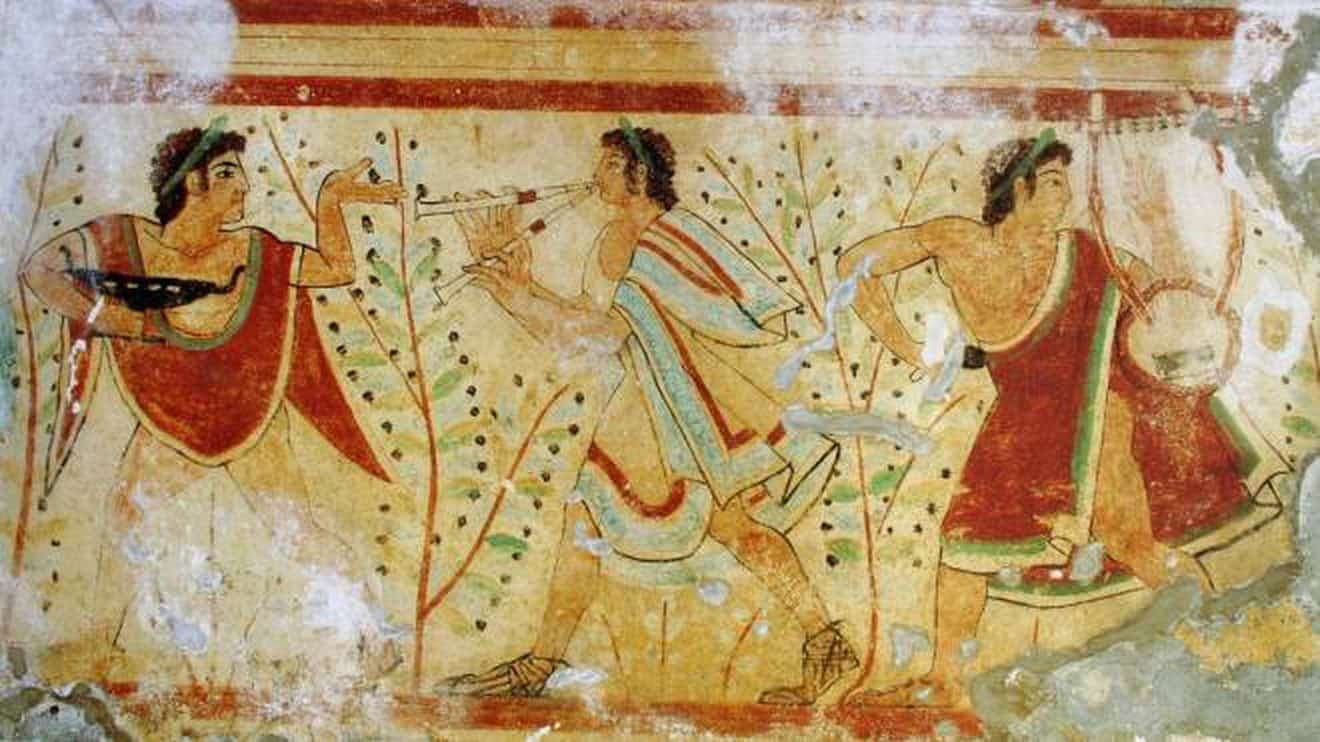
Watercolors of the Tomb of the Monkey in Chiusi, from the 1911 collection
The Tomb of the Monkey in Chiusi in the Museum's Watercolors
The Chiusi tomb that gives its name to the plates reproduced above was discovered in the nineteenth century in the Poggio Renzo area and owes its name to a small monkey tied to a tree, painted in a corner of the decoration. It is one of the very few painted tombs of Chiusi that survive, and it belongs to a phase in which the Etruscan figurative repertoire is entirely centered on funeral games: athletes, wrestlers, dancers, musicians, a seated female figure under a parasol presiding over the ceremony. The scene doesn't tell of the afterlife, it tells of the rite celebrated for the dead above the tomb.
Observe the pigments in the copies: reds, blacks, whites and ochers, with very little green and no stable blue. It isn't a choice of taste, it's the palette available to an Etruscan painter working with earths and carbon black. The color fidelity of the 1911 copies makes it possible to study this palette even where the original has lost it.
The Tarquinia Tombs Reproduced in the Museum of Etruscan and Italic Antiquities
The list of Tarquinian tombs documented by the collection is long and includes some of the most famous in Etruscan painting: the Tomb of the Cardinal, the Tomb of the Old Man, the three chambers of the Tomb of the Orcus, the Tomb of the Shields, the Tomb of Typhon, the Tomb of the Sea, the Tomb of the Maiden, the Tomb Francesca Giustiniani, the Tomb Querciola I, the Tomb of the Funeral Bed, the Tomb of the Chariots, the Tomb of the Leopards, the Tomb of the Triclinium, the Tomb of the Dying Man, the Tomb of the Painted Vases, the Tomb of the Dead Man, the Tomb of the Augurs, the Tomb of the Inscriptions, the Tomb of Hunting and Fishing, the Tomb of the Bacchants, the Tomb of the Bulls, the Tomb of Pulcinella, the Tomb of the Baron, the Tomb of the Lionesses.
Anyone who knows the Monterozzi necropolis knows that today only some of these tombs can be visited on a rotating basis, and that some are viewed through glass, in dim light, for a few minutes. Seeing here the plates of those same chambers, lit and within easy sight, radically changes the preparation for a trip to Tarquinia. The Tomb of Hunting and Fishing, with the divers and the birds over the sea, and the Tomb of the Leopards, with the banquet and the musicians, are the two cases where the comparison between copy and original teaches the most.
The Tomb Golini I of Orvieto
From the Orvieto necropolis the collection documents the Tomb Golini I, discovered in 1863 in the Settecamini area and known for the great underworld banquet with Aita and Phersipnai, the Etruscan deities of the afterlife, and for the famous kitchen scene with the servants at work. The original paintings were detached and are kept in the National Archaeological Museum of Orvieto. Their watercolor copy, made when the tomb was still intact in its context, is a parallel document and cannot be replaced. If you're planning Orvieto, look here before you leave.
The Basement: Room A, Crafts
You go down, and the museum changes register. Room A, called Crafts, is devoted to the development of material culture: ceramics, metals, techniques, forms, workshops. It's the room that hurried visitors find boring and that archaeologists consider the heart of the trade, because it's from the seriation of vases that strata are dated, trade is recognized and routes are reconstructed.
Here you see the buccheri, the glossy black ceramic that is the signature of Etruscan craftsmanship between the 7th and 6th centuries BC, obtained with firing in a low-oxygen environment that blackens the clay body throughout its thickness. You see the Etruscan imitations of Greek tableware and the real imports, Corinthian and Attic, which show how dense the traffic was between the Tyrrhenian and the Aegean. You see the bronzes: candelabra, engraved mirrors, table vessels, products in which the Etruscans were so good that they exported them across the western Mediterranean.
A piece of advice, against the order of the numbers: if you're short on time, skip this room on the way in and visit it on the way back. The shapes of the vases become much more eloquent when you've already seen how a city was organized and how a sanctuary worked.
Room B, the Teaching Classroom of the Museum of Etruscan and Italic Antiquities
Room B is both an exhibition space and a teaching classroom: lectures, seminars, presentations and workshops are held here. A classroom inside a museum is a rarity in Italy, and in this case it is consistent with the nature of the institution, born to teach. If you happen to come on a lecture day you might find it occupied: it's not a lapse in service, it's the museum doing its job. Whoever organizes a visit for a school class or a group of enthusiasts should lean on exactly this, booking in advance: here the archaeologist who explains isn't a paid extra on a tour, they're the house staff.
Room C, History and Institutions
Room C deals with the history and institutions of Etruria and pre-Roman Italy. It's the section that tries to answer the questions the public always asks first: who ruled among the Etruscans, how the cities were organized, what relationship they had with Rome. The picture that emerges is not the textbook one of a unified people, but that of a federation of sovereign cities, the so-called dodecapolis, each with its own aristocracy, its own magistrates, its own foreign policy, often in competition with one another. It is the structural reason for their defeat: Rome absorbed them one at a time, over two centuries, without ever having to face them all together.
Look closely at the materials relating to magistrates and the insignia of power. The fasces, the curule chair, the toga picta, the tuba, the parade chariot: Republican and then Imperial Rome inherited from the Etruscans a large part of the symbolic apparatus with which it presented itself to the world. Anyone strolling through the Forums the next day should remember it.
Room D, Epigraphy, and the Etruscan Language
Room D is devoted to epigraphy, and for me it's the most fascinating in the museum. The question everyone asks, in every language, is always the same: why can't Etruscan be understood? The correct answer is subtler than the legend. Etruscan can be read perfectly well, because it is written in an alphabet of Greek derivation, imported into Etruria through the Greeks of the West and adapted: anyone who learns the signs in an afternoon can read an inscription aloud. What's missing is the vocabulary. Etruscan doesn't belong to the Indo-European family, has no living close relatives, and there is no bilingual text long enough to work as a Rosetta Stone.
The known inscriptions number in the tens of thousands, but the vast majority are short funerary and votive formulas: name, patronymic, matronymic, age, offices held. An enormous and repetitive corpus, from which we confidently derive the naming system, the numerals, kinship terms, religious vocabulary, and very little of complex syntax. The long texts can be counted on the fingers: the Liber linteus kept in Zagreb, written on linen bands reused to wrap a mummy, the Tile of Capua, the Cippus of Perugia, the Tabula Cortonensis that resurfaced in 1992. The room puts in front of you the originals and the casts that let you follow this reasoning without having to be a philologist.

The Rooms of Civil and Sacred Architecture and Urban Planning
Three rooms in the basement are devoted to civil architecture, sacred architecture and urban planning. They are the rooms that on their own justify the trip to Piazzale Aldo Moro, because they contain the scale models that have made this museum known to specialists around the world.
The problem with Etruscan architecture is that almost none of it can be seen. Temples were built with a stone base, a superstructure of mud brick, wooden columns and beams, and a covering of painted terracotta. Wood and mud brick disappear, and what remains is the base and the terracottas that fell to the ground. Visitors who arrive at Veii or Vulci find a rectangle of stones and have to imagine the rest. The scale models serve exactly to fill that gap: they take the excavation data and the surviving terracottas and give back the building in three dimensions.
The Models of Etruscan Temples, the Museum's Showpiece
The first model was devised by Massimo Pallottino himself. The ones of Temples A and B at Pyrgi were made by Giovanni Colonna, who excavated at Pyrgi for decades. From the Arezzo exhibition of 1985 came the models of the great temple of Vulci, the temple of Fiesole, altar D on the acropolis of Marzabotto, the altar of Pieve a Socana, the sanctuary of Portonaccio at Veii and the temples of Pyrgi. It's a collection of reconstructions that covers the entire range of Etruscan sacred architecture, from southern Etruria to inland Etruria to the settlements of the Po valley.
These models are requested on loan for the major international exhibitions on Etruscan civilization. Which means, in practice, that when you arrive you might find an empty case or a loan tag: one of the pieces is traveling. It isn't a flaw of the museum, it's proof that what it holds serves research beyond these walls.
If I had to name a single object to look at for a long time, I'd name the model of Portonaccio at Veii. It's the sanctuary the Apollo now admired at Villa Giulia comes from, and seeing where that statue was placed, on the ridge of the roof, in line with the others, explains in an instant something no caption manages to say: the great Etruscan terracottas weren't meant to be looked at eye to eye, they were meant to be seen from below, against the sky, at a height of eight meters.
The Religion Section
At the end of the route is the section devoted to religion, enriched after 1988 with materials from the exhibition on the sanctuaries of Etruria. It's the section that deals with the Etruscan discipline, the body of doctrines on reading divine signs that the Romans took over wholesale from the Etruscans and kept practicing for centuries, entrusting it to specialists called haruspices. There were three branches: examination of the livers of sacrificial victims, interpretation of lightning, reading of prodigies.
The public always smiles when livers come up. Then it's explained that this technique presupposed a map of the sky divided into 16 sectors, each assigned to specific deities, and that the same map was projected onto the animal's liver and onto the orientation of cities and temples, and the smile fades. It wasn't popular superstition, it was a coherent cosmological system, taught, written down, exported. The religion section makes it visible with votives, terracottas, models of altars and sacred areas.
A firm opinion: this is the part of the museum worth the ticket you don't pay for. Nowhere else in Rome is Etruscan religion explained with this degree of seriousness to a non-specialist public.
The Collections of the Museum of Etruscan and Italic Antiquities: Gorga and Rellini
The holdings rest on two main cores, very different in history and in content. The Gorga Collection includes ceramics of Etruscan and Italic area datable between the archaic and the late Hellenistic age, and Etruscan-Italic and Roman bronze materials. The Rellini Collection gathers materials from the Faliscan and Capenate areas and from the Adriatic side. Around these two axes later acquisitions, long-term loans and excavation materials have settled over time.
Who Evan Gorga Was, the Tenor Who Bought Everything
Gennaro Evangelista Gorga, whom the official pages almost always call Evan Gorga, was born in Brocco, today Broccostella in the province of Frosinone, on February 7, 1865 and died in Rome on December 6, 1957. He began singing in the theater in 1895 and the following year, 1896, was the first Rodolfo in Puccini's La Bohème, with Arturo Toscanini on the podium, at the Teatro Regio in Turin. A career launched in the most spectacular way possible.
He gave it up almost immediately to collect. Not with the method of the amateur who chooses: with the voracity of someone who buys by lots, by classes, by series. He ended up putting together over a hundred and 50 thousand finds divided into some 30 classes, from musical instruments to archaeological antiquities, bought from Roman antiquarians and from excavations. To store them he rented 10 apartments on Via Cola di Rienzo. He ruined himself. In 1929 the State placed the collections under precautionary seizure. On September 27, 1949 Gorga signed an agreement ceding everything to the Ministry, and the purchase was completed on July 30, 1950.
From that moment his collections were distributed among different institutions, and even today you come across a Gorga piece in places very far from one another. Part of it is here, in the Sapienza museum. The musical instruments are the founding core of the National Museum of Musical Instruments, at Santa Croce in Gerusalemme. Other archaeological material passed through the Pigorini Prehistoric Ethnographic Museum, now merged into the Museum of Civilizations at EUR. 85 archaeological finds entered the holdings of the University of Padua between 1952 and 1953.
I think Gorga deserves more attention than he gets. A tenor who gives up success to accumulate a hundred and 50 thousand objects until he ruins himself is a character out of a novel, and his obsession ended up saving materials that would otherwise have gone to the black market without leaving a trace. A visit to this museum and one to the musical instruments museum go very well together on the same day, and they tell of the same man from two opposite sides.
The Rellini Collection and the Faliscan Countryside
The second core bears the name of Ugo Rellini, the paletnologist who founded the Museum of Origins in 1942. It gathers materials from the Faliscan and Capenate areas and from the Adriatic side. The Faliscans lived in the territory north of Rome around Civita Castellana, ancient Falerii, in a strip of Lazio between the Tiber, Lake Bracciano and the Cimini Mountains. They weren't Etruscans: they spoke an Italic language related to Latin, which they wrote, however, in an alphabet derived from the Etruscan one, and culturally they gravitated toward Veii and southern Etruria. A frontier case that archaeologists have studied for a century and a half precisely because it shows how contact between different worlds worked.
The Capenates occupied the area of Capena, even closer to Rome, on the right bank of the Tiber. The Adriatic side instead points to the Picene and mid-Adriatic cultures, which had exchanges with Etruria documented over the centuries. Anyone visiting this section should then plan a day in the real Faliscan countryside: the wooded ravines around Corchiano, the sunken roads, the necropolis, and then Sutri with its amphitheater carved into the tuff, and Nepi. It's a piece of Lazio that Romans themselves know very little.
The Faliscan Cavernette and Recent Acquisitions
In April 2004 the entire body of materials of the historical age found in the excavations of the so-called Faliscan cavernette arrived at the museum from the Museum of Origins. The excavations were conducted between the late nineteenth century and the first three decades of the twentieth by Angelo Pasqui, Raniero Mengarelli and Ugo Rellini in the territories of Corchiano and Falerii. They are cave and rock-shelter contexts, reused in the historical age, which document the long duration of human occupation in that landscape of tuff and ravines.
In October 2005 63 finds entered the collections, among architectural and votive terracottas, ceramics and metal vessels, once again drawn from the boundless Gorga collection and until then kept in storage at the Pigorini Museum. Architectural and votive terracottas: exactly the material needed to complete the sections on sacred architecture and religion. A targeted acquisition, not a chance bequest.
Pyrgi, the Port of Caere, and Why It Feels at Home in This Museum
No place weighs on this museum as much as Pyrgi. It was the port sanctuary of Caere, present-day Cerveteri, and its ruins lie beneath and beside the Santa Severa castle, on the coast north of Rome. Pallottino began excavating there in 1957, and since then the dig has remained a Sapienza site: it means that generations of students learned the trade there and that the materials pass through here.
In 1964 the three gold tablets that changed the history of the field emerged. They had been affixed to the doorpost of Temple B, datable to around 510 BC, measure about 19 centimeters by nine and bear three inscriptions: two in Etruscan and one in Phoenician, which is a summary of the first two. The text commemorates the dedication of the temple to the deity the Etruscans called Uni and the Phoenicians Astarte, at the will of Thefarie Velianas, designated as lord over Caere. The tablets are kept at the National Etruscan Museum of Villa Giulia.
The value of that find is twofold. Linguistically, it is the longest bilingual text we have, and it made it possible to confirm the meaning of a series of Etruscan terms. Historically, it documents a direct political and religious relationship between an Etruscan city and the Punic world at the end of the 6th century BC, the years when the Tarquins fell in Rome. It isn't provincial archaeology: it's the geopolitics of the archaic Mediterranean.
That's why the models of Temples A and B at Pyrgi made by Giovanni Colonna are the heart of this museum. Whoever looks at them here and then goes to see the tablets at Villa Giulia, or the foundations at Santa Severa, puts together a complete account. In the reverse order, instead, you look at three unconnected things. The museum also hosts displays of unpublished materials from the Pyrgi excavation, in agreement with the Superintendency: one of the few places where you see material before it ends up in a scholarly publication.
The Exhibition on Caere and the Question of Illicit Trafficking
On November 14, 2023, on the occasion of the International Day against Illicit Trafficking in Cultural Property, the museum presented the exhibition Caere. Storie di dispersione e di recuperi, curated by Laura Michetti, then director of the museum, with Claudia Carlucci of the Museum Hub, Alessandro Conti of the Department of Sciences of Antiquity and Rossella Zaccagnini of the Superintendency of Archaeology, Fine Arts and Landscape for the province of Viterbo.
On display were pieces that on their own tell the story of the last 50 years of protection: a large red-figure calyx krater signed by Euphronios, from the 6th century BC, twin of the more famous Sarpedon krater, with a scene of struggle between Heracles and Kynos. And four painted terracotta slabs of Etruscan production, seized in 2019. The investigations of the Carabinieri Command for the Protection of Cultural Heritage established that the krater came from clandestine digs conducted at Cerveteri in the 1970s, and obtained its return to Italy in 2010.
There is a hard consistency in all this. A museum that in 1985 saw part of the material it had displayed vanish through theft hosts, 40 years later, the exhibition that explains how the chain of clandestine digging works and how it is dismantled. Anyone visiting the basement today would do well to keep it in mind: every tag that indicates a certain excavation provenance is the result of work that you don't see.
The Museum of Etruscan and Italic Antiquities Today
Since September 30, 2025 the university's museum system has merged into the Polo Museale Sapienza Cultura, which brings together the university museums along with the Botanical Garden and the Nuovo Teatro Ateneo, with the general direction entrusted to Marco Benvenuti. The direction of the Museums Section for the three-year period 2025-2028 is held by Laura Maria Michetti, full professor of Etruscology and Italic Antiquities, who had been director of the Museum of Etruscan and Italic Antiquities. The direction of the museum passed on January 27, 2026 to Alessandro Conti. The area curator is Claudia Carlucci.
Under the previous direction the museum joined the international Google Arts and Culture project for the digitization of collections and continued to coordinate the excavations at Pyrgi and Veii. For those preparing a visit, digitization has a practical side: part of the material can be viewed in advance from home, and you arrive knowing what to look for.
The museum is also a venue for temporary exhibitions. On May 23, 2026, as part of the Museum May of the Hub and the European Night of Museums, the exhibition Etruscan Blue, Etruscan Gold was inaugurated there, devoted to precious materials from Etruscan sanctuaries, accompanied by workshops for children, guided tours and a concert. That evening, with the University City open from 15:00 to midnight, free admission and parking and 17 museums to visit, is probably the best occasion of the year to discover the Sapienza museum system. If you're in Rome in May, find out the date.
How Much the Museum of Etruscan and Italic Antiquities Costs and How to Book
Entrance to the collection is free. Guided tours and educational workshops are booked and may have a fee. The right address to ask is polomusealesapienza@uniroma1.it, which is the Hub's contact for bookings. For information on the museum, including the hours on the day you want to go, the number is 06 49694317 and the email is museo-etruscoitalico@uniroma1.it.
If you're coming with a school, plan ahead, with a few weeks of margin: the staff of university museums is small and availability depends on the lecture calendar. If you're coming on your own, during opening hours, you just walk in. There's no ticket office, no bookshop, no cloakroom, no museum café: there's the faculty bar, which costs what a neighborhood bar costs and not what a museum bar costs, and it's one of the small side pleasures of this visit.
A warning that is worth more than a fare: free doesn't always mean open. A museum that depends on a university department closes for exam sessions, for conferences, for academic bridge days and for maintenance, and doesn't always announce it in advance on the website. The phone call before leaving, repeated here for the third time with good reason, is the real admission ticket.
How to Get to the Museum of Etruscan and Italic Antiquities
The address is Piazzale Aldo Moro 5, inside the University City, Letters and Philosophy building. The simplest way is metro line B, Policlinico stop: you come out, walk along the campus wall and in five minutes you're at the gate. From Termini you can walk a good quarter of an hour or take bus 310, which stops at Università/Regina Elena. At street level the area is also served by lines 71, 492 and 649 and by trams 3 and 19, which run along Viale Regina Elena and Viale delle Province connecting San Giovanni, San Lorenzo and Verano with Villa Borghese and Piazza Risorgimento.
Once inside the campus, the landmark is the Letters and Philosophy building, home of the Department of Sciences of Antiquity: the museum rooms occupy the ground floor and the basement. At the front desk you ask for the museum and get directed. Don't expect the brown signage of the city's museums or a sign on the street: the first time you need a minute to get your bearings, and asking is quicker than wandering.
By car it gets complicated. Vehicle access to the University City is controlled and parking around it, between Policlinico, San Lorenzo and Castro Pretorio, is a lottery you almost always lose. If you're coming from outside Rome, the advice is to leave the car at a park-and-ride on line B and do the last stops by metro: you save 40 minutes and an hour of nerves.
When to Go to the Museum of Etruscan and Italic Antiquities and How Long the Visit Takes
An hour is enough for an attentive visit, an hour and a half for a comfortable one with reading of the panels. If you have a specific interest, for example epigraphy or sacred architecture, you can stay in those two rooms as long as you like without anyone moving you along: one of the privileges of a museum with no crowds.
The best time is a weekday morning during the teaching period, when the building is alive and the staff is present. The worst period is the break between the exam sessions and Ferragosto: the university slows down, some openings thin out and the risk of finding it closed goes up. Between December and the first days of January the university observes the suspension of activities, and the museum follows it.
The seasonal tip, for those visiting Rome in summer: this is one of the rare museums in the city where in August you go in without meeting anybody, and the basement rooms have a decidedly milder temperature than the Forums at two in the afternoon. People looking for shelter from the heat usually fall back on crowded places. Here you find a cool, quiet space, provided you've checked that it's open.
The Museum of Etruscan and Italic Antiquities with Teens and Children
It must be said frankly: under 10 years old this museum doesn't work on its own. There are no screens, nothing to touch, no games. Cases, panels, scale models, casts. A small child gets bored in 20 minutes, and insisting helps nobody. For the youngest, the Civic Zoology Museum at Villa Borghese remains the most sensible choice in Rome.
From 12 years up, instead, things change completely, and for the better. A teenager who is studying the Etruscans at school finds here, in one afternoon, everything the textbook lets them guess at without showing it: how they wrote, how they built, how they buried. For those studying at a classical high school or taking a letters course, the epigraphy room is an hour of lecture worth a semester.
The right way to bring a class is to book a guided tour by writing to polomusealesapienza@uniroma1.it. The teaching classroom exists within the route, the museum was born to be explained and the staff who explain do research on those materials. During the Museum Hub events, in May, workshops designed for the youngest are also offered, from the painted-tomb puzzle to writing in Etruscan.
Accessibility of the Museum of Etruscan and Italic Antiquities
The museum is on two levels, ground floor and basement, so the full route involves a change in level. For those who use a wheelchair or have mobility difficulties, the sensible thing is to arrange the visit in advance by writing to polomusealesapienza@uniroma1.it or calling 06 49694317, stating the specific need: the University City buildings have elevators and service entrances, and the staff know the practicable route better than any written directions.
A useful remark for those with walking difficulties: the University City is large and the internal routes, from the gate at Piazzale Aldo Moro to the Letters building, are measured in hundreds of meters on flat, paved paths. Those arriving by taxi can ask to be dropped as close as possible to the pedestrian entrance of the campus.
The Other Sapienza Museums, a Short Walk from the Museum of Etruscan and Italic Antiquities
This is why it's worth treating the University City as a destination and not as a single stop. The Sapienza Museum Hub brings together the university's museums along with the Botanical Garden and the Nuovo Teatro Ateneo: it is the largest Italian university museum system, and Romans themselves largely ignore that it exists.
In the Same Letters and Philosophy Building
The Museum of Classical Art, the museum of plaster casts of Greek sculptures from the archaic period to the Hellenistic age, occupies rooms at the back of the building and is the one with the widest opening window, Monday to Friday. The Museum of Origins, devoted to prehistory and protohistory, from the first stone tools to bronze swords, from Neolithic pottery to Mycenaean vases, can be visited in the morning and by appointment. Three archaeological museums in a single building: with a phone call beforehand you can do them in one morning, and the mental path that comes out of it, from prehistory to the Etruscans to the Greek world, is not offered by any other place in Rome.
In the Rest of the Campus and Nearby
Scattered around the University City and just outside are also the Giuseppe Sergi Museum of Anthropology, the Museum of the Ancient Near East, Egypt and the Mediterranean on the ground floor of the Rectorate, the Museum Laboratory of Contemporary Art on the first floor of the same Rectorate, the Herbarium Museum in the Botany building, with declared free admission and guided tours by reservation, the Museum of Physics in the Fermi building, the Primo Levi Museum of Chemistry, the Museum of Art and Mineral Deposits, the Museum of Geography in the Letters building, the Museum of Commodity Science and the University Museum of Earth Sciences, which requires mandatory reservation.
Outside the campus, but part of the same system: the Battista Grassi Museum of Comparative Anatomy at Via Antonio Borelli 50, open Tuesday mornings. The Museum of Pathological Anatomy in the General Pathology building of the Policlinico Umberto I, at Viale Regina Elena 324, visitable by appointment only. The Museum of the History of Medicine at Viale dell'Università 34a, with mandatory reservation. The Museum of Hydraulics at Via Eudossiana 20, at San Pietro in Vincoli, with free admission and reservation required. And the Botanical Garden, which belongs to Sapienza but lies on the other side of the Tiber, at Largo Cristina di Svezia, beneath the Janiculum.
The hours of all these sites change with the academic calendar and must be confirmed before setting out. The criterion for organizing a morning in the University City is simple: you call the main museum, ask for confirmation that it's open, and add a second visit only if the second museum is in the same building. Combinations between different buildings only work if you've checked both.
What to See Around the Museum of Etruscan and Italic Antiquities
Outside the gate of Piazzale Aldo Moro begins a quadrant of Rome that visitors almost always cross in a rush, on their way to sleep in some rented apartment. It's a mistake, because there are important things within walking distance.
The basilica of San Lorenzo fuori le Mura is one of the seven pilgrimage churches of Rome, a building made of two basilicas welded together, with its thirteenth-century portico and reused ancient sarcophagi. It carries the wound of the bombing of July 19, 1943, the first to hit Rome, and the reconstruction is still readable to those who know how to look. Next to it, the Verano Cemetery is an open-air museum of nineteenth- and twentieth-century funerary sculpture, free, where a considerable share of the names you read on Rome's street signs lie at rest.
The San Lorenzo neighborhood, right behind, is the place to eat: trattorias, pizza-by-the-slice shops and osterias that at eight in the evening do a different job from the historic center and at half the price. A lunch here after the visit is the natural conclusion of the morning.
Those who want to stay on the theme of university history must instead cross the city and get to Corso del Rinascimento, where the church of Sant'Ivo alla Sapienza is the chapel of the ancient Studium Urbis, the historic seat of the university before its move to the University City in the 1930s. Borromini's spiral dome is one of the boldest inventions of European architecture, and the visit is free during limited hours. The two stops together, the museum inside the new university and the church of the old university, tell seven centuries of Sapienza history.
After the Museum of Etruscan and Italic Antiquities: the Complete Etruscan Itinerary
This museum is an entrance door, and like all doors it has to be walked through. The recommended order is this, and it works.
First Step, Staying in Rome
The National Etruscan Museum of Villa Giulia, inside the villa of Pope Julius III. There you find the Sarcophagus of the Spouses, the Apollo of Veii, the Ficoroni Cista and the gold tablets of Pyrgi. Those who have seen the model of the Portonaccio sanctuary and that of the temples of Pyrgi here arrive in front of those cases with the tools to understand them, and the difference is enormous. Morning here, afternoon at Villa Giulia: half an hour of transit separates the two museums, and the day is one of the smartest you can put together in Rome.
Second Step, the Necropolises
The Banditaccia necropolis at Cerveteri, a city of the dead with streets, squares and blocks, reproduces in stone the urban planning of the living, and is the natural complement to the rooms on architecture and urban planning. Then the painted tombs of Tarquinia, the originals of the watercolor copies seen here. Do them in this order and you'll understand why those copies are a heritage. Those who extend the day to the coast have the Tarquinia salt pans and the Bagni di Sant'Agostino nearby.

Third Step, the Sanctuaries and the Cities
The Veii Park with the Portonaccio sanctuary, less than an hour from the center of Rome and which almost nobody visits. Vulci with the great temple, the Abbadia castle and the bridge over the Fiora. Montalto di Castro as a base for the area. And Orvieto, for the Crocifisso del Tufo necropolis with its cube tombs lined up like houses and for the archaeological museum, where the detached paintings of the Golini Tomb ended up.
For the Italics, Not Only the Etruscans
The National Archaeological Museum of Palestrina, inside the Colonna Barberini palace that occupies the summit of the sanctuary of Fortuna Primigenia, with the Nile mosaic and the model of the sanctuary: to understand pre-Roman Lazio it's worth a library. And, for the city picture, the Museum of Archaeology for Rome.
A Curiosity About the Museum of Etruscan and Italic Antiquities
The nicest curiosity concerns the numbering of the rooms. The two on the ground floor are called LVI and LVII, 56 and 57, in a museum that has nine or 10 rooms in all. A number that high in a museum that small surprises anyone who notices, and almost nobody notices. The explanation is that this numbering doesn't belong to this museum: it belongs to the route of the Museum of Classical Art, the old cast gallery founded by Emanuel Löwy, which occupies the neighboring rooms and has many more rooms. When the Etruscan museum was inaugurated in 1962, its two ground-floor rooms were slotted into the existing sequence, as if the discourse on ancient art continued seamlessly from the Greek world to the Etruscan one.
It's an apparently bureaucratic curiosity that actually says something profound about Massimo Pallottino's approach. In the 1950s Etruscology was fighting to be recognized as an autonomous discipline, after a century in which the Etruscans had been treated either as mysterious Orientals or as provincials of the Greeks. Numbering its rooms in continuity with those of the cast gallery was a declaration of belonging: Etruscan civilization is part of the ancient Mediterranean world, studied with the same tools and displayed in the same sequence.
There's a second layer of curiosity, for those who love buildings. Those rooms are in a building designed by Gaetano Rapisardi and inaugurated in 1935, when the University City was built to move out of the center the university that since the sixteenth century had occupied the Sapienza palace on Corso del Rinascimento. The cast gallery moved there in the summer of 1935. The Etruscan museum arrived 27 years later, in the rooms next door. The result is that two museums born 70 years apart now share a single sequence of Roman numerals on their doors, and no sign explains it. Go and look at the plaques: they're there, in plain sight, and they're the small riddle you'll take home with you.
Something Nobody Tells You About the Museum of Etruscan and Italic Antiquities
That the most famous pieces in this museum aren't ancient finds, and that they may not be there. The scale models of Etruscan temples, in particular those of Temples A and B at Pyrgi made by Giovanni Colonna and the forerunner devised by Massimo Pallottino, are requested on loan by the major international exhibitions on Etruscan civilization. They go to Paris, they go to Germany, they go to the United States, they come back. No tourism site writes this, because no tourism site goes into this detail, and a visitor who comes specifically to see them may find an empty case without understanding why.
The way to avoid it is trivial and nobody suggests it: when you call about the hours, also ask whether the temple models are on site. 30 seconds of conversation. The museum staff answer gladly, because it's a question that reveals an informed visitor, and in a university museum an informed visitor is treated accordingly.
There's a second aspect almost nobody mentions, and it concerns the scientific value of those models. They aren't tourist scale models: they're authored reconstructions, signed by those who directed the excavations, and they represent precise archaeological hypotheses, debatable and debated in the literature. The model of an Etruscan temple is a thesis in three dimensions: it says how tall the roof was, how many columns there were on the front, how the terracottas of the pediment and the ridge were distributed. When a model leaves for an international exhibition it isn't a decorative object that leaves, it's the scientific position of a school.
A third little-known element: the museum also displays unpublished materials from the Pyrgi excavation, in agreement with the Superintendency. It means that in certain seasons you see here objects that haven't yet entered any publication. For an enthusiast it's a very rare condition, and it alone is worth the hour of the visit.
My Advice for Visiting the Museum of Etruscan and Italic Antiquities
Go through it backwards. The natural order leads you to start from the ground floor, with sculpture and painting, and then go down to the basement where the route starts from crafts. The reverse is better: go down right away, go to the end, start from the religion section and the rooms on architecture and urban planning, where the models are, then go back up the corridor toward epigraphy, history and institutions, and leave the crafts room for last. Finish on the ground floor with sculpture and the watercolors.
The reason is didactic. The ceramic cases say little to someone who doesn't yet know what an Etruscan city looked like, where the sanctuary was placed, what was done at a funeral. They say a great deal to someone who has just seen it in a scale model. Reversing the order, the crafts room stops being a list of shapes and becomes the material confirmation of what you understood in the earlier rooms. And the funerary painting, kept for last, arrives when you're ready to read it.
Second piece of advice, less obvious: go with a notebook, not with your phone. In this museum photography yields little, because the glass reflects and the lights are studio lights, while taking notes and sketches works very well. It's a museum designed for study, and whoever treats it that way gets three times as much out of it. And if you really have little time, the minimum sequence is this: temple models, epigraphy room, watercolors. 20 minutes, three stops, and you leave having understood something serious.
Third piece of advice, for those coming from outside Rome: don't come here on the first day. If you have three days in the city and have never seen it, go to the Colosseum, the Forums, the Vatican, Piazza Navona. This museum gives its best on the second or third trip, when you've already seen the obligatory things and start wondering how Italy really worked before Rome.
Another Well-Known Fact, Yet Rarely Mentioned
That Rome took a substantial part of itself from the Etruscans is known to everyone, and it's repeated in every school textbook. What is rarely cited is the concrete scope of that borrowing, and this museum is the place where it becomes visible piece by piece.
The insignia of Roman power are Etruscan: the lictors' fasces with the ax, the curule chair, the purple-striped toga, the war trumpet, the triumphal chariot. The triumph itself, the ceremony every visitor associates with Imperial Rome, has roots in Etruscan ceremonial. The technique of the arch and the vault, which the Romans brought to an unmatched level, comes from Etruria, as does the practice of urban drainage: the Cloaca Maxima, the work that made the Forum valley habitable, is attributed by tradition to Tarquinius Priscus, a king of Etruscan origin. Even the word we use for consecrated space, templum, points back to a technique of dividing the sky that the Etruscan haruspices taught the Romans.
The little-cited point is another, though, and it concerns duration. It wasn't an archaic inheritance later forgotten: the Etruscan discipline remained operative in official Rome for centuries. Haruspices were consulted in the Republican age, in the Imperial age, and still in the 5th century AD someone proposed turning to them to defend the city. A religious technique of a people politically vanished for half a millennium continued to be considered professional expertise. In the section devoted to religion this museum explains it better than any popular book, because it shows the objects on which that technique was practiced.
Anyone visiting the Forums with no idea of what the Etruscan discipline was looks at a building site and not at a system. An hour in this basement before or after the archaeological walk changes the way you read the center of Rome, and costs only the time to get there.
The Right Photo to Take at the Museum of Etruscan and Italic Antiquities
The photograph to take home is not a case: it's a temple model shot from below, at the eye level of someone who would have seen it from the sanctuary square. Crouch until your eye is almost at the level of the base and frame the pediment at an angle, letting the ridge of the roof cut the image at the top. Within a second the model stops looking like a scale model and becomes a building: the squat proportions of the Etruscan temple, the enormous roof, the depth of the portico, the statues in line on the ridge take on the sense they had for someone arriving on foot with an offering in hand. It's the same photograph that lets you understand, back home, why the Apollo of Veii has that stride and that smile: it had to be legible from eight meters below.
The second image I recommend is a detail of the watercolors. Not the whole plate, which almost always turns out badly with the glass reflections, but a detail: a double-flute player, a diver, the parasol of the seated woman, the little monkey tied to the tree. Approach at an angle to avoid glare, brace your hands so you don't move, and forget digital zoom, which here destroys the color. The best result comes from the room's ambient light.
The third photograph is the most refined and very few people take it: the plaque with the Roman numeral of the room. LVI, LVII, nineteenth-century museum numerals on a door in a building from the 1930s, inside a museum from 1962. A single image that contains three eras and the history of a discipline.
A rule of conduct, and it's not a formality: ask the staff before shooting. In a university museum some materials are under study or being published, and the conditions for photographing them can change from one case to another. Asking costs 10 seconds and avoids unpleasant scenes. Skip the flash in any case, in front of ancient pigments and watercolor plates more than a century old.
Some Important Events That Happened Here in History
The first event is the inauguration of 1962, on the occasion of the 6th International Congress of Prehistoric and Protohistoric Sciences. A museum that opens in front of the world scientific community is born with an obligation of quality that showed in the following years, when the collections grew thanks to deposits of materials from the Museum of Origins, the National Etruscan Museum of Villa Giulia and the National Roman Museum, the institution that today includes Palazzo Massimo, the Baths of Diocletian, Palazzo Altemps and the Crypta Balbi.
The second event is a disaster: the flood of 1975, which hit the basement rooms and abruptly interrupted museum activity. Over 10 years of forced closure followed, and the return of the materials the Museum of Origins had granted on deposit. It was the lowest moment in the history of this museum, and the museum doesn't hide it.
The third is the theft of June 1985 against the Museum of Origins, in which part of precisely those returned finds was lost. A mockery that any archaeologist tells through gritted teeth: materials that survived a flood, vanished in a site considered safer.
The fourth is the reopening of 1988, made possible together with new acquisitions for the section devoted to worship and sanctuaries, with the materials of the exhibition Progetto Etruschi, Santuari d'Etruria, which the municipality of Arezzo had staged in the spring of 1985. From there came the models of the great temple of Vulci, the temple of Fiesole, altar D on the acropolis of Marzabotto, the altar of Pieve a Socana, the sanctuary of Portonaccio at Veii and the temples of Pyrgi.
The fifth is the season of redisplays: the 1993 acquisition of the core of ceramics granted on deposit by the Museum of Origins, the new display of 1997, the presentation in December 2000 of the Section of Artistic Manifestations divided into two rooms, the start in 2003 of the collaboration with the Central Institute for Restoration on metal finds, the participation in 2005 in the exhibition for the 700 years of Sapienza at the Vittoriano with a clay cinerary urn from Chiusi. In April 2004 the body of materials from the Faliscan cavernette arrived. In October 2005 the 63 Gorga finds from the Pigorini.
The sixth event is from November 14, 2023: the presentation of the exhibition Caere. Storie di dispersione e di recuperi, on the International Day against Illicit Trafficking in Cultural Property, with the Euphronios krater returned to Italy in 2010 after the investigations of the Carabinieri for the Protection of Cultural Heritage and the four painted slabs seized in 2019.
The seventh is very recent and concerns the setup: on September 30, 2025 the Polo Museale Sapienza Cultura is born, bringing together the university's museums with the Botanical Garden and the Nuovo Teatro Ateneo. On January 27, 2026 Alessandro Conti takes over the direction of the museum. On May 23, 2026, on the European Night of Museums, the exhibition Etruscan Blue, Etruscan Gold on precious materials from Etruscan sanctuaries is inaugurated here. A museum many consider dormant has had, in the last three years, more life than several institutions with a line at the entrance.
Who Passed Through the Museum of Etruscan and Italic Antiquities
The first name is Massimo Pallottino, the founder of modern Etruscology, who conceived this museum in 1955, saw it open in 1962 and devised its first temple model. Holder of the chair of Etruscology in Rome from 1945 to 1980, director of the National Institute of Etruscan and Italic Studies from 1972 until his death, discoverer of the Pyrgi tablets in 1964, Balzan Prize in 1982 and Erasmus Prize in 1984: whoever walks in these rooms walks inside his teaching project.
The second is Giovanni Colonna, the archaeologist who excavated at Pyrgi for decades and who made the models of Temples A and B of the sanctuary, the pieces most requested by international exhibitions. A model signed by the person who directed the dig is a scientific document, and in this museum there are several.
The third name, or rather names, are Gilda Bartoloni and Gilda Benedettini, who from 2002 worked together on the renewal of the exhibition and teaching facilities: panels, cases, a small room for computerized cataloging, a classroom for lectures, fireproof and moisture-proof wall coverings. Looking after the conservation of an underground museum after two floods is work that no visitor sees and without which no visitor would see anything.
Then Laura Maria Michetti, full professor of Etruscology and Italic Antiquities, director of the museum until the handover and today head of the Museums Section of the Polo Museale Sapienza Cultura for the three-year period 2025-2028, under whose direction the museum promoted the exhibition on Caere and joined the international Google Arts and Culture project. With her, Claudia Carlucci, area curator, and Alessandro Conti, director since January 27, 2026 and previously among the curators of the Caere exhibition.
Rossella Zaccagnini of the Superintendency of Archaeology, Fine Arts and Landscape for the province of Viterbo also worked on the 2023 exhibition, and on that occasion the officers of the Carabinieri Command for the Protection of Cultural Heritage came into these rooms, whose men had reconstructed the clandestine path of the Euphronios krater. Among the scholars who worked on the collections, Luciana Drago Troccoli should be remembered, author of the complete publication of the 61 watercolor plates released in 2019 by Edizioni Quasar.
Two indirect presences, finally, but decisive ones. Ugo Rellini, full professor of Paletnology and founder in 1942 of the Museum of Origins, whose name is tied to one of the two collections of this museum and to the old digs in the Faliscan cavernette. And Evan Gorga, the tenor who in 1896 was the first Rodolfo in La Bohème and who then put together over a hundred and 50 thousand objects: he never set foot in these rooms, but a considerable share of what you see in the cases passed through his hands before the State bought everything in 1950.
Quick Questions About the Museum of Etruscan and Italic Antiquities
How much does a ticket to the Museum of Etruscan and Italic Antiquities cost?
Entrance to the collection is free. Guided tours and educational workshops are booked separately and may have a fee: write to polomusealesapienza@uniroma1.it.
What are the opening hours of the Museum of Etruscan and Italic Antiquities?
The university lists opening on Monday and Friday from 9:00 to 19:00 and on Wednesday from 16:00 to 19:00. The time slots follow the academic calendar and change over the course of the year: before going it's always best to confirm at 06 49694317 or write to museo-etruscoitalico@uniroma1.it.
Where exactly is the museum?
Piazzale Aldo Moro 5, inside the Sapienza University City, in the Letters and Philosophy building, home of the Department of Sciences of Antiquity. The rooms occupy the ground floor and the basement.
Do I need to book to visit the Museum of Etruscan and Italic Antiquities?
For a self-guided visit during opening hours, a reservation does not appear to be necessary. Reservation and a prior arrangement are needed instead for guided tours, workshops and school groups.
How long does the visit take?
One hour for an attentive visit, an hour and a half at a relaxed pace. Adding the Museum of Classical Art in the same building makes a comfortable morning.
What is the difference between this museum and the Etruscan Museum of Villa Giulia?
Villa Giulia is the great national museum of masterpieces: Sarcophagus of the Spouses, Apollo of Veii, gold tablets of Pyrgi. This is a didactic university museum, where models, casts and finds serve to explain how a civilization is studied. They complement each other and the right sequence is here first, then Villa Giulia.
Is the Museum of Etruscan and Italic Antiquities suitable for children?
Under 10 it works poorly: nothing interactive, nothing to touch, cases and panels. From 12 up, and in particular for those studying at a classical high school, it's one of the most useful visits in Rome. During the Museum Hub events, workshops for the youngest are organized.
Can I take photographs?
Ask the staff at the entrance: in a university museum some materials may be under study and the conditions vary. Flash is in any case to be avoided in front of the watercolors and the ancient pigments.
Is the museum accessible to people with mobility difficulties?
The route is on two levels, ground floor and basement. Those with specific needs should call 06 49694317 or write to polomusealesapienza@uniroma1.it before the visit, so as to arrange the practicable route.
How do I get to the museum by public transport?
Metro line B, Policlinico stop, five minutes on foot. At street level buses 71, 310, 492 and 649 and trams 3 and 19. From Termini the 310 stops at Università/Regina Elena, or you can walk a quarter of an hour.
Can I park near the Museum of Etruscan and Italic Antiquities?
Badly and with difficulty. Vehicle access to the University City is controlled and the surrounding streets are saturated. It's better to leave the car far away and use line B.
What are the 1911 watercolors?
They are 61 watercolor plates that reproduce the paintings of the Etruscan tombs of Tarquinia, Orvieto and Chiusi, acquired by Massimo Pallottino in the early 1950s. The Tarquinia ones were painted between 1911 and 1912 by Elio d'Alessandris. For the plates of Orvieto and Chiusi the author is unknown. Since many of the original paintings have deteriorated in the meantime, the copies are a document of the first importance.
Which tombs are reproduced in the watercolors?
From Tarquinia, among others, the Tomb of the Leopards, the Tomb of Hunting and Fishing, the Tomb of the Augurs, the Tomb of the Bulls, the Tomb of the Lionesses, the Tomb of the Triclinium, the Tomb of the Orcus in its three chambers, the Tomb of the Baron, the Tomb of the Chariots. From Chiusi the Tomb of the Monkey, from Orvieto the Tomb Golini I.
Are the models of the Pyrgi temples really there?
Yes. The models of Temples A and B were made by Giovanni Colonna, while the museum's first model was devised by Massimo Pallottino. Since they are lent to international exhibitions, it's best to ask by phone whether they're on site the day of your visit.
What are the Pyrgi tablets?
Three gold tablets found in 1964 in the sanctuary of Pyrgi, affixed to the doorpost of Temple B, with two inscriptions in Etruscan and one in Phoenician that is a summary of them. They commemorate the dedication of the temple to Uni Astarte by Thefarie Velianas, lord over Caere. They are kept at Villa Giulia. Here you see the models of the two temples they come from.
What language did the Etruscans speak and why don't we understand it?
Etruscan can be read without difficulty, because it uses an alphabet derived from the Greek one, but it doesn't belong to the Indo-European family and has no close relatives: the vocabulary is missing. The tens of thousands of known inscriptions are mostly short funerary formulas, and the long texts are very few. Room D of the museum is devoted to exactly this.
What are the Gorga and Rellini collections?
The Gorga Collection includes Etruscan and Italic ceramics between the archaic and the late Hellenistic age and bronze materials. It takes its name from Evan Gorga, tenor and collector. The Rellini Collection gathers materials from the Faliscan and Capenate areas and from the Adriatic side and bears the name of the paletnologist Ugo Rellini.
Does the museum have a bookshop or a café?
No. There is no ticket office, bookshop, cloakroom or museum café. There's the faculty bar, which charges university bar prices.
How many museums does Sapienza have and where are they?
The Polo Museale Sapienza Cultura brings together the university's museums along with the Botanical Garden and the Nuovo Teatro Ateneo. Most are in the University City at Piazzale Aldo Moro. Some are elsewhere, like the Museum of Hydraulics at San Pietro in Vincoli and the Botanical Garden beneath the Janiculum.
What other museums can I visit in the same building?
The Museum of Classical Art, with the plaster casts of Greek sculpture, and the Museum of Origins, devoted to prehistory and protohistory. Both in the Letters and Philosophy building, both with hours to be checked.
Is admission free on the first Sunday of the month?
The free first Sunday measure applies to state museums and some municipal museums, not to university museums. Here admission to the collection is free during opening hours, but the museum normally doesn't open on Sundays.
Is there a line to get into the Museum of Etruscan and Italic Antiquities?
No, and that's one of the best reasons to come. It often happens that you're the only visitors in the rooms.
How big is the museum?
About 570 square meters of exhibition space spread over the two floors, with around 10 rooms between the ground floor and the basement.
Does the museum hold temporary exhibitions?
Yes, and it is also a venue for displays of unpublished materials from the Pyrgi excavation, in agreement with the Superintendency. Among the recent exhibitions, Caere. Storie di dispersione e di recuperi in 2023 and Etruscan Blue, Etruscan Gold, inaugurated in May 2026.
Is it worth coming on a first trip to Rome?
No, and I say it plainly. On a first trip there's the Colosseum, the Forums, the Vatican, the historic center. This museum gives its best on a second or third trip, or to those who live in Rome and want to really understand what was there before.
What can I see nearby after the visit?
The basilica of San Lorenzo fuori le Mura, the Verano Cemetery and the San Lorenzo neighborhood for lunch. With a few stops of public transport, the Policlinico, Castro Pretorio and the National Library.
This is not a museum for everyone, and whoever presents it to you as a marvel with a line at the entrance is pulling your leg. It's a study museum, built by scholars to train other scholars, which has gone through a flood, a theft, 10 years of closure and 30 years of patient reconstruction. What it offers to those who come in with the right attitude is as rare as a masterpiece: the chance to understand how knowledge of a vanished civilization is put together, starting from potsherds, casts, copies and models in wood and plaster. The moment that makes the visit worthwhile is when you stop in front of the Portonaccio model and understand what you were looking at in Villa Giulia. Go in the morning, call beforehand, go straight down to the basement and take a full hour. Then leave, cross the campus, and go eat in San Lorenzo.
Article written by the editorial team of TourLeaderPro, contact them for Private/Corporate/V.I.P. Tours and Experiences.
Planning a trip to Rome? The English guides to visiting the city are on ItalyPlanner.com.