The Festivals and Feasts of Lazio: The Calendar, Season by Season
In short. The festivals and feasts of Lazio are not a summer phenomenon: they are a calendar that runs all year and changes protagonist with each season, from the Carnival of Ronciglione in February to the transport of the Macchina di Santa Rosa…
The festivals and feasts of Lazio are not a summer phenomenon: they are a calendar that runs all year and changes protagonist with each season, from the Carnival of Ronciglione in February to the transport of the Macchina di Santa Rosa at Viterbo on September 3, the only Lazio feast on the UNESCO list of intangible cultural heritage. The difference between the hundreds of village events that are worth a trip and those that are worth only a dinner is almost never legible from the poster. These lines put the feasts of Lazio in order season by season, indicating for each the recurring period, what you actually see on site, how long it takes from Rome and where to find the current year's program. Where the tradition is documented for centuries we say so. Where it is a 19th- or 20th-century reconstruction, which in Lazio is the case of many events presented as ancient, we say so just as clearly.
How the calendar of feasts in Lazio works
The traditional feasts of Lazio divide into two opposite families: those with a fixed date, tied to the calendar of saints, and the movable ones, tied to Easter, which shift from year to year by as much as five weeks. It's the first thing to understand before booking, because the second group includes some of the most important events in the region.
Fixed-date feasts
The transport of the Macchina di Santa Rosa at Viterbo takes place on the evening of September 3, whatever day it is. The Barabbata of Marta falls on May 14, preceded by the vespers of the 13th. The Misteri di Santa Cristina at Bolsena take up the evening of July 23 and the morning of July 24. The Sagra delle Regne of Minturno falls on the second Sunday of July, the Sagra dell'Uva of Marino on the first Sunday of October. On these dates you build a trip months in advance.
Movable feasts, tied to Easter
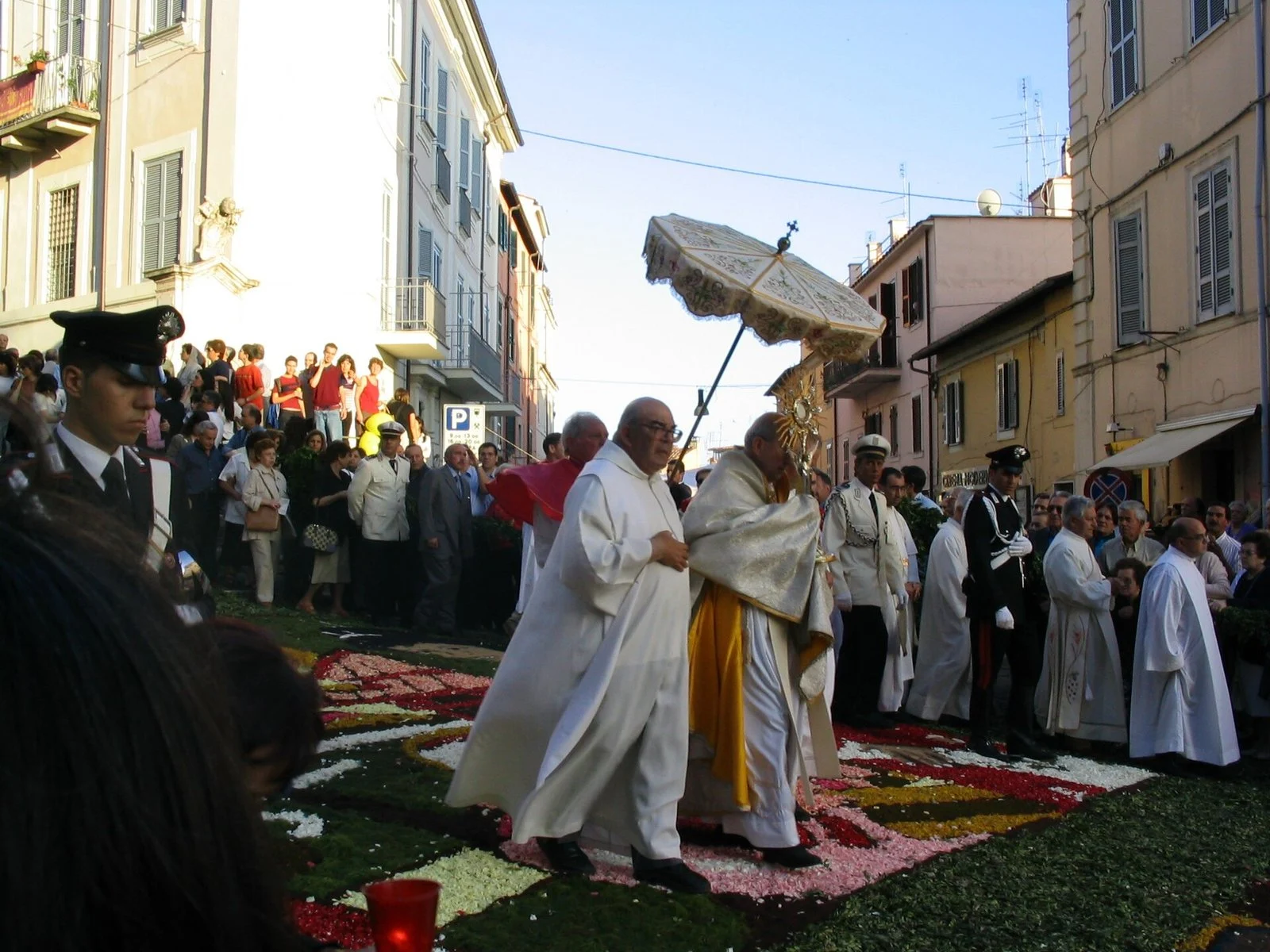
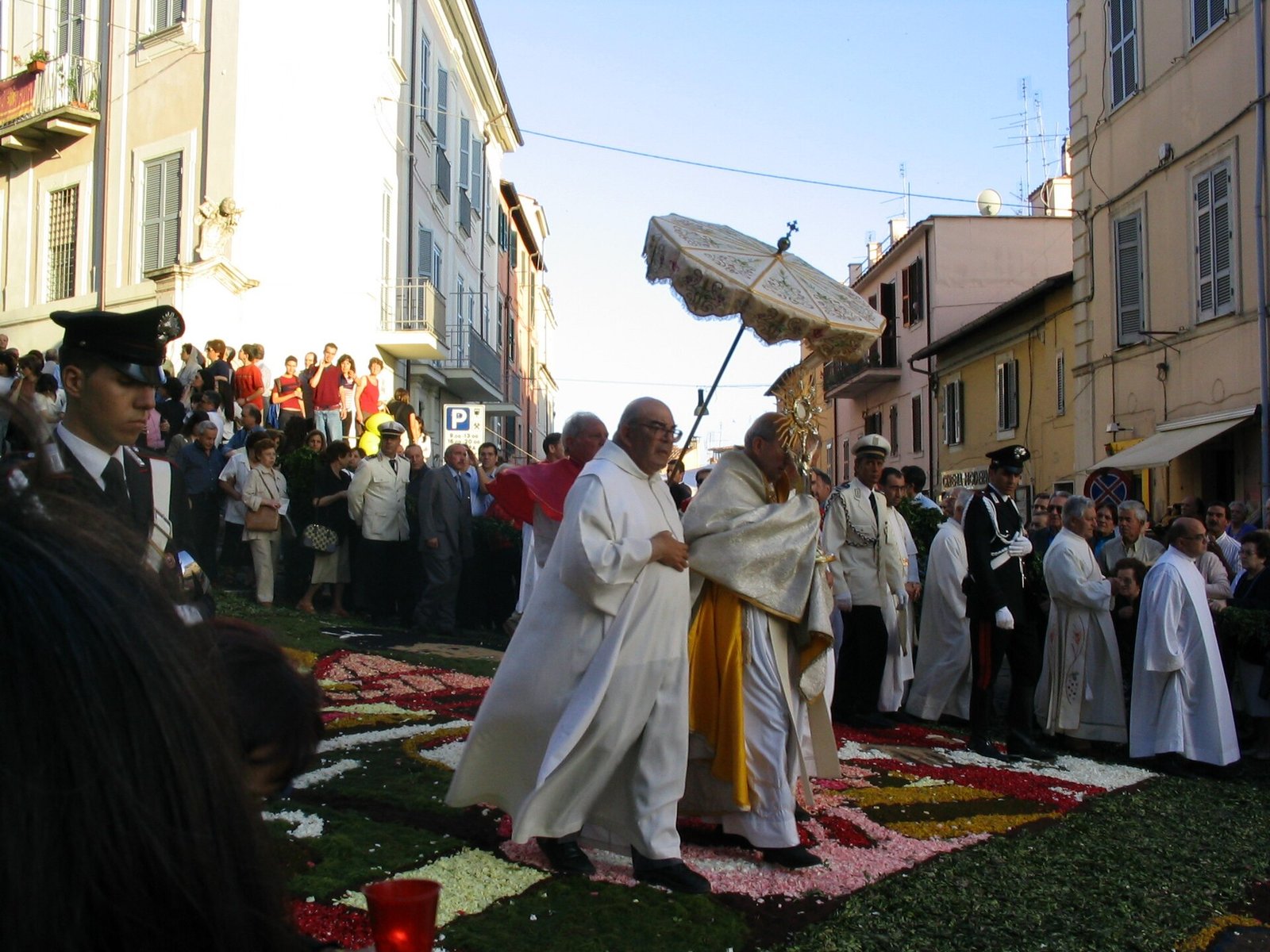
The Infiorata of Genzano di Roma is held for Corpus Domini, that is, the Sunday after the solemnity of the Most Holy Trinity: in practice a weekend between the end of May and the second half of June. The feast of the Santissima Trinità at Vallepietra falls a week earlier. The Passion of Christ at Sezze is on Good Friday. The Carnival of Ronciglione and the Pranzo del Purgatorio at Gradoli depend on Shrove Tuesday and Ash Wednesday. The practical rule is one: first find the date of Easter in the year you're traveling and work out the rest from there.
Where to find the current year's program
The program almost always comes out between two and six weeks beforehand. The sources to check, in order of reliability, are the municipality's website (events or news section), that of the pro loco that organizes, and the VisitLazio portal. For religious feasts it's worth adding the parish or sanctuary, which publish times before the civic programs. We advise not trusting third-party aggregated calendars: they often report dates of past editions, and it happens that a sagra slips by a week without their noticing.
Image: a Lazio village square set up for a traditional festival, with flags, festive lights and the bell tower in the background.
Winter: carnivals, fires and rites of penance
Winter in Lazio concentrates the oldest and least touristy feasts of the region, between January 17, St. Anthony Abbot's day, and Ash Wednesday. It's the season when the farming calendar can still be seen plainly, with very little tourist infrastructure around: blessing of animals, house-to-house collections, collective lunches of the confraternities.
The Carnival of Ronciglione
The Carnival of Ronciglione, in the province of Viterbo, is the most structured carnival event in the region and descends from the Pubbliche allegrezze of the Farnese era, between 1537 and 1649. The first document specifically dedicated to the local carnival is a bishop's edict of January 12, 1748 regulating the use of masks. It takes place on the canonical days of carnival, so on movable dates between the end of January and Shrove Tuesday. The local mask is the Nasi Rossi, established in its current form in 1900: on the Monday of carnival they hand out rigatoni with ragù in terracotta bowls in Piazza della Nave, and the distribution is part of the rite. The Cavalcata degli Ussari, a mounted corps in uniform, is traced by local tradition to 1866 on the basis of oral memory: it is a 20th-century reconstruction and should be taken as such.
The Palio of the Riderless Races
The Barberi races are horse races without a jockey along the town's main street, documented at Ronciglione as early as 1609, when however they were held in August for the feast of St. Bartholomew, and included in the carnival program around 1866. The Palio delle corse a vuoto is listed in the national register of historical reenactments of the Ministry of Culture. Anyone arriving to see them should know that these are a few minutes of racing repeated in several heats, with long waits and a packed crowd along the barriers: the position must be taken early and then not changed. Ronciglione is a little under an hour by car from Rome, about 60 kilometers via the Cassia, and a few minutes from Lake Vico. The Roma Ostiense-Viterbo railway serves the town, but the last useful return has to be checked because the evening runs end late.
The Pranzo del Purgatorio at Gradoli
The Pranzo del Purgatorio of Gradoli, on Lake Bolsena, is held on Ash Wednesday and is one of the very few Lazio feasts with old and continuous documentation: the tradition is traced to the 14th century and a chronicle by the friar Corrado D'Arco of 1560 already attests the Ash Wednesday meal. It is organized by the Fratellanza del Purgatorio, whose hooded members collect offerings among the houses on Shrove Tuesday, offerings then auctioned to finance the lunch. The menu is lean: lake fish, local oil and the beans called del Purgatorio. Participation in the lunch is not open and requires prior agreement with the organizers: whoever arrives without a reservation sees the procession of the hooded but does not sit at the table. Gradoli is about 130 kilometers from Rome, over two hours by car and with no rail connection: it makes sense only by devoting the whole day to the lake, pairing Capodimonte, Valentano or Grotte di Castro.
The March fair at Grottaferrata
The fair of Grottaferrata is the oldest fair event of the Castelli Romani still in operation: the September fair is attested from the second half of the 15th century, the March one from the early 17th, and the formal papal authorization comes with a motu proprio of Clement XIII in 1761. Since 1996 it has been held on an equipped area along Via del Grottino and Viale San Nilo and keeps its twice-yearly rhythm of March and September. It is not a food sagra but a real fair, with farm machinery, crafts and commerce: anyone seeking folklore is disappointed, anyone interested in the economic dimension of the Lazio feasts finds here the best-documented case. It's reached in about 40 minutes from Rome, next to the Greek abbey of San Nilo.
Spring: Holy Week, infiorate and first produce
Between March and June is concentrated the densest part of the Lazio calendar, with three types overlapping in the same weeks: the Passion plays, the Corpus Domini infiorate and the first product sagre. It is also the period when the villages are most practicable.
The Passion of Christ at Sezze
The Sacra Rappresentazione della Passione di Cristo of Sezze, in the province of Latina, takes place on the evening of Good Friday along the streets of the historic center and involves hundreds of local extras, joined by professional actors in some roles. Recent editions exceed the 90th, which places the origin of the event in the first half of the 20th century: it is a modern performance, not a medieval survival, and it is documented in the general catalog of cultural heritage among the ethno-anthropological heritage. Sezze is about 80 kilometers from Rome, an hour and a quarter via the Pontina. The Sezze Romano station on the Naples line is on the plain, far below the historic center on its hill, and requires a connection by road. The visit can be completed with Priverno, Sermoneta, Bassiano and the Ninfa garden, which in spring is at the peak of bloom but requires booking on days with capped numbers.
The Infiorata of Genzano
The Infiorata of Genzano di Roma is held on the Corpus Domini weekend, on a movable date between the end of May and the second half of June, and is the Lazio event that more than any other merits the trip even for those with a single day. On the date of origin the sources don't agree: some trace it to 1778, others to June 6, 1782, the year the carpet covered the whole street for the first time. The practice of the infiorata was in any case born in 17th-century Rome. Since 1875 the infiorata has occupied Via Italo Belardi, formerly Via Livia, the climb linking Piazza IV Novembre to the church of Santa Maria della Cima. The carpet covers about 1890 square meters, is normally composed of 13 pictures and requires around 500 quintals of petals and plant essences.
How you actually see the Infiorata
The sequence is precise: the pictures are composed in the night between Saturday and Sunday, the Corpus Domini procession crosses the carpet on Sunday evening, the carpet is maintained by replacing the wilted petals until Monday evening, when the town's children destroy it in the rite called spallamento. The point almost nobody explains is that the infiorata is looked at in two different ways: from above, from the churchyard of Santa Maria della Cima, you see the overall design, and it's the view of all the photographs. From below you see the petal work but not the composition. On Sunday afternoon the crush along Via Belardi is considerable and access to the viewpoint is regulated: we recommend early Sunday morning, when the colors haven't yet suffered from the sun, or Monday afternoon for the spallamento, the most authentically popular part of the feast. Genzano is a little over 30 kilometers from Rome, 40 minutes via the Appia, but on the day of the infiorata the center is closed: we recommend the Castelli railway line. In the same day you can pair Lake Nemi, Ariccia with Palazzo Chigi, Lanuvio and Velletri.
The Barabbata of Marta, May 14
The Barabbata of Marta, officially the Festa delle Passate, is celebrated on May 14 in honor of the Madonna Santissima del Monte, preceded on the evening of the 13th by solemn vespers, and has been documented since 1557: it is one of the Lazio feasts with the oldest documentation. The procession is organized in productive categories, casenghi, bifolchi, villani and fishermen, accompanied by the band. The Passate are three ritual rounds that the representatives of each category make crossing the sacred area of the church. At the third passage each participant lays a gift on the altar, first fruits, cheese, fish, bread, fruit, and receives a ciambella in exchange. Formal participation in the procession is reserved for men, children included. The reading that traces the feast back to pre-Christian propitiatory rites is widespread in the local literature but cannot be demonstrated from documents. Marta is on the southern shore of Lake Bolsena, 110 kilometers from Rome, an hour and 40 minutes by car: when May 14 falls on a weekday, it stays away from mass tourism.
The Pugnaloni of Acquapendente
At Acquapendente, in the far north of the Tuscia, the feast of the Madonna del Fiore is celebrated in May with the Pugnaloni, large panels composed of leaves and petals on a support, displayed in the center and judged by a jury. The feast is tied to the memory of a civic revolt that local tradition places in the Middle Ages. Acquapendente doesn't have a page on the site but is the first Lazio stop of Via Francigena in Lazio. From Rome it's 140 kilometers, two hours by car.
The Santissima Trinità of Vallepietra
The sanctuary of the Santissima Trinità in Vallepietra stands at 1,337 meters on Monte Autore, on the border between Lazio and Abruzzo, and consists of a cave with an outer structure built against the rock wall. The main festival falls on the weekend of the solemnity of the Holy Trinity, on a movable date between late May and early June, and peaks on Sunday morning with the singing of the Pianto delle Zitelle, performed by young women dressed in white. The text recalls the Passion and tradition traces it back to a very ancient time, while the current form of the performance is documented only in recent times. What sets this festival apart from all the others is the pilgrimage on foot. The faithful climb in groups called compagnie, each led by a standard-bearer, along the trails of Monte Autore, and some start from towns in the Simbruini and Ciociaria areas many hours' walk away. By car it's 80 kilometers from Rome, a good hour and a half through the Aniene valley via Subiaco, with the last stretch on a mountain road regulated by shuttles and closures on festival days. The altitude calls for proper clothing even in late May. Nearby are Trevi nel Lazio, Filettino and Guarcino, from which some compagnie have historically set out.
The Artichokes of Ladispoli and Sezze
Lazio's two artichoke festivals are both held in April. The Sagra del Carciofo Romanesco in Ladispoli, on the coast north of Rome, has reached its 73rd edition, which puts the first one around the early 1950s, and it takes over several squares in the center, including Piazza dei Caduti, Piazza Rossellini and the Nazzareno Fedeli gardens, with producers' stands, cooking demonstrations and shows. The product is the Roman artichoke with protected geographical indication. Ladispoli is 40 kilometers from Rome and is served by the railway line to Civitavecchia. It is the easiest festival to reach by train in all of Lazio. The Sagra del Carciofo in Sezze, in the Lepini mountains, is smaller and has passed its 50th edition. There the mass fair side dominates, here the village side, and the quality of the product on the table doesn't depend on the size of the festival.
The Palio dei Borgia in Nepi
The Palio dei Borgia in Nepi takes place between the end of May and June, over about 10 days spread across three or four weeks, and recalls 1499, the year Alexander VI granted his daughter Lucrezia the lordship of Nepi. The historical parade counts about 400 re-enactors. The program includes the taverns of the four contrade, archery contests, flag games and a final joust. The event is listed in the national register of historical re-enactments of the Ministry of Culture, which gives 1995 as the first edition and describes it as a construction that mixes historical elements and invented traditions. Nepi is 50 kilometers from Rome, 50 minutes along the Cassia bis, and can be combined with Civita Castellana, Calcata and Sutri.
Image: the flower carpet of an infiorata on a street climbing uphill in a Lazio village, with the pictures made of petals and the houses on either side.
Summer: Palii, Shoulder-Carried Machines and Patron Saint Festivals
Between June and early September the calendar fills up with patron saint festivals, palii and re-enactments. It is the most crowded season and the one where quality varies the most. The rule for finding your way is simple: patron saint festivals tied to a fixed date and a procession almost always have a real history, while re-enactments with a grand name and new costumes often don't.
The Sagra delle Fragole in Nemi
The Sagra delle Fragole in Nemi is held on the first Sunday of June and has taken place since 1925. The star is the wild strawberry grown on the shores of the lake, picked between May and October and turned into desserts, preserves, liqueur and craft beer. The folkloric element is the fragolare, the town's girls who parade in costume with a red skirt, black bodice and lace headdress. The legend that links the strawberries to the tears of Venus for the death of Adonis is popular tradition, not history, and fits with the fact that the sanctuary of Diana Nemorensis once stood on the lake. Nemi is 35 kilometers from Rome, less than an hour, but it is a very small town overlooking the crater and parking is the real problem of the day. We recommend leaving the car in Genzano or Velletri and finishing the trip by road transport, or else arriving very early. If you only want to eat the strawberries, the stalls are open on the other weekends of June too.
The Palio del Velluto in Leonessa
The Palio del Velluto in Leonessa, in the Rieti area, takes place around June 29, the feast of Saints Peter and Paul, and is a contest between the town's rioni. Its history comes in two parts: the competition was held without interruption from 1464 to 1556, then stopped for more than four centuries and was revived in 1997. So it is both a documented ancient tradition and a modern re-enactment, and this double nature should be stated more often. The patron saint festival of San Giuseppe da Leonessa falls on the second Sunday of September. Leonessa is 110 kilometers from Rome, two hours along the Salaria, on a plateau at 1,200 meters. Even in late June the evenings are cold. The trip works well by going through Rieti, Cantalice and the sanctuary of Greccio.
The Sagra delle Regne in Minturno
The Sagra delle Regne in Minturno is held on the second Sunday of July in honor of the Madonna delle Grazie and is built entirely around wheat. The word regne comes from the Latin gremia, sheaves. The central moment is the mitituri, the ritual threshing of the wheat, which is then given out to those present, with flag throwers, folk groups and floats decorated with sheaves. It is one of the few harvest festivals in Lazio whose original function can still be read, and it is worth the trip more than many medieval re-enactments. Minturno is 140 kilometers from Rome, an hour and 40 minutes by highway, and is served by the Minturno-Scauri station on the Tyrrhenian line. In the area it combines with Formia, Gaeta, Itri and Campodimele.
The Misteri di Santa Cristina in Bolsena
The Misteri di Santa Cristina take place in Bolsena on July 23 and 24 and are a sacred representation, in living pictures, of the martyrdom of the saint. On the evening of the 23rd the procession with the statue leaves the basilica and reaches the church of the Santissimo Salvatore, stopping in front of each scene set up along the route. On the morning of the 24th it makes the return trip with other pictures. What strikes those who see it for the first time is the prolonged stillness of the participants, who hold their poses for the entire passage of the procession. Bolsena is 120 kilometers from Rome, an hour and 40 minutes along the Cassia. If you stay two days you can use the lake as a base and also see Montefiascone and Civita di Bagnoregio.
The Inchinata in Tivoli
The Inchinata in Tivoli takes place between August 14 and 15 and is a procession of medieval origin that stages the meeting of two ancient sacred images, that of the Savior kept in the cathedral and that of the Madonna kept in Santa Maria Maggiore. The two images are carried toward each other and the culminating moment is the mutual bow that gives the festival its name. It is among the oldest Assumption festivals in Lazio and is not a reconstruction. Tivoli is 30 kilometers from Rome, three quarters of an hour by car and about 50 minutes by train from Tiburtina. The Tivoli calendar also includes the fair of San Giuseppe on March 19, one of the few ancient agricultural fairs that survive, and the procession of the Madonna di Quintiliolo on the first Sunday of May, with flower carpets along the route.
The Palio di San Magno in Anagni
In Anagni the patron saint festivals of San Magno run from August 18 to 26, accompanied by the parade of the medieval contrade. The eight contrade compete in two contests: the archery palio dedicated to Santa Chiara, on August 11, and the ring race, in which horsemen at a gallop must thread progressively smaller rings with the lance in four rounds. The parades recall the episode of the Slap of Anagni of 1303, which is documented history, while the palio format is a contemporary staging. Anagni is 70 kilometers from Rome, an hour by highway. The Anagni-Fiuggi station is on the plain, far from the historic center on the hill, with a road connection. The visit is completed by the cathedral museum of Anagni and its crypt, and the day can widen to Fiuggi or Collepardo.
The Mercatantia in Sutri and the Re-enactments of the Tuscia
The Mercatantia in Sutri is usually held at the end of July, from Friday to Sunday, in the archaeological park of the amphitheater, with games, duels and historical re-enactments in a setting that is worth the visit in itself, because the amphitheater is carved entirely out of tuff. Sutri is an hour from Rome along the Cassia. In the same area the Tuscia offers many re-enactments in summer. In Viterbo there are Ludika, dedicated to historical games, and the historical parade of Santa Rosa, both listed in the national register of historical re-enactments. In Vallerano the Notte delle Candele at the end of August replaces the town's electric lighting with about 100,000 candles. It is a recent event, openly meant as spectacle, not an ancient tradition.
The Wine Fair of Montefiascone
The wine fair of Montefiascone is held every year in August and is dedicated to the Est! Est!! Est!!! wine. The fair in its current form dates to 1958. It is a 20th-century event built on a much older legend, that of the German prelate Johannes Defuk, placed by tradition around 1111, who supposedly liked the local wine so much that he died of it, leaving the city a bequest so that some would be poured on his tomb every year. It is popular tradition, not documented fact, and the fair acknowledges this by re-enacting it in the historical parade. Montefiascone is an hour and a half from Rome and looks down on the lake from above. The view from the rocca dei Papi justifies a stop even outside the fair days.
The Macchina di Santa Rosa in Viterbo, September 3
The transport of the Macchina di Santa Rosa takes place in Viterbo on the evening of September 3, and since 2013 the festival has been on the UNESCO list of intangible cultural heritage, as part of the Network of Italian Shoulder-Carried Big Machines together with the Festa dei Gigli of Nola, the Varia of Palmi and the Discesa dei Candelieri of Sassari. It is the only festival in Lazio with this recognition and the only one for which we think it makes sense to organize a dedicated trip even when starting from far away. The Macchina is a votive structure about 30 meters tall and weighing about five tons, made of light metals and fiberglass, carried on the shoulders by about a hundred men, the Facchini di Santa Rosa, for a little over a kilometer through the historic center, starting around 21:00. The transport recalls the translation of the body of Santa Rosa in 1258. The design is renewed periodically through a public selection, so the structure you see is not the same as 10 years ago.
The site has a dedicated page on this festival, Santa Rosa Machine in Viterbo, which goes into detail on the route, the viewing points and how to get access. Here we limit ourselves to placing it in the regional calendar. The essential practical information is that the historic center is closed in the afternoon, that spots along the route are taken many hours earlier, and that the grandstands, where provided, have limited capacity. Viterbo is 90 kilometers from Rome, an hour and a half along the Cassia, and is connected by rail with Roma Ostiense and Roma Trastevere with considerably longer times. On the evening of September 3 the return by train needs to be checked carefully because the transport ends late.
The Lake Festivals
On the lakes of Lazio, freshwater fish festivals are a genre of their own. In Anguillara Sabazia, on Lake Bracciano, the pro loco organizes the Sagra del Pesce in June, past its 60th edition, with fried small fish and grilled whitefish, and in September the Festa di Settembre with fireworks over the lake. Similar events are held in Trevignano Romano and Bracciano. Anguillara can be reached in 45 minutes by car or on the Roma-Viterbo railway. It is one of the festivals easiest to reach without a car.
Fall: Grapes, Chestnuts, Wine and New Oil
Fall is the season when Lazio is at its best for product festivals, because the harvests arrive almost together: grapes in the Castelli and the Tuscia, chestnuts in the Cimini and Lepini mountains, olives between October and November, mushrooms in the beech and chestnut woods.
The Sagra della Porchetta in Ariccia
The Sagra della Porchetta in Ariccia is held in the first days of September, usually on the first weekend, and has passed its 70th edition. The porchetta of Ariccia is recognized as a protected geographical indication. The central ritual is the handing out of sandwiches, with lines to match. The point we want to make is that in Ariccia you eat porchetta all year round and you eat it well. The fraschette are open on weekends in every season, and anyone looking for the product without the crush does better to choose any Saturday in October. The festival makes sense for those who want to see the celebration, not for those who just want to eat. Ariccia is 28 kilometers from Rome, 40 minutes along the Appia, and combines with Palazzo Chigi, with the monumental bridge and with Albano Laziale, Castel Gandolfo and Lake Albano.
The Sagra dell’Uva in Marino and the Fountain That Gives Wine
The Sagra dell’Uva in Marino is held every first Sunday of October and was established in 1925 on the initiative of the poet Leone Ciprelli. The first edition took place on Sunday, October 4, 1925. So it is a 20th-century festival, although its most famous element is often told as medieval. That element is the so-called miracle of the fountains that give wine. During the sagra the water supply is suspended and wine is fed into the city pipes, and it flows from the fountains in the center. The symbol fountain is that of the Quattro Mori, properly of the Slaves, built in 1636, which depicts chained Turkish figures in memory of Marcantonio Colonna's victory at Lepanto. The practice is not an invention of Marino. In Rome wine flowed from the fountains of the Campidoglio in 1644 and 1670, for papal elections. In Marino it became annual and made the sagra the best known in Italy of this kind.
The recurring program includes the procession in honor of the Madonna del Rosario, the supplica, the historical parade in 16th-century costume systematically revived since 1970, the parade of allegorical floats and the Monday repeat, locally called Sagretta. The practical warning is that the wine flows for a limited and announced stretch of time, not all day long, and that in those minutes the pressure of the crowd around the fountain is considerable. Those traveling with small children will do well to stay at the edges. Marino can be reached in 40 minutes by car or by the train line to Frascati and Velletri as far as the Marino Laziale station, a solution we recommend without hesitation on the day of the sagra.
The Sagra delle Castagne in Soriano nel Cimino
The Sagra delle Castagne in Soriano nel Cimino takes place on the first and second weekends of October and is the main chestnut festival in Lazio. The heart of it is the contest among the town's four contrade, Papacqua, Rocca, Trinità and San Giorgio, and the historical parade Soriano e i suoi Rioni, with more than 500 re-enactors in medieval and Renaissance costume drawn from frescoes and period prints. The reference is the Soriano of the late 1400s and a war episode of 1489. The event is listed in the national register of historical re-enactments of the Ministry of Culture, but it remains a re-enactment. The pairing of a product festival with a costume parade is a 20th-century formula, very widespread in Lazio. The chestnut of the Cimini, on the other hand, is a real product and historically central to the economy of these towns, and in October you find it everywhere between Soriano, Vallerano, Vitorchiano and Caprarola. Soriano is 80 kilometers from Rome, an hour and 20 minutes by car, and the day comes together well by combining Palazzo Farnese in Caprarola or Villa Lante in Bagnaia, both with their own hours and closing days to check before leaving.
The Festa del Vino in Vignanello
In Vignanello, also in the Cimini mountains, the Festa del Vino with historical parade is listed in the national register of historical re-enactments of the Ministry of Culture and is the main wine event of the area. It is a small town and the festival is town-sized. Anyone looking for a big event will be disappointed, and anyone looking for a setting in which to drink the local wine without tourist filters will find what they are looking for. It is 70 kilometers from Rome, an hour and a quarter.
Chestnuts, Mushrooms, Oil and New Wine: The Limits of Verifiability
In autumn Lazio hosts dozens of festivals dedicated to chestnuts, porcini mushrooms, new oil and new wine, and one thing needs to be said frankly here: for many of these there is no stable institutional source certifying their dates and continuity, because they start and stop with the availability of the pro loco. The chestnuts of the Cimini and Lepini mountains, those of Rocca Priora and Monte Compatri, and the mushrooms of the woods of Rocca di Papa and Monte Porzio Catone are real products, but before setting out for a specific festival it's best to check on the website of the comune or the pro loco that this year's edition is really taking place. The same goes for the new oil events, concentrated between late October and November in the olive-growing areas of the Sabina, the Tuscia and the Lepini mountains, and for those of new wine. For the festivals dedicated to fettuccine, often cited as typical of Lazio, there is no established event documented by an institutional source that we can point to with confidence. We prefer to say so rather than report unverified news.
The Broccoletto of Anguillara and the Cherry of Palombara
The broccoletto grown in the Anguillara Sabazia area has a local event at the end of March, which the press places past its 20th edition, but on the pro loco's website the events presented as recurring are the Sagra del Pesce in June and the Festa di Settembre. Anyone who wants to go in spring has to check that the edition is taking place. In Palombara Sabina the Sagra delle Ciliegie is held in June with a parade of allegorical floats and is traced back to 1933. The town has no entry on the site but is in the Roman Sabina, 40 kilometers from Rome, and the outing can widen to Fara in Sabina, the abbey of Farfa, Casperia and Poggio Mirteto. The Palombara calendar also includes San Biagio on February 3 and Sant’Antonio Abate with the blessing of the tractors, a rite held on January 17 in dozens of towns in Lazio.
Image: an autumn festival stall with chestnuts, grapes and demijohns, in a village square at sunset.
Which Festivals Are Really Worth the Trip
Out of more than 300 comuni in Lazio, the events that justify a full day's trip from Rome number fewer than 10. The others are good village festivals, pleasant if you are in the area, but no different from those you find 40 kilometers away. This is the assessment we give to those who ask us to build an itinerary, and it is useful to put it in writing.
The Three to See at Least Once
The first is the transport of the Macchina di Santa Rosa in Viterbo, on September 3. This is for the size of the object carried, for the international recognition and because nothing comparable exists in Lazio. The second is the Infiorata of Genzano on the weekend of Corpus Domini, for the scale of the flower carpet, 1,890 square meters and about 500 quintals of petals, and because it is 40 minutes from Rome. The third is the Barabbata of Marta on May 14, for the opposite reasons: it is small, it is not built for tourism, it has been documented since 1557 and it preserves a ritual structure that has been lost elsewhere.
The Others Worth a Day
Below the first three comes a second group with a good ratio of quality to distance: the Sagra dell’Uva in Marino, for the fountains and because it can be reached by train. The Carnevale of Ronciglione, for the races of the Barberi that you don't see elsewhere in Lazio. The Sagra delle Regne in Minturno, for the ritual threshing of the wheat. The Misteri di Santa Cristina in Bolsena, for the technique of the living pictures. The Inchinata in Tivoli, for the antiquity of the procession. The Pranzo del Purgatorio in Gradoli, provided you book.
Documented Tradition and Reconstructed Tradition
A substantial share of the Lazio festivals presented as very ancient was born or reborn between the 1800s and the 1900s, often to build a local identity for civic or tourist purposes. Saying so takes nothing away. A festival born in 1925 and repeated for a century is in every respect a tradition, but it is a tradition whose inventor is known, and that is more interesting information than the legend that goes with it.
Festivals with Ancient Documentation
The Lazio festivals for which documentation earlier than the 1700s exists are few and easily counted. The Barabbata of Marta is documented since 1557. The Pranzo del Purgatorio in Gradoli appears in a chronicle of 1560 and tradition traces it back to the 1300s. The races of the Barberi in Ronciglione are attested in 1609, though in August and not at carnival time. The September fair of Grottaferrata is attested from the second half of the 1400s. The Palio del Velluto in Leonessa is documented from 1464 to 1556. The transport of the body of Santa Rosa in Viterbo recalls an event of 1258, even though the current Macchina is modern and changes every few years. The Inchinata in Tivoli is of medieval origin and the Infiorata of Genzano dates to the height of the 1700s.
Festivals Refounded or Invented in the 1900s
On the opposite side: the Sagra dell’Uva in Marino was born in 1925 on the initiative of a poet. The Sagra delle Fragole in Nemi in 1925. The mask of the Nasi Rossi in Ronciglione in 1900. The wine fair of Montefiascone in 1958. The Sagra del Carciofo in Ladispoli in the early 1950s. The Sagra delle Ciliegie in Palombara Sabina in 1933. The Passione in Sezze in the first half of the 1900s. The Palio dei Borgia in Nepi in 1995. The Palio del Velluto in Leonessa revived in 1997 after more than four centuries. The historical parade of the Sagra dell’Uva in Marino systematically revived since 1970. It is a list that covers a large part of the best-known events in the region, and the practical consequence for travelers is twofold: a festival built in the 1900s is almost always easier to read and more convenient to watch, because it was designed for an outside audience too, while an ancient festival is harder, longer and less explained, and the participants are not performing.
How to Organize the Day
On the day of the event, the towns of Lazio work differently than usual: closed access roads, full parking, reinforced but irregular public transport, packed restaurants. For the major events the comuni set up park-and-ride lots with shuttles and close the historic center even to residents, with ordinances published a few days earlier on the comune's official notice board and not on tourist portals.
Travel Times from Rome
In ordinary conditions the Castelli Romani, meaning Marino, Genzano, Nemi, Ariccia, Grottaferrata, Castel Gandolfo and Velletri, are between 30 and 50 minutes by car. Tivoli and the lower Aniene valley about three quarters of an hour. The northern coast, Ladispoli, Cerveteri and Civitavecchia, between 40 minutes and an hour. The southern Tuscia, Sutri, Nepi, Ronciglione and Capranica, around an hour. Viterbo and the Cimini mountains, an hour and a half. Lake Bolsena, an hour and 40 minutes. The Ciociaria, from Anagni to Alatri and Veroli, between an hour and an hour and a half. The Rieti area, from Rieti to Cittaducale and Antrodoco, between an hour and a half and two hours. Southern Lazio, from Sperlonga to Gaeta and Minturno, between an hour and a half and an hour and 40 minutes. On the day of the festival add at least 30 or 40 minutes, and in some cases much more.
When the Train Makes Sense
The train is the best solution for a limited but important number of destinations: Marino, Frascati and Velletri in the Castelli, Ladispoli and Civitavecchia on the northern coast, Anguillara and Bracciano on the line to Viterbo, Tivoli on the line to Pescara, Sezze and Minturno on the line to Naples, Anagni on the line to Cassino. Elsewhere the connection requires a change to a road service, and on festival evenings the return times are the main constraint: many Lazio festivals have their culminating moment after 21:00.
Children, Accessibility and Photography
Lazio festivals work for children in the daytime phases and much less in the evening ones, where the density of the crowd is the critical factor: the transport of the Macchina di Santa Rosa, the moment of the fountains in Marino and the races of the Barberi in Ronciglione cannot be managed with a stroller. Accessibility for people with mobility difficulties is generally problematic, because almost all of these historic centers are on hills, with historic paving and steep slopes. Where reserved spots exist they must be requested from the comune in advance. At processions it's best to stay at the edges and not use flash during the rites. For evening festivals more than an hour from Rome we recommend staying overnight in the area, booking well in advance.
Frequently Asked Questions About Lazio Festivals
When are the festivals held in Lazio?
The festivals of Lazio are held all year round, but they cluster between April and June for early produce and between September and November for grapes, chestnuts and oil. Carnival takes up January and February, Holy Week falls between March and April on a movable date, and patron saint festivals are spread across the summer. The most important Lazio festival, the transport of the Macchina di Santa Rosa in Viterbo, always falls on September 3.
What is the most important festival in Lazio?
The most important festival in Lazio is the transport of the Macchina di Santa Rosa in Viterbo, the only event in Lazio on the UNESCO list of intangible cultural heritage since 2013, as part of the Network of Italian Shoulder-Carried Big Machines. It takes place on the evening of September 3. About a hundred facchini carry on their shoulders a structure about 30 meters tall and weighing about five tons for a little over a kilometer through the historic center.
When is the Infiorata of Genzano held?
The Infiorata of Genzano di Roma is held on the weekend of Corpus Domini, so on a movable date between the end of May and the second half of June, along Via Italo Belardi. The flower carpet covers about 1,890 square meters with 13 pictures and requires about 500 quintals of petals. The pictures are composed on Saturday night, the procession passes on Sunday evening, and the spallamento by the children takes place on Monday evening.
Is it true that the fountains give wine in Marino?
At the Sagra dell’Uva in Marino, on the first Sunday of October, wine really does flow from the fountains in the center. During the event the water supply is suspended and wine is fed into the pipes. The symbol fountain is that of the Quattro Mori, from 1636. The wine flows for a limited and announced stretch of time, not for the whole day, and the sagra was established in 1925.
Which Lazio festivals can be reached by train from Rome?
Among the Lazio festivals reachable by train from Rome without a car are the Sagra dell’Uva in Marino, the Sagra del Carciofo Romanesco in Ladispoli, the Sagra del Pesce in Anguillara Sabazia, the Inchinata in Tivoli and the Sagra delle Regne in Minturno. For Viterbo the connection exists but the night return on September 3 should be checked in advance, because the transport of the Macchina ends late.
How do you find the updated program of a Lazio festival?
The program for the current year of a Lazio festival can be found on the institutional website of the comune, in the events or news section, and on the channels of the pro loco that organizes it. The regional portal VisitLazio collects the main events. For religious festivals it's also worth consulting the parish or the sanctuary. Programs usually come out between two and six weeks before the event.
Which Lazio festivals are truly ancient and which were invented in the 1900s?
Among the Lazio festivals with documentation earlier than the 1700s are the Barabbata of Marta, attested since 1557, the Pranzo del Purgatorio in Gradoli, cited in a chronicle of 1560, the races of the Barberi in Ronciglione, documented in 1609, and the fair of Grottaferrata, attested from the 1400s. By contrast, the Sagra dell’Uva in Marino and the Sagra delle Fragole in Nemi, both from 1925, and the Palio dei Borgia in Nepi, from 1995, date to the 1900s.
Who Wrote This Page
This page is maintained by the editorial team of Tour Leader Pro, the Rome-based project office that designs and coordinates visits, itineraries and cultural events in Rome and Lazio. The hours, fares and access conditions given here were checked on the publication date against the official sources named in the text. It's best to recheck them before you go, because they change often. If you find outdated information, let us know.
Anyone building an itinerary in Lazio around a festival, matching the date of the event with visits to the villages, lakes and archaeological sites nearby, may find useful planning tools at Tour Leader Pro, which regularly works on this kind of planning.
For a broader picture of regional transport, rail connections to the Castelli Romani, the Tuscia and southern Lazio, and destinations to pair with a festival day, a good resource is Italy Planner.