Campodimele (LT)
In short. Campodimele (LT) is a town of a little over 500 residents perched on a karst hill between the Ausoni Mountains and the Aurunci, in the province of Latina.
Campodimele (LT) is a town of a little over 500 residents perched on a karst hill between the Ausoni Mountains and the Aurunci, in the province of Latina. The town hall is at Piazza Municipio 4, 04020 Campodimele, phone 0771 598013, email ufficiocultura@comune.campodimele.lt.it. The village has no ticket: walls, alleys, flights of steps and wall walk are free and open at any time, while the churches follow the times of services and it's best to ask at the parish house or at the Comune before going up on purpose. You can only get there by car or private vehicle: the town is served by a single drivable road that branches off the state road of the Liri Valley, the SS 82, and by a second climb, more recently paved, that from the locality of Taverna heads toward the monastery of Sant'Onofrio, with a branch that goes up to the town from near the so-called Bridge of the Witches. From Rome the natural route is the A1 toward Naples, with an exit between Ceprano and Cassino, and then the SS 82 southward. For those coming from the sea the climb starts from Itri and from the Fondi plain. You leave the car in the surface parking lots along the ring road, under the walls: inside the historic center you just walk, because traffic is exclusively pedestrian on streets and flights of steps. In the beach season the Comune runs a shuttle service to the sea at Sperlonga: the times change every year and should be asked at the town hall number. Two hours are enough to visit the village. For the village plus the park trails you need a full day.
Campodimele is part of the Aurunci Mountains district and falls within the Aurunci Mountains Natural Park. If you are building an itinerary in southern Lazio, those two pages are the right container in which to fit this day.

The Cone-Shaped Village: How Campodimele (LT) Is Built
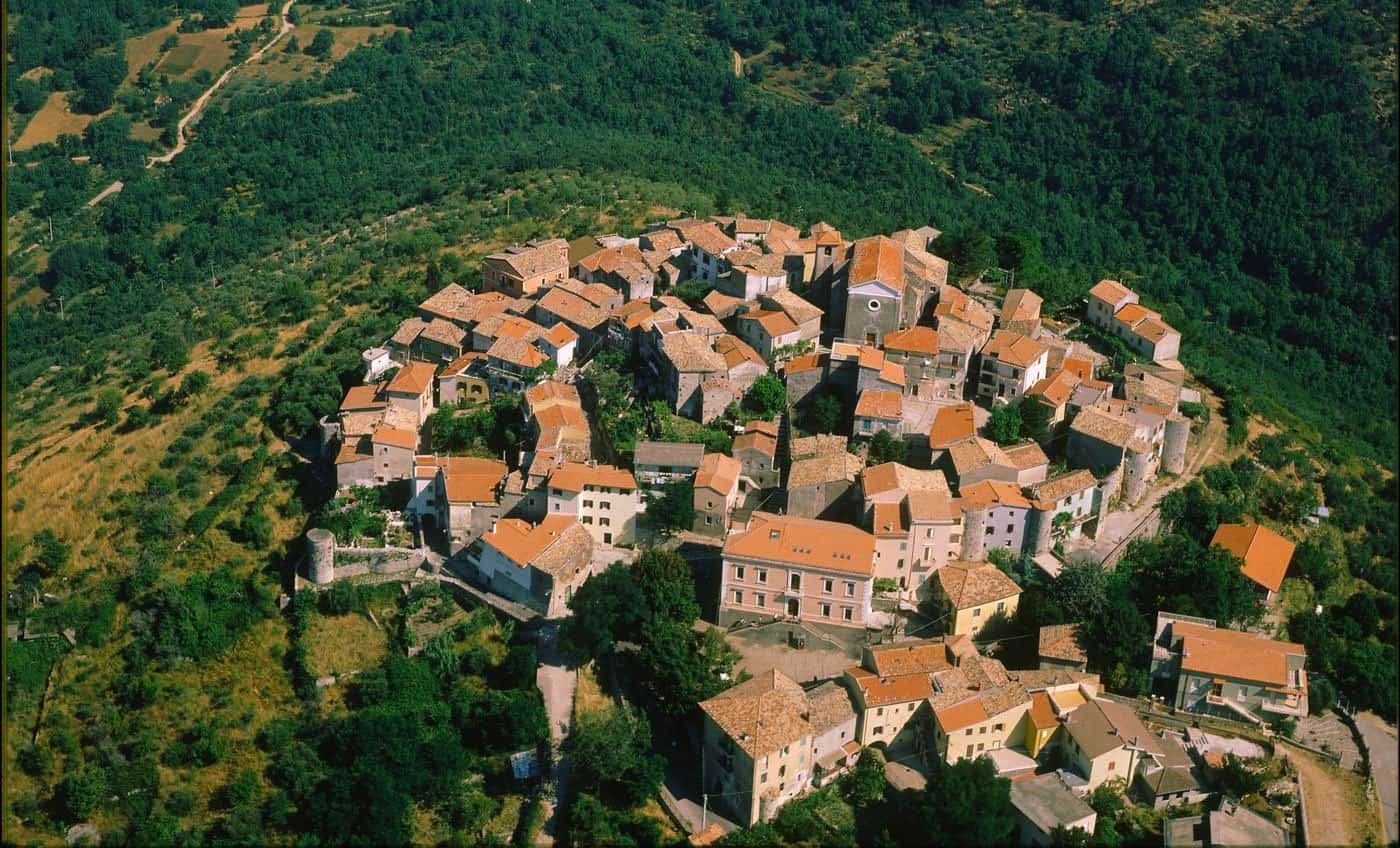
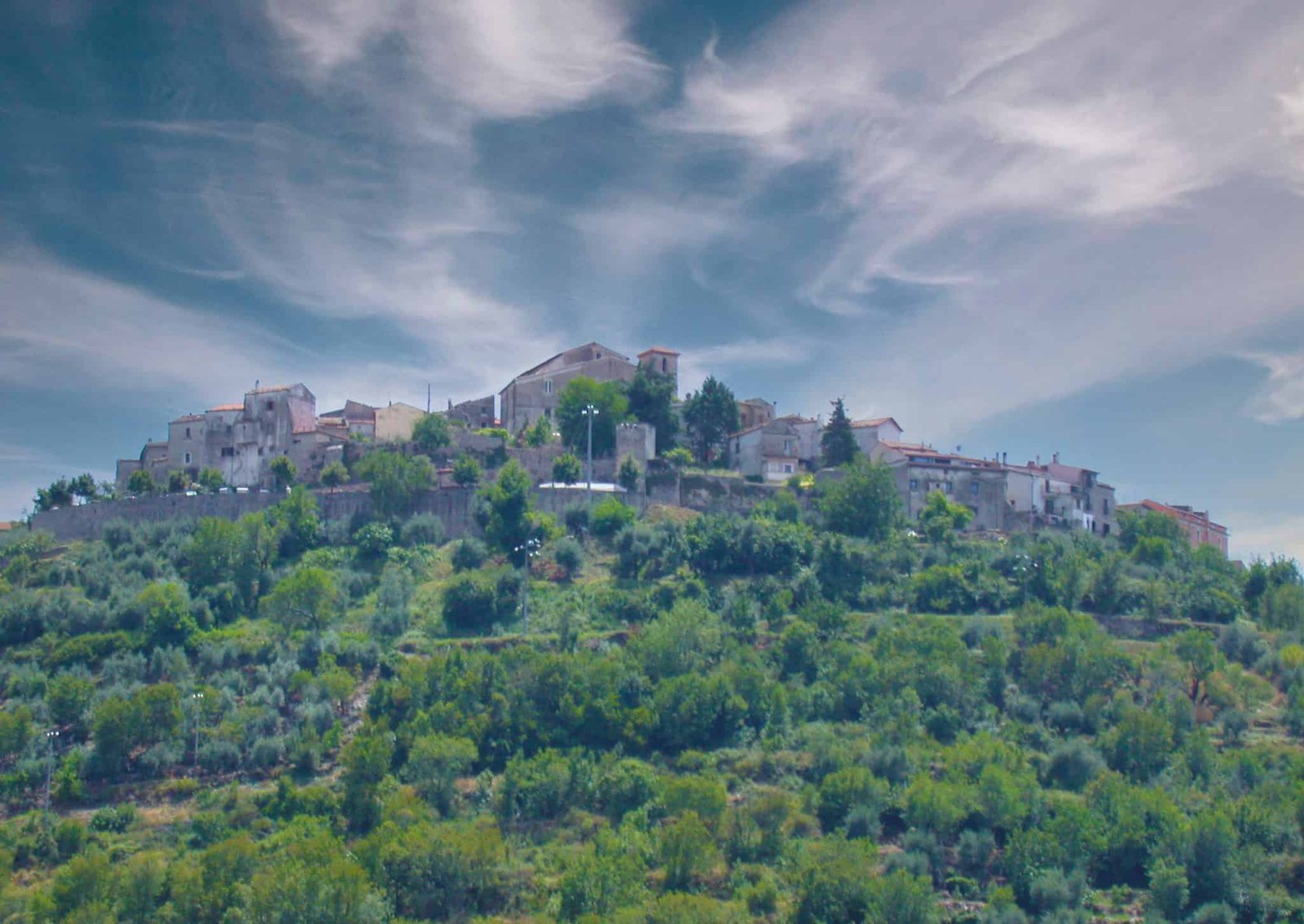
The first thing that strikes you, looking at the town from the road going up, is the geometry. Campodimele presents itself as a compact, uniform cone, an almost perfect circle of houses sloping downward from the bell tower of the parish church, which occupies the summit. The dwellings settle around the internal streets following the lie of the hill, and at the base of the cone runs the city wall, which works at once as foundation, enclosure and parapet. It is not a scenic layout born by chance: it is the form a settlement takes when it must defend itself on all sides and cannot grow in width.
No cars enter inside the walls. The streets are paved with flagstones, often turn into ramps and flights of steps, and the differences in level are handled on foot. It is the reason the center has kept its medieval look better than many nearby villages that sacrificed a square to parking. Without beating around the bush: Campodimele is one of the few villages in southern Lazio where pedestrianization is not a choice of street furniture but a geographic fact, and you can hear it in the silence there is at seven in the evening.
The city wall and the 12 towers
The city wall of Campodimele was built in the 11th century and was equipped with 12 towers. It was not meant to protect a treasure: it was meant to control a road. The route was the one then known as Civita Farnese, the present state road of the Liri Valley, which reconnected with the Appian Way near Itri. On that road, centuries later, the Bourbon troops headed for Isoletta, a hamlet of Arce, on the border between the Kingdom of the Two Sicilies and the Papal State would pass. A fortification like this, on a hill that dominates the passage, is worth more than an isolated castle: it sees anyone coming hours in advance.
The number of towers is confirmed by an archive source worth quoting in full further on, the Apprezzo of 1690, where the town is described as a walled land surrounded by 12 large towers in the ancient style, of almost circular shape. The 17th-century formula says two things in one line: that the towers were already considered ancient at the end of the 1600s and that the circular plan was perceived as the main characteristic of the place. Today not all the towers are legible as independent volumes, because many have been incorporated into houses: you recognize them by the curvature of the wall facing and the thickness of the windows. Look at the corners, not the facades.
The wall walk outside the walls
In the 1990s the village received an important conservative restoration, which put the old wall walk outside the walls back in order. It has become the most beautiful walk in town, and also the most misunderstood: many visitors enter by the gate, tour the center and leave without realizing that the real loop is outside, not inside. The wall walk follows the whole perimeter, stays always at the same level and gives a panorama that changes from quarter to quarter: on one side the Liri valley and the profiles of Cassino, on the other the crown of the Aurunci and, on clear days, the blue slice of the sea toward the Riviera di Ulisse.
The complete loop takes a good 20 minutes walking slowly. It's best to do it counterclockwise, starting from the side facing the mountains and ending on the one facing the sea, so the sunset comes at the end and not in the middle. It's a trifling detail, but it's the difference between a walk and a memory.
Piazza Capocastello and the upper core
The highest point of the town is Piazza Capocastello, the center of the historic core, and you can only reach it on foot. The parish church of San Michele Arcangelo faces onto it, and its bell tower is the signal visible from kilometers away. The place name is transparent: head of the castle, the top of the fortified settlement. Whoever knows the villages of southern Lazio knows that this configuration, church on top and houses in a crown, is typical of centers born as a castrum under the control of an abbey or a county, and Campodimele is both.
The historic center, which preserves a few old churches with some artistic evidence from the 1400s and 1500s, once full of life, is today inhabited by few families and has undergone a complete renovation. This is the sore point and it must be said without hypocrisy: the restoration saved the stones, it did not bring back the inhabitants. Walking there in winter you meet more cats than people. Whoever looks for a lively, noisy village will be disappointed. Whoever looks for an intact and silent medieval layout finds here one of the best in Lazio.
The Churches of Campodimele (LT), One by One
Sant'Onofrio, an anchorite saint, is patron and protector of Campodimele together with the co-patrons San Rocco and San Michele Arcangelo. Three patrons for 500 inhabitants are a precious historical clue: they tell of a community that over time added up different devotions, the eremitic one tied to the monastery, the anti-plague one of San Rocco and the Michaelic one of the Lombards and of the transhumance routes. The town's churches should be read in this order, not in order of size.
The church of San Michele Arcangelo
The parish church stands at the highest point of the town, in Piazza Capocastello. It was built in the 11th century, according to a local tradition on the ruins of a pre-existing pagan temple: the hypothesis of the temple is precisely tradition, not a documented archaeological fact, and should be taken as such. Originally it was known as the church of Sant'Angelo, the simplified form by which San Michele Arcangelo was indicated all over central and southern Italy. The phenomenon is so widespread that it has illustrious parallels: the church of San Michele Arcangelo in Sermoneta, traditionally called Sant'Angelo, and of course Castel Sant'Angelo in Rome, which owes its name to the apparition of the archangel on the Hadrianic mausoleum.
The church was damaged by an earthquake, closed to worship and then restored in 1939. The Comune and the Province then gave it a bronze portal, which is the most recent element and the first you see arriving in the square. Said frankly: the modern portal is the least interesting thing about the building, and many visitors stop there to photograph it without going in. Inside there is better.
The tabernacle of the Malvito school and the painting by Gabriele da Feltre
Inside the parish church are kept the remains of a valuable marble tabernacle from the school of Tommaso Malvito, an artist working in Naples between the end of the 15th and the early 16th century. The attribution is to the school, not to the master's hand: the distinction matters, because Malvito was the great organizer of Neapolitan Renaissance marble sculpture, with a very large workshop that spread his repertoire throughout the Kingdom. Finding a fragment of that production in a mountain town means that Campodimele, in the 1500s, was inside a Neapolitan artistic circuit and not at the margins of the world. It is the most interesting fact about the whole church and nobody tells it.
Beside it, a painting signed by Gabriele da Feltre and dated 1578. A signature and a date are a luxury in a context like this: the vast majority of works in these towns are anonymous and of uncertain date, here we have both pieces of information written on the canvas. In the early 1900s the wooden statue representing Sant'Onofrio scantily clad was then moved here, from the monastery of the same name. The saint's partial nudity is not a whim of the carver: Onofrio, a hermit in the Egyptian desert, is traditionally depicted covered only by his own hair and a belt of leaves, and he is one of the most recognizable saints of the Eastern iconography that passed to the West.
The monastery of Sant'Onofrio
The foundation of the monastery of Sant'Onofrio dates to the 11th century and is due to the very active abbot Desiderius of Montecassino, who entrusted its material execution to the prior Gerard of Pico. Desiderius is the key figure in the whole story of this territory: abbot of Montecassino from 1058, promoter of the abbey's greatest building season, and then pope with the name of Victor III. That a man of that stature laid his hand on a hermitage in these mountains says how much the guarding of the routes between the Liri Valley and the sea mattered to Montecassino.
The complex, originally built in an isolated area, was made up of a single-nave church with attached a series of small rooms that served as lodgings for the hermitage. The type is that of the cenobitic hermitage: not an abbey with a cloister and a monumental refectory, but a minimal core where a few religious lived in separate cells and met only for the liturgy. Partly destroyed during the Second World War, the monastery was restored and rebuilt in the ruined part in the 1980s, and today it is a destination for pilgrims and groups of visitors. You get there by the second road, the one that starts from the locality of Taverna.
A professional's advice: go to the monastery early in the morning or in the late afternoon. At midday the flat light flattens even the landscape, and the value of the place is all in the relationship between the low building and the mountain that towers over it.

The church of the Annunziata
The church of the Annunziata dates to the 13th century and is currently deconsecrated. It is the building that best tells the town's demographic arc: a church built when the village inside the walls needed more places of worship, and abandoned when the inhabitants were no longer enough to fill one. The churches of the Annunziata, in this part of Lazio and in all of Terra di Lavoro, were often tied to lay confraternities that ran assistance to the poor and to pilgrims. The connection with the hospitals mentioned in the 17th-century description of the town is not proven, but it is the most likely track.
The chapel of the Madonna delle Grazie
The chapel of the Madonna delle Grazie is from the 16th century. It is to be looked for in the Taverna area, at the foot of the climb, where over time a second settled core formed along the road. Roadside chapels like this are born for a precise function: to give a place of rest and prayer to whoever travels, before taking on the uncomfortable stretch. If you have a few minutes, look at the relationship between the chapel and the roadway: that is where the original function can be read.
The little church of the Madonna del Rosario at Taverna
The little church of the Madonna del Rosario was built in the postwar period, also in the locality of Taverna. It is the most recent of the territory's churches and the least conspicuous, but it has a documentary value that escapes notice: it is the built proof of reconstruction, of a community that after the destruction of 1944 considered it necessary to rebuild first of all a place of worship down below, where the younger part of the population now lived. Whoever reads a town only through its ancient monuments loses half the story.
The Monuments and Plaques of Campodimele (LT)
Campodimele has a density of public monuments out of proportion to its population, and this is already a fact that tells something. A town that is losing population and keeps commissioning bronzes and mosaics is a town with a strong relationship to those who left and that uses public space as a place of memory. The complete list includes the War Memorial, the Monument to the Emigrant, the Monument to San Pio da Pietrelcina, the Monument to the Shepherd, a majolica mosaic, the plaque of the miracle of 1858, the plaques of the Passionist missions and those of the war events and of the War Merit Medal awarded to the town's gonfalone.
The Monument to the Emigrant
The Monument to the Emigrant is a mosaic by Giovanni Repossi. In the context of Campodimele it is the most significant monument of all, more than the statue of San Pio and more than the war memorial, because it touches the raw nerve of the town's recent history: the departure of whole families for England, Brazil and above all Canada. A mosaic, then, is not a neutral choice: it is a slow technique, made of tesserae set side by side one at a time, and as a metaphor for a community putting itself back together piece by piece far from home it works better than any speech.
San Pio, the shepherd and the sculptor Salvatore Incorpora
Two bronzes in the town bear the signature of the same author, the sculptor Salvatore Incorpora of Catania: the Monument to San Pio da Pietrelcina and the Monument to the Shepherd. The pair is interesting because it lines up the two parallel devotions of a mountain town, the religious one of the 1900s and the one for the trade that fed the community for centuries. The shepherd, in particular, should be looked at while thinking of the 25 kilometers of trails that still today cross the municipal woods: those are not tourist trails invented at a desk, they are transhumance and work routes converted.
The majolica mosaic and the fresco by Egnazio Danti
The majolica mosaic by Laura Supino reproduces the 16th-century fresco by Egnazio Danti preserved in the Vatican. An explanation is needed here, because Danti's name says little to those who don't follow the history of cartography. Egnazio Danti, a Dominican from Perugia, mathematician and cosmographer, was the author of the cycle of geographical maps painted in the Vatican Gallery at the wish of Pope Gregory XIII between 1580 and 1585: 40 panels representing Italy region by region, with a precision that had no equal at the time. That a town of 500 souls wanted to reproduce in majolica its own piece of that map is a gesture of highly refined territorial pride. It means saying: we were already there, painted on the Pope's wall.
The plaques: the miracle of 1858 and the memory of war
A plaque recalls the miracle performed in 1858 by Saint Paul of the Cross in favor of Rosa D'Alena. A point of chronology must be clarified that almost nobody notices: Paul of the Cross, founder of the Passionists, died in 1775, so the 1858 event is an event attributed to his intercession, not an episode of his life. The link with the Passionists also explains the different commemorative plaques scattered in different places of the territory in memory of their missions: the congregation, rooted in the mountains between southern Lazio and Ciociaria, for two centuries traveled through these towns with cycles of preaching that lasted weeks and left a mark carved in stone, literally.
The picture is completed by the commemorative plaques of the war events and of the awarding of the War Merit Medal to the town's gonfalone. A decorated gonfalone is not a formal recognition handed out liberally: it is granted to municipalities that suffered very serious damage and documented civilian losses. In the case of Campodimele, what happened between January and May of 1944 amply justifies it.
The History of Campodimele (LT) from the Origins to 1934
Apiolae, a tradition to dismantle
The origin of the settlement is attributed by an obsolete 18th-century tradition to the survivors of the ancient Latin city of Apiolae, mentioned by Pliny the Elder in the Naturalis Historia (III, 5) and by Livy (1, 5) as conquered and destroyed in the 6th century BC by Tarquinius Priscus, fifth king of Rome. The tradition is precisely a scholarly tradition of the modern age and should be considered unfounded: Apiolae was in all probability in inland southern Lazio, but no element connects it to this hill.
Equally unfounded is the etymological hypothesis according to which the name Apiolae would derive from bees and would then have turned into Campus Mellis, that is, Field of Honey. It is an elegant false etymology and makes a good effect on brochures, but it does not stand up to the test of documents: in medieval records the name appears as Campo de Melle, and the passage from a hypothetical classical Latin to that form cannot be reconstructed. I say it as a place-name enthusiast: etymologies that explain too well are almost always invented after the fact.
1072, 1087 and the Terra Sancti Benedicti
The first certain records of an inhabited and fortified center with this name date to 1072, when the counts of Fondi donated their possessions, among them Campo de Melle and the convent of Sant'Onofrio, to the monastery of Montecassino. 15 years later, in 1087, Abbot Desiderius, who had become Pope Victor III, had carved on the portal of the Cassino basilica, still existing, the name of S. Onophrius de Campo de Melle together with that of all the other possessions acquired by the Terra Sancti Benedicti. This is the most important document concerning Campodimele, and it is not in Campodimele: it is carved in stone at the entrance of Montecassino. Whoever visits the abbey can read the town's name in a list from the 11th century.
In 1158, in a bull of Pope Adrian IV, Campodimele is cited among the towns that were to remain in perpetuity in the diocese of Gaeta. The legal formula served to close a dispute: among abbeys, bishoprics and feudal lords, the ownership of mountain churches was a quarrelsome and profitable matter, and a papal bull was the surest way to put an end to it.
From the Dell'Aquila to the Caetani, from the Colonna to the Di Sangro
The castrum of Campodimele was part of the Duchy of Fondi until 1140, the year in which it was placed within the County of Fondi, a fief of the Norman Dell'Aquila family. In 1298 it passed to the Caetani family, the house of Pope Boniface VIII that in those same decades was building its territorial domain between Sermoneta, Fondi and the Pontine plain. In 1384 Onorato I Caetani took over the administration on behalf of Louis II of Anjou: we are in the midst of the Western Schism, and Fondi is the city where in 1378 the antipope Clement VII had been elected. Campodimele, in its small way, was inside one of the hottest political junctions in Europe.
The town was included in the province of Terra di Lavoro. In 1497 the territory of the entire county of Fondi was granted by the king of Naples to General Prospero Colonna as a reward for the loyalty shown. At the beginning of the 17th century the town, formerly a Gonzaga domain, became the property of the Carafa of Stigliano. In 1647 it was bought by donna Maddalena Miroballo, wife of Troiano, to obtain the title over said land, as the document says. The phrase deserves attention: a town was bought to buy a noble title, and indeed in 1674 donna Maddalena sold the fief back to the Carafa for 5,000 ducats, but the Miroballo family kept using and passed on to their heirs the title of Duke of Campomele. The town went back, the title did not.
On the death of the last heir of the princes of Stigliano, the richest feudal lord of the Kingdom of Naples, in 1689 the entire district of the county of Fondi was forfeited to the treasury, and the king gave it in 1690 to the Austrian Mansfeld family with the title of prince. In 1721 we find Campodimele among the fiefs of the Di Sangro family, which acquired the title of prince of Fondi. In 150 years the town changes master seven times without any of these masters ever having set foot in it for good: it is the very definition of an income fief.
The town in the Apprezzo of 1690
The Apprezzo of 1690 is the document that lets you see Campodimele as in a photograph. An apprezzo was the appraisal survey of a fief, drawn up by technicians appointed by the court on the occasion of a sale: it described the territory, the revenues, the buildings and the inhabitants with a fiscal precision that no chronicle of the time reaches. From that document we know that Campodimele was a walled land surrounded by 12 large towers in the ancient style, of almost circular shape, and that the government of the municipality was entrusted to a judge, a syndic and eight councilors. There was a main church with eight altars, besides four chapels, two of them with a hospital.
On the condition of the inhabitants the Apprezzo is merciless and is worth reading in full: in said land there are no wealthy persons, nor doctor, nor apothecary, nor laborer, nor is there any artisan, only there is a barber. There are no shops of any kind and what they need they get from the neighboring lands. All are poor and work at cultivating the fields and other country trades, and the women help their husbands. They dress generally all in wool and almost all sleep on straw mattresses. The grain the territory produces they sell to pay the taxes, and for most of the year they eat bread of Indian corn and millet.
Two details of that text deserve a note, because it is here that Campodimele's longevity stops being a legend and becomes the history of food. The first: the inhabitants sold the grain to pay taxes and ate bread of Indian corn, that is, maize, and millet. The second: the diet was of necessity poor in animal fats and rich in minor cereals and legumes. What is celebrated today as the longevity diet was born from a condition of extreme poverty, not from a health choice. Anyone who sells Campodimele as a food paradise without saying this is telling half the truth.
The inhabitants were about 800, more than today, considering that they were taxed for about 150 fuochi, that is, families, at the time large and including servants and workers. According to a document of 1701, the feudal and burgensatic revenues, net of expenses and of the adoa, were 173 ducats and 3 tarì. The adoa was the tribute the feudal lord paid to the sovereign in place of military service: so low a figure says that Campodimele, for its lord, was a prestige property more than a source of income.
From the Bourbons to the province of Latina
Following the abolition of the feudal system in 1806, Campodimele was placed in the new municipal order. During the Bourbon era Ferdinand II used to stop there to visit the nearby sanctuaries of the Madonna della Civita, above Itri, of Sant'Onofrio and of San Michele Arcangelo. The king took care of improving the road links between the municipalities of Itri and Campodimele, Pico and others, and of building new churches, coming personally to inaugurate the works.
After the fall of the Kingdom of the Two Sicilies and the realization of Italian Unity, Campodimele, reconfirmed as an autonomous municipality, was part of the mandamento of Fondi, of the district of Gaeta and of the province of Terra di Lavoro, with first Capua and then Caserta as capital. In 1927 it became part of the province of Rome, and stayed there until 1934, the year in which the current province of Latina was established. Seven years as a municipality of the province of Rome are an administrative detail that explains a lot about the way this town looks at once toward Naples, toward Ciociaria and toward the capital.
Banditry in the Mountains of Campodimele (LT)
The territory of Campodimele was long traversed by brigands, favored by the dense woods that allowed hiding and escape toward the so-called No Man's Land, the strip on the border between the Kingdom of Naples and the Papal State where neither police force had full authority to operate. Whoever visits these mountains thinking of an uninhabited scrubland gets the picture wrong: it was a highway of smuggling and fugitives, with logistic bases, informers in the towns and carefully planned escape routes.
The brigands' serra at Campolevole
There still exists, near the locality of Campolevole, which means Hare's Field, on the border with the municipality of Esperia, the so-called serra of the brigands, also called the thieves' cistern: a peak on the ridge of Monte Mandrone surrounded by dense undergrowth, where the outlaws built a circular fortification of dry-stone walls, about six meters in diameter, from which the plateau below was dominated and a defense could be organized. Six meters in diameter is very little: not a camp, but a guard post and a last-resistance position.
On the ridge of Monte Fontanino, on the border with the territory of Pico, opens a deep cave called the lair of Garofalo, from the name of a famous gang leader. There is also a Monte Sant'Olivo, which recalls another well-known brigand. The place names of these mountains are an open-air court chronicle: if a relief bears the name of an outlaw, that outlaw lived there long enough to enter the language of the shepherds.
Among the brigands who roamed the territory are remembered Antonio Gasbarrone of Sonnino, Alessandro Massaroni of Vallecorsa, Gaetano Mammone of Sora, Angelo Ferro of Sant'Oliva and Michele Pezza of Itri, much better known as Fra Diavolo. The latter is the only one who had a second literary and musical life, with Auber's comic opera of 1830 that turned him into an almost likeable character: his true story, made of anti-French guerrilla warfare and an execution in Naples in 1806, was much less romantic.
Chiavone, May 13, 1861
On the stump of this pre-existing criminal phenomenon the pseudo-political formations were grafted in the wake of the surrender of Gaeta. On May 13, 1861 a group of nostalgic brigands, led by Luigi Alonzi of Sora, known as Chiavone, came in the name of Bourbon loyalism to invade Campodimele, Lenola and Monte San Biagio. At Campodimele the brigands ransacked the town hall, took the portraits of Victor Emmanuel II and Garibaldi off the walls to replace them with those of Francis II and Maria Sophie, declared the new unitary kingdom fallen and restored the Bourbon one. The restoration lasted the time of an afternoon, but the scene of the portraits torn from the wall is the most effective picture of what the civil war of 1861 in the South really was.
The phenomenon of banditry, organized in the Ausoni, Aurunci and Lepini mountains, took on dimensions so serious that the Italian army did not go lightly on repression: in a single semester of 1861, 278 brigands were captured, killed in firefights or shot. Many of these were in perfectly good faith, many others put on legitimist clothing for strictly personal ends. There is no honest way to tell this story by choosing only one side, and anyone who tries, from one side or the other, is selling ideology.
Even a few natives of Campodimele found themselves involved, as shown by the arrest at Isoletta of one Falora Michele son of Giuseppe of Campo di Mele, aged 37, who in the telegram sent to the Prefect of Sora on October 27, 1863 is recorded as handed over by the French troops to our Military Command of the zone, for immediate transfer to the Tribunal of Gaeta. One detail should be underlined because it almost always escapes notice: the French troops. In 1863 the French garrison was in the Papal State in defense of Pius IX, and handed the brigands captured across the border over to the Italian army. The two powers detested each other and cooperated.
Pietro Garofalo and the capture of 1869
Apart from the raids of other legitimist bands, among them those of Giuseppe Antonio Conte of Fondi and Francesco Piazza of Mola, that is, of Formia, called Cuccitto, Campodimele was often a refuge for the gang leader Pietro Garofalo and his mistress, his companion. The two used different hiding places both in the town and in the surrounding mountains and were accompanied by many followers. The fact that a wanted fugitive could sleep inside the town, and not only in the woods, says everything about the relations between brigands and community: complicity, fear, kinship, all three together.
The National Guard, led by the mayor of Campodimele, on May 2, 1868 managed to arrest the brigand Giuseppe Cutrozzola of Messina, who was part of the band. The leader and his woman were instead captured by the Carabinieri on the night of March 30, 1869, after a firefight and a hard scuffle, in a house of the medieval village. That house is still there, inside the circle of the walls: it is not marked by any plaque and no guide points it out, but the episode is documented and effectively closes the season of local banditry.
Campodimele (LT) and the Second World War
The Gustav Line and the deportation of January 10, 1944
After the armistice of September 8, 1943 the Gustav Line, the German defensive system that was to halt the Allied advance toward Rome, ran right through the territory of Campodimele. From its heights the Germans controlled the Liri Valley and the communication routes between the Tyrrhenian Sea and the Frosinone hinterland: the position that for a thousand years had been a defensive resource became, in a few months, a sentence.
The consequence came on January 10, 1944 with the deportation of 700 inhabitants out of 1,400, that is, exactly half the population. Then came the abuses, the miseries and the bombings that characterized the Cassino front: in that context the monastery of Sant'Onofrio was destroyed. Finally, with the breaking of the front, the violence and rapes committed by the Moroccan units of the French Expeditionary Corps, who together with the Anglo-Americans conquered Monte Faggeto and then Campodimele between May 18 and 20, 1944.
La Ciociara, Moravia and the days of May
Those episodes provided the spark for the novel La Ciociara by Alberto Moravia, who in that period was displaced on a mountain between Fondi and Campodimele. The novel came out in 1957 and in 1960 became the Vittorio De Sica film that earned Sophia Loren the Oscar for best actress, the first case of a non-English-language performance awarded in that category. The link between this territory and one of the highest moments of Italian cinema is documented and direct, and it is surprising how little it is promoted on site.
A methodological warning, because one slips easily here: the novel is fiction built on a real experience, and the places described by Moravia cannot be mapped one by one. Whoever promises the exact trail where Moravia hid is improvising. What can be said with certainty is that the writer spent the months of displacement in the mountains between Fondi and Campodimele and that the book came from there.
Emigration and the Campodimele Social Club of Toronto
After the devastation of the war many families decided to emigrate to England, Brazil and above all Canada, where other fellow townspeople and people from Ciociaria had preceded them. The phenomenon gradually eased, but the residents kept dwindling and the emergencies tied to the economic crisis, the abandonment of the land and unemployment became pressing. Attempts were made to remedy the decline in inhabitants with several initiatives, which however did not turn out well.
At the same time the dozens of families who arrived in Canada from Campodimele have multiplied, passing 2,000 people in Toronto alone, and in 1976 the Campodimele Social Club was formed in that city, with about 1,000 members, to reaffirm the traditions of the town of origin, strengthen ties with the citizens of the motherland and give vigor to the devotion to Sant'Onofrio. Several families have made their fortune and many return to the town every year, particularly in August. It is the reason Campodimele has two demographics: the registry one, tiny, and the emotional one, which in August triples the people in the alleys and in which you hear English spoken with a Canadian accent.
The Longevity of Campodimele (LT): What the Studies Really Say
Campodimele has been called the city of longevity since 1985, when international attention focused on the clinical values of its inhabitants. The datum that made the news concerned cholesterol, measured at levels much lower than the national average, and blood pressure lower than expected even at an advanced age. Later studies have also reported favorable values for triglycerides. Among the researchers who dealt with it, Pietro Cugini of La Sapienza University of Rome is remembered. Since then scientists, doctors, university professors, journalists and plain curious people from all over the world have come up here looking for an explanation.
The explanation the inhabitants have always given is a set of factors: the fresh, oxygen-rich air that rises from the sea and reaches the mountain, the uncontaminated nature, a diet rich in legumes and an active, simple lifestyle, made of daily uphill walks because here there is no flat stretch. On this point it's worth being clear: the sturdiest hypothesis is neither the air nor a miracle food, but the combination of constant and involuntary physical activity, a diet low in animal protein and social cohesion. An elderly person who lives in a town where everybody knows everybody and where to buy bread he has to climb 50 steps does, without knowing it, exactly what a geriatrician would prescribe.
On the numbers, caution is in order. Over the years very high percentages of people over 80 have circulated, partly unsustainable: today the people over 80 registered in the registry are a few dozen, and some of them don't live in town all year. The centenarians too, who in the past were the attraction of the place, have dwindled, and some have moved in with their children in bigger cities. It's not a refutation of the town's fame, it's the normal evolution of a very small community in which the passing of two people changes the statistics. Whoever comes here expecting a village full of centenarians will be disappointed. Whoever comes to understand how to age well will find a lot to observe.
The most concrete recognition the town has received is of a tourist nature: Campodimele is awarded the Orange Flag of the Touring Club Italiano, a tourist-environmental quality mark assigned to inland localities that combine a valuable historical, cultural and environmental heritage with a real capacity to welcome visitors. The Orange Flag must be renewed periodically through a new assessment, so it is a living recognition and not a title acquired once and for all.
The Aurunci Mountains Natural Park and the Trails of Campodimele (LT)
The municipal territory falls within the Regional Natural Park of the Aurunci Mountains, one of the largest parks in Lazio and one of the least visited in relation to what it offers. The authority organizes guided hikes and environmental education programs. The up-to-date reference for dates, meeting points and availability is the park authority's website, parcoaurunci.it. If you want to walk with a guide, move early: the outings have limited places and fill up in spring.
The 25 kilometers of trails and Monte Le Vele
In the territory of Campodimele 25 kilometers of trails have been equipped in the woods. It is not a high-mountain network: they are mid-slope routes, mostly in the shade, tackled with light hiking shoes and water in tow. From the locality of Crocette, following a trail marked by a park sign, you reach Monte Le Vele. It is the town's signature hike and the one I recommend to those with half a day: you climb among beeches and hornbeams, come out on an open ridge and the panorama covers in one sweep the inland valley and the line of the sea.
A practical warning nobody gives: the signage in the Aurunci woods is uneven and in some stretches faded. Bring a track downloaded on your phone and don't count on network coverage, which often drops out here. In summer set out very early, because on the south-facing slope after 10 a.m. you really suffer.
The breeding center for deer, fallow deer and roe deer
Campodimele hosts a breeding center for fallow deer, red deer and roe deer in the wild state, created with species conservation aims. It is a fenced area of large size, where the animals live in semi-natural conditions: it is not a zoo and should not be described as such. For children it is the most memorable point of the day, with the warning not to expect guaranteed sightings, because the animals move around and in the middle hours take refuge in the shade where they can't be seen. Better first thing in the morning or the last hour of light, as always with ungulates.
In the surroundings, still within the range of a day trip, there are two other natural places that complete the day well: the Natural Monument Mola della Corte, Settecannelle and Capodacqua and the Falvaterra and Rio Obaco Caves, where the visit is guided and must be booked.
What to Eat in Campodimele (LT)
The town's signature product is the cicerchia, an ancient legume grown here in a local variety that was recovered after nearly disappearing. The cicerchia is a rustic plant, resistant to drought, that gives a harvest even on lean soil: for this reason it fed mountain communities for centuries and for this reason it was abandoned as soon as agriculture became mechanized, because it yields little and requires manual work. It is eaten in soup, with a drizzle of raw oil, and has a more decided flavor than the chickpea, slightly bitterish.
Alongside the cicerchia the territory produces shallots, mostly for family consumption, other legumes and olive oil, often from olive groves run without fertilizers because on these slopes you can't get there with machinery. Mutton and goat meat complete the picture, and it is no accident that the town dedicates a contest to the most beautiful goat and sheep of the Aurunci.
An honest warning about dining: Campodimele is a very small town and the restaurant offer is limited and variable over time. I don't give names of places I can't guarantee are open at the moment you read this. It's best to phone in advance, ask the Comune at 0771 598013 or plan to have lunch in Fondi, in Itri or on the coast. Whoever goes up in winter on a weekday seriously risks finding everything closed, and it's not a figure of speech.
The Festivals and Contests of the Year
The town's calendar revolves around three traditional events. In May the Festival della Fiaba e del Racconto takes place, bringing storytellers and workshops for children to the town. Also in May the Fauna Nostra contest is held, dedicated to electing the most beautiful goat and the most beautiful sheep of the Aurunci Mountains: it seems a folkloric curiosity and instead it is a serious livestock show, in which breeders compare the genetic lines of the animals. In August comes the Concorso Nazionale di Poesia Portico di Onofrio, which dedicates to the patron saint the town's longest-running cultural event.
In August is also concentrated the return of emigrants and their descendants, in particular from Canada, and the devotion to Sant'Onofrio reaches the highest point of the year. The exact dates of the events change from season to season and are published by the Comune on its website, comune.campodimele.lt.it: before planning a trip around one of these festivals, check there.
Of the three, the one that truly deserves the trip is Fauna Nostra. It is the only one that shows the town at work and not the town in the shop window, and for those who want to understand the mountains of Lazio it is worth more than 10 sagre.

What Is Around Campodimele (LT)
Campodimele works very well as a piece of a wider itinerary, and badly as the only destination for a whole day if you don't hike. The most interesting nearby places are the coastal centers of southern Lazio, first of all Gaeta and Formia, with the whole Riviera di Ulisse and the beaches of Sperlonga. Toward the interior, at a comfortable distance, there is Cassino with its archaeological area and the famous Abbey of Montecassino, which perfectly completes the story of Desiderius and the Terra Sancti Benedicti.
Staying among the villages, the most successful combination is Campodimele in the morning and Itri in the afternoon, with the castle and the historic center. Alternatively Lenola and its sanctuary. Whoever widens the radius northward enters the area of Pico and Sora, whoever goes down toward the Pontine plain finds Sonnino, the Terracina beach and farther on the Latina lido. Toward the south, beyond Formia, there is Minturno with the archaeological area of Minturnae.
When to Go and How Much Time You Need
The best season is spring, between April and the first half of June: the woods are at their peak, the temperatures allow walking and the May events fill the town. The second good moment is the second half of September and October, with low light that brings out the wall walk and the colors of the woods.
August is lively but crowded for the size of the place, and on a torrid day the loop of the walls without shade is tiring. Winter gives the most authentic town of the year, with absolute silence and fogs that open onto the valley, but you must allow for reduced services, real cold and the concrete possibility of snow on the access roads. If you go from November to March, check the forecasts and don't go up with summer tires.
On timing I'm clear: two hours are enough for the village, the wall walk and the parish church. Add an hour for the monastery of Sant'Onofrio and half a day if you want to do the Monte Le Vele trail. A full day covers everything without rushing.
Campodimele (LT) with Children
The town works well with children from six years up, for a simple reason: it is a closed circle, without cars, where they can neither get lost nor be run over. The outer wall walk is their favorite part, because it looks out over the void and is protected. The deer, fallow deer and roe deer breeding center closes the day the right way.
With strollers the picture changes radically. Flights of steps and ramps make the historic center impassable with a traditional stroller: a baby carrier backpack is better. Bring water, because the drinking fountains are not everywhere, and a change of shoes if you plan to enter the woods.
Accessibility: For Those Who Struggle to Walk
It must be said clearly, without sweetening: the historic center of Campodimele is not wheelchair accessible. Traffic is exclusively pedestrian on streets and flights of steps, with constant slopes and uneven stone paving. Those with mobility difficulties can nonetheless enjoy the lower part of the town, the view from the ring road, the Taverna area with its churches and the monastery of Sant'Onofrio, reachable by car on the paved road.
For precise information on any eased routes and on access to the parish church it's best to call the Comune at 0771 598013 before leaving, especially if the trip is long. A licensed tour guide can organize a tailor-made visit calibrated to the group's abilities: it is the kind of service run by TourLeaderPro with its certified tour leaders.
How Much a Day in Campodimele (LT) Costs
Visiting the village is free. There is no entrance ticket to the historic center, the walls or the wall walk, and not even an access fee: you only pay for fuel or the motorway toll to get there, and possibly lunch. The churches are places of worship with free access during opening hours, and an offering is the only thing you leave.
There are three possible costs: a guide or escort for the day, an excursion organized by the park authority, and the guided visit to the nearby Falvaterra Caves, which has a fee and must be booked. For anyone organizing a group trip, the item that really weighs on the budget is the coach, because the final climb requires a suitable vehicle and not every rental company accepts the job. Check this when you get a quote from whoever organizes group trips in Italy.
A curiosity about Campodimele (LT)
The best curiosity about Campodimele is not the longevity, which everyone knows by now, but the fact that the name of the village has been engraved since 1087 on the portal of another church, that of the abbey of Montecassino. When Abbot Desiderius completed the basilica of Montecassino, he wanted all the possessions of the Terra Sancti Benedicti, the abbey's great territorial domain, to be listed on the bronze portal. In that list appears S. Onophrius de Campo de Melle. The portal still exists and those lines can be read.
The interesting detail is not the quotation itself, but how it worked. Engraving the list of properties on the portal of the mother church was a legal act, not a decorative one. It meant making ownership public and permanent, at a time when parchments burned and witnesses died. Bronze was the safest archive there was. Every pilgrim who entered the basilica read, without knowing it, the abbey's land registry.
There is also a second hidden curiosity in the same story. The name appears in the form Campo de Melle, that is, field of honey, and from there came the 18th-century folk etymology that linked the village to bees and to the Latin city of Apiolae. It is a textbook case: an authentic 11th-century document generated, seven centuries later, a completely false foundation legend. The lesson, for anyone who loves local history, is that the existence of an ancient source does not guarantee the truth of what is built on top of it. Always distrust etymologies that tell a story that is too good.
Something nobody tells you about Campodimele (LT)
No tourist guide says that Campodimele's longevity diet was born from a documented hunger. The document is the Apprezzo of 1690, the appraisal drawn up for the sale of the fief, which says that in the village there were no wealthy people, no doctor, no apothecary, no craftsman except a barber, not a single shop, and that the inhabitants sold the grain the land produced to pay their taxes, eating cornbread and millet for most of the year.
This is the real root of what is celebrated today as a food model. Legumes, minor grains, very little meat, olive oil when there was any: not a health-conscious choice, but the only possible regime for a community that sold its own best grain. Grass pea, the village's emblematic legume, is exactly this: the plant that gives a harvest when nothing else does, and which in fact throughout central Italy fed the mountain poor for as long as they stayed poor.
The second element nobody mentions concerns movement. In Campodimele there is not a single flat stretch. Every move within the village, from the house to the church, from the church to the square, involves steps and slope. An elderly person who lives here accumulates every day, without deciding to, an amount of physical activity that a peer on the plains reaches only by training on purpose. Add the social cohesion of a place where everyone knows each other and isolation doesn't exist, and you have three of the four factors that geriatric literature points to as protective. The good air, which is the brochures' favorite explanation, is probably the least decisive of all.
The third element is uncomfortable and needs saying all the same: the statistics of a village of 500 inhabitants are extremely fragile. Two relocations or two bereavements are enough to change the percentages dramatically. The spectacular figures that circulated over the years on the share of people over 80 should be handled with caution, and in fact today we are talking about a few dozen people, not all of them permanent residents. The phenomenon is real, its numerical representation should be taken with a grain of salt.
The advice I give you for visiting Campodimele (LT)
The main advice is just one and goes against almost everyone's instinct: don't go into the village right away. Leave the car below the walls and first walk the whole outer walkway, all the way around, without stopping to take photos. You need 20 minutes. At the end of that loop you will have understood the shape of the village, its defensive logic, the relationship between the houses and the walls, the four horizons that surround it. Only afterward, go up into the alleys. Whoever enters through the gate first and wanders inside no longer understands anything about the structure, because inside the circle you only see walls a meter from your nose.
The second piece of advice concerns timing. Arrive in mid-afternoon and stay until sunset. Campodimele looks west over the valley, and at midday the flat light erases the relief. In the last hour the stone lights up, the walls cast long shadows and the village becomes another place. If you have to choose the morning instead, then choose it very early, with low haze in the valley. It is the only moment when the cone of the village seems to float.
Third: plan for your legs. There are no shortcuts, elevators or internal shuttles. Wear closed shoes with lugged soles, because the polished stone of the steps becomes treacherous in the damp. If you are traveling with elderly people or people with mobility difficulties, organize a two-speed visit. Part of the group goes to the top, part stays on the walkway and the lower part, and you meet up again. It always works.
Fourth, and here I am categorical: call ahead. The village has 500 inhabitants, and 500 inhabitants means flexible opening hours, churches that open for services and services that close in winter. A call to the Town Hall at 0771 598013 saves you from driving 100 kilometers to find the door closed. Anyone preparing a wider itinerary in southern Lazio can rely on people who work in the area. The guides and tour leaders of TourLeaderPro build tailor-made days among these villages, and if you are traveling with foreign friends, the same areas are described in English in the ItalyPlanner guide to Lazio.
Another well-known fact, yet rarely cited
That Campodimele was on the Gustav Line is known by many, at least by hearsay. What is rarely cited is the exact proportion: on January 10, 1944, 700 inhabitants out of 1,400 were deported. Exactly half of the population. Not a partial roundup, not a reprisal against one group: half of the village taken away in one day, in the middle of winter, from an isolated mountain settlement on its hill.
The fact is well known in studies of the Cassino front, but in the tourist account of the village it almost completely disappears, covered by the more pleasant narrative of longevity and the Orange Flag. Yet it explains everything else. It explains why the monastery of Sant'Onofrio had to be rebuilt in the 1980s, it explains the War Merit Medal awarded to the town's Gonfalone, it explains the mass emigration to Canada that begins right after 1945, it explains why the historic center emptied out. A village does not lose half of its inhabitants in one morning and then resume its life as before.
There is a second episode, even more suppressed. Between May 18 and 20, 1944, with the breaking of the front, Monte Faggeto and then Campodimele were taken by the Anglo-Americans together with the French Expeditionary Corps, and the Moroccan units serving in that corps were responsible for violence and rape against the civilian population. It is the story that Alberto Moravia, displaced to a mountain between Fondi and Campodimele, would turn into the novel La Ciociara. Many visitors arrive here knowing De Sica's film and not knowing that the events it comes from happened on the mountains they are looking at.
In our view this is the village's true intangible heritage, more than grass pea and more than the centenarians. There is no need to turn it into a memorial trail with panels. It would be enough for whoever accompanies visitors to tell it, looking toward Monte Faggeto, instead of repeating for the third time the cholesterol story.
The right photo to take in Campodimele (LT)
The right photo is not taken inside the village. It is taken from the road that climbs, stopping at one of the wide spots before the last hairpin bend, and framing the whole cone: the walls at the base, the houses in a spiral, the bell tower at the top. It is the only image that conveys the circular shape that all the sources talk about from 1690 on, and it is the reason this village is recognizable at a glance among the 100 hilltop villages of Lazio.
Technically: use a moderate telephoto lens, around 70 or 100 millimeters equivalent, not the wide angle. The wide angle pushes the village away and shrinks it in the middle of the greenery. The telephoto compresses the planes and makes the cone look denser and steeper, which is exactly the effect the eye perceives in person. If you only have a phone, use the optical zoom if it has one, not the digital one.
The right time is the last hour before sunset, with the low sun behind the photographer lighting up the pale stone. The second choice is morning with fog in the valley. The village emerges from the white and the photo is worth triple, but it is a condition you cannot plan, it happens from October to February with temperature inversion.
The second photo to take home is instead an inside one: the outer walkway along the walls, shot in perspective with the curve disappearing and the valley on the right. It is a line that leads the eye into the image and always works. Avoid instead the frontal photo of the bronze portal of the parish church, which is the most common mistake. It is the most recent and least characteristic element of the village, and in a photograph it tells nothing.
Some important events that happened here in history
The first event is the donation of 1072: the counts of Fondi gave their properties, including Campo de Melle and the convent of Sant'Onofrio, to the monastery of Montecassino. From that moment the village enters the written record and stays there. 15 years later, in 1087, its name was engraved on the portal of the Cassino basilica among the possessions of the Terra Sancti Benedicti. In 1158 a bull of Pope Adrian IV assigned it in perpetuity to the diocese of Gaeta.
The second block of events is feudal and falls between 1140, when the castrum entered the County of Fondi under the Norman Dell'Aquila family, and 1721, when the village passed to the Di Sangro. In between: the passage to the Caetani in 1298, the administration of Onorato I on behalf of Louis II of Anjou in 1384, the grant to Prospero Colonna in 1497, the purchase by Donna Maddalena Miroballo in 1647 and the resale to the Carafa in 1674 for 5,000 ducats, the reversion to the treasury in 1689 and the donation to the Mansfeld in 1690.
The third event is May 13, 1861, when the band of Luigi Alonzi, known as Chiavone, invaded Campodimele together with Lenola and Monte San Biagio, wrecked the town hall, replaced the portraits of Victor Emmanuel II and Garibaldi with those of Francis II and Maria Sophie, and proclaimed the Bourbon restoration. It is the only day on which this village changed flags on the decision of a bandit chief.
The fourth is the night of March 30, 1869: the Carabinieri captured the bandit chief Pietro Garofalo and his companion in a house in the medieval village, after a firefight and a scuffle. The year before, on May 2, 1868, the National Guard led by the mayor had already arrested the brigand Giuseppe Cutrozzola from Messina. With those two operations the season of local brigandage came to an end.
The fifth and most serious is 1944: the deportation of 700 inhabitants out of 1,400 on January 10, the destruction of the monastery of Sant'Onofrio during the bombings of the Cassino front, the conquest of Monte Faggeto and of the village between May 18 and 20, with violence against the civilian population. The sixth, less dramatic but decisive, is 1985, the year in which studies on the longevity of the people of Campodimele brought the world's attention here and changed the village's image forever. The seventh, finally, is 1976, when the Campodimele Social Club was born in Toronto: an event that happened 6,000 kilometers away but concerns this village more than many others that happened within its walls.
Who passed through Campodimele (LT)
The first name is Desiderius of Montecassino, the abbot who in the 11th century wanted the foundation of the monastery of Sant'Onofrio, entrusting its execution to the prior Gerard of Pico. Desiderius led Montecassino from 1058 and in 1086 was elected pope with the name Victor III. He was not a simple administrator. Under him the abbey became the greatest artistic and cultural center of southern Italy, and his mark on the territory, Campodimele included, is documented by deeds and inscriptions.
The second is Onorato I Caetani, who in 1384 took over the administration of the fief on behalf of Louis II of Anjou. The Caetani family, that of Pope Boniface VIII, dominated a vast territory in those years between lower Lazio and the Pontine plain, and Fondi was the city where in 1378 the election of the antipope Clement VII was carried out, the act that began the Western Schism.
The third is Prospero Colonna, one of the most famous condottieri of the Italian Renaissance, to whom in 1497 the king of Naples granted the entire county of Fondi as a reward for his demonstrated loyalty. The fourth name is that of Donna Maddalena Miroballo, who in 1647 bought the village to obtain a title, and whose family went on using the title of Duke of Campomele even after reselling the fief.
The fifth is a king. Ferdinand II of Bourbon stopped at Campodimele during his journeys to visit the sanctuaries of the Madonna della Civita above Itri, of Sant'Onofrio and of San Michele Arcangelo, and personally took care of improving the roads between Itri, Campodimele and Pico, attending the inauguration of the works. A sovereign who comes to cut the ribbon on a mountain road is a rare thing and says how strategic the connection was considered.
The sixth is Alberto Moravia, who during the displacement of 1943 and 1944 lived on a mountain between Fondi and Campodimele and drew from those months the material for the novel La Ciociara. Through the book and then through Vittorio De Sica's 1960 film, the face of Sophia Loren has become the worldwide image of what happened on these mountains.
The seventh group does not have a single name: they are the brigands. Michele Pezza of Itri, known as Fra Diavolo, Antonio Gasbarrone of Sonnino, Alessandro Massaroni of Vallecorsa, Gaetano Mammone of Sora, Angelo Ferro of Sant'Oliva, Luigi Alonzi known as Chiavone, Pietro Garofalo and Giuseppe Cutrozzola from Messina all crossed or lived in this territory, and some ended up in the place names of the mountains. The eighth, finally, is the long line of doctors, researchers and journalists who from 1985 on have come up here to study longevity. Among them the clinician Pietro Cugini of the Sapienza University of Rome, who worked for years on the cardiovascular parameters of the people of Campodimele.

Quick questions about Campodimele (LT)
How much does it cost to visit Campodimele (LT)?
Nothing. The village, the walls and the outer walkway are free to enter and there is no ticket. You only pay for the trip, a possible lunch and the paid visits in the surrounding area, such as the Falvaterra Caves.
How much time do you need to visit Campodimele (LT)?
Two hours for the village, the walkway and the parish church. Three if you add the monastery of Sant'Onofrio. A whole day if you also want to hike in the park.
How do you get to Campodimele (LT) from Rome?
By car, taking the A1 south and exiting in the area between Ceprano and Cassino, then following the state road of the Liri Valley, the SS 82. The village is served by a single drivable road that branches off that state road.
Can you get to Campodimele (LT) by public transportation?
A scheduled bus connection exists but it is designed for residents, with few runs concentrated in school and work hours. For a day visit a private vehicle is in practice necessary. Updated times and lines should be requested from the Town Hall at 0771 598013.
Where do you park in Campodimele (LT)?
In the parking areas along the ring road, below the walls. You cannot enter the historic center by car. Traffic is exclusively pedestrian on streets and stairways.
Why is Campodimele (LT) called the village of longevity?
Because since 1985 clinical studies have found in its inhabitants cholesterol levels much lower than the national average and low blood pressure values even at an advanced age. From there came the village's international fame.
Are there still centenarians in Campodimele (LT)?
Far fewer than in the past. The people over 80 registered in the civil registry are a few dozen and not all of them live in the village all year. The few remaining centenarians have mostly moved in with their children in larger cities.
How many inhabitants does Campodimele (LT) have?
A little over 500 residents. In 1944 there were 1,400 and at the end of the 17th century about 800. The village shrank because of emigration, not because of a sudden event.
Is Campodimele (LT) wheelchair accessible?
The historic center is not. Stairways, ramps and uneven stone make it impassable. The lower part of the village, the view from the ring road, the Taverna area and the monastery of Sant'Onofrio, which can be reached by car, are accessible.
Do you need to book to visit Campodimele (LT)?
Not for the village. You do need to book the guided excursions of the park authority and the visit to the Falvaterra Caves, and it is a good idea to call restaurants ahead, especially off season.
Can you take photos in Campodimele (LT)?
Yes, anywhere outdoors. Inside the churches the usual rule applies: no flash, no tripod, and no photos during services.
Is Campodimele (LT) suitable for children?
Very much, from age 6 up, because the village is pedestrian and enclosed. With strollers, however, it is hard: a baby carrier is better. The breeding center for deer, fallow deer and roe deer is the part the little ones remember.
What do you eat in Campodimele (LT)?
Grass pea, the village's emblematic legume, in soup. Then other legumes, shallots, local olive oil and sheep and goat meat. The restaurant offering is limited and it is a good idea to call first.
When is the best time to go to Campodimele (LT)?
From April to mid-June and then from mid-September to October. August is lively but hot and crowded for the size of the place. In winter the village is splendid but services are reduced and it can snow.
What festivals are held in Campodimele (LT)?
In May the Festival of the Fairy Tale and the Story and the Fauna Nostra contest for the most beautiful goat and the most beautiful sheep of the Aurunci. In August the National Poetry Competition Portico di Onofrio. The exact dates are published by the Town Hall.
Who is the patron saint of Campodimele (LT)?
Saint Onuphrius, an anchorite saint, together with the co-patrons Saint Roch and Saint Michael the Archangel, to whom the parish church in Piazza Capocastello is dedicated.
How many towers does the wall circuit of Campodimele (LT) have?
12, built in the 11th century. In the Apprezzo of 1690 the village is described as a walled land surrounded by 12 large towers of almost circular shape.
What is the difference between Campodimele (LT) and the other villages of the Aurunci?
The layout. Many neighboring villages stretch lengthwise along a ridge. Campodimele is a closed circle with the walls at the base and the church at the top, and this cone shape is what makes it recognizable.
Is it worth combining Campodimele (LT) with the sea?
Yes, and it is the combination I recommend most often: morning in the village and afternoon in Sperlonga, Gaeta or Formia. In summer the Town Hall also runs a shuttle to the coast, with times to be checked at the town hall.
What does Campodimele (LT) have to do with La Ciociara?
Alberto Moravia spent the months of displacement in 1943 and 1944 on a mountain between Fondi and Campodimele, and from that experience and from the events of May 1944 the novel was born, later brought to the screen by Vittorio De Sica in 1960.
Can you hike in the woods around Campodimele (LT)?
Yes, the municipal territory has 25 kilometers of equipped trails in the woods. The best route starts from the Crocette locality and climbs to Monte Le Vele, following a park sign.
I come back to Campodimele at least once a year and I keep thinking it is one of the places where you best understand how the mountain villages of southern Lazio really worked: the shape, the defense, the hunger, the emigration, the August return. If you have only one day and have to choose between this and a more famous village, come here and bring good shoes. If instead you are looking for nightlife, markets and places open at midnight, spare yourself the climb. It's not that kind of place, and thankfully so. Anyone who wants to build a longer trip around it will find ideas on the page my trip and, for a foreign friend, in the collection of ItalyPlanner day trips.
Article written by the editorial team of TourLeaderPro, contact them for Private/Corporate/V.I.P. Tours and Experiences.
Planning a trip to Rome? The English guides to visiting the city are on ItalyPlanner.com.