Sonnino (LT)
In short. Sonnino (LT) is a town of about 7,400 inhabitants in the province of Latina, with its historic center perched at 430 meters above sea level on the Colle Sant'Angelo, on the western slope of the Monti Ausoni and right up against the Monti Lepini system.
Sonnino (LT) is a town of about 7,400 inhabitants in the province of Latina, with its historic center perched at 430 meters above sea level on the Colle Sant'Angelo, on the western slope of the Monti Ausoni and right up against the Lepini Mountains system. From Rome it is about 100 kilometers: by car you take Via Pontina as far as Latina and then head inland, or you go down the A1 motorway exiting at Frosinone and follow state road 156 of the Monti Lepini, established in 1953 and today largely a fast-flowing road, which connects Frosinone to Latina touching Ceccano, Patrica, Giuliano di Roma, Prossedi, Priverno and Sezze. Allow an hour and three quarters of driving, a bit more with traffic. By train the reference station is Priverno-Fossanova, on the Rome-Naples line via Formia, where the Velletri-Terracina railway also joins: from there buses leave for Priverno, Pontinia, Sabaudia, San Felice Circeo, Roccasecca dei Volsci and Sonnino, and the run to the village should be checked against the regional carrier's timetable before leaving, because on holidays the frequencies are greatly reduced. You leave the car outside the old core: the medieval village is made of steps and uphill alleys, and the practical parking is in the open areas along the ring road and near Piazza Garibaldi. The Museo Terre di Confine, the main paid site in the town, is on Via Giacomo Antonelli: the Ministry of Culture lists opening Monday to Friday 9-13 and 14-19, Saturday and Sunday by reservation, with a full ticket at 3 euros and reduced at 2 euros, phone 0773 907849 or 351 2042438, email museoterrediconfine@gmail.com. Churches and alleys can be visited freely. For the minor churches it is best to phone the parish, because outside worship hours they stay closed. The rest, that is the landscape, is free and worth the trip.
If you are building a wider itinerary in the Pontine hinterland, the Lepini Mountains page gathers the other villages of the same ridge and helps line up two or three stops in the same day.
Why Sonnino (LT) doesn't look like the other villages of Lazio
There is a precise reason why this town has a different physiognomy from Sermoneta or Priverno, and the reason is geopolitical before it is architectural. Until 1870 Sonnino was the last strip of the Papal States toward the Kingdom of the Two Sicilies: a real frontier, with customs posts, smuggling, border crossings and armed bands passing from one jurisdiction to the other within an hour's walk. A border town is not built like a plains town. It is built high, invisible from below, with a single comfortable access and four uncomfortable ones, with watchtowers scattered over the territory and with a population used to considering the armed stranger a daily possibility. Everything you will see as you walk, the steepness of the alleys, the way the houses lean on each other, the position of the castle on the highest point, descends from this condition.
Our opinion: Sonnino is one of the few villages of southern Lazio where history is not a backdrop but an explanation. Whoever arrives looking for the postcard is disappointed, because the town is not restored for tourist use and some things are in a precarious state. Whoever arrives wanting to understand how a frontier of the Papal States worked leaves with ideas much clearer than they would from a museum in Rome.

The history of Sonnino (LT), from the Volsci to the province of Latina
The origins: Via Volosca, the Volsci and the Vicus Somninum
On the origin of the town there are two readings, and it is best to keep them distinct by degree of certainty. The first, from the local historiographic tradition, has the settlement born at the end of the 8th century through refugees from Priverno fleeing the Saracen raids that devastated southern Lazio, that is the ancient provinces of Marittima and Campagna: the same explanation is given for Roccagorga, for Roccasecca dei Volsci and for Maenza, all centers placed in a mountain position and more defensible than Roman Privernum, which stood in the Amaseno plain and whose remains can be visited today at the Privernum archaeological park.
The second reading, supported by other scholars, pushes the date back and brings into play a Roman and pre-Roman matrix. The whole municipal territory was inhabited by the Volsci and then heavily Romanized, as shown by the very many finds scattered in the countryside, and this suggests a continuity of settlement in the early Middle Ages as well. The most discussed clue is a place name: Via Volosca, or Velosca, the oldest access road to the town, today reduced to a secondary route. The name could indicate a road opened by the Volsci, or point to the existence of a second, vanished Volscian center, located on the Pontine slopes of the Ausoni, abandoned in the early Middle Ages and distinct from Privernum. In this hypothesis the Civitas Volosca would be the ancient city on the plain and the Vicus Somninum, that is the village on the summit, the new mountain center. Hypotheses, precisely: neither reconstruction has definitive archaeological proof, and whoever tells you either as a certainty is selling you something.
On one thing the scholars agree: the modern settlement comes from the process of early medieval incastellamento, at a point chosen because it was hard to reach and invisible from almost every direction. At first it was a refuge for men and livestock during raids and an escape route from the unhealthy climate of the Pontine marsh. Then the refuge grew and became a castle.
The 999 bull and the De Sompnino lords
The first document attesting the existence of Sonnino is a papal bull of Pope Sylvester II dated 999. The castle with the large cylindrical tower, resting on the Colle Sant'Angelo, was built around the 9th century by the De Sompnino family, who took their name from the castle and were its first lordship. A detail that gets lost in the guides: the family name derives from the place, not the other way around. It is the right order to understand how the feudal aristocracies of this area formed, grown around a fortification and legitimized by possession of that stone.
Caetani, Borgia, Colonna: who ruled here
On October 11, 1369 half of the castle was bought for 2,000 florins by Onorato I Caetani, who also became its Dominus, that is lord. The Caetani d'Aragona lived there until 1496. Under the papacy of Alexander VI the fief passed to Rodrigo Borgia, and at the pontiff's death, in 1503, it went to the Colonna, who kept the dominion almost without interruption until 1816, the year in which they renounced the feudal rights over the territory. For brief periods the Carafa also stayed there. With a bull of January 13, 1596 Pope Clement VIII raised the land of Sonnino to a principality. In 1850 the palace passed from the Colonna princes to the Antonelli counts, and in 1916 it was bought by the Talani brothers, the last owners, who then closed it.
The Statutum Castri Sopnini of 1423
In 1423 the municipal statute was confirmed, the Statutum Castri Sopnini: a code of 58 articles of civil and criminal law, agreed between the count of Fondi and the community of Sonnino. The old statute, which dates back to the 13th century, is kept in the Archivio di Stato di Roma. It is worth stopping a moment on this point, because it is the fact that says the most about the character of the place. A frontier village that negotiated in writing with its own count, article by article, was not a community of passive subjects. The statute already regulates the fairs, and the Fiera di San Marco on April 25 appears regulated in the 13th century: a commercial fair that has survived for seven centuries, which is extremely rare in Lazio.
Sonnino (LT) on the border with the Kingdom of Naples
Until 1870 Sonnino remained in the Papal States, within the province of Campagna e Marittima, exactly on the border line with the Kingdom of the Two Sicilies. For centuries it served as a bulwark against the Kingdom of Naples, and it is this condition that explains the European fame of its inhabitants, celebrated in the chronicles and in 19th-century iconography for their rebellious temperament, for banditry and for territorial disputes with the neighboring communities.
From the Roman Republic of 1798 to the province of Latina
During the brief Roman Republic of 1798-1799 Sonnino was part of the Department of Circeo, district of Sezze, canton of Piperno, under the guidance of the Assistant Aediles Giuseppe Mancini and Lorenzo Musilli, as established on the 26th of Floreal of Year VI. From 1810 to 1815 it passed to the department of Rome, district of Tivoli, canton of Piperno. With the Restoration and the reform of 1816 it returned to being a baronial place of the Colonna, but already in 1817 it became a podesteria in the delegation of Frosinone, district government of Terracina. In the territorial division of 1827 it appears as a podesteria dependent on Piperno, in that of 1831 as a community subject to an extraordinary commissioner in the district of Pontecorvo. After the annexation to the Kingdom of Italy the municipality entered the province of Rome, in 1934 it passed to the newly established province of Littoria and from 1945 to the province of Latina.
The 1819 edict and the failed destruction of Sonnino (LT)
It is the episode that made Sonnino famous across Europe, and it must be told precisely because the sources don't agree on everything. In the summer of 1819 Cardinal Ercole Consalvi, Secretary of State of Pius VII, issued an edict ordering the destruction of the town and the forced deportation of the inhabitants to other municipalities of the Papal States. The declared reason was banditry: Sonnino had become the base of the gang leader Antonio Gasbarrone and the complicity of the population with the brigands was considered widespread. On the date the sources diverge: the Italian encyclopedia entry gives July 17, 1819, while other historical reconstructions speak of July 18. Those who work on local history can flag the gap. For the visitor the point is another.
The point is that the edict began to be carried out. The demolitions started from Porta Riore, the main access to the town, and according to the historical reconstruction they struck some 40 houses before the operation was stopped. The credit for the interruption is attributed to Gaspare del Bufalo, missionary and founder of the Missionaries of the Most Precious Blood, who with his preaching and his influence convinced the Curia to suspend the collective punishment. The town still celebrates San Gaspare del Bufalo today on the last Saturday of July.
Try to imagine the scene, because it is almost without precedent in 19th-century Europe: a government deciding to physically erase a municipality from the map and scatter its inhabitants for reasons of public order. Not a siege, not a military reprisal in wartime: an administrative act. Walking among the alleys of Sonnino you are walking in a town that survived a death sentence signed by a state.
Banditry and Antonio Gasbarrone, the brigand of Sonnino (LT)
Antonio Gasbarrone was born in Sonnino on December 12, 1793 and died on April 1, 1882 in Abbiategrasso, in the Pia Casa degli Incurabili, at 89 years old. Between these two extremes lies a life that seems invented. Head of a gang that for years controlled the passes between the Papal States and the Kingdom of Naples, he carried out robberies and kidnappings with an almost military organization and built around himself a reputation as a local Robin Hood, fed by the oral tradition according to which he distributed part of the loot to the elderly, the needy and families with children. On this part of the story caution is needed: it is consolidated popular tradition, not archival documentation.
The surrender, instead, is documented. In 1825 Pope Leo XII, having learned of the work of Gaspare del Bufalo in the territory, sent don Pietro Pellegrini, vicar general of Sezze, to negotiate the gang's capitulation. Gasbarrone surrendered on September 19, 1825 in the church of the Madonna Santissima della Pietà, on the ancient Via Volosca. 46 years of prison followed: Castel Sant'Angelo in Rome, then Civitavecchia, where he spent seven years in isolation, then Spoleto in 1848 and Civita Castellana in 1851. He was freed in August 1871, at 78 years old, when the Papal States no longer existed.
Here is a sharp opinion on the figure, and it is not the romantic one. Gasbarrone is not interesting because he was a generous bandit, something for which we have no proof. He is interesting because his criminal career coincides exactly with the crisis of sovereignty of the Papal States in southern Lazio: where the state doesn't reach, someone else administers violence and protection. Whoever visits Sonnino thinking of the folklore of the brigand misses the best part of the story.
The religious architecture of Sonnino (LT), church by church
The church of San Michele Arcangelo, the sanctuary
Commonly called the church of Sant'Angelo, it dates to 1210 and is today a minor sanctuary. It occupies the highest point of the hill, next to what remains of the castle: the dedication to the warrior archangel on the heights is a Lombard and early medieval constant throughout central and southern Italy, and here it returns with precision. In 1798 the church hosted the military tribunal of the occupying French troops, one of those details that tell of the town's stormy relationship with any authority coming from outside. It is from this church that, on the morning of the eve of the Ascension, the religious celebration that opens the Festa delle Torce departs.
The sacred icon of Maria Santissima delle Grazie
Inside the sanctuary of San Michele Arcangelo is kept an icon in Byzantine style of Maria Santissima delle Grazie, attributed to the 12th century. It is worth looking at it carefully and without hurry. Icons of this type in southern Lazio document the long presence of Greek-Byzantine workshops and devotions along the Tyrrhenian route, and in a town that willingly describes itself as a Latin frontier it is a useful reminder: frontiers are also places of passage, not only of barrier. The attribution to the 12th century is the one reported by local tradition and should be taken as an indication, not as a laboratory dating.
The collegiate church of San Giovanni Battista
Built around 1200, it was elevated to a collegiate church and reconsecrated in 1604. The jump in rank is not a bureaucratic detail: a collegiate church has a chapter of canons, therefore a permanent clergy, revenues, an archive. It means that at the beginning of the 1600s Sonnino was a community solid enough to maintain a complex ecclesiastical structure. It is the main church of the town and remains the liturgical reference point of the community.
The church of San Francesco
Built around 1300 and enlarged in 1604, it bears witness to the arrival of the Franciscans in the Pontine hinterland between the 1200s and the 1300s, in perfect coherence with the spread of the mendicant orders in the fortified centers of Lazio. The 17th-century enlargement falls in the same span of years as the reconsecration of the collegiate church: the early 1600s were a moment of strong religious building investment in the town, probably linked to the elevation to principality in 1596.
The church of San Pietro
The current building dates from 1867 and stands on an ancient 14th-century church. Porta San Pietro, the main gate of the village, was also tied to this dedication. On Saints Peter and Paul and on their Roman feast, you will find on the page dedicated to the Lepini Mountains the picture of the other centers that share patron saints and festive calendar with Sonnino.
The church of the Madonna Santissima della Pietà
Dated 1595, it stands on the ancient Via Volosca. Inside is kept a fresco of the Lamentation over the Dead Christ. But the reason this church enters the history books is another: here, in 1825, the surrender of Antonio Gasbarrone took place. If I had to name a single place in Sonnino where landscape, devotion and political history touch, I would name this one. And it is a place that almost no visitor looks for.
The former church of San Marco, now the municipal auditorium
From the 1400s, restored in 1728, today deconsecrated and used as the municipal auditorium. It is a solution you often see in Lazio and that works when done with judgment: a historic building that continues to be used by the community is preserved better than one locked with a key. The Fiera di San Marco of April 25 is tied to the same dedication.
Santa Maria della Misericordia and the chapel of the Madonna di Loreto
The church of Santa Maria della Misericordia dates to about 1200. The chapel of the Madonna di Loreto is dated 1606 and belongs to the season of widespread diffusion of the Lauretan cult in the Papal States after the Council of Trent: small votive buildings that replicated the devotion of the Holy House of the Marche in the minor centers. Both rarely open: whoever wants to see them should ask at the parish a few days in advance.
The church of the Divina Maternità di Maria at Frasso
Built in 1938 in the locality of Frasso, it is the church of the countryside. It signals something important about the geography of the municipality: Sonnino is not only the village on the hill, but a wide territory with hamlets and scattered settlements, from Frasso to Capocroce to Sonnino Scalo, each with its own feast and its own identity. On the last Sunday of June Frasso celebrates Sant'Antonio.
The monastery of Santa Maria delle Canne
A former Benedictine monastery just outside the walls, with a foundation attributed to the 7th century. On January 31, 2011 it collapsed. I mention it because the town's old tourist narrative still lists it among the things to visit, and it is not: whoever gets there finds ruins, not a monastery. The loss is serious, because it was one of the oldest documented monastic settlements of the area. Go knowing what to expect, with suitable shoes and without approaching the unstable structures.
The civil and military architecture of Sonnino (LT)
The Torre Antonelli, the castle
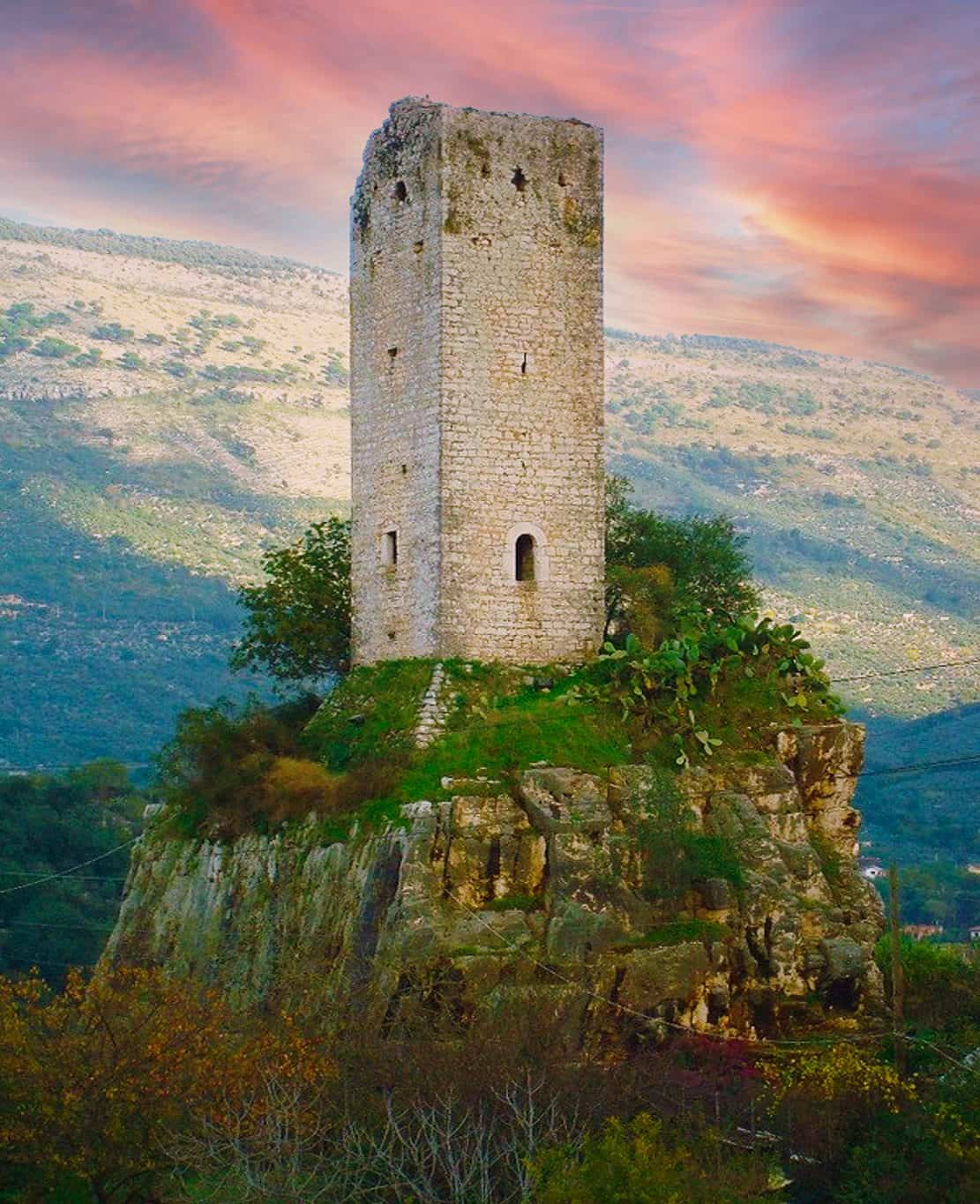
At 24 meters high the Torre Antonelli is the element that dominates the square and the old historic center. It dates to the 9th century and was built by the De Sompnino lords on the Colle Sant'Angelo, as a fortification together with the perimeter walls. The tower is cylindrical in shape. The building had three floors: on the first were the bread ovens and the cisterns, which ensured survival in case of siege. On the second the rooms and other frescoed chambers, among them that of Cardinal Giacomo Antonelli. In front of the castle were the prison rooms, adjoining the Scale di corte.
The original structure has been largely destroyed, including the battlements of the tower. The main entrance of the castle faced today's Piazza Garibaldi, that is the Portella. Proceeding toward the church of Sant'Angelo you can still see the stone anconi that mark the position of the access door. Between 1440 and 1500 the town expanded and completed the city walls, interspersed with the lookout turrets still present today.
On the height there is a detail that deserves to be told well. Originally the tower measured 27 meters. The Antonelli had the top three demolished because the keep was in danger of collapse, and the recovered stone was used to build Palazzo Antonelli. Three meters of medieval tower turned into a 19th-century palace: it is the story of the town in miniature, and it can still be read in the masonry if you have the eye for it.

The Torretta della Fontanella
Originally it was called Torre di Morgazzano. Between the 12th and 13th centuries several towers were erected to control the territory of the Amaseno valley: that was a border strip crossed by the raids of the papal army, particularly harsh at the beginning of the 12th century, and no less devastating were the forays of the brigands. The Torretta della Fontanella controlled the foothill road that connected Priverno to Terracina. It is a modest structure in size and extraordinary in position: from there you understand in 30 seconds why control of this pass was strategic.
The five gates of the village of Sonnino (LT)
In ancient times the town had five entrances, and knowing them is the best way to find your bearings in the maze of alleys.
Porta San Pietro was the main gate, the one reached from the ancient Via Volosca, which was a mule track. Porta Riore, also called dei Priori and formerly Porta San Lorenzo, replaced it as the main access precisely because of its closeness to Via Volosca: in 1819 it was from here that the demolition ordered by the pope began. La Portella was the gate of the lords of the castle, and opened toward the present Piazza Garibaldi. Then remain Porta San Giovanni and Porta di Tocco, which takes its name from the noble Tocco family.
The alleys, the districts and the coats of arms
The medieval village, with a layout dating to the 9th century, is divided into four districts. The alleys characterize the town by appearance and steepness and take their name from the family that lived in them or from a physical feature of theirs. Walking you meet winding lanes, flights of steps, towers and gates, stairs leaning against stone buildings, archivolts, small doors, little pillars. Look up above the lintels: on the facades appear coats of arms, crosses and incised symbols, often not immediately legible.
The best moment for this walk is the evening, when the light of the raking street lamps brings out the relief of the stones and the alleys empty. By day the village is beautiful. At night it is something else.
The Triplice Cinta, the symbol that recurs on the walls
Among the signs incised on the stones of Sonnino the Triplice Cinta recurs: three concentric rectangles connected by four axes. It is a symbol found all over Europe, incised on thresholds, church benches, blocks of masonry, and its interpretation remains debated. The proposed readings range from the ancient board game, the nine men's morris or mill, to a sign of sacred delimitation, up to esoteric and Templar interpretations that circulate widely online and hold up very poorly under documentary verification. The advice: look for them, photograph them, but be wary of anyone who tells you with confidence what they mean. The honest truth is that we don't know with certainty, and this makes them more interesting, not less.

The war memorial
It was built in the early 1920s for the fallen of the First World War. The Municipality of Sonnino commissioned it from the sculptor Ernesto Costantini of Ariccia. It is made of bronze and represents a young soldier, an infantryman, bare-chested, in the act of gripping the sword in defense. The iconographic choice is worth noting: not the victorious soldier, but the exposed body defending itself. In the war memorials of the first postwar period it is a less frequent variant of triumphal rhetoric.
The Ponte del Diavolo
It is part of the aqueduct of Terracina, commissioned by the emperors Hadrian and Antoninus Pius, which connected Amaseno to Terracina over a length of 54 kilometers. The bridge dates to the 2nd century AD. The current name came in the Middle Ages, when many legends flourished around the structure: it is the fate of almost all Roman works that survived in rural areas, which later communities explained by attributing them to a superhuman power because nobody knew anymore how an arch like that was built. An aqueduct of 54 kilometers to supply a port city says how much Terracina counted in the Roman system, and Sonnino was in the middle of it.
The Museo Terre di Confine in Sonnino (LT), room by room
It is the museum that gives meaning to all the rest of the visit, and I recommend doing it before the walk in the village and not after. It is on Via Giacomo Antonelli. The exhibition favors interactivity: organized sequences of sets, visions, dramatizations and other multisensory solutions, with audio guides available. The route is arranged in four sections.
First section: Border land, why?
It illustrates some specific themes of the cultural reality of Sonnino and presents in a problematizing way the global dimension of which this reality is part. Put more directly: the section takes the local case and uses it to make the visitor think about what a border is in general. It is an anthropological approach, not a parochial one, and for a civic museum of a municipality of 7,000 inhabitants it is a courageous choice.
Second section: Represented heritage, lived territory
It focuses on the relationship between some historical events central to the life of the inhabitants and the current representations of local identity. A place of prominence is held by the Torch Procession, accompanied by intercultural comparisons with similar rites. It is the section where you best understand why the May feast is not postcard folklore but a device for defining the territory.
Third section: three frontier figures
Attention shifts to three figures. The first is Maria Grazia, wife of a brigand and a true icon of the genre painting of the time: her story has an emblematic value from the point of view of local cultural heritage-making, because it is connected to the displacement of the people of Sonnino decreed by Pius VII in 1819. The traditional costume of Sonnino worn by Maria Grazia circulated through Europe in the paintings and prints of the northern painters who frequented Rome, and contributed more than any chronicle to building the international image of the town.
The second is Antonio Gasbarrone (1793-1882). Here the museum makes a precise choice: it does not center attention on the complex history of banditry, which other museums treat at length, but focuses on the story of a successful brigand who with his deeds went beyond both places and his own era.
The third is Giacomo Antonelli, born in Sonnino on April 2, 1806 and died on November 6, 1876. Son of a family of very modest origins, later enriched through fortunate real estate speculation, he was created cardinal on June 11, 1847 with the title of deacon of Sant'Agata alla Suburra, became pro-Secretary of State on March 10, 1848 and remained Pius IX's principal minister for more than 20 years, until September 20, 1870 and beyond. He was given the ambiguous reputation of an Italian Richelieu of the Church of Pius IX. That the town that risked being razed to the ground in 1819 gave the Papal States, less than 30 years later, its most powerful man, is one of the best documented ironies of Lazio history.
Fourth section: Words and images of the Elsewhere
The route ends by turning attention to life stories, current perceptions of the territory and contemporary experiences. The museum is completed by a viewing room for film and documentary screenings and an exhibition space for temporary shows.
Practical information for the museum
The Ministry of Culture lists opening Monday to Friday 9-13 and 14-19, Saturday and Sunday by reservation, full ticket 3 euros and reduced 2 euros. Planned closures are on December 8, from December 24 to 25, on December 31, January 1, January 6, at Easter and Easter Monday, on May 1, June 2, August 15 and November 1. Contacts: 0773 907849 and 351 2042438, museoterrediconfine@gmail.com. Since on weekends opening is by reservation, phone a few days ahead: it is the most common mistake of those who arrive on a Saturday and find the door closed. For organized groups and guided visits in Italian or English it is best to rely on licensed professionals: the tourist accompaniment service of TourLeaderPro works regularly in the Pontine hinterland.
Nature around Sonnino (LT): Camposoriano, the Catauso, the calanche
The natural monument of Campo Soriano
Campo Soriano, which everyone here calls Camposoriano, lies on the border between the territories of Terracina and Sonnino and is a karst plateau of about 974 hectares, established as a natural monument by regional law no. 56 of April 27, 1985 and included in 2008 in the Monti Ausoni and Lago di Fondi Regional Natural Park, created on November 19 of that year over a total area of 12,909 hectares.
From the geological point of view it is a polje, that is a vast depression formed by erosion and corrosion over very long times. The floor, flat and of reddish earth, measures between 200 and 300 meters in width by about three kilometers in length, at an elevation of about 360 meters, and is surrounded by four reliefs: Monte Romano, the highest at 864 meters, Monte Pannozzo, Monte Pecorone and Monte Cavallo Bianco. Imposing limestone monoliths emerge from the plain. The most famous is the Rava di San Domenico, about 18 meters high, which the local people also call the Cathedral for its silhouette.
The area has been used in a particular way for viticulture: Moscato di Terracina and Cesanese are grown here. Practical advice: go in low light, early in the morning or late in the afternoon, when the shadows of the monoliths lengthen over the red floor of the polje. At midday in summer the landscape flattens and the heat on the plateau is heavy, with no shade.

The Catauso, the karst sinkhole
It is near Monte Tavanese, in the area called Lagone. It is a karst sinkhole with a first drop of about 25 meters from the main ditch. With successive drops you reach 40 meters in depth, where stalactites and stalagmites can be seen. The first representation of the Catauso on paper dates to 1765 and is due to G. Astolfi, but the first truly significant explorations took place in the early 1900s. It is a place for cavers, not for a Sunday stroll: whoever wants to see it should contact an equipped caving group and not approach the edge alone.
The Calanche di San Nicola
Located at the foot of Monte delle Fate, which at 1,090 meters is one of the major peaks of the Ausoni, they arise as a karst phenomenon and take their name from a church dedicated to San Nicola, of which some ruins remain visible. The contrast between the bare rock and the Mediterranean scrub surrounding it is the reason the detour is worth it.
The Polla di Bagnoli
A place cited by Giuseppe Marocco as the Bagnolo and by Gaetano Moroni as Bagnuolo, it was the spring where women went to wash clothes. They are the two 19th-century scholars who inventoried the Papal States town by town, and it is thanks to them that today we know the name and function of dozens of minor springs like this one. A public wash place, in a mountain town without running water, was the main place of female sociability: the fact that its place name survives says that here it counted.
The mountain huts
The territory preserves three huts that mark the hiking routes toward the high altitudes. The Rifugio Jo Caturo is reached from Sonnino passing the slopes of Monte Tavanese and Monte di Mezzo, climbing toward Monte delle Fate. Then there are the Rifugio la Cona, in the area of Monte Ceraso where the Torch Procession splits into its two branches, and the Rifugio Gasbarrone, whose name alone says how far the brigand has entered the local place names. For routes, passability and seasonal conditions it is best to ask in town before climbing: the trails of the Ausoni are not all marked with the same care.
Festivals, traditions and folklore of Sonnino (LT)
The Festa delle Torce, the rite that redraws the border
It is the most important rite of the town and one of the most singular in all of Lazio. It takes place on the eve of the solemnity of the Ascension. In the morning a service is celebrated in the church of San Michele Arcangelo, in the medieval village. In the early afternoon the torches are blessed and handed to the corporals, and the procession leaves from Piazza San Pietro. From there begins a procession-hike that lasts all night and ends at the first light of dawn, following the boundaries of the municipal territory with lit torches. Local tradition reckons the route at about 30 kilometers.
At Monte Ceraso, at the Cona, the route splits into two branches. The upper way follows the borders with Monte San Biagio, Amaseno and Roccasecca dei Volsci. The lower way those with Monte San Biagio, Terracina, Pontinia and Priverno. Along the way the procession stops at the points where violent deaths occurred to recite Pater, Ave, Gloria and Requiem, followed by the cry Evviva Maria and by rifle shots.
On the origins the sources are more cautious than what is told around. The presence of the torches is documented in the municipal expenses from the 1600s, with entries also found in the 1872 budget under the category Culti e Cimiteri. Scholars link the rite on one side to the Christian Rogations, the processions that preceded the Ascension to invoke blessing on the fields, and further back to the Roman Ambarvalia, rites of purification of the territory. On the other side to an edict of Cardinal Ercole Consalvi of August 20, 1817, which prescribed armed patrolling of the municipal boundaries to counter banditry. It is hard to imagine a more exact synthesis of the character of this town: an agrarian prayer and an anti-banditry patrol that became the same walk.
A not-so-tender opinion: whoever wants to see the Torce must accept not sleeping and walking for hours on rough terrain in the dark. It is not an event for seated spectators. If you are not fit, follow the departure from the village in the afternoon and then come back at dawn for the arrival, without pretending you can do the whole circuit.

The calendar of the other festivals of Sonnino (LT)
On Good Friday the Procession of the Dead Christ is held. On April 25 the Fiera di San Marco returns, regulated already in the 13th century according to the municipal statute. On June 13 the Festa di Sant'Antonio is celebrated, repeated on the last Sunday of June in the locality of Frasso. In the last four days of July there is Capocroce in festa, in the locality of Capocroce. The last Saturday of July is dedicated to San Gaspare del Bufalo, the man who stopped the destruction of the town. In August comes the Sagra della Zazzicchia, with stands and a food-and-wine route in the village, and on August 16 the Festa di San Rocco. On the last Thursday of August the Antica fiera delle merci e del bestiame is held, known to everyone as the Sagra della Capra, in the locality of Sonnino Scalo. In September the Sagra della Crespella closes the calendar. Movable dates and annual programs should be confirmed on the Municipality's channels before setting out.
The Rotunno, the traditional dress of Sonnino (LT)
The typical women's dress is called Rotunno. Local tradition traces its origin back to Saracen models, a fascinating and unproven hypothesis. It was made of heavy wool fabrics worked on the loom, in strong colors. On festive occasions a brocade or silk blouse trimmed with lace was added. The color followed a strict social grammar, readable from a distance: green or light blue for the youngest, white for the betrothed, red for the married, brown for widows. In a small community, where everyone knows everything about everyone, the dress was not ornament: it was a registry office worn on the body. It is this costume, worn by the Sonnino models who posed in Rome, that made the town famous in 19th-century European painting.
What to eat in Sonnino (LT) and the oil that made the town's fame
Extra virgin oil is the municipality's real economic resource. Sonnino falls within the area of the Colline Pontine DOP extra virgin olive oil, recognized in 2010, which includes 25 municipalities of the province of Latina among them Bassiano, Cori, Fondi, Itri, Maenza, Norma, Priverno, Prossedi, Roccagorga, Roccasecca dei Volsci, Sermoneta, Sezze, Sonnino and Terracina. The cultivar is the Itrana, also called Oliva di Gaeta, Trana, Oliva Grossa or Cicerone: a dual-purpose variety, good both for the table and for oil, which gives an extra virgin of character, with measured bitterness and pungency, with grassy notes. The town has received national recognition for its production, including a prize at the Ercole Olivario competition in 2018. The competition's list of winners cannot be consulted online at the time of writing, so verify the category and the producer directly with the Municipality or the local mills.
At the table you eat the poor cooking of the Ausoni: handmade pasta, local cheeses, sheep and goat meats. The two main festivals already say it all. The Zazzicchia is the local sausage, protagonist of August. The Sagra della Capra, tied to the ancient livestock fair, celebrates goat meat, which in the pastoral economy of these mountains was the protein available. The Crespella of September is the traditional fritter. A tip: buy the oil directly from the municipality's mills, not in the souvenir shops of the coast, and ask for the vintage. The price difference is minimal, the quality difference is not. Whoever wants to build a full day around the food and wine theme will find ideas in the English ItalyPlanner guides dedicated to food and wine.
Sonnino (LT) in European literature and iconography
Few towns of this size can claim two literary citations of this weight, and both concern the same event: the destruction ordered in 1819. Sonnino appears in the Zibaldone di pensieri of Giacomo Leopardi, regarding the destruction of the town ordered by Pius VII, and in La Messa der Venardi Ssanto, a Roman sonnet by Giuseppe Gioachino Belli, here too in relation to the destruction of the town.
To be held together with these two testimonies is the figurative fortune of the Sonnino costume, which between the late 1700s and the 1800s circulated throughout Europe through the foreign painters resident in Rome. The result is that the name of Sonnino, in those years, was better known in Munich and Copenhagen than to many Romans. A town of 7,000 inhabitants that landed twice in Italian literature and once in European painting: it doesn't happen often.
A curiosity about Sonnino (LT)
The curiosity I like best concerns the Torre Antonelli and its three missing meters. The cylindrical tower of the castle, built in the 9th century by the De Sompnino, originally measured 27 meters. When the Antonelli counts acquired the complex from the Colonna, in 1850, the keep was in danger of collapse in its top part, and the family had the last three meters demolished. The recovered stone was not disposed of: it was reused to build Palazzo Antonelli. Today the tower measures 24 meters, and whoever strolls through the town looks at a 19th-century palace without knowing that they are observing, literally, the top of a medieval tower reassembled on the ground.
The curiosity gets better if you add the context of the family. The Antonelli were of very modest origins, as the biographical dictionary notes without too much beating around the bush: they got rich through fortunate real estate speculation, and from 1806 on they gave the Church Giacomo Antonelli, the cardinal who would govern the Papal States in practice for more than 20 years. The same family that, in a small frontier municipality, dismantled a medieval tower to build itself a palace, in one generation reached the summit of Roman temporal power. The reuse of those stones is the perfect metaphor for a social climb: you take the old power, lower it by three meters and with that material you build your own residence.
A note on method, because the word curiosity is often used wrongly. This is not a legend: the heights, the dates of the changes of ownership and the destination of the stone are elements that local historical memory preserves precisely and that can be read in the description of the monument. Which takes nothing away from the pleasure of recognizing, from the bottom of the square, the exact point where the tower was cut.
Something nobody tells you about Sonnino (LT)
Nobody will tell you that the town's most identity-defining rite, the Torch Procession, probably has a root in policing. The tourist version tells of a very ancient and devotional procession, and the devotional part is true. But the anthropological studies of the rite point out an element that almost never appears in travel accounts: in 1817 Cardinal Ercole Consalvi, Secretary of State of Pius VII, issued an edict prescribing armed patrolling of the municipal boundaries as a measure against banditry. Two years later the same Consalvi signed the edict for the destruction of Sonnino.
The night procession that every year walks the entire municipal perimeter with lit torches, with stops at the places where violent deaths occurred and with rifle shots, incorporates two grammars together: the Christian one of the Rogations, which blessed the fields before the Ascension, and further back the Roman one of the Ambarvalia, rites of territorial purification. And the administrative one of the border patrol imposed by the Papal States in the midst of the banditry emergency. The documentation of the torches in the municipal expenses goes back to the 1600s, so the rite precedes the edict. But the form we know today, that of the complete circuit of the boundaries, consolidated in that climate.
The reason this is not told is understandable: it ruins the romantic narrative. To me it seems to improve it. A town condemned to destruction by the state that then turns into a community festival the same patrol that the state had imposed on it is a masterpiece of symbolic appropriation. If during the night of the Torce you hear the shots and see the stops at the points of the violent deaths, now you know that you are watching two overlapping stories: the prayer for the fields and the patrolling of the frontier. Few Italian popular festivals preserve such a legible stratification, and almost no guide explains it.
The advice I give you for visiting Sonnino (LT)
The main advice is to reverse the order in which almost everyone visits the town. Most arrive, park, climb into the village, photograph the alleys, come down and leave, and skip the museum because it seems the least attractive piece. It is exactly the mistake to avoid. Go first into the Museo Terre di Confine, on Via Giacomo Antonelli: 3 euros, four sections, barely an hour. You will come out with the key to reading everything you will see afterward, from the steep alleys to the towers scattered in the countryside. Without that key, Sonnino is a pretty village like 50 others in Lazio. With that key it becomes a case study.
Second piece of advice, on timing. The museum opens Monday to Friday, while Saturday and Sunday it works by reservation: phone 0773 907849 or 351 2042438 a few days ahead if you come on the weekend, which is when almost everybody comes. The fact that the museum is easier to visit during the week makes Sonnino a perfect destination for a weekday, when the nearby villages are deserted and the roads of the Lepini are free.
Third piece of advice, on organizing the day. Sonnino alone takes up a full half day: two hours for the village and museum, an hour and a half for Camposoriano. The other half of the day is easily built, because you are at the center of one of the densest stretches of southern Lazio: Priverno and the Privernum archaeological park are a few kilometers away, Terracina is on the other side of Camposoriano, Sermoneta and the Ninfa Garden close the northern quadrant.
Fourth and last: shoes. The village is all steps and stone polished by centuries of passage, and Camposoriano is a karst plateau with uneven ground. Too many people arrive in sandals and give up halfway. If you then want to go around with someone who tells you all this on the spot, know that the Pontine hinterland is served by licensed professionals: TourLeaderPro organizes group trips with certified guides in this area too.
Another well-known fact, yet rarely cited
Everyone knows that Sonnino is famous for its brigands. Almost nobody connects that fame to the administrative geography that made it possible, and that is the real well-known and underestimated fact: until 1870 this municipality was the last strip of the Papal States before the Kingdom of the Two Sicilies, within the province of Campagna e Marittima.
Banditry in 19th-century southern Lazio was not a phenomenon of common crime, but a structural effect of that line. A gang that operated in the Papal States and took refuge in the Neapolitan territory became unreachable: changing jurisdiction meant changing police, judiciary, arrest warrants, in an era without effective extradition agreements. Antonio Gasbarrone and his men prospered for years in that space, and the reaction of the Papal State, disproportionate up to the destruction edict of 1819, can be explained only by the impotence of a power that couldn't control its own margin.
The corollary is cited even less. When the border disappears, the phenomenon ends. Gasbarrone was freed in August 1871, a few months after Porta Pia: he walked out of prison into a country where the frontier that had made his trade possible no longer existed. He was 78 years old. He died 11 years later in Abbiategrasso, in a Lombard nursing home, very far from the Ausoni.
There is one last element that helps measure how much that frontier condition weighed. Sonnino has a municipal statute written already in the 13th century, kept in the Archivio di Stato di Roma, and confirmed in 1423 as the Statutum Castri Sopnini in 58 articles negotiated with the count of Fondi. Frontier municipalities bargained more than the others, because the lord needed them to stay inhabited. The same reason for which, three centuries later, the deportation of the inhabitants proved an unworkable threat.
The right photo to take in Sonnino (LT)
There are three good photos here, and none is the one that most visitors take.
The first is the Rava di San Domenico at Camposoriano, the limestone monolith about 18 meters high that emerges from the flat floor of the polje. It should be photographed in raking light, so in the first hour after dawn or the last before sunset, putting a person at the base to give the scale: without a human reference the image loses its measure completely and the monolith looks like any rock. The reddish floor of the plateau, with the low sun, turns a color that doesn't exist at midday.
The second is the Torre Antonelli from the bottom of the square, framed vertically to fit all 24 meters of the cylindrical shaft. The right moment is late afternoon, when the stone takes on warmth and the houses around stay in shadow. If you have patience, wait for twilight: with the street lamps on and the sky still blue the brightness ratio between lit tower and sky is the best possible.
The third is the least obvious and the most successful: the alleys of the village after sunset. The lanes of Sonnino are narrow, steep and made of steps. By day the flat light flattens them even more. In the evening the street lamps light the stones, the archivolts and the stairs leaning against the facades from the side, and the relief emerges. Look for the facades with coats of arms and with the Triplice Cinta carvings: those three concentric rectangles, in side light, read very well and at midday they vanish.
A warning about the night of the Torce, which many photographers chase. The conditions are extremely difficult: complete darkness, moving subjects, the flames of the torches as the only light source. You need very fast lenses and the willingness to raise the sensitivity beyond what is reasonable. Flash is to be excluded, out of respect and because it would destroy the only interesting thing in the image. Better to focus on the departure from the village, in the early afternoon, when the torches are blessed and handed to the corporals: there is still light and the scene is readable.
Some important events that took place here in history
999. A bull of Pope Sylvester II mentions Sonnino: it is the first document attesting its existence. The town enters written history at the end of the first millennium.
October 11, 1369. Onorato I Caetani buys half of the castle for 2,000 florins and becomes its Dominus. It is Sonnino's entry into the orbit of the most powerful family of southern Lazio in the 1300s.
1423. The Statutum Castri Sopnini is confirmed, 58 articles of civil and criminal law agreed between the count of Fondi and the community. The original document, from the 13th century, is today in the Archivio di Stato di Roma.
1503. At the death of Alexander VI the fief, which had been Rodrigo Borgia's, passes to the Colonna, who will hold it almost uninterruptedly until 1816.
January 13, 1596. With his own bull Clement VIII raises the land of Sonnino to a principality.
1798. The occupying French troops install the military tribunal in the church of San Michele Arcangelo. The next year the town ends up in the Department of Circeo of the Roman Republic.
July 1819. The edict signed by Cardinal Ercole Consalvi for Pius VII orders the destruction of the town and the deportation of the inhabitants to eradicate banditry. The demolitions start from Porta Riore and strike some 40 houses before the execution is interrupted, through the intervention of Gaspare del Bufalo. On the date the sources waver between July 17 and 18.
September 19, 1825. Antonio Gasbarrone surrenders in the church of the Madonna Santissima della Pietà. The negotiation had been conducted by don Pietro Pellegrini, vicar general of Sezze, sent by Leo XII. 46 years of prison will follow.
June 11, 1847. Giacomo Antonelli, born in Sonnino on April 2, 1806, is created cardinal. On March 10, 1848 he becomes pro-Secretary of State of Pius IX: for more than 20 years he will be the most powerful man of the Papal States after the pope.
1850. The palace and the castle complex pass from the Colonna princes to the Antonelli counts. Shortly afterward the tower is lowered by three meters.
1870. With the end of the Papal States Sonnino ceases to be a frontier municipality. It enters the Kingdom of Italy within the province of Rome.
1916. The Talani brothers buy the complex from the Antonelli. They are the last private owners.
1934 and 1945. The municipality passes first to the newly established province of Littoria, then to the province of Latina, where it still is.
January 31, 2011. The monastery of Santa Maria delle Canne collapses, with a foundation attributed to the 7th century. It is the municipality's gravest heritage loss in recent times.
Who has passed through Sonnino (LT)
Onorato I Caetani bought half of the castle in October 1369 and was its lord: the Caetani family, that of Boniface VIII, then dominated a territorial block that went from the Lepini to the sea, and Sonnino was a border pawn of it.
Rodrigo Borgia, that is Pope Alexander VI, held possession of the fief: at his death, in 1503, it passed to the Colonna. The presence of the Borgia in this corner of the Ausoni is documented by the feudal succession, not by stays, and should be told for what it is.
The French troops of occupation arrived in 1798 and installed their military tribunal inside the church of San Michele Arcangelo. The town got to know the Roman Republic and its Assistant Aediles, Giuseppe Mancini and Lorenzo Musilli, up close.
Antonio Gasbarrone (1793-1882) is the best-known man of Sonnino in 19th-century Europe: brigand, then prisoner for 46 years between Castel Sant'Angelo, Civitavecchia, Spoleto and Civita Castellana, freed in August 1871 and died in Abbiategrasso.
Gaspare del Bufalo, missionary, founder of the Missionaries of the Most Precious Blood and later a saint, was active in this territory in the years of banditry and to him is attributed the interruption of the execution of the 1819 edict. The town celebrates him on the last Saturday of July.
Don Pietro Pellegrini, vicar general of Sezze, was the material negotiator of the 1825 surrender, sent by Pope Leo XII. He is a figure who almost always disappears from the popular accounts, squeezed between the brigand and the saint, and yet he did the work.
Cardinal Ercole Consalvi, Secretary of State of Pius VII, signed both the edict of August 20, 1817 on armed patrolling of the boundaries and that of July 1819 on the destruction of Sonnino. No other figure had such a deep effect on the town's fate.
Giacomo Antonelli (1806-1876), born here, cardinal from 1847 and Secretary of State of Pius IX, was the real ruler of the Papal States in the age of the Risorgimento and earned the ambiguous nickname of the Italian Richelieu.
Giacomo Leopardi and Giuseppe Gioachino Belli are not known to have physically passed through the town, but they brought it into Italian literature: the first in the Zibaldone di pensieri, the second in the sonnet La Messa der Venardi Ssanto, both regarding the destruction ordered by Pius VII.
Maria Grazia, wife of a brigand, became an icon of 19th-century genre painting. Through her and the other Sonnino models who posed for the foreign artists in Rome, the costume of the Rotunno reached the salons and collections of half of Europe. The Museo Terre di Confine devotes part of the section on frontier figures to her.
Sonnino (LT) with children, accessibility and what it costs
With children the museum works better than you would expect, precisely because the exhibition relies on sets, dramatizations and multisensory solutions instead of display cases and labels. Two euros for the reduced ticket, and an hour is the right length before attention drops. The village, instead, is demanding for the youngest: the steps are continuous and the stroller is impractical, better a baby carrier backpack. Camposoriano is the best activity for a family: open space, monoliths that seem made on purpose to be walked around, flat ground on the floor of the polje.
On accessibility we need to be honest: the historic center of Sonnino, with its stairs and slopes, cannot be navigated in a wheelchair. Those with mobility problems can however enjoy the main square, the view of the Torre Antonelli and the museum, for which it is best to ask in advance at the number given what the access conditions are.
The budget for a day is minimal. The only fixed expense is the museum ticket, 3 euros full and 2 reduced. The village, the churches during opening hours, Camposoriano and the trails cost nothing. What remains is fuel or the train plus the bus connection from Priverno-Fossanova, and lunch. For a weekend based on the coast or in the nearby villages, the itineraries of the area are told in English in the ItalyPlanner guide to Lazio, useful if you travel with foreign friends.
When to go to Sonnino (LT) and what is around
The best season is spring, between April and June: the Mediterranean scrub is in bloom, Camposoriano still has green on the floor of the polje and the eve of the Ascension falls with the Festa delle Torce. Autumn is also good, especially between October and November, which is the time of the olive harvest and pressing: ask the mills if you can watch the crushing, many welcome it gladly. Summer is the worst time for the plateau, where shade doesn't exist, but it is the time of the sagre, the Zazzicchia and the Sagra della Capra in August. Winter is for those who like empty towns and clear days, with a view that from the Ausoni reaches the sea.
Around, within half an hour by car, there is material for three days. Priverno with its medieval center and the Privernum archaeological park in the Amaseno plain. Terracina with the temple of Jupiter Anxur and the coast. Sezze perched on the Lepini. Roccasecca in the hinterland. And farther south Sperlonga, Itri and Gaeta. Toward the north Sermoneta, the Ninfa Garden, Norma and Carpineto Romano. Toward the sea the Circeo National Park. Whoever organizes a multi-day tour with a group can rely on a dedicated service: TourLeaderPro also arranges custom experiences for small groups. And for those looking for inspiration in English on day trips starting from the big cities, there is the day trips section of ItalyPlanner.
Quick questions about Sonnino (LT)
Where is Sonnino (LT)?
In the province of Latina, in southern Lazio, with the historic center at an elevation of 430 meters on the Colle Sant'Angelo, on the slope of the Monti Ausoni at the edge of the Monti Lepini system. From Rome it is about 100 kilometers.
How far is Sonnino (LT) from Rome and how long does it take?
About 100 kilometers. By car allow an hour and three quarters, via Via Pontina or the A1 motorway to Frosinone and then state road 156 of the Monti Lepini. With the Sunday return traffic on the Pontina it can take longer.
Can you reach Sonnino (LT) by public transport?
Yes, but with a change. The reference station is Priverno-Fossanova on the Rome-Naples line via Formia. From there buses leave that also connect Sonnino. The timetables should be checked on the regional carrier's channels, because on holidays the runs are reduced.
How much does it cost to enter the Museo Terre di Confine?
The Ministry of Culture lists 3 euros full and 2 euros reduced.
What are the opening hours of the museum of Sonnino (LT)?
Monday to Friday 9-13 and 14-19. Saturday and Sunday by reservation. Planned closures on December 8, December 24 and 25, December 31, January 1 and 6, Easter and Easter Monday, May 1, June 2, August 15 and November 1. Phone 0773 907849 or 351 2042438.
Do you need to book to visit Sonnino (LT)?
For the village and the churches no. For the museum on weekends yes, booking is necessary. For the minor churches it is best to contact the parish a few days in advance.
How much time do you need to visit Sonnino (LT)?
A full half day: about an hour for the museum, a good hour for the village, an hour and a half for Camposoriano. With lunch and transfers it comfortably becomes a whole day.
Can you visit the castle and the Torre Antonelli inside?
The complex is privately owned and appears to be closed. The original structure is largely lost. The tower is seen from the outside, from the square and the surrounding alleys.
Can you visit the monastery of Santa Maria delle Canne?
No. The building collapsed on January 31, 2011 and ruins remain. Whoever approaches should do so with caution and without entering the unstable structures.
Is Camposoriano free to visit?
Access to the plateau is free. It is a natural monument established in 1985 and included since 2008 in the Monti Ausoni and Lago di Fondi Regional Natural Park: the rules of conduct of protected areas apply.
How tall is the Rava di San Domenico?
About 18 meters. It is the best-known limestone monolith of the Campo Soriano polje, which some call the Cathedral.
When does the Festa delle Torce take place in Sonnino (LT)?
On the eve of the solemnity of the Ascension. It leaves in the early afternoon from Piazza San Pietro, after the morning service in San Michele Arcangelo, and continues all night until dawn along the municipal boundaries, over a route that tradition reckons at about 30 kilometers.
Can you take part in the Torch procession?
It is an open community rite, but it requires real fitness: you walk at night on rough terrain for many hours. Those who are not prepared should follow the departure in the afternoon and the arrival at dawn.
Is Sonnino (LT) wheelchair accessible?
The historic center is not: it is made of steps and slopes. The main square and the view of the tower remain accessible. For the museum, ask in advance about the access conditions at the numbers given.
Is Sonnino (LT) suitable for children?
The museum yes, thanks to the interactive and multisensory exhibition, and the reduced ticket costs 2 euros. Camposoriano is the best activity for a family. In the village you need a baby carrier backpack and closed shoes, the stroller is impractical.
Where do you park in Sonnino (LT)?
Outside the old core, in the areas along the ring road and near Piazza Garibaldi. You don't enter the medieval village by car.
Who was the brigand Gasbarrone?
Antonio Gasbarrone, born in Sonnino on December 12, 1793, gang leader of papal banditry, surrendered on September 19, 1825 in the church of the Madonna Santissima della Pietà. He stayed in prison for 46 years and was freed in August 1871. He died on April 1, 1882 in Abbiategrasso.
Is it true that the pope ordered Sonnino to be destroyed?
Yes. In July 1819 an edict signed by Cardinal Ercole Consalvi for Pius VII ordered the destruction of the town and the deportation of the inhabitants to eradicate banditry. The demolitions began from Porta Riore and stopped after some 40 houses, thanks to the intervention of Gaspare del Bufalo. On the exact date the sources waver between July 17 and 18.
What do you eat in Sonnino (LT)?
Cooking of the Ausoni: handmade pasta, local cheeses, sheep and goat meat. The Zazzicchia, that is the local sausage, has its sagra in August. The Sagra della Capra closes August at Sonnino Scalo. The Crespella is the September fritter.
What oil is produced in Sonnino (LT)?
Extra virgin of the Itrana cultivar, the same as the Oliva di Gaeta. The municipality falls within the area of the Colline Pontine DOP, recognized in 2010, which includes 25 municipalities of the province of Latina. Buy it from local mills and always ask for the vintage.
What is the difference between Sonnino (LT) and nearby villages like Priverno or Sezze?
Priverno and Sezze are Lepini centers with a more regular urban continuity and a larger ecclesiastical heritage. Sonnino is a frontier town, built to be invisible and defensible, and its historical identity revolves around the border with the Kingdom of Naples and banditry. They are complementary visits, not alternatives.
What is the Triplice Cinta seen on the walls of Sonnino (LT)?
Three concentric rectangles incised on the stone, a symbol found all over Europe. The interpretations range from the ancient game of nine men's morris to a sign of sacred delimitation, up to esoteric readings that circulate widely and are poorly documented. No explanation is established.
Sonnino is not a place that sells well. It has no cover-photo monument, the castle is closed, the oldest monastery has been on the ground since 2011 and the museum costs 3 euros and occupies four rooms. And yet, if I had to choose a single village in southern Lazio to explain to someone what it meant to live on a frontier of the Papal States, I would choose this one without hesitation. Come on a weekday, go into the museum first, climb into the village at sunset and finish at Camposoriano with the low sun. And when you pass under the Torre Antonelli, raise your eyes and look for the three meters that are missing: from there on the town tells its own story.
Article written by the editorial team of TourLeaderPro, contact them for Private/Corporate/V.I.P. Tours and Experiences.
Planning a trip to Rome? The English guides to visiting the city are on ItalyPlanner.com.