Pico (FR)
In short. Pico is a town of about 2,600 inhabitants in the province of Frosinone, at 192 meters above sea level, perched on a limestone spur right up against Monte Pota, on the northern slope of the Aurunci Mountains, inside the boundaries of the…

Pico is a town of about 2,600 inhabitants in the province of Frosinone, at 192 meters above sea level, perched on a limestone spur right up against Monte Pota, on the northern slope of the Aurunci Mountains, inside the boundaries of the Aurunci Mountains Natural Park. From Rome it's about 110 kilometers: the A1 motorway toward Naples, exit Ceprano or Pontecorvo, then provincial roads to the town along the line of regional road 82 of the Liri Valley. The real time from the Grande Raccordo Anulare is a good hour and a half. By train the reference station is Ceprano-Falvaterra, on the Rome-Cassino regional line, about 12 kilometers from the town. From there you continue with the area's intercity buses, with schedules built for commuters and to be checked before leaving. You park in the lower part of town, free of charge, and climb on foot. The old town, the garden of the Farnese castle and the churches require no ticket. Casa Landolfi is a private home and is not open to the public, while the 12 sites of the Tommaso Landolfi Literary Park can be walked freely along the streets of the village. A complete visit of the town takes three or four hours. With the mountain, a whole day. The patron saint is Sant'Antonino Martire, celebrated on September 2. The town hall answers at 0776 544012.
Pico belongs to the same hill belt that includes Castro dei Volsci, Pastena, Lenola and Campodimele, the villages hung between the Liri valley and the Aurunci ridge: an area that those who look only at the road map don't notice, and that those who walk it don't forget. The guides to Pico and the other towns of the Aurunci Mountains read well together, because the territory is one and the stories intertwine.
How to Get to Pico (FR) from Rome: Car, Train and Parking
By Car to Pico (FR): Ceprano or Pontecorvo
The most straightforward way to reach Pico by car is the A1 motorway heading south. There are two useful exits, and the choice depends on how you want to set up the day. From the Ceprano toll booth you cross the Liri plain, run alongside the river, pass in view of Falvaterra and its caves and then begin to climb inland following the signs for Pastena and Pico. From the Pontecorvo toll booth, instead, you arrive from the east: you cut through the valley-floor countryside and climb with a series of hairpin bends that at every curve open a gap onto the valley panorama. Neither route is wrong. The Ceprano one is best for those who want to fit into the same day the Falvaterra caves or the Pastena ones and the villages of the middle valley. The Pontecorvo one is more direct and suits those arriving from the south or wanting to combine the visit with Cassino and the abbey. In both cases the last stretch is on provincial roads that climb, turn and narrow, and the average speed drops a lot compared with the motorway: 110 kilometers on paper, a good hour and a half in reality, and noticeably more on summer weekends, when the A1 south fills with holiday-exodus traffic.
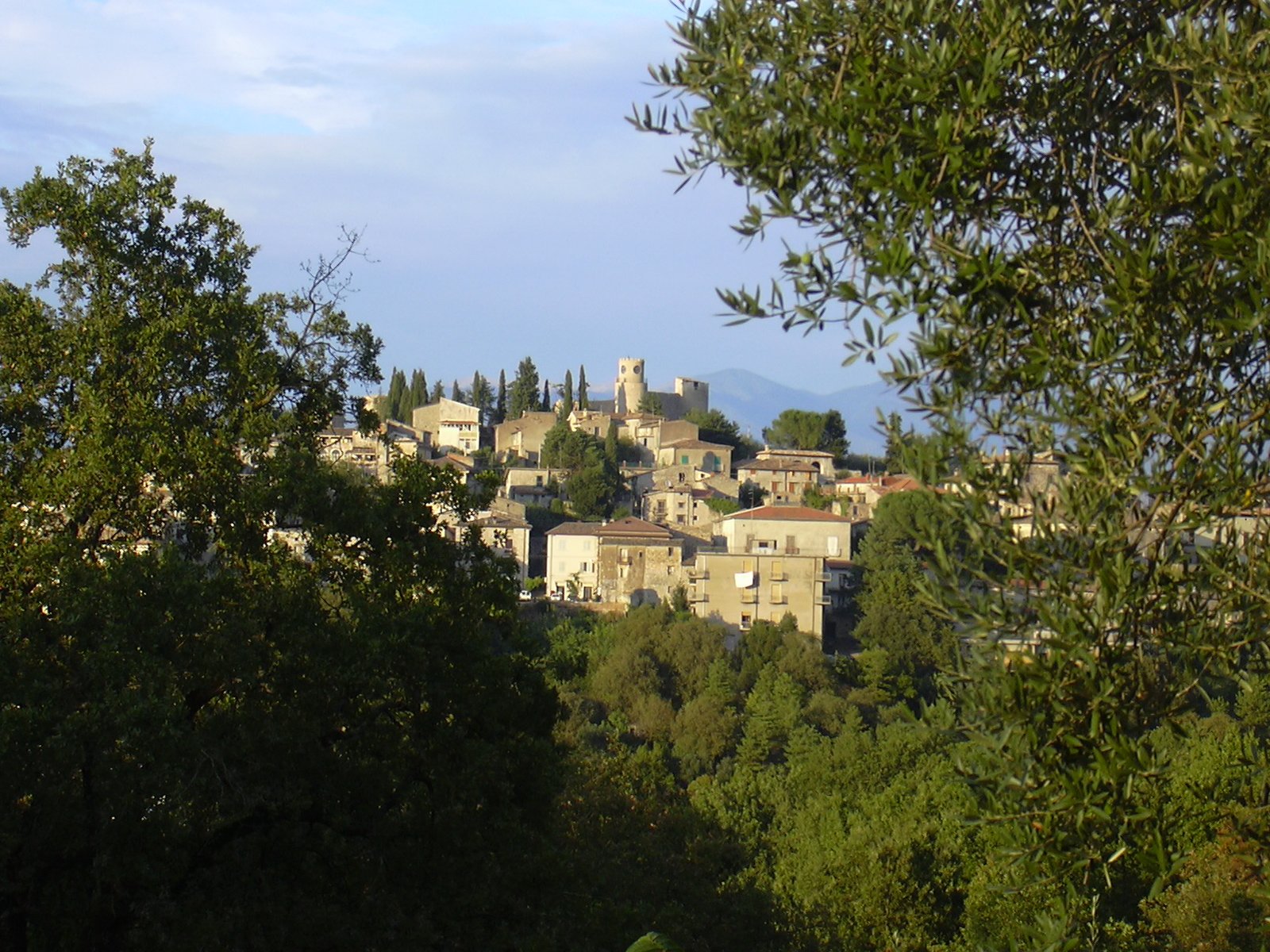
The advice, if you make the trip in a day, is to leave early. Leaving Rome by eight means reaching Pico around 10, with the air still cool, good light for photographs and free parking. Those who leave mid-morning risk a line at the junction for Frosinone and arrive in the worst hour, when the sun beats on the limestone and the village shuts down in the afternoon lull. It sounds like nitpicking and yet it changes the day, especially between June and September.
By Public Transport to Pico (FR): Train to Ceprano-Falvaterra
Public transport exists, but it asks for patience and planning. The reference train station is Ceprano-Falvaterra, on the regional line linking Rome to Cassino and then Naples: from Termini it takes about an hour and a half, with regional trains of decent frequency on weekdays and sparser on Sundays. From the station to the town it's about a dozen kilometers, covered by the intercity buses serving the municipalities of the area, with runs designed for students and commuters: schedules concentrated in the early morning and early afternoon, little or nothing the rest of the day. Whoever wants to attempt the feat without a car must check the updated schedules on the regional operator's site and allow for dead time, even long. An intermediate solution that works is the train to Frosinone or Cassino and renting a car for half a day: it costs something, but it gives back the freedom to move among the villages without depending on a coach. Those who prefer to rely on a professional to organize transfer and visit can turn to the tourist accompaniment services of TourLeaderPro, which also works on the villages of inland Lazio for private and corporate groups.
Where to Park in Pico (FR) and How to Climb to the Village
Once you've arrived, the most concrete practical issue is parking. Pico is a village of medieval layout that climbs a rock spur: the old town has narrow alleys, stairs, arches and covered passages, and it isn't made for cars. The lower part of town, the one that grew along the provincial road around Largo San Francesco, which is now the real commercial center of the town, has free parking spaces and in general causes no problems even on feast days. From there you climb on foot, and the climb is the most authentic part of the experience: you pass under arcades, you walk past stone houses leaning against each other, you glimpse courtyards with a well and laundry hung out, and at every turn the view widens over the valley. Those with mobility difficulties or traveling with very small children must know it in advance: the elevation gain from the lower part to the castle is significant and there are no mechanized shortcuts. The right shoes are light trekking ones, or in any case soles with good grip, because the paving stones polished by centuries of passage become slippery as soon as it rains.
When to Go to Pico (FR): the Right Season
The best period is the shoulder season. Between April and June the countryside is green, the broom bursts out on the slopes, the Aurunci trails are passable without suffering from heat and the skies are clean enough to let you see far. Between September and November you enter the olive harvest season, which here is not a folkloric detail but the economic and social rhythm of the town: the oil mills work, families organize, and whoever happens by in those weeks finds a community in motion. Full summer is beautiful in the long evening hours, but July and August days can be heavy. Winter gives an intense atmosphere, with fog caught in the valleys and the stone turning dark, but you have to allow for short days, some snowfall at high altitudes and the contrast, among the most beautiful and least told in southern Lazio, between the snow-capped peaks and the olive groves still green.
Services, Restaurants and Overnight Stays in Pico (FR)
On services it's best to be clear: Pico is a town of a few thousand inhabitants and doesn't have the tourist infrastructure of a coastal resort. There are cafés, grocery stores, a few restaurants and trattorias where you eat local cooking, but not everything is necessarily open every day and in every season. The practical advice is simple: phone ahead for a lunch stop, without trusting what appears on digital maps, and don't expect continuous hours. On Sunday morning the town comes alive around Mass and the cafés, in the afternoon it slows. For overnight stays the area offers farm stays and country houses scattered in the countryside between Pico, Campodimele and the Pontecorvo plain. Many places are family-run, with few rooms, and must be booked in advance in long-weekend periods. Those who prefer a better-equipped base can use Sora or the Cassino area and move around by day.
One last note on connectivity and essential services. Phone coverage in the town is good, but on the Aurunci trails and in the side valleys there are dead zones: whoever plans a hike should download offline maps before leaving and tell someone the planned route. There is an ATM in town, but not multiplied, and in some small businesses of the area cash remains handy. It's best to refuel along the provincial road or before leaving the motorway, because the gas stations in the inland villages may have reduced hours. Nothing dramatic: these are the small precautions that turn an improvised outing into a successful day. For a general overview of the region and its internal distances, the ItalyPlanner guide to Lazio helps you understand how to fit Pico into a broader itinerary.
What to Combine Pico (FR) With in a Day
If the time available is a whole day, the pairing that works best is with a second village of the same hill belt, so you see two variants of the same theme: defense, rock, border. Castro dei Volsci is a short distance away and offers one of the most photographed views of Ciociaria. To the south, beyond the ridge, Campodimele already belongs to the province of Latina but shares with Pico the same frontier history and the same geology. With two stops the day is full without being frantic, and you return to Rome with the feeling of having understood something about a piece of Lazio that is usually crossed on the motorway without even looking at it. 20 minutes away there's also the archaeological site of Fregellae, the Latin colony of 328 BC destroyed by the Romans in 125 BC, whose finds are partly displayed at the Archaeological Museum of Frosinone.
The Farnese Castle, the Valley and the Invisible Line: How to Read the Landscape of Pico (FR)
The first thing you understand looking at Pico from afar, from the provincial road climbing from Pontecorvo or from the hairpin coming from Pastena, is that this town wasn't born by chance where it is. The village occupies a limestone spur that detaches from the Aurunci massif like a prow and dominates the valley floor: whoever is up there sees anyone coming, and whoever arrives is forced to climb. It's the elementary grammar of hilltop settlements in central-southern Italy, but here it is declined with an almost didactic clarity, because the spur is isolated, the slope is steep on three sides and the saddle connecting it to the mountain is narrow enough to be barred with little. At the top, closing the argument, is the fortress: the Farnese castle, which the people of Pico call simply the castle and which old local usage also knows as the castle of the Barons. It is both the symbol monument of the town and the key to understanding everything else.
The Farnese Castle of Pico (FR): a Thousand Years of Alterations
The structure you see today is the layered result of centuries. The handed-down founding date is 1049, the year in which a certain Giovanni Scinto, with his wife Alfarana, donated to the abbot of Montecassino the church of Santa Marina and built the fortification: it is the first documentary mention of Pico, at the time called Lupica or Pica. The fortress was born as a border stronghold between the territory of Roman influence and the Lombard portion of the county of Pontecorvo, and it is this frontier function that has accompanied the town for almost a millennium. The medieval layout has the features you expect from a ridge fortification: the tower as the dominant element, the walled ricetto where the population took refuge in case of danger, the circuit of walls that exploits the drop of the rock instead of duplicating it. Around the fortress the village thickened by budding, with narrow concentric streets and radial stairways climbing toward the summit. The walls had four gates, and of these only Porta San Rocco has remained intact. Walking the alleys today you can still recognize these passages: lowered arches spanning the street, stairs climbing, exposed local stone walls with squared corners, portals with a monolithic lintel. Nothing monumental in the Roman sense of the term, but a coherent fabric, which is the real value of these centers.
Over the centuries the castle has had the role of residence and garrison of a feudal lordship. In the 1500s Pico entered the possessions of the Farnese house: between 1542 and 1547 the fief belonged to Ottavio Farnese, the grandson of Pope Paul III who would become duke of Parma and Piacenza, and the family kept it as an enclave in the Kingdom of Naples until the extinction of the ducal line, when the properties passed by inheritance into the patrimony of the Bourbons. In 1742 the castle was bought by the Conti and Landolfi families, the same Landolfi as the writer. The transformations between the 1500s and the 1700s softened the fortress into a residence, opening windows where there had been arrow slits and creating residential rooms inside the defensive perimeter. Then time, earthquakes and war did their part. Today the castle is surrounded by a garden that can be visited, which in summer also hosts a rock music festival, and you climb up mainly for the position and the atmosphere: you lean out, look at the valley and understand.
The View from the Castle of Pico (FR)
Because the real point, the reason it's worth coming all the way up here, is what you see from above. From the top of the village the gaze takes in a very wide amphitheater. To the north and west opens the plain cut by the Liri, with the towns hung on their hills, the bell towers poking out among the olive groves, and farther off the outline of the Lepini Mountains and the Ernici closing the horizon. To the east you sense the route leading toward Cassino and the Rapido valley, and on clear days you can make out the bulk of Montecassino on its height. To the south, behind you, the mountain: the Aurunci ridge climbing quickly, wooded below, bare and karstic above, with the gray-silver color of the limestone that turns pink at sunset. Monte Pota, 640 meters, is the immediate backdrop of the town, Monte Sordo reaches 720. In between, invisible but decisive, runs the line that has shaped the history of this town more than anything else.
The Border Between the Papal States and the Kingdom of Naples at Pico (FR)
That line is the border. For centuries, until the unification of Italy, the frontier between the Papal States and the Kingdom of Naples ran through these parts, cutting Ciociaria in two and making this belt of hills a land of margin. Pico was on the Neapolitan side, so much so that until 1927 it belonged to the province of Terra di Lavoro, that is Caserta, and only with the creation of the province of Frosinone did it pass to administrative Lazio. A short distance away, beyond a ditch or a ridge, the pope's territory began. It wasn't a border as we understand it today, with a continuous line drawn on a map. It was rather a band of ambiguity, marked by stone markers, controlled by customs posts, crossed daily by farmers, shepherds, muleteers and smugglers who knew every path. Goods passed back and forth depending on the duties, salt and tobacco were the classic traffic, and whoever had unsettled accounts with one of the two justice systems knew that a few hours' walk was enough to end up in another jurisdiction. This condition shaped the mentality, the economy and even the language of these towns.
The border also explains why the landscape is built the way it is. The watchtowers scattered over the heights, the drove roads climbing the mountain, the dry-stone shelters met along the trails, the granges and fortified farmsteads in the countryside are not decorative elements: they are the infrastructure of a territory used to being crossed and contested. Transhumant herding, which took flocks from the Aurunci toward the coast or toward the plains of the South, has left a network of routes that today is one of the least exploited hiking assets of Lazio. Walking those trails means moving inside a system that worked for centuries and that was broken off only in the 1900s, when the mountain emptied and water routes and asphalt moved everything to the valley floor.
Olives, Terraces and Wine: the Farming Economy of Pico (FR)
Agriculture too tells the same story. The hills around Pico are terraced with dry-stone walls, and on the terraces are the olive trees: old plants, often centuries old, of varieties suited to these limestone soils and these exposures. The oil of Pico has a decisive, low-acid taste, and is the identity product of the whole foothill belt of the Aurunci: not a recent production or one invented for tourism, but the result of a very long selection, in which the position of each plot, the drainage, the wind and the hour of the sun determined what could be planted. Beside the olive trees, the vine. The best-known wine area of the province is that of Atina, where Cabernet has a particular history, arrived in the 1800s and acclimatized to the point of becoming a home variety. But the whole Comino Valley and the southern belt of the Frosinone area share a winemaking tradition that deserves more attention than it receives. A glass of Cabernet di Atina drunk in a trattoria of the area, next to a plate of hand-pulled sagnette and a drizzle of new oil, sums up the territory better than any description.
The 1944 War in the Landscape of Pico (FR)
Then there is the most recent and most painful layer, the one read in the landscape as an absence. In the winter between 1943 and 1944 this area found itself inside the German defensive system known as the Gustav Line, the fortified axis that cut the peninsula from the Tyrrhenian to the Adriatic leaning on rivers and mountains, with the stronghold of Cassino as its hinge. A few kilometers farther back ran the second line, the Hitler Line, with the strongholds of Pontecorvo, Aquino and Piedimonte, which Pico watched over from above. The towns between the Aurunci and the Liri were battlefield, rear area, ground of passage for armies and for fleeing civilians. Pico was bombed and partly destroyed in May 1944, and counted 81 civilian victims. The postwar reconstructions put the houses back up quickly and with the means available, and that is why in so many villages of the area the old fabric lives alongside 1950s building without a break. Recognizing this rupture as you walk is one of the most useful exercises for understanding southern Lazio: what is missing is as informative as what remains.
Putting these layers together, the medieval fortress, the Farnese fief, the border, the transhumance, the oil, the war, means ceasing to look at Pico as a pretty panoramic village and beginning to read it as a document. It's the answer to those who ask what sense it makes to devote half a day to a town few have heard of: the sense is that here the forces that made the history of Italy can be seen with the naked eye, compressed into a few square kilometers. Those who want to place Ciociaria in the wider picture of the region, and understand why this part of the territory has such a different look from that of the Castelli Romani or the Tuscia, will find a good starting point in the ItalyPlanner guide to the small towns of Lazio.
Pico (FR) Place by Place: Visiting the Village
The old town of Pico can be walked in a couple of hours if you walk attentively, much less if you hurry, and it has no ticket offices or mandatory routes. What follows is the order I recommend to those climbing from the lower parking lot: first the walls and the gate, then the churches, then the summit with the castle and the writer's house, finally the mountain for those with legs and time. Each place is also a stop of the Literary Park, and on the panels along the road appear the passages from Landolfi that concern it: it's worth reading them on the spot.
Porta San Rocco and the Walls of Pico (FR)
Of the four gates that opened the medieval walls of Pico, only Porta San Rocco survives intact, and it's from here that you should enter the village. The gate is an arch of local stone opening in the continuous wall formed by the houses themselves, following the logic of hilltop settlements where the outermost dwellings served as a defensive curtain and the few accesses were controlled. Passing under it means changing town: outside the road, the parking lots and the postwar buildings, inside the concentric alleys and radial stairs that the village drew around the castle starting from the 11th century. Next to the gate stands the little church of San Rocco, the saint protector against plague, who in the villages of central Italy is almost always found at the entrances of the settlement for a precise reason: it was the first place where the traveler stopped, and the symbolic threshold beyond which contagion was not to pass. The feast of San Rocco is celebrated on August 16, in the middle of the month when the town fills with returning emigrants, and it's one of the moments when the gate again becomes truly the entrance of the community.
The Church of Santa Marina, the Oldest in Pico (FR)
Santa Marina is the oldest church of Pico and coincides with its first written page: it is the building that in 1049 Giovanni Scinto and his wife Alfarana donated to the abbot of Montecassino, in the same deed that documents for the first time the castle and the town. The dedication to Marina, an Eastern saint venerated especially in southern Italy of Byzantine and Lombard influence, says much about the cultural position of this strip of Lazio, which for centuries looked south and to Montecassino more than to Rome. The present building is the result of successive alterations, and whoever arrives expecting an intact Romanesque monument will be disappointed. Whoever arrives knowing what it represents will understand why the town dedicates a feast to it on July 17, as part of a week that begins with the food and wine itinerary of the 16th and continues with the celebrations for the Madonna della Civita, from the 21st to the 28th. The Madonna della Civita is the Virgin venerated in the sanctuary above Itri, on the other side of the Aurunci: the fact that Pico celebrates her says clearly which way the devotion of these mountains faced.
The Church of Sant'Antonino Martire, Patron Saint of Pico (FR)
The church dedicated to Sant'Antonino Martire, the patron saint of the town, is reached by climbing along the street named for Tommaso Landolfi, in the upper part of the settlement. Antonino is a saint with a typically Campanian and southern Lazio cult, celebrated in several centers of the ancient Terra di Lavoro, and his presence in Pico is another trace of the town's centuries-long belonging to the Neapolitan world. The patronal feast of September 2 is the culmination of the Pico calendar: procession, band, festive lights, and the evening before, the first weekend of September, the Rally di Pico, which in 2016 reached its 38th edition and which the town claims as the first "eco-friendly" rally in Italy. Whoever seeks the quiet of the village should choose another date. Whoever wants to see Pico at its moment of maximum energy won't find a better one. Inside the church, as in all the parish churches of this area, the layering of the furnishings tells the reconstructions: after the damage of 1944 many sacred buildings of the Gustav belt lost their ancient fittings and replaced them with postwar furnishings. Looking at what survived, and what didn't, is already a way of reading recent history.
Santa Maria in Campo, the Church in the Countryside of Pico (FR)
Outside the settlement, in the municipal territory, stands the church of Santa Maria in Campo, whose name says it all: a church "in campo," that is in the countryside, of the kind born along the transit routes and drove roads to serve those who worked the fields and those who passed with flocks. It's the type of building no general guide mentions, and that instead explains the organization of the territory better than the parish church: around rural churches the districts gathered, fairs were held and processions stopped. It's worth the detour especially for those who want to understand how the agrarian landscape of the terraced olive groves was built around a few religious and commercial reference points.
The Garden of the Farnese Castle of Pico (FR)
The garden surrounding the castle is, along with the panorama, the reason you climb all the way up. It can be visited, it has the air of a village garden more than a monumental park, and precisely for that reason it works: between the walls and the trees you walk with the valley below and the mountain behind, and in summer, in late July, the space hosts a rock festival that brings up here an audience that usually has little to do with medieval castles. It's an intelligent use of a monument that would otherwise remain a stage backdrop. I recommend getting there in late-afternoon light and spending at least half an hour walking around the walls, watching how the perimeter follows the drop of the rock without ever duplicating it: it is the clearest lesson in military architecture you can get in this part of Lazio, and it costs nothing.
Casa Landolfi, the Palazzo at the Top of the Village of Pico (FR)
A few dozen meters from the castle, in the upper part of the old town, stands the writer's family palazzo, which everyone calls Casa Landolfi. It's a stately home on three residential levels, with a basement of cellars and an attic, of the kind that in Landolfi's writing returns as "the endless row of rooms, the attics full of crates," with the salon, the large garden and the door "always closed." Sources disagree on the dating: some describe it as a 17th-century construction, others as a home built and enlarged over the course of the 1800s, and it's likely that both are true, with an old core and a 19th-century enlargement. In 1944 the house was badly damaged by the war, and in Racconto d'autunno, written right after, Landolfi transfigured it into an isolated dwelling among the mountains and set against it, in the ending, the "wrecked and silent ruin raped by the fury of war" that he had found again. The palazzo is private property, is not open to the public and was left abandoned for decades. It was reported among the FAI Places of the Heart in 2020 and 2022, and in 2024 its transfer to the Municipality of Pico was announced with a view to cultural use. Whoever arrives today sees the exterior, the position, the context: and already this, honestly, says a great deal. The palazzo is where the castle is, inside the old core, with the valley below and the mountain behind. The mental geography of a writer raised in such a place is not hard to imagine. For a possible opening it's best to ask the municipality or the Literary Park before setting out.
Largo San Francesco, the Living Center of Pico (FR)
Going down, the life of the town concentrates around Largo San Francesco, the square in the lower part where the cafés, shops and the evening stroll are. The name recalls a Franciscan presence that in the villages of Ciociaria is almost a constant, because the mendicant orders settled on the edges of the medieval settlement, outside the walls, and around their convents the town later grew. This is where you have breakfast, ask for advice, buy bread for the mountain, and where the town gathers on summer evenings. It's not a monument: it's the place where Pico is still a town and not a stage set.
Monte Pota and Fossa Rotonda Above Pico (FR)
Behind the village rises Monte Pota, 640 meters, which with Monte Sordo, 720, and Colle Mucoreglia, 662, forms the mountain backdrop of Pico inside the Aurunci Mountains Natural Park. The Literary Park has also traced mountain routes, because Landolfi, who described Pico as "a tiny town, a village lost among the mountains," set his darkest imagination among these woods and these rocks. On the high plateaus, at a place called Fossa Rotonda, on August 10 the Festa della Montagna is celebrated, a day when the town goes up to altitude with long tables, music and the view widening out to the Gulf of Gaeta. The name itself, Fossa Rotonda, describes a doline, that is one of the karst depressions that characterize the summit of the Aurunci: you set off among olive trees and oaks and arrive, with a relatively short elevation gain, in an open, stony environment, with high-altitude meadows, dry-stone walls and, in spring, the wild orchids that are one of the most remarkable botanical sights of Lazio. For those with one extra half day, it's the excursion to do.
A Curiosity About Pico (FR)
If I had to explain in one sentence why Pico deserves to be known well beyond the borders of its province, I'd say this: it's a town of a few thousand inhabitants, wedged between the mountain and the valley, that gave 20th-century Italian literature one of its most singular authors, and that made of this fact a piece of its own identity without turning it into a theme park. The curiosity isn't a colorful anecdote: it's a serious matter, concerning the relationship between a place and whoever was born in it, and one that here you can still touch, because the family house is there, at the top of the village, a few steps from the castle.
Tommaso Landolfi, the Writer Born in Pico (FR)
Tommaso Landolfi was born in Pico on August 9, 1908, son of Pasquale Landolfi, a landowner from a family of the local minor nobility, the same one that in 1742 had bought the castle together with the Conti, and of Maria Gemma Nigro, called Ida. His mother died when he was a very small child, and the house in Pico, the palazzo with its large cold rooms, corridors, windows on the valley, became for him both a refuge and a place full of absences. He studied in Rome and then in Florence, where in 1932 he graduated in Russian language and literature with a thesis on Anna Akhmatova, and Russia would remain for his whole life one of his elective homelands. He was a leading translator, he brought into Italian Gogol's Petersburg Tales, Dostoevsky's Notes from Underground, Pushkin, Lermontov, Turgenev, and knowledge of that tradition can be felt in his own writing.
In the Florence of the 1930s he frequented the world of magazines and literary cafés, coming into contact with the generation that would mark the culture of the Italian century. He was, by temperament and by choice, a reclusive man: he built no public career, sought no limelight, joined no schools or currents. He made his debut in 1937 with Dialogo dei massimi sistemi, followed in 1939 by La pietra lunare and Il mar delle blatte, then for decades stories, short novels, prose, diaries, theatrical texts, a body of work highly recognizable and at the same time hard to place, suspended between the fantastic, the grotesque, linguistic invention and a vein of utterly lucid despair. Critics have always treated him with enormous respect and a certain embarrassment, because Landolfi resembles nobody and does not let himself be used as an example of anything. The prizes came, and they were the major ones: the Viareggio in 1958 for Ottavio di Saint-Vincent and again in 1977 for the poetry collection Il tradimento, the Campiello in 1964 for Tre racconti and in 1974 for Le labrene, the Strega in 1975 for A caso. He was translated abroad, had passionate and devoted readers, but never became a popular author in the commercial sense of the term, and this, it would seem, did not bother him at all.
His biography is dotted with elements that became part of his legend: gambling, practiced with a seriousness that bordered on the metaphysical, long stays in the casinos of Sanremo and Venice, sleepless nights, the figure of a provincial gentleman transplanted into salons and gaming rooms. He married late the young Marisa, had two children, Idolina and Landolfo, who in the diaries Rien va (1963) and Des mois (1967) appear as "la Maior" and "il Minimus," and lived between Rome, the Pico estate and the Riviera. He died in Ronciglione, in the province of Viterbo, on July 8, 1979, of pulmonary emphysema. His relationship with his native town was anything but simple: Pico was for him root and prison, family memory and suffocating province, inheritance and burden. And yet his daughter Idolina, who since 1992 has overseen the republication of the work with Adelphi and in 1996 founded the Centro Studi Landolfiani, has documented that most of the production before the early 1960s was written in Pico itself, at night, with very few corrections, in a calm that manuscripts composed elsewhere don't know. The house was, in his words, the "receptacle of dreams." Whoever comes up here after reading something of his finds himself in the curious position of recognizing, in the stone and the light, the climate of a body of work that never needed to be descriptive to be set somewhere.
Racconto d'autunno and the Town of P.
The book to read before coming is Racconto d'autunno, published in 1947. It's a Gothic novel: a man fleeing during the war finds refuge in an isolated house among the mountains, inhabited by an old man and by presences that can't be explained. The house is the one in Pico, transfigured: the rooms in a row, the attics, the garden, the closed door, and in the background the real war, the one that in 1944 had reduced the palazzo to a ruin. It's one of the rare cases in which a real place enters a fantastic book without losing anything of its concreteness, and for this the Literary Park chose to also be named for the "town of P.," the abbreviation with which Landolfi designated Pico in the diaries. Reading a few pages of it sitting on the low wall under the castle, with the valley in front of you, is an experience I recommend to anyone, even those who seldom read 20th-century literature.
The Tommaso Landolfi Literary Park of Pico (FR)
Around the figure of Landolfi the town has built over time a discreet network of references: the Tommaso Landolfi Literary Park, the first established in Ciociaria and the second in Lazio, belongs to the family of literary parks born since 1995 on the initiative of Stanislao Nievo with the idea of "rereading the works by retracing the places of inspiration." In Pico the park takes the form of 12 sites marked with uniform signage, each with a passage from the writer, a general map, QR codes and a paper plan, as well as town and mountain routes. There's nothing intrusive, no tourist staging, no panel every 10 meters. It's an approach I appreciate, because it respects both the writer and the town: whoever comes for Landolfi finds what they're looking for, whoever comes for the view doesn't feel forced into a literary itinerary. The reconciliation between the town and its most uncomfortable son, it must be said, wasn't immediate: it took a 1987 conference, "Landolfi libro per libro," for the province of Frosinone and the writer to officially make peace, eight years after his death. Today nobody would say so.
The Border, the Brigands and the Stories Still Told in Pico (FR)
The second curiosity this town keeps concerns the 1800s, and in particular the season of brigandage. We have to start from a geographic fact: Pico was right up against the frontier between the Kingdom of Naples and the Papal States, in a mountainous, wooded territory, hard to control, and crossed by a dense network of paths known only to those who lived there. It's the perfect combination for banditry to prosper, and in fact this whole belt of Ciociaria was for decades one of the main theaters of the phenomenon. I'm not speaking only of post-unification brigandage, that of the 1860s that followed the fall of the Kingdom of the Two Sicilies: the tradition is older and runs through the whole modern age, with bands that systematically exploited the double jurisdiction to escape repression.
The mechanism was simple and deadly. A band struck in papal territory and took refuge in Neapolitan territory, or vice versa. The police forces of one State could not pursue into the other without formal agreements, and the agreements were slow, complicated and often ignored. In the meantime the brigands dissolved into the woods of the Aurunci, where there were caves, shepherds' shelters, dry-stone huts, water points known only to the initiated. The local population had an ambiguous relationship with them, made of fear, complicity, forced protection and sometimes admiration: the brigand was a predator, but he was also the only one who challenged a social order in which most people were on the wrong side. Serious historiography has by now dismantled both the romantic hagiography and the purely criminal reading, restoring a complex phenomenon, rooted in peasant poverty, in the land question and in the refusal of compulsory conscription.
What remains today, besides the archive documents, is a still-living oral memory. In the towns of this area the names of some band leaders still circulate, associated with precise places: a cave, a pass, a spring, an isolated farmstead. The stories have been smoothed into tales, and like all folk tales they mix verifiable facts and invention. I don't think they should be taken literally. I do think they should be listened to, because they say something true about the way a community processed a traumatic piece of its own history. Whoever walks the Aurunci trails and stops to talk with a shepherd or an elder of the town can still hear them told, and it's an experience worth more than a guided tour.
A Microcosm of Language, Names and Trades
Then there is a less conspicuous curiosity, which I notice every time I spend a few hours in these villages: the linguistic density. The dialect of Pico and the neighboring towns belongs to the central-southern area and preserves phonetic and lexical features that tell the frontier position better than any boundary marker. The name of the town itself is a case study: in medieval documents it appears as Lupica or Pica, and the most accredited interpretation links it to the "pica," that is the magpie or the jay in the dialects of the Roman-Neapolitan area. The town coat of arms, a castle with three towers with a magpie perched on the central tower, took the etymology literally. There are words that come from the Neapolitan side, others that go up toward inland Lazio, still others tied to herding and olive growing that have no equivalent in Italian because they name objects and gestures that standard Italian never needed to name. The minor place names, the names of ditches, districts, slopes, individual fields, are an open-air archive: they say where there was water, where flocks passed, where the woods were cut, where fighting happened.
The same goes for trades. Until a few decades ago in these towns most everyday objects were produced at home or in a workshop: basketry, woodwork, wool processing, shoemaking, the making of farm tools. The ciocia, the footwear that gave its name to the whole historical region of Ciociaria, was not a folkloric costume but a work shoe made of a leather sole and laces climbing up the leg, suited to stony ground and long walks. Remembering this while looking at a souvenir shop window helps you not to slide into the folksy: behind every typical object there is a practical need, and understanding which need it was is the most respectful way to look at a material culture.
Why All of This Is Concentrated in One Place
The real curiosity, in the end, is the concentration. Within a radius of a few hundred meters, in Pico, there are a feudal fortress that was Farnese, a noble palazzo that is also a writer's house, a medieval urban fabric intact in its logic, the memory of an international border, the traces of a world war and the starting point for the mountain. In the big tourist centers these things are spread over kilometers and mediated by ticket offices, bookshops and mandatory routes. Here they are all found together, unfiltered, and the visitor has to do the work of connecting them. It's more tiring and it is infinitely more interesting. Those who love this kind of travel and prefer to do it accompanied can rely on the group trips organized by TourLeaderPro, which sequences the villages of this belt along a logical thread and not just a geographic one.
I'll add one last remark, concerning the relationship between a small town and its illustrious memory. There are municipalities that, having given birth to a figure of note, make a brand of it and build an economy on top. Pico chose a more discreet way, perhaps also because the writer in question was, by character and by work, the complete opposite of a spokesperson. The result is that here you don't come to consume an icon, but to see a place that produced a certain form of thought. Those who visit other literary villages in Lazio and central Italy will recognize the difference, and almost always appreciate it. In the meantime, the town keeps doing what it has done for centuries: growing olive trees, looking at the valley, resisting depopulation with the stubbornness of those who live on a rock.
Something Nobody Tells You About Pico (FR)
Guides, websites and brochures tell more or less the same things about Pico: the medieval village, the castle, the panorama, the writer, the oil. All true, all useful. But there is a series of things not written anywhere that are exactly what you should know before climbing up here, because they change the way you look at the town and the way you behave inside it. I'll set them down without sweetening them, because respect for a place begins with telling it as it is.
The First Thing: Pico (FR) Is a Town That Is Emptying, and You Can See It
The depopulation of inland areas is the real story of southern Lazio over the last 70 years, and Pico is no exception: residents are about 2,600, and in the old village proper a couple of hundred live. In the postwar period these municipalities had a much larger population. Then came emigration, first abroad, Belgium, Germany, France, Switzerland, Canada, Argentina, depending on the era and the family chains, and then toward Italian cities and toward the industrial district of lower Lazio, the one that formed along the motorway axis starting in the 1960s and of which Pico still takes part with the textile district of the Liri Valley. Those who stayed went to work in factories on the valley floor and little by little moved their residence too. The result, today, is an old town with many closed houses, a high average age, schools struggling to form classes and a community that defends itself with remarkable but not unlimited tenacity.
You see this as you walk, if you know what to look at. The walled-up windows or those with shutters always closed, the street numbers with no doorbell, the rusted mailboxes, the hanging gardens overrun with brambles, the unrepaired cracks. You also see it in summer, when the town suddenly fills because the emigrants and the children and grandchildren of emigrants come back: August is the month when these villages become again for a few weeks what they were, with the Festa della Montagna on the 10th, the procession of the Assumption on the 15th, San Rocco on the 16th, the food evenings, the squares full at night and the houses reopened. Then in September, after the patron saint and the rally, everything deflates. It's a cycle that outsiders rarely grasp, and that explains why the same street can seem full of life on August 15 and deserted on October 15.
Why do I tell you this? Because it changes expectations and it changes behavior. If you know that there is only one open café and that whoever works there is also the person keeping the town open, you walk in with a different spirit. If you know that the farm stay is run by three people of the same family, you understand why you need to book and why the menu is what it is. And if you know that the tourist economy here is not a luxury addition but one of the few levers left to avoid closing altogether, you understand why spending something locally, a lunch, a bottle of oil, a night, is worth far more than the figure suggests. Passing tourism that stops for two photos and leaves is, for a town like this, almost indifferent. Tourism that consumes something and comes back is a piece of the future.
The Second Thing: the Mountain Above Pico (FR) Is More Serious Than It Looks
Looking at the Aurunci from the valley you get the impression of a mild mountain: not very high altitudes, green slopes, short distances. It's a deceptive impression, and every year someone pays for it. The massif is limestone and strongly karstic: this means surface water is extremely scarce, springs are few and concentrated, and on the high slopes you walk in an open environment, without shade, without water points and with a stony surface that tires the ankles far more than a dirt trail. In summer, between 11:00 and 17:00, those altitudes can be very harsh. On top of that karst produces dolines, sinkholes, cracks in the rock covered by vegetation: leaving the marked trail is not a freedom, it's a concrete risk.
I'll add the matter of signage. The hiking network of the Aurunci Mountains Natural Park has been organized and is well maintained in many stretches, but in the less frequented areas the trail markers may be faded, and in late spring vegetation quickly covers the minor tracks. The tracks you find online are of very variable quality: some are reliable, others were recorded years ago on routes that have changed in the meantime. The rule is the usual one: paper or offline map, a reasonable starting time, plenty of water, much more than seems necessary, and the willingness to turn back. Fog on the high plateaus rises quickly and disorients completely, because in a karst environment without vertical reference points all the dolines look alike. Those without experience should do the most sensible thing: rely on the excursions with the environmental guides that the park organizes, which are the best entry point to this mountain.
Then there is the matter of animals. On the Aurunci you meet flocks with guard dogs, animals that do their job and have to be handled the right way: stop, don't shout, don't run, don't approach the lambs, go around the flock at a distance giving the dog time to judge that you are not a threat. It's not a marginal detail, it's the main cause of bad encounters for hikers throughout the Apennines. And there is wildlife, wild boar first of all, for which the same rule applies: distance, calm, no interaction. Nothing frightening, but whoever arrives thinking of a walk in an urban park starts out with the wrong mindset.
The Third Thing: the Traces of War at Pico (FR) Are Everywhere, but Not Marked
This is perhaps the most important point. The territory between Pico, the Aurunci and the Liri valley was one of the main battlefields of the Italian campaign, and the ground still bears the marks. Positions dug into the rock, remains of trenches, riddled walls, craters reabsorbed by vegetation, farmhouses never rebuilt. There is almost never a sign saying what you are looking at: unlike Cassino, where the memorial, the museum and the military cemeteries organize memory explicitly, here the memory of war is diffuse, not monumentalized, often kept only by local place names and family stories. And yet it was right here, in the last 10 days of May 1944, that the French Expeditionary Corps of General Juin, after breaking through in the mountains between Esperia and Sant'Oliva, cut the Pontecorvo-Pico road and attacked the town, in what French sources remember as the most violent clash of the entire Garigliano battle.
There are two practical consequences. The first is that an informed visit to this territory gains enormously from preparation beforehand: reading something about the Gustav Line, the Hitler Line and the battle of Cassino before leaving turns a beautiful landscape into a legible one, and lets you understand why a certain height was decisive, why a certain pass was contested, why a certain town was razed to the ground. Those who want to build an itinerary on this theme can start from Cassino and the Abbey of Montecassino and then go back up west along the Aurunci line, which is exactly the geographic logic of the 1944 breakthrough. The ItalyPlanner English-language guide to Montecassino is useful for those accompanying foreign visitors.
The second consequence is more prosaic and has to be said plainly: in these areas, as in all former front areas, finding unexploded ordnance is not an extraordinary event. It happens during farm work, it happens after heavy rains that shift the ground, it happens on the slopes. The rule is only one and admits no exceptions: if you find something metallic that could resemble a leftover, don't touch it, don't move it, don't photograph it up close. Note the position and notify the authorities. It's not alarmism, it's the standard procedure that anyone who frequents these territories knows, and that occasional visitors almost always ignore.
The Fourth Thing: the Real Calendar of Pico (FR) Doesn't Match the Tourist One
A town like this has its own calendar, marked by events that don't appear on tourist promotion sites but that completely determine the experience of those who arrive. The first is the olive harvest, which occupies roughly late autumn and involves an enormous share of the population: in those weeks the town is empty by day because everyone is in the fields, the oil mills work around the clock, and the air has that unmistakable smell of olive paste. It's a wonderful moment to understand the territory, as long as you know nobody will have much time to give you. Asking to visit an oil mill in the middle of the olive season is possible but has to be arranged beforehand: at the height of processing an improvised visit is a hindrance, while an arranged visit is almost always welcomed with pride.
The second event is the patronal feast of Sant'Antonino on September 2 and, more generally, the cycle of religious and civic celebrations that punctuate the year: the fair of San Biagio on February 3, the Canto delle Palme on the Saturday before Palm Sunday, the Good Friday procession, the Marian celebrations of May with the final torchlight procession, the Infiorata of Corpus Domini with its carpet of petals about 100 meters long. These are the days when the town shows itself to itself, and when an outsider gets access to a community dimension that for the other 360 days stays below the surface: the processions, the band, the committees, the neighborhood rivalries, the food prepared at home and handed out. You don't need to know anyone to take part, you just need to be there with discretion. The third moment is the summer of the return, already described. The fourth, less visible, is winter: from November to March the town is handed over to those who live in it permanently, many services have reduced hours, and whoever arrives must allow for finding little open. In exchange you find the rarest thing of all, that is a village that doesn't play the part of itself. And at the end of December the Christmas concert and the nativity scene in the village give the old town back, for a few evenings, the life it has lost.
I'll add a note on food and wine, which is often told in a blurry way. The Pico area has no wine denomination of its own with great renown, but it is a short distance from areas that do: the Comino Valley and the territory of Atina, where Cabernet has a history of acclimatization going back to the 1800s and has produced a recognizable type, and farther north the belt around Sora and the upper Liri valley. Asking in a trattoria what is drunk within a radius of 20 kilometers is almost always more interesting than ordering a well-known label. And it often happens that the house wine is exactly this, a local product bottled without a label, which can't be found anywhere else.
The Fifth Thing, and the Most Important, About Pico (FR)
If I had to condense everything into one sentence, I'd say that Pico is not a place to visit, it's a place to cross with attention. It has no monument that justifies the trip, no museum that fills two hours, no photographable attraction that closes the account. It has instead a very high density of meaning, spread over a small territory and essentially explained to nobody: it's up to the visitor to put it together. This is the reason many people won't like Pico, and that's perfectly fine: those who seek a packaged experience will do better to go elsewhere, and in Italy there are a thousand places that offer exactly that, very well.
But whoever has the taste for looking at a landscape and understanding why it is made that way, whoever enjoys connecting a fortress to a border and a border to a band of brigands, whoever can appreciate a good oil without needing a sommelier to explain it, whoever finds it fascinating that one of the most unconventional writers of 20th-century Italy was born in a house at the top of a village of a few thousand souls overlooking the Aurunci: that person finds a great deal here. And finds it without lines, without a ticket, without crowds, with the valley below and the mountain behind, on an afternoon unlike any other afternoon of their trip to Italy.
The Advice I Give You for Visiting Pico (FR)
The main advice is only one and I'll say it right away, because it's what makes the difference between a mediocre visit and a memorable day: don't treat Pico as a one-hour stop. It's the natural temptation, because the old town is small and can be walked in 20 minutes if you walk briskly. But 20 minutes here are good for nothing. This is a town that hands itself over slowly, where the value is in the sum of details, the way light enters an alley, the sound of water in a fountain, the conversation that starts at the café when they realize you're an outsider, and not in a monument to photograph and tick off a list. Give it a full half day, better a whole day with the mountain included, and it will give back much more than you expect.
Climb Straight to the Castle of Pico (FR)
The second piece of advice concerns the order of the visit, and here I'm rather dogmatic. Climb right away, as soon as you arrive, without stopping below. Leave the car in the lower part of town and tackle the climb to the castle while you have fresh legs and the light is still slanted. The reason is twofold: on one side the climb itself is the best part, because it's by walking that you read the structure of the village, and you want to do it with high attention and not with tiredness on you. On the other, once at the top you'll have the panorama in the best conditions, before the midday haze flattens the contrasts. After coming down from the fortress you can allow yourself the slow tour of the alleys, the stop, the lunch. The classic mistake is the opposite: coffee, a stroll on the flat, a big lunch and then an attempt at the climb in the early afternoon, with the result that you stop halfway and go home without having seen the thing you came for.
Talk to Someone in Pico (FR)
Third: talk to someone. I know it sounds like a trivial piece of advice, but in villages of this size it is literally the most powerful visiting tool you have. There is no visitor center with trained staff, no audio guide in eight languages, no panel explaining the stratigraphy of the masonry. There are the 12 panels of the Literary Park, which talk about Landolfi, and then there's the bartender, the man sitting on the bench, the woman watering the pots, the guy from the bakery. In Ciociaria the willingness to tell stories is high, and the right question, not "what is there to see," which embarrasses, but "what was this building," "where does this road lead," "when was it rebuilt," opens conversations worth an afternoon of research. From these chats come the information no guide contains: which trail is passable right now, which oil mill accepts visits, where you really eat well, which bell tower can be seen from which point.
Eating in Pico (FR) and Booking
Fourth piece of advice, logistical in nature: eat in town or in the surrounding countryside, and book. The cooking of this area is among the most interesting in Lazio and at the same time among the least touristified. The hand-pulled sagnette, the soups of legumes and wild greens, the sausage "alla pitartela" stuffed with local spice, the marzolina, the aged goat cheese that is the symbol dairy product of the Aurunci, the porcini and truffles from the woods, the preserves, the bread-making. The oil, as I said, is the identity element: ask to taste it raw, on a slice of bread, and ask what area it comes from, because it changes between one side of the Aurunci and the other. On wine, if you want to stay within the territory, go for the labels of the province: Cabernet di Atina is the most characteristic choice, a full-bodied red with a particular history in this part of Italy, but the whites of the area also deserve attention with vegetable dishes. Booking is not a formality: many trattorias have few seats and cook with what they have.
Serious Shoes and the Mountain of Pico (FR)
Fifth: bring serious shoes and allow for the mountain. Even those who don't intend to do a real hike will find footwear with a lugged sole useful, because the old town has slopes and uneven surfaces. But if you have even a couple of extra hours, head up to the trails. The Aurunci Mountains Natural Park is an extraordinary protected area and still little frequented, with a network of routes ranging from an hour's walk to demanding ridge trekking. The characteristic of this mountain is contrast: you set off among olive trees and oaks and arrive, with a relatively short elevation gain, in a karst and open environment, with high-altitude meadows, dolines, dry-stone walls and a flora that includes rare species and Mediterranean endemics. The wild orchids, in spring, are one of the most remarkable botanical sights of Lazio. If you want just one goal, aim for Monte Pota or the Fossa Rotonda plateaus and enjoy the view of the Gulf of Gaeta on one side and the Liri valley on the other.
The GPS on Minor Roads Around Pico (FR)
Sixth piece of advice, and here I speak as someone who has seen too many people get it wrong: don't blindly trust the GPS on minor roads. Navigation apps, in this area, tend to suggest shortcuts on municipal and farm roads that on the map look identical to a provincial road and in reality are strips of asphalt 2.5 meters wide, with a broken surface, blind hairpins and no guardrail. They aren't dangerous if you take them slowly and knowing where you're going, but if you have a low car or little familiarity with mountain driving it's better to stay on the main routes, even at the cost of 10 extra minutes. The same goes for directions to viewpoints and trails: sometimes the dirt road ends sooner than the map suggests.
Building the Itinerary Around Pico (FR) by Contrast
Seventh: build the itinerary by contrast, not by accumulation. A successful day in this part of Lazio pairs different things, not similar things. Pico plus another perched village is a repetition. Pico plus a gorge, a waterfall, a cave or a monastic site is a story. That's why I often suggest combining the visit with Isola del Liri, which with its waterfall in the middle of the town represents the exact reverse of the ridge town, or with the caves of Pastena and Falvaterra, which take underground the same karst geology that at the top of the Aurunci is seen in the open air, or with the climb to the Abbey of Montecassino, where the history of the war and that of Western monasticism cross in a place that resembles nothing else. Alternatively, for those with only one day who want to stay on the mountain theme, the pairing of Pico and the Aurunci trails is more than enough.
Choose the Season for Pico (FR) and Accept It
Eighth: choose the season carefully and accept what the season gives. In spring you'll have blooms, clear air and long days, but also the possibility of sudden afternoon thunderstorms that on the mountain have to be taken seriously. In autumn you'll have the colors, the new oil, chestnuts and mushrooms, but also the morning fog that sometimes completely erases the panorama until late morning. In summer it's best to flip the schedule: visit the village by 11:00, a long break, resume at 17:00, dine late as is the custom here. In winter everything is harder but also truer, with the town handed over to its inhabitants and the low light carving the stone. There is no wrong season, there is only the mistake of coming in one season and expecting it to behave like another.
Slow Down in Pico (FR)
Ninth and last: slow down. It's advice nobody ever follows enough. Contemporary travel culture pushes you to optimize, to cram, to maximize the number of places visited per unit of time. In a place like this that logic produces terrible results, because what makes Pico interesting is not visible at speed. Sit down somewhere for 20 minutes doing nothing. Look at the valley. Listen. The bells, the dogs, the distant engines, the wind in the olive trees. It's in those apparently wasted minutes that a place goes from being a name on a map to being a memory. And if you need help planning the rest of the trip without falling into the trap of the overfull itinerary, the ItalyPlanner day trips page reasons in exactly these terms, spreading the stops over realistic times instead of theoretical distances.
Another Well-Known Fact, Yet Rarely Cited
That Pico is a medieval village with a castle, everyone says. That it was for almost two centuries a Farnese fief, that is a piece of the dynasty that gave the Church Pope Paul III, gave Parma a duchy and gave Rome the palazzo that today houses the French embassy, is read everywhere but almost nobody draws the consequences. And yet the fact changes the way you look at the town. The Farnese were not local lords: they were a family of European dimension, with a patrimony scattered across Lazio, Emilia and the Kingdom of Naples, and Pico was part of that patrimony as a southern enclave, a Farnese possession inside the king's State. Ottavio Farnese, who held the fief between 1542 and 1547, was the pope's grandson, the husband of Margaret of Austria, natural daughter of Charles V, and would become the second duke of Parma: the fortress on the spur of the Aurunci was, for a few years, administered by a man who sat at the tables where Italy was decided. When the ducal line died out, in 1731, the Farnese inheritance passed to Charles of Bourbon, son of Elisabeth Farnese, who shortly after would become king of Naples: by this route Pico returned to the "Medici-Farnese States" of the 1700s, before the castle, in 1742, ended up with the Conti and Landolfi families. This chain, pope, duke, emperor, king, explains why such a small town has such a determined fortress and such a proud coat of arms.
The second well-known but rarely cited fact is the title. In 1802 Pico was granted the title of Royal City, a recognition that in the Kingdom of Naples was conceded to centers with an administrative role or a proven loyalty to the Crown. A town of 2,000 souls called a city may make you smile, but the title says something true: in the hierarchy of the Kingdom's frontier centers, Pico counted. It counted even after unification, when in 1861 it became a municipality of the province of Caserta, heir of the Bourbon Terra di Lavoro, and remained Neapolitan from the administrative point of view until 1927, the year in which the creation of the province of Frosinone moved the border and brought it into Lazio. Many elderly people in Pico keep this double belonging in their family memory, and the cooking, the dialect and the devotion, from the Madonna della Civita of Itri to Sant'Antonino, confirm it.
The third fact is more recent and concerns a list. Pico has been included in the network of the Most Beautiful Villages of Italy, the circuit that selects minor historic centers on the basis of criteria of integrity of the urban fabric, architectural quality and livability. It's a recognition the town displays with moderation and that the visitor does well to take for what it is: a guarantee that the old town has not been distorted, not the promise of an attraction. I'll add the Rally di Pico, which the town claims as the first "eco-friendly" rally in Italy and which in 2016 reached its 38th edition: a sporting event that brings to town, the first weekend of September, an audience that has nothing to do with literary villages, and that shows how a center of 2,600 inhabitants can hold together Landolfi and engines without anyone being scandalized. The real well-known and never-cited fact is exactly this: Pico never needed to choose a single identity, and its strength is the sum.
The Right Photo to Take in Pico (FR)
A premise that holds for all ridge villages and that is particularly true here: the most obvious photograph is almost never the right one. The obvious photo, in Pico, is the town seen from outside, shot from the provincial road, with the castle on top and the pyramid of houses sloping down. It's a beautiful image, it always works, and in fact it's the one everybody takes. The problem is that it flattens: it gives a silhouette and not a place, and above all it explains nothing of the relationship between the village and what surrounds it. The photo I recommend looking for is another, and it takes a bit of work.
The Photo From the Castle of Pico (FR) Toward the Valley
The right photo is taken from above, from the castle garden, looking northwest in the hour before sunset. Climb to the fortress, find a clear opening toward the valley and wait for the sun to drop low enough to rake across the countryside. What happens at that moment is the reason it's worth coming all the way up here: the light, arriving almost parallel to the ground, brings out the relief. The terraces of the olive groves stop being an indistinct green patch and become a succession of steps. The hills on the valley floor separate from one another thanks to the shadows. The Liri, with the right angle, gives back a glint. And behind all this the chain of the Lepini and Ernici arranges itself in successive planes, each a slightly lighter blue than the previous. It's atmospheric perspective, and in inland Ciociaria it works wonderfully because the altitudes and distances are the right ones.
To build the frame well you need three elements. First, a foreground: a corner of stone wall, an olive branch, a tiled roof, the parapet of a terrace. Without a foreground the photo goes flat, a generic panorama that could be anywhere. Second, a leading line that brings the eye into the image: the road snaking below, the row of cypresses, the ridge descending diagonally. Third, a point of interest in depth: an isolated bell tower, a farmstead, the silhouette of another village on its hill. If you manage to put these three things together you have an image that tells the territory instead of merely showing it.
The Arch in the Alleys of Pico (FR)
The second photograph worth looking for is inside the village, and it's something else entirely: it's made in the alleys, and the subject is the arch. The old town of Pico is full of covered passages, lowered arches spanning the street, underpasses connecting two houses, stairs that enter the dark and re-emerge higher up, and it has a gate, Porta San Rocco, that is the arch par excellence. They are typical elements of dense medieval building and they are, from the photographic point of view, gifts: they create a natural frame, divide the image into a zone of shadow and a zone of light, and let you build that Russian-doll composition where you look through something to see something else. The best moment is late morning or early afternoon, when the sun is high enough to enter the vertical slit of the alley and draw a blade of light on the stone.
On this type of shot I give a precise technical piece of advice: expose for the highlights and recover the shadows in post-production, not the opposite. In the alleys the contrast is violent, and if you expose for the shadow you irretrievably blow out the lit part, which is exactly what gives the image meaning. Better a slightly underexposed file, with closed but recoverable shadows, than a white area with no information. If you shoot with a phone, tap the brightest point of the frame to lock the exposure there and then recompose. If you have a camera with raw files, even better: the exposure latitude will save you.
The Centuries-Old Olive Tree Below Pico (FR)
Third image, the one few think of making and that instead is the most characteristic of the place: the olive tree. Not a generic olive grove, but a single tree, old, with a hollow and twisted trunk, isolated on its terrace with the mountain in the background. On the slopes around Pico there are very many, and they are living monuments as much as the castle. Photographing one well requires walking around it until the trunk tells something: the cavities, the twists, the scars of pruning, the gray bark that looks like rock. With the side light of early morning or evening the texture comes out in a sculptural way. If you then manage to include in the background the bluish silhouette of the Aurunci, you have the image that sums up the whole economy and the whole geography of this territory in a single frame.
Pico (FR) Seen From Monte Pota
Fourth possibility, for those with time and legs: the photograph from outside but from above, that is the village seen from a high point on the mountain slope. Climbing along the trails that go up Monte Pota you quickly gain dozens of meters of altitude, and at a certain point you find yourself above the town, which from up there reveals its teardrop shape resting on the spur, with the concentric streets and radial stairs around the castle readable as on a plan. It's the framing that explains, better than any text, why the settlement rises there: you see the rock drop, you see the saddle, you see the controlling position over the valley. It should preferably be done in the morning, when the sun comes from the east and lights the face of the village turned toward the valley instead of leaving it backlit.
Common Sense and Drones at Pico (FR)
On rules of common sense, two words. The old town is inhabited: what looks to us like scenic backdrops are somebody's homes, and open windows are not sets. Asking before photographing a person is the bare minimum. In most cases the answer will be a yes accompanied by a joke, but the question has to be asked. The same goes for private courtyards, half-open doors and the interiors of shops. On drones, the rule is simple: aviation regulations, license, insurance, checking the restricted zones, which inside a nature park are the norm and not the exception, and above all common sense regarding the quiet of a small town where the buzz is heard everywhere. In such a context a badly flown drone burns the reputation of all the photographers who will come after.
Last note, on the sky. On clear days after a bad-weather front the visibility from up here becomes exceptional, and the atmospheric depth of field lets you distinguish very distant reliefs. These are the ideal conditions. Uniformly overcast days, on the contrary, are the worst: flat light erases the relief and the landscape turns gray. If you happen to get that weather, change strategy and concentrate on close details, on surfaces, on doors, on working hands: with a white sky the micro works much better than the macro. And if the weather is truly bad, the best thing to do is go into a café, order something hot and listen: the best photograph of a town, sometimes, is the one you don't take.
Some Important Events That Happened Here in History
The history of Pico is the history of a border that moves and a town that stays, and it can be told by dates. Some are documented in the archives of Montecassino, others belong to local tradition, and I distinguish them.
From 589 to 1049: the Lombards and the Birth of Pico (FR)
Tradition has the history of the territory begin with the Lombard invasion of 589, when Zotone, duke of Benevento, penetrated the Liri valley and the area came into the orbit of the duchy of Benevento, then of the Lombard county of Pontecorvo. It's from this moment that the area becomes a frontier: to the north Roman territory, to the south Lombard, and in the middle a castrum called Lupica. The documented date is 1049, when Giovanni Scinto and his wife Alfarana donated the church of Santa Marina to the abbot of Montecassino and built the castle: it is the birth certificate of Pico, and in 1055 the town was under the direct rule of the abbey. It didn't last: in 1066 it was taken from Montecassino, and in 1091 a Norman lord, Riccardo dell'Aquila, styled himself count of Pico. The speed with which the castle changed hands says how coveted it was.
1123-1124: the Prison of Pico (FR) and Pope Callistus II
The most novelistic episode of Pico's Middle Ages is from 1123, when Riccardo Pignardo, lord of the place, imprisoned in the castle Leone and Pietro di Fondi, two members of the family that controlled the Tyrrhenian side of the Aurunci. The affair reached the pope: in 1124 Callistus II ordered their release, and Abbot Oderisius of Montecassino reconquered Pico for the abbey. It's a tiny story on the scale of great politics, but it tells exactly how this frontier worked: castles taken and lost, petty lords kidnapping rivals, popes and abbots intervening as arbiters and as territorial powers.
1542-1731: Pico (FR) as a Farnese Fief
In the 1500s Pico entered the possessions of the Farnese house. The fief belonged to Ottavio Farnese between 1542 and 1547, and the family held it as an enclave in the Kingdom of Naples until the extinction of the ducal line, in 1731, when the Farnese inheritance passed to the Bourbons: it's the period in which the medieval fortress was softened into a residence and in which the town took on the look it still has. In 1742 the castle was bought by the Conti and Landolfi families, and since then the name Landolfi has never left Pico.
1802-1927: Royal City, Caserta and Frosinone
In 1802 Pico obtained the title of Royal City. With unification, in 1861, it became a municipality of the province of Caserta, heir of the Bourbon Terra di Lavoro. And these were the years of brigandage, with the papal frontier a few kilometers away and the bands using it as a revolving door. In 1927, with the creation of the province of Frosinone, Pico passed to Lazio: a border change decided in Rome that closed, on paper, a thousand years of belonging to the Neapolitan world.
May 1944: the Battle of Pico (FR)
The most tragic event is the war. Between the autumn of 1943 and the spring of 1944 Pico found itself right behind the Gustav Line and the Hitler Line, the second German defensive position between Pontecorvo, Aquino and Piedimonte. When the Allied offensive was launched on May 11, 1944, the French Expeditionary Corps of General Juin, with the Moroccan and Algerian divisions and the goumiers, broke through on the Aurunci Mountains in a maneuver that military histories call incredible for its speed. By May 21 the French had cut the Pontecorvo-Pico road, and in the following days they attacked the town, where the Germans counterattacked with tanks: French sources remember Pico as the most violent clash of the entire battle. The town was bombed and partly destroyed, with 81 civilian victims. There followed, in the days after the front passed, the most painful page: the violence against the civilian population of southern Ciociaria by colonial units, which in Pico counted 98 women raped according to local sources. It's a memory that in the area is still alive and that has to be treated with the respect it deserves: not an anecdote for a tourist guide, but a collective mourning that deeply marked entire communities. Those who visit these places would do well to know it, because it explains much of the character and the reserve you encounter.
1947-1995: Racconto d'autunno and the Literary Park of Pico (FR)
From the rubble of the family house was born, in 1947, Racconto d'autunno, the book with which Landolfi turned the ruin of Pico into one of the places of Italian literature. In 1979 the writer died in Ronciglione. In 1987 the conference "Landolfi libro per libro" marked the official reconciliation between the province and its author. Since 1992 Adelphi has republished the work under the care of his daughter Idolina, who in 1996 founded the Centro Studi Landolfiani. And the town established the Literary Park that bears his name, the first in Ciociaria. In 2020 and 2022 Casa Landolfi was reported among the FAI Places of the Heart, and in 2024 the transfer of the building to the Municipality was announced. It's the most recent history of Pico, and perhaps the most promising.
Who Passed Through Pico (FR)
A border town is by definition a place of passage, and Pico has been one for centuries in very different ways. This is not a list of visiting celebrities, as one could compile for a city of art: it is rather categories of people who crossed this territory leaving something in it, and who help to understand why the town has the look it has. Here they are, from the oldest to the most recent.
Volsci, Aurunci and Romans Along Via Latina
The first to pass, and to stay, were the pre-Roman Italic peoples. This whole belt between the Liri valley and the Aurunci was land of Volsci, Aurunci, Samnites and Hernici, peoples who left traces in the polygonal-masonry walls still visible today in several centers of the area, enormous limestone blocks, fitted dry, which survive after more than 2,000 years. Romanization came later, with conquest and with roads: Via Latina, which linked Rome to Campania through the inland corridor, structured forever the mobility of this part of Italy, and the colony of Fregellae, founded in 328 BC on the Liri 20 minutes from Pico and razed by the Romans in 125 BC for having rebelled, is the most eloquent monument of that phase. Whoever drives the A1 today in the stretch between Frosinone and Cassino retraces, with other means, a very ancient route. And the villages perched on the heights, Pico included, formed also in reaction to that route, that is to stay out of it when being on the road meant being exposed.
The Lombards, the Monks of Montecassino and the Normans
Then came the Lombards of Zotone, in 589, and with them the border. And the monks came. The Benedictine presence in this part of Lazio was decisive: the Abbey of Montecassino, founded by Benedict of Nursia in the 6th century, exercised for over a thousand years a cultural, economic and territorial influence that extended well beyond its height, and Pico was its own from 1049, with the donation of Santa Marina, and again from 1124, with the reconquest by Abbot Oderisius. The Terra Sancti Benedicti, that is the whole of the abbey's holdings and dependencies, included a vast territory of lower Lazio. The granges, the mills, the agricultural holdings and the dependent churches shaped the agrarian landscape, introduced techniques, organized labor. In between the Normans passed: Riccardo dell'Aquila, count of Pico in 1091, belongs to the same wave of adventurers from the north who in a few decades took the South. Whoever visits Montecassino today and then goes down into the towns of the plain and hills sees the two faces of the same system.
The Farnese and the Feudal Lords of Pico (FR)
After them, the feudal lords. Over the centuries the fief of Pico passed through the hands of several families, according to the logic of successions, marriages, sales and royal enfeoffments that governed the Kingdom of Naples, and for almost two centuries it belonged to the Farnese, from Ottavio in 1542 until the extinction of the house in 1731. Their presence should be imagined not as a continuous stay but as an alternation of residence and representation: the lord lived in Parma or Rome and sent an administrator here. What always remained was the apparatus: the steward, the notary, the captain of justice, the tithe registers. The castle and the noble house were the two poles of a small provincial society that went on working this way, with adjustments, until the abolition of feudalism in the early 1800s and to some extent even after, because the landholdings and the social relations deriving from them long outlived the disappearance of the titles. The Landolfi, who owned the castle from 1742, are the perfect example of this continuity.
The Shepherds of Transhumance
Then there are the shepherds, who are the real silent protagonists of this mountain. Transhumance, that is the seasonal movement of flocks from the high pastures to the wintering areas, linked the Aurunci Mountains for centuries to the coastal plains and, along certain routes, to the great drove roads of the South. Thousands of men and hundreds of thousands of animals moved along codified routes, with rest stops, water points, shelters, customs posts and tolls. It wasn't folklore: it was one of the main industries of pre-unification Italy, taxed and regulated, and its end during the 1900s emptied of meaning an entire system of pastoral infrastructure that today we see as scenic ruins. The dry-stone walls, the pens, the stone huts, the fountains at the passes: all this is the material residue of the shepherds' passage, and the marzolina you buy in town today is what remains of their economy.
The Painters of the 1800s and the Ciociaria Models
In the 1800s the travelers arrived. Ciociaria was one of the favorite destinations of landscape painters and foreign travelers staying in Rome: here they found mountains, traditional costumes, an idea of archaic authenticity that industrial Europe was losing, and the light. At the same time, the movement went in the opposite direction too: from the towns of Ciociaria the male and female models who posed in the artists' studios set out for Rome, recognizable by the traditional dress and by the ciocie on their feet, and who became a permanent presence in 19th-century painting. It's a fascinating and ambiguous chapter in the history of this region, because it mixes economic opportunity and stereotype, admiration and exploitation. But it explains why the image of the Ciociaria woman entered the Italian and European collective imagination long before tourism existed.
The Brigands and Those Who Hunted Them
Then the brigands passed, already mentioned, and the soldiers who hunted them: carabinieri, papal gendarmes, regular Bourbon troops and, after 1861, the Italian army engaged in a long and very harsh campaign of repression. For years this area was under a form of military occupation, with checkpoints, searches, arrests, and a population squeezed between two pressures. It's a page that school books told badly for a long time and that recent historiography has reopened with honesty.
The Soldiers of 1944
The most violent passage is the one of 1943-1944. When the Germans dug in on the Gustav Line, the territory between the Garigliano, the Rapido and the Aurunci became the main front of the war in Italy. For these towns it meant everything at once: requisitions, forced labor to build the fortifications, bombings, the evacuation of the population toward the mountains, hunger. Then, with the breakthrough of the line in the second half of May 1944, came the passage of the French under General Juin along the Aurunci axis, the fighting for the town and, with it, the violence suffered by the civilian population in the days after the advance. The Canadians passed through too, who on May 24 broke through the Hitler Line at Pontecorvo, a few kilometers away, and the Poles, who took Piedimonte. For a few weeks this corner of Ciociaria was the center of the world, and then the war moved on toward Rome and forgot it.
Tommaso Landolfi, who did not pass through Pico (FR) but was born here
And finally, of course, him: Tommaso Landolfi, who did not pass through Pico but was born here, and who is at once the town's most illustrious son and its most intermittent visitor. Over the course of his life he went and came back many times, between Florence, Rome, the Riviera and this house at the top of the village. And every return, from what his diaries say, had the flavor of a reckoning with his origins. Yet it was here, at night, that he wrote a large part of his work. Through him, and through the friends, critics and readers who over the years have come looking for the “village of P.,” the name of Pico has entered the history of Italian literature. That doesn't happen to many towns of 2,600 inhabitants.
Who passes through Pico (FR) today
Today those who pass through Pico are yet another category: hikers headed for the Aurunci, village enthusiasts, cycle tourists tackling the climbs of the provincial roads and the mountain bikers of the local group “Lupi degli Aurunci,” crews and spectators of the rally in September, readers of Landolfi with the book in their backpack, travelers heading south who decide to leave the highway for an afternoon. It's a small, irregular flow, but a growing one, and it has the characteristic of being made up of informed people, who deliberately choose not to go where everyone goes. Anyone organizing a tailor-made experience in this stretch of Lazio for a corporate group or a family will find in TourLeaderPro a contact who knows the area, with its customized experiences for small groups. The hope, frankly, is that this flow stays as it is: curious, respectful and not too large.
Pico (FR) with children and accessibility
Pico with children works better than you'd expect from a village without museums, provided you tell it as what it is: a real castle on a real rock, with a medieval gate to walk through, alleys that look like a maze and a mountain behind. Children from six years up like the climb to the castle, especially if you turn it into a hunt for arches and stairs. The garden of the fortress is the right place for a snack, and the view over the valley holds even the attention of the youngest for the time it takes to point out Montecassino on the horizon. The panels of the Literary Park, with their quotations, lend themselves to a read-aloud game. The Festa della Montagna on August 10 and the Infiorata of Corpus Domini are the two dates when the town is best suited to families. The limit is physical: strollers and the historic center don't get along, because of the stairs, the paving stones and the slopes, and with children under three a baby carrier is the better choice. The same limit applies to those with mobility difficulties: the lower part of the town, around Largo San Francesco, is flat and accessible, but the climb to the castle and to Casa Landolfi has no mechanized alternative, and the wheelchair stops at the gate of the village. Those who arrive by car with a companion can get closer along the drivable road that climbs toward the upper part and ask in town for the closest place to the fortress where they can stop. I don't guarantee any solution: ask the Comune before leaving.
What to eat in Pico (FR)
The table of Pico is that of the mountain Ciociaria, with a Neapolitan accent you can hear. The signature product is the salsiccia alla pitartela, a pork sausage flavored with the local spice, eaten fresh from the grill or cured, in slices, with bread. Then the marzolina, the hard cheese of the Aurunci, traditionally goat and today also cow, aged until it becomes sharp: it's the cheese of the transhumant shepherds, made in March, hence the name, and set to age in oil or under herbs. The olive oil is that of the terraces, bold and low in acidity, and worth the trip by itself. In the woods of the Aurunci they gather porcini and truffles, which in autumn end up on the sagnette, the hand-pulled fresh pasta that is the first course of the area. Among the desserts are almond cake, ciambelline al vino, pigne and the carosello, the Easter ring-shaped sweet with an egg. On wine, the Cabernet di Atina remains the most interesting choice of the territory. The wine and food itinerary of July 16 and the food evenings of August are the occasions when the town cooks in the street. On other days you book, and you ask the restaurateur what he bought that morning. Anyone who comes to Pico and orders a dish they could eat in Rome has wasted half the trip.
When to go to Pico (FR): the calendar of festivals
The Pico calendar is packed and, unlike that of many villages, it's all real, meaning made of festivals for the community and not for tourists. On February 3 the San Biagio fair opens the year. On the Saturday before Palm Sunday the Canto delle Palme takes place, a tradition of devotional singing that survives in few towns of southern Lazio. On Good Friday the procession crosses the village. In May the Marian celebrations close with a torchlight procession. At Corpus Domini the Infiorata lays a carpet of petals along about 100 meters. July is the dense month: July 16 the wine and food itinerary, July 17 Santa Marina, July 21 to 28 the celebrations for the Madonna della Civita, at the end of the month the rock festival in the castle garden. August brings the food evenings, the Festa della Montagna on August 10 at Fossa Rotonda, the procession of the Assunta on August 15, San Rocco on August 16. September 2 is the patron saint, Sant'Antonino Martire, and on the first weekend of the month the Rally di Pico. At the end of December, the Christmas concert and the nativity scene in the village. The dates are those of tradition. For the current year they must be confirmed with the Comune, because programs change. If I had to choose a single date, I'd choose July 17: Santa Marina is the festival of the church where everything began, and it falls in a week when the town is alive but not yet crowded by the August homecoming.
What to see around Pico (FR)
Within half an hour Pico has more than you can see in a day. To the south, beyond the ridge, Campodimele and Lenola are the twin villages on the Latina side, and farther down Itri with the sanctuary of the Madonna della Civita, the same one Pico celebrates in July. To the west, Castro dei Volsci and the caves of Pastena and Falvaterra. To the north, the Liri valley with Isola del Liri and its waterfall, Arpino, the city of Cicero, and Roccasecca, where Thomas Aquinas was born. To the east, Aquino, Cassino and the Abbey of Montecassino, 40 minutes away, and farther on the Comino Valley with Atina and San Donato. Toward the sea, Sperlonga and Gaeta are a little under an hour away. It's a territory that lends itself to a stay of two or three days based in an agriturismo, and that on a day trip from Rome should be sampled by choosing Pico and just one other thing.
Quick questions about Pico (FR)
Where is Pico (FR)?
In the province of Frosinone, in southern Lazio, at 192 meters above sea level on the northern slope of the Aurunci Mountains, inside the Aurunci Mountains Natural Park, between the Liri valley and the province of Latina.
How far is Pico (FR) from Rome?
About 110 kilometers, a good hour and a half by car on the A1 to Ceprano or Pontecorvo and then the provincial roads.
How do you get to Pico (FR) without a car?
Regional train Rome-Cassino to Ceprano-Falvaterra, about 12 kilometers away, then an intercity bus with schedules to check in advance. The most practical solution is renting a car in Frosinone or Cassino.
How much does it cost to visit Pico (FR)?
Nothing. The village, Porta San Rocco, the churches and the garden of the Farnese castle are free. You spend money on eating and on the oil.
Can you visit Casa Landolfi in Pico (FR)?
No: it's a private home, not open to the public, and abandoned for decades. In 2024 its transfer to the Comune for cultural use was announced. Before leaving, it's worth asking the Comune or the Literary Park if there are special openings.
What is the Tommaso Landolfi Literary Park?
A route of 12 marked sites in the village and on the mountain, each with a passage from the writer, with a map, QR codes and town and mountain routes. It's the first literary park in Ciociaria and the second in Lazio.
How much time do you need to visit Pico (FR)?
Three or four hours for the village at a leisurely pace. A full day if you add a hike on Monte Pota or a second village.
Can you climb up to the castle of Pico (FR)?
Yes, on foot from the lower parking lot. The garden surrounding the castle can be visited freely and offers the best view over the Liri valley.
Is Pico (FR) suitable for children?
Yes from six years up, for the castle, the arches and the mountain. Under three you need a baby carrier: the historic center is not suitable for strollers.
Is Pico (FR) wheelchair accessible?
Only the lower part around Largo San Francesco. The climb to the castle has stairs and slopes with no mechanized alternative.
Where do you park in Pico (FR)?
In the lower part of the town, along the provincial road and around Largo San Francesco, free of charge. The historic center cannot be driven through.
What is the best time to visit Pico (FR)?
April-June for the blooms and the trails, September-November for the new oil. August is the month of the festivals, winter the one of the real town.
When is the patron saint of Pico (FR) celebrated?
Sant'Antonino Martire, on September 2. The Rally di Pico is run on the same weekend.
What is the Rally di Pico?
A car race held on the first weekend of September, which reached its 38th edition in 2016, and which the town claims as the first “eco-friendly” rally in Italy.
What do you eat in Pico (FR)?
Salsiccia alla pitartela, marzolina, terrace olive oil, handmade sagnette, porcini and truffles from the Aurunci, almond cake and ciambelline al vino. To drink, the Cabernet di Atina.
Why is Pico (FR) called that?
In medieval documents it appears as Lupica or Pica. The name is linked to the “pica,” the magpie or jay in the Roman-Neapolitan dialects, and the town coat of arms shows a three-towered castle with a magpie on the central tower.
Who was Tommaso Landolfi?
One of the greatest Italian writers of the 20th century, born in Pico on August 9, 1908 and died in Ronciglione on July 8, 1979, author of Racconto d'autunno, La pietra lunare and Dialogo dei massimi sistemi, translator from Russian, winner of the Strega, Viareggio and Campiello prizes.
What happened in Pico (FR) in 1944?
The town lay between the Gustav Line and the Hitler Line. In the second half of May 1944 it was attacked by the French Expeditionary Corps, bombed and partly destroyed, with 81 civilian victims and violence against the population in the following days.
Is Pico (FR) part of the Most Beautiful Villages in Italy?
Yes, it is included in the network of the Most Beautiful Villages in Italy.
What is the difference between Pico (FR) and Castro dei Volsci?
They are two ridge villages of the same belt, but Castro dei Volsci has a more famous panorama and a center better kept for tourism. Pico has the Farnese castle, Landolfi's house and the park's mountain behind it. They go well together on the same day.
How far is Pico (FR) from Montecassino?
About 40 minutes by car. The combination of village and abbey is one of the most successful for a day from Rome.
Are there marked trails above Pico (FR)?
Yes, in the Aurunci Mountains Natural Park, toward Monte Pota and the plateaus of Fossa Rotonda. You need hiking shoes, plenty of water and an offline map. Those without experience should rely on the park guides.
Where do you sleep near Pico (FR)?
In agriturismi and country houses between Pico, Campodimele and the Pontecorvo plain, or with a better-equipped base in Sora or the Cassino area.
One last thing: Pico is not a town you win at the first try, and those who arrive in a hurry with a checklist to tick leave convinced they've seen a village like many others. It's a mistake you pay for. Climb to the castle in the right light, read two pages of Landolfi on the low wall, buy a bottle of oil and talk to the person who sells it to you. Those are the three things that make Pico a memory and not a stop, and none of the three costs more than 20 euros.
Article written by the editorial team of TourLeaderPro, contact them for Private/Corporate/V.I.P. Tours and Experiences.
Planning a trip to Rome? The English-language guides for visiting the city are on ItalyPlanner.com.