Fossanova Abbey
In short. Fossanova Abbey is in a hamlet of Priverno, in the province of Latina, where the Amaseno valley opens onto the eastern edge of the Pontine plain.
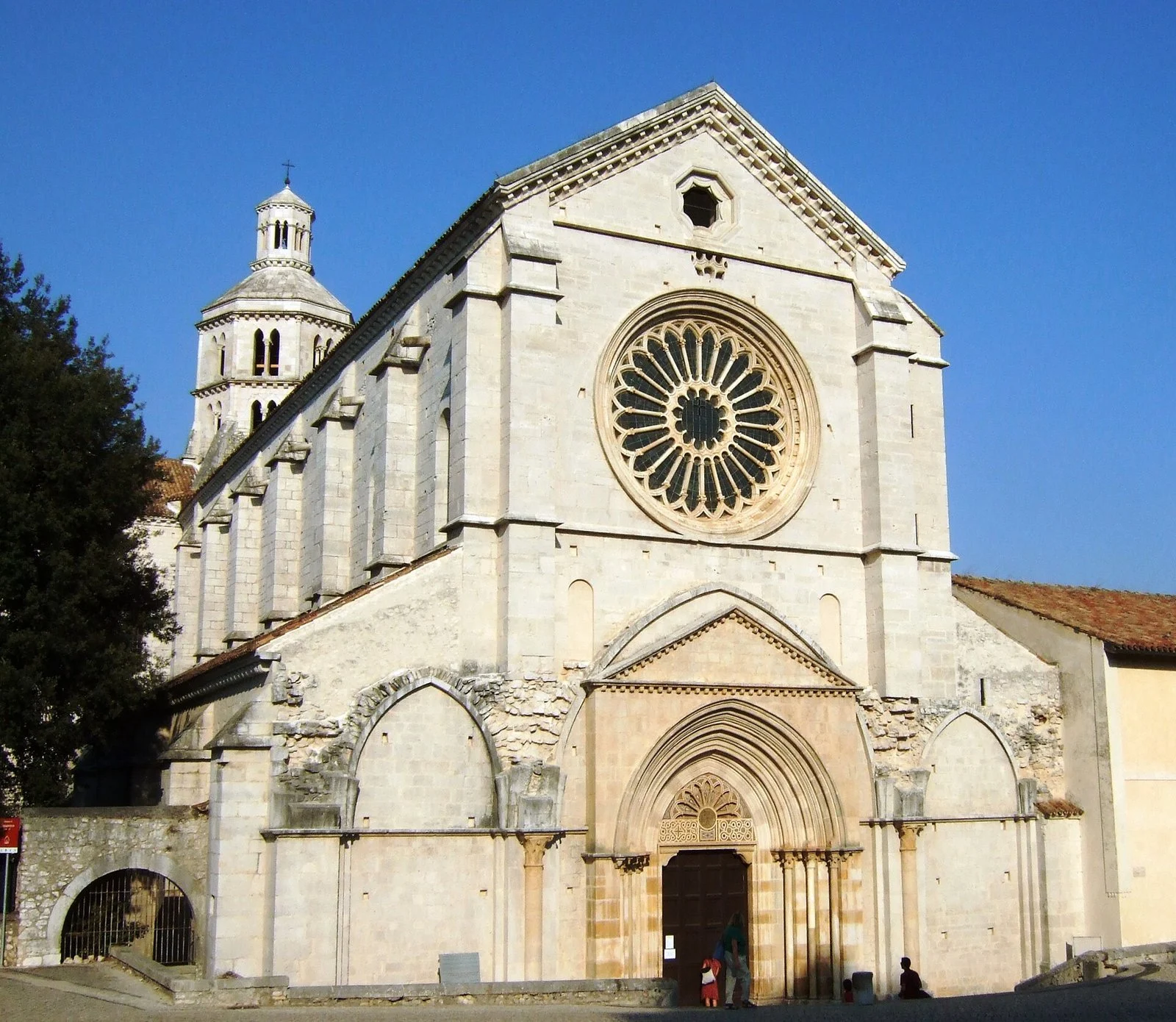
Fossanova Abbey is in a hamlet of Priverno, in the province of Latina, where the Amaseno valley opens onto the eastern edge of the Pontine plain. It is the oldest Cistercian complex in Italy and the one most cited in architectural history textbooks, because it is here that Burgundian Gothic forms arrive for the first time on the peninsula. Saint Thomas Aquinas died here in 1274. Admission is free, the place is little visited on weekdays and anyone who arrives without having read anything risks leaving after 20 minutes without having understood what they looked at.
Rome is a little over 100 kilometers away and no organized tour brings people here regularly. This page lines up what you really see, what the sources say and what the sources disagree on, the real hours, the costs, the concrete way to get there by regional train and what to expect in an area where around the abbey there is almost nothing.
Where Fossanova is and why it is where it is
The address is Via San Tommaso d'Aquino 1, hamlet of Fossanova, 04015 Priverno. The complex is about five and a half kilometers south of the historic center of Priverno, on the plain, where the Amaseno River comes out of the Lepini gorges and slows toward the Pontine plain. The spot is not random: the Cistercians chose damp valley floors, far from inhabited centers, with running water to channel and land to drain.
The position explains half of the abbey's story. Until the full land reclamation of the 1930s the Pontine plain downstream was largely marsh and malaria, while the foothill belt of the Lepini Mountains hosted the hill towns. Fossanova occupies the intermediate belt, the one the monks made farmable. Anyone arriving today sees regular fields and straight canals, not marsh, and so struggles to imagine the starting landscape.
Around the complex there is a small village, a few parking lots, the railway station a couple of kilometers away and little else. The real inhabited centers remain on the hills: Priverno to the northwest, Sonnino to the southeast, Sezze farther west. Those planning a full day have to allow for travel between one town and the next.
How you really get there from Rome
By train, the best option and the most underrated
There is a station called Priverno-Fossanova, on the Rome-Naples line via Formia. The regional trains that link Roma Termini to Formia, Minturno and Naples stop here: direct connections number about 40 a day, spread from five in the morning until late evening, and the trip generally lasts between 55 minutes and an hour and five minutes. It's one of the few places in deep Lazio reachable without a car with decent frequency.
The catch is the last stretch. The station carries the name of the abbey but is not adjacent to it: from the station forecourt to the gate of the complex there are about two kilometers and 700 meters of road, a little under 40 minutes on foot, on country asphalt with no sidewalk for much of the route. By day, with light and suitable shoes, it's a flat, quiet walk among the fields. In the evening or in the rain it becomes uncomfortable.
The alternative to walking is the bus. From the station depart Cotral runs toward Priverno, Sonnino, Pontinia, Sabaudia, San Felice Circeo and Roccasecca dei Volsci: the station, though isolated, works as an interchange for half the district. The schedules are few and concentrated on commuter movements, so they should be read beforehand on the regional company's website and not taken for granted on weekends.
The rail branch that went down from Priverno-Fossanova to Terracina has been closed since 2012 because of a landslide and at the moment does not appear to have been reactivated. Anyone building a coastal itinerary counting on that branch ends up on foot. The link between the station and Terracina is today covered by road.
By car
From Rome it's about 107 kilometers, with real times of around an hour and 20 minutes in free-flowing conditions and over an hour and a half at peak hours or on summer Sunday returns. The most direct route goes along Via Pontina up to the height of Latina and then cuts inland, but the Pontina is a road with a high accident rate and frequent queues: those in no hurry consider the A1 highway to Frosinone and the descent to Priverno from the interior.
In front of the abbey there are free parking areas, not paid, which are enough on weekdays and fill up on spring Sundays and during events. No ZTL, no parking disc, none of the complications that make it tiring to arrive by car in the center of Rome and that we have collected on the page about the ZTL of Rome. Here the problem is the opposite: without a car or a train you can't get around.
On foot, for those who walk
Fossanova appears as a stop in more than one hiking itinerary of southern Lazio, among them routes linking the Lepini towns to the coast. Those arriving on foot from Sonnino or the Lepini see the complex appear all at once at the mouth of the valley, and it's the way the pilgrims saw it. The stages are long and with little shade, so they should be tackled outside the hot months.
Hours, costs and when it's closed
The abbey is a state cultural site managed by the Lazio Regional Directorate of National Museums of the Ministry of Culture, and admission is free. The published hours are 8:30 to 18:30 in standard time and 8:30 to 19:30 in daylight saving time, every day, with no booking. The contact given on the ministerial pages is the switchboard of the Regional Directorate, not an on-site office.
The detail that changes the visit is another: the abbey is a church in use, not a museum, and during services the church closes to visitors. Weddings, masses, celebrations and concerts suspend access without notice on the website. Those who have only one day available do well to phone the same morning, especially on weekends from April to September, when weddings are frequent.
Guided visits exist but are not a continuous service with fixed departure times. They are organized on request for groups, generally from around 10 people up, and must be agreed in advance. The individual visitor who arrives at random finds the complex open and nobody to explain: the information panels are few and concise. This is the reason why it's worth reading something before leaving.
The Medieval Museum of Fossanova, which is inside the complex, has its own hours, different from those of the abbey, with a separate ticket. It should be treated as a distinct visit and checked separately, because it is open for a reduced fraction of the hours in which the church is open.
Why it's said to be the first Gothic in Italy, and with what cautions
The formula circulates in at least three different versions and they are not equivalent. The most cautious, which is also that of the scientific sources, speaks of the first Italian example of Cistercian architecture and of the first importation to the peninsula of the early Gothic forms of Burgundian architecture. Treccani expresses itself exactly this way, without using the word primacy in an absolute sense.
The second version, common in serious popular writing, says first construction in Italy of the Cistercian Gothic type. It's a broader formula but still defensible, because it confines the primacy to a precise architectural family, that of the order's building sites, and not to the whole Italian building output of the period.
The third version, the one you read on signs and in posts, says first Gothic building in Italy. It's the least sustainable. Fossanova is a transitional building, not a mature Gothic building: round arches and pointed arches live together, the ribbed cross vaults coexist with masonry of Romanesque design, there are no flying buttresses, there is none of the vertical thrust of the French cathedrals and there is no figured stained glass at all. Anyone who arrives expecting Chartres in miniature is thrown.
The most useful comparison is with the nearby Cistercian abbeys. Casamari, near Veroli, in the province of Frosinone, was consecrated nine years after Fossanova and has a similar layout with more coherent Gothic solutions. Valvisciolo, in the territory of Sermoneta, belongs to the same family. Anyone who wants to understand Italian Cistercian Gothic should see at least two, because the sense of the thing emerges from the comparison and not from the single building.
What remains is the point that justifies the trip. In an Italy that in the 13th century still built in Romanesque forms and that would adopt the Gothic in its own way, with results unrecognizable compared to the French model, Fossanova is the place where the French model arrives first and in pure form. The primacy concerns the chronology and the importation of a model, not the quality of the result.
Cistercian architecture explained by the building
The architectural rule of the order is born from a polemic. The Cistercians separate from Cluny by contesting the luxury of monastic churches, and Bernard of Clairvaux writes very harsh pages against sculptures in the cloisters, against paintings, against colored stained glass and against stone bell towers. The architecture that results isn't poor for lack of means but by programmatic choice, and this is what makes Fossanova a document and not just a building.
The church and its plan
The church is built entirely of travertine, with a Latin cross plan and three aisles divided by massive rectangular piers onto which half-columns are grafted. The central nave is marked by seven rectangular bays. The apse is flat and square, according to Cistercian custom, and not semicircular as in Italian Romanesque churches: it's one of the most immediate signs for recognizing a building site of the order.
The absence of decoration is the fact that strikes most those who enter. There are no Baroque side chapels, no monumental altars, no fresco cycles, no polychrome marbles. The surfaces are bare, the light comes in through narrow single-light windows and through alabaster, the color is that of the stone. Those who arrive from a day in the churches of the center of Rome, where every wall is occupied, notice the gap immediately.
The rose window
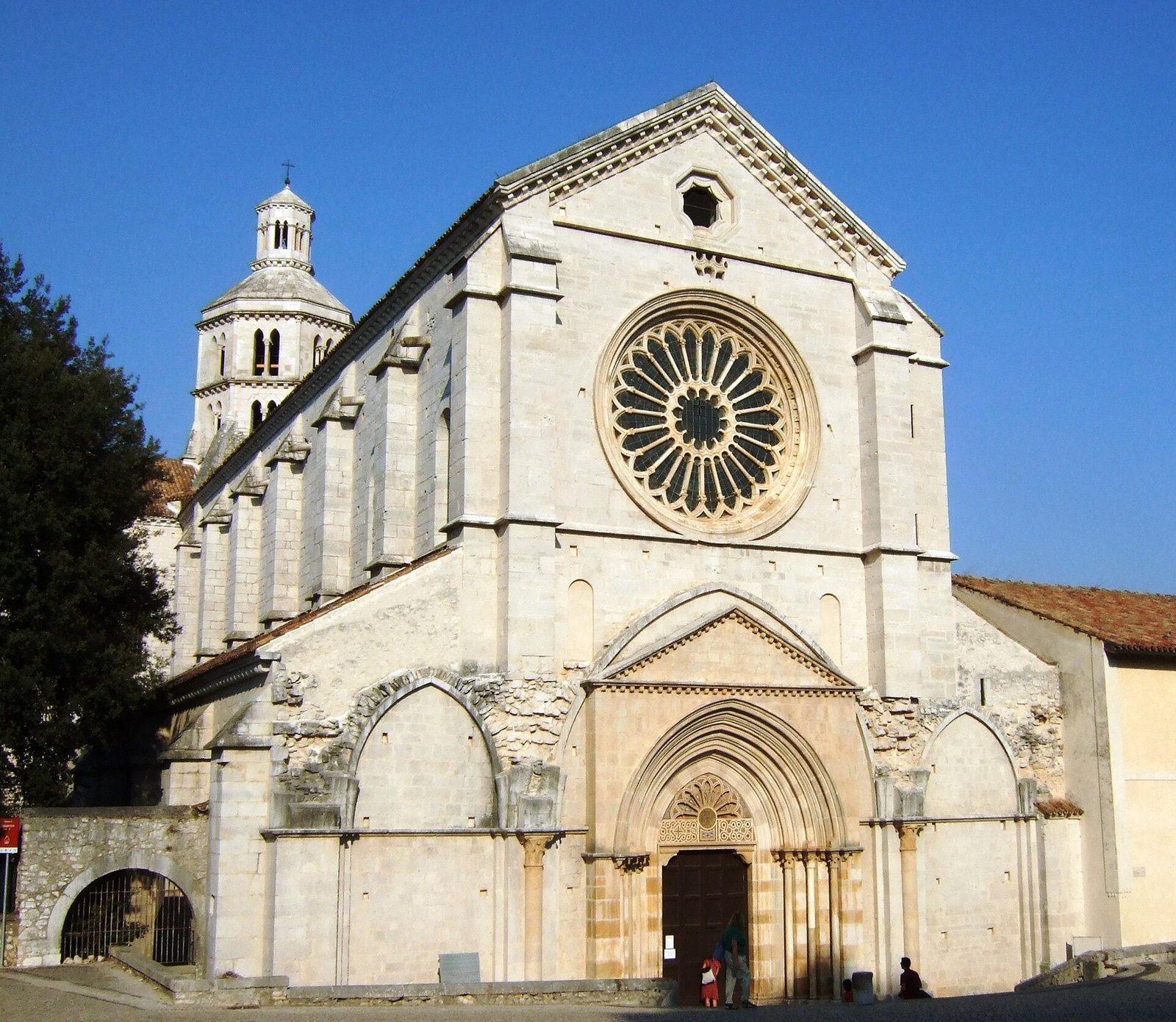
The rose window of the facade is the only element that concedes something to the eye. The framework is formed by 24 paired colonnettes on whose capitals pointed small arches are set, with an octagonal central oculus. The sources note that the present oculus is a rebuilding of an earlier one and that the rose window as a whole has undergone interventions: the surface you see today is not entirely 13th century.
Under the rose window is the portal, strongly splayed, with a pointed arch and concentric archivolts. Above it, on the facade, is a mosaic of Cosmatesque workmanship that according to the current reconstruction occupies the space of an earlier inscription referring to Frederick Barbarossa, whose protection the abbey enjoyed in the period of construction. This is a detail that should be reported as documentary tradition and not as epigraphic certainty.
The crossing tower
Over the crossing of the transept rises an octagonal-plan crossing tower on two levels, with paired windows, topped by a lantern. The lantern is a late addition, placed by the sources at the end of the 16th century, and replaces the function of the bell tower that the original Cistercian rule severely limited. From afar, arriving from the valley, the crossing tower is the first thing you see rising above the roofs of the village.
The cloister
The cloister is the piece that best explains the chronology of the building site. Three sides are Romanesque, with round small arches on smooth double colonnettes and barrel-vaulted galleries. The fourth side, the southern one, was built later in the course of the 13th century in Gothic forms, with pointed arches and more articulated and worked colonnettes. The passage from one side to the other can be read by walking, and is worth more than any panel.
In front of the refectory, projecting into the cloister, the 13th-century lavabo is preserved: a polygonal-plan pavilion with a pyramidal roof, where the monks washed before meals. The columns of the pavilion are reused Roman material, an ordinary detail for Lazio but consistent with the fact that the abbey stands over the remains of a Roman villa of the first century BC, partly visible in front of the church.
The chapter house
The chapter house is the most successful Gothic space of the complex. It is organized in two aisles divided into six bays, with ribbed cross vaults supported by clustered piers composed of joined colonnettes, stone benches along the walls where the monks sat and a central lectern. It's the space where the community gathered every day for the reading of a chapter of the rule, hence the name, and for collective decisions.
Anyone who wants to understand what Cistercian Gothic is should look here and not in the church. The relationship between slender supports and ribbed vaults, the distribution of loads, the renunciation of any narrative element: everything is more accomplished and more legible than in the nave, where the masonry stays heavy. The current dating places the hall around the middle of the 13th century.
The refectory
The refectory runs perpendicular to the cloister, as the order's scheme prescribes, and is a very large space covered by a wooden ceiling supported by five large pointed arches of square profile. The original windows were 13, some walled up today. Along one wall the reading pulpit is preserved intact with the small stair that led up to it: during meals one monk read aloud and the others ate in silence.
The pulpit is one of the elements that make Fossanova legible as a machine of daily life and not just as architecture. The same goes for the calefactorium, the only heated room of the monastery, where in winter texts were copied and parchment was worked because elsewhere the ink froze.
Guesthouse, infirmary and the rest
The guesthouse received travelers and outside guests, whom the rule kept separate from the cloistered space. The infirmary of the choir monks was a building detached from the main core, laid out on two floors, with refectory and kitchen on the lower level and the sick rooms above. Next to it were the scriptorium, the storerooms, the stables and the workshops, because a Cistercian monastery was also a farm.
The whole complex was enclosed by walls, of which the entrance gate remains. This is why still today Fossanova has the look of a small closed village and not of an isolated building: you enter through a gap, cross a built space, arrive at the church. Few other Italian monastic complexes preserve this overall legibility.
A curiosity about Fossanova Abbey
The tomb of Saint Thomas Aquinas, in the church, is empty. It is a simple rectangular stone slab, without ornaments, and the body has not been there for more than 600 years. It is perhaps the most honest object in the whole complex: it marks a place, does not keep a relic, and tells by subtraction the story that emptied the abbey of its main reason for pilgrimage.
The story closed in 1369, when the theologian's remains were transferred to Toulouse, to the church of the Dominicans. Fossanova was Cistercian and Thomas was Dominican: the body of a saint of the rival order had stayed for almost a century in the hands of monks of another religious family, and the dispute was long. The transfer, technically a translation, took from the abbey the pilgrims and at the same time a considerable part of its income.
Some relics remained in Italy and the reference biographical sources list them: the right hand at Salerno, the skull at Priverno, a rib at Aquino. On the later fate of each of them the literature is divided and some attributions are disputed. Anyone looking for Thomas's skull won't find it at Fossanova, and this should be said before the trip and not after.
Saint Thomas Aquinas, the cell and what is really known
In 1274 Pope Gregory X convened a council in Lyon and called Thomas Aquinas to take part. The theologian, already in precarious health, set out anyway. Along the journey from the south toward France he worsened and stopped at the castle of Maenza, in the Lepini, a guest of a niece. From there he had himself carried to the Cistercian abbey of Fossanova, not far away, where he died.
The most credited date of death is March 7, 1274, reported by the entry in the Dizionario Biografico degli Italiani and by the majority of the literature. Some popular sources indicate March 9. The divergence exists and should be noted, but the weight of the documentation is on the side of March 7, the day on which for centuries the Church celebrated his memory before the move to January 28.
The exact place of death is the most romanticized question of the whole story. The available sources indicate different spaces: the monks' infirmary, the abbot's room, the guesthouse. Each version has arguments, none is free of problems, and the identification of the room that is shown to visitors today is the result of a consolidated tradition more than of a compelling documentary proof.
The room indicated as the cell of Saint Thomas is on the upper floor, has been turned into a chapel and keeps an altar with a bas-relief showing the theologian commenting on the Song of Songs to the monks. The bas-relief is a rebuilding promoted by Cardinal Francesco Barberini, commendatory abbot in the 17th century, so a work almost four centuries later than the events it represents.
The episode of the commentary on the Song of Songs is itself hagiographic material. According to the traditional account the monks asked Thomas, by then ill, to explain that book to them, and he did so in his last days. The story has circulated for centuries and has generated the iconography, but it goes back to texts written after his death for canonization purposes. It should be read for what it is.
Anyone who wants to reconstruct the geography of the man, not of the saint, has reference points in southern Lazio. Roccasecca, in the province of Frosinone, is the birthplace indicated by family tradition. Aquino gives its name to the house. The Abbey of Montecassino was his first school, as an oblate child. They are three stops that make up a coherent itinerary and that very few people line up.
One thing nobody tells you about Fossanova Abbey
At the end of the 18th century the church was used as a stable. The French troops who arrived in the area in 1798 plundered the complex, dispersed the monastic community and used the nave as shelter for water buffalo, animals that then populated the Pontine marshes in great numbers. The detail appears in the historical reconstructions of the complex and explains many things about the state in which the abbey reached the 19th century.
The decay wasn't a brief episode. The community had already been reduced for centuries by the effect of the commendam system, introduced in 1457, which entrusted the abbey to outside abbots interested in the revenues and not in religious life. When the French arrived they found an enormous structure inhabited by very few. The plundering delivered the final blow to a decline begun long before.
The recovery was slow and passed through several hands. In 1826 Pope Leo XII bought the complex back and entrusted it to the Carthusians coming from the charterhouse of Trisulti, who stayed until the 1920s. After another gap came the Conventual Friars Minor, in the 1930s, who began the season of modern restorations. None of these communities was Cistercian: from the 18th century to today the order that built Fossanova has not come back.
Anyone walking in the cloister today is looking at a building saved three times and never reinhabited by its own. The present care is entrusted to the fathers of the Institute of the Incarnate Word with the Servants of the Lord and of the Virgin of Matará sisters, present since 2017. In a room of the complex conventual products are sold, which however do not come from monastic production on site.
The land reclamation, the canals and where the name comes from
The name Fossanova derives, according to the most widespread explanation in the encyclopedic sources, from the fossa nova, the drainage canal that the Cistercians dug to reclaim the marshy ground around the settlement. Treccani says it explicitly, linking the place name to the monks' hydraulic work. It is the hypothesis supported by the largest number of sources and the most coherent with what is known about the order.
There is, however, a different version, which traces the name to a drainage ditch of the small medieval settlement, with the value of a sewer and not of a reclamation canal. The difference is not one of detail: in the first case the place name celebrates an agrarian undertaking, in the second it records a service infrastructure. The sources diverge and the question is not closed.
Beyond the name, the hydraulic work is documented and should be framed properly. The Cistercians did not reclaim the Pontine countryside: they reclaimed the district around their abbey, channeling the waters of the Amaseno and the minor ditches, draining the low ground and making it farmable. It was an intervention on the scale of an estate, not on the scale of a region.
The full reclamation of the Pontine plain is a 20th-century matter, carried out by the State between the 1920s and the 1930s with machines, pumps and thousands of workers, largely from Veneto and Friuli. Confusing the two undertakings is a frequent mistake. Those who want to understand the second have the Pontine Land Museum in Latina, which documents the migrations and the farm work of the period.
The abbey's large estate, called the Tenuta di Fossanova, was in any case enormous and stood for centuries, until it passed in the 19th century to the Borghese princes, who with that purchase closed a centuries-long dispute with the municipality of Priverno over the ownership of the land. The present agrarian landscape, with its straight canals, preserves the memory of both seasons of reclamation superimposed.
The advice I give you for visiting Fossanova Abbey
Go on a weekday in late autumn or winter, early in the morning, and bring an extra sweatshirt. The church is not heated, the stone holds the cold and in January the inside temperature is lower than the outside. On the other hand there's nobody, the raking light comes in through the single-light windows and you can hear the silence, which in a building designed around silence is not a secondary detail.
The second piece of advice concerns the sequence. Enter the cloister first and only afterward the church. The cloister explains the complex, the hierarchy of the spaces, the relationship between daily life and liturgy, and shows the break between the three Romanesque sides and the Gothic side. Those who enter the church first see a large bare hall, find it cold and leave before understanding where they are.
The third concerns time. The ministerial pages indicate an hour of visit and an hour is enough for the basic tour, but those who also want to see the museum, the cell of Saint Thomas when it's accessible, the remains of the Roman villa in front of the church and the village should allow at least two and a half hours. Add the trip and you've committed the day.
Last point, practical. Phone ahead. The church closes for services, the museum has reduced and seasonal hours, the cell of Saint Thomas is not always open to the public and the monastic spaces may be barred for works. None of this information appears in real time on a single site, and a phone call saves a trip of two hours round trip.
The village and the Medieval Museum
The village that surrounds the abbey is not medieval in its present form, though the core has ancient origin. The houses you see today were built by the Borghese prince in the early years of the 20th century inside the walled perimeter of the complex, reusing abbey structures and adding new ones. Today the village is inhabited by very few people and for much of the year it is deserted.
The overall effect remains remarkable precisely for this reason. You walk in a settlement of pale stone, with narrow lanes, without traffic, without shop windows, without noise, and the scale is that of a village of 100 people. Those who arrive in the low season can find themselves alone for a whole hour. Those who arrive during the events find the opposite, because the village hosts events that concentrate thousands of visitors in a few days.
The Medieval Museum of Fossanova occupies a vaulted space of the old Cistercian guesthouse and is a section of the Priverno museum system, together with the archaeological museum in the historic center. It displays early medieval and medieval materials from excavations in the territory: everyday ceramics and grave goods, kitchen objects, architectural and liturgical elements from the cathedral, decorative fragments.
The most cited piece is a layered fresco with a Madonna praying and queen among angels and ecclesiastical figures, of the early medieval period, with several overlapping painted layers that can be read. For those coming from Roman archaeology it's a useful leap of centuries: it shows what happened to the territory of Privernum between the ancient city and the medieval village of Piperno.
The hours are seasonal and reduced. In the winter period, roughly from mid-September to the end of May, opening is limited to Saturday, Sunday and holidays, in two slots between morning and afternoon. In summer the opening days increase but the hours shift to late afternoon and evening. Updated information appears on the museum system's website and should be checked before leaving.
Those who arrive in Priverno also find the archaeological museum in the historic center and the archaeological area of Privernum on the plain, sections of the same circuit. The page on the museums of Priverno gathers the complete picture, and it's the check to make before organizing a day that includes both the abbey and the town.
Another well-known fact, yet rarely cited
Fossanova was a daughter house, not a mother house, and this determines everything else. In 1134 or 1135 Pope Innocent II handed a preexisting Benedictine monastery to Burgundian monks tied to the reform of Cîteaux and to the circle of Bernard of Clairvaux. The craftsmen and the architectural models arrived with them: this is why the building speaks French in a context that speaks Italian Romanesque.
The preexisting monastery is documented in 1089 with a dedication to Saint Stephen the protomartyr. Local tradition traces it back much farther, to Saint Benedict or to an early medieval origin in the sixth century, but these attributions have no documentary confirmation and should be kept distinct from the archival fact. Those who want to see a Roman Benedictine site with solid documentation can look at San Benedetto in Piscinula or go up to Subiaco.
The consecration of the high altar of the new church took place in June 1208 and it was carried out by Innocent III in person. The chronicles record an imposing papal retinue, with a procession of horses and a dinner eaten by the pontiff in the refectory together with the monks. The direct presence of the pope signals the political weight the abbey had reached a little over 70 years after the arrival of the Cistercians.
The 13th century was the century of greatest development. The abbey acquired properties, founded dependent houses, built the cloister, the chapter house, the refectory, the dormitories and the guesthouse. The 14th century reversed the curve: the plague of 1348, the loss of papal support, the competition of the mendicant orders and the departure of Thomas's body reduced the abbey to a few dozen monks.
The right photo to take at Fossanova Abbey
The photo that works is not the facade head-on. The facade is symmetrical, severe and in full sun for much of the day: it comes out flat, blown out in the whites and the same as 10,000 others. The photographer who arrives at noon with the sun high gets an image that is technically correct and completely without interest.
The right photo is taken in the cloister, on the southern side, at the height of the lavabo, in the hours when the sun is low. The paired colonnettes cast long shadows on the gallery and the difference between the round arches of the other three sides and the pointed arches of the Gothic side becomes visible in a single frame. It's the only image that tells the building instead of just showing it.
The second useful framing is interior, from the nave toward the apse, on an overcast day. The diffuse light renders the travertine without harsh contrast and lets you read the rhythm of the bays. On a clear day the contrast between the lit single-light windows and the stone in shadow sends everything to full black and white, and the sensor can't recover it.
The third is exterior and has to be sought at a distance, from the fields north of the complex, where the octagonal crossing tower emerges above the roofs of the village with the Lepini behind. You need a modest telephoto lens and half an hour's walk on a dirt road. Photographs taken from the parking lot don't work, because the cars always get into the frame.
Last operational note: photography is allowed inside and outside according to the ministerial indications, but during services you don't photograph and common sense comes before the formal permission. A tripod in church is rarely tolerated and in any case has to be asked of whoever is in charge first.
Some important events that happened here in history
1134, or 1135 according to other datings, marks the handing over of the Benedictine monastery to the Cistercians by Innocent II. It's the act that makes Fossanova the first presence of the order in Italy and that starts the building site destined to introduce Burgundian forms to the peninsula. Both dates appear in the sources and the difference depends on the document taken as reference.
On June 19, 1208 Innocent III consecrates the high altar of the church. It's the moment of the abbey's greatest visibility and the formal conclusion of a building site that lasted decades. The pope is welcomed in procession and dines in the refectory with the community: the scene is recorded by the chronicles and fixes the rank the monastery had reached in the ecclesiastical system of the time.
On March 7, 1274 Thomas Aquinas dies here, on his way to the council of Lyon. The event turns the abbey into a pilgrimage destination and at the same time into an object of dispute between Cistercians and Dominicans, a dispute that will last almost a century and will close with the translation of the remains to Toulouse in 1369.
1348 brings the plague, which drastically reduces the community as across Europe. 1457 introduces the commendam by decision of Callixtus III, with the passage of leadership to outside abbots: it's the beginning of the institutional emptying, slower than the plague but more definitive. The commendatory regime will last until the end of the 18th century.
1798 is the year of the French plundering and of the use of the church as a stable. 1826 is the year of the repurchase by Leo XII and the entrusting to the Carthusians of Trisulti. 1874 brings the declaration of national monument, which puts the complex under state protection and opens the season of restorations.
The 20th century adds three steps. In the early years of the century the Borghese build the houses of the village. In the 1930s the Conventual Friars Minor arrive and systematic restoration begins. At the beginning of the 21st century the rebuilding of the church floor is completed. Since 2017 custody has been entrusted to the Institute of the Incarnate Word.
Who has passed through Fossanova Abbey
Thomas Aquinas is the name that made the place famous, and he passed through it dying. He had written the Summa Theologiae, had taught in Paris and Naples, had built the conceptual scaffolding on which Catholic theology would work for centuries, and ended his life in an abbey of an order that was not his own, in a valley of southern Lazio, at 49.
Innocent III came in person in 1208 for the consecration, with a retinue that the chronicles describe as large. He was the pope who had reorganized the temporal power of the Church, who would convene the Fourth Lateran Council and who moved through central Italy with the awareness of being a head of state as well as a pontiff. His presence here wasn't devotion: it was ecclesiastical politics.
Frederick Barbarossa appears in the history of the complex through the epigraphic tradition of the facade, where an inscription referring to him would have been replaced by the Cosmatesque mosaic. The detail concerns imperial support for the building site and should be handled with caution, because the inscription no longer exists and the reconstruction rests on indirect sources.
Francesco Barberini, cardinal and commendatory abbot in the 17th century, left concrete traces: to him is owed the rebuilding of the altar in the cell of Saint Thomas. The Barberini family acted in Rome on a much larger scale, and those who know their Roman undertakings recognize here a minor intervention but one consistent with the policy of appropriating places of memory.
The Borghese princes entered the story in the 19th century as owners of the estate and in the 20th as builders of the village. It was a relationship of landowners and not of patrons, but without their building intervention the walled perimeter of the complex would probably have lost its legibility. The result is the village you cross today to reach the church.
In recent times the complex has hosted film shoots, among them a film by Liliana Cavani. Fossanova thus belongs, marginally, to the long list of places in Lazio lent to the cinema, a theme that on our page on Rome in the movies concerns above all the city but extends to the province more than you'd imagine.
What to see nearby
Priverno is the first natural stop, a few kilometers away, with the medieval historic center on the heights, the cathedral, the archaeological museum and the square that remains one of the best preserved urban spaces of the Lepini. Those with half a day more add the archaeological area of Privernum on the plain, which documents the Roman city from which the medieval village descends.
Toward the northwest, along the foot of the Lepini, you meet Sermoneta with the Caetani castle and its ceramics museum, the Garden of Ninfa with the ruins of the abandoned city, Bassiano with the Aldo Manuzio museum of writing and Norma overlooking the plain. It's the densest route and the easiest to drive.
Continuing you reach Cori, with the temple of Hercules and the museum of the town and territory, and Sezze. They are ridge towns with serious elevation changes and difficult parking in the historic centers: whoever plans several stops in a day almost always overestimates how many they can really do.
Toward the south, in half an hour you reach the sea. Terracina with the temple of Jupiter Anxur, San Felice Circeo, the Circeo National Park with Lake Fogliano and the other coastal lagoons, farther south Sperlonga and Gaeta. In summer the traffic on these routes is heavy and the times stretch a lot.
Toward the interior opens the Ciociaria. Anagni with the crypt of the cathedral and the cathedral museum, the palace of Boniface VIII, and farther south Roccasecca, Aquino and Montecassino. Those building an itinerary on Thomas Aquinas find here the rest of his biography.
For monasticism, the most instructive comparison remains the one among different orders. The Abbey of Tre Fontane in Rome is Cistercian and lets you see what happens when the same rule meets the city. The Greek Abbey of San Nilo in Grottaferrata is of the Byzantine rite, the Abbey of Farfa in Sabina is Benedictine and imperial.
Those who want to close the Dominican circle do so in Rome. Santa Sabina on the Aventine is the mother house of the order, Santa Maria sopra Minerva is the only Gothic church in the center of Rome and holds the tomb of Saint Catherine, San Sisto Vecchio and Santi Domenico e Sisto complete the picture together with Santa Caterina a Magnanapoli.
Local events deserve a calendar check before leaving. At Fossanova every year an event dedicated to wines produced in abbey settings is held, which fills the village for a few days in June. The complete seasonal picture of festivals and events of the territory is on the page about the food festivals and feasts of Lazio.
Eating in the area
Around the abbey there is almost nothing, and this is the first thing to know. The village has very few businesses, the station has even fewer, and the real towns are kilometers away on the hills. Those who arrive by train without having thought about lunch find themselves with few options and no room to choose. A sandwich bought before leaving solves more problems than it creates.
The area is, however, outside the mass tourist circuit, and this means the fleecing mechanisms typical of the center of Rome are rare here. The risk is not the trap built on purpose, it's the tired kitchen of a place that serves few customers and survives without turnover. The two problems are recognized by different signs, and it's best to keep them distinct.
The signs of the trap are still useful to know because you'll meet them on the coast, at Terracina, at Sperlonga, at San Felice, where in summer the tourist pressure is enormous. The first is the menu with photographs of the dishes: a place that has to show you the image of a carbonara has given up on making itself understood by the name of the dish and works with people who will never come back. No serious kitchen photographs its own work on the sign outside.
The second sign is the scene of handmade pasta in the window or on the sidewalk. The lady rolling out the dough behind the glass is a staging designed for passersby, and the relationship between that performance and the content of the dish that reaches the table is random. In a place that really rolls the pasta every day it's done in the kitchen, not in the street, for practical reasons before aesthetic ones.
The third sign is the person at the entrance inviting you to sit. A place with customers fills up without sending someone to stop passersby. A place that has to drum up customers in the street is telling you that the room doesn't fill by itself. It applies also in the gentle version, the handwritten sign with the welcoming phrase and the fixed price.
The fourth is the kitchen open without interruption from morning until night. A kitchen that never closes has no shifts, has no prepared service, has no shopping done in the morning for lunch: it works on continuous flow with products that hold for hours. It's a legitimate model for a bar, much less for a place where you go to eat seated.
The fifth concerns places set in front of monuments. On the coast and in historic centers the price list changes with the customer: items with no price indicated, fish by weight with no declared size, different prices between the menu displayed outside and the one handed over at the table, cover charges and service fees that appear only on the bill. Ask the price before ordering and ask for the itemized bill afterward. It isn't rudeness, it's normal in any country.
The chains with a repeated sign that you see in the center of Rome almost don't get here, but the reasoning stays valid when you go back. Those places work as tourist attractions, with a standardized product, a constructed aesthetic and an audience that looks for them by name. They aren't a rip-off, they're something other than a trattoria: Romans don't go there, and this says what they are, not that they should be avoided on principle.
The criterion that works everywhere is just one and requires no expertise. Look at who is sitting at the tables and in what language they order. If at two in the afternoon in a Lepini town the room is full of local people speaking dialect and ordering without looking at the menu, you've found it. If the room is occupied only by people with backpacks and cameras, look elsewhere.
In the hill towns, at Priverno, at Sezze, at Sonnino, at Bassiano, the cooking is Lepini: legume soups, home-cured pork, prosciutto, sheep cheeses, wild greens, homemade pasta in the local shapes. Sunday lunch is the occasion when these places give their best and also the one when it's best to book, because the tables are few and the families take them all.
A note on hours, which in southern Lazio are more rigid than in Rome. The kitchen opens around 12:30 and closes around two 30. In the evening they start at eight. Outside those windows you don't eat, and in small towns Monday is often a closing day. Whoever arrives at three in the afternoon counting on finding something open goes hungry.
For those who want the Roman picture, with the reasoned list of the neighborhoods where you eat and of the mechanisms to recognize in the center, we have a page dedicated to where to eat in Rome. The places Daniele really goes to, without payment and without deals, are collected in a public list on Google Maps, updated when something changes or gets worse.
Accessibility and visiting with children
The ministerial pages indicate the place as accessible and the complex is largely on a single level, with surfaces of stone and gravel. The church and the cloister are reachable without major changes in level. The spaces on the upper floor, among them the cell of Saint Thomas, are not: they are reached by narrow stairs, without an elevator, and this has to be allowed for.
The parking is close to the entrance and there are no long stretches to cover, unlike many archaeological sites in Lazio. Those arriving by train, however, have to consider the almost three kilometers from the station on a road without a continuous sidewalk, a route not practicable in a wheelchair. For the Roman picture of accessible facilities we refer to the page on accessible Rome.
With children the visit works better than it seems. The village is closed to traffic, the open spaces are wide, the cloister is a square where you can run and the remains of the Roman villa in front of the church give a concrete hook. What's missing is any structured educational route, and the interior of the church, bare and cold, holds a child's attention for a few minutes.
Frequently asked questions
How much does it cost to enter Fossanova Abbey?
Entrance to the abbey is free, because the complex is one of the state-run cultural sites managed by the Lazio National Museums Regional Directorate. You don't need to book and there is no ticket office. The Fossanova Medieval Museum, which is in the guesthouse, does charge admission and is part of the museum circuit of the municipality of Priverno, with its own fees and hours.
What are the opening hours of Fossanova Abbey?
The hours published by the Ministry of Culture are 8:30 to 18:30 during standard time and 8:30 to 19:30 during daylight saving time, every day. The abbey is, however, a church in active use and closes to visitors during religious services, weddings and celebrations. A phone call on the morning of your visit avoids surprises, especially on spring and summer weekends.
How do you get to Fossanova from Rome without a car?
You take a regional train from Roma Termini on the line for Formia and Naples and get off at the Priverno-Fossanova station. The trip generally takes between 55 minutes and 1 hour 5 minutes, with about 40 direct connections a day. From the station to the abbey it is about 2 kilometers 700 meters, almost 40 minutes on foot along a country road, or a Cotral bus with infrequent runs.
Is it true that Fossanova is the first Gothic building in Italy?
The correct formulation is narrower. Scholarly sources speak of the first Italian example of Cistercian architecture and of the first introduction in Italy of early Gothic forms derived from Burgundy. Fossanova is a transitional building between Romanesque and Gothic, with round arches next to pointed arches and without the typical elements of mature French Gothic. The primacy is one of chronology and importation, not of style in an absolute sense.
Where is Saint Thomas Aquinas buried?
Saint Thomas Aquinas died at Fossanova in 1274 but is not buried here. The tomb in the church is empty: his remains were moved in 1369 to Toulouse, in France, to the Dominican church. Some relics stayed in Italy, and the biographical sources place the right hand in Salerno, the skull in Priverno and a rib in Aquino, with attributions on which the scholarly literature is not unanimous.
Can you visit the cell where Saint Thomas died?
The room that tradition identifies as the place of his death is on the upper floor, has been turned into a chapel and holds a 17th-century altar with a bas-relief. Access is not guaranteed at all times and depends on the presence of whoever looks after the complex, so it's best to ask on site or call beforehand. It should be remembered that the identification of the room rests on established tradition more than on documentary proof.
How long does it take to visit Fossanova?
The ministry's guidance speaks of about an hour, which is enough for the church, cloister, chapter house and refectory at a normal pace. Adding the Medieval Museum, Saint Thomas's cell, the remains of the Roman villa and a walk through the village brings you to 2 and a half hours. If you are coming from Rome and want to combine Priverno or Sermoneta, you have to allow the whole day.
Can Fossanova be visited in the rain?
The church, the covered cloister, the chapter house and the refectory are under cover, so the bulk of the visit goes ahead anyway. Moving between the rooms happens outdoors, though, and the village is walked on stone and gravel, which become slippery when wet. The real problem with rain concerns those who arrive by train, because of the stretch on foot from the station with no shelter.
Are there other Cistercian abbeys nearby to combine with it?
Yes, and the comparison is the most useful thing you can do. Casamari, near Veroli in the province of Frosinone, was consecrated a few years after Fossanova and shows more coherent Gothic solutions. Valvisciolo, in the territory of Sermoneta, belongs to the same architectural family and is closer. Neither one is conveniently reachable by train: you need a car and a dedicated day.
Who wrote this page
The editorial team of Tour Leader Pro maintains these pages from its Rome office, where itineraries, visits and cultural events in Rome and the rest of Lazio are designed and coordinated. The hours, fees and access conditions given here come from the official sources cited in the text and were checked at the date of publication. They change often, so checking before you leave is still necessary. Reports of outdated information are welcome.
Putting together a day outside Rome means matching regional trains with few runs, active churches that close without notice, municipal museums with seasonal hours different from those of the state sites, and distances that look short on paper and are not when they go uphill. If you take on this work for yourself or for a group, you will find materials and planning tools on Tour Leader Pro, designed both for those who guide and for those who organize on their own.
For the wider picture, with regional rail connections, rentals, airports and the destinations in Lazio outside central Rome, from the Lepini Mountains to the Pontine coast and Ciociaria, a useful resource is Italy Planner.