Torre dei Caetani
In short. The Torre dei Caetani stands at the northeastern end of Tiber Island, exactly where Ponte Fabricio unloads onto the island those arriving from the bank of the Jewish Ghetto of Rome.
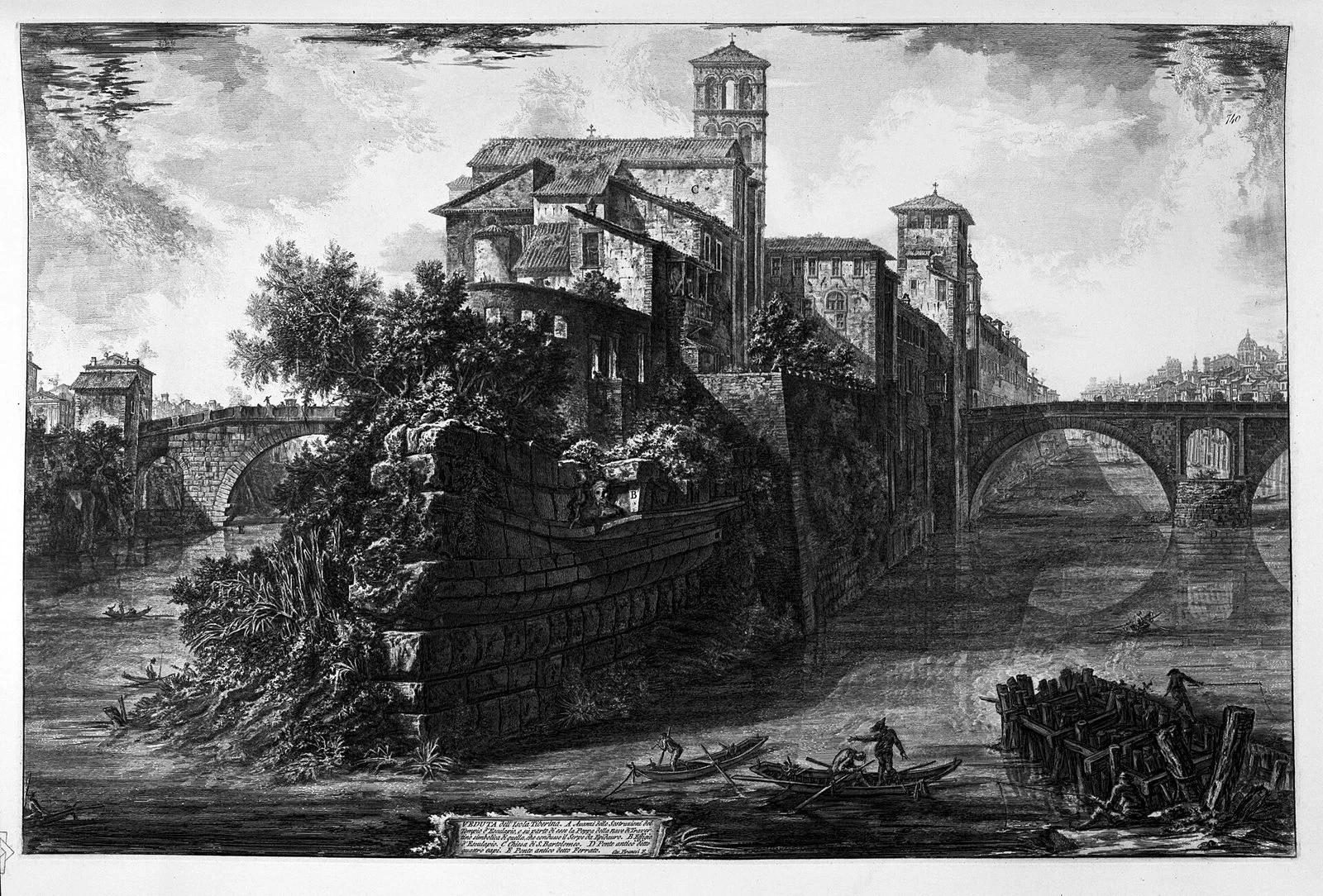
The Torre dei Caetani stands at the northeastern end of Tiber Island, exactly where Ponte Fabricio unloads onto the island those arriving from the bank of the Jewish Ghetto of Rome. It’s a medieval brick tower, tall and narrow, now built into the row of buildings that closes that side of the little square, and anyone who passes it walking fast toward the basilica or the hospital risks not noticing it at all. It’s also called the Torre della Pulzella because of a small relief with a female face set into its side. Who that woman was nobody knows, and everything you read around about her belongs to folklore, not to documentation. The lines that follow tell why a tower like this was built right there, to whom it belonged and in what order, how it turned into a baronial house and then a convent, what you can actually see from the street and from where it’s best to look at it and photograph it. One practical note needs to go first, because it’s the question that comes up most often: the tower can’t be visited. The interiors are in private hands, host cultural activities, and the rare openings to the public are tied to single events, with no regular calendar.
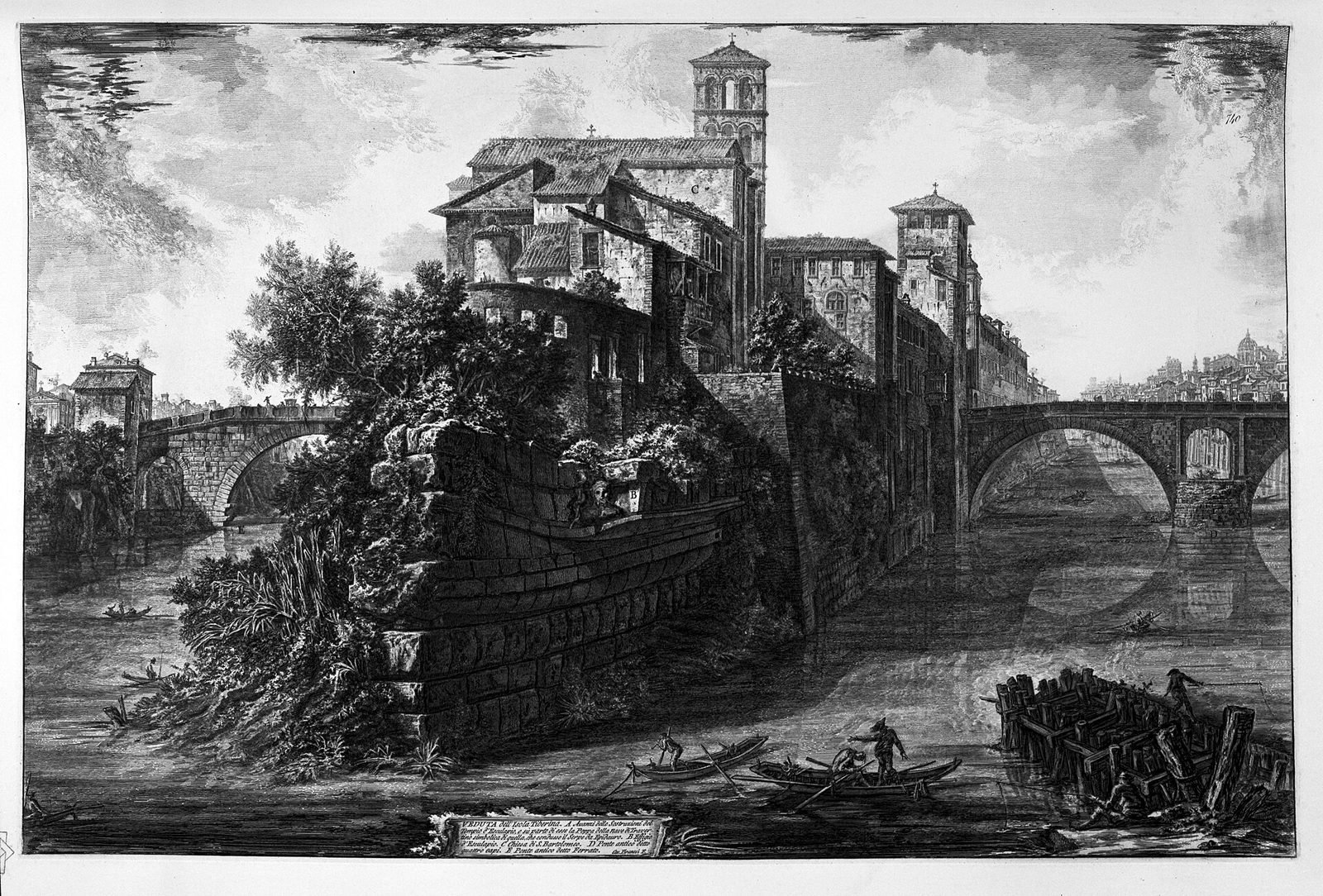
Where the Torre dei Caetani is and how to recognize it
The tower occupies the corner of the island facing upstream, that is, toward the direction the Tiber’s current comes from, on the side of Piazza San Bartolomeo all’Isola that looks at the mouth of Ponte Fabricio. Anyone crossing the bridge from the Ghetto has it ahead on the right, slightly set back from the line of the roadway. Anyone instead coming out onto the island from Ponte Cestio, that is, from the Trastevere side, sees it at the far end of the square, beyond the facade of the basilica.
How to get there by public transport
The island has no stop of its own, because you reach it only on foot from one of the two banks. From the Trastevere side the reference is tram 8, which connects Largo di Torre Argentina to Viale di Trastevere and stops at Piazza Belli, right by Ponte Garibaldi. From there you walk along Lungotevere degli Anguillara for barely 5 minutes and take Ponte Cestio. From the center side it makes sense to think in terms of Via del Teatro di Marcello and Lungotevere de’ Cenci, served by several surface lines, or metro line B getting off at Circo Massimo and a walk of about 15 minutes passing in front of the Mouth of Truth. The surface lines in the center often change number and route because of roadworks and detours, so check on the day on the transport company’s website.
On foot, from the places everyone knows
From the Theater of Marcellus you get there in under 10 minutes going down toward the river and crossing the Ghetto. From the Capitoline Hill the count is the same, with the descent toward Via del Teatro di Marcello. From Largo di Torre Argentina it takes about 12 minutes going by Via Arenula and then turning toward the river. From the Circus Maximus the most direct route runs past the Forum Boarium, in front of the Arch of Janus and back up the Lungotevere to Ponte Palatino, from which you see the stump of Ponte Rotto in the middle of the current.
Getting your bearings on the island in 30 seconds
The island is a little over 300 meters long and has a very simple geography, which is worth fixing in mind before you arrive. At the center is Piazza San Bartolomeo all’Isola with the basilica and its Romanesque bell tower. On the upstream side, that is, toward the Ghetto, Ponte Fabricio comes in and the Torre dei Caetani rises. On the opposite side, downstream, the island narrows into the travertine-clad point where the ancient relief with the staff and the serpent emerges. To the west, toward Trastevere, is Ponte Cestio. To the east and along the whole north flank the hospital stretches out. That’s all: in 10 minutes of walking you do the complete perimeter, quays excluded.
What you see of the Torre dei Caetani from the outside
From the outside, the Torre dei Caetani reads as a brick masonry volume, narrower than it is wide, with openings arranged on several levels and framed in marble, and with its side partly built into the structures that grew up around it over the centuries. What remains is the vertical piece of a larger complex, which included lower buildings and which changed function several times over time. Around it, buildings grew and leaned against the tower, until they swallowed part of its side.
The masonry and the windows
The brick facing tells the layering of the building better than any plaque. The textures are not uniform: regular stretches, rebuilding, infill of vanished openings, later repairs. The surviving windows with marble frames are spread over three main levels according to current descriptions, and they mark the moment when the tower stopped being only a defensive structure and became part of an inhabited residence. A tower born for military control doesn’t need framed windows. It needs arrow slits, a raised entrance and a few openings up high.
The relief of the Pulzella
The relief that gave the tower its second name is a small female face in marble, set into the facing at a height such that from the sidewalk you have to look for it calmly, raising your eyes. No sign points it out, it isn’t lit, and its dimensions are those of a fragment, not of a monumental sculpture. Anyone passing distracted never sees it. Anyone looking for it knowing it exists finds it in a couple of minutes and then can’t stop seeing it.
Why a tower right here: control of the ford
The Torre dei Caetani exists for a military and fiscal reason, not a decorative one: Tiber Island is the point where the Tiber is crossed in the simplest way, because two short bridges do the job that elsewhere takes a single long span, and whoever held the island held the crossing. This is the thread to follow to understand everything else.
The island as a bridgehead
In medieval Rome the river really divided the city. The ancient bridges still standing were few, and each of them counted as a strategic node: it could be closed, it could be watched, a toll could be demanded on it. The island made this even more profitable, because whoever controlled Ponte Fabricio toward the Campo Marzio and Ponte Cestio toward Trastevere at the same time held the whole passage, in both directions, and also had a space defensible on every side by the water.
The baronial towers of Rome
The Rome of the central centuries of the Middle Ages was a city of private towers, built by aristocratic families inside and on top of the ancient fabric. They were not isolated buildings: they were part of fortified compounds that swallowed Roman ruins, churches, houses and walls. The Frangipane did this at the Colosseum and in the area between the Palatine and the Roman Forum, the Orsini at the Theater of Marcellus, which became a palazzo, and the Savelli occupied the front of the Aventine. The same imperial mass that today is called Castel Sant'Angelo was born as a mausoleum and ended up as the most contested fortress in the city. The island fits this logic, and the tower is its most visible surviving piece.
The Pierleoni, the family that made the island a fortress
The tower appears in 12th-century documents as property of the Pierleoni, the family that had turned Tiber Island into a fortification of citywide importance. It is the most solid fact in the whole story and the point to start from: before the Caetani, the island belonged to the Pierleoni, and the defensive system that included the tower bears their stamp.
From financiers to barons
The Pierleoni rose in the Roman hierarchy through money and credit, not through an inherited fief. The sources agree in making them descend from a founder of a Jewish family converted to Christianity in the 11th century, and in linking them to the reform of the Church of those years, of which they were supporters and financiers. Their territorial base was precisely this sector of the city: the island, the mouth of the bridges, the area that now corresponds to the Ghetto and to the stretch of Lungotevere that still bears their name on the other bank, toward the Foro Boario.
The refugee popes: two dates that circulate everywhere
The pages that tell the story of the tower almost always report two episodes: the refuge of Pope Victor III in 1078 and that of Pope Urban II in 1088, during the clashes between the reforming papacy and aristocratic factions. The second episode fits well into the known historical picture, because Urban II was elected in 1088 and the Pierleoni were among his most solid Roman supporters. On the first date, instead, an inconsistency needs flagging that popular sources repeat without discussing it: Desiderius of Montecassino became pope with the name Victor III only in 1086, so in 1078 he was not yet pontiff. Either the date refers to a moment before his election, or it is the product of a consolidated tradition that nobody has checked anymore. It’s best to report it for what it is, that is, a piece of news you read everywhere but which doesn’t hold up against papal chronology.
Anacletus II and the schism of 1130
The moment when the family’s power reaches its peak is 1130, when Pietro Pierleoni is elected with the name Anacletus II in opposition to Innocent II. The schism lasts until 1138 and splits the city in two, with the Pierleoni holed up in their strongholds. In those years control of the island and its bridges is worth much more than heraldic prestige: it is worth the ability to keep open or closed one of the links between the two banks. The tower that today bears the name of the Caetani belonged at that time to that system.
How we get to the Caetani, by way of a destruction
The passage from the Pierleoni to the Caetani was not linear, and anyone who tells it as a simple succession of owners skips the most interesting fact: in the second half of the 13th century the complex underwent a demolition, at a time when it belonged to the Prefetti di Vico, opponents of the Angevins. The news goes back to the 19th-century studies of Carlo Calisse on the Prefetti di Vico, taken up afterward by later literature.
The Prefetti di Vico and the 13th-century demolition
The Prefetti di Vico were a dynasty from the northern Lazio area, powerful and often lined up against the factions that dominated Rome. In the second half of the 13th century, in a city crossed by the conflict between Guelphs and Ghibellines and by the Angevin presence, their stronghold on the island was struck and partly demolished. Private fortifications in Rome were torn down by political decision with a certain regularity: it was the most direct way to take power away from a family without having to besiege it each time.
Then the Caetani, and a residence in place of a fortress
After that phase the complex passed to the Caetani, who turned it into a residence for show. The family name is tied to Benedetto Caetani, elected pope in 1294 with the name Boniface VIII and in office until 1303: under his pontificate the Caetani piled up properties and castles in Lazio with a speed that their adversaries, starting with the Colonna, openly denounced. Several sources place the acquisition of the island around 1300, that is, right in the years of that pontificate, but the reference encyclopedia entry gives no precise year. This has to be said frankly here: a specific date for the passage to the Caetani is not an established fact, and whoever writes one is choosing among reconstructions, not citing a document.
A curiosity about the Torre dei Caetani
The curiosity that counts most of all concerns the relief of the Pulzella: several sources agree in dating that female face to the Roman era, with indications ranging between the 1st century AD and the Julio-Claudian phase, which would make it an ancient fragment reused in the medieval masonry. Popular tradition, on the other hand, tells of a 14th-century maiden. The two things can’t go together, and the distance between them is more than a thousand years.
The story that gets told
The handed-down tale speaks of a young noblewoman who refused an arranged marriage to a rich and much older man, preferring to wait for the return of a fiancé gone off to war, and who for this reason was supposedly shut up for life in the tower. It’s a story that circulates in several versions, with details that change from one telling to another. It has to be labeled for what it is: popular tradition, with no documentary support.
Why the ancient dating dismantles the legend
If the marble is ancient, the face can’t portray a woman who lived a thousand years later. The reuse of Roman fragments in medieval masonry was ordinary practice throughout the city: heads, cornices, capitals and slabs were set into the facings as building material and, at times, as a mark of prestige. The same mechanism can be seen in the facades of medieval Roman churches and in Romanesque bell towers, where ancient pieces are walled in haphazardly together with bricks. Seen this way, the face of the Pulzella becomes much more interesting as evidence of a building practice than as the protagonist of a love story.
The honest position to take
The identity of that face remains unknown. There is no inscription, no document that names it, no shared attribution. Anyone who writes that it is the portrait of a specific woman, with a name and a story, is telling folklore. The verifiable fact stops here: a marble fragment with a female face, set into the side of the tower, of a date that several sources refer to antiquity, which ended up giving the building its second name.
From baronial residence to convent: the 16th and 17th centuries
The Caetani left the island complex in the 16th century because of the damage caused by Tiber floods, and from that moment the history of the building stops being a history of families and becomes a history of institutions. Some reconstructions place the abandonment around the middle of the 16th century, others limit themselves to placing it generically in the century. The second wording is the cautious one.
The floods, the island’s real enemy
Before the construction of the embankment walls, the Tiber regularly invaded the low parts of Rome, and the island was by definition the most exposed of all. The floods did not come once a century. They were a recurring event, ruining ground floors, rotting wooden structures, bringing mud and disease. Living at river level was a choice that, as time went on, no wealthy family was willing to make anymore. The Caetani moved elsewhere, as many other Roman houses did, moving up from the river toward the higher parts of the center.
On the facades of Rome, between the Ghetto, the stretch toward Ponte Sisto and the streets around Campo de’ Fiori, there are still plaques marking the level reached by the water in the historic floods. Looking for them is one of the most instructive exercises you can do in the city: they tell at a glance why Rome decided, after 1870, to enclose its river between two walls.
1638: the complex goes to the Minori Osservanti
In 1638, through the intervention of Cardinal Francesco Barberini, the residential complex and the tower were granted to the Padri Minori Osservanti, who since 1536 had run the nearby basilica of San Bartolomeo all’Isola. This is the step that turns the former baronial residence into a convent, with everything that comes with it: cells, refectory, common spaces, an internal layout completely different from that of a noble house.
From this moment the tower stops being a military or showpiece element and becomes a part of the building like the others, absorbed into a convent organism. It is probably the reason it survived: a stable institution kept it in use and prevented its collapse, while dozens of private Roman towers were torn down, cut down in height or dismantled to recover the material.
19th century: the passage to the public and the concession
On the last passage the sources don’t agree, and both have to be reported. The encyclopedia entry gives 1876 as the year in which the first and second floors of the convent and most of the tower passed into municipal ownership, to be then given in concession to the Università israelitica, that is, to the institution of the Roman Jewish community. Other popular listings speak instead of an acquisition by the State in 1870. The two versions differ on the year and on the public body involved: the first is the more detailed, the second the more widespread on tourist-oriented pages. In the absence of a document that can be consulted, the correct wording is that in the years immediately following the capture of Rome the complex passed into public hands and was entrusted in concession.
That link with the Jewish community is not by chance. The bank opposite, beyond Ponte Fabricio, is that of the enclosure of the Ghetto, established in 1555 and demolished at the end of the 19th century, where today you find the Jewish Museum of Rome and the Synagogue of Rome. Ponte Fabricio was the daily passage between the two worlds, and for centuries it was also an administrative threshold.
One thing nobody tells you about the Torre dei Caetani
The thing nobody says is the most practical: the Torre dei Caetani can’t be visited, and it isn’t a temporary closure pending restoration. The interiors are in private use and host cultural activities, and openings to the public are exceptional, tied to single events or to extraordinary heritage opening initiatives. There is no schedule, no ticket, no ticket office.
Why it’s good to know beforehand
Many pages treat the tower as an accessible monument, and visitors end up circling the building looking for an entrance that isn’t there. The time lost is small, but the wrong expectation ruins the stop. Better to arrive knowing that this is a monument to look at from the outside, and set up the stop accordingly: 10 minutes well spent reading the masonry and looking for the relief are worth more than half an hour wandering in search of a doorway.
What to do if you want to try
Anyone who wants to try to see the interiors has to work on two fronts. The first is the calendar of the extraordinary heritage opening days, which every year in Italy make normally closed buildings accessible: the dates change and the lists of participating buildings are published a few weeks before. The second is the cultural initiatives on the island, which in summer are concentrated on the quays and which occasionally involve spaces that are otherwise closed. In both cases the checking has to be done on the organizers’ official channels, and not on third-party pages that report old hours.
The context: San Bartolomeo, the Fatebenefratelli, the two bridges
The Torre dei Caetani can only be understood together with what surrounds it, because Tiber Island concentrates in 300 meters an ancient sanctuary, a 10th-century basilica, a hospital active for more than four centuries and two Roman bridges. None of these elements arrived here by chance: they were laid down one on top of the other always for the same reason, namely the position.
The basilica of San Bartolomeo all’Isola
The basilica of San Bartolomeo all’Isola was founded by Emperor Otto III at the end of the 10th century, around 998 according to the best-accepted chronology, over the area of the ancient sanctuary. Inside, on the steps of the presbytery, is a medieval marble wellhead, which tradition links to the spring of the earlier sanctuary. Since 2002 the church has been a memorial to the new martyrs of the 20th century and of our own century, and keeps objects and memorabilia tied to people killed for their faith in different contexts around the world. Entry is free, opening hours depend on services and change over the year. Before counting on a visit, it’s best to ask the community that runs it for confirmation.
The hospital, here since the 16th century
The hospital occupies the whole northern flank of the island and has been active since the end of the 16th century, when the religious of the hospital order founded by John of God settled on the island. The name everyone in Rome calls it by, Fatebenefratelli, comes from the formula with which the friars asked for alms for the sick. It’s a working facility, with an emergency room and wards, and this affects the island’s traffic at every hour: ambulances pass on the bridge next to the tower. Anyone taking photographs has to bear in mind that they are not moving in a monumental enclosure, but next to the entrance of a hospital.
Ponte Fabricio and the four-faced herms
Ponte Fabricio dates from 62 BC and bears the name of Lucius Fabricius, the curator viarum who had it built and whose name appears in the inscriptions on the arches. It is the Roman bridge in Rome that best preserves its original structure and that has never stopped being used. The popular nickname Ponte dei Quattro Capi comes from the four-faced marble herms placed on the parapets, ancient pieces repositioned here at a later date, with four faces turned in the four directions. They are within easy reach, photograph well and almost no one notices them, even though they sit on the parapet at eye level.
Ponte Cestio, Ponte Rotto and the others
Ponte Cestio connects the island to Trastevere and is of Roman origin, but the bridge you cross today is largely the result of the late 19th-century reconstruction, made necessary by the widening of the riverbed and the building of the embankment walls. A little farther downstream, from the parapet of Ponte Palatino, you can see the isolated arch of Ponte Rotto, the last remnant of the Pons Aemilius. Going upstream you meet Ponte Garibaldi, Ponte Sisto and farther on Ponte Sant’Angelo, while much farther north there remains the Republican bridge of Milvian Bridge. Anyone who wants to understand Rome through its river has the densest stretch of all here.
The downstream point and the relief of the serpent
At the opposite end from the tower, the island narrows into the so-called prow, a travertine cladding on which a relief with the staff and the serpent, symbol of the god of medicine to whom the ancient sanctuary was dedicated, is still legible. The temple was vowed at the beginning of the 3rd century BC, after a plague, and tradition says the choice of the island was determined by the spot where the sacred serpent, brought by sea from Epidaurus, supposedly stopped. This too is tradition, not chronicle. The relief can be seen from the quay or from the parapet of Ponte Palatino, and it is heavily eroded.
The advice I give you for visiting the Torre dei Caetani
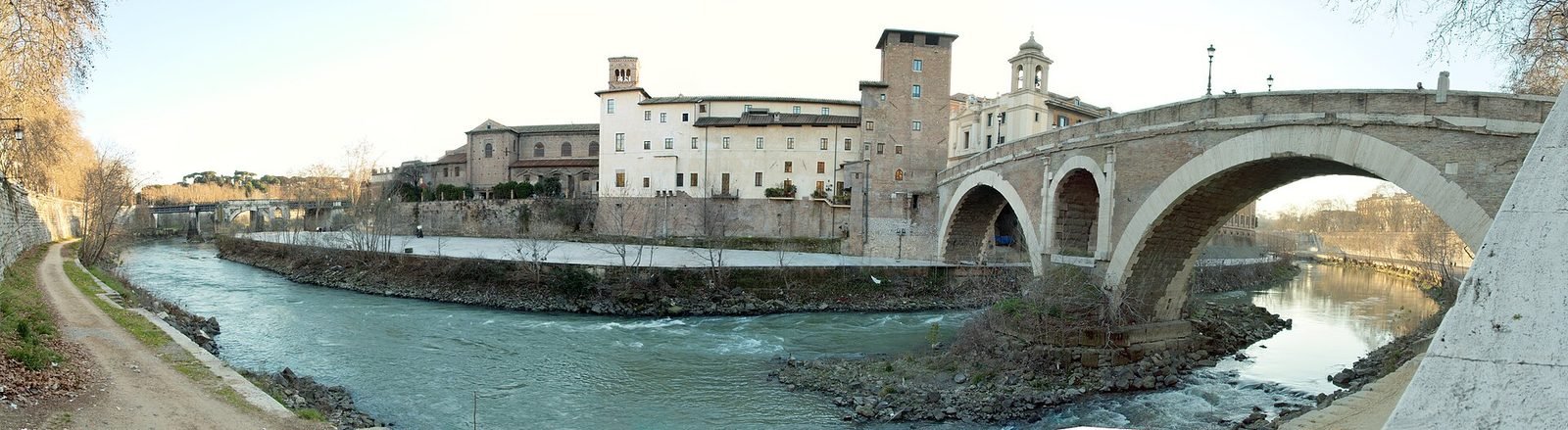
The practical advice is just one and applies to everyone: the Torre dei Caetani should be looked at from three different points in the same walk, because from a single point it doesn’t make sense, and the full loop takes 20 minutes. The three points are the middle of Ponte Fabricio, the quay below street level and the Ghetto bank on the Lungotevere opposite.
First point: the middle of Ponte Fabricio
Stop halfway across the bridge, on the downstream side, and look toward the island. From here the tower is seen in full in its relationship with the square and with the bell tower of the basilica, and you understand its function of blocking the entrance. It’s also the point from which you judge the real height of the building relative to the houses around it. Watch where you stand: the bridge is pedestrian but narrow, and at peak hours the flow is continuous.
Second point: the quay
Going down onto the quays completely changes the relationship with the island, because you bring yourself to river level and look at the buildings from below. The access points are the ramps and stairs built into the embankment walls near the bridges. Two concrete warnings: the descents are steep and often slippery, and the quays are closed when the river level rises, which in fall and winter happens fairly often. Check on the spot, by seeing if the gate at the top of the ramp is open.
Third point: the Ghetto bank
Lungotevere dei Cenci and the stretch toward Ponte Garibaldi offer the overall view: tower, Ponte Fabricio, island and water in a single field of vision. It is the view that best gives the sense of the whole story told here, that is, a built block planted at the head of a bridge. From this bank you also take the best photos at the hours when the sun is low behind the observer.
The verdict, without beating around the bush
The Torre dei Caetani doesn’t hold up as a trip made on purpose. It’s a stop to fit in, not a destination to reach: anyone with two days in Rome who puts it on the program in place of something else is making the wrong choice. Anyone instead who is already crossing the river between the Ghetto and Trastevere and gives it 10 conscious minutes takes home much more than they take home from the line at a famous monument. The value of this building is one of context, and the context here is exceptional.
Another well-known fact, yet rarely cited
The fact is this: the Torre dei Caetani owes its survival to the construction of the Tiber embankment walls, the work that between the end of the 19th century and the early 20th enclosed the river between two stone banks and erased the direct relationship between Rome and its water. Without that intervention the building would have kept suffering the floods that had already driven the Caetani out in the 16th century.
What the embankment walls changed
The works began after the flood of 1870 and went on for decades along the whole urban stretch. The riverbed was straightened and widened, the banks were faced in stone, the river ports and floating mills disappeared, and with them a whole piece of the city’s economy vanished. The island came out transformed: its banks, previously sloping and used as landings, became walled quays, and the bridges had to be adapted to the new section of the river. Ponte Cestio was largely rebuilt for exactly this reason.
This is why the quays matter
The quays of the island are the space that in summer hosts the events along the river, the ones that keep the center open in Rome on July and August evenings, and which are part of the broader calendar of the Estate Romana. The program occupying the river stretch between the bridges changes name and format from year to year, and the up-to-date reference is the page dedicated to Lungo il Tevere Roma. During the months of activity, access to the quays changes hours and routes, and the tower is seen from below in a context completely different from the daytime one.
The right photo to take at the Torre dei Caetani
The photo that best shows the Torre dei Caetani is taken from the Ghetto bank, on Lungotevere dei Cenci, in late afternoon, including in the frame the arch of Ponte Fabricio in the foreground and the tower in the background. It is the only position from which the three elements that matter, water, bridge and tower, fit together in the same frame without forcing an extreme focal length.
From Ponte Fabricio
On the bridge you get the close portrait of the building, with the masonry legible and the relationship with the square. The limit is space: you can’t step back beyond the opposite parapet, so to take in the full height you need a wide angle and you accept a certain convergence of the verticals. Anyone shooting with a phone can partly correct the distortion with the straightening function, or accept it and use it, framing from below deliberately. From the middle of the bridge you also get the four-faced herms well, and they deserve a shot of their own.
From the quays
From the quay the tower is seen from below, above the line of the embankment wall, with the water in the foreground. It’s the position that best conveys the idea of a structure planted on the river. Pay attention to two things: the ground is often damp and slippery near the edge, and there are no continuous parapets along the whole quay. With the river swollen the access is closed and there are no alternatives.
From the Ghetto bank and from Ponte Garibaldi
Lungotevere dei Cenci and the parapet of Ponte Garibaldi give the overall view. From Ponte Garibaldi the island reads from the side, with the two bridges and the tower lined up. It’s the classic postcard framing, and it works best with a medium focal length, around 50 millimeters equivalent, which slightly compresses the planes. From Lungotevere dei Cenci you instead gain the arch of Ponte Fabricio as a natural frame.
The light and the hour
The front of the tower facing the bridge receives direct light in the afternoon hours, so late afternoon is the moment when the brick masonry gives its color. Early in the morning that side is in shadow but the river is smooth and reflects, and this compensates. Summer noon is the worst condition: flat light from above, hard contrasts, no modeling on the masonry. In the evening, after sunset, the artificial lighting of the bridges comes into play and a long exposure becomes the obvious choice, with a tripod or resting the camera on the parapet.
The relief of the Pulzella in photography
Photographing the walled-in face takes a telephoto lens or the pushed digital zoom of a recent phone, because the height at which it sits and the small size of the fragment don’t allow you to capture it legibly at a normal focal length. The best result comes in diffuse light, with an overcast sky or in shade, because direct, raking sun flattens a relief that is already very worn. It’s best to shoot several times resting your elbows, because at that focal length camera shake is almost unavoidable.
Three mistakes almost everyone makes
The first mistake is photographing the tower from below, from the square, a few meters away: you get a wall with no context and the structure can’t be recognized. The second is including parked cars and trash bins in the foreground: just moving onto the bridge gets rid of them. The third is not photographing the herms, the most easily reached ancient piece on the island.
The rules of common sense
The island hosts a working hospital. Don’t photograph ambulances, the emergency room entrance, patients or anyone in a situation of vulnerability. A tripod on the bridge, in a narrow and heavily used passage, is an obstacle: set it up only if there is real space and take it down right away. For drones, the restrictions on the historic center and on urban airspace apply, which make flying impossible without specific authorizations.
Some important events that happened here in history
The events tied to the Torre dei Caetani and its little island span almost a thousand years and almost always have to do with the same thing: someone looking for a safe place in the middle of the river while the city is fighting. The list that follows reports the documented or widely attested episodes, distinguishing them from those that belong to tradition.
1088: the refuge of Urban II
The best-framed episode is the refuge of Pope Urban II with the Pierleoni in 1088, in the thick of the clash between the reforming papacy and the imperial party. Urban II was elected that year and for a long time could not freely dispose of the city: the strongholds of the allied families, the island included, were his Roman base. It’s the moment when the military function of the fortification on the island shows best.
Second half of the 13th century: the demolition
The fortified complex underwent a demolition in the second half of the 13th century at the hands of the Angevins, when it belonged to the Prefetti di Vico. It’s the episode that splits the history of the building in two and that explains why what we see today is not the 12th-century structure in its original form, but the result of later rebuilding.
October 1943 and the ward that didn’t exist
The most recent episode concerns the island’s hospital and should be remembered in full. After the roundup of October 16, 1943 in the Jewish Ghetto of Rome, some doctors of the Fatebenefratelli admitted Jewish people to an isolated ward, attributing to them a nonexistent and highly contagious disease, listed in the charts as K syndrome. The fiction served to keep German inspections away from the rooms. The episode is documented and acknowledged, and led to official recognition for the doctors involved. Anyone who visits the island after passing through the Jewish Museum of Rome reads the whole quarter differently: Ponte Fabricio, in those weeks, was the distance between capture and safety.
What is instead tradition
Not belonging to the documentation are the story of the maiden walled up in the tower, the reading of the female face as a portrait of an identifiable person and the different attributions that circulate about her. They are folkloric material, useful for understanding how Rome has always filled its ancient fragments with stories, and without historical value.
Who has passed through the Torre dei Caetani
Through the Torre dei Caetani and the complex it belongs to have passed, in chronological order, the Pierleoni, at least one pope on the run, the Prefetti di Vico, the Caetani of the family of Boniface VIII, the Minori Osservanti friars and finally the public institutions after Italian unification. One single building, six different owners, each with a different idea of what it should be.
The Pierleoni and the popes
The family that builds the island’s defensive system hosts, according to the sources, Pope Victor III and Pope Urban II. On the first, as said, the chronology doesn’t add up. On the second the picture is consistent with what is known about the period. Behind these names is the mechanism that counts: in Rome, in the central centuries of the Middle Ages, the pope was not master of his own city and depended on alliances with armed families.
Boniface VIII, from afar
Benedetto Caetani, pope from 1294 to 1303, is not personally tied to the tower, but he is the reason the family could afford to acquire it and transform it. His pontificate coincides with the greatest expansion of Caetani property in Lazio and with the open conflict with the Colonna. Anyone who goes from here to the basilica of San Giovanni in Laterano meets his name again: it was he who proclaimed the first jubilee, in 1300.
Eating around the island: how to choose and what to avoid
Around Tiber Island, between the Ghetto and the first stretch of Trastevere, the density of tourist restaurants is among the highest in Rome, and the ratio between price and quality gets worse the closer you get to the bridges. We don’t name restaurants, by choice: a list of signs goes out of date in a few months and teaches the reader nothing. We give the criteria, which apply here as in any other tourist quarter of the city.
The five signs that point to a trap
The first is the lady rolling out fresh pasta in the window or directly on the sidewalk: it’s an advertising lure, not a kitchen, and almost never is that pasta the one that reaches the plate. The second is the menu with photographs of the dishes, often laminated and translated into six languages: it’s for people who will never come back. The third is the tout at the door inviting you to sit: a place forced to stop people on the street has a problem filling its seats, and that problem ends up on the bill or in the raw materials.
The fourth sign is non-stop hours from morning to night with no kitchen break: a real kitchen has two services and stops in between, because it prepares. The fifth is the places set in front of famous monuments, which set the price by the customer in front of them: items with no price on the list, cover charge and service that show up only at the end, different menus inside and outside. These five signs can be recognized from the street, in 30 seconds, without going in.
The chains of the center
In recent years the center of Rome has filled up with places with repeated signs, with the same menu at several points of the city, the line with a number ticket and communication that is all the same. The phenomenon is explained by rents and by tourism volumes, and should be observed for what it is. The fact that counts for the reader: Romans don’t go to those places. We don’t name them and we don’t recommend them.
The simplest criterion of all
Look at who is sitting and in what language they order. At one o’clock on a weekday, in an area like this, a place with hospital staff and office workers ordering without looking at the menu is working on regulars. If at the tables there are only backpacks and cameras, the place lives on passing trade. The second criterion is walking: 6 or 7 minutes toward the interior of Trastevere or toward Via Arenula is enough to leave the monument price band.
For anyone who wants a starting point already selected, without signs placed there at random, we point to Daniele Dezi’s personal list on Google Maps: a curated collection, not sponsored and not paid, built on places tried in person over time.
Accessibility, children and river level
Tiber Island at street level is flat and can be walked with strollers and wheelchairs, because Ponte Fabricio, the square and Ponte Cestio are essentially level, and the island is served by the hospital, so the routes are kept passable. The critical point is the quays, reachable only by stairs and steep ramps.
With children
For a child, the hunt for details works: the four faces of the herms on the bridge parapet, the face walled into the side of the tower, the relief with the serpent on the downstream point. Three targets, one full loop of the island, 20 minutes. The caution concerns the quays, where the edge toward the water is not protected continuously, and the traffic at the mouth of the bridges.
When the Tiber rises
With the fall and winter floods the quays are closed and the water can reach the lower level of the island. On those days the walk is limited to street level, and the best way to look at the tower remains the Ghetto bank. It’s worth checking the situation before going down: the closed gate at the top of the ramp is the definitive answer.
Frequently asked questions about the Torre dei Caetani
Can you visit the Torre dei Caetani?
The Torre dei Caetani can’t be visited: the interiors are in private use and there is no visit route or ticket office. Openings to the public are exceptional and tied to single events or to extraordinary heritage opening days, with no regular calendar. The building is observed from the outside, from Ponte Fabricio, from the island’s square, from the quays and from the Lungotevere on the Ghetto bank.
How much does it cost to see the Torre dei Caetani?
Seeing the Torre dei Caetani from the outside costs nothing, because Tiber Island is an open-air public space, accessible at any hour from Ponte Fabricio and from Ponte Cestio. There is no ticket, because there is no visit of the interiors. The basilica of San Bartolomeo all’Isola, a few meters away, also has free entry, with hours that depend on services.
Why is the Torre dei Caetani also called the Torre della Pulzella?
The Torre dei Caetani is called the Torre della Pulzella because of a small relief with a female face set into its outer masonry. The identity of the woman depicted is unknown and there is no document that names her. Several sources date the fragment to Roman antiquity, which would make it a reused piece, while popular tradition tells of a 14th-century maiden shut up in the tower. That story is folklore, not chronicle.
Where exactly is the Torre dei Caetani?
The Torre dei Caetani is on Tiber Island, at the end facing upstream, at the mouth of Ponte Fabricio, on the side of Piazza San Bartolomeo all’Isola facing the Ghetto bank. Anyone crossing the bridge from Lungotevere dei Cenci finds it on the right, right after leaving the bridge, set back from the roadway.
How do you get to the Torre dei Caetani by public transport?
You get to the Torre dei Caetani only on foot, because Tiber Island is reached by crossing Ponte Fabricio or Ponte Cestio. From the Trastevere side the reference is tram 8, with a stop at Piazza Belli near Ponte Garibaldi, and 5 minutes of walking. From the center you come down from Via del Teatro di Marcello or from the Lungotevere. With metro line B you get off at Circo Massimo and walk a quarter of an hour. Surface lines and routes change often, so it’s best to check them on the day.
How much time do you need to see the Torre dei Caetani?
15 minutes are enough to see the Torre dei Caetani, which becomes half an hour doing the loop of the three viewing points: the middle of Ponte Fabricio, the quay and the Lungotevere of the opposite bank. Adding the basilica of San Bartolomeo, the downstream point with the ancient relief and the view of Ponte Rotto from Ponte Palatino, the whole of Tiber Island keeps you busy for about an hour and a half.
Is the Torre dei Caetani suitable for a visit with children?
The Torre dei Caetani lends itself to a short stop with children, because the loop of Tiber Island is short, flat and full of details to look for: the four-headed herms on the parapet of Ponte Fabricio, the face walled into the side of the tower and the relief with the serpent on the downstream point. The quays need supervision, because the edge toward the water is not protected everywhere.
Can you photograph the Torre dei Caetani?
The Torre dei Caetani can be photographed freely from the outside, since it is a building visible from public space. The best result comes from Lungotevere dei Cenci in late afternoon, with the arch of Ponte Fabricio in the foreground. For the relief of the Pulzella you need a telephoto lens. On the island there is a working hospital: ambulances, the emergency room entrance and patients must not be photographed.
Is the Torre dei Caetani accessible to people with mobility difficulties?
The area around the Torre dei Caetani is accessible, because Ponte Fabricio, Piazza San Bartolomeo all’Isola and Ponte Cestio are level and without significant steps. The quays along the river remain excluded, reachable only by stairs and steep ramps and closed when the Tiber level rises. The interiors of the tower are in any case not visitable by anyone.
Who wrote this page
This page is edited by the editorial team of Tour Leader Pro, the Rome project office that designs and coordinates visits, itineraries and cultural events in Rome and Lazio. The hours, fares and access conditions given here were verified at the date of publication against the official sources named in the text. Check them again before you leave, because they change often. If you find a piece of information that is out of date, let us know.
Anyone building a Roman itinerary that brings together Tiber Island, the ancient bridges of the urban stretch of the Tiber, the Ghetto and Trastevere, and needs to coordinate timing, access and accompaniment, will find planning tools and operational support at Tour Leader Pro.
To place this stop within a broader trip, with connections, transport and destinations in Lazio and the rest of Italy, a useful planning resource is Italy Planner.