Esoteric Rome
In short. Esoteric Rome is a formula that has circulated for at least two centuries and that today supports a quantity of pages, videos and guided tours built almost entirely on the same material: a few verifiable facts and many stories repeated…
Esoteric Rome is a formula that has circulated for at least two centuries and that today supports a quantity of pages, videos and guided tours built almost entirely on the same material: a few verifiable facts and many stories repeated until they became common sense.
This page tries to do the opposite. It lines up places that really exist, says who built them and when, reports what is written or carved on them, and keeps separate three things that almost always get mixed together: the documented fact, the symbolic interpretation proposed by scholars with a first and last name, and the modern legend, declared as legend.
The criterion is simple and holds for all the text that follows. If a piece of information has a source, the source is named. If a piece of information circulates without a source, it is written as a story that circulates without a source. If a piece of information does not hold up to verification, it does not appear at all, and at the end of the page you'll find a chapter that lists what we removed and why. No Roman place "guards a secret," and none of these monuments speaks to a category of initiates.
How to read this page: three levels kept separate
The first level is the documented. Who commissioned a work, in what years, with what materials, what the inscriptions say in their literal wording, where the object was before being moved. These are facts drawn from deeds, surveys, superintendency catalogs and academic bibliography, and in most cases they are known and boring. Almost always the documented level turns out to be more sober than the tale that has grown around it.
The second level is the symbolic interpretation. A scholar proposes a reading: this geometric form refers to that model, this heraldic emblem explains that choice, this inscription takes up that printed treatise. It is legitimate work and often convincing, but it remains interpretation, and must be attributed to whoever formulated it. Two serious scholars can read the same building in two different ways, and in some Roman cases that is exactly what happens.
Why so much material of this kind settled in Rome
For centuries Rome was the place in Europe where three things came together that elsewhere were separate: an enormous quantity of Egyptian and Eastern antiquities brought here by the empire, a papal court that financed study and collecting, and a circulation of books, engravers and printers that made European alchemical literature available. Seventeenth-century Rome reads hieroglyphs, collects mummies, founds museums of curiosities and discusses natural philosophy.
Add one practical thing. Rome has a layered subsoil that continually yields ancient places of worship, and every find feeds stories. The difference between this page and the one devoted to underground Rome is sharp: there we speak of what you visit below street level, here of symbols, inscriptions and cults, and the two routes cross only at a few points.
The Porta Magica of Piazza Vittorio: what is really known
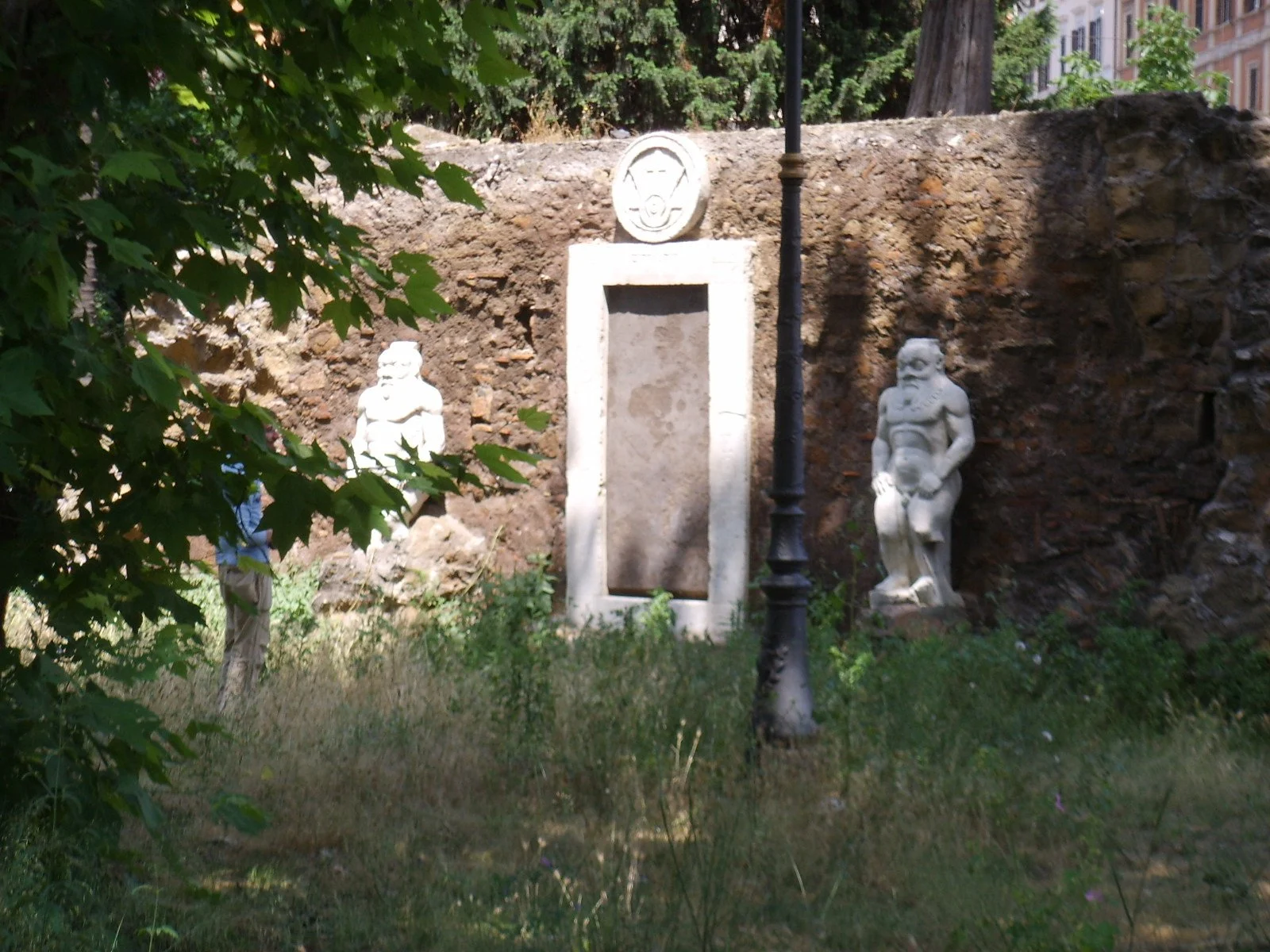
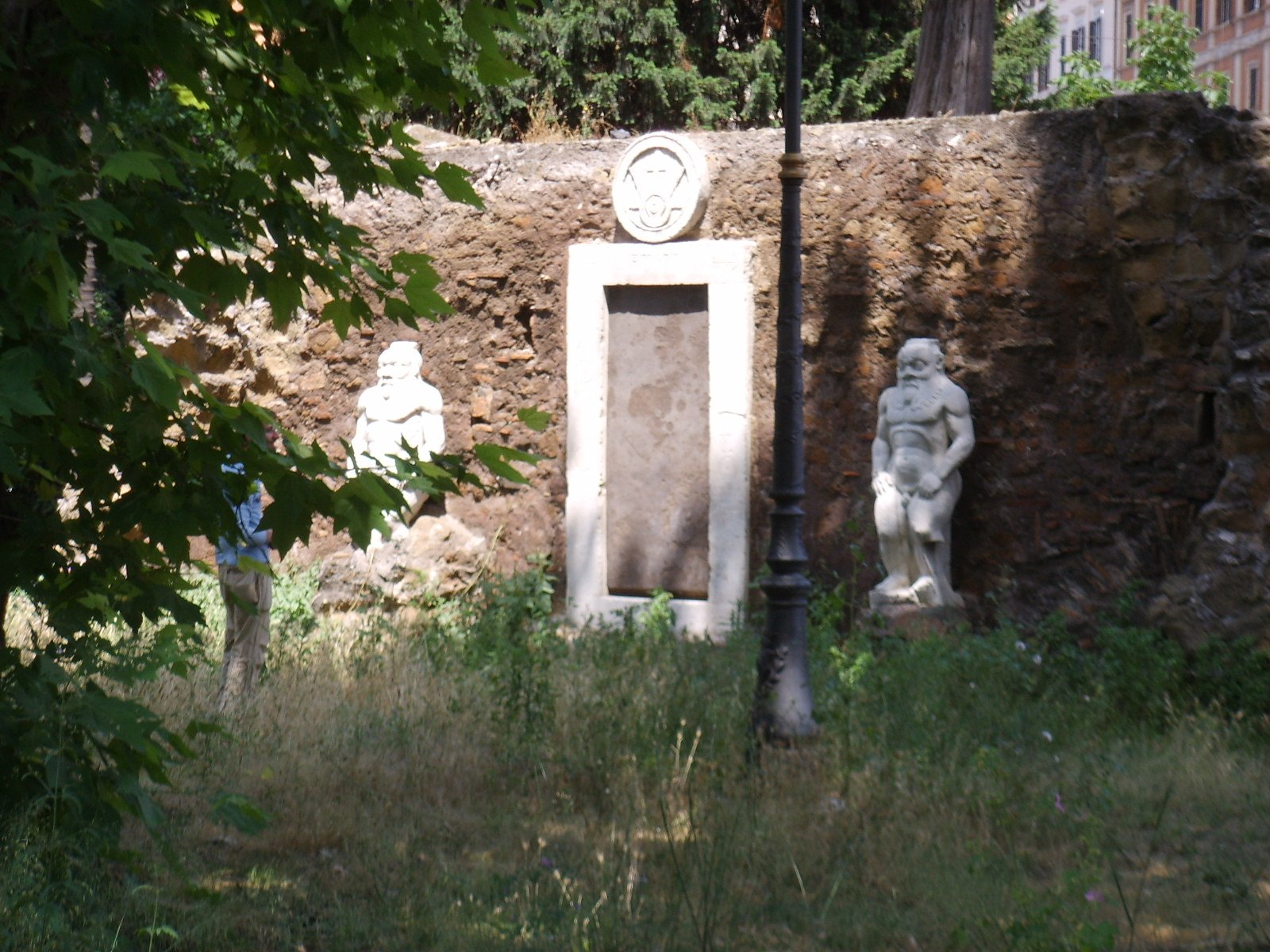
The Porta Magica, also called the Porta Alchemica, is a marble portal covered with planetary symbols and Latin inscriptions, today mounted in the gardens of Piazza Vittorio Emanuele II, on the Esquiline. A page devoted only to this monument already exists, the entry on the Porta Alchemica of Piazza Vittorio, and here we summarize it as a stop on a wider itinerary.
The documented fact
The gate was commissioned by Massimiliano Savelli Palombara, marquis of Pietraforte, in the villa he owned on the Esquiline. On the dating the institutional sources are cautious: the Sovrintendenza Capitolina speaks generically of the second half of the seventeenth century, while other reconstructions indicate the years between 1678 and 1680, which is the date legible on a second gate now lost. Of the villa's five gates this is the only one that survived.
Villa Palombara was expropriated by the Comune di Roma in 1873, when the Esquiline was redesigned to make it the new Umbertine neighborhood around Piazza Vittorio. The portal was dismantled and repositioned around 1888 in the place it occupies now, inside the archaeological area of the so-called Trophies of Marius. It is therefore not in its original place, and this must be kept in mind before reading astronomical orientations or alignments into it.
What is written on it
The inscriptions are in Latin, with some Hebrew signs, and follow the sequence of the planets associated with the metals of the alchemical tradition: Saturn and lead, Jupiter and tin, Mars and iron, Venus and copper, Mercury, antimony, vitriol. The texts are short and deliberately obscure phrases, of the kind that printed alchemical literature produced in quantity: images of ravens that become doves, of earth that flies, of water that burns.
On the threshold step runs the formula SI SEDES NON IS, which is a palindrome of words: read backward it gives SI NON SEDES IS. The game works in Italian too, if you sit you don't go, if you don't sit you go. It is an exercise in Latin wit typical of the seventeenth century, not an encrypted message, and must be read for what it is: a learned joke carved on a garden gate.
The scholars' interpretation
On the origin of the texts research has made concrete progress, and these are the steps least told around. The seven signs of the gate derive from a work by Johannes de Monte-Snyder published in Amsterdam in 1666, and the design of the pediment corresponds to the frontispiece of an alchemical edition of 1677. The Sovrintendenza Capitolina also links the inscriptions to a manuscript by Palombara himself held in the Vatican Apostolic Library.
This moves the monument away from where many put it. The Porta Magica turns out to be a learned assemblage of quotations taken from printed books that circulated all over Europe, commissioned by a nobleman passionate about a subject that in the seventeenth century was discussed in academia and not hidden. It remains, however, the only example of its kind left in a Roman setting.
The two statues of Bes
On either side of the gate stand two Egyptian statues of the god Bes, a household deity protecting the home and childbirth. They did not belong to Villa Palombara and have no relation to the gate: they were found in the excavations of the Quirinal, in the area of the ancient sanctuary of Isis and Serapis, and were placed next to the portal during the 1888 rearrangement. Their placement together is a nineteenth-century choice of urban furnishing.
The legend of the pilgrim
The story everyone knows is that of the pilgrim hosted one night in the villa, who searches the garden for an herb capable of producing gold and the next morning disappears leaving flecks of gold and a sheet full of signs. It has a datable source: it was collected by the scholar Francesco Cancellieri in the early nineteenth century, therefore more than a century after the events it tells. It is a learned tradition, not a document.
On the identification of the pilgrim with the alchemist Giuseppe Francesco Borri, and on the alleged participation of Athanasius Kircher and Gian Lorenzo Bernini in the design of the gate, there is no documentary support. They are later attributions, of the kind that is often and gladly made in Rome: when a work is strange, big names are sought. Whoever tells you these as established facts is telling you a tradition, not research.
How to see it
The portal is inside a fenced area in the gardens of Piazza Vittorio, toward the northeast side. From outside the fence you can see it very well as a whole, but the inscriptions can't be read with the naked eye. Access to the area is by reservation, for accompanied groups and for individual visitors, under the terms published by the Sovrintendenza Capitolina. Check before showing up, because openings change.
The Roman mithraea: an ancient religion, not a modern esotericism
Mithraism is the entry on this page on which the most damage is done, and the damage consists in presenting it as a secret sect with an occult content. The cult of Mithras was a religion widespread in the Roman empire between the first and fourth centuries, practiced above all by soldiers, officials, merchants and freedmen, with a structure of grades of initiation, communal banquets and small-scale sanctuaries. History of religions, not magic.
What we know and what we don't
We know a lot about the form of the sanctuaries. They were narrow, low rooms, often carved out in cellars or covered courtyards, with two side benches on which the faithful reclined for the ritual meals and with a mandatory scene at the back: Mithras killing the bull, flanked by the two torch-bearers Cautes and Cautopates, with a dog, a snake and a scorpion. This scene is called the tauroctony and recurs throughout the empire.
We also know the names of the seven grades, attested by inscriptions and by late antique sources: Corax, Nymphus, Miles, Leo, Perses, Heliodromus, Pater. What we don't know is the content of the doctrine. The Mithraists left no sacred texts, and everything we read on the meaning of their symbols is modern reconstruction starting from the images. Whoever explains to you with confidence what they believed is interpreting, not quoting.
San Clemente
The best-known mithraeum in Rome lies beneath the Basilica of San Clemente, on the third level of excavation, and was identified in 1861. It was carved out in the second quarter of the third century from the courtyard of a second-century house. It preserves the altar with the tauroctony, the side benches and a low barrel vault with the ceiling decorated with stars, which is one of the few Mithraic ceilings preserved in the city.
What makes San Clemente instructive is the stratigraphy. Above the mithraeum is an early Christian basilica of the fourth century, above that still the medieval one you visit today. The passage from one cult to the other is read vertically, in 20 minutes of descent, and it is a lesson in religious history more effective than any tale of mysteries. The complex has a ticket, its own hours and a descending route with narrow stairs.
Santa Prisca, on the Aventine
The mithraeum of Santa Prisca was intercepted in 1934 and systematically excavated between 1952 and 1966 by the Dutch Historical Institute. Carved inside a cryptoporticus of the Trajanic age, it preserves frescoes with the procession of the faithful carrying offerings and, rarely, traces of painted inscriptions naming the figures. One inscription records a precise date, November 20, 212.
Access is reserved for extraordinary openings and events, as the Soprintendenza Speciale di Roma indicates. Anyone who happens onto the Aventine without a reservation finds the church and not the underground. In the vicinity the climb to Santa Sabina is worth it anyway, which with its fifth-century wooden doors offers another case of ancient symbolism legible to the eye.
The Barberini Mithraeum
The Barberini Mithraeum came to light in 1936 during building works between Via delle Quattro Fontane and Via San Nicola da Tolentino. A second-century building turned into a sanctuary in the third, with a fresco that is, together with that of Santa Prisca, the only painted mithraeum left in Rome. Around the central tauroctony run 10 panels with episodes of the myth, a zodiac and a lion-headed deity.
The mithraeum of the Circus Maximus
Beneath the former storehouse of sets and costumes of the Teatro dell'Opera, right by the Circus Maximus, another third-century sanctuary was found in 1931. It includes several vaulted rooms, a room with niches, two halls with benches for the banquets and a floor with a large alabaster disc. The statue of the god, which stood in an aedicula on the back wall, has never been found.
Sant’Ivo alla Sapienza: Borromini's geometry and the limits of symbolic readings
The church of Sant’Ivo alla Sapienza was built by Francesco Borromini between 1642 and 1660, in the courtyard of the old Studium Urbis, under the pontificate of Urban VIII Barberini and then of Alexander VII Chigi. It is the chapel of the University of Rome before the move to the university city, and its spiral lantern is one of the most recognizable profiles of the historic center's skyline.
The construction fact
The plan is generated from two overlapping equilateral triangles that form a six-pointed figure. Borromini cuts the corners with apses and alternates concavity and convexity, obtaining an interior that can't be read in a single glance. The dome rises directly from the plan, without a drum, and the structure climbs to the lantern wrapped in a helical ramp crowned by a flame, the cross and the dove.
The symbolic readings, and who supports them
The six-pointed figure has been read by several scholars as the star of Solomon, the traditional emblem of wisdom, which would fit with the university purpose of the building and with the very title of the Sapienza. It is a coherent reading, taken up in much of the literature on Baroque architecture, and it holds up well because it doesn't ask you to suppose secret intentions: wisdom was the declared theme of the place.
A second, very widespread reading sees in the plan the shape of a bee, in homage to the Barberini. It also circulates in serious local publications, but it asks for more imagination than the first: the same geometric figure is made to correspond now to a star, now to an insect, and the two cannot both be the explanation of the form. Treat it as an iconographic suggestion, not as Borromini's design.
For the spiral lantern, derivations from the Mesopotamian ziggurat and from the ancient lighthouse have been proposed. None of these is demonstrated by drawings or writings of the architect, and the risk is always the same: attributing to a designer intentions that belong to the person looking. The most productive comparison remains the one with the other Roman works by the same author, gathered in the page on Borromini in Rome.
When you can go in
Sant’Ivo stays closed for much of the week, and this surprises those who arrive convinced they will find a church like any other. Historically it was closed in 1870, with the suppression, and reopened for worship only in 1926. Today the openings are limited and variable. The courtyard of Giacomo della Porta, on the other hand, is almost always accessible during the office hours of the State Archive, and from there the dome can be seen whole.
The Bocca della Verità: how the legend really arises
The Mouth of Truth is a disc of pavonazzetto marble about a meter and 80 centimeters in diameter and over a ton in weight, with a bearded male face pierced at the eyes, nostrils and mouth. The most accredited reading recognizes in it Oceanus, a river deity. The original function is debated: the cover of a drain shaft or an element connected to the drainage of a sacred area.
Where it stood and where it stands
The disc is today in the portico of Santa Maria in Cosmedin, where it was placed in the seventeenth century, according to the most widespread reconstruction in 1632. Before, it was set against an exterior wall of the church, where it had been since at least the thirteenth century. Its provenance is almost certainly the area of the Forum Boarium, the cattle market of ancient Rome, a couple of steps from there.
The legend, and its date
The story of the bite on the liar's hand is medieval, and this is the point. It is not a belief of Roman antiquity: it arises when the disc, by then out of context and walled in next to a church, becomes an object of popular tale. The oldest versions circulate in pilgrimage literature and in collections of Roman marvels, that is, in a genre that mixes description and narration without distinguishing them.
The most famous variant tells of a woman suspected of adultery who, having to swear with her hand in the mouth, stages a setup with her lover: he embraces her pretending to be mad in front of everyone, and she can then swear she has not been touched by any man except her husband and that poor fellow. The ambiguous oath is a European narrative motif that recurs elsewhere too, not a Roman fact.
In the twentieth century the machine started up again for a different reason, the cinema. A very well-known scene of an American film shot in Rome in 1953 made the Bocca della Verità a fixed stop, and since then the line in front of the portico has been a tourist phenomenon in itself. The ancient monument is still there, but what brings people to stand in line is a film frame.
The Minerva obelisk: the elephant, the inscription and Kircher
The Minerva obelisk, which Romans call Minerva's chick, is the smallest of the city's Egyptian obelisks. It was found in 1665 in the garden of the Dominican convent attached to the Basilica of Santa Maria sopra Minerva, and Alexander VII decided to make it a monument for the square. The group was completed in 1667.
Who made it
The elephant that holds up the obelisk was sculpted by Ercole Ferrata on a design by Gian Lorenzo Bernini. The attribution is documented and is not a matter of debate, unlike many other Roman works. Anyone who wants to follow the thread of Bernini's commissions in the city finds it ordered in the page on Bernini in Rome, which helps to understand how much of this city bears the same signature.
What is written on the base
On the pedestal runs a Latin inscription that says, in essence, that a strong mind is needed to support solid wisdom. The meaning of the monument is declared there, in plain view, and requires no deciphering: the elephant is the strength that holds up wisdom, the obelisk is ancient wisdom. It is a seventeenth-century iconographic program, of the kind that was designed at a drafting table and explained to the educated public with an epigraph.
Kircher and the hieroglyphs
The reading of the hieroglyphs was entrusted to the Jesuit Athanasius Kircher, the greatest Roman authority on Egyptian matters of the time. His interpretations turned out to be imaginary, because hieroglyphs would be deciphered only in the nineteenth century, after the Rosetta Stone. Kircher was not an impostor: he was a very serious scholar working with the wrong tools, and his story is the best antidote against self-assured decipherments.
A much repeated story circulates about this obelisk, that of the position of the tail and the side toward which the elephant is supposed to look, read as Bernini's spite toward someone. There is no seventeenth-century source that supports it, and it remains what it is: a Roman anecdote with no documents behind it. The full picture of the city's obelisks is in the page on the obelisks of Rome.
A curiosity about esoteric Rome
The curiosity concerns names. Many of the places that are sold today as esoteric bear titles invented in recent times, and the clearest case is precisely that of the Esquiline portal. The current name Porta Magica coexists with Porta Alchemica, Porta Ermetica and Porta dei Cieli, different formulas used by different authors, and none of these is the name given to it by whoever had it built.
The same goes for the word esotericism applied to antiquity. In the seventeenth century a nobleman interested in alchemy was doing something socially acceptable and partly public, discussed in academies and printed in treatises with the permission of the authorities. The idea that all this was clandestine is a modern projection, born when science changed its definition and expelled that tradition from its own perimeter.
One thing nobody tells you about esoteric Rome
Almost all the places on this itinerary are closed almost always. The mithraeum of Santa Prisca opens only on extraordinary occasions, the one at the Circus Maximus only by reservation with limited groups, the Barberini Mithraeum with limited calendars, Sant’Ivo alla Sapienza a few hours a week, the Porta Magica inside a fenced area visitable on request. Anyone who improvises a same-day tour goes home having seen three gates.
The second thing nobody says is how poor the documentary level of some of these stories is compared to the volume of words written about them. On the Porta Magica there are serious studies that link the inscriptions to identified printed books, and they are almost absent from popular accounts, because a quotation from a Dutch treatise of 1666 sells less than a pilgrim who vanishes in the night.
The advice I give you for visiting esoteric Rome
Book first, and build the tour around the reservations you've obtained, not the other way around. The mithraea have their own calendars and limited places, the Porta Magica area has to be requested, Sant’Ivo has short hours. Set two or three sure accesses, then fill the gaps with the places that are always open: the Minerva, Santa Maria in Cosmedin, the Non-Catholic Cemetery, the pyramid seen from outside.
Bring along a criterion for reading, which is worth more than any guidebook. In front of every object ask yourself three things in order: who made it and when, what the inscription says to the letter, and since when the story they're telling me has been circulating. If the third question finds no answer, you have a modern legend in front of you, which doesn't make it less interesting but changes its status.
Avoid doing everything in a single day. These places fall in four different zones, Esquiline, Celian and Aventine, the historic center between Navona and Minerva, Testaccio and Prati, and travel times count more than the visits. Two well-spread half days yield much more than a marathon, and the page on how to get around Rome helps to calculate the real transfers.
Another well-known fact, yet rarely cited
The Egyptian obelisks of Rome are 13, the highest number of any city in the world, Egypt included. It is a known and repeated fact, but the consequence is almost never added: those monoliths were moved and repositioned several times in 20 centuries, by emperors, popes and nineteenth-century administrations. Their current positions tell of modern urban plans, not ancient geometries.
The Esquiline obelisk, behind Santa Maria Maggiore, comes from the Mausoleum of Augustus and was placed there by Sixtus V at the end of the sixteenth century, within a plan to reorganize the streets and the pilgrimage basilicas. Anyone who today draws lines between one obelisk and another is measuring the choices of a pontiff of 1587, who had declared devotional and urban planning goals.
The right photo to take in esoteric Rome
The photo that almost always works is the lantern of Sant’Ivo seen from the courtyard of the Sapienza, on Corso Rinascimento, with the spiral against the sky. You need side light, so mid-morning or late afternoon, and you need to step back to the end of the courtyard to take in the whole elevation. With the sun directly overhead the spiral loses its relief and becomes a shapeless white mass.
The second is the elephant group in Piazza della Minerva, three-quarter view from the south, with the church facade behind. From the right spot the obelisk stands out from the background and reads whole. The square is small and there are always people, so the first hour of the morning is best, when parked cars are few and the marble catches a raking light that brings out the hieroglyphs.
The third is the pyramid seen from inside the Non-Catholic Cemetery, with the cypresses in the foreground. It is the framing that explains in one stroke the strangeness of the place: an Egyptian tomb of the first century BC serving as a backdrop to nineteenth-century Protestant graves. Inside the cemetery you photograph in a low voice and without a tripod: it is a burial place in use, not a park.
Some important events that happened here in history
In 1600 Giordano Bruno was burned in Campo de’ Fiori after a trial lasting years. It is the harshest fact among those tied to this page and must be said without embellishment: a death sentence for heresy, carried out in a market square that today hosts stalls and bars. The statue that commemorates him will arrive almost three centuries later, and will in turn be a political episode.
In 1655 Christina of Sweden arrived in Rome, an abdicated queen converted to Catholicism, who in the following years turned her residence into a center of study. In 1665 the discovery of the obelisk in the Dominicans' garden set the Minerva project in motion. Around 1680, on the Esquiline, the gate of Villa Palombara was being carved. Three events in 25 years, all in the same Rome.
In 1931, 1934 and 1936, within five years, three Roman mithraea came to light: the one at the Circus Maximus during works for a theater storehouse, the one of Santa Prisca under the Aventine church, the Barberini one in a building site. The Rome of the 1930s dug a lot and in a hurry, and to that season we owe much of what can be visited underground today.
Who passed through esoteric Rome
Massimiliano Savelli Palombara, marquis of Pietraforte, is the commissioner of the Esquiline gate and the author of the manuscript that studies link to the inscriptions. Of him we know that he frequented circles where alchemy was a subject of study and that in 1656 he visited the laboratory of Palazzo Riario. He remains a Roman nobleman of the seventeenth century with precise and documented interests, far from a legendary figure.
Christina of Sweden lived in Rome from 1655 until her death in 1689 and hosted in her residence on the Lungara academies, musicians, scientists and a laboratory where chemistry and alchemy were practiced. Giuseppe Francesco Borri, a Milanese physician and alchemist, runs through several of these stories and ends up tried for heresy: his biography is documented, his presence at the Porta Magica is not.
Francesco Borromini and Gian Lorenzo Bernini appear on this page for works attributed with certainty, Sant’Ivo the first, the elephant design the second. Ettore Ferrari, sculptor and Freemason, signed the monument to Giordano Bruno. Victor Jouët, a French priest, founded the Prati collection. Verifiable names, all of them, with dates and works: the minimum one can ask of an itinerary of this kind.
The Museum of the Souls of Purgatory, in Prati
The church of the Sacro Cuore del Suffragio faces the Lungotevere Prati, a little upstream from Castel Sant'Angelo, and is a neo-Gothic building that stands out at once in a city of Baroque churches. Next to the sacristy is the Museum of the Souls of Purgatory, which consists of a single display case along a corridor: don't expect a museum in the usual sense.
What it contains
The display case gathers about 10 objects and documents among prayer books, shirts, caps and little tablets, on which appear burned marks interpreted as handprints. Each piece is accompanied by a caption that relates the story of a deceased person and of an apparition. They are testimonies of nineteenth- and twentieth-century popular devotion, collected and arranged as such, not finds subjected to independent analysis.
How the collection came about
The origin is a fire in 1897 in a chapel of the earlier building. The French priest Victor Jouët, who led the association tied to the church, saw in a trace left by the fire the image of a face, and from that episode began the search for similar testimonies across Europe. The collection is therefore the result of a precise devotional campaign, with a dated beginning and a known promoter.
The Catholic Church has never declared the supernatural authenticity of those objects, and the museum itself doesn't claim it: it presents them as collected testimonies. Anyone who wants another Roman place where devotion takes very direct material forms can compare it with the museum and crypt of the Capuchins on Via Veneto, which is a different case and just as instructive.
The Non-Catholic Cemetery and the pyramid of Caius Cestius
The Pyramid of Cestius is the tomb of Gaius Cestius Epulo, member of the college of the septemviri epulones, and was built between 18 and 12 BC. On the eastern side an inscription records that the work was completed by testamentary provision in 330 days. It stands a little over 36 meters high with a base of about 30, and the burial chamber occupies a minimal fraction of the volume.
Why a pyramid in Rome
The answer is a fashion, not a cult. After the conquest of Egypt in 30 BC Rome fills with Egyptian references, from imported obelisks to pyramid-shaped tombs, and a rich magistrate who has such a tomb built is declaring cultural up-to-dateness and financial means. No ancient source links this tomb to Egyptian religious practices on the part of the deceased.
The medieval legend
Throughout the Middle Ages the pyramid was believed to be the tomb of Remus, and indicated as the meta Remi. Petrarch names it that way too. The error arises from the fact that the inscriptions were covered by vegetation and soil, and that the medieval city read ancient ruins through the story of its own origins. It is an excellent example of how a legend forms from lack of information, not from a will to hide.
The Non-Catholic Cemetery
At the foot of the pyramid stretches the Non-Catholic Cemetery, born because in papal Rome non-Catholics could not be buried in consecrated ground. The first documented burials date to the years around 1716. Buried there are John Keats and Percy Bysshe Shelley, Goethe's son, Antonio Gramsci, Andrea Camilleri, and the gravestones carry inscriptions in dozens of different languages.
The funerary symbolism read on the tombs is the thing most pertinent to this page. Veiled urns, broken columns, winged hourglasses, overturned torches, garlands: a neoclassical repertoire shared across Europe between the eighteenth and twentieth centuries, with conventional and well-known meanings. Some of these symbols also appear in Masonic iconography, but their presence on a gravestone does not prove the deceased's membership in any lodge.
The cemetery is managed by the foreign diplomatic missions, asks for a donation at the entrance and has hours published on its official site. Since 1918 only burials of ashes are accepted. There is a colony of cats living among the tombs, and this is one of the few Roman rumors that can be verified in 30 seconds. A little farther on are Monte dei Cocci and the Testaccio district.
Masonic symbols in Rome: the history of associations, not mystery
Post-unification Italian Freemasonry is a matter of contemporary history, with archives, membership lists, newspapers, lawsuits and a substantial academic bibliography. Treating it as an occult society that governs in the shadows means losing the only truly interesting thing: the role it played in building the liberal State, in municipal administrations and in the battles over the secularity of education between the nineteenth and twentieth centuries.
Palazzo Giustiniani
The Grande Oriente d’Italia settled in Palazzo Giustiniani, near the Pantheon, in 1901, during the grand mastership of Ernesto Nathan, who would become mayor of Rome from 1907 to 1913. The building was later acquired. The address became so identifying that in Italian political language the name of the palace has remained to indicate one of the Masonic obediences, even long after the organization had left it.
In November 1925 the Fascist regime had the law on associations approved that explicitly struck at the lodges. The grand master Domizio Torrigiani dissolved the organization, and the State took possession of the palace within a few months. Already in October 1924 the Masonic headquarters of Rome, Milan and Palermo had been stormed by Fascist squads. The question of the building's ownership remained open for decades.
What you see in the city
The monument to Giordano Bruno in Campo de’ Fiori is the clearest Roman case of a political symbol built by that milieu. It was sculpted by Ettore Ferrari, sculptor and Freemason, and inaugurated on June 9, 1889 after a campaign lasting 13 years, promoted by student committees and then by an international association for free thought that gathered the support of Victor Hugo, Henrik Ibsen and Giosuè Carducci.
On the pedestal runs an epigraph dictated by the philosopher Giovanni Bovio, and eight medallions depict thinkers who came into conflict with ecclesiastical authority, among them Paolo Sarpi, Tommaso Campanella, Giulio Cesare Vanini, Michael Servetus, John Wycliffe and Jan Hus. The inauguration was a political event of the first magnitude, with a very harsh reaction from the Holy See, and in 1929 the request to remove the statue was rejected.
What is not Freemasonry
A quantity of Roman symbols is attributed to Freemasonry by resemblance, and almost always wrongly. Eyes inside triangles, pyramids, bees, five- or six-pointed stars, hourglasses and compasses belong to Christian, heraldic and neoclassical iconographic repertoires much older and much more widespread. An eye inside a triangle on a seventeenth-century church is the Trinity, and it was so two centuries before modern lodges existed.
Christina of Sweden and the laboratory of Palazzo Riario
Christina of Sweden arrived in Rome on December 23, 1655, after abdicating in 1654 and converting to Catholicism. She lived first in Palazzo Farnese, then in Palazzo Mazzarino Rospigliosi, and from 1663 until her death in the Riario palace on the Lungara, today Palazzo Corsini, home of the Galleria Nazionale d’Arte Antica. She died on April 19, 1689 and was buried in the Vatican Grottoes.
What is documented
At the Lungara Christina reopened in 1674 her Royal Academy and kept a circle of writers, musicians and scientists. Her interest in astronomy, medicine, chemistry and alchemy is attested, as are her visits to Kircher's museum at the Collegio Romano. An alchemical laboratory operated in the palace, and the marquis Palombara went there in 1656: it is the documented point of contact between this story and the Porta Magica.
She enriched the palace gardens with rare plants, and from that nucleus descends the present Rome Botanical Garden, which climbs behind the building to the Janiculum. Opposite, on the other side of Via della Lungara, stands the Villa Farnesina, whose astrological vault painted by Baldassarre Peruzzi is another case of documented and legible symbolism.
What is not documented
About the queen, tales circulate of rites, successful transmutations and secret societies founded in the palace. We have not found sources that support them. That a seventeenth-century sovereign financed chemical research is not a revelation: it was a normal practice for those with means and scientific curiosity, in the same century in which the first European experimental academies were born. The line between chemistry and alchemy, then, had not yet been drawn.
Other places that enter the discussion, and how to take them
Some Roman places get pulled into this kind of itinerary with weak arguments, but deserve a visit anyway for their own reasons. The underground basilica of Porta Maggiore, discovered in 1917, is a first-century building with stucco work of mythological subjects. That it was the seat of a Neopythagorean philosophical school is a much-discussed hypothesis, not a fact.
The catacombs of Rome are Christian, Jewish and in some cases other-cult cemeteries, dug in the tufa between the second and fifth centuries. They were not secret hiding places or clandestine meeting places: their existence was known and their function was funerary. The symbolism read there, fish, anchors, orants, the good shepherd, is a well-studied early Christian repertoire.
The Domus Aurea enters these tales by way of the grotesques, the decorative motifs rediscovered in the Renaissance by those who lowered themselves into the buried rooms and which took their name precisely from those grottoes. The passage from ancient decoration to modern symbolic repertoire happened there, and it is one of the soundest threads linking Roman antiquity to the figurative culture of the following centuries.
An itinerary in two half days
The first half day is done in the east, starting from the Esquiline. Porta Magica at the gardens of Piazza Vittorio, with access booked if you obtained it, then Santa Maria Maggiore and its obelisk, and descent toward the Monti district. From there you continue on foot to San Clemente for the mithraeum, with a ticket, counting a good 40 minutes of walking in total.
The second half day takes place in the historic center and on the river. Piazza della Minerva with the elephant, then Sant’Ivo alla Sapienza if the hours coincide, then descent toward Piazza Navona and crossing of the Tiber to the Lungara for Palazzo Corsini and the Farnesina. It is a route almost all on the flat, with a single climb if you decide to end at the Orto Botanico.
The stories we left out, and why
A page like this is judged also by what it doesn't contain. We excluded the reconstruction according to which Bernini, Borri and Kircher designed the Porta Magica together: it circulates widely, but no documentary source supports it, and it is a typical after-the-fact attribution. It remains in the text as a legend, declared as such, because it is part of the history of the monument's reception.
We excluded the anecdote about the position of Minerva's elephant as a personal spite of Bernini's, which has no support in 17th-century sources. We excluded the firm identifications of the pilgrim of Villa Palombara. We excluded the rumors about nocturnal rites at Palazzo Riario. We excluded the attribution of the Porta Maggiore basilica to a Neopythagorean school as an established fact, reporting it as a hypothesis.
Finally, we excluded the whole chapter of presences and apparitions, which belongs to a different genre and finds its natural place in the page on the ghosts of Rome. Those are urban legends to be told as urban legends, with their dates and their narrators, and mixing them with verifiable 17th-century inscriptions does neither of them any good.
Eating nearby: the Esquilino plays in a different league
This itinerary touches areas with very different dining scenes, and it's worth knowing that before you sit down. Around Piazza Vittorio and the streets of the Esquilino, you eat in a neighborhood that has been the most multicultural in Rome for 30 years, with Chinese, Bangladeshi, Indian, Eritrean, Egyptian and South American kitchens next to neighborhood trattorias that have survived. In the center, between Navona and the Minerva, the game is completely different.
The signs of a trap, where they apply
The menu with photographs of the dishes is the first clue and it works everywhere: you photograph the food for people who can't read the language, and a place that lives off its neighborhood doesn't need to. The same goes for the woman rolling fresh pasta behind the window or right on the sidewalk, which is a staged lure built for passersby and says nothing about the cooking in that place.
The person on the doorstep inviting you to sit works the flow of passersby, not the customer who comes back the following week, and nonstop hours from morning to the small hours, with no break between services, tell you there are no defined shifts in the kitchen and that anyone who turns up is served at any hour. These are signs, not verdicts, but when three of them pile up the picture is clear.
Then there are the places set in front of the most photographed monuments, where the price adapts to the customer in front of them: items with no price on the menu, cover charges and service fees that only appear on the bill, different price lists between the dining room and the outside tables. Around the Bocca della Verità, the Minerva and Piazza Navona this mechanism is well oiled, and you should look at the menu before you sit down.
Why the signs change weight in the Esquilino
In the Esquilino, the photograph on the menu can mean something else. In a place run by a family that speaks Chinese or Bengali, with a mixed clientele and dishes a Roman doesn't know, the image really does serve to communicate, and it isn't a sign of a tourist trap. The criterion has to be adjusted: here what counts are the regular customers, the turnover at the tables and prices in line with the neighborhood.
The Nuovo Mercato Esquilino, on Via Filippo Turati, is the place to understand the area in 20 minutes. People shop there for ingredients that are hard to find in the rest of the city, and the most interesting dining in the neighborhood is arranged around the market. No stall is set up for photographs and nobody brings tour groups here: people come here to do their shopping.
The chains with a repeated sign
In the center of Rome, a kind of dining with a repeated sign has grown, with the same menu in several locations, identical decor, a line at the door and English-speaking staff. It works as a tourist attraction in every respect and Romans don't set foot in it. This isn't snobbery: that model sells a product identical to itself, which is exactly the opposite of what you look for near home. In the Esquilino those signs haven't arrived.
The criterion, just one
Look at who is sitting there and in what language they order. If the tables have local people who order without opening the menu, the place stands on its own. If there are only backpacks and maps, keep walking. In the historic center this criterion rules out nine places out of 10 in two seconds. In the Esquilino it rules out very few, and that is the practical difference between the two areas of this itinerary.
If you want a reference that's already filtered, you can consult Daniele Dezi's personal list on Google Maps, a curated and unsponsored collection. You'll find the full reasoning on the page about where to eat in Rome, while for places with a long history behind them there's the page on historic cafés and shops.
When to go, how much it costs, what's closed
The best season is the in-between one, March and April and October and November, for a practical reason: many of these visits take place in damp, cool underground spaces, and in summer the contrast with the outside is strong. The mithraea are cold all year and a sweatshirt is a good idea even in July. The stairs are narrow and the floors are sometimes slippery.
The costs are modest one by one and add up quickly. San Clemente has a ticket for the underground level, the Mithraeum of the Circus Maximus an admission at a low price with free entry for residents and museum card holders, Palazzo Corsini the gallery ticket. The museum in Prati is free, the Non-Catholic Cemetery asks for a donation, the churches don't charge. The free-admission Sundays are summarized on the page about free museums in Rome.
Closures are the variable that ruins the most days. Churches close at lunchtime with their own variable hours, special openings of the mithraea are announced at short notice, Sant'Ivo has a short weekly window. August reduces everything, and religious holidays change church hours in ways that are hard to predict. A check the day before avoids almost all problems.
Frequently asked questions about esoteric Rome
Is there an esoteric Rome, or is it a tourist construction?
In Rome there are monuments with alchemical inscriptions, sanctuaries of ancient cults, funerary symbolism and complex iconographic programs, all documented. What doesn't exist is a unified network of places linked by an occult plan: that is a recent narrative construction, useful for selling itineraries. The real material is rich and doesn't need to be inflated to be interesting.
Can you visit the Porta Magica in Piazza Vittorio up close?
The portal stands inside a fenced area in the gardens of Piazza Vittorio and can be seen as a whole from outside, but the inscriptions can't be read. Access to the area is by reservation, for guided groups of up to 25 people and for individuals, following the procedures published by the Sovrintendenza Capitolina. Openings change over time, so the check should be done a few days beforehand.
Who built the Porta Magica and what do the inscriptions mean?
It was commissioned by Massimiliano Savelli Palombara, Marquis of Pietraforte, in the second half of the 1600s, with proposed dates between 1678 and 1680. The inscriptions are alchemical phrases in Latin, with a few Hebrew signs, associated with the planets and the metals. Scholars link them to printed European treatises of the 1600s and to a manuscript by the marquis himself.
Was Mithraism a secret sect?
Mithraism was a mystery religion widespread in the Roman Empire between the first and fourth centuries, with small sanctuaries, grades of initiation and ritual meals. Its places of worship were known and its followers, often soldiers and officials, were not clandestine. Secrecy of the rites and social secrecy are two different things, and the first does not imply the second.
Which mithraea can you visit in Rome?
The Mithraeum of San Clemente can be visited with the ticket for the underground complex during regular hours. The one at the Circus Maximus opens by reservation with limited groups. The Mithraeum Barberini and the one at Santa Prisca have limited openings and calendars announced case by case. None of these allows an improvised visit, and for three out of four a reservation is mandatory.
Is the legend of the Bocca della Verità ancient?
The legend of the liar's hand being bitten is medieval, not ancient Roman. It arises when the disk, which was a functional element of the Roman era probably tied to the drainage of the Forum Boarium area, ends up out of context, set against a church. Its current worldwide fame, on the other hand, depends to a large extent on a movie scene from 1953.
Does Sant'Ivo alla Sapienza have an esoteric plan?
The plan of Sant'Ivo comes from two overlapping equilateral triangles that generate a six-pointed figure, with corners and apses worked by Borromini. The reading as the star of Solomon, emblem of wisdom, is proposed by several scholars and fits the university purpose of the building. Other readings, such as that of the Barberini bee, remain iconographic suggestions.
Is the Museum of the Souls of Purgatory recognized by the Church?
The collection is kept in a Catholic church and came about on the initiative of a priest, Victor Jouët, after a fire in 1897. The Church has not, however, declared the supernatural authenticity of the objects on display, and the museum itself presents them as testimonies gathered by popular devotion. It can be visited free of charge, in a few minutes, during the church's opening hours.
How much time does this itinerary take?
Two half days cover the main places, and three half-day blocks cover all of them at a relaxed pace. Distances are the factor that weighs the most, because the sites fall in four different areas of the city. With reservations fixed in advance you lose much less time, and it's best to organize the tour around the access you obtained.
Who wrote this page
The editorial team that runs these pages is that of Tour Leader Pro, a Roman project office that designs and coordinates visits, itineraries and cultural events in Rome and Lazio. Dates, attributions, hours and access conditions given here were checked on the publication date against the official sources cited in the text. They change often: if you find an outdated detail, let us know.
Lining up places with irregular opening calendars, mandatory reservations and capacities of 25 people takes work that doesn't show on paper. Anyone who has to build a route like this for themselves or for a group, making church hours, special openings and real travel times fit together, will find planning materials on Tour Leader Pro, designed both for those who guide and for those who organize on their own.
For the broader picture on rail connections, airports, rentals and destinations in Lazio outside central Rome, from the Castelli to the lakes to the coast, the reference resource is Italy Planner, which approaches planning from the side of transfers and distances.