Piccolo Duomo and the Museum of the Souls of Purgatory
In short. The Museum of the Souls of Purgatory occupies a single room next to the sacristy of the church of the Sacred Heart of Suffrage, at Lungotevere Prati 12, 00193 Rome, in the Prati district, on the stretch of the Tiber embankment between…

The Museum of the Souls of Purgatory occupies a single room next to the sacristy of the church of the Sacred Heart of Suffrage, at Lungotevere Prati 12, 00193 Rome, in the Prati district, on the stretch of the Tiber embankment between Via Ulpiano and Via Paolo Mercuri. It has no ticket office, no turnstiles and no gallery staff: admission is free, you enter through the church and ask in the sacristy. It can only be visited when the church is open, so, according to the listing of the Diocese of Rome, Monday to Friday from 9:30 to 12:00, on days before holidays from 9:30 to 12:00 and from 18:00 to 19:30, on holidays from 9:30 to 12:00, with a long midday closure that sends away anyone who arrives at lunchtime. During services the visit is suspended. The parish's phone number is 06 68806517, and a call before setting out is still the quickest way to find out whether anyone is there to open the door of the room. Some institutional listings give the complex a 7:30 to 19:30 span every day. The safe window, according to the listing of the Diocese of Rome, is the morning one between 9:30 and 12:00.
You can walk here from half of northwest Rome. The nearest metro stop is Lepanto, on line A, a little under a kilometer away: 10 minutes at a normal pace along Via Ottaviano and Via Cicerone, or cutting through Piazza Cavour. From Piazza Cavour, 300 meters away, several surface lines pass and terminate, and the square is the reference point to give a taxi driver. If you come from the historic center, you cross Ponte Umberto I or Ponte Cavour and find yourself in front of the facade in five minutes. There is no dedicated parking and the Tiber embankment has paid parking almost everywhere: the car, here, is the worst solution.
One clarification that avoids disappointment at the sacristy counter: this is not a civic museum, nor a state one. It is a parish space, owned by the Church, entrusted to the Missionaries of the Sacred Heart of Jesus. The MIC card is valid for the museums of the City of Rome and is useless here. State museum passes and city tourist cards, likewise, have no relation to this door. You don't need a card because you don't need a ticket: you go in for free and leave, if you want, an offering in the box. The rest of the ideas on what to see in Rome in half a day can be found on the page of tourist attractions.

What the Piccolo Duomo and the Museum of the Souls of Purgatory really are
They are two things layered on top of each other, and it's best to keep them separate from the start. The first is a parish church of the 1900s in neo-Gothic style, unique in Rome in appearance and materials, which Romans have nicknamed the little Duomo of Milan because of its spires, statues and the whiteness of its facade. The second is a minimal collection, about 15 pieces in a few display cases, that documents the devotion to the dead through objects that the faithful of the 1800s and early 1900s believed were marked by contact with the souls of purgatory: pages of prayer books with burned imprints, shirts, caps, pillowcases, small tablets.
The room is not a museum in the modern sense of the term. It has no route, no educational panels prepared by a scientific office, no updated catalog on sale at the entrance. It has small display cases with handwritten captions, the name of the deceased and a date, in a layout that goes back a century and that nobody has wanted to modernize. This is its strength and its limit. The strength: you look at a devotional display that has remained identical, a historical object in itself, like the cases in country shrines. The limit: anyone looking for proof, explanations or counter-explanations won't find them, because the space wasn't born to demonstrate anything to a lay public, but to remind the faithful of the duty of prayer for the dead.
The distinction also matters for the way one writes about these things. The objects on display are testimonies of faith, collected and cataloged by devotional criteria. No ecclesiastical authority has ever declared them miracles, and the Church doesn't ask anyone to believe in them. Calling them proof would be unfair to history. Mocking them would be unfair to the people who handed them over, often in circumstances of mourning. The right register is that of the historian of popular religiosity: you look at an object, read its story, and understand what need it filled.
Why purgatory in particular
Purgatory is defined Catholic doctrine: the Council of Florence in 1439 and the Council of Trent in 1563 established that there is a state of purification after death and that the living can benefit the dead with prayers, alms and masses. From this, and not from a 19th-century fantasy, comes the devotional machine that filled Catholic Europe with confraternities of suffrage, privileged altars, Gregorian masses and bequests in wills. November 2, the commemoration of the dead, is the pivot of this calendar.
The church on Lungotevere Prati is the last great Roman episode of that machine. It was born at the end of the 1800s, when devotion to the souls in purgatory saw a conspicuous revival in France, Belgium and Italy, and it was born with a precise idea: a temple that would serve as an international center of suffrage, with an association gathering members across Europe and a daily liturgy dedicated to the dead. The collection of objects is a corollary, a demonstration room built to convince: look, the dead are asking for help, and you can give it to them.
The history of the church of the Sacred Heart of Suffrage, the Piccolo Duomo of Rome
Victor Jouet, the man from Marseille who wanted a temple for the dead
Victor Jouet, a missionary of the Sacred Heart of Jesus originally from Marseille, is the man around whom the whole story revolves. In 1893 he founded in Rome the Association of the Sacred Heart of Suffrage for the souls of Purgatory, a prayer confraternity whose aim was to have masses celebrated for the forgotten dead, those without family or means. The enterprise began on a modest scale: an oratory in Via dei Cosmati, then a second chapel on Lungotevere Prati that served the community from 1896 to 1914, while the construction site of the real church grew beside it.
The first stone was blessed in 1894 by the bishop of Marseille, a detail that says everything about the French character of the operation. Rome, in those years, is a city where the Church builds little and with difficulty: the breach of Porta Pia dates to 1870, Church property has been largely confiscated, and the new districts of the Savoy capital are born with secular street names and with parishes improvised inside apartments. A Frenchman who buys a lot on the Tiber embankment and plants a miniature cathedral there is news.
The construction site, 1917 and the parish
Construction of the final building began in 1908 and ended in 1917. The church was blessed and opened for worship on November 1, 1917, All Saints' Day, with the commemoration of the dead just around the corner: a choice of calendar that needs no comment. The parish was established on December 10 of the same year. The solemn consecration took place on May 17, 1921 at the hands of Pietro Benedetti, titular archbishop of Tyre, who was also its first parish priest.
Opening a church in Rome in November 1917 means opening it in the weeks of Caporetto, with the country on its knees and Italian families counting their dead in the tens of thousands. The temple of suffrage arrives exactly when the demand for prayers for the dead reaches its historic peak. Anyone visiting the relics room today tends to read it as a Gothic oddity. Read instead within its time, it is a mass service to a society in mourning.
Who runs it today
The church is today the parish of the Sacred Heart of Jesus in Prati, still commonly called the one of Suffrage, and it is entrusted to the Missionaries of the Sacred Heart of Jesus, the congregation of Issoudun to which the founder belonged. The reference diocese is that of Rome. The double name generates confusion in search engines and on maps: anyone searching only for Sacro Cuore risks being directed to the Sacro Cuore in Castro Pretorio, on the other side of the city. The address, Lungotevere Prati 12, remains the surest way not to go wrong.
The 1897 fire and the face on the wall, origin of the Museum of the Souls of Purgatory
It all begins with a fire. In 1897, in the association's temporary chapel, dedicated to the Virgin of the Rosary, a small fire devastated the area behind the altar. The year and the place are certain. The exact day remains uncertain.
The altar painting remained intact. On the blackened wall, according to the account handed down by the community, the priest and some of the faithful recognized the outline of a human face with a sorrowful expression. Victor Jouet interpreted that image as the request of a dead person in torment, seeking contact with the living to obtain prayers. The tradition of the house adds that the expression of the face became calmer as the masses of suffrage went on. In the relics room the image is visible in photographic reproduction. The original is not on display, and this needs to be said first, so that nobody goes looking for a wall that isn't there.
In our judgment the photograph of the face is the weakest piece of the collection from the visual point of view and the strongest from the historical point of view. Weak because a soot stain on plaster, photographed with the technique of 1897, tells our eye what we want to see in it. Strong because without that stain there would be neither the church, nor the room, nor the collection. It is the founding act of the whole enterprise.
Jouet's European journey
Convinced he had seen a sign, the missionary set about looking for similar cases all over Europe. He traveled and wrote, set the network of congregations and parishes in motion, and collected objects that came from Italy, France, Belgium and Germany. The oldest item in the collection dates to 1637. The material was arranged in the church's sacristy, in a room that immediately became the most visited part of the complex.
His method deserves notice, because it is the aspect historians of devotion find most interesting. Jouet did not collect oral tales. He looked for objects and papers, parish records, signed statements, photographs. He applied to popular devotion the documentary mindset of his century, that of archives and written proof. How far the result convinces a reader today is another question. The approach, for 1900, was more rigorous than one would expect.
The blessing of Pius X
The collection grew with the blessing of Pope Pius X, who was persuaded that a room of this kind could call the faithful to their duties toward the dead. The same pontiff also had a direct role in the church: he personally chose the 19 saints whose statues adorn the facade. The link between the Venetian pope and this corner of Prati is therefore closer than tourist literature lets on.
The 1921 downsizing of the Museum of the Souls of Purgatory
Victor Jouet died in 1912. In 1921 the person in charge of the church, Father Gilla Vincenzo Gremigni, decided on a severe review: he reduced the display to only those relics that could be considered indisputably authentic in the documentation, and drastically cut its publicity. From that moment the room stopped being a promoted attraction and became what it still is today: a room that opens to whoever asks for it.
This is the reason the number of objects is so low. The original collection was much larger. What you see now is the residue of a selection made 100 years ago by a churchman who wanted to avoid both ridicule and superstition. Anyone arriving expecting a cabinet of curiosities full of cases is thrown off: it is a few display cases in a room you cross in barely a quarter of an hour.
One observation: that decision of 1921 saved the place. Without the cut, the room would have ended up among the sideshows of the paranormal and the parish would have gotten rid of it. With the cut, it survived as a document of the history of devotion and has come through a century of skepticism unharmed.

The facade of the Piccolo Duomo and the Museum of the Souls of Purgatory
The design is by the Bolognese engineer Giuseppe Gualandi, who looked to the Gothic north of the Alps and not to Italian Gothic: slender pointed arches, verticality, spires, a repertoire that had no modern precedent in Rome. The gabled facade shows on the outside the internal division into three naves by means of six square pillars topped with spires. The sculptures of the front are by Arturo Orsoni.
The technical surprise lies under the skin. The facade is made of reinforced concrete, a material that in the early 1900s was still considered engineering and not architecture, much less sacred architecture. Gualandi uses it to get the lace effect that northern Gothic got with cut stone, and he clads it. It is a learned disguise, and anyone with a good eye recognizes it from the almost serial regularity of the profiles.
The portals, the lunettes and the statues
The three portals have splayed jambs marked by small columns in red Verona marble. The lunettes above the entrances carry bas-reliefs with subjects consistent with the dedication: the Souls of Purgatory in the center, the Deposition on the right, the Resurrection on the left. It is a small theological program set in a row: the dead Christ, the risen Christ, and in between the fate of the souls who wait.
The 19 statues of saints distributed across the front were, as said, chosen by Pius X. Among them are Saint Augustine, Saint Peter, Saint Joseph, Saint John, Saint Paul and Saint Anthony. The decorative apparatus, originally made in artificial stone, deteriorated quickly and from 1960 was replaced with San Gottardo stone. Anyone looking at the facade today therefore sees a surface of a different age from the structure, and this explains why some parts look sharper and others more worn.
The triforia, the rose window and the bell tower
On the side naves open three-light windows. On the central nave there is a six-light window topped by the rose window. The composition culminates in the slender octagonal bell tower, with a clock with two dials, closed at the top by a cross that contains a heart-shaped ex voto donated by Jouet. The detail of the ex voto inside the cross is the kind of thing no guide reads from the sidewalk, because it is 30 meters up.
The nickname of little Duomo of Milan is generous and improper, and it's worth saying so clearly. The Duomo of Milan is a late Gothic cathedral of enormous size with 135 spires. This is a parish church of the early 1900s as wide as a block in Prati. The resemblance is one of impression, not of scale: white spires, statues, verticality. That said, nothing else like it exists in Rome, and for a Roman coming down from the bridge the effect is still that of a piece of Lombardy fallen on the Tiber.
The interior of the Piccolo Duomo and the Museum of the Souls of Purgatory
The interior holds a surprise you only notice on entering: the axis of the hall is rotated relative to the axis of the facade. The available lot, squeezed between the Tiber embankment and the streets behind, forced a compromise, and Gualandi solved it by turning the church behind its own front. Anyone entering by the central portal and expecting the usual symmetrical perspective feels a slippage and generally doesn't understand where it comes from.
The space is arranged in three naves of six bays, covered by cross vaults and divided by pointed arches resting on compound piers with carved capitals. The decoration alternates gray stone and red bricks in bands, a bichromy of medieval descent that here is philological and cold. The floor combines red Verona marble, gray and black, in a herringbone pattern that deserves a look downward: it is the most successful part of the furnishings.
The stained glass and the light of the Piccolo Duomo
Light enters from 18 two-light windows with polychrome stained glass. The saints represented follow one another in pairs and are chosen with a criterion: figures tied to meditation on the last things and to the doctrine of suffrage. Among them are Saint Frances of Rome and Saint Catherine of Genoa, Saint Bridget and Saint Ambrose, Saint Bonaventure and Saint Thomas Aquinas, Saint Ephrem and Saint Peter Damian, Saint Joan of Arc and Saint Sebastian, Saint Robert Bellarmine and Saint Francis de Sales.
The presence of Catherine of Genoa is no accident: her Treatise on Purgatory, composed between the 1400s and 1500s and published posthumously, is the most influential mystical text on the subject in the whole Catholic tradition. Seeing her in stained glass inside the church of suffrage is like finding the reference author cited on the cover. Anyone visiting at leisure should do this exercise: identify the saints and understand why they are there. It is a complete theological itinerary, set in glass.
The altars of the right nave
The first altar of the right nave is dedicated to Saint Michael the Archangel, with an altarpiece by Alessandro Catani: the saint who in the liturgy of the dead leads souls to the light, a required presence in a temple of suffrage. The predella with seven musician angels deserves a closer look.
The second altar is of Saint Margaret Mary Alacoque, with a triptych by Giovan Battista Conti from 1923. The Visitandine nun of Paray-le-Monial is the saint of the apparitions of the Sacred Heart: without her the devotion that gives the church its name would not exist in its modern form. The end chapel of the right nave houses Saint Joseph, with an altarpiece by Giuseppe Brugo. Saint Joseph is the patron of a good death, and he is the last piece of the reasoning.
The altars of the left nave
The first altar on the left is dedicated to Saint Anthony of Padua, altarpiece by Giuseppe Brugo. The second to Saint Gregory the Great, a work by Giovan Battista Conti inspired by the story of the monk Justus. It is the narrative core of the Gregorian masses, the 30 consecutive masses that, according to the pope's Dialogues, freed the soul of his fellow monk. In a church built to have masses of suffrage celebrated, this altar is the manifesto.
The end chapel of the left nave belongs to the Madonna of the Rosary, with an altarpiece by Francesco Notari. The frame is also by Notari, made by Giuseppe Fallaci the carpenter, Arturo Grossi the carver and Giovacchino Corsi the gilder. The dedication echoes that of the temporary chapel where the fire broke out in 1897, and closes the circle of the founding story.
In the last bay on the left is the funerary monument of Monsignor Pietro Benedetti, from 1932, in polychrome marbles, with a bronze Pietà and a bust of the bishop, again by Giovan Battista Conti. It is the tomb of the man who consecrated the church and was its first parish priest. Burial inside the building one has founded is an ancient custom and here it has an almost medieval flavor.
The apse and the main altar
The polygonal apse holds the main altar in polychrome marbles with gilded bronzes, topped by the tabernacle. Behind it, the altarpiece of The Sacred Heart and the Souls of Purgatory by Giuseppe and Alessandro Catani, within a frame with three gables and four spires that repeats in small the motif of the facade. The subject is the whole theology of the house condensed in one painting: the Heart of Christ welcoming the souls in purgatory.
The organ of the Piccolo Duomo
The current organ was built by the firm Ruffatti after 1960, replacing an earlier instrument from the church of Santa Brigida. It has electric action. The display front lines up 27 principal pipes arranged in a palisade, with a central cusp and two side wings, mitre-shaped mouths. The independent movable console is placed on the floor under the fifth left arch of the central nave, with two keyboards of 61 notes and a concave radiating pedalboard of 32 notes. Stops, unions, couplers and cancelers are operated by pivoting tabs. Anyone who happens by during a solemn liturgy will hear it work on the Cecilian repertoire, which in this setting works well.
The relics room: the Museum of the Souls of Purgatory piece by piece
The room is reached through a door opening onto the sixth bay of the right nave. The connection with the sacristy is immediate. In practice you enter a corridor-room used for service, where the display cases are hung and lit in an essential way. The captions are handwritten, with the name of the deceased and the date. The objects come from Italy, Belgium, Germany and France and mostly cover the 1700s, the 1800s and the first decades of the 1900s.
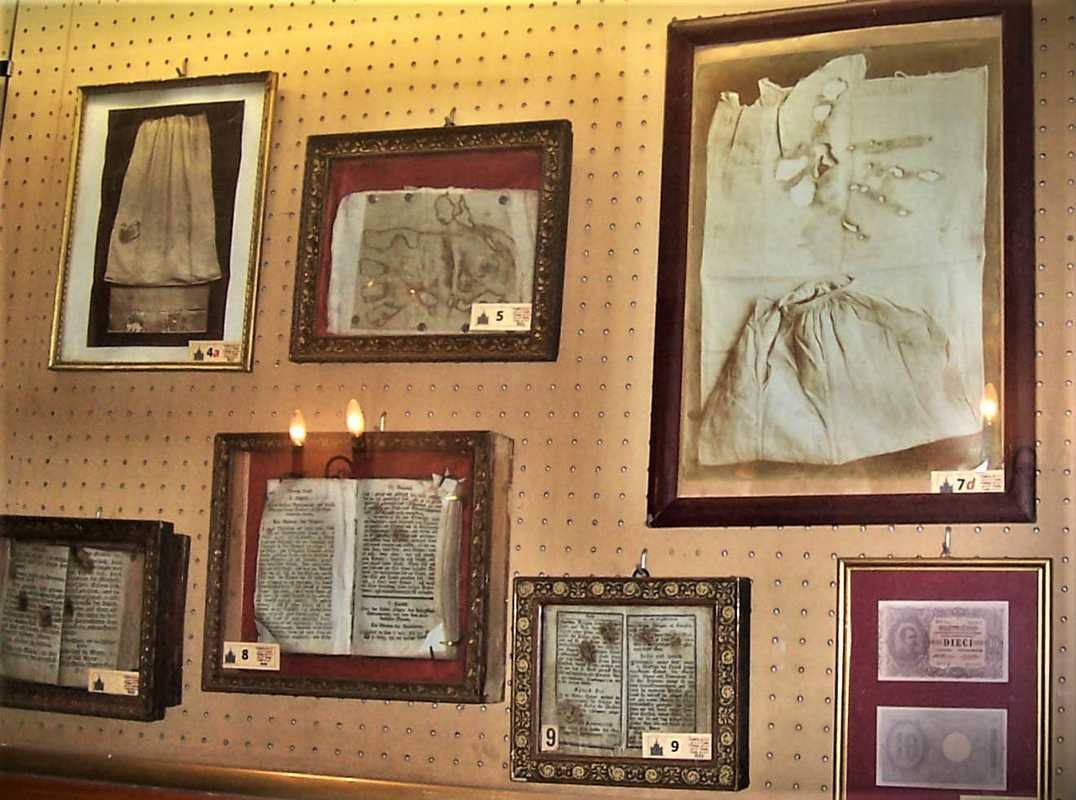
Isabella Fornari, abbess of the Poor Clares of Todi, 1731
This is the most famous piece and the oldest among those with a story told at length. Isabella Fornari, abbess of the monastery of the Poor Clares of Todi, kept clerical garments and a shirt that bear burned imprints. The tradition of the collection attributes them to Father Panzini, deceased, who appeared to the nun. The current dating is 1731. They are the most spectacular marks in the whole room, because the fabric is burned deeply with sharp, not blurred, outlines.
The degree of certainty needs to be stated: the story is devotional tradition documented by the monastic community, not a fact established by a third-party authority. The objects are authentic as objects of the 1700s. The burns are real. The origin of the burns is a matter of faith.
Giuseppe Leleux of Wodecq, the nightshirt of 1789
The relic with the most legible imprints is the nightshirt of Giuseppe Leleux, of Wodecq in Belgium, which bears on the sleeve the burn of a hand. According to the story handed down, in 1789 his mother, who died in 1762, appeared to her son during the night, reproaching him for his dissolute life and for having forgotten her in his prayers. The young man was so shaken that he changed his life, devoted himself to the Church and died, it is told, with a reputation for holiness.
It is the piece to linger on the longest, because it contains the entire grammar of the genre: a living person who neglected a dead one, a dead person who comes back to ask to be remembered, a sign left on matter so that the living person cannot forget. Believe it or not, it is a tale about the duty of family memory, and that is exactly why these objects came into being.
Margherita Demmerle, the book of Ellinghen
Among the paper documents, the book that belonged to Margherita Demmerle, of the parish of Ellinghen, stands out, with the imprint that tradition attributes to her deceased mother-in-law. The dating varies in the sources between 1814 and 1815. It is an interesting case because the imprint is on paper, a material that burns easily. The fact that the mark is circumscribed and the page remains legible is precisely the anomaly the collection insists on.
Palmira Rastelli and the prayer book of Maria Zaganti, 1871
Another book carries the imprints of three fingers, left according to tradition in 1871 by Palmira Rastelli, deceased, on the prayer book of Maria Zaganti. Three fingers, not a whole hand. The detail recurs often in these tales and has a devotional logic of its own, because the light touch indicates a request and not a threat.
Sister Maria of Saint Aloysius Gonzaga, June 1894
The most recent case among the monastic ones concerns a nun who died in 1894, identified as Sister Maria of Saint Aloysius Gonzaga, who is said to have appeared to a fellow sister, leaving the imprint of a burned finger. The memoir preserved in the collection describes the mark left on a pillowcase and the request for prayers for the salvation of her soul. The fellow sister to whom she is said to have appeared is remembered as Sister Maria of the Sacred Heart.
Giuseppe Schitz, December 21, 1838
A prayer book in German preserves the imprint connected with Giuseppe Schitz, dated December 21, 1838. It is one of the pieces that document the Germanic spread of the phenomenon and the fact that Jouet looked for cases well beyond the Latin area.
Luigi Le Senechal and the widower's cap, 1875
Among the everyday objects there is a cap with the mark left, according to the account, by the passage of a deceased woman who asked her widowed husband to recite prayers to hasten her entry into Paradise. The name tied to the piece is Luigi Le Senechal and the date of the apparition is 1875. The cap is the most domestic object in the whole room, and for that reason the most unsettling: not a liturgical garment, not a sacred book, a nightcap.
The banknotes of Montefalco, 1920
The strangest document concerns the monastery of San Leonardo, in Montefalco. Between August and November 1920, 30 banknotes of 10 lire are said to have appeared there, one of them partly burned, left according to the account by the spirit of a deceased priest to convince his brothers to have a mass celebrated for him. In the room you see the photographic reproduction, not the original.
30 banknotes, and not just any number: the reference to the 30 Gregorian masses is evident and makes the case, historically, the one most internal to ecclesiastical culture in the whole collection. Anyone looking for the prank of some novice has a reasonable hypothesis. Anyone looking for a document of how the mentality of suffrage worked in 1920 has, in this piece, the best source in the room.
The reproduction of the face and the item of 1637
The display is completed by the photograph of the imprinted face after the fire of 1897, already described, and by the minor pieces that the cut of 1921 left in the cases. The oldest item in the collection is dated 1637, which places the beginning of the series squarely in the 1600s, a century after the Council of Trent and in the full Baroque season of meditation on death.
How to really visit the Piccolo Duomo and the Museum of the Souls of Purgatory
Realistic time: 40 minutes for the complex, of which about 20 for the church and a quarter of an hour for the room. Anyone who reads all the handwritten captions and looks at the stained glass one by one gets to a good hour. It isn't a visit to plan on its own. It fits well between Castel Sant'Angelo and the center, or before or after St. Peter's Basilica.
You enter by the main door on the Tiber embankment. If the room is closed, ask politely in the sacristy: in most cases someone opens it. On days of a funeral or an important service the answer can be no, and that's fair: it is a working parish, not a museum site with dedicated staff. Covered clothing, shoulders and knees, as in every Roman church.
The Museum of the Souls of Purgatory with children
A question I get often. The room contains no violent images and has no frightening displays: it's fabrics and books in cases. The theme, though, is death, and the captions talk about souls that burn. Under 10 I'd think it over carefully, especially with impressionable children. Over 12, if accompanied by a serious explanation of the historical context, the visit works very well and stays with you. It isn't a place of horror, and presenting it as one would be unfair to the community that looks after it.
Accessibility of the Piccolo Duomo and the Museum of the Souls of Purgatory
The church faces the Tiber embankment with a few steps at the front. The passage to the sacristy and the room is inside the right nave. For a precise assessment of wheelchair access it's best to phone the parish at 06 68806517 before leaving, because availability also depends on who is there at that moment.
Photos, silence and good manners
Photographs without flash are generally tolerated, but the rule is set by whoever opens the door: you ask, and you accept the answer. You don't rest your hands on the display cases, you don't talk loudly, you don't turn the room into a set. It sounds obvious. In practice, in a place that social media have made popular among mystery fans, it isn't at all.
A curiosity about the Piccolo Duomo and the Museum of the Souls of Purgatory
The real curiosity of this building isn't about ghosts. It's about concrete. The neo-Gothic facade that from the Tiber embankment looks like a lace of white stone is built in reinforced concrete, in years when the material was used for bridges, silos and sheds, and never for the front of a church. Gualandi chose it for practical reasons, because it let him produce in series the slender profiles and spires that in authentic Gothic required stonecutters and decades. The result is a declared historical fake, and one of the first Roman examples of industrial Gothic.
Next comes the corollary, even less known. The original decoration was not marble or travertine, but artificial stone, that is, a cement mix molded in imitation of cut stone. That cladding aged badly, flaked under the rains and the dust of the city, and starting in 1960 was replaced with San Gottardo stone. Anyone admiring the sharpness of the statues today isn't looking at the work of 1917. They are looking at an intervention of the 1960s on a structure of the early 1900s.
Then there is the detail of the cross at the top, which contains a heart-shaped ex voto donated by the founder. A personal devotional object walled in at the top of the bell tower, invisible to everyone, is the most revealing gesture of the whole story: Jouet wasn't building a monument to himself, he was building a device for prayer, and he signed its tip with a mark nobody would ever see. If I had to point out the most interesting thing about the building to someone in a hurry, I'd point to that, and not to the display cases of the room.
An urbanistic footnote that Romans like. The Prati district was born after 1870 on the land of the Prati di Castello, at the foot of Castel Sant'Angelo, as a neighborhood for the new Italian bureaucracy, with wide streets and names taken from classical Roman history and the Risorgimento. Planting here, 30 years later, a miniature French cathedral dedicated to the souls in purgatory meant placing a Catholic and foreign accent in the most secular neighborhood of the capital. The little Duomo and the Museum of the Souls of Purgatory were also born as a declaration of presence.
Something nobody tells you about the Piccolo Duomo and the Museum of the Souls of Purgatory
That the face from the fire, the piece around which the entire narrative of the place revolves, is not in the room. You see a photographic reproduction. Every year dozens of visitors arrive convinced they'll find a blackened wall with a human profile, walk around the display cases looking for it and leave disappointed without asking. The reason is simple and no guide writes it: the fire of 1897 happened in the association's temporary chapel, a different building from the current one, which was later replaced by the church built between 1908 and 1917. The wall couldn't survive the construction site.
The second thing nobody says concerns the numbers. People talk about a museum, and the word evokes halls, routes, a ticket office. Here it's a single room, with about 15 objects. Anyone organizing the day planning to give it two hours gets the count wrong by a factor of four. And anyone bringing a large group there creates a jam: the room comfortably holds six or seven people, 10 with difficulty. With groups you go in in shifts, and this should be told to the participants beforehand, not on the threshold.
The third concerns the 1921 selection. The collection you visit today is not Jouet's. It is the one Father Gremigni left standing after eliminating everything that wasn't documented in a way, in his view, indisputable. It means the objects in the cases are the survivors of an examination internal to the Church, not the most spectacular ones. Anyone who reads the room as a catalog of oddities turns the meaning of the operation upside down: it is a catalog of prudence.
Last, a practical one. The church is a working parish, with masses, funerals, weddings and catechism. On weekends and during services access to the room gets complicated, and Saturday afternoon is often the worst time. The best time, from experience, is a weekday morning shortly after opening: empty church, light coming in from the two-light windows, a quiet and helpful sacristy.
The advice I give you for visiting the Piccolo Duomo and the Museum of the Souls of Purgatory
Call ahead, at 06 68806517, and go early in the morning, on a weekday. This is the advice that is worth more than all the others put together, because the decisive variable here isn't the line, which doesn't exist, but the presence of someone to open the door of the room. The window between opening and 10 is the one when the parish is in ordinary activity without major services.
Second piece of advice: look at the church before the collection, not after. Almost everyone does the opposite, rushes to the room, comes out and considers the visit over. That way you lose the sense of it. The display cases are understood only after seeing the altar of Saint Gregory the Great with the story of the Gregorian masses, the stained glass of Catherine of Genoa, the altarpiece of the Sacred Heart with the souls in purgatory. They are all pieces of the same discourse. 20 minutes in the nave turn a quarter of an hour of morbid curiosity into a quarter of an hour of the history of religiosity.
Third: bring coins. Not for the ticket, which doesn't exist, but for the offering and above all for any lights on the chapels. In a church of this kind the coin in the lighting device is the difference between seeing an altarpiece and guessing at it in the dark.
Fourth, and here I go against the grain: don't come on November 2 thinking you'll find the perfect atmosphere. The commemoration of the dead in a parish of suffrage means services one after another, a full church and a closed room. The thematically right day is the worst from the practical point of view. If you want the symbolic coincidence, pick the days right before the end of October, when the celebrations haven't started yet.
Fifth: build the morning around a theme, not around a single door. Purgatory and the memory of the dead in Rome have a natural itinerary that includes the Museum of the Capuchin Friars on Via Veneto with the ossuary crypt, the Non-Catholic Cemetery in Testaccio and the catacombs of Rome. Three places, three very different ways of treating death: Counter-Reformation Catholic, romantic Protestant, early Christian. The room on Lungotevere Prati is the fourth.
Another well-known fact, and yet rarely cited
That this church is a French building on Italian territory, by origin, by money and by culture, and that this explains almost everything about its look. The founder was from Marseille. The first stone was blessed in 1894 by the bishop of Marseille. The architectural model is the Gothic north of the Alps, not the Italian one. Devotion to the souls in purgatory in its associative form is a typically French and Belgian phenomenon of the 1800s. The objects in the collection come in large part from Belgium and Germany. There is nothing like it in Rome because in Rome this culture was not at home.
Add the Italian chronology. The church opens on November 1, 1917, in the same weeks in which the Italian army falls back to the Piave. The parish is born on December 10, 1917. In postwar Italy, with 600,000 dead and hundreds of thousands of families without a grave to weep over, a church dedicated to the suffrage of the dead is not a devotional curiosity. It is a service in huge demand. Prayer associations for the fallen proliferated everywhere, and this temple found itself ready, with its structure already organized.
Third element rarely cited: the relationship with Pius X. The pope remembered today for the reform of sacred music and for communion for children intervened here twice, blessing the collection and personally choosing the 19 saints of the facade statues. It isn't generic patronage. It is supervision. Which places the operation inside the perimeter of the official Church, and not on its esoteric margins as some sensationalist accounts suggest.
Finally, the fourth element, which concerns the sacred geography of the area. Within a radius of a kilometer from Lungotevere Prati 12 you find the bulk of the Palace of Justice, built between 1889 and 1911 to a design by Guglielmo Calderini, and the bridge toward Castel Sant'Angelo, the monument that went from imperial mausoleum to fortress of the popes. Three buildings, three powers: the justice of the Italian State, the fortress of the papacy, and in between the private church of a French missionary who prayed for the dead of half of Europe. Prati, read this way, is a manual of contemporary history in three blocks.
The right photo to take at the Piccolo Duomo and the Museum of the Souls of Purgatory
The good photograph isn't inside, it's outside, and it is taken from the opposite sidewalk of the Tiber embankment or from the Tiber parapet, stepping back just enough to fit the whole facade with the octagonal bell tower. The right light is that of late afternoon, when the sun hits the front from the west and sets the white spires against the sky. In the morning the facade stays in shadow and looks gray, flat, disappointing. If you have a wide-angle lens, this is the moment to use it, because the street is narrow and the church is tall.
The second shot, the one almost nobody tries, is from Ponte Umberto I looking upstream: the bell tower pops up among the Umbertine buildings of Prati and the composition tells the geographic absurdity of the place, a Lombard-French spire in the middle of a neighborhood of Italian bureaucracy. With the river in the foreground, it works better on days with a moving sky than on days of full blue.
Inside, the best photograph is upward, on the cross vaults and the compound piers with the bands of gray stone and red bricks, or against the light on the polychrome two-light windows in the early hours of the morning, when the light comes in low and the glass gives the best color on the herringbone floor. The floor, by the way, is a subject in itself: red Verona marble, gray and black, a geometric design that holds up very well in a shot from above.
In the relics room, the advice goes against the grain: take few photos. First ask, because the rule is made by whoever opens the door. Then consider that the glass of the cases reflects anything and that without flash, in that light, you get blurred and useless images. The piece that works best is the nightshirt of Leleux, for the contrast between the white of the fabric and the brown of the burn. Take one, take it well, and then look with your eyes. The handwritten captions, on the other hand, are worth a close-up photograph: they are the most authentic document in the room, and no catalog reproduces them.
Some important events that happened here in history
1893. Victor Jouet, a missionary of the Sacred Heart of Jesus born in Marseille, founds in Rome the Association of the Sacred Heart of Suffrage for the souls of Purgatory. It is the founding act of everything that will follow. The activity begins in an oratory in Via dei Cosmati, in a modest space that gives no hint of what comes next.
1894. The bishop of Marseille blesses the first stone on the land on the Tiber embankment. The gesture is significant: not a Roman cardinal, but the bishop of the founder's city of origin. The temple is born as a transplanted French enterprise.
1896. A second chapel goes into service on Lungotevere Prati, which will serve until 1914 while the final project is worked on next door. It is here, and not in the current church, that the best-known episode of the story will take place.
1897. A fire devastates the chapel dedicated to the Virgin of the Rosary. The altar painting is unharmed. On the blackened wall the founder and some of the faithful recognize the outline of a sorrowful face. That day, the idea of the collection is born.
1908. Work begins on the final church to a design by the Bolognese engineer Giuseppe Gualandi. The reinforced concrete in the facade is the technical choice that will make the Gothic repertoire possible.
November 1, 1917. The church is blessed and opened for worship on All Saints' Day, on the eve of the commemoration of the dead. Italy is in the middle of the retreat of Caporetto.
December 10, 1917. The parish is established, entrusted to the Missionaries of the Sacred Heart of Jesus.
1912. Victor Jouet dies. The collection loses its animator and is left without a guide to defend its approach.
1920. Between August and November falls the episode of the 30 banknotes of 10 lire from the monastery of San Leonardo in Montefalco, the last important case to enter the collection and the most recent among those on display.
May 17, 1921. Pietro Benedetti, titular archbishop of Tyre and first parish priest, solemnly consecrates the church. In the same year Father Gilla Vincenzo Gremigni reduces the display to the relics considered indisputably authentic and cuts its publicity: it is the cut that determined the current form of the room.
1932. The funerary monument of Monsignor Pietro Benedetti is erected in the left nave, in polychrome marbles, with the bronze Pietà and the bust by Giovan Battista Conti.
From 1960. The exterior decorative apparatus in artificial stone, decayed, is replaced with San Gottardo stone. In the same period the firm Ruffatti builds the new organ, which takes the place of the instrument from the church of Santa Brigida.
February 1, 1998. John Paul II visits the parish. The pastoral visits of the Polish pope to Roman parishes were in the hundreds, but for a community of a few thousand souls they remain the most important day of the century.
Who has passed through the Piccolo Duomo and the Museum of the Souls of Purgatory
Victor Jouet is the first name, and remains the most important. A man from Marseille, a missionary of the Sacred Heart of Jesus, he founded the association in 1893, bought the land, started the construction site, traveled around Europe collecting documents and died in 1912 without seeing the church finished. He is a recognizable human type of 19th-century Catholicism: half mystic and half organizer, with a fundraising ability that today we would call professional.
Pope Pius X, Giuseppe Sarto, is the second. He blessed the collection, considering it useful to call the faithful to their duties toward the dead, and personally chose the 19 saints of the facade statues. His intervention is the element that places the operation inside the official Church.
Pietro Benedetti, titular archbishop of Tyre, was the first parish priest and consecrated the church on May 17, 1921. He rests in the left nave under the monument of 1932. Anyone who enters and walks past without looking at that marble misses the tomb of the man who held the community together in its hardest years.
Gilla Vincenzo Gremigni is the most interesting figure for a historian. In 1921 he did the most uncomfortable thing: he cut the spectacular part of his own founder's collection, kept what he considered documented and turned off the spotlights. He is the man thanks to whom today you visit a sober collection instead of a sideshow.
Monsignor Enrico Dante is the name that very few know and that deserves more attention than all the others. He was a confessor in this church for almost 40 years. In his Roman career he became master of papal ceremonies, the figure who regulated every gesture of papal liturgies, and was created cardinal. Imagining the man who directed the ceremonial of St. Peter's Basilica sitting in a confessional in Prati, decade after decade, listening to clerks and building caretakers, is the most exact portrait of what this parish was.
John Paul II visited the temple on February 1, 1998, as part of the pastoral visits to the parishes of the diocese of Rome.
Then there are the names that don't belong to Rome and that never left the room: Isabella Fornari, abbess in Todi in 1731, Giuseppe Leleux of Wodecq, Margherita Demmerle of Ellinghen, Palmira Rastelli and Maria Zaganti, Giuseppe Schitz, Luigi Le Senechal. They are ordinary people of the European 1700s and 1800s, who entered history only because someone kept an object of theirs and sent it to Rome. This is the reason why this room, setting aside any judgment on the phenomena, is an archive of everyday life: you see the nightshirts, the caps, the pillowcases and the prayer books that people really used.
What to see around the Piccolo Duomo and the Museum of the Souls of Purgatory
Within a 10-minute walk there is a concentration of things above the Roman average. At 300 meters stands the Palace of Justice, the Palazzaccio, built between 1889 and 1911 to a design by Guglielmo Calderini and inaugurated on January 11, 1911: a block of travertine of vast size that Romans hated for a century and that today is starting to be reappraised. Seat of the Court of Cassation, it takes up an entire side of Piazza Cavour.
500 meters downstream you arrive at Castel Sant'Angelo, from the mausoleum of Hadrian to papal fortress to national museum, with the covered passage that links it to the Vatican. From there the walk continues naturally toward St. Peter's Basilica and, with a reservation, to the Vatican Museums and the Vatican Gardens.
On the other bank, once you cross Ponte Umberto I, you enter the historic center and in a quarter of an hour you are at Piazza Navona and the Basilica of Santa Maria sopra Minerva. Anyone who stays in Prati instead can end the morning on Via Cola di Rienzo or at the covered market of Piazza dell'Unità, which serves a better breakfast than any bar on the Tiber embankment.
A Roman itinerary on the memory of the dead that starts from the Piccolo Duomo
If the theme really interests you, and not for the thrill, there is a half-day route that holds together four different visions of death. It starts here, with the devotion of suffrage of the early 1900s. It continues with the Museum of the Capuchin Friars, where the ossuary crypt stages the Baroque meditation on the vanity of life. It goes on to the Non-Catholic Cemetery of Rome, the pyramid, the cats, Keats and Shelley, the romantic death of northerners in love with Italy. It ends at the Catacombs of San Callisto, where early Christian death is expectation and not fright.
For those with more time, the Verano Cemetery adds the monumental 19th-century chapter, and Santo Spirito in Sassia, just across the river, that of hospitals and charitable confraternities. Four centuries of different ways of looking at the same thing.
When to go and when to avoid the Piccolo Duomo and the Museum of the Souls of Purgatory
The best time: a weekday morning, shortly after opening, between Tuesday and Friday. Empty church, good light from the two-light windows, an available sacristy. In summer the advantage multiplies, because at 8:30 the Tiber embankment can still be walked without suffering.
The worst time: lunchtime, because of the closure. Saturday afternoon, because of weddings. November 2 and the days immediately after, because of the liturgical crowding. Holy Week is complicated too, with the calendar of services taking up almost all the useful time slots.
The most beautiful time, which doesn't coincide with the most convenient: an afternoon at the end of October around five, with raking light on the facade and the church preparing for the novena of the dead. If you have to choose the image to take home, that is the best the place can give.
How much the Piccolo Duomo and the Museum of the Souls of Purgatory cost and what to know about tickets
It costs nothing. There is no admission ticket either for the church or for the relics room. An offering is welcome. You don't need to book and there are no official guided visits at fixed times organized by the parish. City museum cards, civic museum passes and state museum passes have no relation to this place, because it is neither civic nor state: it is a parish church.
Anyone who wants an in-depth explanation must turn to a licensed private tour guide. It is the only way to get on the spot the historical reconstruction of the individual pieces, which the handwritten captions report in telegraphic form and in period Italian.
Quick questions about the Piccolo Duomo and the Museum of the Souls of Purgatory
Where is the Museum of the Souls of Purgatory
At Lungotevere Prati 12, 00193 Rome, Prati district, in the sacristy of the church of the Sacred Heart of Suffrage, between Via Ulpiano and Via Paolo Mercuri, a short distance from Piazza Cavour.
How much does it cost to enter the Piccolo Duomo and the Museum of the Souls of Purgatory
Nothing. Admission is free, both in the church and in the relics room. An offering is welcome, which supports the parish.
What are the opening hours of the Museum of the Souls of Purgatory
The room is visited when the church is open: according to the listing of the Diocese of Rome Monday to Friday from 9:30 to 12:00, on days before holidays from 9:30 to 12:00 and from 18:00 to 19:30, on holidays from 9:30 to 12:00. Some institutional listings give a span of 7:30 to 19:30. It's best to phone 06 68806517 before leaving.
Do you need to book to visit the Piccolo Duomo and the Museum of the Souls of Purgatory
No, no reservation is needed. For groups, though, a call to the parish beforehand avoids finding the door closed and lets you arrange entry in shifts.
How do you get into the room of the Museum of the Souls of Purgatory
Through the door that opens onto the sixth bay of the right nave, connected with the sacristy. If it is closed, you ask in the sacristy.
How long does the visit to the Piccolo Duomo and the Museum of the Souls of Purgatory take
About 40 minutes in all: around 20 for the church and a quarter of an hour for the room. Anyone who reads every caption gets to a good hour.
How many objects are on display at the Museum of the Souls of Purgatory
About 15 pieces, in a few display cases in a single room. The original collection was larger and was reduced in 1921.
Can you take photographs at the Museum of the Souls of Purgatory
Generally yes, without flash, but the rule is set by whoever opens the room: it's best to ask. The glass of the cases reflects a lot and the results are often mediocre.
Is the Museum of the Souls of Purgatory suitable for children
There are no violent images, but the theme is death and the captions talk about souls that burn. Under 10, judge case by case. From 12 up, with a serious explanation of the context, it works well.
Is the MIC card valid for the Museum of the Souls of Purgatory
No. The MIC card concerns the civic museums of the City of Rome. It isn't needed here because there is no ticket: it's a parish church and you go in for free.
Is the Piccolo Duomo and the Museum of the Souls of Purgatory accessible by wheelchair
The front on the Tiber embankment has a few steps and the passage to the room is inside the right nave. For a certain answer, it's best to phone the parish at 06 68806517.
Why do they call it the little Duomo of Milan
For the neo-Gothic look of the facade, with spires, statues and verticality from beyond the Alps, unique in Rome. The resemblance is one of impression: the dimensions are those of a parish church.
Who designed the church of the Sacred Heart of Suffrage
The Bolognese engineer Giuseppe Gualandi, who drew inspiration from French Gothic. The sculptures of the facade are by Arturo Orsoni.
When was the church built
The first stone was blessed in 1894, construction of the final building started in 1908 and ended in 1917. The church was opened for worship on November 1, 1917 and consecrated on May 17, 1921.
What was the fire of 1897
A small fire in the temporary chapel dedicated to the Virgin of the Rosary. On the blackened wall the founder recognized the outline of a sorrowful face, and from there the idea of the collection was born.
Can you see the face imprinted on the wall
No. In the room you find a photographic reproduction. The wall belonged to the temporary chapel, replaced by the church built between 1908 and 1917.
What is the most famous object in the Museum of the Souls of Purgatory
The nightshirt of Giuseppe Leleux of Wodecq, with the hand-shaped burn on the sleeve, tied to the apparition of his mother in 1789.
What is the oldest item in the Museum of the Souls of Purgatory
A piece dated 1637, which places the beginning of the series squarely in the 1600s.
Does the Church consider these objects miracles
No. They are devotional testimonies, collected and kept. No ecclesiastical authority has declared them miracles, and Catholic faith does not impose them. In 1921 the collection was reduced to the pieces considered best documented.
What is purgatory according to Catholic doctrine
A state of purification after death, defined by the councils of Florence in 1439 and of Trent in 1563, in which souls can be helped by the prayers and masses of suffrage of the living.
Is the church still an active parish
Yes. It is the parish of the Sacred Heart of Jesus in Prati, entrusted to the Missionaries of the Sacred Heart of Jesus, with masses, funerals and ordinary activities: during services the visit to the room is suspended.
How do you get to the Piccolo Duomo and the Museum of the Souls of Purgatory by public transport
Metro line A, Lepanto stop, a little under a kilometer away, 10 minutes on foot. From Piazza Cavour, 300 meters away, several surface lines pass. From the historic center you cross Ponte Umberto I or Ponte Cavour.
Is there parking
No. The Tiber embankment is a paid parking zone and the traffic is constant: it's best to leave the car and use the metro.
What is the difference from the Capuchin crypt on Via Veneto
The Capuchin crypt is an ossuary decorated with the bones of the friars, a Baroque meditation on death. Here there are no human remains: there are objects that the faithful considered marked by contact with the dead. Two different devotions, two centuries apart.
How long do you wait in line
There is no line. The problem isn't the wait but finding the room open and someone in the sacristy to show it.
Is there a cloakroom or luggage storage
No, and there is neither a bookshop nor a cafe. It's a parish, not an equipped museum complex.
Are there guided tours of the Piccolo Duomo and the Museum of the Souls of Purgatory
The parish does not organize guided visits at fixed times. For an in-depth account you need to turn to a licensed private tour guide.
What is the best time of year to visit the Piccolo Duomo and the Museum of the Souls of Purgatory
The end of October, for the coincidence with the calendar of the dead, avoiding though November 2 and the days immediately following, when the services take over the church.
What to see right after
Castel Sant'Angelo five minutes away, the Palazzo di Giustizia at 300 meters, and with 10 more minutes St. Peter's Basilica. On the other bank you enter the historic center from Ponte Umberto I.
Very different visitors come here, from art historians to mystery fans, and the best visit is made by whoever shakes off the idea of the thrill before going in. That room frightens nobody: it lines up 15 objects that speak of mourning, of guilt and of the all-too-human need to still do something for those who are no longer here. Look at it that way, after walking the nave and understanding why that church exists, and you'll leave with something in hand. Look at it as an attraction of the occult and you'll be out in five minutes, disappointed, having seen nothing.
Article written by the editorial team of TourLeaderPro, contact them for Private/Corporate/V.I.P. Tours and Experiences.
Planning a trip to Rome? The English guides to visiting the city are on ItalyPlanner.com.