Palazzaccio – Palace of Justice of Rome
In short. There are buildings in Rome that you visit and others that simply loom over you.

There are buildings in Rome that you visit and others that simply loom over you. The Palazzaccio - Palace of Justice of Rome undoubtedly belongs to the second group. You don't search for it: you find it there, on the Tiber embankment in Prati, with its mass of travertine that seems to press down on the river and the sky at once. Along the Tiber, between piazza Cavour and ponte Umberto I, you stop short in front of this building, and the first comment is almost always the same: "but it's enormous". So, about this enormity, and about everything hidden inside it, I'd like to talk to you as if we were walking together, slowly, looking up.
The first look at the Palazzaccio - Palace of Justice of Rome
When you arrive from ponte Umberto I and turn right, the Palazzaccio - Palace of Justice of Rome rises in front of you like a wall of pale stone that never seems to end. The first impression is of weight, of an almost stubborn solidity: the travertine from Tivoli, with that color that goes from cream to ochre depending on the light, gives the sense of something built to last a thousand years. You could call it "the transatlantic liner run aground on the Tiber", because it really does have the outline of a huge ship stranded a stone's throw from the river, with flanks marked by columns, pilasters, statues and balustrades that chase each other without a break.
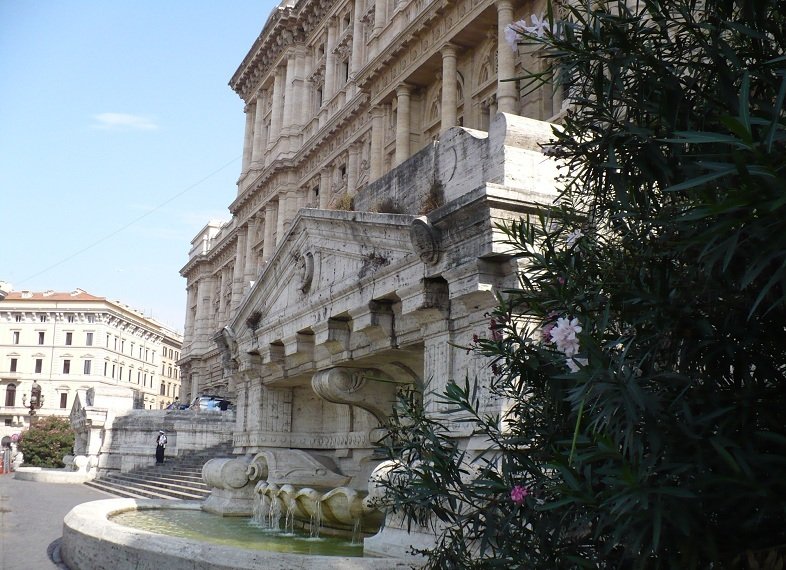
But don't let the first glance fool you. This building needs to be looked at twice. The first time, you find it imposing, perhaps even a bit pompous. The second time, you start to read it, to tell the floors apart, to follow the rhythm of the windows, to notice how the lower part is more severe and the upper part more lively, almost Baroque. It's a palace that tells the story of an entire era, that of a newly unified Italy that wanted to give itself symbols, and that chose justice as one of its new secular divinities. There is a hunger for grandeur here that today moves us and makes us smile at the same time.
My advice is not to rush. The Palazzaccio - Palace of Justice of Rome is not a monument to photograph quickly and move on. It deserves that you walk around at least two of its sides, because each has a different character: the main facade, theatrical and facing the river, and the longer flanks, almost military in their repetition. Only by walking around it do you understand how big it really is, and how much ambition, money and pride it took to put it up.
Where exactly the Palazzaccio - Palace of Justice of Rome is
The Palazzaccio - Palace of Justice of Rome stands in the Prati district, on the Tiber embankment, in that stretch of the city that extends between piazza Cavour and ponte Umberto I. It's a strategic spot, and not by chance: you're on the right bank of the Tiber, facing the ancient heart of the city, with Castel Sant'Angelo a little further south and the basilica of Saint Peter's visible behind you. Whoever designed this area at the end of the 1800s wanted a new, orderly Rome, with wide, straight streets, and the palace was meant to be one of its focal points.
To get your bearings it's simple: if you walk along the river downstream, the palace occupies an entire block facing the Tiber, with the monumental entrance facing the river and Castel Sant'Angelo. Behind it opens piazza Cavour, one of the most elegant green spaces in Prati, with its plane trees, the statue of Cavour and the Waldensian church opposite. It's a corner of the city that has kept a somewhat austere dignity, very "Umbertine", with the nineteenth-century buildings lined up and the historic law offices.
This position is not only geographical, it's symbolic. Placing the Palace of Justice on the opposite bank from the palaces of ancient power, those of the popes and the great families, meant asserting that the justice of the Italian state was something new and secular, one that looked the old Rome in the face without fear. Every time I pass by there, I think about this silent dialogue between the two banks: on one side, the centuries of papal Rome, on the other, the gleaming stone of the young Kingdom of Italy that wanted to prove it knew how to build on a grand scale.
Why the Palazzaccio - Palace of Justice of Rome was born right here
To understand the Palazzaccio - Palace of Justice of Rome, you have to go back to 1870, the year Rome became the capital of the Kingdom of Italy. A city that for centuries had been the seat of the papacy suddenly had to house ministries, courts, offices, a whole state machine that didn't exist before. Everything was needed, and needed fast: new streets, new neighborhoods, new buildings that would tell the world that Italy was finally a modern state. Within a few decades Rome filled with construction sites, and Prati, which had been countryside and vegetable gardens under the Vatican walls, became one of the districts of the new white-collar middle class.
In this plan, justice had a special role. A liberal State is founded on the law, and the law needs a house that represents it. Until then, Rome's courts were scattered across repurposed buildings, often former convents, poorly suited and undignified. The idea of a great, unique and monumental Palace of Justice arose precisely from the desire to give the judiciary a seat worthy of its task, a place that, as soon as you saw it, would inspire respect for the law of the State.
This is how a competition for the new palace was announced, and the site was chosen on that strip of land along the Tiber, in Prati, where the city was growing. It was an area still partly to be urbanized, which made it possible to build something truly colossal without having to tear down ancient fabric. The Palazzaccio - Palazzo di Giustizia di Roma is therefore a direct child of that historical moment: a foundational work, designed not only to function but to proclaim something.
Guglielmo Calderini and the Design of the Palazzaccio - Palazzo di Giustizia di Roma
Behind the Palazzaccio - Palazzo di Giustizia di Roma there is a man, and it's only right to remember his name: Guglielmo Calderini, an architect from Perugia. He was the one who won the competition and signed the design for this enormous building, and both the initial glory and, later, a large part of the criticism fell on him. Calderini was a cultured professional, trained in the eclectic taste of the late 19th century, and he conceived the palace as a kind of encyclopedia in stone, where references to the Renaissance, the Baroque and classical architecture mix together in a whole designed to amaze.
His idea was not sobriety but magnificence. Calderini wanted a building that spoke loudly, that asserted the solemnity of justice through mass, decoration and the richness of its materials. That is why travertine was chosen, why there are columns, statues and the large bronze quadriga meant to crown the whole. It was a language that might even have seemed excessive to the public of the time, but it perfectly met the need for representation of the young State.
Calderini's fate is, in some ways, melancholy. The architect who had dreamed of the monument to Italian justice was later overwhelmed by the controversies over the costs and the structural problems of the work, and the popular nickname "Palazzaccio" was also, at heart, a verdict on his excess of ambition. Yet, looking at the building today, one cannot help recognizing that Calderini created an architectural machine of rare complexity, a piece of history that still dominates the Lungotevere and that has become, for better and for worse, one of Rome's recognizable symbols.
The 1888-1911 Construction Site of the Palazzaccio - Palazzo di Giustizia di Roma
Construction of the Palazzaccio - Palazzo di Giustizia di Roma took more than 20 years: work began in 1888 and was completed in 1911, the year of the major celebrations for the 50th anniversary of Italian Unification. 23 years of construction is a very long time, and this fact alone tells us how gigantic and, at the same time, how troubled the undertaking was. It was not a straightforward build: there were design revisions, technical difficulties, endless debates, and a constant rise in costs that fueled the scandal we'll talk about.
You have to imagine what a site like this meant at the end of the 19th century, with still largely manual means. Blocks of travertine transported from Tivoli, scaffolding that rose dozens of meters, stonecutters and workers busy for years on the decorations, foundries working on the large bronzes. The land along the Tiber, moreover, was far from ideal: water, sand and water tables made the foundations of such a heavy mass complicated, and it was from exactly there that the subsidence problems would later arise.
When the palace was finally completed and inaugurated, in 1911, Rome had its secular cathedral of justice. But the abnormal length of the construction had already engraved in the public memory the image of a costly and troublesome work. In a sense, the Palazzaccio - Palazzo di Giustizia di Roma was born already old with its controversies: people had heard about it for 20 years as a bottomless pit, and the inauguration was not enough to erase that halo. It's a very Italian story, if you think about it, and perhaps that is also why the palace remains so endearingly unlikable.
The Travertine and the Dimensions of the Palazzaccio - Palazzo di Giustizia di Roma
If there is one word that sums up the Palazzaccio - Palazzo di Giustizia di Roma, that word is "mass." The building stretches along the river with a facade that nearly reaches 170 meters and extends in depth for over 150 meters, occupying an entire city block. These figures make this palace one of the largest public buildings erected in Rome after Italian Unification, a colossus measured not in halls but in city blocks. Walking along just one side takes a good few minutes: it seems impossible until you try it.
The material is the real star. Travertine, the Roman stone par excellence, the stone of the Colosseum and the great ancient buildings, covers the building entirely and turns it into a compact, luminous block that changes color during the day. In the morning it is light and almost milky. In the late afternoon, when the sun sinks toward Saint Peter's, it lights up with warm, golden tones that soften its severity. It's the best time to see it.
The structure rises over several floors, with a sturdy base, the noble floors marked by large windows and architectural orders, and a crowning decoration very rich in statues and balustrades. The sheer amount of stone used is impressive, and it was this enormous weight, resting on ground close to the river, that caused some of the structural problems that struck the palace in the following years. Greatness, in short, came at a price, and not only an economic one. The Palazzaccio - Palazzo di Giustizia di Roma is also a lesson in how hard it is to make matter hold up the grand ambitions of men.
There is another aspect of travertine worth pointing out, and that is its kinship with ancient Rome. It is the same stone used to clad the Colosseum, the colonnade of Saint Peter's and a thousand other buildings in the Eternal City, quarried at Tivoli and carried to Rome for centuries. By choosing it for the Palace of Justice, Calderini placed his building within a line of continuity with the most illustrious past, almost to suggest that the justice of the Italian state was the legitimate heir of Roman greatness. It is a subtle message, entrusted not to words but to the material itself, and one that few people pick up on today. At the time, though, it must have rung out clearly.
Looking closely at the surface of the stone, you'll notice the typical holes and veins of travertine, those small irregular cavities that make it a living material, never monotonous. It is a surface that catches the light and returns it in a thousand different ways, and as it ages it acquires shades and patinas that no artificial material could imitate. Time, in this sense, has worked in the palace's favor, softening its appearance and tying it even more closely to the overall color of Rome, that warm hue shared by monuments from very distant eras.
The Quadriga by Ettore Ximenes on the Palazzaccio - Palazzo di Giustizia di Roma
Look up at the top of the main façade and you'll see the highlight of the decoration of the Palazzaccio - Palazzo di Giustizia di Roma: a large bronze quadriga, the work of sculptor Ettore Ximenes. A quadriga is a chariot pulled by four horses, a classical motif that in antiquity crowned triumphal arches and monuments. Here it has been revived to give the building the touch of triumph its designers wanted. The slender horses, the chariot, the figure guiding them: everything is designed to be seen from afar, standing out against the Roman sky.
Ettore Ximenes was a very active and appreciated sculptor between the 19th and 20th centuries, the author of monuments in Italy and abroad. His quadriga on the Palace of Justice is one of those details that often escape the notice of someone who looks distractedly. Yet once you've noticed it, you can no longer ignore it. It crowns the building like a seal, giving it an upward movement that lightens the otherwise crushing mass of stone. It is the theatrical touch that completes the composition.
I like to recommend looking at it from different distances. Up close, from the sidewalk below the palace, the quadriga gets a little lost in perspective. But if you move farther away, perhaps from Ponte Umberto I or from the opposite bank of the Tiber, you finally see it in its entirety, projecting over the façade as if it were about to launch into the void. It is at that moment that you understand the intention of the architect and the sculptor: to make the crowning a gesture of triumph, a way of saying that the justice of the state advances confidently, like a victorious chariot.
It's worth remembering that the quadriga theme is not a casual choice. It has its roots in classical antiquity, where the triumphal chariot was the emblem par excellence of victory and legitimate power. Reproposing it on the Palace of Justice meant ideally linking the justice of the Italian state to the triumph of reason and law over arbitrariness. It is a language that today needs explaining, because we no longer read it immediately. For Calderini and Ximenes's contemporaries, though, it was perfectly clear: that bronze up there was not just decoration, but a declaration of principles entrusted to the universal language of monumental sculpture.
The Statues of the Jurists on the Palazzaccio - Palazzo di Giustizia di Roma
Walking along the base of the Palazzaccio - Palazzo di Giustizia di Roma, you'll notice a series of large statues placed along the façade, solemn images of men wrapped in robes and cloaks. They are the jurists, that is, the great scholars and masters of law whom Italy chose to honor on this building, as if to say that justice does not arise from nothing but rests on the shoulders of those who, over the centuries, thought about and wrote the laws. It is a small pantheon of legal wisdom, arranged so that whoever enters ideally passes beneath their gaze.
These figures are not random decoration. They represent a tradition, that of Roman law and of those who handed it down and commented on it, which unified Italy claimed as its own heritage. Rome, moreover, is the homeland of law par excellence: Roman law is the basis of a large part of European legal systems, and placing the great jurists on the façade meant linking the young Italian justice system to that very long chain of knowledge. It is a learned message, which few today stop to decipher, but which at the time was crystal clear.
I recommend that, when you pass by, you slow down and look these statues in the face. They have stern poses and measured gestures, and they convey a seriousness that is one with the building's function. It's as if they were telling you that the law is a serious matter, the product of centuries of thought, and not a whim of the moment. In an era when we tend to take everything for granted, the Palazzaccio - Palace of Justice of Rome, with its statues, reminds us that behind every ruling there are millennia of human reflection on justice and injustice.
Looking at the arrangement of these figures along the base, one notices how they act almost as a moral threshold before the building itself. They are placed at the eye level of someone walking by, not lost up high like the quadriga, and this makes them fellow travelers of the passerby rather than unreachable deities. It is an intelligent choice: the wisdom of law is brought within reach of the ordinary person, as if to say that law is not the privilege of a few but the heritage of everyone. Walking past them, one can't help but imagine the silent dialogue between these stone masters and the thousands of people who, every day, enter and leave the palace with their cases and their hopes.
Why They Call It "Palazzaccio"
And here we come to the name, that rough and affectionate nickname that Romans have stuck on the Palace of Justice: "Palazzaccio". The suffix "-accio", in Roman dialect as in Italian, is pejorative: it indicates something ugly, unpleasant, badly made. It is therefore not a term of endearment, but an outright criticism, which popular speech has turned into the official name by which everyone, still today, calls the building. Even those who work inside call it that, almost with resigned irony.
The reasons for the nickname are at least three, and it's worth distinguishing them. The first is the cost: the palace cost enormous sums, the construction site dragged on for over 20 years, and the budgets swelled in a way that seemed scandalous to public opinion. The second is structural problems: that travertine colossus soon began to show subsidence and cracks, so much so that it fed the suspicion that it had been built badly. The third is the alleged wrongdoing that was rumored to have accompanied the project, with investigations and controversies over the way the contracts and public funds had been managed.
Put these three things together, an extremely costly work, unsteady and suspected of irregularities, and you understand why Romans, with their knack for the cutting joke, renamed it "Palazzaccio". It is a name that condenses a historical judgment and, at the same time, the typically Roman disenchantment toward power and its great works. Yet, and this is the nice part, the nickname has over time become affectionate: saying "il Palazzaccio" today is no longer an insult, it is almost a rough caress toward a piece of the city that, with all its flaws, belongs to us.
The Scandal and the Inquiry Commission on the Palazzaccio - Palace of Justice of Rome
The story of the Palazzaccio - Palace of Justice of Rome would not be complete without the chapter on controversies. As costs rose and timelines stretched, the work became a target of the press and of political debate. People spoke of waste, design errors, and spending out of control, and over the years the issue reached Parliament and led to the appointment of an inquiry commission tasked with shedding light on how public money had been spent and on who might have been responsible.
It is significant that the very building meant to represent justice ended up under the lens of justice, or at least of public oversight. This contradiction was immediately noticed by Romans and by the newspapers of the time, and it helped fix the image of a work born crooked. Even if there had been real offenses, or only an overly optimistic and reckless management of costs, the damage to its image was already done: in public opinion the Palazzaccio was the monument to waste rather than to the law.
With hindsight, it's best to be careful in judging. Large public works of that era often suffered from unrealistic estimates and from technologies still immature for such ambitious undertakings, and an increase in spending doesn't always mean a crime: sometimes there is only the inexperience of a young state grappling with projects bigger than itself. This story should be told without holding posthumous trials, because the records should be handled with caution. The fact remains that the scandal, true or alleged, is an integral part of the legend of the Palazzaccio - Palace of Justice of Rome.
The Subsidence and Restorations of the Palazzaccio - Palace of Justice of Rome
One of the most concrete problems of the Palazzaccio - Palace of Justice of Rome was structural settling. A building this heavy, built on ground close to the river and its groundwater, began over time to show settling, cracks and signs of distress in the masonry. This turned what was meant to be a symbol of solidity into a constant source of concern, and for a large part of the 20th century the building was accompanied by consolidation work and constant attention to its structural condition.
The most important restorations were concentrated mainly in the second half of the last century, when it became clear that the building needed deep interventions to continue performing its function. They were difficult years, with parts of the building affected by construction sites and with the need to reconcile preserving a monument that was by then historic with the practical needs of a court in operation. Restoring a building this large and this decorated is never simple: every statue, every cornice, every travertine surface requires specific care.
In the end, after long campaigns of work that continued into relatively recent times, the Palazzaccio - Palace of Justice of Rome has returned to appearing in condition worthy of its role, with the facades cleaned and the structure made safe. When you look at it today, with its pale stone shining in the sun, it's hard to imagine how much worry it caused the technicians over the decades. This is also part of its history: that of a fragile colossus, one that required patience and expertise to be saved from its own weight.
The Supreme Court of Cassation inside the Palazzaccio - Palace of Justice of Rome
Today the Palazzaccio - Palace of Justice of Rome is, above all, the seat of the Supreme Court of Cassation, the top of the Italian ordinary justice system. This point needs to be clarified, because it completely changes the way you look at the building: it is not a museum, it is not a tourist attraction, but a workplace where legal questions of great importance for the country are decided every day. The Court of Cassation is the court that ensures uniform interpretation of the law, the final level of ordinary judgment.
Understanding this helps you respect the building for what it is. The people who go in and out of its doors are not visitors with cameras, but judges, lawyers, clerks, and citizens caught up in their cases. Inside those travertine walls is kept a very delicate function of the State, that of having the final word on the law, and the solemnity of the architecture, with all its nineteenth-century emphasis, is meant precisely to express this gravity.
For the visitor, this means something very practical: the Palazzaccio - Palace of Justice of Rome is admired from the outside. There are no tickets to buy, there is no internal tourist route to follow, because it is not a place designed for visiting but for the administration of justice. Personally, I find that this makes it even more fascinating: it is a living monument, one that continues to do exactly what it was built for more than a century ago, and that we can appreciate as citizens before we do as curious people.
The Biblioteca Centrale Giuridica inside the Palazzaccio - Palace of Justice of Rome
The Biblioteca Centrale Giuridica is also housed inside the Palazzaccio - Palace of Justice of Rome, one of the most important collections of legal texts in Italy. It is a detail that often goes unnoticed, but it adds a valuable dimension to the building: not only a place where judgment is passed, but also a place where legal knowledge is studied and preserved. In this sense the building is fully consistent with its purpose, joining the practical exercise of justice with the doctrinal memory that supports it.
A legal library is not simply a book storeroom. It holds codes, collections of judgments, specialized journals, and doctrinal works that trace the evolution of Italian and European law. For judges, lawyers and scholars it is an essential working tool, the place where one goes to look for the precedent, the interpretation, the argument that can make the difference in a case. That all of this is housed right inside the Court of Cassation's building has an almost symbolic value: justice and study live under the same roof.
Here too the general rule applies: this is not a space designed for tourism, but an institution serving scholars and legal professionals. It is worth knowing this when looking at the building from the outside: behind those windows there are not only courtrooms and offices, but also shelves loaded with centuries of legal thought. It is a way to populate with your imagination a building that, from the outside, might seem like nothing but mute stone.
A library like this is also an archive of the legal memory of the nation, a place where the written traces of how Italian law has changed over time are kept. Leafing through its volumes in your mind, you could trace the evolution of legal thought, from the first post-unification codifications to the great reforms of the 20th century, and understand how Italian society gradually redefined the concepts of guilt, responsibility, law and punishment. In this quiet collection lies all the effort of a country trying to give itself fair rules, and finding it right inside the Palazzaccio - Palace of Justice of Rome is a fact of great coherence and beauty.
The Lungotevere Façade and Ponte Umberto I
The relationship between the Palazzaccio - Palace of Justice of Rome and the Tiber is one of its most beautiful features. The main front, the most theatrical and richly decorated one, faces the river, in continuous dialogue with the water flowing below. This is no accident. Placing the representative facade along the Lungotevere meant offering the building to the view of anyone traveling through the city along the river, then as now one of Rome's main routes.
Ponte Umberto I, which links the area of the palace with the historic center at the height of Via Zanardelli and Piazza Navona, is the ideal vantage point to admire this front in its entirety. I really recommend going up and stopping halfway. From there the Palazzaccio shows its full width, with the quadriga on top, the statues, and the base reflected, in a sense, in the river. It is one of those views that tell the story of post-unification Rome, the tree-lined Lungotevere and the embankment walls built in those very years to protect the city from floods.
The bridge and the palace, after all, are children of the same era, the great late-19th-century public works that reshaped Rome's riverside. Walking from the bridge toward the building gives you the sense of crossing a compact piece of that period, with its idea of a monumental and orderly city. It is a route I enjoy doing often, because it combines the view over the water with discovering one of the capital's most imposing symbols.
The Dialogue with Castel Sant'Angelo
Just downstream from the Palazzaccio - Palace of Justice of Rome, along the same bank of the river, rises Castel Sant'Angelo, the mausoleum of Hadrian that was turned into a fortress and later a refuge for popes. The comparison between the two buildings is fascinating and almost instructive: on one side, the cylindrical and ancient mass of the castle, with nearly two millennia of history, on the other, the 19th-century colossus of justice, which is barely more than a century old. Two different ways of understanding power and how it is represented, a short walk from each other.
These two giants can be seen speaking to each other across a distance along the right bank of the Tiber. Castel Sant'Angelo was the stronghold of the papacy's temporal power, the place to take refuge in times of danger, linked to the Vatican by the famous passetto. The Palace of Justice, by contrast, is the symbol of the new power, that of the secular state and written law. Walking from one to the other along the river means crossing, in a sense, the passage from the Rome of the popes to the Rome of the Italian state.
From a purely scenic standpoint, the walk linking Castel Sant'Angelo to the Palazzaccio is among the most evocative in the city. You have the river on one side, the plane trees of the Lungotevere, views toward the bridges and, in the background, the dome of Saint Peter's. It is a route recommended for anyone who wants to catch the spirit of Umbertine Rome without giving up the charm of the ancient city, because here the two eras touch and almost look each other in the eye.
If you have some time, I suggest walking this stretch very slowly, perhaps heading down, where possible, to the riverbanks to look up at the buildings. From that unusual vantage point, the mass of the Palazzaccio - Palace of Justice of Rome looks even more imposing, and its relationship with the water becomes fully evident. It is a viewpoint few tourists seek out, and for that very reason it offers a different, almost intimate feeling in front of a monument that is usually glimpsed in passing from the street.
Both buildings have also been connected, each in its own way, to justice and punishment. Castel Sant'Angelo, during the centuries of papal Rome, was also a prison and a place of detention, the setting for famous trials and executions. The Palazzaccio, by contrast, is the seat of modern justice, that of codes and courts. Between the two there is therefore not only geographic proximity but also a thematic kinship: both speak of the power to judge and to punish, but from entirely different worlds and mindsets. Walking from one to the other means measuring, with the naked eye, the distance between the justice of the old regime and that of the state under the rule of law.
The Prati Neighborhood Around the Palazzaccio - Palace of Justice of Rome
The Palazzaccio - Palace of Justice of Rome cannot be fully understood without the neighborhood around it, that is, Prati. This district was also born after 1870, when the new capital needed housing for the army of civil servants flowing into Rome. It was designed with modern criteria, with a regular grid and wide, straight streets, and even today it keeps the orderly imprint that sets it apart from the tangle of the historic center. The presence of the Palace of Justice soon made it the neighborhood of lawyers and legal professionals.
Walking through Prati around the palace, you'll notice a unique concentration of law firms, court registries, legal bookshops, and specialized stationery shops. It's a microcosm that revolves around justice, an environment where the toga feels at home and where, at lunchtime, the cafés fill with magistrates and lawyers discussing cases. This professional character gives the neighborhood a particular atmosphere, serious but lively, very different from the tourist feel of the monumental areas.
But Prati is not just courthouses. It is also one of the most elegant and livable neighborhoods in Rome, with its Umbertine buildings, its shopping streets such as via Cola di Rienzo, its markets, and its tree-lined squares. It's worth spending some time exploring it, perhaps after seeing the Palazzaccio from the outside. It's the best way to understand the context in which this colossus of justice fits, and to enjoy a Rome that is less visited by tourist crowds but full of character.
A detail I love to share is how Prati is one of the few Roman neighborhoods without streets that point toward St. Peter's. It was deliberately designed with an orthogonal grid that ignores the basilica, in an era of strong tension between the Italian State and the Church. Walking along these straight streets, with the Palazzaccio - Palace of Justice of Rome serving as the focal point, you can still sense that secular and somewhat proud will that inspired the builders of Rome as the capital. It is a piece of urban history that speaks, in silence, of the political passions of the time, and that makes the walk around the palace much richer in meaning than you might imagine.
The eclectic style of the Palazzaccio - Palace of Justice of Rome
From an architectural point of view, the Palazzaccio - Palace of Justice of Rome is a manifesto of late nineteenth-century eclecticism, that taste for mixing different languages of the past in a single building. Calderini drew heavily on the classical and baroque repertoire, composing a facade where architectural orders, columns, pediments, balustrades, statues, and reliefs coexist in a richness that has few equals. There is no purity of a single style, only the will to sum up the entire monumental tradition in one work.
This approach, typical of the era, can disorient the modern eye, which is used to cleaner lines. But if you read it with the right key, that of a building that wants to say "greatness" through accumulation, then everything makes sense. The lower part is more severe, almost fortified, while higher up the composition becomes more animated and decorative, up to the crowning with the quadriga. It is a crescendo designed to suggest the solemnity and authority of justice, culminating in the triumphal gesture at the top.
I invite you to look in particular at the rhythm of the windows and columns along the main floors, because that is where the architect's hand reads best. The openings follow one another with an almost musical regularity, framed by decorative elements that make them stand out without ever breaking the unity of the whole. It is a patient work of composition, holding together a huge surface and keeping it from becoming monotonous: every stretch of facade has its accent, its pause, its climax. This ability to govern such a large mass without losing control of the detail is one of Calderini's least recognized merits.
Personally, I always suggest looking at the palace without prejudice. It has long been criticized as an example of empty grandiloquence, but today we can also appreciate it as a document of an era and a mindset, that of an Italy that wanted to show it knew how to build on a grand scale. The Palazzaccio - Palace of Justice of Rome is, after all, a stone portrait of its time, with all its ambitions and naivety, and for that very reason it deserves to be looked at with curiosity rather than snobbery.
I find it useful, when appreciating it, to compare it mentally with other great buildings of the same period, such as the Vittoriano in piazza Venezia or the ministry buildings that rose in those years. They all share the same rhetoric of grandeur, the same love for marble and statuary, the same desire to impress. The Palazzaccio - Palace of Justice of Rome is, in this panorama, one of the most extreme and consistent examples, almost a compendium of everything official Italian architecture of the late nineteenth century knew how and wanted to do. Anyone who likes to understand an era through its stones will find here a text to read line by line.
The interiors and the memory of the Palazzaccio - Palace of Justice of Rome
Even though the Palazzaccio - Palazzo di Giustizia di Roma cannot be visited as a tourist attraction, it's worth imagining what it holds inside, because it helps you understand its grandeur. Behind the travertine facades are courtrooms, offices, monumental corridors, imposing staircases and reception spaces designed to express the solemnity of the judicial function. The great hall and the main rooms are decorated with the same ambition that governs the exterior, in an interweaving of marble, stucco and paintings.
The size of the interior spaces matches that of the building: everything is large, tall, solemn, conceived to make anyone who enters feel small and to instill respect for the majesty of the law. It is architecture that communicates, that uses the monumental scale as a language, just as the great buildings of the past did when they wanted to impress on visitors a sense of gravity and order.
Since this is not a route open to tourists, these rooms remain to be imagined while you look at the palace from the outside. Knowing that behind those windows lie solemn halls and courtrooms where justice is administered makes the view from outside much richer. The Palazzaccio - Palazzo di Giustizia di Roma thus becomes not a mere wall of stone, but a living container of functions, memories and symbols, one that keeps beating the rhythm of the capital's judicial life.
The Palazzaccio - Palazzo di Giustizia di Roma in the Collective Imagination
Few Roman buildings have a name as deeply absorbed into everyday language as the Palazzaccio - Palazzo di Giustizia di Roma. Saying "andare al Palazzaccio" in Rome means having to do with justice, with a lawsuit, with the Court of Cassation. The nickname has become a real metonymy: the building stands for the institution, and the institution, with all its slowness and rituals, is identified with that mass of travertine along the Lungotevere. It is a sign of how a building can embody, in the eyes of a city, an entire function of the State.
In the imagination of Romans, the Palazzaccio carries a mix of respect and irony. Respect because it is the seat of the highest justice, irony because its very name recalls the controversies surrounding its birth and, by extension, all the difficulties in the relationship between citizens and the judicial machine. It is an ambivalent symbol, which combines trust in the law and, at the same time, skepticism toward its actual administration, in that very Roman way of standing between the sacred and the mocking.
Cinema and literature have also often looked at this building as a backdrop or as a symbol, recognizing its iconic power. Its silhouette over the Tiber is instantly recognizable, and just framing it is enough to evoke the idea of justice, of courts, of destinies being decided. For this reason the Palazzaccio - Palazzo di Giustizia di Roma is not just architecture: it is a piece of the civic soul of the city, a place Romans feel deeply their own, with all their contradictions.
How to See the Palazzaccio - Palazzo di Giustizia di Roma at Its Best on Foot
The best way to appreciate the Palazzaccio - Palazzo di Giustizia di Roma is, without a doubt, on foot. I suggest a small itinerary I often do: start from piazza Cavour, so you first see the Prati area and then approach the palace from the inner side, then walk along the flank until you reach the Lungotevere and the main front, finally, climb onto the ponte Umberto I for the overall view. This way you take in all the features of the building, from the austere flank to the theatrical facade.
Give yourself time to walk the entire perimeter, or at least a large part of it. Only by walking along the long sides do you realize the real scale of the work and the hypnotic rhythm of its windows and decorations. It's a walk that, taken without rush, takes about 20 minutes and offers constant changes of perspective. Every corner offers a new detail, a statue, a frame, a play of shadows on the stone.
Keep in mind that, since it is a public building in full operation, the visit is generally from the outside, except for rare special openings. There are no tickets or internal tourist routes, and that's fine. The pleasure lies in looking, in photographing from outside, in catching the dialogue with the river and with Castel Sant'Angelo. The Palazzaccio - Palazzo di Giustizia di Roma is an urban monument in the fullest sense: you enjoy it by walking, looking up, and letting its mass accompany you along the bank of the Tiber.
The Palazzaccio - Palazzo di Giustizia di Roma at Different Times of Day
One tip concerns the light. The Palazzaccio - Palazzo di Giustizia di Roma changes its appearance depending on the hour, and choosing a good one makes an enormous difference. In the early morning the travertine is pale, and the facade, struck by still fresh light, looks clean and sharp, with the details clearly legible. It is the ideal moment if you want to capture the architecture with precision, perhaps with few people around along the Lungotevere.
The moment I like best of all, however, is late afternoon, when the sun sinks toward the west, toward Saint Peter's. In those hours the stone warms to golden and orange tones, the austere bulk softens, and the quadriga on top stands out against a sky that is beginning to color. That is when the palace is at its best, losing a bit of its heaviness and taking on an almost melancholy beauty, like an old giant at sunset.
In the evening, with the lighting, the Palazzaccio - Palazzo di Giustizia di Roma takes on an even different air, more solemn and theatrical, with the lights highlighting its volumes and reflecting them toward the river. If you have time, I recommend seeing it at several points during the day, because it really is like getting to know different buildings. This changeability is one of its hidden charms: a colossus that, despite its stone immobility, knows how to change mood with the light of Rome.
Things to See in the Area Around the Palazzaccio - Palazzo di Giustizia di Roma
One of the advantages of the Palazzaccio - Palazzo di Giustizia di Roma is its very central location, which makes it an excellent starting point for exploring one of the richest areas of Rome. A few steps away you have Castel Sant'Angelo with its bridge populated by Bernini's angels, and crossing the river you reach piazza Navona, the Pantheon and the whole Baroque heart of the city in a few minutes. It's hard to imagine a better-connected place for weaving together modern and ancient Rome.
On the Prati side, instead, you can head up toward via Cola di Rienzo for shopping and markets, or make your way toward the Vatican, with Saint Peter's and the Vatican Museums within walking distance. This closeness makes it easy to fit the Palace of Justice into a wider itinerary, perhaps as a stop along a route that links the river, the Vatican and the historic center. It works well as a link between these areas.
It's better not to treat the Palazzaccio as an isolated destination, but to experience it as part of a walk along the Tiber. Start from Castel Sant'Angelo, admire the palace from the bridge, head up toward piazza Cavour and Prati, and let curiosity guide you. In this part of Rome every corner tells something, and the great palace of justice, with its pale stone and its troubled history, is one of the most fascinating knots in this urban fabric.
The Civic Significance of the Palazzaccio - Palazzo di Giustizia di Roma
Beyond the architecture and the curiosities, the Palazzaccio - Palazzo di Giustizia di Roma also carries a civic significance. It is the place where the State has the last word on the law, where that function of justice is carried out without which no society can stand. Looking at it means remembering that the law is not an abstraction, but something that needs people, institutions and, yes, buildings too to represent it.
The palace's own history, with its excesses, controversies and restorations, is almost a parable about the complicated relationship between ideals and reality. The intention was a perfect and magnificent temple of justice, and what came out was a costly, shaky colossus, affectionately and sarcastically nicknamed "Palazzaccio". Yet that colossus is still there, it works, it houses the Court of Cassation and its library, and it continues to be the recognizable symbol of Italian justice. There is a lesson in this, about the tenacity of institutions.
For this reason, at the end of a walk in front of the Palazzaccio - Palazzo di Giustizia di Roma, one thought remains: behind the stone and the statues there is a promise, that of justice equal for all, which no building could ever achieve on its own, but which this palace, with its stubborn bulk, reminds us of every day. It is an imperfect monument to a very lofty ideal, and it is perhaps precisely in this distance between dream and reality that its deepest truth lies.
A Curiosity About Palazzaccio - Palazzo di Giustizia di Roma
The curiosity I share most often concerns the nickname itself. Not many buildings get renamed by the people with a derogatory name that then becomes the official one, used by everyone, even by insiders. The "Palazzaccio" was born as a fierce criticism, the stone of waste, corruption and failures, and over time it turned into an affectionate, almost tender nickname, with which Romans refer to a part of the city that they now feel is theirs.
There is something very Roman about this. The city has always had the habit of teasing its monuments, giving them funny or irreverent names, as if to cut their solemnity down to size and bring them back to a human scale. The Palazzaccio is the perfect example of this attitude: a building meant to inspire respect and fear, which popular speech took apart with a single word, returning it to the familiarity of everyday language.
Something Nobody Tells You About Palazzaccio - Palazzo di Giustizia di Roma
One thing that is rarely told is how much the relationship with the river and with the ground has shaped the life of this building. Building a travertine colossus this heavy just a short walk from the Tiber, on soil full of water and water tables, was a bold gamble that cost dearly in subsidence and restoration. The scenic beauty of the palace overlooking the water actually hides one of its most serious structural weaknesses.
When you look at the Palazzaccio - Palace of Justice of Rome from the bridge, then, you are seeing not only a triumph of stone, but also the result of a long struggle between human ambition and the resistance of nature. That ground near the river, which gave the building its spectacular position, also imposed decades of consolidation work and attention on it. It is the hidden price of magnificence, and few people, looking at the cleaned facades, imagine how much invisible work it took to keep them standing.
It's a detail that changes the way you look. You no longer see just a pompous monument, but a delicate organism, cared for over generations by patient technicians. The Palazzaccio thus becomes more human, almost vulnerable, and it is precisely this vulnerability that makes it far more interesting than its sheer grandeur alone.
The advice I give you for visiting Palazzaccio - Palace of Justice of Rome
The most important advice I can give you is not to expect an inside visit, and instead to enjoy the exterior calmly and methodically. Since it is the seat of the Supreme Court of Cassation, the Palazzaccio - Palace of Justice of Rome is not a ticketed tourist attraction: it is admired from the riverside road, from the sides, and from the bridges. Knowing this in advance, you won't be disappointed and you can plan your stop properly, focusing on what really matters, that is, looking and walking.
In practice, I suggest you allow at least half an hour to walk around the building and, if you can, choose late afternoon for the light. Bring along the urge to look up at the quadriga and the statues of the jurists, and don't forget to go up onto ponte Umberto I for the overall view. These small tips turn a quick passing glance into a true encounter with the palace.
Finally, a piece of context: combine the Palazzaccio with a walk along the Tiber as far as Castel Sant'Angelo, so you can catch the dialogue between ancient and modern Rome. This way you won't take home just a photograph of a building, but the sense of a place and its history. This is how to really visit the Palazzaccio - Palace of Justice of Rome: not as a box to tick off, but as a chapter in the long civic story of the city.
One last practical tip: wear comfortable shoes and expect to do some walking, because the perimeter of the building is really long, and the most interesting spots from which to view it, from the bridge along the riverside road to piazza Cavour, are a few hundred meters apart. You don't need anything special, just curiosity and a willingness to look up instead of at your phone. Those who take this time go home with the feeling of having gotten to know not just a palace, but a piece of Rome's identity, and this, trust me, is worth far more than any entrance ticket.
Another well-known fact, yet one that is seldom mentioned
A fact everyone knows but that is rarely highlighted is the direct link between the Palace of Justice and the birth of Rome as the capital. It seems obvious, yet it is the key to everything: without 1870 and without the decision to make Rome the capital of the new Kingdom, this palace would not exist. It is a founding work, part of that great era of construction that was meant to transform a city of popes into a modern capital of a secular state.
Remembering this helps place the building in the right perspective. The Palazzaccio is not an isolated whim, but a piece of a broader urban and political design, which included the lungotevere, new neighborhoods like Prati, the ministries, and the city's great thoroughfares. Looking at it means reading between the lines of the entire project of post-unification Italy, with its hunger for symbols and its will to appear modern and powerful.
It is a well-known fact, as I said, but rarely mentioned because we take it for granted. Yet stopping to think about it gives the building all its historical weight. Every block of travertine tells of the ambition of a nation that wanted to show, including through architecture, that it had fully entered the ranks of modern European states.
The right photo to take of Palazzaccio - Palace of Justice of Rome
If you want to bring home a photograph that does justice to the Palazzaccio - Palace of Justice of Rome, it's best to shoot it from ponte Umberto I or from the opposite bank of the Tiber. From there you can frame the entire main facade, with the quadriga by Ettore Ximenes crowning the building and the river in the foreground. It is the most iconic image, the one that conveys both the massiveness and the relationship with the water, and it's hard to get wrong.
For light, the usual advice applies: aim for late afternoon, when the sun lights the façade from the west and the travertine glows with warm tones. In those hours the stone loses its grey and turns golden, the quadriga stands out against the sky, and the whole scene gains a depth that's missing in the morning. If you can wait for the blue hour after sunset, you can capture the lit-up palace reflected toward the river.
One last idea for a less obvious photo: walk along one of the long sides and shoot in perspective, following the line of windows and decorations that seem to go on forever. It's a framing that conveys the enormous length of the building very well and often surprises whoever sees it. That way you bring home not just the classic postcard, but also an image that shows the true nature of this colossus.
Some important events that happened here in history
The history of the Palace of Justice is marked by a few key moments. The first is the start of construction in 1888, followed by more than 20 years of work amid technical difficulties and growing controversy. The second, and decisive one, is the inauguration in 1911, coinciding with the celebrations for the fiftieth anniversary of Italian unification: the palace thus came into use just as the country was celebrating half a century of unified life, taking on a very strong symbolic value.
Another fundamental chapter is that of the investigations and controversies over costs and structural problems, which accompanied the work from its early years and gave rise to the nickname "Palazzaccio." No less important are the long restoration and consolidation campaigns that marked the twentieth century, made necessary by the building's subsidence and culminating in deep interventions that restored the palace's stability and dignity.
On these events I prefer to keep a careful tone, because the history of a public building is made of documents and details that must be handled with respect. What is certain is that the Palazzaccio has gone through more than a century of Italian life, from the post-unification enthusiasm to the present day, always remaining at the center of the country's judicial life. Every era has left its mark on it, and walking around it means, in a sense, passing through the history of Italian justice itself.
Thinking back over all these moments, it's striking how the palace has managed to stay standing, in every sense, through more than a century of change in the country. It has seen the monarchy and the republic, the wars and the reconstruction, the seasons of major reforms and those of major tensions, without ever ceasing to be the house of justice. This continuity is perhaps its most moving aspect: beyond the controversies and flaws, the Palazzaccio - Palace of Justice of Rome is a fixed point, a building that has accompanied Italy through its entire recent history.
Who has passed through Palazzaccio - Palace of Justice of Rome
For more than a century, an unbroken crowd of magistrates, lawyers, court clerks and citizens has passed through the doors of the Palazzaccio - Palace of Justice of Rome. This is where the Supreme Court of Cassation is based, the top of the ordinary justice system, so generations of judges, among the most authoritative in Italy, have passed through these halls, called to deliver the final word on questions that have often shaped the legal and sometimes political life of the country. Not just famous individuals, but a whole professional class, the magistracy, that has made this building its home.
Alongside them, lawyers have always come and gone, with their robes and their case files, arriving from all over Italy to argue appeals before the Court of Cassation. It's a constant coming and going that gives the building and the Prati neighborhood that distinctive professional atmosphere, made of waiting, discussions in the corridors, and coffees drunk quickly before a hearing. Those who have passed through here, after all, are all of Italy seeking justice, with its hopes and its disappointments.
It's also worth thinking about all the ordinary citizens who, over the decades, have crossed these thresholds for their own cases. Behind every case file there is a story, a life, a conflict to resolve, and the Palazzaccio - Palace of Justice of Rome has been the silent stage for countless human stories. That's why, when you look at it, you don't see only stone and statues: you see the place where, day after day, the justice of an entire country passes through, with all the human weight that this carries.
Quick questions
Where is the Palazzaccio
You'll find it in the Prati district, on the Lungotevere, along the stretch between piazza Cavour and ponte Umberto I. It occupies an entire block on the right bank of the Tiber: the monumental entrance faces the river and Castel Sant'Angelo, while behind it opens piazza Cavour with its plane trees, the statue of Cavour, and the Waldensian church. Crossing the bridge, you reach piazza Navona in a few minutes.
You can visit the interior of the Palazzaccio
Normally no, the visit is from the outside, except for extraordinary openings announced on the website of the Court of Cassation. The Palazzaccio is the seat of the Supreme Court of Cassation and of the Central Legal Library, so it's a workplace for judges, lawyers and clerks. There is no tourist route inside. You look at it from the Lungotevere, from the sides and from the bridges, and knowing this in advance you plan your stop without being disappointed in front of the doors.
Do you pay a ticket to see the Palazzaccio
No, there are no tickets to buy. Being a public building in full operation and not a tourist attraction, the Palazzaccio is admired for free from outside, walking around it. What you need is comfortable shoes and a bit of time, because the perimeter is long and the best points from which to observe it, from the bridge to the Lungotevere as far as Piazza Cavour, are a few 100 meters from one another.
How much time do you need to see the Palace of Justice
Allow at least half an hour to go around the building. The perimeter alone, without hurrying, takes about 20 minutes. An itinerary that works starts from Piazza Cavour, follows the side to the Lungotevere and the main front, and ends on Ponte Umberto I for the overall view. If you have more time, continue along the Tiber to Castel Sant'Angelo.
What is the best time to see the Palazzaccio
Late afternoon. When the sun sinks toward St. Peter's the travertine takes on golden tones and the quadriga on top stands out against the sky. Early in the morning the stone is light, the details read well and there are few people on the Lungotevere. In the evening the lighting brings out its volumes. For the classic photo, stand on Ponte Umberto I or on the opposite bank of the Tiber.
What is there to see near the Palace of Justice
A few steps away you have Castel Sant'Angelo with its bridge, and crossing the river you reach Piazza Navona and the Pantheon in a few minutes. On the Prati side you can go up toward Via Cola di Rienzo for shopping and markets, or head toward the Vatican, with St. Peter's and the Vatican Museums within walking distance. The palace works well as a stop on a walk along the Tiber.
Article written by the editorial team of TourLeaderPro, contact them for Private/Corporate/V.I.P. Tours and Experiences.
Planning a trip to Rome? The English guides for visiting the city are on ItalyPlanner.com.