Hemp Museum of Pisoniano
In short. The Hemp Museum of Pisoniano is at Via Roma 30, in Pisoniano (RM), postal code 00020, on the main street of the town, a good 50 or so kilometers from Rome in the Prenestini Mountains.
The Hemp Museum of Pisoniano is at Via Roma 30, in Pisoniano (RM), postal code 00020, on the main street of the town, a good 50 or so kilometers from Rome in the Prenestini Mountains. It is visited by reservation: you don't show up at the door hoping it's open. The direct contact is the address museocanapapisoniano@libero.it, and on the tourist sheets of the area a mobile number also circulates, 334 2950402. Entry costs a few euros and is agreed when the visit is set. Free openings, when there are any, are concentrated on summer weekends, with the double morning and afternoon band typical of mountain civic museums, while in the cold months you get in only on request. Whoever arrives by car leaves the A24 and goes up the valley toward the Prenestini. Whoever doesn't drive must count on a transfer, because public transport to these towns is designed for residents and not for tourists. Other lists of things to see are among the tourist attractions in our archive.
Let me say right away something worth knowing before hitting the road: this is not a museum you get through in 20 minutes between one outing and the next. It is a single-theme museum, one of the very few in Italy devoted entirely to one plant and one trade, and it has to be approached with the mindset of someone who wants to understand how an agricultural community worked before nylon sent it into retirement. Whoever arrives with the idea of seeing four rusty tools behind glass leaves in a changed mood. Whoever arrives with a good hour ahead and the desire to listen leaves with real competence.

Where the Hemp Museum of Pisoniano is and how to get there
Pisoniano is a municipality of the metropolitan city of Roma Capitale with 729 inhabitants counted in 2024 and a territory of barely 13.20 square kilometers, stretching between 398 and 1,030 meters of elevation. The town hall is at 532 meters. From Rome it is about 57 kilometers. These are numbers that explain better than any adjective what to expect: a small, vertical town, leaning on the slope of the Prenestini Mountains where the Aniene valley begins to narrow.
By car to the Hemp Museum of Pisoniano
The natural route is the A24 motorway toward L'Aquila, exiting in the area of Castel Madama or Vicovaro depending on traffic, then the climb inland toward San Vito Romano and Pisoniano. The last stretch is a mountain provincial road with tight curves and dry-stone walls: you drive slowly, and in winter you check the weather before leaving, because above 500 meters night ice really exists. The town has free parking just outside the historic center. Inside the village the streets are as wide as a cart, and in fact they were made for carts. The blunt advice: leave the car at the first useful spot and do the last 300 meters on foot, you save time and avoid embarrassing maneuvers.
By public transport to Pisoniano
The truth must be told frankly: reaching Pisoniano without a car is possible but inconvenient. The regional intercity service connects the Prenestini towns with the interchange hubs of the capital and with Tivoli, but the runs are calibrated on school and work hours, thin out in the afternoon and almost disappear on Sunday, which is exactly the day a visitor would like to travel. Whoever wants to try must check the runs of the exact day on the regional carrier's website and work out the return before even the outbound. If there are two or three of you, renting a car for the day solves the problem and opens up half the province.
When it's best to go to the Hemp Museum of Pisoniano
The good season runs from May to October, with a personal preference for September: the light on the Prenestini is the best of the year, the heat has loosened its grip and the towns are not yet closed for the winter. July and August have the advantage of weekend openings and patron saint festivals, but also the drawback of a drive uphill under a blazing sun. In winter the museum opens on request, and then it's best to concentrate the visit on a clear day, allow for a few degrees less than in Rome and bring a real jacket.
What the Hemp Museum of Pisoniano really is
The Hemp Museum of Pisoniano preserves, promotes and enhances the cultural heritage and the traditions of the area linked to the cultivation of Cannabis sativa. Put that way it sounds like a line from a brochure. Translated into concrete terms it means that here the entire work cycle of a fiber has been put under shelter, object by object, a fiber that for centuries clothed, tied, bagged and packed peasant Italy, and that within a generation disappeared from the fields leaving behind only incomprehensible tools in attics.
The Bernardini brothers and the collection of 1997
The museum was born from the private collection of the Bernardini brothers, twins originally from Pisoniano, who in 1997 set up a small exhibition of the original instruments with which textile hemp was grown and worked. The show was supposed to last a few weeks and instead filled the town with people: the public's success suggested the idea of turning it into a permanent exhibition. The collection had grown over some 20 years of research house by house, granary by granary, and had been assembled in the family home inside the old village. The ministry sheets record the year of establishment, 1997, and the names of the two original owners, Settimio and Domenico Bernardini, now joined by the Municipality of Pisoniano as the body holding title to the collection.
There is one thing I like a lot in this story, and it sets it apart from a thousand ethnographic collections in Italy born of nostalgia: the Bernardinis did not collect beautiful objects, they collected complete objects. A production cycle is understood only if you have all the links of the chain, and they looked for all of them, including the ugly, dirty and apparently insignificant ones. It is anthropology done without a university chair, and it works.
From the family home to the municipal rooms
Today the Hemp Museum of Pisoniano occupies a small palazzo on the main street of the town, in restored municipal rooms, and is organized on several levels, with two main floors of route. The venue itself is part of the experience: some rooms reconstruct the typical village house, with the fireplace, the bread chest, the high bed and the objects in the places they really occupied, and from certain windows a panorama opens that is worth the climb. It is not a sterile display like those of a provincial capital, and that is a merit: hemp here is not an abstract theme, it is the material that filled those rooms.
The visit to the Hemp Museum of Pisoniano, room by room
The route is built on three large thematic areas, each of which explores a different aspect: hemp in nature, that is, the plant, its cultivation and its properties. The production cycle, with all the phases from processing to the finished product. The anthropological aspects, that is, hemp in domestic uses and in peasant daily life. On this skeleton are grafted the multimedia installations, the films, the machines and the artifacts with which the technique is reconstructed that drew from the stem of the plant the thread to be woven.
Hemp in nature: the first area of the Hemp Museum of Pisoniano
You begin with botany, and it's done well. Cannabis sativa belongs to the Cannabaceae family, is an annual plant with erect stems that can exceed five meters in height, with leaves composed of five to 11 lanceolate leaflets, and is dioecious: male and female plants are separate individuals, and this detail, seemingly out of a textbook, is the pivot of the entire agricultural calendar, because males and females were not harvested at the same moment. The fibers obtained from the stem reach lengths between a meter and a half and three and a half meters: it is this exceptional length, combined with toughness, that made hemp irreplaceable for ropes, nets, sails, sacks and tarps until the mid-1900s.
In this section you also understand why hemp pleased the farmers of the Prenestini: it grows fast, smothers weeds, doesn't demand rich soil and gives back to the soil more than it takes. On the stingy slopes of a Lazio sub-Apennine it was one of the very few vegetable raw materials willing to be grown and transformed without demanding plains and abundant water.
The production cycle: from seed to mannello
Sowing took place between April and May, broadcast, with handfuls thrown on damp, well-prepared ground. The harvest came between July and August and was not a single cut: the male plants were pulled first, which ripen first and give the best fiber, leaving the female ones in the field for the seed. The uprooted plants were gathered into sheaves, the mannelli, and this is where the expression the museum uses as the title of its route comes from, from mannello to canovaccio: from the bundle of freshly picked stalks to the kitchen cloth.
Retting, the phase nobody missed
Then came the worst step. The mannelli were immersed in water pits and left to ferment for days, the time varying according to weather conditions, until the woody part detached from the fiber. Retting is indispensable and repulsive: the water turns black, the stench can be smelled from afar, the retting pits were located downstream of the settlement for reasons anyone understands at the first breath. Whoever worked in the water stayed immersed for hours. In the museum this phase is told with the right harshness, without aestheticizing the toil: it is one of the reasons it's worth listening to the explanation instead of reading only the labels.
Drying, scutching and breaking at the Hemp Museum of Pisoniano
After retting the bundles were gathered into stacks, sheltered from the rain and left to dry for a few weeks. Scutching and breaking followed: the stalks were broken with the gramola, a wooden tool with a hinged jaw that comes down in rhythmic blows, and then beaten with the spatula so that the woody part was reduced to flakes and fell to the ground. In the museum's collection the gramola is one of the objects that most surprises visitors: it looks like a primitive press, works like a lever, and whoever sees it in action understands in three seconds a process that in words takes a paragraph.
Combing and spinning: distaff, spindle, reel
Combing was women's work. The women worked seated, with the comb held firm between the knees, and passed the fibers between the teeth of the tool in successive series, from the wide-toothed comb to the fine-toothed one, separating the tow from the long, shiny fiber. Then they spun, with the rocca, the distaff and the spindle, or with the spinning wheel where the family could afford it. The thread was wound, boiled, cooled and dried before reaching the loom. Among the operations the museum documents there are also reeling, to form skeins, bleaching and unwinding: steps nobody names anymore and that then had a dedicated tool and a precise name.
The loom and weaving
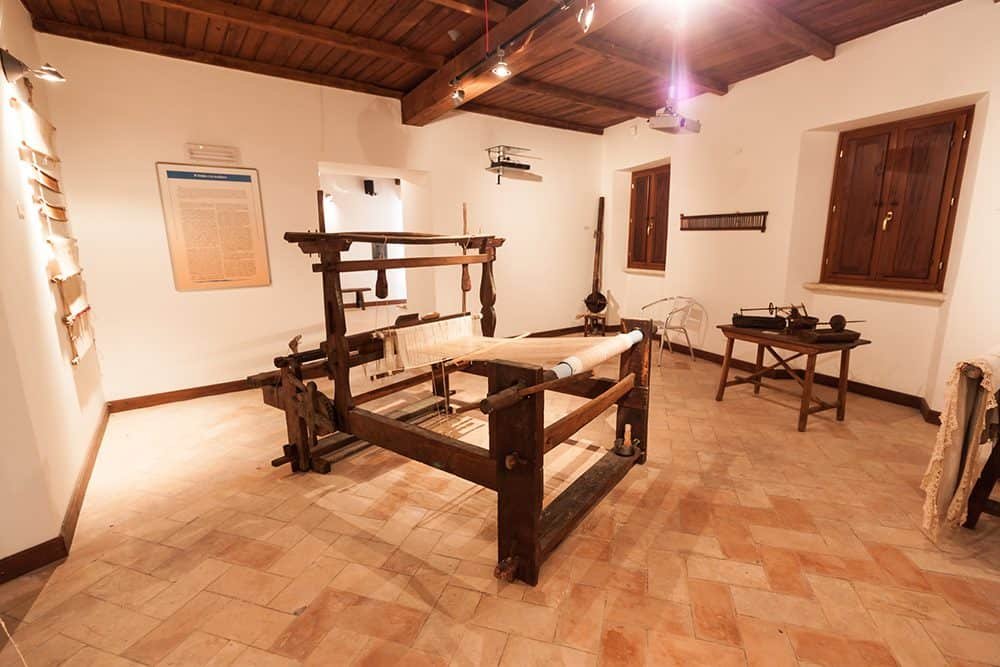
The showpiece of the collection is an 18th-century loom, restored and still working, accompanied by hand-woven fabrics datable to the 18th century. Seeing it assembled and able to work, and not reduced to scenery, changes the sense of the visit: a household loom is not a piece of furniture, it is a machine, with its own logic of heddles, pedals and beams that a weaver of the town knew by heart. Around the loom the collection lines up bobbins, reels, spindles and distaffs, that is, all the small parts that made the work possible. No diplomacy: if on your visit you get the chance to see the loom move, stay there and forget the rest, because that is the thing you'll remember in 10 years.

The anthropological aspects: hemp inside the home
The third area is the one that gives sense to the first two. Hemp was not a product to sell, or not only: it was the fabric of domestic life. Sheets, shirts, sacks for grain, saddlebags, tarps for the olive harvest, ropes for every use, the trousseau a girl brought as a dowry and that her mother had started weaving when she was eight years old. The rooms display domestic uses and peasant daily life, and reconstruct the settings with the five senses in mind: you look, you touch where it is allowed, you listen to the recorded voices of those who did that work. The oral testimonies collected by the founders are, in our judgment, the most fragile and most precious heritage of the museum, because those voices can no longer be recorded.
The uses of hemp beyond textiles
The rooms offer a range of information on the many uses of hemp, from the ancient use as a textile fiber to pharmaceutical, food, cosmetic and building uses, supported by multimedia installations. It is the part that brings the museum closer to the present: industrial hemp has returned to Italian fields after half a century of absence, the seeds are a food, the oils end up in cosmetics and the hemp hurd mixed with lime gives a light, breathable building material. The route crosses tradition, modernity and the avant-garde without making propaganda, and this balance in a museum dedicated to Cannabis sativa was not at all a given.
The section on the machines of Leonardo da Vinci
The Hemp Museum of Pisoniano hosts a section dedicated to the machines of Leonardo da Vinci, with a series of reproductions of the inventions of the Tuscan genius and a discussion of his relationship with textile hemp. The pairing surprises whoever enters without knowing, but it has a solid basis: Leonardo devoted dozens of sheets to the textile sector, and in the Codex Atlanticus are kept the drawings of the spinning machine with movable flyers, of the napping machines, of the spindles for twisting and of two versions of a mechanical loom. They were mechanization projects designed for the fiber cycle, that is, exactly the problem that in Pisoniano was solved by hand and with sheer back strength. Seeing the wooden models next to the grandparents' gramola produces a useful short circuit: the same operation, two centuries and a technological leap apart.
The multimedia installations and the accompanied visit
The visitor is taken into a route that is not merely descriptive but stimulating and interactive, built to make one grasp the differences and transformations that time has brought to the use of hemp. Films and reconstructions fill the gaps that the objects alone don't fill. But the added value, when it happens, is the person who accompanies you: in these town museums the visit is often guided by a young resident, and the difference between a label and a family story is all the difference in the world.
Italian hemp: an enormous story that ended in silence
To understand why a town of 700 souls felt the need for a museum like this, you need to know what hemp was in Italy. Not a folkloric detail: an economic power.
90,000 hectares and the fiber record
Between the 1930s and 1940s the Italian surface planted with hemp was around 90,000 hectares, and in 1937 national production was worth almost a sixth of the world's. Three fifths of the crop came from the provinces of Bologna and Ferrara, with peaks in Veneto and Piedmont, and one fifth from the Naples area. In 1938 the province of Ferrara alone produced 419,667 quintals, ahead of Bologna with 242,602 and Naples with 224,457. The Italian fiber was classified as the best in the world for toughness, fineness, softness and shine, and the areas of Frattamaggiore in the Naples area and Aversa in the Caserta area gave the finest product of all. In 1935 the State went as far as banning the export of the seed of Italian giant hemp and the import of foreign seed, to defend that quality from competition.
Why hemp disappeared from the fields
The postwar collapse has three intertwined causes. The first is technological: nylon and the other synthetic fibers, together with cheap imported cotton, made uneconomical a production cycle that required months of manual labor. The second is social: that work demanded hands that in the 1950s and 1960s were emigrating toward cities and factories. The third is regulatory and ideological, that is, the prohibitionist obsession that made every Cannabis a public order problem even when it was fiber varieties without effects. The result is that in 2003 hemp accounted for 0.3 percent of the total volume of natural fibers in the world, with China and South Korea leading production. A world record vanished in 30 years, without anyone devoting a line of news to it.
Hemp of the Aniene and its economy
In the valley of the Aniene and the Giovenzano hemp never had the industrial dimensions of Emilia, but it was one of the most important economic resources until the 20th century, and it was a wholly communal production: retting, breaking and weaving involved the entire community of the town, with a division of tasks between men and women, loans of tools and exchanged days of work. That economy has been lost, and the museum evokes it with minute detail. That is why the Hemp Museum of Pisoniano is a deposit of technical-cultural anthropology made with original finds from an era erased by the technological development of the second postwar period, and it has very few comparisons in Lazio.
Pisoniano around the Hemp Museum
The rioni and the shape of the town
Pisoniano is subdivided into rioni, and the names deserve to be read aloud: il borgo, il castellucciu, la scaramella, il caronaro, l'africa, il colle, la piaja, il ponte and il casale. Nine names for 700 inhabitants, which says how much belonging to the neighborhood counted in a town of this size. Strolling among the rioni after the visit to the museum is the natural complement of the route: the houses you see are those the museum rooms reconstruct.
The name of Pisoniano and its history
Historical sources trace the origin of the name to the Roman gens of the Pisones, and in particular to Lucius Calpurnius Piso, who would have had a villa here as his property. I use the conditional because it is a scholarly tradition based on onomastics, not a fact documented by an inscription. The place name has passed through a long chain of forms: Vicus Pisonis, Piscanum, Castrum Pisciani, Pisonianum, Pisiano, Pisciano and finally Pisoniano, the official form since 1872.
In the 12th century the place, with the name of Piscanum or Pisiano, appears as belonging to the chapter of the basilica of Sant'Eustachio in Rome, which granted it to members of the Colonna family. It remained with the Colonna, in the Genazzano branch, until at least the 15th century. The link with Sant'Eustachio is not random, and will come in useful further on: the saint who gives his name to the Roman chapter is the same one of the legend set on the mountain above here.
Churches, fountains and small signs
The religious heritage of the town includes the church of San Paolo Apostolo, the church of the Madonna della Neve and the one dedicated to Santa Vittoria, patron of the place. In 2009 the town installed the fountain of the acquaiola, which depicts a young woman with the water basin: an explicit homage to the women who carried water and who, in the same hours, spun hemp. Since 2005 Pisoniano has been twinned with Sannat, on the island of Gozo in Malta, which for a municipality of this size is a rather ambitious choice.
The festivals of Pisoniano
The calendar of festivals is dense. Corpus Domini is among the most deeply felt occasions, remembered above all for the infiorata that covers the streets of the village. On July 9 Santa Vittoria, patron of Pisoniano, is celebrated. August 5 is the day of the Madonna della Neve, with a reenactment in which, as the Madonna passes, artificial snow is fired from special cannons, and the real celebration always takes place the following Sunday. On the first Sunday of October the Madonna del Santo Rosario is celebrated. If you have to choose a date to combine museum and living town, aim for the first weekend of August: the snow of an early ferragosto is one of those popular inventions worth the trip.

A curiosity about the Hemp Museum of Pisoniano
The most beautiful curiosity of this museum is not an object: it is a word. The route carries the title from mannello to canovaccio, and that canovaccio is the linguistic proof that hemp clothed Italy for much longer than we remember. The dictionary records canovaccio as derived from canapa through the northern dialects, with the alternative of French canevas, and gives as its first meaning that of a rather coarse, rough hemp cloth for kitchen uses. The cloth we keep hanging beside the sink, today a cotton blend and made in Asia, we go on calling by the name of the fiber it no longer contains.
The game widens if you look at the map. Canepa in Liguria, Canepina in the Viterbo area, Canavaccio in the Marche: place names that all come from the same plant and signal where hemp was grown. And Macerata, Macereto and the dozens of places that contain that root allude to no stone: they allude to the retting pits, the water ditches where the mannelli fermented. An entire layer of Italian place names is an agricultural land register hidden in plain sight, and you get there starting from a town of 700 inhabitants in the Prenestini.
A polemical postscript: when hemp is talked about in Italy the conversation slides in three seconds to recreational use, and there is no way out. A museum that brings the discussion back to the fiber, the loom and the canovaccio performs a cultural service worth much more than a thousand TV debates.
One thing nobody tells you about the Hemp Museum of Pisoniano
No guide writes it to you, and yet it is the datum that determines the success of the day: here the museum and the town are not two distinct things. The municipal rooms that host the collection reconstruct the typical Pisoniano house, and the real houses are 30 meters away, in the same light conditions, with the same wall thicknesses and the same steep stairs. The visit really works only if after the last room you go down into the village and mentally redo the route outdoors. Whoever arrives, looks at the display cases and leaves in 20 minutes has seen half of what there was to see, and on top of that the less interesting half.
The second element nobody explains concerns the language of the objects. The museum displays the gramola, the distaff, the rocca, the bobbin, the reel, the hemp comb: names that a person born after 1970 has never had occasion to use. There is no way to understand a production cycle without possessing the lexicon, and that is why the accompanied visit changes everything. If you book, ask explicitly if someone will accompany you: the answer determines the quality of what you'll take home.
Third practical and little-known datum: museums of this size don't have staff on continuous hours. That means a phone call or an email a few days ahead is not a bureaucratic formality, it is the condition for getting in. Whoever arrives unannounced on a winter Saturday afternoon finds a closed door and no grievance to claim.
The advice I give you for visiting the Hemp Museum of Pisoniano
The advice is to treat it as the second stop of a day and not the first. The reason is technical: the museum visit lasts between 40 minutes and an hour and a half depending on how much you let yourself be told, which on its own doesn't justify a trip of 57 kilometers. But if it is fitted into an itinerary of the Prenestini it becomes the piece that gives sense to all the others. The best pairing is Palestrina in the morning, with the sanctuary of Fortuna Primigenia and the archaeological museum, lunch in town, Pisoniano in the afternoon. A wilder alternative: Pisoniano first, then the climb to the sanctuary of the Mentorella, which can also be reached on foot from the town.
Second piece of advice, on how to book. Write indicating how many of you there are and ask for availability on two or three alternative dates: in museums run with volunteers and municipal staff, flexibility on the date is worth more than any insistence on the time. If you are a school group or an association, say so right away, because the visit is structured differently and it is worth asking for a workshop.
Third, on behavior in the rooms. Touching is not forbidden everywhere, but it is not free either: some fibers and some 18th-century fabrics are as fragile as they look. Ask first. And bring children, if you have them: this is one of the few museums where an eight-year-old understands everything, because the objects have an evident function and the story is a sequence of actions. One last thing: wear closed shoes. The village is uphill, the paving is uneven and flip-flops here are a terrible idea.
Another well-known fact, yet rarely cited
Everyone knows that hemp was the fiber of the poor. What is rarely cited is that Italian hemp was also the best in the world, and that this record had a name, an address and figures. The historical sources record its toughness, fineness, softness and shine as superior to any competitor, and in 1935 the legislator went as far as banning the export of the seed of Italian giant hemp and the import of foreign seed precisely so as not to let the national variety degrade. It was not a rustic fallback fiber: it was a product of excellence that the European naval and textile industries competed for.
The second rarely cited element concerns women. The entire central segment of the cycle, the most delicate and most qualifying one, was women's work: combing done seated with the comb between the knees, spinning with distaff and spindle, weaving on the household loom. These were technical skills handed down from mother to daughter, with a hierarchy of skill recognized by the town, and they produced the most important property asset a peasant family could accumulate, namely the trousseau. When it is said that the museum tells of a vanished civilization, this is also said: a female professional knowledge has vanished that nobody ever called a profession.
The third fact is that this story closed in a handful of years. Between the end of the 1940s and the mid-1960s Italian hemp went from almost a sixth of world production to a statistical remainder. No traumatic event, no symbolic date: only nylon, cheap cotton and the northern factories absorbing labor. Material civilizations don't end with a twist, they end because one day nobody repeats that gesture.
The right photo to take at the Hemp Museum of Pisoniano
The photograph everyone tries to take is the frontal loom, and it is the wrong photograph. A loom shot head-on becomes an unreadable grid of threads and wood: you can't understand the depth, you can't understand the mechanism and the photo dies. Stand instead at three quarters, crouch to the height of the beam and use as a guide line the warp threads that run toward the back. With side window light, which in these rooms is the dominant one, the threads light up one by one and the weave becomes a drawing. It is the same rule that holds for spiral staircases: never frontal, always oblique.
The second image to take home is a close-up detail of combed fiber. Worked hemp has a vegetal shine that metal and cotton don't have, a cool reflection that in raking light renders beautifully in macro. Rest the phone on a shelf to hold it still, focus at a few centimeters and don't use the flash: direct light flattens the fiber and gives you back a gray mass with no information.
The third photo you take outside. From the windows of the rooms and from the high points of the village the panorama opens onto the Prenestini, and in low-light hours the sequence of ridges separates into overlapping planes of different color. Close the frame with a piece of wall or a window jamb in the foreground, so that the depth reads. Final advice, valid for the whole museum: ask first if photographs are allowed and if they are allowed without flash. In small museums the courtesy of a question opens doors the regulations don't provide.
Some important events that happened here in history
The first event that counts is medieval and concerns ownership. In the 12th century the castrum we now call Pisoniano appears among the possessions of the chapter of the basilica of Sant'Eustachio in Rome, which grants it to members of the Colonna family. It is not a bureaucratic step: it means the town enters the orbit of one of the most powerful baronies in Lazio, the one that controlled the Prenestine belt from the castle of Genazzano, and it stays there until at least the 15th century. The affairs of Pisoniano, for 300 years, are the affairs of the Colonna, with all that entails in terms of wars with the papacy, sieges and reconstructions.
The second event is the long stratification of the name, which is a historical event even if it has no date: Vicus Pisonis, Piscanum, Castrum Pisciani, Pisonianum, Pisiano, Pisciano, Pisoniano. Each form corresponds to a different administrative and linguistic phase, and the official sanction of the last comes in 1872, when the town takes its current name. Behind that 19th-century choice is the desire, typical of post-unification Italy, to claim a Roman ancestry.
The third event dates from 1997 and directly concerns this story: the temporary exhibition set up by the Bernardini brothers with the hemp tools collected in the town's houses drew an audience large enough to convince everyone that a permanent venue was needed. From there came the museum, the recognition as a place of culture and the acquisition of the collection by the Municipality. On the scale of a town of 700 inhabitants, the birth of a single-theme museum recognized at the national level is the event of the century.
The fourth I write because it belongs to the landscape here more than to the town: on October 29, 1978, for his first trip as pontiff outside Rome, John Paul II climbed to the sanctuary of the Mentorella, on the mountain that closes the horizon of Pisoniano, before about 20,000 people. The path that leads up there starts from the center of the town, and since then it has carried his name.
Who has passed by the Hemp Museum of Pisoniano
The real figures of this story are not princes but artisans: Settimio and Domenico Bernardini, twins from Pisoniano, passionate researchers and anthropologists in the field without holding the title. They spent 20 years knocking on the doors of their fellow townspeople to be given objects that others considered scrap, cataloged them, put them back in working order and in 1997 displayed them in the family home. Without them this collection would have ended up in the dumpsters between 1980 and 2000, as happened in hundreds of Italian towns. If the museum exists, the credit is documented and has two names.
In the short radius, the historical figure who really passed through these parts is Karol Wojtyla. The path that climbs from the center of Pisoniano to the sanctuary of the Mentorella, about nine kilometers with 718 meters of total elevation gain, two hours and 20 minutes up and an hour and 50 minutes down at hiking difficulty, is named after him because the Mentorella was his prayer refuge already as a cardinal. As pope he returned several times, and the dates are recorded: October 29, 1978, March 31, 1979, December 28, 1987, April 17, 1990, December 27, 1991, December 30, 1996, October 28, 1997, February 3, 2000.
On the same mountain tradition makes even more ancient people pass. The sanctuary, at a little over 1,000 meters, stands according to legend at the spot of the conversion of Saint Eustace, the Roman tribune martyred under Hadrian, and the cave under the church is said to have hosted Benedict of Nursia for two years before he went down to Subiaco. These are traditions, and as such must be taken. Documented, instead, is the passage of the Jesuit Athanasius Kircher, the German scholar of the Roman collections, who in 1661 rediscovered the sanctuary in ruins and directed its restoration, and that of the Polish Resurrectionists, to whom Pius IX gave the place in 1857 and who in 1883 bought it back for 8,500 lire. The Polish presence on the mountain explains, 100 years later, why a cardinal from Krakow would climb up there to pray.
The Hemp Museum of Pisoniano with children
It works, and works better than many prestigious museums of the capital. The reason is that every displayed object answers the question what is it for, and the answer is visible: this breaks, this combs, this winds, this weaves. A six-year-old doesn't understand a Latin inscription, but understands perfectly well that a thread is drawn from a dry stalk. The practical advice is to prepare the visit with a single sentence, before entering: today we see how a T-shirt was made when there were no shops. From there on they do everything on their own.
If you travel with small children, allow for the fact that the village is uphill and that the stroller is almost unusable in the alleys: better a baby carrier or a child-carrying backpack. Inside the museum the levels are connected by stairs, so there too the stroller becomes a nuisance.
Accessibility, services and practical rules
The museum occupies a historic small palazzo spread over several levels in a mountain village, and this poses objective limits for those with mobility difficulties: the internal stairs exist and cannot be bypassed at every point. Whoever moves in a wheelchair or has walking problems should report it at the booking stage, because the availability of a reduced route on the accessible floor must be agreed case by case. The same courtesy applies for essential services: restrooms, cloakroom and bag storage in a structure of this size are not guaranteed, and it's best to arrive light.
How long the visit to the Hemp Museum of Pisoniano lasts
With an accompanied visit and a few questions you easily exceed 60 minutes, and with a curious group you reach an hour and a half. On your own, walking and reading, 40 minutes are enough. Add half an hour for the village and an hour if you decide to have lunch in town. To organize a full day count Pisoniano as a block of two and a half hours including parking, and fill the rest with a second destination 20 minutes away by car.
What to see around the Hemp Museum of Pisoniano
This part of Lazio has a density of serious things that nobody in Rome suspects. A few kilometers away is Palestrina, with the sanctuary of Fortuna Primigenia and the National Archaeological Museum that holds the Nile mosaic, and in its territory the villa of Hadrian. Above the town you reach Castel San Pietro Romano, the village of the Colonna fortress with a view that covers half of Lazio.
Toward the south are Genazzano, main fief of the Colonna and seat of the sanctuary of the Madonna del Buon Consiglio, with the park of the Selva, and Olevano Romano, the town that the German painters of the 1800s painted more than any other Italian place after Rome. Whoever has a geological passion should find the time for the geopaleontological museum of Rocca di Cave, which displays the fossil coral reef of the Prenestini.
Toward the north the valley leads to Tivoli, with Villa d'Este, Hadrian's Villa and the Park of Villa Gregoriana, and farther up toward the upper Aniene valley you meet Anticoli Corrado, the town of models and painters, Arsoli with the Massimo castle, Subiaco with the Benedictine monasteries, which remains the strongest destination of the whole valley.
Quick questions about the Hemp Museum of Pisoniano
Where exactly is the Hemp Museum of Pisoniano?
At Via Roma 30, in Pisoniano (RM), postal code 00020, in a small palazzo on the main street of the town, in the Prenestini Mountains about 57 kilometers from Rome.
Can the Hemp Museum of Pisoniano be visited freely or do you need to book?
You need to book. Free openings, when planned, concern the weekends of the summer season. For the rest of the year you get in on request agreed in advance.
How do you book a visit to the Hemp Museum of Pisoniano?
By writing to museocanapapisoniano@libero.it or by contacting the phone number given on the pages of the Municipality of Pisoniano. Better a few days in advance and proposing two or three alternative dates.
How much is the ticket for the Hemp Museum of Pisoniano?
Entry is a few euros, with reduced rates for groups and school classes. The exact amount must be confirmed at the time of booking.
How long does the visit to the Hemp Museum of Pisoniano last?
From 40 minutes on your own to an hour and a half with an accompanied visit and questions. Add half an hour for the village.
When was the Hemp Museum of Pisoniano born?
In 1997, from the exhibition set up by the Bernardini brothers with the original hemp-processing tools collected in the town. The success of that temporary exhibition led to the permanent venue.
Who runs the Hemp Museum of Pisoniano?
The collection, born as the private collection of the brothers Settimio and Domenico Bernardini, is today attributed to the Municipality of Pisoniano and is registered among the places of culture.
What can you see at the Hemp Museum of Pisoniano?
The complete cycle of textile hemp: the plant and its cultivation, retting, breaking, combing, spinning and weaving, with looms, gramole, combs, reels, spindles, distaffs and bobbins, as well as reconstructions of the peasant house and multimedia installations.
Is it true that the Hemp Museum of Pisoniano has a section on Leonardo da Vinci?
Yes. A section displays reproductions of Leonardo's inventions and illustrates his relationship with textile hemp. In his codices Leonardo designed spinning machines, napping machines and mechanical looms.
Is the Hemp Museum of Pisoniano suitable for children?
Very. The objects have an immediately understandable function and the story is a sequence of actions. Just watch out for the internal stairs and the village's climbs, hardly compatible with a stroller.
Is the Hemp Museum of Pisoniano accessible by wheelchair?
The route develops over several levels connected by stairs in a historic building. Whoever has mobility difficulties must report it at the booking stage to agree on a reduced route.
Can you take photographs at the Hemp Museum of Pisoniano?
It's best to ask at the entrance and in any case avoid flash on the ancient fabrics, which are sensitive to direct light.
Can you touch the displayed objects?
Some yes, others no. The 18th-century fibers and fabrics are fragile: ask before reaching out a hand.
How do you get to Pisoniano by car?
By the A24 motorway toward L'Aquila, exiting in the area of Castel Madama or Vicovaro and going up the provincial road to San Vito Romano and Pisoniano. Last stretch narrow and winding, free parking outside the historic center.
Can you get to the Hemp Museum of Pisoniano by public transport?
It is possible with the regional intercity service, but the runs are few and calibrated on school hours, with drastic reductions on weekends. Check the hours of the precise day and plan the return first.
How far is Pisoniano from Rome?
About 57 kilometers, which by car means between an hour and an hour and a quarter in normal traffic conditions.
What is the difference between the Hemp Museum of Pisoniano and the other Italian hemp museums?
Pisoniano is a single-theme museum on peasant civilization built on original finds collected in a single town, with the full cycle documented tool by tool. Other venues, in Umbria and Emilia, tell the story of the same fiber with different educational layouts and workshops.
Why a hemp museum in Pisoniano in particular?
Because in the valley of the Aniene and the Giovenzano hemp was one of the main economic resources until the 1900s, and Pisoniano still preserved, in the 1990s, the tools and the oral memory of that work.
What is hemp retting?
The phase in which the bundles of stalks were immersed in water pits for days, so that fermentation detached the woody part from the fiber. It was the most strenuous and smelly step of the whole cycle.
What is a mannello?
The bundle of freshly pulled hemp plants, tied to be carried to retting. The museum's route is titled precisely from mannello to canovaccio.
Why is the kitchen cloth called canovaccio?
Because the term derives from canapa through the northern dialects, or from French canevas, and originally indicated a coarse, rough hemp cloth for household use.
What festivals are celebrated in Pisoniano?
Corpus Domini with the infiorata, Santa Vittoria the patron on July 9, the Madonna della Neve on August 5 with artificial snow fired as the statue passes and celebrations the following Sunday, the Madonna del Santo Rosario on the first Sunday of October.
What can be combined with a visit to the Hemp Museum of Pisoniano?
Palestrina with the sanctuary of Fortuna Primigenia and the archaeological museum, Castel San Pietro Romano, Genazzano, Olevano Romano, or the climb to the sanctuary of the Mentorella along the path that starts from the town.
Can you walk from Pisoniano to the Mentorella?
Yes, along the path named after Karol Wojtyla: about nine kilometers in total with 718 meters of elevation gain, two hours and 20 minutes up and an hour and 50 minutes on the way back, hiking difficulty. You need trekking shoes and water.
What is the best period to visit the Hemp Museum of Pisoniano?
From May to October, with September as the ideal month for light and temperatures. In winter you get in on request and it's best to choose a clear day.
Does the Hemp Museum of Pisoniano have anything to do with recreational cannabis?
No. The museum tells of textile hemp, that is, the fiber from which cloths, ropes and trousseaus were made, and documents its agricultural and artisan cycle together with the food, cosmetic and building uses.
Are there guided visits at the Hemp Museum of Pisoniano?
Often yes, entrusted to local staff, and it's the mode I recommend: the difference between reading the labels and being told the cycle by someone who knows those houses is enormous. Ask when you book.
One last recommendation, the only one that matters. Don't go to Pisoniano to tick a museum off a list: go to understand how an entire economy worked before it vanished, and give yourself time to listen. In a town of 700 inhabitants someone decided that those tools were worth the effort of being saved. The least we can do, climbing all the way up there, is to look at them with the same seriousness with which they were collected.
Article written by the editorial team of TourLeaderPro, contact them for Private/Corporate/V.I.P. Tours and Experiences.
Planning a trip to Rome? The English guides for visiting the city are on ItalyPlanner.com.