Teatro Argentina
In short. The Teatro Argentina is at Largo di Torre Argentina 52, in Rome, and it's open and fully active: it's run by the Fondazione Teatro di Roma, which uses it as its main hall.
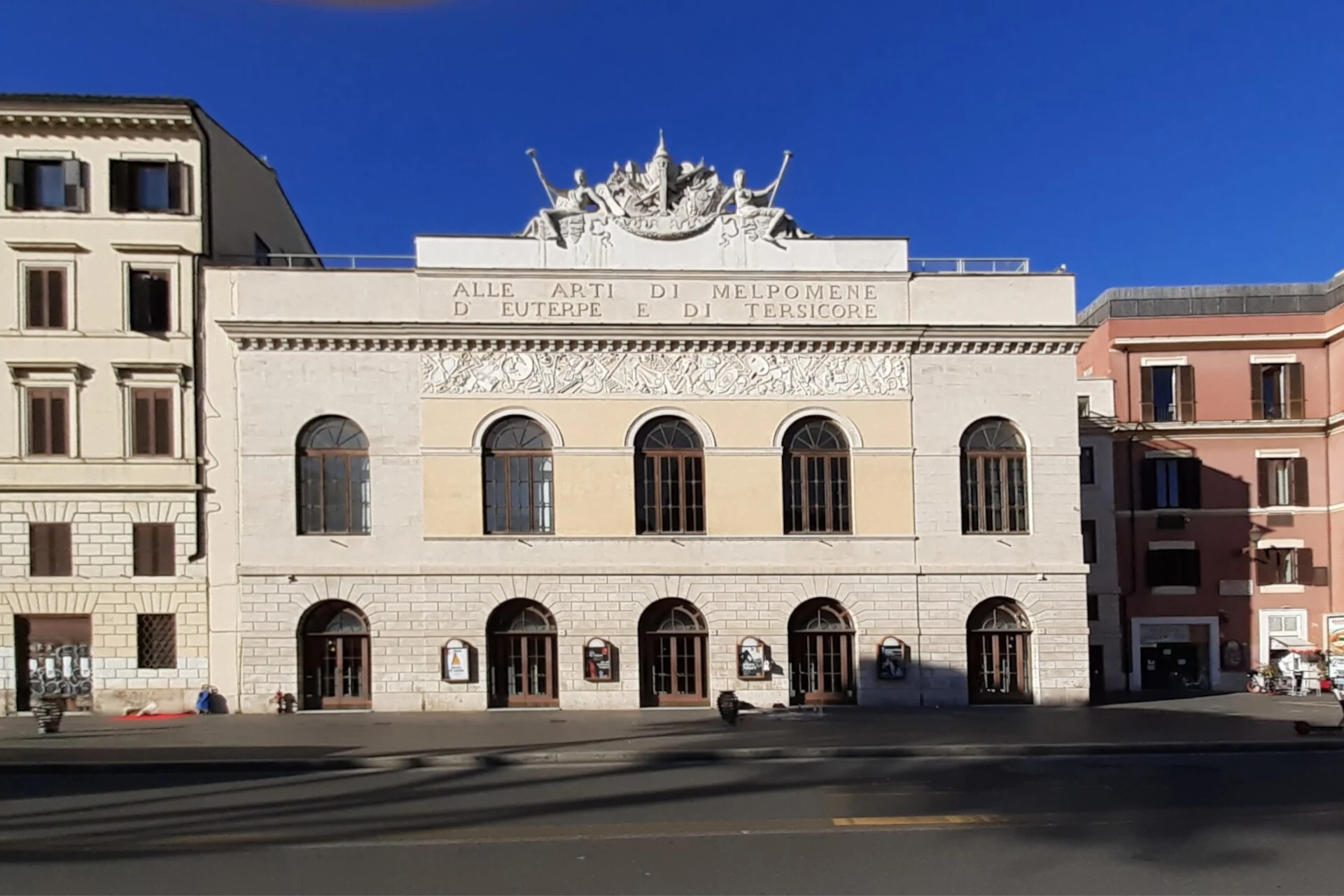
The Teatro Argentina is at Largo di Torre Argentina 52, in Rome, and it's open and fully active: it's run by the Fondazione Teatro di Roma, which uses it as its main hall. Single tickets cost from 26 to 44 euros at full price, with reductions down to 20, and are bought at the theater's box office or online on the VivaTicket circuit given by the official website. The 2026-2027 season opens on October 8.
The theater has two draws that everyone knows. The first is musical: here, on February 20, 1816, Gioachino Rossini's The Barber of Seville was staged for the first time, and the evening was a disaster. The second is archeological: the hall rises on the area that in Roman times belonged to Pompey's great complex, a few meters from the curia where Julius Caesar was killed in 44 BC.
The practical information on prices, box office hours, guided tours and program comes from the official pages of the Teatro di Roma and of the Capitoline Superintendency consulted on September 28, 2026. The theater changes hours from one season to the next, prices can vary for individual shows and the tours have few dates: before you set out, check the show's page or phone the box office at the official numbers given further on.
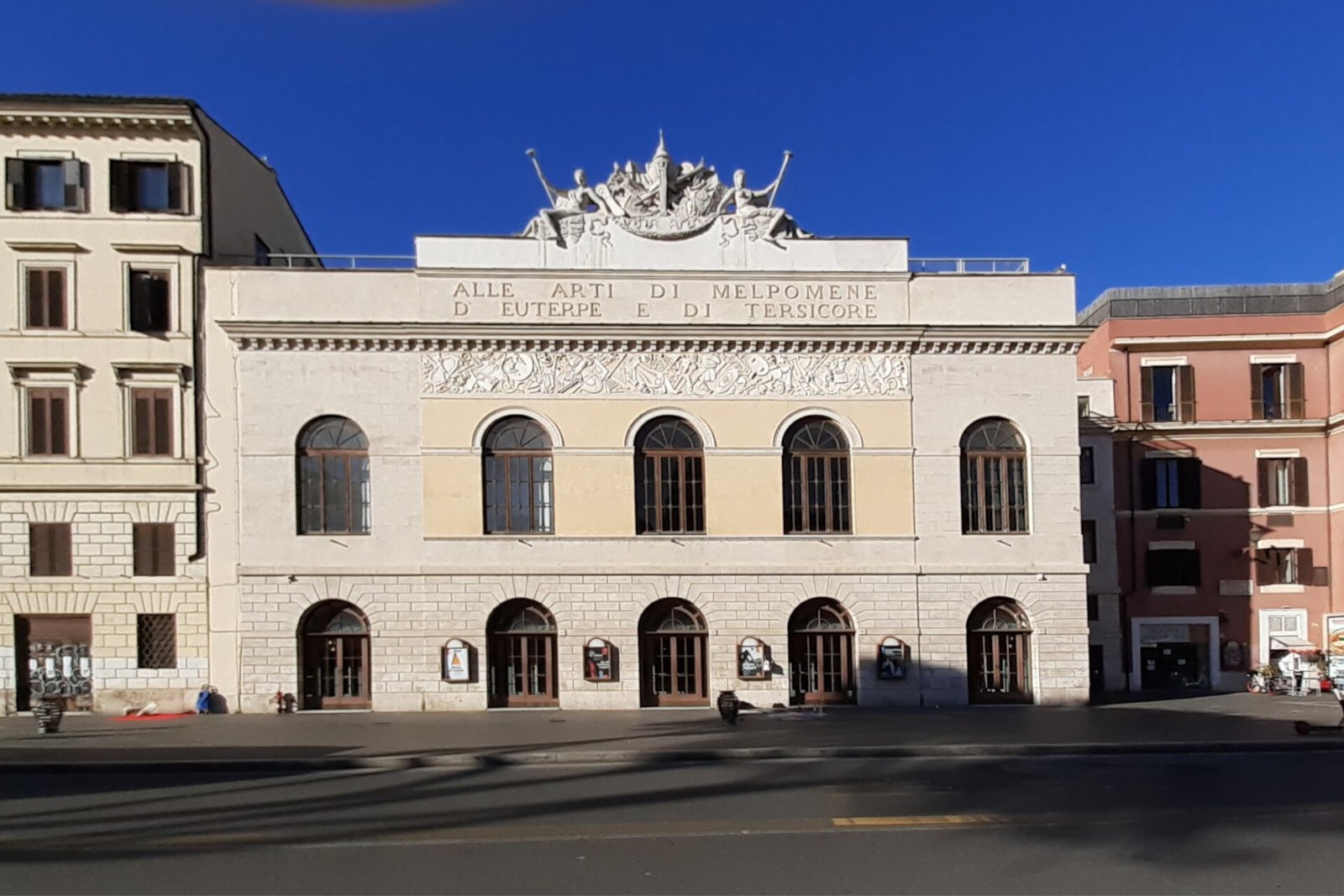
Where it is and what you see
The theater closes off the western side of Largo di Torre Argentina, the sunken square where the republican temples of the Sacred Area of the Campus Martius emerge. In front of the entrance, beyond the railing, lives the most photographed cat colony in the city, that of the Largo Argentina Cat Sanctuary. If you arrive by tram or on foot from Corso Vittorio you find the facade in front of you without needing to look for it.
The facade is the last thing to judge the theater by. It's a neoclassical front from 1826, signed by the architect Pietro Holl, so sober it looks like an office building. Many tourists walk past it 10 times without realizing that behind that wall is one of the best-preserved 18th-century halls in Italy. It's a small urban deception, typical of the Rome that hides its interiors behind fronts redone in the 19th century.
Inside, the hall is horseshoe-shaped, following the design of Girolamo Theodoli, with six tiers of boxes rising toward a decorated green ceiling and a large central chandelier shaped like a candelabrum. The red of the upholstery and the gilding date from the late 20th-century restoration. The Teatro di Roma states 354 seats in the orchestra and 366 spread across the boxes, while other sources give different numbers.
The foyer and the Sala Squarzina complete the spaces open to the public on show evenings. In the attic, above the hall, there is also a small museum run by the Capitoline Superintendency, created in 1973 from an idea by Cecilia Pericoli Ridolfini, with fragments of the 18th-century ceiling, wooden stage machines, costumes and portraits of performers. It can be visited only by reservation, and I discuss it in the chapter on tours.
What the evening audience doesn't see are the stage from behind, the dressing rooms and the archeological area under the building. These spaces enter only the guided tours. Behind the theater, at Via del Sudario 44, is instead the Burcardo palazzetto, with the medieval tower that gave its name to the whole area: the remains are visible in the courtyard, and the building houses the SIAE's theatrical collections.
Who runs it today and what state it is in
The theater is open and programs regularly. It belongs to Roma Capitale and is the main seat of the Fondazione Teatro di Roma, the body that also runs the Teatro Valle, the Teatro India on the Lungotevere and the Teatro Torlonia inside Villa Torlonia. Four different halls, with a single program and one central box office, which is right here at the Argentina.
According to the official contacts page, the Foundation is led by president Francesco Siciliano, general director Maurizio Roi and artistic director Luca De Fusco, who also directs two productions of the current season. The legal form of a foundation is recent: the sources date it to 2022, with a new board of directors installed the following year. Before, it was a public theater body with a different statute.
The hall's state of preservation is good. The last major intervention documented by the Teatro di Roma is the restoration overseen by the architect Paolo Portoghesi, which made the stage usable again, brought back the original red of the upholstery in place of the gold yellow of the 1970s and rebuilt the box valances with the festoon outline of the old drawings.
A note on the city context. In recent years the Foundation's programming has been the subject of heated political discussions, especially over appointments. For someone buying a ticket this matters little: the hall works, the box office answers, the shows go on. I mention it because in online reviews you sometimes find controversies that concern the body and not the theater as a place to visit.
A practical effect of the single management is that at the Argentina's counter you can also buy tickets for the Valle, the India and the Torlonia. Anyone passing through the center for an evening here can therefore book a show in the other halls at the same time, without crossing the city. For groups and schools the channel remains the box office, with the dedicated rates published by the theater.
A curiosity about the Teatro Argentina
The name has nothing to do with the South American country. It comes from Strasbourg. At the end of the 15th century the prelate Johannes Burckardt, papal master of ceremonies under Alexander VI Borgia, had a house built in this area. He was born in Strasbourg, which in Latin was called Argentoratum, and signed himself episcopus argentinensis. His Latin title, that is, contained his city of origin.
The Superintendency recounts that Burckardt had the word ARGENTINA carved on all four sides of the medieval tower incorporated into his house. From there the name passed to the tower, from the tower to the square, from the square to the theater built two centuries later. Today Romans say just Argentina, as if it were a neighborhood, and almost nobody knows it carries an Alsatian episcopal signature.
The land on which Burckardt built was not his in full ownership. The Superintendency specifies that he had it in emphyteusis from the monks of the abbey of Farfa, who owned buildings and land in Rome in this part of the Campus Martius. It's an administrative detail, but it comes in handy later, when you go down into the archeological area under the theater.
The Burcardo palazzetto, on Via del Sudario, is still standing, even if the late 20th-century restorations changed it quite a bit. Today it houses the museum of the SIAE's theatrical collections. The educational visits indicated by the Superintendency are by mandatory reservation, for groups of up to 20 people, lasting an hour and a half. The theater ticket and the Burcardo one have nothing in common.
There is an amusing side effect of this story of names. Anyone looking for the theater on the maps finds Largo di Torre Argentina, Via di Torre Argentina, the Argentina tram stop, and ends up believing the tower is one of the ruins in the Sacred Area. It isn't. The real tower is behind, inside a private courtyard, and can't be seen from the square. The name has traveled, the building has stayed put.
Box office, hours and prices
The box office is in the same building, at Largo di Torre Argentina 52, and sells tickets for all the Foundation's halls. The official phone is 06 684000311 or 06 684000314, the email is biglietteria@teatrodiroma.net. You can also pay by card, because the counter has a POS. After issue, tickets can't be exchanged or canceled, and reserved ones must be picked up by one hour before the show.
Where you really buy: at the counter, by phone, or online from the channel indicated by the official website of the Teatro di Roma, which points to the VivaTicket circuit. If you prefer to go straight through the theater's shop on that circuit, the online sale is here: Teatro di Roma tickets on VivaTicket. Other resellers are not indicated by the operator.
On the counter hours the theater's sources don't agree. The box office page gives opening Monday to Saturday from 11 to 19 and on Sunday three hours before the show starts. The same site's frequently asked questions instead speak of Monday to Friday, from 11 to 19, plus the three hours before each performance. If you want to stop by on a Saturday morning, call first.
The price list for single tickets published by the Teatro di Roma for the Argentina has three bands. Orchestra seat: 44 euros full price, 35 reduced. Orchestra boxes, first and second tier: 35 euros full price, 30 reduced. Boxes of the third and fourth tier: 26 euros full price, 20 reduced. The reduced rate goes to those under 35 and over 65, teachers, members of affiliated associations and cral and people with disabilities.
Lower rates exist for specific categories, always excluding the last three performances. Students of affiliated theater schools and academies pay 20 euros for an orchestra seat, 15 in the lower boxes, 13 in the upper ones. School groups 17, 15 and 12. Performing arts workers 15 euros. The operator doesn't publish presale fees, so any difference between the counter and online purchase should be asked of the box office.
For the 2026-2027 season the fixed-seat subscription includes seven shows and costs 189 euros for an orchestra seat, 168 in the orchestra boxes, first and second tier, 133 in the gallery of the third and fourth tier, at full price. The version with two additional titles of your choice goes up to 219, 198 and 163 euros. The TdR Card costs 145 euros and holds 12 credits that can also be used by several spectators.
Start times change according to the day of the week and are given on each show's page, with the premieres often starting at a different time from the repeat performances. Don't trust the time you remember from the previous season. The rules for latecomers don't appear on the box office page, and in a theater for plays you go in when the house staff allows it, often only at the intermission.
One thing nobody tells you about the Teatro Argentina
Under the theater there is an archeological area, and it isn't the one you expect. Everyone thinks right away of Caesar and Pompey's curia. The guided tours of the Teatro di Roma, instead, describe an area excavated between the theater and the curia where you can also read the remains of the Benedictine refectory tied to the abbey of Farfa. Monastic Middle Ages, in between the republican era and the 18th century of the dukes.
This brings us back to Burckardt and his land in emphyteusis. The monks of Farfa had a stable presence here, with their own buildings, and the theater was built over layers that tell the whole history of the Campus Martius: republican temples, Pompey's complex, a monastic settlement, Renaissance houses, a noble palace, a performance hall. Few buildings in Rome line up so many eras vertically.
The second detail almost nobody knows is the museum in the attic. The Teatro Argentina has above the hall one of the smallest museums of the Capitoline system, conceived in the 1970s to tell of the transformations of the area, the structure of the hall and theatrical life. There are fragments of the 18th-century ceiling with putti and garlands, preparatory drawings by Cesare Fracassini, a caricature by Pier Leone Ghezzi.
The collection is completed by wooden stage machines, 1926 reliefs by Biagini, costumes from productions like I masnadieri and portraits of performers, among them the dancer Fanny Elssler. It isn't a half-day museum. It's a one-hour room for those who love theaters. In our judgment this attic is worth more than any panel on the Barber you might find in the foyer.
The show tours and the museum in the attic
The Teatro di Roma organizes guided tours led by actresses and actors of the company, titled Ve lo faccio vedere io ora il teatro! and curated by Claudio Longhi. They last an hour, begin at 11 and take up to 35 people. The route takes in the foyer, the Sala Squarzina with a reading of Roman-dialect sonnets, the hall with its six tiers of boxes, the green ceiling, the chandelier and the archeological area.
The published rates are 18 euros full price, 15 for groups, 8 for schools, and a 30-euro TdR Card valid for three tours. You book online on the VivaTicket circuit from the theater's website, or, for groups who want a private tour, by writing to visiteguidate@teatrodiroma.net. The operator doesn't publish a minimum number of participants or the availability of tours in foreign languages.
The weak point is the calendar. At the time of consultation the only published date is Sunday, December 13, 2026, at 11. In 2025, for example, the tours were concentrated on three Saturdays in May, and places are few. If you're interested, check the tours page every two or three weeks, because new dates come out without big announcements.
The attic museum is another matter and has a different operator, the Capitoline Superintendency. According to its page, groups of up to 25 people must book at the number 060608, active from 9 to 19, and individual visitors also enter only by reservation, according to a specific calendar. The rate for non-residents of Rome is 9.50 euros full price and 5 euros reduced from 6 to 25 years old.
For Rome residents with the MIC card the museum entry is free, as in the other civic museums, and under five you don't pay. For information on the museum the Superintendency gives a city email address. It's worth asking at 060608 if there is a date that combines the museum and the visit to the hall, because separately they give less.
My advice for visiting the Teatro Argentina
Buy a second-tier box, not the orchestra seat. It's a position against the grain, but the numbers support it: the orchestra seat costs 44 euros, the lower box 35, and from the second tier you see the stage and the hall together. In the orchestra you look at the stage and nothing else. In a theater like this, the hall is half the show, and giving it up to sit a few meters closer to the actors is a waste.
The third and fourth tiers cost even less, 26 euros full price and 20 reduced, but in a horseshoe theater the high side boxes have a partial view of the stage. For a spoken-word show it's fine, for dance less so. When you buy, ask the box office if the box is central or lateral, and how many seats are in front of you.
Arrive half an hour early. Not for the coat check, but to look at the hall as it fills, from the corridor of the boxes or from the back of the orchestra, with the chandelier lit and the curtain closed. It's the moment when the Argentina most resembles the 18th-century theater, when the audience also came to be seen and the hall counted as much as the stage.
If you're under 35 use the reduced rate, which at the Teatro di Roma is not a marginal concession: it applies in all bands and is worth up to 9 euros on the orchestra seat. Bring an ID. The same goes for those over 65. If you come as a group of at least 10 people you can ask for the group conditions, which the theater also provides for subscriptions.
One last thing, valid for any historic hall in the center: leaving at the end of the show is slow, and the square in the evening is full of traffic and public transit. If you have a train or an appointment, take a seat near the exit. After 22 the largo empties quickly and finding a taxi on the spot isn't a given.
On dress the theater doesn't publish rules, and in Rome the audience for plays dresses in very varied ways. At premieres you'll see jackets and elegant dresses, at afternoon repeats jeans and sweaters. The practical advice is another: bring a light layer, because the high boxes are warm in winter and the orchestra near the doors catches drafts at every intermission.
What the 2026-2027 program announces
In the 2026-2027 season the program announces for the Argentina an opening with dance: What the Body Does Not Remember by Wim Vandekeybus and Ultima Vez on October 8 and 9, then Four Seasons Changed, to music by Max Richter and with Michiel Vandelvende, on October 11. From October 15 to 18 Romeo Castellucci arrives with the Societas and his Faust.
Repertory plays fill the autumn and winter. The Teatro di Roma announces Shakespeare's Othello directed by Luca De Fusco from November 4 to 29, Peccato che fosse una sgualdrina by John Ford, again with De Fusco, from December 2 to 13, and La pazzia di Re Giorgio by Alan Bennett directed by Massimo Popolizio from January 9 to 31.
February and March bring Una delle ultime sere di Carnovale by Goldoni, directed by Valerio Binasco, from February 2 to 14, Non posso narrare la mia vita by Roberto Andò from February 18 to 28, Hamlet directed by Leonardo Lidi from March 2 to 14 and Lo Zar by and with Stefano Massini from March 16 to 25. Then Chekhov's Platonov directed by Peter Stein, from March 31 to April 11.
In spring the program announces L'angelo del focolare by Emma Dante from April 14 to 25, Ezra in gabbia by Leonardo Petrillo from April 28 to 30 and two dance titles for Capitale Danza 2027: Portrait by Mehdi Kerkouche on May 8 and 9, Momo by Ohad Naharin on May 15 and 16. Dates and titles can change, and the individual show's page is authoritative.
The Argentina's program is only one part of the Foundation's season. The more experimental shows are staged at the Teatro India, the more intimate ones at the Torlonia, and the return of the Valle adds a hall devoted to contemporary playwriting. If a title interests you and you don't find it here, look for it in the Teatro di Roma's general calendar, which puts all the halls together on a single page.
Another well-known fact, yet rarely cited
That Caesar was killed at Largo Argentina is known by anyone who has taken a school trip to Rome. What is rarely cited is the precise context, and it's best to separate the levels. Ancient documents say Caesar was killed on the Ides of March in 44 BC during a session of the Senate meeting in Pompey's curia, a building that was part of the great complex built by Pompey the Great.
Archeology says the remains attributed to that curia are in the Sacred Area, on the side toward the theater, behind the temples. Pompey's complex included the masonry theater, which lay farther west, toward Campo de' Fiori, and a long portico that reached as far as here. The Teatro Argentina, therefore, rises on the area of that complex, not on top of the ancient theater.
Legend, then, does the rest. You hear that Caesar died under the orchestra, or on the stage, or at a precise point marked somewhere. None of these versions has a basis. The exact place of the killing is marked by nothing, and the guides who point to a precise stone are telling a convenient story. The theater's own page simplifies, speaking generically of Pompey's Theater.
A view against the grain: the phrase here Caesar was killed is the most overused in Rome and does more harm than good. It makes you look at the largo as the scene of a crime, and not as what it is, a piece of city where you can read more than two millennia of construction sites one on top of the other, from the republican temple to the 18th-century hall.
To understand the difference between Pompey's curia and the Senate's official one it's worth seeing the Curia Iulia in the Forum, the seat that Caesar himself had rebuilt and that was under construction in precisely the years of his death. The Senate met elsewhere because the curia in the Forum wasn't available, and this explains why the killing took place in the Campus Martius.
The right photo to take at the Teatro Argentina
The photo that counts is taken inside, from the center of a second- or third-tier box, before the lights go down. Frame vertically the curve of the boxes on the other side, with the chandelier above and a piece of curtain below. Horizontally the horseshoe hall flattens and loses the depth of the six tiers. During the show, obviously, the phone stays off.
The operator doesn't publish, on the box office page, a detailed rule on photographs in the hall with the lights on. Ask the house staff before shooting, especially if you use a real camera. On the guided tours photos are part of the experience, and morning light renders the green of the ceiling better than the artificial light of the evenings.
Outside, Holl's facade looks like little up close. The right photo is taken from the railing of the Sacred Area, on the opposite side of the largo, with the republican temples in the foreground and the theater in the background, at blue hour, when the sign is lit and the ancient remains are still legible. A cat on the low wall, and the cats are almost always there, completes the composition.
Avoid the frontal photo of the entrance with the program board in front. It's the one everybody takes and it's flat, because the facade has no relief and the traffic of the largo always gets into the frame. If the name interests you, look instead for the Burcardo tower in the courtyard at Via del Sudario 44, when the gate is open: it's the real origin of the word Argentina.
The premiere of the Barber, between documents and legend
The documented facts are few and certain. Rossini's The Barber of Seville debuted at the Argentina on February 20, 1816, commissioned by the management of Duke Francesco Sforza Cesarini, a great theater lover, who died a few days before the premiere with the theater's accounts full of debts. The opera was staged under the title Almaviva, o sia L'inutile precauzione, so as not to offend those who loved Paisiello's Barber.
Tradition, taken up by the Teatro di Roma itself, tells that the premiere was a huge fiasco. The Roman audience was attached to Giovanni Paisiello's version and the supporters of the old master whistled all evening. The second performance, the same sources say, was a triumph. The passage from fiasco to success in 24 hours is the most solid part of the story.
Legend adds details that repeat in every program booklet: the singer who tripped on stage, the cat that wandered onto the stage during the finale of the first act, the composer mocked for the jacket he wore. These are episodes reported by memoirs and 19th-century anecdote, not by contemporary documents. They are happily told, but it's best to tell them as what they are.
Put bluntly: the Barber is the wrong reason to go into the Argentina. In the hall there is nothing that recalls that evening, except a plaque. Anyone who goes in looking for Rossini comes out disappointed. Anyone who goes in to see an 18th-century hall still in use, with six tiers of boxes and a real audience, comes out happy, and listens to Rossini elsewhere, for example at the Rome Opera House.
For those who want to follow the family that built the theater, the Sforza Cesarini left a strong mark outside the city, in the Castelli Romani. In Genzano di Roma there is the Palazzo Sforza Cesarini, with the park overlooking Lake Nemi. It is the same ducal family, and the same vocation for representation and spectacle.
Some important events that happened here in history
At the end of the 15th century, between 1491 and 1500 according to the Teatro di Roma, Johannes Burckardt builds his palazzetto incorporating a medieval tower and carves his Latin title on the four sides. The name Argentina stays attached to the area for the following centuries, and in the 18th century the Sforza Cesarini family decides to build the theater on its own property next to the late Gothic buildings.
Construction starts around 1730 on a design by Girolamo Theodoli. The first structure was almost entirely of wood, except for the perimeter walls and the stairs, with six tiers of boxes, 186 according to encyclopedic sources. The inauguration takes place in January 1732 with Berenice by Domenico Sarro, but on the day the sources don't agree: the Teatro di Roma gives January 13, other sources the 31st.
The 19th century is the golden age. In 1816 the Barber, in 1822 Gaetano Donizetti's Zoraida di Granata, in 1826 Pietro Holl's new facade, in 1827 a concert by Niccolò Paganini. Then two premieres by Giuseppe Verdi: I due Foscari on November 3, 1844 and La battaglia di Legnano on January 27, 1849, in the turbulent months that led to the Roman Republic.
On La battaglia di Legnano the three-level rule applies. The document is the date of the premiere, in the midst of the crisis of the Papal State, with the pope already fled from Rome. The Teatro di Roma writes that the opera gave voice to demonstrations against papal power. The scenes of delirious audiences that you read in fictionalized biographies are instead Risorgimento tradition, to be taken with caution.
After 1870, with Rome as capital of the Kingdom, the theater passes to the city and becomes an institutional hall. In the 20th century it changes its look several times: in the 1970s the upholstery becomes gold yellow, and in the same decade, in 1973, the attic museum is born. Portoghesi's restoration then brings back the red and makes the stage usable again.
The latest steps are institutional. The transformation of the Teatro di Roma into a foundation, dated by the sources to 2022, and the widening of the circuit, which today includes four halls with the return of the Valle. The theater that whistled at Rossini has become the seat of a body that programs dozens of titles a year among plays, dance and contemporary theater.
Who has passed through the Teatro Argentina
Gioachino Rossini, naturally, who here lived the worst evening and the second best evening of his Roman career. He hadn't yet turned 24, came from successes in Venice and Naples and wrote the Barber in a very short time for the carnival season. The theater owes its international fame to him, and he, judging by the premiere, didn't owe it much.
Gaetano Donizetti and Giuseppe Verdi, who appear in the most cited chronologies of the theater. Donizetti with Zoraida di Granata in 1822, Verdi with two premieres, I due Foscari and La battaglia di Legnano. Verdi had Roman premieres in other halls too, but it's here that the second opera tied him forever to the political season of 1849. His name in the city also returns in the programs of the Costanzi.
Niccolò Paganini, who in 1827 gave a concert here remembered by the Teatro di Roma in its official chronology. For those who want to see instruments of the period, the collection of the National Museum of Musical Instruments at Santa Croce in Gerusalemme is the right visit to pair, with violins, pianos and wind instruments from those years.
Goethe and Stendhal, not as performers but as spectators and writers on Roman theatrical life: the show tours read pages of their texts in the hall. Goethe lived in Rome between 1786 and 1788, and his house on the Corso is today the Casa di Goethe. Stendhal frequented Italian theaters as a music lover and wrote about them with his sharp irony.
Gabriele D'Annunzio and Luigi Pirandello, whom the Teatro di Roma tours recall among the authors staged on this stage. Of Pirandello in Rome his study remains, which can be visited at the Luigi Pirandello House Museum, an apartment where you understand his relationship with the theater better than in any biography.
Among the lesser-known names, Fanny Elssler, the 19th-century Austrian dancer whose portrait is in the attic museum, and Luigi Squarzina, a 20th-century man of the theater after whom the hall you walk through on entering is named. Today the list grows every season with the directors of the program, from Castellucci to Peter Stein, from Emma Dante to Massimo Popolizio.
How to get there and where not to park
The simplest way is tram 8. ATAC reactivated it on the entire Casaletto-Venezia route from September 21, 2026, after a period of suspension for works on the network, and the Largo Argentina stop is in front of the Sacred Area. From Trastevere, along Viale Trastevere, it's a few minutes. The Metro doesn't serve this part of the historic center, so those arriving by line A or line B have to complete the trip on the surface.
Many bus lines cross the largo, which is one of the main surface hubs of the center. The operator doesn't publish a list of lines on its pages, and the routes change often for works and events: check the ATAC app or website the same evening. After midnight the service switches to the night lines, with much lower frequencies.
Don't come by car. The theater says so too, in its own way: in the frequently asked questions it recalls that the Argentina is inside the ZTL of the center and that none of the Foundation's halls has private parking. You can park only in the paid public garages outside the limited traffic zone, and then walk. A ZTL violation costs more than the orchestra ticket.
On foot the theater is easily reached from all over the historic center. From the Pantheon it's a few minutes to the south, from Piazza Navona you come down crossing Corso Vittorio, from Piazza Venezia you follow Via delle Botteghe Oscure. In the evening the route from the Pantheon is the most pleasant and the best lit.
Accessibility and what not to expect
The Teatro di Roma states that its halls are accessible to all audiences. At the Argentina, seats in the orchestra are reserved for people with disabilities according to safety regulations, and the companion sits in a nearby seat. A spectator with a disability is entitled to the reduced ticket at the counter, and a companion with INPS certification is entitled to a free ticket.
To check seat availability the theater recommends writing to biglietteria@teatrodiroma.net or phoning 06 684000314 or 06 684000311, during box office hours. The operator doesn't publish details on elevators, accessible restrooms, subtitles or audio description for the Argentina's hall: these are questions to ask when booking, specifying the show.
The boxes, by structure, are the critical point. In an 18th-century theater they're reached by narrow corridors and stairs, and the seats in the high boxes are not designed for people with mobility difficulties. Anyone with walking problems must ask for the orchestra, even if it costs more: it is the only section where access is designed for everyone.
Don't expect museum services. During the day, outside the guided tours and the afternoon shows, the theater cannot be visited: the box office sells tickets but doesn't let you into the hall. There is no open bookshop as in a museum, there are no audio guides, and the attic museum has a different operator with its own rules.
Eating in the area
Largo Argentina lies on the route of anyone going from the Pantheon to Trastevere, and the dining around it has adapted to this flow. There are serious places in the side streets and traps on the main thoroughfares. The problem isn't the historic center itself, but the quantity of places built for a customer who passes once and doesn't come back.
The first sign to recognize is the menu with photographs of the dishes. A place that has to show you the photo of the carbonara is speaking to someone who doesn't know what it is, and cooks accordingly. Laminated menus in five languages, with the dishes photographed under yellow light, are the sign of a kitchen designed for the passing tourist.
The second sign is the lady rolling out pasta in the window or outdoors, in front of the door. It's a scene, not a guarantee. Well-made fresh pasta is prepared in the kitchen, in the morning, away from dust and exhaust fumes. When you find it displayed on the street, a visual lure is at work, and the bill takes it into account.
The third is the barker, the person at the door who stops you to invite you to sit. A place that has to look for customers on the street has no regular clientele, and a regular clientele is the only real guarantee. The same goes for places open without a break from morning to late at night: a serious kitchen has a pause, because it has to prepare.
The fourth concerns prices. Places set in front of monuments tend to adapt the bill to the customer, with items without prices on the menu, dishes listed as the daily special without a figure and sometimes a different price list between the indoor tables and the outdoor ones. Always ask the price before ordering, especially for fish and wine by the glass.
Why don't Romans go there? Not out of snobbery. Simply because they know the alternative, and the alternative costs the same or less. Before a show at 19 or 20 the practical solution is an early dinner in the streets toward the Ghetto or toward Campo de' Fiori, or a quick meal and the real dinner afterward, knowing that many kitchens close around 23.
The rule is to look at who's sitting down and in what language they order. If at lunch, on a weekday, there are office workers and people from the neighborhood, you're in the right place. To avoid trial and error, I keep our list of the places where we eat, in Rome and the surrounding area, updated, without sponsorships.
What to combine in a day
The natural combination is theater in the evening and the historic center on foot by day. Start from the Sacred Area, go down toward the Basilica of Sant'Andrea della Valle, where the first act of Tosca is set, then continue toward Piazza Farnese and the Galleria Spada. It's a half-day loop that stays entirely within the perimeter of Pompey's complex.
To the east are the Church of the Gesù and the Crypta Balbi, which tells the layering of this part of Rome better than any other museum. From there the Jewish Ghetto, with the Turtle Fountain, the Portico d'Ottavia and the Theater of Marcellus, the other ancient theater in the area.
If you follow the thread of theater you can do a tour of the halls in the center. The Valle is a few minutes on foot away, then there are the Teatro Quirino near the Trevi Fountain, the Teatro Eliseo on Via Nazionale and the Teatro Sistina. None has an 18th-century hall like this one, and the comparison helps you understand it.
For cinema you cross the river. In Trastevere you find the Cinema Troisi and the Nuovo Cinema Sacher, two theaters with a specific history and audience, while toward Saint Peter's there is the Teatro Ghione and, farther away, the Casa del Cinema in Villa Borghese. Tram 8 takes you toward Trastevere in a few minutes.
If time is short, there are three brief stops within 10 minutes: Pasquino, the talking statue behind Piazza Navona, the Museo di Roma at Palazzo Braschi and the church of San Carlo ai Catinari, on the other side of Via Arenula. They're half-hour visits each, ideal before an afternoon show.
If you have a whole day you can close the circle toward the Tiber. From the Ghetto you reach the Synagogue of Rome and the Tiber Island, then you climb up to the Capitoline Hill for sunset. From there to the theater it's 15 minutes on foot, downhill, by way of Via delle Botteghe Oscure. It's a full day but without public transit, ending in an orchestra seat or, better, in a box.
Frequently asked questions
Is the Teatro Argentina open?
Yes. The theater is open and active as the main seat of the Fondazione Teatro di Roma. The 2026-2027 season opens on October 8 with dance and continues until May 2027. The box office, at Largo di Torre Argentina 52, sells tickets for all the Foundation's halls and answers at the numbers 06 684000311 and 06 684000314.
How much does a ticket cost at the Teatro Argentina?
According to the Teatro di Roma price list the orchestra seat costs 44 euros full price and 35 reduced, the orchestra boxes, first and second tier, 35 and 30, the boxes of the third and fourth tier 26 and 20. The reduced rate goes to those under 35 or over 65, teachers, members of affiliated associations and people with disabilities.
Where do you buy tickets?
At the theater's box office, at Largo di Torre Argentina 52, by phone or online on the VivaTicket circuit indicated by the official website. At the counter you can also pay by card. Tickets can't be exchanged or canceled after issue, and reserved ones must be picked up by one hour before the show starts.
Can you visit the theater without seeing a show?
Yes, with the show tours led by the actors of the Teatro di Roma, lasting an hour, at a price of 18 euros full price. The dates are few: at the end of September 2026 only Sunday, December 13 at 11 was published. You book online on VivaTicket, or groups write to visiteguidate@teatrodiroma.net.
Is it true that Julius Caesar was killed under the theater?
No, not strictly. Caesar was killed in Pompey's curia, a building of the great Pompeian complex whose attributed remains are in the Sacred Area of Largo Argentina, on the side toward the theater. The Teatro Argentina rises on the area of that complex, but no point in the hall marks the place of the killing.
Why is it called Argentina?
The name comes from Strasbourg, in Latin Argentoratum. The papal master of ceremonies Johannes Burckardt, born in that city, signed himself argentinensis and had the word ARGENTINA carved on the tower of his house, today at Via del Sudario 44. The name passed from the tower to the square and then to the theater built in the 18th century.
Is the theater wheelchair accessible?
The Teatro di Roma states that its halls are accessible and reserves seats in the orchestra at the Argentina for people with disabilities, with the companion in a nearby seat. The spectator is entitled to the reduced rate, the INPS-certified companion to a free ticket. The theater recommends checking availability by writing to the box office or phoning during opening hours.
Is there parking near the theater?
No. The theater is inside the ZTL of the historic center and the Foundation specifies that none of its halls has private parking. It's best to use tram 8, reactivated by ATAC on the entire route from September 21, 2026, or the buses that cross the largo, and leave the car in a public garage outside the limited traffic zone.
Who wrote this page
This page comes from the editorial team of Tour Leader Pro, the Roman outfit that designs itineraries, visits and cultural events across Rome and Lazio. The prices, hours and purchasing arrangements given here come from the official sources of the Teatro di Roma, the Capitoline Superintendency and ATAC as of the date given at the top: they change from one season to the next, so check them again before you leave and tell us what you find different.
Putting together an evening at the theater and a day in the historic center means fitting together box office hours that change, guided tours with very few dates, trams that stop for works and kitchens that close early, for yourself or for a group of 40 people. If you face this kind of puzzle, on Tour Leader Pro you'll find working materials designed for those who guide and for those who organize on their own.
For the wider picture, meaning regional trains and seasonal schedules, airports, travel between one city and another and destinations in Lazio outside the center of Rome, from the Castelli to the volcanic lakes down to the Tyrrhenian coast and the villages of the interior, a useful resource for putting together a multi-day itinerary is Italy Planner.