Teatro Eliseo
In short. The Teatro Eliseo is at Via Nazionale 183, in Rome, and has been closed to the public since March 2020.
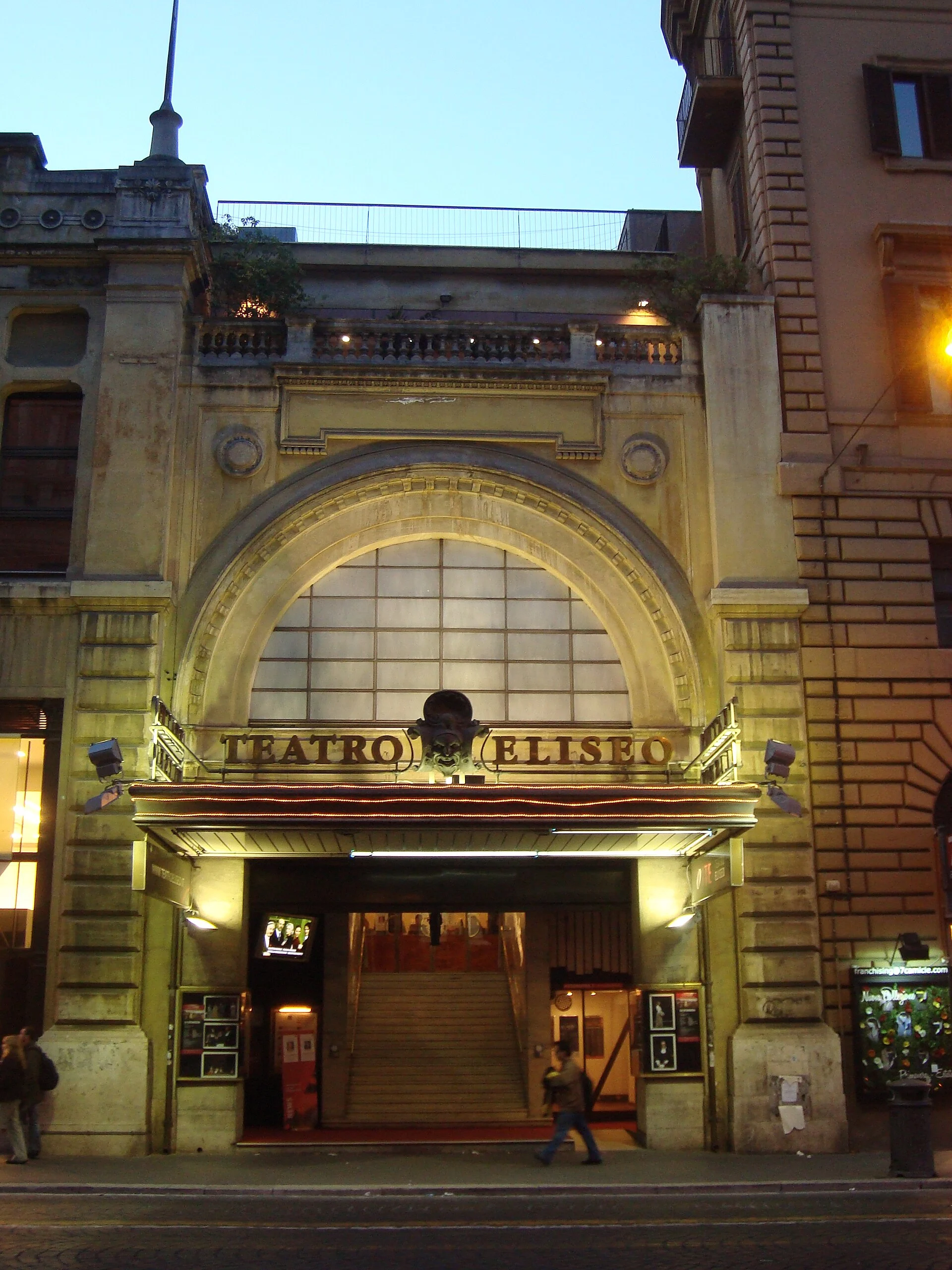
The Teatro Eliseo is at Via Nazionale 183, in Rome, and has been closed to the public since March 2020. For now you can't go in, but the reopening is announced for October 2, 2026 in the Piccolo Eliseo hall and for October 28 in the main hall. It is being reopened by Viola Produzioni, the company run by Alessandro Longobardi, with a six-month lease that can be renewed. Tickets are bought at the box office on Via Nazionale, by phone at 06 45752270 or online on TicketOne, the circuit given by the official website.
The owner of the building remains Luca Barbareschi, who put it up for sale in 2022. The Lazio Region had announced the purchase at the end of 2023, then the deal fell through. The October event, therefore, is a return on a lease and not a definitive rescue. The theater has more than a century of history: Eduardo De Filippo, Anna Magnani, Luchino Visconti, Vittorio Gassman and Monica Vitti have passed through here, to name the ones everybody knows.
The practical information in these lines matches what appeared on September 28, 2026 from the theater's official website, from the national and local press published in mid-September and from the ANSA agency. Prices, box office hours and dates may change from week to week in the first month of reopening: always check the theater's website before setting out.
Where it is and what it's like
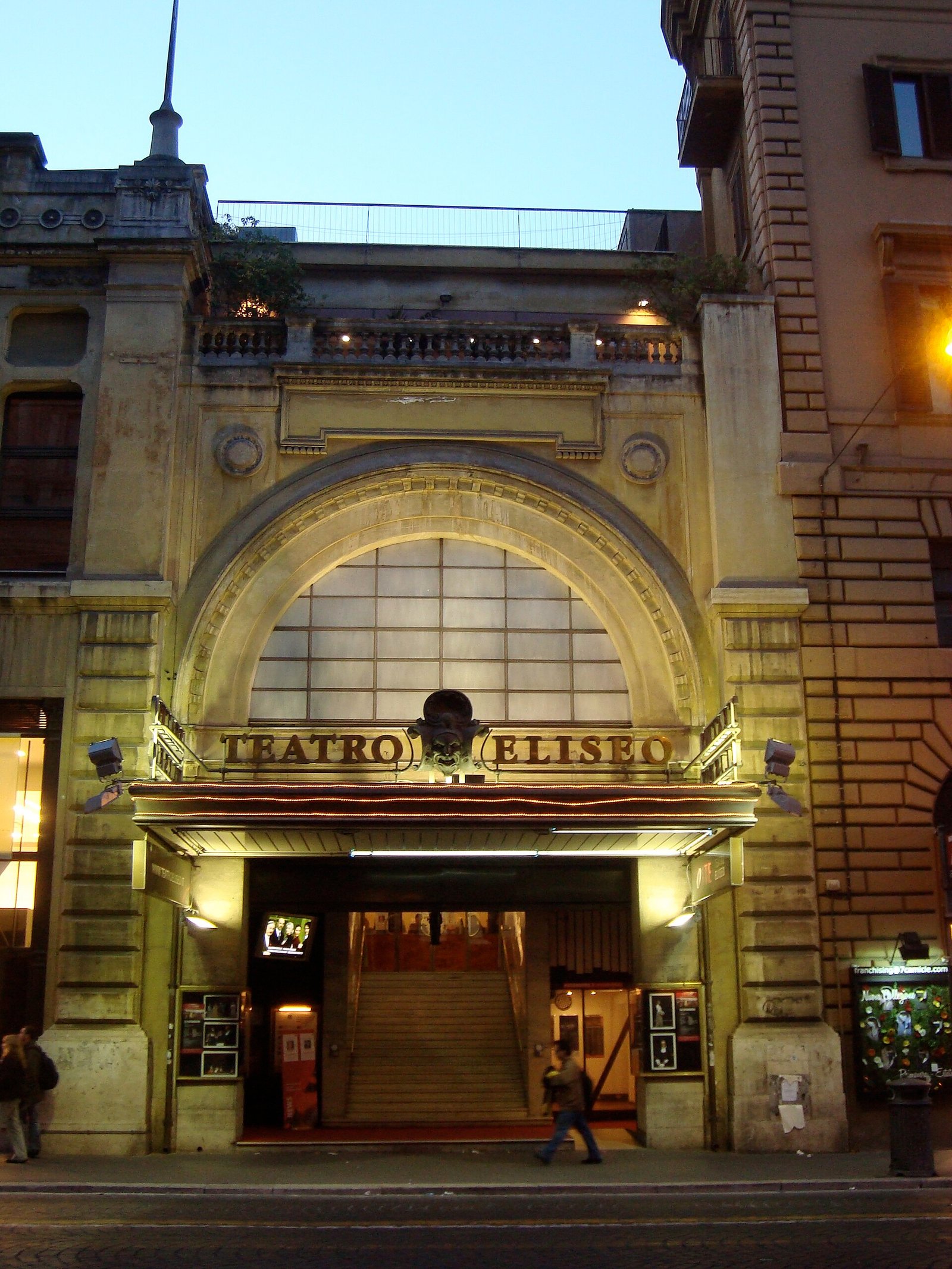
Via Nazionale is the street opened after 1870 to connect Termini station with Piazza Venezia, the straight axis of capital Rome, made of Umbertine palazzi, banks, hotels and shops. The Eliseo opens directly onto the sidewalk, at number 183, on the stretch between the Quirinal and Piazza della Repubblica. Anyone who arrives without looking for it risks walking right past: it doesn't have the isolated bulk of an opera house, it is an entrance in a row with the rest of the street.
Behind that entrance there are two halls. The main hall, the Eliseo proper, is given by the press of September 2026 at around 700 seats, with stalls and balconies. The Piccolo Eliseo, carved out in 1977 from the old Ridotto, has a separate access at number 183 E and a capacity that sources give between 250 and 265 seats. Two theaters under the same roof, with separate programming.
The sale announcement of 2022 described a complex with about 60 rooms among halls, dressing rooms, offices and services, that is a complete theater machine and not just an auditorium with a stage. It's a detail that matters to understand the six years of closure: a building like this costs a lot even when it is switched off, with maintenance, systems, security and staff, and no private management keeps it idle for long without consequences.
The City of Rome, on the dedicated page of the tourist portal, lists the theater as accessible to visitors in wheelchairs, with dedicated restrooms and an interior bar. This is information published before the reopening and referring to the structure: to know which seats of the main hall are really reachable without stairs, and how they are booked, it's best to write to the theater through the contacts given on the official website before buying.
The current state: closed since 2020, the October reopening
The sequence is this. In March 2020 the theater closes for the pandemic, like all the others. Unlike the others, it doesn't reopen. In November 2021 comes the collective dismissal of the 21 employees, in January 2022 the sale announcement at €24 million entrusted to an international real estate agency. At the end of 2023 the Lazio Region announces it wants to buy it for the same figure, and the deal then stalls amid controversy and financial questions.
In November 2024 Barbareschi launches a public appeal to save the theater. Then, according to the trade press, at the end of May 2026 comes the agreement with Viola Produzioni, which takes the structure on lease, does the safety-compliance work in about 60 days and puts together a season in a very short time. ANSA, on September 17, 2026, reports a six-month contract with a renewal option. This is the legal framework of the reopening.
Longobardi is not a new name in the Roman theater map: the same sources recall that Viola Produzioni already runs the Sala Umberto, the Teatro Brancaccio and Spazio Diamante. For the spectator this means a well-oiled organization, a box office that knows how to work, subscriptions and agreements with companies and clubs. It also means a program built with an eye on the box office, and it couldn't be otherwise with two months of preparation.
The position here goes against the grain, and it's clear. The reopening has been told as the rebirth of the temple of Roman drama, in the tones of a city celebration. The right name is another: a six-month lease in a private building still for sale. Good news, certainly, but not a solution. If in a year the Eliseo is still open, then we can talk about a rescue. Until then go, and go often, because the paying public is the strongest argument for renewal.
What it means, concretely, for those who buy a ticket. The announced season covers autumn and winter, and the September press reports titles up to March 2027. The six-month contract, if counted from the agreement of late May, expires before that date, so the season itself presupposes the renewal. Nobody has reason to think it will fall through, but anyone buying a long subscription would do well to read carefully the refund conditions published by the theater.
A curiosity about the Teatro Eliseo
The name Eliseo came about through a contest. In May 1918 the hall, which until then had changed its name several times, was renamed with the proposal of a certain Prosperi, winner of the competition held to find a new name. Popular sources call him Michele Prosperi, older ones cite only the surname. Management passed at that moment to Mentore Clerici, who already ran the movie theater.
The contest closed a series of identity changes that in 18 years had given the place four names. Arena Nazionale in 1900, when it was an outdoor wooden structure with a stage and a canopy. Teatro Apollo from 1910, with the masonry building. Teatro Cines from 1912, when the main hall passed to cinema and operetta. Eliseo from 1918. Each name tells a different public and a different way of making money from entertainment.
The name chosen looked far: the Elysian Fields of mythology, the paradise of heroes, and at the same time the Champs-Élysées of Paris, that is the idea of an elegant theater for the capital's bourgeoisie. It's a name that has held for more than a century, surviving the reconstruction of 1938, about 10 different managements and the six years of darkness. Today whoever says Eliseo in Rome says drama, and nobody remembers the Apollo or the Cines anymore.
The most interesting change of name, however, concerns the small hall. The Ridotto that in 1912 became the Sala Apollo, a café chantant with little tables, songs and variety acts, is the same space that since 1977 has been called Piccolo Eliseo and hosts contemporary drama. Where a century ago people drank listening to the chanteuse, today new texts are heard in silence. Rome is full of these reversals, and this is one of the most successful.
One thing nobody tells you about the Teatro Eliseo
The theater's old website no longer leads to the theater. The domain used for years by the previous management now redirects automatically to a site that has nothing to do with the performing arts. Anyone searching for the Eliseo on a search engine can still find those old pages indexed, with box offices, seasons and history, and click. The official site given by the City of Rome is eliseoteatro.it, and that's where you must buy.
It's a practical matter before it's a curious one. In the first days of sales of a much-awaited season, among old pages, secondary resellers and third-party ads, it's easy to end up paying for a ticket that doesn't exist or that costs double. The rule is simple: start from the official site and follow its links, even when they send you to an external sales circuit. Everything else is noise.
Second thing rarely said: the Eliseo could not become something else. Already in 2022, when it was put up for sale, the trade press underlined that the building's permitted use allows film, theater, concert and show activities, and prevents turning it into a restaurant, supermarket or parking lot. The complex is also recognized as being of significant cultural interest. Anyone who feared a supermarket on Via Nazionale feared a possibility that the zoning rules excluded.
This restriction also explains why the sale never closed. A building that can only be a theater is worth something to those who know how to run a theater, and the players able to support an investment of that scale in Rome can be counted on the fingers of one hand. The lease found in 2026 is the market's answer to that problem: whoever knows how to do theater takes it on lease, without buying the walls.
The basic question remains open, which none of the parties has yet resolved in public: who will buy the walls, and at what price. As long as the property stays for sale, every management is by definition temporary, and every important investment in the building, from the systems to the restoration of the halls, stays suspended. Anyone who loves this theater should follow that game more than the program, because that is where it's decided if in 10 years the Eliseo will still exist.
Tickets, box office and how to get in
The theater is visited by buying a ticket for a show. The operator gives no guided tours of the spaces, nor open days without a performance, and in the sources consulted no organized tours of the complex turn up. The box office is at Via Nazionale 183 and, according to the official website, opens Tuesday to Saturday from 16:00 to 19:00, on Sunday only during show hours, and is closed on Monday. The phone is 06 45752270. A single price list is not published: the fare is read show by show.
Where you really buy: the official website of the Teatro Eliseo publishes the program of the two halls and refers to TicketOne for online sales. Alternatively the box office accepts payments by phone or by email with credit card, and Carta del Docente and Carta della Cultura. For groups, schools and agreements there is a dedicated office at 06 45752271.
Subscriptions are the traditional formula of the Eliseo and, with a management used to working with corporate agreements, it's foreseeable that they will return here too. Before buying single tickets for three or four shows, check on the site if a card or a booklet exists: in Rome's private theaters the price difference, over a season, is often significant. Ask also about discounts for young people and seniors, which the site must state clearly.
For groups, from schools to company clubs to organized parties, the way is a direct request to the theater. The operator publishes in the sources consulted neither a group fare nor a minimum threshold, but the theaters run by the same company habitually work with agreements and group bookings. With parties of 30 or 40 people it's best to move at least three weeks ahead and ask for adjacent seats in the stalls, not scattered across sections.
For show day the rule of all historic theaters applies: show up at least 20 minutes early, because the foyer fills up and ticket pickup slows down. In the first weeks after six years of closure it's reasonable to expect some settling in services, from the coat check to the bar. If you have accessibility needs, report them at the time of purchase and not at the door.
What not to expect in the first season
Don't expect a theater made new. The works done in the summer, according to the press, are safety-compliance works, that is the ones needed to reopen safely, and not an overall restoration. After six years of closure it's reasonable to find some signs of time in the finishes, the fabrics, the foyer furnishings. The real restoration, the one the Region declared it wanted to do in 2023, never began.
Don't expect a stable program for years either. A season built in 60 days is necessarily made of ready-made shows, productions of the same company and hosted shows available on the market. It can be an excellent season, but the artistic line of the new Eliseo will be understood only with the second, if there is one. Judging the new course from the first month would be unfair both ways.
Finally, don't expect to find reliable information everywhere. Online there are still pages of the old management, tourist portal listings stuck at 2019, reviews of shows from six years ago presented as current. The only sure reference, for dates, prices and hours, is the official website. For the state of the theater, the Roman press of September 2026 is extensive and consistent.
My advice for visiting the Teatro Eliseo
Start from the Piccolo Eliseo. The main hall reopens on October 28 with the big-draw titles, the ones that fill 700 seats, while the small hall opens earlier, on October 2, and is historically the place where the Eliseo made its most interesting choices in contemporary drama. With 200 or 300 spectators the relationship with the stage is another thing, and tickets usually cost less.
Pick seats in the center stalls in the main hall, or the first row of the balcony if the site puts it on sale at a reasonable price. In Italian-style theaters rebuilt in the 1930s the view from the sides can be cut by the projections, and there is no published visibility map for each seat. If you have doubts, call the box office and ask: whoever works there knows the seats to avoid better than any floor plan.
Go in the first weeks. Put plainly: the reopening is on a six-month lease, and nobody today can guarantee that in spring the season continues with the same management. Anyone who has always put off an evening at the Eliseo now has a sure window. The audience of the first evenings, then, has a particular energy: many Romans return to that hall after years and you can hear it in the applause.
For those coming from outside Rome with only one evening, the advice is to pair the show with a walk on the Quirinal and a dinner in rione Monti, which can be reached on foot going down toward Via dei Serpenti. Avoid looking for parking on Via Nazionale: it's a heavy traffic axis with reserved lanes, and free spaces in the surroundings, in the evening, are an illusion.
On clothing, no written rule. The Eliseo is not an opera house with a gala evening, and the Roman drama audience dresses as for dinner out. Just avoid bulky backpacks and travel bags, which in a historic theater with a small coat check become a problem for you and for whoever sits next to you. If you arrive straight from the train or the airport, leave your luggage at the hotel or in a storage place before the show.
The six years of closure, explained without taking sides
The Eliseo case has become over the years a political topic, and those who write about it tend to take sides. It's best to keep the facts separate. Luca Barbareschi comes to head the theater in September 2015, after a suspension of activity that began in November 2014, and becomes its owner. On the date of the purchase of the building the sources don't agree: some give 2014, others 2018.
During the years of his management the theater receives significant public contributions. Besides the Single Fund for the Performing Arts, which finances many Italian theaters, in 2017 an amendment approved in Parliament authorizes an expense of €4 million for each of the years 2017 and 2018 in favor of the Eliseo, recognized as being of significant cultural interest. In 2021 pandemic relief payments for lost revenue also arrive.
Then the closure, the layoffs of November 2021, the sale announced in January 2022. On the exact date when activity formally stopped the sources don't agree: March 2020 is the date of closure to the public, while a trade outlet gives September 30, 2021 as the date of closure of the theater. They are two different things, and confusing them feeds a lot of controversy.
The Lazio Region's purchase proposal comes at the end of 2023, for €24 million, inside a budget measure, with the stated goal of restoring the theater and giving it back a public function in agreement with the Ministry of Culture. The opposition in the regional council contests it, and the deal doesn't conclude. Anyone who wants to form an opinion will find the articles of the time in national dailies and Roman outlets, with very different positions.
There is also a part of the story that always stays in the background: the people who worked there. The collective dismissal of November 2021 involved all 21 employees, with an agreement providing for installment payment of severance pay. Stagehands, electricians, ushers, box office and administrative staff: the practical knowledge of a theater is in those hands, and rebuilding it takes years, not the 60 days of a production.
Another well-known fact, yet rarely cited
The Eliseo has always been a private theater. It has never belonged to the City, unlike the Teatro Argentina, which is the seat of the city's public theater, nor to the State. Its history is a history of impresarios, families of managers and companies, from Vincenzo Torraca to Giuseppe Battista, from the Monaci to Barbareschi. Anyone who today asks that it return to being public asks for something that in 120 years has never been.
This doesn't mean public money is foreign to its history. Italian private theater has lived for decades on a mixed system, with box office, subscriptions, sponsors and state contributions. The Eliseo has always had national weight, with companies starting out from here for tours, and for this reason it has always received support. What is specific to recent years is the size of that support, not its existence.
The second rarely cited fact concerns the theater geography of Via Nazionale and surroundings. Within a radius of one kilometer there are the Teatro Quirino, the Teatro Sistina, the Teatro dell'Opera and the Teatro Brancaccio. The Eliseo is not an island: it is part of the densest entertainment district in Rome, born when this was the capital's new street.
The third fact concerns the audience. The Eliseo has always had a very loyal base of subscribers, largely Roman, often passed down from generation to generation: grandfather's seat, auntie's subscription. Six years of closure have broken that chain, and part of those subscribers have moved to other theaters or stopped going. Rebuilding that audience is the real challenge of the new course, more than the program.
The right photo to take at the Teatro Eliseo
The right photo is taken in the evening, from the other side of Via Nazionale, with the entrance lit up and traffic passing. Wait for the moment when a bus or a taxi crosses the frame and use a slightly long exposure: the car lights become a streak and the entrance stays still. It's the image that best tells what the Eliseo is, a theater inside a working street, not an isolated monument.
The second photo is that of the audience lining up on the evening of the premiere, in the weeks of the reopening. In a few years it will be a document, whatever happens. Shoot the entrance with the people, not the people up close, and remember that nobody likes to end up in the foreground of someone else's photo: ask, or keep your distance. Courtesy, in these cases, is worth more than the perfect framing.
Inside, during the show, you don't photograph or film, as in any theater. The good moment is before the lights go down, when the hall fills up. From the balcony, if the staff allows it, the view over the stalls and the closed curtain conveys the shape of the 1938 hall. No flash, no phone raised when the lights dim: it's the quickest way to get yourself scolded by the usher.
A technical note for those using the phone in the evening on Via Nazionale. The shop signs and the streetlights have different color temperatures, and auto mode tends to give a dirty yellow. Shoot in uncompressed format if the phone allows it and correct afterward, or lower the exposure by half a stop to save the lights of the entrance. The rest of the street can stay in shadow.
Anyone who wants a less obvious image can look for the theater from above, from the streets that climb toward the Quirinal, where Via Nazionale is seen flowing like a canal of lights between the buildings. From there the entrance of the Eliseo is one point among many, and that is exactly the sense of the photo: a theater that doesn't impose itself on the city but lives inside it, on a par with banks, hotels and shops. It works best at blue hour, right after sunset.
How to get there
On foot is the best solution for those staying in the center. From Termini you go down Via Nazionale past Piazza della Repubblica and arrive in a good quarter of an hour at a calm pace. From Piazza Venezia you go up in the opposite direction, in a similar time, along the Quirinal gardens. From the Trevi Fountain you arrive by climbing toward the Quirinal and then coming down onto the street.
By public transport, Via Nazionale is served by many urban bus lines, and the metro has stations within walking distance both on Piazza della Repubblica side and on Via Cavour side. Lines change often because of detours and roadworks, and in the evening frequencies drop: check the route on the official Rome public transport planner before going out, especially for the return after the show.
By car it's a terrible idea. Via Nazionale has lanes reserved for public transport, limited traffic zone gates in the surroundings and paid parking that is rare and expensive. Anyone arriving from outside Rome should leave the car in a park-and-ride and continue by public transport. A taxi is a good choice for the return, but in the evening, at the exit of two theaters at once, you'll find few free: book it in time.
For the walk back at night, Via Nazionale is lit and busy until late, and the road toward Termini has no particular problems. The side streets that go down toward Monti and the Esquilino are darker and emptier after midnight, as in any big city: no alarm, just normal caution. Anyone staying in the station area can get back in 15 minutes without depending on transport.
Some important events that happened here in history
Spring 1900: on this plot on Via Nazionale the Arena Nazionale opens, an open-air wooden structure for variety, with a simple stage and a small canopy. According to some popular reconstructions the land was part of the appurtenances of Palazzo Rospigliosi, on the flank of the Quirinal, but the detail should be taken with caution. On September 24, 1910 the masonry Teatro Apollo is inaugurated, dedicated to operettas, variety and opera.
In 1912 the Ridotto is separated and becomes the Sala Apollo, a café chantant, while the main hall takes the name Teatro Cines and hosts cinema and operetta. A popular source places in 1914 a remake of the facade in Liberty style. In May 1918 comes the name Eliseo and the management of Mentore Clerici. In 1935 the Grande Compagnia Spettacoli Eliseo is born, with Anna Magnani among the headline names.
On January 5, 1938 the Eliseo we know today is inaugurated, after six months of radical reconstruction, under the direction of Vincenzo Torraca, who will lead the theater for almost 40 years. The name of the designer of that reconstruction does not appear in the popular sources consulted. In the 1930s and 1940s the hall hosts variety and drama together, with Ettore Petrolini, Totò, Macario, Emma Gramatica, Paola Borboni.
On January 30, 1945, with Rome liberated a few months earlier, I parenti terribili by Jean Cocteau is staged with direction by Luchino Visconti, then almost a newcomer in theater. It's the beginning of the Compagnia Italiana di Prosa, which for 15 years makes the Eliseo the home of a new way of directing in Italy, with American and Russian texts staged for the first time at that level.
The context of that premiere matters. Rome had been liberated in June 1944, the North was still occupied, the war was not over. Staging Cocteau, with a direction that broke with the theater of the star performer, meant declaring that Italian culture was starting again from somewhere else. The Eliseo audience, bourgeois and used to quality variety, found itself facing something different, and the hall became the place of that turning point.
In February 1961 L'Arialda by Giovanni Testori, staged by the company, is seized for obscenity, and the episode marks the end of that season. In October 1977 the Ridotto is rebuilt and becomes the Piccolo Eliseo, while management passes to Giuseppe Battista. The inauguration of that new phase is entrusted to Pirandello's Henry IV with Romolo Valli and direction by Giorgio De Lullo.
The following years mark the alternation of directions: Rossella Falk and Umberto Orsini between the 1980s and the end of the century, Maurizio Scaparro from 1997 to 2001 with the management of Vincenzo Monaci, Giuseppe Patroni Griffi from 2002, Antonio Calbi from 2005, Massimo Monaci from 2007. In November 2014 activity stops, in September 2015 it restarts with Luca Barbareschi, in March 2020 it closes. In October 2026 it reopens.
Behind the dates are the managers, figures the public knows little. Vincenzo Torraca, who held the theater from 1938 for almost 40 years, going through the war and the postwar. Giuseppe Battista, who led it for about 20 years from 1977. The Monaci family, with Vincenzo and then Massimo, from 1997. Each change of management has brought a different idea of theater, and today's Eliseo is the layered sum of all these ideas.
Who has passed through the Teatro Eliseo
Anna Magnani, first of all, who in the 1930s was the star of the Grande Compagnia Spettacoli Eliseo and came from the revue. Anyone who knows only the Magnani of Rome, Open City forgets that her training is theatrical and popular, made of variety and comic timing, and that the Eliseo was one of the stages of that school. Alongside her, in the same seasons, passed Petrolini, Totò and Macario.
Eduardo, Titina and Peppino De Filippo, who in 1936 brought Natale in casa Cupiello to the stage of the Eliseo, when the comedy was not yet the television classic we know. Anyone who wants a direct thread to that season of Italian theater also finds in Rome the Casa Museo di Luigi Pirandello, the author of Henry IV which in 1977 inaugurated the new phase of the hall.
Luchino Visconti and his company, with Rina Morelli and Paolo Stoppa as a fixed couple, Giorgio De Lullo and Tatiana Pavlova, and guests like Ruggero Ruggeri, Arnoldo Foà, Franco Zeffirelli, Marcello Mastroianni and Vittorio Gassman. In those years passed A Streetcar Named Desire, Death of a Salesman, Three Sisters. For a young actor, working at the Eliseo with Visconti was a license.
Anna Proclemer and Giorgio Albertazzi, who in the 1950s and 1960s made the Eliseo one of their Roman homes. The Compagnia dei Quattro of Franco Enriquez. The Piccolo Teatro di Milano of Giorgio Strehler on tour. Giuseppe Patroni Griffi, who staged here texts like Metti, una sera a cena, and who many years later would return as artistic director, until his death.
Romolo Valli and Giorgio De Lullo, protagonists of the reopening of 1977. Then Rossella Falk and Umberto Orsini, directors and performers. On the stage of the late 20th century: Monica Vitti in The Odd Couple directed by Franca Valeri, Mariangela Melato in Medea directed by Giancarlo Sepe, Nino Manfredi in Gente di facili costumi, Ugo Tognazzi, Alberto Lionello, Lilla Brignone, Turi Ferro.
In the 2000s Giorgio Albertazzi returns, and Silvio Orlando, Anna Marchesini, Giuliana De Sio, Franca Valeri, Leo Gullotta, Remo Girone, Alessandro Gassman pass through. Anyone who loves Italian cinema will recognize many of these names, and not by chance: until the 1980s the road between Roman drama theater and the studios of Cinecittà was traveled every day in both directions.
The Piccolo Eliseo, the hall worth knowing
The Piccolo Eliseo was born in October 1977 from the complete reconstruction of the Ridotto, that is of that space which in 1912 had become a café chantant with the name Sala Apollo. It has an entrance at number 183 E of Via Nazionale and a capacity that historical notes give as 265 seats, while the press of 2026 speaks of 250. The difference probably depends on safety adjustments, but the official figure will be given by the theater.
For decades the Piccolo has been the hall of bets: new texts, contemporary Italian authors, young companies, actors who would then move on to the main hall. Not all managements have used it the same way, and over the years it has alternated very lively periods and periods of stopgap programming. The 2026 reopening begins right here, and the signal is clear.
The practical advice is to treat the Piccolo as a separate theater, with its own program, and not as the minor hall of the Eliseo. In a hall of this size even the seats at the back are good, and weeknight evenings often have free seats until the last minute. It's the best way to get to know the new course without paying the price of the main hall.
A warning for those coming from outside. In Roman theaters with two halls, the separate entrances confuse more than one visitor: it happens that people show up at the door of the main hall with a Piccolo ticket and discover that the access is elsewhere. Check the name of the hall on the ticket and look for number 183 E. Arriving with a few minutes' margin saves you from running along the sidewalk after the show has already started.
Where to see theater nearby
Anyone looking for drama in the center without waiting for the main hall of the Eliseo has nearby alternatives. The Quirino Vittorio Gassman is on Via delle Vergini, a few minutes from the Trevi Fountain, and has a program of classical and contemporary drama. The Teatro Argentina, seat of the city's public theater, is a quarter of an hour on foot toward the Pantheon. The Teatro Valle, reopened in the same period, completes the triangle.
For musical comedy and big entertainment titles the historic reference is the Sistina, on Via Sistina, above Piazza Barberini. The Brancaccio, toward the Esquilino, and the Sala Umberto, near Via del Corso, are run by the same company that has reopened the Eliseo, and their programming gives a fairly precise idea of the style of the new course.
For opera and ballet the Teatro dell'Opera is a few minutes on foot away, toward the Viminal. For comedy and popular theater the Ambra Jovinelli is in Piazza Guglielmo Pepe, on the Esquilino. Farther away, but in the same network of Roman subscribers, the Teatro Olimpico at Flaminio and the Ghione near St. Peter's.
For those who prefer the screen to the stage, the tradition of Roman art-house cinema is found at the Nuovo Sacher in Trastevere and at the Cinema Troisi, and in summer in the open-air arenas. The MIAC instead tells the history of Italian cinema and television, with many faces that trod the Eliseo stage.
Outside the center, the Roman theater network widens to the Auditorium Parco della Musica for music and dance, to the Globe Theatre in Villa Borghese for outdoor Shakespeare in the warm season and to the Casa del Cinema for screening series. Anyone staying in Rome a week can build a small tour of the city's stages, and the Eliseo, at last, is back to being part of it.
What to combine before the show
The most obvious choice is on the opposite side of Via Nazionale: the Palazzo delle Esposizioni, with its temporary exhibitions, is the natural pairing for an afternoon that ends at the theater. A little higher up are the Basilica of San Vitale, below street level, and Sant'Agata dei Goti, one of the oldest churches in the area, hidden behind the street.
Climbing toward the hill you arrive at Piazza del Quirinale, with the Quirinal Palace and the Scuderie, and then to the Baroque pair of Sant'Andrea al Quirinale and San Carlo alle Quattro Fontane, Bernini and Borromini 100 meters from each other. At the crossing are the Four Fountains.
On the Termini side you meet Piazza della Repubblica, the Baths of Diocletian and Palazzo Massimo, or Santa Maria della Vittoria with the Ecstasy of Saint Teresa. Going down toward Via Cavour you enter rione Monti, with the Basilica of Santa Pudenziana and, lower down, Trajan's Markets.
Anyone with a whole afternoon can go up to Palazzo Barberini, with the Galleria Nazionale di Arte Antica, and then come down toward the Fontana del Mosè and Via Nazionale. It's a loop of a couple of hours at a calm pace, with a coffee break, and it brings you to the theater entrance without hurry and without needing public transport, which on Friday evening in this area is often full.
Eating before or after the show
Via Nazionale is a street of passage, full of hotels and shops, and the dining you find along the sidewalk is largely designed for those who sleep there one night and won't be back. It's not a moral judgment: it is the economic model of the street. Anyone going to the theater who wants to eat well has to move a few hundred meters, toward Monti or toward the side streets, where Romans really eat.
The signs to recognize are always the same. The menu with photos of the dishes, translated into five languages, speaks to someone who doesn't know what a cacio e pepe is. The person at the door who invites you in works for a place that has no regular customers. The lady rolling out the sfoglia in the window puts on a show, and the show, tonight, you have already booked elsewhere.
Be wary of places open continuously from morning to late at night, with no break between lunch and dinner: a real kitchen needs to stop to prepare. Be wary of items without a price, of the fish of the day with no figure next to it, of menus that differ between inside and outside. Near monuments and stations it happens that the price adapts to the customer, and asking before ordering is not rude.
The practical problem, when going to the theater, is the hour. Evening shows usually start between 20:00 and 21:00, and eating before means sitting down early, around 19:00, when many Roman kitchens are just opening. Eating after means coming out around 23:00, when many have already closed. Book, and say on the phone that you're coming from the theater: serious places know how to organize.
Rione Monti is the closest and most Roman answer. In 10 minutes on foot from Via Nazionale you enter a web of streets where neighborhood osterie, wine bars and newer places coexist, frequented by those who live and work there. Not everything is good, of course, and even there places built for tourist traffic exist: the signs described above apply everywhere, and looking at who is sitting at the tables remains the best criterion.
To avoid trial and error, we have collected the addresses we really frequent, in Rome and around, with no sponsorships: our list of the places where we eat. In the area between Via Nazionale, Monti and the Esquilino there are several options both for a quick dinner before the show and for a hot dish after, and the list changes when the places change.
Frequently asked questions
Is the Teatro Eliseo open?
The Teatro Eliseo at Via Nazionale 183 has been closed to the public since March 2020. The reopening is announced for October 2, 2026 in the Piccolo Eliseo hall and for October 28, 2026 in the main hall, with management by Viola Produzioni and artistic direction by Alessandro Longobardi. Dates and program should be checked on the theater's official website, eliseoteatro.it.
Who owns the Teatro Eliseo?
According to ANSA, at the 2026 reopening the owner of the building is still Luca Barbareschi, who had put it up for sale in 2022 for €24 million. Viola Produzioni has rented it for six months with an option to renew. The purchase by the Lazio Region, announced at the end of 2023, did not go through.
Where do you buy tickets?
At the box office at Via Nazionale 183, open Tuesday to Saturday from 16:00 to 19:00, by phone at 06 45752270, or online on TicketOne, the platform the official website eliseoteatro.it points to. The theater's old domain now leads to an unrelated site, so don't trust outdated search results.
How much do tickets cost?
The official site doesn't publish a single price list: the price changes from show to show and appears on the sales page of each title. For subscriptions, reduced rates and partnership discounts the operator refers you to the promotion office, at 06 45752271, which is also available on WhatsApp. Always ask at the box office before buying elsewhere.
What is the Piccolo Eliseo?
The Piccolo Eliseo is the second hall of the complex, created in 1977 from the reconstruction of the Ridotto, with its entrance at number 183 E on Via Nazionale. Sources give its capacity as between 250 and 265 seats. It has a program separate from that of the main hall and has historically hosted contemporary drama and younger companies.
Can you visit the theater without attending a show?
The operator doesn't mention guided visits to the spaces or openings without a performance, and no organized tours appear in the sources consulted. The way into the Eliseo is to buy a ticket for a show. From the outside you can see the entrance on Via Nazionale, which, lit up in the evening, still gives you an idea of the place and its position.
Is the theater wheelchair accessible?
The City of Rome page on the tourism portal lists the theater as accessible, with restrooms for people with disabilities. To find out which seats in the main hall and in the Piccolo Eliseo can be reached without stairs, and how to book them, it's best to contact the theater through the official website before buying, stating your needs.
When was the Teatro Eliseo founded?
The venue began in the spring of 1900 as the Arena Nazionale, an open-air wooden structure for variety shows. In 1910 it became the Teatro Apollo, built in masonry, in 1912 the Teatro Cines, and in May 1918 it took the name Eliseo. The hall you see today is the one inaugurated on January 5, 1938, after six months of radical reconstruction.
Who wrote this page
This page comes from the editorial staff of Tour Leader Pro, the Rome-based organization that designs itineraries, tours and cultural events in Rome and Lazio. The status of the theater, the reopening dates and the management data reported here come from the press and institutional sources as of the date given at the top: in the first month of a reopening everything moves fast, so check again. Tell us what you find changed.
Organizing an evening at the theater in Rome for a group means fitting together box offices that open at different times, dinners to move earlier or later, taxis you can't find at closing time and night transport that thins out. If you're facing this kind of puzzle, for yourself or for 40 people, on Tour Leader Pro you'll find working materials designed for those who guide groups and for those who organize on their own.
For the bigger picture, meaning regional trains and seasonal timetables, rentals, airports, transfers between provinces and Lazio destinations outside central Rome, from the Castelli to the volcanic lakes of the north, down to the Tyrrhenian coast and the villages of the interior, a useful resource for putting together a multi-day itinerary is Italy Planner.